
Submitted:
11 June 2026
Posted:
12 June 2026
You are already at the latest version
Abstract
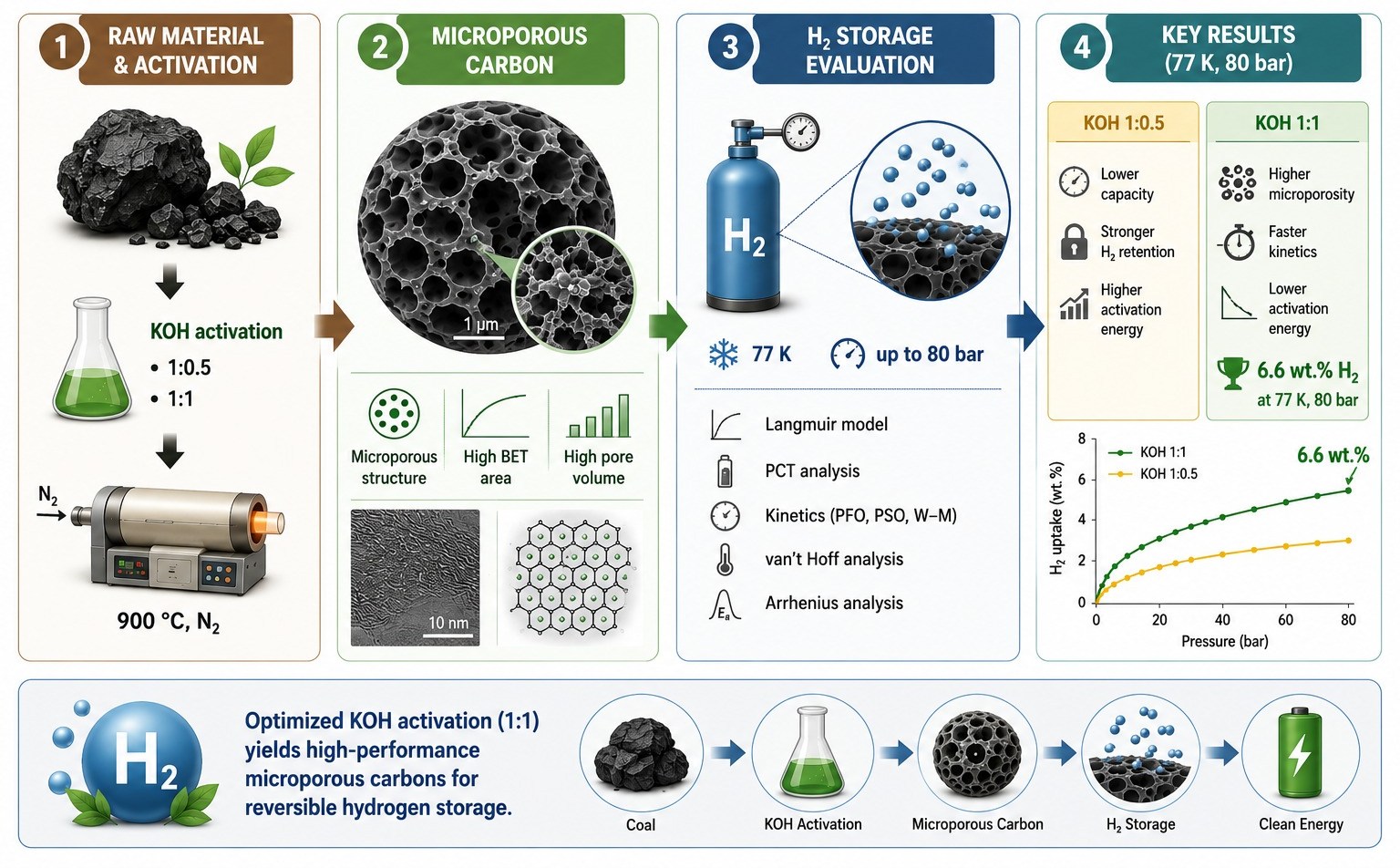
This study focuses on the synthesis of microporous carbon adsorbents derived from Shoptykol coal (Maikuben basin) via potassium hydroxide (KOH) chemical activation at two ratios (1:0.5 and 1:1), and on the evaluation of their hydrogen adsorption–desorption performance. The samples were prepared under an inert nitrogen atmosphere and characterized using particle size analysis, thermogravimetric analysis, BET surface area measurements, SEM/TEM microscopy, and gas sorption techniques. Hydrogen storage behavior was investigated using a high-pressure volumetric adsorption system over a wide range of pressures and temperatures, including cryogenic conditions (77 K and 80 bar). The experimental data were analyzed using Langmuir isotherm modeling, kinetic models (pseudo-first and pseudo-second order, Weber–Morris diffusion), and thermodynamic approaches based on van’t Hoff and Arrhenius equations. The Shoptykol:KOH (1:1) sample demonstrated higher adsorption capacity, achieving up to 6.6 wt% hydrogen storage at 77 K and 80 bar, as well as faster adsorption–desorption kinetics and lower activation energy compared to the 1:0.5 sample. Overall, optimized alkaline activation of coal-derived carbon materials is an effective strategy for producing high-performance adsorbents, and the 1:1 sample shows superior hydrogen storage properties for energy storage applications.
Keywords:
carbon materials
; adsorbent
; adsorption
; hydrogen storage
; surface area
Copyright: This open access article is published under a Creative Commons CC BY 4.0 license, which permit the free download, distribution, and reuse, provided that the author and preprint are cited in any reuse.


