
Submitted:
11 June 2026
Posted:
12 June 2026
You are already at the latest version
Abstract
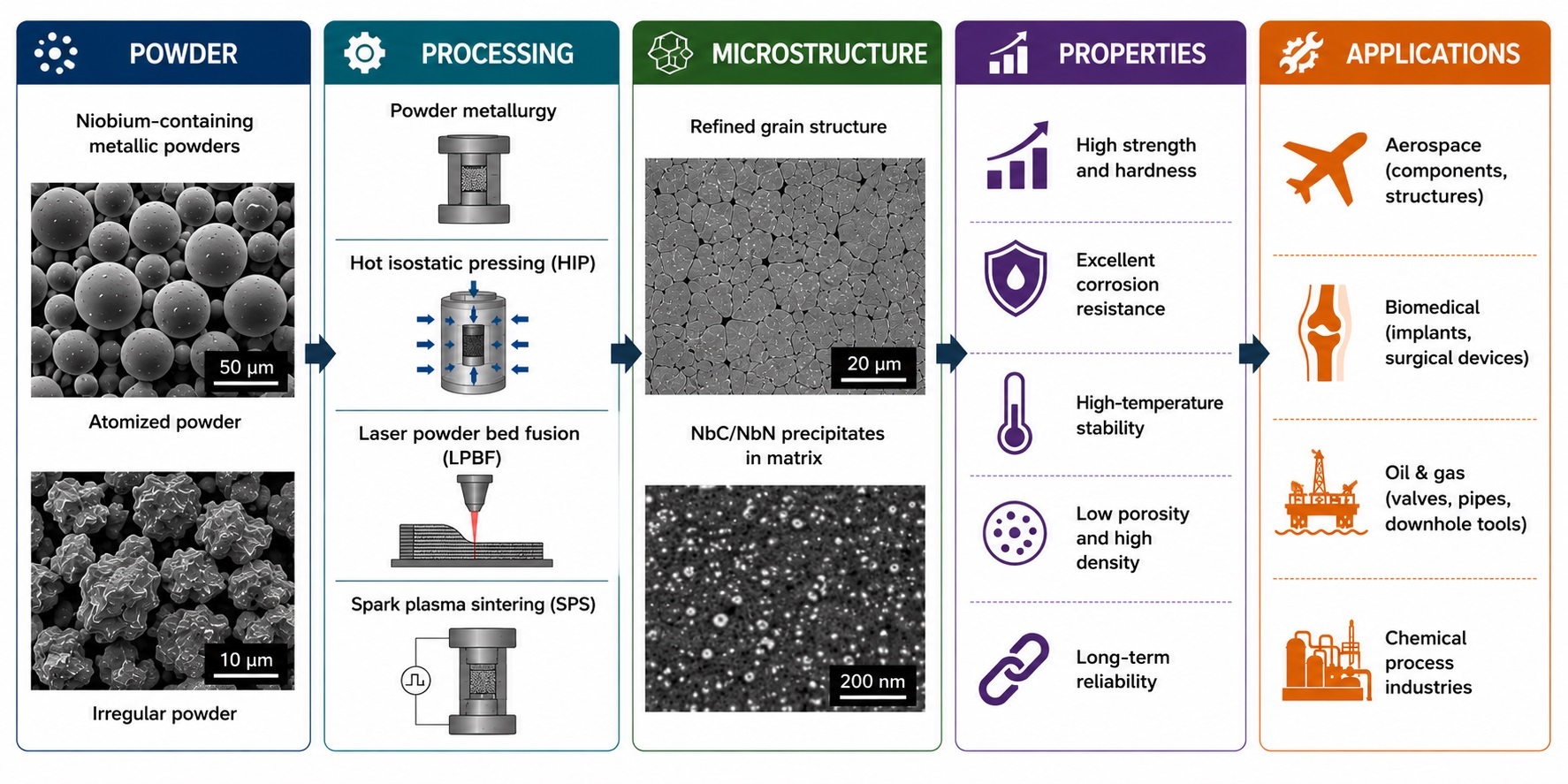
Metallic powder systems containing niobium play a key role in the development of advanced materials for structural, biomedical, energy, and surface-engineering applications. The incorporation of niobium into metallic powders influences particle behavior during processing, phase stability, microstructural evolution, and the resulting mechanical and corrosion properties of consolidated materials. This review examines the scientific and technological advances related to niobium-containing metallic powders, covering powder production routes, particle characterization methods, processing techniques, and performance evaluation. Publications on powder metallurgy, additive manufacturing, thermal processing, surface modification, and corrosion-resistant materials were analyzed to identify relationships among powder characteristics, processing conditions, and material performance. The available evidence indicates that niobium contributes to grain refinement, precipitation control, microstructural stabilization, improved resistance to wear, and localized corrosion. The element also expands the applicability of metallic powders in functional coatings, biomaterials, engineered surfaces, and components manufactured from particulate feedstocks. Current challenges involve powder homogeneity, process reproducibility, economic considerations, and the prediction of long-term service behavior. The analysis highlights niobium's contribution to the design of high-performance metallic powder systems and identifies research directions for developing materials with enhanced reliability and industrial applicability.
Keywords:
niobium-containing powders
; metallic powder systems
; powder processing
; particle characterization
; powder metallurgy
; microstructural evolution
Copyright: This open access article is published under a Creative Commons CC BY 4.0 license, which permit the free download, distribution, and reuse, provided that the author and preprint are cited in any reuse.


