
Submitted:
10 June 2026
Posted:
11 June 2026
You are already at the latest version
Abstract
The distinct engineering advantages of Oscillating-Water-Column (OWC) systems have driven substantial academic interest lately. This work examines the on-shore U-shaped OWC (U-OWC), selected for its cost-effective installation integrated with existing coastal infrastructure and its superior broadband response to diverse wave climates. Time-domain CFD simulations, incorporating the scaling-rematched approach, were conducted to quantify key hydrodynamic and air-compressibility coefficients, including the amplitude of the wave exciting force, fluid-damping coefficient, added mass, absorption factor, and the effective PTO (Power Take-Off)-damping and air-compressibility coefficients. These parameters collectively elucidate the underlying hydrodynamics and how they are interwoven with the compressibility of the air in the plenum chamber, thereby impacting the U-OWC's energy-capture performance under incident waves. A principal finding is the identification of C+ interval wherein air compressibility enhances capture performance in the lower wave-period range examined (< 8.0s). The added mass of the present U-OWC exhibits a remarkably pronounced decrease around the wave period of 8.0s, which can be verified by a simple resonance formula of heave buoys to underline its strong near-resonance behavior.
Keywords:
U-OWC
; hydrodynamic coefficients
; air compressibility
; C+ interval
; added mass
; near resonance
; wave exciting force
; absorption factor
1. Introduction
Marine renewable energy has increasingly emerged as a cornerstone in the pursuit of sustainable and resilient global energy systems. Among the various ocean-based resources, wave energy stands out for its exceptionally high energy density and inherent predictability, offering clear advantages over other renewables. As reported by Falnes [1,2], typical marine wave energy densities range from approximately 2 to 3 kW/m² — several times greater than those of wind (0.4 – 0.6kW/m²) and solar radiation (0.1 – 0.2kW/m²). Globally, wave energy accounts for nearly 39% of total marine renewable potential, representing a theoretical annual resource of roughly 29,500 TWh/year [3]. These characteristics make wave energy a compelling and strategically significant renewable resource for addressing long-term energy security and climate challenges.
Among various wave energy converter (WEC) technologies, the Oscillating Water Column (OWC) has gained particular prominence due to its structural simplicity and demonstrated reliability in harsh marine conditions. This is because OWC systems convert the oscillatory motion of enclosed water columns into pneumatic power, which subsequently drives the power take-off (PTO), i.e., the air turbine, which is inherently located away from erosive and biohazardous seawater. Furthermore, the on-shore type of OWC has one additional key advantage: its compatibility with existing coastal infrastructure, such as breakwaters [4] and harbor walls, which further enhances its survivability while reducing construction and maintenance costs. Notable full-scale installations of on-shore OWCs include the Sakata Harbor wave power plant in Japan [5], the U-shaped OWC at the Mutriku wave power plant in Spain [6], and the port of Civitavecchia in Italy [7]. Collectively, these implementations underscore the on-shore OWC’s Technology Readiness Level (TRL 8) [8], economic feasibility, and suitability for deployment, thereby positioning it as one of the most extensively researched and practically demonstrated WEC technologies.
The historical development of OWC technology traces back to an early navigational aid patented by Courtney in the 1880s, the whistling buoy [9], which harnesses wave-induced pressure fluctuations to produce acoustic signals. This OWC device also marks the first practical demonstration of ocean energy conversion. In the early 20th century, Bochaux-Praceique constructed a small-scale OWC near Bordeaux, France, capable of producing roughly 1 kW of power for household use [10]. Masuda’s wave-powered navigation buoy exemplified subsequent progress in 1947 [11], which incorporated an air turbine for charging batteries and for autonomous power generation. The modern era of OWC research emerged during the energy crises of the 1960s and 1970s, motivating intensive theoretical, numerical, and experimental studies of OWC hydrodynamics and performance. Major contributions include theoretical analyses (e.g., Evans [12]; Malmo and Reitan [13]), numerical investigations (e.g., Hong et al. [14]; Simonetti et al. [15]; Wang et al. [16]), and experimental validations (e.g., Sarmento [17]; López et al. [18]). A comprehensive overview of OWCs’ evolution is provided by Falcão and Henriques [19]. As a whole, these efforts have significantly advanced the scientific understanding and technological readiness of OWC-based wave energy conversion.
With the advent of advanced computational capabilities, Computational Fluid Dynamics (CFD) has become an indispensable tool for OWC research, enabling robust analyses of complex wave–structure interactions without the prohibitive costs of large-scale experiments. CFD-based investigations have yielded valuable insights into OWC optimization, for example, Bouali and Larbi [20] employed ANSYS Fluent to explore geometric configurations that maximize energy extraction; López et al. [21] used STAR-CCM+ with a RANS–VOF framework to model turbine–chamber coupling; Ciappi et al. [22] validated aerodynamic performance of Wells turbines via hybrid analytical–CFD models. Even though some numerical models other than CFD have been particularly used, e.g., Kim et al. [23]—potential-flow simulations for inclined OWC geometries, Ning et al. [24]—fully nonlinear time-domain boundary element model for wave–structure interaction, Rezanejad et al. [25]—two-dimensional linear wave theory for analyzing OWCs with stepped bottoms, current research trends underscore CFD’s pivotal role in improving modeling accuracy, accelerating design optimization, and bridging gaps between theory and experiment in modern OWC developments.
Recent comparative numerical studies have increasingly focused on geometric configurations. Three primary geometric configurations were commonly employed in the design and study of OWCs: the traditional OWC, L-shaped OWC (L-OWC), and U-shaped OWC (U-OWC). López et al. [26] conducted 2D numerical simulations with OpenFOAM to evaluate and compare these three configurations at a model scale, and to validate their numerical results against experimental data. Their study focused specifically on identifying optimal dimensions for U-OWC and L-OWC systems operating under the wave climates at Vigo, Spain. The L-OWC configuration outperformed both U-OWC and traditional models in energy efficiency; however, the U-OWC was distinguished by its broader operational bandwidth. Based upon this, Lin et al. [27] undertook 2D numerical simulations of incompressible flow by FLOW-3D® to establish an extensive performance database for a model-scale L-OWC. They subsequently used an optimization process integrated with a machine learning process to systematically yield optimal structural dimensions, achieving further improvements in energy capture efficiency compared to those reported by López et al. [26]. These findings underscore the importance of geometric configuration in OWC performance, highlighting the ongoing need for detailed numerical analyses and comprehensive hydrodynamic studies of OWC geometries.
Despite considerable progress, several challenges persist in the numerical simulation and practical optimization of OWCs. Previous studies by López et al. [26] and Lin et al. [27] identified four primary challenges frequently encountered during numerical investigations of OWCs, namely scaling effects between model-scale and full-scale simulations, dimensional simplifications from 2D to 3D modeling, accurate modeling of air compressibility, and realistic representation of Power Take-Off (PTO) mechanisms. Among these factors, accurately capturing the air compressibility effects within the plenum chamber of OWCs is particularly critical, as they significantly influence the device’s performance at full-scale conditions. Sarmento and Falcão [28], Portillo et al. [29], and Falcão and Henriques [30] characterized the dynamic effects of air compressibility in OWCs by analogy to a spring-like mechanism. Numerical studies of a 3D, full-scale OWC by Elhanafi et al. [31] revealed that failing to account for air compressibility can result in efficiency errors of nearly 12% compared to model-scale data, particularly under resonance and optimized PTO damping. Further numerical investigations by Simonetti et al. [32] using OpenFOAM reinforced these conclusions, indicating that omitting air compressibility could result in overestimations in both the plenum chamber air pressure and volumetric airflow by as much as 15%. Nevertheless, the inaccuracies in capture efficiency remained largely within a 10% margin. Carlo et al. [33] focused on optimizing the hydrodynamic performance and geometric parameters of a traditional U-OWC. Combining 1:30-scale physical wave flume experiments with CFD simulations, this study explored the effects of the U-duct width and the orifice diameter on the device's performance. Furthermore, it derived empirical relationships for calculating the resonance index and hydrodynamic efficiency for engineering design. Wang et al. [34] proposed an innovative U-OWC concept featuring a front wall capable of pitching motion within the U-duct. Based on linear wave theory analysis, the study demonstrated that by configuring an appropriate angular spring stiffness, this dynamic front wall design can significantly expand the frequency bandwidth for high-efficiency wave energy absorption. However, the enhanced efficiency results in significantly larger wave loads acting on the back lip-wall, necessitating a balance between wave power extraction efficiency and structural safety in practical applications. Zheng et al. [35] similarly aimed to modify front wall rigidity by proposing a U-OWC design with a flexible bottom-standing front wall. By developing a theoretical model based on linear potential flow theory, it is found that the flexural rigidity of the flexible wall is a key parameter. Its deflection can induce both the natural mode resonance of the flexible wall and wave near-trapping effects, leading to three distinct peaks in the maximum wave power capture efficiency curve, thereby achieving high-efficiency absorption over a broader range of wave frequencies. Model experiments on an OWC chamber connected to an expanded reservoir performed by López et al. [36] further corroborated these numerical insights, demonstrating that disregarding compressibility effects could lead to significant underestimations or overestimations of power output, depending heavily on specific wave conditions and turbine-induced damping. Additionally, a theoretical correction method proposed by Falcão et al. [37], combining experimental and potential flow analyses, demonstrated that appropriately accounting for air compressibility can notably enhance predicted capture width ratios at specific wave periods. Altogether, these studies underscore the complexity and importance of accurately accounting for air compressibility in numerical simulations to ensure reliable optimization of OWC performance. Henriques et al. [38] conducted wave flume experiments on a breakwater-integrated U-OWC, uniquely incorporating accurate modeling of air compressibility into the scaled model. The experimental results confirmed that the ratio of wave amplitude to lip clearance significantly affects device efficiency; increasing wave amplitude or decreasing lip clearance reduces the pneumatic capture width ratio. This non-linear effect implies that the U-OWC possesses the potential for "passive control of pneumatic power peaks," allowing the system to self-protect during highly energetic wave conditions.
To address these challenges, Nguyen et al. [39] introduced a scaling-rematched methodology that provides a systematic framework for reconciling model-scale and full-scale hydrodynamics. This approach enables the accurate determination of essential coefficients, such as added mass, radiation damping, and excitation forces, while integrating theoretical corrections to account for spring-like air compressibility effects. The method further employs FLOW-3D’s impeller model to simulate PTO damping effects from air turbines, enhancing the fidelity of numerical predictions. Applied initially to an L-OWC, the methodology proved effective in refining performance estimates and quantifying the influence of compressibility. The present paper further applies this methodology to a U-OWC and comprehensively evaluates its capture performance, hydrodynamic behavior, and compressibility effects. This paper is structured as follows. Section 2 briefly describes the scaling-rematched approach and details the numerical simulations employed. Section 3 presents the results and discussions of capture factors, hydrodynamic and gravitational coefficients, and effective coefficients of PTO damping and air compressibility. Lastly, Section 4 concludes the main results.
2. Methodology
2.1. Scaling-Rematched Approach
This study adopts the theoretical approach developed by Nguyen et al. [39] for rematching the scales associated with hydrodynamics and air compressibility. In this framework, the free surface of the water column within an OWC’s plenum chamber, located at a depth h, is modeled as a massless oscillator that undergoes vertical harmonic oscillations in response to an incident plane wave of amplitude at the angular frequency . Nguyen et al. [39] proposed a key modeling which serially connects effects of PTO damping and air compressibility caused by the air turbine on the oscillator (OWC’s free surface) that yields “effective” coefficients of air compressibility and PTO damping, respectively and , as
where represents the cross-sectional area ratio between the PTO and the chamber's free surface, is the coefficient capturing the spring-like effect of air compressibility inside the OWC, and is the damping coefficient attributed to the PTO (air turbine). The key element in this modelling, , can be further derived as ([28])
where denotes the exponent in the polytropic equation of air, the atmospheric pressure of air, S the area of the free surface in the OWC’s plenum chamber (the chamber’s cross-sectional area), and the chamber’s volume above SWL.
As noted by Nguyen et al. [39], acquiring authentic, full-scale experimental data regarding air compressibility in OWCs remains a significant challenge. Furthermore, to the authors’ best knowledge, no full-scale OWC experimental data are available. Nevertheless, we can perform certain inductive verifications of the modelling in Eq. (1) by demonstrating its capability to yield the expected limiting behaviors of and as follows.
- As approaches zero (i.e., the air chamber is fully open to the atmosphere without PTO/air turbine present), the formulation rightly forces both and to vanish. Such a result validates that no air volume fluctuates and no power is captured without PTO.
- As approaches zero, which represents a vacuum condition within the plenum chamber, the model dictates that both and approach zero. This outcome physically signifies that without an air medium, neither air compressibility nor the damping effects of the PTO system can exist.
- As approaches infinity, which represents a completely blocked PTO where the plenum chamber acts as a closed space, the model predicts that and approach and zero, respectively. This outcome indicates that only air compression and expansion occur, resulting in zero power extraction.
- As approaches infinity, the air within the plenum chamber is treated as incompressible. This is a standard assumption in model-scale studies, where in Eq. (2) is typically small. The modeling yields and rightly as
Nguyen et al. [39] further show that the capture factor of an OWC can be derived as
where denotes the complex amplitude of the wave exciting force, the damping coefficient resulting from the fluid effects of wave radiation and viscosity, the added mass induced by the water column’s oscillation, B the OWC’s width, the group velocity of the incident wave, the water density, and g the gravitational acceleration. This suggests that Eq. (4) can be expressed in a dimensionless format as
where
and
It can be seen that the second bracket on the right-hand side of Eq. (5) attains its maximum of 1 when that achieves reactance cancellation and that satisfies resistance matching.
To initiate the scaling-rematched approach, Eq. (5) is reformulated for the model scale (denoted by the subscript “ms”) when , as suggested by Eq. (3). That is,
Once Froude similarity is established, the square of the wave frequency () scales inversely with the geometric dimension of the OWC. Consequently, the hydrodynamic and gravitational coefficients on the right-hand side of Eq. (8) are expected to conform to the model law, i.e.,
where the subscription “ps” denotes the prototype scale.
Next, by applying regression and curve-fitting techniques to the database obtained from either numerical simulations or model-scale experiments, the hydrodynamic parameters can be evaluated to represent .
In order to rematch the scaling for the air compressibility, is evaluated using Eq. (2) as
where (isentropic process) as proposed by Falcão et al. [24]. By letting and using Eq. (7), the effective coefficients of air compressibility and PTO damping at the prototype scale can be evaluated by
Finally, with Eqs. (5), (9), and (11), the capture factor of the prototype OWC can be evaluated by
2.2. Numerical Simulations
- (a)
- Computational domain and boundary conditions
In this study, three-dimensional time-domain simulations of CFD for the unsteady incompressible flows of water and air inside and outside a U-OWC were performed using the software package FLOW-3D®, which employs the finite-volume method to solve the Reynolds-Averaged Navier–Stokes (RANS) equations. The governing equations, including the continuity equation for incompressible flow:
where is the fluid velocity, the viscosity, p the pressure, and the gravitational-acceleration, were discretized using structured computational meshes. The complex OWC geometry was precisely defined through the Fractional Area-Volume Obstacle Representation (FAVOR) technique, facilitating accurate modeling of solid boundaries within structured grids. Pressure–velocity coupling was ensured by employing the Semi-Implicit Method for Pressure-Linked Equations (SIMPLE algorithm). The Volume-of-Fluid (VOF) method was utilized to accurately track the free surface interface between air and water, while turbulence was modeled using the k-ω turbulence closure model.
All simulations used a two-fluid incompressible approach, treating water at 20°C as Fluid 1 and air at 25°C as Fluid 2. Following the recommendation by Elhanafi et al. [31], air compressibility was neglected given its minimal impact at the selected model-scale conditions.
Figure 1 depicts the computational domain configured as a three-dimensional numerical wave tank at a 1/20th model scale. The numerical domain dimensions were three wavelengths in length (), 2.4m in width (, equal to six times the OWC half-width), and 1.15m in height (), with a constant water depth of 0.5m. The computational domain length was set to three wavelengths to ensure that the output data from the first three fully developed waves remained free of contamination from reflections of the wavemaker. To simplify the simulation and reduce computational requirements, symmetry conditions were applied along the x-z plane, modeling only half of the turbine geometry; thus, the measured turbine flow rates were doubled during analysis to obtain accurate results. Boundary conditions included incident wave generation (Stokes and Cnoidal waves) at the inflow boundary, symmetry at the lateral sides, solid-wall conditions at the bottom and longitudinal end, and atmospheric pressure conditions at the upper boundary (summarized in Table 1). Furthermore, a solid wall was placed immediately in front of the OWC structure to realistically simulate wave breaking.
As shown in Figure 1(a), a two-block grid arrangement was implemented to enhance computational accuracy and efficiency: Block 1 covered the whole computational domain, whereas Block 2 specifically encompassed the internal region of the U-OWC chamber. The simulation employs an adaptive time-stepping scheme to ensure stability.
A grid convergence test was conducted for Block 1 using three distinct grid sizes: 1/140, 1/150, and 1/160 of the incident wavelength (λ). The evaluation of convergence outcomes used relative differences of two RAOs (Response Amplitude Operators) as defined in Eq. (14)
where is the relative difference between consecutive cases n and n-1,the height of incident wave, the average oscillation of the water column, and the air pressure drop across the PTO.
The relative difference indeed decreased as the grid size became finer. As a result, we chose the grid size of 1/160 of λ for Block 1, as it made both and below 1%. Block 2 was assigned a much finer grid size equal to 1/12 of the orifice diameter (0.110m) to capture detailed flow behavior within the chamber. Additionally, the water–air interface region () was refined further, with a grid size set to 1/6 of the simulated wave height to minimize numerical energy dissipation at this critical interface.
Model-scale simulations mentioned above were performed at a constant wave height of 0.075m across seven wave periods (Tms = 1.68s, 1.79s, 1.90s, 2.12s, 2.35s, and 2.80s). As summarized in Table 2, these wave conditions represent 1:20-scale equivalents of realistic sea states, featuring full-scale wave heights of 1.5m and wave periods Tps = 6.5s, 7.5s, 8.0s, 8.5s, 9.5s, 10.5s, and 12.5s. Based on field data documented by Chen et al. [40], these specific parameters were selected to represent the typical wave climate of coastal waters in Northeastern Taiwan—a region characterized by its high annual accumulated wave energy. This selection ensures that the numerical simulations are directly relevant to the practical design and optimization of OWCs operating in this area.
- (b) Baseline U-OWC model
Following the procedures described above, the baseline geometry of the present U-OWC, previously studied by Nguyen [41], was adopted, as illustrated in Figure 2. Table 3 presents the design parameters of the present U-OWC at Tms = 1.90s, as reported by Nguyen [41]. These values form the basis for the current investigation and ensure consistency with prior research.
- (c) Impeller model
In this study, we used the impeller model in FLOW-3D® to simulate the damping effect induced by the PTO (air turbine). The details of how the impeller model functions can be found in our previous work (Nguyen et al. [39]), which will be briefly described as follows.
When the axial velocity effect is neglected, the impeller model behaves as a linear turbine. Therefore, the pressure drop the impeller model induces is expressed as:
where L is the thickness of the impeller, R the outer radius of the impeller, Ad the accommodation coefficient for rotational speed, and Q the net flow rate. As shown in Eq. (15), the impeller model enables precise damping control by tuning Ad, rather than changing the PTO’s dimensions and associated grid configurations as in prior research.
Figure 3 shows the schematic of the impeller model with dimeter do = 0.110m. To ensure satisfactory curve-fitting outcomes for and the key hydrodynamic coefficients, we systematically tested different numbers of points and finally selected 11 distinct Ad values corresponding to 11 individual settings during the fitting process (see Sec. 4.1 in [39]).
3. Results and Discussion
3.1. U-OWC’s Capture Factors at Model and Prototype Scales
For the present U-OWC, across the seven examined wave periods (Tps) ranging from 6.5s to 12.5s, all data points of capture factor yielded by the FLOW-3D® simulations (, ) show excellent fits to the corresponding curves, as illustrated in Figure 4. This result indicates the confirming the validity of the OWC mechanism described by Eq. (8). It is evident that both and increase with rapidly toward their respective peak values, i.e., and , before they gradually decrease as further increases. For instance, at Tps = 7.5s (Figure 4(b)), and rise sharply from zero to their respective maxima, where and , then taper off toward zero as . Figure 4 also shows, at a given Tps, that (1) and never cross each other within , i.e., either or for the full range of , and (2) and occur at different , i.e., the optimal value of at which or occurs. This variance highlights the influence of air compressibility, which not only affects the magnitude of but also shifts between the model and prototype scales (details follow).
3.2. C+ and C- Intervals
Figure 5 and Table 4 present the trends and values of , , , and of the present U-OWC. It can be observed that (1) when Tps 7.5s, (also ) and , and (2) when Tps 8.0s, (also ) and . For example, at Tps = 6.5s (i.e., Tps 7.5s), occurs at , whereas occurs at ; at Tps = 9.5s (i.e., Tps 8.0s), occurs at , whereas occurs at . These results indicate that (1) Tps = 6.5s and 7.5s are within the C+ interval (designated by Nguyen et al. [39]) where air compressibility promotes and increases of the air turbine required to maximize , and (2) Tps = 8.0s, 8.5s, 9.5s, 10.5s, and 12.5s are within the C- interval (also designated by Nguyen et al. [39]) where air compressibility impedes and decreases of the air turbine required to maximize .
At Tps = 6.5s, the elevation of (0.899) above (0.549) remarkably reaches 0.35 and hence results in the highest among that of other Tps cases examined, surpassing the value (0.869) at Tps = 7.5s with a peaking (0.695). Entering the C- interval of the present U-OWC, drops significantly to 0.551 at Tps = 8.0s, and thereafter the decline of below mildly varies from about 0.11 to 0.08. At Tps 9.5s, and remain almost constant around respective values of 0.38 and 0.46, i.e., low capture performance for long waves at especially the prototype scale.
, , , and , of the present U-OWC against Tps = 6.5s, 7.5s, 8.0s, 8.5s, 9.5s, 10.5s, and 12.5s (refer to Table 2 for corresponding Tms).
3.3. Hydrodynamic and Gravitational Coefficients
Nguyen et al. [39] demonstrated that the scaling-rematched approach developed therein enables one to obtain the OWC’s hydrodynamic and gravitational coefficients, which influence its performance as shown in Eqs. (8) and (12) for the model and prototype scales, respectively. In the present paper, we therefore analyze the performance of the present U-OWC with its dimensionless amplitude of the wave exciting force (), fluid damping coefficient (), gravitational acceleration (), and, most importantly, added mass (). Figure 6 illustrates how these coefficients vary with Tps ranging from 6.5s to 12.5s, and Table 5 provides their corresponding numerical values for detailed comparisons.
Using the linear wave theory, the amplitude of the wave exciting force may be estimated as
where denotes the amplitude of the dynamic pressure exerted on the inlet of the water duct bounded between zib and zit, and k the wavenumber. Combining Eqs. (6) and (16), can be shown to be approximately in inverse proportion to Tps (in the present Tps range) as follows
where
Finally,
Indeed, the approximately inverse proportionality between and is found in Figure 6 for the present U-OWC. This finding provides further evidence for the reliability and robustness of the methodology proposed in this study. Furthermore, according to Eq. (16), one can notice that two factors contribute to the value of with fixed B: (1) the vertical dimension of the inlet (i.e., ), and (2) the dynamic pressure (i.e., ) distributed on the inlet area. Since the U-OWC usually has a shallower inlet as compared to that of the L-OWC (e.g., the L-OWC studied by Nguyen et al. [39]), the U-OWC should experience higher due to larger and hence higher if these two types are of the same inlet’s vertical dimension.
According to Eq. (6), increases as decreases with being constant. As shown in Figure 6 and Table 5, monotonically increases with Tps from 0.567 at Tps = 6.5s to 0.764 at Tps = 12.5s, since monotonically decreases with increasing Tps. Again in Figure 6 and Table 5, the added-mass values of the present U-OWC manifest themselves to be the most influential in the performance of OWCs. Within the range of Tps = 6.5s to 12.5s, starts with a significantly large value of 1.086 at Tps = 6.5s and drops to 0.910 at Tps = 7.5s. Then at Tps = 8.0s, exhibits a remarkably pronounced decrease of 0.613 to 0.297, bringing the value of from above to below. After a little drop to 0.288 at Tps = 8.5s, mildly rises to 0.387 at Tps = 12.5s and keeps all the way below . Based on Eqs. (8) and (12), the reactance associated with the hydrodynamic and gravitational coefficients is expressed in the form of . It is obvious that (1) Tps = 6.5s and 7.5s are within an interval coinciding with the C+ interval where , and (2) Tps = 8.0s, 8.5s, 9.5s, 10.5s, and 12.5s are within an interval coinciding with the C- interval where . It is because that, at Tps = 6.5s and 7.5s, which represents the total reactance of the OWC system at the prototype scale (Eq. (12)) becomes less than which represents the total reactance at the model scale (Eq. (8)) since (negative) cancels with (positive); at Tps = 8.0s, 8.5s, 9.5s, 10.5s, and 12.5s, on the other hand, at the prototype scale becomes greater than at the model scale since (positive) adds up with (positive).
This pronounced decrease of for the present U-OWC may be interpreted as a phenomenon of near-resonance (when damping effects are present) with a natural period T0, which can be roughly estimated in analogy to heave buoys using a simple formula ([42])
where denotes the length measured along the centerline of the water column from the inlet of the water duct to the free surface in the plenum chamber. Using Table 3 and Eq. (20), and of the present U-OWC can be calculated as
This is very close to the wave period Tps = 8.0s where just experiences a deep fall of 0.613 from 0.910 at Tps = 7.5s to 0.297, indicating a strong near-resonant behavior occurring around Tps = 8.0s.
The fluid damping coefficient of the present U-OWC fluctuates within a narrow range between 0.082 (Tps = 6.5s) and 0.141 (Tps = 9.5s), which is significantly lower than the other coefficients. Nevertheless, represents two of the three damping effects, in which the incoming wave energy is converted to and transferred in a specific form, i.e., the radiation and viscous damping effects stemming from respectively make wave to radiate away and generate heat to dissipate, and the PTO’s damping effect caused by of the air turbine takes air-flow energy off to the next-stage conversion (e.g., electricity). In other words, adding up these three forms of energy should account for the total wave energy absorbed by the OWC in operation. In order to study this aspect of hydrodynamics associated with the OWC, we define the “absorption factor” (denoted as ) following the manner of defining as
The value of characterizes the hydrodynamic energy flow entering the OWC into three modes:
(1) “attraction” mode, if : the OWC attracts extra incoming wave energy from outside of its frontal-projection area possibly through certain mechanism of wave diffraction similar to the operations of near-shore devices such as BBDB (Backward Bent Duct Buoy) and OWSC (Oscillating Wave Surge Converter);
(2) “repel” mode, if : the OWC repels part of the incoming wave energy out of its frontal-projection area;
(3) “harmony” mode, if : the OWC is in an ideally harmonic operation with the afar-incoming (2D) plane wave.
In light of the symmetric functional structure on two damping terms in the denominator of Eq. (8) for the model scale and Eq. (12) for the prototype scale, it can be readily deduced that
We investigate and show in Figure 7 and Table 6 the most characteristic and , which occur simultaneously with and , respectively, for the seven examined Tps ranging from 6.5s to 12.5s. It can be observed that only at Tps = 6.5s and 7.5s are just above 1, i.e., the energy flow into the OWC is in a mild “attraction” mode, while all other values including are significantly less than 1, i.e., the energy flow into the OWC is in a strong “repel” mode. This phenomenon is due to the fact that, unlike near-shore devices as mentioned above with its wave-scattering characteristics (e.g., BBDB) or body oscillation (e.g., OWSC) to alter the incoming wave field, on-shore OWCs rarely generate wave diffraction effects because their structures are fixed to existing coastal infrastructure. Furthermore, appears to share the same C+ and C- intervals with where air compressibility respectively increases and decreases the values.
3.4. Effective Air Compressibility and PTO Damping Coefficients
Figure 8 presents the variations of and vs. , and Table 7 shows the corresponding values of , , , and , across wave periods Tps ranging from 6.5s to 12.5s for the present U-OWC. It is important to highlight the key behaviors of these parameters, as defined in Eqs. (7) and (11), namely (1) as and (2) and intersect at and . These characteristics are clearly illustrated in Figure 8. For instance, as shown in Figure 8(a), for Tps = 6.5s, as , and the curves for and intersect at while .
It is evident that by varying only, the condition of complex conjugate which consists of resistance matching (i.e., ) and reactance cancelling (i.e., ) cannot be achieved. This results in that the value of will fall between two values of which individually achieve the conditions of resistance matching or reactance cancelling. For example, at Tps = 7.5s, the value of 0.498 indeed falls between two values of 0.134 and 0.733, which respectively satisfy the conditions of resistance matching () and reactance cancelling () as shown inTables 5 and 7.
It is also noted that there is a pair of , and , that achieve the same , and where occurs at . Across all Tps in this study, always takes the value of in the pair, which achieves . It is because that, of the pair would lead to a large , which in turn requires a large value of far beyond the present data for better reactance cancelling. For example, at Tps = 7.5s again, the pair to achieve is (0.498 , 2.786), and , which is indeed much larger than (see Table 5), and hence results in a worse reactance .
4. Conclusions
This study incorporates numerical simulations with the scaling-rematched approach to obtain the key hydrodynamic and air-compressibility coefficients associated with an on-shore U-OWC, namely, amplitude of the wave exciting force (), fluid damping coefficient (), gravitational acceleration (), added mass (), and effective air compressibility () and PTO damping coefficients (). The numerical simulations were conducted in the time domain using incident waves with various periods commonly observed in the Northeastern Taiwan waters. These results help elucidate the U-OWC’s hydrodynamic behavior and combined air-compressibility effects, and how they impact the capture performance under such a wave climate.
Key findings include:
- Air compressibility significantly impacts OWC performance by modifying the capture factor and optimal PTO damping from model to prototype scales. This study highlights that the U-OWC's C+ interval occurs at lower wave periods (Tps = 6.5s and 7.5s), which is notably shorter than the C+ interval characteristic of L-OWC systems ([39]).
- The amplitude of the wave exciting force () of the present U-OWC is approximately in inverse proportion to Tps, consistent with a simple theory proposed in Section 3.3. This finding provides further evidence for the reliability and robustness of the methodology proposed in this study.
- The added mass values of the present U-OWC exhibits a remarkably pronounced decrease around Tps = 8.0s, bringing the value of from above to below. Consequently, the range of negative values of at Tps < 8.0s coincides with the C+ interval because air compressibility reduces the reactance as . On the contrary, the range of positive values of at Tps > 8.0s coincides with the C- interval because air compressibility increases the reactance as .
- Following 3, the period Tps (8.0s) around which the pronounced decrease of occurs is shown to be very close to the natural period (7.9s) predicted by a simple resonance formula of heave buoys, indicating that a strong near-resonance behavior occurs around this Tps.
- The absorption factor is defined to be the ratio of the total wave power absorbed by the OWC via damping effects of and to afar-incoming plane-wave power within the OWC’s frontal-projection area. For the present U-OWC, only at Tps = 6.5s and 7.5s are in a mild “attraction” mode (i.e., the OWC attracts a little extra incoming wave energy from outside of its frontal-projection area), while all other are in a strong “repel” mode (i.e., the OWC repels significant part of the incoming wave energy out of its frontal-projection area). It is because that on-shore OWCs are difficult in generating effects of wave diffraction since their bodies are fixed to existing coastal infrastructures.
- During a damping-control process, the optimal value of the PTO’s damping coefficient, , always takes a value smaller than that which achieves . This result highlights the critical role of air compressibility in mitigating -induced reactance.
Future research aimed at enhancing the performance of the U-OWC will focus on increasing the front-channel depth c with two foreseeable advantages: (1) amplifying the wave-exciting force, and (2) shifting the natural period toward longer, more energetic wave regimes, thereby delaying the near-resonant effects and extending the C+ interval.
Author Contributions Statement
Yi-Chih Chow: Writing– original draft, review & editing, Methodology, Investigation, Formal analysis, Validation, Data curation, Conceptualization. Hong-Yang Chang: Data Curation, Visualization, Software. Duy Tong Nguyen: Visualization, Software. Chen-Chou Lin: Writing– review & editing, Supervision, Project administration, Investigation, Funding acquisition, Resources, Validation, Formal analysis, Conceptualization.
Funding
This work is supported by the National Science and Technology Council, Taiwan (R.O.C.), under grant No. NSTC 113-2221-E-A49-136.
Data Availability Statement
Data will be made available upon reasonable request.
Acknowledgments
The authors would like to thank the Center for Ocean Energy Systems for its support.
Conflicts of Interest
The authors declare no conflict of interest.
Abbreviations
| OWC | Oscillating Water Column |
| PTO | Power Take-off |
| WEC | Wave Energy Converter |
| TRL | Technology Readiness Level |
| ps | Prototype scale |
| ms | Model scale |
| RAO | Response Amplitude Operator |
| CF (CF) | Capture Factor |
| AF (AF) | Absorption Factor |
References
- Falnes, J. A review of wave-energy extraction. Mar. Struct. 2007, 20, 185–201. [Google Scholar] [CrossRef]
- Falnes, J. Ocean Waves and Oscillating Systems; Cambridge University Press: Cambridge, UK, 2002. [Google Scholar]
- IRENA; International Renewable Energy Agency. Wave energy technology brief, 2014. Available online: https://www.irena.org/-/media/Files/IRENA/Agency/Publication/2014/Wave-Energy_V4_web.pdf (accessed on 6 June 2026).
- Zheng, S.; Zhang, Y.; Iglesias, G. Coast/breakwater-integrated OWC: A theoretical model. Mar. Struct. 2019, 66, 121–135. [Google Scholar] [CrossRef]
- Suzuki, M.; Arakawa, C.; Takahashi, S. Performance of wave power generating system installed in breakwater at Sakata port in Japan. In Proceedings of the International Offshore and Polar Engineering Conference, Toulon, France, 23–28 May 2004; pp. 202–209. [Google Scholar]
- Torre-Enciso, Y.; Ortubia, I.; Aguileta, L.I.; Marqués, J. Mutriku Wave Power Plant: From the Thinking out to the Reality. In Proceedings of the 8th European Wave and Tidal Energy Conference, Uppsala, Sweden, 7–10 September 2009; pp. 319–329. [Google Scholar]
- Arena, F.; Romolo, A.; Giao, M.; Ascanelli, A. On Design and Building of a U-OWC Wave Energy Converter in the Mediterranean Sea: A Case Study. In Proceedings of the ASME 2013 32nd International Conference on Ocean, Offshore and Arctic Engineering, Nantes, France, 9–14 June 2013; Ocean Renewable Energy; Volume 8. [Google Scholar] [CrossRef]
- IRENA; International Renewable Energy Agency. Innovation outlook: Ocean energy technologies, 2020. Available online: https://www.irena.org/-/media/Files/IRENA/Agency/Publication/2020/Dec/IRENA_Innovation_Outlook_Ocean_Energy_2020.pdf (accessed on 6 June 2026).
- Courtney, J.M. Improvement in Buoys. U.S. Patent US178911A, 1876. [Google Scholar]
- Cruz, J. Ocean Wave Energy: Current Status and Future Perspectives; Springer: Berlin/Heidelberg, Germany, 2008. [Google Scholar]
- Masuda, Y. An Experience of Wave Power Generator through Tests and Improvement. In Hydrodynamics of Ocean Wave-Energy Utilization; Evans, D.V., Falcão, A.F.O., Eds.; Springer: Berlin/Heidelberg, Germany, 1986; pp. 154–196. [Google Scholar]
- Evans, D.V. The Oscillating Water Column Wave-energy Device. IMA J. Appl. Math. 1978, 22, 423–433. [Google Scholar] [CrossRef]
- Malmo, O.; Reitan, A. Wave-power absorption by an oscillating water column in a channel. J. Fluid Mech. 1985, 158, 153–175. [Google Scholar] [CrossRef]
- Hong, D.C.; Hong, S.Y.; Hong, S.W. Numerical study on the reverse drift force of floating BBDB wave energy absorbers. Ocean Eng. 2004, 31, 1257–1294. [Google Scholar] [CrossRef]
- Simonetti, I.; Cappietti, L.; Elsafti, H.; Oumeraci, H. 3D Numerical Modelling of Oscillating Water Column Wave Energy Conversion Devices: Current Knowledge and OpenFOAM® implementation. In Proceedings of the 1st International Conference on Renewable Energies Offshore, Lisbon, Portugal, 24–26 November 2014. [Google Scholar]
- Wang, C.; Deng, Z.; Wang, P.; Yao, Y. Wave Power Extraction from a Dual Oscillating-Water-Column System Composed of Heave-Only and Onshore Units. Energies 2019, 12, 1742. [Google Scholar] [CrossRef]
- Sarmento, A.J.N.A. Wave flume experiments on two-dimensional oscillating water column wave energy devices. Exp. Fluids 1992, 12, 286–292. [Google Scholar] [CrossRef]
- López, I.; Pereiras, B.; Castro, F.; Iglesias, G. Performance of OWC wave energy converters: Influence of turbine damping and tidal variability. Int. J. Energy Res. 2015, 39, 472–483. [Google Scholar] [CrossRef]
- Falcão, A.F.O.; Henriques, J.C.C. Oscillating-water-column wave energy converters and air turbines: A review. Renew. Energy 2016, 85, 1391–1424. [Google Scholar] [CrossRef]
- Bouali, B.; Larbi, S. Contribution to the Geometry Optimization of an Oscillating Water Column Wave Energy Converter. Energy Procedia 2013, 36, 565–573. [Google Scholar] [CrossRef]
- López, I.; Pereiras, B.; Castro, F.; Iglesias, G. Optimization of turbine-induced damping for an OWC wave energy converter using a RANS–VOF numerical model. Appl. Energy 2014, 127, 105–114. [Google Scholar] [CrossRef]
- Ciappi, L.; Stebel, M.; Smolka, J.; Cappietti, L.; Manfrida, G. Analytical and Computational Fluid Dynamics Models of Wells Turbines for Oscillating Water Column Systems. J. Energy Resour. Technol. 2021, 144, 051301. [Google Scholar] [CrossRef]
- Kim, J.S.; Nam, B.W.; Kim, K.H.; Park, S.; Shin, S.H.; Hong, K. A Numerical Study on Hydrodynamic Performance of an Inclined OWC Wave Energy Converter with Nonlinear Turbine–Chamber Interaction based on 3D Potential Flow. J. Mar. Sci. Eng. 2020, 8*, 176. [Google Scholar] [CrossRef]
- Ning, D.; Wang, R.; Zhang, C. Numerical Simulation of a Dual-Chamber Oscillating Water Column Wave Energy Converter. Sustainability 2017, 9, 1599. [Google Scholar] [CrossRef]
- Rezanejad, K.; Bhattacharjee, J.; Guedes Soares, C. Stepped sea bottom effects on the efficiency of nearshore oscillating water column device. Ocean Eng. 2013, 70, 25–38. [Google Scholar] [CrossRef]
- López, I.; Carballo, R.; Fouz, D.M.; Iglesias, G. Design Selection and Geometry in OWC Wave Energy Converters for Performance. Energies 2021, 14, 1707. [Google Scholar] [CrossRef]
- Lin, C.C.; Chow, Y.C.; Nguyen, D.T. The Geometrical Design of the L-shaped Oscillating Water Column Using Artificial Neural Network. In Proceedings of the 15th European Wave and Tidal Energy Conference, Bilbao, Spain, 3–7 September 2023. [Google Scholar] [CrossRef]
- Sarmento, A.J.N.A.; Falcão, A.F.O. Wave generation by an oscillating surface-pressure and its application in wave-energy extraction. J. Fluid Mech. 1985, 150, 467–485. [Google Scholar] [CrossRef]
- Portillo, J.C.C.; Gato, L.M.C.; Henriques, J.C.C.; Falcão, A.F.O. Implications of spring-like air compressibility effects in floating coaxial-duct OWCs: Experimental and numerical investigation. Renew. Energy 2023, 212, 478–491. [Google Scholar] [CrossRef]
- Falcão, A.F.O.; Henriques, J.C.C. The spring-like air compressibility effect in oscillating-water-column wave energy converters: Review and analyses. Renew. Sustain. Energy Rev. 2019, 112, 483–498. [Google Scholar] [CrossRef]
- Elhanafi, A.; Macfarlane, G.; Fleming, A.; Leong, Z. Scaling and air compressibility effects on a three-dimensional offshore stationary OWC wave energy converter. Appl. Energy 2017, 189, 1–20. [Google Scholar] [CrossRef]
- Simonetti, I.; Cappietti, L.; Elsafti, H.; Oumeraci, H. Evaluation of air compressibility effects on the performance of fixed OWC wave energy converters using CFD modelling. Renew. Energy 2018, 119, 741–753. [Google Scholar] [CrossRef]
- Carlo, L.; Iuppa, C.; Faraci, C. A numerical-experimental study on the hydrodynamic performance of a U-OWC wave energy converter. Renew. Energy 2023, 203, 89–101. [Google Scholar] [CrossRef]
- Wang, C.; Zhang, Y.; Xu, H.; Guo, P. Response of a U-Oscillating Water Column system with a pitching front wall in regular waves. Ocean Eng. 2024, 310*, 118591. [Google Scholar] [CrossRef]
- Zheng, S.; Zheng, H.; Michele, S.; Zhu, G.; Lee, Y.C.; Greaves, D. Wave power extraction from a U-shaped oscillating water column consisting of a flexible bottom-standing front wall. Renew. Energy 2025, 250, 123173. [Google Scholar] [CrossRef]
- López, I.; Carballo, R.; Taveira-Pinto, F.; Iglesias, G. Sensitivity of OWC performance to air compressibility. Renew. Energy 2020, 145, 1334–1347. [Google Scholar] [CrossRef]
- Falcão, A.F.O.; Henriques, J.C.C.; Gomes, R.P.F.; Portillo, J.C.C. Theoretically based correction to model test results of OWC wave energy converters to account for air compressibility effect. Renew. Energy 2022, 198, 41–50. [Google Scholar] [CrossRef]
- Henriques, J.C.C.; Gato, L.M.C.; Falcão, A.F.O. Experimental testing of a breakwater integrated U-OWC. In Proceedings of the 15th European Wave and Tidal Energy Conference, Bilbao, Spain, 3–7 September 2023. [Google Scholar] [CrossRef]
- Nguyen, D.T.; Chow, Y.-C.; Lin, C.-C. Modeling and performance estimation for L-shaped OWC wave energy converters with a theoretical correction for spring-like air compressibility. Renew. Energy 2024, 237, 121499. [Google Scholar] [CrossRef]
- Chen, Y.-L.; Lin, C.-C.; Chen, J.-H.; Lee, Y.-H.; Tzang, S.-Y. Characteristics of wave energy resources on coastal waters of northeast Taiwan. Renew. Energy 2023, 202, 1–16. [Google Scholar] [CrossRef]
- Nguyen, D.T. Numerical modeling, hydrodynamic analysis, and performance estimation for OWC wave energy converters with a scaling-rematched approach for air compressibility. Ph.D. dissertation, Department of Systems Engineering and Naval Architecture, National Taiwan Ocean University, Keelung, Taiwan, 2024. [Google Scholar]
- Pecher, A.; Kofoed, J.P. (Eds.) Handbook of Ocean Wave Energy; Springer: Cham, Switzerland, 2017. [Google Scholar] [CrossRef]
Figure 1.
Schematics of (a) present U-OWC model, and (b) computational domain and boundaries of the numerical wave tank.
Figure 1.
Schematics of (a) present U-OWC model, and (b) computational domain and boundaries of the numerical wave tank.
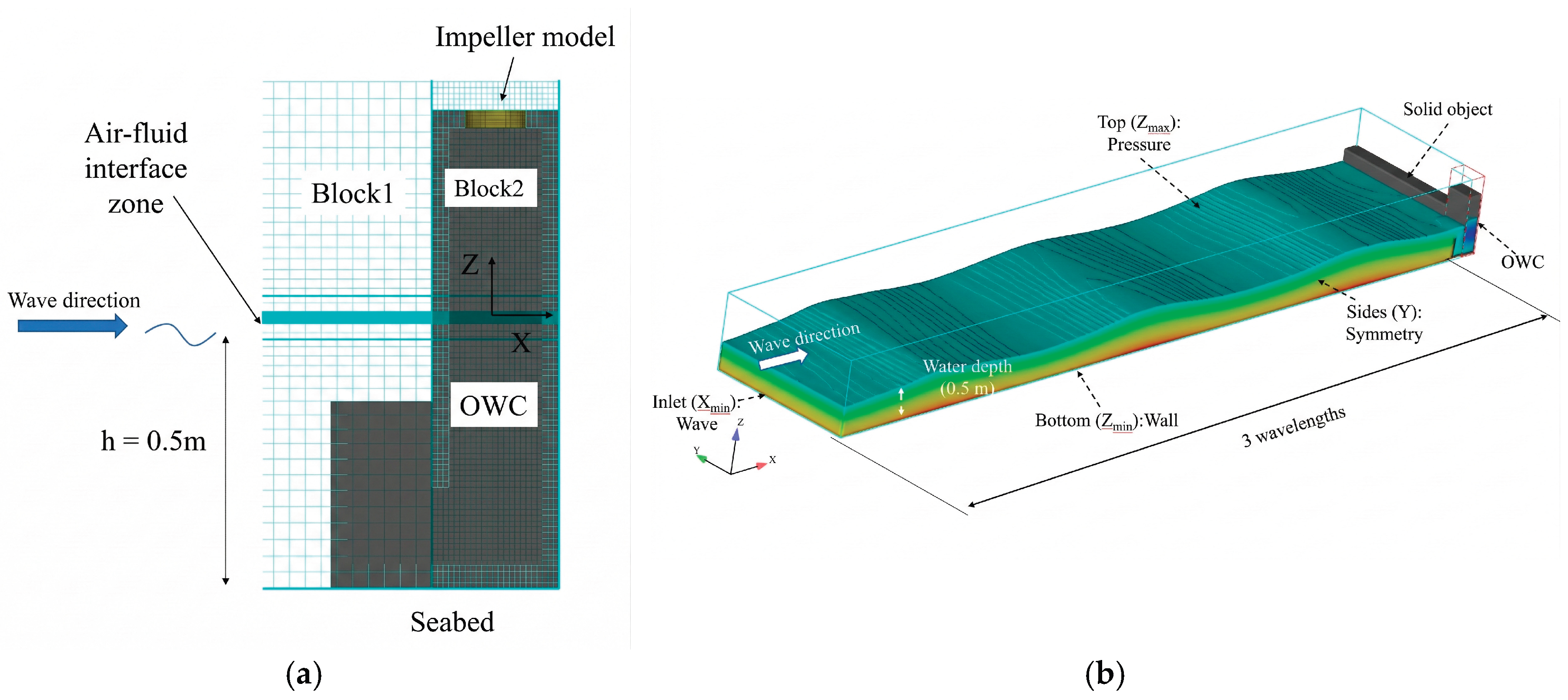
Figure 2.
Geometric parameters of 1/20th scaled baseline model of the present U-OWC: (a) side view, (b) top view.
Figure 2.
Geometric parameters of 1/20th scaled baseline model of the present U-OWC: (a) side view, (b) top view.
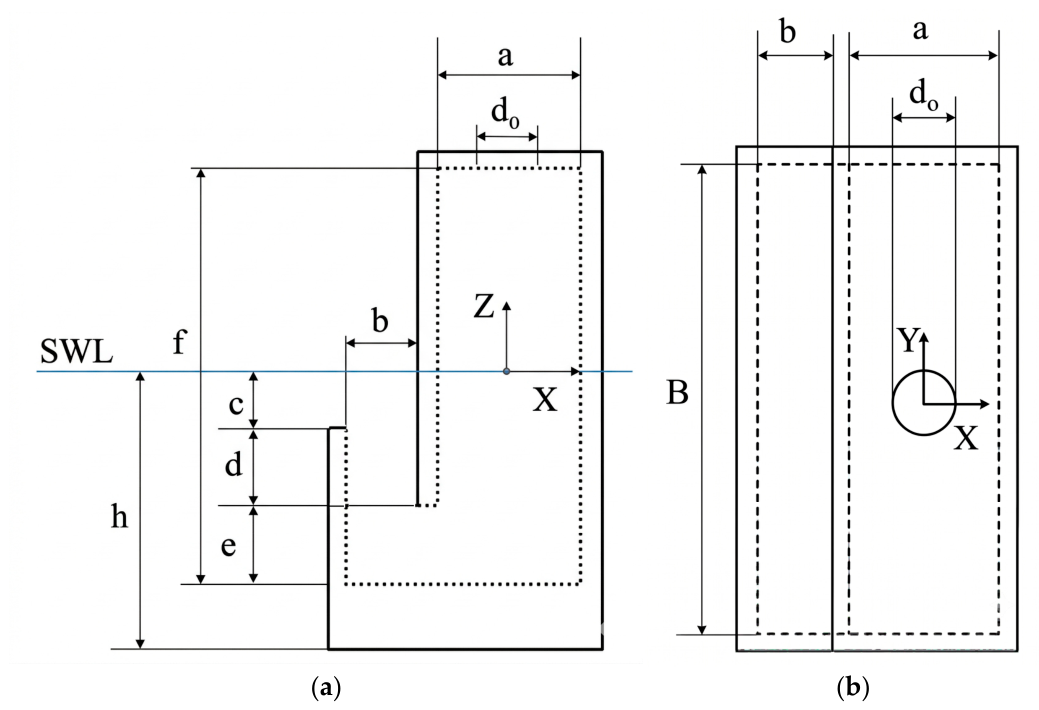
Figure 3.
The schematic diagram of the orifice with impeller model inside: (a) side view, (b)top view.
Figure 3.
The schematic diagram of the orifice with impeller model inside: (a) side view, (b)top view.
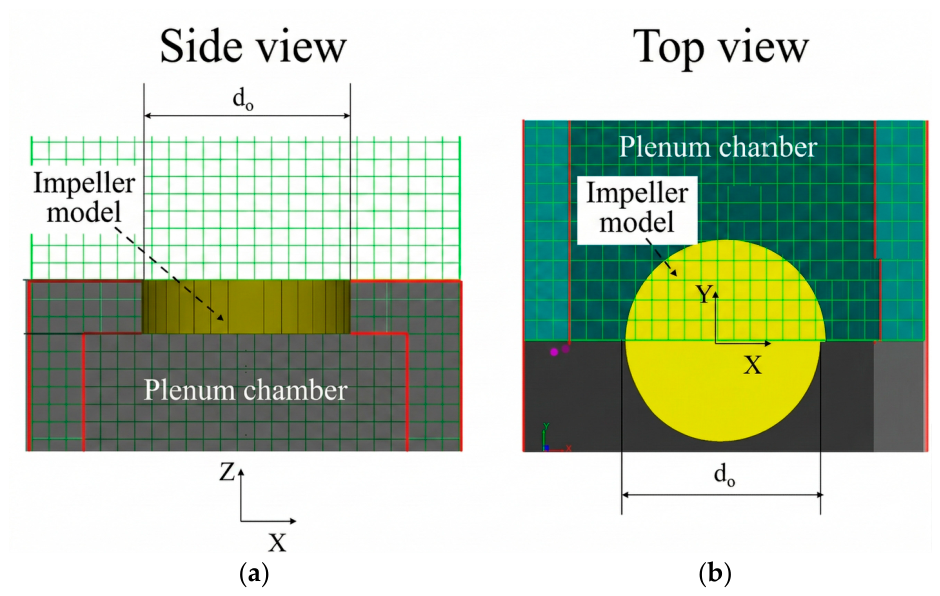
Figure 4.
Capture factors and as functions of , i.e., , of the present U-OWC at the model and prototype scales, respectively, at Tps = (a) 6.5s, (b) 7.5s, (c) 8.0s, (d) 8.5s, (e) 9.5s, (f) 10.5s, and (g) 12.5s (refer to Table 2 for corresponding Tms). The maximal points, and , and the data points yielded by the FLOW-3D® simulations (, ) are marked.
Figure 4.
Capture factors and as functions of , i.e., , of the present U-OWC at the model and prototype scales, respectively, at Tps = (a) 6.5s, (b) 7.5s, (c) 8.0s, (d) 8.5s, (e) 9.5s, (f) 10.5s, and (g) 12.5s (refer to Table 2 for corresponding Tms). The maximal points, and , and the data points yielded by the FLOW-3D® simulations (, ) are marked.
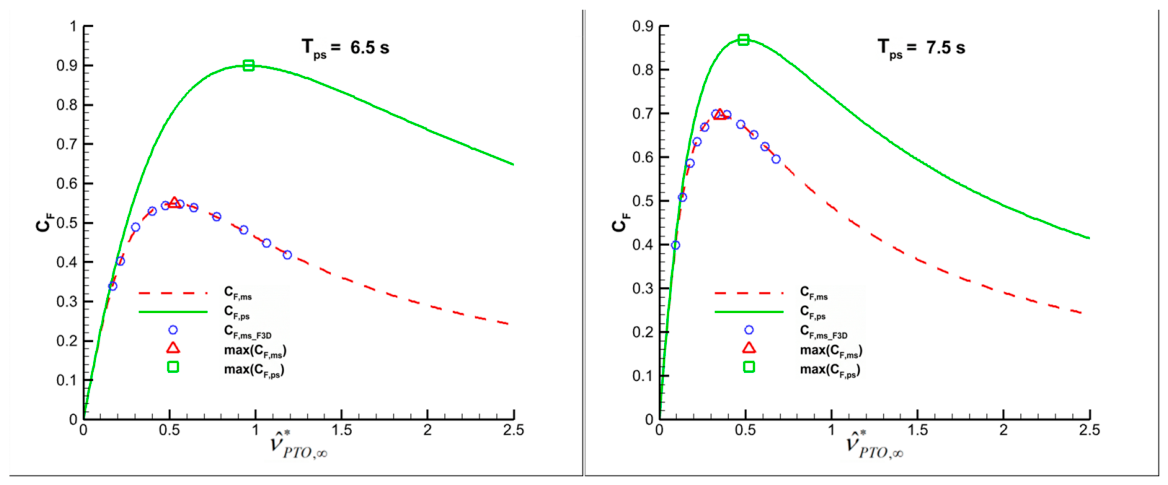
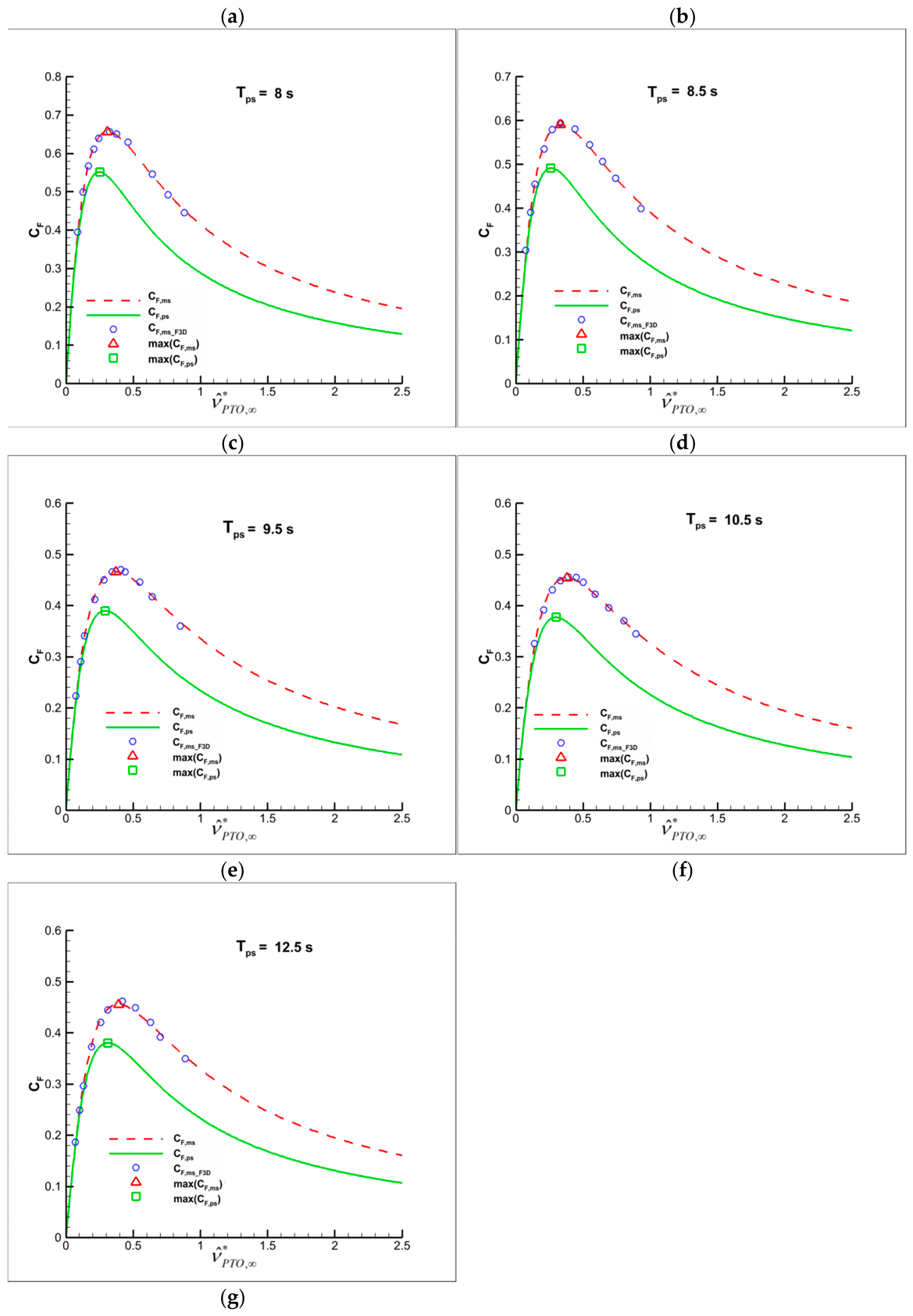
Figure 5.
Maximal capture factors at their respective optimal damping coefficients of PTO:
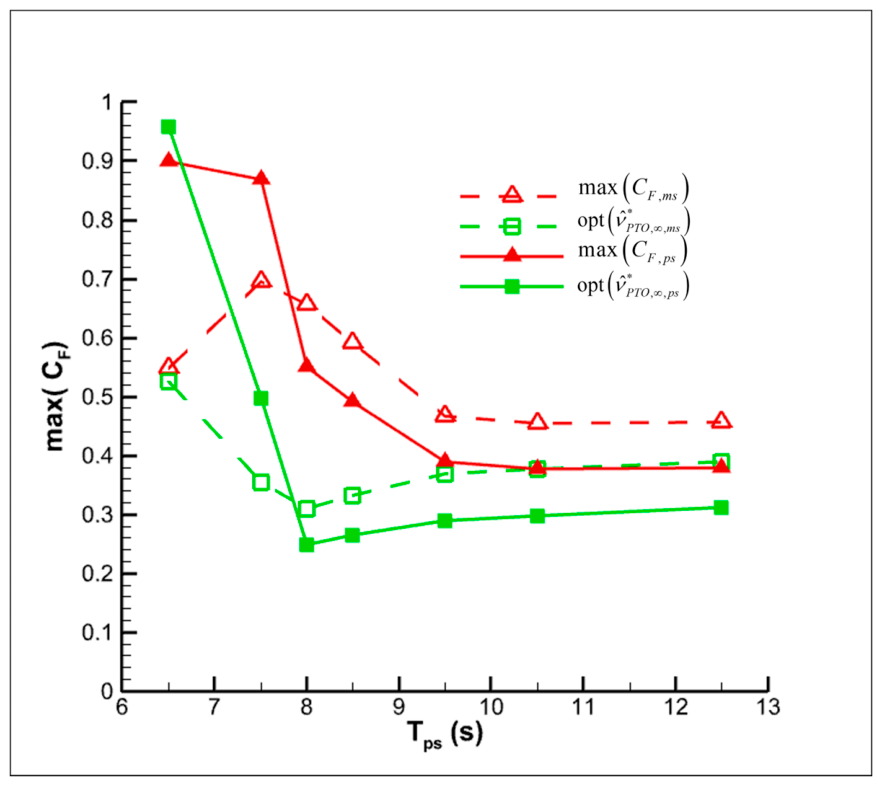
Figure 6.
Hydrodynamic and gravitational coefficients of the present U-OWC: , against Tps = 6.5s, 7.5s, 8.0s, 8.5s, 9.5s, 10.5s, and 12.5s (refer to Table 2 for corresponding Tms).
Figure 6.
Hydrodynamic and gravitational coefficients of the present U-OWC: , against Tps = 6.5s, 7.5s, 8.0s, 8.5s, 9.5s, 10.5s, and 12.5s (refer to Table 2 for corresponding Tms).
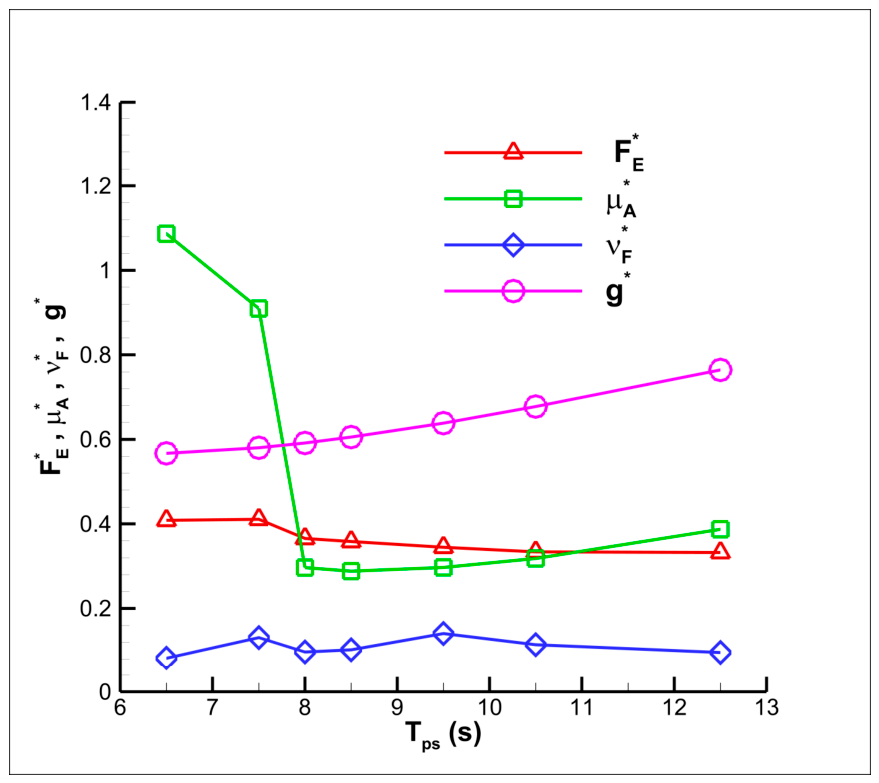
Figure 7.
Absorption factors at their respective capture factors being maximal: and , and and replotted as shown in Figure 5 for comparison purposes, of the present U-OWC against Tps = 6.5s, 7.5s, 8.0s, 8.5s, 9.5s, 10.5s, and 12.5s (refer to Table 2 for corresponding Tms).
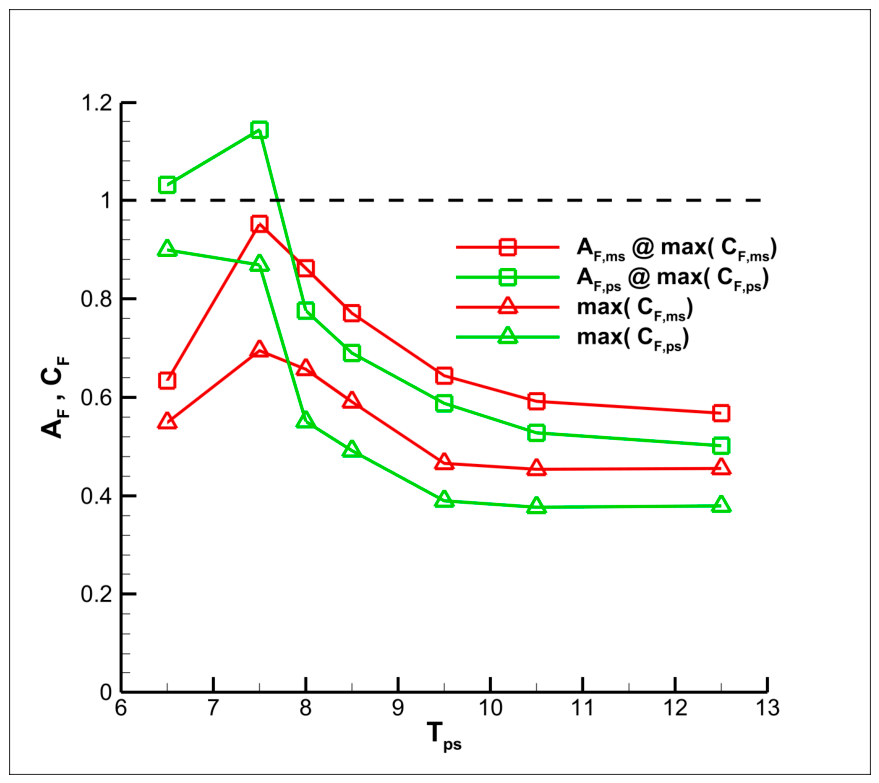
Figure 8.
Effective air compressibility and PTO damping coefficients of the present U-OWC at the prototype scale, and as functions of , i.e., and , at Tps = (a) 6.5s, (b) 7.5s, (c) 8.0s, (d) 8.5s, (e) 9.5s, (f) 10.5s, and (g) 12.5s. The intersection of and (i.e., ), and are also marked. The vertical black dashed line and associated number indicate the at which and reside. The horizontal black dashed line and associated number indicate that as .
Figure 8.
Effective air compressibility and PTO damping coefficients of the present U-OWC at the prototype scale, and as functions of , i.e., and , at Tps = (a) 6.5s, (b) 7.5s, (c) 8.0s, (d) 8.5s, (e) 9.5s, (f) 10.5s, and (g) 12.5s. The intersection of and (i.e., ), and are also marked. The vertical black dashed line and associated number indicate the at which and reside. The horizontal black dashed line and associated number indicate that as .
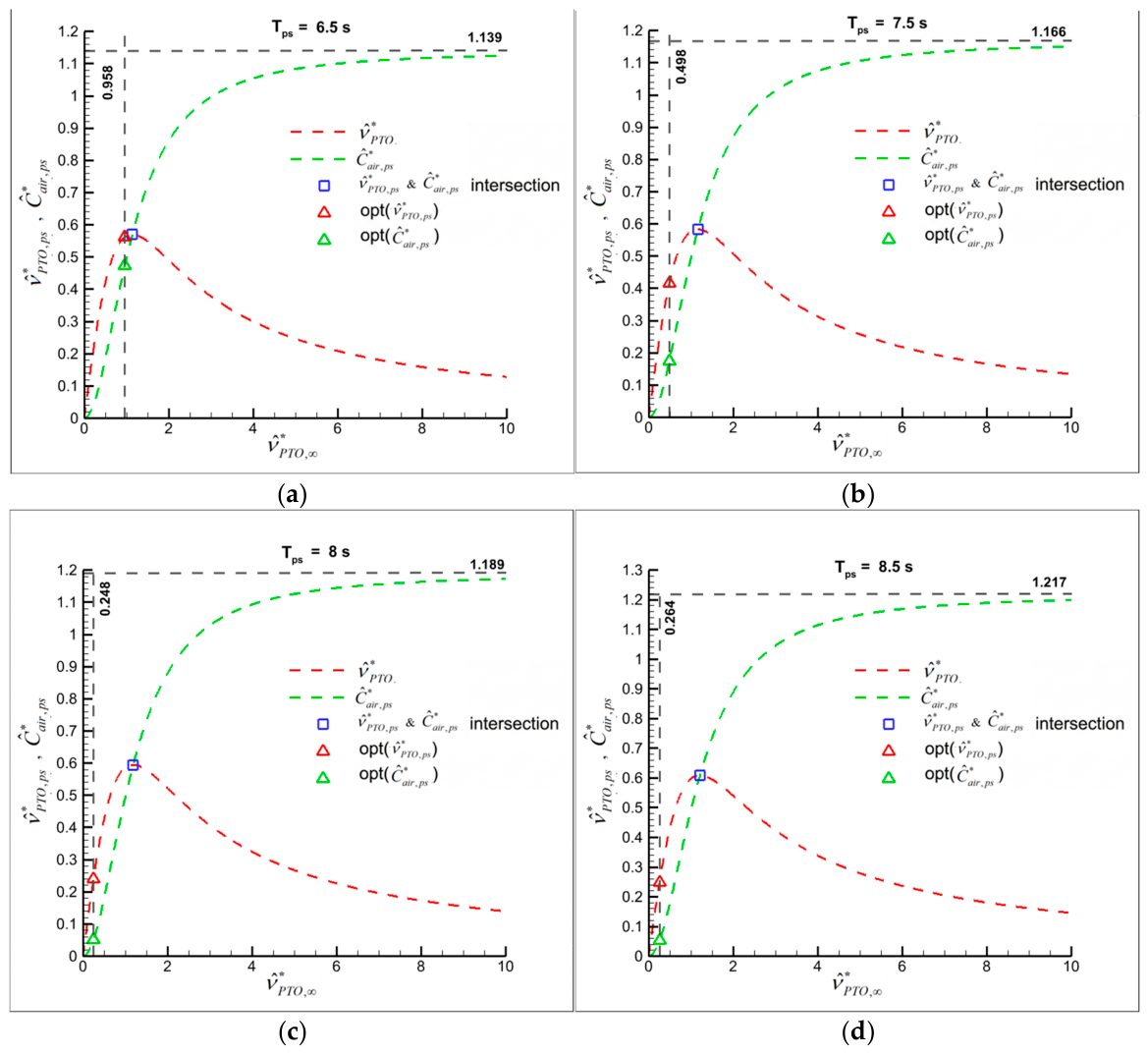
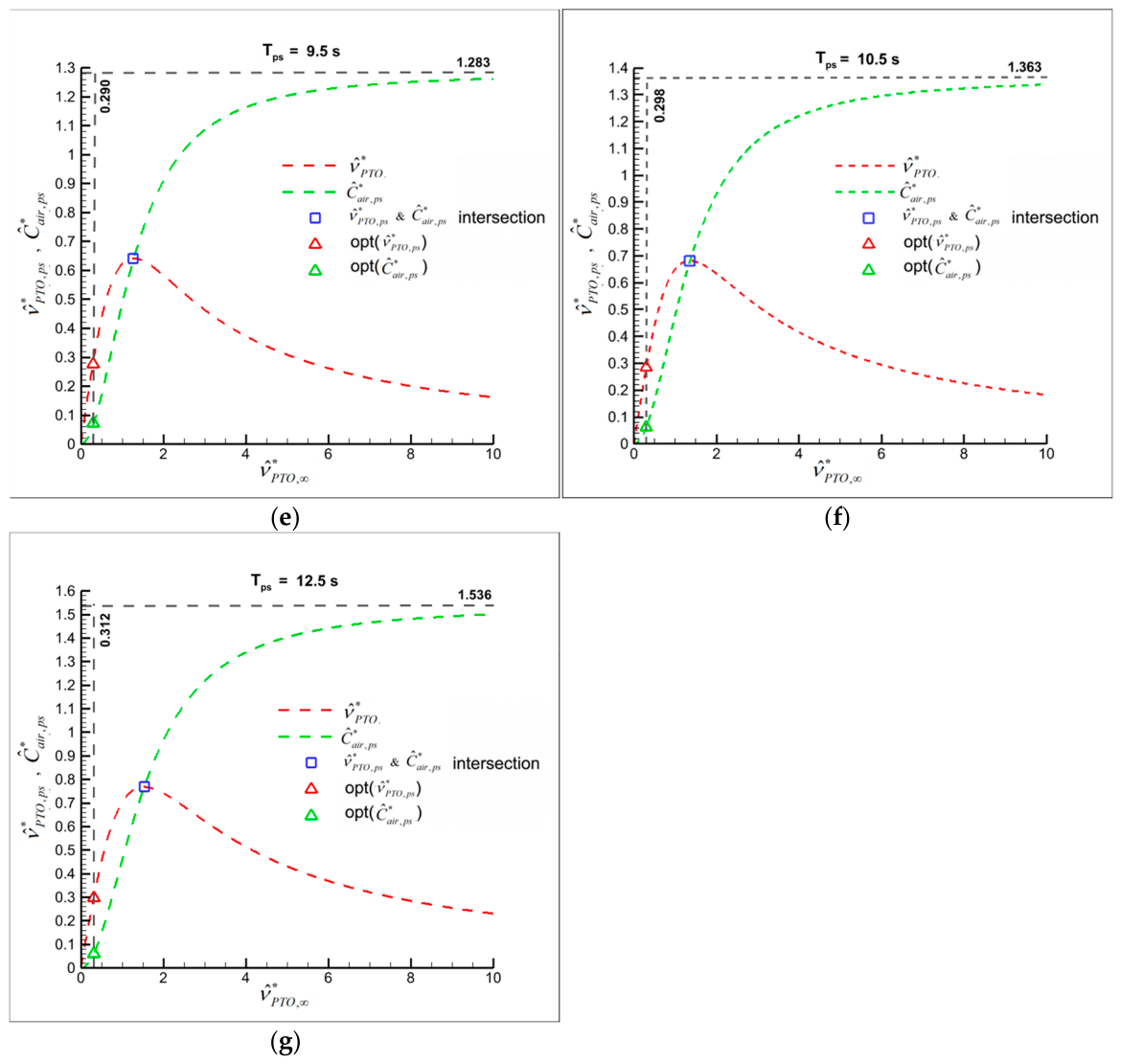

Table 1.
Dimensions and boundary conditions of the computational domain.
| Description | Boundary conditions @ Tms = 1.90s |
Location (m) |
|
| Xmin | Stokes and Cnoidal wave | -11.75 | |
| Xmax | Wall | 0.117 | |
| Ymin | Symmetry | 0.00 | |
| Ymax | Symmetry | 2.40 | |
| Zmin | Wall | -0.50 | |
| Zmax | Pressure | 0.65 | |
Table 2.
Seven wave periods at the model scale (Tms) and their corresponding values at the prototype scale (Tps).
Table 2.
Seven wave periods at the model scale (Tms) and their corresponding values at the prototype scale (Tps).
| Tms (s) | Tps (s) |
| 1.45 | 6.5 |
| 1.68 | 7.5 |
| 1.79 | 8.0 |
| 1.90 | 8.5 |
| 2.12 | 9.5 |
| 2.35 | 10.5 |
| 2.80 | 12.5 |
Table 3.
Design parameters of the baseline U-OWC model, from Nguyen [41].
Table 3.
Design parameters of the baseline U-OWC model, from Nguyen [41].
| Design parameters | Value (m) |
| Chamber width a (X-dir) | 0.170 |
| Width of front channel b | 0.155 |
| Depth of front channel c | 0.155 |
| Depth from front channel to chamber inlet d | 0.155 |
| Height of chamber inlet e | 0.140 |
| Water depth h | 0.500 |
| OWC breadth B (Y-dir) | 0.736 |
| Orifice diameter do | 0.110 |
Table 4.
Values of , , , and of the present U-OWC within Tps = 6.5s ~ 12.5s (refer to Table 2 for corresponding Tms).
Table 4.
Values of , , , and of the present U-OWC within Tps = 6.5s ~ 12.5s (refer to Table 2 for corresponding Tms).
| Tps (s) | ||||
| 6.5 | 0.549 | 0.526 | 0.899 | 0.958 |
| 7.5 | 0.695 | 0.355 | 0.869 | 0.498 |
| 8.0 | 0.657 | 0.310 | 0.551 | 0.248 |
| 8.5 | 0.591 | 0.333 | 0.492 | 0.264 |
| 9.5 | 0.466 | 0.369 | 0.390 | 0.290 |
| 10.5 | 0.454 | 0.377 | 0.377 | 0.298 |
| 12.5 | 0.456 | 0.389 | 0.380 | 0.312 |
Table 5.
Values of hydrodynamic and gravitational coefficients of the present U-OWC: , and within Tps = 6.5s ~ 12.5s (refer to Table 2 for corresponding Tms).
Table 5.
Values of hydrodynamic and gravitational coefficients of the present U-OWC: , and within Tps = 6.5s ~ 12.5s (refer to Table 2 for corresponding Tms).
| Tps (s) | |||||
| 6.5 | 0.408 | 1.086 | 0.082 | 0.567 | -0.519 |
| 7.5 | 0.411 | 0.910 | 0.131 | 0.580 | -0.330 |
| 8.0 | 0.366 | 0.297 | 0.097 | 0.592 | 0.295 |
| 8.5 | 0.358 | 0.288 | 0.102 | 0.606 | 0.317 |
| 9.5 | 0.345 | 0.297 | 0.141 | 0.638 | 0.341 |
| 10.5 | 0.334 | 0.318 | 0.114 | 0.678 | 0.360 |
| 12.5 | 0.332 | 0.387 | 0.096 | 0.764 | 0.377 |
Table 6.
Values of the absorption factors at their respective capture factors being maximal: and , and and relisted as shown in Table 4 for comparison purposes, of the present U-OWC within Tps = 6.5s ~ 12.5s (refer to Table 2 for corresponding Tms).
| Tps (s) | ||||
| 6.5 | 0.634 | 1.031 | 0.549 | 0.899 |
| 7.5 | 0.953 | 1.143 | 0.695 | 0.869 |
| 8.0 | 0.862 | 0.776 | 0.657 | 0.551 |
| 8.5 | 0.771 | 0.690 | 0.591 | 0.492 |
| 9.5 | 0.644 | 0.588 | 0.466 | 0.390 |
| 10.5 | 0.592 | 0.528 | 0.454 | 0.377 |
| 12.5 | 0.568 | 0.502 | 0.456 | 0.380 |
Table 7.
Values of , , and of the present U-OWC within Tps = 6.5s ~ 12.5s (refer to Table 2 for corresponding Tms).
Table 7.
Values of , , and of the present U-OWC within Tps = 6.5s ~ 12.5s (refer to Table 2 for corresponding Tms).
| Tps (s) | |||
| 6.5 | 0.958 | 0.562 | 0.473 |
| 7.5 | 0.498 | 0.417 | 0.175 |
| 8.0 | 0.248 | 0.239 | 0.050 |
| 8.5 | 0.264 | 0.249 | 0.053 |
| 9.5 | 0.290 | 0.276 | 0.071 |
| 10.5 | 0.298 | 0.284 | 0.062 |
| 12.5 | 0.312 | 0.298 | 0.060 |
Disclaimer/Publisher’s Note: The statements, opinions and data contained in all publications are solely those of the individual author(s) and contributor(s) and not of MDPI and/or the editor(s). MDPI and/or the editor(s) disclaim responsibility for any injury to people or property resulting from any ideas, methods, instructions or products referred to in the content. |
© 2026 by the authors. Licensee MDPI, Basel, Switzerland. This article is an open access article distributed under the terms and conditions of the Creative Commons Attribution (CC BY) license (http://creativecommons.org/licenses/by/4.0/).
Copyright: This open access article is published under a Creative Commons CC BY 4.0 license, which permit the free download, distribution, and reuse, provided that the author and preprint are cited in any reuse.


