
Submitted:
09 June 2026
Posted:
10 June 2026
You are already at the latest version
Abstract
Brain-specific angiogenesis inhibitor 1-associated protein 2 (BAIAP2), which encodes Insulin Receptor Substrate Protein 53 (IRSp53), has emerged as a brain-disease gene. BAIAP2 involvement in pathogenic CNS disorders is due to its roles in molecular architecture, synaptic signaling, circuit computation, and human neurodevelopmental pathology can be examined within a single mechanistic framework. Unlike many synaptic risk genes that are assigned broad scaffolding functions, IRSp53 is distinguished by the convergence of membrane-shaping capacity, actin control, and postsynaptic condensate organization, through which N-methyl-D-aspartate receptor (NMDAR) -dependent signaling is tuned rather than merely supported. Across mouse models, disrupted IRSp53 has been linked to altered postsynaptic density assembly, abnormal glutamatergic physiology, reduced prefrontal population activity, and impaired social behavior. These phenotypes have not only been observed across scales but, in part, have been reversed in adulthood, indicating that pathogenic effects are not fixed once development has ended. In parallel, emerging human studies have extended BAIAP2 beyond idiopathic neuropsychiatric association toward defined neurodevelopmental disorders, including cortical migration defects and developmental epileptic encephalopathy. A multi-scale view is that the BAIAP2 is not considered as a synaptic organizer, but a causal bridge between nanoscale postsynaptic structure, systems-level dysfunction, and disease expression.
Keywords:
BAIAP2
; IRSp53
; postsynaptic density
; NMDA receptor
; social behavior
; neurodevelopmental disorders
; synaptic organization
1. Introduction
BAIAP2, which encodes IRSp53, has moved into sharper focus as a nervous-system disease gene because evidence has extended from nanoscale postsynaptic organization to circuit dysfunction, behavior, and human neurodevelopmental pathology [1,2,3,4]. This trajectory is not commonly achieved for synaptic genes. In many cases, disease relevance is inferred from broad association studies or from descriptive expression patterns. In contrast, for BAIAP2, mechanistic, physiological, behavioral, and human-genetic observations have been connected by direct perturbation. IRSp53 has been distinguished within this landscape by an unusual combination of properties: membrane deformation, actin coupling, and scaffold integration at excitatory synapses [1]. A gene with that architecture is of particular interest because structural organization at the postsynaptic density can be related directly to receptor signaling and then to higher-order network function [1,2,3].
The case for BAIAP2 as a brain-disease gene was initially investigated in mouse studies showing that IRSp53 loss is accompanied by social deficits together with abnormal NMDAR-linked synaptic function [2]. That early framework has since been refined rather than merely repeated. Cell-type-specific deletion experiments showed that removal of IRSp53 from glutamatergic neurons produces a more substantial social and electrophysiological phenotype in the tested forebrain setting, whereas deletion in GABAergic neurons exerts comparatively limited effects [3]. The mechanistic substrate for this deficiency was then clarified when IRSp53 was shown to promote postsynaptic density assembly through multivalent phase separation with core postsynaptic density (PSD) proteins while simultaneously enhancing actin filament bundling. Thereby placing receptor organization and cytoskeletal control within one experimentally defined system [1]. As a result, BAIAP2 has become notable not because synaptic dysfunction is observed after its disruption, but because a plausible bridge has been established between molecular architecture and the specific class of synaptic abnormalities seen in vivo [1,2,3].
What has made the gene especially compelling is that this bridge is not limited to the synapse. Adult re-expression of IRSp53 was shown to normalize medial prefrontal NMDAR-mediated transmission and to improve social behavior, indicating that the majority of the phenotype is not developmentally irretrievable [4]. In parallel, in vivo recordings demonstrated that IRSp53 deficiency is associated with reduced prefrontal firing variability, weakened burst dynamics, and impaired social representation, placing the defect at the level of cortical computation rather than at receptor physiology [5] . Circuit dissection then identified a prefrontal-lateral hypothalamic-ventral tegmental pathway through which social deficits could be mechanistically interpreted, and region-targeted chemogenetic work further implicated the ventral dentate gyrus as an intervention-sensitive node [6,7]. Most recently, human genetic research has extended BAIAP2’s role beyond heterogeneous psychiatric implications into defined neurodevelopmental disorders. Through supporting cellular and in vivo functional data, a lissencephaly-associated variant was functionally linked to neuronal migration failure, and de novo missense variants were associated with developmental and epileptic encephalopathy [8,9] . BAIAP2 is therefore unusual not because it participates in one level of neural organization, but because causally informative evidence has been assembled across several of them.
2. Synaptic Mechanism of IRSp53 in PSD Condensates and Actin Organization
IRSp53 is composed of three key domains, IRSp53-MIM domain (IMD): Cdc42/Rac interactive binding (CRIB) domain, and Scr homology 3 (SH3) domain [10,11] (Figure 1). IMD is IRSp53 structural domain, involved in IRSp53 membrane binding. IMD, by forming membrane curvature, helps to form membrane protrusions and filopodia. IMD also play role in inducing recruitment of actin regulators [12,13,14,15]. CRIB is the regulatory domain of IRSp53, which activates IRSp53 by binding active GTPases to terminate autoinhibition (Figure 2.4). SH3 domain is responsible for protein-protein interactions. It is involved in IRSp53 interactions with PSD ligands. Moreover, through its proline-rich motif recruit proteins involved in actin bundling and filopodia formation (Figure 2.5).
IRSp53 has been placed at excitatory postsynaptic sites as more than a generic adaptor. It was shown to bind PSD-95 through its C-terminal PDZ-binding motif and to bind Shank through its SH3-mediated interactions (Figure 1), forming a bridge between major PSD scaffold layers. In cultured neurons, synaptic localization was reduced when the PSD-95-binding motif was removed; also, spine density and size were decreased after IRSp53 knockdown or dominant-negative interference. Ultrastructural work further showed that IRSp53 is concentrated at the PSD in spine-rich neurons, consistent with a structural role at glutamatergic synapses rather than a diffuse cytoplasmic one [16,17,18].
The strongest current mechanistic advance has come from reconstitution studies showing that IRSp53 promotes excitatory PSD assembly through multivalent phase separation with PSD-95 and Shank3. In that system, IRSp53 was enriched across core and deeper PSD-like layers, and the resulting condensates promoted actin filament bundling both in solution and on membranes. Mutations that weakened PSD-95 binding impaired synaptic enrichment, whereas mutations that disrupted IRSp53-actin interaction impaired actin bundling and interfered with spine-head maturation in cortical neurons [1]. Activity dependence has also been demonstrated morphologically, as IRSp53 was found to accumulate further within the PSD pallium after depolarization or NMDA exposure, supporting the view that PSD recruitment is dynamically regulated rather than fixed [1].
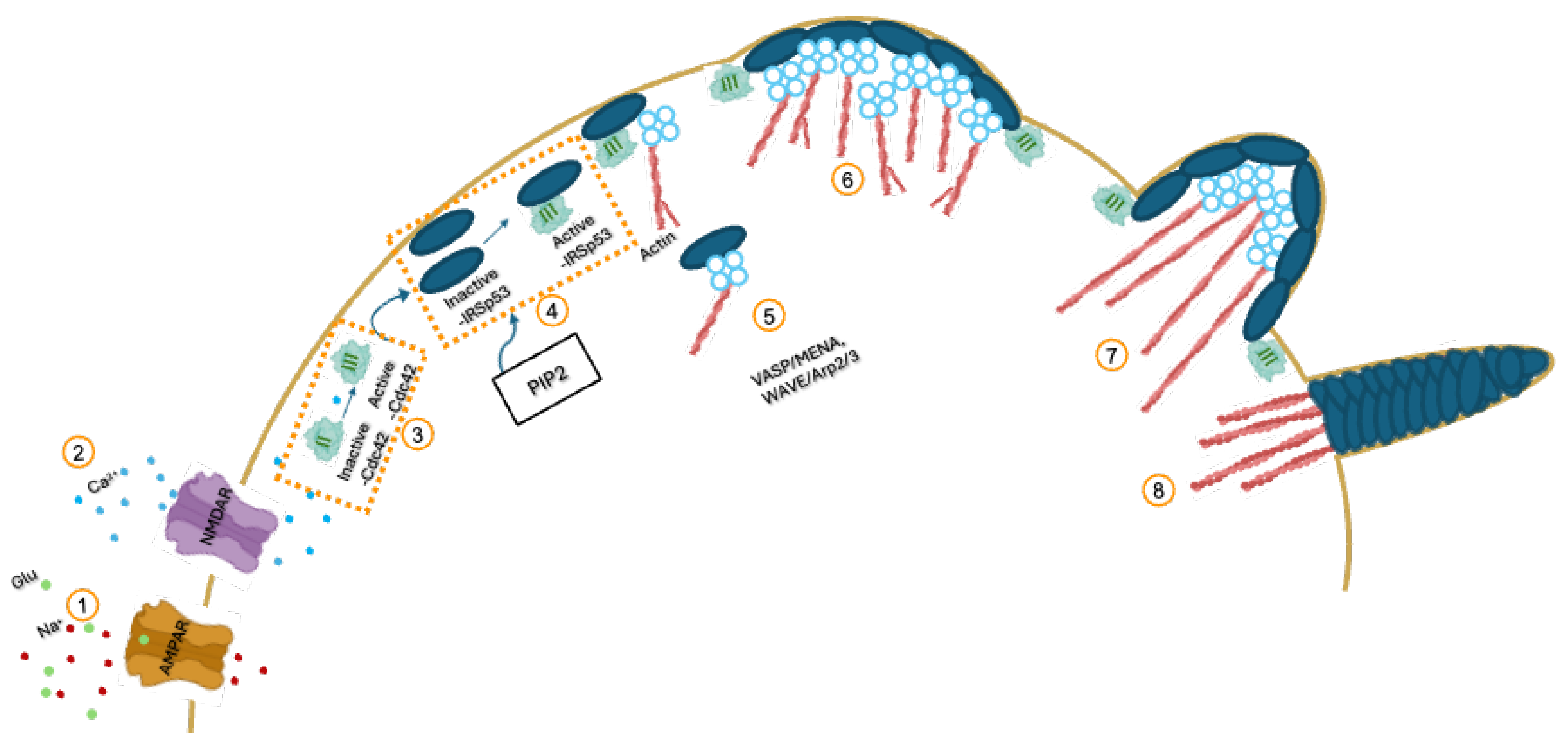
The various functions of IRSp53 are dependent on the interactions between its domains and PSD macromolecules such as Cdc42. During synaptic activity, glutamate release and the resulting influx of Na+ through AMPARs initiate membrane depolarization, which in turn promotes NMDAR activation and calcium entry into the postsynaptic compartment (Figure 2.1,2). The rise in intracellular calcium contributes to activation of Cdc42 (Figure 2.3), a key upstream regulator of actin remodelling in dendritic spines. Once activated, Cdc42 binds IRSp53 and relieves IRSp53’s autoinhibited conformation, allowing the protein to unfold and form actin bundle-filopodia (Figure 2.4). Cdc42 activates filopodia formation, and IRSp53 promotes the actin bundle formation through its SH3 domain to Mena (Figure 1, Figure 2.5). In parallel, through in vitro reconstitution systems, it is demonstrated that IRSp53 self-assembly depends on PIP2 (Figure 2.4). Full-length IRSp53 clusters are crucial for the VASP/Mena recruitment and to induce actin assembly and formation of filopodium-like protrusions on the membrane [19] (Figure 2.5,6). IRSp53-SH3 domain recruits VASP/MENA and Wave/Arp2/3, which together drive the assembly of both linear and branched actin networks. (Figure 2.6). Cdc42-dependent binding also facilitates the formation of IRSp53 and VASP foci, where VASP clustering supports processive elongation of actin filaments (Figure 2.7). As these actin filaments extend, the membrane-bending activity of IRSp53 works together with VASP-mediated filament growth to drive protrusion beyond the plane of the membrane (Figure 2.8). However, overexpression of IRSp53 has negative effect on filopodia formation and linking Cdc42 to Mena, since IRSp53-N terminal domain can bind to Cdc42 but cannot recruit Mena and make a bridge between Cd42 and Mena [20]. These studies indicate formation of condensates between IRSp53 and PSD proteins enhance actin-bundling activity, formation, and growth of filopodia, and its maturation into dendrite spines. Point mutations that disturb IRSp53 binding to actin strongly block the formation of filament bundles in vitro and lead to a severe defects in spine head maturation when overexpressed in cultured cortical neurons. In a research depletion of endogenous IRSp53 led to severe reduction in the spine head width and spine density, which could be rescued by the re-expression of WT-IRSp53. In contrast, re-expression of the actin binding deficient mutants failed to rescue the phenotypes, indicating that the actin bundling activity of IRSp53 is critical for normal spine development [1].
A mechanistic link to receptor signaling has also been suggested. Rapid NMDA-dependent synaptic translocation of IRSp53 was shown in hippocampal neurons, where synapse-targeted IRSp53 enhanced miniature EPSC amplitude [21]. Conversely, IRSp53 deficiency was associated with increased PSD-NMDAR subunit levels and altered hippocampal synaptic plasticity, indicating that IRSp53, which is likely to tune receptor organization within PSD architecture rather than merely decorate it [22]. Mice lacking IRSp53 show increased NMDAR function accompanied by social and cognitive deficits [23]. Experiments in animal models of ASDs indicated that reduced NMDAR function has been associated with ASD-like phenotypes [24,25]. Other studies have shown that actin filaments are essential for synaptic localization and activity of NMDARs and AMPARs [26,27,28,29,30]. In a study, IRSp53-/- SC-CA1 synapses show reduced LTD-related NMDAR EPSCs [2], which differs from LTD of AMPAR EPSCs in aspects including the underlying mechanisms; LTD of NMDAR EPSCs requires depolymerization of actin, whereas LTD of AMPAR EPSCs requires activation of calcineurin [31,32]. These results suggest that IRSp53 deletion leads to an abnormal stabilization of synaptic actin filaments, which may promote synaptic localization of NMDARs and suppress activity-dependent removal. IRSp53 acts as a postsynaptic scaffold and influences NMDAR signaling, AMPAR trafficking, and spine maturation by linking dendritic spine actin architecture to glutamate receptor organization.
In an experiment using cultured neurons, it has been indicated that IRSp53 overexpression increases the density of dendritic spines but does not affect their length or width. siRNA-mediated knockdown of IRSp53 reduced spine density, length, and width [17]. Mutation in IRSp53-SH3 or disruption of WAVE2 reduced spine density and size, which indicates the important role of IRSp53-mediated protein interactions in spine morphogenesis. SH3 regulatory complex components such as Abi2 and WAVE1 are involved in formation of different dendrite spine morphologies. By release of WAVE1, Arp2/3 activates and leads to actin polymerization and formation of branched actin networks [33,34,35,36](Figure 2.5). Whereas, Arp2/3 complex inhibition changes that IRSP53-induced membrane protrusions to formation of lamelliopodia and loss of filopodia. These results indicate IRSp53-dependent actin remodeling has a high effect on regulation of protrusion morphology [37,38].
The morphology of dendrite spine is important in synaptic plasticity. Through the activity of Arp2/3, an actin patch on the dendritic shaft elongates into a filopodium, and the tip expands into a mature spine head. This process is important in dendritic spine structure and plasticity, which is involved in formation and consolidation of memory [27]. In a study a single-nucleotide polymorphism (SNP) variant located in the BAIAP2 gene in healthy individuals is associated with emotional regulation of human memory strength [39]. Regulation of verbal memory strength by negative information was associated with SNP genotype, BAIAP2 mRNA levels, and activity of the parahippocampal cortex. Studies on individuals with ASDs and schizophrenia showed several SNPs were associated with disease susceptibilities [23].
3. Cell-Type and Excitatory/Inhibitory Specificity in Excitatory and Inhibitory Neurons
IRSp53 has not been restricted to one neuronal class, but its distribution has not been identical across them. Ultrastructural work showed that the protein is closely associated with the postsynaptic density in spine-rich excitatory neurons and is also present in spiny inhibitory neurons, although its synaptic organization differs between these cellular contexts [18]. This point has been important because it argues against a simple presence-versus-absence model and instead suggests that BAIAP2-dependent dysfunction should be interpreted in relation to cell type, synaptic architecture, and circuit position. The present results show that IRSp53 in the pyramidal cells of neocortex and hippocampus concentrated at the center of the PSD, whereas IRSp53 in the spiny inhibitory neurons of neostriatum and cerebellar cortex was distributed uniformly along the synapse. These regional differences in the tangential organization of IRSp53 within the PSD further support the notion that dendritic spines are not uniform across brain regions [18]. IRSp53 mRNA is abundantly expressed in brain regions rich in spiny neurons of hippocampus, cerebellum, striatum, and cortex [18,40,41]. In the adult mouse hippocampus, IRSp53 immunoreactivity is present in the dentate gyrus, CA1, CA2, and CA3. IRSp53 staining was prominent in GABAergic medium spiny neurons in the striatum, whereas it was lacking in spiny GABAergic interneurons in the neocortex and hippocampus [18,42]. However, IRSp53 expression seems to be limited to spiny neurons regardless of their neurotransmitter phenotype; more studies are necessary to verify if that is the case for other members of the I-BAR family [42].
Direct causal evidence has come from cell-type-specific deletion. When BAIAP2 was removed from Emx1-lineage dorsal telencephalic glutamatergic neurons, social deficits, hyperactivity, and an increased evoked excitatory-to-inhibitory ratio in medial prefrontal cortex were observed. In contrast, deletion in VIAAT-lineage GABAergic neurons produced much weaker behavioral and electrophysiological effects in the same study. These experiments indicate that the dominant contribution to the tested phenotype arises from glutamatergic neurons rather than from a primary loss in inhibitory cells [3]. This conclusion was strengthened by adult re-expression experiments performed in the excitatory-neuron conditional model. In these experiments, restoration of IRSp53 normalized medial prefrontal NMDAR-related transmission and improved social behavior [4].
Interneuron subtypes show vulnerability to excitatory perturbations, parvalbumin (PV) interneurons show high sensitivity to upstream synaptic imbalance and somatostatin interneurons contribute to later-stage dendritic compensation of pyramidal activity [43,44]. Developmental studies indicate that excitation-inhibition balance is dynamically regulated, suggesting that early excitatory disruptions may reshape inhibitory circuit maturation trajectories [43,45,46]. IRSp53-dependent loss of excitatory synaptic stability may initially bias PV-dependent network adaptation, followed by slower compensatory adjustments in SST- and CCK-mediated inhibition [44]. Homeostatic plasticity mechanisms may partially restore firing-rate stability, but such compensation does not necessarily preserve circuit function and can lead to abnormal inhibitory reorganization after prolonged excitatory deficit [47]. Taken together, the available evidence suggests that excitatory/inhibitory disruption in BAIAP2 deficiency is driven less by a direct pan-neuronal failure and more by excitatory postsynaptic dysfunction that secondarily shifts network balance.
4. Circuit Physiology from Prefrontal Coding to Social Behavior
In a study, a shift from synaptic defect to circuit-level dysfunction was possible when medial prefrontal activity was examined in vivo in IRSp53-mutant mice. In this research, social deficits were accompanied by reduced firing variability, reduced burst firing, and weaker neuronal discrimination between social and non-social targets. The proportion of excitatory medial prefrontal neurons encoding social information was also reduced, indicating that the defect was not limited to global hypo- or hyperactivity, but extended to degraded representation of socially relevant cues at the population level [1].
The circuit consequences of this cortical abnormality were traced downstream. In mice with IRSp53 deletion restricted to cortical excitatory neurons, the medial prefrontal cortex-lateral hypothalamus (LH)-ventral tegmental area (VTA) pathway was shown to contribute to social deficits. Via LH-projecting, prefrontal neurons of mutant displayed increased excitability linked to reduced potassium channel gene expression, which was associated with excessive excitatory input onto LH-GABA neurons. Secondary changes were detected in the LH/VTA relay, with weakened inhibitory drive onto VTA/GABA neurons and over-inhibition of VTA dopamine neurons. Importantly, social behavior was improved by optogenetic activation of the LH/GABA–VTA/GABA pathway, providing direct evidence that the disturbed social phenotype is carried, at least in part, by an identifiable cortical-subcortical network rather than by an isolated local cortical defect [6].
In a study co-expression of IRSp53 with dopaminergic, cholinergic, oxytocinergic, and serotonergic neurons suggested that IRSp53 function extends beyond cortical synaptic scaffolding. Given that all four neurotransmitter systems regulate sensorimotor gating, inhibition deficits likely reflect disruption of dopaminergic-forebrain circuit dynamics and not just a single pathway impairment. Previous work [2,3,48,49] also indicates that IRSp53 loss reduces synaptic input and induces compensatory increases in neuronal excitability, which suggests that the behavioral phenotype may arise from homeostatic adaptations that destabilize network-level gain control. IRSp53-related dysfunction supports a model in which multi-modulatory dysregulation across convergent basal ganglia–thalamocortical loops underlies social and sensorimotor deficits [50].
5. Reversibility and Intervention by Adult Rescue and Region-Targeted Modulation
Perhaps the most consequential advance in the BAIAP2 field has been the demonstration that part of the phenotype remains reversible in adulthood. In a conditional model with IRSp53 loss in Emx1-lineage excitatory neurons, systemic delivery of a BBB-penetrant PHP.eB vector at postnatal week 8 was used to re-express IRSp53 in the adult brain. Social interaction and social approach were improved, and NMDAR-mediated synaptic abnormalities in medial prefrontal layer 5 pyramidal neurons were normalized, whereas hyperactivity and anxiety-like behavior were not corrected. These results suggested that the social and synaptic components of BAIAP2 deficiency are not obligatorily fixed by early development and that therapeutic windows may differ across phenotypic domains [4].
In IRSp53-/- mice, loss of the protein alters NMDAR function, synaptic transmission, and increases behavioral abnormalities [23,51]. Some behavioral phenotypes, such as synaptic function and social behavior, are reversible through pharmacological normalization of NMDAR and IRSp53 adult re-expression. Whereas, phenotypes, anxiety and hyperactivity are not rescuable, which suggests the idea that they may reflect circuit-level alterations established during development which are less amenable to later modifications [4,23]. Knockdown of BAIAP2 in developmental studies in early brain formation of mouse cortex resulted in defects of neuronal migration, morphogenesis, and differentiation [8]. The deficiency in migration for p.Arg29Trp variant disease-associated failed to rescue and reduced localization to plasma membrane, which indicates a partial loss-of-function effect [8]. In contrast, temporal rescue of synaptopathy gene, MECP2 models of Rett syndrome resulted in recovery of neurological and behavioral phenotypes, which demonstrates many deficits are physiologically reversible after development [52]. Also, GRIN1 adult reinstatement, encoding NMDAR subunits, rescues synaptic transmission, social interaction, and cognitive function [53].
Intervention has also been localized to specific nodes. In Emx1-Cre; IRSp53 flox/flox mice, chemogenetic inhibition of ventral dentate gyrus Emx1-expressing cells restored social deficits, whereas chemogenetic activation in control mice induced social impairment. In the same study, hippocampal CRHR1 expression was elevated in mutant mice and reduced by inhibitory manipulation, further supporting the vDG as an intervention-sensitive locus rather than a passive downstream site [2]. A broader but less gene-deficiency-specific line of evidence was provided in a chronic mild stress model, in which hippocampal BAIAP2 overexpression reduced depression-like behavior and was accompanied by increased spine density and higher GluA1 and SYN1 expression [3]. The available data support two distinct therapeutic concepts: restoration of the missing gene product and state-dependent modulation of vulnerable circuit compartments.
It is worth to take into consideration the practical and mechanistic part of region-targeted intervention. Any therapeutic strategy will face delivery limitations, especially for achieving efficient and stable expression in hippocampal or limbic populations without broader off-target effects. The type of isoform is also important, since BAIAP2/IRSp53 isoforms may differ in domain composition, localization, and interaction partners. Cell-type targeting adds another layer of specificity, because a manipulation that is effective in excitatory neurons may not produce the same results in inhibitory interneurons or glial-supporting environments. Taken together, these issues raise a broader mechanistic question: whether hippocampal rescue engages a shared synaptic mechanism that can explain both social and affective phenotypes, or whether it corrects only a subset of BAIAP2-sensitive processes while leaving others intact.
6. Neurodevelopment and Human Genetics in Migration Defects and Epileptic Encephalopathy
The neurodevelopmental relevance of BAIAP2 has now been supported by direct human variant analysis coupled to functional testing. In a child with posterior-greater-than-anterior lissencephaly, a de novo p.Arg29Trp variant was identified, and follow-up experiments moved the observation beyond genetic coincidence. BAIAP2 knockdown in the developing mouse cortex caused delayed neuronal migration together with defects in morphogenesis and differentiation, whereas expression of the human variant failed to rescue the migration phenotype. The mutant protein was also shown to lose normal membrane-peripheral localization, supporting a loss-of-function mechanism that is consistent with the membrane-actin interface of IRSp53. These findings placed BAIAP2 within cortical development itself, rather than only within later synaptic maturation [8].
A second disease axis has emerged through developmental and epileptic encephalopathy. De novo missense BAIAP2 variants were reported in six individuals with severe infantile or early-childhood-onset epilepsy, global developmental delay, and variable intellectual disability. Functional work suggested that these variants cluster in a regulatory region important for autoinhibition, promote abnormal protrusive morphology, increase neuronal excitability through enhanced excitatory synaptogenesis, and in zebrafish produce developmental abnormalities, aberrant neurite growth, and increased sensitivity to chemically induced hyperactivity. Together, these data suggest that BAIAP2 can contribute to neurodevelopmental disease through at least two distinct but mechanistically connected routes: impaired cortical construction and excessive excitatory drive within developing neural networks [9].
BAIAP2/IRSp53 has a significant role in genotype-phenotype crossroads, because the emerging human variants do not all seem to produce the same biological outcome. In lissencephaly, the reported p.Arg29Trp change was linked to impaired membrane localization and failed to rescue a neuronal migration defect, supporting a loss-of-function mechanism in cortical development [8]. Whereas, the recently described developmental and epileptic encephalopathy-associated missense variants clustered in the multiple phosphorylation site region that supports BAIAP2 autoinhibition, and functional assays suggested disrupted conformational control with a gain-of-function-like effect on protrusion formation and neuronal excitability [9]. This raises the possibility that migration-related and encephalopathy-related alleles affect different functional domains and bias IRSp53 toward distinct cellular phenotypes, rather than appearing as one uniform disease mechanism [8].
In the future, it is worth testing these alleles in systems matched to the phenotype. For migration defects, in utero electroporation in developing cortex or organoid-based migration assays can be taken into consideration. Whereas dominant-negative versus gain-of-function effects on synaptic function are better addressed in cultured neurons, slice physiology, or rescue experiments in mutant mice. Since IRSp53 is also involved in postsynaptic density organization and actin bundling [1], domain-resolved mutagenesis could help to separate membrane targeting, PSD scaffolding, and actin-regulatory functions. Hence, BAIAP2 may provide a good example of how a gene can connect early neurodevelopmental phenotypes with later synaptic and circuit dysfunction through variant-specific mechanisms [1,8,9].
7. Conclusions and Outlook
Research on BAIAP2/IRSp53 has progressed from descriptive synaptic observations to a mechanistic framework that links nanoscale postsynaptic organization to circuit dysfunction and neurodevelopmental diseases. Across the studies reviewed here, IRSp53 emerges not as a passive scaffold, but as a molecule at the intersection of membrane dynamics, actin organization, and excitatory synaptic architecture. IRSp53 appears to influence how excitatory synapses are structurally assembled and physiologically stabilized through its interactions with PSD-95, Shank proteins, actin regulators, and glutamate receptor-associated complexes. The research in this area indicated that IRSp53 contributes to PSD condensate organization, which strengthens the idea that disturbances in synaptic ultrastructure can lead to broader abnormalities in neuronal signaling and behavior.
Importantly, BAIAP2 disruption is not limited to isolated synaptic defects. Mouse studies have shown a connection between IRSp53 deficiency and altered medial prefrontal coding, impaired social representation, dysregulated hypothalamic and dopaminergic circuit interactions, and disturbances in excitation-inhibition balance. Human genetic findings indicated the relevance between BAIAP2 and defined neurodevelopmental conditions, such as cortical migration disorders and developmental epileptic encephalopathy. Together, these findings support that IRSp53 participates across several levels of neural organization, from cytoskeletal control during early cortical development to mature circuit computation in the adult brain.
One of the most significant developments in the field has been that some phenotypes remain reversible after development. Adult rescue experiments and circuit-targeted manipulations indicate that parts of the pathological state reflect ongoing physiological dysfunction rather than irreversible developmental injury. This makes BAIAP2 a promising target among synaptopathy-associated genes for therapeutic intervention beyond early developmental stages. Albeit the incomplete reversibility of anxiety-like behavior and hyperactivity suggests that different phenotypic domains may stabilize at different developmental stages.
Several questions remain unresolved. It is still unclear how different BAIAP2 variants alter IRSp53 function at the molecular level, and if migration-related and synaptic phenotypes arise through shared or partially distinct mechanisms. Also, the degree to which inhibitory circuit adaptations represent compensatory responses versus primary pathological processes remains debatable. Future work can benefit from integrating structural reconstitution systems, in vivo physiology, human cellular models, and variant-specific functional assays.
Overall, BAIAP2/IRSp53 provides an unusually coherent example of how disturbances in synaptic architecture can lead to systems-level dysfunction and human neurodevelopmental disorders. Currently, molecular organization, circuit physiology, and translational neuroscience can increasingly be studied by a single mechanistic sequence rather than as disconnected levels of analysis.
References
- Feng, Z.; Lee, S.; Jia, B.; Jian, T.; Kim, E.; Zhang, M. IRSp53 promotes postsynaptic density formation and actin filament bundling. J. Cell Biol. 2022, 221(8). [Google Scholar] [CrossRef] [PubMed]
- Chung, W.; Choi, S.Y.; Lee, E.; Park, H.; Kang, J.; Park, H.; et al. Social deficits in IRSp53 mutant mice improved by NMDAR and mGluR5 suppression. Nat. Neurosci. 2015, 18(3), 435–43. [Google Scholar] [CrossRef] [PubMed]
- Kim, Y.; Noh, Y.W.; Kim, K.; Yang, E.; Kim, H.; Kim, E. IRSp53 Deletion in Glutamatergic and GABAergic Neurons and in Male and Female Mice Leads to Distinct Electrophysiological and Behavioral Phenotypes. In Frontiers in Cellular Neuroscience; 2020; pp. 14–2020. [Google Scholar]
- Noh, Y.W.; Yook, C.; Kang, J.; Lee, S.; Kim, Y.; Yang, E.; et al. Adult re-expression of IRSp53 rescues NMDA receptor function and social behavior in IRSp53-mutant mice. Commun. Biol. 2022, 5(1), 838. [Google Scholar] [CrossRef] [PubMed]
- Kim, W.; Shin, J.J.; Jeong, Y.J.; Kim, K.; Bae, J.W.; Noh, Y.W.; et al. Suppressed prefrontal neuronal firing variability and impaired social representation in IRSp53-mutant mice. eLife 2022, 11, e74998. [Google Scholar] [CrossRef] [PubMed]
- Noh, Y.W.; Kim, Y.; Lee, S.; Kim, Y.; Shin, J.J.; Kang, H.; et al. The PFC-LH-VTA pathway contributes to social deficits in IRSp53-mutant mice. Mol. Psychiatry 2023, 28(11), 4642–54. [Google Scholar] [CrossRef]
- Kim, S.H.; Lee, B.; Lee, S.M.; Kim, Y. Restoring social deficits in IRSp53-deleted mice: chemogenetic inhibition of ventral dentate gyrus Emx1-expressing cells. Transl. Psychiatry 2024, 14(1), 425. [Google Scholar] [CrossRef] [PubMed]
- Tsai, M.-H.; Lin, W.-C.; Chen, S.-Y.; Hsieh, M.-Y.; Nian, F.-S.; Cheng, H.-Y.; et al. A lissencephaly-associated BAIAP2 variant causes defects in neuronal migration during brain development. Development 2024, 151(2). [Google Scholar] [CrossRef]
- Zhang, G.; Lu, Y.; Xie, L.; Begemann, A.; Papuc, S.M.; Zweier, M.; et al. De novo missense variants in BAIAP2 are associated with developmental and epileptic encephalopathies. Epilepsia 2026, 67(1), 480–98. [Google Scholar] [CrossRef] [PubMed]
- Yamagishi, A.; Masuda, M.; Ohki, T.; Onishi, H.; Mochizuki, N. A Novel Actin Bundling/Filopodium-forming Domain Conserved in Insulin Receptor Tyrosine Kinase Substrate p53 and Missing in Metastasis Protein *. J. Biol. Chem. 2004, 279(15), 14929–36. [Google Scholar] [CrossRef]
- Machesky, L.M.; Johnston, S.A. MIM: a multifunctional scaffold protein. J. Mol. Med. 2007, 85(6), 569–76. [Google Scholar] [CrossRef]
- Frost, A.; De Camilli, P.; Unger, V.M. F-BAR Proteins Join the BAR Family Fold. Structure 2007, 15(7), 751–3. [Google Scholar] [CrossRef]
- Peter, B.J.; Kent, H.M.; Mills, I.G.; Vallis, Y.; Butler, P.J.G.; Evans, P.R.; et al. BAR Domains as Sensors of Membrane Curvature: The Amphiphysin BAR Structure. Science 2004, 303(5657), 495–9. [Google Scholar] [CrossRef]
- Shimada, A.; Niwa, H.; Tsujita, K.; Suetsugu, S.; Nitta, K.; Hanawa-Suetsugu, K.; et al. Curved EFC/F-BAR-Domain Dimers Are Joined End to End into a Filament for Membrane Invagination in Endocytosis. Cell. 2007, 129(4), 761–72. [Google Scholar] [CrossRef]
- Millard, T.H.; Bompard, G.; Heung, M.Y.; Dafforn, T.R.; Scott, D.J.; Machesky, L.M.; et al. Structural basis of filopodia formation induced by the IRSp53/MIM homology domain of human IRSp53. EMBO Journal. 2005, 24(2), 240–50. [Google Scholar] [CrossRef] [PubMed]
- Soltau, M.; Berhörster, K.; Kindler, S.; Buck, F.; Richter, D.; Kreienkamp, H.-J. Insulin receptor substrate of 53 kDa links postsynaptic shank to PSD-95. J. Neurochem. 2004, 90(3), 659–65. [Google Scholar] [CrossRef]
- Choi, J.; Ko, J.; Racz, B.; Burette, A.; Lee, J.-R.; Kim, S.; et al. Regulation of Dendritic Spine Morphogenesis by Insulin Receptor Substrate 53, a Downstream Effector of Rac1 and Cdc42 Small GTPases. J. Neurosci. 2005, 25(4), 869–79. [Google Scholar] [CrossRef] [PubMed]
- Burette, A.C.; Park, H.; Weinberg, R.J. Postsynaptic distribution of IRSp53 in spiny excitatory and inhibitory neurons. J. Comp. Neurol. 2014, 522(9), 2164–78. [Google Scholar] [CrossRef] [PubMed]
- Tsai, F.-C.; Henderson, J.M.; Jarin, Z.; Kremneva, E.; Senju, Y.; Pernier, J.; et al. Activated I-BAR IRSp53 clustering controls the formation of VASP-actin–based membrane protrusions. Sci. Adv. 2022, 8(41), eabp8677. [Google Scholar] [CrossRef] [PubMed]
- Krugmann, S.; Jordens, I.; Gevaert, K.; Driessens, M.; Vandekerckhove, J.; Hall, A. Cdc42 induces filopodia by promoting the formation of an IRSp53:Mena complex. Curr. Biol. 2001, 11(21), 1645–55. [Google Scholar] [CrossRef] [PubMed]
- Hori, K.; Yasuda, H.; Konno, D.; Maruoka, H.; Tsumoto, T.; Sobue, K. NMDA Receptor-Dependent Synaptic Translocation of Insulin Receptor Substrate p53 via Protein Kinase C Signaling. J. Neurosci. 2005, 25(10), 2670–81. [Google Scholar] [CrossRef]
- Sawallisch, C.; Berhörster, K.; Disanza, A.; Mantoani, S.; Kintscher, M.; Stoenica, L.; et al. The Insulin Receptor Substrate of 53 kDa (IRSp53) Limits Hippocampal Synaptic Plasticity *. J. Biol. Chem. 2009, 284(14), 9225–36. [Google Scholar] [CrossRef] [PubMed]
- Kang, J.; Park, H.; Kim, E. IRSp53/BAIAP2 in dendritic spine development, NMDA receptor regulation, and psychiatric disorders. Neuropharmacology 2016, 100, 27–39. [Google Scholar] [CrossRef] [PubMed]
- Lee, E.-J.; Choi, S.Y.; Kim, E. NMDA receptor dysfunction in autism spectrum disorders. Curr. Opin. Pharmacol. 2015, 20, 8–13. [Google Scholar] [CrossRef] [PubMed]
- Won, H.; Lee, H.-R.; Gee, H.Y.; Mah, W.; Kim, J.-I.; Lee, J.; et al. Autistic-like social behaviour in Shank2-mutant mice improved by restoring NMDA receptor function. Nature 2012, 486(7402), 261–5. [Google Scholar] [CrossRef] [PubMed]
- Allison, D.W.; Gelfand, V.I.; Spector, I.; Craig, A.M. Role of Actin in Anchoring Postsynaptic Receptors in Cultured Hippocampal Neurons: Differential Attachment of NMDA versus AMPA Receptors. J. Neurosci. 1998, 18(7), 2423–36. [Google Scholar] [CrossRef] [PubMed]
- Kim, I.H.; Racz, B.; Wang, H.; Burianek, L.; Weinberg, R.; Yasuda, R.; et al. Disruption of Arp2/3 results in asymmetric structural plasticity of dendritic spines and progressive synaptic and behavioral abnormalities. J. Neurosci. 2013, 33(14), 6081–92. [Google Scholar] [CrossRef]
- Furukawa, K.; Fu, W.; Li, Y.; Witke, W.; Kwiatkowski, D.J.; Mattson, M.P. The Actin-Severing Protein Gelsolin Modulates Calcium Channel and NMDA Receptor Activities and Vulnerability to Excitotoxicity in Hippocampal Neurons. J. Neurosci. 1997, 17(21), 8178–86. [Google Scholar] [CrossRef]
- Rosenmund, C.; Westbrook, G.L. Calcium-induced actin depolymerization reduces NMDA channel activity. Neuron 1993, 10(5), 805–14. [Google Scholar] [CrossRef]
- Wyszynski, M.; Lin, J.; Rao, A.; Nigh, E.; Beggs, A.H.; Craig, A.M.; et al. Competitive binding of α-actinin and calmodulin to the NMDA receptor. Nature 1997, 385(6615), 439–42. [Google Scholar] [CrossRef]
- Morishita, W.; Marie, H.; Malenka, R.C. Distinct triggering and expression mechanisms underlie LTD of AMPA and NMDA synaptic responses. Nat. Neurosci. 2005, 8(8), 1043–50. [Google Scholar] [CrossRef]
- Selig, D.K.; Hjelmstad, G.O.; Herron, C.; Nicoll, R.A.; Malenka, R.C. Independent mechanisms for long-term depression of AMPA and NMDA responses. Neuron 1995, 15(2), 417–26. [Google Scholar] [CrossRef] [PubMed]
- Takenawa, T.; Suetsugu, S. The WASP–WAVE protein network: connecting the membrane to the cytoskeleton. Nat. Rev. Mol. Cell Biol. 2007, 8(1), 37–48. [Google Scholar] [CrossRef] [PubMed]
- Lebensohn, A.M.; Kirschner, M.W. Activation of the WAVE Complex by Coincident Signals Controls Actin Assembly. Mol. Cell. 2009, 36(3), 512–24. [Google Scholar] [CrossRef]
- Padrick, S.B.; Cheng, H.-C.; Ismail, A.M.; Panchal, S.C.; Doolittle, L.K.; Kim, S.; et al. Hierarchical Regulation of WASP/WAVE Proteins. Mol. Cell. 2008, 32(3), 426–38. [Google Scholar] [CrossRef] [PubMed]
- Padrick, S.B.; Rosen, M.K. Physical Mechanisms of Signal Integration by WASP Family Proteins. Annu. Rev. Biochem. 2010, 79((Volume 79), 707–35. [Google Scholar] [CrossRef]
- Pipathsouk, A.; Brunetti, R.M.; Town, J.P.; Graziano, B.R.; Breuer, A.; Pellett, P.A.; et al. The WAVE complex associates with sites of saddle membrane curvature. J. Cell Biol. 2021, 220(8). [Google Scholar] [CrossRef]
- Jones, T.; Cui, B. Light-Inducible Generation of Membrane Curvature in Live Cells with Engineered Bar Domain Proteins. Biophys. Journal. 2020, 118(3), 610a. [Google Scholar] [CrossRef]
- Luksys, G.; Ackermann, S.; Coynel, D.; Fastenrath, M.; Gschwind, L.; Heck, A.; et al. BAIAP2 Is Related to Emotional Modulation of Human Memory Strength. PLoS ONE 2014, 9(1), e83707. [Google Scholar] [CrossRef] [PubMed]
- Abbott, M.-A.; Wells, D.G.; Fallon, J.R. The Insulin Receptor Tyrosine Kinase Substrate p58/53 and the Insulin Receptor Are Components of CNS Synapses. J. Neurosci. 1999, 19(17), 7300–8. [Google Scholar] [CrossRef] [PubMed]
- Bockmann, J.; Kreutz, M.R.; Gundelfinger, E.D.; Böckers, T.M. ProSAP/Shank postsynaptic density proteins interact with insulin receptor tyrosine kinase substrate IRSp53. J. Neurochem. 2002, 83(4), 1013–7. [Google Scholar] [CrossRef]
- Chatzi, C.; Westbrook, G.L. Revisiting I-BAR Proteins at Central Synapses. In Frontiers in Neural Circuits; 2021; pp. 15–2021. [Google Scholar]
- Hensch, T.K. Critical period plasticity in local cortical circuits. Nat. Rev. Neurosci. 2005, 6(11), 877–88. [Google Scholar] [CrossRef]
- Urban-Ciecko, J.; Barth, A.L. Somatostatin-expressing neurons in cortical networks. Nat. Rev. Neurosci. 2016, 17(7), 401–9. [Google Scholar] [CrossRef] [PubMed]
- Turrigiano, G. Too Many Cooks? Intrinsic and Synaptic Homeostatic Mechanisms in Cortical Circuit Refinement. Annu. Rev. Neurosci. 2011, 34((Volume 34), 89–103. [Google Scholar] [CrossRef] [PubMed]
- Sohal, V.S.; Rubenstein, J.L.R. Excitation-inhibition balance as a framework for investigating mechanisms in neuropsychiatric disorders. Mol. Psychiatry 2019, 24(9), 1248–57. [Google Scholar] [CrossRef] [PubMed]
- Turrigiano, G.G.; Nelson, S.B. Homeostatic plasticity in the developing nervous system. Nat. Rev. Neurosci. 2004, 5(2), 97–107. [Google Scholar] [CrossRef]
- Kim, Y.; Noh, Y.W.; Kim, K.; Kim, E. Hyperactive ACC-MDT Pathway Suppresses Prepulse Inhibition in Mice. Schizophr. Bull. 2021, 47(1), 31–43. [Google Scholar] [CrossRef]
- Kim, M.-H.; Choi, J.; Yang, J.; Chung, W.; Kim, J.-H.; Paik, S.K.; et al. Enhanced NMDA receptor-mediated synaptic transmission, enhanced long-term potentiation, and impaired learning and memory in mice lacking IRSp53. J. Neurosci. 2009, 29(5), 1586–95. [Google Scholar] [CrossRef]
- Kim, Y.; Yang, E.; Kim, H. Impaired prepulse inhibition in mice with IRSp53 deletion in modulatory neurotransmitter neurons including dopamine, acetylcholine, oxytocin, and serotonin. Biochem. Biophys. Res. Commun. 2022, 586, 114–20. [Google Scholar] [CrossRef] [PubMed]
- Bobsin, K.; Kreienkamp, H.-J. Severe learning deficits of IRSp53 mutant mice are caused by altered NMDA receptor-dependent signal transduction. J. Neurochem. 2016, 136(4), 752–63. [Google Scholar] [CrossRef]
- Guy, J.; Gan, J.; Selfridge, J.; Cobb, S.; Bird, A. Reversal of Neurological Defects in a Mouse Model of Rett Syndrome. Science 2007, 315(5815), 1143–7. [Google Scholar] [CrossRef]
- Venkatesan, S.; Binko, M.A.; Mielnik, C.A.; Ramsey, A.J.; Lambe, E.K. Deficits in integrative NMDA receptors caused by Grin1 disruption can be rescued in adulthood. Neuropsychopharmacology 2023, 48(12), 1742–51. [Google Scholar] [CrossRef]
Figure 1.
IRSP53 Domain Organization and PSD Interactions. Schematic view of IRSp53 domains with length of 522 aa and IMD, CRIB, and SH3 domains. The IMD domain is responsible for membrane binding. CRIB’s major role is to terminate autoinhibition by binding to Cdc42-GTP and Rac-GTP. SH3 is the domain involved in PSD interactions by binding to Shank, PSD-95, Eps8, Wave2, and Mena to filopodia by actin polymerization.
Figure 1.
IRSP53 Domain Organization and PSD Interactions. Schematic view of IRSp53 domains with length of 522 aa and IMD, CRIB, and SH3 domains. The IMD domain is responsible for membrane binding. CRIB’s major role is to terminate autoinhibition by binding to Cdc42-GTP and Rac-GTP. SH3 is the domain involved in PSD interactions by binding to Shank, PSD-95, Eps8, Wave2, and Mena to filopodia by actin polymerization.
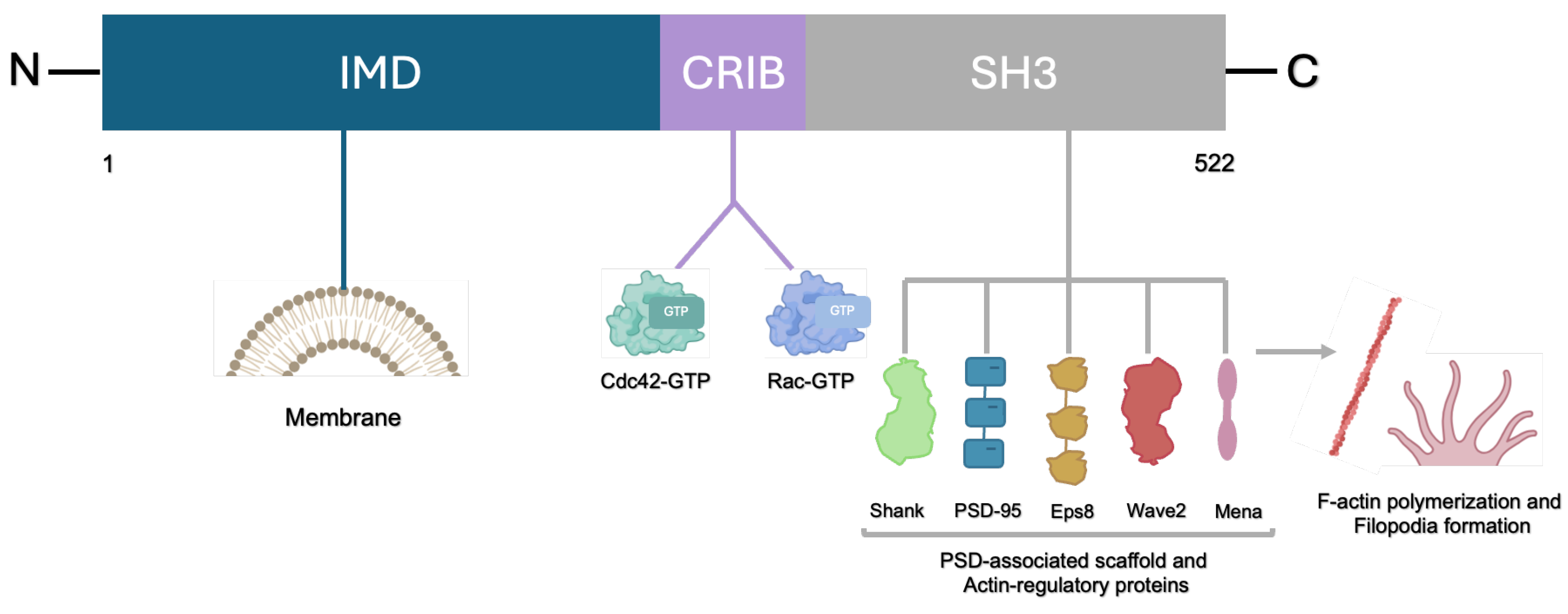
Figure 2.
IRSp53 in Actin Bundling and Dendritic Spine Formation. (1) During synaptic activity, release of Glu, and influx of Na+, AMPAR are activated and lead to membrane depolarization. (2) Membrane depolarization activates NMDAR and lead into Ca2+ influx. (3) Ca2+ is involved in activation of Cdc42. (4) Activated-Cdc42 removes the autoinhibition of IRSp53 and unfolds IRSp53. Through PIP2 recruitment, IRSp53 goes through self-assembly. (5) IRSp53 through its SH3 recruits VASP/MENA and Wave/Arp2/3. (6) The recruited protein clusters lead to linear and branched actins (7) binding to Cdc42, facilitating the formation of IRSp53 and VASP foci, in which VASP clustering allows processive actin filament elongation. (9) The membrane-bending activity of IRSp53, together with the processive elongation of actin filaments by VASP, cooperates to drive filament growth beyond the x-y plane of the membrane. As this occurs, fascin cross-links the filaments, helping them withstand opposing membrane tension and external compressive forces.
Figure 2.
IRSp53 in Actin Bundling and Dendritic Spine Formation. (1) During synaptic activity, release of Glu, and influx of Na+, AMPAR are activated and lead to membrane depolarization. (2) Membrane depolarization activates NMDAR and lead into Ca2+ influx. (3) Ca2+ is involved in activation of Cdc42. (4) Activated-Cdc42 removes the autoinhibition of IRSp53 and unfolds IRSp53. Through PIP2 recruitment, IRSp53 goes through self-assembly. (5) IRSp53 through its SH3 recruits VASP/MENA and Wave/Arp2/3. (6) The recruited protein clusters lead to linear and branched actins (7) binding to Cdc42, facilitating the formation of IRSp53 and VASP foci, in which VASP clustering allows processive actin filament elongation. (9) The membrane-bending activity of IRSp53, together with the processive elongation of actin filaments by VASP, cooperates to drive filament growth beyond the x-y plane of the membrane. As this occurs, fascin cross-links the filaments, helping them withstand opposing membrane tension and external compressive forces.
Disclaimer/Publisher’s Note: The statements, opinions and data contained in all publications are solely those of the individual author(s) and contributor(s) and not of MDPI and/or the editor(s). MDPI and/or the editor(s) disclaim responsibility for any injury to people or property resulting from any ideas, methods, instructions or products referred to in the content. |
© 2026 by the authors. Licensee MDPI, Basel, Switzerland. This article is an open access article distributed under the terms and conditions of the Creative Commons Attribution (CC BY) license (http://creativecommons.org/licenses/by/4.0/).
Copyright: This open access article is published under a Creative Commons CC BY 4.0 license, which permit the free download, distribution, and reuse, provided that the author and preprint are cited in any reuse.


