
Submitted:
08 June 2026
Posted:
09 June 2026
You are already at the latest version
Abstract
Additive Manufacturing (AM) process parameters significantly influence the thermal, mechanical, and surface roughness properties of printed parts. While experimental characterization is highly accurate, it is often excessively time-consuming and costly, hindering the development of scalable predictive models. This study adopts a Materials Informatics approach to curate a multi-sourced benchmarking dataset comprising 543 entries for ABS, PLA, and TPU filaments, integrating data from web-scraping (WSDS), literature (LDDS), and manufacturer technical datasheets (MTDS). Data cleaning included outlier detection via Tukey’s fences and the evaluation of imputation strategies, with K-Nearest Neighbors (KNN) consistently outperforming simple mean/median methods. We evaluated three regression models, Random Forest (RF), Ridge Regression (RR), and Support Vector Regression (SVR), using a nested cross-validation pipeline to predict tensile strength, elongation, and surface roughness. The results reveal significant data gaps in existing literature, with missingness exceeding 60% for critical parameters like fan speed and wall thickness. While the Random Forest model achieved high predictive accuracy for bulk mechanical properties, specifically a test-set R2 of 0.995 for PLA elongation, all models struggled with surface roughness, often yielding negative R2 values. This suggests that current process descriptors are insufficient to capture the stochastic nature of surface morphology. This work provides a foundational benchmarking dataset for the research community and highlights the necessity for stricter data mining protocols and more sophisticated feature engineering to achieve reliable predictive quality in material extrusion (MEX) polymers.
Keywords:
additive manufacturing
; 3D printing
; material extrusion
; ABS
; PLA
; TPU
; prediction model
; data mining
; imputation methods
1. Introduction
Additive Manufacturing (AM), specifically 3D Printing (3DP), has emerged as a revolutionary manufacturing process that addresses challenges such as complex geometries, rapid prototyping, material versatility, and reduced energy consumption and material wastage [1,2]. It is the process of building an object one layer at a time. A specific type of 3DP process, material extrusion (MEX), commonly implemented as fused filament fabrication (FFF) and trademarked as fused deposition modeling (FDM), has become the most common additive manufacturing process, accounting for about 60% of the global market share compared to other methods due to its customizability, simplicity, and ease of use [1,3,4,5]. With this, it has gained popularity for both consumer and industrial use, and is utilized in multiple industries, including aeronautics, automotive, defense, biomedical, dentistry, and drug delivery systems, among others [6].
Among the most widely utilized polymers in FFF, Polylactic Acid (PLA) and Acrylonitrile Butadiene Styrene (ABS) remain the dominant materials in both consumer and industrial applications [7]. PLA is widely favored due to its low cost, ease of printing, and high rigidity, whereas ABS is recognized for its superior toughness, impact resistance, and thermal durability. In addition to these materials, Thermoplastic Polyurethane (TPU) is also commonly used because of its elastic and flexible properties, making it suitable for applications requiring deformability and resilience [7,8,9]. However, the quality and efficiency of the final print are heavily dependent on the mechanical [10]and thermal [11]properties of these filaments. Despite advancements in material science, accurately predicting these properties remains a challenge due to the complex microstructural variations inherent in the layer-by-layer deposition process[12]. In the context of this study, the reported mechanical and surface properties correspond primarily to additively manufactured polymer specimens produced through material extrusion (MEX) processes rather than the intrinsic properties of the filament feedstock alone. Although the filament material composition (e.g., PLA, ABS, or TPU) strongly influences the resulting behavior, the final properties of printed specimens are also governed by process-dependent factors such as anisotropy, interlayer adhesion, porosity, raster orientation, thermal history, and cooling behavior. Consequently, the dataset was designed to capture process–property relationships of printed parts generated under varying manufacturing conditions rather than solely the baseline properties of raw filament materials.
A significant barrier to progress is the lack of centralized, comprehensive databases and predictive models that incorporate data-driven methods [13]. While experimental data is highly effective for property characterization, it is inherently time-consuming and costly to acquire at scale. Furthermore, existing research typically relies on narrowly scoped, study-specific data, which hinders the development of transferable and scalable predictive models. This data fragmentation inhibits the ability of researchers to uncover hidden patterns that could optimize printing outcomes without the need for exhaustive physical testing [14,15,16,17,18,19].
To address these gaps, the prediction of process-dependent properties of material extrusion (MEX)-printed polymer specimens, such as tensile strength, elongation, and surface roughness, can provide researchers with an initial understanding of the expected performance of additively manufactured parts [15,16,20,21]. Predicting these properties based on input parameters, such as printing speed, infill pattern, and infill density, requires a large dataset for data scientists and researchers to study [22,23,24]. Thus, a dataset based on the published papers and web-scraped data sources of previous researchers in the field of Additive Manufacturing (AM) can be collected to address this gap. Although there are several ways to do this data collection, in this paper, we focus on 3 different ways: using web scraping [25], manual paper searching, and gathering the Manufacturer's data sheet [13].
2. Theory and Methods
2.1. Data Acquisition and Data Cleaning
The data acquisition followed the Materials Informatics Workflow (Figure 1), where we started by setting the printing parameters in a single material data should include the following: layer height, wall thickness, infill density, nozzle temperature, bed temperature, print speed, fan speed, surface roughness, tensile strength, and elongation. The data collection is based on 3 different data sources, with the following definitions:
- Web-scraped data sources (WSDS) – Data gathered through web scraping.
- Literature-derived data sources (LDDS) – Data gathered through manual checking of published papers that contain the desired features.
- Material Technical Data Sheet (MTDS) – Data gathered through the manufacturer’s data sheet.
The following are the inclusion and exclusion criteria to be satisfied: (1) The data should be sourced from reputable research databases, such as MDPI, ScienceDirect, ResearchGate, Index Copernicus, etc., and must be current, dating back to 2019 to the latest. (2) It can also be taken from known websites, such as Kaggle, and is not limited to published papers. (3) In the manual paper search, we used the search string: “("3D") AND "print" AND "XXX" AND "composites" AND ("thermal" AND "mechanical" AND "properties") AND ("FDM" OR "FFF")” with *XXX* to be filled with PLA, ABS, or TPU. (4) And for the materials technical data sheet, the PLA, ABS, and TPU materials must be in a filament form applicable for FFF printers.
Although the dataset includes key processing parameters such as nozzle temperature, bed temperature, print speed, layer height, and infill density, machine-specific descriptors were not consistently available across the collected sources and were therefore not incorporated into the final dataset. These omitted descriptors include printer model, machine architecture, extrusion mechanism (e.g., direct-drive or Bowden systems), nozzle diameter, nozzle geometry, cooling configuration, and motion-system characteristics. In material extrusion (MEX) additive manufacturing, such hardware-related parameters can substantially influence extrusion stability, thermal history, interlayer bonding, dimensional accuracy, and surface morphology. In particular, nozzle diameter affects bead width, deposition behavior, layer adhesion, and surface finish, all of which contribute directly to the resulting mechanical and surface properties of printed specimens. Consequently, the absence of machine-specific descriptors may contribute to variability within the aggregated dataset and may partially explain the limited predictive performance observed for surface roughness modeling.
Following data acquisition, the collected information was consolidated into a single Excel file for subsequent analysis. To evaluate dataset completeness, missingness was assessed for each variable prior to imputation. In this study, missingness refers to the absence of reported or extractable values for a given parameter across the aggregated records obtained from literature-derived sources, web-scraped repositories, and manufacturers’ technical datasheets. The missing count corresponds to the number of dataset rows in which a variable was unavailable or not reported, while the missing percentage (%) was calculated as:
where the total number of dataset rows in the compiled dataset was n = 543. Missingness was analyzed to evaluate data completeness, identify underreported process parameters, and guide subsequent preprocessing decisions such as feature exclusion and imputation strategy selection. Variables with high missingness indicate inconsistent reporting practices across additive manufacturing studies and may reduce the robustness and generalizability of predictive modeling.
This compiled data, which is referred to as a “dataset,” was subjected to data cleaning and standardization, exploratory data analysis, and modeling. During data cleaning, metadata fields (ID, sources, URL, and links) were removed, and non-target features with more than 50% missing values were excluded.The categorical data (material, infill pattern) were standardized using rule-based mapping. The numerical data were parsed using an extractor that removes units in the data field (e.g., %, mm/s, mm, etc.) and also handles ranges inside the data field. Exploratory data analysis (EDA) was subsequently performed on the cleaned data without imputation. The standardized dataset was exported before imputation to enable reuse in future EDA, imputation, and modeling studies. For predictive modeling, separate algorithms were trained for each material and target property (tensile strength, elongation, and surface roughness). A pipeline incorporating column-wise preprocessing was implemented. Numerical features were imputed and scaled where appropriate, while categorical features were imputed using a mode-based simple imputer. Categorical variables were subsequently one-hot encoded with infrequent-category grouping to control dimensionality. To avoid leakage and to select an imputation method, numeric imputers (mean, median, and KNN) were chosen using masking and recovering with a validation procedure nested inside each cross-validation (CV) training fold. Model performance was evaluated using K-fold CV, reporting mean absolute error (MAE), root mean square error (RMSE), and coefficient of determination (R2). A final evaluation using the best-performing model per material and target based on the cross-validated linear regression value.
2.2. Data Imputation Methods
2.2.1. Mean/Median/Mode Imputer
The mean imputer calculates the average of the existing values and then fills in the missing values in the dataset. The median imputer finds the middle value in the whole dataset and fills in the missing values. The mode (or the most frequent) imputer is used in categorical data. It fills the missing values with the most frequent data in the dataset.
2.2.2. K-Nearest Neighbors (KNN) Imputer
The K-Nearest Neighbors (KNN) Imputer is a method that calculates the distances of a missing value to the other values in a dataset. Based on the selected number of nearest neighbors "k", "information" from the neighboring observations is utilized to impute the missing values. In this study, Euclidean distance was used to calculate the distance between neighboring data points, as expressed by:
where i∈ observed columns, and n = the number of features/data used for comparison. Additionally, we used k = 5 as the number of nearest neighbors in this analysis [26].
2.3. Validation Metrics
2.3.1. Mean Absolute Error (MAE)
This metric measures the average absolute difference between imputed values and true values [27].
2.3.2. Root Mean Square Error (RMSE)
This metric penalizes larger errors more strongly and is sensitive to outliers [28].
2.3.3. Coefficient of Determination (R2)
This metric measures how well the imputed values preserve the variance of true values [29].
2.4. Exploratory Data Analysis
To examine the dataset following the preprocessing stage, exploratory data analysis (EDA) was performed. Various visualization techniques were utilized to investigate correlations, trends, and distributions among the different features. In addition, outlier analysis was conducted for each feature. For outlier detection, the Interquartile Range (IQR) was defined foreach dataset column A=\{a_1,a_2,…,a_n \} , as,
where:
First quartile (Q_1) = 25th Quartile of A
Third quartile (Q_3) = 75th Quartile of A
The outlier thresholds are then defined as:
For a data point , it is considered an outlier if:
This statistical boundary is commonly known as Tukey’s fences. This is used to define outliers in a given dataset [30].
3. Results
3.1. Data Documentation
After applying the inclusion and exclusion criteria, the final dataset comprised 543 entries, as shown in Figure 2. This included 300 entries from web scraping, 213 entries from manual checking of papers, and 30 entries collected from the manufacturer's technical data sheet (MTDS). The manufacturer technical datasheet data were obtained through review of supplier websites and direct communication with selected suppliers via email.

Table 1.
Data Profile.
| Dataset material | ABS, PLA, and TPU |
|---|---|
| Description | This dataset contains properties of 3D printing filament (ABS, PLA, TPU) using various sources. |
| Sources | Web scraping, published papers, and manufacturers‘ datasheet |
| Data collection data | July – September 2025 |
| Number of rows | 543 |
| Number of columns | 16 |
| Domain | 3D Printing, Additive Manufacturing, Material Science, Data Science |
3.2. Data Extraction and Structure
The dataset includes three categories of variables:
- Printing parameters: Material, layer height, wall thickness, infill density, infill pattern, nozzle temperature, bed temperature, print speed, fan speed.
- Thermal/Mechanical Properties: Surface roughness, tensile strength, elongation, glass transition temperature.
- Metadata: ID, source, URL, title
The dataset is focused on the three most utilized materials in FFF technology: PLA, ABS, and TPU [7,8,9]. To simplify the inclusion criteria, this study excludes additives and composites with high concentrations of secondary materials. Consequently, the data focuses exclusively on high-concentration formulations of PLA, ABS, and TPU specifically used in FFF technology. In Table 2, “Object” refers to text-based or categorical variables, whereas “Float64” and “Int64” denote numerical variables stored as floating-point and integer values, respectively. Table 2 summarizes the dataset column data types together with their corresponding missing-value percentages.
PLA has the greatest number of data entries with a total of 287, followed by ABS with 194, and the least is TPU with 62 data entries, as summarized in Figure 3. PLA and ABS are considered the foundational materials for FFF technology, with PLA specifically being the most widely adopted material due to its ease of use and low-cost compatibility [2]. This historical prevalence has led to a significant accumulation of literature exploring these polymers both as neat materials and matrices for complex composites [4].
3.3. Outlier Detection
Outlier detection was performed using the interquartile range (IQR) method to account for the non-Gaussian and heterogeneous nature of the aggregated dataset. Given that the data were collected from multiple sources (i.e., web scraping, literature-derived sources, and manufacturers’ datasheets) with varying experimental conditions, measurement variability, unit conversions, specific applications, and reporting standards, the resulting distributions exhibited skewness and potential extreme values. The IQR method provides a robust, distribution-independent approach that is less sensitive to extreme observations compared to mean–variance-based techniques. This allows the identification of anomalous entries while preserving physically meaningful variability inherent in the mechanical and surface roughness properties of FFF-printed polymers. Thus, the results of the IQR method used for outlier detection in numerical data are summarized in Table 3.
When the three material classes were analyzed as a single pooled dataset, the number of detected outliers increased by 9% for surface roughness, 80% for elongation, and 54% for tensile strength relative to the cumulative number of outliers identified from material-specific analyses. This increase suggests that pooling PLA, ABS, and TPU introduces artificial outlier detection caused by the intrinsically different property distributions of each polymer. Because these materials differ in molecular structure, stiffness, ductility, thermal response, and recommended FFF processing conditions, their mechanical and surface roughness properties are not expected to follow a common statistical distribution. Consequently, values that are physically reasonable for one material may be incorrectly classified as anomalous when evaluated against the combined distribution. To avoid conflating material-dependent variability with true anomalous observations, outlier detection was therefore performed separately for each material using the IQR method. The material-specific IQR results are reported in Table 4, Table 5 and Table 6 to preserve the physical interpretability of the data and to ensure that outlier identification reflects deviations within each polymer class rather than differences between polymer systems.
Among the evaluated response variables, surface roughness exhibited the highest number of detected outliers across PLA, ABS, and TPU datasets. This increased variability is likely associated with inconsistencies in surface quality requirements, post-processing conditions, measurement techniques, and printing parameter selections among different data sources. Because surface roughness is highly sensitive to layer height, extrusion conditions, raster strategy, and finishing operations, substantial inter-source variation is expected in a multi-source aggregated dataset. In contrast, elongation and tensile strength showed comparatively fewer outliers, indicating greater distributional consistency across the collected records. This suggests that these mechanical properties may exhibit stronger underlying statistical regularity and therefore provide a more stable basis for predictive modeling. The lower frequency of anomalous observations in elongation and tensile strength may contribute to improved model robustness and higher predictive reliability compared to surface roughness.
3.4. EDA Results
For the exploratory data analysis, visualization techniques were utilized to examine the distribution and relationships within the dataset. The target distributions for elongation, tensile strength, and surface roughness for each material are shown in Figure 4. Additionally, correlation heat maps for the numerical features of the combined dataset and the individual material datasets are shown in Figure 5, Figure 6, Figure 7 and Figure 8.
Correlation between variables across ABS, PLA, and TPU materials was presented in Figure 5.A. Among the variables, nozzle temperature vs. bed temperature got the highest positive correlation (r = 0.61). This indicates that regardless of the material, these two parameters have moderate linear relationship, since these two parameters are commonly adjusted together prior to printing to enhance the layer adhesion, maintain stable extrusion, and reduce chances of warpage. On the other hand, bed temperature vs. elongation got the highest negative correlation (r = –0.26). This indicates that, regardless of the material used, an increase in bed temperature tends to result in a decrease in elongation. This behavior can be attributed to the intrinsic properties of polymeric materials, where exposure to elevated or near-annealing temperatures promotes stronger interlayer adhesion and molecular diffusion between deposited layers. As the layers bond more rigidly, the printed structure becomes less capable of plastic deformation, thereby reducing its elongation or ductility. Additionally, the correlation does not reach a higher value because the thermal response of polymeric materials is also influenced by other temperature-dependent properties, such as glass transition temperature, melting point, and thermal degradation or combustion behavior, which vary among materials and affect the overall mechanical response during printing. Meanwhile, upon examining the variables with negligible to very weak correlations, the relationships between bed temperature vs. both surface roughness and tensile strength were observed to be among the lowest. This suggests that variations in bed temperature have minimal direct influence on the overall surface quality and tensile performance of the printed parts. One possible explanation is that the bed temperature primarily affects the adhesion and stability of the initial layers during the early stages of printing. While proper bed heating is essential for preventing warping and ensuring adequate first-layer bonding, its effect becomes less significant on the succeeding deposited layers that largely determine the final mechanical properties and surface characteristics of the print. Consequently, bed temperature contributes only indirectly to print quality (both surface and mechanical strength), resulting in very weak correlation values with surface roughness and tensile strength.
Since there are different temperature requirements per material, the need to establish correlation among variables were also implemented. In Figure 5.B-D, there is a consistent pattern with the bed temperature and nozzle temperature, which are positive correlations ranging from 0.23 to 0.60. However, these three materials have unique correlations across the variables. Among these polymers, PLA has the weakest correlations, with r = 0.25 and r = –0.39 as the highest positive and negative correlations, respectively. ABS has moderate correlation across the variables (r = –0.39 to 0.6), and TPU has the highest (r = –0.81 to 0.85). Both PLA and ABS have the least correlation to all variables vs. elongation. This is in relation to the stiffness of both materials regardless of printing temperature parameters. Conversely to TPU, elongation is very susceptible to changes as different printing temperature parameters were either increased.
3.5. Data Imputation and Modeling Results
From the previous discussion, it is found necessary to separate the dataset per material (ABS, PLA, and TPU). The targets, such as tensile strength, elongation, and surface roughness, were set to their corresponding features (input parameters like infill pattern, infill density, etc.).
For the data modeling, the dataset was first separated according to material type (ABS, PLA, and TPU). For each material, separate target variables (tensile strength, elongation, and surface roughness) and their corresponding input features (e.g., infill pattern, infill density, and other process parameters) were defined. Model selection was performed using k-fold cross-validation (K-fold CV) with k ∈ {3, 5} depending on the number of available samples for each material and target. The evaluated models included random forest (RF), ridge regression (RR), and support vector regression with radial basis function kernel (SVR-RBF). Data imputation and validation are nested within the K-fold CV pipeline to minimize data leakage. Mask-and-recover validation was implemented for numeric imputers (mean, median, KNN), this randomly hides observed numeric values then apply imputation method then measure its value based on the actual’ “hidden” values using validation metrics (MAE, RMSE, R2). For the categorical features, categorical baseline diagnostic was performed using the mode imputation and weighted averaging across categorical columns. Next, the best performing imputer within each training fold was subsequently selected for thee modeling pipeline. The summary of results for K-fold CV results are listed in Table 7, and the results of the single strain-test runs are summarized in Table 8. The detailed K-fold CV results are summarized in Table A1, Table A2 and Table A3 for PLA, Tables B1-B3 for ABS, and Tables C1-C3 for TPU. The TPU surface roughness was excluded from K-fold CV analysis due to insufficient usable rows (n = 9). The implemented pipeline excluded datasets with fewer than 40 usable rows (n < 40).
To further evaluate the applicability of the machine learning models across different materials and mechanical properties, the K-fold cross-validation results summarized in Table 7 and illustrated in Figure 9 were analyzed. Most of the evaluated models produced negative R2 values, particularly for surface roughness prediction, indicating that the models performed worse than a simple mean predictor. This suggests weak or unstable feature–target relationships, insufficient predictive structure in the dataset, or inadequate dataset representation to support reliable generalization. In practical terms, the selected process parameters may not sufficiently capture the complex mechanisms governing surface morphology in material extrusion additive manufacturing.
From a materials-processing perspective, surface roughness in material extrusion is affected by multiple interacting phenomena, including layer adhesion [31], cooling behavior, raster orientation, layer height [31], nozzle vibration, thermal shrinkage or expansion, extrusion consistency [14], and filament moisture absorption. These variables exhibit highly nonlinear and stochastic interactions, making surface roughness considerably more difficult to model than bulk mechanical properties. The consistently negative R2 values obtained across Random Forest, Ridge, and SVR-RBF models, therefore, indicate that the current feature set, dataset size, and absence of machine-specific descriptors are insufficient for robust roughness prediction. This also suggests that additional process descriptors or larger datasets may be required to capture the variability associated with surface morphology formation during printing.
In contrast, several positive R2 values were obtained for elongation and tensile strength predictions, particularly for the Random Forest and SVR-RBF models, as shown in Table 8. Among all materials, PLA exhibited the strongest predictive behavior, especially for elongation, indicating a more stable and learnable relationship between the selected process parameters and the resulting mechanical response. These results imply that the selected features are more strongly correlated with bulk mechanical behavior than with surface characteristics. The improved performance of Random Forest and SVR-RBF further suggests that nonlinear models are better suited for capturing the complex relationships inherent in additively manufactured polymer systems.
However, relatively low positive R2 values observed in several cases (i.e., elongation among TPU and ABS materials, and tensile strength among all materials) still indicate limited predictive robustness and scattered data distributions. Such behavior weakens the overall explanatory capability of the models and suggests that the available dataset may not adequately represent the full variability of the process–property relationships, as shown in Figure 10. Consequently, additional experimental data covering wider processing conditions and material behaviors are necessary to improve model generalization, reduce prediction uncertainty, and better characterize the relationship between processing parameters and mechanical performance in material extrusion additive manufacturing.
5. Conclusions
This study successfully developed a multi-sourced benchmarking dataset comprising 543 entries for ABS, PLA, and TPU filaments by integrating data from web-scraped repositories, published literature, and manufacturer datasheets. The analysis exposed a substantial imbalance in additive manufacturing (AM) data availability: while ABS and PLA are relatively well documented, TPU remains significantly underrepresented, therefore, TPU-related observations should be interpreted cautiously due to limited sample availability. Moreover, several critical process parameters, including fan speed and wall thickness, were frequently absent from published studies, with missingness rates exceeding 60%.
The exploratory and predictive analyses revealed several important insights. First, the relationships between process parameters and mechanical and surface roughness outcomes are strongly material-dependent. For ABS, nozzle temperature emerged as the dominant predictor of surface roughness, whereas bed temperature exhibited the strongest influence for PLA. Additionally, the moderate positive correlation observed between nozzle and bed temperatures (r = 0.61) suggests that these parameters are commonly optimized simultaneously to improve layer adhesion and reduce warpage across materials.
Second, Random Forest (RF) models demonstrated the strongest overall predictive capability for mechanical properties, achieving an R2 value of 0.995 for PLA elongation in selected test cases. However, predictive performance for surface roughness remained consistently poor across all models, with several configurations yielding negative R2 scores. This highlights the inherent complexity and stochastic behavior of surface morphology, which cannot be adequately represented using conventional process parameters alone. Factors such as nozzle vibration, thermal shrinkage, and transient deposition dynamics likely contribute significantly to these outcomes.
Third, among the evaluated imputation strategies, the K-Nearest Neighbors (KNN) method consistently outperformed mean and median imputation approaches. This finding suggests that preserving local feature relationships within heterogeneous AM datasets is more effective than relying on global statistical averages, even in noisy and incomplete data environments.
Overall, the findings demonstrate that data-driven modeling offers a cost-effective alternative to extensive experimental campaigns, but they also reveal the limitations imposed by the current quality and consistency of AM literature. The high variability, incomplete reporting practices, and scarcity of standardized process descriptors continue to constrain the reliability and transferability of predictive models, particularly for surface quality prediction. Specifically, the Manufacturer's technical and material datasheet values may not fully represent the behavior of printed parts because testing conditions, specimen geometries, and processing routes differ from those of experimentally printed FFF samples. Future dataset development efforts should also incorporate machine-specific and hardware-dependent descriptors, including printer model, nozzle diameter, extrusion system configuration, cooling strategy, and motion-control architecture. The inclusion of these variables may improve the physical interpretability of process–property relationships and enhance the robustness and transferability of machine learning models for predicting both mechanical behavior and surface quality in MEX-printed polymers.
Ultimately, the curated dataset developed in this work provides a foundational benchmarking resource for the AM community. Beyond serving as a consolidated reference for process–property relationships, it highlights critical deficiencies in current reporting practices and establishes a basis for the development of more scalable, transferable, and robust predictive models in materials science and additive manufacturing.
6. Patents
Copyright was filed for the compilation of the dataset under the Intellectual Property Office of the Philippines.
Supplementary Materials
The following supporting information can be downloaded at: Preprints.org, Figure S1: title; Table S1: title; Video S1: title.
Author Contributions
Conceptualization, TBGL, JOC, and PAMG; methodology, TBGL, PAMG, and JOC; software, PAMG and JOC; validation, PAMG, KMDS and JOC; formal analysis, TBGL, PAMG, KMDS, JOC, ERA, LIMB, DDAF, MM, SGSA and RAMU; investigation, PAMG, KMDS, JOC, ERA, LIMB, DDAF, MM, SGSA, RAMU, and AKMC; resources, TBGL; data curation, PAMG, KMDS, JOC and ERA; writing—original draft preparation, TBGL, PAMG and KMDS; writing—review and editing, TBGL, PAMG, KMDS, JOC, ERA, LIMB, DDAF, MM, SGSA, RAMU, and AKMC; visualization, TBGL, PAMG and KMDS; supervision, TBGL; project administration, TBGL; funding acquisition, TBGL. All authors have read and agreed to the published version of the manuscript.
Funding
This research and APC were funded by the Department of Science and Technology (DOST) under the DOST Grants-in-Aid Project No. 1213380.
Institutional Review Board Statement
Not applicable for this study due to non-involvement of humans or animals.
Data Availability Statement
The raw data supporting the conclusions of this article will be made available by the authors on request.
Acknowledgments
The authors would like to thank Engr. Fred P. Liza for providing the FFFprinters. During the preparation of this work, the author TBG Lopez used ChatGPT to check grammar, tense consistency, and flow of discussion. After using this tool, the author reviewed and edited the content as needed and took full responsibility for the content of the publication. Additionally, the authors utilized Google Colab in executing python scripts for the graphs, figures, and modeling.
Conflicts of Interest
The authors declare no conflicts of interest. The authors agreed to publish the data and hold no interest in disputing for future IP applications. The funders had no role in the design of the study, data collection and analysis, decision to publish, or preparation of the manuscript.
Abbreviations
The following abbreviations are used in this manuscript:
| ABS | Acrylonitrile Butadiene Styrene |
| PLA | Polylactic Acid |
| TPU | Thermoplastic Polyurethane |
| FDM | Fused Deposition Modeling |
| FFF | Fused Filament Fabrication |
| AM-MEx | Additive Manufacturing – Material Extrusion |
| WSDS | Web-scraped data sources |
| LDDS | Literature-derived data sources |
| MTDS | Materials Technical Data Sheet or Manufacturer’s Technical Data Sheet |
| EDA | Exploratory Data Analysis |
| KNN | K-Nearest Neighbors |
| RF | Random Forest |
| SVR-RBF | Support Vector Regression using Radial Basis Function Kernel |
| CV | Cross-validation |
| IQR | Interquartile range |
| MAE | Mean Absolute Error |
| RMSE | Root Mean Square Error |
| R2 | Coefficient of Determination |
Appendix A
Detailed results of the K-fold cross-validation of ABS material.
Table A1.
ABS filament (with tensile strength as the target to predict) K-fold CV results. The usable rows (non-missing target) = 172.
Table A1.
ABS filament (with tensile strength as the target to predict) K-fold CV results. The usable rows (non-missing target) = 172.
| Model | R2 (mean ± SD) | RMSE (mean ± SD) |
MAE (mean ± SD) |
Numeric imputer | Categorical baseline acc. |
|---|---|---|---|---|---|
| Random Forest | 0.496 ± 0.104 | 10.74 ± 1.28 | 8.31 ± 0.98 | KNN | 0.413 |
| SVR (RBF) | 0.472 ± 0.044 | 11.03 ± 0.71 | 8.60 ± 0.47 | KNN | 0.413 |
| Ridge | 0.325 ± 0.087 | 12.46 ± 1.04 | 9.80 ± 0.96 | KNN | 0.413 |
Table A2.
ABS filament (with elongation as the target to predict) K-fold CV results. The usable rows (non-missing target) = 141.
Table A2.
ABS filament (with elongation as the target to predict) K-fold CV results. The usable rows (non-missing target) = 141.
| Model | R2 (mean ± SD) | RMSE (mean ± SD) |
MAE (mean ± SD) |
Numeric imputer | Categorical baseline acc. |
|---|---|---|---|---|---|
| Random Forest | 0.172 ± 0.323 | 5.68 ± 3.23 | 2.98 ± 0.891 | KNN | 0.52 |
| SVR (RBF) | 0.149 ± 0.105 | 5.96 ± 3.40 | 3.24 ± 0.819 | KNN | 0.52 |
| Ridge | 0.093 ± 0.070 | 6.11 ± 3.36 | 3.86 ± 0.869 | KNN | 0.52 |
Table A3.
ABS filament (with surface roughness as the target to predict) K-fold CV results. The usable rows (non-missing target) = 88.
Table A3.
ABS filament (with surface roughness as the target to predict) K-fold CV results. The usable rows (non-missing target) = 88.
| Model | R2 (mean ± SD) | RMSE (mean ± SD) |
MAE (mean ± SD) |
Numeric imputer | Categorical baseline acc. |
|---|---|---|---|---|---|
| SVR (RBF) | -0.340 ± 0.097 | 108.92 ± 43.64 | 58.71 ± 23.85 | KNN | 0.571 |
| Ridge | -1.035 ± 1.980 | 101.95 ± 11.33 | 73.85 ± 5.86 | KNN | 0.571 |
| Random Forest | -2.961 ± 4.103 | 135.58 ± 10.01 | 93.25 ± 6.74 | KNN | 0.571 |
Appendix B
Detailed results of the K-fold cross-validation of PLA material.
Table A4.
PLA filament (with tensile strength as the target to predict) K-fold CV results. The usable rows (non-missing target) = 269.
Table A4.
PLA filament (with tensile strength as the target to predict) K-fold CV results. The usable rows (non-missing target) = 269.
| Model | R2 (mean ± SD) | RMSE (mean ± SD) |
MAE (mean ± SD) |
Numeric imputer | Categorical baseline acc. |
|---|---|---|---|---|---|
| SVR (RBF) | 0.216 ± 0.184 | 42.95 ± 36.13 | 14.48 ± 5.82 | KNN | 0.497 |
| Ridge | -0.285 ± 0.482 | 46.54 ± 31.43 | 20.84 ± 3.99 | KNN | 0.497 |
| Random Forest | -1.327 ± 1.881 | 52.10 ± 29.24 | 18.12 ± 3.66 | KNN | 0.497 |
Table A5.
PLA filament (with elongation as the target to predict) K-fold CV results. The usable rows (non-missing target) = 202.
Table A5.
PLA filament (with elongation as the target to predict) K-fold CV results. The usable rows (non-missing target) = 202.
| Model | R2 (mean ± SD) | RMSE (mean ± SD) |
MAE (mean ± SD) |
Numeric imputer | Categorical baseline acc. |
|---|---|---|---|---|---|
| Random Forest | 0.799 ± 0.265 | 67.74 ± 51.07 | 18.53 ± 15.64 | KNN | 0.582 |
| Ridge | 0.221 ± 0.188 | 158.17 ± 35.49 | 93.52 ± 19.07 | KNN | 0.582 |
| SVR (RBF) | -0.014 ± 0.024 | 182.24 ± 39.70 | 41.71 ± 17.93 | KNN | 0.582 |
Table A6.
PLA filament (with surface roughness as the target to predict) K-fold CV results. The usable rows (non-missing target) = 127.
Table A6.
PLA filament (with surface roughness as the target to predict) K-fold CV results. The usable rows (non-missing target) = 127.
| Model | R2 (mean ± SD) | RMSE (mean ± SD) |
MAE (mean ± SD) |
Numeric imputer | Categorical baseline acc. |
|---|---|---|---|---|---|
| Random Forest | -0.201 ± 0.068 | 68.37 ± 22.92 | 32.44 ± 11.79 | KNN | 0.421 |
| Ridge | -0.322 ± 0.675 | 64.95 ± 14.48 | 43.16 ± 5.99 | KNN | 0.421 |
| SVR (RBF) | -1.593 ± 2.167 | 82.53 ± 8.07 | 49.59 ± 8.38 | KNN | 0.421 |
Appendix C
Detailed results of the K-fold cross-validation of TPU material.
Table A7.
TPU filament (with tensile strength as the target to predict) K-fold CV results. The usable rows (non-missing target) = 51.
Table A7.
TPU filament (with tensile strength as the target to predict) K-fold CV results. The usable rows (non-missing target) = 51.
| Model | R2 (mean ± SD) | RMSE (mean ± SD) |
MAE (mean ± SD) |
Numeric imputer | Categorical baseline acc. |
|---|---|---|---|---|---|
| Random Forest | 0.224 ± 0.433 | 11.00 ± 2.69 | 8.34 ± 2.20 | KNN | 0.435 |
| SVR (RBF) | -0.045 ± 0.178 | 13.57 ± 2.57 | 9.24 ± 1.26 | KNN | 0.435 |
| Ridge | -0.204 ± 0.133 | 14.45 ± 1.80 | 10.83 ± 1.22 | KNN | 0.435 |
Table A8.
TPU filament (with elongation as the target to predict) K-fold CV results. The usable rows (non-missing target) = 47.
Table A8.
TPU filament (with elongation as the target to predict) K-fold CV results. The usable rows (non-missing target) = 47.
| Model | R2 (mean ± SD) | RMSE (mean ± SD) |
MAE (mean ± SD) |
Numeric imputer | Categorical baseline acc. |
|---|---|---|---|---|---|
| Random Forest | 0.271 ± 0.119 | 246.47 ± 33.36 | 169.54 ± 39.69 | KNN | 0.588 |
| SVR (RBF) | -0.214 ± 0.330 | 318.77 ± 61.57 | 253.10 ± 31.15 | KNN | 0.588 |
| Ridge | -1.088 ± 1.05 | 394.26 ± 37.96 | 303.25 ± 35.26 | KNN | 0.588 |
References
- A. Gupta et al., “Additive manufacturing for space applications: A review of processes, properties, and prospects,” Acta Astronaut., vol. 236, pp. 1037–1062, Nov. 2025. [CrossRef]
- F. M. Mwema and E. T. Akinlabi, “Basics of Fused Deposition Modelling (FDM),” 2020, pp. 1–15. [CrossRef]
- S. Pahari and G. W. Melenka, “Analysis of the interface properties of multi-material fused filament fabricated (FFF) printed polymer composite structures,” Int. J. Adhes. Adhes., vol. 142, p. 104074, Sep. 2025. [CrossRef]
- S. Wickramasinghe, T. Do, and P. Tran, “FDM-Based 3D Printing of Polymer and Associated Composite: A Review on Mechanical Properties, Defects and Treatments,” Polymers (Basel)., vol. 12, no. 7, p. 1529, Jul. 2020. [CrossRef]
- H. Zheng et al., “3D Printing Continuous Fiber Reinforced Polymers: A Review of Material Selection, Process, and Mechanics-Function Integration for Targeted Applications,” Polymers (Basel)., vol. 17, no. 12, p. 1601, Jun. 2025. [CrossRef]
- S. G. Gaurkhede, Y. Han, and J. Deng, “Numerical simulation of the first layer printing in electric field-assisted fused filament fabrication for robust unconventionally oriented additive manufacturing,” Manuf. Lett., vol. 41, pp. 931–937, Oct. 2024. [CrossRef]
- M. S. Andrés et al., “Use of 3D printing PLA and ABS materials for fine art. Analysis of composition and long-term behaviour of raw filament and printed parts,” J. Cult. Herit., vol. 59, pp. 181–189, Jan. 2023. [CrossRef]
- A. Kantaros, E. Soulis, F. I. T. Petrescu, and T. Ganetsos, “Advanced Composite Materials Utilized in FDM/FFF 3D Printing Manufacturing Processes: The Case of Filled Filaments,” Materials, vol. 16, no. 18, p. 6210, Sep. 2023. [CrossRef]
- I. Khan et al., “Parametric investigation and optimisation of mechanical properties of thick tri-material based composite of PLA-PETG-ABS 3D-printed using fused filament fabrication,” Composites Part C: Open Access, vol. 12, p. 100392, Oct. 2023. [CrossRef]
- F. T. Omigbodun, N. Osa-Uwagboe, A. G. Udu, and B. I. Oladapo, “Leveraging Machine Learning for Optimized Mechanical Properties and 3D Printing of PLA/cHAP for Bone Implant,” Biomimetics, vol. 9, no. 10, p. 587, Sep. 2024. [CrossRef]
- M. Corey, K. Weber, and B. Eslami, “AI-Powered Thermal Fingerprinting: Predicting PLA Tensile Strength Through Schlieren Imaging,” Polymers (Basel)., vol. 18, no. 3, p. 307, Jan. 2026. [CrossRef]
- B. Ray, B. Oskolkov, C. Liu, Z. Leblanc, and W. Tian, “FFF-based metal and ceramic additive manufacturing: Production scale-up from a stream of variation analysis perspective,” Manuf. Lett., vol. 35, pp. 811–821, Aug. 2023. [CrossRef]
- W. Mycroft et al., “A data-driven approach for predicting printability in metal additive manufacturing processes,” J. Intell. Manuf., vol. 31, no. 7, pp. 1769–1781, Oct. 2020. [CrossRef]
- Z. Li, Z. Zhang, J. Shi, and D. Wu, “Prediction of surface roughness in extrusion-based additive manufacturing with machine learning,” Robot. Comput. Integr. Manuf., vol. 57, pp. 488–495, Jun. 2019. [CrossRef]
- Y. Wei and D. Wu, “Model-based real-time prediction of surface roughness in fused deposition modeling with graph convolutional network-based error correction,” J. Manuf. Syst., vol. 71, pp. 286–297, Dec. 2023. [CrossRef]
- E. Molero, J. J. Fernández, O. Rodríguez-Alabanda, G. Guerrero-Vaca, and P. E. Romero, “Use of Data Mining Techniques for the Prediction of Surface Roughness of Printed Parts in Polylactic Acid (PLA) by Fused Deposition Modeling (FDM): A Practical Application in Frame Glasses Manufacturing,” Polymers (Basel)., vol. 12, no. 4, p. 840, Apr. 2020. [CrossRef]
- A. Z. Naser, F. Defersha, and S. Yang, “Feature selection and framework design toward data-driven predictive sustainability assessment and optimization for additive manufacturing,” Transactions of the Canadian Society for Mechanical Engineering, vol. 48, no. 4, pp. 523–533, Dec. 2024. [CrossRef]
- H. Tercan and T. Meisen, “Machine learning and deep learning based predictive quality in manufacturing: a systematic review,” J. Intell. Manuf., vol. 33, no. 7, pp. 1879–1905, Oct. 2022. [CrossRef]
- Qingnan Zhou and Alec Jacobson, “Thingi10K: A Dataset of 10,000 3D-Printing Models,” ArXiv, 2016. [CrossRef]
- M. Huang, S. Jin, Z. Tang, Y. Chen, and Y. Qin, “A Method for Predicting Surface Finish of Polylactic Acid Parts Printed Using Fused Deposition Modeling,” Processes, vol. 11, no. 6, p. 1820, Jun. 2023. [CrossRef]
- A. Mishra and V. S. Jatti, “Novel Coupled Genetic Algorithm–Machine Learning Approach for Predicting Surface Roughness in Fused Deposition Modeling of Polylactic Acid Specimens,” J. Mater. Eng. Perform., vol. 33, no. 12, pp. 6136–6145, Jun. 2024. [CrossRef]
- M. Ramasamy et al., “Effect of process parameters on tensile strength and surface quality of PLA-ABS part produced by fused deposition modeling,” Indian Journal of Engineering and Materials Sciences, vol. 28, no. 03, 2021. [CrossRef]
- S. Pawar and D. Dolas, “Effect of process parameters on flexural strength and surface roughness in fused deposition modeling of PC-ABS material,” Journal of Micromanufacturing, vol. 5, no. 2, pp. 164–170, Nov. 2022. [CrossRef]
- H. Yang, F. Ji, Z. Li, and S. Tao, “Preparation of Hydrophobic Surface on PLA and ABS by Fused Deposition Modeling,” Polymers (Basel)., vol. 12, no. 7, p. 1539, Jul. 2020. [CrossRef]
- Y. Zhang and Y. Fiona Zhao, “A Web-based automated manufacturability analyzer and recommender for additive manufacturing (MAR-AM) via a hybrid Machine learning model,” Expert Syst. Appl., vol. 199, p. 117189, Aug. 2022. [CrossRef]
- M. Alwateer, E.-S. Atlam, M. M. A. El-Raouf, O. A. Ghoneim, and I. Gad, “Missing Data Imputation: A Comprehensive Review,” Journal of Computer and Communications, vol. 12, no. 11, pp. 53–75, 2024. [CrossRef]
- T. Chai and R. R. Draxler, “Root mean square error (RMSE) or mean absolute error (MAE)? – Arguments against avoiding RMSE in the literature,” Geosci. Model Dev., vol. 7, no. 3, pp. 1247–1250, Jun. 2014. [CrossRef]
- T. O. Hodson, “Root-mean-square error (RMSE) or mean absolute error (MAE): when to use them or not,” Geosci. Model Dev., vol. 15, no. 14, pp. 5481–5487, Jul. 2022. [CrossRef]
- D. Chicco, M. J. Warrens, and G. Jurman, “The coefficient of determination R-squared is more informative than SMAPE, MAE, MAPE, MSE and RMSE in regression analysis evaluation,” PeerJ Comput. Sci., vol. 7, p. e623, Jul. 2021. [CrossRef]
- “Exploratory Data Analysis,” in The Concise Encyclopedia of Statistics, New York, NY: Springer New York, pp. 192–194. [CrossRef]
- D. Wu, Y. Wei, and J. Terpenny, “Predictive modelling of surface roughness in fused deposition modelling using data fusion,” Int. J. Prod. Res., vol. 57, no. 12, pp. 3992–4006, Jun. 2019. [CrossRef]
Figure 1.
Materials Informatics Workflow.
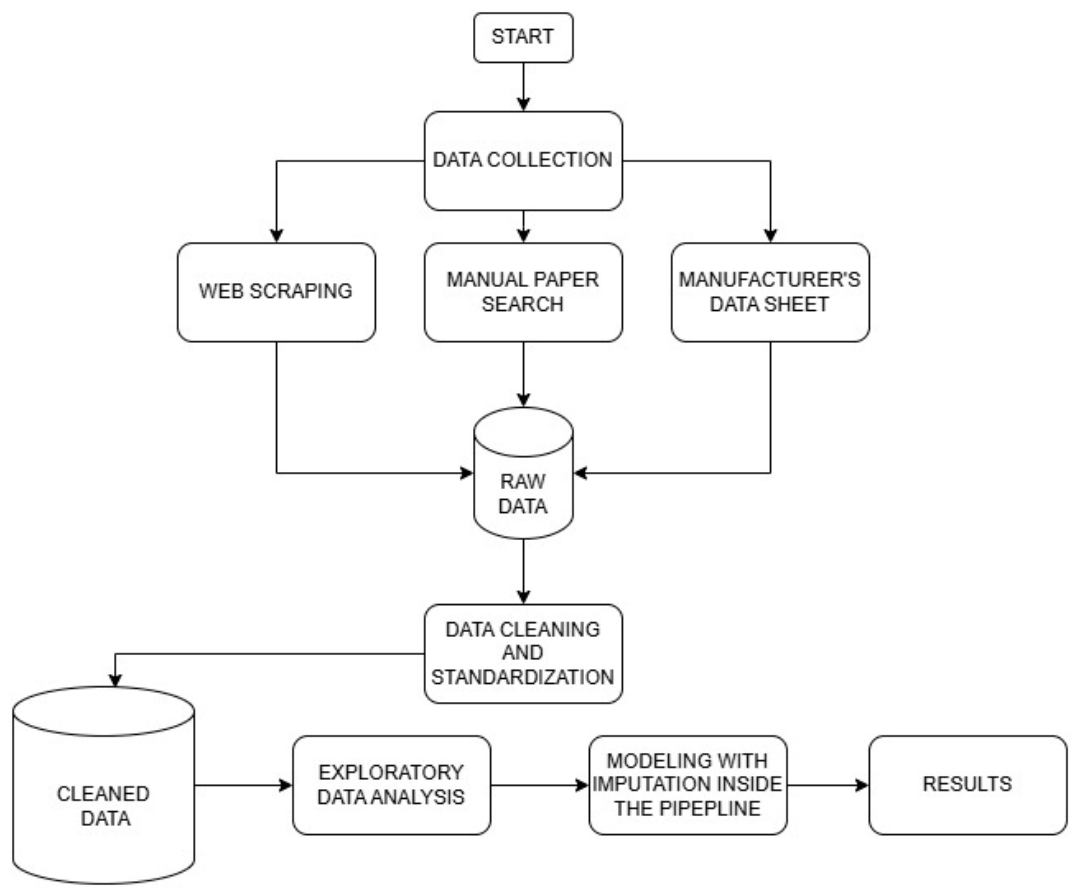
Figure 2.
A total of 543 datasets comprised of data from web-scraped data sources (WSDS), literature-derived data sources (LDDS), and manufacturers’ technical datasheets (MTDS).
Figure 2.
A total of 543 datasets comprised of data from web-scraped data sources (WSDS), literature-derived data sources (LDDS), and manufacturers’ technical datasheets (MTDS).
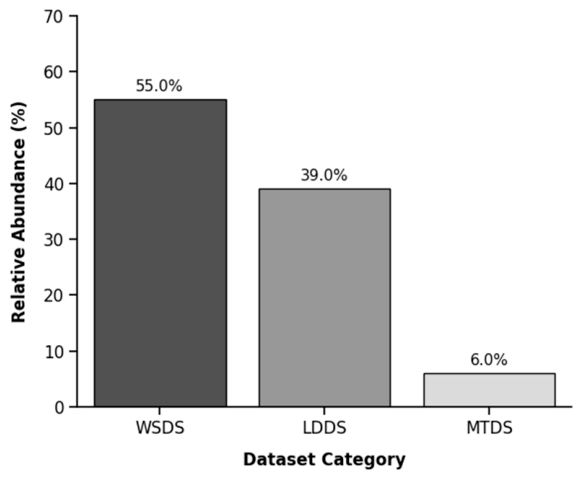
Figure 3.
Data distribution among the three different 3D printing materials.
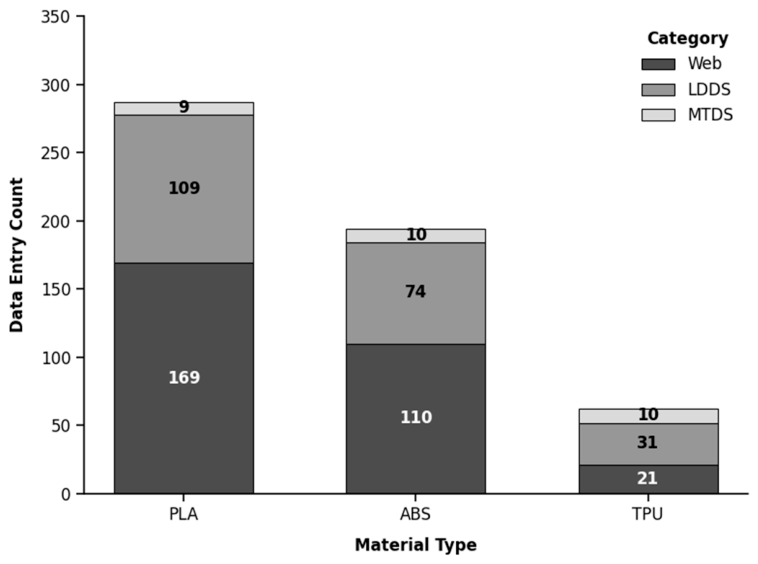
Figure 4.
Target distribution of data entries per material for (A) elongation %, (B) tensile strength, and (C) surface roughness.
Figure 4.
Target distribution of data entries per material for (A) elongation %, (B) tensile strength, and (C) surface roughness.
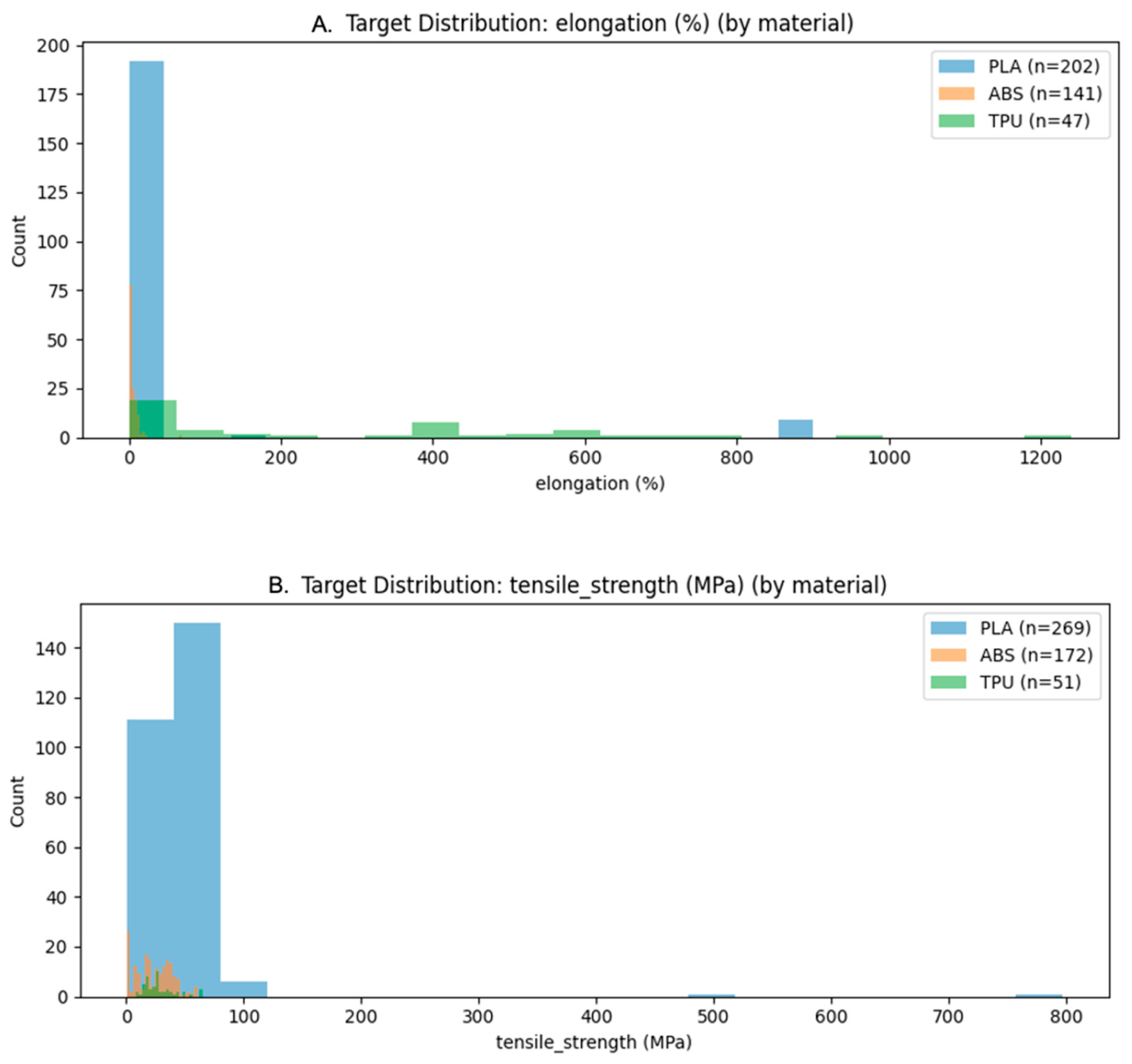
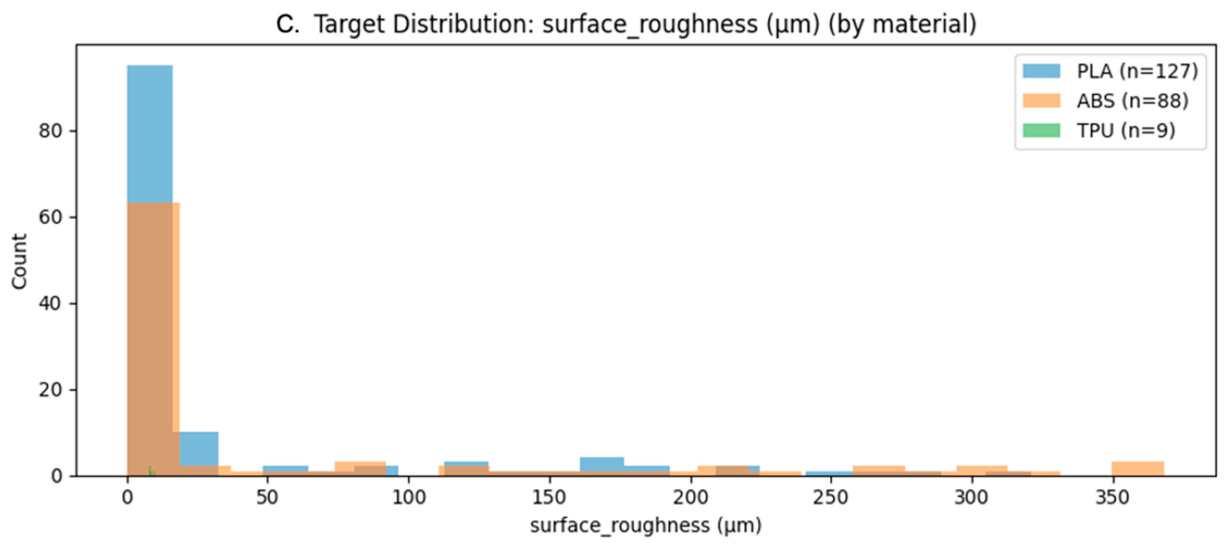
Figure 5.
Pearson correlation heatmap of numerical data in the combined materials dataset.
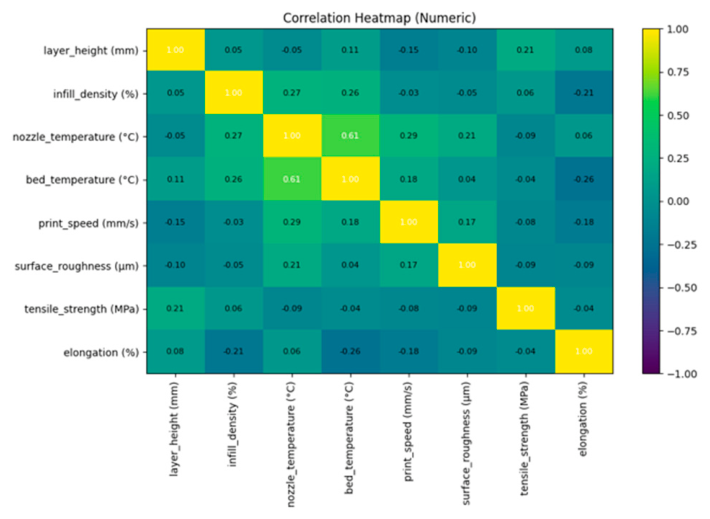
Figure 6.
Pearson correlation heatmap of numerical data in ABS filament dataset.
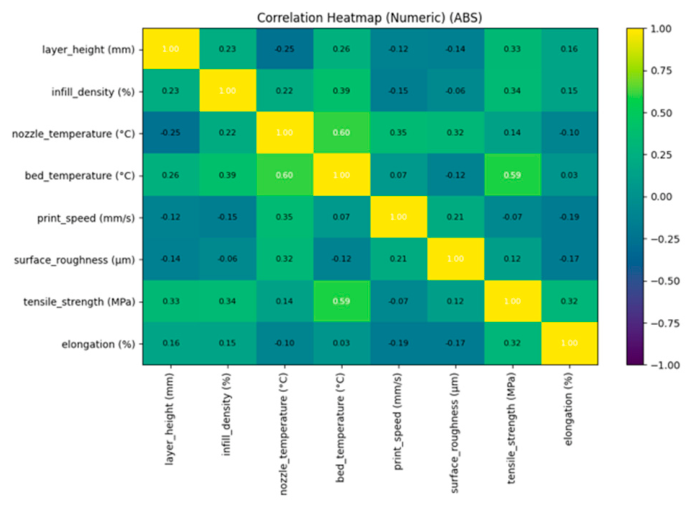
Figure 7.
Pearson correlation heatmap of numerical data in PLA filament dataset.
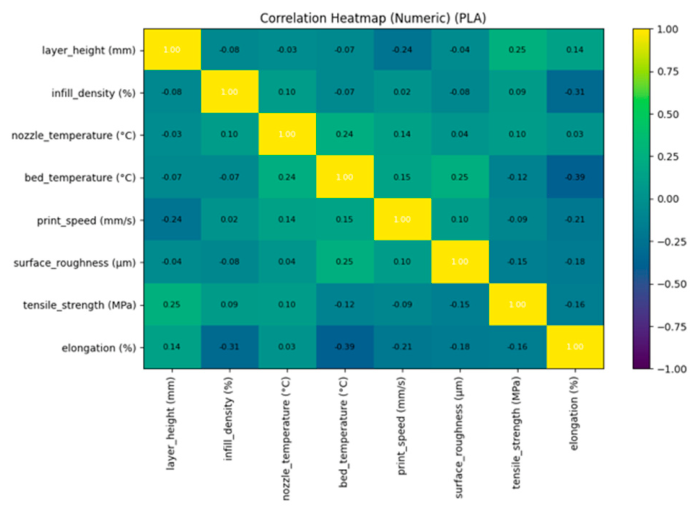
Figure 8.
Pearson correlation heatmap of numerical data in TPU filament dataset.
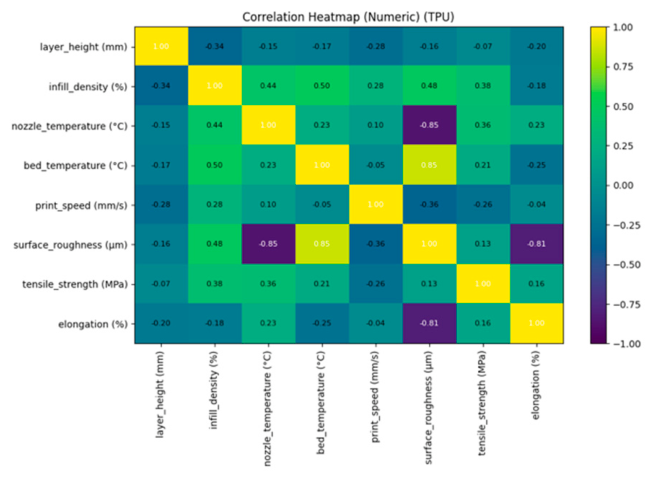
Figure 9.
Heatmap summarizing mean R2 scores from K-fold cross-validation for each material–property–model combination.
Figure 9.
Heatmap summarizing mean R2 scores from K-fold cross-validation for each material–property–model combination.
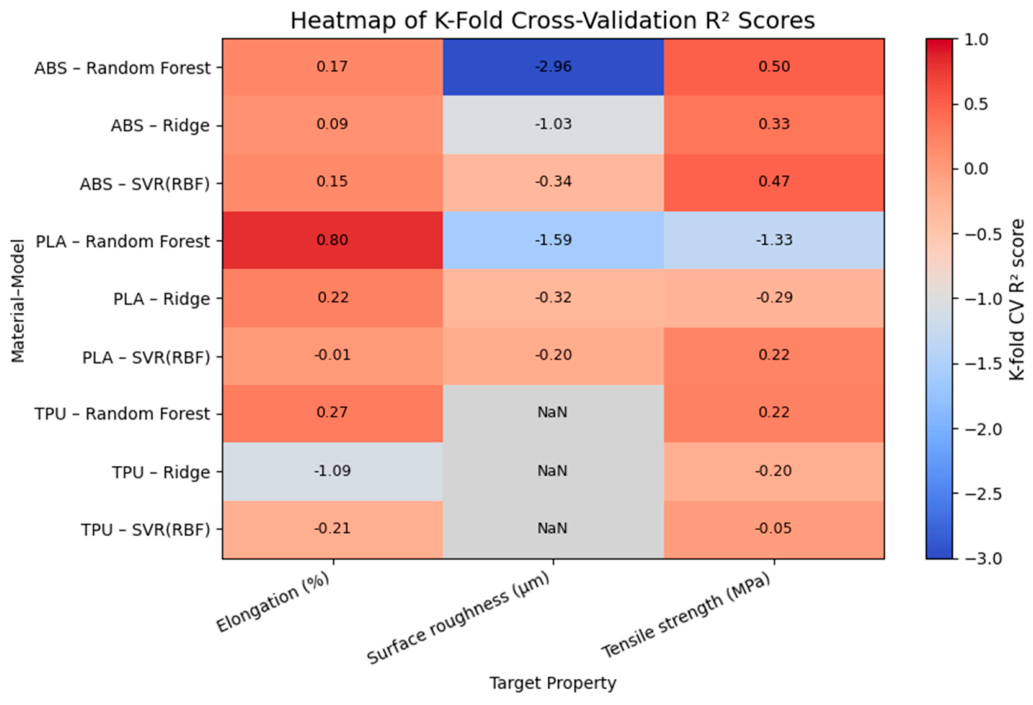
Figure 10.
Bubble plot of model applicability to materials and mechanical properties.
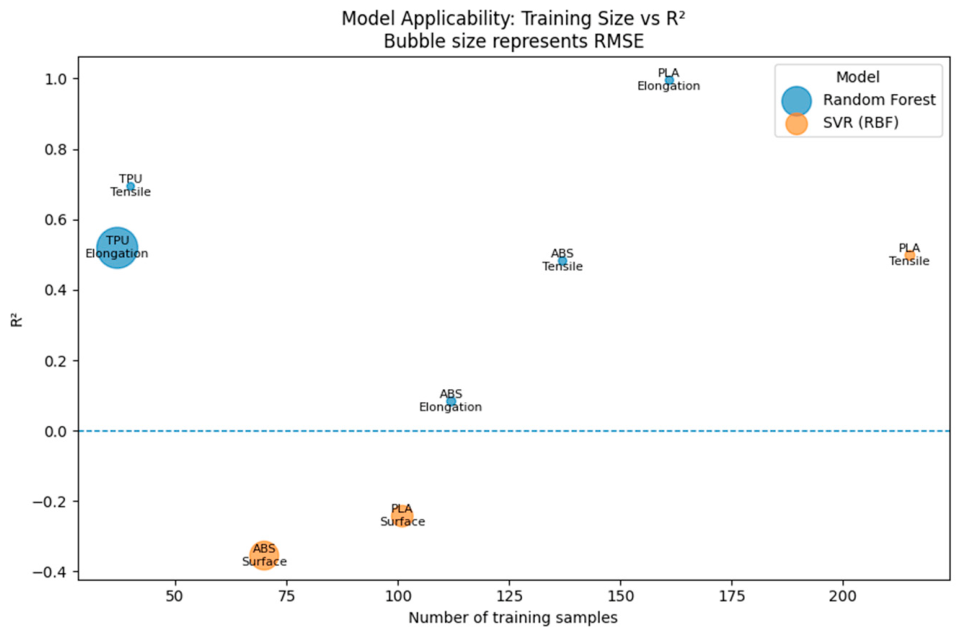
Table 2.
Summary of dataset variables, corresponding data types, missing counts, and missing percentages calculated relative to the total dataset size (n = 543).
Table 2.
Summary of dataset variables, corresponding data types, missing counts, and missing percentages calculated relative to the total dataset size (n = 543).
| Column | Data type | Missing count | Missing percentage (%) |
|---|---|---|---|
| Fan speed (%) | Object | 344 | 63.35 |
| Wall thickness (mm) | Object | 324 | 59.67 |
| Surface roughness (µm) | Object | 294 | 54.14 |
| Infill pattern | Object | 242 | 44.57 |
| Elongation (%) | Object | 153 | 28.18 |
| Bed temperature (°C) | Float64 | 129 | 23.76 |
| Print speed (mm/s) | Float64 | 112 | 20.63 |
| Infill density (%) | Float64 | 52 | 9.58 |
| Tensile strength (MPa) | Float64 | 51 | 9.39 |
| Layer height (mm) | Float64 | 46 | 8.47 |
| URL | Object | 30 | 5.52 |
| Title of paper | Object | 30 | 5.52 |
| Nozzle temperature | Float64 | 17 | 3.13 |
| ID | Int64 | 0 | 0.00 |
| Material | Object | 0 | 0.00 |
| Source | Object | 0 | 0.00 |
Table 3.
Outlier detection summary using IQR for all materials.
| Column | Count (Non-missing) |
Outliers | Outlier percentage (%) |
Lower fence | Upper fence |
|---|---|---|---|---|---|
| Surface roughness (µm) | 224 | 45 | 20.09 | -18.050 | 37.17 |
| Elongation (%) | 390 | 49 | 12.56 | -6.98 | 16.50 |
| Print speed (mm/s) | 431 | 43 | 9.98 | 10.00 | 90.00 |
| Layer height (mm) | 497 | 15 | 3.02 | -0.05 | 0.35 |
| Tensile strength (MPa) | 492 | 4 | 0.81 | -24.34 | 90.18 |
| Nozzle temperature (°C) | 526 | 1 | 0.19 | 180.00 | 260.00 |
| Infill density (%) | 491 | 0 | 0.00 | -25.00 | 175.00 |
| Bed temperature (°C) | 414 | 0 | 0.00 | 30.00 | 110.00 |
Table 4.
Outlier detection summary of ABS filament (number of rows = 194) using IQR per target.
| Column | Count (Non-missing) |
Outliers | Outlier percentage (%) |
Lower fence | Upper fence |
|---|---|---|---|---|---|
| Surface roughness (µm) | 88 | 18 | 20.45 | -68.32 | 116.19 |
| Elongation (%) | 141 | 5 | 3.55 | -9.05 | 17.75 |
| Tensile strength (MPa) | 172 | 0 | 0.00 | -27.28 | 72.61 |
Table 5.
Outlier detection summary of PLA filament (number of rows = 194) using IQR per target.
| Column | Count (Non-missing) |
Outliers | Outlier percentage (%) |
Lower fence | Upper fence |
|---|---|---|---|---|---|
| Surface roughness (µm) | 127 | 22 | 17.32 | -16.49 | 35.03 |
| Elongation (%) | 202 | 13 | 6.44 | -3.60 | 11.60 |
| Tensile strength (MPa) | 269 | 6 | 2.23 | -10.90 | 87.82 |
Table 6.
Outlier detection summary of TPU filament (number of rows = 62) using IQR per target.
| Column | Count (Non-missing) |
Outliers | Outlier percentage (%) |
Lower fence | Upper fence |
|---|---|---|---|---|---|
| Surface roughness (µm) | 9 | 1 | 11.11 | 5.75 | 12.55 |
| Elongation (%) | 51 | 3 | 5.88 | -5.11 | 58.11 |
| Tensile strength (MPa) | 47 | 1 | 2.13 | -641.29 | 1088.77 |
Table 7.
Summary of K-fold CV result (for simplicity, we used R2 here) per material per target.
| Material | Model | Elongation (%) | Surface roughness (µm) |
Tensile strength (MPa) |
|---|---|---|---|---|
| ABS | Random Forest | 0.172406 | -2.961059 | 0.495726 |
| ABS | Ridge | 0.092912 | -1.034803 | 0.325366 |
| ABS | SVR(RBF) | 0.148524 | -0.339946 | 0.472321 |
| PLA | Random Forest | 0.799896 | -1.592788 | -1.327432 |
| PLA | Ridge | 0.220486 | -0.322177 | -0.285482 |
| PLA | SVR(RBF) | -0.014096 | -0.200784 | 0.216332 |
| TPU | Random Forest | 0.271683 | NaN | 0.224321 |
| TPU | Ridge | -1.088215 | NaN | -0.203748 |
| TPU | SVR(RBF) | -0.214365 | NaN | -0.045401 |
Table 8.
Single test/train result with 80% training dataset and 20% test dataset (best model per material per target).
Table 8.
Single test/train result with 80% training dataset and 20% test dataset (best model per material per target).
| Material | Target | Model | Imputation method | No. of train | No. of test | MAE | RMSE | R2 |
|---|---|---|---|---|---|---|---|---|
| ABS | Elongation (%) | Random Forest |
KNN | 112 | 29 | 4.59 | 12.09 | 0.083 |
| ABS | Surface roughness (µm) | SVR (RBF) |
KNN | 70 | 18 | 61.93 | 121.17 | -0.355 |
| ABS | Tensile strength (MPa) | Random Forest |
KNN | 137 | 35 | 8.31 | 10.24 | 0.482 |
| PLA | Elongation (%) | Random Forest |
KNN | 161 | 41 | 3.34 | 10.11 | 0.995 |
| PLA | Surface roughness (µm) | SVR (RBF) |
Mean | 101 | 26 | 32.38 | 67.31 | -0.243 |
| PLA | Tensile strength (MPa) | SVR (RBF) |
KNN | 215 | 54 | 8.24 | 13.72 | 0.498 |
| TPU | Elongation (%) | Random Forest |
KNN | 37 | 10 | 120.95 | 247.94 | 0.519 |
| TPU | Surface roughness (µm) | NaN | NaN | NaN | NaN | NaN | NaN | NaN |
| TPU | Tensile strength (MPa) | Random Forest |
KNN | 40 | 11 | 5.46 | 8.35 | 0.694 |
Disclaimer/Publisher’s Note: The statements, opinions and data contained in all publications are solely those of the individual author(s) and contributor(s) and not of MDPI and/or the editor(s). MDPI and/or the editor(s) disclaim responsibility for any injury to people or property resulting from any ideas, methods, instructions or products referred to in the content. |
© 2026 by the authors. Licensee MDPI, Basel, Switzerland. This article is an open access article distributed under the terms and conditions of the Creative Commons Attribution (CC BY) license (http://creativecommons.org/licenses/by/4.0/).
Copyright: This open access article is published under a Creative Commons CC BY 4.0 license, which permit the free download, distribution, and reuse, provided that the author and preprint are cited in any reuse.


