
Submitted:
05 June 2026
Posted:
09 June 2026
You are already at the latest version
Abstract
Background: The Analytic Thinking Score (ATS) has been interpreted as a linguistic marker of organized thought. Written language typically shows higher ATS than spoken language. From the perspective of active inference under the free energy principle, we proposed a neurocomputational model of the mechanism underlying this writing-over-speaking advantage. We propose that ATS reflects precision-weighted inference over latent conceptual-organization (CO) states during language production. We hypothesize that written production supports higher ATS when it increases posterior confidence in high-CO states. Methods: University students described Thematic Apperception Test images in spoken and written modalities. ATS values were obtained from the resulting language samples. Participants were modeled as active-inference agents using a two-timestep Markov decision process (MDP) in which observed speaking and writing cues updated beliefs about latent CO states. Belief updating was formalized through variational message passing and interpreted in terms of prediction-error signaling and precision-weighted neuronal synaptic gain. An attention-related parameter (AP) controlled the precision and directionality of the mapping between latent CO states and observed production cues. Bayesian model selection was used to assess the model’s construct validity. Results: Written responses showed higher ATS than spoken responses. The group-level AP estimate indicated that writing cues supported posterior inference toward high-CO states stronger than speaking cues. Bayesian model selection favored the active-inference MDP over a Variational Laplace linear model. Conclusions: Writing may increase ATS by providing production cues that support precision-weighted inference toward high-CO states. ATS is therefore interpreted as a downstream linguistic trace of latent CO inferred during language production.
Keywords:
active inference
; natural language processing
; analytic thinking
; writing
1. Introduction
Language serves as a fundamental tool for organizing and expressing thoughts. It not only enables communication but also reflects underlying cognitive processes that guide how individuals interpret, organize, and interact with the world [1]. Consider, for example, a picture-description task, such as the thematic apperception test [2]. In general, in this task participants produce short narratives about a visual depiction (e.g., pictures or drawings). The basic trial consists of two stages. The participant expects the presentation of the visual depiction, and once the visual depiction is shown the participant produces a short narrative about its content.
The narrative’s production entails at least two stages: prelinguistic and linguistic stages. In the prelinguistic stage, the speaker constructs an internal representation of the picture content whereas in the linguistic stage the speaker translates or encodes that representation into words [3,4,5,6,7]. These stages are not unique to speaking. The analogue in writing-production models is the planning, idea-generation, or content-generation stage, in which writers generate, select, and organize ideas before translating them into written language [8,9,10,11,12,13,14,15,16,17].
Regardless of the language-production modality, the prelinguistic stage refers to the unobservable conceptual apprehension [18,19], conceptual or event representation [19,20], or conceptual organization (CO) [21] in the mind of the speaker or writer, which is subsequently grammatically encoded [4]. Although these terms originate in different theoretical traditions, they all refer to an internal semantic representation of external or internal stimuli. In this manuscript, the term CO is used as an encompassing construct for this prelinguistic semantic organization.
Despite the distinction between prelinguistic and linguistic stages, the structure of the language produced during the linguistic stage can reveal prelinguistic patterns of CO and broader cognitive traits, including abstract reasoning ability [22], working-memory load [23], and individual differences in personality, emotional expression, and mental health [24,25,26]. Advances in computational linguistics and natural-language processing have made it possible to quantify these patterns objectively [27]. One such measure is the analytic thinking score (ATS), developed within the Linguistic Inquiry and Word Count framework, LIWC, [28,29].
The ATS is a continuous variable ranging from 0 to 100 that indexes the relative degree of categorical versus narrative thinking expressed in language. High ATS values are associated with categorical function words, especially articles and prepositions, whereas lower values are associated with more narrative or context-dependent function words, including adverbs, pronouns, negations, auxiliary verbs, and conjunctions. For example, consider the text “The car by the house near the building was in the garage. He drove it there because they felt really scared and could not stay inside anymore”. The first sentence is article- and preposition-dense and therefore receives a high ATS (100), whereas the second sentence contains more narrative/context-dependent function words and therefore receives a low ATS (0.05). The overall ATS (66.02) reflects the relative balance of these linguistic markers.
ATS has been assigned psychometric [25,27]and clinical significance [21,30]. For example, Silva, et al. [30] and Limongi, et al. [21] showed that individuals with first-episode schizophrenia produced spoken responses with significantly lower ATS than healthy controls, suggesting that reduced linguistic structure may reflect conceptual disorganization, or lower CO. Notably, this effect emerged despite no group differences in the overall proportion of function and content words, emphasizing ATS as a stylistic marker of thought organization rather than merely a marker of lexical quantity.
Observational studies indicate that ATS differs across spoken and written registers, with higher scores typically observed in written language [31,32]. Moreover, university students whose essays contain a greater proportion of categorical function words relative to narrative function words, that is, higher ATS, tend to achieve higher academic grades [22]. More recent work also links ATS in written registers to cognitive variables [33]. These findings suggest that writing may provide especially favorable conditions, for example increased attentional focus for the generation of organized CO. However, the psychological status of ATS has been established primarily through correlational analyses between function-word use and presumed cognitive variables [22,33]. Furthermore, no study has directly compared ATS across spoken and written language modalities under controlled laboratory conditions while also formalizing the underlying neurocognitive mechanism.
The present manuscript addresses this gap by developing a Bayesian-brain, active-inference model of the ATS as a linguistic index of the prelinguistic CO. The paper proceeds in four steps. First, it establishes the idea of precision-weighted inference over CO through a succinct high conceptual link between the words-as-attention assumption in natural language processing, CO, and attention as a synaptic gain mechanism. Second, it formalizes this link at Marr’s [34] three levels of analysis within an active-inference (Markov decision process, MDP) model. Third, it instantiates the model through a laboratory-controlled experiment. Finally, it assesses the construct validation of the MDP model within the framework of Variational Laplace, free energy, and Bayesian model selection.
From Words-as-Attention to Attention as Synaptic Gain During Precise Inference of CO
Traditionally, natural-language processing approaches for inferring unobserved cognitive processes from observed fine-grained linguistic features, such as word counts, have assumed that words provide observable evidence of attention. This idea is often described as the words-as-attention assumption [35]. Eye-movement research [18,36] has also provided evidence for the fundamental role of attention during the unobserved prelinguistic stage of language production, when speakers and writers selectively sample and organize information before encoding it into language. Together, these lines of research suggest that ATS derived from computational analyses of linguistic registers may reflect attentional foci that emerged during the unobservable or hidden prelinguistic CO and were later encoded into observable language.
From a neurobiological perspective, attention can be understood as synaptic gain control. Synaptic gain refers to the responsiveness of neuronal populations to incoming input: when gain is increased, the same sensory input produces a stronger postsynaptic response and has greater influence on downstream processing. In predictive-processing and active-inference accounts, attention is often interpreted as increasing the gain of neuronal populations encoding prediction errors, thereby making selected sensory signals more precise, or more influential, during perceptual inference [4,5,6]. Heuristically, focusing attention on a stimulus means giving that stimulus more weight when the brain updates its interpretation about the stimulus content.
The picture-description task provides a suitable experimental design for assessing whether ATS reflects attention during prelinguistic CO. In this task, participants are cued to either speak or write a narrative about the content of a picture. The central claim is not that writing directly produces higher ATS. Rather, the speaking or writing cue helps the participant interpret what kind of CO is required for the task. In the formal model introduced below, this cue-guided interpretation is represented as the precision with which speaking or writing cues guide inference over CO. When the cue is treated as clear and reliable (i.e., precise), it produces stronger confidence in the corresponding form of CO.
Under this formulation, high ATS is expected when the participant becomes highly confident in a writing-associated form of CO: that is, a more stable, categorical, and analytically organized way of preparing the picture content for language. Conversely, low ATS is expected when the participant becomes highly confident in a speaking-associated form of CO, which is assumed to be more narrative and context-dependent. Therefore, the writing-over-speaking advantage in analytic thinking could be interpreted as the behavioral expression of more precise cue-guided inference over CO, rather than as a direct consequence of writing per se.
The process described above imposes a computational problem for the participant. During picture description, the participant must determine what kind of conceptual organization the task requires: a more categorical, writing-associated form of CO or a more narrative, speaking-associated form of CO. This determination cannot be read directly from the picture itself. Rather, it must be inferred by combining the speaking or writing cue, prior expectations about the picture, and incoming sensory information from the picture. The participant must also determine how much weight, or confidence, to assign to the speaking or writing cue when using it to guide CO. In other words, the task requires not only inference over what form of CO is currently relevant, but also inference over the precision with which the cue should guide that CO. In the following section, we formalize the solution of these problems in terms of Marr’s levels of analysis [34] applied to active inference and the Bayesian brain.
The Bayesian Brain and the ATS Through Marr’s Levels of Analysis
Marr’s computational, algorithmic, and implementational levels of analysis provide a useful framework for linking cognitive theories, computational models, and neural mechanisms [37,38]. The computational level specifies the problem an agent must solve and why that problem matters. In the present case, the problem is to infer the CO state under which a picture-description response is generated. The algorithmic level specifies the procedures by which this inference is performed. The implementational level specifies how the algorithm could be realized neurally.
In the present formulation, the computational level is expressed as Bayesian inference framed within a two-timestep Markov decision process (MDP). Here, the participant is modeled as an active-inference agent that infers a hidden CO state from observed speaking and writing cues. Attention enters the model as the precision with which observed cues are mapped onto hidden CO states. The algorithmic level corresponds to marginal message passing; whereby posterior beliefs are iteratively updated to minimize variational free energy. The implementational level corresponds to a neural-process interpretation of the same updates, in which prediction-error signals and precision-weighted synaptic gain provide a plausible cortical implementation. Prediction error therefore bridges levels: it is the formal quantity that drives belief updating and the signal proposed to be encoded by neuronal populations in the neural implementation. Below, we detail all three levels of analysis.
Computational Level of Analysis: Inferring Latent CO States Through Bayes Theorem
Bayesian approaches to brain function, commonly referred to as the Bayesian-brain hypothesis [39,40,41,42,43,44,45,46] propose that the brain does not passively register the world but infers the hidden causes of sensory input. Because sensory evidence is often ambiguous, incomplete, or noisy, perception requires the integration of prior expectations with current evidence. A prior belief refers to what the system expects before new evidence is considered. Sensory evidence refers to the information currently available to the organism. A posterior belief is the updated belief that results from combining prior expectations with sensory evidence. Formally, this updating process can be described as the inversion of a generative model using Bayes theorem:
Here, CO denotes a hidden state, o denotes an observation (i.e., speaking or writing cue), P(CO) is the prior belief over hidden CO states, P(o | CO) is the likelihood: the probability of observing a particular speaking or writing cue if a given CO state were present. P(o) is the model evidence, and P(CO | o) is the posterior belief over hidden states after observing the speaking or writing cue. In words, the active-inference agent infers the most likely hidden CO state by combining what it expected before the observation of the speaking or writing cue with how strongly the observation supports each candidate CO state.
Active inference extends this Bayesian account by specifying how organisms use generative models to perceive and act. In active inference, there are four main families of models: static perception, dynamic perception, dynamic perception with policy selection, and dynamic perception with flexible policy selection [47]. In all four model families, perception corresponds to updating beliefs so that they better explain sensory observations, whereas action corresponds to changing sensory input so that it becomes consistent with expected or preferred states. In this implementation, the model falls within the family of dynamic perception and is specified as a two-timestep MDP. It therefore formalizes how active-inference agents infer CO states from sensory speaking and writing cues, not how they select among alternative actions.
The two-timestep MDP shown in Figure 1 realizes dynamic perception as inference over latent CO states. The hidden-state factor represents the level of CO under which the active-inference agent is preparing to describe the picture. Each trial begins in a start state, after which the agent uses the observed speaking or writing cue to infer whether the current picture-description context is more likely to support low or high CO. The hidden-state space is therefore start, low CO, and high CO.
The observation modality contains three possible outcomes: a start cue, a speaking cue, and a writing cue. The likelihood matrix (A) specifies the probability of each observed cue conditional on each hidden CO state. The (D) vector fixes prior beliefs over the initial state, whereas the (B) matrix allows transitions from the start state to either a low-CO or high-CO state.
The likelihood matrix illustrates how the present model adopts the active-inference account of attention as the precision-weighting of sensory evidence. In active inference, attention is treated as the inferred precision, or expected fidelity, of the mapping between hidden states and observations [48,49,50,51,52,53]. In the present model, this principle is applied to CO: the attention-related parameter AP controls the precision and directionality with which latent CO states are mapped onto observed speaking or writing cues.
Formally, the likelihood matrix specifies the probability of observing a start, speaking, or writing cue conditional on the current hidden CO state. The agent inverts this mapping to infer the most probable CO state from the observed speaking or writing cue. When AP = 0.50, speaking and writing cues are equally likely under either CO state, making the mapping maximally ambiguous. Thus, the observed cue provides no differential evidence for whether the agent is in a low-CO or high-CO state. As AP increases above 0.50, the mapping becomes increasingly diagnostic in the hypothesized direction: the speaking cue provides stronger evidence for a low-CO state, whereas the writing cue provides stronger evidence for a high-CO state. Conversely, as AP decreases below 0.50, the mapping becomes increasingly diagnostic in the opposite direction: the speaking cue provides stronger evidence for a high-CO state, whereas the writing cue provides stronger evidence for a low-CO state. In this sense, AP does not represent ATS itself, but the diagnostic precision with which speaking or writing cues disclose the latent CO state that is later expressed linguistically in ATS.
This formulation clarifies how AP relates to ATS. AP does not directly increase ATS. Rather, AP controls the precision and directionality of the mapping between latent CO states and observed speaking or writing cues, thereby determining how strongly an observed cue updates posterior beliefs about the latent CO state. The posterior belief over CO is the immediate computational bridge to ATS. In the present interpretation, high and low ATS are treated as stochastic behavioral readouts of posterior beliefs over latent CO states: a stronger posterior belief in the high-CO state increases the probability of producing a high-ATS text, whereas a stronger posterior belief in the low-CO state increases the probability of producing a low-ATS text. This can be expressed heuristically as:
where (y) denotes the observed linguistic outcome, (s) denotes the latent CO state, and (o) denotes the observed speaking or writing cue.
As posterior confidence in a high-CO state approaches 1, the active-inference agent is assumed to enter an attentional set that supports more stable, categorical, and analytically organized prelinguistic CO, which is expressed downstream as higher ATS. Conversely, as posterior confidence in a low-CO state approaches 1, the agent is assumed to enter an attentional set that supports less stable or less analytically organized CO, which is expected to yield lower ATS. The behavioral writing-over-speaking advantage therefore arises when the mapping is precise in the hypothesized direction, such that writing cues provide stronger evidence for high-CO states than speaking cues.
Algorithmic level of analysis: updating beliefs about CO states through marginal message passing
At the algorithmic level, belief updating over CO states is computed through marginal message-passing [54]. The two relevant updating equations can be written as follows:
At the first timestep, posterior beliefs over CO states are updated by combining the prior message from (D), the backward temporal message from the second time point, and the likelihood message supplied by the observed speaking or writing cue. At the second timestep, beliefs are updated by combining the forward message from the first time point with the likelihood message. In both equations, denotes the softmax normalization that converts log-probability messages into posterior beliefs over hidden CO states.
The likelihood message () is the component of the update through which the observed speaking or writing cue supplies evidence for the latent CO state. The strength and directionality of this evidence are controlled by AP, which determines how precisely latent CO states are mapped onto observed speaking or writing cues in the likelihood matrix. Thus, AP specifically modulates the sensory-evidence term in the message-passing update, while the (D) and (B) terms encode prior and temporal constraints on state inference.
This algorithmic formulation is important because the model contains two distinct time scales. The task itself has two time points, but the inference performed within each time point can involve multiple internal message-passing iterations. Thus, as explained below, a two-timestep MDP can implement an iterative neural updating process while processing a single speaking or writing cue.
Neural (implementational) Level of Analysis
In the neural process theory of active inference [49], the brain implements belief updating through a prediction-error formulation of message passing [48,50]. In predictive-processing formulations, neuronal populations encoding expectations about hidden states generate predictions, whereas prediction-error populations encode the mismatch between incoming evidence and current beliefs. These prediction errors update neuronal activity until posterior beliefs best explain the sensory evidence. Canonical-microcircuit accounts further motivate the interpretation of belief updating in terms of layered cortical message passing and precision-weighted synaptic gain [51,52].
Figure 2 depicts the simplified neural implementation used in the present model. The computer screen presents a clear picture-description stimulus together with a speaking or writing cue. However, the sensorium registers this input as a noisy sensory observation. Within the present formulation, lower diagnostic precision in the cue–CO mapping corresponds to less informative sensory evidence about the latent CO state, whereas higher diagnostic precision corresponds to a less ambiguous sensory message. For example, in the hypothesized direction of the present model, AP = 0.8 provides stronger evidence for the corresponding latent CO state than AP = 0.6. Feedforward sensory evidence projects toward the granular layer, where precision-weighted prediction-error messages are computed. These messages update state representations associated with the inferred CO state in supragranular layers.
In the picture-description task, prediction-error signals carry evidence about latent CO. A writing cue or speaking cue is compared against predictions generated from current beliefs about the latent CO state. The resulting prediction error updates neuronal activity encoding posterior beliefs about whether the agent is in a low-CO or high-CO state. AP can therefore be interpreted as a gain parameter on CO-relevant prediction errors. It is important to note that the figure is schematic: it is intended to show how active-inference message passing can be related to cortical layers, not to assign the entire model to a literal one-to-one anatomical circuit.
For the first and second timesteps respectively, the prediction-error formulation can be expressed as the difference between incoming model-based evidence and the current belief state:
For brevity, we explain the neuronal process at the second timestep (Figure 2). The prediction error (PE) signal results from the algebraic sum of the agent’s belief about the CO state transition before observing the speaking or writing cue, the likelihood message after observing either the writing or speaking cue, and the current posterior CO state belief, . The first two messages are excitatory, and the third message is inhibitory. Prediction error therefore expresses the mismatch between model-based evidence and the agent’s current posterior belief over the CO state.
Prediction error then updates the neuronal activity, or membrane voltage, underlying posterior belief. In continuous form, this can be written as:
Here, (v) denotes neuronal activity or membrane voltage, and (k) indexes belief-updating iterations. Importantly, (k) does not denote task time. Even in a two-timestep MDP, the system can perform multiple internal neural updates while processing a single observation. After each update, posterior beliefs over CO states are obtained by applying a softmax function to the updated voltage. The iterative process continues until prediction error is minimized and posterior beliefs settle. At convergence, the posterior belief over CO reflects the hidden organization state that best explains the speaking or writing cue. This posterior belief over CO is then interpreted as the latent inferential state expressed downstream in ATS.
Summary of the Model
The central thesis is that speaking and writing are not merely external conditions that directly alter analytic thinking. Rather, they are observed speaking or writing cues that provide sensory evidence about latent states of CO. The attention-related likelihood precision parameter, AP, modulates the precision and directionality of the likelihood mapping between latent CO states and observed speaking or writing cues, thereby shaping posterior beliefs about whether the current picture-description context is more consistent with a low-CO or high-CO state. These posterior beliefs constitute the immediate computational bridge to ATS: the MDP does not model ATS directly, it models the latent prelinguistic CO stage that is expressed downstream in in the linguistic stage.
Once the agent infers a low-CO or high-CO state, this posterior belief constrains the attentional and CO under which picture-derived evidence is sampled, organized, and prepared for linguistic encoding. ATS is therefore interpreted as the downstream linguistic expression of CO inferred through precision-weighted processing of speaking or writing cues. The causal chain can be summarized as follows:
Production cue→A(AP)→q(CO state)→attentional set→linguistic encoding→ATS
In this chain, (A(AP)) is the likelihood mapping controlled by the attention-related precision parameter. Formally, this likelihood specifies the probability of observing a speaking or writing cue conditional on the latent CO state. During inference, the agent inverts this mapping to infer the posterior probability of low versus high CO from the observed cue. The term q(CO state) denotes this posterior belief over latent CO states. The attentional set is the cognitive-neurobiological state associated with this posterior belief. Finally, ATS is the observable linguistic marker produced after the inferred CO state has been translated into language. In the following section, we report a laboratory-controlled experiment that instantiates the current formulation.
2. Materials and Methods
Participants
A sample of N = 17 (13 female) with a mean age of 20 (SD= 2.08) healthy subjects from Brandon University participated in the study. Fourteen participants (82%) identified English as their first language. Participants were recruited using posters, online advertising and through in-person outreach and received compensation of fifty dollars (gift card) at the end of the experimental session. Participants were required to be registered as an undergraduate or graduate student in any department or program at Brandon University, be at least 18 years of age and considered a ‘healthy subject’ – being they had no history of any neurological or mental health disorders. There were no other inclusion criteria. Participants provided written informed consent adhering to the regulations of Brandon University Research Ethics Committee. Sample size estimation was based on sequential analysis and optional stopping [55,56].
Optional Stopping for Sample Size Definition
After collecting data from 10 participants, we fit Bayesian ANCOVA models to the ATS, including condition as a fixed effect, participant as a random effect, and number of words as a covariate. All ANCOVA models were implemented in JASP [57]. We defined a stopping criterion based on BF₁₀ > 10, indicating strong evidence [58] in support of higher ATS in the writing condition compared to the speaking condition Data collection proceeded one participant at a time, with BF₁₀ recomputed after each addition, until the threshold was reached.
Procedure
Participants were seated at a computer desk and provided verbal instructions of the experimental procedure. All participants received the same instructions and were informed the purpose of the study was to collect discourse samples while viewing pictures. Written instructions were provided on the computer screen before beginning two familiarization trials. Specifically, participants were instructed: “In this task, you will be shown a series of images. For each image, we ask that you carefully observe it while at the same time describing what you see. Describe the picture with as much detail as you can. Tell us what you see in the image, describe any elements you wish, and what you think might be happening. At times, you may be prompted to describe the image out loud. At other times, you may be asked to type your response on the computer keyboard. Please provide as much detail as possible in either format. There is no right or wrong answer; we are simply interested in your observations and thoughts. You will have a 2-minute window to respond to each image. You may stop early if you have no further comments. After the 2-minutes is up there will be an opportunity to rest before the next image is presented.”. The researcher remained in the room for the entire experiment.
Stimuli
Experimental stimuli consisted of ten images taken from the thematic apperception test bank [2] and were presented on a Dell Pro 24 Plus (P2425H) computer monitor positioned approximately 30 inches away from the participant. All pictures were presented at a consistent size (portrait, 5x7 inches) and displayed on a neutral grey background. Directly below the image, the language condition cue was indicated using a single capitalized letter (S for speak, W for write) in black type font. The image and language condition cue were presented simultaneously to the participant. Prior to being exposed to the experimental block, participants completed a familiarization trial using two black and white images that did not belong to the TAT test bank and had the opportunity to ask any questions regarding the task before moving onto the experimental stimuli.
Experimental Task
Participants completed an experimental block viewing 10 images, responding to 5 in written modality and 5 in spoken modality, with the opportunity to rest after images. Image order and response modality was randomized and counterbalanced across participants. Participants were simultaneously presented with an image and response modality cue and had 120 seconds to respond to each image. As specified in the task instructions, participants were requested to describe the image in as much detail as possible and that they could create a narrative or story about what they saw. Spoken responses were audio recorded using a headset-mounted microphone and were later transcribed by the researcher. Written responses were typed using the keyboard and automatically logged into an excel file on the computer system. The task was built using PsychoPy [59],
Data Processing and Analysis
Speech samples were transcribed and preprocessed to remove fillers and stutters. Written samples were corrected for typos and abbreviations. All 170 discourse samples were formatted as individual plain text files. Using LIWC-22 [28], we obtained trial-wise ATS. At the subject level and collapsed across conditions, ATS values were discretized based on each participant’s median distribution; scores equal to or below the median were categorized as low ATS, whereas scores above the median were categorized as high ATS. We used SPM12 (http://www.fil.ion.ucl.ac.uk/spm/) and modified scripts available in [47,60] to specify and estimate the parameters of the two-timestep MDP model described and explained in the previous section.
3. Results
Behavioral Results
Table 1 summarizes the behavioral results. Mean ATS was higher in the writing condition than in the speaking condition. A Bayesian ANCOVA model comprising fixed effect of condition, random effect of subject and trial, and numbers of words as covariate of no interest confirmed this difference and ruled out an effect of number of words (i.e., the model including the covariate received less support, BF₁₀ = 8.80 × 10⁸, than the model without the covariate, BF₁₀ = 2.04 × 10⁹ 10. Table 2 shows the estimates of the winning model. We further fit a Bayesian generalized linear mixed effects model (binomial family) to confirm that the ATS difference between conditions remained after discretization (Table 3 shows the estimates in logit units, and Figure 3 shows the transformed estimates to probabilities).
Computational Model Results
Model Parameter Estimates and Parametric Empirical Bayes (PEB)
Table 4 shows the subject-level parameter estimates of the MDP model. The subject-level posterior estimates of the attention-related parameter AP, transformed from logit space to probability space, ranged from 0.50 to 0.72. Descriptively, the mean transformed estimate was (M = 0.59), (SD = 0.07), indicating that the estimated likelihood mapping was above the non-diagnostic value of 0.50.
To formally assess whether AP exceeded its non-diagnostic value at the group level, we submitted the first-level posterior estimates to a second-level Parametric Empirical Bayes model [61,62]. Importantly, AP was estimated in logit space at the first level and was transformed into probability space only for interpretation. Therefore, in the PEB model and associated SPM output, the relevant null value is 0, not 0.50. This is because a logit-scale value of 0 corresponds exactly to (AP = 0.50) on the probability scale. Thus, testing whether the group-level PEB estimate is greater than 0 in logit space is equivalent to testing whether the transformed AP parameter is greater than 0.50 in probability space.
The PEB model yielded a positive group-level posterior estimate (AP = 0.657), after applying the transformation to a probability scale. The posterior probability that the group-level logit parameter was greater than 0 was approximately 1.00, providing strong evidence that the estimated attention-related likelihood precision parameter exceeded its non-diagnostic value of 0.50 on the probability scale (Figure 4). In the present model, this indicates that, at the group level, the likelihood mapping was diagnostic in the hypothesized direction, with writing cues providing stronger evidence for high-CO states and speaking cues providing stronger evidence for low-CO states.
Construct validity: Bayesian Model Selection
Because the present MDP embodies the theoretical construct of latent conceptual organization, operationalized as precision-weighted inference from speaking or writing cues to CO states, we assessed its construct validity by comparing it against a simpler descriptive model of ATS estimated under Variational Laplace. This comparison was motivated by the distinction between describing a condition effect and explaining the latent process that could have generated it. A linear model can test whether ATS differs between speaking and writing, but it treats production condition as an observed predictor acting directly on ATS. It therefore quantifies the writing-over-speaking effect without formalizing the hidden inferential mechanism through which participants use speaking or writing cues to infer latent CO states, establish an attentional set, and generate linguistic output.
By contrast, the active-inference MDP formalizes the hypothesis that speaking and writing are not merely external response formats but observed cues that provide evidence about latent states of CO.
Variational Laplace [63] provides a common Bayesian estimation framework for this comparison because it returns an approximation to the log model evidence, or variational free energy, for each fitted model. This is important because model evidence evaluates accuracy and complexity jointly. A model is favored only when its gain in explanatory accuracy justifies its additional complexity. Therefore, comparing the variational free energies of the linear model and the MDP provides a principled test of whether the mechanistic active-inference model explains the ATS data better than a simpler descriptive account.
At the group level, we used random-effects Bayesian model selection following Rigoux, et al. [64]. This framework is appropriate because it does not assume that the same model generated every participant’s data. Instead, it treats model identity as a random effect and estimates the expected frequency with which each model occurs in the population. This is especially suitable for behavioral and cognitive data, where participants may differ in the extent to which their responses are governed by the hypothesized latent mechanism. The protected exceedance probability was used as the main index of model superiority because it estimates the probability that one model is more frequent than the competing model while correcting for the possibility that apparent differences in model frequencies arise by chance. The Bayesian omnibus risk was also reported because it estimates the probability that the apparent model-frequency differences are not meaningful.
Random-effects Bayesian model selection favored the active-inference MDP over the Variational Laplace linear model. The MDP showed a protected exceedance probability of 0.95, indicating a high probability that it was the more frequent model in the population after correcting for chance differences in model frequency. The Bayesian omnibus risk was low, (BOR = 0.08), indicating a relatively small probability that the observed differences in model frequency reflected random variation. Together, these results indicate that the MDP provided a better account of the ATS data than the Variational Laplace linear model after accounting for model complexity.
Discussion
The present study proposed and tested a Bayesian-brain active-inference model of the writing-over-speaking advantage in analytic thinking. The central claim is that speaking and writing are not merely external production conditions that directly alter analytic thinking; they are observed production cues that provide sensory evidence about latent states of conceptual organization (CO).
Within the model, the observed speaking or writing cue updates posterior beliefs about whether the current picture-description condition is more consistent with a low-CO or high-CO state. These posterior beliefs are hypothesized to establish an attentional set that shapes how picture-derived evidence is sampled, organized, and prepared for linguistic encoding. Accordingly, ATS is interpreted as the downstream linguistic expression of precision-weighted inference over latent CO.
This interpretation is consistent with cognitive-process models of writing, in which writing involves recursive coordination among planning, translating, reviewing, and monitoring processes [8,9,10,11,12,13,14,15,17]. From this perspective, writing may increase ATS because it permits pausing, rereading, revision, and repeated coordination between the visual stimulus and the emerging linguistic response. Writing also provides a relatively stable external trace of the developing response, which may support the maintenance and reorganization of picture-derived content before it is encoded linguistically. The finding that written responses produced higher ATS than spoken responses is therefore interpreted not as a direct effect of writing on word choice, but as the downstream linguistic consequence of a production cue that more strongly supports posterior inference toward a high-CO state. As discussed below, this interpretation extends the words-as-attention assumption by treating observed linguistic markers as traces of cue-guided attentional and inferential processes during prelinguistic CO.
Expanding the Words-as-Attention Assumption to a Formal Active Inference Framework and Neural Implementation
The present model assigns a formal and biologically plausible role to attention, albeit in the specific context of picture-description tasks. The AP parameter determines the diagnosticity and directionality of the likelihood mapping between latent CO states and observed speaking or writing cues. When AP = 0.50, speaking and writing cues are maximally ambiguous because each cue is equally likely under low- and high-CO states. As AP moves away from 0.50, the likelihood mapping becomes increasingly diagnostic. Values above 0.50 indicate the hypothesized mapping in which writing cues provide stronger evidence for high CO and speaking cues provide stronger evidence for low CO. Values below 0.50 indicate the reversed mapping, in which speaking cues provide stronger evidence for high CO and writing cues provide stronger evidence for low CO.
This distinction is important for interpreting ATS. Greater likelihood precision does not imply that ATS should increase uniformly in both speaking and writing conditions. Rather, precision strengthens posterior confidence in the latent CO state supported by the observed cue. When the likelihood mapping is precise in the hypothesized direction, a writing cue should increase posterior confidence in a high-CO state, which is expected to support more stable, categorical, and analytically organized prelinguistic conceptual organization. Conversely, a speaking cue should increase posterior confidence in a low-CO state, which is expected to yield lower ATS relative to writing. Thus, precision amplifies the condition-specific consequences of cue-based inference over latent CO rather than exerting a uniform positive effect on ATS.
At the implementational level, this attentional precision can be interpreted as synaptic gain. Specifically, in the prediction-error formulation of the model, the likelihood message expresses what the observed speaking or writing cue implies about the latent CO state. AP determines the precision and directionality of this likelihood message. When AP differs from 0.50, the likelihood message becomes more discriminative, producing a stronger update to neuronal activity or membrane voltage during belief updating. Thus, AP can be interpreted as modulating the strength of the neural message by which the observed speaking or writing cue updates beliefs about latent CO.
From External Validation to a Computational Phenotyping Role of the ATS
The ATS has already received evidence for external validity [22,33]. The present account extends this work by providing a construct-validating model of one possible generative mechanism underlying ATS. Specifically, the model attempts to connect computational demands, algorithmic belief updating, and plausible neural implementation within a single explanatory framework.
The Bayesian model comparison provides construct-validating evidence for the proposed active-inference account. The linear model captured the descriptive association between production modality and ATS, but it treated speaking and writing as observed predictors acting directly on the behavioral outcome. By contrast, the MDP embedded this condition effect within a generative architecture in which production cues update posterior beliefs over latent CO states through a precision-weighted likelihood mapping. The finding that the MDP outperformed the linear model therefore suggests that the writing-over-speaking effect is better understood not simply as a direct consequence of production modality, but as the behavioral expression of an inferred latent CO state.
This construct validity also supports the interpretation of subject-level AP estimates beyond classical group-level analysis. Although the group-level PEB estimate indicated that the cue–CO mapping was more diagnostic than the non-informative value of 0.50, individual estimates varied across participants. Some participants showed estimates close to the non-diagnostic boundary, whereas others showed stronger evidence for a precise mapping between latent CO states and observed speaking or writing cues. These differences should not be treated merely as noise around the group mean. Within the active-inference framework, they may reflect meaningful individual variability in the precision with which speaking or writing cues establish posterior beliefs about CO. In psychological terms, some participants may use the speaking/writing cue as a strong organizer of attention, whereas others may rely less strongly on that cue when sampling and organizing picture-derived evidence.
The subject-level AP estimates also have a possible neural interpretation. Participants with AP estimates close to 0.50 would correspond to weaker gain on cue-related prediction-error signals. Values above 0.50 indicate stronger gain in the hypothesized direction, whereas values below 0.50 would indicate stronger gain in the reversed direction. Although no neural data were collected, these differences provide a principled computational hypothesis for future studies: individuals may differ in the degree to which production cues modulate neural gain and thereby organize prelinguistic attentional sampling.
Future directions
The neural interpretation of the current model opens new lines of research on the generative mechanisms of ATS. Future studies combining the present task with electroencephalography, pupillometry, eye tracking, electrodermal conductance, or functional near-infrared spectroscopy could test this interpretation more directly by examining whether AP estimates farther from 0.50 are associated with stronger cue-evoked signatures of precision-weighted belief updating. In the hypothesized direction, this would mean testing whether AP estimates farther above 0.50 are associated with stronger evidence that writing cues support high-CO states and speaking cues support low-CO states.
For example, the eye-tracking literature on language production provides an empirical bridge between this computational claim and the psycholinguistic process of message formulation. Griffin, et al. [36] showed that speakers’ eye movements during scene description are closely coordinated with sentence formulation, and that early fixations reflect rapid apprehension of response-relevant event structure rather than simple capture by visually salient objects. Gleitman, et al. [18] further showed that event apprehension and utterance formulation interact dynamically, challenging a strictly serial view in which thought is fully formed before speech begins. Konopka [3] extends this point by showing that speakers encode not only individual objects, but also relational event structure before and during grammatical formulation. Together, these findings support the assumption that language production begins with selective sampling of visual information relevant to the message to be produced.
Although simple, this model is especially relevant for the study of conceptual disorganization in computational psychiatry. Prior work has shown that individuals with schizophrenia, especially those with clinical symptoms of conceptual disorganization, tend to produce spoken language with lower ATS compared with healthy controls [21,30]. The present framework suggests that such reductions may reflect disturbances in the precision-weighting of cues or evidence that normally support organized CO. If the active-inference agent fails to assign sufficient precision to features that support high-CO states, discourse may become less coherent, less structured, and less analytically organized. This interpretation is consistent with active-inference accounts proposing that abnormal perception and cognition may reflect altered precision weighting [39,40,41,42,43,44,45,46,47,49,53]. The current results therefore motivate future studies asking whether writing could partially stabilize CO in affected populations by providing additional opportunities for visual monitoring, self-correction, and re-sampling of contextual evidence.
Both the reliability of subject-level estimates and construct validity are especially important for interpreting ATS as a potential computational phenotype. A robust group-level writing-over-speaking effect does not necessarily imply that the same effect is equally strong, equally stable, or equally meaningful for every participant. This issue is central to the reliability paradox [65]: experimental effects may be robust at the group level while showing limited test–retest reliability as individual-difference measures. Raw ATS difference scores may therefore be sensitive to trial content, narrative style, typing speed, speech fluency, language background, or idiosyncratic response strategies. Model-derived parameters provide one possible route for addressing this problem because they attempt to estimate the latent mechanism proposed to generate the observed effect.
If future studies show that AP is recoverable, stable across repeated testing, and associated with theoretically relevant external measures, then it could be treated as a candidate computational phenotype of precision-weighted CO [66]. Such a phenotype would not identify analytic thinking itself, nor would it reduce CO to a single linguistic score. Rather, it would quantify one computational condition under which analytic linguistic structure emerges: the precision and directionality with which production cues update posterior beliefs about latent conceptual organization.
Limitations
Several limitations should be acknowledged. First, the current model formalizes inference over latent CO states from speaking and writing cues, but it does not model the full process by which CO is constructed over time. CO is represented as a latent state inferred from the cue structure of the task and expressed downstream in ATS, rather than being directly observed or decomposed into its cognitive subcomponents. Thus, the model captures one computational condition under which more or less organized conceptual structure may be expressed in language, but it does not provide a complete model of conceptual organization itself.
Second, the behavioral design demonstrates a writing-over-speaking difference in ATS, but it does not identify which specific components of writing are responsible for this difference. Writing differs from speaking in motor demands, temporal pacing, visual feedback, opportunities for pausing and revision, and social-pragmatic expectations. Future work should isolate these components more directly to determine whether the observed ATS advantage is driven by visual monitoring, revision, slower production pace, reduced social pressure, or some combination of these factors.
Third, the MDP model presented in this work falls within the category of dynamic perception or predictive coding. Although this is a special case of active inference, it does not include policy selection or expected free energy minimization. A more complete active-inference model could incorporate active sampling, gaze allocation, revision policies, and the expected epistemic value of different production strategies. Such extensions would allow future models to move beyond cue-based inference over CO states and toward a fuller account of how participants actively sample, monitor, and revise picture-derived conceptual content during speaking and writing.
Author Contributions
Conceptualization, A.S, R.T. and R.L.; methodology, R.L.; software, R.L.; validation, X.X., Y.Y. and Z.Z.; formal analysis, R.L.; investigation, R.T.; resources, R.L.; writing—original draft preparation, A.S. A.M. and R.T.; writing—review and editing, A.S., R.T., A.M. and R.L.; supervision, R.L.; funding acquisition, R.L. All authors have read and agreed to the published version of the manuscript.”
Funding
This research was funded by Social Sciences and Humanities Research Council (Canada), grant number 430-2024-00727.
Institutional Review Board Statement
The study was conducted in accordance with the Declaration of Helsinki, and approved by the Institutional Review Board (or Ethics Committee) of Brandon University (protocol code 23412, October 2, 2024 ).
Informed Consent Statement
Informed consent was obtained from all subjects involved in the study.
Data Availability Statement
Modeling scripts and raw data files can be downloaded from the Writing-brain laboratory website https://people.brandonu.ca/limongir/home/the-writing-brain-laboratory/.
Conflicts of Interest
The authors declare no conflicts of interest.
References
- Pennebaker, J.W.; Mehl, M.R.; Niederhoffer, K.G. Psychological Aspects of Natural Language Use: Our Words, Our Selves. Annu. Rev. Psychol. 2003, 54, 547–577. [Google Scholar] [CrossRef]
- Murray, H.A. Thematic Apperception Test manual.
- Konopka, A.E. Encoding actions and verbs: Tracking the time-course of relational encoding during message and sentence formulation. J. Exp. Psychol. Learn. Mem. Cogn. 2019, 45, 1486–1510. [Google Scholar] [CrossRef]
- Wheeldon, L.R.; Konopka, A. Grammatical Encoding for Speech Production; 2023. [Google Scholar] [CrossRef]
- Levelt, W.J.M. Speaking: From Intention to Articulation; The MIT Press, 1989. [Google Scholar]
- Garrett, M.F. The Analysis of Sentence Production11The research reported here was supported in part by NIMH grant HD 05/68-02,03,04. Some of the work was done in collaboration with S. R. Shattuck and her contribution is gratefully acknowledged. This paper was written while the author was a Senior Research Fellow of the Australian-American Educational Foundation (Fulbright-Hayes program) at Monash University, Melbourne. In Psychology of Learning and Motivation; Bower, G.H., Ed.; Academic Press, 1975; Volume 9, pp. 133–177. [Google Scholar]
- Konopka, A.E.; Brown-Schmidt, S. Message Encoding. In The Oxford Handbook of Language Production; Goldrick, M., Ferreira, V.S., Miozzo, M., Eds.; Oxford University Press, 2014; p. 0. [Google Scholar]
- Flower, L.; Hayes, J.R. A Cognitive Process Theory of Writing. Coll. Compos. Commun. 1981, 32, 365–387. [Google Scholar] [CrossRef]
- Hayes, J.R.; Berninger, V.W.; Arfe, B.; Dockrell, J.; Berninger, V. Cognitive Processes in Writing: A Framework. In Writing Development in Children with Hearing Loss, Dyslexia, or Oral Language Problems: Implications for Assessment and Instruction; Oxford University Press, 2014; p. 0. [Google Scholar]
- Hayes, J.R. Modeling and remodeling writing. Writ. Commun. 2012, 29, 369–388. [Google Scholar] [CrossRef]
- Alamargot, D.; Chanquoy, L. Through Model. Writing 2001 Volume 9.
- Thomas, G.; Doris, G.; Rainer, O.; Wiebke, P. düsseldorf university press; Berlin, Boston, 2021. [Google Scholar]
- Purcell, J.J.; Turkeltaub, P.E.; Eden, G.F.; Rapp, B. Examining the central and peripheral processes of written word production through meta-analysis. Front Psychol. 2011, 2, 239. [Google Scholar] [CrossRef] [PubMed]
- Olive, T. Working memory in writing; 2011; pp. 485–503. [Google Scholar]
- van Galen, G.P. Handwriting: Issues for a psychomotor theory. Hum. Mov. Sci. 1991, 10, 165–191. [Google Scholar] [CrossRef]
- Baaijen, V.M.; Galbraith, D. Discovery Through Writing: Relationships with Writing Processes and Text Quality. Cogn. Instr. 2018, 36, 199–223. [Google Scholar] [CrossRef]
- Galbraith, D.; Baaijen, V. Conflict in writing: Actions and objects. In Writing(s) at the Crossroads: The process-product interface; Cislaru, G., Ed.; John Benjamins Publishing Company: Amsterdan, 2015; pp. 253–276. [Google Scholar]
- Gleitman, L.R.; January, D.; Nappa, R.; Trueswell, J.C. On the give and take between event apprehension and utterance formulation. J. Mem. Lang. 2007, 57, 544–569. [Google Scholar] [CrossRef]
- Ünal, E.; Ji, Y.; Papafragou, A. From Event Representation to Linguistic Meaning. Top. Cogn. Sci. 2021, 13, 224–242. [Google Scholar] [CrossRef]
- Papafragou, A.; Grigoroglou, M. The role of conceptualization during language production: evidence from event encoding. Lang. Cogn. Neurosci. 2019, 34, 1117–1128. [Google Scholar] [CrossRef]
- Limongi, R.; Silva, A.M.; Mackinley, M.; Ford, S.D.; Palaniyappan, L. Active Inference, Epistemic Value, and Uncertainty in Conceptual Disorganization in First-Episode Schizophrenia. Schizophr. Bull. 2023, 49, S115–s124. [Google Scholar] [CrossRef]
- Pennebaker, J.W.; Chung, C.K.; Frazee, J.; Lavergne, G.M.; Beaver, D.I. When small words foretell academic success: the case of college admissions essays. PLoS ONE 2014, 9, e115844–e115844. [Google Scholar] [CrossRef] [PubMed]
- Just, M.A.; Carpenter, P.A. A capacity theory of comprehension: individual differences in working memory. Psychol. Rev. 1992, 99, 122–149. [Google Scholar] [CrossRef] [PubMed]
- Pennebaker, J.W.; King, L.A. Linguistic styles: language use as an individual difference. J. Pers. Soc. Psychol. 1999, 77, 1296–1312. [Google Scholar] [CrossRef]
- Chung, C.; Pennebaker, J.W. The psychological functions of functions words. In Social Communication; Fiedler, K., Ed.; Psychological Press: NY, 2007; pp. 343–359. [Google Scholar]
- Kahn, J.H.; Tobin, R.M.; Massey, A.E.; Anderson, J.A. Measuring Emotional Expression with the Linguistic Inquiry and Word Count. Am. J. Psychol. 2007, 120, 263–286. [Google Scholar] [CrossRef] [PubMed]
- Tausczik, Y.R.; Pennebaker, J.W. The Psychological Meaning of Words: LIWC and Computerized Text Analysis Methods. J. Lang. Soc. Psychol. 2009, 29, 24–54. [Google Scholar] [CrossRef]
- Boyd, R.; Ashokkumar, A.; Seraj, S.; Pennebaker, J. Dev. Psychom. Prop. LIWC-22 2022.
- Pennebaker, J.W.; Boyd, R.; Jordan, K.; Blackburn, K. The development and psychometric properties of LIWC2015; University of Texas at Austin: Austin, TX, 2015. [Google Scholar]
- Silva, A.M.; Limongi, R.; MacKinley, M.; Palaniyappan, L. Small Words That Matter: Linguistic Style and Conceptual Disorganization in Untreated First-Episode Schizophrenia. Schizophr. Bull. Open 2021, 2, 1–10. [Google Scholar] [CrossRef]
- Pennebaker, J.W. The Secret Life of Pronouns: What Our Words Say About Us; Bloomsbury Press: New York, 2011. [Google Scholar]
- Boyd, R.L.; Ashokkumar, A.; Seraj, S.; Pennebaker, J.W. The Development and Psychometric Properties of LIWC2015; University of Texas at Austin: Austin, TX, 2015. [Google Scholar]
- Markowitz, D.M. Analytic thinking as revealed by function words: What does language really measure? Appl. Cogn. Psychol. 2023, 37, 643–650. [Google Scholar] [CrossRef]
- Marr, D. Vision: A Computational Investigation into the Human Representation and Processing of Visual Information; Freeman: New York, 1982. [Google Scholar]
- Boyd, R.L.; Markowitz, D.M. Verbal behavior and the future of social science. 2025, 411–433. [Google Scholar] [CrossRef] [PubMed]
- Griffin, Z.M.; Bock, K. What the eyes say about speaking. Psychol. Sci. 2000, 11, 274–279. [Google Scholar] [CrossRef] [PubMed]
- Lengyel, M. Marr's three levels of analysis are useful as a framework for neuroscience. J. Physiol. 2024, 602, 1911–1914. [Google Scholar] [CrossRef]
- Bechtel, W.; Shagrir, O. The Non-Redundant Contributions of Marr's Three Levels of Analysis for Explaining Information-Processing Mechanisms. Top. Cogn. Sci. 2015, 7, 312–322. [Google Scholar] [CrossRef]
- Pezzulo, G.; Parr, T.; Friston, K. The evolution of brain architectures for predictive coding and active inference. Philos. Trans. R. Soc. B Biol. Sci. 2022, 377, 20200531. [Google Scholar] [CrossRef]
- Parr, T.; Pezzulo, G.; Friston, K.J. Active Inference: The Free Energy Principle in Mind, Brain, and Behavior; MIT Press: Cambridge, MA, 2022. [Google Scholar]
- Hipolito, I.; Ramstead, M.J.D.; Convertino, L.; Bhat, A.; Friston, K.; Parr, T. Markov blankets in the brain. Neurosci. Biobehav. Rev. 2021, 125, 88–97. [Google Scholar] [CrossRef]
- Parr, T.; Friston, K.J. The Anatomy of Inference: Generative Models and Brain Structure. Front. Comput. Neurosci. 2018, 12, 1–23. [Google Scholar] [CrossRef]
- Friston, K.J.; Parr, T.; de Vries, B. The graphical brain: Belief propagation and active inference. Netw. Neurosci. 2017, 1, 381–414. [Google Scholar] [CrossRef]
- Friston, K.J. The history of the future of the Bayesian brain. Neuroimage 2012, 62, 1230–1233. [Google Scholar] [CrossRef]
- Friston, K. The free-energy principle: a unified brain theory? Nat. Rev. Neurosci. 2010, 11, 127–138. [Google Scholar] [CrossRef]
- Friston, K.J. Hierarchical Models in the Brain. PLoS Comput Biol. 2008, 4. [Google Scholar] [CrossRef]
- Smith, R.; Friston, K.J.; Whyte, C.J. A step-by-step tutorial on active inference and its application to empirical data. J. Math. Psychol. 2022, 107, 102632. [Google Scholar] [CrossRef]
- Parr, T.; Friston, K.J. Attention or salience? Curr. Opin. Psychol. 2019, 29, 1–5. [Google Scholar] [CrossRef]
- Mirza, M.B.; Adams, R.A.; Friston, K.; Parr, T. Introducing a Bayesian model of selective attention based on active inference. Sci. Rep. 2019, 9, 13915. [Google Scholar] [CrossRef]
- Parr, T.; Friston, K.J. Working memory, attention, and salience in active inference. Sci. Rep. 2017, 7, 14678. [Google Scholar] [CrossRef]
- Feldman, H.; Friston, K.J. Attention, uncertainty and free-energy. Front Hum. Neurosci. 2010, 4, 1–23. [Google Scholar] [CrossRef]
- Friston, K. The free-energy principle: a rough guide to the brain? Trends Cogn. Sci. 2009, 13, 293–301. [Google Scholar] [CrossRef] [PubMed]
- Mirza, M.B.; Cullen, M.; Parr, T.; Shergill, S.; Moran, R.J. Contextual perception under active inference. Sci. Rep. 2021, 11, 16223. [Google Scholar] [CrossRef] [PubMed]
- Parr, T.; Markovic, D.; Kiebel, S.J.; Friston, K.J. Neuronal message passing using Mean-field, Bethe, and Marginal approximations. Sci. Rep. 2019, 9, 1–18. [Google Scholar] [CrossRef] [PubMed]
- Rouder, J.N. Optional stopping: No problem for Bayesians. Psychon. Bull. Rev. 2014, 21, 301–308. [Google Scholar] [CrossRef] [PubMed]
- Tendeiro, J.N.; Kiers, H.A.L.; van Ravenzwaaij, D. Worked-out examples of the adequacy of Bayesian optional stopping. Psychon. Bull. Rev. 2022, 29, 70–87. [Google Scholar] [CrossRef]
- Team, J. JASP (Version 0.18) [Computer software]; https://jasp-stats.org/: 2024.
- Jeffreys, H. Theory of Probability; Oxford University Press: Oxford, 1961. [Google Scholar]
- Peirce, J.W. PsychoPy Psychophys. Softw. Python 2007.
- Smith, R.; Kuplicki, R.; Feinstein, J.; Forthman, K.L.; Stewart, J.L.; Paulus, M.P.; Tulsa, i.; Khalsa, S.S. A Bayesian computational model reveals a failure to adapt interoceptive precision estimates across depression, anxiety, eating, and substance use disorders. PLoS Comput. Biol. 2020, 16, e1008484. [Google Scholar] [CrossRef]
- Friston, K.J.; Litvak, V.; Oswal, A.; Razi, A.; Stephan, K.E.; van Wijk, B.C.M.; Ziegler, G.; Zeidman, P. Bayesian model reduction and empirical Bayes for group (DCM) studies. Neuroimage 2016, 128, 413–431. [Google Scholar] [CrossRef]
- Zeidman, P.; Jafarian, A.; Seghier, M.L.; Litvak, V.; Cagnan, H.; Price, C.J.; Friston, K.J. A guide to group effective connectivity analysis, part 2: Second level analysis with PEB. Neuroimage 2019, 200, 12–25. [Google Scholar] [CrossRef]
- Zeidman, P.; Friston, K.; Parr, T. A primer on Variational Laplace (VL). Neuroimage 2023, 279, 120310. [Google Scholar] [CrossRef]
- Rigoux, L.; Stephan, K.E.; Friston, K.J.; Daunizeau, J. Bayesian model selection for group studies - revisited. Neuroimage 2014, 84, 971–985. [Google Scholar] [CrossRef] [PubMed]
- Haines, N.; Kvam, P.D.; Irving, L.; Smith, C.T.; Beauchaine, T.P.; Pitt, M.A.; Ahn, W.-Y.; Turner, B.M. A tutorial on using generative models to advance psychological science: Lessons from the reliability paradox. Psychol. Methods 2025, No Pagination Specified-No Pagination Specified. [Google Scholar] [CrossRef]
- Limongi, R.; Skelton, A.B.; Tzianas, L.H.; Silva, A.M. Increasing the Construct Validity of Computational Phenotypes of Mental Illness Through Active Inference and Brain Imaging. Brain Sci. 2024, 14, 1278. [Google Scholar] [CrossRef] [PubMed]
Figure 1.
Formal specification of the two-timestep MDP. The D vector fixes the initial state, the B matrix allows transition from the start state to high and low CO states, and the A matrix maps hidden CO states to observed speaking or writing cues. The attention-related parameter AP controls the precision of the cue-CO mapping.
Figure 1.
Formal specification of the two-timestep MDP. The D vector fixes the initial state, the B matrix allows transition from the start state to high and low CO states, and the A matrix maps hidden CO states to observed speaking or writing cues. The attention-related parameter AP controls the precision of the cue-CO mapping.
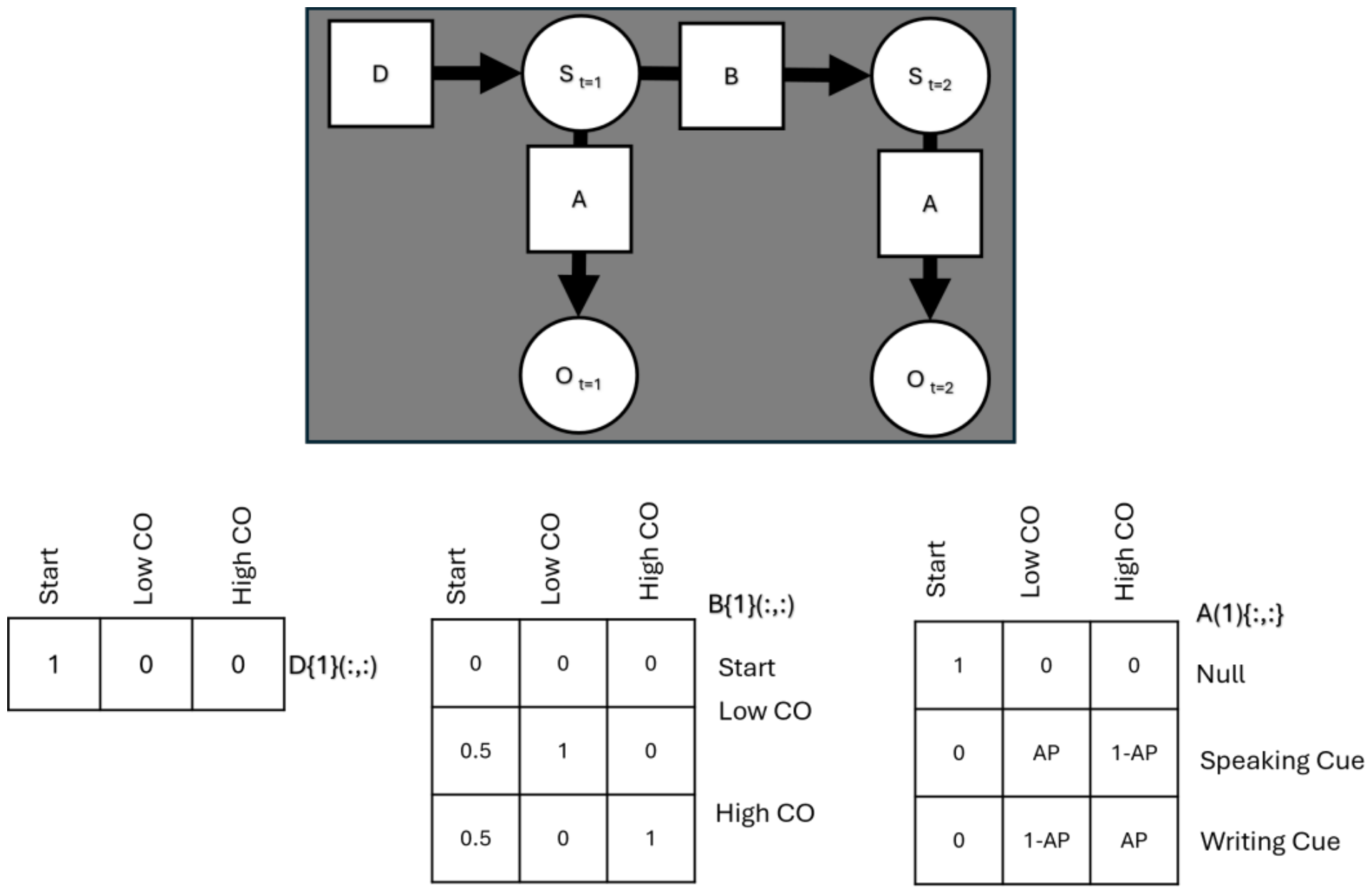
Figure 2.
MDP model and prediction-error formulation linking computational, algorithmic, and implementational levels of analysis of the picture-description task. A clear picture-description stimulus and speaking (S) or writing (W) cue are registered as a noisy sensory observation in the sensorium. Precision-weighted sensory evidence projects to the granular layer and updates beliefs about the hidden CO state through prediction-error message passing. The comparison between AP = 0.8 and AP = 0.6 illustrates how stronger diagnostic precision in the hypothesized direction produces a less ambiguous sensory message and stronger posterior updating toward the corresponding CO state. In the neural implementation, blue arrows represent excitatory messages whereas the red arrow represents the inhibitory message.
Figure 2.
MDP model and prediction-error formulation linking computational, algorithmic, and implementational levels of analysis of the picture-description task. A clear picture-description stimulus and speaking (S) or writing (W) cue are registered as a noisy sensory observation in the sensorium. Precision-weighted sensory evidence projects to the granular layer and updates beliefs about the hidden CO state through prediction-error message passing. The comparison between AP = 0.8 and AP = 0.6 illustrates how stronger diagnostic precision in the hypothesized direction produces a less ambiguous sensory message and stronger posterior updating toward the corresponding CO state. In the neural implementation, blue arrows represent excitatory messages whereas the red arrow represents the inhibitory message.
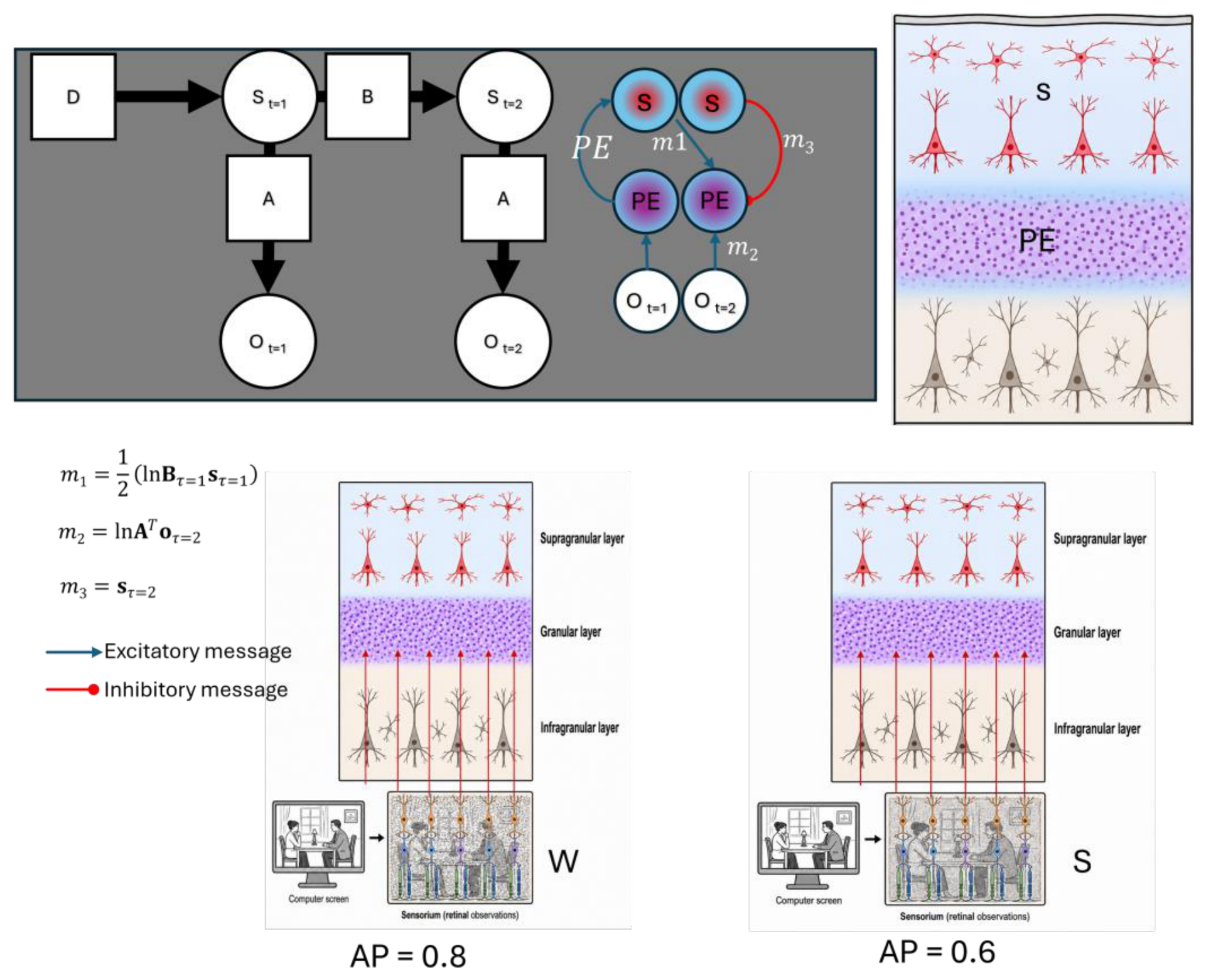
Figure 3.
Probability transformation of posterior logit estimates of the Bayesian generalized linear mixed-effects model.
Figure 3.
Probability transformation of posterior logit estimates of the Bayesian generalized linear mixed-effects model.
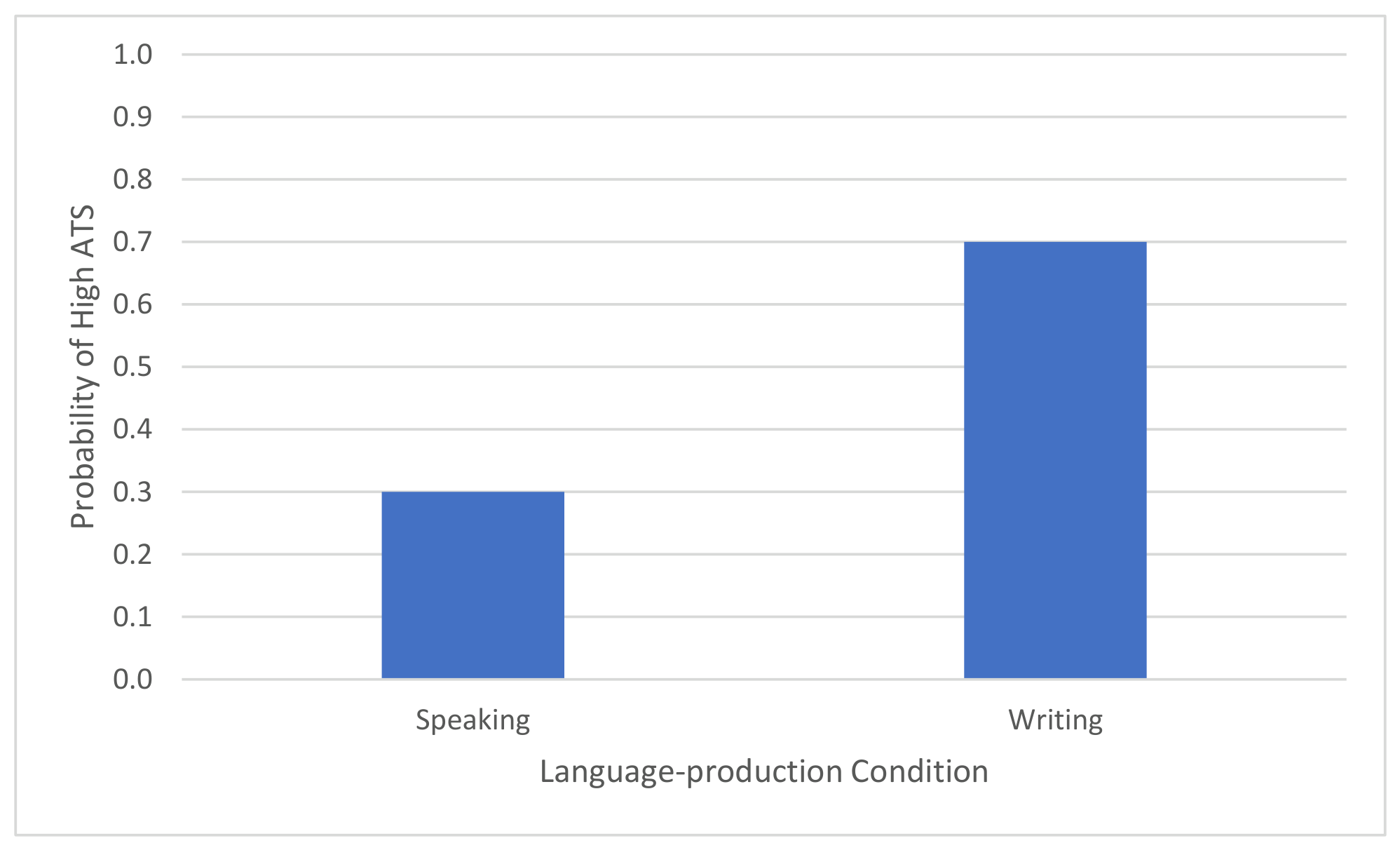
Figure 4.
Posterior group level mean estimate of AP parameter. The error bar represents 95% credible interval.
Figure 4.
Posterior group level mean estimate of AP parameter. The error bar represents 95% credible interval.
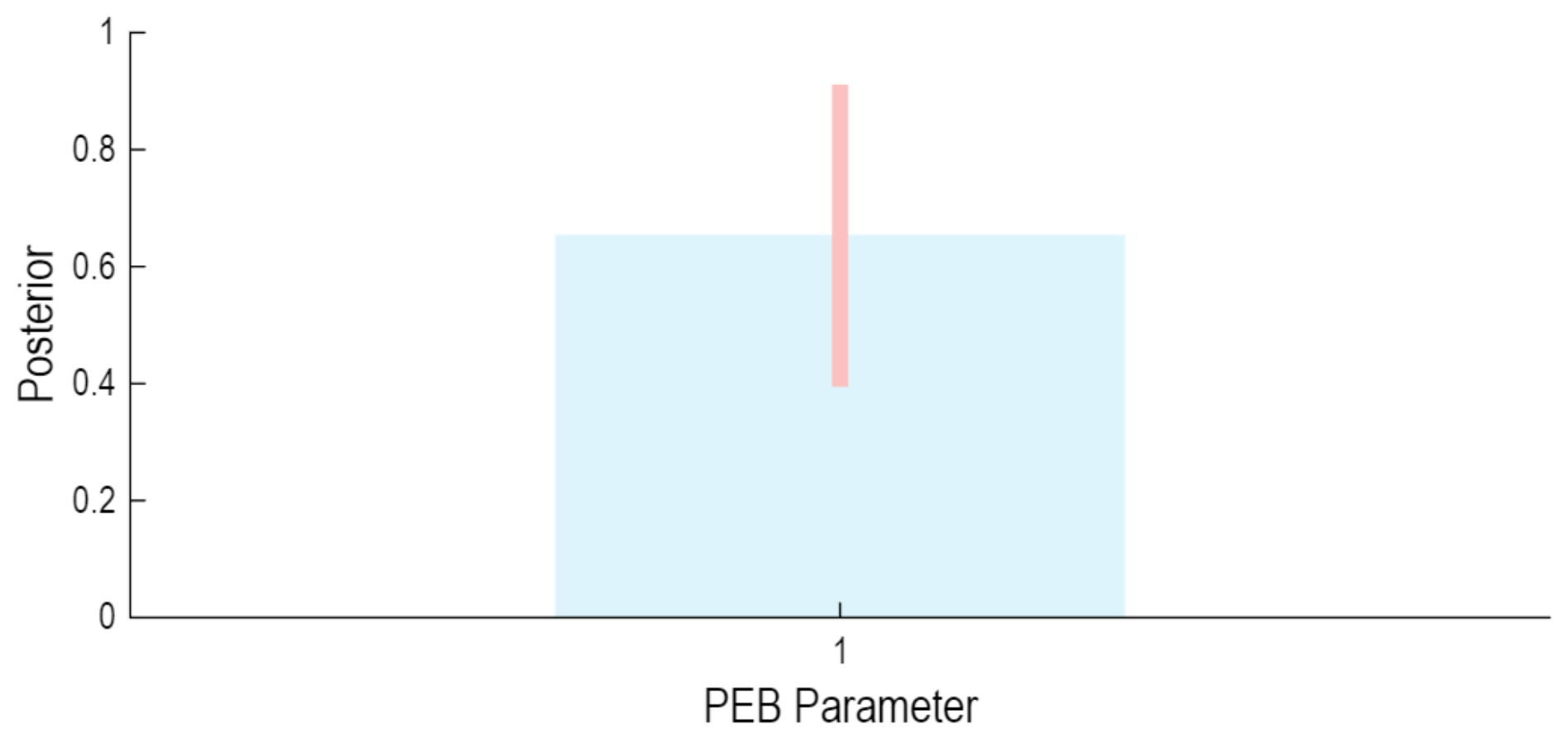

Table 1.
Descriptive statistics of LIWC analysis.
| Condition | Mean | SD | Range | ||
| Min | Max | ||||
| ATS | Speaking | 52.03 | 28.77 | 4.6 | 99 |
| Writing | 78.99 | 22.1 | 6.2 | 99 | |
| Number of Words | Speaking | 97.75 | 55.83 | 7.0 | 216 |
| Writing | 56.97 | 19.44 | 8.0 | 97 | |
Table 2.
Parameter estimates of the Bayesian ANCOVA model.
| 95% Credible Interval | ||||
| Parameter | Mean | SD | Lower | Upper |
| Intercept | 65.55 | 3.69 | 57.98 | 72.78 |
| Speaking | -13.12 | 1.82 | -16.81 | -9.48 |
| Writing | 13.12 | 2.00 | 8.42 | 16.44 |
Table 3.
Parameter estimates of the Bayesian generalized linear mixed-effects model.
| 95% Credible Interval | ||||
| Estimate | SE | Lower | Upper | |
| Intercept | 0.01 | 0.18 | -0.33 | 0.38 |
| Speaking | -0.81 | 0.19 | -1.26 | -0.44 |
| Writing | 0.81 | 0.19 | 0.44 | 1.26 |
Table 4.
Parameter estimates of the MDP model.
| Subject | AP |
| 1 | 0.66 |
| 2 | 0.53 |
| 3 | 0.53 |
| 4 | 0.61 |
| 5 | 0.5 |
| 6 | 0.53 |
| 7 | 0.66 |
| 8 | 0.61 |
| 9 | 0.66 |
| 10 | 0.66 |
| 11 | 0.53 |
| 12 | 0.5 |
| 13 | 0.61 |
| 14 | 0.5 |
| 15 | 0.61 |
| 16 | 0.72 |
| 17 | 0.66 |
Disclaimer/Publisher’s Note: The statements, opinions and data contained in all publications are solely those of the individual author(s) and contributor(s) and not of MDPI and/or the editor(s). MDPI and/or the editor(s) disclaim responsibility for any injury to people or property resulting from any ideas, methods, instructions or products referred to in the content. |
© 2026 by the authors. Licensee MDPI, Basel, Switzerland. This article is an open access article distributed under the terms and conditions of the Creative Commons Attribution (CC BY) license (http://creativecommons.org/licenses/by/4.0/).
Copyright: This open access article is published under a Creative Commons CC BY 4.0 license, which permit the free download, distribution, and reuse, provided that the author and preprint are cited in any reuse.


