

Submitted:
05 June 2026
Posted:
08 June 2026
You are already at the latest version
Abstract
Restaurants combine long opening hours, catering demand, kitchen ventilation, DHW and mixed-fuel cooking loads, making their decarbonisation different from generic commercial retrofit. This single-case study develops a whole-building utility-calibrated OpenStudio/EnergyPlus model for Beit El Zaytoun, a 655.82 m² restaurant in Park Royal, London. Monthly electricity and gas data for June 2024–May 2025 were used to anchor the baseline at whole-building level. Standalone and cumulative scenarios tested insulation, low-emissivity double glazing, LED lighting and controls, ASHP service scenarios and an 11 kWp PV array. Baseline demand was 413,895 kWh/yr, equivalent to 631.1 kWh/m²·yr and 75,020 kgCO₂e/yr. The best building-focused package reduced net imported energy to 314,734 kWh/yr and operational carbon to 56,700 kgCO₂e/yr, a retained 24.0% reduction on the source reporting basis. The model-derived residual process load, kitchen and catering gas plus kitchen and back-of-house electricity, remained 233,920 kWh/yr across building-focused scenarios. The Residual-Load Index (RLI) rose from 0.57 to 0.74; with ±15% process-load allocation uncertainty, the optimised RLI range was 0.63–0.85, so the post-retrofit balance remained process-load dominated. The case demonstrates a practical decarbonisation ceiling likely to recur in similar high-process-load hospitality premises: fabric, lighting, heat electrification and PV are necessary but insufficient without catering-equipment, cooking-fuel, kitchen-ventilation, refrigeration-control, sub-metering and demand-response strategies. The paper contributes whole-building utility-calibrated quantitative evidence and a transferable RLI metric for sub-sector-specific retrofit policy.
Keywords:
operational carbon
; restaurant energy use
; EnergyPlus
; OpenStudio
; air-source heat pumps
; solar photovoltaics
; process loads
; residual-load index
1. Introduction
Operational energy in existing buildings remains central to the United Kingdom’s net-zero pathway [1,2]. In non-domestic buildings, operational carbon is governed not only by envelope heat transfer and HVAC efficiency, but also by operating hours, internal gains, process loads, ventilation rates, equipment control, tenancy arrangements and maintenance practice [3,4,5]. These drivers are particularly important in food-service premises. Restaurants combine cooking equipment, refrigeration, kitchen extract, make-up air, domestic hot water, decorative lighting, variable occupancy and extended daily service periods [6,7,8,9]. Their annual energy use intensity (EUI) can therefore exceed that of many conventional commercial premises even when the envelope is not the dominant load [6,7,10].
This paper examines Beit El Zaytoun, a Lebanese restaurant in Park Royal, London. The case is used as an analytical mechanism case rather than as a generic consultancy retrofit report. Its value lies in testing what happens when a conventional building-focused decarbonisation package is applied to a high-process-load hospitality building. Park Royal is one of the largest food-production and distribution clusters in Europe and the focus of the UKRI Place-Based Impact Acceleration Account programme on Net Zero Food Supply Chains [11,12,13,14]. Many SME hospitality premises in such clusters are leased, operationally constrained and weakly sub-metered. These conditions are not incidental: they define the feasible retrofit boundary and the confidence with which savings can be verified.
The research problem is that conventional retrofit logic often assumes a progressive pathway from fabric improvement to efficient lighting, heat-pump electrification and roof-mounted PV. That sequence is coherent for buildings where space conditioning and regulated electrical loads dominate [15,16], but it is incomplete where catering and other process loads remain large. In restaurants, cooking gas, kitchen electrical equipment, refrigeration, extract ventilation and make-up air can still dominate after space-heating and lighting measures have been implemented [6,7,8]. Total percentage savings alone are therefore not enough, because the composition of residual demand changes after retrofit. The analysis separates demand reduction, fuel switching, HVAC service-coverage change, PV import offset and remaining process demand.
The study uses OpenStudio/EnergyPlus because dynamic simulation is required to represent interactions between envelope heat transfer, internal gains, HVAC service coverage, electrification and PV offset [17,18,19,20,21,22,23]. The model was anchored against whole-building electricity and gas consumption for June 2024–May 2025. Monthly utility data were used where available for model calibration; however, the manuscript does not claim IPMVP-grade validation or sub-metered end-use calibration because appliance-level metering, measured kitchen ventilation rates and full post-retrofit M&V data were not available [19,21,24,25]. The term whole-building utility-calibrated is used throughout in this restricted sense, and the model is suitable for comparative scenario appraisal and mechanism analysis rather than for verified savings claims.
This paper quantifies how far a conventional building-focused retrofit package can reduce energy use and operational carbon in a high-process-load UK restaurant and identifies the residual loads that constrain further decarbonisation. The analysis tests standalone and cumulative fabric, glazing, lighting, ASHP and PV scenarios using the utility-calibrated OpenStudio/EnergyPlus model. It then applies a Residual-Load Index (RLI) to show how unchanged catering and process loads reshape the post-retrofit energy balance.
The paper makes three contributions. First, it provides a utility-calibrated OpenStudio/EnergyPlus retrofit analysis for an under-represented UK restaurant typology. Second, it separates demand reduction, fuel switching, service expansion and PV import offset, avoiding a single undifferentiated retrofit-saving claim. Third, it proposes RLI as a transferable indicator for identifying when catering and process loads become the dominant constraint on operational decarbonisation in food-service buildings.
Figure 1.
Analytical structure of the study, showing how demand reduction, fuel switching, service-coverage change and PV offset interact with residual process loads.
Figure 1.
Analytical structure of the study, showing how demand reduction, fuel switching, service-coverage change and PV offset interact with residual process loads.
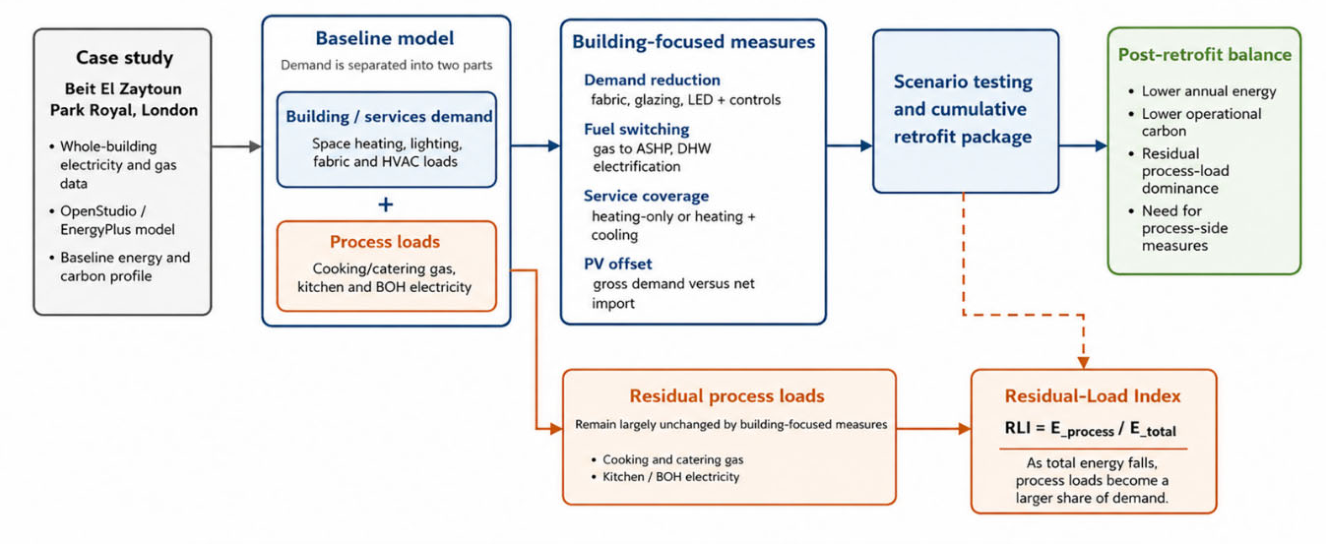
The remainder of the paper is structured as follows. Section 2 summarises the relevant evidence on restaurant energy use, simulation calibration and residual process loads. Section 3 describes the case-study building. Section 4 sets out the modelling boundary, data provenance, scenario design and uncertainty method. Section 5 presents the baseline, retrofit and residual-load results. Section 6 and Section 7 provide the discussion and practical and policy implications. Section 8 sets out the limitations and Section 9 concludes.
2. Background and Research Gap
Restaurant decarbonisation cannot be treated as a simple extension of generic commercial-building retrofit. The relevant evidence base sits across non-domestic operational energy, commercial-kitchen and restaurant loads, simulation calibration, heat-pump service boundaries, PV import offset and process-load reporting. The purpose of this section is therefore to define the specific gap addressed by the case study rather than to provide a broad review of commercial retrofit.
2.1. Operational Energy and Carbon in Existing Commercial Buildings
Operational carbon from non-domestic buildings remains a leading contributor to UK greenhouse-gas emissions despite progressive grid decarbonisation [1,10,26]. Reviews of building energy consumption and benchmarking also show that non-domestic energy demand varies strongly by building function [27,28]. Most commercial-building decarbonisation research has focused on offices, where archetype-led parametric studies dominate [19,20], or on supermarkets and large retail formats where refrigeration loads are an established research focus. Methodologically, the field has converged on a layered approach: an as-built baseline model, anchored or calibrated against whole-building or sub-metered data, against which energy efficiency measures are tested in isolation and in combination. Carbon impact is then derived using time-varying or static emission factors, with UK practice predominantly using the annually updated DESNZ GHG Conversion Factors [29], applied consistently across the baseline and all scenarios to enable like-for-like comparison [3]. The robustness of conclusions depends on three fragilities: the quality of the anchoring or calibration step, the transparency of the EEM specification, and the appropriate treatment of process loads, all of which are tested in the present study. Recent literature on the building-energy performance gap [4,5] further reinforces that aggregate utility agreement does not imply correct end-use disaggregation, and that operational verification is conditioned on data resolution.
2.2. Restaurant and Commercial-Kitchen Energy Use
Restaurants exhibit a markedly different end-use signature from general commercial premises. CIBSE TM46 [10] places restaurants in their own benchmark category with typical-practice values of approximately 800 kWh/m²·yr (combined fossil and electrical) and best-practice values of approximately 460 kWh/m²·yr; both figures are several times higher than typical office benchmarks. The drivers are well documented in the commercial-kitchen literature. Mudie et al. document UK commercial-kitchen electricity profiles that establish catering as the dominant electrical end use in food-service settings [6], with refrigeration, cooking and dishwashing loads operating outside customer-facing hours. Mudie provides benchmarking evidence and highlights the difficulty of deriving stable floor-area metrics where production intensity and operating hours differ between premises [7]. Kolokotroni et al. show that ventilation and refrigeration are central to energy use in food retail and food-related premises [30]. Recent work by Zhang et al. on commercial-kitchen ventilation and air-conditioning systems demonstrates that demand-controlled ventilation and airflow optimisation, including cooking-oil control strategies [8], can deliver substantial energy savings while maintaining oil-fume control and thermal comfort. Restaurant-specific analysis of solar PV integration by Gunasegaran et al. indicates that roof-mounted PV usually offsets only a fraction of total demand in high-load dining and kitchen premises [9], even when annual PV yield matches well to occupied hours. UK-specific peer-reviewed evidence on operational restaurant performance is comparatively scarce; this sparsity is one motivation for the present contribution. Restaurant-sector data are also often hidden inside broad “commercial” benchmark classes, weakening retrofit targeting at the sub-sector scale.
2.3. Simulation, Anchoring and Calibration
EnergyPlus and OpenStudio are established platforms for dynamic building-energy simulation and can represent heat-balance, HVAC, internal-gain and control interactions relevant to retrofit scenarios [17,18]. Calibration literature distinguishes between model adjustment against measured data and formal compliance with statistical criteria such as NMBE and CV(RMSE) [19,20,21,22,23]. ASHRAE Guideline 14 and IPMVP are useful references for M&V [24,25], but they require data resolution and boundary definition stronger than whole-building utility comparison alone. Heo et al. develop Bayesian calibration approaches that quantify uncertainty under data sparsity [21], an approach particularly relevant when end-use sub-metering is absent. CIBSE TM54 sets out a structured approach to evaluating operational energy at the design stage [3]. The present study positions itself within this calibration spectrum: it is whole-building utility-calibrated for feasibility-stage option appraisal, but is not represented as IPMVP-Option-D-grade validation because sub-metered and post-retrofit M&V data were not available.
2.4. Fabric, Glazing and Lighting Measures
Fabric, glazing and lighting upgrades are common first-stage retrofit measures. CIBSE Guide A provides reference constructions and environmental-design data used to judge envelope and thermal assumptions [31]. CIBSE Guide F and SLL guidance provide lighting-efficiency and lighting-quality reference points [32,33]. However, the whole-building effect of these measures depends on their baseline load share. In process-load-heavy premises, even high percentage savings in heating or lighting can translate into modest whole-building savings. This paper therefore reports both measure-level effects and residual-load composition, in order to make the constraint visible.
2.5. Heat-Pump Electrification and Service Coverage
Heat-pump electrification is central to building decarbonisation, but its retrofit interpretation depends on the service boundary [15,16,34]. Replacing gas heating with an ASHP is not the same as adding cooling to previously uncooled zones, nor is it the same as electrifying DHW. These mechanisms have different energy, carbon and comfort implications. Critically, air-to-air ASHP systems do not provide DHW, so any scenario that displaces gas DHW in a building modelled with an air-to-air proxy must represent DHW provision through a separate electrified load (a heat-pump water heater or direct electric resistance) or specify an air-to-water variant or hybrid configuration. The academic literature has not always made this distinction explicit, nor has it consistently distinguished between heat-pump scenarios that maintain existing service coverage and those that expand it. For these reasons, the ASHP scenarios in the present study are treated as service scenarios rather than simple equipment substitutions, and space-heating electrification, DHW fuel-switching assumptions, cooling operation and served-zone changes are reported separately (see Section 4.8). Installation in the UK is governed by the MCS framework and supported [35], for eligible non-domestic premises, by the Boiler Upgrade Scheme [36].
2.6. PV and Behind-the-Meter Generation
Behind-the-meter PV can reduce grid-electricity import but does not reduce underlying building demand [37,38]. Its impact depends on roof area, orientation, shading, inverter sizing, self-consumption, export and the temporal overlap between generation and demand [37,38]. In high-load restaurants, annual electricity demand may exceed PV generation, but this does not by itself prove full self-consumption at hourly resolution. The present study therefore reports PV as annual import-offset potential, distinguishing gross demand before PV from net imported energy after PV, and explicitly states the full annual self-consumption assumption used in the central carbon result. Installation in the UK is governed by the MCS PV standard [39].
2.7. Research Gap
Three gaps motivate the paper. First, peer-reviewed, modelled UK restaurant retrofit evidence remains thinner than evidence for offices, schools, dwellings or generic retail premises [6,7,9]. Second, scenario studies often report total savings without identifying how residual load composition changes after retrofit. Third, ASHP and PV measures are frequently interpreted as simple technology swaps even when they alter DHW provision, cooling service or electricity-import boundaries. This paper addresses these gaps through a single mechanism case with explicit data-provenance labels, scenario-boundary rules, RLI reporting, gross-versus-net energy reporting in PV cases, and analytical post-processing uncertainty screening on the dominant assumptions.
3. Case-study Building
This section describes the case-study building as a physical asset, independent of the modelling treatment applied to it in Section 4. The aim is to establish the geometry, envelope, operating profile, existing systems and lighting and process loads that the model must represent before any modelling, screening or scenario assumption is introduced.
3.1. Location, Tenure and Use
Beit El Zaytoun operates from 15–17 Barrett’s Green Road, Park Royal, London. The use is a Lebanese sit-down restaurant with dining, kitchen and back-of-house areas. The premises are within a leased single-storey shell, likely dating from the 1970s–1980s. The building illustrates a common converted-shell hospitality condition rather than claiming representativeness of a population. Tenancy matters because fabric alteration, external plant and rooftop PV require landlord consent, structural checks and statutory approvals; these are treated as research-relevant boundary conditions rather than incidental project-management details.
3.2. Geometry and Envelope
The floor area is 655.82 m² and the perimeter is approximately 108 m. The building is oriented approximately 13° east of due south, with an estimated window-to-wall ratio of 50%. The existing wall U-value is 1.19 W/m²K, roof U-value is 3.84 W/m²K, glazing U-value is 4.80 W/m²K and glazing g-value is 0.78 [31]. These are visual-survey and reference-construction values, not intrusive-survey measurements. Thermal bridging, moisture condition and airtightness were not directly measured and are not claimed in this study.
3.3. Operating Profile
The reported operating hours are 11:00–23:30 Monday to Thursday, 11:00–00:00 on Friday, and 09:30–00:00 at weekends. The venue can accommodate high peak dining occupancy (licensed maximum 250 covers), but typical service-period loads are lower than maximum capacity. The model therefore uses service-period diversity rather than constant maximum occupancy (Section 4.5). The interior design emphasises ambience through artificial planting and decorative lighting, which informs the lighting strategy and constrains the form, though not the substance, of any LED replacement programme.
3.4. Existing Systems (Heating, Cooling and DHW)
Baseline heating is mixed. The dining and perimeter zones are served by a gas boiler and radiators, supplemented by gas patio heaters in one seating zone and electric suspended panels in peripheral seating areas. A Carrier 42QHC024DS split unit (6.4 kW cooling, 7.0 kW heating) provides heating and cooling in part of the central seating zone. The kitchen, utility, store and loft areas are treated as unconditioned or partially untreated in the baseline model. DHW is provided by a packaged water-heating system. The reported 600 kBtu/h (~176 kW) input is retained as equipment context but not treated as a validated annual DHW load without sub-metering.
3.5. Lighting and Process Loads
Dining lighting combines decorative and functional luminaires, represented at 9.579 W/m². Kitchen lighting is represented at 18 W/m² [32]. The process-load definition used in the paper is deliberately narrow: kitchen and catering gas plus kitchen and back-of-house electrical equipment. Kitchen ventilation and make-up air affect HVAC load but are not directly metered as separate energy end uses. This boundary keeps the RLI transparent but conservative: some ventilation-related energy may also be process-driven, which would raise the effective RLI above the value reported here.
3.6. Implementation Context
The premises are leased, so any retrofit must be agreed with the landlord and the tenant; the tenant may not control fabric, roof, external plant or electrical infrastructure. External ASHP condensers may trigger acoustic and planning assessments, and rooftop PV may require structural assessment, roof access and grid and export arrangements. These constraints are not invalidating, but they bound which measures are technically and contractually deliverable; they are revisited in Section 8 (Limitations).
4. Materials and Methods
This section defines the operational boundary, data provenance, model setup, scenario design and uncertainty-screening approach used to test retrofit measures against the case-study building described in Section 3. A distinction is maintained between measured utility totals, reported survey inputs, model-derived end-use allocations and derived indicators, so that the feasibility-stage results are not overstated as sub-metered validation. As-built geometry, envelope, operating hours, existing systems and lighting and process loads are taken from Section 3 and not restated here.
4.1. Case Selection and Analytical Boundary
A single-case methodology was used because the purpose is mechanism testing rather than statistical generalisation [15]. Beit El Zaytoun was selected because it represents a high-load restaurant use, has full-year electricity and gas totals, sits within the Park Royal food-system decarbonisation context [11,12,13], and contains the practical constraints typical of leased SME hospitality premises. The findings should be transferred analytically to similar high-process-load premises rather than statistically to the restaurant stock as a whole.
The operational boundary includes purchased electricity, natural gas, building services, lighting, space conditioning, DHW and catering or process loads. Embodied carbon, refrigerant leakage, construction-stage emissions and whole-life carbon are outside the boundary. This exclusion is deliberate: the paper addresses operational-energy retrofit, not product-level or whole-life assessment. Refrigerant leakage is noted as relevant to a whole-life or full operational-carbon assessment of heat-pump systems, but it is not included in the delivered-energy and location-based operational-carbon boundary used here.
4.2. Data Provenance Taxonomy
The model uses five data classes, applied consistently throughout the paper to make the numerical claims traceable. Measured data are the annual whole-building electricity and gas totals for June 2024–May 2025. Reported survey data include floor area, approximate WWR, orientation, existing U-values, lighting power densities and visible HVAC equipment (Section 3). Modelled data include end-use allocation, HVAC loads, unmet hours and scenario outputs. Derived data include EUI, operational carbon, PV offset fractions and RLI. Screening assumptions are used where the source dataset does not contain detailed schedules, ventilation rates, infiltration, exact zone areas or hourly profiles. A value is described as measured only where it comes from annual utility records; reported where it comes from site observations, drawings, nameplate information or the source feasibility dataset; model-derived where it comes from end-use allocation or scenario simulation; and derived where it is calculated from other reported or model-derived values. This terminology prevents the residual-load result being misread as sub-metered evidence.
4.3. Whole-Building Utility-Anchored Baseline
The baseline is constrained by whole-building utility data, summarised in the calibration evidence table in Section 5.1. The source dataset includes electricity and gas consumption for June 2024–May 2025 and supports whole-building feasibility calibration. The manuscript does not claim sub-metered or IPMVP-grade calibration because end-use metering, measured kitchen extract rates and post-retrofit monitoring were not available. The model was anchored to a total of 413,895 kWh/yr, consisting of 117,008 kWh/yr electricity and 296,886 kWh/yr natural gas, yielding an EUI of 631.1 kWh/m²·yr over a floor area of 655.82 m² (Section 3.2). Annual operational carbon is reported on the source-reporting basis of 75,020 kgCO₂e/yr. Because the displayed conversion factors are rounded in the source feasibility dataset, all scenario carbon values in this manuscript retain the source-reporting basis rather than recalculating each row independently from rounded factors.
4.4. Simulation and Reproducibility Specification
A whole-building OpenStudio/EnergyPlus model was used to represent the restaurant geometry, envelope, internal gains, lighting, HVAC service coverage and annual energy balance [17,18]. The modelling approach is documented against EnergyPlus v25.1 and OpenStudio 3.6 documentation. The executable model file is not released with this manuscript because the study is based on a commercially sensitive premises dataset. Instead, the manuscript reports the inputs, assumptions and scenario boundaries needed to understand and scrutinise the feasibility-stage results.
The model uses a London-region typical meteorological-year weather basis. Because the source manuscript package did not include the exact archived weather-file identifier, London Gatwick IWEC/TMY is identified here only as a reproducibility assumption for an equivalent screening model, not as a confirmed original file. This limitation mainly affects load distribution and scenario deltas rather than the annual baseline total, which is constrained by utility data. Any design-stage or post-retrofit M&V study should archive the exact weather file, OpenStudio model, EnergyPlus IDF and output files alongside anonymised utility and sub-metering data [17,18,24,25].
The model uses a four-zone reporting aggregation: front-of-house dining and perimeter areas, kitchen, back-of-house and storage and utility areas, and circulation and vestibule. The aggregated area schedule used for reproducibility is shown in Table 1. These areas are screening allocations consistent with the total floor area; they are not derived from a measured zone survey and may differ from the actual fitout. They are reported only to enable reproduction of an equivalent screening model.
4.5. Operating Schedules, Setpoints and Internal Gains
The case-study operating hours (Section 3.3) are represented in the model through fractional service-period profiles rather than constant maximum occupancy, because hourly cover counts were not available. Table 2 reports the schedule specification as a screening assumption rather than as metered occupancy. Heating setpoints are represented as 20–21 °C for occupied dining zones and 18 °C for back-of-house zones where heating service is provided, and cooling setpoints in cooling-enabled zones are represented as 24–26 °C. These setpoints are screening assumptions consistent with CIBSE Guide A occupant comfort criteria for hospitality and back-of-house spaces [31]; they are not derived from a building management system log. The heating-only ASHP scenario does not by itself demonstrate summer comfort; that question is treated as a limitation in Section 8 with reference to CIBSE TM52 [40]. People, lighting and equipment gains are represented through the schedules and the as-built lighting power densities reported in Section 3.5. Catering process electricity and gas are constrained by the model-derived annual process allocation, not by appliance-level metering.
4.6. Ventilation, Extract and Infiltration Assumptions
Kitchen ventilation is a critical uncertainty in restaurant energy modelling [8]. The source dataset did not include measured extract rates, hood operation or make-up air temperatures. To avoid leaving this hidden, the reproducibility model uses explicit screening assumptions consistent with practice reported by Zhang et al. [8]. Kitchen extract is represented as 20 air changes per hour during active cooking, 10 air changes per hour during prep and cleaning, and 2 air changes per hour during closed and standby periods. Make-up air is assumed to follow extract operation, with 80–90% supplied through transfer or make-up pathways and the remaining imbalance affecting infiltration. No ventilation heat recovery is assumed in the baseline, reflecting the typical converted-shell condition. Dining outdoor air is represented as occupancy-linked ventilation during service periods, aligned with the operating profile. Infiltration is represented as an equivalent 0.5 ACH during closed periods and 1.0 ACH during active service for front-of-house zones, with higher effective exchange possible near entrances and kitchen pressure paths. These values are screening assumptions because no blower-door test, pressure measurement or extract commissioning data were available. The uncertainty screening therefore includes a ±20% ventilation and extract band (Section 4.10 and Table 10).
Kitchen ventilation matters disproportionately in restaurant energy modelling because the extract–make-up air loop drives a large fraction of the heating load through cold-air introduction during winter operation. Even modest reductions in extract rate during prep and standby periods, or the introduction of partial heat recovery where hygiene and grease-management constraints permit, can deliver disproportionate heating-energy savings relative to the absolute volumetric flow change. This is why kitchen ventilation is an explicit candidate for second-stage process-side intervention, as revisited in the practical implications and limitations sections, and why the present uncertainty screening band is set at ±20% rather than a narrower envelope-grade band.
4.7. Modelled Envelope, Lighting and HVAC Parameters
The as-built fabric, lighting and HVAC parameters for the case-study building are given in Section 3 (geometry and envelope in Section 3.2; existing systems in Section 3.4; lighting and process loads in Section 3.5). For the modelled retrofit scenarios, the envelope scenario reduces wall and roof thermal transmittance to a post-upgrade screening range consistent with cavity and roof insulation, and the glazing scenario uses U = 1.6 W/m²K and g = 0.50 representative of low-emissivity double glazing. The LED and controls scenario reduces dining and kitchen lighting power densities from the as-built values of 9.579 W/m² and 18 W/m² to 6 W/m² and 12 W/m² respectively, with occupancy, scene, daylight and time-schedule control assumptions consistent with CIBSE Guide F and SLL lighting guidance [32,33]. Boiler efficiency and detailed control sequences are not verified; the baseline gas total is constrained by annual utility anchoring.
4.8. ASHP, DHW and PV Scenario Boundaries
The ASHP scenarios are decomposed in Table 3 because they are not pure equipment replacements. Space-heating electrification is represented using a high-efficiency air-to-air heat-pump proxy. Because air-to-air systems do not provide DHW, the displacement of gas DHW in both ASHP variants was represented as a separate electrified DHW load (a heat-pump water heater or direct electric resistance, configured to match the baseline DHW demand). Cooling is either enabled and expanded or disabled, depending on the scenario. This distinction is essential because the heating-only case performs better in annual energy terms partly because it avoids cooling electricity. In a final detailed design, an air-to-water ASHP coupled to a hot-water cylinder, or a dedicated heat-pump water heater, would be the appropriate route to deliver the combined space-heating and DHW function [35]. The combined scenario should therefore be interpreted as space-heating electrification plus DHW fuel-switching, not as a single equipment substitution.
The PV scenario uses an 11 kWp roof-mounted array with annual yield of 11,025 kWh/yr estimated using PVGIS [37]. PV is treated as grid-import offset, not demand reduction. The central result assumes full annual self-consumption because annual electricity demand is much larger than PV yield. This is an annual import-offset potential, not a verified hourly behind-the-meter result. Hourly or monthly load–yield matching would be required to confirm export and self-consumption. The system was sized by the available sloped roof area (approximately 55 m² at 4–6 m² per kWp planning ratio), not by demand or inverter capacity. Installation conforms to the MCS framework [39].
4.9. Energy, Carbon and Residual-Load Equations
Annual operational carbon emissions were computed by applying static UK Government GHG Conversion Factors (2025 release) to the metered or simulated annual energy use of each fuel carrier [29]:
where E_i and EF_i are annual energy demand (kWh/yr) and emission factor (kgCO₂e/kWh) for carrier i. For this study EF_elec = 0.177 and EF_gas = 0.183 kgCO₂e/kWh [29]. Energy use intensity was computed as:
with A_floor the gross internal floor area (655.82 m²). Percentage savings against baseline were computed as:
C_annual = Σ_i (E_i × EF_i)
EUI = E_total / A_floor
ΔE (%) = (E_baseline − E_scenario) / E_baseline × 100
ΔC (%) = (C_baseline − C_scenario) / C_baseline × 100
PV generation offsets imported electricity rather than reducing underlying building demand. The PV offset fraction is computed against gross-baseline electricity demand to provide a stable reporting basis:
with E_PV the annual PV generation (kWh/yr) and E_electricity,gross the annual gross-baseline electricity demand. To formalise the residual-load argument quantitatively, the Residual-Load Index (RLI) is defined as the share of total annual energy demand attributable to process and catering end uses:
where E_process is the sum of kitchen and back-of-house electrical equipment and kitchen and catering gas (held constant in absolute terms across the building-focused scenarios because those measures do not address process loads), and E_total is the total annual energy demand of the relevant scenario (gross delivered energy in baseline and demand-side scenarios; net imported energy in PV cases). RLI varies between 0 (no process load) and 1 (process load equals total demand); higher RLI values indicate that further building-focused measures will deliver progressively smaller absolute and proportional carbon reductions. In this paper, E_process is model-derived rather than sub-metered, so RLI is reported with ±15% process-allocation screening uncertainty (Section 4.10, Table 9 and Table 10). The ±15% screening band is applied to E_process only while the scenario total E_total is held constant. The band therefore tests process/non-process allocation uncertainty within the reported annual energy total, rather than a re-simulated change in whole-building demand.
F_PV (%) = E_PV / E_electricity,gross × 100
RLI = E_process / E_total
4.10. Scenario Design and Uncertainty Method
Scenarios are defined in two families. Standalone cases test one measure against the baseline where possible. Cumulative cases layer measures sequentially to approximate a phased retrofit package. The ASHP cases are exceptions: they are bundled service scenarios, not pure equipment substitutions, and this composite-scenario caveat applies wherever Cases 4a and 4b appear and is not repeated in subsequent sections. PV is modelled as grid-import offset, not demand reduction, with gross demand before PV reported separately from net imported energy after PV.
Uncertainty is treated through analytical post-processing screening rather than re-simulated parametric modelling. The tested ranges are process-load allocation ±15%, ASHP and DHW electrical efficiency ±15%, kitchen extract and make-up air ±20%, envelope U-values ±20%, lighting-control persistence ±20%, and PV yield ±10%. These ranges are not probabilistic confidence intervals; they identify which assumptions dominate the interpretation. The central RLI conclusion is considered robust only if the optimised case remains process-load dominated (RLI > 0.5) under the low-process-load boundary.
4.11. Modelled Inputs Register and Scenario Definitions
Table 4 consolidates the model inputs and their provenance for the modelled scenarios. Items already given in narrative form in Section 3 are included for reference only, so that the input register is complete and machine-readable; the case-study description in Section 3 remains the single narrative source for as-built physical attributes. Table 5 defines the standalone and cumulative retrofit scenarios, separating intervention labels from mechanism classes. This distinction is retained to avoid collapsing demand reduction, fuel switching, service expansion and generation offset into a single undifferentiated saving.
5. Results
5.1. Baseline Energy and Carbon Performance and Calibration Evidence
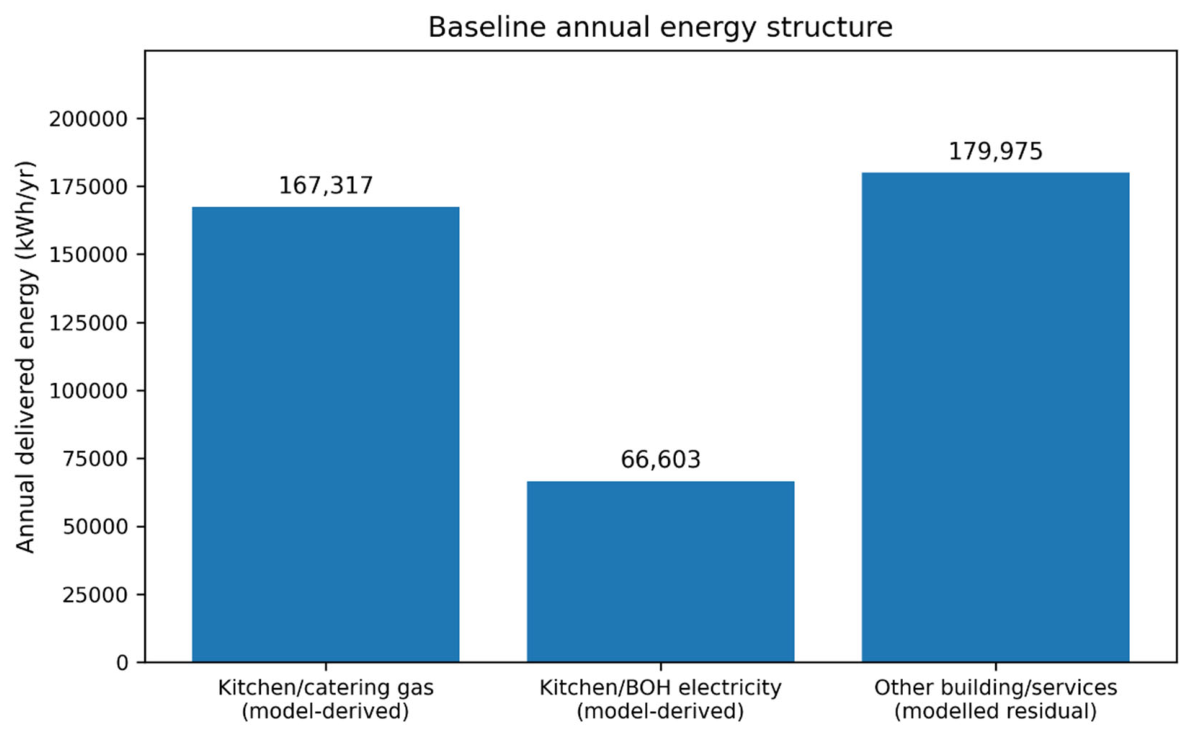
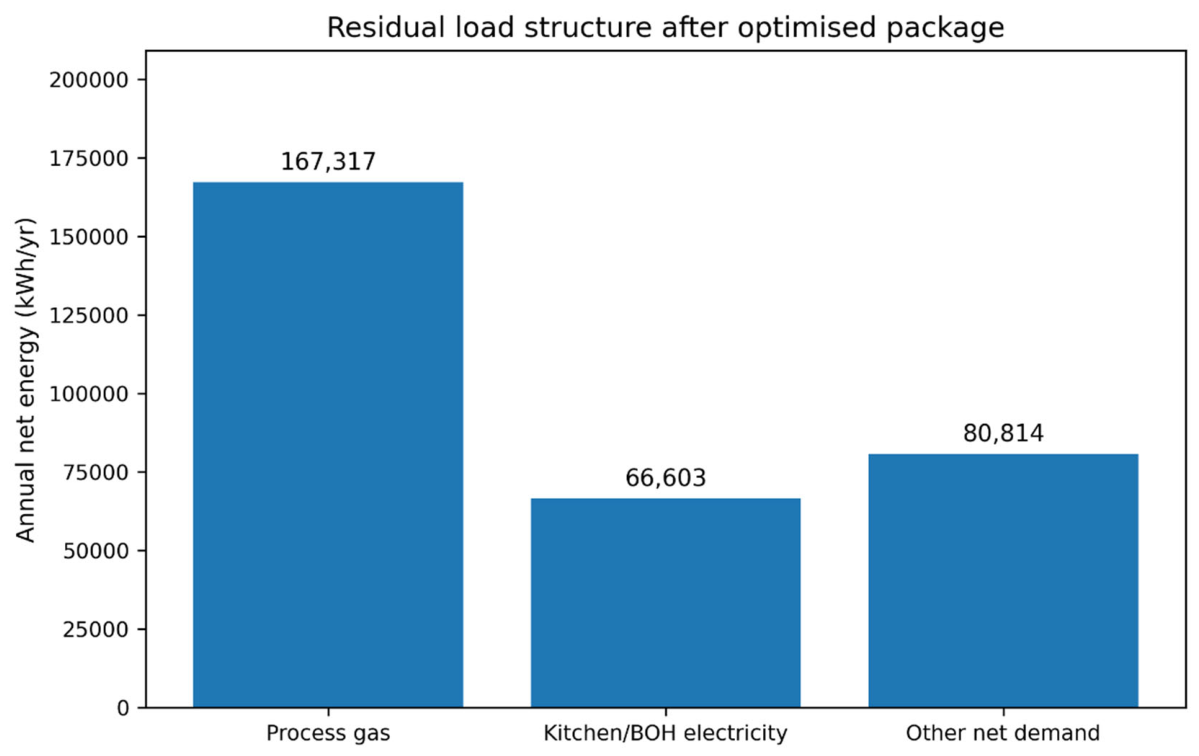
The whole-building utility-calibrated baseline is 413,895 kWh/yr. Dividing by 655.82 m² gives 631.1 kWh/m²·yr. This sits below the approximate CIBSE TM46 typical-practice restaurant benchmark (~800 kWh/m²·yr) and above the approximate best-practice benchmark (~460 kWh/m²·yr), indicating that the annual total is plausible for the use class [10]. The baseline carbon value retained for consistency with the source-reporting basis is 75,020 kgCO₂e/yr. The model-derived process-load allocation is 167,317 kWh/yr residual kitchen and catering gas plus 66,603 kWh/yr kitchen and back-of-house electricity. This gives E_process = 233,920 kWh/yr and a baseline RLI = 0.57. The RLI value is not a sub-metered result; it is a model-derived indicator constrained by whole-building utility data and is reported with the uncertainty range in Section 5.5.

Table 6.
Whole-building utility-anchored evidence and baseline performance; modelled values are source-constrained totals, not sub-metered calibration statistics.
Table 6.
Whole-building utility-anchored evidence and baseline performance; modelled values are source-constrained totals, not sub-metered calibration statistics.
| Carrier | Measured (kWh/yr) | Modelled (kWh/yr) | Difference | Calibration/anchoring status |
|---|---|---|---|---|
| Electricity | 117,008 | 117,008 | <1% | Whole-building utility-anchored |
| Natural gas | 296,886 | 296,886 | <1% | Whole-building utility-anchored |
| Total annual energy | 413,895 | 413,895 | <1% | Whole-building, feasibility-grade |
| Monthly utility profile | June 2024-May 2025 | Used for calibration | Not shown | Feasibility-grade |
| End-use sub-metering | Not available | – | – | Limitation |
Source-reporting operational carbon: electricity = 20,710 kgCO₂e/yr and gas = 54,309 kgCO₂e/yr, giving 75,020 kgCO₂e/yr. Displayed conversion factors are rounded in the source feasibility dataset, so the source-reporting carbon values are retained for scenario comparison. EUI = 413,895 / 655.82 = 631.1 kWh/m²·yr. Process-load share at baseline = (167,317 + 66,603) / 413,895 = 56.5%, giving a baseline RLI of 0.57. Unmet hours at baseline: 7,049 (4,082 occupied).
Figure 2.
Baseline end-use energy structure. Process gas and kitchen/back-of-house electricity are model-derived allocations within the whole-building utility-anchored model; other building/services demand is the modelled residual.
Figure 2.
Baseline end-use energy structure. Process gas and kitchen/back-of-house electricity are model-derived allocations within the whole-building utility-anchored model; other building/services demand is the modelled residual.
5.2. Standalone Measure Results
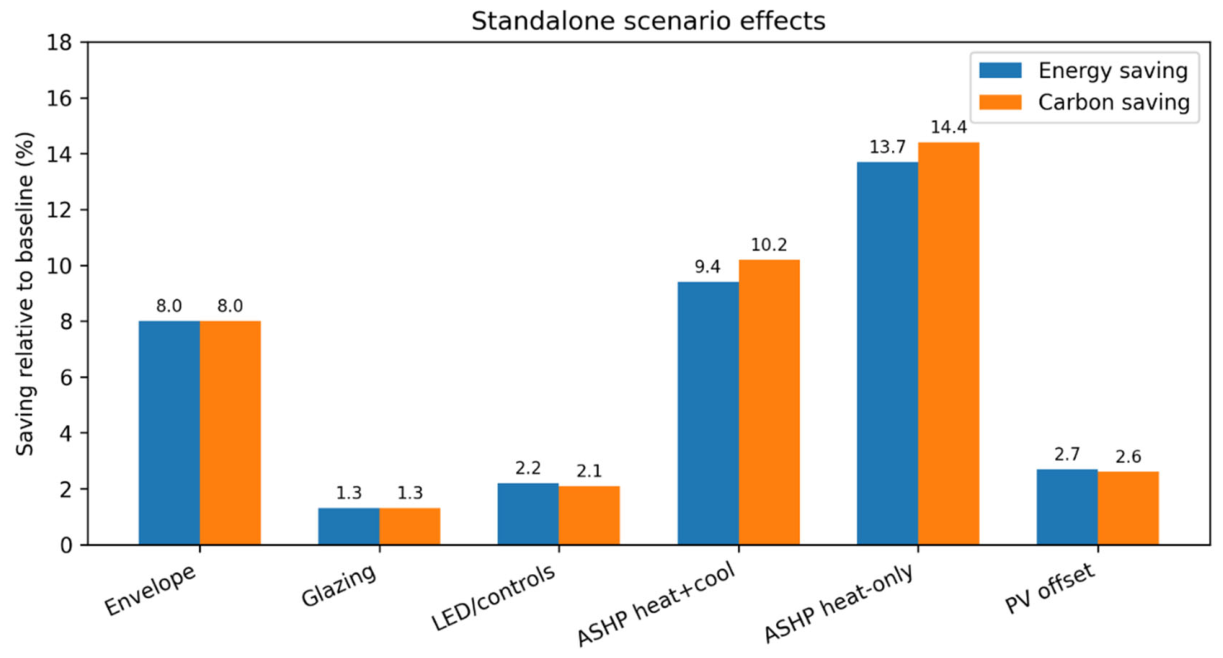
Standalone results are summarised in Table 7. The largest single change is the ASHP heating-only service scenario, which reduces energy to 357,189 kWh/yr and carbon to 64,215 kgCO₂e/yr. This result must not be interpreted as a simple heat-pump efficiency claim. It combines removal of gas space heating, assumed DHW electrification and avoidance of expanded cooling energy. The ASHP heating-and-cooling scenario reduces energy to 374,931 kWh/yr and carbon to 67,355 kgCO₂e/yr. It saves less because cooling provision and service coverage expand. Envelope insulation reduces total energy to 380,825 kWh/yr (an 8.0% saving), the largest building-related single-measure energy reduction, principally through reduced gas space-heating demand (from 107,125 to 77,017 kWh/yr). Glazing alone reduces energy by 1.3%, while LED with controls reduces energy by 2.2%; the small whole-building impact in both cases reflects that perimeter-zone heating gas and lighting electricity are modest shares of total demand. PV offsets 11,025 kWh/yr of grid import (9.4% of baseline electricity demand) and reduces carbon by approximately 1,951 kgCO₂e/yr (2.6% of baseline operational emissions). The asymmetry between the 2.7% energy saving and 2.6% carbon saving for PV reflects the higher carbon factor of gas, which PV does not displace.
Figure 3.
Standalone scenario effects on annual energy and operational carbon. ASHP cases are not like-for-like replacements because service coverage and DHW assumptions change.
Figure 3.
Standalone scenario effects on annual energy and operational carbon. ASHP cases are not like-for-like replacements because service coverage and DHW assumptions change.
5.3. Cumulative PACKAGE results
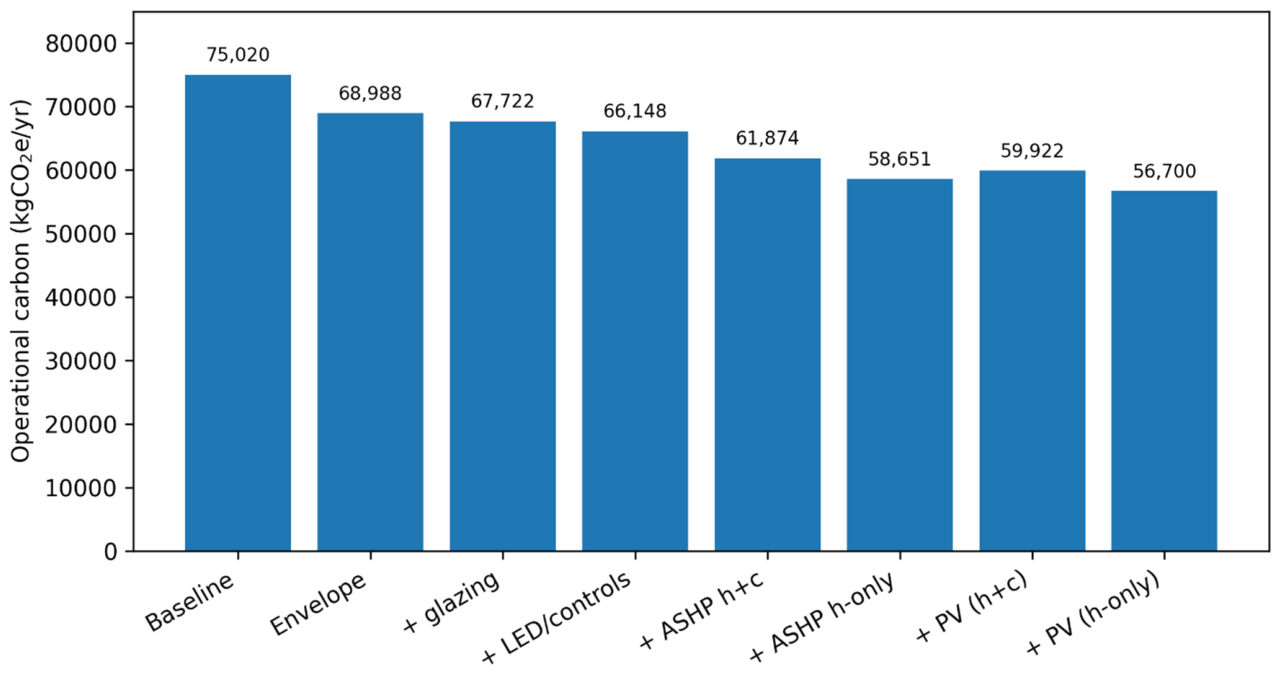
The cumulative results show a staged reduction from 413,895 kWh/yr at baseline to 314,734 kWh/yr in the best net case. The pathway is not strictly additive because measures interact. The LED and controls step reduces lighting electricity but also reduces internal heat gains. The modelled gas value in that step is therefore interpreted as an interaction within the cumulative energy balance rather than an independent gas-saving measure [17,18]; this reflects the heat-balance interaction captured by EnergyPlus. The best pre-PV package is fabric + glazing + LED/controls + ASHP heating-only, with gross annual demand of 325,759 kWh/yr and carbon of 58,651 kgCO₂e/yr. Adding 11,025 kWh/yr of PV reduces net imported energy to 314,734 kWh/yr and carbon to 56,700 kgCO₂e/yr. The retained headline saving is 24.0% on the source-report basis. Gross demand before PV and net imported energy after PV are reported separately to avoid treating generation as demand reduction.
Table 8.
Cumulative package results. The 24.0% carbon reduction is retained consistently because it is the reporting basis of the source feasibility dataset.
Table 8.
Cumulative package results. The 24.0% carbon reduction is retained consistently because it is the reporting basis of the source feasibility dataset.
| Cumulative case | Energy basis | Energy (kWh/yr) | EUI (kWh/m²·yr) | Carbon (kgCO₂e/yr) | Carbon saving (%) |
|---|---|---|---|---|---|
| Baseline | Delivered | 413,895 | 631.1 | 75,020 | 0.0 |
| Envelope | Delivered | 380,825 | 580.7 | 68,988 | 8.0 |
| + glazing | Delivered | 373,817 | 570.0 | 67,722 | 9.7 |
| + LED/controls | Delivered | 364,853 | 556.3 | 66,148 | 11.8 |
| + ASHP heat+cool | Delivered | 343,964 | 524.5 | 61,874 | 17.5 |
| + ASHP heat-only | Gross before PV | 325,759 | 496.7 | 58,651 | 21.8 |
| + PV (h+c) | Net after PV | 332,939 | 507.7 | 59,922 | 20.1 |
| + PV (h-only) | Net after PV | 314,734 | 479.9 | 56,700 | 24.0 |
Figure 4.
Cumulative package pathway for annual energy and operational carbon. Energy in PV cases is net imported energy after annual PV offset; the two panels use separate axes to avoid misleading overlap between energy and carbon series.
Figure 4.
Cumulative package pathway for annual energy and operational carbon. Energy in PV cases is net imported energy after annual PV offset; the two panels use separate axes to avoid misleading overlap between energy and carbon series.
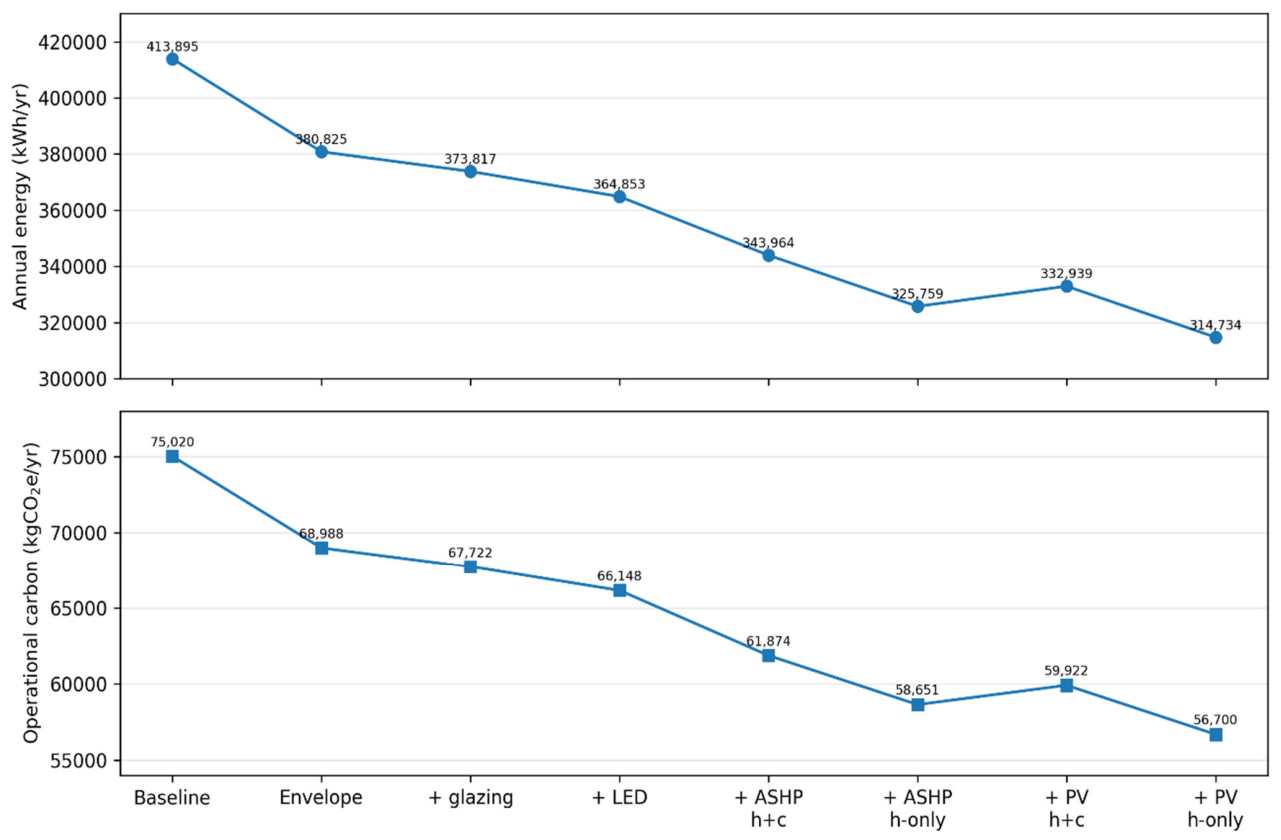
Figure 5.
Operational carbon pathway from baseline to the optimised package. Incremental differences include interaction effects and should not be interpreted as isolated causal savings.
Figure 5.
Operational carbon pathway from baseline to the optimised package. Incremental differences include interaction effects and should not be interpreted as isolated causal savings.
5.4. Fuel switching and PV offset
The baseline fuel split is approximately 28% electricity and 72% gas. In the optimised package, gross electricity demand before PV is 158,442 kWh/yr and residual gas demand is 167,317 kWh/yr. PV yield is 11,025 kWh/yr, equal to approximately 7.0% of optimised gross electricity demand and 3.4% of optimised gross total demand. After PV, net imported electricity is 147,417 kWh/yr and the optimised net split is approximately 47% gas and 53% electricity import. The PV offset fraction against gross-baseline electricity (Equation 5) is 9.4%. The PV calculation assumes full annual self-consumption because annual electricity demand is much larger than PV yield. This is a defensible feasibility assumption but not a verified hourly result. If hourly load profiles show export, the import reduction and economic benefit would be lower. The carbon result is therefore reported as annual import-offset potential, not measured behind-the-meter performance.
5.5. Residual-Load Index and Process-Load Constraint
The most important result is the change in load composition. The residual process energy remains 233,920 kWh/yr in the best package because the modelled building-focused measures do not replace cooking equipment, catering equipment, refrigeration or process controls. Since total net energy falls, the process share rises. RLI rises from 0.57 in the baseline to 0.74 in the optimised net case (Table 9). This is the decarbonisation ceiling demonstrated by the case. The package reduces annual carbon by 24.0%, but it leaves a residual process-dominated energy balance. Further reduction would require measures outside the conventional building-retrofit package: efficient catering equipment, induction or alternative cooking-fuel strategies, demand-controlled kitchen ventilation, heat recovery where hygienically and technically feasible, refrigeration optimisation, staff operating protocols, sub-metering and demand-response.
Figure 6.
Fuel split in the baseline, optimised gross package before PV, and optimised net package after PV. The PV case reports grid electricity import after annual offset.
Figure 6.
Fuel split in the baseline, optimised gross package before PV, and optimised net package after PV. The PV case reports grid electricity import after annual offset.
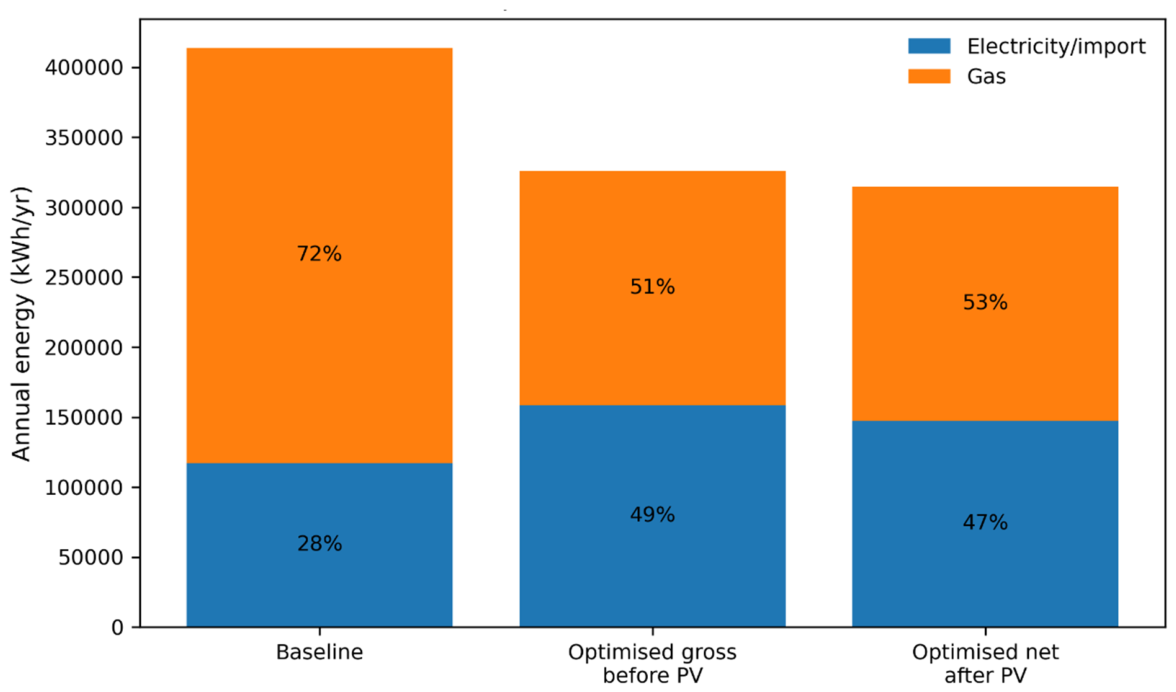
Figure 7.
Residual-Load Index central values with ±15% process-load allocation uncertainty. Total scenario energy is held constant for the allocation screen; the process-load allocation is model-derived and not sub-metered.
Figure 7.
Residual-Load Index central values with ±15% process-load allocation uncertainty. Total scenario energy is held constant for the allocation screen; the process-load allocation is model-derived and not sub-metered.
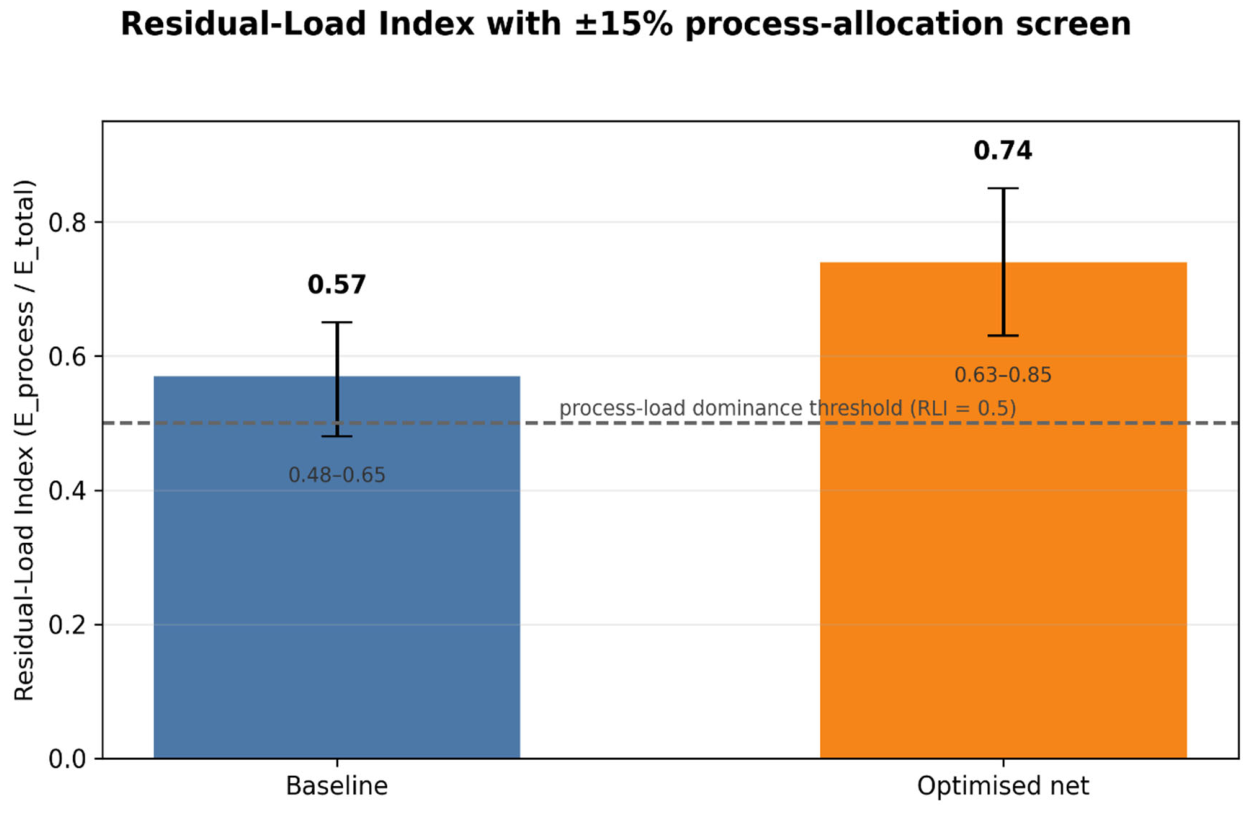
Figure 8.
Residual-load structure after the best package. The dominant remaining loads are model-derived cooking and catering gas and kitchen/back-of-house electricity.
Figure 8.
Residual-load structure after the best package. The dominant remaining loads are model-derived cooking and catering gas and kitchen/back-of-house electricity.
5.6. Analytical Uncertainty Screening
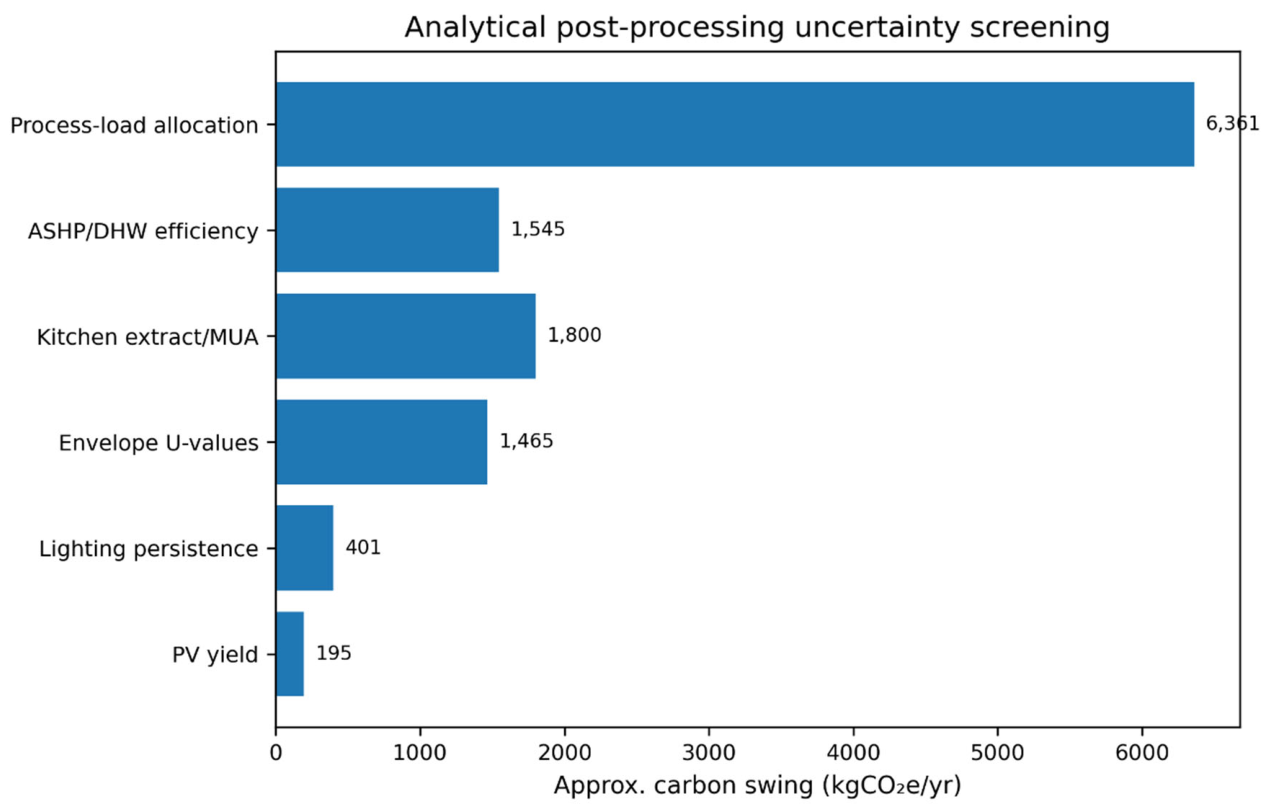
The uncertainty screening identifies which assumptions matter most (Table 10). Process-load allocation dominates the result. For RLI, the ±15% test is an allocation screen that holds total scenario energy constant and shifts the process/non-process split. Read as a physical demand sensitivity rather than an allocation test, the same ±15% change would be equivalent to approximately ±35,088 kWh/yr of process energy and ±6,361 kgCO₂e/yr. The carbon swing is calculated by applying the same ±15% change to model-derived process gas and kitchen and back-of-house electricity separately, then multiplying by their respective emission factors: 0.15 × (167,317 × 0.183 + 66,603 × 0.177) = 0.15 × 42,408 = 6,361 kgCO₂e/yr. This does not overturn the conclusion: even at the low-process case, the optimised RLI remains approximately 0.63, well above the 0.5 threshold for process-load dominance. PV yield uncertainty is much smaller, with ±10% PV yield changing carbon by about ±195 kgCO₂e/yr. Lighting persistence and envelope U-value uncertainty are also smaller than process-load and ventilation uncertainty. Kitchen extract and make-up air sensitivity is reported as post-processing screening only; measured extract rates were not available.
Figure 9.
Analytical post-processing uncertainty screening around the optimised package. Values are post-processing screening bands, not re-simulated probabilistic confidence intervals; process-load allocation is the dominant uncertainty.
Figure 9.
Analytical post-processing uncertainty screening around the optimised package. Values are post-processing screening bands, not re-simulated probabilistic confidence intervals; process-load allocation is the dominant uncertainty.
5.7. Comfort and Unmet-Hours Interpretation
The source model reports baseline unmet hours of 7,049 total hours, including 4,082 occupied hours. The ASHP heating-and-cooling scenario reduces these to 1,341 total hours and 746 occupied hours. The heating-only ASHP case reduces heating-related unmet hours to 1,040 total hours and 451 occupied hours. The occupied-hour definition follows the restaurant operating schedule in Table 2; the screening heating setpoint is 20–21 °C for occupied front-of-house areas and 18 °C for served back-of-house zones, while cooling-enabled zones use a 24–26 °C cooling setpoint. These values indicate improved modelled heating service, but they do not establish summer comfort under the heating-only case. The manuscript does not claim compliance with CIBSE TM52 [40] or any non-domestic overheating criterion. A comfort-compliant design would require zone-level operative temperatures, adaptive-comfort criteria, internal-gain schedules, ventilation assumptions, shading assumptions and summer weather assessment. The heating-only ASHP option is an annual-energy result, not a complete comfort design conclusion; summer comfort under that scenario must be evidenced through a separate TM52-style adaptive-comfort assessment, which lies outside the scope of this study.
5.8. Cost and Payback
Indicative simple paybacks were derived where cost data were considered sufficiently robust. Lighting with controls offers the shortest indicative payback among the building-focused measures, consistent with widespread commercial-sector evidence. Cavity-fill insulation paybacks depend strongly on confirmed wall build-up and installation cost; roof-quilt and double-glazing paybacks are sensitive to the alternative depreciation schedule of the existing assets. ASHP retrofit paybacks (including the separately electrified DHW load) are sensitive to the relative price of electricity and gas, the availability of grant support for eligible non-domestic buildings, and electrical-supply upgrade costs. PV paybacks depend on tariff, self-consumption fraction and any export agreement [37,38]. Cost figures are reported as indicative and are not used to anchor the central decarbonisation argument of the paper, which is intentionally framed in physical energy and carbon terms.
6. Discussion
6.1. Why the Baseline EUI is High but Plausible
The baseline EUI of 631.1 kWh/m²·yr is high compared with many commercial building types but plausible for a restaurant. The value sits between the approximate TM46 typical-practice and best-practice restaurant benchmark values [10]. Its plausibility is also supported by the underlying end-use structure: long operating hours, mixed gas and electricity use, catering process loads, lighting and partial conditioning. The plausibility of the baseline therefore strengthens, rather than weakens, the residual-load argument: the elevated EUI is structural to the typology rather than an artefact of poor operation [6,7].
6.2. Why Fabric and Glazing do not Dominate the Result
The existing wall, roof and glazing values are poor by modern standards (Section 3.2), so fabric measures do reduce energy. However, the whole-building saving is limited because a large share of annual demand is not envelope-driven. Glazing performs particularly weakly in whole-building terms because perimeter heat loss is only one component of a restaurant energy balance. These results do not mean envelope measures are irrelevant: reduced peak heating loads, lower plant sizes, improved winter comfort, improved internal-surface temperatures and heat-pump readiness all matter [16,31]. They mean that envelope savings should be interpreted within the whole end-use composition, and that envelope-only retrofit programmes will under-perform when applied to restaurants.
6.3. Lighting Savings and Internal-Gain Interaction
The lighting scenario reduces electricity demand, but the whole-building impact is constrained by the size of process energy. The cumulative LED step also illustrates a standard dynamic-simulation interaction: reduced lighting power reduces internal heat gains, which can modestly alter heating demand in heating-dominated periods [17,18]. This is why EnergyPlus-style dynamic analysis is preferable to static subtraction of lighting kWh. In this case, lighting remains useful but it is not a dominant decarbonisation pathway in absolute or proportional terms [32,33].
6.4. ASHP cases as Service Scenarios, not Pure Technology Swaps
The ASHP scenarios require careful interpretation. The heating-and-cooling case expands service coverage and introduces or increases cooling. The heating-only case avoids that cooling demand and therefore performs better in annual energy terms. However, the result combines several mechanisms: space-heating fuel switching, assumed DHW fuel switching represented as a separately electrified load (Section 3.8), service coverage and cooling exclusion. It does not prove that heating-only operation is always preferable. It shows that cooling provision must be treated as an explicit service-level decision (which zones, what comfort target, what schedule), not as an incidental feature of heat-pump replacement [15,16]. The DHW provision in both ASHP variants is conditioned on a separately electrified DHW load (HPWH or direct electric); a final detailed design would typically use an air-to-water ASHP with a coupled cylinder, or a dedicated heat-pump water heater [35].
6.5. PV Contribution and Roof-AREA constraint
The 11 kWp PV array produces 11,025 kWh/yr. This is useful but small relative to total annual demand. PV reduces grid import, not underlying demand. Its impact is limited by available roof area (approximately 55 m² of sloped roof at 4–6 m² per kWp) and by the high residual annual load. In this case, PV is a supporting measure rather than the primary decarbonisation mechanism. Hourly self-consumption should be tested before final design because annual yield alone cannot quantify export or coincidence [37,38].
6.6. The Residual-Load Mechanism
The main insight is compositional. When building-related loads are reduced, unchanged process loads account for a larger share of the remaining total. The RLI increases from 0.57 to 0.74, with an optimised screening range of 0.63–0.85 under ±15% process-load allocation uncertainty. This does not mean the retrofit has failed. It means the first retrofit package has shifted the constraint. After fabric, lighting, heat electrification and PV, the limiting loads are cooking gas and kitchen and back-of-house electricity. This is the point at which standard building-retrofit measures reach diminishing returns. RLI is therefore proposed as a transferable analytical metric to be reported alongside EUI and operational carbon for any food-service building, supporting comparison across future restaurant and food-service cases and policy targeting.
6.7. Transferability
The result should not be statistically generalised to all restaurants. Its transferability lies in the mechanism: where process loads dominate the baseline, conventional building measures reduce the non-process fraction first, causing residual process loads to become the binding constraint. The mechanism is likely relevant to restaurants, cafes, food halls and small food-production premises with long operating hours and mixed-fuel catering equipment, but the magnitude will depend on menu, equipment, ventilation, occupancy and roof area [6,7,9]. The findings are most directly transferable to other UK converted-shell restaurants from the 1970s–1980s era with mixed-fuel HVAC, single glazing and high catering loads, and less directly transferable to purpose-built modern restaurants with all-electric kitchens, stronger envelopes and integrated MVHR.
6.8. Reporting Implications and the RLI Framing
The RLI framing also makes clear why the apparent success of a retrofit package can become harder to communicate after implementation. In the baseline, process loads and building loads are mixed within the same utility bills. After fabric and HVAC measures, the remaining utility profile may look stubbornly high even when the building-related measures have performed as intended. Without residual-load reporting, this can be misread as a failed retrofit. With residual-load reporting, the interpretation is different: the first package has shifted the decarbonisation problem from the envelope and space-conditioning system towards the catering process. This matters for design sequencing. A conventional first stage should still reduce avoidable fabric, lighting and heating demand. A second stage should then be explicitly process-focused. For this case, the next-stage options would include equipment-level cooking energy audits, induction or other lower-carbon cooking trials where acceptable to the operator, demand-controlled kitchen ventilation [8], heat recovery subject to hygiene and grease-management constraints, refrigeration controls, staff shutdown procedures, and load-shifting where it does not affect service quality. These measures were not modelled in the current paper because the source data do not include equipment-level metering or extract-rate measurements. Their exclusion is therefore a boundary condition, not a claim that they are unimportant. RLI provides a reporting structure that makes this division of labour visible to operators, designers and policymakers alike.
7. Practical and POLICY implications
Building-focused packages remain necessary. Poor fabric, inefficient lighting and gas-fired heating still create avoidable energy and carbon demand. However, for high-process-load hospitality premises, grant programmes and design briefs should not stop at fabric, heat pumps and PV. They should separately budget and monitor building loads and process loads.
For designers, the first implication is diagnostic: sub-metering should be installed before or alongside retrofit. Whole-building utility bills cannot identify whether savings are being lost through cooking equipment, ventilation, controls or HVAC operation. At minimum, future M&V should separate whole-building electricity, whole-building gas, heat-pump electricity, kitchen and catering circuits, refrigeration where practicable, ventilation fans and PV generation and export [24,25].
For local authorities and place-based programmes such as the UKRI Park Royal Net Zero Food Systems initiative [11,12], SME decarbonisation support should distinguish conventional building measures from catering and process measures. Heat-pump support must include electrical-capacity checks, acoustic assessment and landlord consent, and must specify whether DHW is included in the package and through which technology route. PV support must include structural assessment, roof access, fire strategy and grid and export assumptions. Restaurant-specific support should also consider demand-controlled kitchen ventilation [8], efficient catering equipment, cooking-fuel transition and operational training. Reporting RLI alongside EUI and operational carbon would allow programme-level comparison of where each business sits on the building-versus-process trade-off curve.
For researchers, this case shows that residual-load reporting should become routine in process-load-heavy building studies. A single total-saving percentage is insufficient. Reporting RLI before and after retrofit makes the limiting load visible and prevents overclaiming progress towards operational net zero.
8. Limitations
The study has nine main limitations. First, the baseline is whole-building utility-anchored at feasibility level rather than sub-metered or IPMVP-grade. Its confidence remains limited by the absence of end-use metering and post-retrofit M&V data [19,24,25]. Second, no sub-metered process, HVAC, refrigeration, lighting or DHW data were available, and no hourly measured load profiles or metered PV self-consumption profiles were available. Third, process-load values are model-derived allocations within annual utility totals, not direct measurements. Fourth, kitchen extract and make-up air rates are screening assumptions rather than measured design values [8]. Fifth, fabric U-values are based on visual survey and CIBSE Guide A reference constructions [31]; no intrusive survey, airtightness test or thermal-bridge calculation was undertaken. Sixth, ASHP scenarios combine space-heating electrification, separately electrified DHW assumptions and service-coverage changes; cross-scenario comparison must distinguish demand reduction from coverage change and from carrier substitution. Seventh, PV is assessed with annual yield and a full annual self-consumption assumption [37,38]; hourly coincidence and export are not modelled. Eighth, static annual carbon factors are used [29]; time-varying grid carbon is outside the scope. Ninth, the case is single-site and should be analytically, not statistically, generalised [15]. These limitations do not invalidate the central mechanism, but they constrain the precision of the numerical savings. The strongest next step would be a monitored follow-up study with end-use sub-metering, measured kitchen ventilation rates, archived model files and post-retrofit M&V.
Table 11.
Implementation constraints and uncertainty sources in leased hospitality premises.
| Constraint / uncertainty | Issue | Research / design implication |
|---|---|---|
| Whole-building calibration/anchoring | No sub-metered or post-retrofit M&V calibration | Feasibility-stage scenario comparison; not IPMVP-grade validation |
| Process-load uncertainty | Kitchen appliances and extract / MUA rates not directly measured | Residual-load split should be tested using sub-metering and extract-flow logging |
| Envelope uncertainty | U-values inferred from visual survey and CIBSE reference assemblies | Intrusive survey and calculated U-values needed before detailed design |
| ASHP service coverage and DHW | ASHP cases alter served zones, cooling provision, and require separate electrified DHW | Not a strict like-for-like one-measure replacement |
| PV implementation | Roof structure, shading, landlord consent, grid/export arrangements unresolved | PV output and self-consumption to be confirmed in detailed design |
| Leased premises tenure | Tenant may not control fabric, roof, external plant, electrical infrastructure | Requires landlord-tenant governance and capital/benefit allocation |
| Acoustics and planning | External ASHP condensers may trigger acoustic and planning assessments | Plant location and attenuation are deployment barriers |
| Hourly load profiles | No half-hourly electricity or PV self-consumption data | Required for self-consumption and demand-response analysis |
| Comfort assessment | No CIBSE TM52 overheating evaluation undertaken | Heating-only ASHP requires separate summer comfort study |
Table 12.
Comparison with benchmark values and prior literature.
| Comparator | Value / evidence | Interpretation |
|---|---|---|
| This case baseline | 631.1 kWh/m²·yr; 75,020 kgCO₂e/yr; RLI 0.57 | High but plausible for long-hours restaurant |
| CIBSE TM46 restaurant typical practice [10] | Approx. 800 kWh/m²·yr | Used as contextual benchmark only |
| CIBSE TM46 restaurant best practice [10] | Approx. 460 kWh/m²·yr | Optimised package reaches 480 kWh/m²·yr, close to this benchmark |
| Mudie et al. [6,7] | High catering electricity share in UK kitchens | Supports residual-load thesis |
| Zhang et al. [8] | Demand-controlled kitchen ventilation savings | Supports next-step process-side interventions |
| Gunasegaran et al. [9] | PV in commercial restaurants offsets a fraction only | Supports the PV roof-area constraint observation |
| Heo et al. [21] | Bayesian calibration of retrofit models under data sparsity | Frames the appropriate level of confidence under data sparsity |
| de Wilde [4]; performance-gap literature | Predicted vs measured energy gap in non-domestic buildings | Reinforces that aggregate utility agreement ≠ correct end-use disaggregation |
9. Conclusions
This paper presents a whole-building utility-anchored building-energy case study of a high-process-load UK restaurant. The main conclusions are as follows:
- The baseline annual demand is 413,895 kWh/yr, equivalent to 631.1 kWh/m²·yr and 75,020 kgCO₂e/yr. The value is plausible against CIBSE TM46 restaurant benchmarks [10], and the baseline Residual-Load Index of 0.57 indicates that process loads already account for over half of total demand.
- The best building-focused package (envelope insulation, low-emissivity double glazing, LED lighting and controls, ASHP heating-only with separately electrified DHW, and 11 kWp PV) reduces net annual energy to 314,734 kWh/yr (479.9 kWh/m²·yr) and operational carbon to 56,700 kgCO₂e/yr. The retained headline carbon reduction is 24.0% on the source-reporting basis. This is meaningful but not operational net zero.
- The ASHP heating-only variant outperforms the heating-and-cooling variant in both annual energy and carbon terms because the heating-and-cooling case introduces or expands cooling provision in zones not previously cooled; the DHW provision in both variants is modelled as a separately electrified load because air-to-air systems do not provide DHW.
- Model-derived kitchen and catering gas and kitchen and back-of-house electricity remain 233,920 kWh/yr in absolute terms across the building-focused scenarios. RLI rises from 0.57 in the baseline to 0.74 in the optimised net case. Even under a ±15% process-load allocation screening band, the optimised RLI range is 0.63–0.85, so the post-retrofit balance remains process-load dominated.
- In this case, and likely in similar high-process-load hospitality premises, building-focused decarbonisation alone cannot reach operational net zero. The residual catering and process loads constitute the principal practical limit on carbon reduction through fabric, HVAC and on-site PV alone. RLI is proposed as a transferable analytical metric to be reported alongside EUI and operational carbon for food-service buildings.
- Future work should integrate sub-metered M&V, monthly calibration statistics, kitchen-equipment efficiency strategies, demand-controlled kitchen ventilation, heat recovery, refrigeration and controls optimisation, cooking-fuel switching, PV and load matching, and demand-response evaluation, and should be tested across multiple food-service typologies to support sub-sector-specific decarbonisation policy.
Author Contributions
Harshul Singhal: Conceptualisation; Methodology; Software; Formal analysis; Investigation; Data curation; Writing—original draft; Visualisation. Ali Badiei: Supervision; Conceptualisation; Methodology; Validation; Writing—review and editing; Project administration; Funding acquisition.
Funding
This project received funding from the EPSRC, Place-Based Impact Acceleration Account Programme, Grant No: EP/Y023846/1—Park Royal PBIAA Net-Zero Food Supply Chains.
Institutional Review Board Statement
Not applicable. The study used technical building, energy and utility data only and did not involve human-subject research.
Informed Consent Statement
Not applicable. No personal data or human-subject interviews are reported; permission to use premises-level operational utility records for this case study was obtained from the case-study operator.
Data Availability Statement
A public, non-peer-reviewed project case-study report summarising the feasibility audit is available through the Park Royal Net Zero Food Systems programme [41]. The underlying utility records, working calculation workbook and executable simulation files are not publicly released because they contain premises-level operational and commercially sensitive project information. Modelling assumptions, scenario definitions and screening ranges required to reproduce an equivalent feasibility-stage analysis are reported in Section 3, Section 4 and Section 5 and Table 1, Table 2, Table 3, Table 4, Table 5, Table 6, Table 7, Table 8, Table 9 and Table 10. The corresponding author may be contacted for academic-research enquiries.
Acknowledgments
The authors acknowledge Brunel University of London and the University of Lancashire for institutional support, and the project consortium of the Park Royal Net Zero Food Systems programme. We thank the operator of Beit El Zaytoun for permitting use of the premises as a case study and for access to operational utility records.
Conflicts of Interest
The authors declare that they have no known competing financial interests or personal relationships that could have appeared to influence the work reported in this paper.
Nomenclature
| Abbreviation | Definition |
| ASHP | Air-source heat pump |
| BES | Building energy simulation |
| CIBSE | Chartered Institution of Building Services Engineers |
| COP | Coefficient of performance (heating) |
| CV(RMSE) | Coefficient of variation of the root mean square error |
| DESNZ | Department for Energy Security and Net Zero (UK) |
| DHW | Domestic hot water |
| EEM | Energy efficiency measure |
| EER | Energy efficiency ratio (cooling) |
| EUI | Energy use intensity (kWh/m²·yr) |
| HPWH | Heat-pump water heater |
| HVAC | Heating, ventilation and air conditioning |
| IPMVP | International Performance Measurement and Verification Protocol |
| LPD | Lighting power density (W/m²) |
| M&V | Measurement and verification |
| MUA | Make-up air |
| NMBE | Normalised mean bias error |
| PV | Photovoltaic |
| PVGIS | Photovoltaic Geographical Information System (EC JRC) |
| RLI | Residual-Load Index = E_process / E_total |
| SCOP | Seasonal coefficient of performance |
| SME | Small and medium-sized enterprise |
| TM46/TM52/TM54 | CIBSE Technical Memoranda 46/52/54 |
| WWR | Window-to-wall ratio |
Appendix A. Carbon-Factor and Boundary Statement
Annual operational carbon is computed using static UK DESNZ 2025 GHG Conversion Factors [29]: 0.177 kgCO₂e/kWh for grid electricity and 0.183 kgCO₂e/kWh for natural gas. Factors are applied consistently to baseline and scenario energy values to enable like-for-like comparison. Time-varying grid carbon and projected grid decarbonisation are outside the scope of this paper. Embodied carbon, refrigerant leakage from heat-pump scenarios, construction-stage emissions and exported PV electricity are also outside the operational boundary used here. The scope is delivered-energy operational carbon on a location-based annual basis.
Table A1.
Carbon-accounting boundary and factor assumptions.
| Item | Treatment in this study | Source/justification |
|---|---|---|
| Electricity factor | 0.177 kgCO₂e/kWh | DESNZ 2025 [29] |
| Gas factor | 0.183 kgCO₂e/kWh | DESNZ 2025 [29] |
| Calculation basis | Location-based annual operational carbon | Operational scope |
| Source-reporting carbon basis | Retained for scenario comparison | Avoids round-trip rounding error |
| Time-varying factors | Not modelled | Out of scope |
| PV treatment | Grid-import offset; not demand reduction | This study / [37,38] |
| Embodied carbon | Excluded | Boundary decision |
| Refrigerant leakage | Excluded | Boundary decision |
| Exported electricity | Not separately modelled | Limitation |
| Future grid factors | Not modelled (static factors held constant) | Limitation |
References
- UK Parliament The Climate Change Act 2008 (2050 Target Amendment) Order 2019 2019.
- Climate Change Committee The Sixth Carbon Budget: The UK’s Path to Net Zero; Climate Change Committee: London, UK, 2020.
- Chartered Institution of Building Services Engineers TM54: Evaluating Operational Energy Performance of Buildings at the Design Stage. 2022.
- de Wilde, P. The Gap between Predicted and Measured Energy Performance of Buildings: A Framework for Investigation. Autom. Constr. 2014, 41, 40–49. [Google Scholar] [CrossRef]
- van Dronkelaar, C.; Dowson, M.; Spataru, C.; Mumovic, D. A Review of the Regulatory Energy Performance Gap and Its Underlying Causes in Non-Domestic Buildings. Front. Mech. Eng. 2016, 1, 17. [Google Scholar] [CrossRef]
- Mudie, S. A.; Essah, E. A.; A. Grandison, R. Felgate Electricity Use in the Commercial Kitchen. Int. J. Low.-Carbon Technol. 2016, 11, 66–74. [Google Scholar] [CrossRef]
- Mudie, S.A. Energy Benchmarking in UK Commercial Kitchens. Build. Serv. Eng. Res. Technol. 2016, 37, 205–219. [Google Scholar] [CrossRef]
- Zhang, C.; Yang, F.; Liu, H.; Xia, Y.; He, L.; Yu, Y.; Zeng, L.; Cao, C.; Gao, J. Energy Savings of Commercial Kitchen Ventilation and Air-Conditioning Systems Based on Cooking-Oil Control and Thermal Comfort. Energy Build. 2024, 315, 114317. [Google Scholar] [CrossRef]
- Gunasegaran, M. K.; Hasanuzzaman, M.; Tan, C. K.; Bakar, A. H. A.; Ponniah, V. Energy Consumption, Energy Analysis, and Solar Energy Integration for Commercial Building Restaurants. Energies 2023, 16, 7145. [Google Scholar] [CrossRef]
- Chartered Institution of Building Services Engineers TM46: Energy Benchmarks. 2008. Available online: https://www.cibse.org/knowledge-research/knowledge-portal/tm46-energy-benchmarks.
- UK Research and Innovation STREAM 1: Park Royal PBIAA Net Zero Food Supply Chains (EP/Y023846/1). Available online: https://gtr.ukri.org/projects?ref=EP%2FY023846%2F1 (accessed on 5 May 2026).
- Park Royal Net Zero Food Systems Programme Background and Aims. Available online: https://parkroyalnetzero.co.uk/ (accessed on 5 May 2026).
- Greater London Authority Park Royal Atlas; Greater London Authority: London, UK, 2014.
- HM Government Net Zero Strategy: Build Back Greener; Department for Business, Energy and Industrial Strategy: London, UK, 2021.
- Yin, R.K. Case Study Research and Applications: Design and Methods, 6th ed.; Sage Publications: Thousand Oaks, CA, USA, 2018. [Google Scholar]
- Hong, T.; Lee, S. H.; Zhang, W.; Sun, K.; Hooper, B.; Kim, J. Nexus of Electrification and Energy Efficiency Retrofit of Commercial Buildings at the District Scale. Sustain. Cities Soc. 2023, 95, 104608. [Google Scholar] [CrossRef]
- U.S. Department of Energy EnergyPlus Engineering Reference, Version 25.1. Available online: https://bigladdersoftware.com/epx/docs/25-1/engineering-reference/ (accessed on 5 May 2026).
- National Renewable Energy Laboratory OpenStudio: An Open-Source Integrated Analysis Platform. Available online: https://www.nrel.gov/research/software/openstudio (accessed on 5 May 2026).
- Coakley, D.; Raftery, P.; Keane, M. A Review of Methods to Match Building Energy Simulation Models to Measured Data. Renew. Sustain. Energy Rev. 2014, 37, 123–141. [Google Scholar] [CrossRef]
- Pan, Y.; Huang, Z.; Wu, G. Calibrated Building Energy Simulation and Its Application in a High-Rise Commercial Building in Shanghai. Energy Build. 2007, 39, 651–657. [Google Scholar] [CrossRef]
- Heo, Y.; Choudhary, R.; Augenbroe, G. A. Calibration of Building Energy Models for Retrofit Analysis under Uncertainty. Energy Build. 2012, 47, 550–560. [Google Scholar] [CrossRef]
- Fumo, N. A Review on the Basics of Building Energy Estimation. Renew. Sustain. Energy Rev. 2014, 31, 53–60. [Google Scholar] [CrossRef]
- Tian, W.; Heo, Y.; de Wilde, P.; Li, Z.; Yan, D.; Park, C. S.; Feng, X.; Augenbroe, G. A Review of Uncertainty Analysis in Building Energy Assessment. Renew. Sustain. Energy Rev. 2018, 93, 285–301. [Google Scholar] [CrossRef]
- ASHRAE Guideline 14-2014: Measurement of Energy, Demand, and Water Savings. 2014.
- Efficiency Valuation Organization International Performance Measurement and Verification Protocol: Core Concepts; Efficiency Valuation Organization: Washington, DC, USA, 2022.
- Department for Energy Security and Net Zero. Digest of UK Energy Statistics 2025; GOV.UK: London, UK, 2025.
- Borgstein, E. H.; Lamberts, R.; Hensen, J. L. M. Developing Energy Consumption Benchmarks for Buildings: Bank Branches in Brazil. Energy Build. 2014, 82, 82–91. [Google Scholar] [CrossRef]
- Pérez-Lombard, L.; Ortiz, J.; Pout, C. A Review on Buildings Energy Consumption Information. Energy Build. 2008, 40, 394–398. [Google Scholar] [CrossRef]
- Department for Energy Security and Net Zero Greenhouse Gas Reporting: Conversion Factors 2025. In GOV; UK: London, UK, 2025.
- Kolokotroni, M.; Watkins, R.; Santamouris, M. Energy Aspects and Ventilation of Food Retail Buildings. Adv. Build. Energy Res. 2015, 9, 1–19. [Google Scholar] [CrossRef]
- Chartered Institution of Building Services Engineers Guide A: Environmental Design. 2021.
- Chartered Institution of Building Services Engineers Guide F: Energy Efficiency in Buildings 2012.
- Society of Light and Lighting The SLL Code for Lighting. 2022.
- International Energy Agency Heat Pumps: Tracking Clean Energy Progress. Available online: https://www.iea.org/energy-system/buildings/heat-pumps (accessed on 5 May 2026).
- MCS MIS 3005-I:2025; Heat Pump Installation Standard. 2025.
- UK Government Apply for the Boiler Upgrade Scheme. Available online: https://www.gov.uk/apply-boiler-upgrade-scheme (accessed on 5 May 2026).
- European Commission Joint Research Centre Photovoltaic Geographical Information System (PVGIS). Available online: https://re.jrc.ec.europa.eu/pvg_tools/en/ (accessed on 5 May 2026).
- Luthander, R.; Widén, J.; D. Nilsson, J. Palm Photovoltaic Self-Consumption in Buildings: A Review. Appl. Energy 2015, 142, 80–94. [Google Scholar] [CrossRef]
- MCS MIS 3002:2025; Solar PV Installation Standard. 2025.
- Chartered Institution of Building Services Engineers TM52. The Limits of Thermal Comfort: Avoiding Overheating in European Buildings. 2013. [Google Scholar]
- Case Studies. Park Royal Net Zero Food Systems.
Table 1.
Zone-area aggregation used to make the whole-building model reproducible.
| Reporting zone | Area allocation | Basis | Main energy role |
|---|---|---|---|
| Front-of-house dining/perimeter/core | 430.00 m² | Screening allocation | Occupancy, lighting, space conditioning |
| Kitchen | 145.00 m² | Screening allocation | Cooking, kitchen electricity, extract interaction |
| Back-of-house/store/utility | 55.00 m² | Screening allocation | Equipment, storage, partial or untreated service |
| Vestibule/circulation | 25.82 m² | Screening allocation | Entry losses and circulation lighting |
| Total | 655.82 m² | Survey/source dataset total | EUI denominator |
Table 2.
Screening operating schedule used for reproducibility. Fractions are profile multipliers, not measured occupancy or metered equipment load.
Table 2.
Screening operating schedule used for reproducibility. Fractions are profile multipliers, not measured occupancy or metered equipment load.
| Period | Occupancy fraction | Lighting fraction | Catering/process fraction | Notes |
|---|---|---|---|---|
| Closed overnight | 0.00 | 0.05 | 0.05 | Security/standby only |
| Prep/cleaning | 0.05 | 0.50 | 0.35 | Before/after service |
| Lunch service | 0.45 | 0.90 | 0.75 | Typical weekday active period |
| Afternoon shoulder | 0.20 | 0.70 | 0.55 | Lower occupancy/service |
| Dinner service | 0.70 | 1.00 | 1.00 | Peak cooking and dining |
| Weekend service | 0.60–0.80 | 1.00 | 0.90–1.00 | Longer operating period |
Table 3.
ASHP, DHW and cooling boundary decomposition. Values are model-derived scenario outputs, not equipment sizing recommendations.
Table 3.
ASHP, DHW and cooling boundary decomposition. Values are model-derived scenario outputs, not equipment sizing recommendations.
| Boundary item | Baseline | ASHP heat+cool | ASHP heat-only |
|---|---|---|---|
| Space heating | Gas boiler/radiators, direct gas heaters, electric panels and local split heating | Gas space heating removed; electric heat-pump service represented | Gas space heating removed; electric heat-pump heating represented |
| DHW | Gas hot-water system | Gas DHW removed; separate electrified DHW load assumed | Gas DHW removed; separate electrified DHW load assumed |
| Cooling | Limited existing cooling in part of dining area | Cooling enabled and expanded; 16,983 kWh/yr standalone and 17,419 kWh/yr cumulative | Cooling disabled except residual model load; 22 kWh/yr standalone and 192 kWh/yr cumulative |
| Served zones | Partial and uneven service | Conditioning extended relative to baseline | Heating service improved without added cooling |
| Interpretation | Existing mixed service | Fuel switching plus service expansion | Fuel switching plus cooling exclusion |
Table 4.
Consolidated model-input register and provenance. Process values are model-derived allocations within the whole-building utility-anchored model, not sub-metered end-use measurements.
Table 4.
Consolidated model-input register and provenance. Process values are model-derived allocations within the whole-building utility-anchored model, not sub-metered end-use measurements.
| Item | Value / basis | Provenance class | Use in model |
|---|---|---|---|
| Floor area | 655.82 m² (Section 3.2) | Reported survey/source dataset | EUI denominator |
| Baseline electricity | 117,008 kWh/yr | Measured annual utility total | Baseline anchoring |
| Baseline gas | 296,886 kWh/yr | Measured annual utility total | Baseline anchoring |
| Baseline energy | 413,895 kWh/yr | Derived from utilities | Baseline total |
| Existing wall U-value | 1.19 W/m²K (Section 3.2) | Visual survey/reference [31] | Envelope input |
| Existing roof U-value | 3.84 W/m²K (Section 3.2) | Visual survey/reference [31] | Envelope input |
| Existing glazing U-value | 4.80 W/m²K (Section 3.2) | Visual survey/reference [31] | Envelope input |
| Existing glazing g-value | 0.78 (Section 3.2) | Visual survey/reference [31] | Solar gain input |
| Dining LPD | 9.579 W/m² (Section 3.5) | Lighting audit/source dataset | Internal gains/electricity |
| Kitchen LPD | 18 W/m² (Section 3.5) | Lighting audit/source dataset | Internal gains/electricity |
| Kitchen extract | 20 ACH cooking; 10 ACH prep; 2 ACH standby | Screening assumption [8] | Ventilation/HVAC interaction |
| Front-of-house infiltration | 0.5 ACH closed; 1.0 ACH active | Screening assumption | Heat-loss/air-exchange input |
| Process gas | 167,317 kWh/yr | Model-derived allocation | RLI and residual load |
| Kitchen/BOH electricity | 66,603 kWh/yr | Model-derived allocation | RLI and residual load |
| PV array | 11 kWp; 11,025 kWh/yr | PVGIS [37]/source dataset | Grid-import offset |
| Electricity factor | 0.177 kgCO₂e/kWh | DESNZ 2025 [29] | Carbon calculation |
| Gas factor | 0.183 kgCO₂e/kWh | DESNZ 2025 [29] | Carbon calculation |
Table 5.
Scenario definitions, mechanism class and interpretation boundaries.
| Scenario | Type | Measure definition | Mechanism class | Interpretation caveat |
|---|---|---|---|---|
| Baseline | Anchor | Existing fabric, systems, lighting and process loads | Reference | Whole-building utility-anchored |
| Standalone 1 | EEM | Wall and roof insulation | Demand reduction | U-values require intrusive confirmation |
| Standalone 2 | EEM | Low-e double glazing | Demand reduction / comfort | Whole-building saving limited by process share |
| Standalone 3 | EEM | LED lighting and controls | Electrical demand reduction | Lower lighting gains can slightly increase heating |
| Standalone 4a | Service scenario | ASHP heating and cooling plus DHW fuel switching | Fuel switching + service expansion | Not like-for-like |
| Standalone 4b | Service scenario | ASHP heating-only plus DHW fuel switching | Fuel switching + cooling exclusion | Summer comfort not demonstrated |
| Standalone 5 | Generation | 11 kWp PV | Electricity import offset | Not demand reduction |
| Cumulative 1 | Package | Envelope only | Demand reduction | Phased retrofit |
| Cumulative 2 | Package | Envelope + glazing | Demand reduction | Phased retrofit |
| Cumulative 3 | Package | Envelope + glazing + LED/controls | Demand reduction | Phased retrofit |
| Cumulative 4a | Package | Cum. 3 + ASHP heat+cool + DHW | Combined | Service expansion in cooling |
| Cumulative 4b | Package | Cum. 3 + ASHP heat-only + DHW | Combined | Cooling exclusion; comfort caveat |
| Cumulative 5a | Package | Cum. 4a + PV | Combined + offset | Net imported energy reported |
| Cumulative 5b | Package | Cum. 4b + PV (best) | Combined + offset | Headline case |
| (Out of scope) | Process-side | Catering equipment / kitchen ventilation / cooking-fuel switching / refrigeration controls | Residual-load reduction | Not modelled in current scope |
Table 7.
Standalone scenario results. ASHP cases are bundled service scenarios; PV is an import-offset case, not demand reduction.
Table 7.
Standalone scenario results. ASHP cases are bundled service scenarios; PV is an import-offset case, not demand reduction.
| Scenario | Annual energy (kWh/yr) | EUI (kWh/m²·yr) | Energy saving (%) | Carbon (kgCO₂e/yr) | Carbon saving (%) |
|---|---|---|---|---|---|
| Baseline | 413,895 | 631.1 | 0.0 | 75,020 | 0.0 |
| Envelope | 380,825 | 580.7 | 8.0 | 68,988 | 8.0 |
| Glazing | 408,592 | 623.0 | 1.3 | 74,059 | 1.3 |
| LED/controls | 404,942 | 617.5 | 2.2 | 73,449 | 2.1 |
| ASHP heat+cool | 374,931 | 571.7 | 9.4 | 67,355 | 10.2 |
| ASHP heat-only | 357,189 | 544.6 | 13.7 | 64,215 | 14.4 |
| PV offset | 402,870 | 614.3 | 2.7 | 73,068 | 2.6 |
Table 9.
Residual-Load Index and uncertainty range. Process values are model-derived, not sub-metered.
Table 9.
Residual-Load Index and uncertainty range. Process values are model-derived, not sub-metered.
| Metric | Baseline | Optimised net package | Provenance |
|---|---|---|---|
| Total annual energy | 413,895 kWh/yr | 314,734 kWh/yr | Utility-anchored / modelled |
| Process gas | 167,317 kWh/yr | 167,317 kWh/yr | Model-derived allocation |
| Kitchen/BOH electricity | 66,603 kWh/yr | 66,603 kWh/yr | Model-derived allocation |
| E_process total | 233,920 kWh/yr | 233,920 kWh/yr | Derived |
| RLI (central) | 0.57 | 0.74 | Derived |
| RLI (±15% screening band) | 0.48–0.65 | 0.63–0.85 | Analytical screening |
Table 10.
Analytical post-processing uncertainty screening around the optimised package. These are screening bands, not re-simulated probabilistic confidence intervals.
Table 10.
Analytical post-processing uncertainty screening around the optimised package. These are screening bands, not re-simulated probabilistic confidence intervals.
| Uncertainty parameter | Tested range | Approx. allocation or demand-equivalent swing | Approx. carbon swing | Interpretation |
|---|---|---|---|---|
| Process-load allocation | ±15% | ±35,088 kWh/yr | ±6,361 kgCO₂e/yr | Dominant; RLI remains > 0.5 |
| ASHP/DHW electrical efficiency | ±15% | ±8,730 kWh/yr | ±1,545 kgCO₂e/yr | Affects electrified service scenario |
| Kitchen extract / make-up air | ±20% | ±10,000 kWh/yr | ±1,800 kgCO₂e/yr | Post-processing screening only |
| Envelope U-values | ±20% | ±8,015 kWh/yr | ±1,465 kgCO₂e/yr | Affects heating saving |
| Lighting-control persistence | ±20% | ±2,265 kWh/yr | ±401 kgCO₂e/yr | Includes internal-gain interaction |
| PV yield | ±10% | ±1,103 kWh/yr | ±195 kgCO₂e/yr | Minor relative to total demand |
Disclaimer/Publisher’s Note: The statements, opinions and data contained in all publications are solely those of the individual author(s) and contributor(s) and not of MDPI and/or the editor(s). MDPI and/or the editor(s) disclaim responsibility for any injury to people or property resulting from any ideas, methods, instructions or products referred to in the content. |
© 2026 by the authors. Licensee MDPI, Basel, Switzerland. This article is an open access article distributed under the terms and conditions of the Creative Commons Attribution (CC BY) license (http://creativecommons.org/licenses/by/4.0/).
Copyright: This open access article is published under a Creative Commons CC BY 4.0 license, which permit the free download, distribution, and reuse, provided that the author and preprint are cited in any reuse.


