

Submitted:
04 June 2026
Posted:
08 June 2026
You are already at the latest version
Abstract
We report the first in situ confirmation and developmental characterization of pregnancy in a free-swimming oceanic manta ray (Mobula birostris) using underwater, contactless ultrasonography. Conducted in Revillagigedo National Park, Mexico, the study enabled visualization of foetal morphology and characterization of developmental stages, including one mid-stage individual and two late-stage pregnancies. External abdominal and dorsal distension were absent in the mid-stage case but were detectable in later stages, although these features were not always evident in standard video imagery. These findings demonstrate that underwater ultrasonography provides a feasible, non-lethal tool for improving pregnancy detection and refining reproductive parameters in wild manta ray populations.
Keywords:
contactless imaging
; pregnancy diagnosis
; reproductive ecology
; Revillagigedo National Park
; underwater ultrasonography
1. Significance Statement
Understanding reproduction in highly mobile marine megafauna remains limited. Using underwater, contactless ultrasonography, we provide the first in situ confirmation of pregnancy in free-swimming oceanic manta rays (Mobula birostris), documenting foetal development stages previously undescribed in the wild. This approach enables improved detection of pregnancy and refinement of key reproductive parameters, providing critical information for population assessments and conservation of this endangered species.
Accurate assessment of reproductive status is fundamental for estimating population productivity and informing conservation actions for large pelagic elasmobranchs. For manta rays, key reproductive traits such as gestation period, developmental stage and fecundity are difficult to determine in the wild because individuals are highly mobile and generally inaccessible for capture-based assessment.
Underwater ultrasonography enables non-lethal pregnancy diagnosis and in utero characterization of foetal development. In captive reef manta rays (Mobula alfredi), serial ultrasound examinations described an approximately one-year gestation, consistent with observations in wild individuals (Marshall and Bennett, 2010), and proposed three developmental stages: early (0–80 d post-copulation), middle (80–150 d), and late (150–360 d), based on foetal characteristics including the onset of buccal pumping and changes in pectoral fin position (Murakumo et al., 2020). In the same study, neonatal disc width at birth ranged from 153.5 to 192.0 cm DW (mean 180.3 cm, SD 14.1), providing a useful reference point for interpreting foetal size measurements in relation to gestation (Murakumo et al., 2020).
Recent advances now enable underwater contactless ultrasound assessment of free-swimming mobulids using dedicated submersible systems. In particular, contactless scanning using standardized sagittal and transverse perspectives and video-based workflows has been used to characterize internal anatomy and reproductive activity, and demonstrated that pregnancy may be missed when inferred from external signs of coelomic distention (visual ventral and dorsal bulges corresponding to the uterus) alone (Froman et al., 2023). Pregnant free-swimming M. birostris have previously been identified visually in field studies (e.g., Cooper et al., 2025), although such assessments are likely limited to more advanced stages of gestation where external distension is apparent.
Mobula birostris is currently assessed as Endangered on the IUCN Red List (Marshall et al., 2022). Reproductive ecology including age at maturity, reproductive seasonality, fecundity, and the identification of mating, pupping and nursery sites have been highlighted as conservation research priorities across manta and devil rays (Stewart et al., 2018). Here, we report underwater contactless ultrasonography confirming pregnancy in three oceanic manta rays (M. birostris) in Revillagigedo National Park, Mexico. Pregnancy was not always apparent from external morphology, suggesting that visually based assessments may underestimate pregnancy prevalence during mid-gestation.
Observations were conducted during scuba dives with free-swimming female oceanic manta rays (M. birostris) at Revillagigedo National Park, Mexico: “Timshel” (El Boiler, 15 January 2026), “Ophelia” (El Boiler, 5 March 2026) and “Grecia” (Roca Partida, 7 March 2026). These encounters followed a non-invasive protocol designed to minimize disturbance to natural behaviour. The researcher (M.C.) positioned herself lateral to, or beneath, the individual so the manta ray could visually detect her presence before initiating ultrasound data collection. Scanning was conducted only while individuals maintained normal swimming, and no avoidance behaviour was observed. All mantas repeatedly re-approached the researcher during the same dive, allowing data to be collected without active pursuit.
Underwater, contactless ultrasonography was performed using a Duo-Scan: Go Oceanic system (IMV Imaging) equipped with a manufacturer-specified 3–6 MHz 170o wide angle curvilinear transducer (default manufacturer settings were used). The ultrasound was operated at a maximum imaging depth of 24 cm with an on-screen 1 cm grid. Sonograms were recorded using an iPhone 15 Plus (Apple Inc., Cupertino, USA) placed within a SeaTouch 4 Max Plus waterproof housing (Divevolk, Shenzhen, China) mounted on a bespoke frame and connected via Wi-Fi to the ultrasound unit; the housing was positioned within ~1 cm of the ultrasound unit during recording. The probe was held in near-contact without touching the animal, at a distance of approximately 5 cm from the skin surface. Scans were initiated on the left dorsolateral surface of the caudal coelom adjacent to the dorsal fin, with the probe in a sagittal plane and progressed anteriorly along the dorsal surface for approximately 40 cm. Multiple parallel scan transects were performed moving from medial to lateral using a reverse “N” pattern (parallel passes with short connecting scans). Transverse planes were similarly acquired using a “Z” track pattern. Transverse scans were initiated anteriorly and laterally on the coelom, where the sagittal scans completed. Probe movement was lateral to medial, with multiple parallel scans ending in the caudal coelom, near the dorsal fin region (Figure 1). Probe direction followed standard ultrasound conventions, with the anterior notched portion of the probe facing the head for sagittal planes and the right side for transverse planes. Sonogram video content also followed convention with the left side of the screen corresponding to the direction of the head or right side depending on the plane. Several parallel scan transects were performed along the dorsum to sample across the same region. Timshel was scanned nine times during a single dive (18 s–2 min per scan), whereas Ophelia and Grecia each yielded a single scan (1 min 28 s and 43 s, respectively).
Still frames were extracted from ultrasound videos for annotation and measurement. Measurements were made using the ultrasound display grid (each square = 1 cm) as a scale for estimating foetal disc width (Timshel only) and uterine lining thickness. For Timshel, disc width was estimated as twice the distance from the foetal midline to the left pectoral fin tip (lpf), assuming bilateral symmetry; this value should be considered an estimate because the foetus was flexed and not fully aligned with the imaging plane. Foetal disc width could not be estimated for Ophelia or Grecia because the foetus exceeded the field of view in the frames obtained. Rhythmic movements of the foetal buccal region, consistent with buccal pumping, were noted when visible in the ultrasound frames. Uterine lining thickness was measured as the maximal distance from the uterine lumen boundary to the outer uterine wall visible in-frame, based on measurements from multiple frames. Stage of pregnancy (early, middle, late) was assigned based on foetal characteristics described in Murakumo et al., 2020.
External pregnancy cues were assessed qualitatively using standard ventral, dorsal, and lateral imagery collected during the same encounters. External distension was evaluated in situ and from video footage, with dorsal and ventral bulging recorded as present or absent.
Underwater ultrasonography confirmed pregnancy in three free-swimming oceanic manta rays (M. birostris), “Timshel,” “Ophelia,” and “Grecia,” representing different developmental stages. For all individuals, observations are presented as (i) maternal external features and (ii) foetal features derived from ultrasound imaging. Timshel displayed multiple scars on the face near the eye; no clear mating scars were observed on the pectoral fins of any individual.
Maternal external features: maternal disc width was estimated at approximately 5.0 m for Timshel, 5.0 m for Ophelia and 5.5 m for Grecia based on concordant visual estimates by three divers present, consistent with sexually mature adult females (DW50 ≈ 4.48 m) (Rambahiniarison et al., 2018). In Timshel, no visible abdominal distension or dorsal bulging was detected in ventral, dorsal, or lateral views despite ultrasound confirmation of pregnancy. In contrast, both Ophelia and Grecia exhibited external distension consistent with pregnancy, observed in situ as predominantly dorsal bulging in Ophelia and both dorsal and ventral bulging in Grecia. However, these features were difficult to resolve in video footage due to low contrast against the dark dorsal pigmentation, particularly in the melanistic individual (Grecia). Across all three individuals, intermittent, subtle changes in dorsal body contour were observed in situ and/or on video, suggestive of foetal movement beneath the maternal skin surface. Mating scars were not clearly observed in any individual.
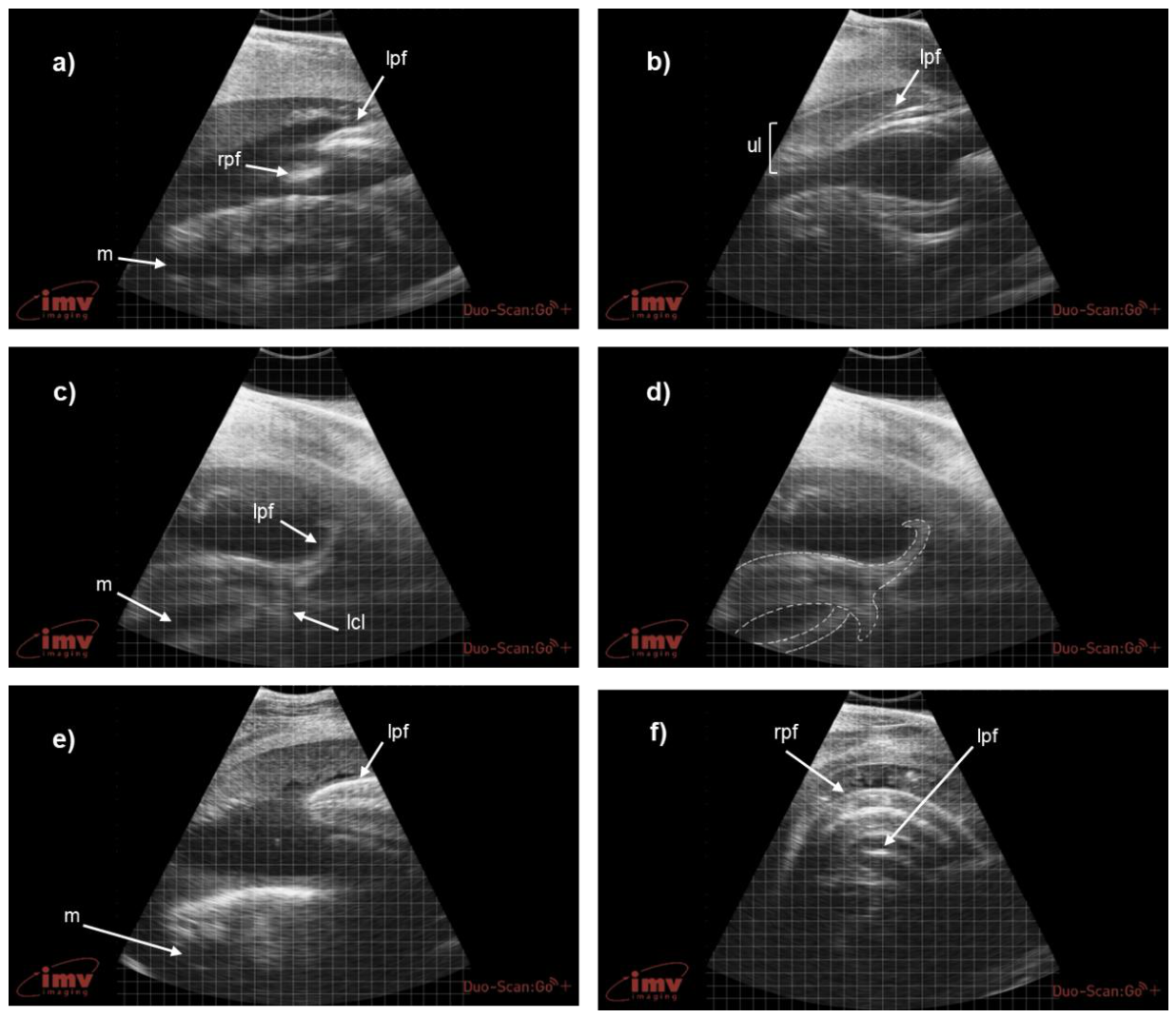
Foetal features (ultrasound imaging): in Timshel, underwater ultrasonography confirmed a middle developmental stage pregnancy. A foetus was visualized within the uterus (Figure 2a–d; Video S1), including a longitudinal (sagittal) view (Figure 2a; Video S1) and transverse cross-sectional views (Figure 2b–d). The foetal head was positioned anteriorly in the uterus and the pectoral fins were bent dorsally along the curve of the uterine wall with no evidence of overlap. Measurements were derived from the on-screen 1 cm grid (Figure 2b): foetal disc width was estimated at approximately 56–60 cm, and uterine lining (ul), consistent with trophonemata, was estimated at 4 cm from multiple frames. Rhythmic opening and closing of the foetal mouth, consistent with buccal pumping, were observed (Video S1). In Ophelia and Grecia, ultrasonography was consistent with late developmental stage pregnancy (Figure 2e,f). In Ophelia, the foetal mouth was visible (Figure 2e), and the pectoral fins appeared folded dorsally with substantial overlap. In Grecia, overlapping foetal pectoral fins were also evident (Figure 2f), although the foetal head and mouth were not visible in the frames obtained. In both individuals, the uterine lining appeared compressed in multiple frames (typically ~2–3 cm), with maximum observed thickness reaching ~4 cm. Buccal pumping could not be assessed in these late-stage examinations because the foetal head was partially or entirely outside the field of view.
This study provides the first peer-reviewed in situ ultrasound confirmation and developmental characterization of pregnancy in free-swimming oceanic manta rays. The reproductive biology of mobulids is largely inferred from the more commonly studied reef manta ray, M. alfredi (Stewart et al., 2018). Our observations validate the use of underwater ultrasonography with free-swimming M. birostris and highlight its potential to quantify species-specific reproductive parameters in the wild. Comparative ultrasound studies of reef manta rays provide important context for interpreting foetal development in mobulids. Murakumo et al. (2020) described an approximately one-year gestation in M. alfredi and defined early, middle, and late developmental stages based on foetal morphology and behaviour observed via ultrasonography. Although this staging framework is derived from M. alfredi, foetal features observed here align most closely with the middle and late developmental stage criteria, while species-specific timing for M. birostris remains to be validated. Foetal development differed among individuals, with Timshel corresponding most closely to a middle developmental stage, whereas Ophelia and Grecia exhibited features consistent with late-stage pregnancy.
Buccal pumping becomes apparent from the middle developmental stage (80–150 d post-copulation; ~3–5 months), and embryos at this stage have been observed to rotate within the uterine cavity while pectoral fin tips bend along the uterine wall but do not overlap (Murakumo et al., 2020). Rhythmic opening and closing of the foetal mouth observed in Timshel is consistent with embryonic buccal pumping described in manta rays, which has been proposed to facilitate gas exchange in utero in the absence of a placenta or umbilical cord (Tomita et al., 2012). In the frames available, pectoral fin overlap was not apparent. Together, these observations support classification as the middle stage, rather than the late-stage criterion of marked pectoral-fin overlap, which begins at approximately 150 d in M. alfredi (Murakumo et al., 2020).
Our results also highlight limitations of inferring pregnancy status from external morphology alone. Froman et al. (2023) reported that visible pregnancy bulges in manta rays become reliably detectable only after approximately six months of gestation, and that reproductive status may therefore be misclassified when assessments rely solely on external cues. In Timshel, underwater ultrasonography confirmed pregnancy with foetal characteristics most consistent with the middle developmental stage, yet no obvious maternal abdominal distension was evident in ventral views and no dorsal bulge was visible in dorsal or lateral imagery. This demonstrates that externally visible signs of pregnancy can be absent even when pregnancy is confirmed by ultrasound.
In our late-stage cases, dorsal and/or ventral bulging was detectable; however, externally based assessments of reproductive status may require close inspection (Froman et al., 2023). Notably, external distension appeared more pronounced in Grecia, where both dorsal and ventral bulging were observed, compared to Ophelia, in which bulging was primarily dorsal. Given that external distension is reported to increase with gestational progression (Froman et al., 2023), this difference may indicate that Grecia was at a more advanced stage within the late developmental phase. In addition, mating scars were not clearly observed in our individuals, underscoring the limited reliability of using external cues alone (Froman et al., 2023; Marshall and Bennett, 2010). Late-stage developmental features observed in the wild for Ophelia and Grecia are consistent with patterns described for captive reef manta rays by Murakumo et al. (2020), including the reported appearance of a maternal dorsal bulge, incomplete visualization of the uterus due to foetal size and depth, and dorsally folded foetal pectoral fins with extensive overlap. In the frames obtained, the foetal head was partially visible or not visible and buccal pumping could not be assessed owing to foetal size and imaging-depth constraints. As noted by Murakumo et al. (2020), this may reflect the increased depth of the foetal head relative to the maternal skin surface and the associated limits of ultrasound penetration, given that the maximum imaging depth used in this study was 24 cm. Together, these observations support the utility of underwater ultrasonography for distinguishing middle and late developmental stages in free-swimming oceanic manta rays and reinforce that external signs (e.g., ventral or dorsal bulging) may become more apparent in later pregnancy.
If pregnancy is often not externally apparent during early and middle stages, visual surveys likely underestimate the proportion of mature and/or pregnant females (Froman et al., 2023). Further, if late-stage pregnancies are difficult to observe via photos or videos, in-situ observations by trained researchers may be necessary to confirm reproductive status. These cryptic pregnancies can bias inferences about reproductive rates and areas of reproductive importance in places such as Revillagigedo National Park.
Future work should expand underwater ultrasound screening across individuals and seasons to determine when external distension becomes detectable in M. birostris, refine foetal size–stage relationships, and improve field criteria for visual pregnancy assessment. Integrating pregnancy confirmation with satellite telemetry would also help identify parturition timing and locate candidate pupping areas used by pregnant females.
Supplementary Materials
The following supporting information can be downloaded at the website of this paper posted on Preprints.org. Video S1. Underwater ultrasound segment of a foetus within the uterus of an oceanic manta ray (Mobula birostris) in sagittal view, showing rhythmic buccal pumping.
Author Contributions
M.C. conceived the study, led and conducted the fieldwork and data collection, including all ultrasound procedures, and wrote the first draft of the manuscript. H.N. contributed to methodology development, assisted in fieldwork, and reviewed and edited the manuscript. J.P. assisted in fieldwork and reviewed and edited the manuscript. T.P. reviewed and edited the manuscript.
Data Availability Statement
Research was conducted in collaboration with Revillagigedo National Park under permits issued by CONANP and SEMARNAT (permit no. SBRA/DGVS/09624/25), in accordance with Mexican wildlife and animal welfare regulations. All data were collected non-invasively through in situ observations and contactless underwater ultrasonography of free-swimming individuals. No animals were captured, restrained, harassed, or harmed, and all efforts were made to minimize disturbance to natural behaviour.
Acknowledgments
Support for this work was provided by Alonso I. Rodríguez and Cuidando los Mares de México A.C., the John Tolan Foundation, the DiverMojo Foundation, and the Marine Megafauna Foundation through continued investment in oceanic manta ray research. The authors are grateful to John Beltramo for his logistical support and personal financial contribution to the expedition aboard Timshel. We also thank the crews of Timshel and the liveaboard Adventure for their support during the expeditions in which these data were collected. We thank all participants involved in field activities during the expeditions, including members of the research team and citizen scientists. We also thank Camilo Thompson for legal support related to permitting and regulatory compliance.
References
- Cooper, T.M.; Green, L.; Setyawan, E.; Erdmann, M.; Duffy, C.A.J.; Constantine, R.; Della Penna, A. Movement ecology and foraging behaviours of oceanic manta rays (Mobula birostris) in the coastal waters of Aotearoa, New Zealand. R. Soc. Open Sci. 2025, 12, 250838. [Google Scholar] [CrossRef]
- Froman, N.; Genain, M.-A.; Stevens, G. M. W.; Pearce, G. P. Use of underwater contactless ultrasonography to elucidate the internal anatomy and reproductive activity of manta and devil rays (family: Mobulidae). J. Fish. Biol. 2023, 103, 305–323. [Google Scholar] [CrossRef] [PubMed]
- Stewart, J. D.; Jaine, F. R. A.; Armstrong, A. J.; Armstrong, A. O.; Bennett, M. B.; Burgess, K. B.; Couturier, L. I. E.; Croll, D. A.; Cronin, M. R.; Deakos, M. H.; Dudgeon, C. L.; Fernando, D.; Froman, N.; Germanov, E. S.; Hall, M. A.; Hinojosa-Alvarez, S.; Kashiwagi, T.; Keyes, P.; Lezama-Ochoa, N.; Stevens, G. M. W. Research priorities to support effective manta and devil ray conservation. Front. Mar. Sci. 2018, 5, 314. [Google Scholar] [CrossRef]
- Marshall, A. D.; Bennett, M. B. Reproductive ecology of the reef manta ray Manta alfredi in southern Mozambique. J. Fish. Biol. 2010, 77, 169–190. [Google Scholar] [CrossRef] [PubMed]
- Marshall, A. D.; et al. Mobula birostris (amended version of 2020 assessment). IUCN Red. List Threat. Species 2022, 2022, e.T198921A214397182. [Google Scholar]
- Murakumo, K.; Matsumoto, R.; Tomita, T.; Matsumoto, Y.; Ueda, K. The power of ultrasound: observation of nearly the entire gestation and embryonic developmental process of captive reef manta rays (Mobula alfredi). Fish. Bull. 2020, 118, 1–7. [Google Scholar] [CrossRef]
- Rambahiniarison, J. M.; Lamoste, M. J.; Rohner, C. A.; Murray, R.; Snow, S.; Labaja, J.; Araujo, G.; Ponzo, A. Life history, growth, and reproductive biology of four mobulid species in the Bohol Sea, Philippines. Front. Mar. Sci. 2018, 5, 269. [Google Scholar] [CrossRef]
- Tomita, T.; Toda, M.; Ueda, K.; Uchida, S.; Nakaya, K. Live-bearing manta ray: how the embryo acquires oxygen without placenta and umbilical cord. Biol. Lett. 2012, 8, 721–724. [Google Scholar] [CrossRef] [PubMed]
Figure 1.
Schematic representation of underwater contactless ultrasound scan orientations used on free-swimming oceanic manta rays (Mobula birostris). Track patterns used for scan acquisition are indicated for sagittal (reverse “N”) and transverse (“Z”) transects. (a) Sagittal scan orientation. (b) Transverse scan orientation. Arrows indicate the direction of probe movement relative to the body.
Figure 1.
Schematic representation of underwater contactless ultrasound scan orientations used on free-swimming oceanic manta rays (Mobula birostris). Track patterns used for scan acquisition are indicated for sagittal (reverse “N”) and transverse (“Z”) transects. (a) Sagittal scan orientation. (b) Transverse scan orientation. Arrows indicate the direction of probe movement relative to the body.
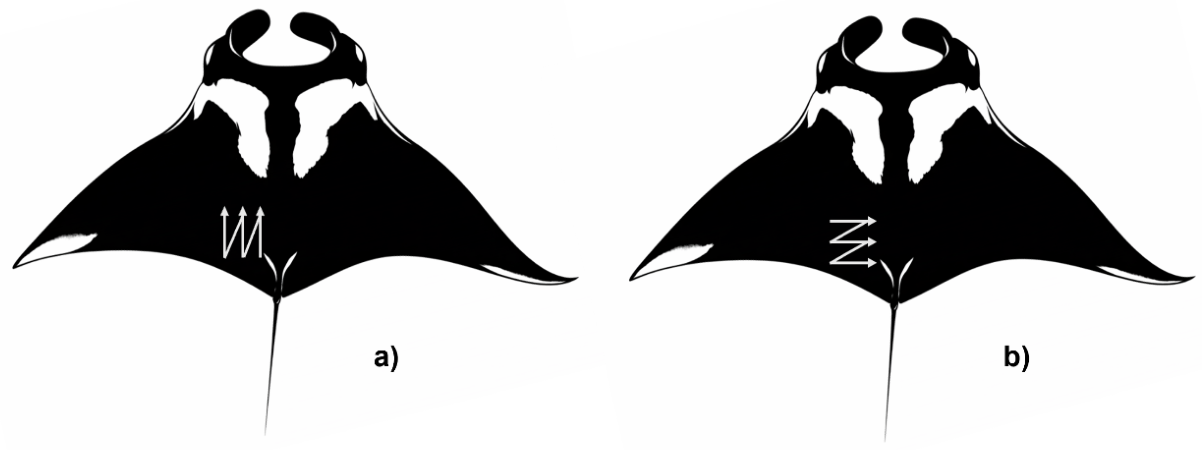
Figure 2.
Ultrasound still frames obtained from underwater, contactless imaging of pregnant oceanic manta rays (M. birostris) in Revillagigedo National Park, Mexico, showing foetal anatomical features across gestational stages. Panels (a–d) show a middle developmental stage pregnancy in “Timshel.” (a) Sagittal view showing the mouth (m) and left and right pectoral fin tips (lpf, rpf). (b–d) Transverse views: (b) left pectoral fin (lpf) and uterine lining (ul); (c) mouth (m), left pectoral fin (lpf) and left cephalic lobe (lcl); (d) interpreted foetal outline corresponding to panel (c). Panel (e) shows a late developmental stage pregnancy in “Ophelia,” sagittal view showing the foetal mouth (m) and left pectoral fin (lpf). Panel (f) shows a late developmental stage pregnancy in “Grecia,” transverse view showing dorsally folded pectoral fins, with the right pectoral fin margin (rpf) overlying the left (lpf). Grid spacing = 1 cm.
Figure 2.
Ultrasound still frames obtained from underwater, contactless imaging of pregnant oceanic manta rays (M. birostris) in Revillagigedo National Park, Mexico, showing foetal anatomical features across gestational stages. Panels (a–d) show a middle developmental stage pregnancy in “Timshel.” (a) Sagittal view showing the mouth (m) and left and right pectoral fin tips (lpf, rpf). (b–d) Transverse views: (b) left pectoral fin (lpf) and uterine lining (ul); (c) mouth (m), left pectoral fin (lpf) and left cephalic lobe (lcl); (d) interpreted foetal outline corresponding to panel (c). Panel (e) shows a late developmental stage pregnancy in “Ophelia,” sagittal view showing the foetal mouth (m) and left pectoral fin (lpf). Panel (f) shows a late developmental stage pregnancy in “Grecia,” transverse view showing dorsally folded pectoral fins, with the right pectoral fin margin (rpf) overlying the left (lpf). Grid spacing = 1 cm.
Disclaimer/Publisher’s Note: The statements, opinions and data contained in all publications are solely those of the individual author(s) and contributor(s) and not of MDPI and/or the editor(s). MDPI and/or the editor(s) disclaim responsibility for any injury to people or property resulting from any ideas, methods, instructions or products referred to in the content. |
© 2026 by the authors. Licensee MDPI, Basel, Switzerland. This article is an open access article distributed under the terms and conditions of the Creative Commons Attribution (CC BY) license (http://creativecommons.org/licenses/by/4.0/).
Copyright: This open access article is published under a Creative Commons CC BY 4.0 license, which permit the free download, distribution, and reuse, provided that the author and preprint are cited in any reuse.


