
Submitted:
03 June 2026
Posted:
04 June 2026
You are already at the latest version
Abstract
Since the gene was first articulated as a unit of inheritance and causation, evolutionary biology has operated under a productive but unresolved tension between experimental practice and explanatory language. Perturbation experiments, association studies, and plasticity assays are routinely interpreted as if they should converge on a single notion of genetic causation, yet they rarely do. This mismatch has been sensed repeatedly—from early organicist critiques, through the work of Gould and Alberch, to contemporary contributions from systems biology and evolutionary developmental biology—but has resisted unification. Here, we argue that the persistence of this tension reflects not missing data or incomplete theory, but a fundamental mismatch between explanatory frameworks. Specifically, different experimental approaches interrogate biological systems at different organizational levels and therefore probe distinct causal regimes. By integrating insights from gene regulatory network structure, developmental buffering, canalization, and polygenic adaptation, we show that genetic necessity is a sparse, level relative property associated with structural dependence, whereas evolutionary change proceeds through widespread, small, contributory effects that are tolerated by developmental systems. Genome wide association studies succeed precisely because they map this domain of available variation, while knockouts reveal where systems are fragile rather than where evolution most readily acts. Developmental plasticity further bridges these regimes by exposing shifts in network sensitivity under environmental change. Reframing causation as contribution based and level relative resolves longstanding conflicts between genetics, development, and evolution, and provides a coherent framework for interpreting experimental results without privileging any single methodology. This perspective aligns causal language with biological organization and offers a unified account of how development structures evolutionary possibility.
Keywords:
polygenic
; GWAS
; necessity
; gene regulatory networks
; variability
; developmental architecture
1. Introduction
Since the gene was first conceptualized as a unit of inheritance and causation in the early twentieth century, biology has lived with a productive but unresolved tension between experimental practice and explanatory language. T. H. Morgan’s formulation of the gene [1,2], forged in the context of Mendelian segregation and chromosomal mapping, provided an extraordinarily powerful framework for linking variation, inheritance, and phenotype. Yet embedded within this success was an implicit assumption that would later prove fragile: that genetic causation could be localized to discrete components, and that perturbing those components would reveal their causal primacy. From its inception, the gene concept thus carried both explanatory force and a latent ambiguity—one that has repeatedly resurfaced as biological systems became better characterized.
Early resistance to this reductionist framing emerged almost immediately in the form of the organicism movement[3], led by figures such as E. S. Russell [4,5], Ritter [6], and Woodger [7]. Organicists argued that living systems could not be understood as additive assemblies of parts, and that causal relevance resided in organization, coordination, and relations rather than isolated components[5]. However, organicism arose in a pre-molecular era. Lacking mechanistic access to regulatory interactions, population-level genetic data, or formal models of development, its critiques remained largely philosophical. The problem was felt clearly, but could not yet be articulated with operational precision.
This tension re-emerged forcefully in the late twentieth century, most notably through the work of Stephen Jay Gould and Pere Alberch, who emphasized developmental constraint[8,9], generative rules[10], and the role of form in evolution[10,11]. Their critiques challenged adaptationist and gene-centric narratives by showing that not all phenotypic variation is equally accessible to selection. Yet even here, the vocabulary of networks, buffering, and multilevel causation was still nascent, and the molecular data required to ground these ideas empirically were only beginning to accumulate. Development was recognized as important, but its causal logic remained difficult to formalize.
Over the last several decades, prominent voices—including Denis Noble[12], Frederik Nijhout(13–15), Stuart Newman[16], and Gerd Müller[17], among others—have continued to articulate variations of the same concern: that biological causation cannot be cleanly reduced to genes, that development plays an active role in shaping evolutionary trajectories, and that perturbation-based notions of necessity often mislead. These contributions have been increasingly informed by molecular data, systems biology, and evolutionary developmental biology. Still, despite growing sophistication, the core tension has persisted. The problem has been described repeatedly, but never fully resolved.
Recent efforts have attempted to unify these perspectives more explicitly. A notable example is the recent Special Issue The Gene: An Appraisal[12] initiated by Keith Baverstock[18], which brought together diverse approaches to address the relationship between genes, development, and evolutionary change. Similarly, in a prior contribution to this collection, we argued that developmental systems cannot be fully understood through the lens of a genetic control paradigm[15]. Yet even these contemporary syntheses fell short of full unification. They successfully identified the symptoms of the problem, but stopped short of isolating its underlying cause.
Here, we argue that the persistent difficulty lies not in missing data or insufficient theory, but in a mismatch between explanatory frameworks. Modern biology routinely employs three powerful experimental approaches—perturbation experiments (e.g., knockouts), association studies (e.g., GWAS), and plasticity assays—while implicitly assuming that they should converge on a single notion of genetic causation. When they fail to do so, the discrepancy is often treated as paradoxical. We suggest instead that this expectation is misplaced. Each of these approaches interrogates biological systems at different organizational levels and under different causal regimes. Expecting them to identify the same “causal genes” conflates structural dependence with evolutionary contribution, and necessity with availability.
This realization did not arise from abstract theorizing alone, but from repeated exposure to the same confusion in practice. Only after teaching multiple rounds of genetics and developmental biology—often back-to-back and to the same students—did the nature of the mismatch become unmistakable. Students were taught, on the one hand, that genes act in networks, that traits are polygenic, and that development is robust and context dependent. On the other hand, they were asked to interpret knockouts as demonstrations of necessity, GWAS hits as causal drivers, and plasticity as deviation from a genetic norm. The resulting conceptual friction was not a failure of student understanding, but a reflection of an unresolved inconsistency in how the field itself frames causation.
In this manuscript, we aim to resolve this longstanding tension by reframing genetic causation as level-relative and contribution-based, rather than absolute and necessity-driven. By integrating insights from network biology, developmental buffering, canalization, and polygenic adaptation, we show that the apparent contradictions between experimental approaches dissolve once causation is aligned with organizational level. What emerges is not a rejection of the gene, but a clearer understanding of what genes can—and cannot—be said to cause in structured biological systems.
2. Necessity in Logic Versus Necessity in Biology
In formal logic, necessity is absolute: if A is necessary for B, then B cannot occur without A [19,20]. Biological systems rarely conform to this structure. Traits are typically polygenic, buffered, and context-dependent. Yet biological practice routinely applies necessity language to genes whose perturbation yields partial, quantitative, or conditional effects.
At present, it is difficult to find a study in evolutionary or developmental biology that does not include some form of necessity analysis. High-throughput approaches—such as genomics, transcriptomics, and association mapping—routinely identify genetic correlates of focal traits, and these statistical associations are typically followed by perturbation experiments intended to establish causality. The underlying assumption is that disrupting a candidate gene can validate its causal status with respect to trait formation. However, this practice often reproduces the same gene-centric logic it seeks to overcome: once a genetic signature is identified, the expectation is that the corresponding gene, considered in isolation, should causally explain the trait.
Decades of work in developmental genetics have instead demonstrated that genes do not act independently, but as components of dynamic, nonlinear, and often unintuitive molecular networks(21–25). When viewed from this perspective, necessity studies do not merely test whether a gene is required for a phenotype; they implicitly situate that gene within a broader regulatory architecture. Indeed, the cumulative effect of necessity analyses over the last several decades has been the progressive reconstruction of gene regulatory networks underlying focal traits. Thus, modern necessity studies do not simply identify candidate genes as “necessary,” but also reveal how the phenotypic consequences of perturbation depend on network position, interaction structure, and developmental context as currently understood.
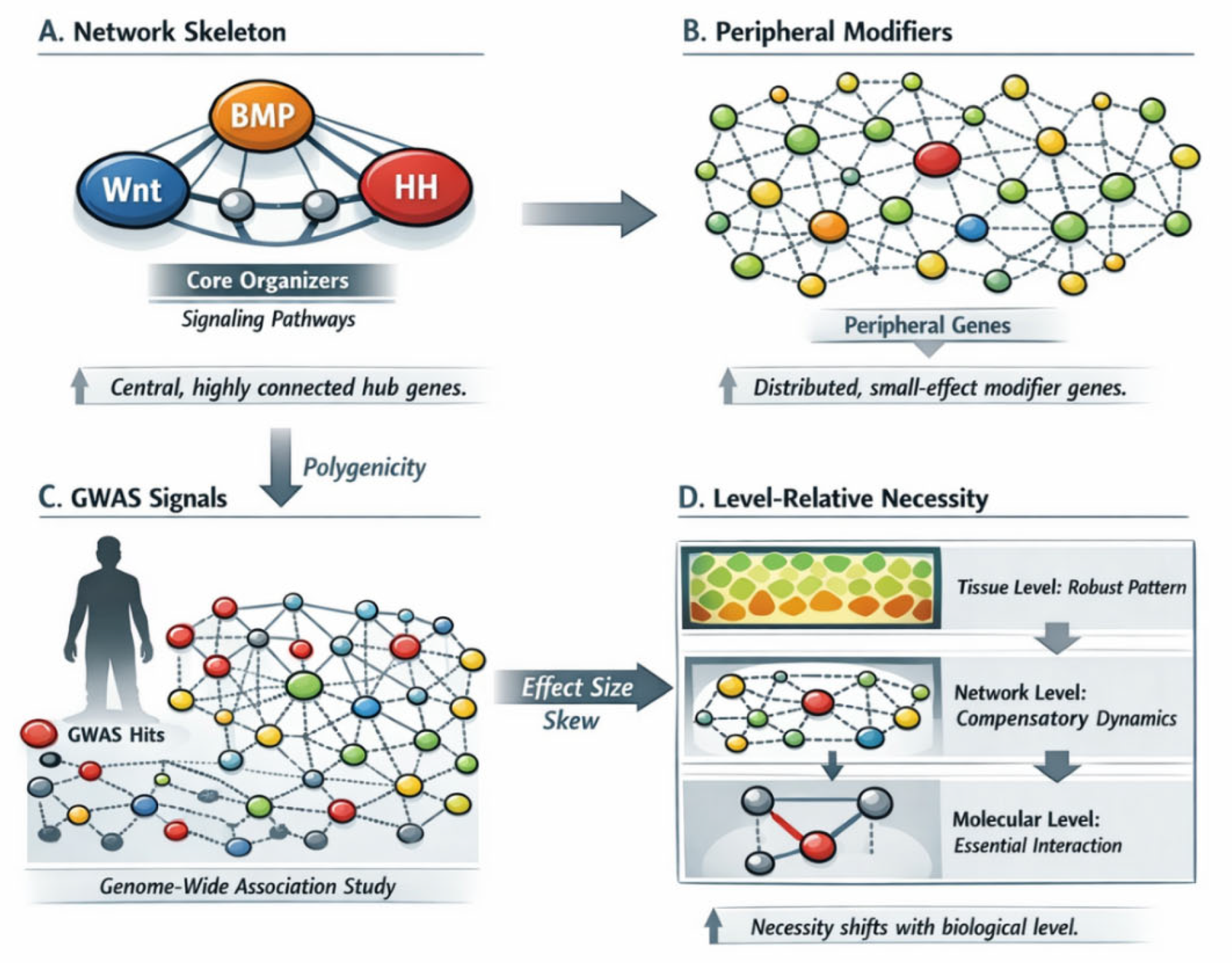
Gene regulatory networks therefore exhibit internal structure rather than uniform connectivity (Figure 1). A small subset of components functions as core organizers, forming what can be described as the network skeleton. These elements occupy central positions in the interaction topology and are responsible for establishing large-scale patterning, spatial organization, and the coordination of cell populations into coherent developmental fields[26]. Canonical signaling pathways such as BMP[27], Wnt[28,29], and Hedgehog[30,31], together with their signal transduction machinery, exemplify this skeletal role. Rather than encoding fine phenotypic detail, these pathways define the global architecture of developmental dynamics—setting boundaries, gradients, and regulatory regimes within which downstream processes unfold(30–34). Perturbations to this skeletal structure therefore tend to yield broad, pleiotropic effects, reflecting disruption of the organizing framework itself rather than the loss of a single trait-specific instruction.
Surrounding the network skeleton is a much larger set of peripheral modifiers—nodes and edges that interface with the core but do not define its fundamental structure. These include extracellular matrix components that influence ligand diffusion[28,35], factors that modulate secretion rates from signaling centers, and molecular elements that subtly alter signal transduction efficiency, timing, or degradation. Individually, such modifiers exert small, often quantitative effects(28, 35, 36); collectively, however, they shape the responsiveness, robustness, and context sensitivity of the network skeleton. Importantly, it is this layered organization—central organizers coupled to numerous peripheral modifiers—that gives rise to polygenicity.
Phenotypic outcomes emerge from the cumulative influence of many genes acting on a shared structural core, rather than from additive contributions of independent loci(37–41). From Fisher and Wright onward, additive genetic variance has been understood as arising from allele effects at individual loci; what has changed is not the locus-based nature of causation, but our understanding of how those contributions are organized, buffered, and made visible by developmental systems(42–44). Polygenicity thus reflects the architecture of regulatory networks themselves: a stable skeleton that constrains developmental possibilities, surrounded by a distributed set of modifiers that bias outcomes within those constraints.
This structured organization resolves a persistent tension in how necessity and polygenicity are interpreted in biological systems. Classic Hox gene perturbations such as Ultrabithorax, Antennapedia, and Proboscipedia were rightly interpreted as demonstrating causal necessity, but this necessity also reflected disruption of core network structure rather than singular genetic instruction(45–48). Core organizers, by virtue of their central position within the network skeleton, often appear “necessary” because their perturbation disrupts the global coordination of the system, leading to large, pleiotropic, and frequently catastrophic effects[26].
Such outcomes are routinely taken as evidence of causal primacy. In contrast, peripheral modifiers rarely yield dramatic phenotypes when perturbed individually, instead producing modest, quantitative, or context-dependent shifts in trait expression. Yet it is precisely these peripheral components that dominate standing genetic variation[42,43] and underlie polygenic trait architecture, as they bias the behavior of an otherwise stable network skeleton without redefining its organizing logic. Thus, necessity concentrates at the level of network structure, while quantitative variation accumulates at the network periphery.
This asymmetry between apparent necessity and distributed quantitative variation is captured explicitly in network-based models of gene regulation, most notably in the work of Crombach and Hogeweg (2008), who demonstrate how network topology alone can generate both robustness to most mutations and sensitivity to a restricted subset of highly connected nodes[49]. In network terms, the distinction between core organizers and peripheral modifiers corresponds to differences in connectivity and influence within gene regulatory networks. Some genes occupy positions where they interact with many other components—either directly or through cascades of downstream effects—while most genes participate in far fewer interactions.
These highly connected components, often referred to as network hubs, are not defined by their molecular identity but by their position in the regulatory architecture. Perturbations to such hubs tend to propagate broadly through the network, altering multiple downstream processes simultaneously, whereas perturbations to weakly connected genes are more likely to be absorbed locally. As a result, the distribution of phenotypic effect sizes across genes is inherently uneven: a small number of centrally positioned genes produce large, system-level effects when disrupted, while a much larger number of peripheral genes contribute small, incremental, and often context-dependent influences[49]. Crombach and Hogeweg (2008) formalized this intuition using evolving gene regulatory network models, showing that networks naturally acquire this skewed organization, in which robustness to most mutations coexists with sensitivity concentrated at a restricted subset of highly connected nodes[49].
This network-based interpretation provides a natural explanation for a longstanding pattern in genome-wide association studies. Critical reviews of GWAS consistently note that complex traits are associated with extremely large numbers of loci of individually tiny effect, with limited correspondence to developmental organizing genes, leading to growing concern about causal interpretation despite strong predictive power[42,50,51,52,53,54]. Within a structured network, this outcome is expected. Genes occupying hub-like positions within the network skeleton—those involved in organizing signaling fields or coordinating regulatory state—are subject to strong constraint, as perturbations produce large, often deleterious, pleiotropic effects and are therefore efficiently removed by selection. In contrast, peripheral modifiers that interface with the skeleton at its edges can vary without destabilizing the underlying developmental program, allowing them to accumulate genetic variation and dominate quantitative trait architecture.
GWAS thus preferentially detect variants in genes affecting extracellular matrix composition, ligand diffusion, secretion dynamics, receptor sensitivity, or signal transduction efficiency, not because these genes are primary causal drivers of patterning, but because their network position permits fine-scale modulation of phenotype. From this perspective, the apparent disconnect between developmental “master regulators” and GWAS hits does not reflect a failure of association mapping, but rather reveals the layered structure of gene regulatory networks[43,51,53]: necessity and organizing power concentrated at the core, and polygenic variation distributed across the periphery.
This interpretation is further reinforced by the analysis of Siegal and Bergman (2002), who showed that developmental robustness—and the appearance of genetic necessity—can arise as an emergent property of regulatory network structure itself, even in the absence of direct selection for robustness[55]. Using transcriptional regulatory network models, they demonstrated that increasing connectivity naturally produces canalization, such that phenotypic outcomes become insensitive to most genetic perturbations while remaining highly sensitive to disruptions at a small number of centrally embedded components. Within this framework, the majority of genes are contributory rather than necessary: their perturbation alters quantitative features of network behavior without destabilizing the underlying developmental attracto[55]r. Genes that appear “necessary” are those whose perturbation compromises the stability of the network as a whole, not because they uniquely encode a trait, but because they occupy positions critical for maintaining coordinated system dynamics.
Taken together with network-based models of evolvability and empirical patterns from GWAS, this work underscores that necessity in biological systems is neither ubiquitous nor intrinsic, but instead emerges sparsely from network organization, against a background of widespread contributory genetic influence.
3. Emergence and Level-Relative Causation
Across the sciences, emergence is commonly invoked to describe situations in which system-level properties arise from interactions among components, yet cannot be adequately explained by those components considered in isolation[56]. In this sense, explanatory relevance shifts from individual parts to patterns of organized interaction, and from local mechanisms to collective dynamics.
This perspective has deep historical roots in biology, most explicitly articulated by the organicist tradition of the early twentieth century. Thinkers such as E. S. Russell, Ritter, and Woodger argued that living systems are not reducible to additive assemblies of parts, but are instead organized wholes in which causal significance resides in relations, coordination, and integration[3]. Although organicism predated modern molecular biology, its central claim—that biological explanation must account for how parts are organized into functioning systems—anticipates contemporary accounts of emergence grounded in network structure and multilevel organization.
In biological systems, however, emergence has a more precise meaning tied to hierarchical organization and developmental dynamics[57]. García-Guillén and El-Sherif formalize emergence as a level-relative phenomenon, in which causal explanations depend on the organizational scale at which a process is described[58]. In their framework, molecular interactions give rise to regulatory networks, networks give rise to tissue-level patterns, and patterns give rise to organismal traits—yet causal relationships do not translate uniformly across these levels.
A gene may be causally relevant at one level while becoming screened off or redistributed at another, as higher-order interactions constrain and channel lower-level variation[14,15,59]. Emergence, in this biological sense, reflects the fact that developmental systems generate new causal regimes as organization increases, such that necessity, sufficiency, and explanatory adequacy must be evaluated relative to the level of analysis rather than assumed to propagate upward unchanged[9]. This level-relative view of emergence provides the conceptual foundation for understanding why genetic necessity is often context-dependent, sparse, and unstable across scales[16,17]—a point made explicit in the example of level-relative necessity that follows.
A central implication of emergence in developmental systems is that causal roles—and with them, judgments of necessity—are relative to both organizational level and network position. Within a structured gene regulatory network, the distinction between a stable organizing framework and a surrounding set of modulatory influences becomes critical. Components of the network skeleton—core organizers that coordinate signaling fields and establish global regulatory regimes—often appear necessary because their perturbation disrupts the coherence of the system itself. In contrast, peripheral modifiers typically do not abolish pattern formation when perturbed individually, instead producing graded or context-dependent shifts in phenotype. These differences do not reflect a dichotomy between “important” and “unimportant” genes, but rather arise from how causal influence is distributed across the network’s architecture.
This distinction becomes particularly clear when causal analysis is evaluated across levels of organization. At a local, molecular level, a skeletal component may be necessary for enforcing a specific regulatory interaction—for example, maintaining signal propagation within a developmental field(60–62). Yet at higher levels of organization, such as tissue-level patterning or field-level coordination, the same outcome may persist through compensatory interactions among network components, even when individual elements are perturbed(49, 55, 63). Conversely, peripheral modifiers that exert negligible effects at the level of global organization may play a measurable role in shaping quantitative variation within an already established pattern(64–66).
Necessity thus shifts with scale: core organizers are necessary for maintaining the integrity of the developmental framework, while peripheral modifiers are contributory to variation expressed within that framework. What changes across levels is not the molecular mechanism itself, but the causal frame of reference imposed by higher-order organization (Box 1; Figure 2).
This level-relative redistribution of causal influence is made explicit in recent theoretical analyses of evolving gene regulatory networks. Jorritsma and van den Berg (2026) demonstrate that the phenotypic impact of a given gene depends on both its embedding within the network skeleton and the environmental context in which the network operates, such that the same component can alternate between high-impact and low-impact roles without any change to its intrinsic function[67]. Similarly, Booth and Hadjivasiliou (2025) show that network organization governs both evolvability and predictability by progressively screening off early, component-level perturbations as higher-order interactions stabilize system dynamics[68]. In both cases, causal relevance shifts from individual genes to the structure of interactions that bind them into a coherent whole. These results reinforce the conclusion that biological necessity is not a fixed attribute of genes, but an emergent, level-dependent property of structured regulatory systems—rooted in the distinction between a conserved network skeleton and a distributed periphery of contributory modifiers.
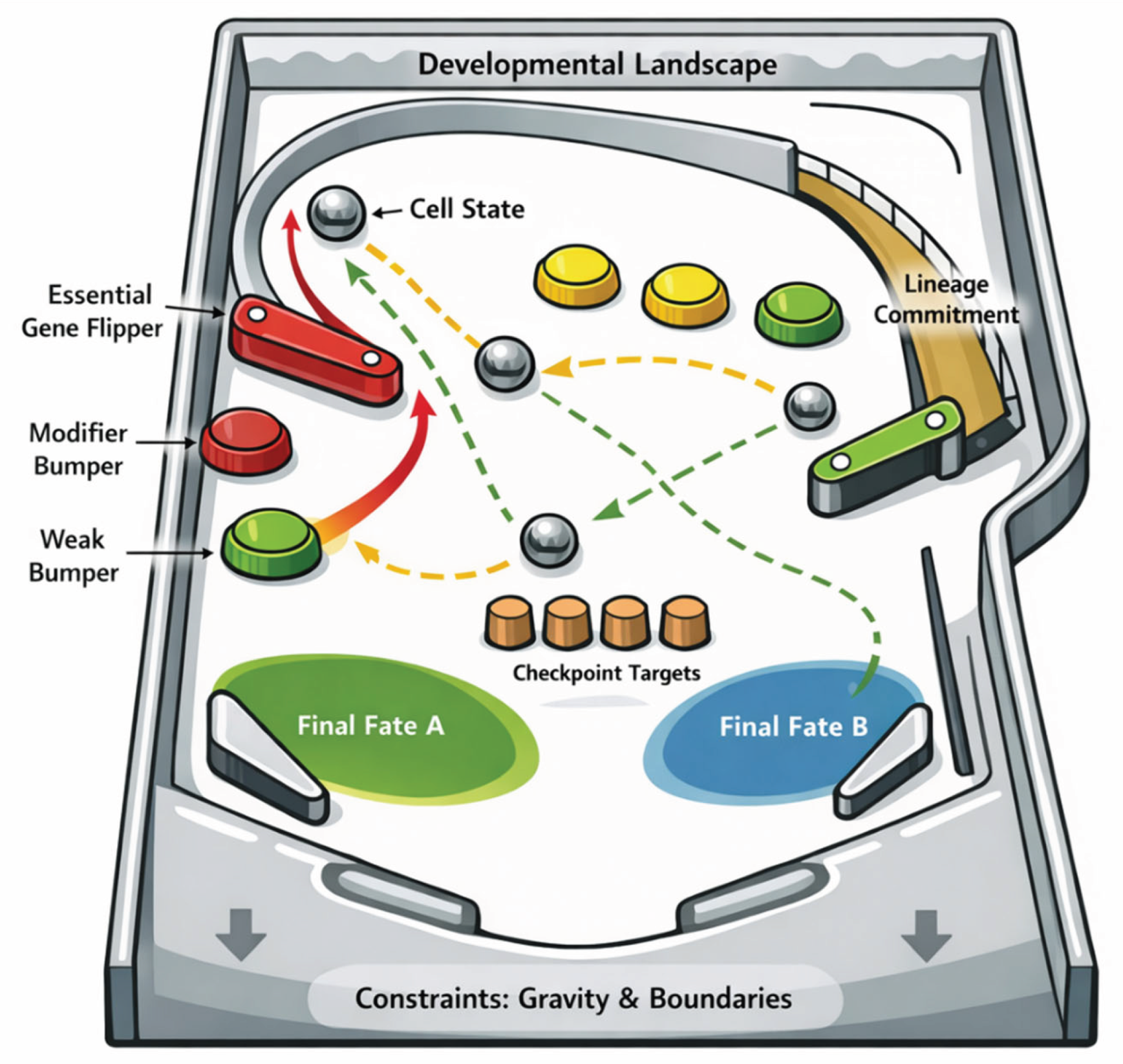
Box 1. A heuristic model for contribution and emergence.
To summarize the contribution-based framework developed in this paper, it is useful to consider a heuristic metaphor drawn from pinball mechanics. In this analogy, the developmental system is represented as a pinball table, the ball represents a cell’s evolving state, and genes correspond to structural features—such as bumpers, flippers, and ramps—that redirect trajectories to varying degrees. Highly influential genes resemble strong flippers: perturbing them produces large redirections in developmental trajectories and often yields pronounced phenotypic effects. Genes with weaker or more context-dependent effects function like passive bumpers, subtly biasing trajectories without determining outcomes on their own. The layout of the table—the architecture of the gene regulatory network—constrains which trajectories are possible, while gravity and boundaries represent physical, temporal, and physiological constraints. Crucially, the final position of the ball depends on the cumulative history of interactions rather than on any single element. Early perturbations may exert strong local effects yet lose predictive power as additional interactions accumulate, illustrating how causal necessity at one level can be screened off at higher organizational levels. The metaphor emphasizes probabilistic emergence, graded contribution, and network dependence without implying deterministic control by individual genes.
Taken together, these considerations clarify why attempts to force polygenic traits into a monogenic or Mendelian causal framework have repeatedly generated conceptual tension rather than explanatory progress(39, 42, 50, 51, 69). Mendelian necessity is defined at the level of discrete inheritance and individual components, whereas most developmental and complex traits arise from organized interactions distributed across regulatory networks and higher-order structures. Treating such traits as if they ought to yield single necessary causes conflates levels of explanation, mistaking the visibility of large effects at one scale for causal primacy across all scales. As a result, genes are alternately labeled as paradoxically “essential yet insufficient,” or as statistically important yet biologically opaque.
A level-relative view of causation resolves this tension by recognizing that necessity, contribution, and explanatory adequacy are not absolute properties of genes, but emergent features of organized systems evaluated at specific levels of analysis. Within structured regulatory networks, core organizers may be necessary for maintaining system-level coherence, while a broad periphery of contributory genes shapes quantitative variation without redefining the developmental framework itself. Polygenicity is therefore not a failure of causal explanation, nor a challenge to biological organization, but the expected signature of emergence in hierarchical systems. By aligning causal claims with organizational level, the apparent conflict between Mendelian logic and polygenic architecture dissolves, replaced by a coherent account in which genetic effects are understood as position-, context-, and level-dependent manifestations of networked developmental causation.
4. Screening off and the Loss of Lower-Level Explanatory Power
In complex biological systems, causal relationships at lower levels of organization are often screened off by higher-level structure and dynamics. Screening off refers to the process by which upstream or component-level variation loses explanatory power once system-level organization is established[59]. When this occurs, changes at the molecular or genetic level no longer translate directly into phenotypic differences, not because those changes are irrelevant, but because their effects are absorbed, buffered, or redistributed by interactions at higher levels of organization. As a result, causal relevance shifts upward: system-level states and interactions become better predictors of outcome than the properties of individual components[49,58,68].
Within developmental and evolutionary biology, screening off provides a mechanistic explanation for a long-recognized but often puzzling phenomenon: the accumulation of substantial genetic variation in the absence of equivalent phenotypic divergence[63,70]. Regulatory networks, once organized into stable configurations, can tolerate extensive genetic nonuniformity while preserving consistent developmental outcomes[55,61]. In this context, canalization can be understood as an evolutionary property of developmental systems—the stability of phenotype despite genetic, environmental, or contextual variation across individuals, populations, or species(71–74). Canalization does not imply the absence of genetic effects; rather, it reflects the progressive screening off of lower-level variation by higher-order regulatory dynamics[49,64], such that many genetic differences become phenotypically silent under typical conditions[75].
This perspective clarifies how cryptic genetic variation can accumulate over evolutionary time. Mutations affecting peripheral components, redundant interactions, or buffered pathways may alter local molecular processes without perturbing the system-level attractors that govern development. Such variation remains hidden until buffering is disrupted—by environmental stress[76], genetic perturbation[75], or evolutionary change[71,73]—at which point previously screened-off effects can become phenotypically expressed.
Ian Dworkin’s foundational analysis of canalization and cryptic genetic variation formalized this view by emphasizing that robustness and hidden variation are not exceptional features of biological systems, but expected consequences of their hierarchical and network-based organization[77]. In doing so, this work provides a critical bridge between developmental buffering, evolutionary potential, and the loss of explanatory power at lower levels of analysis.
Viewed through the lens of screening off, the architecture revealed by genome-wide association studies takes on a coherent developmental interpretation[42]. Within structured regulatory systems, small, additive variants correspond precisely to screened-off genetic variation: changes that alter molecular or cellular processes locally, yet fail to propagate to the level of phenotype because higher-order network dynamics absorb their effects[49,55]. The prevalence of polygenic signals in GWAS therefore reflects not weak causation, but buffered causation[51,78]—genetic contributions that are real, measurable, and evolutionarily relevant, yet phenotypically silent under typical conditions due to canalized developmental organization(63, 75, 77). In this sense, GWAS catalogues the genetic substrate of potential variation rather than the determinants of baseline form (Figure 3).
A striking experimental demonstration of this principle comes from the work of Rutherford and Lindquist, who showed that the molecular chaperone HSP90 functions as a capacitor for phenotypic variation, masking the effects of genetic differences under normal conditions and releasing them when buffering is compromised[75]. When HSP90 activity is reduced, previously cryptic genetic variation becomes phenotypically expressed, revealing a reservoir of screened-off contributions that had accumulated without visible effect[76,79].
This result provides a mechanistic illustration of canalization as an emergent property of developmental systems: robustness permits genetic diversity to build silently, while perturbation of buffering exposes variation that was always present but causally suppressed at higher organizational levels. Together, GWAS patterns and experimental studies of buffering converge on the same conclusion—phenotypic stability and genetic diversity are not opposing features of biological systems, but complementary outcomes of hierarchical organization and screening off.
4.1. Screening Off Permits Adaptation in Changing Environments
Screening off does not merely stabilize phenotype in the face of genetic variation; it also establishes the conditions under which evolvability can be expressed when environments change. Because developmental systems are organized around robust network dynamics, they are inherently capable of producing multiple phenotypic outcomes without requiring new genetic inputs. As a result, the first response to novel or stressful environments is typically developmental plasticity rather than genetic change[80,81].
Plastic responses explore alternative regions of phenotypic space while preserving the integrity of the underlying network skeleton, allowing organisms to maintain function under altered conditions. During this phase, genetic variation continues to accumulate in screened-off components of the system, remaining largely phenotypically silent as long as existing network dynamics remain intact(63, 77, 82).
Crucially, environmental change can alter not only selective pressures but also the internal dynamics of regulatory networks, shifting which components occupy positions of sensitivity. Theoretical analyses of evolving gene regulatory networks show that when selective regimes change, different regions of the network can become phenotypically consequential, while previously sensitive components may become buffered[67]. Jorritsma and van den Berg (2026) explicitly demonstrate that the phenotypic impact of a given gene depends on both environmental context and network configuration, such that the same component can alternate between contributory and high-impact roles across conditions.
Similarly, Booth and Hadjivasiliou (2025) show that network organization governs evolvability by determining how perturbations propagate through the system, with changes in external conditions reshaping the mapping between genetic variation and phenotypic outcome[68]. In this framework, evolvability arises not from the continual exposure of all genetic variation, but from context-dependent reconfiguration of network sensitivity, which allows previously cryptic variants to become penetrant when buffering is altered[83].
Empirical studies of phenotypic buffering provide direct support for this view. In systems where developmental outcomes remain stable across wide ranges of genetic and environmental variation—such as the phenotypic buffering documented in monogeneans—cryptic genetic diversity can accumulate without disrupting form or function. Only when environmental or developmental constraints are relaxed does this hidden variation become phenotypically expressed[64,71,73,81]. Formal models of canalization, such as those developed by Kadelka (2026), capture this process by showing how network dynamics generate stable attractors that screen off lower-level variation while preserving the capacity for rapid phenotypic change when those dynamics are perturbed[84]. Together, these results illustrate how screening off, plasticity, and evolvability are not opposing forces, but sequential and complementary features of structured developmental systems.
4.2. Plasticity-First Versus Mutation-First Models of Phenotypic Evolution
Traditional mutation-first models of evolution implicitly assume that novel phenotypes arise through the appearance of new mutations, which are then amplified or eliminated by selection[85,86]. In this view, genetic change precedes phenotypic change, and development is treated largely as a passive mapping from genotype to form[87,88]. While this framework is effective for traits with simple genetic architectures, it becomes increasingly strained when applied to complex, polygenic traits embedded in robust developmental systems[69,78]. Screening off, canalization, and buffering imply that most genetic variation does not immediately manifest at the phenotypic level, making it unlikely that incremental mutational change alone can account for the rapid emergence of coordinated, functional phenotypic novelty(9, 63, 80).
Plasticity-first models invert this causal sequence[80]. Here, developmental systems are inherently plastic, capable of producing a range of phenotypic outcomes when challenged by novel environmental or physiological conditions[64,89]. Environmental change initially elicits plastic responses—often mediated by shifts in regulatory dynamics, endocrine signaling, or network sensitivity—rather than requiring new mutations(71, 81, 90). Because screening off has allowed cryptic genetic variation to accumulate, these plastic responses can draw upon pre-existing genetic diversity that was previously phenotypically silent[75]. Selection then acts not on isolated mutations, but on developmental trajectories and reaction norms[91,92], refining, stabilizing, or partitioning plastic outcomes over time.
This logic is formalized in the monkey saddle model of the evolution of plasticity, developed in Suzuki et al., 2019. In this framework, developmental systems are visualized as a structured phenotypic landscape shaped jointly by genotype and environment[71]. Canalized traits occupy deep, stable valleys; highly plastic traits reside on flatter regions where phenotype varies smoothly with environmental input; and polyphenisms correspond to landscapes with multiple stable attractors. Crucially, evolutionary change proceeds by movement across this surface—often initiated by sensitizing events such as environmental shifts or disruptions of buffering—that expose cryptic variation and alter which regions of the network become developmentally consequential[71]. Plasticity thus precedes and guides genetic change, with subsequent selection driving genetic accommodation, polyphenism, or renewed canalization.
From this perspective, evolvability under environmental change is not generated by the continual production of new mutations, but by reconfiguration of developmental sensitivity within structured regulatory networks. Screening off ensures that variation can accumulate without immediate phenotypic cost; plasticity allows that variation to be sampled when conditions change[79,93,94]; and genetic accommodation stabilizes favored outcomes once exposed[81].
The apparent opposition between robustness and evolvability therefore dissolves: robustness enables the storage of variation, while plasticity governs its release. Together, these processes provide a coherent, developmentally grounded account of how complex phenotypes evolve—one that aligns naturally with empirical patterns of cryptic variation, canalization, and context-dependent genetic effects.
This plasticity-first perspective[95] is further supported by formal dynamical treatments of canalization and buffering in regulatory systems. Kadelka (2026) shows that canalization emerges naturally from the stability properties of gene regulatory networks, with phenotypic robustness arising from attractor structure rather than from the elimination of genetic variation[84]. In these models, evolvability is preserved because perturbations that alter system parameters or interaction strengths can shift the location and accessibility of attractors, thereby changing which components of the network become phenotypically consequential.
Complementary insights emerge from the ordinary differential equation–based models developed by Nijhout and colleagues, which explicitly link hormonal regulation, network dynamics, and developmental outcomes[73,96]. These ODE frameworks demonstrate how continuous changes in integrator signals or effector sensitivities can generate discrete developmental transitions, stabilize phenotypes against genetic and environmental noise, and yet remain poised to reorganize under novel conditions.
Together, these theoretical approaches provide a rigorous mechanistic foundation for plasticity-first evolution[80,95]: screening off enables the accumulation of genetic variation, canalization stabilizes form, and shifts in network dynamics—whether induced by environmental change or developmental reparameterization—allow cryptic variation to be released and shaped by selection. In this view, plasticity, robustness, and evolvability are not competing explanations, but mutually reinforcing properties of structured developmental systems.
5. Implications for Evolutionary Biology
One of the most striking features of contemporary evolutionary genetics is the simultaneous success and dissatisfaction associated with genome-wide association studies. GWAS has proven remarkably effective at identifying reproducible statistical associations between genetic variants and complex traits, revealing the deeply polygenic nature of most phenotypes(41, 43, 54). Yet these results are often perceived as mechanistically opaque: effect sizes are small, causal interpretation is diffuse, and the identified loci rarely align with the canonical developmental genes long thought to organize trait formation. This gap between statistical power and biological intuition has led to recurring debates about “missing heritability,” omnigenicity, and the apparent disconnect between developmental biology and evolutionary genetics(12, 42, 50).
Within the framework developed here, this tension is not paradoxical but expected. GWAS operates precisely in the regime where screened-off, tolerable variation accumulates—that is, among peripheral contributors whose effects are buffered by developmental networks and therefore permitted to persist within populations. Core organizers and network skeleton components, by contrast, are often invisible to GWAS not because they are unimportant, but because their perturbation is frequently catastrophic, pleiotropic, or strongly selected against[42]. GWAS thus succeeds by mapping available variation, not organizing necessity[50,97]. Its statistical architecture reflects the structure of developmental systems: robustness concentrates large effects at the core, while polygenicity emerges from the periphery.
This interpretation aligns naturally with recent theoretical and empirical work on polygenic adaptation. Barghi, Hermisson, and Schlötterer emphasize that adaptation commonly proceeds via subtle, coordinated allele-frequency shifts across many loci rather than fixation of single large-effect mutations[43]. Zwaenepoel et al. similarly show that the genetic architecture of local adaptation is shaped by effect-size distributions and network constraints, with peripheral modifiers playing a dominant role in evolutionary response[98]. Forward-time simulations by Bellagio and Exposito-Alonso further demonstrate that polygenic architectures confer greater robustness and adaptability under realistic environmental change, whereas monogenic solutions are fragile and contingent[99]. Across these studies, a consistent picture emerges: evolutionary change is dominated by small, distributed effects embedded within structured systems, rather than by isolated, necessary genes.
If small-effect alleles predominate evolutionary change, we are left with a necessity of our own: we must invert our gaze. Large phenotypic effects often capture attention because they reveal network necessity—disrupting core organizers makes the structure of the system visible. Yet these same effects frequently leave the organism at a disadvantage, rendering such variants unlikely substrates for sustained evolutionary change. Small effects, by contrast, are absorbed by the system. They bias developmental outcomes without destabilizing them, allowing these variants to persist, recombine, and respond to selection. Evolution therefore acts on tolerable, available variation, not on genes labeled “necessary” by perturbation logic. From this perspective, necessity and evolvability occupy opposing regions of the same network: necessity marks structural dependence, while contribution marks evolutionary opportunity.
This contribution-based view does not diminish the importance of developmental organization; rather, it restores it to its proper role. Developmental networks define what kinds of variation are buffered, which perturbations are lethal, and which genetic changes can meaningfully participate in evolutionary dynamics. Evolutionary biology, in turn, operates within this space of constrained possibility, refining phenotypic outcomes through the accumulation and redistribution of small effects. By recognizing that causal importance and evolutionary relevance are not synonymous, this framework reconciles the insights of evo-devo with the empirical success of statistical genetics. GWAS works because it interrogates the domain where evolution is free to act; it feels unsatisfying only when we ask it to reveal the architecture of necessity rather than the dynamics of contribution.
6. Implications for experimental design and interpretation
Adopting a contribution-based, level-relative framework has immediate consequences for how experimental results are interpreted across evolutionary and developmental biology. Many current experimental tensions arise not from flawed data, but from misaligned expectations—specifically, the assumption that perturbation experiments, association studies, and plasticity assays should converge on the same notion of causation[15,100]. When causal relevance is instead understood as position- and level-dependent, these approaches become complementary rather than contradictory, each probing a different aspect of organized biological systems.
In perturbation and knockout studies, large phenotypic effects are often taken as evidence of causal primacy(14, 101, 102). Within the present framework, such effects are better interpreted as indicators of network position, particularly disruption of core organizers or stabilizing interactions within the network skeleton. Knockouts reveal where systems are fragile, not necessarily where evolution operates most freely.
Conversely, the absence of a dramatic phenotype following perturbation should not be read as evidence of irrelevance; many genes exert contributory, distributed effects that are buffered under normal conditions yet remain evolutionarily consequential(39, 43, 63, 69). Interpreting knockouts through the lens of network structure and screening off thus shifts emphasis from binary judgments of necessity to questions of how perturbations propagate—or fail to propagate—across levels of organization.
Genome-wide association studies require a similar recalibration. GWAS excels at detecting genetic variants that persist and vary within populations, and therefore maps the domain of tolerable variation rather than the architecture of developmental organization[50,51]. Under a contribution-based framework, the predominance of small-effect loci is not a limitation but a feature: GWAS identifies the genetic substrate on which selection can act without destabilizing the system. Mechanistic dissatisfaction arises only when GWAS is implicitly asked to reveal core organizers or necessary components—entities that are often invisible to association mapping precisely because they are under strong constraint. Properly interpreted, GWAS and perturbation studies address different causal questions[103]: one identifies evolutionary opportunity, the other reveals structural dependence.
Plasticity assays and environmental manipulations likewise take on new significance when viewed through level-relative causation. Plastic responses should not be treated merely as noise around a genetically determined mean[80,89], nor as special cases of adaptation[91,104], but as systematic probes of network sensitivity[9] and flexibility[17]. Environmental change can shift which components of a regulatory network become phenotypically consequential[49,55], exposing cryptic variation that was previously screened off. In this sense, plasticity experiments function as controlled perturbations of developmental dynamics, revealing how causal relevance is redistributed across levels under altered conditions. Interpreted this way, plasticity is not opposed to genetic explanation, but provides a critical bridge between genotype, development, and evolution.
More broadly, this framework suggests a shift in experimental questions. Rather than asking whether a gene is necessary, experiments can ask under what conditions and at what level a component becomes consequential. Rather than seeking single causal drivers, studies can characterize effect-size distributions, buffering capacity, and sensitivity shifts within networks. And rather than treating robustness and evolvability as competing properties, experiments can investigate how robustness enables the accumulation of variation that fuels evolutionary change when developmental constraints are relaxed.
Taken together, these perspectives do not call for abandoning existing experimental tools, but for reinterpreting their outputs within a coherent causal framework. Knockouts, GWAS, and plasticity assays each illuminate different facets of structured biological systems: necessity, contribution, and context-dependent sensitivity. When integrated through a level-relative, contribution-based lens, these approaches converge on a unified picture in which development organizes variation, evolution acts on what is available and tolerable, and causation is distributed across interacting levels rather than localized to individual genes[105]. This shift—from necessity to contribution, from parts to organization—offers a way forward that reconciles experimental practice with the complex realities of evolutionary change.
Genetic necessity is not a universal explanatory currency. In emergent biological systems, most genes contribute rather than strictly determine phenotypes. Recognizing this distinction clarifies causal inference, improves genotype–phenotype mapping, and strengthens integration between developmental and evolutionary biology.
Conclusions
This manuscript began with a simple but persistent problem: the widespread use of necessity language in evolutionary and developmental biology, and the growing sense that this language fails to capture how complex traits are actually built, varied, and evolved. By reframing necessity as a level-relative, network-emergent property, and by distinguishing between structural dependence and evolutionary contribution, we have shown that this tension is not a failure of existing data or methods, but a mismatch between explanatory frameworks. Developmental systems are organized to buffer most genetic variation while remaining sensitive to a limited set of structural dependencies; evolution, in turn, proceeds by acting on the variation that survives this buffering. When causation is viewed through this lens, the apparent contradictions between knockouts, GWAS, plasticity experiments, and evolutionary theory dissolve into a coherent picture in which necessity is sparse, contribution is widespread, and phenotypic change reflects shifts in network sensitivity rather than the action of privileged genes. Moving forward, aligning our causal language with the multilevel organization of biological systems offers not only conceptual clarity, but a more faithful account of how development constrains, enables, and ultimately guides evolutionary change.
Acknowledgements
The author thanks Richard Gawne, Fred Nijhout, and Kimberly Cooper for many helpful discussions over the past several years that shaped the ideas and questions developed in this work. Support for this research was provided in part by High Point University through summer research funding. The author also gratefully acknowledges the High Point University Natural Science Fellows Program for financial support of undergraduate student research projects that contributed to this study.
References
- Morgan, T. H.; Sturtevant, A. H.; Muller, H. J.; Bridges, C. B. The Mechanism of Mendelian Heredity; H. Holt and Company, 1923. [Google Scholar]
- T. H. Morgan, The Theory of the Gene; Yale University Press, 1926.
- Nicholson, D. J.; Gawne, R. Neither logical empiricism nor vitalism, but organicism: what the philosophy of biology was. Hist. Philos. Life Sci. 2015, 37, 345–381. [Google Scholar] [CrossRef]
- E. S. Russell, Form and Function: A Contribution to the History of Animal Morphology; (J. Murray, 1916).
- E. S. Russell, The Interpretation of Development and Heredity: A Study in Biological Method; Clarendon Press, 1930.
- Badger, R.G. W. E. Ritter, The Unity of the Organism; Or, The Organismal Conception of Life; 1919. [Google Scholar]
- J. H. Woodger Biological Princ. A Crit. Study 2014.
- Alberch, P. Developmental Constraints in Evolutionary Processes in Evolution and Development; Bonner, J. T., Ed.; Springer, 1982; pp. 313–332. [Google Scholar]
- Alberch, P. From genes to phenotype: dynamical systems and evolvability. Genetica 1991, 84, 5–11. [Google Scholar] [CrossRef]
- Gould, S. J.; Lewontin, R. C. The spandrels of San Marco and the Panglossian paradigm: a critique of the adaptationist programme. Proc. R. Soc. Lond. B Biol. Sci. 1979, 205, 581–598. [Google Scholar] [CrossRef]
- Gould, S. J. Is a new and general theory of evolution emerging? Paleobiology 1980, 6, 119–130. [Google Scholar] [CrossRef]
- Noble, D. Editorial for online collection — The gene: An appraisal. Prog. Biophys. Mol. Biol. 2024, 187, 1–4. [Google Scholar] [CrossRef] [PubMed]
- Nijhout, H. F. Problems And Paradigms: Metaphors and the role of genes in development. BioEssays 1990, 12, 441–446. [Google Scholar] [CrossRef] [PubMed]
- Gawne, R.; McKenna, K. Z.; Nijhout, H. F. Unmodern Synthesis: Developmental Hierarchies and the Origin of Phenotypes. BioEssays 2018, 40, 1600265. [Google Scholar] [CrossRef] [PubMed]
- McKenna, K. Z.; Gawne, R.; Nijhout, H. F. The genetic control paradigm in biology: What we say, and what we are entitled to mean. Prog. Biophys. Mol. Biol. 2022, 169–170, 89–93. [Google Scholar] [CrossRef]
- Newman, S. A.; Müller, G. B. Epigenetic mechanisms of character origination. J. Exp. Zool. 2000, 288, 304–317. [Google Scholar] [CrossRef]
- Müller, G. B.; Newman, S. A. The innovation triad: an EvoDevo agenda. J. Exp. Zool. B Mol. Dev. Evol. 2005, 304B, 487–503. [Google Scholar] [CrossRef]
- Baverstock, K. The Gene: An appraisal. Prog. Biophys. Mol. Biol. 2024, 186, e73–e88. [Google Scholar] [CrossRef]
- Carnap, R. Modalities and Quantification. J. Symb. Log. 1946, 11, 33–64. [Google Scholar] [CrossRef]
- S. Kripke, Semantical Considerations on Modal Logic. Acta Philos. Fenn. 1963, 16, 83–94.
- Wagner, G. P. The developmental genetics of homology. Nat. Rev. Genet. 2007, 8, 473–479. [Google Scholar] [CrossRef]
- McKenna, K. Z.; Wagner, G. P.; Cooper, K. L. “Chapter One - A developmental perspective of homology and evolutionary novelty” in Current Topics in Developmental Biology, Evolutionary Developmental Biology; Gilbert, S. F., Ed.; Academic Press, 2021; pp. 1–38. [Google Scholar]
- Newman, S. A.; Bhat, R. Dynamical patterning modules: a “pattern language” for development and evolution of multicellular form. Int. J. Dev. Biol. 2009, 53, 693–705. [Google Scholar] [CrossRef]
- Meinhardt, H.; Gierer, A. Pattern formation by local self-activation and lateral inhibition. BioEssays 2000, 22, 753–760. [Google Scholar] [CrossRef]
- Levine, M.; Davidson, E. H. Gene regulatory networks for development. Proc. Natl. Acad. Sci. 2005, 102, 4936–4942. [Google Scholar] [CrossRef]
- Diaz-de-la-Loza, M.-C.; Loker, R.; Mann, R. S.; Thompson, B. J. Control of tissue morphogenesis by the HOX gene Ultrabithorax. Development 2020, 147, dev184564. [Google Scholar] [CrossRef] [PubMed]
- Lecuit, T.; Cohen, S. M. Dpp receptor levels contribute to shaping the Dpp morphogen gradient in the Drosophila wing imaginal disc. Development 1998, 125, 4901–4907. [Google Scholar] [CrossRef] [PubMed]
- Lin, X.; Perrimon, N. Dally cooperates with Drosophila Frizzled 2 to transduce Wingless signalling. Nature 1999, 400, 281–284. [Google Scholar] [CrossRef] [PubMed]
- Grimm, S.; Pflugfelder, G. O. Control of the Gene optomotor-blind in Drosophila Wing Development by decapentaplegic and wingless. Science 1996, 271, 1601–1604. [Google Scholar] [CrossRef] [PubMed]
- Zecca, M.; Basler, K.; Struhl, G. Sequential organizing activities of engrailed, hedgehog and decapentaplegic in the Drosophila wing. Development 1995, 121, 2265–2278. [Google Scholar] [CrossRef]
- Tanimoto, H.; Itoh, S.; Ten Dijke, P.; Tabata, T. Hedgehog Creates a Gradient of DPP Activity in Drosophila Wing Imaginal Discs. Mol. Cell 2000, 5, 59–71. [Google Scholar] [CrossRef]
- Organista, M. F.; et al. , The Spalt Transcription Factors Generate the Transcriptional Landscape of the Drosophila melanogaster Wing Pouch Central Region. PLoS Genet. 2015, 11, e1005370. [Google Scholar] [CrossRef] [PubMed]
- Raspopovic, J.; Marcon, L.; Russo, L.; Sharpe, J. Digit patterning is controlled by a Bmp-Sox9-Wnt Turing network modulated by morphogen gradients. Science 2014, 345, 566–570. [Google Scholar] [CrossRef]
- Minina, E.; Kreschel, C.; Naski, M. C.; Ornitz, D. M.; Vortkamp, A. Interaction of FGF, Ihh/Pthlh, and BMP Signaling Integrates Chondrocyte Proliferation and Hypertrophic Differentiation. Dev. Cell 2002, 3, 439–449. [Google Scholar] [CrossRef]
- Cortes, M.; Baria, A. T.; Schwartz, N. B. Sulfation of chondroitin sulfate proteoglycans is necessary for proper Indian hedgehog signaling in the developing growth plate. Development 2009, 136, 1697–1706. [Google Scholar] [CrossRef] [PubMed]
- Saxena, A.; et al. , Interspecies transcriptomics identify genes that underlie disproportionate foot growth in jerboas. Curr. Biol. 2022, 32, 289–303.e6. [Google Scholar] [CrossRef]
- Wright, S. Systems of Mating. I. The biometric relations between parent and offspring. Genetics 1921, 6, 111–123. [Google Scholar] [CrossRef]
- Wright, S. Evolution in Mendelian populations. Genetics 1931, 16, 97–159. [Google Scholar] [CrossRef]
- Fisher, R. A. The Correlation between Relatives on the Supposition of Mendelian Inheritance. Trans. R. Soc. Edinb. 1919, 52, 399–433. [Google Scholar] [CrossRef]
- Lande, R. Natural Selection and Random Genetic Drift in Phenotypic Evolution. Evolution 1976, 30, 314–334. [Google Scholar] [CrossRef]
- Yang, J.; et al. , Common SNPs explain a large proportion of the heritability for human height. Nat. Genet. 2010, 42, 565–569. [Google Scholar] [CrossRef]
- Boyle, E. A.; Li, Y. I.; Pritchard, J. K. An Expanded View of Complex Traits: From Polygenic to Omnigenic. Cell 2017, 169, 1177–1186. [Google Scholar] [CrossRef] [PubMed]
- Barghi, N.; Hermisson, J.; Schlötterer, C. Polygenic adaptation: a unifying framework to understand positive selection. Nat. Rev. Genet. 2020, 21, 769–781. [Google Scholar] [CrossRef]
- Barton, N. H.; Etheridge, A. M.; Véber, A. The infinitesimal model: Definition, derivation, and implications. Theor. Popul. Biol. 2017, 118, 50–73. [Google Scholar] [CrossRef]
- Lewis, E. B. A gene complex controlling segmentation in Drosophila. Nature 1978, 276, 565–570. [Google Scholar] [CrossRef] [PubMed]
- Morata, G.; Garcia-Bellido, A. Developmental analysis of some mutants of the bithorax system ofDrosophila. Wilhelm. Rouxs Arch. Dev. Biol. 1976, 179, 125–143. [Google Scholar] [CrossRef] [PubMed]
- Pultz, M. A.; Diederich, R. J.; Cribbs, D. L.; Kaufman, T. C. The proboscipedia locus of the Antennapedia complex: a molecular and genetic analysis. Genes Dev. 1988, 2, 901–920. [Google Scholar] [CrossRef]
- Hughes, C. L.; Kaufman, T. C. Hox genes and the evolution of the arthropod body plan. Evol. Dev. 2002, 4, 459–499. [Google Scholar] [CrossRef] [PubMed]
- Crombach, A.; Hogeweg, P. Evolution of Evolvability in Gene Regulatory Networks. PLoS Comput. Biol. 2008, 4, e1000112. [Google Scholar] [CrossRef] [PubMed]
- Manolio, T. A.; et al. , Finding the missing heritability of complex diseases. Nature 2009, 461, 747–753. [Google Scholar] [CrossRef] [PubMed]
- Visscher, P. M.; et al. , 10 Years of GWAS Discovery: Biology, Function, and Translation. Am. J. Hum. Genet. 2017, 101, 5–22. [Google Scholar] [CrossRef]
- Hayes, B.; Goddard, M. Genome-wide association and genomic selection in animal breeding. Genome 2010, 53, 876–883. [Google Scholar] [CrossRef]
- Watanabe, K.; et al. , A global overview of pleiotropy and genetic architecture in complex traits. Nat. Genet. 2019, 51, 1339–1348. [Google Scholar] [CrossRef]
- Wray, N. R.; et al. , From Basic Science to Clinical Application of Polygenic Risk Scores: A Primer. JAMA Psychiatry 2021, 78, 101–109. [Google Scholar] [CrossRef] [PubMed]
- Siegal, M. L.; Bergman, A. Waddington’s canalization revisited: Developmental stability and evolution. Proc. Natl. Acad. Sci. 2002, 99, 10528–10532. [Google Scholar] [CrossRef]
- P. W. Anderson, More Is Different. Science 1972, 177, 393–396.
- C. H. Waddington, The Strategy of the Genes; Routledge, 1957.
- Garcia-Guillen, J.; El-Sherif, E. From genes to patterns: a framework for modeling the emergence of embryonic development from transcriptional regulation. Front. Cell Dev. Biol. 2025, 13. [Google Scholar] [CrossRef]
- Brandon, R. The Levels of Selection. PSA Proc. Bienn. Meet. Philos. Sci. Assoc. 1982, 315–323. [Google Scholar]
- Affolter, M.; Basler, K. The Decapentaplegic morphogen gradient: from pattern formation to growth regulation. Nat. Rev. Genet. 2007, 8, 663–674. [Google Scholar] [CrossRef]
- Davidson, E. H. The Regulatory Genome: Gene Regulatory Networks In Development And Evolution; Elsevier, 2010. [Google Scholar]
- Freeman, M. Feedback control of intercellular signalling in development. Nature 2000, 408, 313–319. [Google Scholar] [CrossRef]
- C. H. Waddington, Canalization of Development and the Inheritance of Acquired Characters. Nature 1942, 150, 563–565. [CrossRef]
- Nijhout, H. F. Development and evolution of adaptive polyphenisms. Evol. Dev. 2003, 5, 9–18. [Google Scholar] [CrossRef]
- Blair, S. S. Wing Vein Patterning in Drosophila and the Analysis of Intercellular Signaling. Annu. Rev. Cell Dev. Biol. 2007, 23, 293–319. [Google Scholar] [CrossRef] [PubMed]
- Orgogozo, V.; Morizot, B.; Martin, A. The differential view of genotype–phenotype relationships. Front. Genet. 2015, 6. [Google Scholar] [CrossRef]
- Jorritsma, A.; van den Berg, P. The evolution of plasticity and evolvability in a simple gene regulatory network. Evolution 2026, 80, 230–239. [Google Scholar] [CrossRef] [PubMed]
- Booth, H.; Hadjivasiliou, Z. Gene Network Organization, Mutation, and Selection Collectively Drive Developmental Pattern Evolvability and Predictability. PRX Life 2025, 3, 033023. [Google Scholar] [CrossRef]
- Falconer, D. S. Introduction to Quantitative Genetics; Pearson Education, 1996. [Google Scholar]
- Gibson, G.; Wagner, G. Canalization in evolutionary genetics: a stabilizing theory? BioEssays 2000, 22, 372–380. [Google Scholar] [CrossRef]
- Suzuki, Y.; McKenna, K. Z.; Nijhout, H. F. “Regulation of phenotypic plasticity from the perspective of evolutionary developmental biology” in Phenotypic Switching; Academic Press, 2020; pp. 403–442. [Google Scholar]
- Nijhout, H. F. Genetic assimilation, robustness and plasticity are key processes in the development and evolution of novel traits. Dev. Biol. 2025, 523, 132–138. [Google Scholar] [CrossRef]
- Nijhout, H. F.; Kudla, A. M.; Hazelwood, C. C. “Genetic assimilation and accommodation: Models and mechanisms” in Current Topics in Developmental Biology; Academic Press, 2021; pp. 337–369. [Google Scholar]
- Debat, V.; David, P. Mapping phenotypes: canalization, plasticity and developmental stability. Trends Ecol. Evol. 2001, 16, 555–561. [Google Scholar] [CrossRef]
- Rutherford, S. L.; Lindquist, S. Hsp90 as a capacitor for morphological evolution. Nature 1998, 396, 336–342. [Google Scholar] [CrossRef]
- Sangster, T. A.; et al. , HSP90-buffered genetic variation is common in Arabidopsis thaliana. Proc. Natl. Acad. Sci. 2008, 105, 2969–2974. [Google Scholar] [CrossRef]
- Gibson, G.; Dworkin, I. Uncovering cryptic genetic variation. Nat. Rev. Genet. 2004, 5, 681–690. [Google Scholar] [CrossRef]
- Barton, N. H.; Turelli, M. Evolutionary Quantitative Genetics: How little do we know? Annu. Rev. Genet. 1989, 23, 337–370. [Google Scholar] [CrossRef]
- Rohner, N.; et al. , Cryptic Variation in Morphological Evolution: HSP90 as a Capacitor for Loss of Eyes in Cavefish. Science 2013, 342, 1372–1375. [Google Scholar] [CrossRef]
- M. J. West-Eberhard Developmental Plast. Evol.> 2003.
- Suzuki, Y.; Nijhout, H. F. Evolution of a Polyphenism by Genetic Accommodation. Science 2006, 311, 650–652. [Google Scholar] [CrossRef]
- Wagner, A. Robustness and Evolvability in Living Systems; Princeton University Press, 2007. [Google Scholar]
- Bergman, A.; Siegal, M. L. Evolutionary capacitance as a general feature of complex gene networks. Nature 2003, 424, 549–552. [Google Scholar] [CrossRef]
- Kadelka, C. Canalization as a stabilizing principle of gene regulatory networks: a discrete dynamical systems perspective. npj Syst. Biol. Appl. 2026, 12, 30. [Google Scholar] [CrossRef]
- J. B. Haldane The Causes Evol.> 1932.
- S. R. A. Fisher, The Genetical Theory of Natural Selection: A Complete Variorum Edition; OUP Oxford, 1930.
- R. C. Lewontin, The Genetic Basis of Evolutionary Change; Columbia University Press, 1974.
- Mayr, E. Cause and Effect in Biology. Science 1961, 134, 1501–1506. [Google Scholar]
- Pigliucci, M. Phenotypic Plasticity: Beyond Nature and Nurture; JHU Press, 2001. [Google Scholar]
- Flatt, T. The Evolutionary Genetics of Canalization. Q. Rev. Biol. 2005, 80, 287–316. [Google Scholar] [CrossRef]
- Via, S.; et al. , Adaptive phenotypic plasticity: consensus and controversy. Trends Ecol. Evol. 1995, 10, 212–217. [Google Scholar] [CrossRef]
- Schlichting, C.; Pigliucci, M. Phenotypic Evolution: A Reaction Norm Perspective; Sinauer, Ed.; 1998. [Google Scholar]
- Levis, N. A.; Isdaner, A. J.; Pfennig, D. W. Morphological novelty emerges from pre-existing phenotypic plasticity. Nat. Ecol. Evol. 2018, 2, 1289–1297. [Google Scholar] [CrossRef]
- Levis, N. A.; Pfennig, D. W. Plasticity-led evolution: evaluating the key prediction of frequency-dependent adaptation. Proc. R. Soc. B Biol. Sci. 2019, 286, 20182754. [Google Scholar] [CrossRef]
- Levis, N. A.; Pfennig, D. W. Evaluating ‘Plasticity-First’ Evolution in Nature: Key Criteria and Empirical Approaches. Trends Ecol. Evol. 2016, 31, 563–574. [Google Scholar] [CrossRef]
- Nijhout, H. F.; Best, J. A.; Reed, M. C. Systems biology of robustness and homeostatic mechanisms. WIREs Syst. Biol. Med. 2019, 11, e1440. [Google Scholar] [CrossRef] [PubMed]
- Gibson, G. Rare and common variants: twenty arguments. Nat. Rev. Genet. 2012, 13, 135–145. [Google Scholar] [CrossRef]
- Zwaenepoel, A.; Sachdeva, H.; Fraïsse, C. The genetic architecture of polygenic local adaptation and its role in shaping barriers to gene flow. Genetics 2024, 228, iyae140. [Google Scholar] [CrossRef] [PubMed]
- T. Bellagio, M. Exposito-Alonso, Polygenic and monogenic adaptation drive evolutionary rescue at different magnitudes of environmental change. 2025. Available online: https://www.biorxiv.org/content/10.1101/2025.06.13.659553v1 (accessed on 24 March 2026).
- Lehner, B. Molecular mechanisms of epistasis within and between genes. Trends Genet. 2011, 27, 323–331. [Google Scholar] [CrossRef]
- Lehner, B. Genotype to phenotype: lessons from model organisms for human genetics. Nat. Rev. Genet. 2013, 14, 168–178. [Google Scholar] [CrossRef] [PubMed]
- E. F. Keller, The Century of the Gene; Harvard University Press, 2009.
- Noble, D. A theory of biological relativity: no privileged level of causation. Interface Focus 2012, 2.1, 55–64. [Google Scholar] [CrossRef] [PubMed]
- Ghalambor, C. K.; McKAY, J. K.; Carroll, S. P.; Reznick, D. N. Adaptive versus non-adaptive phenotypic plasticity and the potential for contemporary adaptation in new environments. Funct. Ecol. 2007, 21, 394–407. [Google Scholar] [CrossRef]
- Tautz, D.; et al. , Beyond Mendel: a call to revisit the genotype–phenotype map through new experimental paradigms. Genetics 2026, iyag024. [Google Scholar] [CrossRef]
Figure 1.
Structured gene regulatory networks redistribute causal influence. Structured gene regulatory networks consist of a conserved core of organizing components surrounded by a large periphery of contributory modifiers. Perturbations to the core produce large, pleiotropic effects and appear ‘necessary’, while polygenic variation accumulates in the periphery where effects are buffered. This organization redistributes causal influence across levels. This figure was generated with the aid of Copilot AI.
Figure 1.
Structured gene regulatory networks redistribute causal influence. Structured gene regulatory networks consist of a conserved core of organizing components surrounded by a large periphery of contributory modifiers. Perturbations to the core produce large, pleiotropic effects and appear ‘necessary’, while polygenic variation accumulates in the periphery where effects are buffered. This organization redistributes causal influence across levels. This figure was generated with the aid of Copilot AI.
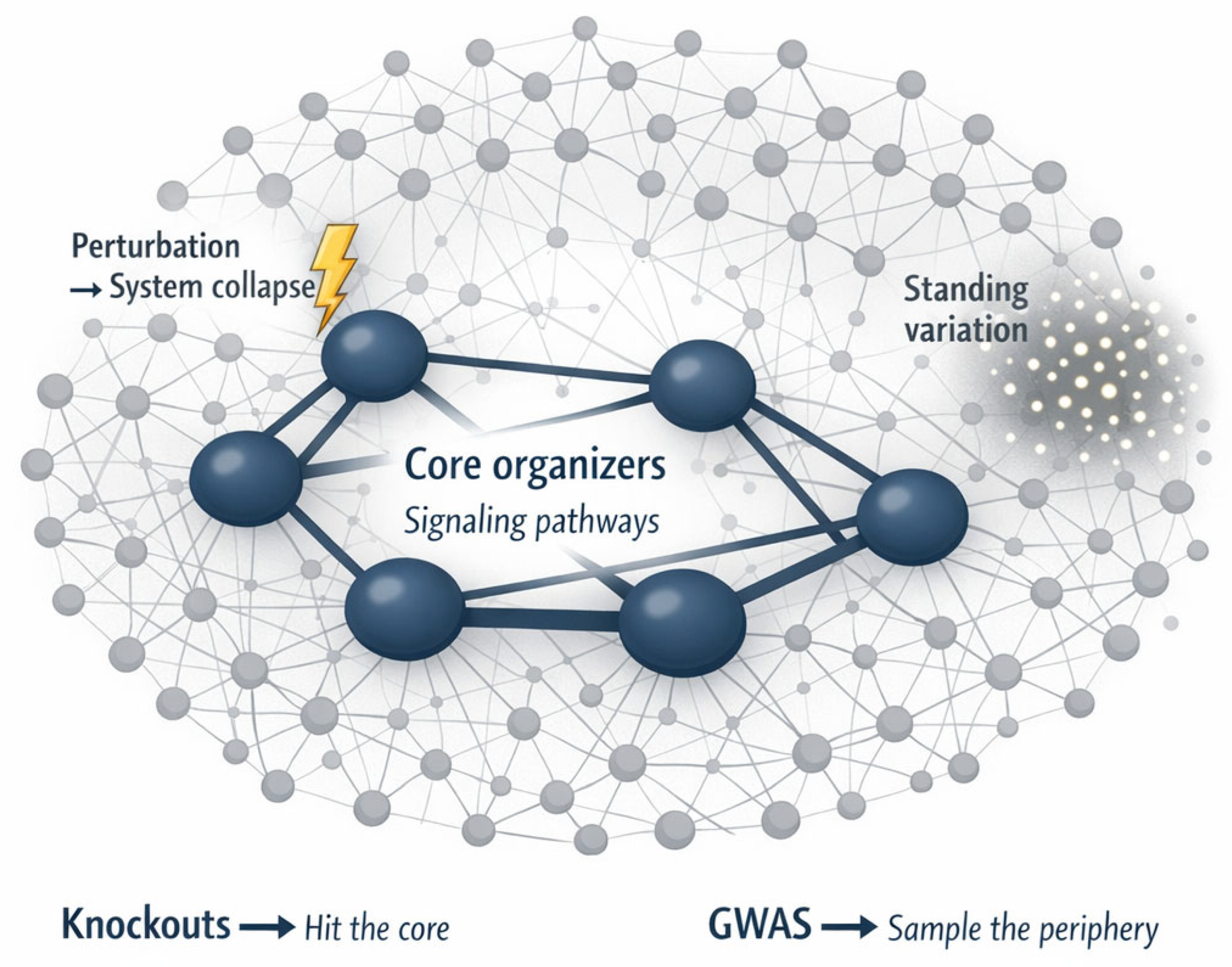
Figure 2.
Level-relative causal roles of the same gene in a developmental system. (Left panel) At a focal level of analysis, Gene X functions as an essential flipper: perturbation produces a large, direct redirection of developmental trajectory and a pronounced immediate phenotype. At this level, Gene X may reasonably be classified as “necessary.” (Right panel) When embedded within a broader gene regulatory network, the same Gene X functions as a minor bumper. Its perturbation biases trajectories but does not uniquely determine final outcomes, which emerge from cumulative interactions among multiple components and constraints. At this level, Gene X is better understood as a contributory cause rather than a strictly necessary determinant. Together, the panels illustrate how causal status is level-relative in emergent biological systems and why necessity claims cannot be generalized across organizational scales. This figure was generated with the aid of Copilot AI.
Figure 2.
Level-relative causal roles of the same gene in a developmental system. (Left panel) At a focal level of analysis, Gene X functions as an essential flipper: perturbation produces a large, direct redirection of developmental trajectory and a pronounced immediate phenotype. At this level, Gene X may reasonably be classified as “necessary.” (Right panel) When embedded within a broader gene regulatory network, the same Gene X functions as a minor bumper. Its perturbation biases trajectories but does not uniquely determine final outcomes, which emerge from cumulative interactions among multiple components and constraints. At this level, Gene X is better understood as a contributory cause rather than a strictly necessary determinant. Together, the panels illustrate how causal status is level-relative in emergent biological systems and why necessity claims cannot be generalized across organizational scales. This figure was generated with the aid of Copilot AI.
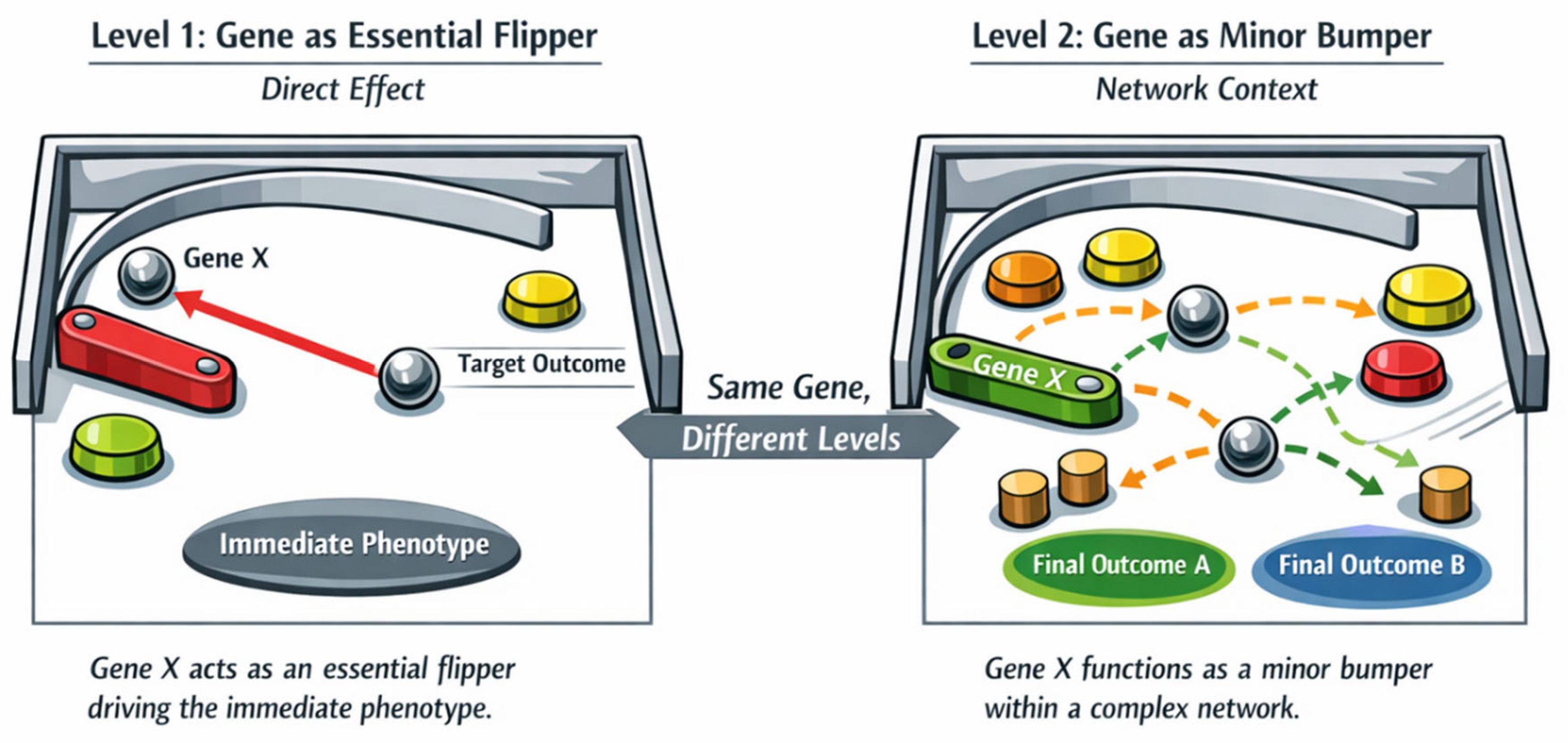
Figure 3.
Structured gene regulatory networks generate polygenicity and level-relative necessity. This figure illustrates how structured gene regulatory networks (GRNs) give rise to polygenic trait architecture, effect-size skew, and level-relative judgments of genetic necessity. (A) The network is organized around a conserved skeleton composed of core organizers—such as canonical signaling pathways (e.g., BMP, Wnt, Hedgehog) and their signal transduction machinery—that coordinate developmental fields and establish global regulatory regimes. These components occupy hub-like positions within the network, interacting with many downstream targets and integrating signals across space and time. Perturbation of skeletal elements disrupts system-level coordination and therefore often appears “necessary” in experimental assays. (B) Surrounding the network skeleton is a dense periphery of contributory modifiers, including extracellular matrix proteoglycans, factors influencing ligand diffusion and secretion dynamics, and components that subtly modulate signal transduction efficiency or timing. Individually, these peripheral nodes exert small, quantitative, or context-dependent effects; collectively, they bias the behavior of the skeletal network without redefining its organizing logic. This layered architecture produces an inherently skewed distribution of phenotypic effect sizes, with large effects concentrated at highly connected hubs and many small effects distributed across the periphery. (C) This organization explains empirical patterns from genome-wide association studies (GWAS). Variants affecting skeletal hubs are typically rare or strongly constrained due to pleiotropic and often deleterious consequences, whereas peripheral modifiers accumulate standing genetic variation and dominate GWAS signals. GWAS thus preferentially detect contributory genes that tune phenotypic outcomes within an established developmental framework, rather than core organizers that define that framework. (D) Causal relevance and genetic necessity are therefore level-relative. At lower organizational levels, individual skeletal components may appear necessary for specific regulatory interactions, while at higher levels—such as tissue- or field-level patterning—network dynamics and compensatory interactions redistribute causal influence. Necessity emerges sparsely and positionally from network structure, against a background of widespread contributory genetic influence. This framework integrates network topology, developmental robustness, evolvability, and polygenicity into a unified account of biological causation. This figure was generated with the aid of Copilot AI.
Figure 3.
Structured gene regulatory networks generate polygenicity and level-relative necessity. This figure illustrates how structured gene regulatory networks (GRNs) give rise to polygenic trait architecture, effect-size skew, and level-relative judgments of genetic necessity. (A) The network is organized around a conserved skeleton composed of core organizers—such as canonical signaling pathways (e.g., BMP, Wnt, Hedgehog) and their signal transduction machinery—that coordinate developmental fields and establish global regulatory regimes. These components occupy hub-like positions within the network, interacting with many downstream targets and integrating signals across space and time. Perturbation of skeletal elements disrupts system-level coordination and therefore often appears “necessary” in experimental assays. (B) Surrounding the network skeleton is a dense periphery of contributory modifiers, including extracellular matrix proteoglycans, factors influencing ligand diffusion and secretion dynamics, and components that subtly modulate signal transduction efficiency or timing. Individually, these peripheral nodes exert small, quantitative, or context-dependent effects; collectively, they bias the behavior of the skeletal network without redefining its organizing logic. This layered architecture produces an inherently skewed distribution of phenotypic effect sizes, with large effects concentrated at highly connected hubs and many small effects distributed across the periphery. (C) This organization explains empirical patterns from genome-wide association studies (GWAS). Variants affecting skeletal hubs are typically rare or strongly constrained due to pleiotropic and often deleterious consequences, whereas peripheral modifiers accumulate standing genetic variation and dominate GWAS signals. GWAS thus preferentially detect contributory genes that tune phenotypic outcomes within an established developmental framework, rather than core organizers that define that framework. (D) Causal relevance and genetic necessity are therefore level-relative. At lower organizational levels, individual skeletal components may appear necessary for specific regulatory interactions, while at higher levels—such as tissue- or field-level patterning—network dynamics and compensatory interactions redistribute causal influence. Necessity emerges sparsely and positionally from network structure, against a background of widespread contributory genetic influence. This framework integrates network topology, developmental robustness, evolvability, and polygenicity into a unified account of biological causation. This figure was generated with the aid of Copilot AI.
Disclaimer/Publisher’s Note: The statements, opinions and data contained in all publications are solely those of the individual author(s) and contributor(s) and not of MDPI and/or the editor(s). MDPI and/or the editor(s) disclaim responsibility for any injury to people or property resulting from any ideas, methods, instructions or products referred to in the content. |
© 2026 by the authors. Licensee MDPI, Basel, Switzerland. This article is an open access article distributed under the terms and conditions of the Creative Commons Attribution (CC BY) license (http://creativecommons.org/licenses/by/4.0/).
Copyright: This open access article is published under a Creative Commons CC BY 4.0 license, which permit the free download, distribution, and reuse, provided that the author and preprint are cited in any reuse.


