
Submitted:
04 June 2026
Posted:
04 June 2026
You are already at the latest version
Abstract
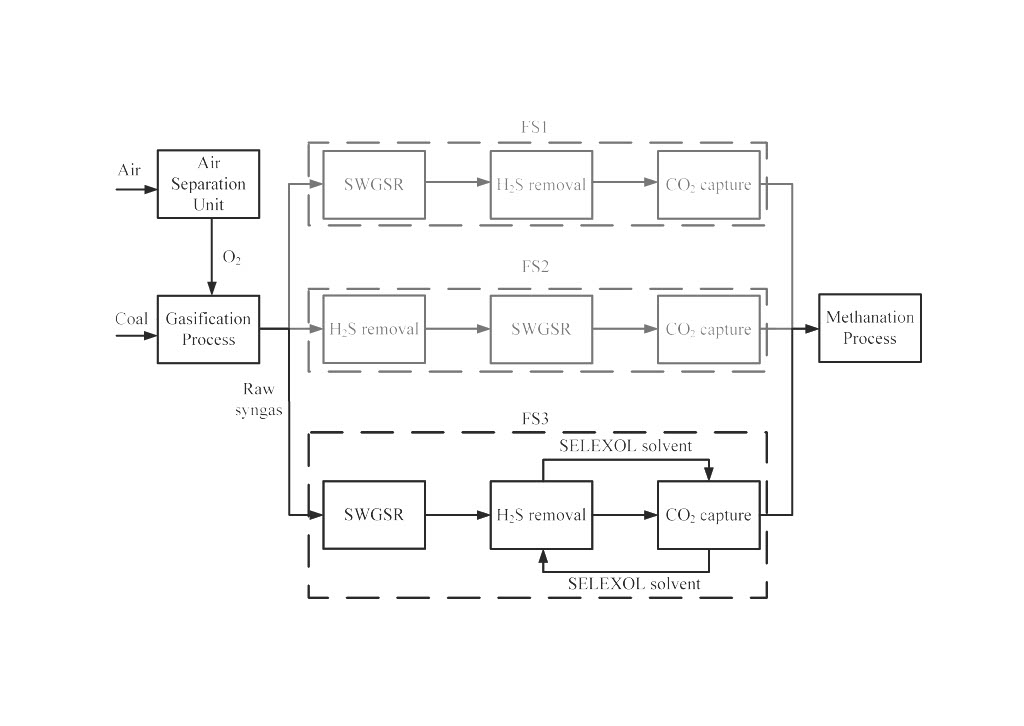
To promote coal purification, this study investigates the optimization and control of the downstream processes in coal gasification: the sour water gas shift reaction (SWGSR) and sour gas removal (AGR). For steady-state design, an SWGSR/AGR process model was developed using Aspen Plus software, and the simulation results were validated using data from the National Energy Laboratory. Three different process flow schemes were considered in the study. Based on the results of sensitivity analysis, the optimization variables for these processes included: steam injection flow rate, number of H₂S absorber trays, number of degassing tower trays, degassing tower feed stage, and degassing tower feed tray temperature. All of the above variables had a significant impact on the total annual cost (TAC) of each process flow scheme. The SWGSR/AGR process was designed to minimize TAC while maintaining product specifications. The TACs for Process Schemes 1, 2, and 3 were $98,967,790.9, $116,881,378.3, and $95,338,636.5, respectively. Regarding dynamic control, control structures for flow structures 1 and 3 (FS1 & FS3) are proposed. The automatic tuning method, detuning method, and Tyrens-Luyben tuning rule method are employed to determine controller parameters. Simulation results show that, under varying throughput and load disturbances, FS3 achieves faster disturbance rejection rates and setpoint tracking.
Keywords:
optimization
; control
; acid gas removal
; coal gasification
Copyright: This open access article is published under a Creative Commons CC BY 4.0 license, which permit the free download, distribution, and reuse, provided that the author and preprint are cited in any reuse.


