

Submitted:
03 June 2026
Posted:
04 June 2026
You are already at the latest version
Abstract
Sudden cardiac death (SCD) is a natural death of cardiac origin and accounts for millions of deaths worldwide each year, representing a major public health issue. Despite its significance, scientific investigation into SCD is often limited. Not all laboratories collect biological samples, such as blood or tissue, for genetic testing, and even when such analyses are performed, pathogenic or clinically relevant genetic variants are not always detected or fully informative. This review aims to highlight biological specimens that are frequently overlooked and underutilized in genetic analyses due to their complex nature: formalin-fixed, paraffin-embedded (FFPE) tissues. Although FFPE samples are suboptimal for traditional genetic investigations, they often represent the only available material when fresh or properly frozen tissue has not been collected. The main limitation in using FFPE tissues arises from formalin-induced modifications that can compromise DNA quality. Recent research, however, has identified novel biomarkers of interest, particularly microRNAs (miRNAs), short non-coding RNAs that remain stable in their expression even under suboptimal environmental conditions. The focus of this review is to emphasize the potential of FFPE tissues, historically used for histological studies, as valuable sources for innovative molecular analyses employing these novel biomarkers. By leveraging miRNAs and other emerging molecular targets, FFPE specimens could provide insights previously inaccessible through conventional DNA-based testing, thereby expanding the toolbox for postmortem investigations in SCD. This review underlines the importance of reconsidering archived FFPE tissues not merely as historical or morphological resources, but as promising matrices for cutting-edge molecular and forensic research.
Keywords:
sudden cardiac death
; molecular autopsy
; miRNA
; FFPE tissue
1. Introduction
Sudden cardiac death (SCD) is defined as a natural, nonviolent death presumed to be of a cardiac cause that occurs within 1 hour of the onset of cardiac symptoms or 24 hours of last being seen healthy and alive [1,2]. SCD has always been a widespread phenomenon among the population. In fact, it is responsible for several millions of deaths every year and it remains a major health problem [3].
The annual incidence is estimated to range from 30 to 125 cases per 100,000 person-years, rising exponentially with age and occurring more frequently in men than in women. Although the incidence is relatively low, the global number of cases is substantial, estimated at 6–9 million per year based on extrapolations from worldwide annual deaths. Sudden cardiac death is considered the most probable cause, accounting for 10–15% of all deaths globally and therefore represents a major public health concern [4,5].
Cardiac pathologists and coroners are tasked with determining the cause and mechanism of SCD, whether in a hospital setting or within forensic investigations.
In the forensic medicine field, a genetic analysis, the so-called “molecular autopsy”, could help in determining the cause of the SCD in individuals in those cases that remain unexplained after a comprehensive forensic autopsy (negative autopsy) [6]. Post-mortem genetic analysis is recommended in most cases but is currently not performed always. The post-mortem testing can identify gene variants in around one-third of cases. In SCD cases, it has been shown that combining post-mortem testing and family investigation of first-degree relatives can lead to a diagnostic yield of 40% [7]. Anyway, tissue and blood retention for DNA extraction would be crucial to allow post-mortem genetic analysis for heritable cardiovascular disorders. Unfortunately, optimal specimens—such as whole blood—are often unavailable because they are not routinely preserved during autopsy. Formalin-fixed paraffin-embedded (FFPE) tissue is ubiquitously collected at autopsy, but the poor quality of the DNA extract from these specimens certainly limits the use of traditional sequencing methods. Fixation in formalin-based solutions, followed by paraffin embedding to produce FFPE tissue blocks, represents the gold-standard approach for preserving human tissues for diagnostic purposes. Processing material through this method has several advantages, ranging from reducing risks of infectious agents potentially present in the fresh material to ensuring preservation of the structural integrity of the tissue. Embedding in paraffin wax allows for the preparation of thin sections enabling detailed examination of tissue architecture with basic stains such as hematoxylin and eosin, which help distinguish the various cellular components. The main drawback of FFPE tissue is that formalin induced sequence artifacts, so-called ‘FFPE artefacts’ as they can be misinterpreted as true variants independent of their individual causes. The artifacts appear as changes in the DNA sequences following next-generation sequencing (NGS) that were not present in the sample before it was fixed. It is imperative to be able to distinguish genuine mutations from the artifactual ones caused by fixation. Sequence artifacts can also be reduced by selecting DNA polymerases that have low efficiencies at bypassing DNA lesions that are artifactual. Steiert et al. [8] demonstrated the importance of critical parameters that most affect sequencing results by generating DNA sequences from older FFPE samples and compared this to DNA from fresh frozen tissue. Although some problems can be managed, others cannot be fully controlled. The pivotal step in any diagnostic procedure is the preparation and isolation of high-quality starting material. This requires careful optimization of both sample collection and preservation methods. Since no universally accepted standard exists for tissue fixation, the wide variability in preservation techniques hinders subsequent preparative and diagnostic processes. Moreover, most diagnostic laboratories receive material from multiple clinical centers, and even minor differences in standard fixation protocols can lead to substantial variations in the quality and yield of extracted DNA. The most used method for tissue preservation in medical applications is formaldehyde fixation followed by paraffin embedding. While this approach effectively preserves tissue architecture, cell morphology, and intracellular components (proteins, carbohydrates, etc.), prolonged formalin fixation also induces crosslinking between proteins and nucleic acids and generates random breaks in nucleotide sequences. Although several strategies exist to mitigate these issues, molecular analysis on FFPE tissue samples remains highly challenging. FFPE-specific artefacts—false positives observed in FFPE-derived DNA—can also occur and may be misinterpreted as true variants, independent of the actual individual-specific alterations.
In recent years, however, attention has shifted toward alternative biomarkers, such as miRNAs. miRNAs are small non-coding RNA of approximately 20-22 nucleotides, inherently stable, very robust and resistant to severe changes in pH or temperature and their expression levels remain consistent when comparing fresh-frozen tissue to FFPE tissue [9,10,11]. On contrary, mRNA undergoes greater degradation, given its longer conformation. Moreover, studies on specimens stored for 12–20 years in FFPE blocks demonstrated that miRNAs remain stable for long period [12,13]. For these reasons, miRNAs can be considered optimal biomarkers for postmortem analyses on FFPE tissues.
One of the main contexts in which FFPE tissues are used for molecular analyses is when no other biological matrix is available. In addition, this type of specimen can be stored at room temperature for years. In forensic settings, FFPE blocks are often preserved for long periods and, when needed, high-quality analytical techniques can still be applied even years after their initial preparation. The most frequent forensic applications involve FFPE heart tissue, particularly in cases of SCD.
The purpose of this review is to emphasize miRNAs as new biomarkers that may be helpful in genetic analysis for SCD, particularly when using complex biological matrices such as FFPE. To this end, we have highlighted features and potential advantages of using miRNAs in molecular analysis of SCD. We have collected published studies on miRNA analysis from FFPE heart tissue with the aim of being able to use these findings also for forensic purposes, in the field of sudden cardiac death.
2. Literature Search Strategy
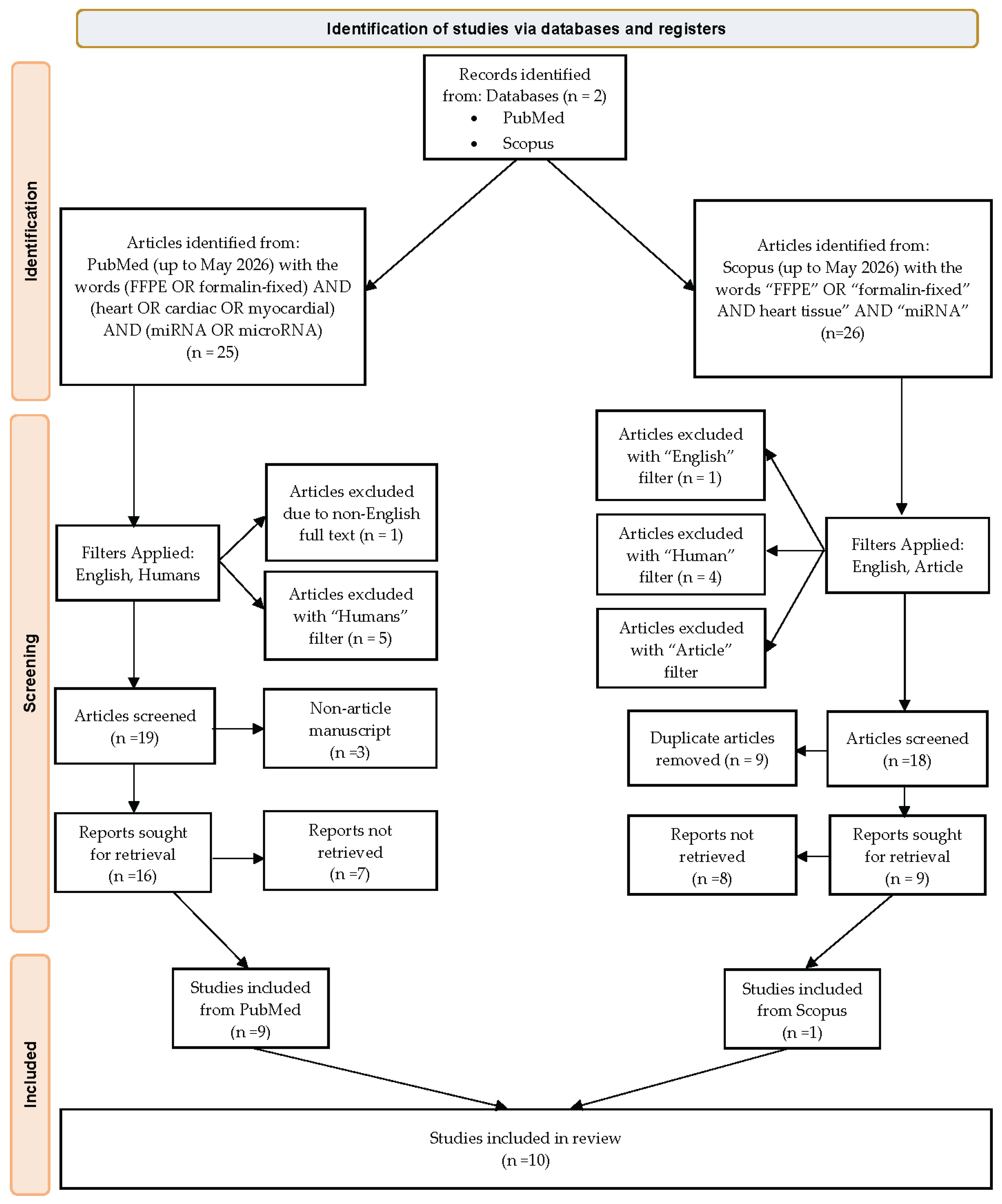
Relevant studies published between 2012 and 2025 were identified through a PubMed database (https://pubmed.ncbi.nlm.nih.gov/) and Scopus database (https://www.scopus.com/pages/home#basic) (accessed on May 2026) using combinations of the following keywords: the word (FFPE OR formalin-fixed) AND (heart OR cardiac OR myocardial) AND (miRNA OR microRNA). On PubMed, twenty-five studies were found with inserting the keywords mentioned above. We applied two filters in PubMed: language “English” and “Human” studies. One article was excluded due to non-English full text. Five articles were excluded because they involved non-human subjects. We excluded one case report and two reviews. Four studies containing the key word but not consistent with the topic discussed in the review were excluded. Finally, nine studies were selected from PubMed database.
Searching on Scopus we obtained 26 results. Three filters were applied: Language “English”, Keyword “Human” and Document Type “Article”. Out of eighteen screened articles, 9 are duplicates of PubMed database and 8 articles are not aligned with the aim of the review. We retrieved 1 study from Scopus database. A total of 10 studies were included in this review.
The analytical process described is shown in Figure 1 (Adapted PRISMA 2020).
3. miRNA Stability in FFPE Tissue
One of the earliest studies investigating the stability of microRNAs in FFPE tissue was conducted by Li in 2007 [14]. This study compared the stability of 160 miRNAs in FFPE samples with that in fresh-frozen tissue through a qRT-PCR, highlighting the potential of these molecules for genetic analysis. Researchers first analyzed miRNA expression in thawed tissue samples and subsequently compared the results with those obtained from frozen and FFPE tissues. Their results showed that specific miRNAs can be similarly recovered from frozen, thawed, and FFPE tissue samples, indicating a high level of molecular stability. In fact, as also explained by Li et al. [14], microRNAs are stable molecules because of their short length (20–22 nt) and because they are bound to proteins of the RISC complex, which protect them from degradation. In this work, cells were processed as FFPE samples: suspended cells were aliquoted, pelleted, and either snap-frozen or FFPE to generate cell blocks. A limitation of this early study is that it did not analyse tissue collected directly from subjects but instead relied on cultured cells that were subsequently fixed in formalin. Following this initial investigation, several subsequent studies using paraffin-embedded tissue samples confirmed the stability of microRNAs.
Peiro-Chova et al. in 2013 [15] conducted the first study in which the stability of small RNA molecules (snoRNA and miRNAs) was analyzed in thawed tissue samples and then compared to that of frozen and FFPE tissue samples. The robustness and stability of miRNAs in FFPE tissue were tested. The researchers analyzed 14 cryopreserved tissue samples, 10 frozen samples that underwent a severe thawing process and their paired FFPE tissue samples from patients with breast cancer obtained during primary surgical resection. Researchers performed an electrophoresis of the three groups of samples (optimally frozen, thawed, and FFPE). The electrophoretic profiles of small RNAs from improperly frozen and thawed samples, as well as from FFPE tissues, were compared with those from properly stored fresh-frozen tissues. Specific miRNA molecules resulted similarly recovered from the three different tissue sample sources, supporting their high degree of stability. Well-preserved fresh-frozen tissues represent the optimal material for molecular analyses and high-throughput technologies; however, their availability in large quantities is often limited. Consequently, alternative tissue sources such as FFPE samples are increasingly used, as they preserve tissue morphology effectively and are widely available in pathology and histology archives worldwide, representing a valuable resource for biomedical research. Furthermore, the storage of frozen tissues is costly and labor-intensive and carries the risk of accidental events, such as uncontrolled thawing at room temperature, which may compromise sample integrity.
Moreover, they performed a qRT-PCR analysing the recovery of three miRNAs (miR-21, miR-125b, and miR-191) in all three groups of samples (optimally frozen, thawed, and FFPE samples). It is interesting to note that miRNAs were detected at lower Ct values in FFPE samples than in frozen/ thawed samples. This may be a consequence of the different extraction method used to isolate RNA from FFPE samples than that used for frozen/thawed samples. As mentioned above, residual RNA–protein cross-links that are not removed in FFPE samples following the digestion by proteinase K prevent some longer RNA molecules from being extracted. Peiro-Chova et al. [15] demonstrated that specific miRNA molecules are similarly recovered in different tissue sample sources (frozen, thawed, and FFPE), which supports their high degree of stability.
Another study on miRNA stability in FFPE tissue samples focused on guanine (G) and cytosine (C) content. Kakimoto et colleagues [16] showed that miRNAs with higher GC% were better preserved in FFPE samples. Additionally, miRNAs with GC% of less than 40% were significantly degenerated in FFPE specimens (p = 1.4×10⁻¹⁰). They, previously, demonstrated that the read length of RNA is strongly related with its stability in FFPE samples, and miRNAs are more abundantly detected than longer RNAs after prolonged fixation [17]. Subsequently, they compared the stability of miRNAs in FFPE cardiac tissues using NGS. The mode read length in FFPE samples was 11 nucleotides, while that in the matched frozen samples was 22. Deep sequencing and qPCR analyses demonstrated that GC content affects the stability of miRNAs in FFPE samples. This study further showed that miRNA degradation occurs predominantly at the 3’ end rather than the 5’ end. Identified miRNA-degrading enzymes include both 3’-to-5’ and 5’-to-3’ exoribonucleases, while no endoribonucleases have been reported. Exoribonuclease activity may differ between the two ends, and the absence of a poly-A tail at the 3’ end may further promote degradation after tissue sampling. Nonetheless, the precise mechanisms governing miRNA turnover remain largely unknown.
Mucciaccia et al. [18], in 2015, compared the degradation of different type of tissues. The aim of this study was to investigate if fractions of small RNAs obtained from different human tissues, collected at autopsy at different postmortem intervals (PMIs), can be suitable for forensic purposes. The research group analyzed different postmortem and putrefied FFPE tissue types collected from autopsy from four individuals at different PMI. They evaluated the specific RNA recovery, quality, integrity, and the resulting usefulness as template for forensic genetic determinations by RT-qPCR analysis. Moreover, they showed that time-dependent RNA degradation also depends on the anatomical localization of the organ studied. Recently, RNA degradation rate has been shown to be tissue-specific [19], possibly resulting from the different concentration/activity of digestive enzymes and ribonucleases in the various organs. An analysis of the integrity of total RNA (RIN values) extracted postmortem from different fresh unfixed organs, collected from mice at different times from euthanasia, reported that the heart and lung displayed the best RNA stability even at long postmortem intervals [19,20]. It was previously reported that in abdominal organs, chemical, thermal, and microbiological processes leading to nucleic acid degradation can occur immediately after death, resulting in more rapid RNA degradation compared to other organs, such as the lung and brain where bacterial flora is not present. miRNAs are less conditioned by postmortem decay thanks to their tiny size and their close association with large protein complexes that makes mature miRNAs much more stable than mRNAs and less prone to degradation. miRNA expression profile, contrary to that of mRNAs, is barely influenced by FFPE treatment and closely resembles that from fresh or frozen tissues. The comparison between total extracted RNA samples revealed that the differences in RNA degradation profiles were organ specific and were related to the PMI value for each organ and that the percentage of small RNA pool molecules increased with RNA degradation due to accumulation of very short degraded by-products.
Boisen et al. [21] published a study that further confirmed the stability of miRNAs under different formalin fixation conditions. While formalin fixation caused a reduction in miRNA expression, the expression profiles of frozen and FFPE samples from the same tumor remained largely highly correlated. Four sections of fresh colon rectal cancer (CRC) and pancreatic (PC) tissues were considered to compare miRNA expression in different conditions. One section was frozen at -80°C, the others were fixed in 10% of formalin-fixation solution for 2, 3 and 6 days rispectively. After fixation, tissue sections were embedded in paraffin and then stored at room temperature. Overall, considerable variability between frozen and FFPE samples was observed, with frozen samples from different tumors often clustering together in hierarchical analyses. Global mean normalization had limited impact on improving clustering, suggesting that formalin fixation may induce non-uniform alterations in miRNA measurability. Although formalin fixation for 2–6 days reduced miRNA expression by 30–65%, expression profiles from frozen and matched FFPE samples from the same tumor generally remained highly correlated. Many previous studies have reported a good correlation between frozen- and FFPE samples [22,23,24,25,26,27]. Building on early studies that demonstrated the stability of miRNA molecules even in complex biological matrices such as FFPE tissues, other studies [12,28] extended the research by examining the long-term persistence of miRNA stability over time.
Bovell [28] et colleagues were the first to demonstrate the stability of miRNAs in FFPE tissue samples stored for long periods (>20 years). They analysed 345 FFPE CRC tissues, stored for 6 to 28 years (1982-2004), for the expression of six miRNAs (miR-20a, miR-21, miR-106a, miR-181b, miR-203, and miR-324-5p) using TaqMan microRNA assays and qRT-PCR. The study focused on miRNA expression in archived CRC tissues found similar levels of all six examined miRNAs in tissues stored for over 28 years. The results of this study demonstrated that miRNA expression levels and stability were not significantly altered in FFPE tissues of CRCs stored for 6 to 28 years, all p-values (t-test) were greater than 0.05. In conclusion of the study, miRNAs are stable in FFPE tissues stored for long periods of time. Regression analyses showed that there was no correlation between the levels of miRNAs and the acquisition year (i.e., there was no statistically significant difference in the expression levels for each miRNA in FFPE tissues over several years of storage).
Subsequently, Peskoe, in 2017 [12] collected 92 FFPE radical prostatectomy specimens stored for 12–20 years. The relative stability of each transcript over time was assessed using general linear models. The correlation between transcript quantities, sample age, and RNA integrity number (RIN) were determined utilizing Spearman rank correlation. There are several factors that can contribute to the loss of RNA stability in FFPE blocks including fixation time, fixation method, or exposure to oxidation, extreme temperatures, or light [12,29,30]. An interesting observation from this study concerns the differential stability of individual miRNAs. For example, miR-221 and miR-141 were significantly more stable over time compared to miR-21 and RNU6B. This supports previous reports of differential stability between different miRNAs [25]. No correlation was observed between sample RIN and the age of FFPE blocks. The study reported a gradual, linear decline in miRNA signal in FFPE samples stored for 12–20 years, with some miRNAs exhibiting greater stability than others. Overall, the age of the FFPE block emerged as the most consistent factor influencing miRNA stability. These results suggested that it would be beneficial to consider sample block age, rather than RNA quality, in miRNA expression analyses from older FFPE samples.
All studies mentioned have demonstrated the stability of miRNAs in FFPE tissues, promoting further utilization of stored tissue samples in the comprehensive analyses of these short molecules.
4. miRNA Molecular Analysis in FFPE Heart Tissue Samples
For the reasons outlined above, miRNAs are considered excellent biomarkers for a wide range of diseases, from cancer to cardiovascular disorders. Due to their high stability, their biomarker potential is preserved even when complex matrices, such as FFPE tissues, are used. In the forensic field, the identification of novel biomarkers may assist in the evaluation of complex causes of death, including SCD. Fresh tissues or blood samples are often unavailable in forensic investigations; therefore, the analysis of miRNA profiles from FFPE tissues represents a valuable alternative.
This review highlights the relevance of miRNAs as molecular biomarkers capable of improving analytical outcomes even when derived from complex biological matrices such as FFPE tissues. In particular, forensic studies frequently rely on paraffin-embedded tissue blocks for the investigation of SCD. This review summarizes the scientific literature published to date on miRNA analyses performed on FFPE cardiac tissues, employing a range of methodologies from conventional techniques, such as real-time PCR, to advanced approaches, including NGS.
Among the different studies included in the review, miRNAs were analysed through different techniques. The amount of biological material collected is variable: the number of sections considered for extraction and even their thickness. Section thickness can range from 4 to 20 µm [16,17] and the number of sections used for miRNA extraction varies from 1-2 [16,17] up to 8 slices of embedded tissue [31,32,33,34,35,36,37,38,39].
Before proceeding with the isolation and extraction of nucleic acids, it is necessary to remove as much paraffin as possible from the FFPE tissue block because it could interfer with the extraction yield. One of the most commonly used approaches for this purpose is xylene. This approach is still highly debated. It is intended to remove paraffin, which interferes with the recovery of biological material. Nonetheless, the use of xylene prior to nucleic acid extraction is often considered controversial and, in some cases, undesirable for several reasons. Exposure to organic solvents such as xylene may lead to partial degradation or loss of nucleic acids, particularly small RNAs, thereby reducing overall yield. In addition, xylene-based protocols have been associated with increased variability in RNA yield and quality among samples, which may affect the reliability of downstream quantitative analyses such as qPCR or NGS. Furthermore, xylene is highly toxic, volatile, and flammable, requiring strict safety measures and specialized laboratory infrastructure, which limits its suitability for routine diagnostic or forensic workflows. Moreover, the inclusion of xylene can complicate protocol standardization, whereas alternative deparaffinization approaches tend to be simpler and more reproducible.
Importantly, recent studies have demonstrated that xylene-free deparaffinization methods—such as heat-based protocols or the use of less aggressive, proprietary reagents—can provide miRNA yields and quality comparable to, or in some cases superior to, those obtained with xylene, thereby questioning its necessity in modern extraction protocols [35,36,37,38,39,40,41].
The extraction kit most used in papers selected for this review is miRNeasy FFPE kit (Qiagen) [18,31,32,34,35], High Pure miRNA Extraction Kit (Roche, Mannheim) [36] and RecoverAll Total Nucleic Acid Isolation Kit (Applied Biosystems) [16,17,37,38].
Extraction kits could have different performances and different yields but no one had compared more kits between them.
The first research study investigating microRNAs in FFPE cardiac tissues was conducted by Boštjančič et al. [31] in 2012. They cut 3 to 8 sections of 10 µm and the total RNA was isolated using miRNeasy FFPE kit (Qiagen). They added xylene for deparaffinization. The concentration of extracted RNA was measured by NanoDrop-1000 (Thermo Scientific) and the integrity was analysed on a Bioanalyzer 2100 (Agilent).
They analysed total RNA from three infarcted tissues and compared it with three corresponding remote myocardium samples. Five to ten μg of RNA from heart samples was used for miRNA microarray analysis. The miRNA expression profiling revealed 43 differentially expressed miRNAs in infarcted tissue compared with the corresponding remote myocardium. Twenty miRNAs showed expression levels similar to those observed in healthy human hearts, 19 exhibited greater differences in expression, and 4 were uniquely differentially expressed in the present study.
The results were validated using two different qPCR technologies: SYBR Green and a TaqMan-based approach. A subset of miRNAs identified as differentially expressed by microarray analysis was confirmed by qPCR. Validation was performed using the miScript system (Qiagen) or TaqMan-based technology (Applied Biosystems). For this purpose, two pooled RNA samples were generated from RNAlater-preserved and FFPE tissue samples. The authors demonstrated that expression analyses performed using TaqMan or SYBR Green yielded comparable results and that miRNA expression data obtained from RNAlater-preserved and FFPE tissues were consistent across both technologies. Given these comparable results, FFPE tissue presents clear advantages over samples preserved in RNAlater at −20 °C, including reduced costs and storage requirements. Additionally, FFPE blocks are suitable for both genetic analyses and histological examination.
The study of Courts et al. [32] is the first to assess whether miRNA expression can be reliably measured in FFPE tissues from SIDS patients and whether potentially pathogenic dysregulation of heart- and brain-specific miRNAs can be detected. Twentyeight samples of heart tissue were collected from 14 German SIDS patients and 14 controls (children whose cause of death was different from SIDS). Fresh tissues were snap frozen directly after removal from the body, transported on dry ice if applicable, and then stored at -80°C until use. The FFPE tissue collective consisted of samples of brainstem tissue from 11 German SIDS patients and 10 age-matched German controls. For extraction from FFPE tissues, slices of 10 mm were cut from the tissue blocks. Total-RNA containing small-RNA was extracted from FFPE tissue slices using the miRNeasy FFPE Kit (Qiagen). Total-RNA concentration was measured with the QubitTM fluorometer (Invitrogen) using the Quant-iTTM RNA Assay Kit (Invitrogen). Then, miRNAs were reversely transcribed to cDNA using the TaqMan1 MicroRNA Reverse Transcription Kit (Applied Biosystems). The kit utilized a specific priming strategy in which miRNA specific stem loop primers bind to their mature miRNA target, thus only mature miRNAs are transcribed to cDNA. MiRNA expression levels were quantified using qPCR on an ABI PRISM 7000 Sequence Detection System (Applied Biosystems), employing TaqMan miRNA Assays (Applied Biosystems). Two small nucleolar RNAs (snoRNAs), U18 and U47, were considered for subsequent normalization of non-biological variances in the data. Statistical analyses included assessment of data normality, comparison of mean expression levels using Student’s t-test or the Mann–Whitney U test, and Dunn–Bonferroni correction for multiple testing; p ≤ 0.05 was considered statistically significant. For each tissue they obtained different results.
A significantly higher expression of miR-1 was detected in fresh heart tissue of SIDS as compared to control cases whereas expression of miR-133a did not differ significantly between SIDS and control cases. Instead, expression analysis of let-7b and miR-124a in FFPE brainstem tissue showed a significantly higher expression of let-7b was detected in SIDS as compared to control cases whereas expression of miR-124a did not differ significantly between SIDS and control cases. In conclusion, they confirmed that heart and brain specific dysregulation of miR-1 and let-7b, respectively, might be involved in SIDS pathogenesis.
Mucciaccia et al. [18] analyzed amplification performance of FFPE-extracted RNA, showing that it is specific for different organs from the same individual. This pilot study showed that RNA profiles obtained from different organs (brain, liver, lung, kidney and myocardium) and at different postmortem intervals provide valuable insights and considerations, highlighting their potential applications in forensic science.
Their work demonstratted that, despite a conspicuous and variable degradation degree, the recovery of total RNAs from FFPE samples from all the autoptic organs studied and the subsequent molecular analysis of small RNA targets were still possible.
RNA was isolated using the miRNeasy FFPE Kit (Qiagen). RNA yield and purity were assessed by measuring absorbance at 260 nm with a NanoDrop ND 1000 spectrophotometer (Thermo Scientific), while RNA quality and integrity were evaluated by on-chip microcapillary electrophoresis using an Agilent 2100 Bioanalyzer with the RNA 6000 Nano Kit (Agilent Technologies). RT-qPCR analysis was performed using two different commercially available gene expression kits. In particular, reverse transcription of total RNA was performed using the High Capacity RNA-to-cDNA kit (Applied Biosystem) or the miScript II RT kit (Qiagen), depending on the type of RNA target to be amplified, following the manufacturer’s recommendations. After an extensive evaluation of RNA integrity across different tissue types, the research group focused on miRNAs, as they are specifically preserved even after long postmortem intervals. In particular, miR-21 was detected in all postmortem samples analyzed, including putrefied organs, across different postmortem intervals, suggesting that miRNAs represent one of the few molecular targets that can be further investigated for forensic purposes. The amplification of specific miRNAs from FFPE tissues could therefore facilitate retrospective molecular analyses aimed at determining the timing of injuries and myocardial infarction, as well as supporting the differential diagnosis of asphyxial death. This approach could be applied to archived fixed tissues in forensic settings and may provide additional evidence in cases where fresh or frozen material is no longer available.
Being the central theme of the review, we want to focus on the results on myocardial tissue. miR-21 was consistently expressed in all the post mortem conditions analysed, including in cases showing signs of putrefaction, where it was in fact the tissue exhibiting the highest levels of miR-21 expression. These findings suggest that cardiac tissue may represent one of the most suitable targets for miRNA analysis, even at extended postmortem intervals and following formalin fixation. These results showed that the identification of specific miRNAs in heart tissue samples may help elucidate the presence of myocardial infarction or other cardiac-related diseases.
The study carried out by Kakimoto et al. in 2015 [17], archival tissue samples were utilized to establish a method to evaluate the miRNA profiles of autoptic tissues following exposure to rough conditions in order to elucidate potential biomarkers of acute myocardial infarction (AMI). They considered cardiac tissue to be well suited for postmortem quantitative analysis because the heart is less susceptible to degradation than other organs after death. Nineteen samples of frozen cardiac tissue and 36 samples of FFPE were collected. Over-fixed samples, were formalin-fixed for more than three months, were excluded from the study, as the longer fixation periods appeared to increase the degradation candidate small RNA.
Total RNA was isolated with a RecoverAll Total Nucleic Acid Isolation Kit (Applied Biosystems) adding a step of deparaffininization at 50°C for 5 min and modifying some steps as described in the manuscript [17]. RNA concentration and purity were evaluated with a spectrophotometer (BioSpec-nano). RNA integrity was assessed using microcapillary electrophoresis on a 2100 Bioanalyzer with a Small RNA kit (Agilent Technology). Four candidate biomarkers were selected for the study: miR-1, miR-133a, miR-208b, miR-499a-5p. As control candidates 3 miRNAs (miR-191, miR-93, miR-26b) and 3 other small RNAs were selected. These miRNAs are specific to cardiac muscle and relevant for AMI diagnosis. cDNA was synthesized using a TaqMan MicroRNA Reverse Transcription kit (Applied Biosystems) according to the manufacturer’s instructions. Subsequently, mature miRNAs were quantified using a StepOnePlus real-time PCR system (Applied Biosystems). Data processing was performed using StepOnes software version 2.3 (Applied Biosystems). Comparisons between the AMI cases and controls were performed with the Mann-Whitney U-test (p-values < 0.05). miR-133a was excluded from further analysis due to its grossly outlying amplification efficiency (more than 10%). miR-208b was the most stable miRNA over increasing fixation times, while initially more abundant miRNAs—miR-26b, miR-1, and miR-499a—gradually decreased below its levels after 11, 36, and 39 months of fixation, respectively. miR-191 and miR-26b demonstrated to be the best endogenous control genes to quantify the expression of post-mortem miRNA biomarkers in deceased cardiac infarction patients, since they were less influenced by the PMI or fixation time of the sample compared to the other control gene candidates. The method described by Kakaimoto et al. suggested that miRNA quantification of FFPE tissues is practically useful at postmortem examination, and can be a helpful diagnostic tool for critical cardiac injury.
In 2016, Kakimoto et al. [16] performed a second study analysing miRNA deep sequencing. The small RNA libraries were created using the Ion Total RNA-seq kit v2 (Life Technologies, USA), according to the manufacturer's instructions. Libraries were, then, sequenced on an Ion 318 chip using the Ion Torrent PGM system (Life Technologies). Sequencing data was analysed by Torrent Browser. From the three frozen specimens, a total of 6,462,853 sequencing reads were obtained, of which 5,979,759 (92.1%) successfully aligned to the human reference genome (hg19). Among these aligned reads, 2,080,072 (32.0%) corresponded to annotated miRNAs listed in miRBase v21. Conversely, sequencing of the three FFPE samples produced 11,388,982 reads in total, with 9,905,331 reads (87.0%) mapping to the human genome; however, only 1,070,701 reads (9.4%) were assigned to known miRNAs. Notably, the FFPE sample that underwent the longest fixation time exhibited the poorest miRNA mapping efficiency (5.6%). Differences in miRNA expression were observed between the paired samples. In frozen tissues, miR-1-3p was the predominant miRNA, accounting for approximately 20–30% of the total reads. By comparison, FFPE samples were characterized by a different dominant miRNA, miR-133a-3p, which comprised up to 14% of the overall miRNA population, whereas miR-1-3p contributed less than 10% of total miRNA reads in FFPE specimens.
To validate the results of miRNA deep sequencing, the researchers performed qPCR analysis on seven selected target miRNAs with GC% of 27–64% detected in the cardiac tissue in abundance.
Although miRNAs are more stable than mRNAs, the data demonstrated some limitations of FFPE sample utilization for miRNA deep sequencing. Because miRNAs degrade at different rates, the relative expression of each miRNA in FFPE tissue may not match that in the corresponding frozen tissue. Reliable quantification should be supported by additional analyses, such as qPCR validation, and employing multiple quantitative approaches may enhance the future use of archival FFPE samples.
Subsequently, Di Francesco et al [33] applied NGS technology in FFPE endomyocardial biopsies (EMBs) to explore the miRNA expression profile of heart transplanted patients. The results were validated using a real-time PCR.
The cited study is not intended for forensic purposes; however, it highlighted the relevance of using formalin-fixed, paraffin-embedded cardiac tissue in other clinical contexts and emphasized that employing such complex specimens can help avoid additional invasive biopsies for the patient.
Li et al. [35] showed the diagnostic value of cardiac miR-126-5p, miR-134-5p and miR-499a-5p in CAD-SCD cases. Thirty CAD-SCD cases were selected, including 18 individuals who experienced more than once asymptomatic myocardial ischemia (CAD-activated SCD) and 12 victims without prominent pathological features of insucient blood supply (CAD-silent SCD). Thirty traumatic victims were enrolled as controls. For each FFPE sample, 2–3 sections of 10µm thickness were cut from FFPE tissue block and total RNAs were extracted using miRNeasy FFPE Kit (Qiagen).
The expressions of cardiac miR-126-5p, miR-134-5p, and miR-499a-5p were analyzed by RT-qPCR, using miRCURY LNA RT Kit (Qiagen) and miRCURY LNA SYBR Green PCR Kits (Qiagen) according to the instructions of the manufacturer. U6 snRNAs were used as the endogenous control for miRNA quantification. Results showed a downregulation of miR-126 5p in CAD-SCD victims by ∼3.1-fold an a downregulation of miR-499a-5p by ∼1.9-fold. There was no statistically significant trend in miR-134-5p between the two groups. The authors concluded that the combination of miR-126-5p and miR-499a-5p is a good indicator for assessing CAD-SCD, demonstrating strong diagnostic performance.
Koussa et al. [34] also applied miRNA analysis in a clinical setting. They conducted a directed search for dysregulated miRNAs in lung and heart autopsy samples of infants with bronchopulmonary dysplasia (BPD). Total RNA was extracted from FFPE tissue sections using deparaffinization solution and the miRNeasy FFPE kit (Qiagen). Concentration was measured with NanoDrop ND-1000 Spectrophotometer (ThermoFisher Scientific). In this study, a different technique was employed—one that is widely used for the analysis of miRNA expression—namely, miRNA microarray analysis, using Agilent G3 Human v21 8X60K miRNA arrays. This study identified miRNAs that are similarly dysregulated in archived postmortem lung and heart samples in subjects with histologic BPD. The results showed upregulation in miR-378b, miR-184, miR-3667-5p, miR-3976, miR-4646-5p, and miR-7846-3p across both tissue types. The interpretation and prediction of targets for the miRNAs of interest rely on bioinformatic prediction tools, such as DAVID and mirDIP, as well as pathway prediction resources, including KEGG pathway analysis.
More recently, studies on SCD using FFPE heart tissue have gained increasing attention, and in particular, two notable studies have been published. The first, by Mildeberger et al. [36], aimed to identify novel reliable biomarkers to differentiate among cardiac death cases. In this study, the potential of various miRNAs as biomarkers was evaluated in both tissue and blood samples from cases of cardiac death. Slices of FFPE were used for the RNA extraction, which was performed with the High Pure miRNA Extraction Kit (Roche). NanoDrop Spectrophotometer (Thermo Scientific) was used for measuring the concentration. Quantification of the miRNA was performed using the TaqMan MicroRNA Assay (Applied Biosystems) in a two-step RT-PCR. The results showed that miR-1, miR-133a and miR-26a were upregulated in FFPE tissues of the SCD cases compared to the myocardial infarction and control cases. Upregulation of miR-26a is also statistically significant. All three miRNAs showed great potential to discriminate between the causes of SCD.
The last study on postmortem analyses of myocardial miRNA expression in FFPE heart tissue is the one conducted by Letho et al. [37]. They published the first study investigating miRNA expression using FFPE cardiac tissue from patients with sepsis.
RNA was isolated from FFPE cardiac samples using the RecoverAll Total Nucleic Acid Isolation Kit for FFPE (Invitrogen). miRNA expression level was analysed by NGS using RealSeq Single Index kit (RealSeq Biosciences) for library preparation, and sequencing was performed on Novaseq SP100 (Illumina) using single end reads. Sequencing data were analysed using the miND® and the meND v1.2.8 analysis pipeline. Differentially expressed miRNAs were identified using edgeR v3.32 and Ingenuity Pathway Analysis (IPA) software (Qiagen) by incorporating target predictions from TargetScan human, Ingenuity Expert Findings, miRecords, and Tarbase databases. miRNA sequencing identified a total of 1,753 miRNAs, of which 267 showed high expression levels in the samples and were therefore selected for differential expression analysis. This analysis revealed 32 miRNAs that were differentially expressed in myocardial tissues from sepsis cases compared with control samples. Among the eight miRNAs with a log2FC>1, miR-12136 showed the largest increase in mean counts in septic heart tissue and miR-146b-5p had the highest fold change and miR-451a had the largest difference in mean counts and highest fold decrease. Multiple regulatory miRNAs showed significant up- or down-regulation in the myocardial tissue of septic patients compared with non-septic individuals. Notably, all the miRNAs discussed have been previously associated with inflammatory processes or cardiovascular pathologies.
5. Conclusions
SCD might be due to different cardiac pathologies, channelopathies or cardiomyopathies, and its diagnosis is challenging for coroners. Collecting a blood sample or fresh tissue at the time of an autopsy is not always possible. In Italy, there are two different types of autopsy: one called a judicial autopsy and the other known as a diagnostic post-mortem examination. In general, it is more difficult to obtain consent for a diagnostic post-mortem examination than for a judicial autopsy, since the judicial autopsy does not require the consent of the family, as it is ordered by the judicial authority for legal and investigative purposes. For this reason, the issue of consent does not arise in practice. By contrast, a diagnostic post-mortem examination usually requires the consent of the deceased’s relatives. This is where most of the difficulties emerge. Family members may refuse consent due to emotional distress, cultural or religious beliefs, or a limited understanding of the clinical value of the procedure. In both the judicial autopsy and, especially, in the diagnostic post-mortem examination genetic analysis is not mandatory, although it is recommended. This implies that, in some cases, physicians do not proceed with the collection of blood or fresh-frozen tissues for genetic testing, as these samples require storage at controlled temperatures (−20 °C or -80 °C), thereby increasing costs and demanding adequate freezer capacity within laboratory facilities.
Far more frequently, tissues are collected during autopsy and subsequently formalin-fixed for histological examination. This matrix does not require costly storage conditions, since FFPE tissues can be preserved at room temperature for extended periods. Although FFPE would be considered an ideal biological material for genetic analysis, albeit for the reasons just mentioned, formalin-fixation induces DNA-protein cross-linking, fragmentation and DNA damage which may lead to sequence alterations and spurious variant calls. The major issue is the occurrence of false positives caused by artifacts introduced during formalin fixation.
For all the reasons listed above, other genetic biomarkers that are more conservative, robust and stable may be considered. MiRNAs are promising biomarkers as they are highly stable, as both their expression levels and sequences remain unchanged even if the biological material is under adverse temperature or pH conditions. Many studies have focused on miRNAs and their role in cardiovascular diseases, owing to their differential expression patterns and intrinsic properties. In this review, we have summarized studies investigating miRNAs as stable biomarkers in FFPE heart tissue, with particular attention to their involvement in SCD and related cardiovascular conditions.
This work highlights that miRNAs have strong potential as valuable biomarkers due to their stability even in complex biological matrices such as FFPE tissues. This feature is fundamental for post-mortem studies, especially when FFPE is the only biological matrix available, even after many years.
Author Contributions
Conceptualization A.B.D.M., M.P., C.T.; methodology A.B.D.M.; writing—original draft preparation. A.B.D.M., M.P.; writing—review and editing C.T.; supervision C.T., M.P.; project administration M.P. All authors have read and agreed to the published version of the manuscript.
Funding
This research has received funding from the project Heal Italia – Project Code PE00000019, CUP I33C22006900006 - funded under the National Recovery and Resilience Plan (NRRP), Mission 4 Component 2 Investment 1.3 - Creation of "Extended Partnerships with Universities, Research Centers, and Companies for the Funding of Basic Research Projects" – Project "Health Extended Alliance for Innovative Therapies, Advanced Lab Research, and Integrated Approaches of Precision Medicine (HEAL ITALIA)" Call for tender No. 341 of 15/03/2022, and Concession Decree No. 0001559.11-10-2022 of Italian Ministry of University funded by the European Union – NextGenerationEU.
Conflicts of Interest
The authors declare no conflicts of interest.
References
- Goldstein, S. The Necessity of a Uniform Definition of Sudden Coronary Death: Witnessed Death within 1 Hour of the Onset of Acute Symptoms. Am. Heart J. 1982, 103, 156–159. [Google Scholar] [CrossRef] [PubMed]
- Zipes, D.P.; Wellens, H.J.J. Sudden Cardiac Death. Circulation 1998, 98, 2334–2351. [Google Scholar] [CrossRef]
- Tfelt-Hansen, J.; Garcia, R.; Albert, C.M.; Merino, José Luís; Krahn, A.D.; Marijon, Éloi; Basso, C.; Wilde, Arthur A.M.; Haugaa, K.H. Risk Stratification of Sudden Cardiac Death: A Review. Europace 2023, 25. [Google Scholar] [CrossRef] [PubMed]
- Empana, J.-P.; Lerner, I.; Valentin, E.; Folke, F.; Böttiger, B.; Gislason, G.; Jonsson, M.; Ringh, M.; Beganton, F.; Bougouin, W.; et al. Incidence of Sudden Cardiac Death in the European Union. J. Am. Coll. Cardiol. 2022, 79, 1818–1827. [Google Scholar] [CrossRef]
- Lynge, T.H.; Risgaard, B.; Banner, J.; Nielsen, J.L.; Jespersen, T.; Stampe, N.K.; Albert, C.M.; Winkel, B.G.; Tfelt-Hansen, J. Nationwide Burden of Sudden Cardiac Death: A Study of 54,028 Deaths in Denmark. Heart Rhythm 2021, 18, 1657–1665. [Google Scholar] [CrossRef]
- Neubauer, J.; Lecca, Maria Rita; Russo, G.; Bartsch, C.; Medeiros-Domingo, A.; Berger, W.; Haas, C. Exome Analysis in 34 Sudden Unexplained Death (SUD) Victims Mainly Identified Variants in Channelopathy-Associated Genes. Int. J. Leg. Med. 2018, 132, 1057–1065. [Google Scholar] [CrossRef]
- Lahrouchi, N.; Raju, H.; Lodder, E.M.; Papatheodorou, S.; Miles, C.; Ware, J.S.; Papadakis, M.; Tadros, R.; Cole, D.; Skinner, J.R.; et al. The Yield of Postmortem Genetic Testing in Sudden Death Cases with Structural Findings at Autopsy. Eur. J. Hum. Genet. 2019, 28, 17–22. [Google Scholar] [CrossRef]
- Steiert, Tim Alexander; ParraG; Gut, M.; Arnold, N.; Trotta, J.-R.; Tonda, R.; Moussy, A.; Gerber, Z.; Abuja, P.M.; Zatloukal, K.; et al. A Critical Spotlight on the Paradigms of FFPE-DNA Sequencing. Nucleic Acids Res. 2023, 51, 7143–7162. [Google Scholar] [CrossRef] [PubMed]
- Liu, A.; Tetzlaff, M.T.; VanBelle, P.; Elder, D.; Feldman, M.; Tobias, J.W.; Sepulveda, A.R.; Xu, X. MicroRNA Expression Profiling Outperforms MRNA Expression Profiling in Formalin-Fixed Paraffin-Embedded Tissues. PubMed 2009, 2, 519–527. [Google Scholar]
- Chen, X.; Ba, Y.; Ma, L.; Cai, X.; Yin, Y.; Wang, K.; Guo, J.; Zhang, Y.; Chen, J.; Guo, X.; et al. Characterization of MicroRNAs in Serum: A Novel Class of Biomarkers for Diagnosis of Cancer and Other Diseases. Cell Res. 2008, 18, 997–1006. [Google Scholar] [CrossRef]
- Mitchell, P.S.; Parkin, R.K.; Kroh, E.M.; Fritz, B.R.; Wyman, S.K.; Pogosova-Agadjanyan, E.L.; Peterson, A.; Noteboom, J.; O’Briant, K.C.; Allen, A.; et al. Circulating MicroRNAs as Stable Blood-Based Markers for Cancer Detection. Proc. Natl. Acad. Sci. 2008, 105, 10513–10518. [Google Scholar] [CrossRef]
- Peskoe, S.B.; Barber, J.R.; Zheng, Q.; Meeker, A.K.; De Marzo, A.M.; Platz, E.A.; Lupold, S.E. Differential Long-Term Stability of MicroRNAs and RNU6B SnRNA in 12–20 Year Old Archived Formalin-Fixed Paraffin-Embedded Specimens. BMC Cancer 2017, 17. [Google Scholar] [CrossRef]
- Manne, U. MiRNAs Are Stable in Colorectal Cancer Archival Tissue Blocks. Front. Biosci. 2012, E4, 1937–1940. [Google Scholar] [CrossRef] [PubMed]
- Li, J.; Smyth, P.; Flavin, R.; Cahill, S.; Denning, K.; Aherne, S.; Guenther, S.M.; O’Leary, J.J.; Sheils, O. Comparison of MiRNA Expression Patterns Using Total RNA Extracted from Matched Samples of Formalin-Fixed Paraffin-Embedded (FFPE) Cells and Snap Frozen Cells. BMC Biotechnol. 2007, 7. [Google Scholar] [CrossRef]
- Peiró-Chova; Peña-Chilet, L.; María; López-Guerrero, José Antonio; García-Giménez, José Luis; Alonso-Yuste, E.; Burgues, O.; Lluch, A.; Ferrer-Lozano, J.; Ribas, G. High Stability of MicroRNAs in Tissue Samples of Compromised Quality. Virchows Arch. 2013, 463, 765–774. [Google Scholar] [CrossRef]
- Kakimoto, Y.; Tanaka; Kamiguchi, M.; Hiroshi; Ochiai, E.; Osawa, M. MicroRNA Stability in FFPE Tissue Samples: Dependence on GC Content. PLoS ONE 2016, 11, e0163125–e0163125. [Google Scholar] [CrossRef] [PubMed]
- Kakimoto; Kamiguchi, Y.; Hiroshi; Ochiai, E.; Satoh, F.; Osawa, M. MicroRNA Stability in Postmortem FFPE Tissues: Quantitative Analysis Using Autoptic Samples from Acute Myocardial Infarction Patients. PLoS ONE 2015, 10, e0129338–e0129338. [Google Scholar] [CrossRef] [PubMed]
- Muciaccia, B.; Vico, C.; Aromatario, M.; Fazi, F.; Cecchi, R. Molecular Analysis of Different Classes of RNA Molecules from Formalin-Fixed Paraffin-Embedded Autoptic Tissues: A Pilot Study. Int. J. Leg. Med. 2014, 129, 11–21. [Google Scholar] [CrossRef] [PubMed]
- Sampaio-Silva, F.; Magalhães, T.; Carvalho, F.; Dinis-Oliveira, R.J.; Silvestre, R. Profiling of RNA Degradation for Estimation of Post Morterm Interval. PLoS ONE 2013, 8, e56507. [Google Scholar] [CrossRef]
- De Paepe, M.E.; Mao, Q.; Huang, C.; Zhu, D.; Jackson, C.L.; Hansen, K. Postmortem RNA and Protein Stability in Perinatal Human Lungs. Diagn. Mol. Pathol. 2002, 11, 170–176. [Google Scholar] [CrossRef]
- Boisen, M.K.; Dehlendorff, C.; Linnemann, D.; Schultz, Nicolai Aagaard; Jensen, Benny Vittrup; Høgdall, Estrid; Johansen, J.S. MicroRNA Expression in Formalin-Fixed Paraffin-Embedded Cancer Tissue: Identifying Reference MicroRNAs and Variability. BMC Cancer 2015, 15. [Google Scholar] [CrossRef] [PubMed]
- Hoefig, K.P.; Thorns, C.; Roehle, A.; Kaehler, C.; Wesche, K.O.; Repsilber, D.; Branke, Biggi; Thiere, M.; Feller, A.C.; Merz, H. Unlocking Pathology Archives for MicroRNA-Profiling. PubMed 2008, 28, 119–123. [Google Scholar]
- de Biase, D.; Visani, M.; Morandi, L.; Marucci, G.; Taccioli, C.; Cerasoli, S.; Baruzzi, A.; Pession, A. MiRNAs Expression Analysis in Paired Fresh/Frozen and Dissected Formalin Fixed and Paraffin Embedded Glioblastoma Using Real-Time PCR. PLoS ONE 2012, 7, e35596. [Google Scholar] [CrossRef]
- Glud, M.; Klausen, M.; Gniadecki, R.; Rossing, M.; Hastrup; Cilius Nielsen, N.; Finn; Drzewiecki, K.T. MicroRNA Expression in Melanocytic Nevi: The Usefulness of Formalin-Fixed, Paraffin-Embedded Material for MiRNA Microarray Profiling. 2009, 129, 1219–1224. [Google Scholar] [CrossRef]
- Meng, W.; McElroy, J.P.; Volinia, S.; Palatini, J.; Warner, S.; Ayers, L.W.; Palanichamy, K.; Chakravarti, A.; Lautenschlaeger, T. Comparison of MicroRNA Deep Sequencing of Matched Formalin-Fixed Paraffin-Embedded and Fresh Frozen Cancer Tissues. PLoS ONE 2013, 8, e64393. [Google Scholar] [CrossRef]
- Zhang, X.; Chen, J.; Radcliffe, T.; LeBrun, D.P.; Tron, V.A.; Feilotter, H. An Array-Based Analysis of MicroRNA Expression Comparing Matched Frozen and Formalin-Fixed Paraffin-Embedded Human Tissue Samples. J. Mol. Diagn. 2008, 10, 513–519. [Google Scholar] [CrossRef]
- Pritchard, C.C.; Cheng, H.H.; Tewari, M. MicroRNA Profiling: Approaches and Considerations. Nat. Rev. Genet. 2012, 13, 358–369. [Google Scholar] [CrossRef]
- Bovell, L. MiRNAs Are Stable in Colorectal Cancer Archival Tissue Blocks. Front. Biosci. 2012, E4, 1937. [Google Scholar] [CrossRef]
- Jung, M.; Schaefer, A.; Steiner, I.; Kempkensteffen, C.; Stephan, C.; Erbersdobler, A.; Jung, K. Robust MicroRNA Stability in Degraded RNA Preparations from Human Tissue and Cell Samples. Clin. Chem. 2010, 56, 998–1006. [Google Scholar] [CrossRef]
- Rentoft, M.; Fahlén, J.; Coates, P.J.; Laurell, G.; Sjöström, B.; Rydén, P.; Nylander, K. MiRNA Analysis of Formalin-Fixed Squamous Cell Carcinomas of the Tongue Is Affected by Age of the Samples. Int. J. Oncol. 2011, 38, 61–69. [Google Scholar]
- Boštjančič, E.; Zidar, N.; Glavač, D. MicroRNAs and Cardiac Sarcoplasmic Reticulum Calcium ATPase-2 in Human Myocardial Infarction: Expression and Bioinformatic Analysis. BMC Genom. 2012, 13, 552. [Google Scholar] [CrossRef] [PubMed]
- Courts, C.; Grabmüller, M.; Madea, Burkhard. Dysregulation of Heart and Brain Specific Micro-RNA in Sudden Infant Death Syndrome. Forensic Sci. Int. 2013, 228, 70–74. [Google Scholar] [CrossRef]
- Di Francesco, A.; Fedrigo, Marny; Santovito, Donato; Natarelli, L.; Castellani, C.; Pascale, F.D.; Toscano, G.; Fraiese, A.; Feltrin, G.; Benazzi, E.; et al. MicroRNA Signatures in Cardiac Biopsies and Detection of Allograft Rejection. J. Heart Lung Transplant. 2018, 37, 1329–1340. [Google Scholar] [CrossRef] [PubMed]
- Koussa, S.; Dombkowski, A.; Cukovic, D.; Poulik, J.; Sood, B.G. MicroRNA Dysregulation in the Heart and Lung of Infants with Bronchopulmonary Dysplasia. Pediatr. Pulmonol. 2023, 58, 1982–1992. [Google Scholar] [CrossRef]
- Li, L.; He, X.; Liu, M.; Yun, L.; Cong, B. Diagnostic Value of Cardiac MiR-126-5p, MiR-134-5p, and MiR-499a-5p in Coronary Artery Disease-Induced Sudden Cardiac Death. Front. Cardiovasc. Med. 2022, 9. [Google Scholar] [CrossRef]
- Mildeberger, L.; Bueto, J.; Wilmes, V.; Scheiper-Welling, S.; Niess, C.; Gradhand, E.; Verhoff, M.A.; Kauferstein, S. Suitable Biomarkers for Post-Mortem Differentiation of Cardiac Death Causes: Quantitative Analysis of MiR-1, MiR-133a and MiR-26a in Heart Tissue and Whole Blood. Forensic Sci. Int. Genet. 2023, 65, 102867. [Google Scholar] [CrossRef]
- Lehto, P.; Skarp, S.; Saukko, T.; Säkkinen, H.; Syrjälä, H.; Kerkelä, R.; Saarimäki, S.; Bläuer, S.; Porvari, K.; Pakanen, L.; et al. Postmortem Analyses of Myocardial MicroRNA Expression in Sepsis. Sci. Rep. 2024, 14, 29476. [Google Scholar] [CrossRef] [PubMed]
- Bass, B.P.; Engel, K.B.; Greytak, S.R.; Moore, H.M. A Review of Preanalytical Factors Affecting Molecular, Protein, and Morphological Analysis of Formalin-Fixed, Paraffin-Embedded (FFPE) Tissue: How Well Do You Know Your FFPE Specimen? Arch. Pathol. Lab. Med. 2014, 138, 1520–1530. [Google Scholar] [CrossRef]
- Petersen, P.H.D.; James, J.P.; Riis, L.B.; Høgdall, C.K.; Høgdall, E.V. Proof of Concept Study: Comparison of Semi-Automated RNA Isolation Methods from Archived Formalin-Fixed, Paraffin-Embedded Tissues with Clinical Routine RNA Isolation Methods. Methods Protoc. 2024, 7, 101. [Google Scholar] [CrossRef]
- Bernini Di Michele, A.; Onofri, V.; Melchionda, F.; Fiordelmondo, L.; Ciarimboli, E.; Palpacelli, M.; Sablone, S.; Turchi, C.; Pesaresi, M. Cardiac Genetic Variants in Sudden, Unexpected Death in Epilepsy: From Challenging DNA Extraction Methods to Updated NGS Panels for Improved Genetic Analysis. Genes 2025, 16, 1272. [Google Scholar] [CrossRef]
- Evers, D.L.; He, J.; Kim, Y.H.; Mason, J.T.; O’Leary, T.J. Paraffin Embedding Contributes to RNA Aggregation, Reduced RNA Yield, and Low RNA Quality. J. Mol. Diagn. 2011, 13, 687–694. [Google Scholar] [CrossRef]
Figure 1.
Analytical process for literature search – flow diagram by PRISMA 2020 (Source: Page MJ, et al. BMJ 2021;372:n71. doi: 10.1136/bmj.n71).
Figure 1.
Analytical process for literature search – flow diagram by PRISMA 2020 (Source: Page MJ, et al. BMJ 2021;372:n71. doi: 10.1136/bmj.n71).
Disclaimer/Publisher’s Note: The statements, opinions and data contained in all publications are solely those of the individual author(s) and contributor(s) and not of MDPI and/or the editor(s). MDPI and/or the editor(s) disclaim responsibility for any injury to people or property resulting from any ideas, methods, instructions or products referred to in the content. |
© 2026 by the authors. Licensee MDPI, Basel, Switzerland. This article is an open access article distributed under the terms and conditions of the Creative Commons Attribution (CC BY) license (http://creativecommons.org/licenses/by/4.0/).
Copyright: This open access article is published under a Creative Commons CC BY 4.0 license, which permit the free download, distribution, and reuse, provided that the author and preprint are cited in any reuse.


