

Submitted:
01 June 2026
Posted:
02 June 2026
You are already at the latest version
Abstract
Dogs follow human pointing gestures to one of two options at above chance level, but only slightly. The finding in focus is the remarkable smallness of this effect. If dogs understand the referential aspect of human pointing gestures, why do they make so many mistakes? One potential explanation relates to the motivational context created by the presence of food rewards in such tasks. When foraging, dogs meander, a focal search strategy characterized by a high turning rate. Even if a dog understands the gesture and heads in the correct direction, moved by this behavioural mode, they may turn away before reaching the correct option. Poor success rates may be an effect of performance factors, not necessarily competence. To address this possibility, the present study manipulated the affordances of the circumstance. In experiment 1, we assessed the effect of erecting physical barriers between options (i.e., a radial arm maze) to restrict meandering. In experiment 2, we added corridors of scent leading to each option (“scent maze”). We observed no difference in success rates. The manipulations of affordances did not appear to affect dogs’ success rates, which suggests the dogs’ low success rate is not due to unexpected effects of local foraging strategies. With this alternative explanation refuted, pressure is back on questions about dogs’ competencies related to intentionality and the referential nature of pointing gestures.
Keywords:
Canis familiaris
; point following
; human-dog communication
; referential communication
; radial arm maze
; foraging behaviour
; intentionality
1. Introduction
Domestic dogs (Canis familiaris) follow human pointing gestures (e.g. Soproni et al., 2002; Scheider et al., 2013; Kaminski & Nitzschner, 2013; ManyDogs, 2023). This appears to be a rare example of inter-species communication. That it occurs has been amply verified, but the most basic questions about this ostensible communication remain open. Is this communication one-sided? All agree that the human gesturer means to refer to the place pointed to. But does the dog understand this reference? Very little of the extant work on dog point-following has faced this central question about why dogs go in the direction of the pointing gesture, yet this question is not only obvious, but also carries weight about how we understand dogs’ mental life. This question relates to such big things as the attribution of mental content (i.e. intentionality, sensu Brentano; Allen, 1995) to dogs. The answer is far from obvious.
The question received a jolt recently after a multi-laboratory consortium showed with a super-sized sample of dogs (n = 704) that the success rates in a standard pointing paradigm are astonishingly low (53% on a 2-option task; ManyDogs, 2023). Previous success rates in published studies had been high enough that claims that the communication was mutual and indicative of the understanding of referents (Referential Communication Hypothesis) had not seemed so disingenuous, and this grew to be the dominant view (Kaminski & Nitzschner, 2013). In principle, the referential communication hypothesis just predicts above chance success on pointing tasks, with no articulated basis for specifying a specific effect size (Bowers, Samipour & Köse, preprint), and so the 53% of ManyDogs (2023) is ostensible support. The rub is that even the default hypothesis predicts above chance success rates. In particular, pointing gestures pull attention to the indicated side of the arena (Rossi, et al., 2014). This would be expected to happen with any natural beast, but especially with dogs given their heightened sensitivity to human attentional cues. This explanation gets points for parsimony, not just because it is simpler, but because we expect it to exert an influence in any case given what is already known about attention. This observation accentuates the inadequacy of versions of the referential communication hypothesis that are not specific about effect size. A recent study, responding to this challenge, found that effect sizes were indeed lower than should be expected by the referential communication hypothesis (Bowers, Samipour & Köse, preprint). The viability of this metaphysically heavy view hinges on its ability to say why effect sizes are as low as they are.
One possible explanation for why success rates are low relates to how dogs engage with the task. It is a food-finding task, so it makes sense to think about how dogs behave when foraging for food. What local locomotor search tactics are evoked by this very specific motivational context, and how are these tactics affecting outcomes (Hoffman et al., 1999; Timberlake et al., 1999)? Attention to how such factors affect behaviour in the laboratory is a central feature of a behaviour systems approach (Timberlake, 1983; 2001; Bowers, 2020; Burghardt & Bowers, 2017). In a focal search context, dogs do not walk in a straight path to a single target (Kadar et al., 2005). Rather, they meander, a manner of locomotion characterised by a high turning rate (Broseghini et al., 2024). With this in mind, a dog in a pointing task might often arrive at nominally incorrect options first, not due to any failure of understanding, but simply because it is not moving in a straight path to a target location. The assumption that dogs will take straight paths to a target in this or other foraging tasks is anthropomorphic.
Meandering is a fine foraging strategy for a pack hunter, as it promotes one of two helpful outcomes. First, it may permit the dog to intercept a fresh sensory tack of prey (Broseghini et al., 2024). A patch of forest floor may be scattered with signs of various prey animals; scents only a few minutes old may no longer be helpful for locating prey. But dogs are alarmingly good not only at detecting scents of prey, but also at discerning subtle differences in the freshness of scents, and they can determine direction of travel from a modest sample of such scents (Thesen et al. 1993). Meandering permits the taking of such a sample. Second, it creates the conditions for a flush. A pack of dogs moving through the brush in this way forces hiding animals into flight, creating a battue, and that is where a dog’s chances for scoring a kill are highest. Although it may work well in hunting, this strategy may impede performance on object-choice tasks such as those employed to assess dogs’ ability to understand human pointing gestures.
Pointing studies typically begin with procedures designed to familiarise the dog with the task of finding morsels of food hidden in cups. At testing, a human stands or kneels before them and points to one of two cups. Standardly, this is set in an open room with no constraints on movement. Under these conditions, a small majority of dogs oblige, and eventually contact one of the cups. But what is not noted in reports is that the path to the selected cup is rarely straight; rather, the dog often contorts throughout the arena. Typically, the dog has 20 seconds to make a choice, to be marked as either correct or incorrect; much ground can be covered in those 20 seconds, most of which is not represented on the score sheet.
The open arena affords meandering, which is evoked among dogs by the feeding context of the experiment. If such meandering impedes performance on point-following tasks, changing the affordances present in the task could selectively remove the impediment, and thereby improve performance.
1.1. Experiment 1: The radial arm maze
One simple way of removing the affordance to meander is with physical barriers. In Experiment 1, we simply erected short walls between each cup, creating corridors to each option. This produced what was essentially a radial arm maze (depicted in Figure 1). A radial arm maze is a maze that consists of several straight alleys that emanate from a central platform in a circle or semi-circle. Such apparatus were initially developed with attention to the rat Umvelt (Timberlake, 2002), but have since been adapted to the study of other animals, including dogs (Craig et al., 2012). If species-typical foraging proclivities evoked by the feeding-relevant aspect of the task impede dogs’ performance in point-following studies, the presence of the barriers may enhance accuracy. Experiment 1 presents dogs with the same pointing task with and without barriers forming a radial arm maze. If performance is higher in the maze, the low success rates observed in typical conditions of open arenas may have little to do with failure to comprehend referential communication.
1.2. Experiment 2: The scent maze
Rather than restricting movement, a more positive way of changing affordances is to add an affordance. Experiment 2 attempted this by creating a maze with arms radiating to the same six cup locations, except that instead of walls, there were patterns of odours. A line of cloth laced with a specific scent marked a straight path to each cup (Figure 2). There is stochasticity to a dog’s meandering, but the nose is down and will be heeded. By creating corridors of scent, we attempted to specifically afford the following of straight paths.
2. Other Aspects of the Present Study
2.1. Six Options
Most point-following studies present a choice between two cups. With just two cups, the probability of choosing correctly by chance is high (50%). This makes it harder to discern understanding from guessing. One simple solution is to increase the number of options. With three, four or five options, the chance rate drops to 33%, 25%, and 20%, respectively, and the probability of passing a binomial test quickly falls beyond reasonable hope for a random chooser. Following Bowers, Samipour and Köse (preprint), the present study employed a six-option task (chance rate = 16.7%; see also Mugleston, Huang & Dahl, preprint).
Six options furthermore allowed us to reissue the chance-rate manipulation test employed in that previous study (Bowers, Samipour & Köse, preprint). The chance-rate manipulation test presents the same dogs with two tasks with different chance rates in order to compare models that focus on how error rates relate to chance rates. As in our previous study, the standard 2-cup task served as the comparison task.
2.2. Same Direction Pointing
A second innovation of the present study is that the person pointing was seated behind the dog and facing the apparatus with the same orientation as the dog. This is unlike typical pointing studies (e.g. ManyDogs, 2023) in which the gesturer stands behind the cups facing the dog. This methodological shift carries at least three advantages.
First, it is more naturalistic. When dogs point, they take the same orientation as the receiver toward the thing pointed to. Dogs appear to heed such points from conspecifics (Hare & Tomasello, 1999). Also, when pointer dogs point when hunting with humans, the pointer takes the orientation of the human hunter and faces the direction of the prey (Akkad et al., 2015). The training involved in preparing pointers for this interaction does not involve steps to ingrain the orientation-taking aspect; dogs do this naturally.
Second, the typical case in which the experimenter faces the dog while pointing places an extra cognitive demand on the dog; it requires perspective conversion. The ostensible message is presented from the pointer’s perspective, and translating this into one’s own perspective might involve additional processing (Yeh et al., 2021). Dogs can do this (e.g. Kaminski et al., 2009; Catala et al. 2017), but it is not known whether the requirement of converting perspectives imparts a processing cost, and if so, whether that cost affects choices. In contrast, by pointing from the same orientation as the dog, as in the present study, the dog views the gesture from the gesturer’s perspective, which can reduce a demand for perspective-taking and engender the establishment of joint attention.
Third, same direction pointing solves some practical hurdles that appear with the use of more than two options. The cups should all be equally distant from the dog. Otherwise, the assumption that every option is equally likely to be chosen by a random chooser would be suspect. But there are also reasons for wanting to keep constant the distance from the pointing finger to the cup. In the typical circumstance in which the gesturer stands behind the cups facing the dog, there is no arrangement of more than two cups that satisfies both desiderata. Two cups can be arranged in a line such that the are equally distant from the dog and also the gesturing experimenter. But with more cups, some will necessarily be closer to the pointing finger than others. This distance is one of the factors that have been identified as a predictor of success in point-following (Lyn et al., 2021; Udell et al., 2013). This furthermore creates an even bigger problem, because the angular distance of the experimenter to the various locations in the semi-circle around the dog varies drastically. Both problems disappear with same-direction pointing, in which the gesturer is equally distant from all cup locations, and the angular distance is consistently about 30 degrees.
2.3. Who Points?
It might matter who delivers the pointing gesture. Dogs are especially attentive to people with whom they have an established bond (Horn et al., 2012), and might be more responsive to gestures issued by their guardian than by a stranger. Also, the dog-guardian bond has cognitive consequences; when there is uncertainty, dogs seek guidance from their guardian (Miklósi et al., 2003). With this in mind, we asked the dogs’ guardians to take the role of gesturer. We are not the first to do this. Some have found that having the guardian point is more effective (Cook et al., 2014; Tan et al., 2018), although the literature is divided on this point, some studies showing no difference (e.g. Elgier et al., 2009; Pongrácz et al., 2013).
3. Methods of Experiment 1
3.1. Subjects
Of a sample of 42 dogs, 37 provided usable data. These 37 dogs (24 in maze condition; 13 in control condition) were aged 0.4–16 years (median: 4 years; 26 female). Breed was highly variable, with 5 Cocker Spaniels, 3 Golden Retrievers, 2 German Shepherds, 2 Maltipoos, and the rest were singular breeds, or various mixes. Of the other five dogs, four (9.5% of the sample) failed to engage with the task past the warm-up trials, and one was excluded due to experimenter error (3 female, aged 1.5-18 years, all different breeds). A further 6 dogs who made a choice on fewer than four trials on the 6-cup task did not contribute to analyses that required calculating odds ratios for each dog’s performance. We recruited dogs and their guardians from around Ankara, mostly among the students and staff at Bilkent University, by posters around campus, social media, and university-wide email announcements. The dog’s human guardian chaperoned their dog throughout all procedures conducted. This person provided informed consent vicariously for their dog. Overwhelmingly, participants reported feeding their dog twice daily, once in the morning, once in the evening. Therefore, we conducted all sessions in the afternoon.
3.2. Apparatus
The experiment took place in a basement room (3.9 x 6.6 m; 2.3 m high). We used an object-choice paradigm (Anderson et al., 1995), in which dogs could find a morsel of food in one of multiple cups. In the 6-cup task, the six cups were arranged in a semi-circle around the dog, each 1.7 m from the dog. In the 2-cup task, only two cups were present (2.7 m apart; see Figure 1). In order to eliminate visual and olfactory cues, cups were opaque and false-baited, having been lightly brushed with the food used. To increase discernibility, bright yellow cups were used.
Dogs in the experimental group performed the task in a radial-arm maze, which consisted of five walls (1.9m long; 25 cm high) that divided the laboratory space into six areas (photographed in Figure 3). In the control group, dogs performed the task without any such barriers. The walls were secured with two bricks placed on either side of the barrier (21cm from the far end).
There were three people in the room: one experimenter, the dog's guardian, and one recorder. During the experiment, the dog's guardian sat behind the dog on a chair and held the dog (sometimes with a leash, depending on the dog-owner relationship). All sessions were video-recorded.
3.3. Procedure
Before starting test trials, warm-up procedures were conducted to familiarise the dogs with the experimental space, the experimenter, and the task of finding food in the cups. At the beginning, the experimenter started with visible placement of treats, wherein they placed the food on the floor in front of the dog. When ready, the experimenter signalled the owner to release the dog, so the dog could approach the food. In all phases, if a baited cup was chosen, the dog was allowed to eat the food; if they chose any other cup, it was shown to be empty.
In all interactions with the dog, the experimenter used high-pitched, pet-directed speech to attract the dog's attention, established eye contact with the dog, invoked the dog's name, used specific words that were part of the dog's regular interactions with its guardian, and showed the food before its placement. The guardians were given no specific instructions in these regards.
Two-cup warm-up. After succeeding in the visible placement, there was a second warm-up condition in which the experimenter placed the food in one cup while making eye contact, calling the dog's name, and showing the food. This trial was done once on each side; upon the dog's choice of a cup, the experimenter allowed the subject to eat the food. In the case of an incorrect choice, the experimenter showed that the cup was empty. Next, in a two-cup visible baiting phase, the experimenter again sought eye contact, called the dog’s name, showed the food, then placed it in one of two available cups. Subjects passed this phase upon finding the food on four out of six trials.
Two-cup test. At the beginning of each two-cup test trial, the experimenter positioned the two cups (see Figure 1), then placed food in each cup behind an opaque occluder (measuring 22 x 31 cm), but immediately removing the food from one of the cups, such that only one cup was left baited. The experimenter moved to stand behind the owner in order to remain out of the dog’s sight, and then, when cued, the owner pointed towards the baited cup with their index finger, open arm for 20 seconds. After the dog observed the pointing, the owner released the dog. This condition included eight trials (two blocks four trials). If the dog failed to choose the cup within 20 seconds, the trial was classified as "no response" and repeated.
Six-cup warm-up. As the number of cups increased to six, four more warm-up trials were added to familiarise the dog with the four new locations. In each such trial, the experimenter went to the location of one of the new cups, called the dog's name, and visibly placed food in it. After calling the dog's name again, the owner was signalled to release the dog. If a correct choice was made, the dog was allowed to eat the food. A trial was repeated if the dog did not respond. Experimenter continued warm-up trials until the dog chose all four trials correctly; if the dog was not able to pass this criterion, they were released from the experiment.
Six-cup test. The six-cup test was similar to the two-cup test but with four additional cups. The baiting procedure consisted of the experimenter placing a morsel of food in every cup location, complete with the visual and auditory cues involved, but leaving the food only in one cup (previously decided upon by die toss). The experimenter then moved to stand behind the dog. When signalled, the guardian pointed to the baited cup. The dog had 20 seconds to choose a cup; if the dog chose more than one cup, the first and second choices were recorded, and if the dog did not choose any cup within 20 seconds, the trial was classified as "no response", in which case the trial was repeated. This condition included eight trials (two blocks of four trials).
No-point control trials. Four trials were run to control for any unanticipated variables. All details were like the six-cup test trials except without the pointing gesture.
Test trials were counterbalanced (ABAB design), such that dogs first completed four trials of the two-cup condition, then four trials of the six-cup condition, then four trials with two cups, then four trials with six cups. One No-point trial followed every two 6-cup test trials.
3.4. Design
Experiment 1 involved one between-subject factor, the presence versus absence of the maze, and one within-subject factor (the three tasks: 2-cup, 6-cup, no-point control). Effects of these variables were tested with generalized linear mixed models (GLMM; binomial family, logit link function), with individual dog as random factor. This manner of analysis is robust to variable numbers of observations within subjects. An ABAB design was employed to control for potential order effects; post hoc analyses showed no sign that performance was any different in earlier or later trials (no main effect, nor interaction with task or condition; all p’s > .6).
Given dissimilar chance rates, to assess how performance compared in the 2-cup and 6-cup tasks, each subject’s choices in each task were translated into an odds ratio (with the Haldane-Anscombe correction applied in cases of zeros). A paired-samples t-test was conducted on the natural logarithms of these two sets of values. Power analysis revealed that this test was able to detect effect sizes of OR = 2.57 at 80% power. Given the success rate of 63% in the 2-cup task, by the reasoning described in Bowers, Samipour & Köse (preprint), the expected effect size evaluates to OR = 3.76. This was used as equivalence bounds in equivalence t-tests (Lakens, 2017). Z-tests were also applied to the odds ratio data to assess whether dogs succeeded at above chance rates by each task and criterion. These tests were sufficiently sensitive to detect effect sizes of OR = 2.25 at 80% power.
Given multiple comparisons, null hypothesis rejection decisions were based on the Benjamini and Hochberg (1995) procedure of controlling for a family-wise false discovery rate (FDR = .2). This study was not preregistered. Data are available from [future link to repository] or upon request.
Dependent variables. The most standard criterion for scoring a dog’s choice in an object-choice task is contacting the cup with paw, maw or snout (here called “contact” criterion). In the present case, the maze delineated six areas around the six cups, and entrance into these areas provided a second, lower-bar criterion (here called “area” criterion). These areas were marked even in the absence of the maze for comparison with the no-maze control condition. The two dependent variables in focus were whether the first cup contacted (or area entered) was the baited cup/area or not. These data were binomial. Trials in which the dog failed to select any cup were recorded as “no response”. No trial in which a choice was made was excluded from analyses. To be clear, in the 2-cup task, the area criterion considered only the areas surrounding the two cups present.
4. Results of Experiment 1
4.1. Did Dogs Follow the Pointing Gestures?
Dogs chose the baited cup at above chance levels under both choice criteria in both the 2-cup task (area: z = 2.56, p = .010; contact: z = 2.38, p = .017), and the 6-cup task (area: z = 2.33, p = .020; contact: z = 2.99, p = .003; Figure 4). In the No-point control condition, performance did not differ from chance (.167) by either criterion (area: z = 0.66, p = .508; contact: z = 1.40, p = .161). Comparison of the 6-cup trials with and without pointing evinced a reliable difference by the area criterion (z = 2.33, p = .020), but not by the contact criterion (z = 0.96, p = .335). This may be due to relatively low response rates in the No-point condition, leaving this comparison underpowered, as observed in earlier studies as well.
4.2. How Did Performance Compare on the 2-Option and 6-Option Tasks?
Success rates on the 2-cup and 6-cup tasks were indiscernible from each other (Figure 4) by both the area criterion (2-cup: OR = 1.71, 90% CI = {1.21, 2.40}; 6-cup: OR = 1.77, 90% CI = {1.18, 2.65}) and the contact criterion (2-cup: OR = 1.64, 90% CI = {1.17, 2.31}; 6-cup: OR = 2.10, 90% CI = {1.40, 3.17}). The planned t-test bolstered this negative conclusion for both the area criterion (t(29) = 1.26; p = .218; 90% CI on d = {-0.08, 0.53}) and the contact criterion (t(30) = 0.10; p = .920; 90% CI on d = {-0.28, 0.31}). Equivalence tests confirmed the absence of an effect (area: t(29) = -2.74, 5.26, p’s < .006; contact: t(30) =-3.96, 4.17, p’s < .001). This concords with previous results (Bowers, Samipour & Köse, preprint).
4.3. Did the Maze Affect Performance?
The presence of the barriers between options did not appear to affect dogs’ success rates (area: χ² (1) = 1.14, p = .285; contact: χ² (1) = 2.02, p = .156; see Figure 5). This factor also showed no interaction with task (area: χ² (2) = 0.99, p = .609; contact: χ² (2) = 0.12 , p = .944), which is another blow to the tested hypothesis; if dogs understood the gesture, and it is just that the affordances of an open arena were interfering with reaching the correct cup, barring a ceiling effect, performance on the 6-cup task should be affected more than on the 2-cup task.

Table 1.
Estimated means and confidence intervals for all conditions and both criteria.
| Task | Condition | Area | Contact | ||||
|---|---|---|---|---|---|---|---|
| Proportion | 95% CI | Proportion | 95% CI | ||||
| 2-cup | open | 0.60 | 0.48 | 0.72 | 0.56 | 0.43 | 0.69 |
| walls | 0.67 | 0.57 | 0.75 | 0.68 | 0.59 | 0.76 | |
| 6-cup | open | 0.21 | 0.13 | 0.31 | 0.21 | 0.13 | 0.32 |
| walls | 0.26 | 0.19 | 0.34 | 0.31 | 0.23 | 0.41 | |
| No-point | open | 0.12 | 0.07 | 0.22 | 0.16 | 0.09 | 0.28 |
| walls | 0.16 | 0.09 | 0.25 | 0.24 | 0.15 | 0.37 | |
4.4. Patterns of Non-Responding
Failure to select either cup is not an uncommon outcome in point-following studies (ManyDogs, 2023). Although, selecting neither cup is a failure to follow the gesture, so not entirely neutral, such data are typically set aside for epistemic reasons. However, if non-responding were more frequent under some circumstances than others, it may be helpful to know, so as an exploratory analysis, we asked whether non-responding was affected by the presence or absence of the maze, or the presence or absence of the pointing gesture (6-cup task; area criterion). No main effect of the maze was observed (χ² (1) = 1.28, p = .258). However, no-response rates were higher in the no-point control trials (estimate: .14, 95% CI = {.06, .28}) than in trials in which the handler pointed (estimate: .05, 95% CI = {.02, .12}; χ² (1) = 5.71, p = .017), which could be due to the handler giving ambiguous signals in the slightly unnatural no-gesture condition. The effect appeared to be more pronounced in the presence of the maze (interaction: χ² (1) = 6.07, p = .014), with the maze+gesture trials garnering the fewest failures to respond.
5. Methods of Experiment 2
Three dogs served as subjects in Experiment 2. They represented three different breeds (all male; aged 4, 4, and 11 years). Experiment 2 was conducted like Experiment 1 in all unspecified ways. It took place in the same room as Experiment 1, and most details were unchanged. The cups were placed in the same locations; the dog and handler and experimenters were positioned similarly, and the trials were conducted similarly. The maze consisted of just two or six strips of cloth (1.9 m long; 5 cm wide) taped to the floor, each leading from the dog’s starting location to one of the cup locations. Each cloth was infused with one of three different scents: chamomile, olive, and coconut. In two-cup trials, the two scents were the same. In six-cup trials, scents were positioned such that, for instance, the two strips of camomile were separated by a strip of olive and a strip of coconut (and so forth, as depicted with colour in Figure 2).
For the first dog (Susam), the scent maze was present from the beginning of experiment. Noticing that the dog seemed dishevelled, possibly due to the presence of the scents, we began to implement a within-subject control, which involved starting the experiment prior to installing the scent maze, which included the warm-up procedures and 8 test trials. Then, during a 15-minute break, with the dog out for a walk, we assembled the scent maze. Upon the dog’s return to the laboratory, the dog was allowed to freely explore the area before running another 8 test trials with each of the pointing conditions (2-cup and 6-cup) and four no-pointing trials with 6 cups.
6. Results of Experiment 2
Experiment 2 was closed after only three dogs had been recruited. Given the
subtlety of point-following effect sizes, three dogs does not enable a null
hypothesis rejection strategy. What we can say about these three dogs is that their
performance in the scent maze was typical of dogs in analogous point-following
tasks. They responded like the dogs in Experiment 1, and in previous studies,
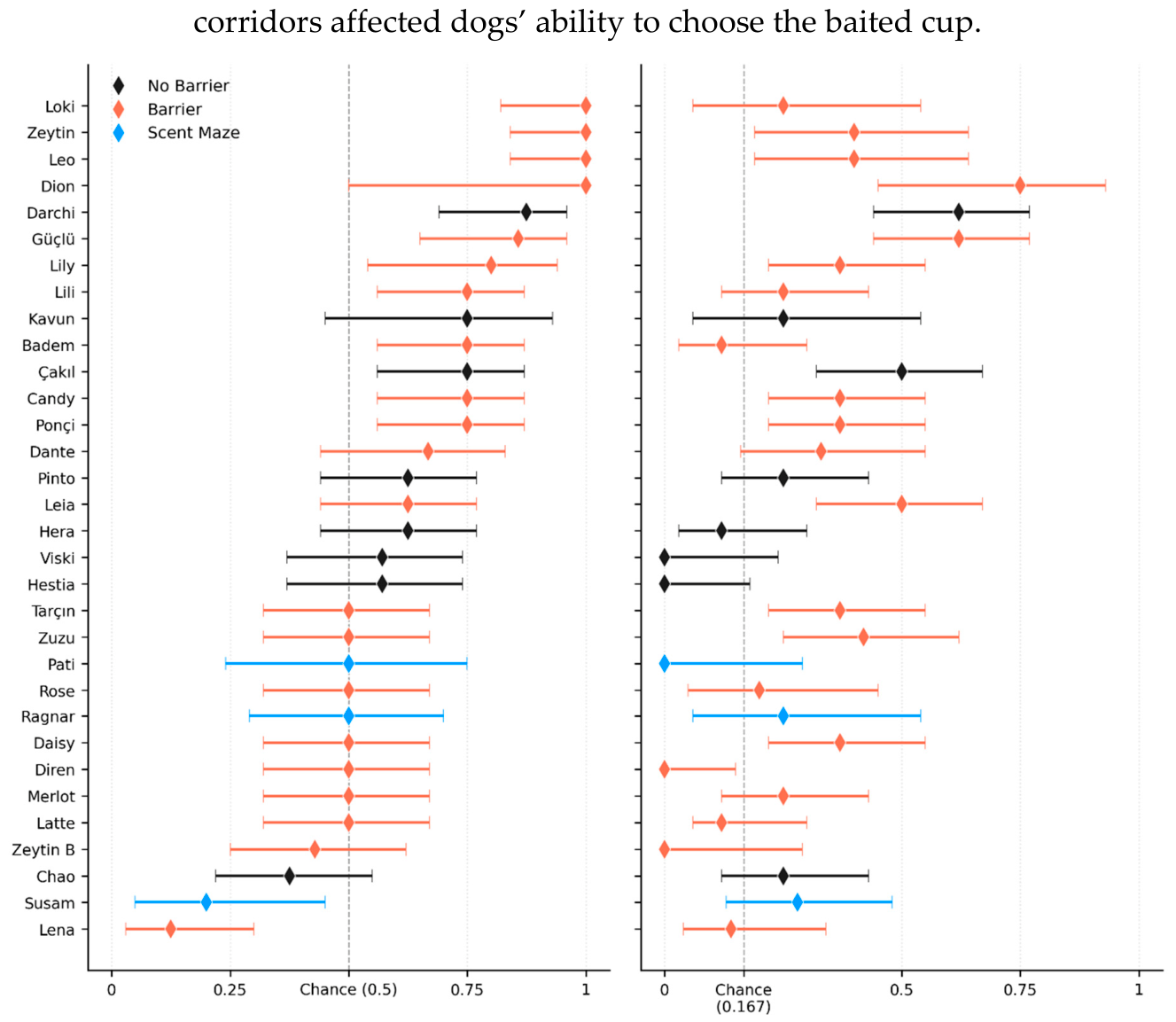
hovering about the chance rate (2-cup task: OR = 1, 1, 0.3; 6-cup task: OR = 0.9, 1.7,
2.0, respectively, a very typical overall outcome of OR = 1.45). Figure 6 shows these
results amid those of Experiment 1. The two dogs from Experiment 2 that
completed control trials without the scent maze succeeded at above typical rates in
those trials (with 6 cups, OR = 3, 2). These data give no indication that the scent corridors affected dogs’ ability to choose the baited cup.
7. General Discussion
In recognition of the tendency of dogs to meander in a focal search foraging context, the present study attempted to change the affordances in the task to encourage locomoting in straight lines. If success rates in pointing studies are hindered by a tendency to turn as a part of a focal foraging strategy, by changing dogs’ affordances to support locomotion in straight lines, we expect increased success rates. We observe that neither of our two attempts to constrain the affordance to meander—neither physical barriers nor lines of scent—affected dogs’ success in following pointing gestures. These findings put to rest the worry that low point-following accuracy in the object-choice paradigm may be a performance artifact of local search strategies in the specific motivational context evoked by the task.
This speaks against the referential communication hypothesis only indirectly. If success rates had been palpably higher in the maze conditions than otherwise, it would have suggested that success rates were low in the open arena because of the non-anthropomorphic way that dogs approach a foraging context. Only if dogs possess the capacity to understand referents is there reason to expect local foraging tactics to interfere with performance, and therefore to expect the maze manipulations to increase performance. Our results are consistent with the alternative explanation based on attention capture, which predicted no such difference. This does not mean that dogs lack the capacity to understand pointing gestures, but merely that one alternative reason for low rates was refuted.
One reason to not be surprised by the present results was that there appear to be no breed effects in laboratory point-following success rates. Even large scale studies (notably ManyDogs, 2023) have failed to associate success in pointing tasks with dog breeds. This is a more general difficulty for the referential communication hypothesis. The apparent lack of breed effects relates to the hypothesis tested here: if success rates are low because the affordances of the open arena evoke meandering in dogs, one would expect some breeds, maybe gun dogs bred for flushing, to be more affected than others. This appears not to be the case.
Point-following studies typically measure choices by contact; the dog touches the cup with maw or paw. Having walls between options in the present study permitted consideration of a second dependent measure of choice, entering the region of a cup. Sometimes, two criteria for a single construct can produce different answers. In this case, the two measures told the same story. Furthermore, there was a temporal discrepancy between the two criteria, permitting us to see whether the dog started in the right region more consistently than its ultimate nosing of the right cup. This appeared not to be the case; dogs contacted the baited cup about as often as they entered the correct region.
Were the walls high enough to create the hypothesised effect? At 25 cm, some dogs in our sample could step over the walls with little effort. This worry is addressed by consideration of the natural variability in our sample. The walls were more of an obstacle for the toy poodle than for the high-stepping retrievers, and it was easy to determine whether small, medium and large dogs showed any differences in performance. Exploratory analyses of variance showed no sign of any effect involving the dogs’ height (F’s < 1).
The present study deviated from prior work in positioning the gesturing person and the dog, to face the task from the same orientation. This is arguably more natural given how dogs communicate with each other and with human hunters. In real communicative contexts, orientation is shared. This led to the expectation that performance might be higher with this methodological shift. But dogs succeeded at rates comparable to what we have seen in the past with more typical methods. Low success rates can therefore not be attributed to this feature of common pointing tasks. This observation also dissuades explanations based on extra processing demands of perspective-taking of a gesturer facing opposite the dog. Letting the guardian do the pointing might also have rescued success rates, but it did not. These were a few potential reasons for mediocre performance even from an intentionally capable animal. That they fail gives the referential communication hypothesis that much less to hold on to. More positively, the same direction pointing solves some practical difficulties that emerge with more than two options: permitting the equation of both planar and angular distance to all cups. Hence, the observation that performance by this method is similar to other point-following methods encourages its use in multi-option point-following tasks.
The presence of six options permits application of a chance-rate manipulation test to see whether dog point-following is sensitive to changes of chance rate (described in Bowers, Samipour & Köse, preprint). This is important for differentiating the referential communication hypothesis from alternative explanations because the hypothesis is ambiguous regarding the absolute size of the effect, but can be made specific regarding how the effect is expected to scale with chance rate. Thus, having two tasks with very different chance rates permits the specification of an expected effect size on the relative performance. Meanwhile, the attentional alternative is also ambiguous on the absolute effect size, but predicts the ratio of the odds to remain constant irrespective of chance rate. So the competing explanations come apart quantitatively when subjected to different chance rates. The present study, using same-direction pointing, with and without barriers between the options, found again that error rates rise proportional to the number of options, as predicted by the hypothesis that pointing gestures merely produce a shift in attention (as in Bowers, Samipour & Köse, preprint). The conclusion that follows is that dogs follow pointing gestures not by understanding that the gesturer means to refer to a specific object, but just by having their attention pulled in the right direction.
As in previous studies, dogs were again shown to follow human pointing gestures. However, this does not imply understanding of referential content. The present study considered a few dimensions of laboratory work on point-following in dogs that might have explained low success rates even by the intentional account. The open arena might have afforded local foraging tactics that bias a high turning rate. Pointing from a different orientation might have conflicted with the dog’s umvelt, or the need to switch perspectives might have added a processing demand. A stranger’s gestures might have been uncompelling to dogs. But still success rates were unmoved. Rather, when considering all the patterns, the intentional explanation for point-following becomes dimmer, and the attentional alternative is becoming more likely. Given how well dogs are able to track human attention, this may be the whole answer.
Author Contributions
Conceptualization, RIB; Methodology, RIB, SS; Formal Analysis, RIB; Investigation, SS, CS, OO; Resources, RIB, CS; Data Curation, SS, CS, OO; Writing – Original Draft Preparation, RIB wrote introduction, results, discussion; SS wrote methods; Review & Editing, all authors; Visualization, RIB, SS; Supervision, RIB; Project Administration, SS.
Funding
This work was not specifically funded.
Ethics Statement
All procedures were reviewed and approved by the Bilkent University Institutional Review Board (No. 443, 725) on 13 June 2025.
Data Availability Statement
All data in reference in this article will be made available by the authors upon request or posted on an open repository.
Acknowledgments
The help with the running of experiments by Ezgi Kayaaslan, Buse İrem Solak, Yaren Köse, Cemre Çapar, Doğa Keçe, Elif Cebel, Melike Kahraman, Nastaran Hajiakbari Balo, Hawraa Arab, and Monika Petříková is acknowledged with gratitude.
Conflicts of Interest
We have no conflicts of interest to disclose.
References
- Allen, C. Intentionality: Natural and artificial. In Comparative Approaches to Cognitive Science; Roitblat, H. L., Meyer, Jean-Arcady, Eds.; MIT Press, 1995; pp. 93–110. [Google Scholar]
- Anderson, J. R.; Sallaberry, P.; Barbier, H. Use of experimenter-given cues during object-choice tasks by capuchin monkeys. Anim. Behav. 1995, 49(1), 201–208. [Google Scholar] [CrossRef]
- Akkad, D. A.; Gerding, W. M.; Gasser, R. B.; Epplen, J. T. Homozygosity mapping and sequencing identify two genes that might contribute to pointing behavior in hunting dogs. Canine Genet. Epidemiol. 2015, 2, 5. [Google Scholar] [CrossRef]
- Benjamini, Y.; Hochberg, Y. Controlling the false discovery rate: A practical and powerful approach to multiple testing. J. R. Stat. Soc. Ser. B 1995, 57, 289–300. [Google Scholar] [CrossRef]
- Bowers, R.I. Six clarifications for behaviour systems. Behav. Process. 2020, 170, 103987. [Google Scholar] [CrossRef] [PubMed]
- Bowers, R.I.; Samipour, S.; Köse, Y. Error rates scale with chance rate in dog point-following: A test of a referential communication hypothesis. [CrossRef]
- Broseghini, A.; Lõoke, M.; Guérineau, C.; Marinelli, L.; Mongillo, P. Ethogram of the predatory sequence of dogs (Canis familiaris). Appl. Anim. Behav. Sci. 2024, 279, 106402. [Google Scholar] [CrossRef]
- Burghardt, G.M.; Bowers, R.I. From instinct to behavior systems: An integrated approach to ethological psychology. In APA Handbook of Comparative Psychology; Call, J., Burghardt, G.M., Pepperberg, I.M., Snowdon, C.T., Zentall, T., Eds.; American Psychological Association: Washington, DC, USA, 2017; Vol 1, pp. 333–364. [Google Scholar] [CrossRef]
- Catala, A.; Mang, B.; Wallis, L. J.; Huber, L. Dogs demonstrate perspective taking based on geometrical gaze following in a Guesser–Knower task. Anim. Cogn. 2017, 20(4), 581–589. [Google Scholar] [CrossRef]
- Cook, A.; Arter, J.; Jacobs, L. F. My owner, right or wrong: the effect of familiarity on the domestic dog's behavior in a food-choice task. Anim. Cogn. 2014, 17(2), 461–470. [Google Scholar] [CrossRef]
- Craig, M.; Rand, J.; Mesch, R.; Shyan-Norwalt, M.; Morton, J.; Flickinger, E. Domestic dogs (Canis familiaris) and the radial arm maze: spatial memory and serial position effects. J. Comp. Psychol. 2012, 126(3), 233–242. [Google Scholar] [CrossRef]
- Elgier, A. M.; Jakovcevic, A.; Mustaca, A. E.; Bentosela, M. Learning and owner-stranger effects on interspecific communication in domestic dogs (Canis familiaris). Behav. Process. 2009, 81(1), 44–49. [Google Scholar] [CrossRef]
- Hare, B.; Tomasello, M. Domestic dogs (Canis familiaris) use human and conspecific social cues to locate hidden food. J. Comp. Psychol. 1999, 113, 173–7. [Google Scholar] [CrossRef]
- Hoffman, C. M.; Timberlake, W.; Leffel, J.; Gont, R. How is radial arm maze behavior in rats related to locomotor search tactics? Anim. Learn. Behav. 1999, 27, 426–444. [Google Scholar] [CrossRef]
- Horn, L.; Range, F.; Huber, L. Dogs’ attention towards humans depends on their relationship, not only on social familiarity. Anim. Cogn. 2012, 16(3), 435–443. [Google Scholar] [CrossRef]
- Kadar, E. E.; Fisher, P.; Virk, G. S. Basic strategies of target search by smell. In Studies in Perception and Action VIII; Heft, H., Marsh, K. L., Eds.; Lawrence Erlbaum, 2005; pp. 82–84. [Google Scholar]
- Kaminski, J.; Bräuer, J.; Call, J.; Tomasello, M. Domestic dogs are sensitive to a human’s perspective. Behaviour 2009, 146, 979–998. [Google Scholar] [CrossRef]
- Kaminski, J.; Nitzschner, M. Do dogs get the point? A review of dog-human communication ability. Learn. Motiv. 2013, 44(4), 294–302. [Google Scholar] [CrossRef]
- Lakens, D. Equivalence tests. Soc. Psychol. Personal. Sci. 2017, 8, 355–362. [Google Scholar] [CrossRef]
- Lyn, H.; Broadway, M.; Jett, S. E.; Samuelson, M. M.; Christopher, J.; Chenkin, B. The effects of distance on pointing comprehension in shelter dogs. Anim. Cogn. 2021, 24(4), 855–865. [Google Scholar] [CrossRef]
- MacLean, E. L.; Krupenye, C.; Hare, B. Dogs (Canis familiaris) account for body orientation but not visual barriers when responding to pointing gestures. J. Comp. Psychol. 2014, 128(3), 285–297. [Google Scholar] [CrossRef] [PubMed]
- ManyDogs Project; Espinosa, J.; Stevens, J. R.; Alberghina, D.; Always, H. E. E.; Barela, J. D.; Bogese, M.; Bray, E. E.; Buchsbaum, D.; Byosiere, S.-E.; Byrne, M.; Cavalli, C. M.; Chaudoir, L. M.; Collins-Pisano, C.; DeBoer, H. J.; Douglas, L. E. L. C.; Dror, S.; Dzik, M. V.; Ferguson, B.; et al. ManyDogs 1: A Multi-lab replication study of dogs' pointing comprehension. Anim. Behav. Cogn. 2023, 10(3), 232–286. [Google Scholar] [CrossRef]
- Miklósi, Á.; Pongrácz, P.; Lakatos, G.; Topál, J.; Csányi, V. A comparative study of the use of visual communicative signals in interactions between dogs (Canis familiaris) and humans and cats (Felis catus) and humans. J. Comp. Psychol. 2005, 119(2), 179–186. [Google Scholar] [CrossRef] [PubMed]
- Mugleston, J.D.; Huang, S.-M.; Dahl, C.D. Referential and attentional accounts of dog point-following in an asymmetric multi-cup design; BioRxiv. [CrossRef]
- Pongrácz, P.; Gácsi, M.; Hegedüs, D.; Péter, A.; Miklósi, Á. Test sensitivity is important for detecting variability in pointing comprehension in canines. Anim. Cogn. 2013, 16(5), 721–735. [Google Scholar] [CrossRef]
- Rossi, A.; Smedema, D.; Parada, F.J.; Allen, C. Visual attention in dogs and the evolution of non-verbal communication. In Domestic Dog Cognition and Behavior; Horowitz, A., Ed.; Springer: Berlin Heidelberg, 2014; pp. 133–154. [Google Scholar] [CrossRef]
- Scheider, L.; Kaminski, J.; Call, J.; Tomasello, M. Do domestic dogs interpret pointing as a command? Anim. Cogn. 2013, 16(3), 361–372. [Google Scholar] [CrossRef] [PubMed]
- Soproni, K.; Miklósi, Á.; Topál, J.; Csányi, V. Dogs’ (Canis familiaris) responsiveness to human pointing gestures. J. Comp. Psychol. 116 (1) 2002, 27–34. [Google Scholar] [CrossRef]
- Téglás, E.; Gergely, A.; Kupán, K.; Miklósi, Á.; Topál, J. Dogs’ gaze following is tuned to human communicative signals. Curr. Biol. 2012, 22(3), 209–212. [Google Scholar] [CrossRef]
- Tan, J.; Walker, K. K.; Hoff, K.; Hare, B. What influences a pet dog's first impression of a stranger? Learn. Behav. 2018, 46(4), 414–429. [Google Scholar] [CrossRef] [PubMed]
- Thesen, A.; Steen, J. B.; Døving, K. B. Behaviour of dogs during olfactory tracking. J. Exp. Biol. 1993, 180(1), 247–251. [Google Scholar] [CrossRef] [PubMed]
- Timberlake, W. The functional organization of appetitive behavior: Behavior systems and learning. In Advances in analysis of behaviour; Zeiler, M., Harzem, P., Eds.; Wiley: London, 1983; Vol. 3, pp. 177–221. [Google Scholar]
- Timberlake, W. Motivational modes in behavior systems. In Handbook of contemporary learning theories; Mowrer, R. R., Klein, S. B., Eds.; Erlbaum: Mahwah, 2001; pp. 155–209. [Google Scholar]
- Timberlake, W. Niche-related learning in laboratory paradigms: the case of maze behavior in Norway rats. Behav. Brain Res. 2002, 134, 355–374. [Google Scholar] [CrossRef]
- Timberlake, W. Anthropomorphism revisited. Comp. Cogn. Behav. Rev. 2007, 2, 139–144. [Google Scholar] [CrossRef]
- Timberlake, W.; Leffel, J.; Hoffman, C. M. Stimulus control and function of arm and wall travel by rats on a radial arm floor maze. Anim. Learn. Behav. 1999, 27, 445–460. [Google Scholar] [CrossRef]
- Udell, M.; Hall, N. J.; Morrison, J.; Dorey, N. R.; Wynne, C. D. Point topography and within-session learning are important predictors of pet dogs’(Canis lupus familiaris) performance on human guided tasks. Rev. Argent. De Cienc. Del. Comport. 2013, 5(2), 3–20. [Google Scholar] [CrossRef]
- Yeh, Y. Y.; Wang, C. C.; Cheng, S. K.; Chiu, C. D. Dissociation of posture remapping and cognitive load in level-2 perspective-taking. Cognition 2021, 214, 104733. [Google Scholar] [CrossRef] [PubMed]
Figure 1.
The apparatus in Experiment 1. Dog and gesturer began the trial seated afore two or a semi-circle of six cups. On 2-cup trials, the cup locations marked yellow were used; on 6-cup trials, all six locations were used. The blue lines mark where walls were erected in the “maze” condition. No walls were present in the control condition, but the resultant areas were still marked for scoring where the dogs went on test trials.
Figure 1.
The apparatus in Experiment 1. Dog and gesturer began the trial seated afore two or a semi-circle of six cups. On 2-cup trials, the cup locations marked yellow were used; on 6-cup trials, all six locations were used. The blue lines mark where walls were erected in the “maze” condition. No walls were present in the control condition, but the resultant areas were still marked for scoring where the dogs went on test trials.
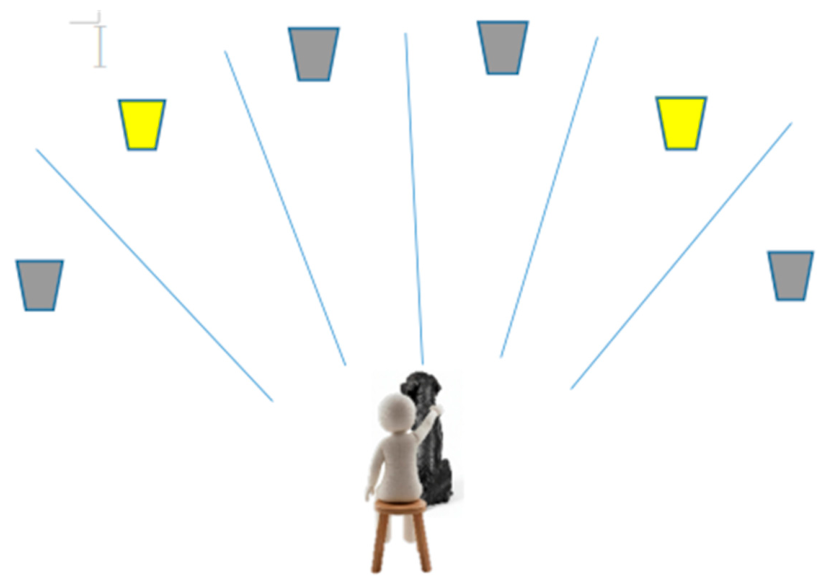
Figure 2.
The apparatus in Experiment 2. Dog and gesturer began the trial seated afore two or a semi-circle of six cups. On 2-cup trials, the cup locations marked yellow were used; on 6-cup trials, all six locations were used. The lines depict the lines of scented cloth that were spread out to each cup in the “maze” condition. The colours indicate the patterns of scent. In each case, three innocuous scents were used: olive (in blue), coconut (in red), daisy (in yellow).
Figure 2.
The apparatus in Experiment 2. Dog and gesturer began the trial seated afore two or a semi-circle of six cups. On 2-cup trials, the cup locations marked yellow were used; on 6-cup trials, all six locations were used. The lines depict the lines of scented cloth that were spread out to each cup in the “maze” condition. The colours indicate the patterns of scent. In each case, three innocuous scents were used: olive (in blue), coconut (in red), daisy (in yellow).
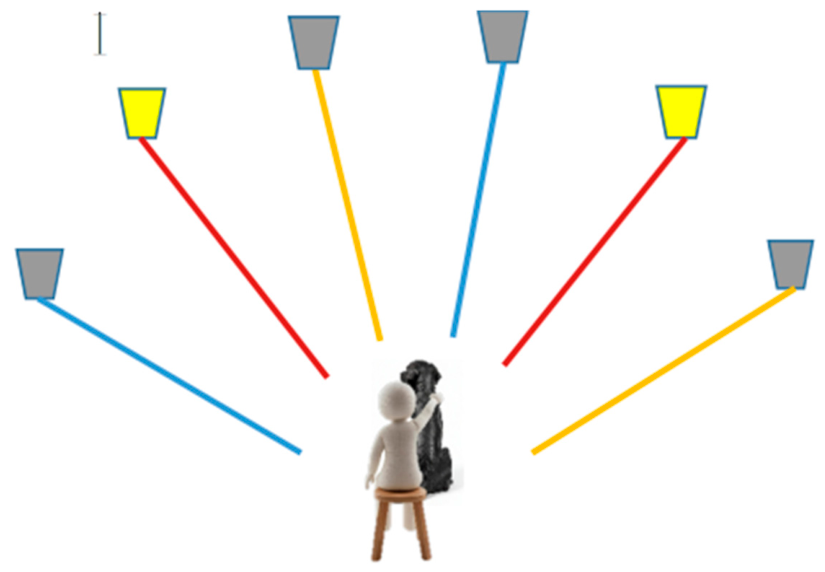
Figure 3.
The radial-arm maze employed in the present study. (Note: During experiments, the bricks were positioned farther back).
Figure 3.
The radial-arm maze employed in the present study. (Note: During experiments, the bricks were positioned farther back).
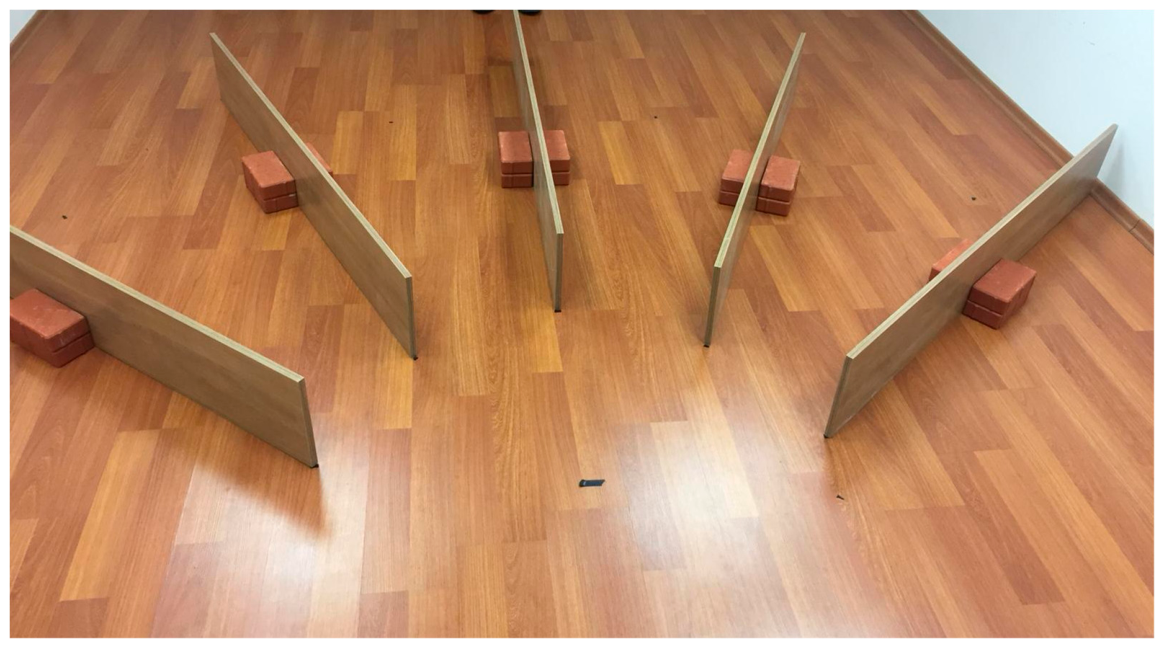
Figure 4.
Comparison of performance on the 2-option and 6-option tasks as odds ratios. Error bars show 90% confidence intervals.
Figure 4.
Comparison of performance on the 2-option and 6-option tasks as odds ratios. Error bars show 90% confidence intervals.
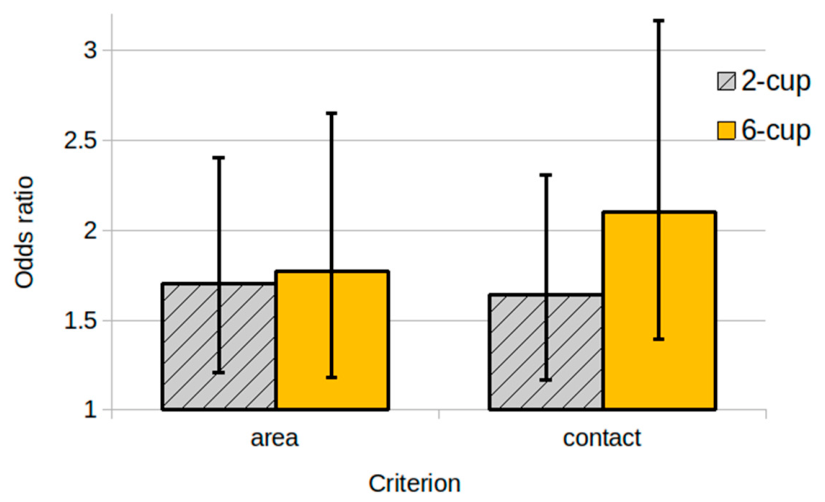
Figure 5.
Success rates across conditions (by the area criterion). Bars show mean proportion of successful choice of the baited cup in all conditions. Error bars show 95% confidence interval.
Figure 5.
Success rates across conditions (by the area criterion). Bars show mean proportion of successful choice of the baited cup in all conditions. Error bars show 95% confidence interval.
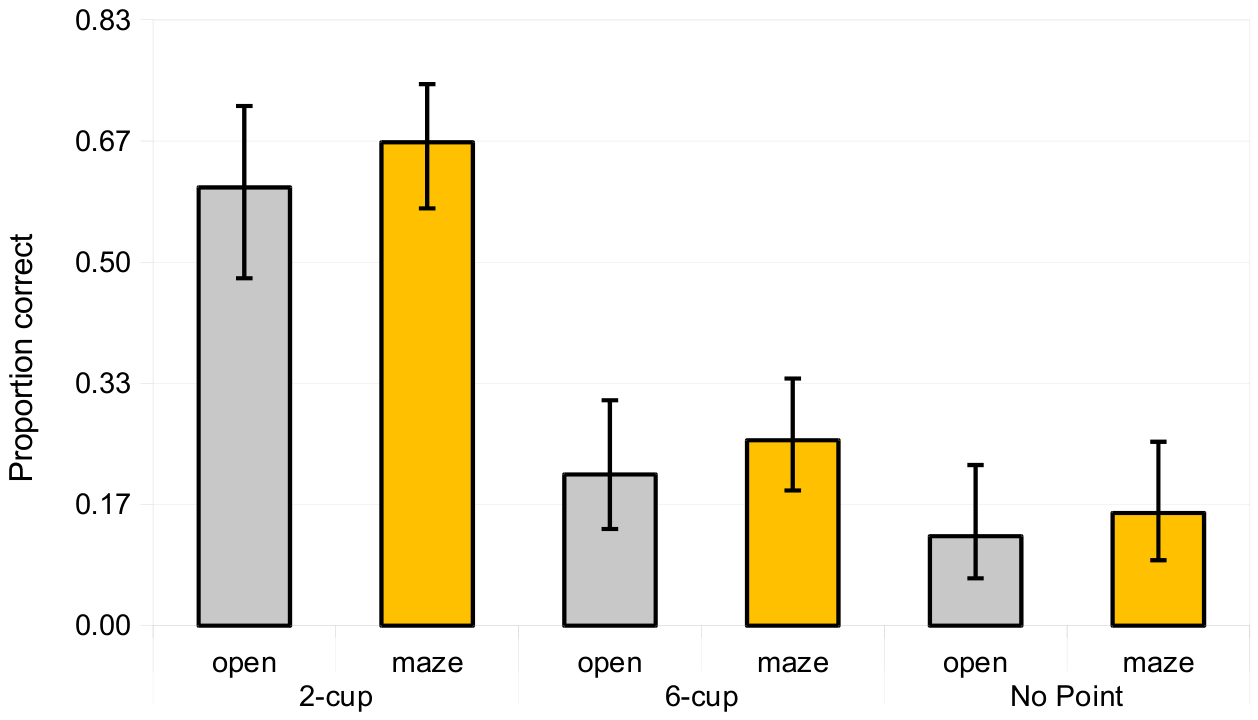
Figure 6.
Forrest plots showing the performance of individual dogs in both experiments, in the 2-cup (left panel) and 6-cup tasks (right panel). Diamonds represent the proportion of success (by contact criterion). Error bars represent 50% confidence intervals.
Figure 6.
Forrest plots showing the performance of individual dogs in both experiments, in the 2-cup (left panel) and 6-cup tasks (right panel). Diamonds represent the proportion of success (by contact criterion). Error bars represent 50% confidence intervals.
Disclaimer/Publisher’s Note: The statements, opinions and data contained in all publications are solely those of the individual author(s) and contributor(s) and not of MDPI and/or the editor(s). MDPI and/or the editor(s) disclaim responsibility for any injury to people or property resulting from any ideas, methods, instructions or products referred to in the content. |
© 2026 by the authors. Licensee MDPI, Basel, Switzerland. This article is an open access article distributed under the terms and conditions of the Creative Commons Attribution (CC BY) license (http://creativecommons.org/licenses/by/4.0/).
Copyright: This open access article is published under a Creative Commons CC BY 4.0 license, which permit the free download, distribution, and reuse, provided that the author and preprint are cited in any reuse.


