
Submitted:
01 June 2026
Posted:
02 June 2026
You are already at the latest version
Abstract
Salt stress is a primary abiotic constraint on crop production, impairing growth and reducing yield and quality in high-salinity environments. As a critical source of edible oil and protein, soybean is particularly vulnerable to salt stress during emergence and seedling establishment, making it essential to understand the genetic basis of salt tolerance at these early developmental stages for productive cultivation in saline soils. Here, a natural population of 256 soybean accessions was phenotyped for salt tolerance at emergence and seedling stages and genotyped using the ZDX1 SNP array. Genome-wide association analysis identified 60 salt tolerance-associated SNPs consolidated into 19 QTLs, 13 associated with emergence-stage and three with seedling-stage salt tolerance. Five QTLs co-localized with previously reported stress-tolerance genes, including seedling-stage QTL qSTG-SSB-03, located 192 kb from the major salt tolerance gene GmSALT3. Four candidate genes were prioritized: Glyma.10G040000, encoding a glutathione S-transferase, was identified at the emergence stage, while Glyma.10G148700, Glyma.10G149200, and Glyma.10G149600, encoding a calmodulin-binding protein (CaM), drought-induced protein 19 (Di19), and a protein phosphatase 2C (PP2C), respectively, were identified at the seedling stage, all with established roles in salt-stress responses.
Keywords:
soybean
; salt tolerance
; genome-wide association study (GWAS)
; candidate genes
1. Introduction
Soybean (Glycine max [L.] Merr.) is a globally critical food and oilseed crop whose stable production underpins food security and agricultural economies worldwide [1]. Soil salinization severely constrains soybean growth, development, and yield by disrupting cellular homeostasis through ion toxicity, osmotic stress, and oxidative damage, collectively suppressing germination, root development, photosynthetic efficiency, and biomass accumulation [2,3]. Globally, an estimated 950 million hectares are affected by salinity, including roughly 20% of the 230 million hectares of irrigated land, with the affected area expanding at approximately 10% annually [4,5,6,7]. Developing salt-tolerant cultivars is consequently among the most cost-effective strategies to address this challenge [8].
Salt tolerance in soybean is a quantitative trait governed by multiple genes acting through a complex regulatory network [9]. Critically, tolerance is developmentally stage-specific: germplasm exhibiting strong tolerance at germination or seedling establishment does not necessarily perform well at maturity, and tolerance across stages can be largely uncorrelated [10,11,12,13]. Furthermore, salt stress during early development suppresses canopy establishment and vegetative growth, with cascading effects on subsequent stages that ultimately reduce both seed yield and protein content [14,15,16]. Mapping the genetic loci underlying salt tolerance specifically at emergence and seedling stages is therefore a prerequisite for breeding improved cultivars [17].
Early efforts to map soybean salt tolerance relied on biparental populations. Lee et al. [18] used an F2:5 population from a cross between the salt-tolerant cultivar S-100 and the salt-sensitive cultivar Tokyo, mapping a major seedling-stage QTL to a 3.6 cM interval flanked by SSR markers Sat_091 and Satt237 on chromosome 3. This locus was subsequently validated across multiple studies [19,20,21,22]. In 2014, Qi et al. [23] and Guan et al. [24] independently cloned the underlying gene, Glyma03g32900, from wild and cultivated soybean, designating it GmCHX1 and GmSALT3, respectively; the encoded cation Na+/H+ transporter limits Na+ accumulation in seedling leaves, markedly improving salt tolerance. Do et al. [20] crossed salt-tolerant Fiskeby III with moderately salt-sensitive Williams 82, generating 132 F2 families, and mapped a QTL on chromosome 13 linked to leaf sodium concentration (LSC). More recently, Li et al. [25] used a recombinant inbred line (RIL) population derived from Williams 82 × PI483460B to map qSalt_Gm18 on chromosome 18, alongside qSalt_Gm03, which co-localizes with GmCHX1 on chromosome 3. To date, 68 soybean salt tolerance QTLs identified from biparental populations have been cataloged in SoyBase (www.soybase.org).
Relative to biparental linkage mapping, genome-wide association studies (GWAS) exploit linkage disequilibrium (LD) within natural populations and offer distinct advantages: broader allelic diversity, finer mapping resolution, and no requirement to construct segregating populations [26,27,28]. High-density SNP-based GWAS has been widely deployed across crops, including rice [29], cowpea [30], rapeseed [31], cotton [32], alfalfa [33], and sesame [34], and has emerged as a cornerstone approach in plant molecular breeding [35]. In soybean, Kan et al. [36] applied GWAS to 191 landraces at the germination stage, identifying one significant SNP on chromosome 9 associated with the germination index ratio and seven SNPs on chromosomes 2, 3, 9, 12, and 13 associated with the germination rate ratio. Dong et al. [37] subsequently identified a major salt tolerance locus controlled by E2, a homolog of Arabidopsis GIGANTEA (GI), using leaf chlorosis as the phenotypic indicator; E2 knockout enhanced tolerance by promoting peroxidase activity and reducing reactive oxygen species (ROS) accumulation under salt stress.
Despite these advances, genetic studies of salt tolerance specifically at the emergence stage remain scarce. In this study, a natural population of 256 soybean accessions was evaluated for salt tolerance at both emergence and seedling stages under controlled salt stress and genotyped with a high-density SNP array. GWAS was then conducted to identify regulatory loci and mine candidate genes, providing a resource for gene cloning and marker-assisted selection in salt-tolerance breeding programs.
2. Materials and Methods
2.1. Materials
A total of 256 soybean accessions were used in this study, comprising 255 domestic and one foreign accession (Table S1). The salt-tolerant cultivar Zhonghuang 39 and the salt-sensitive line NY27-38 served as controls throughout emergence-stage evaluations.
2.2. Salt Stress Treatment and Tolerance Assessment at the Emergence Stage
For each accession, 60 mature, uniformly sized seeds of consistent shape and color were selected. Small pots (7 × 7 × 8 cm) were filled with vermiculite to 2 cm below the rim, sown with 10 seeds each, and topped with vermiculite to the rim. Every 24 pots were arranged in a large container (46 × 32 × 10 cm). For salt treatment, 6 L of 150 mmol/L NaCl solution was added to each large container; after 5 min of saturation, the small pots were transferred to a clean container. Subsequently, 3 L of Reverse Osmosis water (RO water) was replenished every 3 days. Once the vermiculite reached its maximum water-holding capacity, the pots were immediately moved to a fresh container to prevent salt leaching. Control treatments were conducted identically, substituting the NaCl solution with 6 L of water. All treatments were performed in triplicate.
Emergence was scored daily from the appearance of the first seedling, defined as cotyledon protrusion above the vermiculite surface, until NY27-38 displayed clear salt-injury symptoms (severely suppressed emergence and failure of cotyledon expansion) while Zhonghuang 39 remained unaffected, with normal emergence and cotyledon expansion. At this endpoint, the number of fully established seedlings (those with expanded cotyledons and leaves) was recorded. Salt tolerance phenotypes were assessed using an individual-plant classification scheme (Figure 1; Table S2) according to Liu et al. [38], from which the salt tolerance index (SI) was calculated. Emergence-stage salt tolerance grade (STG-SI) was then assigned based on the mean SI across three replicates according to Table S2 (Figure S1). The SI was calculated as:
where I is the individual-plant category value, Nᵢ is the number of plants in category I, 10 is the number of seeds sown per pot, and 5 is the maximum category value. The salt tolerance coefficient (ST) was defined as the ratio of emerged seedlings under salt stress to those under control conditions.
2.3. Salt Stress Treatment and Tolerance Assessment at the Seedling Stage
Seed preparation and sowing for the seedling-stage assay followed the same protocol as described for the emergence stage. After sowing, 6 L of RO water was added to each large container. After 5 min of saturation, the pots were transferred to a clean container, and 3 L of RO water was replenished every 3 days using the same procedure. Once unifoliate leaves were fully expanded (approximately 10 days after sowing), salt treatment was initiated by adding 3 L of 200 mmol/L NaCl solution to each container. After saturation, pots were moved to clean containers, and this treatment was repeated on days 13 and 16. Five days after the final salt application, leaf salt-injury symptoms were scored in each replicate according to a five-grade scale (Table S3; Figure S2) following Liu [39]: grade 1, highly tolerant; grade 2, tolerant; grade 3, moderately tolerant; grade 4, sensitive; grade 5, highly sensitive. The mean grade across three replicates was calculated to assign the final seedling-stage salt tolerance grade (STG-SS), with means falling between consecutive integers rounded to the higher grade.
2.4. Phenotypic Data Processing and Analysis
Descriptive statistics and normality testing were conducted in SPSS (v25.0, IBM), and one-way ANOVA was performed in R (v4.4.2). The emergence-stage salt tolerance coefficient (ST) and salt tolerance index (SI) were standardized by rank-based inverse normal transformation (INT) following Zachary et al. [40], yielding the transformed traits ST-INT and SI-INT, respectively.
For ordinal traits with small, skewed distributions, binarization is a recognized strategy in GWAS that sharpens contrast between phenotypic extremes and increases power to detect association signals [41], Accordingly, STG-SI and STG-SS were each binarized: accessions scoring below 3 were classified as strongly tolerant (coded 1) and those scoring 3 or above as weakly tolerant (coded 0), producing binary traits STG-SIB and STG-SSB, respectively. Pearson correlation coefficients among ST-INT, SI-INT, STG-SIB, and STG-SSB were computed using the psych package (v2.6.3) in R (v4.4.2) and visualized with the ggpairs function in the GGally package (v2.4.0).
2.5. Genotype Data Quality Control
Genomic DNA was extracted from all 256 accessions and genotyped using the ZDX1 SNP array, co-developed by the Institute of Crop Sciences, Chinese Academy of Agricultural Sciences, and Beijing Compass Biotechnology Co., Ltd. SNP quality control followed Sun et al. [42], with PLINK (v1.9) used to remove SNPs with genotype missing rate > 0.4, or minor allele frequency < 0.05.
2.6. Linkage Disequilibrium Estimation
Linkage disequilibrium (LD) decay was estimated using PopLDdecay (v3.31; BGI Genomics) and visualized in R (v4.4.2) with ggplot2 (v3.4.3). The physical distance at which r2 declined to 0.5 (½ max r2) was taken as the LD decay distance for this population.
2.7. Population Structure and Kinship Analysis
K-means clustering was performed using the kmeans function in R (v4.4.2), with the optimal number of subpopulations identified by the elbow method, plotting the sum of squared errors (SSE) for K = 2–10 and selecting the K at which SSE decline flattened. PCA was conducted with the prcomp function in R (v4.4.2). A neighbor-joining (NJ) phylogenetic tree was constructed from pairwise genetic distance matrices using the ape (v5.8-1) and ggtree (v3.16.0) packages. Population structure was additionally estimated with ADMIXTURE across K = 2–8, with the optimal K selected by minimizing cross-validation (CV) error. The final subpopulation assignment integrated results from K-means clustering, PCA, the NJ tree, and ADMIXTURE. A kinship matrix was computed from SNP data using GAPIT (v3.5; http://zzlab.net/GAPIT), and relatedness within and between subpopulations was visualized as a heatmap.
2.8. Genome-Wide Association Analysis (GWAS)
GWAS was conducted on the GAPIT platform (v3.5; http://zzlab.net/GAPIT) using seven models, including GLM, MLM, CMLM, MLMM, SUPER, FarmCPU, and BLINK, with population structure and kinship coefficients included as covariates to control false positives. Significant association loci were declared at a Bonferroni-corrected threshold of −log10(P) ≥ 4, and results were visualized with ggplot2 (v3.4.3) in R (v4.4.2).
2.9. Candidate Gene Identification
LD structure around significant SNPs was examined using LDBlockShow (v1.40) to delineate haplotype blocks and identify candidate gene intervals, guided by the population’s LD decay distance. Expression profiles of candidate genes across soybean tissues were retrieved from the Williams 82 reference genome on Phytozome (https://phytozome.jgi.doe.gov/pz/portal.html).
3. Results
3.1. Phenotypic Evaluation of Salt Tolerance at Emergence and Seedling Stages
At the emergence stage, the mean emergence rate under control conditions was 0.93 (range: 0.4–1.0). Salt stress reduced this significantly to a mean of 0.85 (range: 0–1.0), a difference confirmed by one-way ANOVA (P < 0.0001) (Figure S3).
At the emergence stage, mean ST was 89.32 (range: 33.33–100) and mean SI was 0.62 (range: 0.09–1.00) (Table 1). Both traits deviated markedly from normality: ST was strongly left-skewed (skewness = −1.90) with a leptokurtic distribution (kurtosis = 4.60), while SI exhibited mild left skewness (skewness = −0.50). Rank-based inverse normal transformation was applied to both, and the resulting ST-INT and SI-INT closely approximated normal distributions, with skewness and kurtosis near zero, means near zero, and variance near one (Table 1; Figure S4A, B). STG-SI and STG-SS were both right-skewed (skewness = 0.52 and 0.66, respectively; Table 1) and were therefore binarized, yielding STG-SIB and STG-SSB with strongly tolerant proportions of 60.16% and 62.50%, sufficiently balanced for association analysis (Figure S4C, D). All four transformed traits were carried forward for GWAS.
3.2. Correlation Analysis
Pearson correlation analysis among ST-INT, SI-INT, STG-SIB, and STG-SSB revealed strong positive associations among all three emergence-stage traits (Figure 2): ST-INT vs. SI-INT, r = 0.681; ST-INT vs. STG-SIB, r = 0.520; SI-INT vs. STG-SIB, r = 0.794, all significant. By contrast, the seedling-stage trait STG-SSB showed negligible correlations with STG-SIB (r = 0.062), ST-INT (r = 0.083), and SI-INT (r = 0.106), indicating that salt tolerance at emergence and at the seedling stage are essentially independent phenotypes in this population.
ST-INT is salt tolerance coefficient after inverse normal transformation at emergence stage; SI-INT is salt tolerance index after inverse normal transformation at emergence stage; STG-SIB is salt tolerance index grades after binary conversion at emergence stage; STG-SSB is salt tolerance grades following binary conversion at seedling stage.
3.3. Genotype Data Quality Control
ZDX1 SNP array genotyping across all 256 accessions initially yielded 159,064 SNPs (Figure 3A). After PLINK-based filtering for missing rate and minor allele frequency, 89,361 SNPs were retained for GWAS.
3.4. Linkage Disequilibrium
PopLDdecay analysis showed that r2 declined steadily with increasing physical distance, reaching the decay threshold of r2 = 0.5 at approximately 50 kb (Figure 3B), which was adopted as the LD decay distance for candidate gene interval definition.
3.5. Population Structure Analysis Based on Clustering, Phylogeny, and Principal Components
Four complementary methods were employed to characterize the genetic structure of this population. K-means clustering with the elbow method revealed a clear inflection point in the within-cluster sum of squares at K = 6, marking this as the most appropriate clustering solution (Figure 4A). PCA was consistent with this result, revealing pronounced genetic stratification in which PC1 and PC2 explained 13.34% and 9.84% of total genetic variation, respectively, with samples forming six discernible clusters in PC1–PC2 space (Figure 4B). NJ phylogenetic analysis independently grouped all accessions into six distinct branches (Figure 4C). ADMIXTURE analysis produced a broadly concordant outcome (Figure 4D,E): cross-validation error declined continuously with increasing K, but the per-step reduction (ΔCV) diminished progressively from K = 2 to K = 6, then rose sharply at K = 7 (ΔCV = 0.0267), pointing to six or seven as the likely range for the true number of subgroups. Integrating all four analyses, K = 6 was selected as the optimal solution for this population, with subpopulations 1 through 6 containing 15, 90, 70, 17, 22, and 35 accessions, respectively; this subpopulation assignment was incorporated into all subsequent GWAS models. The kinship heatmap further confirmed elevated relatedness among individuals within subpopulations alongside clear genetic differentiation between them (Figure 4F), a pattern consistent with within-group homogenization and between-group divergence.
3.6. Genome-Wide Association Study of Salt Tolerance-Related Traits
GWAS was performed on the GAPIT platform for all four transformed traits, ST-INT, SI-INT, STG-SIB, and STG-SSB, using the full SNP dataset. To minimize false positives, only loci detected by at least three of the seven association models were retained. This yielded 60 significant SNPs consolidated into 19 QTLs, with the number of SNPs per QTL ranging from 1 to 20 (Table 2; Figure 5 and Figure 6).
Three QTLs for the emergence-stage trait ST-INT were mapped to chromosomes 4, 7, and 13 (Table 2). The strongest signal was qST-INT-04 (Gm04_46793849) on chromosome 4 (−log10P = 5.7). The chromosome 13 locus qST-INT-13 (Gm13_35700100) was situated approximately 0.87 Mb from GmbZIP132 [43] and 1.39 Mb from GmBIN2 [44]. GmbZIP132 encodes a bZIP transcription factor induced by salt and drought that positively regulates salt tolerance at seed germination [43], while GmBIN2 encodes a GSK3-type kinase similarly induced by both stresses and a positive regulator of stress tolerance [44].
Ten QTLs for the emergence-stage trait SI-INT were identified across chromosomes 1 (four loci), 2, 7, 9, 10, 11, and 14 (Table 2). The strongest signal came from qSI-INT-02 (Gm02_3640916–Gm02_3649811) on chromosome 2, which spanned two SNPs. The chromosome 9 locus qSI-INT-09 (Gm09_5191652) mapped approximately 1.70 Mb from GmPHD6 [45], whose overexpression in soybean hairy roots enhances salt tolerance while knockout increases sensitivity. The chromosome 10 locus qSI-INT-10 (Gm10_3521576–Gm10_3614887) lay approximately 2.54 Mb from GmWRKY54 [46] and 2.14 Mb from GmERF75 [47], both implicated in salt tolerance. The chromosome 14 locus qSI-INT-14 (Gm14_6728116) was located 0.76 Mb from a previously reported marker associated with GsPRX, a gene involved in the oxidative stress response [48].
ST-INT is salt tolerance coefficient after inverse normal transformation at emergence stage; SI-INT is salt tolerance index after inverse normal transformation at emergence stage; STG-SIB is salt tolerance index grades after binary conversion at emergence stage; STG-SSB is salt tolerance grades following binary conversion at seedling stage.
ST-INT is salt tolerance coefficient after inverse normal transformation at emergence stage; SI-INT is salt tolerance index after inverse normal transformation at emergence stage; STG-SIB is salt tolerance index grades after binary conversion at emergence stage; STG-SSB is salt tolerance grades following binary conversion at seedling stage.
Three QTLs for the emergence-stage binary trait STG-SIB were detected on chromosomes 5, 12, and 15 (Table 2), with qSTG-SIB-15 (Gm15_15831968) on chromosome 15 producing the strongest signal (−log10P = 5.74).
Three QTLs for the seedling-stage trait STG-SSB were mapped to chromosomes 3, 10, and 11 (Table 2). The chromosome 3 locus, qSTG-SSB-03 (Gm03_38525925–Gm03_38815289), was the most prominent, spanning a 0.29 Mb interval supported by 20 SNPs, with peak signal at Gm03_38688580 (−log10P = 9.08). This QTL lies approximately 192 kb from Glyma03g32900 (GmSALT3/GmCHX1), the major seedling-stage salt tolerance gene cloned independently by Guan et al. [24] and Qi et al. [23], corroborating earlier reports of a major salt tolerance locus on chromosome 3 [18,21].
3.7. Candidate Gene Analysis
To refine candidate intervals and clarify local haplotype structure, candidate gene identification focused on qSI-INT-10 (Gm10_3521576–Gm10_3614887) for emergence-stage salt tolerance and qSTG-SSB-10 (Gm10_38386826–Gm10_38472859) for seedling-stage salt tolerance, the QTLs with the greatest number of significant SNPs outside the chromosome 3 locus. LDBlockShow analysis resolved seven well-defined LD blocks (Figure S5). For qSI-INT-10, a consistent and significant LD block was detected across the GLM, MLMM, and SUPER models (Figure S5A–C), while for qSTG-SSB-10, a conserved block was identified in the BLINK, CMLM, GLM, and MLM models (Figure S5D–G).
From each stable LD block, the SNP with the highest r2 was selected, and genes within a 50 kb window on either side were screened as candidates based on the estimated LD decay distance. Within the emergence-stage QTL qSI-INT-10, 23 candidate genes were identified (Table 3), spanning functions including cell wall biosynthesis and remodeling (e.g., cellulose synthase A4 Glyma.10G039600 and the KATAMARI1 homolog Glyma.10G040700, encoding a xyloglucan galactosyltransferase), transcriptional regulation (e.g., MYB-family transcription factor APL homolog Glyma.10G039700 and auxin response factor 1 Glyma.10G040400), stress response and metabolism (e.g., glutathione S-transferase Glyma.10G040000 and alcohol dehydrogenase 1 Glyma.10G041000), and protein kinase activity and methylation (e.g., Glyma.10G041300 and Glyma.10G040100). For the seedling-stage QTL qSTG-SSB-10, 18 candidate genes were identified (Table 3), enriched for roles in DNA metabolism and repair (e.g., RecQ family helicase Glyma.10G148300, Werner syndrome-like exonuclease Glyma.10G148600, and single-stranded DNA-binding protein Glyma.10G149700) and stress response (e.g., drought-induced protein 19 Glyma.10G149200 and calmodulin-binding protein Glyma.10G148700), along with six uncharacterized and three functionally unknown proteins. Based on functional annotation and established relevance to salt stress, four genes, namely Glyma.10G040000, Glyma.10G148700, Glyma.10G149200, and Glyma.10G149600, were designated high-confidence candidate genes and are discussed in detail below.
4. Discussion
Salt tolerance in soybean is developmentally stage-specific [49], and tolerance at germination generally exceeds that at emergence; timely post-sowing irrigation can reduce surface salinity and partially mitigate this vulnerability [50]. In soils with dry-weight salt content below 1.0%, emergence is reduced even when germination rates remain high across genotypes. This distinction is strikingly illustrated by the cultivar Williams, which maintained a germination rate of 81% at 330 mM NaCl, yet seedling growth plummeted to just 5% under the lower concentration of 220 mM NaCl [51]. Under field conditions, seeds may germinate successfully in saline soil but fail to penetrate a salt-hardened surface crust. This demonstrates that soybean seeds can survive saline conditions during germination, while the same stress can be lethal at emergence, underscoring the need to evaluate salt tolerance, map relevant loci, and identify candidate genes specifically at the emergence stage.
Relatively few soybean salt-tolerance genes have been cloned through forward genetics to date, including the seedling-stage genes GmSALT3/GmCHX1 [23,24] and GsERD15B [48], and the germination-stage gene GmCDF1 [52]. The present GWAS yielded four candidate genes, one emergence-stage and three seedling-stage. The emergence-stage candidate Glyma.10G040000, located within qSI-INT-10, encodes a glutathione S-transferase (GST). GSTs are well-established contributors to plant salt tolerance, acting primarily by maintaining ROS homeostasis and thereby limiting salt-induced oxidative damage; transgenic overexpression of GST genes consistently enhances salt tolerance [53]. GST expression is further modulated by MYB and WRKY transcription factors, embedding these enzymes within broader stress-regulatory networks [54]. In soybean specifically, the tau-class member GmGSTU23 enhances salt tolerance through elevated glutathione transferase activity [55], suggesting that Glyma.10G040000 may confer tolerance through analogous mechanisms centered on ROS detoxification.
The three seedling-stage candidate genes all map to qSTG-SSB-10. Glyma.10G148700 encodes a calmodulin-binding protein, a class of regulators that decode salt-induced cytosolic Ca2+ transients and translate them into adaptive physiological responses. In rice, the calmodulin-binding protein OsMSR2 is strongly induced by salt stress, and its overexpression in Arabidopsis enhances tolerance by modulating ABA signaling and downstream stress-response gene expression [56]. Conversely, the Medicago truncatula ortholog MtCML40 acts as a negative regulator: its overexpression increases salt sensitivity, accompanied by Na+ accumulation in shoots and suppression of the sodium efflux genes MtHKT1;1 and MtHKT1;2 [57]. The contrasting roles of these orthologs highlight calmodulin-binding proteins as pivotal, if context-dependent, regulators of the salt-stress response, and position Glyma.10G148700 as a strong candidate for further functional characterization.
Glyma.10G149200 encodes drought-induced protein 19 (Di19), a family with documented roles in plant salt tolerance. In soybean, GmDi19-5 is a negative regulator that interacts with the E3 ubiquitin ligase GmPUB21 and is degraded in an ABA-dependent manner, enabling fine-tuned modulation of stress responses [58]. In maize, ZmDi19-1 enhances salt tolerance by activating downstream stress-responsive genes and boosting antioxidant capacity [59], while in cotton, GhDi19-3 and GhDi19-4 improve salt tolerance through Ca2+ and ABA signaling and concurrent ROS scavenging [60]. Collectively, Di19 proteins appear to function as central signaling nodes integrating multiple stress pathways, making Glyma.10G149200 a compelling candidate for salt tolerance.
Glyma.10G149600 encodes a PP2C family protein. In Arabidopsis, PP2Cs are core negative regulators of ABA signaling and can directly interact with and inhibit the plasma membrane Na+/H+ antiporter SOS1, a key sodium efflux transporter [61]. In peanut, PP2C genes including AhPP2C45 and AhPP2C134 are significantly upregulated under salt stress [62]. By directly regulating sodium transport and compartmentalization, PP2Cs serve as indispensable nodes in saline-environment adaptation, supporting a role for Glyma.10G149600 in soybean salt tolerance.
Beyond gene discovery, translating genomic findings into practical breeding requires broader consideration of how and when salt stress is evaluated. Unlike many abiotic stresses, salt-alkali stress persists throughout most or all of the crop growth cycle [63]. Current soybean salt-tolerance research is disproportionately focused on the seedling stage, under the assumption that early vegetative vigor reliably predicts agronomic performance, an assumption that does not always hold, since excessive salinity can redirect photosynthate from growth to stress tolerance. Indeed, some salt-tolerant genotypes show early vigor comparable to sensitive lines yet significantly outperform them under field conditions [50], highlighting the indispensable role of multi-stage field evaluation. Furthermore, most laboratory assays use NaCl as the sole treatment, whereas salinized soils worldwide vary widely in pH and ionic composition [64]. Salinization and alkalization frequently co-occur, yet their combined effects on plant growth are not simply additive, the severity ranking from greatest to least is saline-alkaline stress, alkaline stress, then salt stress alone, and mixed saline-alkaline injury substantially exceeds the sum of the individual stresses [65,66]. As research on mixed saline-alkaline tolerance remains sparse, future efforts should extend beyond single-salt or single-alkali treatments to encompass the complex stress combinations encountered in the field.
5. Conclusions
GWAS combining 200K SNP array data from 256 soybean germplasm accessions with salt-tolerance phenotypes at emergence and seedling stages identified 60 significant SNPs consolidated into 19 QTLs, with 13 associated with emergence-stage and three with seedling-stage salt tolerance. Known stress-tolerance genes were located near five of these QTLs; notably, the seedling-stage QTL qSTG-SSB-03 lies just 192 kb from the major salt-tolerance gene GmSALT3. Four high-confidence candidate genes were prioritized: the emergence-stage gene Glyma.10G040000, encoding a glutathione S-transferase, and the seedling-stage genes Glyma.10G148700, Glyma.10G149200, and Glyma.10G149600, encoding a calmodulin-binding protein, drought-induced protein 19, and a PP2C family protein, respectively. Functional validation of these candidates will be an important priority for future work.
Supplementary Materials
The following supporting information can be downloaded at the website of this paper posted on Preprints.org.
Author Contributions
Zhangxiong Liu and Lijuan Qiu: Conceptualization and writing–revision and editing. Zhangxiong Liu and Lijuan Qiu: Resources. Xiaojian Luo, Zhangxiong Liu, and Yue-mei Ji: Investigation. Xiaojian Luo, Yue-mei Ji, Jiangyuan Xu, Yongzhe Gu, and Jun Wang: Data curation and analysis. Xiaojian Luo, Zhangxiong Liu, Yue-mei Ji, Jiangyun Xu, Yongzhe Gu, and Jun Wang: Writing-original draft. For all authors: Final approval of the published version, and accountability for all aspects of the work.
Funding
This work was supported by the National Key R&D Program of China (2021YFD1201104), the Agricultural Science and Technology Innovation Program of the Chinese Academy of Agricultural Sciences (CAAS).
Data availability statement
The data that support the findings of this study are available from the corresponding author, [ZXL], upon reasonable request.
Disclosure statement: The authors declare no potential conflicts of interest with respect to the research, authorship, and/or publication of this article.:.
References
- He, Y.; Chen, Y.; Yu, C.; Lu, K.; Jiang, Q.; Fu, J.; Wang, G.; Jiang, D. Photosynthesis and yield traits in different soybean lines in response to salt stress. Photosynthetica 2016, 54(4), 630–635. [Google Scholar] [CrossRef]
- Lu, M.; Riaz, M.; Tong, K.; Hao, W.; Yang, Y.; Zhao, X.; Wang, L.; Niu, Y.; Yan, L. Boron-induced phenylpropanoid metabolism, Na+/K+ homeostasis and antioxidant defense mechanisms in salt-stressed soybean seedlings. J. Hazard. Mater. 2025, 491. [Google Scholar] [CrossRef]
- Singleton, P.; Bohlool, B. Effect of salinity on nodule formation by soybean. Plant Physiol. 1984, 74, 72–76. [Google Scholar] [CrossRef]
- Ajay, S. Soil salinity: a global threat to sustainable development. Soil Use Manag. 2022, 38, 39–67. [Google Scholar]
- Liu, Y.; Wang, P.; Ruan, H.; Wang, T.; Yu, J.; Cheng, Y.; Kulmatoy, R. Sustainable use of groundwater resources in the transboundary aquifers of the five central Asian countries: challenges and perspectives. Water 2020a, 12(8), 2101. [Google Scholar] [CrossRef]
- Muchate, N.; Nikalje, G.; Rajurkar, N.; Suprasanna, P.; Nikam, T. Physiological responses of the halophyte Sesuvium portulacastrum to salt stress and their relevance for saline soil bio-reclamation. Flora. 2016, 224, 96–105. [Google Scholar] [CrossRef]
- Radanielson, A.; Angeles, O.; Li, T.; Ismail, A.; Gaydon, D. Describing the physiological responses of different rice genotypes to salt stress using sigmoid and piecewise linear functions. Field Crops Res. 2018, 220, 46–56. [Google Scholar] [CrossRef] [PubMed]
- Sheng, X.; Ai, Z.; Tan, Y.; Hu, Y.; Guo, X.; Liu, X.; Sun, Z.; Yu, D.; Chen, J.; Tang, N.; et al. Novel salinity-tolerant third-generation hybrid rice developed via CRISPR/Cas9-mediated gene editing. Int. J. Mol. Sci. 2023, 24(9), 8025. [Google Scholar] [CrossRef]
- Fu, S.; Wang, L.; Li, C.; Zhao, Y.; Zhang, N.; Yan, L.; Li, C.; Niu, Y. Integrated transcriptomic, proteomic, and metabolomic analyses revealed molecular mechanism for salt resistance in soybean (Glycine max L.) seedlings. Int. J. Mol. Sci. 2024, 25(24), 13559. [Google Scholar] [CrossRef]
- EI-Hendawy, S.; Hu, Y.; Yakout, G.; Awad, A.; Hafiz, S.; Schmidhalter, U. Evaluating salt tolerance of wheat genotypes using multiple parameters. Eur. J. Agron. 2005, 22, 243–253. [Google Scholar] [CrossRef]
- Kingsbury, R.; Epstein, E. Selection for salt-resistant spring wheat. Crop Sci. 1984, 24, 310–315. [Google Scholar] [CrossRef]
- Manchanda, G.; Garg, N. Salinity and its effects on the functional biology of legumes. Acta Physiol. Plant. 2008, 30, 595–618. [Google Scholar] [CrossRef]
- Vicente, O.; Boscaiu, M.; Naranjo, M.; Estrelles, E.; Belles, J.; Soriano, P. Responses to salt stress in the halophyte Plantago crassifolia (Plantaginaceae). J. Arid Environ. 2004, 58, 463–481. [Google Scholar] [CrossRef]
- Francois, L.; Maas, E.; Donovan, T.; Youngs, V. Effect of salinity on grain-yield and quality, vegetative growth, and germination of semidwarf and durum-wheat. Agron. J. 1986, 78, 1053–1058. [Google Scholar] [CrossRef]
- Saisho, D.; Takumi, S.; Matsuoka, Y. Salt tolerance during germination and seedling growth of wild wheat Aegilops tauschii and its impact on the species range expansion. Sci. Rep. 2016, 6. [Google Scholar] [CrossRef] [PubMed]
- Shannon, M.; Grieve, C. Tolerance of vegetable crops to salinity. Sci. Hortic. 1999, 78, 5–38. [Google Scholar] [CrossRef]
- Morton, M.; Awlia, M.; Al-Tamimi, N.; Saade, S.; Pailles, Y.; Negrão, S.; Tester, M. Salt stress under the scalpel-dissecting the genetics of salt tolerance. Plant J. 2019, 97, 148–163. [Google Scholar] [CrossRef]
- Lee, G.J.; Carter, T.E.; Villagarcia, M.R.; Li, Z.; Zhou, X.; Gibbs, M.O.; Boerma, H.R. A major QTL conditioning salt tolerance in S-100 soybean and descendent cultivars. Theor. Appl. Genet. 2004, 109, 1610–1619. [Google Scholar] [CrossRef]
- Chen, H.; Cui, S.; Fu, S.; Gai, J.; Yu, D. Identification of quantitative trait loci associated with salt tolerance during seedling growth in soybean (Glycine max L.). Aust. J. Agric. Res. 2008, 59, 1086–1091. [Google Scholar] [CrossRef]
- Do, T.D.; Vuong, T.D.; Dunn, D.; Smothers, S.; Patil, G.; Yungbluth, D.C.; Chen, P.; Scaboo, A.; Xu, D.; Carter, T.E.; et al. Mapping and confirmation of loci for salt tolerance in a novel soybean germplasm, Fiskeby III. Theor. Appl. Genet. 2018, 131(3), 513–524. [Google Scholar] [CrossRef]
- Hamwieh, A.; Tuyen, D.; Cong, H.; Benitez, E.; Takahashi, R.; Xu, D. Identification and validation of a major QTL for salt tolerance in soybean. Euphytica. 2011, 179, 451–459. [Google Scholar] [CrossRef]
- Shi, X.; Yan, L.; Yang, C.; Yan, W.; Moseley, D.O.; Wang, T.; Liu, B.; Di, R.; Chen, P.; Zhang, M. Identification of a major quantitative trait locus underlying salt tolerance in ‘Jidou 12’ soybean cultivar. BMC Res. Notes. 2018, 11, 95. [Google Scholar] [CrossRef]
- Qi, X.; Li, M.; Xie, M.; Liu, X.; Ni, M.; Shao, G.; Song, C.; Yim, A.K.Y.; Tao, Y.; Wong, F.L.; et al. Identification of a novel salt tolerance gene in wild soybean by whole-genome sequencing. Nat. Commun. 2014, 5, 4340. [Google Scholar] [CrossRef]
- Guan, R.X.; Qu, Y.; Guo, Y.; Yu, L.; Liu, Y.; Jiang, J.; Chen, J.; Ren, Y.; Liu, G.; Tian, L.; et al. Salinity tolerance in soybean is modulated by natural variation in GmSALT3. Plant J. 2014, 80(6), 937–950. [Google Scholar] [CrossRef]
- Li, Y.; Ye, H.; Vuong, T.D.; Zhou, L.; Do, T.D.; Chhapekar, S.S.; Zhao, W.; Li, B.; Jin, T.; Gu, J.; et al. A novel natural variation in the promoter of GmCHX1 regulates the conditional gene expression to improve salt tolerance in soybean. J. Exp. Bot. 2023a, 75(3), 1051–1062. [Google Scholar] [CrossRef] [PubMed]
- Hu, D.; Zhao, Y.; Zhu, L.; Li, X.; Zhang, J.; Cui, X.; Li, W.; Hao, D.; Yang, Z.; Wu, F.; et al. Genetic dissection of ten photosynthesis-related traits based on InDel-and SNP-GWAS in soybean. Theor. Appl. Genet. 2024, 137, 96. [Google Scholar] [CrossRef]
- Jang, S.; Park, S.; Lar, S.; Zhang, H.; Lee, A.; Cao, F.; Seo, J.; Ham, T.; Lee, J.; Kwon, S. Genome-wide association study (GWAS) of mesocotyl length for direct seeding in rice. Agron. 2021, 11, 2527. [Google Scholar] [CrossRef]
- Sahito, J.; Zhang, H.; Gishkori, Z.; Ma, C.; Wang, Z.; Ding, D.; Zhang, X.; Tang, J. Advancements and prospects of genome-wide association studies (GWAS) in maize. Int. J. Mol. Sci. 2024, 25(3), 1918. [Google Scholar] [CrossRef] [PubMed]
- Shi, H.; Zhang, W.; Cao, H.; Zhai, L.; Song, Q.; Xu, J. Identification of candidate genes for cold tolerance at seedling stage by GWAS in rice (Oryza sativa L.). Biol. 2024, 13, 784. [Google Scholar] [CrossRef]
- Xiong, H.; Chen, Y.; Ravelombola, W.; Mou, B.; Sun, X.; Zhang, Q.; Xiao, Y.; Tian, Y.; Luo, Q.; Alatawi, I.; et al. Genetic dissection of diverse seed coat patterns in cowpea through a comprehensive GWAS approach. Plants. 2024, 13, 1275. [Google Scholar] [CrossRef]
- Zhang, F.; Xiao, X.; Xu, K.; Cheng, X.; Xie, T.; Hu, J.; Wu, X. Genome-wide association study (GWAS) reveals genetic loci of lead (Pb) tolerance during seedling establishment in rapeseed (Brassica napus L.). BMC Genom. 2020, 21, 139. [Google Scholar] [CrossRef] [PubMed]
- Wang, L.; Yang, Y.; Qin, J.; Ma, Q.; Qiao, K.; Fan, S.; Qu, Y. Integrative GWAS and transcriptomics reveal GhAMT2 as a key regulator of cotton resistance to Verticillium wilt. Front. Plant Sci. 2025, 16, 1563466. [Google Scholar] [CrossRef] [PubMed]
- He, F.; Xu, M.; Liu, H.; Xu, Y.; Long, R.; Kang, J.; Yang, Q.; Chen, L. Unveiling alfalfa root rot resistance genes through an integrative GWAS and transcriptome study. BMC Plant Biol. 2025, 25, 58. [Google Scholar] [CrossRef] [PubMed]
- Li, D.; Dossa, K.; Zhang, Y.; Wei, X.; Wang, L.; Zhang, Y.; Liu, A.; Zhou, R.; Zhang, X. GWAS uncovers differential genetic bases for drought and salt tolerances in sesame at the germination stage. Genes. 2018, 9, 87. [Google Scholar] [CrossRef]
- Li, B. Identification of genes conferring plant salt tolerance using GWAS: current success and perspectives. Plant Cell Physiol. 2020, 61(8), 1419–1426. [Google Scholar] [CrossRef]
- Kan, G.; Zhang, W.; Yang, W.; Ma, D.; Zhang, D.; Hao, D.; Hu, Z.; Yu, D. Association mapping of soybean seed germination under salt stress. Mol. Genet. Genom. 2015, 290, 2147–2162. [Google Scholar] [CrossRef]
- Dong, L.; Hou, Z.; Li, H.; Li, Z.; Fang, C.; Kong, L.; Li, Y.; Du, H.; Li, T.; Wang, L.; et al. Agronomical selection on loss-of-function of GIGANTEA simultaneously facilitates soybean salt tolerance and early maturity. J. Integr. Plant Biol. 2022, 64(10), 1866–1882. [Google Scholar] [CrossRef]
- Liu, X.X.; Chang, R.Z.; Guan, R.X.; Qiu, L.J. Establishment of salt tolerance identification method at soybean seedling emergence stage and screening of salt-tolerant germplasm. Acta Agron. Sin. 2020b, 46(01), 1–8. [Google Scholar] [CrossRef]
- Liu, X.X. Development and utilization of marker for salt-tolerant gene GmSALT3 and identification of salt-tolerant QTL at seedling emergence stage in soybean. Master’s Thesis, Chinese Academy of Agricultural Sciences, Beijing, China, 2019. [Google Scholar]
- Zachary, R.; Jacqueline, M.; Richa, S.; Susan, R.; Lin, X. Operating characteristics of the rank-based inverse normal transformation for quantitative trait analysis in genome-wide association studies. Biometr 2020, 76(4), 1262–1272. [Google Scholar]
- Bi, W.; Zhou, W.; Zhang, P.; Sun, Y.; Yue, W.; Lee, S. Scalable mixed model methods for set-based association studies on large-scale categorical data analysis and its application to exome-sequencing data in UK Biobank. Am. J. Hum. Genet. 2023, 110, 762–773. [Google Scholar] [CrossRef]
- Sun, R.; Sun, B.; Tian, Y.; Su, S.; Zhang, Y.; Zhang, W.; Wang, J.; Yu, P.; Guo, B.; Li, H.; et al. Dissection of the practical soybean breeding pipeline by developing ZDX1, a high-throughput functional array. Theor. Appl. Genet. 2022, 135(4), 1413–1427. [Google Scholar] [CrossRef]
- Liao, Y.; Zhang, J.; Chen, S.; Zhang, W. Role of soybean GmbZIP132 under abscisic acid and salt stresses. Plant Physiol. Biochem. 2008, 50(2), 221–230. [Google Scholar] [CrossRef]
- Wang, L.; Chen, Q.; Xin, D.; Qi, Z.; Zhang, C.; Li, S.; Jin, Y.; Li, M.; Mei, H.; Su, A.; et al. Overexpression of GmBIN2, a soybean glycogen synthase kinase 3 gene, enhances tolerance to salt and drought in transgenic Arabidopsis and soybean hairy roots. J. Integr. Agric. 2018, 17(9), 1959–1971. [Google Scholar] [CrossRef]
- Wei, W.; Tao, J.; Chen, H.; Li, Q.; Zhang, W.; Ma, B.; Lin, Q.; Zhang, J.; Chen, S. A histone code reader and a transcriptional activator interact to regulate genes for salt tolerance. Plant Physiol. 2017, 175(3), 1304–1320. [Google Scholar] [CrossRef] [PubMed]
- Wei, W.; Liang, D.; Bian, X.; Shen, M.; Xiao, J.; Zhang, W.; Ma, B.; Lin, Q.; Lv, J.; Chen, X.; et al. GmWRKY54 improves drought tolerance through activating genes in abscisic acid and Ca2+ signaling pathways in transgenic soybean. Plant J. 2019, 100(2), 384–398. [Google Scholar] [CrossRef] [PubMed]
- Zhao, M.; Yin, L.; Liu, Y.; Ma, J.; Zheng, J.; Lan, J.; Fu, J.; Chen, M.; Xu, Z.; Ma, Y. The ABA-induced soybean ERF transcription factor gene GmERF75 plays a role in enhancing osmotic stress tolerance in Arabidopsis and soybean. BMC Plant Biol. 2019, 19(1), 1–14. [Google Scholar] [CrossRef] [PubMed]
- Jin, T.; Sun, Y.; Shan, Z.; He, J.; Wang, N.; Gai, J.; Li, Y. Natural variation in the promoter of GsERD15B affects salt tolerance in soybean. Plant Biotechnol. J. 2021, 19, 1155–1169. [Google Scholar] [CrossRef]
- Shelke, D.B.; Pandey, M.; Nikalje, G.C.; Zaware, B.N.; Suprasanna, P.; Nikam, T.D. Salt responsive physiological, photosynthetic and biochemical attributes at early seedling stage for screening soybean genotypes. Plant Physiol. Biochem. 2017, 118, 519. [Google Scholar] [CrossRef]
- Liu, Y.; Yu, L.L.; Qu, Y.; Chen, J.L.; Liu, X.X.; Hong, H.L.; Liu, Z.X.; Chang, R.Z.; Gilliham, M.; Qiu, L.J.; Guan, R.X. GmSALT3, which confers improved soybean salt tolerance in the field, increases leaf Cl- exclusion prior to Na+ Exclusion but does not improve early vigor under salinity. Front. Plant Sci. 2016, 7, 1485. [Google Scholar] [CrossRef]
- Hosseini, M.K.; Powell, A.A.; Bingham, I.J. Comparison of the seed germination and early seedling growth of soybean in saline conditions. Seed Sci. Res. 2002, 12, 165–172. [Google Scholar] [CrossRef]
- Zhang, W.; Liao, X.; Cui, Y.; Ma, W.; Zhang, X.; Du, H.; Ma, Y.; Ning, L.; Wang, H.; Huang, F.; et al. A cation diffusion facilitator, GmCDF1, negatively regulates salt tolerance in soybean. PLoS Genet. 2019a, 15, e1007798. [Google Scholar] [CrossRef]
- Meng, H.; Zhao, J.; Yang, Y.; Diao, K.; Zheng, G.; Li, T.; Dai, X.; Li, J. PeGSTU58, a glutathione s-transferase from Populus euphratica, enhances salt and drought stress tolerance in transgenic Arabidopsis. Int. J. Mol. Sci. 2023, 24(11), 9354. [Google Scholar] [CrossRef]
- Yuan, L.; Dang, J.; Zhang, J.; Wang, L.; Zheng, H.; Li, G.; Li, J.; Zhou, F.; Khan, A.; Zhang, Z.; et al. A glutathione S-transferase regulates lignin biosynthesis and enhances salt tolerance in tomato. Plant Physiol. 2024, 196(4), 2989–3006. [Google Scholar] [CrossRef]
- Li, X.; Pang, Y.; Zhong, Y.; Cai, Z.; Ma, Q.; Wen, K.; Nian, H. GmGSTU23 encoding a tau class glutathione s-transferase protein enhances the salt tolerance of soybean (Glycine max L.). Int. J. Mol. Sci. 2023b, 24(6), 5547. [Google Scholar] [CrossRef]
- Xu, G.; Rocha, P.; Wang, M.; Xu, M.; Cui, Y.; Li, L.; Zhu, Y.; Xia, X. A novel rice calmodulin-like gene, OsMSR2, enhances drought and salt tolerance and increases ABA sensitivity in Arabidopsis. Plant. 2022, 234, 47–59. [Google Scholar] [CrossRef]
- Zhang, X.; Wang, T.; Liu, M.; Sun, W.; Zhang, W. Calmodulin-like gene MtCML40 is involved in salt tolerance by regulating MtHKTs transporters in Medicago truncatula. Environ. Exp. Bot. 2019b, 157, 79–90. [Google Scholar] [CrossRef]
- Yang, Y.; Ren, R.; Karthikeyan, A.; Yin, J.; Jin, T.; Fang, F.; Cai, H.; Liu, M.; Wang, D.; Zhi, H.; et al. The soybean GmPUB21-interacting protein GmDi19-5 responds to drought and salinity stresses via an ABA-dependent pathway. Crop J. 2023, 11(4), 1152–1162. [Google Scholar] [CrossRef]
- Zhang, X.; Cai, H.; Lu, M.; Wei, Q.; Xu, L.; Bo, C.; Ma, Q.; Zhao, Y.; Cheng, B. A maize stress-responsive Di19 transcription factor, ZmDi19-1, confers enhanced tolerance to salt in transgenic Arabidopsis. Plant Cell Rep. 2019c, 38, 1563–1578. [Google Scholar] [CrossRef]
- Zhao, L.; Li, Y.; Li, Y.; Chen, W.; Yao, J.; Fang, S.; Lv, Y.; Zhang, Y.; Zhu, S. Systematical characterization of the cotton Di19 gene family and the role of GhDi19-3 and GhDi19-4 as two negative regulators in response to salt stress. Antioxidants 2022, 11(11), 2225. [Google Scholar] [CrossRef]
- Fu, H.; Yu, X.; Jiang, Y.; Wang, Y.; Yang, Y.; Chen, S.; Chen, Q.; Guo, Y. SALT OVERLY SENSITIVE 1 is inhibited by clade D Protein phosphatase 2C D6 and D7 in Arabidopsis thaliana. Plant Cell. 2023, 35(1), 279–297. [Google Scholar] [CrossRef]
- Wu, Z.; Luo, L.; Wan, Y.; Liu, F. Genome-wide characterization of the PP2C gene family in peanut (Arachis hypogaea L.) and the identification of candidate genes involved in salinity-stress response. Front. Plant Sci. 2023, 14, 1093913. [Google Scholar] [CrossRef]
- Ha, B.K.; Vuong, T.D.; Velusamy, V.; Nguyen, H.T.; Shannon, J.G.; Lee, J.D. Genetic mapping of quantitative trait loci conditioning salt tolerance in wild soybean (Glycine soja) PI 483463. Euphytica. 2013, 193(1), 79–88. [Google Scholar] [CrossRef]
- Rengasamy, P. Soil processes affecting crop production in salt-affected soils. Funct. Plant Biol. 2010, 37(7), 613–620. [Google Scholar] [CrossRef]
- Gong, B.; Wang, X.F.; Wei, M.; Li, Y.; Shi, Q.H. Overexpression of S-adenosylmethionine synthetase 1 enhances tomato callus tolerance to alkali stress through polyamine and hydrogen peroxide cross-linked networks. Plant Cell Tissue Organ Cult. 2016, 124(2), 377–391. [Google Scholar] [CrossRef]
- Wang, X.P.; Jiang, P.; Ma, Y.; Geng, S.J.; Wang, S.C.; Shi, D.C. Physiological strategies of sunflower exposed to salt or alkali stresses: restriction of ion transport in the cotyledon node zone and solute accumulation. Agron. J. 2015, 107(6), 2181–2192. [Google Scholar] [CrossRef]
Figure 1.
Individual-plant classification criteria for salt tolerance at the emergence stage.
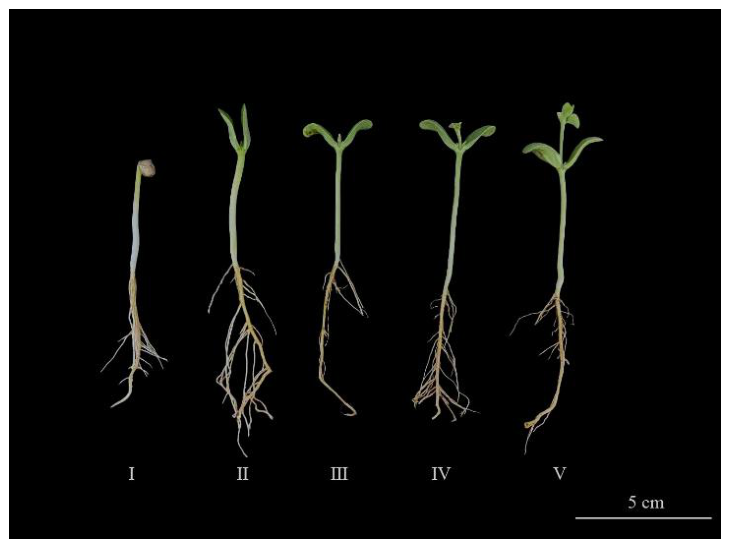
Figure 2.
Phenotypic trait correlation matrix. Upper triangle: Pearson correlation coefficients with significance indicators (*P < 0.05, **P < 0.01, ***P < 0.001); diagonal: frequency distribution histograms for ST-INT, SI-INT, STG-SIB, and STG-SSB; lower triangle: scatter plots with fitted regression lines.
Figure 2.
Phenotypic trait correlation matrix. Upper triangle: Pearson correlation coefficients with significance indicators (*P < 0.05, **P < 0.01, ***P < 0.001); diagonal: frequency distribution histograms for ST-INT, SI-INT, STG-SIB, and STG-SSB; lower triangle: scatter plots with fitted regression lines.
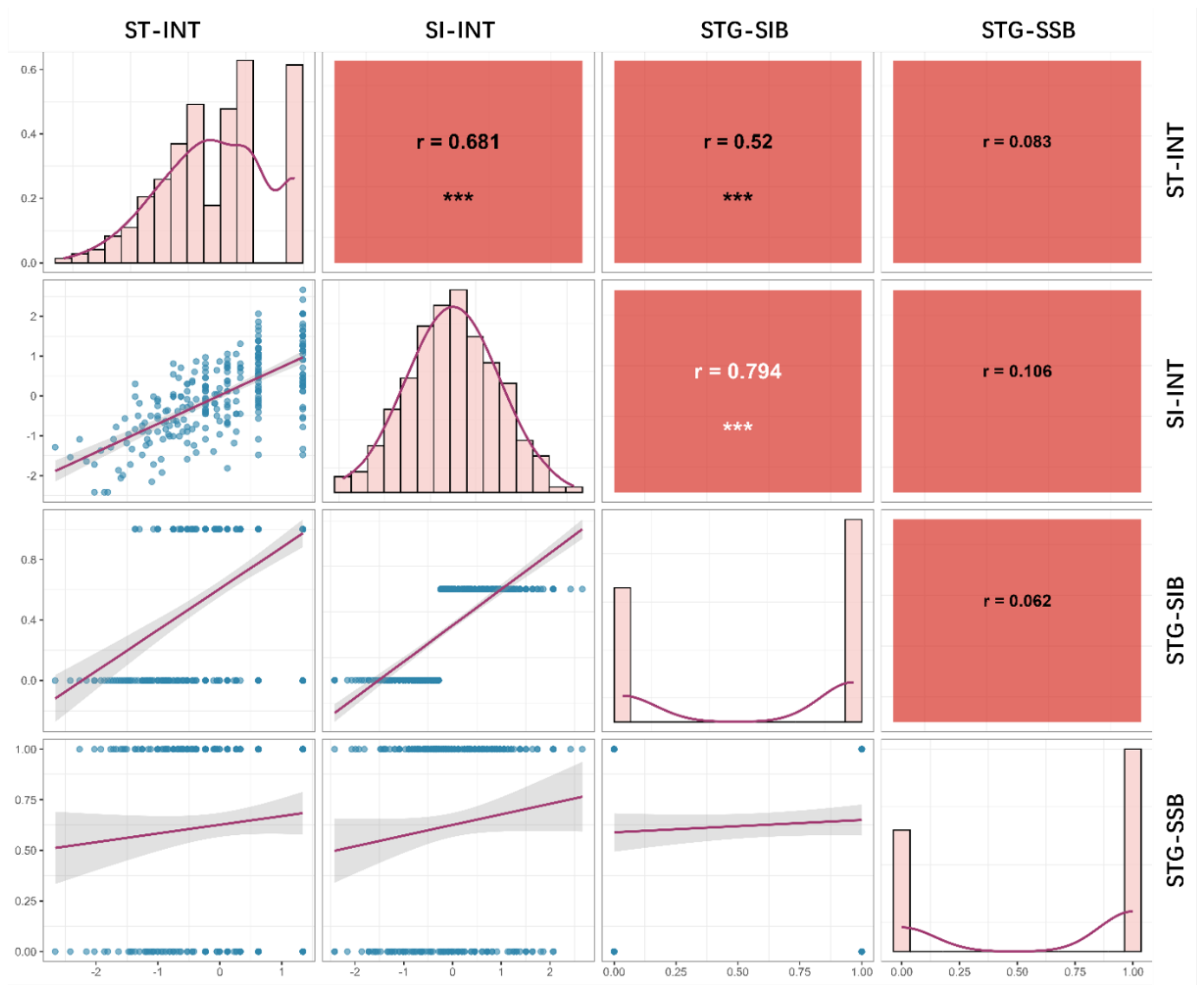
Figure 3.
Genomic distribution of SNP markers and linkage disequilibrium in the 256-accession panel. (A) Density of the 89,361 SNPs across the 20 soybean chromosomes in 1 Mb windows; (B) LD decay curve showing the decline in r2 with increasing physical distance.
Figure 3.
Genomic distribution of SNP markers and linkage disequilibrium in the 256-accession panel. (A) Density of the 89,361 SNPs across the 20 soybean chromosomes in 1 Mb windows; (B) LD decay curve showing the decline in r2 with increasing physical distance.
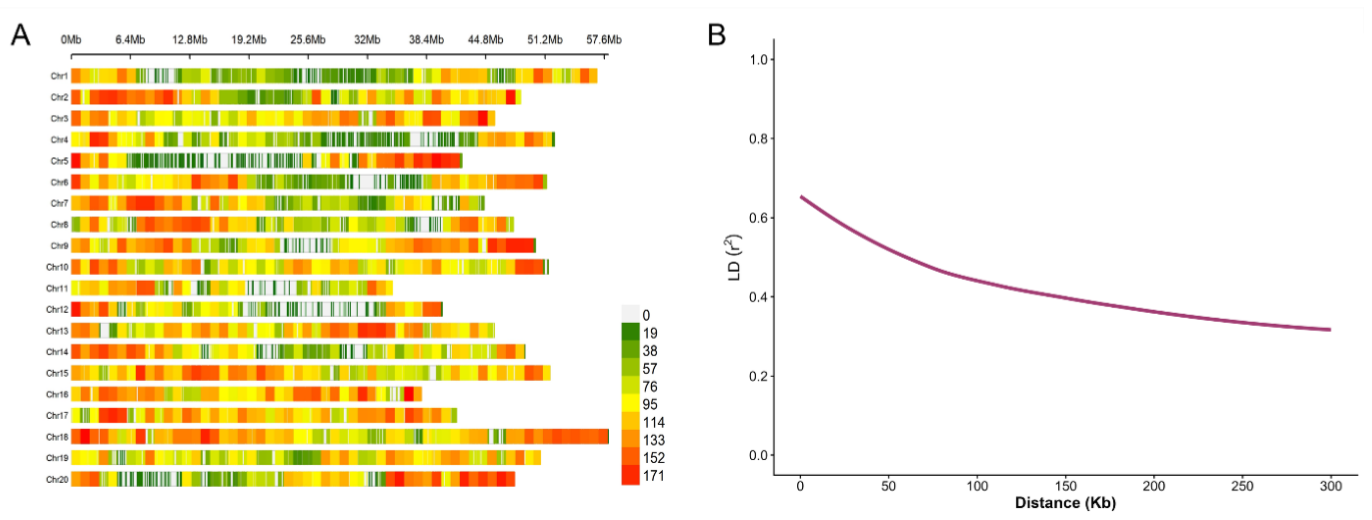
Figure 4.
Genetic structure and relatedness of 256 soybean accessions. (A) Elbow plot from K-means clustering, used to determine the optimal number of subpopulations; (B) Principal component analysis scatter plot (PC1 vs. PC2) showing genetic stratification among the 256 accessions; (C) Neighbor-joining tree constructed using pairwise p-distances; (D) Cross-validation error curves across K = 2–8 used to guide ADMIXTURE model selection; (E) ADMIXTURE ancestry plots for K = 2–8, where each vertical bar represents one accession and colored segments denote the proportional ancestry contribution from each inferred source population; (F) Kinship heatmap from hierarchical clustering of all 256 accessions, with darker shading indicating closer relatedness.
Figure 4.
Genetic structure and relatedness of 256 soybean accessions. (A) Elbow plot from K-means clustering, used to determine the optimal number of subpopulations; (B) Principal component analysis scatter plot (PC1 vs. PC2) showing genetic stratification among the 256 accessions; (C) Neighbor-joining tree constructed using pairwise p-distances; (D) Cross-validation error curves across K = 2–8 used to guide ADMIXTURE model selection; (E) ADMIXTURE ancestry plots for K = 2–8, where each vertical bar represents one accession and colored segments denote the proportional ancestry contribution from each inferred source population; (F) Kinship heatmap from hierarchical clustering of all 256 accessions, with darker shading indicating closer relatedness.
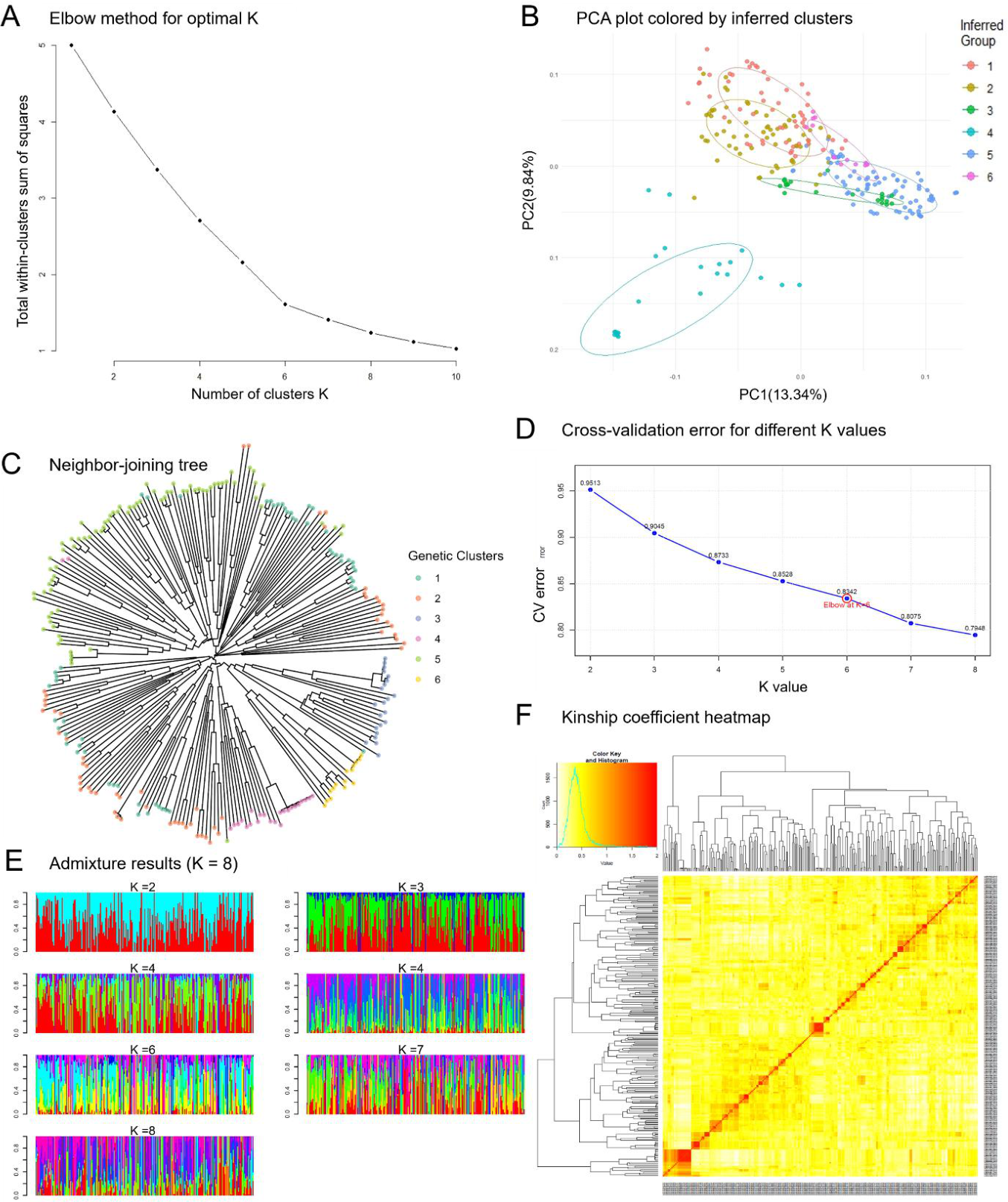
Figure 5.
Quantile–quantile plots for ST-INT (A), SI-INT (B), STG-SIB (C), and STG-SSB (D) across the BLINK, CMLM, FarmCPU, GLM, MLM, MLMM, and SUPER models.
Figure 5.
Quantile–quantile plots for ST-INT (A), SI-INT (B), STG-SIB (C), and STG-SSB (D) across the BLINK, CMLM, FarmCPU, GLM, MLM, MLMM, and SUPER models.
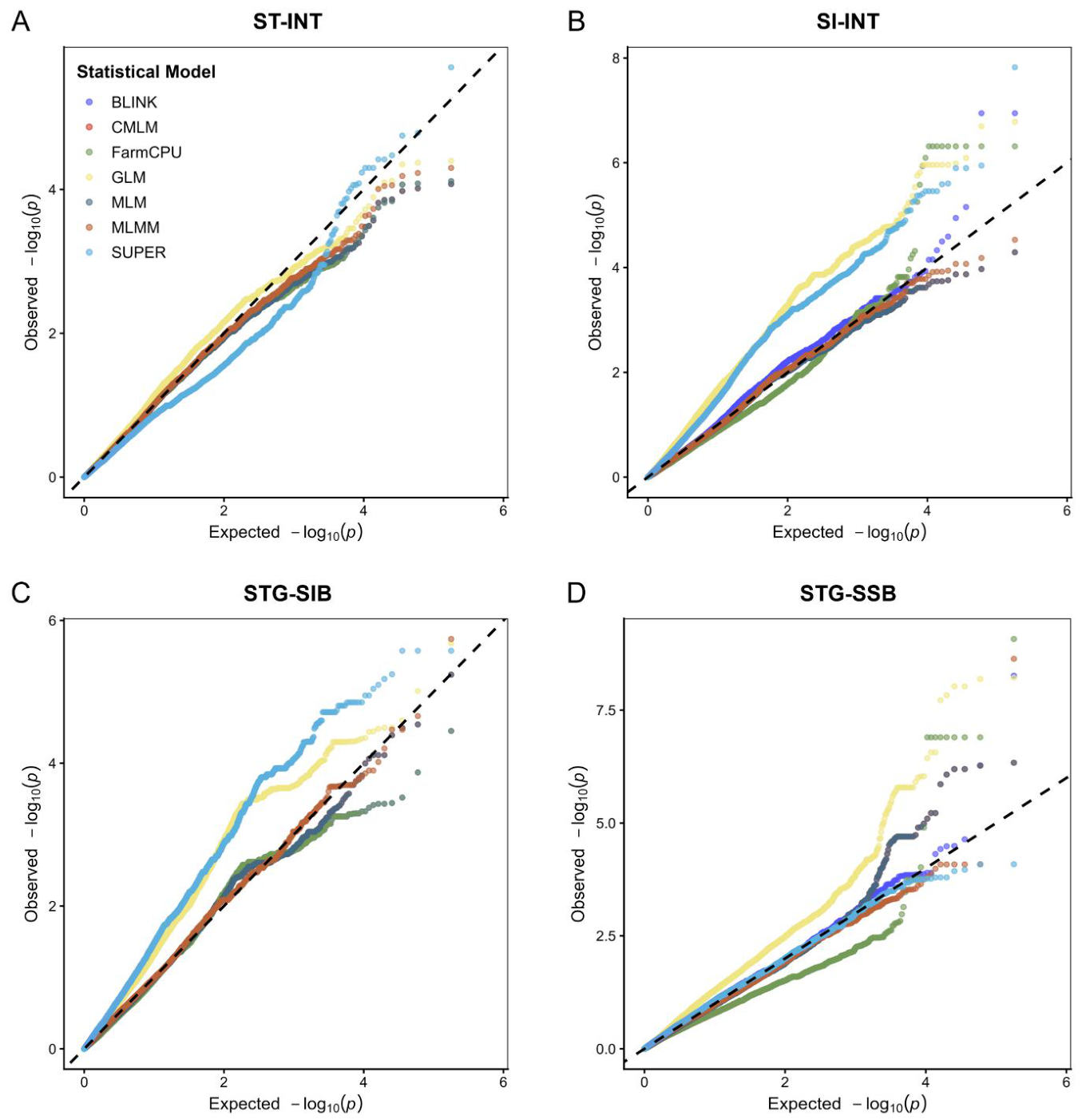
Figure 6.
Manhattan plots for ST-INT (A), SI-INT (B), STG-SIB (C), and STG-SSB (D) across the BLINK, CMLM, FarmCPU, GLM, MLM, MLMM, and SUPER models.
Figure 6.
Manhattan plots for ST-INT (A), SI-INT (B), STG-SIB (C), and STG-SSB (D) across the BLINK, CMLM, FarmCPU, GLM, MLM, MLMM, and SUPER models.
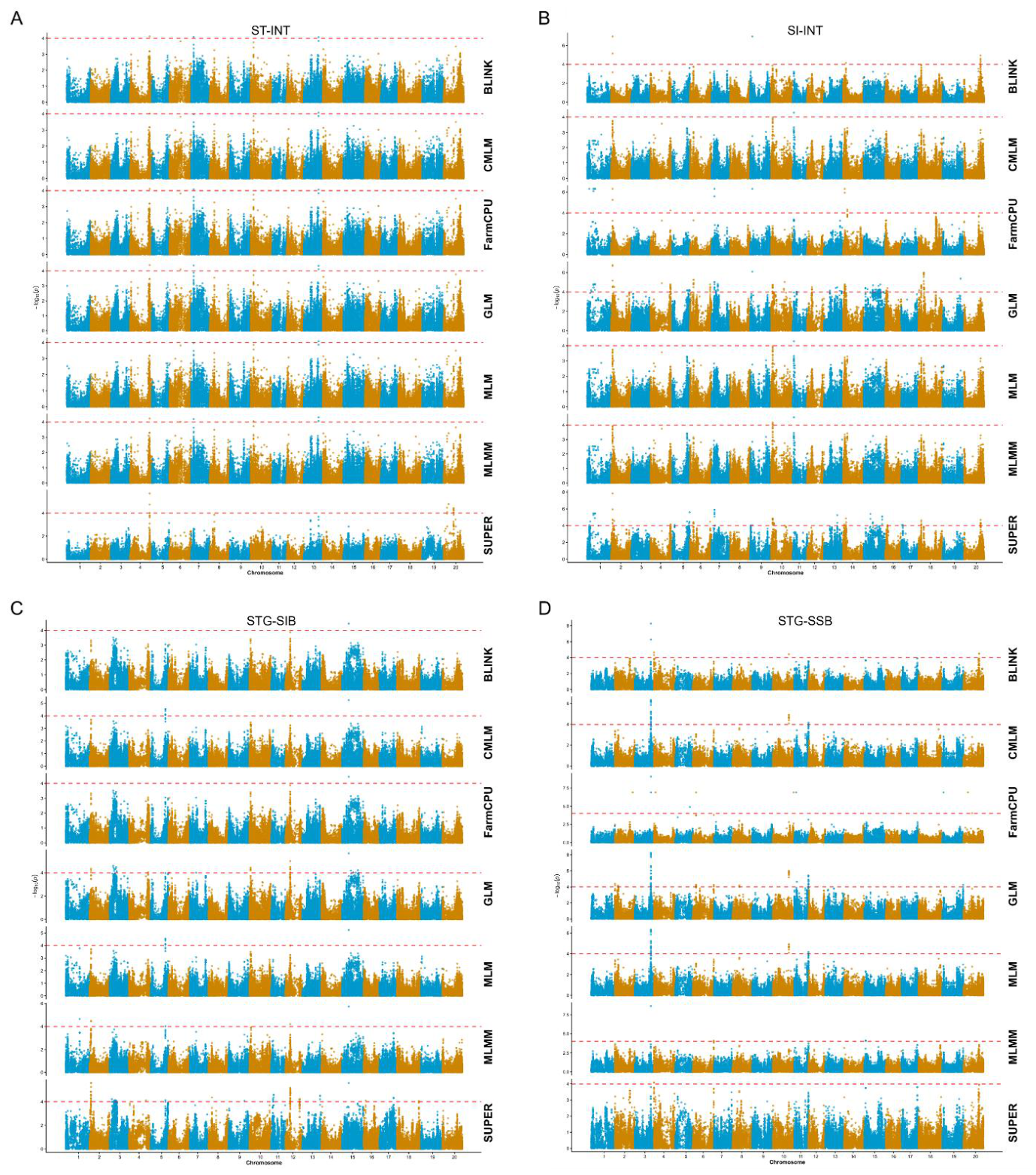

Table 1.
Descriptive statistics of salt tolerance at emergence and seedling stages.
| Traits | Maximum | Minimum | Mean | Variance | SD a | Skewness | Kurtosis |
| ST b | 100.00 | 33.33 | 89.32 | 128.82 | 11.35 | -1.90 | 4.60 |
| SI c | 1.00 | 0.09 | 0.62 | 0.05 | 0.23 | -0.50 | -0.66 |
| STG-SI d | 5.00 | 1.00 | 2.43 | 1.30 | 1.14 | 0.52 | -0.63 |
| STG-SS e | 5.00 | 1.00 | 2.30 | 1.54 | 1.24 | 0.66 | -0.63 |
| ST-INT f | 1.34 | -2.66 | -0.02 | 0.88 | 0.94 | -0.26 | -0.57 |
| SI-INT g | 2.66 | -2.42 | 0 | 0.96 | 0.98 | 0 | -0.28 |
| STG-SIB h | 1.00 | 0 | 0.60 | 0.24 | 0.49 | -0.41 | -1.84 |
| STG-SSB I | 1.00 | 0 | 0.63 | 0.24 | 0.49 | -0.51 | -1.74 |
a SD is standard deviation; b ST is salt tolerance coefficient at emergence stage; c SI is salt tolerance index at emergence stage; d STG-SI is salt tolerance index grades at emergence stage; e STG-SS is salt tolerance grades at seedling stage; f ST-INT is salt tolerance coefficient after inverse normal transformation at emergence stage; g SI-INT is salt tolerance index after inverse normal transformation at emergence stage; h STG-SIB is salt tolerance index grades after binary conversion at emergence stage; I STG-SSB is salt tolerance grades following binary conversion at seedling stage.
Table 2.
Quantitative trait loci (QTL) for salt tolerance identified by GWAS in this study.
| QTL name | Associated traits | Chr. | SNP interval | SNP number contained | Highest association SNP | −log10(P) |
| qST-INT-04 | ST-INT a | 4 | Gm04_46793849 | 1 | Gm04_46793849 | 5.70 |
| qST-INT-07 | ST-INT | 7 | Gm07_6279424 | 1 | Gm07_6279424 | 4.37 |
| qST-INT-13 | ST-INT | 13 | Gm13_35700100 | 1 | Gm13_35700100 | 4.35 |
| qSI-INT-01-1 | SI-INT b | 1 | Gm01_14874637-14927241 | 2 | Gm01_14874637 | 6.09-6.32 |
| qSI-INT-01-2 | SI-INT | 1 | Gm01_17436477 | 1 | Gm01_17436477 | 6.32 |
| qSI-INT-01-3 | SI-INT | 1 | Gm01_18506780 | 1 | Gm01_18506780 | 6.32 |
| qSI-INT-01-4 | SI-INT | 1 | Gm01_19151980 | 1 | Gm01_19151980 | 6.32 |
| qSI-INT-02 | SI-INT | 2 | Gm02_3640916-3649811 | 2 | Gm02_3649811 | 6.78-7.82 |
| qSI-INT-07 | SI-INT | 7 | Gm07_7238076-7250804 | 2 | Gm07_7238076 | 5.90-6.32 |
| qSI-INT-09 | SI-INT | 9 | Gm09_5191652 | 1 | Gm09_5191652 | 6.95 |
| qSI-INT-10 | SI-INT | 10 | Gm10_3521576-3614887 | 3 | Gm10_3521576、Gm10_3614887 | 4.73-4.84 |
| qSI-INT-11 | SI-INT | 11 | Gm11_2844635 | 1 | Gm11_2844635 | 4.53 |
| qSI-INT-14 | SI-INT | 14 | Gm14_6728116 | 1 | Gm14_6728116 | 4.86 |
| qSTG-SIB-05 | STG-SIB c | 5 | Gm05_35273972-35303385 | 2 | Gm05_35303385 | 4.39-4.50 |
| qSTG-SIB-12 | STG-SIB | 12 | Gm12_11112335 | 1 | Gm12_11112335 | 5.18 |
| qSTG-SIB-15 | STG-SIB | 15 | Gm15_15831968 | 1 | Gm15_15831968 | 5.74 |
| qSTG-SSB-03 | STG-SSB d | 3 | Gm03_38525925-38815291 | 20 | Gm03_38688580 | 4.41-9.08 |
| qSTG-SSB-10 | STG-SSB | 10 | Gm10_38386826-38472859 | 16 | Gm10_38398774 | 5.20-6.01 |
| qSTG-SSB-11 | STG-SSB | 11 | Gm11_34520086-34522630 | 2 | Gm11_34522630 | 4.67-4.81 |
a ST-INT is the salt tolerance coefficient after inverse normal transformation at the emergence stage; b SI-INT is the salt tolerance index after inverse normal transformation at the emergence stage; c STG-SIB is the salt tolerance index grades after binary conversion at the emergence stage; d STG-SSB is the salt tolerance grades after binary conversion at the seedling stage.
Table 3.
Candidate genes and functional annotations.
| QTL name | Gene ID | Chr. | Start | End | Gene function |
| qSI-INT-10 | Glyma.10G039200 | Gm10 | 3476029 | 3482210 | Tetratricopeptide repeat protein 7B-like |
| Glyma.10G039300 | Gm10 | 3484313 | 3487965 | Rho GDP-dissociation inhibitor 1 | |
| Glyma.10G039400 | Gm10 | 3489552 | 3494424 | Exocyst complex component EXO84B-like | |
| Glyma.10G039500 | Gm10 | 3495933 | 3498821 | Uncharacterized protein LOC100793067 | |
| Glyma.10G039600 | Gm10 | 3498156 | 3501931 | Cellulose synthase A4 | |
| Glyma.10G039700 | Gm10 | 3509365 | 3515838 | Myb family transcription factor APL-like | |
| Glyma.10G039800 | Gm10 | 3523133 | 3524397 | Unknown protein | |
| Glyma.10G039900 | Gm10 | 3528125 | 3529563 | 60S ribosomal L23-like protein | |
| Glyma.10G040000 | Gm10 | 3532303 | 3534011 | Glutathione S-transferase family protein | |
| Glyma.10G040100 | Gm10 | 3534381 | 3541727 | Histone-lysine N-methyltransferase SUVR2-like | |
| Glyma.10G040200 | Gm10 | 3547051 | 3547805 | Mitochondrial import receptor subunit TOM9-2-like | |
| Glyma.10G040300 | Gm10 | 3548744 | 3550403 | Uncharacterized protein LOC102667717 | |
| Glyma.10G040400 | Gm10 | 3557161 | 3561101 | Auxin response factor 1 | |
| Glyma.10G040500 | Gm10 | 3561542 | 3565454 | ATP binding/protein serine/threonine kinase | |
| Glyma.10G040600 | Gm10 | 3568550 | 3571109 | Photosystem II reaction center PSB28 protein | |
| Glyma.10G040700 | Gm10 | 3572769 | 3575692 | Xyloglucan galactosyltransferase KATAMARI1-like | |
| Glyma.10G040800 | Gm10 | 3585796 | 3589311 | Proline-rich protein precursor | |
| Glyma.10G040900 | Gm10 | 3591102 | 3596087 | Tetratricopeptide repeat protein 4 homolog | |
| Glyma.10G041000 | Gm10 | 3597307 | 3601274 | Alcohol dehydrogenase 1 | |
| Glyma.10G041100 | Gm10 | 3601867 | 3606814 | 3-oxoacyl-[acyl-carrier-protein] synthase | |
| Glyma.10G041200 | Gm10 | 3613943 | 3614897 | RmlC-like cupins superfamily protein | |
| Glyma.10G041300 | Gm10 | 3621767 | 3629177 | Protein kinase superfamily protein | |
| Glyma.10G041400 | Gm10 | 3654431 | 3661105 | PfkB-like carbohydrate kinase family protein | |
| qSTG-SSB-10 | Glyma.10G148100 | Gm10 | 38339322 | 38341729 | Uncharacterized protein DDB_G0271670-like |
| Glyma.10G148200 | Gm10 | 38353363 | 38357916 | Uncharacterized protein LOC100777900 | |
| Glyma.10G148300 | Gm10 | 38372070 | 38378539 | RecQ family ATP-dependent DNA helicase | |
| Glyma.10G148400 | Gm10 | 38379206 | 38380060 | Unknown protein | |
| Glyma.10G148500 | Gm10 | 38381421 | 38382250 | Protein of unknown function (DUF3511) | |
| Glyma.10G148600 | Gm10 | 38382588 | 38389222 | Werner Syndrome-like exonuclease-like | |
| Glyma.10G148700 | Gm10 | 38415381 | 38418722 | Calmodulin-binding protein | |
| Glyma.10G148800 | Gm10 | 38420217 | 38425350 | Importin subunit alpha-1b | |
| Glyma.10G148900 | Gm10 | 38427372 | 38430979 | DNA polymerase III, epsilon subunit-like protein | |
| Glyma.10G149000 | Gm10 | 38431647 | 38436740 | Syntaxin of plants 43 | |
| Glyma.10G149100 | Gm10 | 38441580 | 38441963 | Unknown protein | |
| Glyma.10G149200 | Gm10 | 38464899 | 38467826 | Drought-induced 19 | |
| Glyma.10G149300 | Gm10 | 38468901 | 38469373 | Uncharacterized protein LOC100797448 | |
| Glyma.10G149400 | Gm10 | 38469764 | 38473037 | PHD and RING finger domain-containing protein 1 | |
| Glyma.10G149500 | Gm10 | 38493040 | 38499888 | ATP binding microtubule motor family protein | |
| Glyma.10G149600 | Gm10 | 38511278 | 38514578 | Protein phosphatase 2C family protein | |
| Glyma.10G149700 | Gm10 | 38516493 | 38521186 | Single-stranded DNA-binding protein | |
| Glyma.10G149800 | Gm10 | 38520715 | 38521086 | Uncharacterized protein LOC102667166 |
Disclaimer/Publisher’s Note: The statements, opinions and data contained in all publications are solely those of the individual author(s) and contributor(s) and not of MDPI and/or the editor(s). MDPI and/or the editor(s) disclaim responsibility for any injury to people or property resulting from any ideas, methods, instructions or products referred to in the content. |
© 2026 by the authors. Licensee MDPI, Basel, Switzerland. This article is an open access article distributed under the terms and conditions of the Creative Commons Attribution (CC BY) license (http://creativecommons.org/licenses/by/4.0/).
Copyright: This open access article is published under a Creative Commons CC BY 4.0 license, which permit the free download, distribution, and reuse, provided that the author and preprint are cited in any reuse.


