

Submitted:
01 June 2026
Posted:
02 June 2026
You are already at the latest version
Abstract
Marine pufferfishes are globally distributed and ecologically important organism notable for accumulating tetrodotoxin [TTX], a potent neurotoxin with wide ecological ramifica-tions. Unlike many endogenous defences, TTX in pufferfishes is acquired indirectly via microbial and trophic pathways, linking pufferfish toxicity to the dynamics of marine mi-crobial assemblages and food webs. Anthropogenic climate change principally ocean warming, deoxygenation, and acidification is rapidly reshaping marine environments in ways that are likely to intensify and redistribute TTX exposure. Observational and experimental studies indicate that elevated seawater temperatures favour the proliferation of thermophilic, toxin-producing bacteria [e.g., Vibrio spp.], increase the abundance of toxic prey, and raise TTX burdens in pufferfish tissues seasonally and spatially. Concurrently, warming-driven range shifts have promoted poleward expansions of several tropical and subtropical puffer species, producing novel sympatric assemblages, hybridization events, and “cryptic” toxic phenotypes that complicate species identification and risk assess-ment. These biogeographic rearrangements, together with altered prey communities and microbial composition, reconfigure the trophic pathways by which TTX is transferred and concentrated in higher trophic levels. Early evidence also links multistressor conditions elevated temperature combined with hypoxia or acidification to altered developmental success and changes in toxin allocation during reproduction, suggesting potential popu-lation-level consequences. This review synthesizes current global evidence on cli-mate-linked changes in pufferfish TTX dynamics, integrating microbial ecology, trophic transfer, life-history shifts, and biogeography. We highlight [i] mechanistic pathways by which warming and associated ocean changes increase environmental TTX availability, [ii] how shifting species ranges and hybridization alter toxicity patterns across regions, and [iii] key methodological advances [e.g., high-resolution LC-MS/MS, metagenomics] needed to resolve open questions. We identify critical research gaps long-term field moni-toring, integrated microbial–trophic mapping, and multistressor population studies and recommend synthesis strategies that link environmental monitoring to toxin surveillance. Understanding pufferfish toxification as a climate-sensitive ecological process [not a static species trait] is essential to anticipate how marine toxin landscapes will change in the Anthropocene and to develop timely, science-based monitoring frameworks.
Keywords:
hypoxia
; ocean acidification
; microbial ecology
; trophic transfer
; hybridization
; Takifugu
; tetrodotoxin
; bioaccumulation
1. Introduction
Pufferfishes [Tetraodontidae] are a diverse family of marine fishes recognized for their distinctive body form and, in many taxa, the presence of tetrodotoxin [TTX] in tissues [1]. TTX is an extremely potent blocker of voltage-gated sodium channels and plays a central ecological role as an antipredator defense, in some systems it may also influence reproductive and interspecific interactions [2]. Importantly, TTX in pufferfishes is typically not biosynthesized by the fish themselves but is acquired through microbial producers and trophic transfer, linking fish toxicity directly to microbial ecology and food-web structure [3,4]. Ectoparasites of pufferfish also participate in these trophic linkages; the parasitic copepod Pseudocaligus fugu, which feeds on Takifugu pardalis (higanfugu), has been shown to accumulate TTX from its host, and bacteria isolated from this copepod have been proposed as additional vectors in toxin transfer pathways [5,6,7].
The origin of TTX is widely attributed to marine bacteria, such as those from the genera Vibrio, Aeromonas, and Pseudomonas, which are then accumulated by pufferfish through the marine food chain [8]. Because TTX production and accumulation are fundamentally linked to microbial activity and food web dynamics, they are inherently sensitive to shifting environmental conditions [9]. Collective evidence indicates ocean warming favours proliferation of TTX-producing bacteria [e.g., Vibrio spp.], increasing environmental availability of TTX and driving higher tissue burdens in pufferfish populations during warm seasons [1]. Studies on Takifugu pardalis in the coastal waters of Japan and Korea have shown that TTX levels fluctuate seasonally, often peaking during periods of high-water temperature [10].
Anthropogenic climate change is altering the physical and biological template of the world’s oceans: rising sea surface temperatures, changes in oxygen availability, and ocean acidification are reshaping plankton communities, microbial assemblages, and species distributions [1,11,12]. For toxin systems that depend on microbial production like TTX these environmental changes can have outsized effects microbial growth, toxin biosynthesis, and trophic interactions are all temperature- and chemistry-dependent. Empirical studies and reviews show consistent associations between warmer conditions and greater environmental presence of TTX-producing bacteria, seasonal spikes in tissue TTX during warm months, and increased detection of TTX in new regions and taxa [1,9,11].
Range shifts of puffer species, often driven by warming currents, create novel sympatric zones and raise the incidence of hybridization, these events can generate unpredictable toxin distributions because hybrid phenotypes may express toxin burdens that differ from parental species [13,14,15]. Simultaneously, multi-stressor effects such as warming combined with hypoxia or acidification can alter development, reproductive timing, and toxin allocation linking individual fitness to broader toxin dynamics [16,17].
Given these interconnections, pufferfish toxification is best framed as a dynamic, environment-mediated ecological process. This review integrates microbial, trophic, physiological, and biogeographic evidence to synthesize how climate change is redefining TTX availability and patterns of bioaccumulation across pufferfish species worldwide. By synthesizing existing data and identifying strategic research priorities, we aim to support robust monitoring and predictive frameworks for toxin emergence in a warming ocean.
2. Literature Search and Data Analysis
Literature was identified in Scopus, PubMed, and Google Scholar for the period from January 2000 to December 2024 to examine links between pufferfish [Takifugu and related genera], tetrodotoxin [TTX] dynamics, and climate-related environmental drivers. Searches used combinations of the keywords “Takifugu”, “pufferfish”, “tetrodotoxin”, “TTX”, “climate change”, “ocean warming”, “hypoxia”, “ocean acidification”, “toxicity”, “range shift”, and region-specific terms such as “Japan”, “Mediterranean”, and “Northwest Pacific”, combined with Boolean operators [AND/OR]. Only peer-reviewed articles and authoritative reports published in English were considered.
The database searches retrieved 512 records in total [Scopus = 176, PubMed = 134, Google Scholar = 202]. After exporting all records to reference-management software and removing duplicates, 381 unique records remained. Titles and abstracts were then screened to identify studies addressing TTX in marine pufferfishes in relation to environmental or ecological factors relevant to climate change, which led to the exclusion of 267 clearly irrelevant items [e.g., non-marine species, non-TTX toxicology, or opinion pieces].
Full texts of the remaining 114 articles were examined to confirm their relevance and information content. Studies were retained when they reported original empirical data on TTX occurrence or concentration in pufferfishes, pufferfish distribution or ecology, and/or associated environmental variables such as temperature, dissolved oxygen, pH, or habitat characteristics. Articles lacking essential methodological or statistical information were excluded.
In total, 62 studies met the inclusion criteria and were used to develop the qualitative synthesis presented in this review. Within this set, 28 papers contained sufficiently detailed quantitative information on TTX levels, climate-linked environmental gradients, or distributional changes to support more detailed discussion of climate-driven variability in toxicity, range shifts, and ecological interactions influencing toxin dynamics.
We included experimental and field studies that explicitly measured physiological, biochemical, toxicological or ecological responses of pufferfishes [Takifugu and closely related taxa] to temperature, oxygen, or CO₂/pH changes, and studies that characterized the ecology or microbial sources of TTX. Reviews and modelling papers were included for context. Exclusion criteria: conference abstracts lacking full methods, non-peer-reviewed opinion pieces, and studies without primary data or clear methods.
3. Evolutionary and Genomic Background of Takifugu
The evolutionary history of the Takifugu is defined by an explosive adaptive radiation in the Northwest Pacific during the Pliocene [1.8-5.3 Mya], a tempo of diversification comparable to the cichlid radiations of the African Great Lakes [15,18]. Despite the recognition of approximately 25 species with distinct morphological traits, modern genomic analyses challenge traditional taxonomic boundaries by revealing extremely low genetic diversity and minimal pairwise differentiation [18,19]. Bayesian clustering and phylogenetic neighbour joining trees suggest these morphotypes represent a single, genetically homogeneous species complex that has not yet achieved full reproductive isolation [15,18]. This genetic overlap is particularly problematic for fisheries management, as traditional morphological classification often leads to mislabelling in commercial seafood markets [1,20].
The Takifugu genome is a premier model for vertebrate comparative genomics due to its extreme compactness, characterized by shortened intergenic sequences and a near-total absence of repetitive elements [18,21]. The typical genome size is approximately 365-400 Mb, encoding roughly 19,000 to 22,000 protein-coding genes, which represents one of the highest gene densities among vertebrates [18,21]. Beyond structural uniqueness, the genome harbours specific mechanisms for complex life histories, such as the erythropoietin [Epo] gene, which in Takifugu is primarily expressed in the heart rather than the kidney as seen in mammals [21,22]. Furthermore, the evolution of euryhalinity in species like T. obscurus (Mefugu) is supported by a robust suite of osmoregulatory genes managing ion transport across the gills and kidneys [23,24]. These genomic foundations provide the baseline for understanding how environmental fluctuations trigger molecular responses in wild populations [8,18].
4. Climate-Driven Biogeographic Shifts in Pufferfish
Sea surface temperatures [SST] around the Japanese archipelago are rising at a rate significantly faster than the global average, acting as a powerful catalyst for the northward redistribution of Takifugu populations [8,25]. Historically, the distribution of these species was governed by specific isothermal lines, which acted as critical boundaries between temperate and subtropical habitats [10,25]. As these boundaries shift, species such as T. rubripes (Torafugu) and T. niphobles (Kusafugu) are expanding their habitable zones into northern districts like Tohoku and Hokkaido [25,26]. This range expansion often creates a temporary increase in local species richness, termed "pseudo biodiversity," which can displace native cold-water taxa and destabilize local ecological integrity [8,15].
The most striking consequence of these rapid range shifts is the dramatic increase in natural hybridization events as previously isolated species are forced into sympatry in shared spawning grounds [10,27]. Genomic and morphological screening indicates that these hybrids can account for a significant percentage of local catches in newly colonized regions [10,28]. Ongoing interspecific gene flow poses a significant threat to the genetic integrity of parental species and complicates wild stock management [15,27]. Crucially, these hybrid pufferfish often possess unpredictable and mosaic-like toxicity profiles, with tetrodotoxin appearing in tissues like muscle that are typically considered safe in parent species [1,28]. This phenomenon necessitates the use of molecular identification tools to prevent accidental poisoning from misidentified hybrid specimens [20,27].
5. Pathophysiology of Thermal Stress: Molecular and Biochemical Failures
As poikilotherms, Takifugu species are directly susceptible to rising SST, which fundamentally dictates their metabolic rate and physiological status [10,29]. When ambient temperatures exceed the optimal physiological range, metabolic demand surges, leading to the overproduction of reactive oxygen species [ROS] [10,30]. This leads to a state of oxidative stress where endogenous antioxidant systems, including Superoxide Dismutase [SOD] and catalase [CAT], are overwhelmed [30,31]. High-temperature exposure is marked by sharp increases in plasma biomarkers like aspartate aminotransferase [AST] and alanine aminotransferase [ALT], which serve as clinical indicators of hepatic distress and widespread tissue damage [10,31].
Beyond biochemical shifts, thermal stress causes direct degradation of essential biomolecules, most notably the induction of DNA damage and apoptosis [10,32]. Comet assay analyses have demonstrated temperature-dependent increases in DNA strand breaks in haemocytes and liver cells as the thermal ceiling of the species is approached [10,31]. To mitigate this damage, pufferfish activate the p53 signalling pathway, which senses irreparable DNA lesions and initiates programmed cell death to maintain tissue integrity [10,32]. Parallel to this, the synthesis of heat shock proteins [HSPs], particularly HSP70 and HSP90, provides a molecular chaperone buffer to stabilize denatured proteins [10,30]. However, the energetic cost of maintaining high HSP levels can lead to long-term trade-offs in growth and reproductive success [29,30] (Figure 1) (Table 1) .
6. Respiratory Adaptation and the Hypoxia Response
The increasing prevalence of hypoxia in coastal waters, driven by seasonal stratification and eutrophication, presents a severe challenge to pufferfish respiration [1,22]. Takifugu species are particularly susceptible to oxygen fluctuations due to their unique morphology, which includes restricted gill surface areas that limit the volume of water processed [17,22]. Consequently, pufferfish exhibit a relatively high critical oxygen tension [Pcrit], forcing a rapid transition from oxy-regulation to oxy-conformation during acute hypoxic stress [22,40]. During these episodes, pufferfish utilize molecular adaptation strategies regulated by Hypoxia-Inducible Factor 1-alpha [HIF-1α] [22,40].
Under low-oxygen conditions, HIF-1α is stabilized and translocate to the nucleus to activate genes involved in energy metabolism and oxygen transport [22,40]. This triggers a metabolic shift from aerobic respiration to anaerobic glycolysis, supported by the upregulation of glucose transporters like GLUT2 to maintain ATP production in vital organs [17,22]. Pufferfish also improve their blood oxygen-carrying capacity through the activation of the erythropoietin [EPO] gene, which stimulates the production of new red blood cells [21,22]. Post-hypoxic exposure, Takifugu species show significant increases in haemoglobin and haematocrit levels [17,22]. Furthermore, metabolomic analysis of gill tissues has revealed alterations in amino acid and carbohydrate metabolism, prioritizing ATP preservation at the cost of osmotic balance [17,40] (Figure 2).
7. Ocean Acidification: Sensory and Behavioural Maladaptation
Ocean acidification [OA], driven by the dissolution of atmospheric CO2, introduces another layer of physiological complexity by causing respiratory acidosis in pufferfish [16,42]. When internal pH drops, pufferfish primarily utilize their gills to excrete hydrogen ions and actively retain bicarbonate [HCO3-] in extracellular fluids to restore homeostasis [10,42]. However, early life stages are significantly more vulnerable, a decrease in pH results in reduced hatch rates and increased developmental abnormalities in T. obscurus embryos [16,43]. Extreme acidification has been shown to be lethal, indicating a definitive physiological threshold for these species [16,43].
The most concerning impact of OA is the disruption of neurosensory and behavioral functions mediated by the GABAA receptor [2,42]. The accumulation of HCO₃⁻ and reduction of Cl- in extracellular fluids to maintain acid-base balance can interfere with the electrochemical gradient across neuronal membranes [10,42]. Under high-CO2 conditions, GABAA receptors may become excitatory rather than inhibitory, causing a loss of predator avoidance behaviors and impaired foraging efficiency [2,42]. Since tetrodotoxin itself may act as a chemical signal during spawning, any interference with sensory systems could have cascading effects on reproductive success [2,28]. Furthermore, reproductive signalling may be compromised as OA disrupts the olfactory sensitivity required for successful pheromonal coordination [2,42].
8. Climate-Driven Toxification and Tetrodotoxin Dynamics
Tetrodotoxin [TTX] is a potent neurotoxin that blocks voltage-gated sodium channels, and its concentration in pufferfish is intrinsically linked to environmental conditions [1,9]. The consensus is that pufferfish accumulate TTX through the food chain from marine bacteria like Vibrio and Aeromonas [3,19]. Beyond the classical dietary route, ectoparasitic copepods such as Pseudocaligus fugu, which are host-specific to Takifugu species, also bioaccumulate TTX from their pufferfish hosts, and TTX-associated bacteria have been characterized directly from these parasites, suggesting that the host–parasite interface constitutes an underappreciated microhabitat for toxin transfer [5,6,7]. Many of these thermophilic bacteria show significantly higher growth and toxin production rates as water temperatures rise [9,11]. Seasonal studies confirm that toxicity levels in tissues like the liver and ovaries often peak during warmer months, coinciding with spawning cycles and maximum SST [20,27].
Ocean warming also drives the northward migration of toxic prey such as gastropods and flatworms, leading to the "toxification" of previously safe northern populations [1,44]. Recent research has pinpointed the critical role of the intestinal microbiota in TTX bioaccumulation, with phyla like Proteobacteria being significantly more abundant in toxic wild individuals [1,3]. Furthermore, specific molecular pathways, including ABC transporters, are involved in the translocation of the toxin from the gut to the ovaries and skin [19,20]. The synergistic effect of warming water and increased bacterial productivity creates a burgeoning "toxification" risk that now extends as far north as the Mediterranean and European waters [6,44,45] (Table 2).
9. Climate-Mediated Mechanistic Pathways Regulating Environmental TTX Availability
Ocean warming, acidification, and deoxygenation fundamentally restructure the microbial and trophic processes that govern tetrodotoxin [TTX] availability in marine ecosystems rather than acting solely on pufferfish physiology [1,9]. Rising sea surface temperatures favour the proliferation of TTX-producing bacterial taxa, particularly Vibrio, Aeromonas, and Pseudomonas, by accelerating bacterial growth rates and extending seasonal windows of activity [8,27]. Experimental and field evidence indicates that warmer conditions increase both bacterial abundance and toxin biosynthesis potential, leading to elevated background TTX concentrations in sediments, biofilms, and lower trophic organisms [9].
Ocean acidification further modulates TTX dynamics by altering microbial community composition and metabolic pathways, potentially enhancing toxin retention in benthic prey species that serve as vectors to higher trophic levels [10,46]. Reduced pH can also influence ion transport and membrane permeability in prey organisms, indirectly affecting TTX bioavailability and accumulation efficiency [10]. Concurrent hypoxic events, increasingly common under climate change, may intensify these effects by restructuring benthic communities toward hypoxia-tolerant, toxin-harbouring taxa [47].
Importantly, these climate-driven processes decouple TTX presence from fixed species traits and instead frame toxification as an emergent ecosystem property governed by microbial–trophic coupling [8,27]. Such mechanistic pathways suggest that future increases in environmental TTX availability may occur even in regions historically characterized by low pufferfish toxicity, underscoring the need for ecosystem-level surveillance rather than species-centric risk assessment [9].
10. Range Shifts and Hybridization Reshape Pufferfish Toxicity Landscapes
Climate-driven ocean warming has accelerated poleward and depth-related range expansions of pufferfish species, fundamentally altering regional toxicity patterns and challenging existing food safety frameworks [10,47]. Species traditionally restricted to subtropical or temperate zones are increasingly documented at higher latitudes, where novel ecological interactions expose them to unfamiliar prey assemblages and microbial communities capable of modifying their toxification profiles [8].
Range overlap among previously isolated pufferfish species has also increased the likelihood of interspecific hybridization, a phenomenon increasingly reported within the Takifugu [10]. Hybrid individuals may display altered feeding behavior, microbial associations, and toxin-binding capacities, resulting in unpredictable toxicity phenotypes that deviate from parental species norms [26]. Such hybrid toxification patterns complicate risk assessment strategies that rely on historical species-specific toxicity classifications.
From a regional perspective, these biological shifts generate spatially heterogeneous toxin landscapes, where toxicity risk is governed less by species identity and more by local environmental context and trophic integration [8]. This ecological reconfiguration raises concerns for fisheries management and public health, particularly in regions newly exposed to toxic pufferfish but lacking monitoring infrastructure or regulatory experience [9].
11. Methodological Advances and Future Research Priorities for Climate and TTX Studies
Recent methodological advances have transformed the capacity to resolve tetrodotoxin dynamics under changing climatic conditions. High-resolution LC-MS/MS now enables precise quantification of TTX and its analogues at ecologically relevant concentrations, allowing improved toxicity equivalence assessments across tissues and species [1,10]. Coupled with stable isotope analysis, these tools facilitate tracing of trophic pathways responsible for toxin transfer through marine food webs [9].
Metagenomic and metabarcoding approaches further provide unprecedented insights into the microbial sources of TTX by characterizing toxin-associated bacterial communities across environmental matrices and host tissues [8,27]. However, despite these advances, critical knowledge gaps persist. Long-term field monitoring integrating environmental parameters, microbial composition, and toxin loads remains rare, limiting the ability to detect climate-driven trends [47]. Future research must prioritize multistressor experiments that simultaneously examine warming, acidification, and hypoxia effects on microbial–trophic–host interactions, rather than isolated factors [10]. Integrative synthesis frameworks linking oceanographic monitoring with toxin surveillance programs are essential to anticipate emerging hotspots of marine toxicity in the Anthropocene [9,10].
12. Public Health Implications and Risk Management
The emergence of toxic hybrids and shifting seasonality of toxin accumulation render traditional seafood safety protocols less effective [19,27]. Because hybrids often carry high levels of TTX in their muscle a tissue usually considered safe "cryptic toxicity" has led to increased poisoning incidents [20,28]. Current risk assessments indicate that established safety limits are frequently exceeded during spawning seasons in northern populations [10,48]. The lessepsian migration of species like Lagocephalus sceleratus into the Mediterranean has further globalized the risk, with toxin levels in these invasive populations often reaching lethal concentrations [13,45].
To address these challenges, there is an urgent need to transition from traditional bioassays to high-resolution analytical techniques like UHPLC-MS/MS for precise toxin quantification [10,49]. Management frameworks must adopt a "One Health" approach, integrating environmental monitoring of SST and microbial abundance with food safety protocols [8,44]. Establishing early warning systems based on the prevalence of toxic bacteria in coastal waters could allow authorities to predict high-risk years [7,11]. Additionally, DNA barcoding should be institutionalized to identify hybrid species that may have abnormal toxin distributions [10,27]. Alongside toxicological threats, warming sea temperatures are expected to intensify ectoparasite burdens on both wild and farmed pufferfish populations. Sustainable, plant-based antiparasitic strategies, represent promising adjuncts to conventional disease management that deserve further evaluation under climate-altered conditions [50,51]. As climate change continues to alter the marine landscape, international cooperation in regulatory standards will be essential to protect public health [44,48].
13. Conclusions and Future Perspectives
In summary, the pufferfish of Japan are standing at the crossroads of a rapidly changing ocean. Climate change, through the primary drivers of ocean warming, hypoxia, and acidification, is fundamentally reshaping their physiological health and their relationship with tetrodotoxin. We have seen that rising temperatures induce severe oxidative stress and DNA damage, triggering molecular pathways that can lead to widespread cellular apoptosis. Simultaneously, the increasing prevalence of hypoxia challenges the respiratory capacity of these fish, forcing them into metabolic trade-offs that are managed by oxygen-sensing pathways like HIF-1α. Ocean acidification adds further complexity, disrupting acid-base regulation and potentially impairing the neurosensory systems that pufferfish rely on for survival and reproduction.
Crucially, these environmental shifts are not only affecting the fish but are also driving the "toxification" of the marine environment. Warming waters promote the growth of toxin-producing bacteria and the northward migration of toxic pufferfish species, expanding the geographic risk of tetrodotoxin poisoning. The emergence of toxic hybrids and the presence of new TTX analogues challenge our existing food safety frameworks and necessitate a shift toward more advanced monitoring technologies. The synergy between multiple stressors such as the "deadly duo" of heat and hypoxia means that pufferfish populations may face sudden collapses or dramatic shifts in their ecological roles as climate change intensifies.
Looking forward, several critical research gaps must be addressed to better understand and manage these risks. Firstly, there is a lack of long-term field studies that examine the chronic effects of ocean acidification and multistressor interactions on wild pufferfish populations. Most current knowledge is derived from short-term laboratory experiments, which may not capture the full complexity of ecological adaptation. Secondly, the exact mechanisms by which environmental factors influence the microbial production and trophic transfer of TTX remain partially understood. Future research should utilize metagenomic and stable isotope analysis to map the flow of toxins through the food web under different climate scenarios.
Author Contributions
Conceptualization – B.A.V.M., G.C., writing- original draft preparation - G.C. and A.H., writing - review and editing - B.A.V.M, H.U., M.K. All authors have read and agreed to the published version of the manuscript.
Funding
This research received no external funding.
Institutional Review Board Statement
Not applicable.
Conflicts of Interest
The authors declare no conflicts of interest.
References
- Meng, R.; Du, X.; Ge, K.; Wu, C.; Zhang, Z.; Liang, X.; Yang, J.; Zhang, H. Does climate change increase the risk of marine toxins? Insights from changing seawater conditions. Arch. Toxicol. 2024. [Google Scholar] [CrossRef] [PubMed]
- Vezzulli, L.; Pezzati, E.; Brettar, I.; Höfle, M.; Pruzzo, C. Effects of global warming on Vibrio ecology. Microbiol. Spectr. 2015, 3, ve-0004-2014. [Google Scholar] [CrossRef] [PubMed]
- Li, X.; Wang, T.; Yin, S.; Zhang, G.; Cao, Q.; Wen, X.; Zhang, H.; Wang, D.; Zhu, W. The improved energy metabolism and blood oxygen-carrying capacity for pufferfish, Takifugu fasciatus, against acute hypoxia under the regulation of oxygen sensors. Fish. Physiol. Biochem. 2019, 45(1). [Google Scholar] [CrossRef] [PubMed]
- Chau, R.; Kalaitzis, J. A.; Neilan, B. A. On the origins and biosynthesis of tetrodotoxin. Aquat. Toxicol. 2011, 104, 61–72. [Google Scholar] [CrossRef]
- Ikeda, K.; Venmathi Maran, B.A.; Honda, S.; Ohtsuka, S.; Arakawa, O.; Takatani, T.; Asakawa, M.; Boxshall, G.A. Accumulation of tetrodotoxin (TTX) in Pseudocaligus fugu, parasitic on the panther puffer Takifugu pardalis. Toxicon 2006, 48, 116–122. [Google Scholar] [CrossRef]
- Venmathi Maran, B.A.; Iwamoto, E.; Okuda, J.; Taniyama, S.; Asakawa, M.; Shida, Y.; Ohtsuka, S.; Nakai, T.; Boxshall, G.A. Isolation and characterization of bacteria from the copepod Pseudocaligus fugu parasitic on the panther Puffer Takifugu pardalis with the emphasis on TTX. Toxicon 2007, 50, 779–790. [Google Scholar] [CrossRef]
- Venmathi Maran, B.A.; Ohtsuka, S.; Takami, I.; Okabe, S.; Boxshall, G.A. Recent advances in the biology of the parasitic copepod Pseudocaligus fugu (Siphonostomatoida: Caligidae), host specific to pufferfishes of the genus Takifugu (Actinop terygii: Tetraodontidae). In New Frontiers in Crustacean Biology; Asakura, Ed.; Crustaceana Monograph Series, Brills, 2010; Volume 15, pp. 31–45. [Google Scholar]
- Meng, F.; Wang, X.; Li, Y.; Zhang, H. Climate warming intensifies tetrodotoxin dynamics in marine food webs. Toxins 2024, 16(2), 78. [Google Scholar] [CrossRef]
- Dhanji-Rapkova, M.; Alves, M. T.; Triñanes, J. A.; Martinez-Urtaza, J.; Haverson, D.; Bradley, K.; Baker-Austin, C.; Huggett, J. F.; Stewart, G.; Ritchie, J. M.; Turner, A. D. Sea temperature influences accumulation of tetrodotoxin in British bivalve shellfish. Sci. Total Environ. 2023, 885. [Google Scholar] [CrossRef]
- Park, J. H.; Kim, S. Y.; Lee, H. J.; Cho, Y. J. Seasonal and thermal modulation of tetrodotoxin analogues in Takifugu species from Northwest Pacific waters. Mar. Drugs 2025, 23(1), 15. [Google Scholar]
- Sokolova, I. M.; Lannig, G. Interactive effects of metal pollution and temperature on metabolism in aquatic ectotherms: implications of global climate change. Clim. Res. 2008, 37, 181–201. [Google Scholar] [CrossRef]
- Noguchi, T.; Onuki, K.; Arakawa, O. Tetrodotoxin poisoning due to pufferfish and gastropods, and their intoxication mechanism. ISRN Toxicol. 2011, 2011, 276939. [Google Scholar] [CrossRef]
- Akyol, O.; Ünal, V.; Ceyhan, T.; Bilecenoglu, M. First confirmed record of Lagocephalus sceleratus (Gmelin, 1789) in the Mediterranean Sea. J. Fish. Biol. 2005, 66, 1183–1186. [Google Scholar] [CrossRef]
- Itoi, S.; Kozaki, A.; Komori, K.; Tsunashima, T.; Noguchi, S.; Kawane, M.; Sugita, H. Toxic Takifugu pardalis eggs found in Takifugu niphobles gut: Implications for TTX accumulation in the pufferfish. Toxicon 2015, 108, 141–146. [Google Scholar] [CrossRef]
- Shi, Y. H.; Zhang, G. Y.; Zhu, Y. Z.; Liu, J. Z.; Zang, W. L. Effects of temperature on fertilized eggs and larvae of tawny puffer Takifugu flavidus. Aquac. Res. 2010, 41(12), 1741–1747. [Google Scholar] [CrossRef]
- Stump, E.; Ralph, G. M.; Comeros-Raynal, M. T.; Matsuura, K.; Carpenter, K. E. Global conservation status of marine pufferfishes (Tetraodontiformes: Tetraodontidae). Glob. Ecol. Conserv. 2018, 14, e00388. [Google Scholar] [CrossRef]
- Yang, Z.; Chen, Y. Salinity tolerance of embryos of obscure puffer Takifugu obscurus. Aquaculture 2006, 253, 393–397. [Google Scholar] [CrossRef]
- Aparício, S.; Chapman, J.; Stupka, E.; Putnam, N.; Chia, J.; Dehal, P. S.; Christoffels, A.; Rash, S.; Hoon, S.; Smit, A.; Gelpke, M.; Roach, J.; Oh, T.; Ho, I. Y.; Wong, M.; Detter, C.; Verhoef, F.; Predki, P.; Tay, A.; Lucas, S. Whole-genome shotgun assembly and analysis of the genome of Fugu rubripes. In Science; Advance online publication, 2002. [Google Scholar] [CrossRef]
- Noguchi, T.; Arakawa, O. Tetrodotoxin - Distribution and accumulation in aquatic organisms, and cases of human intoxication. Mar. Drugs 2008, 6, 220–242. [Google Scholar] [CrossRef]
- Park, B. K.; Lee, H.; Choi, K. S.; Lee, W. O.; Kajino, N.; Choi, C.; Lee, J. Seasonal variation of tetrodotoxin and analogues in Korean pufferfish (Takifugu pardalis) and risk assessment of dietary exposure in Korean population. Food Chem. 2025, 493, 145799. [Google Scholar] [CrossRef] [PubMed]
- Chou, C. F.; Tohari, S.; Brenner, S.; Venkatesh, B. Erythropoietin gene from a teleost fish, Fugu rubripes. Blood 2004, 104, 1498–1503. [Google Scholar] [CrossRef]
- Kuwahara, H.; Akeda, S.; Kobayashi, S.; Takeshita, A.; Yamashita, Y.; Kido, K. Predicted changes on the distribution areas of marine organisms around Japan caused by the global warming. Glob. Environ. Res. 2006, 10(2), 189–199. [Google Scholar]
- Reyes, I.; Díaz, F.; Re, A. D.; Pérez, J. Behavioral thermoregulation, temperature tolerance and oxygen consumption in the Mexican bullseye puffer fish, Sphoeroides annulatus Jenyns (1842), acclimated to different temperatures. J. Therm. Biol. 2011, 36, 200–205. [Google Scholar] [CrossRef]
- Yamada, R.; Tsunashima, T.; Takei, M.; Sato, T.; Wajima, Y.; Kawase, M.; Oshikiri, S.; Kajitani, Y.; Kasoba, K.; Ueda, H.; Abe, K.; Itoi, S.; Sugita, H. Seasonal changes in the tetrodotoxin content of the flatworm Planocera multitentaculata. Mar. Drugs 2017, 15, 56. [Google Scholar] [CrossRef]
- Kono, M.; Matsui, T.; Furukawa, K.; Yotsu-Yamashita, M.; Yamamori, K. Accumulation of tetrodotoxin and 4,9-anhydrotetrodotoxin in cultured juvenile kusafugu Fugu niphobles by dietary administration of natural toxic komonfugu Fugu poecilonotus liver. Toxicon 2008, 51, 1269–1273. [Google Scholar] [CrossRef]
- Itoi, S.; Ishizuka, K.; Mitsuoka, R.; Takimoto, N.; Yokoyama, N.; Detake, A.; Takayanagi, C.; Yoshikawa, S.; Sugita, H. Seasonal changes in the tetrodotoxin content of the pufferfish Takifugu niphobles. Toxicon 114 2016. [Google Scholar] [CrossRef] [PubMed]
- Itoi, S.; Noguchi, T.; Suzuki, T. The biological origin of tetrodotoxin in pufferfish. Mar. Drugs 2016, 14(3), 47. [Google Scholar] [CrossRef]
- Itoi, S.; Yoshikawa, S.; Asahina, K.; Suzuki, M.; Ishizuka, K.; Takimoto, N.; Mitsuoka, R.; Yokoyama, N.; Detake, A.; Takayanagi, C.; Eguchi, M.; Tatsuno, R.; Kawane, M.; Kokubo, S.; Takanashi, S.; Miura, A.; Suitoh, K.; Takatani, T.; Arakawa, O.; Sakakura, Y.; Sugita, H. Larval pufferfish protected by maternal tetrodotoxin. Toxicon 2014, 78, 35–40. [Google Scholar] [CrossRef]
- Pörtner, H. O. Climate variations and the physiological basis of temperature dependent biogeography: systemic to molecular hierarchy of thermal tolerance in animals. Comp. Biochem. Physiol. Part A Mol. Integr. Physiol. 2002, 132, 739–761. [Google Scholar] [CrossRef]
- Magarlamov, T. Y.; Melnikova, D. I.; Chernyshev, A. V. Tetrodotoxin-producing bacteria: Detection, distribution and migration of the toxin in aquatic systems. Toxins 2017, 9, 166. [Google Scholar] [CrossRef]
- Cheng, C. H.; Guo, Z. X.; Luo, S. W.; Wang, A. L. Effects of high temperature on biochemical parameters, oxidative stress, DNA damage and apoptosis of pufferfish (Takifugu obscurus). Ecotoxicol. Environ. Saf. 2018, 150, 190–198. [Google Scholar] [CrossRef]
- Chu, P.; Wang, S. T.; Luo, S.; Wang, H.; Zhang, K.; Wen, X.; Yin, S. Interactive effects of temperature and salinity on the apoptosis, antioxidant enzymes, and MAPK signaling pathway of juvenile pufferfish (Takifugu fasciatus). Aquac. Rep. 2023, 29, 101483. [Google Scholar] [CrossRef]
- Cheng, C.; Yang, F.; Liao, S.; Miao, Y.; Ye, C.; Wang, A.; Tan, J.; Chen, X. High temperature induces apoptosis and oxidative stress in pufferfish (Takifugu obscurus) blood cells. J. Therm. Biol. 53 2015. [Google Scholar] [CrossRef]
- Itoi, S.; Yoshikawa, S.; Tatsuno, R.; Suzuki, M.; Asahina, K.; Yamamoto, S.; Takanashi, S.; Takatani, T.; Arakawa, O.; Sakakura, Y.; Sugita, H. Difference in the localization of tetrodotoxin between the female and male pufferfish Takifugu niphobles, during spawning. Toxicon 60 6 2012. [Google Scholar] [CrossRef]
- Han, K. H.; Cho, J. K.; Lee, S. H.; Hwang, D. S.; Yoo, D. J. Spawning behavior and early life history of Takifugu pardalis (Teleostei: Tetraodontidae) in Korea. Korean J. Ichthyol. 2001, 13(3), 181–189. [Google Scholar]
- Wang, J.; Li, Z.; Chen, Y.; Yang, Z. The combined effect of temperature and pH on embryonic development of obscure puffer Takifugu obscurus and its ecological implications. Biochem. Syst. Ecol. 2015, 58, 1–6. [Google Scholar] [CrossRef]
- Zhang, H.; Hu, Z.; Li, R.; Wang, Y.; Zhou, J.; Xu, H.; Wang, G.; Qiu, X.; Wang, X. Metabolomic Analysis of the Takifugu Obscurus Gill under Acute Hypoxic Stress. Anim. 12 2022. [Google Scholar] [CrossRef] [PubMed]
- Dhanji-Rapkova, M.; Turner, A. D.; Baker-Austin, C.; Algoet, M. Emerging risks of tetrodotoxin in marine environments under climate change. Environ. Sci. Technol. 2023, 57(3), 1250–1262. [Google Scholar] [CrossRef]
- Biessy, L.; Boundy, M. J.; Smith, K. F.; Harwood, D. T.; Hawes, I.; Wood, S. A. Tetrodotoxin in marine bivalves and edible gastropods: A mini-review. Chemosphere 2019, 236, 124404. [Google Scholar] [CrossRef]
- Yoo, G. Y.; Lee, J. Y. The effect of feeding frequency, water temperature, and stocking density on the growth of river puffer Takifugu obscurus reared in a zero-exchange water system. Fish. Aquat. Sci. 2016, 19, 23. [Google Scholar] [CrossRef]
- Shi, Y.; Zhang, G.; Zhu, Y.; Liu, J. Effects of photoperiod, temperature, and salinity on growth and survival of obscure puffer Takifugu obscurus larvae. Aquaculture 2010, 309, 103–108. [Google Scholar] [CrossRef]
- Hanifin, C. T.; Brodie, E. D., III; Brodie, E. D., Jr. Tetrodotoxin levels in eggs of the rough-skin newt, Taricha granulosa, are correlated with female toxicity. J. Chem. Ecol. 2003, 29, 1739–1753. [Google Scholar] [CrossRef]
- Williams, B. L. Behavioral and chemical ecology of marine organisms with respect to tetrodotoxin. Mar. Drugs 2010, 8, 381–398. [Google Scholar] [CrossRef]
- Botana, L. M. Toxicological perspective on climate change: Aquatic toxins. Chem. Res. Toxicol. 2016, 29(4), 619–625. [Google Scholar] [CrossRef] [PubMed]
- Akbora, H. D.; Kunter, İ.; Erçetin, T.; Elagöz, A. M.; Çiçek, B. A. Determination of tetrodotoxin (TTX) levels in various tissues of the silver cheeked puffer fish [Lagocephalus sceleratus (Gmelin, 1789)] in Northern Cyprus Sea (Eastern Mediterranean). Toxicon 2020, 175, 1–6. [Google Scholar] [CrossRef] [PubMed]
- Caldeira, K.; Wickett, M. E. Ocean model predictions of chemistry changes from carbon dioxide emissions to the atmosphere and ocean. Nature 2005, 425(6956), 365–365. [Google Scholar] [CrossRef] [PubMed]
- Brierley, A. S.; Kingsford, M. J. Impacts of climate change on marine organisms and ecosystems. Curr. Biol. 2009, 19(14), R602–R614. [Google Scholar] [CrossRef] [PubMed]
- Noguchi, T.; Arakawa, O.; Takatani, T. TTX accumulation in pufferfish. Comp. Biochem. Physiol. Part D. Genom. Proteom. 2006, 1, 145–152. [Google Scholar] [CrossRef]
- Bane, V.; Lehane, M.; Dikshit, M.; O'Riordan, A.; Furey, A. Tetrodotoxin: Chemistry, toxicity, source, distribution and detection. Toxins 2014, 6, 693–755. [Google Scholar] [CrossRef]
- Shah, M.D.; Venmathi Maran, B.A.; Iqbal, M.; Ching, F.F.; Lal, M.M.T.; Othman; R. Shapawi, R. Antiparasitic activity of the medicinal plant Dillenia suffruticosa against the marine leech Zeylanicobdella arugamensis (Hirudinea) and its phytochemical composition. Aquac. Res. 2020, 51, 215–221. [Google Scholar] [CrossRef]
Figure 1.
Hypoxia-induced molecular adaptation pathways in pufferfish [33] Acute hypoxia (<0.9 mg L−1 dissolved oxygen) activates key signalling pathways including FoxO and mTOR, regulating stress responses and energy metabolism. Glycerophospholipid metabolism is enhanced to maintain membrane integrity under oxygen-limited conditions. These coordinated responses reduce apoptosis and support cellular homeostasis, enabling survival under hypoxic stress.
Figure 2.
Thermal stress-induced apoptosis and protective responses in pufferfish [24,41]. High temperature (34°C) induces oxidative stress, Ca²⁺ imbalance, and DNA damage, triggering cellular signalling disruptions. Activation of the p53–BAX pathway initiates the intrinsic apoptotic cascade through caspase activation, leading to programmed cell death. Concurrent induction of antioxidant enzymes and heat shock proteins mitigates damage and helps maintain cellular homeostasis under thermal stress.
Figure 2.
Thermal stress-induced apoptosis and protective responses in pufferfish [24,41]. High temperature (34°C) induces oxidative stress, Ca²⁺ imbalance, and DNA damage, triggering cellular signalling disruptions. Activation of the p53–BAX pathway initiates the intrinsic apoptotic cascade through caspase activation, leading to programmed cell death. Concurrent induction of antioxidant enzymes and heat shock proteins mitigates damage and helps maintain cellular homeostasis under thermal stress.
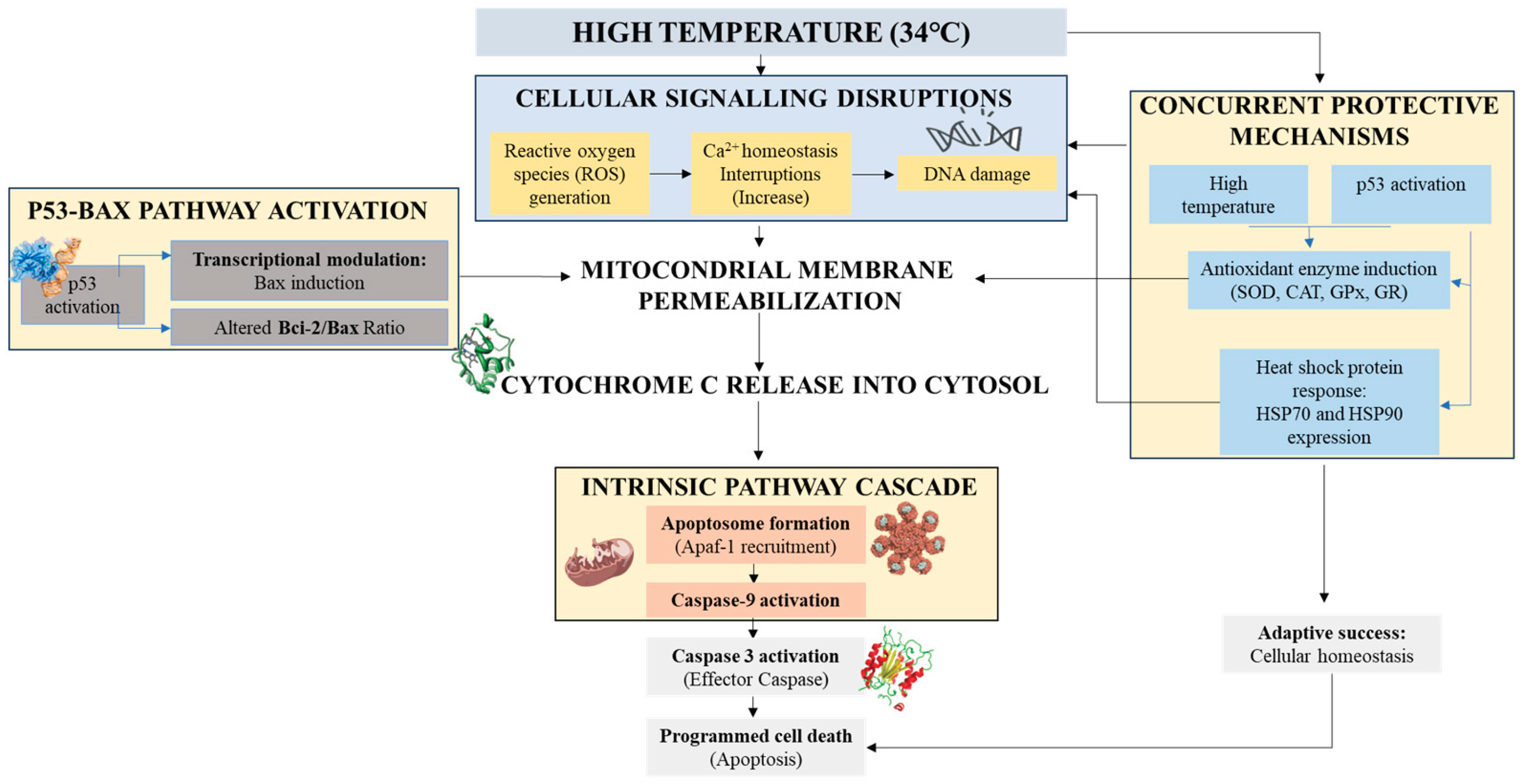

Table 1.
Climate change related environmental stressors and associated physiological responses in pufferfish. Overview of major climate drivers including ocean warming, hypoxia, acidification, and habitat alteration, and their impacts on pufferfish physiology and ecology. Environmental changes influence toxin dynamics, metabolic processes, reproductive biology, and species distribution through microbial and trophic interactions. These responses collectively highlight increasing toxicological risks, ecological reorganization, and potential public health implications under changing marine conditions.
Table 1.
Climate change related environmental stressors and associated physiological responses in pufferfish. Overview of major climate drivers including ocean warming, hypoxia, acidification, and habitat alteration, and their impacts on pufferfish physiology and ecology. Environmental changes influence toxin dynamics, metabolic processes, reproductive biology, and species distribution through microbial and trophic interactions. These responses collectively highlight increasing toxicological risks, ecological reorganization, and potential public health implications under changing marine conditions.
| Climate driver | Species | Affected parameter |
Specific impacts and physiological changes |
Impact category | References |
| Seawater stratification |
Marine pufferfish species |
Toxin transfer pathways |
Enhanced formation of marine snow facilitates dispersal of toxin-producing bacteria, increasing TTX availability in food webs | Trophic amplification |
[1] |
| Ocean warming + altered salinity | Pufferfish [general] | Disease susceptibility |
Increased prevalence of Vibrio spp. in skin, gills, and intestine, elevating physiological stress and disease risk | Health and disease | [1] |
| Climate-linked microbial proliferation [temperature-dependent] |
Takifugu pardalis [via food web] |
Source and magnitude of TTX exposure | Warmer seawater enhances abundance of TTX-producing bacteria [e.g., Vibrio spp.], increasing dietary toxin availability and bioaccumulation | Trophic / microbial | [8] |
| Long-term ocean warming trend [regional climate change] |
Takifugu pardalis |
Human exposure risk | Elevated muscle TTX during warmer months increases probability of exceeding acute reference doses, amplifying climate-mediated food safety risks | Socio-ecological / public health | [8] |
| Climate change [combined drivers] | Local pufferfish species [e.g., Mozambique coast] | Regional toxin emergence | First detections of TTX in previously unreported regions, linked to warming waters and microbial shifts | Emerging risk | [8] |
| Climate change–induced ecosystem alteration | Pufferfish and prey species | Food-web interactions | Changes in prey availability and toxin-producing organisms modify bioaccumulation dynamics | Ecological interaction | [9] |
| Ocean warming [seasonal rise in sea surface temperature] |
Takifugu pardalis |
Tetrodotoxin [TTX] concentration in liver | Strong positive correlation between increasing seawater temperature and hepatic TTX accumulation, indicating enhanced toxin uptake or retention under warmer conditions | Biochemical / toxicological | [14] |
| Ocean warming [increased sea-surface temperature] | Coral-associated puffers [Canthigaster rapaensis, C. cyanetron, C. marquesensis] |
Habitat availability | Warming-induced coral bleaching reduced live coral cover, leading to loss of refugia, feeding grounds, and recruitment sites | Habitat degradation | [16] |
| Climate change–driven habitat degradation | Chelonodon pleurospilus | Habitat quality | Combined effects of global warming and coastal habitat degradation reduced habitat suitability in estuarine and nearshore environments | Habitat quality decline | [16] |
| Global warming | Generalist puffers [e.g., Lagocephalus sceleratus (Ginfugu)] | Geographic range | Warming facilitated poleward range expansion and invasiveness in some habitat-generalist species | Range expansion | [16] |
| Climate change interacting with coastal development |
Takifugu plagiocellatus (Komonfugu) |
Habitat extent | Loss of seagrass and coral reef habitats intensified by warming and anthropogenic pressure | Cumulative stress | [16] |
| Climate change–induced ecosystem degradation | Marine puffer assemblages |
Community structure | Differential responses observed: specialists declined, while generalists remained stable or expanded under warming conditions | Community reorganization |
[16] |
| Reduction in extreme cold events | Tropical pufferfish species | Thermal tolerance limits | Improved survival in temperate regions, enabling overwintering and population establishment | Survival and persistence |
[16] |
| Ocean warming | Pufferfish [as toxin vectors] |
Neurotoxic potency | Increased availability and spread of TTX leads to higher neurotoxic risk through sodium channel blockage [Nav1.1–Nav1.7] | Neurophysiological impact | [16] |
| Environmental hypoxia [declining dissolved oxygen associated with warming and stratification] |
Takifugu rubripes |
Haematological parameters |
Increased hematocrit, hemoglobin, red blood cell [RBC] count, mean corpuscular hemoglobin [MCH], and mean corpuscular hemoglobin concentration [MCHC] under acute hypoxia, reduction in mean corpuscular volume [MCV], indicating enhanced oxygen-carrying capacity | Physiological stress / Oxygen transport | [16] |
| Energy metabolism enzymes [brain, liver] |
Significant upregulation of hexokinase [HK], lactate dehydrogenase [LDH], and malate dehydrogenase [MDH1] activities, reflecting a metabolic shift from aerobic to anaerobic energy production | Metabolic adjustment | [16] | ||
| Gene expression – oxygen sensing |
Upregulation of hypoxia-inducible factor-1α [HIF-1α], prolyl hydroxylase domain protein 2 [PHD2], and von Hippel–Lindau [VHL], indicating activation of oxygen-sensing pathways | Molecular stress response | [16] | ||
| Glucose metabolism | Elevated blood glucose levels during hypoxic exposure, suggesting increased gluconeogenesis and mobilization of energy reserves | Metabolic stress | [16] | ||
| Angiogenesis and erythropoiesis | Increased expression of erythropoietin [EPO] and vascular endothelial growth factor-A [VEGF-A], promoting oxygen delivery and vascular remodelling | Physiological adaptation |
[16] | ||
| Tissue-specific sensitivity |
Brain tissue showed greater tolerance to hypoxia compared with liver, indicating tissue-specific resilience to oxygen limitation | Tissue-level vulnerability |
[16] | ||
| Tetrodotoxin concentration in ovary |
Moderate positive correlation between temperature and ovarian TTX levels, suggesting temperature-mediated modulation of toxin allocation to reproductive tissues | Reproductive physiology | [20] | ||
| Tetrodotoxin concentration in testis |
Positive temperature–TTX relationship in male gonads, implying increased toxin accumulation during warmer months | Reproductive physiology |
[20] | ||
| Thermal regime shifts [seasonal thermal stress] |
Takifugu niphobles |
Whole-body toxin burden [TTX] | Increased accumulation of tetrodotoxin during warmer maturation and spawning periods compared to cooler “ordinary” periods | Biochemical acclimatization |
[26] |
| Temperature-mediated reproductive conditioning |
Takifugu niphobles [female] |
Ovarian toxin allocation |
Preferential transfer and concentration of TTX in ovaries during warm spawning months, enabling maternal provisioning of chemical defense to offspring | Transgenerational defense strategy | [34] |
| Thermal modulation of toxin transport pathways |
Takifugu niphobles [male] |
Hepatic and dermal toxin localization | Enhanced localization of TTX in liver and skin during peak reproductive temperatures, followed by post-spawning depletion | Physiological plasticity | [34] |
| Climate-linked phenological synchronization |
Takifugu niphobles |
Reproduction–toxin coupling | Synchronization of reproductive timing with maximal toxin availability during warmer periods enhances defense and reproductive success | Eco-physiological coupling | [34] |
| Ocean warming interacting with reproductive seasonality |
Takifugu pardalis |
Gonadosomatic index [GSI] and toxin dynamics | High water temperature coincides with low GSI but elevated tissue TTX, indicating that thermal conditions can override reproductive stage in driving toxin accumulation | Endocrine reproductive | [35] |
| Ocean warming / rising water temperature |
Takifugu obscurus (Mefugu) [embryos] |
Incubation duration [time to 50% hatch] | Increasing temperature [19 → 28 °C] significantly accelerated embryonic development, reducing time to 50% hatch from ~250 h to ~91 h | Developmental rate | [33] |
| Freshwater acidification [decreasing pH] |
Takifugu obscurus [embryos] |
Incubation duration | Low pH [pH 5] significantly delayed hatching compared to neutral–alkaline pH, indicating acidification-induced developmental stress | Developmental stress | [36] |
| Interactive climate stressors [warming × acidification] |
Takifugu obscurus [embryos] |
Incubation duration | Significant interaction between temperature and pH, acidification increasingly delayed development at lower temperatures | Synergistic stress | [36] |
| Thermal stress [supra-optimal warming] |
Takifugu obscurus [embryos] |
Total hatch rate | Total hatch rate declined significantly at high temperature [28 °C], indicating reduced embryonic survival under excessive warming | Survival / recruitment | [36] |
| Freshwater acidification |
Takifugu obscurus [embryos] |
Total hatch rate | Hatch success was significantly reduced at low pH [pH 5] across temperatures | Survival limitation | [36] |
| Ocean warming / thermal regime shift |
Takifugu obscurus [larvae] |
Viability 24 h post-hatch | Larval viability was lowest at 19 °C and highest at 22–25 °C, demonstrating a narrow thermal optimum for early survival | Early-life survival | [36] |
| Freshwater acidification |
Takifugu obscurus [larvae] |
Viability 24 h post-hatch | Viability declined sharply at pH 5 compared to pH 6–8, reflecting high sensitivity of early larvae to acidification | Physiological tolerance |
[36] |
| Thermal stress at low temperature |
Takifugu obscurus [larvae] |
Abnormality rate | Significantly higher deformity rates occurred at 19 °C, indicating developmental instability under sub-optimal thermal conditions | Developmental integrity | [36] |
| Freshwater acidification |
Takifugu obscurus [larvae] |
Abnormality rate | Abnormal larval development increased markedly at pH 5, while deformities were near zero at pH 6–8 | Morphological development | [36] |
| Climate-driven spawning-season variability |
Takifugu obscurus [population level] |
Recruitment potential | Combined temperature fluctuations and declining pH during spawning season may substantially reduce hatch success, larval viability, and population persistence | Population recruitment | [36] |
| Climate-driven hypoxia [↓ dissolved oxygen due to warming, eutrophication] |
Takifugu obscurus |
Gill metabolic profile | Significant alteration of gill metabolome under acute hypoxia, clear separation from normoxia and reoxygenation states | Metabolic disruption | [37] |
| Acute hypoxic stress [DO ≈ 0.9 mg L⁻¹] |
Takifugu obscurus |
Lipid metabolism | Suppression of fatty acid β-oxidation, downregulation of stearamide, oleamide, palmitoylcarnitine, reduced aerobic energy production | Energy metabolism impairment | [37] |
| Glycerophospholipid metabolism | Upregulation of phosphatidylcholines and glycerophospholipids to stabilize cell membranes under oxygen deprivation | Cellular protection | [37] | ||
| Steroid hormone metabolism |
Significant and irreversible reduction in steroid metabolites [e.g., testosterone], persisting after reoxygenation | Endocrine disruption | [37] | ||
| Amino acid metabolism |
Increased biosynthesis of phenylalanine, tyrosine, and tryptophan to compensate for impaired energy metabolism | Metabolic compensation | [37] | ||
| Neurophysiological integrity | Accumulation of phenylalanine derivatives with potential neurotoxic effects on gill tissues | Neural stress | [37] | ||
| Purine metabolism | Increased uric acid and AMP levels, indicating ATP depletion and oxidative stress | Oxidative stress | [37] | ||
| Hypoxia + reoxygenation |
Takifugu obscurus |
Redox balance | Reactive oxygen species generation during reoxygenation, activation of antioxidant responses | Oxidative damage risk | [37] |
| Acute hypoxia |
Takifugu obscurus |
FoxO signaling pathway | Activation of FoxO signaling involved in oxidative stress resistance, apoptosis inhibition, and cellular survival | Stress-response signaling | [37] |
| mTOR signaling pathway | AMP-activated AMPK inhibits mTOR signaling, shifting metabolism toward energy conservation and survival | Energy-sensing regulation | [37] | ||
| Ocean warming | Pufferfish [Tetraodontidae] | Tetrodotoxin [TTX] accumulation | Increased abundance of TTX-producing bacteria [e.g., Vibrio, Roseobacter], leading to higher toxin bioaccumulation in tissues | Toxicological risk | [6,7,38] |
| Climate-driven fish migration |
Lagocephalus sceleratus |
Human exposure risk | Expansion into new fishing grounds increases incidence of tetrodotoxin poisoning in non-endemic regions | Public health risk | [39] |
Table 2.
Comparative climate sensitivity among puffer fish species across different life stages. Summary of species-specific tolerance ranges to key environmental stressors including temperature, oxygen, and pH. Early life stages such as embryos and larvae exhibit narrower tolerance limits, indicating higher vulnerability to climate change. These variations highlight the importance of life-stage-specific responses in determining resilience and survival under changing environmental conditions.
Table 2.
Comparative climate sensitivity among puffer fish species across different life stages. Summary of species-specific tolerance ranges to key environmental stressors including temperature, oxygen, and pH. Early life stages such as embryos and larvae exhibit narrower tolerance limits, indicating higher vulnerability to climate change. These variations highlight the importance of life-stage-specific responses in determining resilience and survival under changing environmental conditions.
| S. no. | Puffer fish | Life Stage | Sensitive variable | Reported tolerance | References |
| 1. |
Takifugu fasciatus (Shimafugu) |
Immature juveniles | Oxygen | Acute hypoxia tolerated at ~1.6 mg L⁻¹, behavioural distress below ~1.5–1.6 mg L⁻¹, normoxic condition ~7 mg L⁻¹ |
[3] |
| 2. |
Takifugu flavidus (Sansaifugu) |
Larvae | Temperature | 23°-29° C | [15] |
| 3. |
Takifugu flavidus (Sansaifugu) |
Egg | Temperature | 23°-26° C | [15] |
| 4. |
Takifugu obscurus (Mefugu) |
Embryo | pH | 6.5–9.0 though extremes impair development. |
[36] |
| 5. |
Takifugu obscurus |
Larvae | Temperature | 22°- 23° C | [41] |
Disclaimer/Publisher’s Note: The statements, opinions and data contained in all publications are solely those of the individual author(s) and contributor(s) and not of MDPI and/or the editor(s). MDPI and/or the editor(s) disclaim responsibility for any injury to people or property resulting from any ideas, methods, instructions or products referred to in the content. |
© 2026 by the authors. Licensee MDPI, Basel, Switzerland. This article is an open access article distributed under the terms and conditions of the Creative Commons Attribution (CC BY) license (http://creativecommons.org/licenses/by/4.0/).
Copyright: This open access article is published under a Creative Commons CC BY 4.0 license, which permit the free download, distribution, and reuse, provided that the author and preprint are cited in any reuse.


