

Submitted:
31 May 2026
Posted:
02 June 2026
You are already at the latest version
Abstract
Background: Patent ductus arteriosus is a congenital heart defect in which the ductus arteriosus fails to close after birth, causing abnormal blood flow and potential heart failure. The Branham reflex, a transient slowing of the heart rate after ductus closure, has been described in transcatheter procedures and surgical ligation. Methods: A retrospective review was conducted on 25 dogs undergoing surgical PDA ligation under a standardized anesthetic protocol. Heart rate and arterial blood pressures were recorded at multiple time points before, during, and after surgery. The incidence of the Branham reflex and the need for cardiovascular drugs were assessed. Results: Nineteen dogs (76%) exhibited the Branham reflex, characterized by a transient decrease in heart rate and a concurrent increase in diastolic pressure, which resolved without antimuscarinic medication. The reflex was less frequent in dogs weighing more than 10 kilograms. Complications occurred in 12% of patients, with no fatalities. Conclusions: The Branham reflex is common but generally self-limiting. Careful hemodynamic monitoring is essential, especially in smaller dogs. These findings provide important guidance for veterinarians to optimize perioperative care and minimize risks during PDA surgery.
Keywords:
patent ductus arteriosus
; surgical ligation
; Branham reflex
; dog
; hemodynamic
1. Introduction
Patent ductus arteriosus (PDA) is a congenital heart anomaly characterized by the persistence of the ductus arteriosus after birth, likely resulting from a hereditary deficiency of smooth muscle within the ductal wall in dogs [1,2]. During fetal life the ductus arteriosus (DA) shunts blood away from the nonfunctional lungs back to the systemic circulation[3]. Immediately after birth, physiological closure of the DA normally occurs, between 48 hours and 1 month of age [4]; thereafter, the DA will become a nonpatent elastic structure known as the ligamentum arteriosum [5]. Failure of DA closure results in PDA, allowing blood to flow from the systemic circulation (aorta) into the pulmonary circulation (“left-to-right” shunting) [3], driven by the pressure gradient between these systems. In left-to-right PDA, chronic volume overload of the pulmonary circulation leads to left-sided congestive heart failure (CHF), which may progress to generalized CHF [6,7,8,9]; in severe cases, pulmonary arterial pressure may exceed systemic pressure, resulting in reversal of shunt flow from left-to-right to right-to-left [2,3]. CHF can develop as early as one week of age, with 70% of dogs with PDA exhibiting clinical signs of CHF before 12 months of age [6].
Treatment of left-to-right PDA is based on mechanical occlusion of the DA, which can be achieved through surgical ligation (standard ductal dissection and double ligation, Jackson-Henderson technique, or hemostatic clips) or via transcatheter occlusion (embolization coils, Amplatzer duct occluder, Amplatzer vascular plug, or Amplatz canine duct occluder [ACDO]) [3,9,10,11,12,13]. Following PDA closure, hemodynamic changes such as decreased preload and increased afterload can be observed, leading to a reduction in left heart chamber volume and, in some cases, a transient decrease in myocardial contractility [9,14,15,16,17].
In contrast, mechanical closure of right-to-left shunts is not recommended and management is limited to symptomatic medical treatment [3].
Currently, percutaneous transvascular techniques are considered the treatment of choice for PDA occlusion, with surgical ligation reserved for cats, small dogs, or specific ductal morphologies unsuitable for transcatheter devices [13]. Nevertheless, in the authors’ experience, transcatheter occlusion remains a more expensive technique, mainly due to the high cost of the devices and the equipment required, such as fluoroscopy and catheters, making it less affordable for all patients. Consequently, given its established safety profile, efficacy, and cost-effectiveness [8], surgical ligation continues to be the conventional approach most frequently employed in routine clinical practice, at least in Spain.
Although surgical ligation techniques for PDA have been extensively studied, anesthetic protocols for these procedures have received comparatively less attention. One point that has not been thoroughly investigated in literature, to the authors’ knowledge, is the incidence of the Branham sign. The Branham sign is a physiological reflex bradycardia caused by a sudden increase in aortic pressure following the ligation of a systemic arteriovenous shunt, as the PDA[3,18]. While the existence of this phenomenon is well recognized [10,19,20], and its incidence has been evaluated in transvascular techniques [13], data specifically on the management of the Branham sign during surgical ligation are lacking. In addition, the same happened with its incidence and its significance in relation to factors such as sex, age, and body weight, few studies analyze and relate it [21].
Therefore, the objectives of the present study were to assess the incidence of the Branham sign during surgical PDA ligation, to determine its hemodynamic consequences, and to evaluate whether the administration of cardiovascular stimulant drugs is necessary.
2. Materials and Methods
A retrospective review was conducted of the clinical records of 61 patients diagnosed with left-to-right shunting PDA and treated at the University Veterinary Hospital Rof Codina in Lugo, Spain, over a ten-year period from January 2015 to March 2025. Clinical data were obtained from both physical and electronic medical records. Electrocardiography, radiography, echocardiography reports, surgical records, and anesthesia charts were collected and reviewed. Regarding premedication protocols, specific data were extracted from the anesthesia records, and only patients who received the same anesthetic protocol were included in this study.
Inclusion criteria consisted of the availability of complete records for all intraoperative hemodynamic parameters. Exclusion criteria included the use of an anesthetic protocol other than the one described (due to the low number of patients), species other than dogs (due to the low number of feline patients), intraoperative deaths (which were included in the complication analysis), and incomplete anesthesia parameter records.
All medical records from 61 patients were reviewed; of these, 25 were ultimately included in the study, as shown in Figure 1.
2.1. Anesthetic Protocol
Premedication consisted of acepromazine 0.025 mg/kg intramuscularly [IM], combined with methadone (0.3 mg/kg IM). Anesthesia was induced with midazolam 0.25 mg/kg intravenously [IV], followed 5–10 minutes later by etomidate (a range of 0.5-1 mg/kg IV was used in a dose to effect manner). After induction, patients were intubated, and anesthesia was maintained in all cases with sevoflurane at a concentration of 1.2–2.4%], parameters were maintained within the following ranges: tidal volume 10-20 mL/kg, peak pressure 8-15, respiratory rate 10-16 breaths/min and positive end-expiratory pressure in 4, the exact dose/parameter were determined at the anesthetist’s discretion according to the patient’s individual requirements, using a closed-circuit anesthesia system with mechanical ventilation (Mindray WATO EX-35 workstation).
During anesthesia, all patients received a constant rate infusion (CRI). Some patients received a CRI of methadone, lidocaine 2%, and ketamine 10% at a rate of 1 mL/kg/h (corresponding to a combination of methadone 0.1 mg/kg/h, ketamine 0.6 mg/kg/h, and lidocaine 1.5 mg/kg/h), whereas others received fentanyl administered in boluses of 2.5 µg/kg.
In addition, locoregional anesthesia of the surgical site was performed using intercostal bupivacaine 0.5% (2 mg/kg), conducting a blinded block of the third, fourth, and fifth intercostal spaces. Fluids for anesthesia were administered in all cases as lactated Ringer’s solution at 5 mL/kg/h.
Prophylactic antibiotic therapy consisted of cefazolin (22 mg/kg IV) administered 30 minutes before surgery and repeated at the end of the procedure. Preoperative analgesia was provided with meloxicam (0.2 mg/kg IV).
Atropine at 0.02 mg/kg IV is administered if the heart rate falls below 50 bpm, according to previously published protocols by other authors [3].
Patients were hospitalized and monitored for 24 hours after surgery.
2.2. Surgery Protocol
Surgery of the PDA was performed using the conventional technique, achieving closure by ligation with silk, as described by Fossum (2018) and Brockman (2018) [6,22].
The surgical approach was via a left lateral thoracotomy through the fourth intercostal space. Following incision of the skin and intercostal muscles along the caudal aspect of the rib, a Finochietto rib retractor was placed to improve exposure of the intrathoracic structures.
Once the thoracic cavity was accessed and the structures fully visualized, the ductus arteriosus was isolated. The left vagus nerve was carefully retracted using one or two vessel loops to allow access to the ductus. In some patients, the left cranial vena cava overlaid the ductus; in these cases, it was gently retracted to achieve adequate exposure.
The ductus arteriosus was dissected using specific instruments, including DeBakey forceps, 90° angled Mixter thoracic forceps, or 45° Julian thoracic artery forceps, depending on the surgeon’s preference. Once isolated, a silk suture (Silkam®, B. Braun) 0/0 or 1/0 was passed around the ductus. The knot was gradually, carefully, and firmly tightened, completing the ligation with two secure knots [22].
For ligation, the aortic side was closed first to interrupt flow through the ductus arteriosus, followed by ligation on the pulmonary artery side [22].
Finally, the thoracic cavity was closed according to standard recommendations [6].
2.3. Data Collection
All patients included in the study were continuously monitored throughout the procedure using an advanced multiparametric monitor (Mindray iPM12 Vet), which was previously validated for blood pressure measurement in dogs. The cuff used was selected by the anesthetist, and either veterinary-specific or neonatal cuffs compatible with the equipment could be used. In all cases, the cuff was placed on the left forelimb between the elbow and carpal joints. The recorded variables included sex, age, body weight, breed, end-tidal CO₂, end-tidal sevoflurane concentration, respiratory rate, heart rate, non-invasive arterial blood pressure (systolic, diastolic, and mean arterial pressure), peripheral oxygen saturation, and body temperature. Systolic, diastolic, and mean arterial pressures were measured using an automatic non-invasive oscillometric technique.
For the purposes of this study, heart rate (HR), systolic arterial pressure (SAP), diastolic arterial pressure (DAP), and mean arterial pressure (MAP) were evaluated at the following time points: T1 (first measure post intubation), T2 (pre-occlusion), T3 (immediately post-occlusion), and T4 (first measure post cavity closure), in order to determine the prevalence of the Branham sign.
The diagnosis of patent ductus arteriosus (PDA) was established using color Doppler echocardiography, which confirmed the presence of abnormal blood flow between the pulmonary artery and the aorta. In patients undergoing surgical intervention, the diagnosis was further confirmed intraoperatively by thoracotomy and direct visualization of the ductus arteriosus.
Any decrease in heart rate was classified as a positive Branham sign.
The use of different analgesic agents, such as a CRI of methadone, lidocaine, and ketamine, or the use of fentanyl, was not considered an exclusion criterion, as previous studies have shown that different analgesic protocols do not influence the incidence of the Branham reflex [21].
2.4. Stadistics
The statistical analysis was carried out with Sigma Plot 12.5 (Systat Software Inc., San Jose, CA, USA). The results were expressed as a mean ± standard deviation.
Statistical analyses were performed to evaluate variations in heart rate (HR) and arterial blood pressure (ABP). Data normality was assessed using the Shapiro–Wilk test. For normally distributed variables, a one-way analysis of variance (ANOVA) was applied. A significance level of p < 0.05 was considered statistically significant.
To compare HR values across different time points, a Kruskal–Wallis one-way analysis of variance on ranks was used, with a significance level set at p < 0.05.
Comparisons of HR between age groups and between sexes were performed using the Mann–Whitney rank-sum test (p < 0.05). In contrast, comparisons of body weight among groups were conducted using the Kruskal–Wallis one-way analysis of variance on ranks, with the same level of significance.
3. Results
Clinical records from a total of 61 patients were evaluated. Of these, 4 patients (6.56%) were cats, and 57 patients (93.44%) were dogs. All feline patients were European Shorthair cats; due to their low representation and to avoid introducing additional variables, they were excluded from the analysis.
For subsequent analyses, 24 patients were excluded due to insufficient anesthetic data and 8 due to the use of different anesthetic protocols. Consequently, the final study population consisted of 25 canine patients.
Among the 25 patients included in the study, 72% were females (n = 18) and 28% were males (n = 7), resulting in a female-to-male ratio of 3:1. The mean body weight was 8.1 ± 11.0 kg, and the range of age was 3–60 months.
The most frequently represented group was mixed-breed dogs (n = 5), accounting for 20% of the study population, followed by Bichon Maltese and Chihuahua (n = 3 each), and Yorkshire Terrier (n = 2). All other breeds were represented by a single patient (n = 1): Poodle, Pomeranian, Welsh Corgi, Pyrenean Mastiff, Caucasian Shepherd Dog, Italian Greyhound, Labrador Retriever, Mastiff, Andalusian Terrier, Schnauzer, Belgian Shepherd, and West Highland White Terrier.
HR and ABP were recorded at four time points (T1–T4). Values are expressed as means ± standard deviations and are presented in Table 1. HR decreased progressively from 126 ± 39.12 bpm at T1 to 98 ± 27.13 bpm at T4. Diastolic arterial pressure (DAP) increased from 43.04 ± 27.57 mmHg at T1 to 54.64 ± 17.47 mmHg at T4. Similarly, mean arterial pressure (MAP) increased from 53.52 ± 18.96 mmHg at T1 to 63.48 ± 17.03 mmHg at T4, whereas systolic arterial pressure (SAP) remained relatively stable, ranging from 82.64 ± 22.63 mmHg at T1 to 85.92 ± 23.55 mmHg at T4.
Statistically significant differences were observed between HR at T1–T4 and DAP at T1–T4 (p < 0.05), as shown in Figure 2 in form of Δ% for each patient.
To determine the presence of the Branham reflex, the percentage change in HR (ΔHR%) was calculated for each patient between T2 and T3 (pre-occlusion and post-occlusion), as well as across the remaining time points. This approach allowed the assessment of whether statistically significant differences existed among the evaluated parameters at the predefined time points.
Based on these results, 19 out of 25 patients exhibited a positive Branham reflex, corresponding to 76% of the study population. Mean values and their corresponding standard deviations are presented in Table 2. Notably, fourteen patients showed a decrease in HR greater than 20%.
Table 2 summarizes the mean values and standard deviations of the percentage changes (Δ%), providing an overall view of the results. However, the individual Δ% values are more informative when analyzed separately. To better illustrate the wide range of responses, corresponding graphs were generated and are presented in Figure 3.
As shown in Figure 3, between T2 and T3—corresponding to the moment of ductus closure—HR tended to decrease in the majority of patients. In parallel, DAP increased, even if it was only a minimal increase, in 13 patients, as expected. In these same patients, concomitant increases in MAP and SAP were also observed.
In all cases, the decrease in HR resolved by T4 without the need for atropine administration, indicating that the reflex was transient and did not result in excessive bradycardia.
Regarding DAP Δ%, statistically significant differences were observed between T1–T4 and all other intervals (T1–T4 vs. T2–T3, T1–T4 vs. T1–T3, and T1–T4 vs. T2–T4; p < 0.05). No statistically significant differences were detected among the remaining Δ% comparisons.
Patients were further stratified by age, sex, and body weight to assess whether these variables influenced the presence of the Branham reflex. HR comparisons revealed no statistically significant differences between age groups. Similarly, no significant differences were observed when patients were grouped by sex or weight. Considering the proportion of individuals exhibiting a positive reflex within each subgroup, approximately 75–80% of patients were positive across all groups, except for the subgroup weighing >10 kg, in which only 50% of patients demonstrated the Branham reflex. These data are summarized in Table 3.
Complications occurred in 12% of the patients, with no fatalities, and were within the range previously reported in other studies [10,19,25]. In one patient, isolation of the PDA using hemostatic forceps resulted in minor diffuse bleeding, necessitating the conversion to the Jackson-Henderson technique [6], successfully controlling the bleeding and achieving closure of the PDA. In another case, mild bleeding resulted from a ductal laceration, which was managed using conventional ligatures and subsequent application of hemostatic agents. Lastly, an accidental lung laceration occurred in one patient and was resolved without subsequent complications.
4. Discussion
As shown in the results, of the 25 patients undergoing surgical closure of PDA under the same anesthetic protocol, 19 (76%) exhibited a positive Branham reflex. Notably, none of these patients required the administration of antimuscarinic drugs.
According to the population results obtained in this study, the findings are consistent with previously published studies regarding the prevalence of PDA. In the present study, PDA was more prevalent in females, representing 72% of the population, which aligns with other reports [7,8,23,24,25,26] where females were predominant, including one study reporting a female-to-male ratio of 3:1 [10]. As reported in other studies, PDA was more frequent in small breeds, with a mean body weight of 8.1 ± 11.0 kg [2,3,26,27]. Crossbreed dogs were the most represented breed in our population, accounting for 20% of the cases [10,24]. Regarding the age at presentation, most patients were referred to our center for diagnostic confirmation and treatment evaluation. The majority were younger than 1 year, with a range of age of 3–60 months, indicating early diagnosis in our population (Northern Spain), likely during routine puppy health checks. On one hand, this contrasts with other studies reporting lower referral rates relative to the actual PDA population and higher mean ages at presentation [10,19]. On the other hand, it is consistent with studies recommending early treatment, given that PDA is a congenital condition [7,8,25,28].
Regarding breed, as mentioned previously, the most frequent breed was mixed-breed, followed by Bichon Maltese and Chihuahua. These findings are noteworthy because they are consistent with two previous studies [7,8], aside from mixed breed. Many other studies did not identify Chihuahua as one of the most common breeds, although its predisposition to the condition has been recognized. [1,10,25,29,30,31].
In patients with PDA, it is common to observe low DAP [32]. Some authors have attributed the hypotension, reported in more than 60% of cases in previous studies, to the frequent use of acepromazine as premedication [24]. However, studies using alternative premedication protocols have also demonstrated hypotension in patients with PDA [13,32].
Therefore, the low DAP is primarily attributed to the diversion of cardiac output from the systemic circulation to the pulmonary circulation. In addition, patients with PDA are often young, and younger patients naturally exhibit lower arterial blood pressure than adults due to their stage of development [32].
This reduction in DAP is typically compensated by an increase in HR to maintain adequate perfusion, as well as by SAP, which is usually normal or elevated [32]. These changes occur because PDA closure decreases preload and increases afterload [5,9,33,34]. These observations are consistent with the data obtained in the present study, where DAP was 43.04 ± 27.57 mmHg and HR was 125.84 ± 39.12 bpm before closure. Similar findings have been reported in previous studies using the ACDO closure technique [13,28].
Consequently, in patients with PDA, a reduction in HR and an increase in arterial blood pressure are physiological cardiovascular responses observed after ductus occlusion [18], which is known as Branham sign or Branham reflex. Moreover, some authors recommend exercising caution with premedication and anesthetic protocols, as patients with PDA are particularly sensitive to hypotension[24].
On another note, regarding the Branham reflex in the ACDO technique, previous studies have reported a lower prevalence compared with our findings. While one study observed the reflex in 20% of cases [13], in the present study it was observed in 76% of patients. This difference may be attributed to the fact that surgical ligation typically achieves complete closure (or near-complete) of the ductus immediately during the procedure, whereas with the ACDO device, closure occurs gradually [7,11,13,21]. This highlights an important consideration for the surgical ligation technique: closure should be performed slowly to allow a gradual adjustment in HR and DAP, thereby reducing the risk of hemodynamic complications associated with abrupt changes in physiological parameters. Moreover, some authors recommend tightening the ligature gradually over 2–3 minutes before achieving complete closure [35,36]. Such gradual hemodynamic adjustment can be considered an additional advantage of the transvascular technique compared with the open technique, improving procedural safety.
Another aspect to consider between techniques is the difference in hemodynamic responses. A previous study using the ACDO technique reported that maximal DAP increase occurred 10 minutes post-occlusion, while maximal HR reduction was observed 21.2 ± 13.7 minutes after occlusion [24]. In our study, however, DAP reached its maximal value immediately after closure and then decreased progressively, resulting in a difference between T1 (surgical start) and T4 (surgical finish) of 0.52 ± 0.66 mmHg. HR, on the other hand, decreased progressively, reaching its maximal reduction at the end of surgery (-23.08 ± 17.69). These differences compared with previous studies, as mentioned above, may be explained by the faster achievement of complete PDA closure with the open surgical technique. On the other hand, it should be noted that a previous study comparing the incidence of the Branham reflex in animals undergoing surgical ligation and a transvascular technique demonstrated no differences in the occurrence of the Branham reflex between the two approaches [21].
Regarding antimuscarinic drugs (such as atropine and glycopyrrolate), some authors recommend their routine administration during premedication [22], while others suggest their use only if the Branham reflex occurs and intervention is necessary [6,22]. The results of the present study are consistent with the opinion of Broaddus et al. [3], indicating that although the reflex may occur, it generally does not pose a life-threatening risk in hemodynamically stable patients. The bradycardia induced by the Branham reflex is usually moderate, occurring as a sudden decrease in heart rate that progressively normalizes, sometimes persisting for up to one hour after surgery, as observed in our results. Broaddus et al. recommend administering atropine if heart rate decreases below 50 bpm[3]. Nevertheless, caution is warranted, as a previous report described a fatality attributed to bradycardia apparently induced by the Branham reflex, which did not respond to atropine [20].
In terms of the results relating HR changes during PDA surgery to age, sex, and body weight, as mentioned previously, no statistically significant differences were observed between groups. However, the presence of the Branham reflex was lower in dogs weighing >10 kg, occurring in only 50% of cases compared with approximately 75% in the other groups. To the authors’ knowledge, this finding has not been previously reported and could be due to the greater cardiovascular stability in larger patients. It has been shown that smaller patients are more susceptible to bradycardia and hypotension, generally due to relative anesthetic overdosing or greater blood loss relative to body volume [37,38]. Both factors may make the reflex more difficult to detect. Moreover, these results are contrary to previously published studies reporting that age and body weight do not influence the Branham sign, although it should be noted that that study used invasive blood pressure monitoring, which is the gold standard. [21].
Among the limitations of the present study is the use of oscillometric blood pressure measurement, rather than the more accurate invasive method. Another limitation inherent to the retrospective nature of the study is that the choice of drugs, due to the anaesthetic protocol, might have been more appropriate to avoid interference with the collected data regarding blood pressure, by avoiding hypotensive drugs. In addition, another limitation is the number of patients analyzed in this retrospective study. This limitations will be addressed in future prospective investigations.
5. Conclusions
In this study, 76% of dogs exhibited the Branham reflex during surgical closure of the patent ductus arteriosus. The reflex was transient and resolved without pharmacological intervention. Its occurrence was less frequent in dogs weighing more than 10 kg.
In addition, slow and progressive tightening of the ligature is recommended to allow gradual cardiovascular adaptation and reduce the risk of hemodynamic disturbances associated with abrupt ductal closure, thereby decreasing the likelihood of triggering the Branham reflex.
These findings indicate that the Branham reflex is a common but generally self-limiting physiological response in dogs undergoing surgical PDA ligation. Therefore, the routine administration of anticholinergic drugs as part of the premedication protocol or immediately after closure is not necessary. Careful intraoperative monitoring, particularly in smaller patients, remains essential. A thorough understanding of these hemodynamic responses can help veterinarians optimize anesthetic management, enhance perioperative safety, and improve clinical outcomes for dogs with this congenital heart condition.
The conclusions of this study should be interpreted with caution, as discussed in the limitations section; studies with a larger number of patients are recommended.
Author Contributions
Conceptualization, V. V-C. and S. F-M..; methodology, V.V-C., N. M-F..; formal analysis, V. V-C.; data curation, S F-M.; writing—original draft preparation, V.V-C..; review and editing, N. M-F, S F-M and A. A-G..; supervision, A. A-G. All authors have read and agreed to the published version of the manuscript.
Funding
This research received no external funding.
Institutional Review Board Statement
Not applicable, retrospective study.
Informed Consent Statement
Retrospective study, not applicable
Data Availability Statement
The original contributions presented in this study are included in the article. Further inquiries can be directed to the corresponding author.
Conflicts of Interest
The authors declare no conflicts of interest.
Abbreviations
The following abbreviations are used in this manuscript:
| PDA | Patent ductus arteriosus |
| DA | Ductus arteriosus |
| CHF | Congestive Heart Failure |
| IM | Intramuscular |
| IV | Intravenous |
| HR | Heart rate |
| ABP | Arterial blood pressure |
| DAP | Diastolic arterial pressure |
| SAP | Systolic arterial pressure |
| MAP | Mean arterial pressure |
| ACDO | Amplatz Canine Duct Occluder |
References
- Buchanan, J.W. Patent Ductus Arteriosus Morphology, Pathogenesis, Types and Treatment. J. Vet. Cardiol. 2001, 3. [Google Scholar] [CrossRef]
- den Toom, M.L.; Meiling, A.E.; Thomas, R.E.; Leegwater, P.A.J.; Heuven, H.C.M. Epidemiology, Presentation and Population Genetics of Patent Ductus Arteriosus (PDA) in the Dutch Stabyhoun Dog. BMC Vet. Res. 2016, 12. [Google Scholar] [CrossRef]
- Broaddus, K.D.; Tillson, D.M. Patent Ductus Arteriosus in Dogs; 2010. [Google Scholar]
- Gittenberger-de Groot, A.C.; Strengers, J.L.M.; Mentink, M.; Poelmann, R.E.; Patterson, D.F. Histologic Studies on Normal and Persistent Ductus Arteriosus in the Dog. J. Am. Coll. Cardiol. 1985, 6, 394–404. [Google Scholar] [CrossRef]
- Kittleson, M.D.; Kienle, R.D. Small Animal Cardiovascular Medicine; 1998; p. 603. [Google Scholar]
- Fossum, T.W. Small Animal Surgery, 5th Edition. ed; Mosby: St. Louis, Missouri (USA), 2018; ISBN 978-0-323-44344-2. [Google Scholar]
- Saunders, A.B.; Gordon, S.G.; Boggess, M.M.; Miller, M.W. Long-Term Outcome in Dogs with Patent Ductus Arteriosus: 520 Cases (1994-2009). J. Vet. Intern. Med. 2014, 28, 401–410. [Google Scholar] [CrossRef] [PubMed]
- McNamara, K.L.; Regier, P.J.; Toth, D.; Mickelson, M.; Luther, J.; Pyne, C.; Wallace, M.; Sturkie, C.; Dugat, D.; Marvel, S.; et al. Risk Factors for Intraoperative Hemorrhage and Perioperative Complications and Short- and Long-Term Outcomes during Surgical Patent Ductus Arteriosus Ligation in 417 Dogs. J. Am. Vet. Med. Assoc. 2023, 261. [Google Scholar] [CrossRef]
- Piantedosi, D.; Piscitelli, A.; De Rosa, A.; Serrano Lopez, B.; Claretti, M.; Boz, E.; Mazzoni, L.; Calvo, I.N.; Ciaramella Id, P.; Bussadori, C.; et al. Evaluation of Left Ventricular Dimension and Systolic Function by Standard Transthoracic Echocardiography before and 24-Hours after Percutaneous Closure of Patent Ductus Arteriosus in 120 Dogs. 2019. [Google Scholar] [CrossRef] [PubMed]
- Van Israël, N.; French, A.T.; Dukes-McEwan, J.; Corcoran, B.M. Review of Left-to-Right Shunting Patent Ductus Arteriosus and Short Term Outcome in 98 Dogs. J. Small Anim. Pract. 2002, 43, 395–400. [Google Scholar] [CrossRef] [PubMed]
- Porciello, F.; Caivano, D.; Giorgi, M.E.; Knafelz, P.; Rishniw, M.; Moise, N.S.; Bufalari, A.; Fruganti, A.; Birettoni, F. Transesophageal Echocardiography as the Sole Guidance for Occlusion of Patent Ductus Arteriosus Using a Canine Ductal Occluder in Dogs. J. Vet. Intern. Med. 2014, 28, 1504–1512. [Google Scholar] [CrossRef]
- Caivano, D.; Birettoni, F.; Fruganti, A.; Rishniw, M.; Knafelz, P.; Moïse, N.S.; Porciello, F. Transthoracic Echocardiographically-Guided Interventional Cardiac Procedures in the Dog. J. Vet. Cardiol. 2012, 14, 431–444. [Google Scholar] [CrossRef]
- De Monte, V.; Staffieri, F.; Caivano, D.; Nannarone, S.; Birettoni, F.; Porciello, F.; Di Meo, A.; Bufalari, A. Heart Rate and Blood Pressure Variations after Transvascular Patent Ductus Arteriosus Occlusion in Dogs. Res. Vet. Sci. 2017, 113, 73–78. [Google Scholar] [CrossRef]
- Giliberti, P.; De Leonibus, C.; Giordano, L.; Giliberti, P. The Physiopathology of the Patent Ductus Arteriosus. J. Matern. Fetal. Neonatal Med. 2009, 22 Suppl 3, 6–9. [Google Scholar] [CrossRef]
- Kimball, T.R.; Ralston, M.A.; Khoury, P.; Crump, R.G.; Cho, F.S.; Reuter, J.H. Effect of Ligation of Patent Ductus Arteriosus on Left Ventricular Performance and Its Determinants in Premature Neonates. J. Am. Coll. Cardiol. 1996, 27, 193–197. [Google Scholar] [CrossRef]
- Hou, M.; Qian, W.; Wang, B.; Zhou, W.; Zhang, J.; Ding, Y.; Xu, Q.; Huang, J.; Shen, J.; Cao, L.; et al. Echocardiographic Prediction of Left Ventricular Dysfunction After Transcatheter Patent Ductus Arteriosus Closure in Children. Front. Pediatr. 2019, 7, 480907. [Google Scholar] [CrossRef] [PubMed]
- Nagata, H.; Ihara, K.; Yamamura, K.; Tanoue, Y.; Shiokawa, Y.; Tominaga, R.; Hara, T. Left Ventricular Efficiency after Ligation of Patent Ductus Arteriosus for Premature Infants. J. Thorac. Cardiovasc. Surg. 2013, 146, 1353–1358. [Google Scholar] [CrossRef] [PubMed]
- Tranquilli, W.J.; Thurmon, J.C.; Grimm, K.A. (Eds.) Lumb and Jones’ Veterinary Anesthesia and Analgesia, 4th ed.; Blackwell Publishing Ltd: Oxford, UK, 2007. [Google Scholar]
- Van Israël, N.; French, A.T.; Dukes-McEwan, J.; Welsh, E.M. Patent Ductus Arteriosus in the Older Dog. J. Vet. Cardiol. 2003, 5, 13–21. [Google Scholar] [CrossRef] [PubMed]
- Das, S.; Yool, D.A.; French, A.T.; Self, I.A.; Del-Pozo, J. An Unusual Morphology of Patent Ductus Arteriosus in a Dog. J. Small Anim. Pract. 2012, 53, 353–356. [Google Scholar] [CrossRef]
- Madruga, F.L.; Pereira, Y.M.; Panti, A.; Handel, I.; Culshaw, G. Branham Sign in Dogs Undergoing Interventional Patent Ductus Arteriosus Occlusion or Surgical Ligation: A Retrospective Study. Open Vet. J. 2021, 11, 603–612. [Google Scholar] [CrossRef]
- Brockman, D.J.; Holt, D.E.; ter Haar, G. BSAVA Manual of Canine and Feline Head, Neck and Thoracic Surgery, 2nd ed.; British Small Animal Veterinary Association (BSAVA): Quedgeley, Gloucester, UK, 2018; ISBN 978-1-905319-93-0. [Google Scholar]
- Oliveira, P.; Domenech, O.; Silva, J.; Vannini, S.; Bussadori, R.; Bussadori, C. Retrospective Review of Congenital Heart Disease in 976 Dogs. J. Vet. Intern. Med. 2011, 25, 477–483. [Google Scholar] [CrossRef]
- Parisi, C.; Phillips, V.; Ferreira, J.; Linney, C.; Mair, A. Anaesthetic Management and Complications of Transvascular Patent Ductus Arteriosus Occlusion in Dogs. Vet. Anaesth. Analg. 2020, 47, 581–587. [Google Scholar] [CrossRef]
- Goodrich, K.R.; Kyles, A.E.; Kass, P.H.; Campbell, F. Retrospective Comparison of Surgical Ligation and Transarterial Catheter Occlusion for Treatment of Patent Ductus Arteriosus in Two Hundred and Four Dogs (1993–2003). Vet. Surg. 2007, 36, 43–49. [Google Scholar] [CrossRef]
- Brambilla, P.G.; Polli, M.; Pradelli, D.; Papa, M.; Rizzi, R.; Bagardi, M.; Bussadori, C. Epidemiological Study of Congenital Heart Diseases in Dogs: Prevalence, Popularity, and Volatility throughout Twenty Years of Clinical Practice. PLoS ONE 2020, 15. [Google Scholar] [CrossRef]
- Bussadori, C. Textbook of Cardiovascular Medicine in Dogs and Cats, 1st ed.; Bussadori, C.M., Ed.; Edra: Palm Beach Garden, FL, USA, 2023; ISBN 9788419844101. [Google Scholar]
- Parisi, C.; Phillips, V.; Ferreira, J.; Linney, C.; Mair, A. Anaesthetic Management and Complications of Transvascular Patent Ductus Arteriosus Occlusion in Dogs. Vet. Anaesth. Analg. 2020, 47, 581–587. [Google Scholar] [CrossRef]
- Bureau, S.; Monnet, E.; Orton, E.C. Evaluation of Survival Rate and Prognostic Indicators for Surgical Treatment of Left-to-Right Patent Ductus Arteriosus in Dogs: 52 Cases (1995-2003). J. Am. Vet. Med. Assoc. 2005, 227, 1794–1799. [Google Scholar] [CrossRef] [PubMed]
- Ackerman, N.; Burk, R.; Hahn, A.W.; Hayes, H.M. Patent Ductus Arteriosus in the Dog: A Retrospective Study of Radiographic, Epidemiologic, and Clinical Findings. Am. J. Vet. Res. 1978, 39, 1805–1810. [Google Scholar] [CrossRef]
- Bomassi, E.; Libermann, S.; Bille, C.; Rattez, E. Patent Ductus Arteriosus in a Family of Chihuahuas. J. Small Anim. Pract. 2011, 52, 213–219. [Google Scholar] [CrossRef] [PubMed]
- Duke-Novakovski, Tanya.; Vries, M. de.; Seymour, Chris. BSAVA Manual of Canine and Feline Anaesthesia and Analgesia, 3rd ed.; BSAVA, Ed.; British Small Animal Veterinary Association: Gloucester, 2020; ISBN 9781905319619. [Google Scholar]
- Eerola, A.; Jokinen, E.; Boldt, T.; Pihkala, J. The Influence of Percutaneous Closure of Patent Ductus Arteriosus on Left Ventricular Size and Function: A Prospective Study Using Two- and Three-Dimensional Echocardiography and Measurements of Serum Natriuretic Peptides. J. Am. Coll. Cardiol. 2006, 47, 1060–1066. [Google Scholar] [CrossRef] [PubMed]
- Noori, S. Pros and Cons of Patent Ductus Arteriosus Ligation: Hemodynamic Changes and Other Morbidities after Patent Ductus Arteriosus Ligation. Semin. Perinatol. 2012, 36, 139–145. [Google Scholar] [CrossRef]
- Hunter, S.L.; Culp, L.B.; Muir, W.W.; Lerche, P.; Birchard, S.J.; Smeak, D.D.; McLoughlin, M.A. Sodium Nitroprusside-Induced Deliberate Hypotension to Facilitate Patent Ductus Arteriosus Ligation in Dogs. Vet. Surg. 2003, 32, 336–340. [Google Scholar] [CrossRef]
- Stanley, B.J.; Luis-Fuentes, V.; Darke, P.G.G. Comparison of the Incidence of Residual Shunting between Two Surgical Techniques Used for Ligation of Patent Ductus Arteriosus in the Dog. Vet. Surg. 2003, 32, 231–237. [Google Scholar] [CrossRef]
- Martin-Flores, M.; Mostowy, M.M.; Sakai, D.M.; Mohammed, H.O.; Gleed, R.D.; Campoy, L. Investigation of Associations between Preoperative Acepromazine or Dexmedetomidine Administration and Development of Arterial Hypotension or Bradycardia in Dogs Undergoing Ovariohysterectomy Ella Pittman Dvm. Small Anim. Exot. JAVMA JUL 2019, 15, 193. [Google Scholar] [CrossRef]
- Brodbelt, D.C.; Pfeiffer, D.U.; Young, L.E.; Wood, J.L.N. Results of the Confidential Enquiry into Perioperative Small Animal Fatalities Regarding Risk Factors for Anesthetic-Related Death in Dogs. J. Am. Vet. Med. Assoc. 2008, 233, 1096–1104. [Google Scholar] [CrossRef]
Figure 1.
Patient flow diagram.
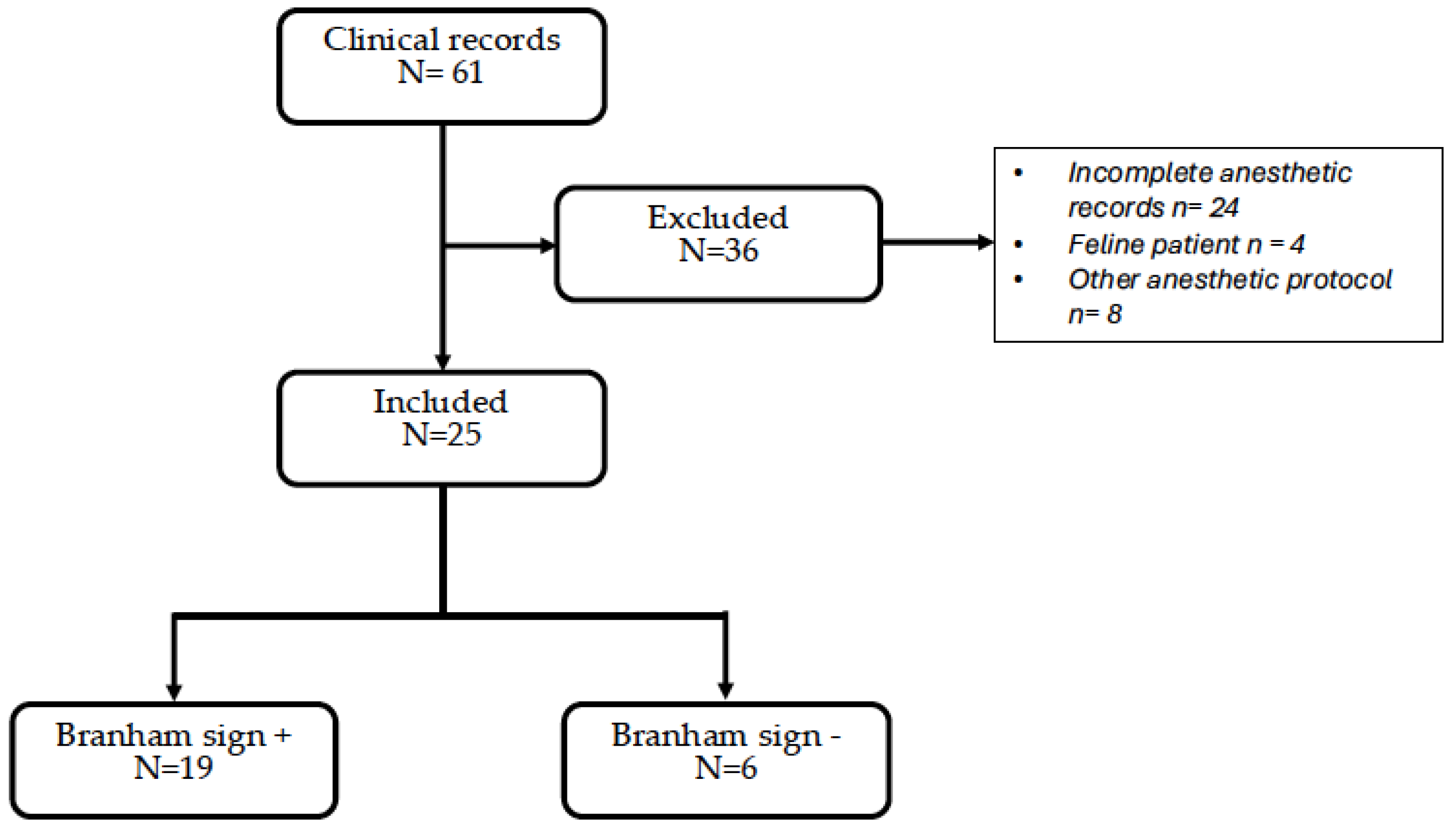
Figure 2.
Δ% of Heart Rate (HR) for each patient between T1 and T4; Δ% of Diastolic Arterial Pressure (DAP) for each patient between.
Figure 2.
Δ% of Heart Rate (HR) for each patient between T1 and T4; Δ% of Diastolic Arterial Pressure (DAP) for each patient between.
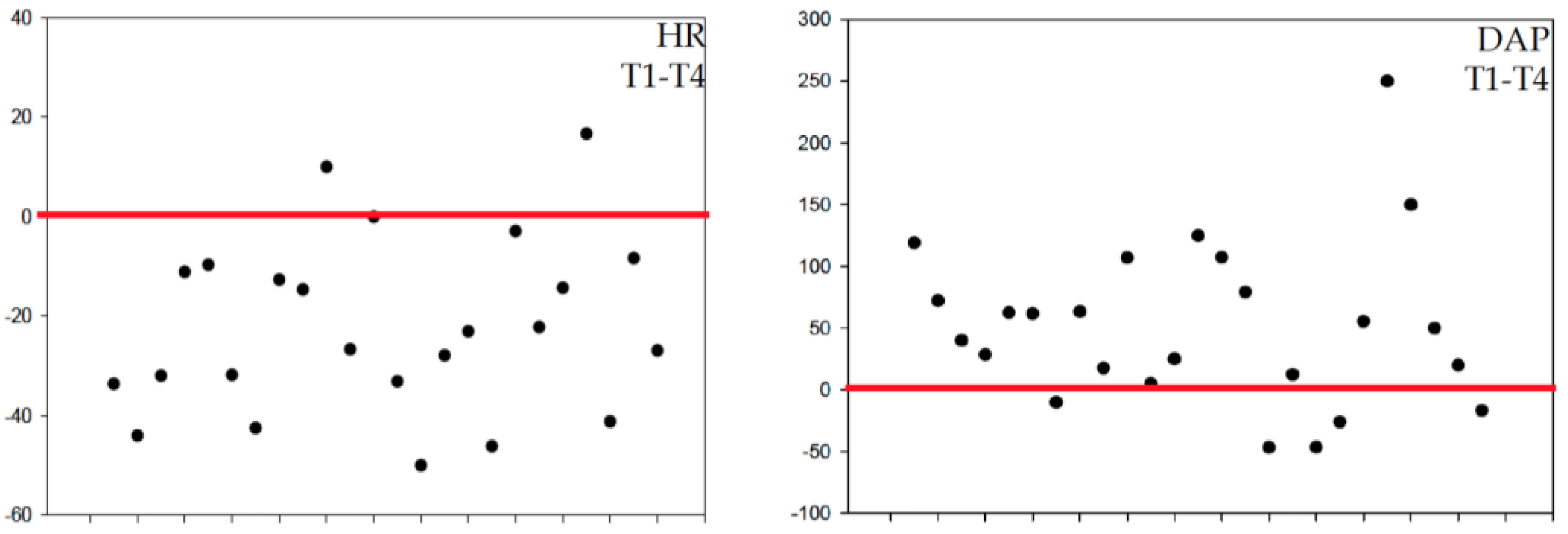
Figure 3.
Δ% of the different hemodynamic parameters (Heart Rate, Diastolic Arterial Pressure, Mean Arterial Pressure, Systolic Arterial Pressure) for each patient between T2 and T3, with T2 representing the pre-occlusion time point and T3 the time point immediately after Patent Ductus Arteriosus closure.
Figure 3.
Δ% of the different hemodynamic parameters (Heart Rate, Diastolic Arterial Pressure, Mean Arterial Pressure, Systolic Arterial Pressure) for each patient between T2 and T3, with T2 representing the pre-occlusion time point and T3 the time point immediately after Patent Ductus Arteriosus closure.
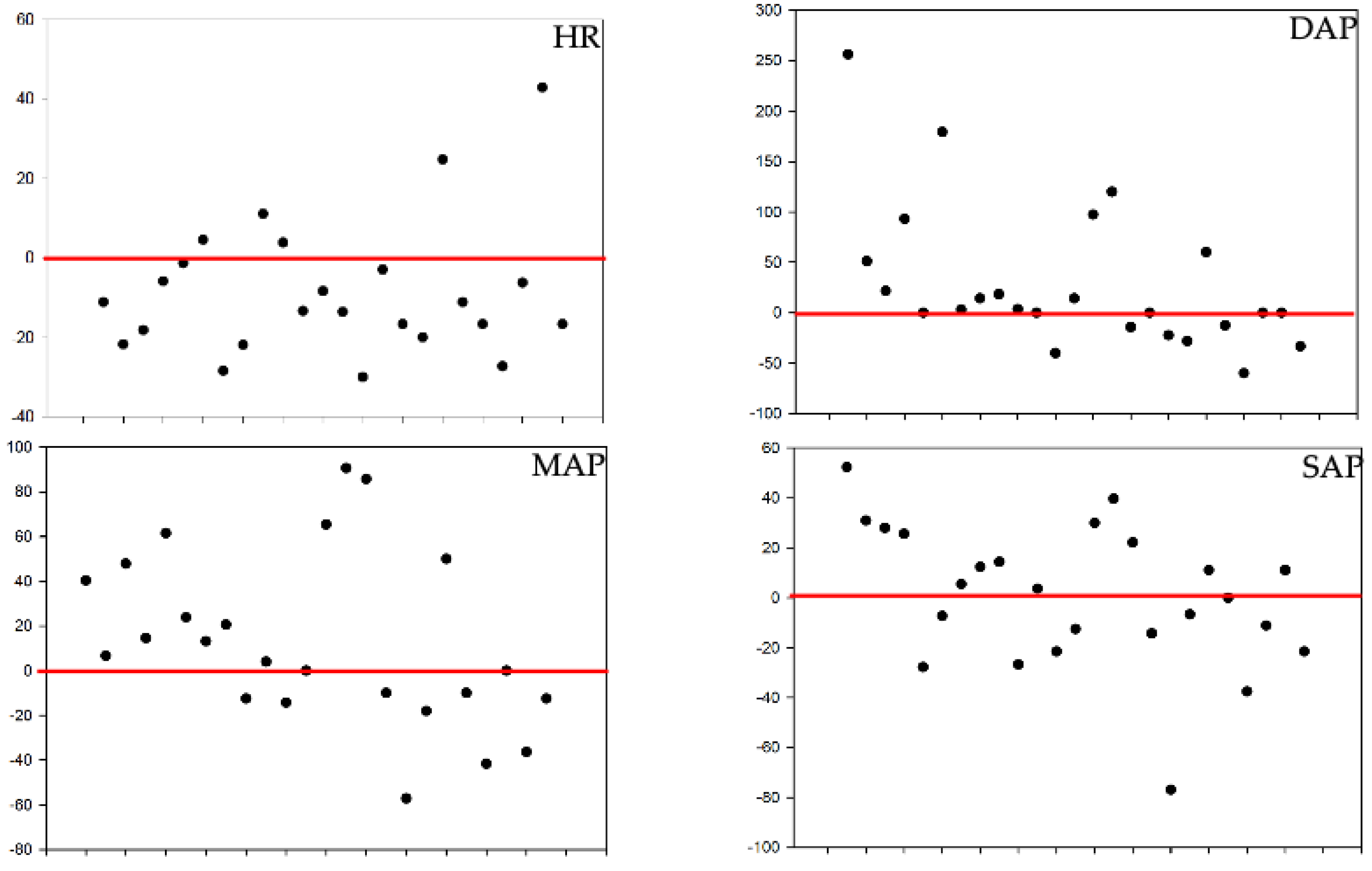

Table 1.
Hemodynamic parameters (Heart Rate, Diastolic Arterial Pressure, Mean Arterial Pressure, Systolic Arterial Pressure) at different time points.
Table 1.
Hemodynamic parameters (Heart Rate, Diastolic Arterial Pressure, Mean Arterial Pressure, Systolic Arterial Pressure) at different time points.
| T1 | T2 | T3 | T4 | |
| HR (lpm) | 125.84 ± 39.12* | 116.56 ± 25.24 | 107.56 ± 28.90 | 98.40 ± 27.13* |
| DAP (mmHg) | 43.04 ± 27.57* | 43.76 ± 18.83 | 50.36 ± 20.39 | 54.64 ± 17.47* |
| MAP (mmHg) | 53.52 ± 18.96 | 53.6 ± 13 | 61.68 ± 25.29 | 63.48 ± 17.03 |
| SAP (mmHg) | 82.64 ± 22.63 | 80.72 ± 14.63 | 82.24 ± 27.58 | 85.92 ± 23.55 |
*Statistically significant differences (p <0.05).
Table 2.
Between time Δ%.
| T1-T3 | T1-T4 | T2-T3 | T2-T4 | |
| HR | 17.04 ± 19.43* | -23.08 ± 17.69 | -11.11 ± 16.94 | -22.22 ± 22.00* |
| DAP | 32.76 ± 53.03* | 0.52 ± 0.66* | 28.87 ± 72.14* | 0.41 ± 0.65* |
| MAP | 20.51 ± 42.08 | 100.33 ± 0.63 | 17.50 ± 44.25 | 25.38 ± 49.99 |
| SAP | 0.94 ± 28.17 | 0.09 ± 0.36 | 0.94 ± 28.17 | 0.07 ± 0.28 |
*Statistically significant differences (p <0.05).
Table 3.
Heart Rate Δ% according to patient distribution by factors that may influence the epidemiology and pathogenesis of Patent Ductus Arteriosus, such as sex, age, or weight. The percentage of patients with a positive Branham reflex (BR) is also reported for each group.
Table 3.
Heart Rate Δ% according to patient distribution by factors that may influence the epidemiology and pathogenesis of Patent Ductus Arteriosus, such as sex, age, or weight. The percentage of patients with a positive Branham reflex (BR) is also reported for each group.
| T1-T3 | T1-T4 | T2-T3 | T2-T4 | |||
| Age | <12 months | HR | 6.55 ± 104.91 | -16.24 ± 59.30 | -9.55 ± 14.83 | -17.81 ± 15.04 |
| BR | 80% | |||||
| >12 months. (included) | HR | -13.10 ± 20.81 | -26.92 ± 11.90 | -5.22 ± 23.30 | -9.66 ± 30.89 | |
| BR | 80% | |||||
| Body weight | <5 kg | HR | -8.62 ± 59.23 | 11.06 ± 107.25 | -8.19 ± 15.03 | -18.08 ± 14.59 |
| BR | 80% | |||||
| 5-10kg | HR | -13.77 ± 23.26 | -8.67 ± 28.08 | -10.05 ± 20.33 | 23.12 ± 10.34 | |
| BR | 80% | |||||
| >10kg | HR | 42.93 ± 66.66 | -14.74 ± 11.10 | 12.00 ± 26.83 | 12.16 ± 40.34 | |
| BR | 50% | |||||
| Sex | Female | HR | 6.14 ± 101.31 | -11,68 ± 56.22 | -9.38 ± 14.47 | -18.69 ± 13.95 |
| BR | 77% | |||||
| Male | HR | -12.20 ± 19.34 | -16.44 ± 17.30 | -1.11 ± 27.78 | -2.93 ± 38.82 | |
| BR | 75% | |||||
Disclaimer/Publisher’s Note: The statements, opinions and data contained in all publications are solely those of the individual author(s) and contributor(s) and not of MDPI and/or the editor(s). MDPI and/or the editor(s) disclaim responsibility for any injury to people or property resulting from any ideas, methods, instructions or products referred to in the content. |
© 2026 by the authors. Licensee MDPI, Basel, Switzerland. This article is an open access article distributed under the terms and conditions of the Creative Commons Attribution (CC BY) license (http://creativecommons.org/licenses/by/4.0/).
Copyright: This open access article is published under a Creative Commons CC BY 4.0 license, which permit the free download, distribution, and reuse, provided that the author and preprint are cited in any reuse.


