

Submitted:
28 May 2026
Posted:
01 June 2026
You are already at the latest version
Abstract
In complex systems theory, there are different ways to describe a system in terms of information, such as emergence (Shannon entropy), self-organisation, and complexity. These measures provide information about the dynamic behaviour of a complex system. We study the differences in entropy and complexity for many-body systems undergoing a transition from a regular to a chaotic regime. To do this, we analyse the eigenvectors of the 48Ca nucleus for different quadrupole-type two-body interactions. We obtain the eigenvectors by diagonalising the two-body Hamiltonian for 48Ca using the Antoine code. We then calculate the entropy and complexity for the different quadrupole-type interactions. The differences found in information entropy and complexity are clear when comparing a regular system with a chaotic one. We find that the complexity of the regular and chaotic states of 48Ca shows differences associated with its internal interactions.
Keywords:
48Ca
1. Introduction
Complex systems are systems composed of many units that interact with each other, giving rise to behaviours that are challenging to model due to intricate interactions among their components and with their environment. These interactions result in a wide range of properties, including nonlinearity, emergence, robustness, and adaptability, among others. The study of complex systems is relevant in various scientific domains, with applications in biology, economics, the social sciences, climatology, medicine, and other fields. In physics, the study of complex systems has evolved from foundational concepts in statistical mechanics and chaos theory, and it continues to expand by exploring how these concepts can be applied to address real-world challenges and uncover the underlying patterns governing diverse systems [1,2,3]. The notion of complexity considered here relates to achieving an ’optimal’ balance between regularity and disorder. Building on the above, our interest is to study the Shannon entropy and complexity of nuclear states of 48Ca, which are known to exhibit statistical transitions in their spectra, ranging from noise associated with quantum chaos [4,5,6,7] to noise [8,9].
The article’s structure is as follows: in Section two, we will describe the energy spectra of 48Ca that we will be working with. Subsequently, in Section three, we will explain how to calculate Shannon entropy and complex- ity and provide an overview of its behavior depending on the two-body quadrupole interaction. In Section four, we establish a distance measure to an equiprobable system, namely a system independent of interactions, and com- pute the complexity of nuclear states. Finally, in the last section, we present our conclusions.
2. Nuclear States of 48Ca
For the study of Shannon information and complexity, we use the energy levels and eigenvectors of the 48Ca nucleus. This nucleus has been used in theoretical studies to describe the statistical transitions of its energy levels as a function of the quadrupole interaction. It has been shown that, for weak interactions, its energy levels display regular behaviour, whereas, as the quadrupole interaction increases, the system undergoes a transition from a regular to a chaotic regime. The system is described by a schematic Hamiltonian that includes a monopole term plus a quadrupole–quadrupole two-body interaction
whose strength depends on the parameter .
For the case of 48Ca, within the shell-model framework, the problem is reduced to a 40Ca core plus eight neutrons in the shell. We work with angular momentum and parity , for which 1627 nuclear states are available, and we consider interaction parameters and . These interactions correspond to regular and chaotic behaviour, respectively. The diagonalisation performed with the Antoine code [10] provides the energy levels of the available states.
In Figure 1a, we present the sequence of energies obtained from the diagonalisation using a two-body random ensemble (TBRE) instead of the term in Equation (1). For this TBRE, we use random numbers with a standard deviation , similar to a realistic interaction such as the modified Kuo–Brown interaction KB3 [11]. In Figure 1b, we present the energies from a TBRE with matrix-element values twenty times smaller, . The sequence of energies in Figure 1a can be approximated by a continuous binomial distribution [12]; however, the second one (Figure 1b) shows fluctuations that can be interpreted as a reminiscence of the shell structure.
For Figure 1b, the energy levels obtained for (weak interaction) outline some internal structure change associated with the formation of correlations between groups of levels whose power spectra analysis denoted a noise. The two noises are known like pink and brown noises respectivelly, associated with quantum chaos an brownian statistics. In another hand, the Figure 1c is a subdistribution of the energies for the TBRE. Precisely, one subset of energies in the Figure 1b among . The power spectrum for this subset of energy levels give noise.
In addition, an analysis of the power spectrum shows that the unfolded energy levels for exhibit noise , which is associated with chaotic behaviour [8]. For Figure 1b, the energy levels obtained for (weak interaction) reveal an internal structural change associated with the formation of correlations between groups of levels, whose power-spectrum analysis indicates a noise. These two types of noise are known as pink and brown noise, respectively, and are associated with quantum chaos in Brownian statistics. Figure 1c shows a sub-distribution of the energies for the TBRE, corresponding to the subset of energies in Figure 1b with . The power spectrum for this subset of energy levels displays noise.
Thus, the distribution with weak interaction is composed of several sub-distributions of chaotic energy levels; however, the total power spectrum is not chaotic. In the limit , the energy-level structure is related to the harmonic oscillator with some monopole interactions that weakly break the degeneracy, leaving bunches of energy levels. Each bunch of levels is locally chaotic, because there is interaction between all states inside the bunch. When the two-body interaction increases, states from different bunches interact, leading to a smoother distribution with an overall chaotic behaviour characterised by .
On the other hand, the chaotic behaviour of the system is reflected in the energy-level statistics, which are described by a Wigner distribution. In similar research [14], it has been found that atomic nuclei behave as a chaotic system when the interaction parameter takes values above . Under this premise, we calculate the Shannon entropy and study the chaotic behaviour in terms of the information content and complexity of the nuclear states.
3. Shannon Entropy of Nuclear States
In quantum systems, the problem becomes more difficult because the concept of a trajectory has no meaning in quantum mechanics. However, the dynamics of the system are described by the average behaviour (in statistical terms) of each of the elements, and it is here that it makes sense to consider the Shannon entropy for the analysis of a system. As stated by Zelevinsky “The information entropy of individual eigenvectors turns out to be a convenient measure of the degree of complexity of individual wave functions” [15]. We describe the nucleus 48Ca in terms of a 40Ca core, so that the basis states of 48Ca are expressed in terms of the basis |k〉 of 40Ca as
In Figure 2, we plot each of the 1627 k components of the probability (on the vertical axis) for each state (on the horizontal axis), for (a) and (b) [13]. To make the patterns clearer, we display only the probabilities satisfying . For a weak quadrupole interaction, the graph shows gaps between components for certain states, whereas for a strong interaction these gaps disappear. As shown in Figure 2a, subsets of states exist for weak interactions that do not mix with other subsets. By increasing the quadrupole interaction [Figure 2b], mixing between subsets of components occurs, smoothing the distribution of k components. In other words, a strong interaction produces level repulsion, which is reflected in the mixing of a large set of states with different values.
The Shannon entropy is defined as
To normalise this entropy, we use the maximum value that the information entropy can reach for a Gaussian orthogonal ensemble (GOE) [15]:
The results are shown in Figure 3a, where we can see that the entropy for is on average lower than the entropy for . We can also see that for weak interactions, , the gaps that appear in Figure 2a have a counterpart in Figure 3a in the Shannon entropy for the same interaction, where downward peaks are observed. It is important to mention that for the k values near the limits and , the values of S go to zero because there are few states that are the most probable; these are the most pure states.
Although the graph is intuitive with respect to what we understand by information entropy, it is interesting to adopt another auxiliary quantity to place our system far from or close to order. We adopt the definition of D’ [16]. This is a kind of distance from an equiprobable distribución, defined as
where is the i-th probability of a N-system, and is the corresponding probability of an equiprobable system. The differences are squared to avoid negative probabilities.
We can plot the entropy versus this distance; however, we prefer to plot the entropy versus the real difference, or distance,
By discarding all coefficients with , we guarantee that for each . In this case, for we obtain 14 cases with , in the range , while for we have 25 such cases in the range . We expect that these negative differences have very little influence on the results.
When we plot S vs. D [Figure 3b], we identify two limits: at , corresponding to maximal randomness or maximal entropy, and at , corresponding to maximal order or minimal entropy. In the same figure, the maximal entropy again occurs for , with , but this case reaches an order limit around ; in contrast, the entropy for is on average lower than for , but it can attain states of almost complete order, with D close to 1.
4. Complexity as a Tool to Characterise Nuclear Behaviour
Complexity can be interpreted as a measure of the balance between organisation and disorganisation. It can also be understood in terms of the amount of information needed to describe a system, considering two extreme cases: a crystal and an ideal gas, which require minimal and maximal information, respectively, to be described [16]. Intuitively, the complexity tends to zero when the system is near the two limits and . The maximum of the complexity is reached at some point between these two limits, defining the emerging dynamics.
We define the complexity as
with S normalised by Equation (4). Another common definition is [17], where is the disequilibrium.
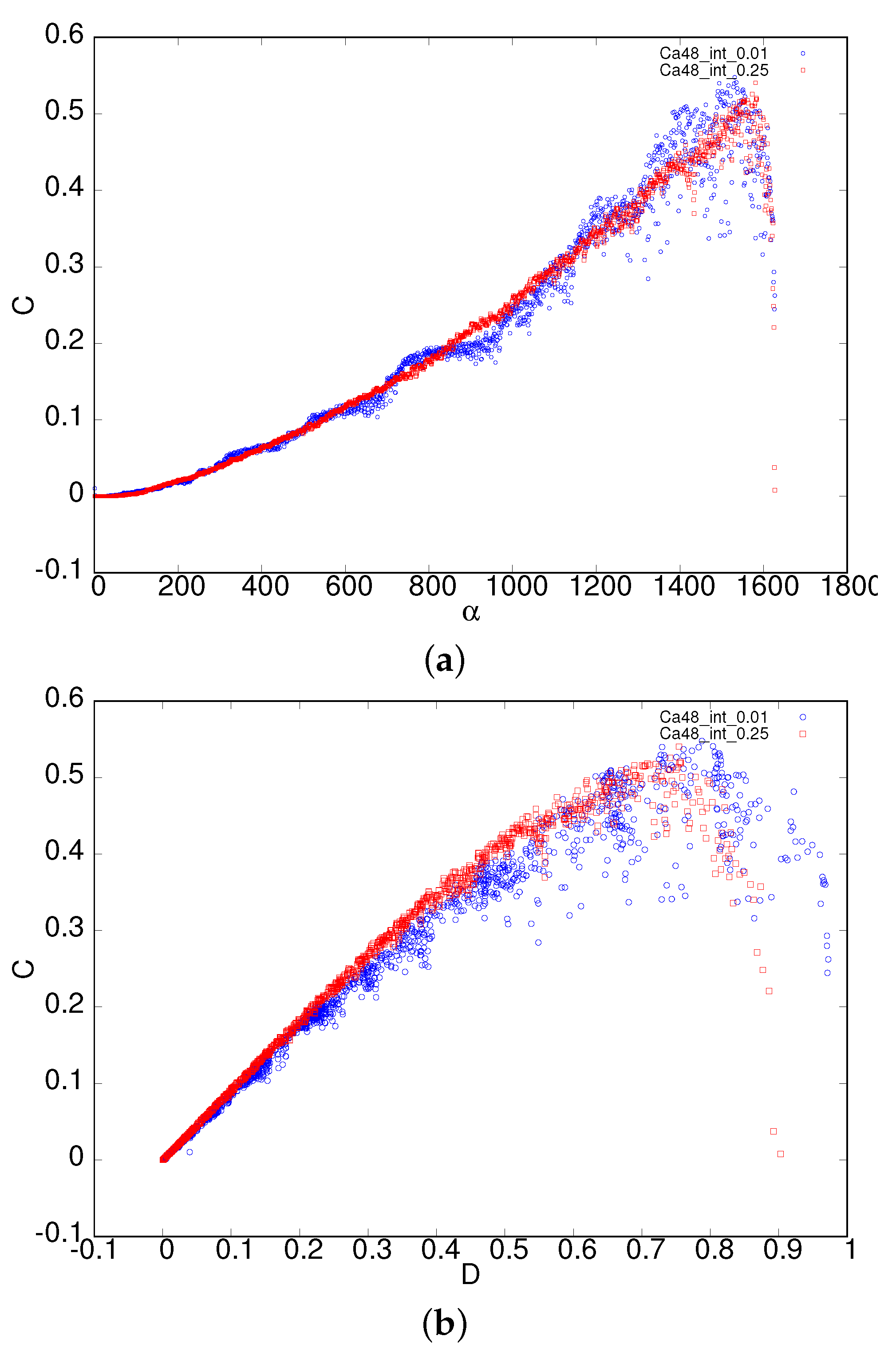
Figure 4a shows the complexity C as a function of . As with the Shannon entropy, the complexity vanishes at the extremes, where the states are almost pure, and increases in the intermediate region where configuration mixing occurs. However, the maximum complexity is not located at the centre, so it is useful to examine complexity as a function of disequilibrium. The complexity pattern also shows ripples, with local maxima and minima. These arise from the internal structure of energies and eigenvectors seen in Figure 1c and Figure 2a, since the weak interaction is not strong enough to mix configurations between the different subsets of states.
The maxima of both complexity curves are near . It is risky to say that the states near the limit are the most complex, since the diagonalisation performed with ANTOINE in the M scheme does not use the total angular momentum as a good quantum number. However, independent of the specific state, with the help of the disequilibrium we can estimate where the maximum of the complexity is located.
In Figure 4b, the complexity depends on the disequilibrium. The structure of both complexity curves for and is similar to that in Figure 4a; however, the maximum complexity for appears near , while for it appears near . For the complexity there are several important values of D: the two values inherent to its definition, and , which correspond to random and ordered phases, or physically to ideal-gas and crystalline phases, respectively. However, the position of the maximum complexity can be basis-dependent. In our case, we will emphasise in the conclusions the differences between the complexity limits of the chaotic phase for and .
5. Conclusions
We studied the entropy and complexity of the 48Ca nucleus for the set of states with and positive parity, in the ANTOINE M scheme, and compared Shannon entropy and complexity for quadrupole two-body interactions with two different strengths, and . For the weak interaction, the energies and eigenvectors show clusters or groups of states, while increasing the interaction by a factor of twenty mixes most configurations and smooths the spectrum towards a binomial-like distribution. This increase in interaction produces a transition from noise to chaotic noise. Comparing the entropy for the two interactions, we see that the stronger interaction gives a more uniform and higher entropy, confirming that the system with noise is more organised than the system with noise. Since complexity depends directly on entropy, the qualitative behaviour is similar: increasing the quadrupole interaction, which largely controls the nuclear shape, enhances configuration mixing and leads to greater complexity. Interestingly, we can also observe local complexity maxima associated with the weakly interacting clusters or groups of states in the spectrum, suggesting that, like entropy, complexity can be discussed in terms of contributions from such groups.
It is also important to note that the dependence of complexity on disequilibrium explains the slight separation between the global complexity maxima for the two interactions. The complexity maximum for is closer to the ordered limit , while for it occurs at a smaller D, before approaching .
For systems such as the atomic nucleus, we know that a maximum of complexity is not found at the extreme limits, but at an intermediate point. The position of this maximum may be close to , as suggested by Figure 4b. What we can firmly state from our results is that complexity is sensitive to the structure of the interactions. Since the energies are basis-independent, the presence of level groups with chaotic structure [Figure 1b] is reflected in local complexity maxima. This implies that, for a larger quadrupole interaction that mixes configurations between different groups of states, a single global complexity maximum emerges. Therefore, the noise associated with quantum chaos corresponds to a single complexity maximum.
Acknowledgments
We acknowledge financial support from the PAPIIT-UNAM-IN113023. LLH gratefully acknowledge a CONAHCYT graduate scholarship.
References
- Rickles, D.; Hawe, P.; Shiell, A. A simple guide to chaos and complexity. J. Epidemiol. Community Health 2007, 61, 933–937. [Google Scholar] [CrossRef] [PubMed]
- Mendoza, B. D.; Lara, D. A.; López-Aparicio, J.; Armendáriz, G.; López-Hernández, L.; Velázquez, V.; Hernández, E. M.; Grether, M.; López-Moreno, E.; Frank, A. “Quantum chaos in time series of single photons as a superposition of wave and particle states”. Photonics 2021, 8. [Google Scholar] [CrossRef]
- Tsai, C.-H.; Ma, H.-P.; Lin, Y.-T.; Hung, C.-S.; Huang, S.-H.; Chuang, B.-L.; Lin, C.; Lo, M.-T.; Peng, C.-K.; Lin, Y.-H. Sci. Rep. 2020, 10, 14916. [CrossRef] [PubMed]
- Bohigas, O.; Giannoni, M. J.; Schmit, C. Characterization of chaotic quantum spectra and universality of level fluctuation laws. Phys. Rev. Lett. 1984, 52, 1–4. [Google Scholar] [CrossRef]
- Berry, M. Quantum chaology (The Bakerian Lecture, 1987). Proc. R. Soc. Lond. Ser. A 1987, 413, 183–198. [Google Scholar] [CrossRef]
- Gutzwiller, Martin C. Chaos in Classical and Quantum Mechanics. In Number 1 in Interdisciplinary Applied Mathematics; Springer-Verlag: New York, NY, 1990. [Google Scholar]
- Chirikov, B.V.; Izraelev, F.M.; Shepelyansky, D.L. Dynamical stochasticity in classical and quantum mechanics. Soviet Sci. Rev. 1981, C2, 209–267, Decoherence and the Appearancs of a Classical World in Quantum Theory, (Springer, Berlin, 2003). [Google Scholar]
- Relaño, A.; Gómez, J. M. G.; Molina, R. A.; Retamosa, J.; Faleiro, E. Quantum Chaos and 1/f Noise. Phys. Rev. Lett. 2002, 89, 244102. [Google Scholar] [CrossRef] [PubMed]
- Landa, E.; Morales, Irving O.; Fossion, R.; Stránský, P.; Velázquez, V.; López Vieyra, J. C.; Frank, A. Criticality and long-range correlations in time series in classical and quantum systems. Phys. Rev. E 2011, 84, 016224. [Google Scholar] [CrossRef] [PubMed]
- Antoine, Code; Caurier, E.; Nowacki, F. Strasbourg. 1987. [Google Scholar]
- Poves, A.; Zuker, A.P. Phys. Reports 1981, 70, 235. [CrossRef]
- Zuker, A. P. Phys. Rev. C 2001, 64, 021303(R). [CrossRef]
- Fernández, G.; Hernández, E. M.; Hautefeuille, M.; Landa, E.; Morales, I. O.; Velázquez, V.; Fossion, R.; Vargas, C. E.; Frank, A. Quantum interference vs. quantum chaos in the nuclear shell model. J. Phys.: Conf. Ser. 2015, 578, 012014. [Google Scholar] [CrossRef]
- Lara Bustillos, D. A.; López-Hernández, L.; Ramírez-Cruz, N.; Hernández, E. M.; Fossion, R.; López-Moreno, E.; Vargas, C. E.; Velázquez, V. Nuclear energy level complexity: Fano factor signature of chaotic behavior of nearest-neighbor time-series analysis. Phys. Rev. C 2020, 102, 044301. [Google Scholar] [CrossRef]
- Zelevinsky, V.; Horoi, M.; Brown, B. A. Information entropy, chaos and complexity of the shell model eigenvectors. Phys. Lett. B 1995, 350, 141. [Google Scholar] [CrossRef]
- López-Ruiz, R.; Mancini, H. L.; Calbet, X. A Statistical Measure of Complexity. Physics Letters A 1995, 209. [Google Scholar] [CrossRef]
- Pineda, Omar K.; Kim, Hyobin; Gershenson, Carlos. A Novel Antifragility Measure Based on Satisfaction and Its Application to Random and Biological Boolean Networks. Complexity 2019, 2019, 3728621. [Google Scholar] [CrossRef]
Figure 1.
Energy levels of 48Ca as a function of the interaction parameter . The two-body interaction in (a) is 25 times greater than in (b). In (c), a selected sector of the energy spectrum from (b) is shown.
Figure 1.
Energy levels of 48Ca as a function of the interaction parameter . The two-body interaction in (a) is 25 times greater than in (b). In (c), a selected sector of the energy spectrum from (b) is shown.
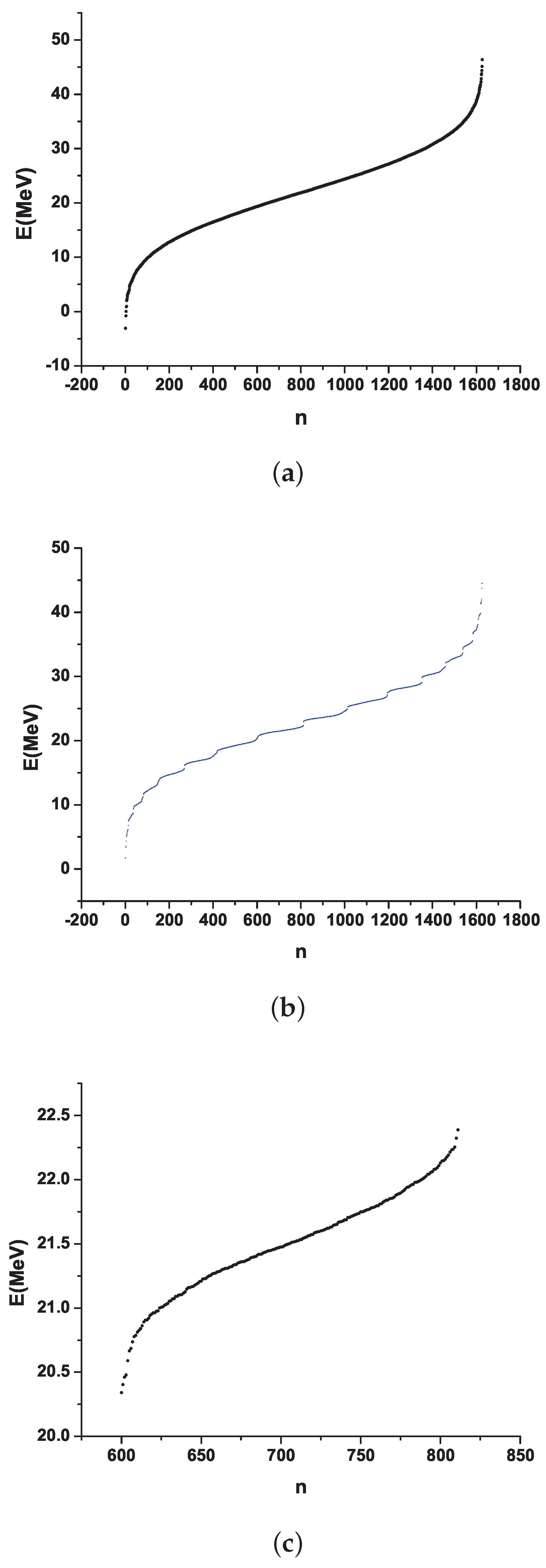
Figure 2.
Probabilities on the vertical axis for each state vector on the horizontal axis for the 48Ca nucleus with . We use two values of the quadrupole–quadrupole interaction: (a) and (b) . The probability distributions show gaps for weak interactions.
Figure 2.
Probabilities on the vertical axis for each state vector on the horizontal axis for the 48Ca nucleus with . We use two values of the quadrupole–quadrupole interaction: (a) and (b) . The probability distributions show gaps for weak interactions.
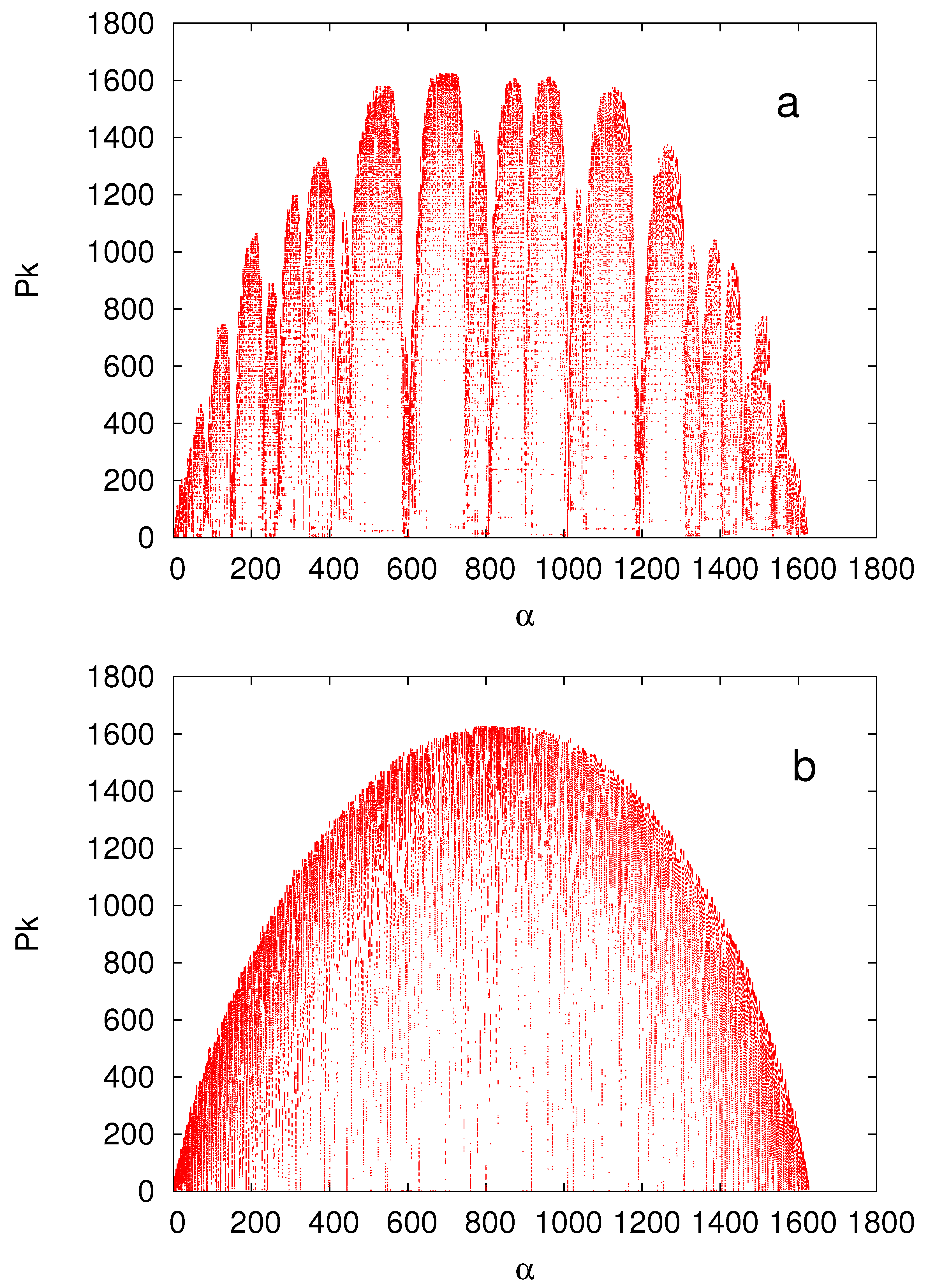
Figure 3.
Shannon entropy as a function of the interaction parameter for (blue circles) and (red squares). (a) Shannon entropy versus basis state ; (b) Shannon entropy versus disequilibrium D.
Figure 3.
Shannon entropy as a function of the interaction parameter for (blue circles) and (red squares). (a) Shannon entropy versus basis state ; (b) Shannon entropy versus disequilibrium D.
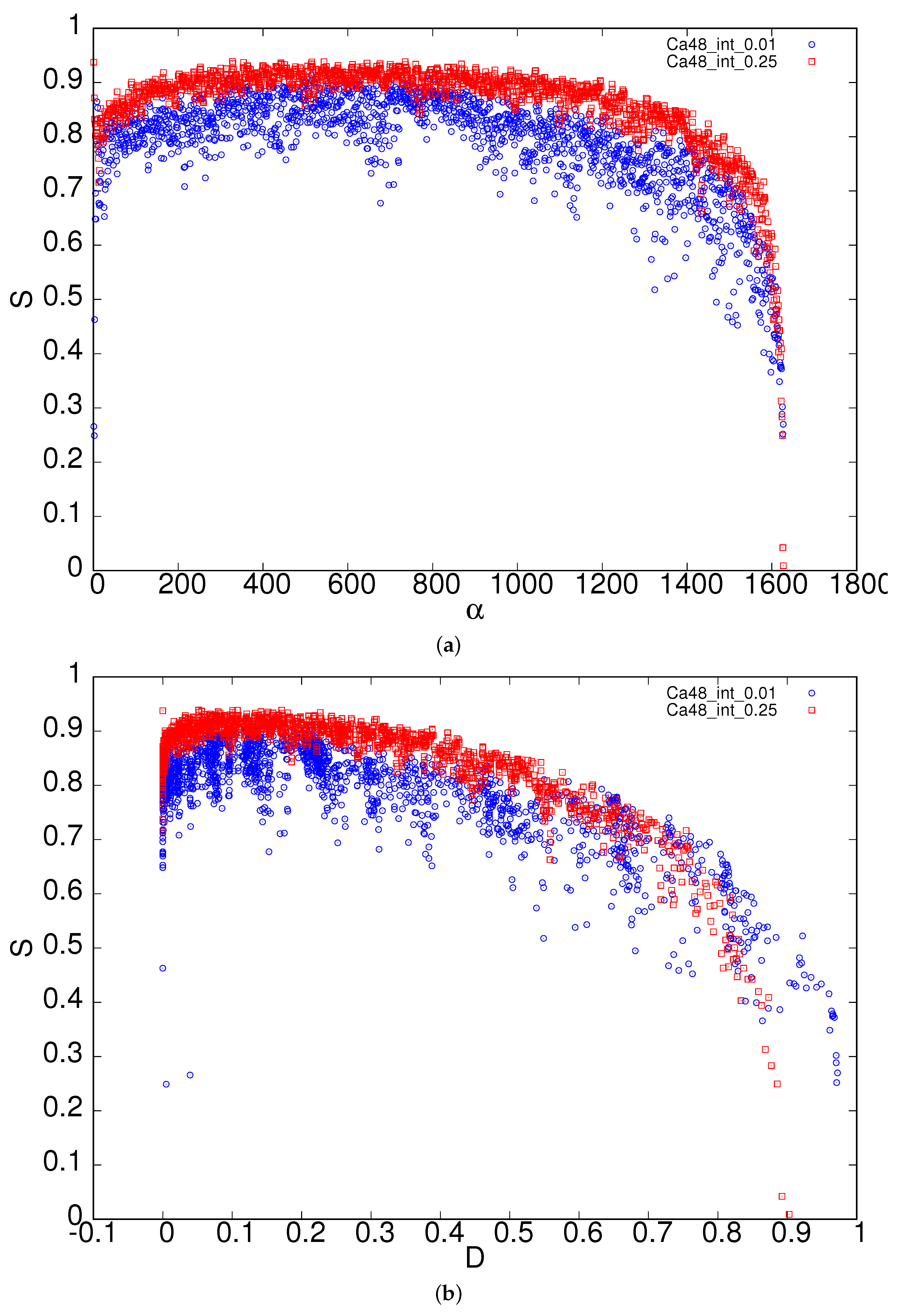
Figure 4.
Complexity as a function of the interaction parameter for (blue circles) and (red squares). (a) Complexity versus basis state ; (b) Complexity versus disequilibrium D.
Figure 4.
Complexity as a function of the interaction parameter for (blue circles) and (red squares). (a) Complexity versus basis state ; (b) Complexity versus disequilibrium D.
Disclaimer/Publisher’s Note: The statements, opinions and data contained in all publications are solely those of the individual author(s) and contributor(s) and not of MDPI and/or the editor(s). MDPI and/or the editor(s) disclaim responsibility for any injury to people or property resulting from any ideas, methods, instructions or products referred to in the content. |
© 2026 by the authors. Licensee MDPI, Basel, Switzerland. This article is an open access article distributed under the terms and conditions of the Creative Commons Attribution (CC BY) license (http://creativecommons.org/licenses/by/4.0/).
Copyright: This open access article is published under a Creative Commons CC BY 4.0 license, which permit the free download, distribution, and reuse, provided that the author and preprint are cited in any reuse.


