

Submitted:
27 May 2026
Posted:
28 May 2026
You are already at the latest version
Abstract
The original Bell inequalities were derived with four terms of channel-to-channel correlations of paired photons but are violated with sixteen terms of channel-to-channel correlations. The same correlation function can be derived for non-entangled photons as it was for entangled ones. The correlation probability for independent photons and qubits exceeds that of the entangled photons. Entanglement reduces the detection probability of the first measurement to 1/2 but does not affect the second photon’s maximal probability of detection. For one channel-to-one channel correlation, the quantum probability of entangled photons can be factorized, which should enable a local determination of a quantum nonlocal effect. A single photon is scattered by the quantum Rayleigh scattering making it impossible to synchronize the detections of an original pair of photons. All experimental results can be explained by means of the intrinsic field of photons as confirmed by independently published experimental results involving independent photons.
Keywords:
Bell inequalities
; quantum correlations of polarization states
; quantum nonlocality
; quantum Rayleigh scattering
1. Introduction
Experimental and theoretical evidence [1,2] is mounting to challenge the conventional interpretations of the Bell inequalities. The common view maintains that only entangled quantum states such as entangled pairs of photons are capable of violating Bell inequalities by delivering statistical functions that enable their violations. Such a violation would prove the existence of a quantum effect of nonlocality whereby a first measurement on an entangled photon should bring about an impact on the outcome of a second measurement on the other photon. Such measurements involve Pauli spin operators whose expectation values are probed experimentally.
Additionally, recent background briefing articles [3,4] reveal significant difficulties in the implementation of practical quantum computers [5] based on the concepts of entangled states and quantum nonlocality-related correlations of detected single photons [6].
It is assumed that: “The violation of Bell inequalities can be seen as a detector of entanglement that is robust to any experimental imperfection: as long as a violation is observed, we have the guarantee, independently of any implementation details, that the two systems are entangled” [6]. Yet, experimental results have demonstrated violations of Bell inequalities by using independent photons [7,8], while the correlation function used for the Clauser-Horne-Shimony-Holt (CHSH) inequality [6] has the same form as that of the polarimetric Stokes measurements [9] which are considered to be classical. These results are consistent with a major contradiction also pointed out in a section of ref. [6](p. 442) headlined “More nonlocality with less entanglement” leading one to the anomaly of nonlocality.
The 1964 article of the original inequality by Bell [10], was intended to prove the advantages of the entangled states. In ref. [10], the theoretical case of two spin 1/2 particles in the entangled singlet state is considered with one measurement taking place at location A and another simultaneous measurement carried out at location B, in the context of the Stern-Gerlach magnetic field separation of the spins. The original 1964 Bell inequality [10] was violated with expectation values of the product of two Pauli spin operators onto which the polarization filter state vectors are projected and applied to the entangled state of spinor singlet. However, a well-documented equality from the spin-vector algebra [11](Eq. (A6)] reveals that the expansion of the correlation operator contains an identity operator , so that:
which allows any quantum state – whether entangled or non-entangled – to generate the same correlation function. The unit vectors and identify the orientations on the Poincaré sphere of the state vectors of the two separate detectors, each detector consisting of two orthogonal channels, , with all four channels simultaneously open to register an incoming particle; thus, the unity correlation corresponds to the four detectors recording all the particles for a lossless system.
Upon rotation by an angle from the z-axis, the detecting eigenstate at location , and after a rotation by an angle , the detecting eigenstate at location , become a superposition of the two incoming spin-1/2 states [12]:
where . The local eigenstates capture particles from both input eigenstates. With lossless systems, all the particles are counted by either local detecting channel leading to the mistaken claim – because of the overall equal number of detections – of one detection influencing the other. As a result, the measurement distorts the physical reality. We recall that the quantum mechanical formalism does not provide any information about individual events or the sequential order of detections and non-detections.
By rewriting Bell’s notation [10] in the context of rotated eigenstates of eqs. (2) for as , and comparing it with of eq. (1) , we notice that the output correlation is determined by the orientations of the spin analyzers regardless of the incoming state reaching both dual-channel detectors. The rotational invariance of the expectation values of unity (anti-) correlation for the quantum singlet state of spin 1/2 particles, is the result of the analysing eigenstates capturing all the incoming particles between the two orthogonal detecting channels, which is a local effect.
The basic assumption made by Bell in 1964 is physically incorrect: “If measurement of component , where is some unit vector, yields the value +1, then according to quantum mechanics, the measurement of must yield the value –1, and vice versa” [10].
The output correlation based on the Pauli measurements is linked to the eigenstates of the analysers rather than being indicative of the incoming spins. The physical degree of freedom that is detected corresponds to the number of particles recorded by the eigenstate channels of the analysers. Each detecting channel can capture both incoming spins in line with the quantum projection postulate or the quantum rotation operator as indicated in eqs. (2).
A straightforward derivation of the original Bell inequalities is presented in section 2 without any limiting conditions by employing photon-to-photon correlations. The state vector-to-vector correlations of eq. (1) are developed in section 3. The results of these two sections are combined in section 4 to describe the very strong correlations between independent photons. The flaws of the entangled photons are outlined in section 5, and physical aspects are considered in section 6.
2. Coincident Detections of Photon-to-Photon from an Experimental Perspective
We consider two detecting stations A and B separately located. Each station is composed of two orthogonal channels which are continuously open to register one incoming photon of an initial pair of photons. A photon is recorded by the channel that matches its physical property. Thus, for synchronized time-windows, a sequence of 1s and 0s is generated for a detection or no-detection respectively at each of the four individual photodetectors placed at the output of the channels.
Subject to conservation of photons in such two photonic systems A and B, the following equalities hold for two orthogonal channels denoted by and , for which the m-th individual measurements of the sequences are: so that and . The probability of detecting a photon by a channel is and , etc., where is the same total number of incoming photons per location.
For lossless systems, the probabilities are related: and . The four sub-ensembles of channel-to-channel correlations are labelled between one channel at location A and one channel at location B, with the settings corresponding to the values while identifying the values. Nevertheless, for lossless systems, only two individual sequences need to be measured for the calculation of the probabilities of coincident detections:
The conservation of the coincident probabilities of detections is found by summing up the last terms of eqs. (3) resulting in unity:
This relation indicated that the violation of the Bell-type inequality requires, in fact, more than one ensemble of measurements consisting of four sequential sub-ensembles for each pair of detecting channels. Changing the sign of the second term in eq. (4) leads one to the photon-to-photon Bell-parameter expression [13] by inserting from eq. (3)
+ =
For any values of , the parameter is unity: .
Changing the sign of the second and fourth terms in eq. (4) results in the correlation function used in the CHSH inequality [14]:
which after substitution from eqs. (3) becomes
For independent photons and the maximal values of for complete overlap of the two sequences, the correlation function becomes . For the correlation function vanishes. A maximally negative correlation is obtained with which is accompanied by leading to in eq. (7).
If the quantum nonlocality effect synchronizes the detections at location B following a detection at location A, then either the same eigenvalue two terms of or the opposite eigenvalue two terms add up to unity so that
The Clauser-Horne (CH) inequality [14] uses only one detector at each of the two locations under the assumption of a lossless system and based on the conservation of correlations as in eq. (4). This was done – see eq. (B8) of ref. [14] – by defining a sixteen-term Bell parameter and substituting from eq. (6) into eq. (5a) for all four distinct terms resulting in this inequality for the sixteen-term Bell parameter:
between the two-channel analyser at location A and the two-channel analyser at location B and for two different setting groups , each having two orthogonal channels of detections . From a physical perspective, the photon-to-photon correlations were replaced with state vector-to-vector correlations between the two detectors as in eq. (1). Additionally, the factorized joint probability
specifying the separability condition [14] for independent detections, lacks any information about the sequential distributions of binary detection or no-detection elements for each of the individual channels which is needed to evaluate the correlations of eqs. (3). The resultant CH inequality is derived from eqs. (7) and (8) as:
Nevertheless, this simplified inequality (9) still includes the values of the sixteen detector-to-detector correlations of the CHSH inequality as it is the result of adding up four versions of equality (7). Thus, the violations of the CHSH and CH inequality are due to the correlation contributions from four 2x2 terms – unlike four one-to-one correlations in the original Bell inequalities [13] – rather than being brought about by the entangled photons because the same correlation function can be obtained experimentally with independent photons [7,8,9] as indicated by eq. (1).
Experimentally, for the CHSH inequality [15] the correlation probability is with the number of coincident counts of photons and the number of all coincident detections for all four settings . However, this normalization is mathematical because the physical number of initiated photon-pairs is very much larger as photons are lost between the source and the photodetectors, for various reasons, thereby throwing doubt about the real statistics. This normalization makes a violation of the CHSC impossible as . This is the case of ref. [16] with its Figure 1 showing a very low success rate of detection of only 150 coincidences over 5s integration time despite 1 million events per second.
The modified-CH inequality used in refs. [17,18] contains correlations between ‘1’s and ‘0’s, so that, in terms of coincidence probabilities , the inequality (9) is re-written as:
with the normalization factor of initiated events being used. But, as only one term of the four terms is measured in any individual run of one photon per detector, the linear combination of eq. (10) would relate the maximal values on the left-hand side to the minimal values on the right-hand side. With such probabilities for all four terms, the opposite requirements of the inequality for the coincident detections of (1;1) on the left-hand side, and for only one-location detection (1;0) or (0;1) on the right-hand side, make a violation impossible, mathematically, unless arbitrary values are selected from various data sets or ensembles of measurements recorded at four different times. In this case, the inequality becomes physically meaningless.
The 2015 landmark experiments [17,18] reported a very low probability of coincident detections of a mere 0.0002 (2x10--4) with one setting at each of the two stations, the overall outcomes being fitted with highly non-entangled states of photons, thereby disproving any claim of quantum nonlocality despite the common view [19].
3. Probabilities of Local Detections Versus Correlation of State Vectors
On the one hand, the correlation function of eq. (1) involves, for linearly polarized photons, only the scalar product of the state vectors describing the orientations of the polarization analysers on the Poincaré sphere (PS), while, on the other hand, the photon-to-photon correlations are utilized in the derivations of Bell inequalities [14,20] as outlined in section 2. In this section, a connection is pursued between the probabilities of local detections and the correlation function between the polarization filters.
Let us consider the following two state vectors of linear polarization and specifying an incoming stream of photons and an analysing polarization filter, respectively:
with denoting the common reference eigenstates. The analysing orthogonal states are related by rotation angles Experimentally, the quantum state of polarization is defined by an angle which is determined from the number of detected photons, i.e., . The probability of projective detection is [21]
which is equivalent to the overlap on the Poincaré sphere (PS) of the two states [9].
For independent photons forming a qubit-like superposition of two orthogonal polarization states with , the probabilities of first detections at location A, or B, are
describing a local interference when both eigenstates are populated simultaneously. For , the local detection probability for independent photons is . For identical orientations of the polarization analysers, i.e., , the product of the two interference patterns of eqs. (13) will peak at a value of unity as a joint probability of coincident detections . Thus, independent states of photons can outperform entangled states in the contest for quantum correlations of detections.
A vector-to-vector correlation [9] is associated with a mutual projection between polarization vectors as indicated in eq. (1). The correlation in the Jones representation of polarizations [9] is evaluated as the overlap between vectors such as , that is:
This correlation is displayed on the Poincaré sphere (PS), for the corresponding Stokes vectors as [9]:
The angle difference of the correlation function stems from the mathematical inner product of the two filter states displayed on the Poincaré sphere after the ensemble measurements have been completed.
For identical orientations of the two separate analysers, i.e., , the correlations on the Poincaré sphere become unity, i.e., even for independent or classical photons, identical to the result of Pauli spin vectors as projective probabilities of detecting incoming photons add up, analogously to eqs. (2), i.e., .
The next objective is to link the evaluated correlations to measurement probabilities of both independent and entangled photons through the Jones correlations of eqs. (14) which can be associated with detection probabilities as in eq. (12) and connected to the Stokes vectors on the Poincaré sphere through eq. (16).
4. Quantum Correlations of Independent Photons
Quantum correlations are evaluated as the expectation values of a product of operators [6,21]. For the projective operators corresponding to polarization filters with one detection channel at each of the two locations A and B, respectively, the probability of correlated detections has the following form for an input state|, analogously to eq. (12):
with and identifying the states of the polarization filters, and being the Hermitian conjugate state of detected input state . By contrast, the probability of coincident detections is experimentally calculated from the sum of products of time-correlated and separate terms, i.e., , as defined in section 2. For, the correlation probability depends on the sequential orders of the two data sets, which is not the case for the state vector-to-vector correlation as the filters’ rotation angles will accommodate any sequential orders. In other words, will have multiple values and can be larger than which has only an average value regardless of the sequential orders of detections.
For the basis states of the shared measurement Hilbert space, the polarization filters’ states are and the input polarization state is The resultant correlation probability between filter polarization states and for independent states of photons becomes from eq. (17):
This correlation probability of eq. (18b) is composed of three terms: two projections of the input states onto the respective filters, while the term indicates the overlap between the two filters. The magnitude of this correlation function of coincident detections can reach a peak of unity for the symmetric case of , outperforming the coincidence values of 0.5 obtained with entangled states of photons calculated in the next section for channel-to-channel correlations.
There are two different types of correlations for the Jones and Stokes polarization representations but neither one contains one photon-to-one photon correlations. Consequently, the correlation equality (18b) is substituted into (16) yielding for the correlation of the Stokes vectors on the Poincaré sphere:
where ; .
A similar expression applies for with .
The photon-to-photon correlation is a random combination of the two sequential orders of detections at locations A and B , but is not a product of the local probabilities or normalized numbers of detections and
. The sequential orders of those detections are unpredictable and the values of the correlated detections could exceed the product of the two local probabilities also known as the separability condition [21]. One-to-one correlations of individual photons do not appear in the quantum formalism. Thus, the quantum correlation and is only related to the Stokes vectors on the Poincaré sphere through eqs. (15) and (16).
5. One-to-One Factorized Probabilities of Coincident Detections of Entangled Photons
With only one photon, allegedly, reaching each of the two separate detecting stations, in a Bell scenario, only one of the two orthogonal polarization channels will be triggered. Thus, four one-to-one correlation data sets will be recorded as the four measurement sub-ensembles build up. A rigorous derivation based on the von Neumann formalism of wave function collapse of a maximally entangled state Is presented here.
For the entangled state
The joint probability for coincident detections at both locations A and B becomes:
where identify the quantum states of the polarization analysers as outlined in the previous section, | is the reduced and normalized wavefunction after a first detection, and is the probability of first detection. The probability of detection at location B, without an earlier detection at location A is If a first detection takes place at location A, then the probability of detection at location B becomes
The possibility of factorizing the quantum probability for joint events as in eq. (21) is identical to the classical case of joint probabilities with the second local probability being conditioned on a first detection. This strong similarity between the classical and quantum joint probabilities renders the local condition of separability [6,21] irrelevant for the derivation of Bell inequalities.
With one single photon reaching the only operational detecting channel, the probability of detection at location A is , and each detection of is collapsing the wavefunction and inducing, for , a corresponding detection at location B by means of the alleged quantum nonlocality effect. But when there is no detection at location A, the wavefunction does not collapse and the recording at location B can be either or . Thus, the number of detections at location B can increase above the 1/2 value for entangled photons. But this has never been done either because of the quantum Rayleigh scattering [22,23] of a single-photon and/or the non-existence of such a nonlocal effect.
However, as local measurements at location B result in a difference between = 1/2 and , experimental proof, or otherwise, of any quantum nonlocal effects can be verified at location B by carrying out two ensembles of measurements, one with a prior detection at location A and the second one without such a detection. Additionally, if the quantum nonlocality effect operates at the level of each pair of initially entangled photons, by switching on and off the measurement at location A, a signal would be detected at location B between zero and non-zero probabilities of local detections, by simply coordinating the two filters’ angles to be equal for the zero probability of joint detections.
We consider next a detection at location B – following a detection at location A – so that , which can be recast as an interference pattern at location B, in the form:
which is identical to the detectable interference of one independent qubit of eq. (13). In both cases, the local probability of detection has a maximal value of unity unlike the probability at location A for the first measurement which was reduced to 1/2 as a result of the entanglement eliminating the coherence term. As the entanglement is destroyed by the first measurement, there is no effect on the second measurement despite the conventional interpretation [19]. The apparent shift in the interference pattern at location B by a rotation angle would also provide another means of detecting the presence of a quantum nonlocality effect; yet, no such experimental result has been reported if only because the quantum mechanical formalism is limited to predictions of the statistical average of the ensemble of identical measurements, making no prediction about single, individual quantum events.
6. Physical Aspects of Quantum Correlations
“The idea that a measurement on one particle in an entangled pair could affect the state of the other distant particle” which is claimed as proven in ref. [19] – or an interpretation of having the second measurement being influenced by the first one – raises a range of physical inconsistencies and contradictions as explained above in section 5. Particularly so, the factorization of the joint probability of detections should allow for a local determination of the existence of a quantum nonlocality effect with the possibility of signal transmission from location A to location B. But such an outcome has never been reported as it is commonly viewed as impossible. All the more so, given that the quantum formalism does not provide for photon-to-photon correlations; the correlations occur between state vectors on the Poincaré sphere.
For the two polarized photons shown in the inset to Figure 1 of [19] “quantum mechanics predicts that the polarization measurements performed at the two distant stations will be strongly correlated.” Yet quantum-strong correlations can also be achieved with independent photons or classical systems [7,8,9] as derived in section 3.
Another quotation of interest from [19] is: “In what are now known as Bell’s inequalities, he showed that, for any local realist formalism, there exist limits on the predicted correlations.” Once again, as pointed out above, Bell inequalities can be violated, experimentally, with expectation values from independent and multi-photon states [1,7,8,9].
Experimental outcomes of independent photons violating Bell-inequalities have been reported over recent years but have been disregarded as they did not fit in with the conventional interpretation. However, a recent article [1] coauthored by one the 2022 Nobel Laureates in Physics, confirming the absence of entanglement, should lead to a significant reconsideration of the concept of quantum nonlocality.
The physical reality of independent photons delivering stronger than 1/2 values of channel-to channel correlations was outlined in sections 3 and 4 of this article. A physically meaningful interpretation of the effect of induced coherence invoked in ref. [1] is presented in the Appendix, doing away with speculative assumptions of not knowing the propagation paths of various photons. The parametric amplification of spontaneously emitted single photons is missing from ref. [24] as well as the possibility of generating simultaneously all possible combinations of paired photons, even though eq. (A2) of ref. [24] includes all possible Hamiltonian components. Furthermore, the Pauli flipping operators used in ref. [24] require that both modes be populated simultaneously, which is impossible with only one photon reaching a detector at any given time.
7. Conclusions
Bell inequalities were derived with four terms of photon-to-photon correlations but are violated with sixteen terms. Evaluations of quantum correlations between two separate polarization channels reveal that it is the first probability of detection which is impacted by the entanglement of two photons. This probability reduces to 1/2 compared with that of independent qubits. The interference pattern of the second measurement remains unchanged but for a phase shift, which should enable a local determination of a possible nonlocal effect. The quantum correlation of entangled photons involves the state vectors of the analysers, whereas the experimental detections involve the normalized sum of photon-to-photon products. A growing body of experimental results deliver quantum strong correlations of unity between independent photons.
An interpretation of having the second measurement being influenced by the first one raises a range of physical inconsistencies and contradictions as explained above following eq. (21). Particularly, the factorization of the joint probability of detections should allow for a local determination of the existence of a quantum nonlocality effect with the possibility of signal transmission from location A to location B. But such an outcome has never been reported as it is commonly viewed as impossible.
Consequently, this commonly seen physical interpretation is completely wrong about Quantum Nonlocality: “Entangled particles exhibit correlations that cannot be explained by classical mechanisms. Measurements performed on one entangled particle instantaneously affect the state of the other(s), regardless of the distance between them. This nonlocality challenges our classical intuitions about the nature of reality and has been confirmed through numerous experimental tests of Bell’s theorem.” As already emphasized throughout this article, a scrutiny of experimental results reveals extremely low experimental correlations of a mere 0.0002 (2x10--4) [17,18] falling far short of any experimental confirmation of a quantum nonlocality effect.
Experimental reproducibility of outcomes explains correlations of any type. Identical physical systems operated under identical conditions will produce identical outcome distributions.
Institutional Review Board Statement
Not applicable.
Informed Consent Statement
Not applicable.
Data Availability Statement
The author declares that the data supporting the findings of this study are available from the listed references. No data was generated by the author.
Conflicts of Interest
The author declares no conflict of interest or competing interests.
Appendix A. Comments on: Violation of Bell inequality with unentangled photons
The article of ref. [1] employs the concept of quantum indistinguishability involving two processes of photon-pair generation with a configuration in which the paths of the two photons reaching a detector are indistinguishable in the last stage of propagation. This concept was originally presented in 1991 in ref. [25] and reproduced in Figure A1 below.
The experimental results of ref. [1] are explained with the conventional quantum optics theory of one photon propagating in a straight-line inside dielectric media. This, however, contradicts the well-document physical process of the quantum Rayleigh scattering of single photons [22,23].
The experimental setup of ref. [1] replaces ‘entangled’ photons with ‘unentangled’ photons and the interpretation for the violation of the Bell-type CHSH inequality is attributed to “indistinguishability of the creation processes” leading to probabilities of coincident counts of photons.
However, quantum correlations without entanglement have been previously reported. Published experiments of quantum-strong correlations with independent photons [7,8] employed polarimetric measurements. These results are consistent with the expansion of the Pauli vector correlation operator leading to an identity operator multiplied by the correlation function as in eq. (1).
Let us return, with more detail, to the presence of the quantum Rayleigh scattering of single photons in a dielectric medium [22,23]. Although a single photon is deflected from a straight-line propagation in a dielectric medium by the quantum Rayleigh scattering, groups of identical photons can propagate in a straight-line through quantum Rayleigh stimulated emission (QRStE) [26,27]. The spontaneously emitted photons in the nonlinear crystal undergo parametric amplification, forming a group of identical photons which can overcome the quantum Rayleigh scattering through quantum Rayleigh stimulated emission. Similarly, the effect of QRStE plays a critical role in creating groups of identical photons in a commonly used dielectric beam splitter – from the scattered single photons – as explained in ref. [27]. Each group of photons carries the random phase of the original spontaneously emitted photons.
In a nonlinear parametric process of second order, the parametric amplification is accompanied by a phase-pulling effect regardless of any phase-matching restriction [26,27].
The signal phase , the idler phase and the pump phase are related, for maximal amplification by [27]
In the context of Figure A1 reproducing the experimental setup of ref. [25], the instantaneous photocurrent generated by the two signal beams s1 and s2 of photon numbers
Figure A1.
The configuration for signal-signal interference with the idler i1 propagating through the nonlinear crystal NL2 alongside pump p2. PM indicates a phase modulator.
Figure A1.
The configuration for signal-signal interference with the idler i1 propagating through the nonlinear crystal NL2 alongside pump p2. PM indicates a phase modulator.
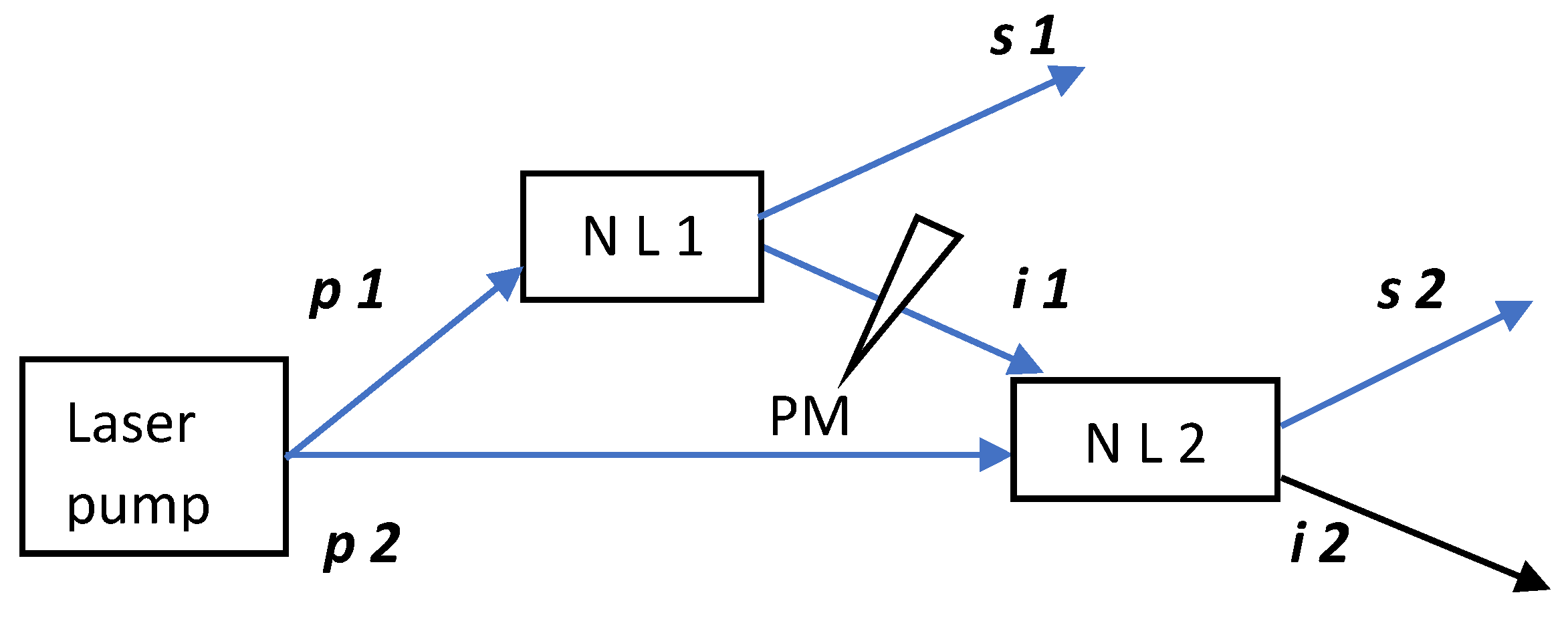
possessing parallel polarisations and impinging onto the same detecting area of efficiency , is given by [26]:
The only time-varying phase arises from the spontaneous emission of single photons which are amplified with a phase-pulling effect – see eq. (A1) – leading to
where the idler beam i1 is strong enough because of the unavoidable amplification in the nonlinear crystal NL1 and is injected alongside the pump p2 into the nonlinear crystal NL2 to cause a fast phase shift of the spontaneously emitted signal photons in NL2 with very little of its own change [27]. It is noteworthy that the phase difference of eq. (A3b) is a function of the pump phases and a bias or modulation phase . This approach of cross-phase pulling effect can be applied a few times over in the case of the experimental setup of ref. [1] while recognizing that repeated parametric amplifications can occur.
References
- Wang, K.; Hou, Z.; Qian, K.; Chen, L.; Krenn, M.; Aspelmeyer, M.; Zeilinger, A.; Zhu, S.; Ma, X.-S. Violation of Bell inequality with unentangled photons “. Sci. Adv. 2025, 31. [Google Scholar] [CrossRef] [PubMed]
- Cabbolet, M.; Caudano, Y. A paradox in the quantum-mechanical treatment of destructive measurements on photons “. J. Phys. Photonics 2025, 7, 045033. [Google Scholar] [CrossRef]
- Gent, E. “Quantum Computing’s Hard, Cold Reality Check: Hype is everywhere, skeptics say, and practical applications are still far away”. IEEE Spectrum. 22 Dec 2023. Available online: https://spectrum.ieee.org/quantum-computing-skeptics.
- Brooks, M. “The race to find quantum computing’s soft spot”. Nature 2023, Vol 617, S1–S3. [Google Scholar] [CrossRef] [PubMed]
- Kok, P.; Lovett, B. W. Introduction to Optical Quantum Information Processing; Cambridge University Press: Cambridge, UK, 2010. [Google Scholar]
- Brunner, N.; Cavalcanti, D.; Pironio, S.; Scarani, V.; Wehner, S. Bell nonlocality. Rev. Mod. Phys. 2014, 86, 419–478. [Google Scholar] [CrossRef]
- Iannuzzi, 7 M.; Francini, R.; Messi, R.; Moricciani, D. Bell-type Polarization Experiment With Pairs Of Uncorrelated Optical Photons”. Phys. Lett. A 2020, 384(9), 126200. [Google Scholar] [CrossRef]
- Ivashkin, A.; Abdurashitov, D.; Baranov, Al.; Guber, F.; Morozov, S.; Musin, S.; Strizhak, A.; Tkachev, I. “Testing entanglement of annihilation photons”. Sci. Rep. 2023, 13, 7559. [Google Scholar] [CrossRef] [PubMed]
- Vatarescu, Polarimetric Quantum-Strong Correlations with Independent Photons on the Poincaré Sphere. Quantum Beam Sci. 2022, vol. 6, 32. [CrossRef]
- Bell, J. S. “On the Einstein-Podolsky-Rosen paradox” in Speakable and Unspeakable in Quantum Mechanics; Cambridge University Press: Cambridge, England, 1989. [Google Scholar]
- Gordon, J. P.; Kogelnik, H. “PMD fundamentals: Polarization mode dispersion in optical fibers”. PNAS 2000, vol. 97(no. 9), 4541–4550. [Google Scholar] [CrossRef] [PubMed]
- Tipler, F. J. Quantum nonlocality does not exist. PNAS 2014, 111(31), 11281–11286. [Google Scholar] [CrossRef] [PubMed]
- Clauser, J. F.; Horne, M. A.; Shimony, A.; Holt, R. A. “Proposed experiment to test local hidden variables theories”. Phys. Rev. Lett. 1969, 23, 880–884. [Google Scholar] [CrossRef]
- Clauser, J. F.; Horne, M. A. “Experimental consequences of objective local theories”. Phys. Rev. D. 1974, 10, 526. [Google Scholar] [CrossRef]
- Ursin, R.; et al. Entanglement-based quantum communication over 144 km. In Nature Phys.; 2007; Volume 3, pp. 481–6. [Google Scholar]
- Santamaria Amato, L.; Katia Pallotti, D.; Siciliani de Cumis, M.; Dequal, D.; Andrisani, A.; Slussarenko, S. Testing the speed of spooky action at a distance in a table-top experiment. Sci. Rep. 2023, 13, 8201. [Google Scholar] [CrossRef] [PubMed]
- Giustina, M.; et al. ‘Significant-Loophole-Free Test of Bell’s Theorem with Entangled Photons. Phys. Rev. Lett. 2015, 115, 250401. [Google Scholar] [CrossRef] [PubMed]
- Shalm, L. K. ‘‘Strong Loophole-Free Test of Local Realism. Phys. Rev. Lett. 2015, 115, 250402. [Google Scholar] [CrossRef] [PubMed]
- Aspect, A. Closing the Door on Einstein and Bohr’s Quantum Debate. Physics 2015, 8, 123. [Google Scholar] [CrossRef]
- Bell, J. S. “Introduction to the hidden-variable question” in Speakable and Unspeakable in Quantum Mechanics, p. 38; Cambridge University Press: Cambridge, England, 1989. [Google Scholar]
- Garrison; Chiao, R.Y. Quantum Optics; Oxford University Press, 2008. [Google Scholar]
- Vatarescu, A. The Scattering and Disappearance of Entangled Photons in a Homogeneous Dielectric Medium. Rochester Conference on Coherence and Quantum Optics (CQO-11), 2019. [Google Scholar] [CrossRef]
- Vinogradov, P.; Shishkov, V. Y.; Doronin, I. V.; Andrianov, E. S.; Pukhov, A. A.; Lisyansky, A. A. Quantum theory of Rayleigh scattering. Opt. Express 2021, 29(2), 2501–2520. [Google Scholar] [CrossRef] [PubMed]
- Pan, J.-W.; Chen, Z.-B.; Lu, C.-Y.; Weinfurter, H.; Zeilinger, A.; Zukowski, M. Multiphoton entanglement and interferometry “. Rev. Mod. Phys. 2012, Vol. 84(No. 2), 777–837. [Google Scholar] [CrossRef]
- Zou, X. Y.; Wang, L. J.; Mandel, L. Induced coherence and indistinguishability in optical interference. Phys. Rev. Lett. 1991, 67, 318–321. [Google Scholar] [CrossRef] [PubMed]
- Vatarescu, A. “Instantaneous Quantum Description of Photonic Wavefronts and Applications”. Quantum Beam Sci. 2022, vol. 6(no. 4), Art. No. 29. [Google Scholar] [CrossRef]
- Vatarescu, A. The Quantum Regime Operation of Beam Splitters and Interference Filters. Quantum Beam Sci. 2023, vol. 7(no. 2 Art. No. 11). [Google Scholar] [CrossRef]
Disclaimer/Publisher’s Note: The statements, opinions and data contained in all publications are solely those of the individual author(s) and contributor(s) and not of MDPI and/or the editor(s). MDPI and/or the editor(s) disclaim responsibility for any injury to people or property resulting from any ideas, methods, instructions or products referred to in the content. |
© 2026 by the authors. Licensee MDPI, Basel, Switzerland. This article is an open access article distributed under the terms and conditions of the Creative Commons Attribution (CC BY) license (http://creativecommons.org/licenses/by/4.0/).
Copyright: This open access article is published under a Creative Commons CC BY 4.0 license, which permit the free download, distribution, and reuse, provided that the author and preprint are cited in any reuse.


