
Submitted:
27 May 2026
Posted:
28 May 2026
You are already at the latest version
Abstract
The influence of SNSs on individuals has become a central topic in contemporary research. Yet prior work has predominantly focused on private platforms while largely neglecting pro-fessional networks such as LinkedIn. Addressing this gap, the present study investigates whether passive LinkedIn use—defined as the non-interactive consumption of content—contributes to social media fatigue, a state of psychological exhaustion associated with social media engagement. Beyond examining this relationship, the study also advances the field methodology by introducing a behavioral report of LinkedIn use, the LinkedIn Activity Questionnaire (LAQ). The present study focuses specifically on the passive use of LinkedIn. Drawing on an online sample (N = 137) and validated measurement instruments, correlation analyses and parallel mediation models were employed to test the roles of both communica-tion overload and information overload as underlying mechanisms. The findings revealed a significant indirect effect via communication overload, whereas information overload did not serve as a mediator. Notably, both forms of overload were significantly associated with social media fatigue, while no direct relationship between passive LinkedIn use and fatigue emerged. These findings offer new insights into the mechanisms linking professional social network use and well-being. Finally, the findings are discussed including study limitations and future research directions.
Keywords:
professional social media
; social media fatigue
; communication overload
; information overload
; LinkedIn
1. Introduction
The use of social networking sites (SNSs) and how they influence the human psyche are topics that are increasingly being addressed in current research (Koh et al., 2024; Stangl et al., 2023). SNSs constitute a comprehensive subcategory of social media. While social media serves the purpose of creating and sharing content, SNSs focus on establishing relationships between users and facilitating the maintenance of these relationships (Matveev, 2024). SNSs have become indispensable today. They function as a means of communication and as platforms for the exchange of information (Kim et al., 2024).
Previous studies indicated that the influence of SNSs was both positive and negative depending on the variable considered (Koh et al. 2024). They exerted a positive impact by increasing satisfaction through establishing and maintaining emotional connections with friends as well as reducing feelings of loneliness, thereby improving social and psychological well-being (Mahapatra & Schatz, 2015; Brown et al., 2021; Dodemaide et al., 2021; Barker, 2009; Chan, 2018; Reimann et al., 2023)). However, they exerted also a negative impact on well-being. For example, they elicited fear of missing out (FoMO) and in general fostered anxiety symptoms and depressive tendencies (Ozimek & Bierhoff, 2019; Brandenberg et al., 2019; David & Roberts, 2023; Erliksson et al., 2020).
The way social media is used is likely to influence whether positive or negative consequences follow. In this context, a distinction has been drawn between active and passive use, respectively. Passive use refers to consuming content without social interaction (Frison & Eggermont, 2015). Active use, on the other hand, implies that individuals interact with other users (Aikins, 2021). Verduyn et al. (2015) demonstrated that passive Facebook use negatively affects emotional well-being. Furthermore, the study by Escobar-Viera et al. (2018) revealed a positive association between passive use and depression, while active use was in contrast associated with lower levels of depression.
Another negative consequence that can arise from the use of SNSs, and which has received increasing attention from researchers in recent years, is the experience of social media fatigue (Jabeen et al., 2023; Świątek et al., 2021). Ravindran et al. (2014, p. 2317) define social media fatigue as “a subjective, multidimensional user experience that encompasses feelings such as tiredness, irritation, anger, disappointment, reluctance, loss of interest, or reduced need/motivation in connection with various aspects of social media use and interactions.” Several studies link social media fatigue to the cognitive overload that can result from the use of SNSs. The sheer volume of information and messages transmitted by SNSs can thus lead to an inability to cope with them and, consequently, to social media fatigue (Ravindran et al. 2014, Bright et al. 2014; Cao & Sun 2017; Li et al. 2024).
Two key types of overloads are information overload and communication overload (Lee et al., 2015). Information overload describes a state in which users are confronted with more information than they can process (Eppler & Mengis, 2004; Ravindran et al., 2014). Communication overload, on the other hand, occurs when SNSs exceed the communication capacity of the respective user (Cho et al., 2011).
In addition to this cognitive level, social media fatigue also manifests on an emotional level, causing users to experience, for example, indifference, boredom, or a lack of interest when using SNSs (Yamakami, 2012; Lin, 2015; Zhang et al., 2016). Social media fatigue also often leads to a decrease in social media use, which manifests itself at the behavioral level. According to Revindran et al. (2014), this behavior is divided into three types of usage intent: reduced frequency of use, brief breaks and leaving the current social network or switching to another one.
Current research on the nature of social media use, its resulting psychological effects, and the phenomenon of social media fatigue has primarily focused on private SNSs (Zhang & Leung, 2014; Stangl et al., 2023; Koh et al., 2024). However, the use of professional SNSs, such as XING or LinkedIn, has also gained increasing attention in recent years (Utz & Breuer, 2016). While XING is widespread in Germany, Switzerland, and Austria, LinkedIn is used on a global scale (Thattil, 2023). LinkedIn currently has more than one billion members worldwide, making it the largest global professional SNS (LinkedIn, 2025). For this reason, and because LinkedIn places a stronger focus on the flow of information and exchange (Rätze, 2023)., LinkedIn is the platform on which our research is focused
Despite its growing relevance, empirical research on LinkedIn remains comparatively limited, particularly with regard to platform-specific behavioral assessment tools. Existing measures often fail to distinguish between professional and private SNS use or between different forms of LinkedIn engagement. There is also evidence that the use of professional SNSs can have negative consequences, such as higher depressive tendencies (cf. Ozimek & Bierhoff, 2019).
However, many studies focus primarily on private SNSs such as Facebook, Instagram, and WeChat, or address social media in general without concentrating on a specific platform (Baj-Rogowska, 2023). This disparity highlights the prevailing research gap regarding the focus on LinkedIn and how passive use, as well as resulting overload from usage, influences social media fatigue. Furthermore, passive use in the context of social media fatigue has often been addressed as an outcome rather than a predictor (Zhu & Bao, 2018; Tian et al., 2024). In addition, existing research lacks standardized behavioral measures specifically designed to assess LinkedIn use patterns, particularly passive LinkedIn use. Most prior studies have relied on generic social media measures or platform-unspecific self-reports, limiting the precise investigation of professional SNS behavior. To address this methodological weakness, the present study introduces the LinkedIn Activity Questionnaire (LAQ), a novel instrument developed to capture LinkedIn-specific usage behavior.
Accordingly, the present study contributes to the literature in two ways. First, it examines the relationship between passive LinkedIn use, overload, and social media fatigue within the context of professional SNSs. Second, it introduces the LinkedIn Activity Questionnaire (LAQ) as a platform-specific instrument for assessing LinkedIn usage behavior. The central research question is: Does passive LinkedIn use lead to increased social media fatigue, mediated by communication overload and information overload? The paper begins with a review of the current state of research and an explanation of key concepts. Based on this review, hypotheses are then derived and tested. Finally, the results are presented, interpreted, and discussed.
2. Theoretical Background
The theoretical analysis focuses on the LinkedIn platform and the relationship between passive use of SNSs and social media fatigue, as well as the problematic effects of communication overload and information overload.
2.1. LinkedIn
The LinkedIn platform was founded in 2002 and launched the following year (Shepherd, 2025). LinkedIn is the largest global professional network, with members in over 200 countries and regions (Shacklett & Hanna, 2025). The platform’s goal is to connect professionals worldwide, thereby increasing their productivity and success. To this end, LinkedIn offers opportunities to network with other users, promote oneself or one’s company, and publish content (Shepherd, 2025). Using the platform offers benefits for one’s professional career and has thus become a key tool for employees and recruiters (Bala, 2024). In addition to the benefits, research has also identified negative consequences of its use; for example, increased frequency of LinkedIn use has been associated with an increase in anxiety and depression (Jones et al., 2016). A study by Johnson and Leo (2020), which examined the relationship between LinkedIn use, ego depletion (i.e., mental exhaustion), and job searching via LinkedIn, found that the likelihood of a person feeling drained increases with the frequency of their LinkedIn use, while the likelihood of a successful job search decreases. These findings suggest that LinkedIn use can also have negative consequences and lead to a feeling of exhaustion.
To date, there has been little research on the phenomenon of social media fatigue that focuses exclusively on LinkedIn use. Only blog posts or posts on LinkedIn mention LinkedIn fatigue and suggest that users may suffer from it (McIntosh, 2021). However, there is hardly any reputable research on the topic, which is why this paper addresses it from a scientific perspective. The following section focuses on the central constructs of this research: social media fatigue.
1.2. Social Media Fatigue
Using social media can lead to increased fatigue. The cognitive effort required to actively engage with social media can deplete a person’s energy, leading to social media fatigue which describes the subjective feeling of tiredness and burnout resulting from social media activities (Ravindran et al., 2014). The experience of fatigue varies from person to person, as the same situation may lead to a mild feeling of tiredness in one person, while in another it may already result in a state of exhaustion (Ravindran et al., 2014). Social media fatigue is thus the self-reported subjective feeling of fatigue resulting from the use of SNSs (Lee et al., 2016). It is multidimensional, as the sensation can involve emotional, cognitive, and behavioral aspects Ravindran et al. (2013). These three dimensions are described next.
When people become overwhelmed by their use of social media, for example, through constant replying or additional external demands, this can manifest on a cognitive level as impaired reasoning, memory, and thinking. This is evident, for example, in a decline in academic performance or in making mistakes. Health issues may arise on an emotional and psychological level, such as depression, frustration, burnout, or anxiety. Finally, on a behavioral level, various reactions may occur, such as ceasing use or reducing engagement in interactions.
The likelihood that users will stop using the service increases with the severity of their fatigue (Maier et al., 2015; Xie and Tsai, 2020). Lin et al. (2020) describe ceasing use, reducing use in terms of frequency and duration, or a person’s thoughts about changing their use in these respects as discontinuous intention to use. Kim et al. (2024) posits that when users experience social media fatigue, they perceive the time they have spent on the platform in question as not sufficiently beneficial, which in turn negatively influences their attitude toward the platform. This negative attitude then fosters the intention to discontinue use.
The many features and possibilities of social media lead people to spend more time using these platforms and to devote energy and attention to managing the content and interactions (Maier et al., 2012). Users with higher usage intensity are more likely to experience social media fatigue (Luqman et al., 2017, Malik et al., 2020). Users may also have difficulty coping with the flood of information and communication on social media. This condition is referred to as social media overload (Maier et al., 2015 cited in Whelan et al., 2020, p. 869; Zhang et al., 2016). When processing social media content becomes overwhelming for a person, this can increase the likelihood of experiencing fatigue (Whelan et al., 2020). The following sections address overload as a contributing factor to social media fatigue.
2.3. Overload from SNSs
Overload is defined as a person’s subjective perception and assessment of the amount of people, information, and objects that they can no longer process (Saegert, 1973). There are various types of overload considered in the context of SNSs, such as system feature overload, information overload, social overload, communication overload, and connection overload (Grandhi et al., 2005; Zhang et al., 2016; Maier et al., 2014; Lee et al., 2016; LaRose et al., 2014).
- -
- System feature overload occurs when a social network is perceived as too complex for the specific task at hand, or when new features exhibit excessive complexity that is disproportionate to the increased technical effort or the heightened complexity of use (Karr-Wisniewski & Lu, 2010; Lee et al., 2016).
- -
- Connection overload describes the strain and stress associated with updating, maintaining, and constantly receiving messages, which can accompany the use of SNSs (LaRose et al., 2014).
- -
- When users feel they must provide too much social support to friends on SNSs, this can lead to social overload (Maier et al., 2014).
This study examines information overload and communication overload. These two types of overload are the focus of this research because, according to Cao and Sun (2017) and Lee et al. (2015), social media overload describes a state in which the intensive use of SNSs results in users being confronted with an extreme volume of communication requests and a high amount of information, leading to an excessive drain on users’ cognitive and energetic resources and exceeding their capacity to cope. Both types of overloads are considered stressors that can lead to negative consequences such as fatigue, discontinuation of network use, dissatisfaction, and emotional exhaustion (Maier et al., 2015; Ragu-Nathan et al., 2008; Tarafdar et al., 2011). For this reason, communication overload and information overload are two key aspects of social media overload.
The following sections explore these two aspects of overload in greater depth.
2.3.1. Communication Overload and Social Media Fatigue
Communication overload refers to a person’s subjective perception that their own processing capacity is being exceeded by requests for conversation and communication via SNSs (Saegert, 1973; Li et al., 2024). Constant communication can lead to an imbalance between users’ need for communication and their cognitive abilities, resulting in their inability to cope with the amount of communication requests (Cao & Sun, 2017; Li et al., 2024). Like social media fatigue, communication overload is subjective; thus, the same level of communication may be difficult for one person to manage and lead to fatigue, while another person may have no difficulty managing it and therefore becomes fatigued more slowly (Ravindran et al., 2014).
The increased amount of information, along with connections to and communication with more people, can influence users’ behavior and attention. (Saegert, 1973; Li et al., 2024). The disruption of attention in everyday life caused by frequent communication requests from SNSs can lead users to invest more energy in order to return to their original state after the interruption. This fosters the excessive consumption of cognitive energy, which in turn can lead to social media fatigue (Cao & Sun, 2017; Li et al., 2024).
2.3.2. Information Overload and Social Media Fatigue
Information overload caused by SNSs occurs when the amount of information that needs to be processed exceeds one’s information-processing capacity (Eppler & Mengis, 2004; Whelan & Teigland, 2013). One model that can be used to explain information overload is the limited capacity model (Zhang et al., 2021; Lang, 2000) which posits that people have a limited capacity to process information. If this capacity is exceeded, it can lead to negative consequences, such as increased stress levels, reduced decision-making ability, and cognitive overload. Being exposed to a variety of constantly updated content is likely to be experienced as an information overload. Attempting to cope with this flood of information from SNSs is likely to deplete cognitive resources leading to fatigue and exhaustion (Pang & Ruan, 2023; Shahrzadi et al., 2024; Lang, 2000).
The limited capacity model is relevant to research on information overload, as SNSs today exposes people to an unprecedented amount of information that often exceeds their processing capacity. Users' attempts to navigate the never-ending flood of information is likely to overwhelm their cognitive resources, which both can lead to problems understanding the information and difficulties in processing it (Ayyagari et al., 2011, Zhang et al. 2021). The Limited Capacity Model of Motivated Mediated Message Processing (LC4MP) also posits that humans have limited cognitive resources and that these resources are allocated to three processes:
- -
- encoding, that is, the reception and processing of information from media messages,
- -
- storage, that is, the transfer of encoded information into memory
- -
- and retrieval, that is, the ability to retrieve the stored information when needed (Lang, 2000; Lang 2009).
If online content contains a multitude of stimuli, this can lead to an overload of cognitive resources, potentially resulting in information being encoded more superficially, stored poorly, or recalled only unreliably (Lang, 2009). When processing messages from a network, resource allocation constantly adapts to the information load, changes in stimulus characteristics, motivational relevance, and the level of activation within the user’s motivational system, as well as their intentions and goals for using the network. Cognitive overload occurs when insufficient resources are available for one of the processes—namely, encoding, storage, or retrieval. Another relevant influencing factor is how many resources the message itself requires (Lang, 2009).
According to Kim et al. (2024), the nature of the overload may vary across different types of SNSs. A distinction is made between text-based and image-based SNSs. Platforms such as Threads and Twitter are considered text-based SNSs. They are characterized by the fact that communication and interaction take place primarily through text, even though multimedia is permitted (Davis, 2023; Pittman & Reich, 2016; Kim et al., 2017). Instagram and Pinterest, on the other hand, are considered image-based networks, as the focus is on videos and images (Kim et al., 2017). Users of text-based SNSs share opinions, news, and experiences and engage in conversations in the comments section (Kim et al., 2024). The large amount of text on text-based networks requires increased cognitive effort, which can have a positive effect on information overload and, consequently, potentially also on social media fatigue (Kim et al., 2024; Sheng et al., 2022).
As mentioned in the introduction, a key factor to consider in research on SNSs and their effects on mental health is the nature of usage itself (i.e., passive or active; cf., Frison & Eggermont, 2015; Aikins, 2021; Verduyn et al., 2015; Escobar-Viera et al., 2018). To date, passive use in particular has been associated with negative emotions (Burke et al., 2010; Deters & Mehl, 2012). Therefore, the following sections address the types of use and the relationships between passive use and the constructs discussed.
2.4. Passive Use of SNSs
In terms of usage patterns, a distinction is made between active and passive use. Passive use refers to viewing other users’ content without attempting to interact with them (Tosun, 2012; Chen et al., 2016). It includes viewing the feed, photos, and videos, as well as reading comments, but does not include commenting on or sharing content oneself (Frison & Eggermont, 2015; Erliksson et al., 2020). Active use, on the other hand, is characterized by posting, commenting, participating in groups, and sending messages (Aikins, 2021). The key difference between the two types of use is whether some form of communication takes place via the social network (Zhu & Bao, 2018).
Studies examining the potential effects of passive social media use have found that it can be associated with reduced subjective well-being and symptoms of social anxiety (Zhu & Bao, 2018). Furthermore, passive use can lead to envy and feelings of loneliness (Krasnova et al., 2013; Burke et al., 2010). In their study, Duvenage et al. (2019) showed that students had more difficulty recovering from negative emotions when they relied on passive digital behaviors to cope with daily stressors. Passive use is often associated with negative consequences for users’ mental health (Aalbers et al., 2019). One reason for this may be that passive use inhibits the user’s emotions internally (Verduyun et al., 2015). Active use, on the other hand, leads to emotions being expressed outwardly through interactions, which, according to emotion regulation theory, is central to strengthening existing relationships with friends and obtaining social support (Myruski et al., 2019; Farmer and Kashdan, 2012; Nolen-Hoeksema, 2012). Suppressing negative emotions, on the other hand, has been shown to be ineffective in reducing them, a finding that is also reflected in the study results discussed by Duvenage et al. (2019) including Farmer and Kashdan, 2012; Nolen-Hoeksema, 2012; Rasmussen et al., 2019.
With respect to LinkedIn current research focuses primarily on the potential career benefits that may result from it. It has been shown that passive LinkedIn use offers informational advantages, as it facilitates the identification of potentially relevant contacts and thus makes it easier to reach out to them in a targeted manner. This is referred to as ambient awareness and refers to the metacognitive knowledge of who knows whom and who knows what (Leonardi, 2015). Active use, on the other hand, offers more benefits in terms of career and job opportunities as well as one’s personal image, since social capital—that is, the resources derived from social relationships—can be leveraged to one’s advantage in one’s professional career (Davis et al., 2020). A study by Bontcheva et al. (2013) also showed that users who post more rarely perceive the amount of posts as excessive. However, there has been no in-depth examination of the relationship between passive LinkedIn use and its potential negative consequences.
Although LinkedIn is discussed as a platform in research on passive social network use and its outcomes, it has rarely been examined in isolation (Ravindran et al., 2014). Professional SNSs differ substantially from private SNSs in terms of communication goals, self-presentation, and networking behavior, making platform-specific operationalizations particularly important. One reason for this limited evidence may be the lack of platform-specific measurement instruments capable of capturing different forms of LinkedIn usage behavior. Existing measures of SNS use are often generalized across platforms and frequently do not differentiate sufficiently between passive and active forms of professional social networking behavior. To address this limitation, the present study introduces the LinkedIn Activity Questionnaire (LAQ), which was developed to assess LinkedIn-specific usage patterns with a particular focus on passive use.
2.5. The Relationship Between Passive Use, Overload, and Social Media Fatigue
Current research examining the link between social media fatigue and passive use focuses on social media fatigue and overload (Zhu & Bao, 2018; Bright et al., 2014). Ravindran et al. (2014), for example, argue that users change the nature of their usage to prevent social media fatigue. Consequently, when they feel overwhelmed, they limit their participation in the social network (Bright et al., 2015). Zhu & Bao (2018) also assumed that social media fatigue promotes passive use.
However, the effect of passive use on social media fatigue has not yet been explored in detail although some studies have examined the intention to use SNSs passively (Tian et al., 2024; Li et al., 2021), but not current usage behavior. The present study, on the other hand, examines individuals’ current usage behavior and aims to determine whether passive use can trigger social media fatigue, as passive use has been shown to have negative consequences for users’ mental well-being.
To determine whether the reverse effect also exists (media fatigue causing using behavior) and to address the existing research gap regarding the use of professional SNSs and social media fatigue and overload, this study examines the following research question: Does passive use behavior of LinkedIn lead to increased social media fatigue, mediated by both communication overload and information overload?
The research hypotheses are:
H1.
Passive LinkedIn use is positively associated with social media fatigue.
H2a.
Passive LinkedIn use is positively associated with communication overload.
H2b.
Passive LinkedIn use is positively associated with information overload.
H3.
Communication overload is positively associated with social media fatigue.
H4.
Information overload is positively associated with social media fatigue.
H5.
The positive relationship between passive LinkedIn use (IV) and social media fatigue (DV) is mediated H5a by communication overload (M1a) and H5b by information overload (M1b).
Note that we did not expect a direct influence of passive social media use on social media fatigue. In contrast, we assumed the occurrence of an indirect effect with communication overload on the one hand and information overload on the other hand as mediators between passive social media use and social media fatigue. Therefore, in our theoretical approach negative phenomena like communication overload and information overload represent the essential links between passive social media use and social media fatigue which represents a negative state which might have detrimental effects on successful social media use.
3. Method
A non-experimental, quantitative, one-time online questionnaire was employed to investigate the research question and hypotheses. The questionnaire was created and administered using the Unipark software. A pretest was conducted with n = 5 participants in order to identify ambiguities in content as well as technical errors. After the problems identified by the pretest were resolved, the official survey began on May 28, 2025, and ended on July 3, 2025. The average completion time of the questionnaire was 15.45 minutes. The survey was conducted in collaboration with another student, which is why the questionnaire collected data on constructs that are not considered in this report.
3.1. Participants
The questionnaire was shared via social media platforms such as WhatsApp, Instagram, and LinkedIn. In addition, friends and family members were personally asked to participate and invited to share the survey link. As an incentive for students to participate, they were compensated with subject hours. The sample is a. convenience sample which included participants who could be reached at the time the survey was conducted.
To determine the required sample size, a prior power analysis was conducted using the G*Power program (version 3.1.9.7). Since, in addition to the three central variables, a control variable, the duration of use, was to be taken into account, a necessary sample size of N = 132 was calculated for a multiple regression with four predictors, an effect size of f² = .15, a significance level of α = .05, and a power of 1 – β = .95.
To participate in the study, participants had to use LinkedIn and be of legal age. A total sample of 445 people was reached, meaning that 445 people opened the survey. However, only 31.46% completed the survey, resulting in a sample size of 140. However, three participants had to be excluded due to too many missing values, resulting in a final sample size of N = 137. Of the 137 individuals, 84 were female and 53 were male; no one identified as non-binary. The average age was 31.95 years with a standard deviation of SD = 10.04. The youngest participant was 21 years old and the oldest was 62 years old. Regarding the highest level of education, 75.18% of the participants reported holding an academic degree (Bachelor’s, Master’s, or Diplom), 24.09% reported a vocational diploma or high school diploma, and one person reported a secondary school diploma. 68.61% of the sample consisted of employees, 25.55% were students, 2.19% reported being self-employed, and 3.65% of the sample were job seekers at the time of the survey (Table B3). Most respondents (61.31%) reported working full-time (35 or more hours per week), while 14.6% were working students and 13.14% worked part-time (20 to fewer than 35 hours per week) (Table B5). The distribution of work experience presented a mixed picture. The majority of respondents had one to four years of work experience (32.1%), followed by those with five to ten years (17.5%) and 11-20 years (16.8%). 13.1% of the participants reported having less than one year of professional experience, while 7.3% had no professional experience at all. Longer periods of employment were less common; 9.5% of the participants reported having 21–30 years of professional experience, 2.9% had 31–40 years, and only 0.7% had 41–50 years (see APPENDIX A).
3.2. Materials
Participants were informed that participation was voluntary and that their identities would remain anonymous. They received information regarding the General Data Protection Regulation.
Demographic data was collected. The survey asked about age, gender, highest level of education, current employment status, ability to work, work experience, whether the respondent held a leadership role, the frequency of LinkedIn use per week, and which notification settings were enabled on LinkedIn. Next, LinkedIn usage was assessed. In addition, information overload, communication overload and social media fatgue were measured and participants were asked regarding their intention to discontinue use of LinkedIn.
All questionnaires used were translated from English into German by the study investigators using the backtranslation method by Brislin (1970) adapted to the LinkedIn context. For example, the term “Friends” was replaced with “Contacts” in the adapted version, since LinkedIn is a professional rather than a personal social network. Similarly, “friend requests” were rephrased as “connection requests.”.
To measure (passive) LinkedIn use, we developed the LinkedIn Activity Questionnaire (LAQ) (see APPENDIX D). We derived the new measure from the XING Activity Questionnaire (XAQ) by Brandenberg et al. (2019). The XAQ originally contained 27 items including the following six subscales: Watching Compare (α = .87), Watching Inform (α = .77), Acting Global (α = .83), Acting Dyadic (α = .73), Acting Career (α = .80), and Impressing (α = .74). The Watching Inform and Watching Compare scales represent passive use, while the other scales reflect active use. The 27 items exhibited an overall internal consistency of α =. 92 in the previous study. In the present study, we have adapted the XAQ items with respect to LinkedIn deriving the LAQ.. Exploratory factor analysis suggested a three-factor structure of the LAQ including 24 items representing the following subscales: Passive Use, Active Use, and Career Management. Because passive use is a key factor in our hypotheses, we have focused on this subscale in the statistical analyses.
Information overload was measured using the questionnaire developed by Zhang et al. (2016), which has a good Cronbach’s alpha value of α = .86. The questionnaire consists of four items, and responses are rated on a seven-point Likert scale (ranging from “strongly disagree” to “strongly agree”). An example item from the questionnaire is: I am often distracted by the excessive amount of information available to me on LinkedIn.
The questionnaire developed by Lee et al. (2015) was used to assess communication overload. The Cronbach’s alpha value for this questionnaire is α = .82, which is considered good. It contains five items on a seven-point Likert scale (from “strongly disagree” to “strongly agree”) and was measured, for example, by the following item: I receive more messages and updates from contacts on LinkedIn than I can handle.
The questionnaire developed by Zhang et al. (2021) was used to measure social media fatigue by 15 items, with five items each corresponding to the behavioral, emotional, and cognitive levels. One item on the behavioral level is: I find it difficult to come up with good ideas for posts on LinkedIn. An item measuring the emotional level is: I feel nervous when I receive connection requests on LinkedIn. And an item measuring the cognitive level is: I am often overwhelmed by the amount of information available on LinkedIn. McDonald’s Omega was calculated for internal consistency, yielding a value of ω = .83. The subscale for cognitive fatigue yielded a value of ω = 0.61, for behavioral fatigue ω = 0.76, and for emotional fatigue ω = 0.71. Responses were given on a seven-point Likert scale (strongly disagree to strongly agree). Values of .80 and above are considered as good, values of .70 or higher are considered as acceptable, and values of .60 or lower indicate limited reliability (McNeish, 2017; Hair, 2014).
Discontinuous usage intention was measured using the questionnaire developed by Kim et al. (2024), which consists of four items and is rated on a five-point Likert scale (ranging from “strongly disagree” to “strongly agree”). One item on this scale, for example, reads: If I could, I would stop using LinkedIn. The reliability and validity of the scale were calculated using composite reliability and average variance extracted, with values of CR = .875 and AVE = .64. The CR value indicates high internal consistency, and the AVE suggests good convergent validity (Fornell & Larcker, 1981; Hair, 2014).
3.3. Statistical Analysis
The statistical analysis was conducted using R Studio (version 4.4.2). To develop the LinkedIn Activity Questionnaire Items from the XAQ were adapted with respect to LinkedIn. Factor analysis was employed to derive independent subcales. Both analytical and interpretive objectivity are given (Moosbrugger & Kelava, 2020). Finally, for the constructs of communication overload, information overload, discontinuous usage intention and for the Social Media Fatigue Scale mean scores were calculated for each participant across the respective items and a total score was computed.
To test hypotheses H1, H2a, H2b, H3, and H4, a Pearson product-moment correlation was calculated for metric variables (Rasch et al., 2014). Calculating these correlations allows for the examination of bivariate relationships between the relevant variables. The prerequisites were checked prior to the calculation. To this end, the variables were tested for normal distribution using skewness, kurtosis, and the Shapiro-Wilk test., The test was two-tailed at a significance level of p <.05. A correlation of .10 is interpreted as a weak effect, a value of .30 or higher is considered a moderate effect, and a correlation value of .50 or higher is classified as a strong effect (Bortz & Döring, 2013).
To test H5, a parallel mediation analysis was conducted. The PROCESS model by Hayes (Hayes, 2017) was used for this purpose. Passive LinkedIn use was the independent variable (IV), social media fatigue was the dependent variable (DV), communication overload represented mediator one (M1), and information overload represented mediator two (M2). In addition, frequency of use was included as a covariate, because it may influence the experience of social media fatigue, requiring control for this variable (Luqman et al., 2017; Malik et al., 2020). Bootstrapping was used to estimate the indirect effects, with 10,000 samples drawn. A bias-corrected 95% confidence interval was also used. An indirect effect is interpreted as significant if the confidence interval does not include the value zero.
At the correlational level, the relationship between social media fatigue, communication overload, information overload, passive LinkedIn use and frequency of use was examined in relation to discontinuous usage intention. Confirmation of statistical assumptions was first tested employing a significance level of p < .05.
Internal consistency was calculated for all scales and an exploratory factor analysis was also conducted. For the LinkedIn Activity Questionnaire, this was done to determine which items reflect passive usage behavior and which reflect active usage behavior. The exploratory analysis was performed using principal axis factor analysis with oblique rotation for the scales to examine their dimensional structure. The number of factors to be extracted was determined in each case using a parallel test. Prior to this, the suitability of the data for factor analysis was verified using the Kaiser-Meyer-Olkin (KMO) test and Bartlett’s test (Kaiser, 1974). The evaluation of Cronbach’s alpha was based on the thresholds established by Georg and Mallery (2016) as well as Moosbrugger and Kelava (2020), according to which values of .70 or higher are classified as acceptable and values of .80 or higher are considered as good.
4. Results
The findings of the exploratory factor analysis, the descriptive and inferential statistical analyses, and the results of the exploratory analysis are discussed and presented in the following sections.
4.1. Exploratory Factor Analysis of the Scales
The LinkedIn Activity Questionnaire (KMO = .82) and the Social Media Fatigue Scale (KMO = .84) yielded good values, the Communication Overload Scale (KMO = .76) yielded an acceptable value, and the Information Overload Scale yielded a nearly acceptable value (KMO = .68). All Bartlett’s tests were significant (p < .001), so the data can be considered suitable for factor analysis overall (see APPENDIX B).
For the LinkedIn Activity Questionnaire, the parallel test yielded a four-factor solution. Given the conceptual similarity of the items and the exploratory purpose of the analysis, these items were combined into a single passive-use factor. Items that loaded onto factors 1 and 3 were thus combined into a single factor based on content considerations (i.e., Factor 1 = Passive LinkedIn Use) resulting in a preliminary three-factor solution adopted for exploratory purposes. Passive use is represented by eleven items (BV_1, BV_2, BV_3, BV_4, BV_5, BV_6, BI_1, BI_2, II_3, SD_3, SD_4) (Table C2). The internal consistency of the scale is good, with a Cronbach’s alpha of α = .87 (Table C1). These findings provide initial support for the internal consistency and structural differentiation of the passive-use dimension of the LAQ (see APPENDIX C).
An exploratory factor analysis was also conducted for the Social Media Fatigue Scale (Table B3). As in the original version, this yielded three factors. Factor one included all items from the cognitive level as well as one item from the emotional level. However, not all items loaded onto factors two and three as they did in the original version. Based on the content of the items, it became apparent that all items in factor two were related to forgetting something or addressed negative emotions toward LinkedIn. In factor three, only two items loaded well, both of which addressed not knowing what to post. However, to assess how well the items represented the originally intended dimensions, Cronbach’s alpha was calculated for the original structure. The cognitive scale exhibited good internal consistency (α = .88), while the behavioral scale showed only moderate and questionable consistency (α = .69), whereas the emotional scale had acceptable internal consistency (α = .72). The Social Media Fatigue Scale showed good overall internal consistency with α = .87 (Table C1). The internal consistency of the Communication Overload Scale was α = .83 (Table C1), which is considered good; the parallel analysis suggested a two-factor solution (Table B4). The Information Overload Scale showed acceptable internal consistency of α = .77 (Table C1). The scale for measuring discontinuous usage intention had acceptable internal consistency of α = .73 (Table C1). The Information Overload Scale proved to be unidimensional (Table B5).
4.2. Descriptive Statistics
Following the exploratory factor analyses, descriptive statistics were calculated. First, the weekly frequency of use yielded a median of Md = 2.0, which corresponds to one to two hours of use. However, 38.7% of the participants reported using LinkedIn for less than one hour per week. 31.4% of the participants used LinkedIn for one to two hours per week, while 23.4% spent three to four hours per week on LinkedIn. Only 5.8% reported spending five to six hours per week online on LinkedIn, and only one person used LinkedIn for seven to nine hours per week (Table A1). To assess passive usage, a mean score of the passive items was calculated for each person. This resulted in a mean of M = 2.79 (SD = 0.66). This procedure was applied to all scales. The mean score for communication overload was M = 2.89 (SD = 1.3), and for information overload it was M = 3.88 (SD = 1.21). For social media fatigue, a mean of M = 3.04 (SD = 0.98) was calculated across all items. The mean for discontinuous usage intention was M = 2.45 (SD = 0.84) (Table B6).
Table 1 summarizes the means and standard deviations for each subscale.
4.3. Hypothesis Testing
First, the preconditions for performing a parallel mediation analysis for all key variables were examined.
4.3.1. Correlation Analyses
Bivariate Pearson correlations were calculated between the key variables. The analyses revealed that passive LinkedIn use was not significantly correlated with either information overload (r(137) =.015, p =.859) or social media fatigue (r(137) = .017, p = .841). Hypotheses H1 and H2b could therefore not be confirmed. A significant, albeit only weakly positive, correlation was found between passive use and communication overload r(137) = .183, p = .033. Hypothesis H2a was therefore confirmed. There was a moderate and significant correlation between communication overload and social media fatigue (r(137) = .524, p < .001), which confirms Hypothesis H3. Similarly, a strong positive correlation was found between information overload and social media fatigue, r(137) = .646, p < .001, thus confirming Hypothesis H4. To account for the potential influence of the control variable (weekly usage frequency), partial correlations were also calculated. Even when controlling for this variable, the described relationships remained intact. Only a slight increase in the correlation coefficient between passive LinkedIn use and social media fatigue emerged; however, the relationship did not remain significant. The correlation between passive LinkedIn use and communication overload also increased slightly. The other correlation coefficients remained virtually unchanged. Thus, hypotheses H2a, H3, and H4 were confirmed, while H1 and H2a were refuted (Tables C3 and C4).
4.3.2. Parallel Mediation Analysis
The mediation model focused on social media fatigue as dependent variable. The parallel mediation analysis, with passive LinkedIn use as the predictor, social media fatigue as the criterion variable, and communication overload and information overload as parallel mediators, yielded a significant overall model, F (3;133) = 39.551, p < .001, with an explained variance of R² = .472. Thus, the model explains remarkable 47.2% of the variance of Social Media Fatigue.
How is social media fatigue determined? The total effect of passive LinkedIn use on social media fatigue was not significant, β = .017, 95% CI [-.228, .279], p = .841. The direct effect of passive LinkedIn use on social media fatigue was also not significant, β = -.041, BC 95% CI [−0.248, 0.135], p = 0.528. The indirect effect via both mediators was also not statistically significant, because the confidence interval included the value zero, β = 0.058, BC 95% CI [−0.072, 0.188].
However, passive LinkedIn use was in correspondence with H5a a significant predictor of communication overload, β = .183, 95% CI [.019, .676], p = .033, whereas, in contrast to H5b, no significant association was found with information overload, β = .015, 95% CI [-.308, .347], p = .859. Communication overload proved to be a significant predictor of social media fatigue (β = .275, 95% CI [.082, .336], p < .001), as did information overload (β = .507, BC 95% CI [.292, .532], p < .001). Finally, an indirect effect via communication overload was obtained in correspondence with H5a (β = .050, BC 95% CI [.002, .117]), but not via information overload (in contrast to H5b; β = .008, 95% CI [−0.085, 0.100]). Therefore, only communication overload (but not information overload) mediated the influence of passive media use on social media fatigue.
In summary, these results indicate that the relationship between passive LinkedIn use and social media fatigue was mediated by communication overload, but not by information overload. Hypothesis H5b was therefore rejected whereas H5a was confirmed. Note that communication overload constitutes the key type of disturbance between passive media use and social media fatigue. Therefore, the influence of passive media use on social media fatigue might be mitigated by avoiding the occurrence of communication overload.
Even after including the covariate “frequency of LinkedIn use per week,” the model fit and the direct effects of communication overload and information overload on social media fatigue remained virtually unchanged. The total indirect effect across both mediators increased slightly; however, the confidence interval continued to include the value zero and thus remained statistically insignificant. The H5 hypothesis tests are summarized in Figure 1.

Note. Note: m = 10,000; bootstrap intervals in square brackets; frequency of use (β = .117, 95% BC CI [-.014; .247]) as a covariate showed no significant effect on the statistical mediation model. p < .05*, p < .01**, p < .001***.
4.3.3. Exploratory Analysis
The correlation between social media fatigue and the intention to discontinue use was significant and moderately positive, r(137) = .564, p < .001; the relationship remained significant and moderately positive even when controlling for duration of use, r(137) = .555, p < .001. Communication overload also showed a significant positive correlation with discontinuous usage intention r(137) = .288, p < .001, as did information overload r(137) = .390, p < .001. Passive LinkedIn use revealed a weak negative and statistically insignificant correlation with discontinuous usage intention r(137) = -.114, p > .05; the same applies to weekly usage frequency r(137) = -.156, p > .05 (Table D3).
4.4. Post-Hoc Power Analysis
To assess the statistical power of the reported effects, a post-hoc power analysis was performed using the p-checker app (see https://shinyapps.org/apps/p-checker/). To calculate the success rate, the median observed power, the inflation rate and the R-index, the Test of Excess Significance (TES) and the Test of Insufficient Variance (TIVA) were used. Six hypothesis-oriented effects were considered (five t-values and one F-value) (Schimmack, 2018).
The TES analysis yielded a success rate of .667; this result reflects that half of the hypotheses were confirmed, and the overall model was significant. The median observed power was .785, which is slightly below the benchmark of .80 for sufficient test power according to Cohen (1988). The inflation rate was -.1186, suggesting that fewer hypotheses were confirmed than would be expected based on the observed power. The calculated R-index was .904, meaning that the present findings could theoretically be well replicated in follow-up studies. The values suggest relatively high replicability and sufficient statistical power. For the TIVA, the result was χ²(5) = 102.585, p = 1, var = 20.517, indicating that there were no biases.
5. Discussion
5.1. Summary and Interpretation of the Results
Hypotheses H1 and H2b could not be confirmed, because the bivariate correlations showed that passive LinkedIn use was not significantly associated with either information overload or social media fatigue. Hypothesis H2a, on the other hand, was confirmed, because a significant association between passive LinkedIn use and communication overload was observed. In addition, a moderate to strong association between both overload dimensions and social media fatigue was obtained confirming H3 and H4. Therefore, both types of overload played a central role in the experience of social media fatigue.
Even after controlling for frequency of use, the key associations remained unchanged. It is particularly noteworthy that the association between passive LinkedIn use and information overload increased slightly when controlling for the covariate. The parallel mediation analysis provided further insights. The overall model was significant, but the total and indirect effects were not. The findings indicate a significant indirect pathway via communication overload, while the overall indirect effect remained non-significant. The research question of this study was therefore not unequivocally confirmed. The exploratory analyses revealed a moderate and stable association between social media fatigue and the intention to discontinue use, suggesting potential behavioral consequences of social media fatigue. Users who experience greater fatigue from SNSs thus have a heightened intention to reduce or discontinue their use. The overload dimensions also showed a correlation with the intention to discontinue use; however, passive LinkedIn use and frequency of use showed no correlation with the intention to discontinue use.
5.2. Discussion
Previous research has been criticized in part due to methodological and conceptual weaknesses and problematic operationalizations (Meier & Krause, 2022; Valkenburg et al., 2021; Ellison et al., 2020). The present study introduces the LinkedIn Activity Questionnaire (LAQ) as a platform-specific measure of LinkedIn usage behavior. Given recent criticism regarding overly broad or inconsistent operationalizations of active and passive social media use, the development of this platform-sensitive behavioral measure contributes to the improvement of the measurement of professional SNS usage patterns. The good internal consistency of the passive-use dimension provides initial support for the usefulness of the inventory with respect to LinkedIn-specific passive usage behavior.
In general, empirical evidence is available both for and against the notion that passive usage behavior negatively influences well-being. A study by Zhang et al. (2020) showed that both types of use might foster the experience of negative emotions. Note that active and passive use tend to be strongly associated with one another (Meier & Krause, 2022). It could therefore also happen that active use can lead to negative consequences such as social media fatigue.
The lack of a significant association between passive LinkedIn use and information overload might be due to the fact that LinkedIn is generally used less frequently (Bontcheva et al., 2013). This conclusion corresponds with the fact that users post on LinkedIn less than on private SNSs. A study by Bontcheva et al. (2013) found that 73.4% of users of professional SNSs were able to manage their feed, and only 26.6% reported occasionally missing posts or losing track of them. This study also found no significant correlation between reading posts and information overload. The participants reported feeling less overwhelmed by professional SNSs than by private SNSs, although they did not necessarily cope better with the amount of posts. The usage frequency also reflects this infrequent use of the platform in our study, as the majority of users spend less than one hour per week or just one to two hours per week on LinkedIn.
Furthermore, fewer posts are formulated on professional platforms. In the study by Bontcheva et al. (2013), 88.3% of participants reported posting monthly or less frequently, while 70.3% posted at least weekly on private SNSs. Based on this, it can be assumed that the lower usage intensity and reduced amount of posts compared to private SNSs resulted in a lower likelihood of information overload. In the present study, after controlling for covariates, it was found that higher usage frequency was associated with less communication and information overload, which could be attributed to the fact that LinkedIn users who use the network more regularly stay better informed and are thus not confronted with too much new information and communication requests when using it (Bontcheva et al., 2013).
The fact that passive use of LinkedIn is significantly linked to information overload may be since passive use precludes interaction via SNSs, and thus any form of communication including communication requests is perceived as unwanted by passive users. The goal of LinkedIn is to connect users (Shepherd, 2025). Individuals who consciously use LinkedIn passively because they do not wish to interact may feel overwhelmed by LinkedIn’s focus on exchange through connection requests and messages, as this exhausts their capacity (Saegert, 1973; Li et al., 2024). If a person has a low need for communication, the LinkedIn platform and its features may elicit an imbalance between the person’s low need for communication and the occurrence of many communication opportunities and requests on the LinkedIn platform.
In correspondence with previous research both dimensions of overload have a significant influence on the experience of social media fatigue (see also Kim et al., 2024; Adhikari & Panda, 2019; Baj-Rogowska, 2023). If users are exposed to an excess of communication and too much information through LinkedIn, the resulting cognitive overload is likely to elicit social media fatigue (Bright et al., 2015; Lee et al., 2016). This suggests that professional SNSs elicit the risk of arousing media fatigue through their use.
The finding that social media fatigue is linked to an intention to discontinue use—that is, an increased likelihood of reducing or ceasing use—is also consistent with previous research findings (Ravindran et al., 2014; Zhang et al., 2016). Therefore, social media fatigue resulting from the use of LinkedIn might elicit discontinuous usage intentions among LinkedIn users.
Users might perceive the benefits of LinkedIn to be too small compared to the resources it costs them to continue using the platform. Explanations for this phenomenon are offered by models such as the Cognitive Load Theory (Sweller, 1988) and the Stressor-Strain-Outcome model (Koeske & Koeske, 1993). According to the Stress-Strain-Outcome model, the two dimensions of overload represent the stressors, social media fatigue represents the strain, and the reduction in usage represents the outcome. For a professional network like LinkedIn, this could mean that it might happen that the perceived burden is no longer proportional to the professional benefits.
In this context, the Theory of Planned Behavior offers another explanatory framework (Ajzen, 1991). This theory assumes that individuals who perceive their behavioral control over an action as high are more likely to perform that action, even when faced with challenges related to it. Accordingly, reducing stressors associated with SNSs is likely to improve perceived behavioral control. Consciously managing one’s engagement with a social network is likely to lead to a reduction in overload and fatigue. Thus, greater control might influence the decision whether or not to continue using a social network.
In summary, the results of this study suggest that, with regard to passive LinkedIn use, it is not so much the high amount of information (= information overload) but rather the communication overload that serves as a mediating factor in the experience of social media fatigue.
5.3. Limitations and Outlook
An advantage of this study is that the negative effects of passive media use are divided into communication overload and information overload. Therefore, it was possible to investigate two pathways of mediation between passive media use and social media fatigue and to identify the crucial role of communication overload. But the present study does not allow causal analysis because of its cross-sectional design (Setia, 2016). Follow-up studies might therefore employ longitudinal or experimental designs in order to facilitate causal analysis of the results. Furthermore, the current study did not account for the participants’ private social media usage. The participants’ general usage pattern might have influenced the results. But the occurrence of such an influence is unlikely because the formulation of the items regarding LinkedIn usage were rephrased to counteract this problem.
The sample investigated in this study is largely homogeneous in terms of usage frequency. Most participants reported using LinkedIn for less than one to two hours per week. This low frequency of use might reduce the intensity of perceived overload and social media fatigue. It is therefore possible that the expected effects would be more pronounced with more frequent use (Luqman et al., 2017; Malik et al., 2020). Future research should therefore aim for a heterogeneous distribution of usage frequency to increase representativeness of the sample.
The scales used generally exhibited satisfactory internal consistency; however, the behavioral subscale of the Social Media Fatigue Scale showed only moderate reliability. Furthermore, some items were reclassified on the basis of the results of the exploratory factor analysis. This procedure should be validated in future studies through confirmatory analyses.
The questionnaires used for the measurement of the two overload dimensions were developed in Asia. Consequently, they were not formulated according to German standards, which may have had a negative impact, as some items consist of long sentences and contain various adverbs. Therefore, the items were not always formulated as concisely and precisely as possible (Benlidayi & Gupta, 2024). Furthermore, cultural differences were not considered, which is problematic, for example, when translating idioms and colloquial expressions (Beaton et al., 2000). Furthermore, a common-method bias may exist, as both the predictors and the criterion were collected using the same questionnaire (Rodríguez-Ardura & Meseguer-Artola, 2019).
Note that the statistical analysis did not distinguish between whether individuals used the platform purely passively or whether they used LinkedIn both actively and passively. For this reason, and due to the aforementioned divergences in the research regarding the active/passive dichotomy, future research should examine whether active use or the use of LinkedIn in general has an influence on the experience of social media fatigue (Meier & Krause, 2022). Furthermore, future research could determine whether the research question of this study applies to users who use LinkedIn exclusively in a passive manner.
When examining the outliers, it was noted that there were individuals whose overload scores were higher than their levels of social media fatigue. One reason for this could be that the individuals who perceive this overload are already taking steps to counteract social media fatigue through their behavior. Therefore, qualitative research would be of interest for follow-up studies.
Longitudinal studies would be a promising methodological approach in future research (Maxwell & Cole, 2007). Follow-up studies could also examine the individual dimensions of social media fatigue more closely. The present study indicated that the emotional subscale elicited on average the lowest scores. follow-up studies could build on this finding.
Additionally, the LAQ is currently be regarded as a preliminary measurement device. Although its passive-use dimension demonstrated good internal consistency, further validation using confirmatory factor analysesand larger samples is desirable.
5.4. Theoretical and Practical Implications
Beyond the theoretical contributions, the present study also contributes methodologically by introducing the LAQ as a preliminary LinkedIn-specific behavioral measure. Given the increasing relevance of professional SNSs, platform-specific operationalizations may facilitate more differentiated investigations of professional social networking behavior in future occupational health research.
At the theoretical level, the findings of this study contribute to the further development of existing models, as communication overload serves as a key mediator between passive LinkedIn use and social media fatigue. Information overload is not a mediator, but it is also significantly associated with social media fatigue. The results suggest that the use of professional SNSs is likely to lead to communication overload when users engage with the platform passively. The results are explained by models such as the Stress-Strain-Outcome model or the Limited Capacity model and are integrated within convincing theoretical approaches in this field of research (Sweller, 1988; Koeske & Koeske, 1993).
In practice, social media fatigue is interpreted as a sign that an individual’s threshold for social media stress has been exceeded, which can lead to withdrawal from the platform or taking more frequent breaks (Maier et al., 2015). In an organizational context and for HR managers, the results of this research offer opportunities to promote healthy user behavior among employees, for example through training on self-regulation, notification management, and stress management, thereby counteracting fatigue in the long term (Peper & Harvey, 2018; Supriyadi et al., 2025). Individuals who feel fatigued by digital technologies should set limits for themselves and recognize that disconnecting from digital technologies, as well as taking breaks and practicing self-regulation, represent important interventions (Peper & Harvey, 2018). The present research revealed a mediating relationship between passive LinkedIn use, communication overload, and social media fatigue. Affected individuals should learn strategies to counteract this communication overload. To do so, users are adviced to pay attention to their personal needs, for example by disabling notifications or taking scheduled breaks to counteract the perceived overload (Reinecke & Oliver, 2016).
The importance of this topic in the workplace is supported by a study by van Zoonen and Rice (2017), which highlighted that while the use of social media for work-related purposes may be associated with greater autonomy, it is also linked to increased work pressure. Furthermore, a connection was revealed between social media use, autonomy, and exhaustion. The use of social media for work tends to intensify the work experience, which in turn is likely to be associated with increases in stress caused by interruptions or unpredictability (van Zoonen & Rice, 2017; Chesley, 2014).
A key influencing factor seems to be individuals’ responsiveness. Lower responsiveness has a positive impact on autonomy and exaggerated work engagement; however, in the long term, it does not necessarily lead to a reduced workload due to the constant flow of information and communication requests (van Zoonen & Rice, 2017).
According to Gibbs et al. (2013), a high amount of information and frequent communication due to the amount of content to be processed leads to a forced detachment from work. This underscores the urgency for organizations and users themselves to take action to address this issue. From the perspective of the LinkedIn platform itself, countering fatigue constitutes a strategic challenge, as a link between social media fatigue and discontinuous usage intent has been demonstrated. Therefore, the platform might introduce features that give users more control over the frequency of interactions and communications (Ruiz et al., 2024).
In conclusion, this study has provided new insights into the relationship between passive use of professional SNSs and the experience of social media fatigue, as well as the mechanisms underlying this relationship. Our findings provide key insights into the understanding of passive LinkedIn use and social media fatigue because passive use via communication overload elicits social media fatigue which is connected with detrimental effects.
In general, the findings of correlation analyses and mediation analysis have yielded both theoretical and practical implications that can lead to improvements in the practical use of professional SNSs. In addition, theis study employed a promising new measurement device regarding the assessment of LinkedIn-specific usage behavior by the LinkedIn Activity Questionnaire.
Author Contributions
Conceptualization, P.O., H.S., E.B. and E.R.; methodology, P.O., A.S., E.B.; validation, P.O. and E.R.; formal analysis, P.O., A.S., E.B; investigation, A.S., E.B.; resources, E.R.; data curation, P.O., E.R..; writing—original draft preparation, P.O., A.S., E.B.; writing—review and editing, P.O., A.S., E.B, D.H. and H.W.B.; visualization, A.S.; supervision, P.O.; project administration, E.R. and P.O. All authors have read and agreed to the published version of the manuscript.
Funding
This research received no external funding.
Institutional Review Board Statement
The study was conducted in accordance with the Declaraion of Helsinki, and approved by the Local ethical committee of Ruhr University of Bochum, approval code: 595, approval date: 3 November 2019.
Informed Consent Statement
Informed consent was obtained from all subjects involved in the study.
Data Availability Statement
The dataset generated and analyzed during the current study is available in the OSF repository: XXX (will be made visible after acceptance of the paper).
Conflicts of Interest
The authors declare no conflict of interest.
Appendix A. Supplementary Descriptive Statistics
The following tables present the descriptive statistics for the calculations performed in the study.

Table A1.
Frequency of LinkedIn use per week.
| N | % | |
|---|---|---|
| Less than 1h | 53 | 38.7% |
| 1-2h | 43 | 31.4% |
| 3-4h | 32 | 23.4% |
| 5-6h | 8 | 5.8% |
| 7-9h | 1 | 0.7% |
Note: N= 137.
Table A2.
Descriptive statistics on the highest level of education attained.
| N | % | |
|---|---|---|
| Junior High School Diploma | 1 | 0.73% |
| Vocational Diploma/High School Diploma | 33 | 24.09% |
| Academic degree (Bachelor's, Master's, Diploma) | 103 | 75.18% |
Note: N= 137.
Table A3.
Descriptive statistics on Employment Status.
| N | % | |
|---|---|---|
| Student | 35 | 25.55% |
| Employee | 94 | 68.61% |
| Self-employed | 3 | 2.19% |
| Job seeker | 5 | 3.65% |
Note: N= 137.
Table A4.
Descriptive statistics on Work Experience -.
| N | % | |
|---|---|---|
| No work experience | 10 | 7.30% |
| Less than a year | 18 | 13.14% |
| 1-4 years | 44 | 32.12% |
| 5-10 years | 24 | 17.52% |
| 11-20 years | 23 | 16.79% |
| 21-30 years | 13 | 9.49% |
| 31-40 years | 4 | 2.92% |
| 41-50 years | 1 | 0.73% |
Note: N= 137.
Table A5.
Descriptive statistics on Work Capacity -.
| N | % | |
|---|---|---|
| Unable to Work | 8 | 5.84% |
| Part-time employment (mini-job) | 7 | 5.11% |
| Working student | 20 | 14.60% |
| Part-time (20 to less than 36 hours per week) | 18 | 13.14% |
| Full-time (35+ hours per week) | 84 | 61.32% |
Note: N= 137.
Table A6.
Descriptive statistics for the scales.
| N | Min. | Max. | M | SD | |
|---|---|---|---|---|---|
| Passive use | 137 | 1.18 | 4.55 | 2.79 | .66 |
| Social Media Fatigue | 137 | 1 | 5.78 | 3.04 | .98 |
| Communication overload | 137 | 1 | 6.6 | 2.89 | 1.3 |
| Information overload | 137 | 1.5 | 7 | 3.88 | 1.21 |
| Intended use | 137 | 1 | 5 | 2.45 | .84 |
Note: N= 137.
Appendix B. Exploratory Factor Analyses and Reliability Analyses
The following tables present the results of the exploratory factor analysis conducted as part of the study.
Table B1.
Descriptive statistics for the scales.
| KMO | χ² | df | p | |
|---|---|---|---|---|
| LAQ | .82 | 1359.0 | 276 | <.001 |
| Social Media Fatigue | .84 | 851.58 | 105 | <.001 |
| Communication overload | .76 | 274.75 | 10 | <.001 |
| Information overload | .68 | 214.25 | 6 | <.001 |
Note: KMO = Kaiser-Meyer-Olkin-Test, χ²= Bartlett-test for sphericity.
Table B2.
Exploratory factor analysis of the LinkedIn Activity Questionnaires: Structure matrix.
| Items | Factor 1 | Factor 2 | Factor 3 | Factor 4 |
|---|---|---|---|---|
| AG_1 | .741 | .214 | ||
| AG_2 | .660 | |||
| AG_3 | .643 | |||
| AG_4 | .228 | .610 | -.272 | |
| AG_5 | .224 | .206 | ||
| BV_1 | .437 | .500 | ||
| BV_2 | .593 | .233 | ||
| BV_3 | .673 | |||
| BV_4 | .726 | |||
| BV_5 | .276 | .524 | ||
| BV_6 | .536 | .249 | ||
| II_1 | .347 | .252 | ||
| II_2 | .588 | |||
| II_3 | .708 | |||
| II_4 | .205 | .505 | ||
| BI_1 | .538 | |||
| BI_2 | .322 | .208 | .305 | |
| KA_1 | .621 | |||
| KA_2 | .823 | |||
| KA_3 | .788 | |||
| SD_1 | .507 | .358 | ||
| SD_2 | .322 | .240 | ||
| SD_3 | .577 | |||
| SD_4 | .349 | .230 | .240 |
Note: The extraction method is principal component analysis; the rotation method is Oblimin with Kaiser normalization.
Table B3.
Exploratory Factor Analysis of the Social Media Fatigue Questionnaire: Structure matrix -.
Table B3.
Exploratory Factor Analysis of the Social Media Fatigue Questionnaire: Structure matrix -.
| Items | Factor 1 | Factor 2 | Factor 3 |
|---|---|---|---|
| SMF_1 | .864 | ||
| SMF_2 | .838 | ||
| SMF_3 | .824 | ||
| SMF_4 | .760 | ||
| SMF_5 | .554 | ||
| SMF_6 | .979 | ||
| SMF_7 | .441 | ||
| SMF_8 | .476 | .232 | |
| SMF_9 | .624 | ||
| SMF_10 | .579 | ||
| SMF_11 | .294 | ||
| SMF_12 | .432 | ||
| SMF_13 | .665 | ||
| SMF_14 | .769 | ||
| SMF_15 | .584 |
Note: The extraction method is principal component analysis; the rotation method isOblimin with Kaiser normalization.
Table 4B.
Exploratory Factor Analysis of the Communication Overload Scale: Structure matrix.
| Items | Faktor 1 | Faktor 2 |
|---|---|---|
| CO_1 | .735 | |
| CO_2 | .829 | |
| CO_3 | .581 | |
| CO_4 | .993 | |
| CO_5 | .706 |
Note: The extraction method is principal component analysis, the rotation method is Oblimin with Kaiser normalization.
Table B5.
Exploratory Factor Analysis of the Information Overload Questionnaire: Structure matrix.
| Items | Factor 1 |
|---|---|
| IO_1 | .705 |
| IO_2 | .957 |
| IO_3 | .794 |
| IO_4 | .263 |
Note: The extraction method is principal component analysis; the rotation method is Oblimin with Kaiser normalization.
Appendix C. Correlations
Table C1.
Correlation matrix.
| Variable | Passive use | SMF | CO | IO | NH | DNA |
|---|---|---|---|---|---|---|
| Passive use | 1.00 | |||||
| SMF | .017 | 1.00 | ||||
| CO | .183* | .524*** | 1.00 | |||
| IO | .015 | .646*** | .505*** | 1.00 | ||
| NH | .416*** | -.141 | -.113 | -.129 | 1.00 | |
| DNA | -.114 | .564*** | .288*** | .390*** | -.156 | 1.00 |
Table C2.
Partial correlation matrix, taking usage frequency into account as a covariate.
| Variable | Passive use | SMF | CO | IO | DNA |
|---|---|---|---|---|---|
| Passive use | 1.00 | ||||
| SMF | .084 | 1.00 | |||
| CO | .254** | .517*** | 1.00 | ||
| IO | .077 | .639*** | .510*** | 1.00 | |
| DNA | -.0416 | .555*** | .276*** | .378*** | 1.00 |
Note: N= 137. *, = **, = ***, SMF= Social Media Fatigue, CO= Communication overload, IO= Information overload, NH= Frequency of use, DNA= Discontinuous intention to use.
Appendix D. LinkedIn Activity Questionnaire
Table D1.
LinkedIn Activity Questionnaire.
| Item | German | English |
|---|---|---|
| AG_1 | Ich nehme an Diskussionen über Beiträge im Nachrichtenbereich teil. | I participate in discussions about posts in the news feed. |
| AG_2 | Ich erstelle oder kommentiere Beiträge in Gruppen oder Foren. | I create or comment on posts in groups or forums. |
| AG_3 | Ich teile Neuigkeiten. | I share news updates. |
| AG_4 | Ich kommentiere Status-Updates anderer Nutzer:innen. | I comment on other users’ status updates. |
| AG_5 | Ich überprüfe, ob meine privaten Nachrichten gelesen wurden oder nicht. | I check whether my private messages have been read or not. |
| BV_1 | Ich sehe mir die Kontakte und Netzwerke anderer Nutzer:innen an. | I look at other users’ contacts and networks. |
| BV_2 | Ich sehe mir die Profildetails anderer Nutzer:innen an (z. B. Berufserfahrung, Ausbildung, Organisationen, Interessen, persönliche Informationen). | I look at other users’ profile details (e.g., work experience, education, organizations, interests, personal information). |
| BV_3 | Ich schaue mir die (neuesten) Aktivitäten anderer Nutzer:innen an. | I look at other users’ (recent) activities. |
| BV_4 | Ich sehe mir die Gruppen anderer Nutzer:innen an. | I look at other users’ groups. |
| BV_5 | Ich schaue, welche Gemeinsamkeiten ich mit anderen Nutzer:innen habe. | I look at what I have in common with other users. |
| BV_6 | Ich folge anderen Nutzer:innenprofilen. | I follow other users’ profiles. |
| II_1 | Ich achte auf bevorstehende Geburtstage meiner Kontakte. | I pay attention to my contacts’ upcoming birthdays. |
| II_2 | Ich sende Geburtstagswünsche oder Glückwunschkarten, die von LinkedIn vorgeschlagen werden. | I send birthday wishes or greeting cards suggested by LinkedIn. |
| II_3 | Ich lese Artikel auf der Startseite. | I read articles on the homepage. |
| II_4 | Ich schreibe und/oder lese private Nachrichten. | I write and/or read private messages. |
| BI_1 | Ich sehe mir Unternehmensprofile an. | I look at company profiles. |
| BI_2 | Ich schaue mir meine Profil-Statistiken an. | I look at my profile statistics. |
| KA_1 | Ich suche nach Jobs (reguläre Suchfunktion; Betrachtung von Jobempfehlungen). | I search for jobs (using the regular search function and viewing job recommendations). |
| KA_2 | Ich organisiere meine Jobsuche (Gespeichert, in Bearbeitung, Beworben, Archiviert). | I organize my job search (saved, in progress, applied, archived). |
| KA_3 | Ich nutze meine Daten von LinkedIn für meine Bewerbungen. | I use my LinkedIn data for my job applications. |
| SD_1 | Ich sehe mir meine eigenen Profildetails an. | I look at my own profile details. |
| SD_2 | Ich überprüfe, ob mein Profilbild mich im besten Licht präsentiert und bearbeite es, falls nötig. | I check whether my profile picture presents me in the best possible light and edit it if necessary. |
| SD_3 | Ich suche nach Personen, die ich kenne oder kennen könnte. | I search for people I know or might know. |
| SD_4 | Ich sehe mir die Profile meiner Profilbesucher:innen an. | I look at the profiles of people who viewed my profile. |
Note. Based on our exploratory factor analyses, we used as passive factor: BV_1, BV_2, BV_3, BV_4, BV_5, BV_6, BI_1, BI_2, II_3, SD_3, SD_4.
References
- Aalbers, G.; McNally, R. J.; Heeren, A.; de Wit, S.; Fried, E. I. Social media and depression symptoms: A network perspective. Journal of Experimental Psychology: General 148(8) 2019, 1454–1462. [Google Scholar] [CrossRef] [PubMed]
- Adhikari, K.; Panda, R. K. Examining the Role of Social Networking Fatigue toward Discontinuance Intention: The Multigroup Effects of Gender and Age. Journal Of Internet Commerce 2019, 19(2), 125–152. [Google Scholar] [CrossRef]
- Aikins, D. Redirect your Efforts: Extraversions Effect on the Informational Benefits Received from Active and Passive LinkedIn Use [Thesis], 2021; Utrecht University.
- Ayyagari, N.; Grover, N.; Purvis, N. Technostress: Technological Antecedents and Implications. MIS Quarterly 35(4) 2011, 831. [Google Scholar] [CrossRef]
- Baj-Rogowska, A. Antecedents and outcomes of social media fatigue. Information Technology And People 36(8) 2023, 226–254. [Google Scholar] [CrossRef]
- Bala, A. Why LinkedIn is Important for Professionals and Businesses. November 2024. Available online: https://www.linkedin.com/pulse/why-linkedin-important-professionals-businesses-abdullahi-bala-jr1if/.
- Barker, V. Older Adolescents’ Motivations for Social Network Site Use: The Influence of Gender, Group Identity, and Collective Self-Esteem. CyberPsychology & Behavior 12(2) 2009, 209–213. [Google Scholar] [CrossRef]
- Beaton, D. E.; Bombardier, C.; Guillemin, F.; Ferraz, M. B. Guidelines for the process of cross-cultural adaptation of self-report measures. Spine 2000, 25(24), 3186–3191. [Google Scholar] [CrossRef]
- Benlidayi, I. C.; Gupta, L. Translation and Cross-Cultural Adaptation: A Critical Step in Multi-National Survey Studies. Journal Of Korean Medical Science 39(49) 2024. [Google Scholar] [CrossRef]
- Bontcheva, K.; Gorrell, G.; Wessels, B. Social media and information overload: Survey results. In arXiv; 2013. [Google Scholar] [CrossRef]
- Bortz, J.; Döring, N. Forschungsmethoden und evaluation: für human-und sozialwissenschaftler, 5. Aufl. ed; Springer-Verlag, 2013. [Google Scholar]
- Brandenberg, G.; Ozimek, P.; Bierhoff, H.; Janker, C. The relation between use intensity of private and professional SNS, social comparison, self-esteem, and depressive tendencies in the light of self-regulation. Behaviour & Information Technology 2018, 38(6), 578–591. [Google Scholar] [CrossRef]
- Bright, L. F.; Kleiser, S. B.; Grau, S. L. Too much Facebook? An exploratory examination of social media fatigue. Computers in Human Behavior 44 2014, 148–155. [Google Scholar] [CrossRef]
- Brown, R. M.; Roberts, S. G. B.; Pollet, T. V. Loneliness is negatively related to Facebook network size, but not related to Facebook network structure. Cyberpsychology Journal Of Psychosocial Research On Cyberspace 15(2) 2021. [Google Scholar] [CrossRef]
- Burke, M.; Marlow, C.; Lento, T. Social network activity and social well-being. In Proceedings of the 28th International Conference On Human Factors in Computing Systems; ACM, 2010; pp. 1909–1912. [Google Scholar] [CrossRef]
- Cao, X.; Sun, J. Exploring the effect of overload on the discontinuous intention of social media users: An S-O-R perspective. Computers in Human Behavior 2017, 81, 10–18. [Google Scholar] [CrossRef]
- Chan, M. Mobile-mediated multimodal communications, relationship quality and subjective well-being: An analysis of smartphone use from a life course perspective. Computers in Human Behavior 87 2018, 254–262. [Google Scholar] [CrossRef]
- Chen, W.; Fan, C.; Liu, Q.; Zhou, Z.; Xie, X. Passive social network site use and subjective well-being: A moderated mediation model. Computers in Human Behavior 64 2016, 507–514. [Google Scholar] [CrossRef]
- Chesley, N. Information and communication technology use, work intensification and employee strain and distress. Work Employment And Society 2014, 28(4), 589–610. [Google Scholar] [CrossRef]
- Cho, J.; Ramgolam, D. I.; Schaefer, K. M.; Sandlin, A. N. The Rate and Delay in Overload: An Investigation of Communication Overload and Channel Synchronicity on Identification and Job Satisfaction. Journal Of Applied Communication Research 2011, 39(1), 38–54. [Google Scholar] [CrossRef]
- Cohen, J. Statistical power analysis for the behavioral sciences, 2nd ed.; Lawrence Erlbaum Associates, 1988. [Google Scholar]
- Contreras, G.; Mateos De Cabo, R.; Gimeno, R.; The Authors. Women who LinkedIn: The gender networking gap among executives. European Management Journal 2024, 43, 383–398. [Google Scholar] [CrossRef]
- David, M. E.; Roberts, J. A. The Dual Nature of Social Media: Examining the Direction of Causal Flow Between Fear of Missing Out and Social Media Use. Cyberpsychology Behavior And Social Networking 2023, 26(12), 881–885. [Google Scholar] [CrossRef]
- Davis, H.; Deil-Amen, R.; Rios-Aguilar, C.; González Canché, M. S. Networking via LinkedIn: An examination of usage and career benefits. Journal of Vocational Behavior 118 2020, 103396. [Google Scholar] [CrossRef]
- Davis, S. Threads: Meta´s text-based messaging app takes on Twitter. Revista Merca2.0. 2023. Available online: https://www.merca20.com/threads-vs-twitter/.
- Deters, F. G.; Mehl, M. R. Does posting Facebook status updates increase or decrease loneliness? An online social networking experiment. Social Psychological And Personality Science 2012, 4(5), 579–586. [Google Scholar] [CrossRef]
- Dodemaide, P.; Merolli, M.; Hill, N.; Joubert, L. Therapeutic affordances of social media and associated quality of life outcomes in young adults. Social Science Computer Review 2021, 41(1), 44–63. [Google Scholar] [CrossRef]
- Duvenage, M.; Correia, H.; Uink, B.; Barber, B. L.; Donovan, C. L.; Modecki, K. L. Technology can sting when reality bites: Adolescents’ frequent online coping is ineffective with momentary stress. Computers in Human Behavior 102 2019, 248–259. [Google Scholar] [CrossRef]
- Ellison, N. B.; Triệu, P.; Schoenebeck, S.; Brewer, R.; Israni, A. Why we don’t click: Interrogating the relationship between viewing and clicking in social media contexts by exploring the “non-click”. Journal Of Computer-Mediated Communication 2020, 25(6), 402–426. [Google Scholar] [CrossRef]
- Eppler, M. J.; Mengis, J. The concept of information overload: A review of literature from organization science, accounting, marketing, MIS, and related disciplines. The Information Society 2004, 20(5), 325–344. [Google Scholar] [CrossRef]
- Erliksson, O. J.; Lindner, P.; Mörtberg, E. Measuring associations between social anxiety and use of different types of social media using the Swedish Social Anxiety Scale for Social Media Users: A psychometric evaluation and cross-sectional study. Scandinavian Journal Of Psychology 2020, 61(6), 819–826. [Google Scholar] [CrossRef] [PubMed]
- Escobar-Viera, C. G.; Shensa, A.; Bowman, N. D.; Sidani, J. E.; Knight, J.; James, A. E.; Primack, B. A. Passive and active social media use and depressive symptoms among United States adults. Cyberpsychology Behavior And Social Networking 2018, 21(7), 437–443. [Google Scholar] [CrossRef] [PubMed]
- Farmer, A. S.; Kashdan, T. B. Social anxiety and emotion regulation in daily life: Spillover effects on positive and negative social events. Cognitive Behaviour Therapy 2012, 41(2), 152–162. [Google Scholar] [CrossRef]
- Fornell, C.; Larcker, D. F. Evaluating structural equation models with unobservable variables and measurement error. Journal Of Marketing Research 1981, 18(1), 39–50. [Google Scholar] [CrossRef]
- Frison, E.; Eggermont, S. Exploring the relationships between different types of Facebook use, perceived online social support, and adolescents’ depressed mood. Social Science Computer Review 2015, 34(2), 153–171. [Google Scholar] [CrossRef]
- George, D.; Mallery, P. IBM SPSS Statistics 23 step by step: A simple guide and reference, 14th ed.; Routledge, 2016. [Google Scholar]
- Gibbs, J. L.; Rozaidi, N. A.; Eisenberg, J. Overcoming the “ideology of openness”: Probing the affordances of social media for organizational knowledge sharing. Journal Of Computer-Mediated Communication 2013, 19(1), 102–120. [Google Scholar] [CrossRef]
- Grandhi, S. A.; Jones, Q.; Hiltz, S. R. Technology overload: Is there a technological panacea? In Proceedings of the 2005 Americas Conference in Infromation Systems (AMCIS 2005); AIS Electronic Library, 2005. Available online: https://aisel.aisnet.org/amcis2005/493.
- Hair, J. F. A primer on partial least squares structural equation modeling (PLS-SEM); Sage, 2014. [Google Scholar]
- Hayes, A. F. Introduction to mediation, moderation, and conditional process analysis: A regression-based approach, 2nd ed.; Guilford publications, 2017. [Google Scholar]
- Jabeen, F.; Tandon, A.; Sithipolvanichgul, J.; Srivastava, S.; Dhir, A. Social media-induced fear of missing out (FoMO) and social media fatigue: The role of narcissism, comparison and disclosure. Journal Of Business Research 2023, 159, 113693. [Google Scholar] [CrossRef]
- Johnson, M. A.; Leo, C. The inefficacy of LinkedIn? A latent change model and experimental test of using LinkedIn for job search. Journal Of Applied Psychology 2020, 105(11), 1262–1280. [Google Scholar] [CrossRef]
- Jones, J. R.; Colditz, J. B.; Shensa, A.; Sidani, J. E.; Lin, L. Y.; Terry, M. A.; Primack, B. A. Associations between internet-based professional social networking and emotional distress. Cyberpsychology Behavior And Social Networking 2016, 19(10), 601–608. [Google Scholar] [CrossRef]
- Kaiser, H. F. An index of factorial simplicity. Psychometrika 1974, 39(1). [Google Scholar] [CrossRef]
- Karr-Wisniewski, P.; Lu, Y. When more is too much: Operationalizing technology overload and exploring its impact on knowledge worker productivity. Computers in Human Behavior 2010, 26(5), 1061–1072. [Google Scholar] [CrossRef]
- Kim, D. H.; Seely, N. K.; Jung, J. Do you prefer, Pinterest or Instagram? The role of image-sharing SNSs and self-monitoring in enhancing ad effectiveness. Computers in Human Behavior 2017, 70, 535–543. [Google Scholar] [CrossRef]
- Kim, S.; Ma, I.; Son, J. How does stress experienced on instagram differ from threads? Comparing social media fatigue based on platform types. Computers in Human Behavior 157 2024, 108249. [Google Scholar] [CrossRef]
- Koeske, G. F.; Koeske, R. D. A preliminary test of a stress-strain-outcome model for reconceptualizing the burnout phenomenon. Journal Of Social Service Research 1993, 17(3–4), 107–135. [Google Scholar] [CrossRef]
- Koh, G. K.; Ow Yong, J. Q. Y.; Lee, A. R. Y. B.; Ong, B. S. Y.; Yau, Chun En; Ho, C. S. H.; Goh, Y. S. Social media use and its impact on adults’ mental health and well-being: A scoping review. Worldviews Evidence-Based Nursing 2024, 21(4), 345–394. [Google Scholar] [CrossRef]
- Krasnova, H.; Wenninger, H. E.; Widjaja, T.; Buxmann, P. Envy on Facebook: A hidden threat to users’ life satisfaction? Wirtschaftsinformatik 2013, 55(6), 147–157. Available online: https://aisel.aisnet.org/wi2013/92.
- Lang, A. The limited capacity model of mediated message processing. Journal Of Communication 2000, 50(1), 46–70. [Google Scholar] [CrossRef]
- Lang, A. The limited capacity model of motivated mediated message processing. In The SAGE handbook of media processes and effects; Sage, 2009; p. 193,204. [Google Scholar]
- LaRose, R.; Connolly, R.; Lee, H.; Li, K.; Hales, K. D. Connection overload? A cross cultural study of the consequences of social media connection. Information Systems Management 2014, 31(1), 59–73. [Google Scholar] [CrossRef]
- Lee, A. R.; Son, S.; Kim, K. K. Information and communication technology overload and social networking service fatigue: A stress perspective. Computers in Human Behavior 55 2015, 51–61. [Google Scholar] [CrossRef]
- Leonardi, P. M. Ambient awareness and knowledge acquisition: Using social media to learn "who knows what" and "who knows whom. MIS Quarterly 2015, 39(4), 747–762. [Google Scholar] [CrossRef]
- Li, J.; Guo, F.; Qu, Q.; Hao, D. How does perceived overload in mobile social media influence users’ passive usage intentions? Considering the mediating roles of privacy concerns and social media fatigue. International Journal Of Human-Computer Interaction 2021, 38(10), 983–992. [Google Scholar] [CrossRef]
- Li, K.; Jiang, S.; Yan, X.; Li, J. Mechanism study of social media overload on health self-efficacy and anxiety. Heliyon 2024, 10(1), e23326. [Google Scholar] [CrossRef] [PubMed]
- Lin, K. Predicting Asian undergraduates’ intention to continue using social network services from negative perspectives. Behaviour And Information Technology 2015, 34(9), 882–892. [Google Scholar] [CrossRef]
- Lin, S.; Lin, J.; Luo, X.; Liu, S. Juxtaposed effect of social media overload on discontinuous usage intention: The perspective of stress coping strategies. Information Processing & Management 2020, 58(1), 102419. [Google Scholar] [CrossRef]
- LinkedIn. LinkedIn | LinkedIn. LinkedIn. 2025. Available online: https://www.linkedin.com/company/linkedin/?src=direct%2Fnone&veh=direct%2Fnone.
- Luqman, A.; Cao, X.; Ali, A.; Masood, A.; Yu, L. Empirical investigation of Facebook discontinues usage intentions based on SOR paradigm. Computers in Human Behavior 70 2017, 544–555. [Google Scholar] [CrossRef]
- Mahapatra, N.; Schatz, M. C. S. Social networking among health sciences iniversity students: Examining social network usage, social support, and general well-being. Journal Of Human Behavior in The Social Environment 2015, 25(6), 618–629. [Google Scholar] [CrossRef]
- Maier, C.; Laumer, S.; Eckhardt, A.; Weitzel, T. When social networking turns to social overload: explaining the stress, emotional exhaustion, and quitting behavior from social network sites ́users. Proceeding of the European Conference on Information Systems (ECIS 2012); AIS Electronic Library, 2012. Available online: https://aisel.aisnet.org/ecis2012/71/.
- Maier, C.; Laumer, S.; Eckhardt, A.; Weitzel, T. Giving too much social support: social overload on social networking sites. European Journal Of Information Systems 2014, 24(5), 447–464. [Google Scholar] [CrossRef]
- Maier, C.; Laumer, S.; Weinert, C.; Weitzel, T. The effects of technostress and switching stress on discontinued use of social networking services: a study of Facebook use. Information Systems Journal 2015, 25(3), 275–308. [Google Scholar] [CrossRef]
- Malik, A.; Dhir, A.; Kaur, P.; Johri, A. Correlates of social media fatigue and academic performance decrement. Information Technology And People 2020, 34(2), 557–580. [Google Scholar] [CrossRef]
- Matveev, M. S. A «social media» or a «social network»: what does the sociologist mean. Sociodynamics 5 2024, 1–9. [Google Scholar] [CrossRef]
- Maxwell, S. E.; Cole, D. A. Bias in Cross-Sectional Analyses of Longitudinal Mediation. Psychological Methods 2007, 23–44. [Google Scholar] [CrossRef] [PubMed]
- McIntosh, B. 62 % of LinkedIn members say “LinkedIn fatigue” is real. Things Career Related. 2021. Available online: https://thingscareerrelated.com/2021/06/01/62-of-linkedin-members-say-linkedin-fatigue-is-real/.
- McNeish, D. Thanks coefficient alpha, we’ll take it from here. Psychological Methods 2017, 23(3), 412–433. [Google Scholar] [CrossRef]
- Meier, A.; Krause, H. Does passive social media use harm Well-Being? Journal Of Media Psychology Theories Methods And Applications 2022, 35(3), 169–180. [Google Scholar] [CrossRef]
- Moosbrugger, H.; Kelava, A. (Eds.) Testtheorie und Fragebogenkonstruktion, 3. Aufl.; Springer, 2020. [Google Scholar]
- Myruski, S.; Quintero, J. M.; Denefrio, S.; Dennis-Tiwary, T. A. Through a screen darkly: Use of computer-mediated communication predicts emotional functioning. Psychological Reports 2019, 123(6), 2305–2332. [Google Scholar] [CrossRef]
- Nolen-Hoeksema, S. Emotion regulation and psychopathology: The role of gender. Annual Review Of Clinical Psychology 2012, 8(1), 161–187. [Google Scholar] [CrossRef]
- Ozimek, P.; Bierhoff, H. All my online-friends are better than me – three studies about ability-based comparative social media use, self-esteem, and depressive tendencies. Behaviour & Information Technology 2019, 39(10), 1110–1123. [Google Scholar] [CrossRef]
- Pang, H.; Ruan, Y. Can information and communication overload influence smartphone app users’ social network exhaustion, privacy invasion and discontinuance intention? A cognition-affect-conation approach. Journal Of Retailing And Consumer Services 2023, 73, 103378. [Google Scholar] [CrossRef]
- Peper, E.; Harvey, R. Digital addiction: Increased loneliness, anxiety, and depression. NeuroRegulation 2018, 5(1), 3–8. [Google Scholar] [CrossRef]
- Pittman, M.; Reich, B. Social media and loneliness: Why an Instagram picture may be worth more than a thousand Twitter words. Computers in Human Behavior 62 2016, 155–167. [Google Scholar] [CrossRef]
- Rätze, L. XING oder LinkedIn – welches Karrierenetzwerk ist das richtige für Ihr Unternehmen? 2023. Available online: https://hiral.de/ratgeber/employer-branding/xing-oder-linkedin#h2-2094250714.
- Ragu-Nathan, T. S.; Tarafdar, M.; Ragu-Nathan, B. S.; Tu, Q. The consequences of technostress for end users in organizations: Conceptual development and empirical validation. Information Systems Research 2008, 19(4), 417–433. [Google Scholar] [CrossRef]
- Rasch, B.; Friese, M.; Hofmann, W.; Naumann, E. Quantitative Methoden 1: Einführung in die Statistik für Psychologen und Sozialwissenschaftler.; Springer, 2014. [Google Scholar]
- Rasmussen, E. E.; Punyanunt-Carter, N.; LaFreniere, J. R.; Norman, M. S.; Kimball, T. G. The serially mediated relationship between emerging adults’ social media use and mental well-being. Computers in Human Behavior 102 2019, 206–213. [Google Scholar] [CrossRef]
- Ravindran, T.; Chua, A. Y.; Goh, D. H. Characteristics of social network fatigue. In 2013 6th International Conference on Infromation Technology: New Generations; IEEE, 2013; pp. 431–438. [Google Scholar] [CrossRef]
- Ravindran, T.; Kuan, A. C. Y.; Lian, D. G. H. Antecedents and effects of social network fatigue. Journal Of The Association For Information Science And Technology 2014, 65(11), 2306–2320. [Google Scholar] [CrossRef]
- Reinecke, L.; Oliver, M. B. Reinecke, L., Oliver, M.B., Eds.; Media use and well-being: Status quo and open questions. In The Routledge handbook of media use and well-being; Routledge, 2016; pp. 3–13. [Google Scholar]
- Reimann, L.E.; Ozimek, P.; Rohmann, E.; Bierhoff, H.W. Post more! The mediating role of social capital between Instagram use and satisfaction with life. Current Psychology 2023, 42, 12175–12189. [Google Scholar] [CrossRef] [PubMed]
- Rodríguez-Ardura, I.; Meseguer-Artola, A. Editorial: How to prevent, detect and control common method variance in electronic commerce research. Journal Of Theoretical And Applied Electronic Commerce Research 2019, 15(2). [Google Scholar] [CrossRef]
- Ruiz, N.; León, G. M.; Heuer, H. Design frictions on social media: Balancing reduced mindless scrolling and user satisfaction. arXiv 2024. [Google Scholar] [CrossRef]
- Saegert, S. Crowding: Cognitive overload and behavioral constraint; Environmental Psychology Program, 1973. [Google Scholar]
- Schimmack, U. The replicability revolution. In Behavioral and Brain Sciences 41; 2018. [Google Scholar]
- Setia, M. Methodology series module 3: Cross-sectional studies. Indian Journal Of Dermatology 2016, 61(3), 261. [Google Scholar] [CrossRef]
- Shacklett, M. E.; Hanna, K. T. What is LinkedIn and how does it work? WhatIs. 2025. Available online: https://www.techtarget.com/whatis/definition/LinkedIn.
- Shahrzadi, L.; Mansouri, A.; Alavi, M.; Shabani, A. Causes, consequences, and strategies to deal with information overload: A scoping review. International Journal Of Information Management Data Insights 2024, 4(2), 100261. [Google Scholar] [CrossRef]
- Sheng, N.; Yang, C.; Han, L.; Jou, M. Too much overload and concerns: Antecedents of social media fatigue and the mediating role of emotional exhaustion. Computers in Human Behavior 139 2022, 107500. [Google Scholar] [CrossRef]
- Shepherd, J. 41 Essential LinkedIn Statistics You Need to Know in 2025. The Social Shepherd. 2025. Available online: https://thesocialshepherd.com/blog/linkedin-statistics.
- Siebertz, K.; Bebber, D.v.; Hochkirchen, T. Kontrollverfahren. In Statistische Versuchsplanung; Springer Vieweg, 2017; pp. 85–137. [Google Scholar] [CrossRef]
- Stangl, F. J.; Riedl, R.; Kiemeswenger, R.; Montag, C. Negative psychological and physiological effects of social networking site use: The example of Facebook. Frontiers in Psychology 14 2023. [Google Scholar] [CrossRef] [PubMed]
- Supriyadi, T.; Sulistiasih, S.; Rahmi, K. H.; Fahrudin, A.; Pramono, B. The impact of digital fatigue on employee productivity and well-being: A scoping literature review. Environment And Social Psychology 2025, 10(2). [Google Scholar] [CrossRef]
- Sweller, J. Cognitive load during problem solving: Effects on learning. Cognitive Science 1988, 12(2), 257–285. [Google Scholar] [CrossRef] [PubMed]
- Świątek, A. H.; Szcześniak, M. M.; Borkowska, S.H. A preliminary validation of the polish version of the social media fatigue scale. Psychology Research And Behavior Management 14 2021, 719–729. [Google Scholar] [CrossRef]
- Tarafdar, M.; Tu, Q.; Ragu-Nathan, T. S.; Ragu-Nathan, B. S. Crossing to the dark side. Communications Of The ACM 2011, 54(9), 113–120. [Google Scholar] [CrossRef]
- Thattil, S. Xing oder LinkedIn: Welche Karriere-Plattform ist besser? Computerwoche. Xing oder LinkedIn: Welche Karriere-Plattform ist besser? | Computerwoche, 2023.
- Tian, Y.; Chan, T. J.; Ng, M. L.; Liu, H. N. Perceived overload in social networking sites affect the users’ passive usage intention: A cognition-affect-conation approach. International Journal Of Data And Network Science 2024, 8(4), 2509–2518. [Google Scholar] [CrossRef]
- Tosun, L. P. Motives for Facebook use and expressing “true self” on the Internet. Computers in Human Behavior 2012, 28(4), 1510–1517. [Google Scholar] [CrossRef]
- Urban, D.; Mayerl, J. Angewandte Regressionsanalyse: Theorie, Technik und Praxis; Springer VS, 2018. [Google Scholar] [CrossRef]
- Utz, S.; Breuer, J. Informational benefits from social media use for professional purposes: Results from a longitudinal study. Cyberpsychology Journal Of Psychosocial Research On Cyberspace 2016, 10(4). [Google Scholar] [CrossRef]
- Valkenburg, P. M.; Van Driel, I. I.; Beyens, I. The associations of active and passive social media use with well-being: A critical scoping review. New Media & Society 2021, 24(2), 530–549. [Google Scholar] [CrossRef]
- Van Zoonen, W.; Rice, R. E. Paradoxical implications of personal social media use for work. New Technology Work And Employment 2017, 32(3), 228–246. [Google Scholar] [CrossRef]
- Verduyn, P.; Lee, D. S.; Park, J.; Shablack, H.; Orvell, A.; Bayer, J.; Ybarra, O.; Jonides, J.; Kross, E. Passive Facebook usage undermines affective well-being: Experimental and longitudinal evidence. Journal Of Experimental Psychology General 2015, 144(2), 480–488. [Google Scholar] [CrossRef]
- Whelan, E.; Teigland, R. Transactive memory systems as a collective filter for mitigating information overload in digitally enabled organizational groups. Information And Organization 2013, 23(3), 177–197. [Google Scholar] [CrossRef]
- Whelan, E.; Islam, A. N.; Brooks, S. Is boredom proneness related to social media overload and fatigue? A stress–strain–outcome approach. Internet Research 2020, 30(3), 869–887. [Google Scholar] [CrossRef]
- Xie, X.; Tsai, N. The effects of negative information-related incidents on social media discontinuance intention: Evidence from SEM and fsQCA. Telematics And Informatics 2020, 56, 101503. [Google Scholar] [CrossRef]
- Yamakami, T. Towards understanding SNS fatigue: Exploration of social experience in the virtual world. In 2012 7th International Conference on Computing and Convergence Technology (ICCCT); Seoul, Korea, 2012; pp. 203–207. [Google Scholar]
- Zhang, S.; Shen, Y.; Xin, T.; Sun, H.; Wang, Y.; Zhang, X.; Ren, S. The development and validation of a social media fatigue scale: From a cognitive-behavioral-emotional perspective. PLOS ONE 2021, 16(1), e0245464. [Google Scholar] [CrossRef]
- Zhang, S.; Zhao, L.; Lu, Y.; Yang, J. Do you get tired of socializing? An empirical explanation of discontinuous usage behaviour in social network services. Information & Management 2016, 53(7), 904–914. [Google Scholar] [CrossRef]
- Zhang, X.; Rost, D. H.; Wang, J.; Reynolds, K. J. Active and passive social networking sites usage and negative emotions: A reciprocal relationship? Journal Of Social And Clinical Psychology 2020, 39(3), 195–213. [Google Scholar] [CrossRef]
- Zhang, Y.; Leung, L. A review of social networking service (SNS) research in communication journals from 2006 to 2011. New Media & Society 2014, 17(7), 1007–1024. [Google Scholar] [CrossRef]
- Zhu, X.; Bao, Z. Why people use social networking sites passively. Aslib Journal Of Information Management 2018, 70(2), 158–175. [Google Scholar] [CrossRef]
Figure 1.
Results of the hypothesis tests H5.
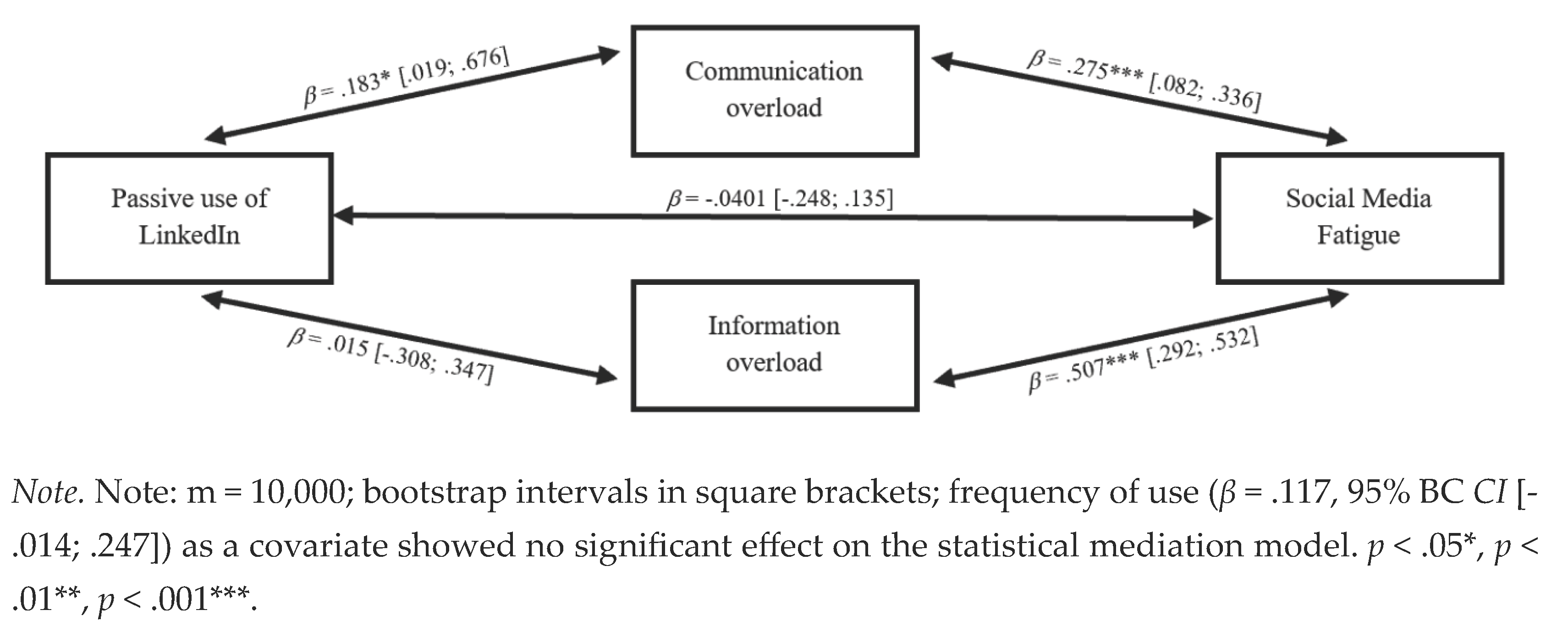
Table 1.
Descriptive Statistics for the Social Media Fatigue Subscales.
| Subscale | M | SD | Median | Skew | Kurtosis |
|---|---|---|---|---|---|
| Cognitive | 3.27 | 1.41 | 3.20 | .20 | -.80 |
| Behavioral | 3.26 | 1.16 | 3.60 | -.28 | -.25 |
| Emotional | 2.57 | 1.06 | 2.60 | .40 | -.60 |
Notes. M = mean; SD = standard deviation; skewness = measure of the asymmetry of the distribution; kurtosis = measure of the peakedness of the distribution.
Disclaimer/Publisher’s Note: The statements, opinions and data contained in all publications are solely those of the individual author(s) and contributor(s) and not of MDPI and/or the editor(s). MDPI and/or the editor(s) disclaim responsibility for any injury to people or property resulting from any ideas, methods, instructions or products referred to in the content. |
© 2026 by the authors. Licensee MDPI, Basel, Switzerland. This article is an open access article distributed under the terms and conditions of the Creative Commons Attribution (CC BY) license (http://creativecommons.org/licenses/by/4.0/).
Copyright: This open access article is published under a Creative Commons CC BY 4.0 license, which permit the free download, distribution, and reuse, provided that the author and preprint are cited in any reuse.


