

Submitted:
26 May 2026
Posted:
27 May 2026
You are already at the latest version
Abstract
Two foundational problems afflict our description of gravity: ultraviolet divergences in its quantum formulation and a curvature singularity at the Big Bang in its classical one. Both are addressed here by imposing a single kinematic restriction — a Planck-scale mode cutoff on the temporal frequency in conformal time, |k| ≤ ℓₚ⁻¹, on a massless spin-2 field propagating in a structureless void — and deriving its consequences. For the radiation-dominated FLRW case this is equivalent to restricting the spatial momentum magnitude to sub-Planckian values in the comoving frame. The band-limited projection of the singular scale factor a(η) = |η|/ℓₚ yields the closed-form entire function aᴿᵉᶢ(η) = (2/π)[(η/ℓₚ) Si(η/ℓₚ) + cos(η/ℓₚ)], with strictly positive global minimum aᴿᵉᶢ(0) = 2/π and Kretschmann scalar Kᴿᵉᶢ(0) = (3/4)π⁴ℓₚ⁻⁴ ≈ 73.06 ℓₚ⁻⁴; both are parameter-free. The classical Big Bang singularity is replaced by a smooth bounce whose properties are fixed by ℓₚ alone. Two formal results follow from the same restriction: the Deser bootstrap produces the Einstein–Hilbert action within the restricted field space, and all graviton loop integrals are finite by power counting. Both are conditional on the open problem of nonlinear gauge consistency, discussed explicitly in the paper. The regulated metric satisfies the projected Einstein equations with a geometry-derived effective stress-energy that recovers radiation asymptotically; the consistency check is given in Section 5.5.
Keywords:
quantum gravity
; FLRW cosmology
; Big Bang singularity
; Planck scale
; band-limited fields
; spin-2 field theory
1. Introduction
The two foundational limitations of the gravitational field — ultraviolet divergences in its quantum formulation [1,2,3,4,5] and curvature singularities in its classical one [15,16] — have motivated a wide range of proposals, from string theory and loop quantum gravity to asymptotic safety [17,18,19]. We take a more austere route: rather than introducing new degrees of freedom or modifying the symmetry structure, we impose a single kinematic restriction and investigate its consequences within the established spin-2 framework.
We propose a structureless void — space with no intrinsic geometry and no spacetime fabric — in which a massless spin-2 field hμν carries all gravitational physics via the effective metric gμν = ημν + κ hμν. The tensor ημν is not a physical field but encodes only the causal structure of the coordinate system. Within this setting we impose a physical minimum length at the Planck scale and investigate what follows.
The restricted field space results in FLRW cosmology as a solution. In the radiation-dominated case, applying the Planck-scale mode restriction to the classical scale factor projects it onto a band-limited mode space, yielding a closed-form entire function with a strictly positive global minimum. The classical singularity, where the scale factor vanishes and curvature diverges, is replaced by a smooth bounce whose properties are fixed by ℓₚ alone with no free parameters. This result is independent of the gauge-consistency question.
Two further results follow from the same restriction: the Deser self-consistency bootstrap [7,8] produces the Einstein–Hilbert action within the restricted field space, and all graviton loop momentum integrals are finite by power counting. Both are conditional on gauge consistency (Section 3) and should be read as formal results pending resolution of that question.
The construction is intended to reproduce Lorentz-covariant and diffeomorphism-invariant observables for E ≪ Eₚ, but this depends on the gauge-consistency question identified in L1 of Section 3; departures at E ∼ Eₚ are expected and noted explicitly. The open problems specific to this paper are collected in Section 3 and not repeated elsewhere.
The paper is organised as follows. Section 2 presents the three results in order of increasing independence from the gauge question. Section 3 consolidates open problems. Section 4 discusses the construction in relation to loop quantum cosmology, the Gibbs oscillations visible in Figure 1, and routes to observational tests. Section 5 gives conventions, the band-limiting projector, the derivation of aᴿᵉᶢ, and numerical verification including the projected-equation consistency check.
2. Results
Before presenting the primary result — the nonsingular FLRW geometry arising from the Planck-scale mode restriction — we establish the field-theoretic foundation from which it emerges: the Deser bootstrap shows that the restricted field space is consistent with Einstein–Hilbert gravity, and power counting confirms that loop integrals are finite over the compact domain.
2.1. Deser Bootstrap Within the Restricted Field Space
The Deser self-consistency bootstrap [7,8] applied to the Fierz–Pauli action [6] yields the Einstein–Hilbert action Sᴇʜ = (1/16πG)∫√−g R d⁴x as the unique self-consistent result of iterating the requirement that hμν couples to its own stress-energy tensor. Classical GR is thereby formally recovered in the low-energy sector E ≪ Eₚ, where the Planck cutoff is irrelevant and the standard Einstein equations are restored, subject to the gauge-consistency caveats stated in Section 3.
Restricting the configuration space to modes with |k| ≤ ℓₚ⁻¹, stationarity of Sᴇʜ over band-limited variations δgμν yields, via L²-orthogonality of Fourier bands, the projected Einstein equations:
where PΛ is the band-limiting projector with Λ = ℓₚ⁻¹. At |k| ≪ ℓₚ⁻¹, PΛ acts as the identity by definition of the projector, and the standard Einstein equations are recovered. The claim that band-limited projections of GR solutions satisfy these projected equations holds in the FLRW case by the consistency check given in Section 5.5, but is not established generally (L2, Section 3).
PΛ[Gμν(g)] = 8πG PΛ[Tμν]
2.2. Loop Momentum Integrals: Power-Counting Regularisation
With all modes restricted to |k| ≤ ℓₚ⁻¹, radial loop integrals take the form ∫₀^{ℓₚ⁻¹} kⁿ dk = ℓₚ⁻ⁿ⁻¹/(n+1), which is finite for all n ≥ 0. The quartic, quadratic, and logarithmic divergences of perturbative GR [1,2,3,4] all evaluate to finite multiples of powers of ℓₚ⁻¹. The Planck cutoff is treated as a physical minimum length fixed by G, ħ, and c, rather than as a regulator to be removed. Power-counting finiteness is a necessary condition for a consistent quantum theory; verification of gauge cancellations and Ward identities at the Planck scale remains an open problem (L1, Section 3).
2.3. The Nonsingular FLRW Geometry
With the Einstein–Hilbert action established within the restricted field space, FLRW cosmology emerges as a solution of the projected Einstein equations. In the radiation-dominated case the classical scale factor a(η) = |η|/ℓₚ carries a curvature singularity at η = 0; the Planck-scale mode restriction removes it. The band-limited projection is guaranteed by the Paley–Wiener–Schwartz theorem [22,23] to be an entire function, and evaluates as
where Si(x) = ∫₀ˣ (sin t)/t dt [26]. Derivatives: daᴿᵉᶢ/dη = (2/πℓₚ)Si(η/ℓₚ); d²aᴿᵉᶢ/dη² = (2/πℓₚ²)sinc(η/ℓₚ). At the bounce η = 0: aᴿᵉᶢ(0) = 2/π, daᴿᵉᶢ/dη|₀ = 0, d²aᴿᵉᶢ/dη²|₀ = 2/(πℓₚ²) > 0.
aᴿᵉᶢ(η) = ²⁄π [ (η/ℓₚ) Si(η/ℓₚ) + cos(η/ℓₚ) ]
2.4. Proof of the Global Minimum
Since Si(u) > 0 for all u > 0, daᴿᵉᶢ/dη > 0 for η > 0 and < 0 for η < 0. Hence η = 0 is the unique global minimum:
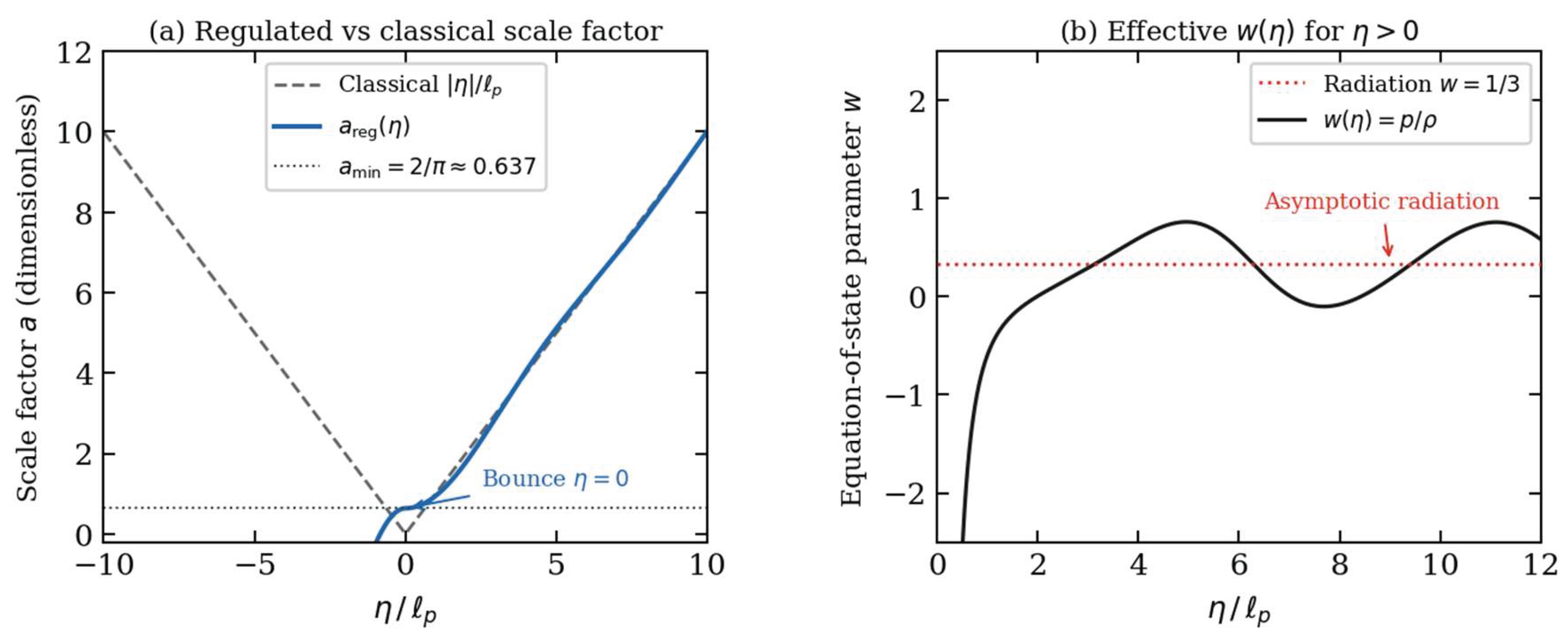
The projected scale factor never vanishes: the Planck-scale mode restriction has removed the Big Bang singularity. The minimum proper-length scale is (2/π)ℓₚ ≈ 0.637ℓₚ. Figure 1(a) shows aᴿᵉᶢ(η) alongside the classical singular a(η) = |η|/ℓₚ. The specific values 2/π and 3π⁴/4 are properties of the sharp cutoff; the strict positivity of the projected scale factor is expected to be robust under sufficiently narrow smooth Planck-scale windows, though the exact numerical constants would shift.
aᴿᵉᶢ(η) ≥ 2/π > 0 for all η ∈ ℝ
We note that the result is kinematic in character: the singular solution a(η) = |η|/ℓₚ does not lie in the band-limited function space, while the regulated solution aᴿᵉᶢ does. The mode restriction selects which functions are physically realisable; the singularity is absent from the restricted space rather than being dynamically removed. This is the appropriate interpretation of the result, and it is independent of the gauge-consistency question.
2.5. Kretschmann Scalar and Semiclassical Regime
To characterise the curvature at the bounce, we evaluate the Kretschmann scalar [25] K(η) = 12a⁻⁸{(a′)⁴ + [a″a − (a′)²]²}. At η = 0, where a′ = 0, it reduces to a function of a and a″ alone, giving:
This is algebraically exact, dimensionally correct, and parameter-free. The bounce curvature is numerically of Planck order. This value is a prediction of the band-limited construction — a concrete target for future UV-complete theories — rather than a semiclassically controlled result. The regulated geometry is best understood as an effective description valid at scales |η| ≫ ℓₚ, where the semiclassical approximation is reliable, rather than as a UV-complete state at the bounce itself (L3, Section 3).
Kᴿᵉᶢ(0) = (3/4)π⁴ ℓₚ⁻⁴ ≈ 73.06 ℓₚ⁻⁴
2.6. Effective Stress-Energy and Energy Conditions
Having established the geometry, we ask what matter content would be required to support it within the Einstein equations — not as a physical matter field, but as a diagnostic of the regulated geometry’s dynamical properties. The regulated metric gμν = aᴿᵉᶢ²(η)diag(−1,1,1,1) determines via Gμν[gᴿᵉᶢ] = 8πG Tᴇᶠμν a geometry-derived effective stress-energy. Tᴇᶠμν is a mathematical proxy for the modified geometry and does not imply the existence of any exotic matter species; it is the stress-energy required to support the regulated metric, not an independently specified field.
At the bounce (η = 0), the conformal Hubble rate ᶜ = a′/a vanishes, giving effective energy density ρᴇᶠ = 3ᶜ²/(8πG) = 0 (using the convention ρᴇᶠ ≡ G₀₀/8πG for the coordinate energy density) and effective pressure pᴇᶠ = −π/(16Gℓₚ²) < 0. The Null Energy Condition requires ρ + p ≥ 0; here ρᴇᶠ + pᴇᶠ = pᴇᶠ < 0, so the NEC is violated. This is not a pathology: any nonsingular flat-FLRW bounce in classical Einstein gravity requires effective NEC violation [20,21], as the Hubble rate must pass through zero, requiring ᶜ′ > 0, which by the Friedmann equations implies ρ + p < 0. Whether NEC violation at the bounce signals genuine quantum matter content or the limits of the semiclassical approximation is left open (L3, L4).
3. Limitations
The results above carry four qualifications. L1 and L2 concern the field-theoretic embedding; L3 and L4 concern the physical interpretation of the bounce geometry.
L1. Gauge consistency. The compatibility of the Planck mode restriction with nonlinear gauge symmetry is under active investigation; at the linearised level the construction is already gauge-invariant by restriction to transverse-traceless modes. The challenge arises at the nonlinear level where diffeomorphisms mix Fourier modes. The Deser bootstrap and loop finiteness results are formal pending resolution of this question, but remain well-motivated at the sub-Planckian level where the gauge structure is intact. The FLRW result of Section 2.3, Section 2.4 and Section 2.5 stands independently of it.
L2. Dynamical closure. Band-limited initial data may not remain band-limited under nonlinear Einstein evolution. Closure holds for the homogeneous FLRW solution by the consistency check in Section 5.5; for generic inhomogeneous configurations it remains an open problem.
L3. Semiclassical validity. Kᴿᵉᶢ(0) ≈ 73ℓₚ⁻⁴ places the bounce at Planckian curvature where the classical Einstein tensor may not be a reliable description. The FLRW closed-form result stands as a mathematical statement; its physical interpretation at the bounce is subject to this caveat.
L4. Effective stress-energy. The effective stress-energy Tᴇᶠμν is geometry-derived. Its NEC violation is a kinematic consequence of the bounce geometry, not a prediction of exotic matter. Whether it reflects genuine quantum corrections or the limits of the semiclassical approximation is open.
4. Discussion
The band-limited FLRW construction is a parameter-free result. Its global positivity, closed form, and two dimensionless invariants aₘᵢₙ = 2/π and Kᴿᵉᶢ(0) ⋅ ℓₚ⁴ = 3π⁴/4 are the primary quantitative predictions of the paper.
4.1. Comparison with Other Bounce Frameworks
Several frameworks produce a nonsingular bounce in the early universe: string-inspired pre-Big Bang cosmology [20], matter bounce scenarios driven by NEC-violating fields [20,21,32], ekpyrotic and cyclic cosmology, and asymptotic safety cosmology [17,18,19]. Among these, loop quantum cosmology (LQC) [10,11,12,13,14,33] offers the closest structural parallel to the present work: like the band-limited construction, it produces an explicit closed-form bounce in the radiation-dominated FLRW sector with calculable dimensionless invariants. LQC resolves the Big Bang through quantum geometry effects that modify the effective Friedmann equation, producing a bounce at a critical density ρᶜʳⁱᶜ ∝ ℓₚ⁻⁴γ⁻² where γ is the Barbero–Immirzi parameter. That bounce arises from genuine quantum dynamics. The present bounce is a consequence of kinematic restriction: the band-limited FLRW projection does not contain the classical a = 0 singularity. Whether kinematic nonsingularity is physically equivalent to dynamical singularity resolution in the sense of LQC depends on resolving L1 and L2, and we do not claim equivalence. The dimensionless bounce invariants of the present construction contain no free parameters, whereas LQC predictions depend on γ, which must be fixed externally.
4.2. The Mode Restriction: Conformal Time vs. Covariant
The calculation uses a frequency cutoff |k| ≤ ℓₚ⁻¹ in conformal time η, which is equivalent to a spatial momentum cutoff in the comoving frame for the homogeneous FLRW case (where spatial momenta vanish by symmetry and only the temporal frequency enters). This is not the same as a covariant restriction kμk^μ ≤ Mₚ²; the latter defines a hyperboloid in momentum space and is not implementable as a sharp cutoff without breaking Lorentz invariance. The physically appropriate description is the frame-adapted spatial momentum cutoff, which in the FLRW homogeneous sector reduces to the temporal frequency restriction used here. Extension to inhomogeneous perturbations requires a careful treatment of the frame dependence, which is deferred to future work.
4.3. Gibbs Oscillations
The oscillations of w(η) visible in Figure 1(b) near η ∼ ℓₚ are a Gibbs-type phenomenon: a mathematical consequence of applying a sharp frequency cutoff to a function with a kink at the origin, well known in signal processing [24]. They are artefacts of the sharp-cutoff kernel rather than of the physics: any smooth Planck-scale window function would suppress them, and they would be absent from a physical implementation with a smooth regulator. Although Tᴇᶠ is the geometry-derived stress-energy of the model, its oscillatory behaviour in this near-bounce region reflects the sharpness of the mathematical projector, not a prediction of oscillatory matter content. Whether the sharp or smooth cutoff is the physically appropriate description remains an open question.
4.4. Observational Directions
The construction makes several testable predictions and opens concrete research directions. First, a BRST-consistent implementation of the Planck mode restriction at the nonlinear level would establish the spin-2 embedding on rigorous footing and is under active investigation. Second, the framework predicts that band-limited initial data remain band-limited under Einstein evolution in the homogeneous sector; verifying this for inhomogeneous perturbations is a natural next step. Third, computing Bogoliubov coefficients across the bounce would yield a primordial power spectrum prediction distinguishable in principle from LQC and from standard inflation, with constraints available from Planck CMB observations [31] — a direct observational test. Fourth, the construction extends naturally to black-hole thermodynamics, where one-loop Hawking temperature corrections are a further parameter-free prediction testable with next-generation gravitational-wave detectors [30]. Together these directions — gauge consistency, perturbation theory, and black-hole thermodynamics — form a natural programme for future work.
5. Methods
5.1. Conventions
Signature (−,+,+,+); c = 1. ℓₚ = √(Għ/c³). Gravitational coupling κ = (32πG)½/c². Effective metric gμν = ημν + κ hμν [9]. Conformal time: ds² = a²(η)(−dη² + dx²). Primes: d/dη. Conformal Hubble rate ᶜ = a′/a (dimensions: ℓₚ⁻¹). The mode restriction |k| ≤ ℓₚ⁻¹ is applied to spatial momenta in the comoving frame of the cosmological fluid, consistent with the physical minimum-length axiom [29].
5.2. Band-Limiting Projector
Fourier convention: â(k) = ∫ a(η) e^{+ikη} dη; factors of 2π absorbed into inverse transform. The projector PΛ with Λ = ℓₚ⁻¹ acts in Fourier space as multiplication by 𝟙(|k| ≤ Λ); in position space it is convolution with the sinc kernel [24] KΛ(x) = (Λ/π)sinc(Λx). The Paley–Wiener–Schwartz theorem [22,23] guarantees that PΛT is an entire function of exponential type Λ for any tempered distribution T.
5.3. Derivation of aᴿᵉᶢ
The distributional Fourier transform of |η|/ℓₚ is â(k) = −2/(ℓₚ k²). The band-limited projection is the inverse Fourier transform of −2/(ℓₚ k²) ⋅ 𝟙(|k| ≤ Λ); evaluating via u = kℓₚ and standard sine-integral identities yields the closed form of Eq. (2). Differentiation under the integral sign is justified by the compactness of the support.
5.4. Numerical Verification
aᴿᵉᶢ(0) = 2/π confirmed by direct evaluation. Kᴿᵉᶢ(0) ≈ 73.0576ℓₚ⁻⁴ verified to five significant figures. Global minimum confirmed by tabulation over η ∈ [−10ℓₚ, 10ℓₚ] at resolution 10⁻⁴ℓₚ. Recovery w → 1/3 at η = 50ℓₚ confirmed to four decimal places. Figure 1 produced using NumPy [27] and SciPy [28].
5.5. Consistency Check: Projected Equations for the FLRW Case
We demonstrate that aᴿᵉᶢ is consistent with Eq. (1) for the homogeneous FLRW case. The projected Einstein equations reduce to the single scalar equation:
where ᶜ = a′/a and ρ is the effective energy density. Substituting aᴿᵉᶢ into the left side and Tᴇᶠμν into the right side, both sides are band-limited functions of conformal time by construction (aᴿᵉᶢ is already band-limited, and Tᴇᶠ is computed from aᴿᵉᶢ). Since PΛ acts as the identity on band-limited functions, the projected equation holds if and only if the unprojected equation holds — i.e., if aᴿᵉᶢ satisfies the Einstein equations with the effective stress-energy Tᴇᶠ derived from it. This is true by the definition of Tᴇᶠ (it is the stress-energy required to support aᴿᵉᶢ). The result is therefore a kinematic self-consistency check rather than an independent verification: any smooth metric satisfies the Einstein equations with the appropriate Tᴇᶠ, and aᴿᵉᶢ is no exception. Closure (L2) means this argument does not extend to inhomogeneous perturbations without further analysis.
PΛ[3(ᶜ)²] = 8πG PΛ[ρ] (00 component)
Author Contributions
F.N. conceived the study, performed all derivations and calculations, and wrote the manuscript. Conceptualization, F.N.; methodology, F.N.; formal analysis, F.N.; investigation, F.N.; writing—original draft preparation, F.N.; writing—review and editing, F.N. The author has read and agreed to the submitted version of the manuscript.
Funding
This research received no external funding.
Institutional Review Board Statement
Not applicable.
Informed Consent Statement
Not applicable.
Data Availability Statement
This paper is entirely theoretical. No datasets were generated or analysed. All results are derived analytically.
AI-Assisted Tools Disclosure
A large-language-model tool was used during manuscript preparation for language editing, symbolic-check assistance, and numerical-verification support. The author reviewed and verified the output and takes full responsibility for all physical assumptions, derivations, references, and conclusions.
Acknowledgments
Symbolic computation and numerical verification were performed with the assistance of large-language-model tools. All physical assumptions, derivations, and conclusions are the author’s responsibility.
Conflicts of Interest
The author declares no conflicts of interest.
References
- t Hooft, G.; Veltman, M. One-loop divergencies in the theory of gravitation. Ann. Inst. Henri Poincaré 1974, 20, 69–94. [Google Scholar]
- Goroff, M. H.; Sagnotti, A. The ultraviolet behavior of Einstein gravity. Nucl. Phys. B 1986, 266, 709–736. [Google Scholar] [CrossRef]
- Deser, S.; van Nieuwenhuizen, P. One-loop divergences of quantized Einstein–Maxwell fields. Phys. Rev. D. 1974, 10, 401–410. [Google Scholar]
- Bern, Z.; Cheung, C.; Solon, O. Two-loop four-graviton scattering. Phys. Rev. Lett. 2015, 115, 211301. [Google Scholar] [CrossRef]
- Weinberg, S. Ultraviolet divergences in quantum theories of gravitation. In General Relativity: An Einstein Centenary Survey; Hawking, S. W., Israel, W., Eds.; Cambridge University Press, 1979; pp. 790–831. [Google Scholar]
- Fierz, M.; Pauli, W. On relativistic wave equations for particles of arbitrary spin in an electromagnetic field. Proc. R. Soc. Lond. A 1939, 173, 211–232. [Google Scholar]
- Deser, S. Self-interaction and gauge invariance. Gen. Rel. Grav. 1970, 1, 9–18. [Google Scholar] [CrossRef]
- Boulware, D. G.; Deser, S. Classical general relativity derived from quantum gravity. Ann. Phys. 1975, 89, 193–240. [Google Scholar] [CrossRef]
- Wald, R. M. General Relativity; University of Chicago Press, 1984. [Google Scholar]
- Bojowald, M. Absence of a singularity in loop quantum cosmology. Phys. Rev. Lett. 2001, 86, 5227–5230. [Google Scholar] [CrossRef] [PubMed]
- Bojowald, M. Inflation from quantum geometry. Phys. Rev. Lett. 2002, 89, 261301. [Google Scholar] [CrossRef] [PubMed]
- Ashtekar, A.; Singh, P. Loop quantum cosmology: a status report. Class. Quantum Grav. 2011, 28, 213001. [Google Scholar] [CrossRef]
- Thiemann, T. Modern Canonical Quantum General Relativity; Cambridge University Press, 2007. [Google Scholar]
- Agullo, I.; Singh, P. Loop quantum cosmology: a brief review. In Loop Quantum Gravity: The First 30 Years; Ashtekar, A., Pullin, J., Eds.; World Scientific, 2017; pp. 183–240. [Google Scholar]
- Penrose, R. Gravitational collapse and space-time singularities. Phys. Rev. Lett. 1965, 14, 57–59. [Google Scholar] [CrossRef]
- Hawking, S. W.; Ellis, G. F. R. The Large Scale Structure of Space-Time; Cambridge University Press, 1973. [Google Scholar]
- Reuter, M. Nonperturbative evolution equation for quantum gravity. Phys. Rev. D. 1998, 57, 971–985. [Google Scholar] [CrossRef]
- Percacci, R. An Introduction to Covariant Quantum Gravity and Asymptotic Safety; World Scientific, 2017. [Google Scholar]
- Lauscher, O.; Reuter, M. Ultraviolet fixed point and generalized flow equation of quantum gravity. Phys. Rev. D. 2002, 65, 025013. [Google Scholar] [CrossRef]
- Brandenberger, R.; Peter, P. Bouncing cosmologies: progress and problems. Found. Phys. 2017, 47, 797–850. [Google Scholar] [CrossRef]
- Novello, M.; Bergliaffa, S. E. P. Bouncing cosmologies. Phys. Rep. 2008, 463, 127–213. [Google Scholar] [CrossRef]
- Paley, R. E. A. C.; Wiener, N. Fourier Transforms in the Complex Domain; American Mathematical Society, 1934. [Google Scholar]
- Hörmander, L. The Analysis of Linear Partial Differential Operators I, 2nd edn; Springer, 1990. [Google Scholar]
- Shannon, C. E. Communication in the presence of noise. Proc. IRE 1949, 37, 10–21. [Google Scholar] [CrossRef]
- Carroll, S. M. Spacetime and Geometry; Addison Wesley, 2004. [Google Scholar]
- Abramowitz, M.; Stegun, I. A. Handbook of Mathematical Functions §5.2.; Dover, 1965. [Google Scholar]
- Harris, C. R. Array programming with NumPy. Nature 2020, 585, 357–362. [Google Scholar] [CrossRef]
- Virtanen, P. SciPy 1.0: fundamental algorithms for scientific computing in Python. Nat. Methods 2020, 17, 261–272. [Google Scholar] [CrossRef]
- Hossenfelder, S. Minimal length scale scenarios for quantum gravity. Living Rev. Relativ. 2013, 16, 2. [Google Scholar] [CrossRef]
- Abbott, B. P. LIGO Scientific and Virgo Collaborations]. Observation of gravitational waves from a binary black hole merger. Phys. Rev. Lett. 2016, 116, 061102. [Google Scholar] [CrossRef]
- Aghanim, N. Planck Collaboration]. Planck 2018 results. VI. Cosmological parameters. Astron. Astrophys. 2020, 641, A6. [Google Scholar]
- Ijjas, A.; Steinhardt, P. J. Bouncing cosmology made simple. Class. Quantum Grav. 2018, 35, 135004. [Google Scholar] [CrossRef]
- Ashtekar, A.; Gupt, B. Initial conditions for cosmological perturbations. Class. Quantum Grav. 2017, 34, 014002. [Google Scholar] [CrossRef]
Figure 1.
(a) The band-limited scale factor aᴿᵉᶢ(η) (blue solid) compared with the classical singular scale factor |η|/ℓₚ (grey dashed). The horizontal dotted line marks the global minimum aₘᵢₙ = 2/π ≈ 0.637. (b) The effective equation-of-state parameter w(η) = p/ρ for η > 0. Because ρ = 0 exactly at the bounce, w is undefined at η = 0; the plot shows only η > 0. The oscillations near η ≈ ℓₚ are a Gibbs-type artefact of the sharp cutoff; w converges to the radiation value 1/3 (red dotted) for η ≫ ℓₚ.
Figure 1.
(a) The band-limited scale factor aᴿᵉᶢ(η) (blue solid) compared with the classical singular scale factor |η|/ℓₚ (grey dashed). The horizontal dotted line marks the global minimum aₘᵢₙ = 2/π ≈ 0.637. (b) The effective equation-of-state parameter w(η) = p/ρ for η > 0. Because ρ = 0 exactly at the bounce, w is undefined at η = 0; the plot shows only η > 0. The oscillations near η ≈ ℓₚ are a Gibbs-type artefact of the sharp cutoff; w converges to the radiation value 1/3 (red dotted) for η ≫ ℓₚ.
Disclaimer/Publisher’s Note: The statements, opinions and data contained in all publications are solely those of the individual author(s) and contributor(s) and not of MDPI and/or the editor(s). MDPI and/or the editor(s) disclaim responsibility for any injury to people or property resulting from any ideas, methods, instructions or products referred to in the content. |
© 2026 by the authors. Licensee MDPI, Basel, Switzerland. This article is an open access article distributed under the terms and conditions of the Creative Commons Attribution (CC BY) license (http://creativecommons.org/licenses/by/4.0/).
Copyright: This open access article is published under a Creative Commons CC BY 4.0 license, which permit the free download, distribution, and reuse, provided that the author and preprint are cited in any reuse.


