

Submitted:
27 May 2026
Posted:
27 May 2026
You are already at the latest version
Abstract
Epigenetic regulation has played a major role in the evolution of plant sexual reproduction. Across more than a billion years, ancestral genome-defence mechanisms in early eukaryotes were progressively expanded, diversified, and repurposed throughout the green lineage. Streptophyte algae assembled the first plant-specific methylation and small RNA systems, providing pre-adaptations for terrestrial reproduction. In bryophytes and early vascular plants, these systems became integrated into gametophyte development, sporogenesis, and meiotic genome protection. Seed plants experienced substantial diversification and expansion of chromatin regulators and small RNA machinery, enabling increasingly sophisticated control of cone, ovule, and embryo development. Angiosperms underwent the most dramatic re-wiring of epigenetic pathways, including gene-family diversification, subfunctionalization, and the emergence of imprinting, endosperm-specific demethylation, and lineage-specific reproductive small RNAs such as phasiRNAs. Convergent solutions, including imprinting, meiotic TE silencing, and TE-derived regulatory elements, arose independently across lineages. Ecological and life-history pressures further shaped epigenetic diversification, linking environmental stress, mating systems, and domestication to reproductive epigenetic plasticity. Together, these findings reveal epigenetic regulation as a dynamic, modular, and deeply evolvable framework that has repeatedly enabled reproductive innovation throughout plant evolution.
Keywords:
evolution of plant reproduction
; epigenetic regulation
; DNA methylation
; small RNAs
; RdDM
; PRC2
; chromatin remodeling
; genomic imprinting
; seed development
Introduction
Epigenetic regulation has become central to understanding how plant reproductive systems evolved, diversified, and adapted across more than a billion years of evolutionary history. DNA methylation, histone modifications, small RNA pathways, and chromatin-remodelling complexes form a multilayered regulatory architecture that controls genome stability, gene expression, and cell identity [1,2,3]. Although these mechanisms originated long before plants existed, their progressive integration into reproductive processes such as meiosis, gametophyte differentiation, fertilization, embryogenesis, and seed development was neither linear nor uniform. Instead, epigenetic systems were repeatedly reshaped by genome architecture, life-cycle innovations, and ecological pressures, producing lineage-specific solutions to the challenges of sexual reproduction [4].
The central problem addressed in this review is how ancient chromatin-based genome-defence systems were transformed into the highly specialized reproductive regulatory networks characteristic of modern land plants and especially angiosperms. Early eukaryotes evolved DNA methylation, including the RNA-directed DNA methylation (RdDM), systems and RNA interference primarily to silence transposable elements (TEs) and maintain genome integrity [5]. Subunit homologs of Polycomb Repressive Complex 2 (PRC2), a suppressor of gene expression through triple methylation of histone H3K27, also originated in the ancient eukaryotes before their diversification [6]. As plants transitioned from aquatic streptophyte algae to terrestrial embryophytes, these ancestral systems were elaborated into plant-specific pathways such as CHROMOMETHYLASE-mediated methylation and canonical RdDM [7]. These innovations supported the emergence of multicellular gametangia, protected meiotic genomes from TE activation, and enabled the evolution of alternation of generations.
The rise of vascular plants (tracheophytes) and seed plants (spermatophytes) introduced new developmental contexts in which epigenetic regulation became essential. Massive increases in genome size, repetitive content, and developmental complexity, driven by transposable element (TE) proliferation and frequent whole-genome duplications (WGDs) created selective pressures for expanded silencing pathways and chromatin-remodelling capacity, specifically involving DNA methylation, histone modifications, and RNA-directed DNA methylation, to maintain genome stability and regulate gene expression [8,9]. In gymnosperms, which diverged in the Devonian, strong DNA methylation and heterochromatinization evolved to stabilize massive TE-rich genomes, while early diversification of Argonaute (AGO), Dicer-like (DCL), and RNA-dependent RNA polymerase (RDR) families facilitated further evolution of small RNA pathways that later acquired specialized roles in reproductive development [10,11]. Angiosperms represent the most dramatic reorganization of epigenetic control in plant evolution. The emergence of highly reduced gametophytes and the mechanism of double fertilization (when one sperm cell fuses with the egg cell to form a diploid embryo (2n), while a second sperm cell fuses with the diploid central cell nuclei to form a triploid endosperm (3n)) are key innovations in angiosperms that generated distinct epigenetic asymmetries between maternal and paternal genomes [12,13,14,15,16]. Selective DNA demethylation in the central cell, paternal genome hypermethylation, and Polycomb Repressive Complex 2 (PRC2) – mediated repression established genomic imprinting as a uniquely angiosperm innovation. In parallel, lineage-specific expansions of small RNA pathways, including reproductive phasiRNAs, introduced dynamic regulatory layers that fine-tune meiotic progression, gamete specification, and early embryogenesis [17,18].
The evolution of plants from aquatic streptophyte algae to modern angiosperms was a complex process taking well over 500 million years, beginning with freshwater green algae in the Paleozoic to terrestrial dominance, culminating in the widespread success of flowering plants by the Cretaceous period [19,20]. Recent advances in comparative genomics, single-cell epigenomics, and spatial transcriptomics now allow reconstruction of how these systems evolved across bryophytes, ferns, gymnosperms, and angiosperms. Understanding this evolutionary trajectory is essential for interpreting the diversity of plant reproductive strategies and for predicting how epigenetic systems may respond to future environmental change. This review synthesizes current evidence to trace the origins, diversification, and functional integration of epigenetic pathways in plant reproduction. It focuses on the emergence of core regulatory systems, their specialization in gametophytes and functional germlines, their roles in fertilization, embryogenesis, and seed development, and the major evolutionary transitions that shaped their diversification.
1. Origins and Evolution of Core Epigenetic Machinery
1.1. Proterozoic Origins: Ancestral Genome-Defence Systems
The core epigenetic systems that underpin plant reproduction today and also were inherited by animals and fungi for regulating gene expression have deep evolutionary roots extending back to early eukaryotes. Comparative genomic analyses indicate that the Last Eukaryotic Common Ancestor (LECA), which lived approximately 1.5–1.8 billion years ago during the Proterozoic, possessed a sophisticated chromatin-regulatory toolkit, including cytosine DNA methyltransferases (DNMTs), histone-modifying enzymes, ATP-dependent chromatin remodelers, and RNA interference (RNAi) machinery [21,22,23,24]. These ancestral systems evolved primarily as genome-defence mechanisms, particularly to suppress transposable elements (TEs) and maintain genome stability during meiosis. Partial the RNA-directed DNA methylation-like (RdDM-like) components (AGO, DCL, RDR, DRM homologs) are ancient and predate land plants. Because meiotic chromatin is especially vulnerable to TE activation, early eukaryotes already relied on epigenetic pathways to protect the integrity of their genomes during reproductive events. This ancient association between epigenetics and sexual reproduction provided the foundation upon which plant-specific regulatory systems were later built [25,26].
1.2. Streptophyte Algae: Assembly of Plant-Specific Epigenetic Modules
The distinction between Chlorophyta and Streptophyta represents a pivotal evolutionary divergence in how green algae manage their genomes and adapt to terrestrial stress. This divergence took place over one billion years ago marked the beginning of a major evolutionary trajectory in epigenetic complexity. Chlorophyte algae retain only partial or mosaic epigenetic systems, with limited CHG/CHH methylation and reduced small RNA diversity. In contrast, streptophyte algae—the sister group to land plants, show a pronounced expansion and specialization of epigenetic pathways [27,28,29,30].
Comparative analyses of streptophyte algae indicate that several molecular components later central to reproductive epigenetics were already present in algal ancestors close to the origin of land plants. This includes ancestral homologs of SET domain histone methyltransferases, Polycomb components – functional Polycomb Repressive Complex 2 (PRC2), including homologs of E(z) and Su(z)12, ARGONAUTE (AGO) proteins, DICER-LIKE (DCL) genes and elements of DNA methylation machinery. Rather than emerging simultaneously as integrated pathways, these modules likely originated in distinct contexts such as chromosome organization, transposon repression, developmental switching, and only later became coupled in reproductive regulation [28,31] (Figure 1).
Particularly important was the evolution of chromatin systems capable of maintaining alternative developmental states. In early streptophytes, transitions between haploid and diploid programs likely depended on regulatory circuits involving TALE homeodomain factors such as KNOX and BELL, but increasing evidence suggests these systems became integrated with chromatin-level repression early in evolution [32]. PRC2 is involved in the regulation of transcription of genes, responsible for the suppressing of sporophytic developmental programs in moss gametophytes [33]. In this sense, Polycomb-mediated silencing was probably first associated with life-cycle regulation before later being recruited into specialized reproductive developmental processes.
Genomic studies of Klebsormidium, Zygnema, and Chara reveal the presence of CHROMOMETHYLASE-like (CMT-like) methyltransferases capable of establishing symmetric CHG methylation, a hallmark of land-plant methylation systems [34,35,36]. The discovery of PRC2 in Zygnematophyceae overturned the earlier assumption that Polycomb repression originated in embryophytes and instead indicates that this regulatory module predates the colonization of land.
Another key innovation in streptophyte algae is the expansion of small RNA pathways. These algae produce 21–24 nt small interfering RNAs that target TEs, representing an early form of the RNA-directed silencing systems that later became central to land-plant reproduction [29]. In addition, streptophytes exhibit gene-body methylation (gbM) patterns resembling those of embryophytes, suggesting that the regulatory architecture for distinguishing constitutively expressed genes from TE-rich heterochromatin was already emerging before terrestrialization [37,38]. Together, these features indicate that streptophyte algae assembled a set of epigenetic modules capable of supporting multicellular gametangia, zygotic meiosis, and stress-responsive chromatin regulation—key prerequisites for the evolution of complex reproductive systems in land plants.
1.3. Early Land Plants: Integration into Gametophyte–Sporophyte Life Cycles
The transition to land during the Ordovician–Devonian (~ 470–360 million years ago (Ma)) brought new selective pressures that further shaped epigenetic evolution. Early land plants, represented today by bryophytes (mosses, liverworts, and hornworts) already possessed a full complement of a fundamental and conserved DNA methylation toolkit – MET1-like, CMT-like, and DRM-like methyltransferases, enabling CG, CHG, and limited CHH methylation [39,40]. These methylation systems played essential roles in sporogenesis, gametophyte development, and meiotic genome protection. In Physcomitrium patens, PRC2-mediated H3K27me3 regulates the transition from vegetative to reproductive development and is required for proper sporophyte patterning [33,41,42]. Bryophytes also deploy 21–24 nt siRNAs that silence TEs during gametangia formation and meiosis, demonstrating that small RNA-mediated genome defence was already integrated into reproductive regulation at the dawn of land-plant evolution [43] (Figure 1, Table 1).
As land-plant genomes grew larger and more TE-rich, additional mechanisms evolved to ensure efficient access of methyltransferases to densely packed heterochromatin. A key innovation was the using of DDM1 (Decrease in DNA Methylation 1), a chromatin remodeler that removes linker histone H1 from compact heterochromatic regions. By transiently opening these otherwise inaccessible domains, DDM1 enables methyltransferases to maintain silencing across TE-dense genomic compartments—an essential requirement for genome stability, especially in the tissues of reproductive organs [1] DDM1-like chromatin remodelers are broadly conserved across land plants and may have acquired increasing importance as genomes expanded.
1.4. Diversification of CMT, RdDM, AGO/DCL/RDR Families
As vascular plants emerged, epigenetic systems diversified further. One of the most consequential developments was the expansion of the CMT family. CMT3 became specialized for CHG methylation, while CMT2 evolved to target CHH methylation in heterochromatin, particularly in TE-dense genomic regions [7]. This diversification created a multilayered methylation system capable of stabilizing increasingly large and TE-rich genomes. In parallel, RdDM pathway emerged as a uniquely plant-specific innovation. Partial RdDM-like components predated land plants, whereas the canonical RdDM pathway, defined by the specialized RNA polymerases IV and V, RDR2, DCL3, and AGO4/6/9, forming a small RNA–guided methylation system that became essential for TE silencing in reproductive tissues, originated in seed plants and became fully elaborated in angiosperms [44] (Table 1). The AGO, DCL, and RDR gene families underwent repeated expansions across land-plant evolution, with major radiations in seed plants and angiosperms. These expansions enabled functional specialization, including the emergence of small RNA pathways that regulate gametogenesis and early embryogenesis [45] (Figure 1).
Complementing these methylation pathways, plants also evolved active DNA demethylation systems that allow targeted removal of methylation marks. This process is mediated by a family of DNA glycosylases, ROS1, DME, DML2, and DML3, which excise methylated cytosines and replace them with unmethylated bases via base-excision repair. These enzymes provide a counterbalance to methyltransferase activity and enable dynamic remodeling of methylation landscapes during reproduction and subsequent development [46,47]. Their activity ensures that regulatory loci can be selectively demethylated in response to developmental cues, thereby supporting flexible control of gene expression, including reproductive tissues.
1.5. PRC2 Evolution: From General Repression to Reproductive Specialization
PRC2 also underwent significant evolutionary refinement. Although its core components are conserved across eukaryotes, plants evolved lineage-specific PRC2 complexes with distinct developmental roles. In bryophytes, PRC2 plays a critical role in regulating the haploid-diploid transition and sporophyte development acting as an epigenetic silencer that prevents the premature development of the diploid sporophyte phase from haploid gametophytes; in ferns and gymnosperms, it contributes to sporangium differentiation and embryo patterning [6,48]; and in angiosperms, PRC2 diversified into specialized complexes such as FIS-PRC2, which is essential for endosperm development and genomic imprinting [49,50]. This progressive specialization illustrates how an ancient chromatin-repression system was repeatedly adapted to meet the regulatory demands of increasingly complex reproductive structures.
1.6. Whole-Genome Duplications and TE Load as Evolutionary Drivers
Whole genome duplications (WGDs) and transposable element expansion are key drivers of plant evolution, providing raw genetic material for creating complex, tissue-specific regulatory networks. These events often enable subfunctionalization, where duplicate gene copies (such as those in the RNA-directed DNA methylation pathway) divide the original gene’s functions, allowing for increased regulatory complexity and the emergence of specific roles in regulation of reproductive development [45,51,52]. At the same time, transposable elements proliferation, particularly in gymnosperms and angiosperms, created a strong evolutionary demand for robust methylation and small RNA pathways. Conifer genomes, which can exceed 20–30+ Gb and is largely driven by the accumulation of long terminal repeat retrotransposons (LTR-RTs), exhibit exceptionally high levels of CG and CHG methylation, expanded CMT lineages, and extensive heterochromatinization, reflecting the evolutionary interplay between genome size, TE activity, and epigenetic silencing capacity [53,54].
Taken together, these findings show that the core epigenetic machinery of plants did not arise abruptly but instead evolved through a series of cumulative innovations. Ancient genome-defence systems were progressively elaborated in streptophyte algae, integrated into reproductive development in early land plants, diversified in vascular plants, and specialized in seed plants. This evolutionary trajectory established the regulatory foundation upon which the complex epigenetics regulating reproductive processes in angiosperms would later be built (Table 1).
2. Evolution of Epigenetic Regulation in Gametophytes and Functional Germlines
The evolution of plant reproduction has been tightly coupled with the diversification of epigenetic mechanisms that regulate developmental transitions, genome stability, and transmission of heritable information. This relationship is particularly evident in gametophytes and germlines, where epigenetic regulation integrates developmental patterning with protection of genomic integrity during reproduction. Comparative and functional studies increasingly indicate that many of the pathways controlling reproductive epigenetic states originated early in green plant evolution and were progressively modified during the transition from ancestral streptophyte algae to land plants, seed plants, and angiosperms. Epigenetic mechanisms operating in reproductive lineages appear to have evolved through gradual recruitment and specialization of ancient chromatin-based regulatory systems [28] (Figure 1).
2.1. Bryophytes and the Emergence of Epigenetic Regulation of Alternating Generations
One of the earliest evolutionary contexts in which epigenetic regulation appears to have acquired significant importance was the control of life-cycle phase transitions. Bryophytes likely preserve key features of ancestral reproductive epigenetic organization. Because these non-vascular plants are haploid-dominant, they bypass the masking effects of diploidy and provide important insight into early functions of epigenetic regulation in reproduction [55,56]. Alternation of generations required robust mechanisms for maintaining the developmental identities of haploid and diploid phases, and comparative evidence suggests that chromatin-mediated repression played a key role in this process. Studies in bryophytes have shown that components of the Polycomb Repressive Complex 2 (PRC2), including homologs of CURLY LEAF (CLF), SWINGER (SWN), and FERTILIZATION-INDEPENDENT ENDOSPERM (FIE), contribute to repression of sporophytic developmental programs during gametophyte growth, indicating an ancient role for H3K27me3-mediated silencing in life-cycle regulation [33,57,58]. In Physcomitrium and Marchantia, disruption of PRC2 components including CLF, FIE, and related factors causes ectopic activation of sporophytic developmental programs in gametophytic tissues, indicating that Polycomb repression became central to maintaining generation identity [33,41]. This may represent one of the earliest examples where chromatin regulation was transformed from general developmental control into reproductive phase specification. Thus, an important innovation at this evolutionary stage was the integration of epigenetic regulation with alternation of generations itself.
Bryophytes also reveal early coupling between heterochromatin regulation and reproductive function [59]. Components related to CMT, methyltransferase SUVH4/KYP (KRYPTONITE), and RNA-mediated silencing contribute to transposon repression in gametophytic tissues, suggesting that germline-associated genome defense systems were already being elaborated in early land plants [40]. Importantly, this period likely saw the first major transformation of epigenetic systems from largely genome-stabilizing functions by silencing repetitive DNA toward developmental specialization and chromatin pathways became integrated with regulation of reproductive identity, a fundamental evolutionary step.
2.2. Vascular Plants and the Diversification of Reproductive Epigenetic Modules
The evolution of vascular plants introduced major changes in reproductive architecture, including heterospory, reduction of free-living photosynthesizing gametophytes, and increasing separation of reproductive developmental programs. In vascular plants, unlike bryophytes, the predominant phase is the sporophyte. These transitions likely reshaped selective pressures acting on reproductive epigenetic systems. Reduction of gametophytes probably intensified demands for developmental canalization and functional germline protection, favouring greater specialization of chromatin and methylation pathways. This period likely saw substantial diversification of DNA methylation systems, including functional partitioning among MET1, CMT3, and DRM-related pathways. Evidence also suggests that the RNA-directed DNA methylation (RdDM) pathway acquired increasing importance during seed plant evolution [60,61] (Table 1). While core components of such as NRPD1, NRPE1 (evolved from standard RNA polymerase II), RDR2, DICER-LIKE 3 (DCL3), and AGO4 originated earlier, comparative analyses indicate the canonical Pol IV/V-dependent pathway became fully elaborated in seed plants and especially angiosperms [62]. This may represent a second major evolutionary transformation: epigenetic pathways originally centered on transposon silencing became expanded into developmental regulatory systems increasingly integrated with reproduction. Small RNA evolution also accelerated during this period. Expansion of AGO and DCL families provided substrates for functional divergence, with some paralogs retaining ancient silencing roles while others acquired specialized reproductive functions. Such duplication-driven partitioning appears to have been a recurrent mechanism in epigenetic evolution [45].
2.3. Seed Plants: Genome Conflict and Reproductive Epigenetic Innovation
The origin of seeds introduced new evolutionary challenges—extended reproductive development, parental genomic interactions, and increased transgenerational demands that profoundly reshaped epigenetic regulation. Evidence suggests that the capacity for reproductive methylation reprogramming arose alongside the increasing complexity of reproduction. Extensive central-cell-specific demethylation and endosperm-associated reprogramming are characteristic of angiosperms, its emergence appears to coincide with the evolution of double fertilization and the formation of the triploid endosperm, a developmental innovation that originated roughly 140–125 million years ago, but more limited reproductive methylation dynamics occur in other land plants [4,63]. The expansion of transposable elements (TEs) in seed plant genomes created a “genomic shock” that acted as a major evolutionary driver, forcing the development of advanced epigenetic silencing mechanisms to maintain stability. This selective pressure was directly met by the diversification of the RNA-directed DNA methylation (RdDM) pathway, which evolved into a sophisticated surveillance system. At this stage, epigenetic regulation expanded beyond genome defense to assume direct developmental roles [64]. Polycomb complexes, originally associated with broader developmental repression, acquired increasingly specialized reproductive functions. Diversification of MEA, FIS2, and related PRC2 components in angiosperms has evolved to drive developmental innovation, specifically in angiosperm’s endosperm and embryo formation [65].
A critical innovation in seed plants may have been selective epigenetic reprogramming rather than global resetting. Unlike animals, plants generally retain overall DNA methylation patterns across generations while using targeted, locus-specific reprogramming in reproductive companion cells. This evolutionary strategy likely allowed developmental flexibility while preserving genome stability [66]. Active demethylation mediated by DEMETER (DME) and its related DNA glycosylases which regulate gene expression, particularly within the central cell of the female gametophyte and the vegetative cell of the male gametophyte. These enzymes are evolutionarily ancient, but their highly specialized role in central-cell demethylation evolved in flowering plants [46,67].
2.4. Angiosperm Innovations: Germline Specialization and Epigenetic Asymmetry
In angiosperms, reproductive epigenetic regulation underwent further transformation through cell-type specialization and multicellular organization of silencing. One of the most significant innovations was evolution of an epigenetic division of labor between germ cells and accessory companion cells. In pollen, partial relaxation of silencing in the vegetative nucleus generates small RNAs reinforcing transposon repression in sperm through pathways involving Pol IV, RNA-DEPENDENT RNA POLYMERASE 2 (RDR2), DCL3/4, and AGO4/6. This system, known as accessory companion cell regulation, appears not as a simple extension of ancestral silencing but as a derived reorganization of epigenetic function across interacting cell types. Its evolutionary significance is substantial. It transformed genome protection from largely cell-autonomous silencing into intercellular reproductive regulation, a major conceptual shift in epigenetic organization [68,69].
Angiosperms also saw elaboration of lineage-specific reproductive small RNA systems, particularly phasiRNAs, which are largely absent in bryophytes and early vascular plants and became prominent in seed plants, diversifying further in angiosperms, particularly monocots. These small RNAs are produced from long non-coding RNA precursors in a highly synchronized manner, with different sizes peaking at distinct stages to ensure proper pollen formation. Their emergence coincided with the evolution of complex anther architecture and refined control of male fertility [70,71]. In crops such as rice and maize, phasiRNAs accumulate during pre-meiotic and meiotic stages and are essential for proper anther development. PhasiRNAs accumulate in all cell types, with the highest levels in meiocytes, followed by tapetum, in anthers they move from tapetal to meiotic cells [72]. Mutations in important phasiRNA biogenesis components – DCL4, DCL5, or RDR6, disrupt phasiRNA production and cause male sterility, underscoring their functional importance [73,74]. Also, in Arabidopsis thaliana miR172 is a critical post-transcriptional regulator that controls floral organ identity and fertility by targeting APETALA2 (AP2) and related AP2-like transcription factors (e.g., TOE1, TOE2, SMZ, SNZ). miR172 levels rise during floral transition to down-regulate these targets [75,76].
Another essential transformation involved epigenetic asymmetry between male and female lineages. Female gametophytes evolved specialized demethylation dynamics, companion-cell functions, and imprinting-related regulation, while male lineages developed distinctive chromatin remodeling and small RNA-based surveillance systems. Such asymmetry likely contributed to later innovations including parent-of-origin effects and endosperm-associated regulation [77,78].
Rather than isolated novelties, these changes represent cumulative restructuring of ancient epigenetic modules into highly specialized reproductive systems.
2.5. Evolutionary Transformation of Functional Germline Protection Systems
An overarching pattern across plant evolution is progressive transformation of germline protection mechanisms. In early green lineages, genome surveillance likely centered on basic transposon repression. In bryophytes and early land plants, these pathways became integrated with regulation of phase identity and reproductive development. In vascular and seed plants, major expansion of silencing machinery, TE-driven genome evolution, and gene family diversification transformed the pathways into increasingly specialized reproductive regulatory networks. In angiosperms, further innovations reorganized these pathways through intercellular signaling, selective reprogramming, and lineage-specific small RNA systems. This trajectory illustrates that germline protection did not simply become stronger through time; it became developmentally integrated and evolutionarily creative. Gene family evolution underlies much of this history. Expansion of AGO, DCL, RDR, CMT, SUVH, and PRC2 families repeatedly generated opportunities for specialization (Figure 1; Table 1). Whole-genome duplications and subsequent gene retention provided paralogs that were repeatedly subfunctionalized and neofunctionalized, increasing the complexity of reproductive epigenetic networks, particularly in seed plants.
Thus, the evolution of epigenetic regulation in gametophytes and germlines was not peripheral to plant reproductive evolution; it was one of its mechanistic foundations. From streptophyte ancestors to flowering plants, reproductive diversification was accompanied by progressive transformation of epigenetic systems, linking genome defense, developmental regulation, and evolutionary innovation into a shared history.
3. Fertilization, Embryogenesis, and Seed-Associated Epigenetic Innovations
The evolution of double fertilization, embryogenesis, and seeds in angiosperms necessitated a sophisticated epigenetic landscape to manage the complex developmental, nutritional, and protective requirements of the seed. This shift in plant life history required new mechanisms to differentiate the embryo and endosperm, control parental genomic interactions, and manage nutrient storage. While many chromatin-based pathways involved in these processes originated much earlier in green evolution, seed plant and especially angiosperm reproduction generated new selective pressures associated with zygotic genome activation, parental genome interactions, embryo patterning, transposon control, nutrient allocation, and developmental dormancy [79]. Comparative studies indicate that the ability to reorganize DNA methylation during reproductive development is a derived feature of angiosperms and is not present in more basal land-plant lineages. In the moss Physcomitrium patens, for example, methylation patterns in reproductive cells remain largely unchanged, showing none of the extensive remodeling characteristic of angiosperm germlines [80]. Gymnosperms tend to maintain stable levels of DNA methylation showing its only modest changes within their reproductive tissues, in contrast to the extensive methylation reprogramming characteristic of angiosperms. This pattern implies that broad, dynamic methylation remodeling during seed development is a comparatively recent evolutionary innovation restricted to flowering plants, rather than a universal feature shared by all seed-plant lineages [62,81].
3.1. Origins of Epigenetic Control in Zygotic Transitions
The epigenetic problems associated with fertilization arose long before the origin of seeds. In the earliest eukaryotes, syngamy itself created challenges involving genome merging, chromatin reorganization, and resetting of developmental programs. In green algae, although embryogenesis in the land plant sense had not yet evolved, transitions from gametic fusion to diploid developmental states likely required primitive chromatin-mediated switches. Comparative evidence suggests that the regulatory logic governing early plant zygotic activation shares deep evolutionary roots with pathways that manage the haploid-diploid phase transitions (alternation of generations) in ancestral algae. This connection implies that mechanisms once used to switch between gametophyte and sporophyte stages were co-opted for embryo development. TALE homeodomain regulators such as KNOX and BELL, present in chlorophytes and streptophytes, were among the earliest factors involved in post-fertilization developmental reprogramming, and their later integration with chromatin regulators appears to have been a crucial early step in the evolution of embryogenic control [82].
The emergence of multicellular embryos (sporophytes) in bryophytes, often referred to as the “maternal embrace” (or embryophytic habit), is a defining evolutionary innovation. This transition from a unicellular zygote (found in ancestral algae) to a multicellular sporophyte involved critical developmental stabilization mechanisms, including epigenetic repression [83,84]. Comparative studies suggest that the PRC2 complex was already functioning in embryo-associated developmental restriction early in land plant evolution (Figure 1; Table 1). As already mentioned these conserved homologs of CURLY LEAF (CLF), SWINGER (SWN) and FERTILIZATION-INDEPENDENT ENDOSPERM (FIE) indicate that H3K27me3-mediated control of embryonic developmental programs has ancient evolutionary origins [57].
This likely represents an important evolutionary shift: chromatin systems originally involved in maintaining generation identity were recruited into control of embryogenesis itself. Such co-option may have been fundamental to the origin of the plant embryo as a developmental innovation.
3.2. Evolution of Epigenetic Regulation During Embryogenesis
Embryogenesis imposed novel demands on gene regulation, requiring progressive stabilization of developmental trajectories, restriction of transposon activity, and coordination of maternal and zygotic programs. Many epigenetic systems central to these processes arose through stepwise elaboration. DNA methylation appears to have acquired increasingly specialized embryonic functions during vascular plant evolution. While ancestral methylation pathways likely centered on genome stability, maintenance methylation mediated by MET1, chromomethylation via CMT3, and de novo methylation through DOMAINS REARRANGED METHYLTRANSFERASE 2 (DRM2) became integrated into embryo patterning and developmental robustness [5,85,86]. In angiosperm embryos, DNA methylation dynamics involve selective remodeling where specific, localized changes occur, while overall methylation patterns, particularly CHG and CG methylation, are maintained across generations. This contrasts sharply with animal systems where genome-wide resetting takes place and likely represents a distinctive evolutionary strategy in which developmental progression and transposon control were balanced without erasing inherited epigenetic states [4]. Such partial reprogramming may itself have been a seed plant innovation.
Chromatin remodeling factors also became central to embryonic development. DDM1, PICKLE (PKL), and ATP-dependent remodelers contribute to chromatin state transitions during embryo development, while histone variant dynamics influence developmental competence [87,88]. Particularly important was the evolutionary expansion of Polycomb function. Although ancestral PRC2 likely acted broadly in developmental repression, in seed plants Polycomb regulation acquired increasingly specialized roles in embryo patterning and developmental timing. In Arabidopsis, CLF, EMF2, FIE, and MSI1 regulate embryo- and seed-associated repression networks, reflecting substantial functional diversification of ancient modules [89,90].
This expansion likely accompanied a broader evolutionary transformation in which epigenetic systems moved from maintaining developmental states to actively structuring embryonic developmental programs.
3.3. Seed Evolution and the Rise of Novel Epigenetic Demands
The origin of seeds generated one of the most profound shifts in reproductive evolution and fundamentally altered the landscape of epigenetic regulation. Seeds introduced prolonged developmental arrest, maternal-offspring interactions, nutrient allocation conflicts, and dormancy regulation—all requiring new forms of developmental memory and regulatory stability. These innovations likely intensified selection for epigenetic systems capable of integrating developmental and environmental information over long timescales.
Polycomb evolution appears tightly linked to these innovations. The FIS-class PRC2 complex, including the above-mentioned MEA, FIS2, FIE, and MSI1, represents a particularly significant seed plant innovation. Although derived from ancient Polycomb machinery, these complexes acquired reproductive functions associated with seed development and, in angiosperms, endosperm regulation [89]. Their emergence may represent one of the clearest examples of functional co-option during reproductive evolution: a deeply conserved chromatin repression system was transformed into a key regulator of seed-specific developmental processes.
Seed evolution also intensified links between epigenetic regulation and genome conflict. Expanding transposable element loads in seed plant genomes likely drove increased reliance on methylation and RNA-mediated silencing pathways. Expansion and diversification of RdDM components—including NRPD1, RDR2, DCL3, AGO4, and DRM2—may have been partly shaped by these pressures [62].
3.4. Double Fertilization, Imprinting, and Epigenetic Asymmetry in Angiosperms
Among the most remarkable epigenetic innovations in plant evolution is the emergence of genomic imprinting associated with double fertilization and endosperm evolution in flowering plants. Genomic imprinting, characterized by parent-of-origin-specific gene expression, is also a hallmark of angiosperm endosperm development. It arises from differential epigenetic marking of maternal and paternal alleles through DNA demethylation, histone modifications, and small RNA pathways [91]. In Arabidopsis DEMETER (DME) specifically expressed in the central cell of the female gametophyte, where it initiates active DNA demethylation by removal of 5-methylcytosine (5mC) from the DNA, leading to a hypomethylated maternal genome in the central cell prior to fertilization. DME-like glycosylases are specifically adapted to regulate seed development and genomic imprinting [92]. Maternal expression of MEA, FWA, and FIS2 depends on FIS-PRC2 complex, which suppresses paternal alleles and prevents premature endosperm proliferation [50]. Example of paternally imprinted gene in endosperm of Arabidopsis thaliana is PHERES1 (PHE1) [93]. Although imprinting is widespread in angiosperms, the specific imprinted genes differ between lineages such as rice and Arabidopsis, indicating independent evolutionary trajectories [94].
The parental conflict theory proposes that imprinting evolved from divergent maternal and paternal interests in resource allocation to the developing embryo [95]. Excessive paternal gene influence can lead to overgrowth and seed failure, whereas excessive maternal repression can impair embryo development. The absence of imprinting in gymnosperms and bryophytes supports the idea that imprinting as currently understood emerged with the evolution of the biparental endosperm and is best documented in angiosperm endosperm. Gymnosperms may show parent-of-origin effects, but true imprinting is not firmly established. However, the discovery of paternal chromosome repression in Marchantia polymorpha, where the paternal genome is globally silenced in the sporophyte, suggests that imprinting-like mechanisms may have arisen multiple times independently in plant evolution [96]. This aligns with the view that imprinting originated from TE-silencing pathways and was repeatedly co-opted for reproductive functions [97].
3.5. Small RNAs and Transposon Control in Embryo and Seed Evolution
The emergence of small RNA–mediated genome regulation was an important innovation in the evolution of land-plant reproduction, providing a mechanism to stabilize the genome during the vulnerable phases of embryogenesis and seed development. Across embryophytes, small RNAs act as the primary regulators of transposable elements (TEs), and their diversification in seed plants, particularly angiosperms, enabled the evolution of complex reproductive structures, parental genome interactions, and long-term seed viability.
In seed plants, the RNA-directed DNA methylation (RdDM) pathway constitutes the central small RNA system responsible for TE silencing during reproduction. RdDM relies on 24-nt siRNAs generated by RNA polymerase IV, RDR2, and DCL3, which guide AGO4/6/9 to nascent scaffold transcripts produced by RNA polymerase V. This pathway is strongly upregulated in reproductive tissues, reflecting the high demand for TE suppression during gamete formation, fertilization, and early embryogenesis [98,99].
As already mentioned, a defining feature of angiosperm reproduction is the asymmetric deployment of small RNAs in the male gametophyte. In pollen, the vegetative cell undergoes partial DNA demethylation and controlled TE activation, producing a burst of 21–24 nt siRNAs that move into the sperm cells to reinforce TE silencing in the male germline [68,100]. This intercellular small RNA transfer is unique to flowering plants and represents an evolutionary solution to the challenge of protecting the haploid genome while maintaining rapid gametophyte development. The resulting reinforcement of TE repression in sperm contributes directly to embryo genome stability after fertilization.
In the female gametophyte, the central cell exhibits targeted DNA demethylation prior to fertilization, generating maternal siRNAs that shape imprinting and early endosperm development [101,102]. These maternal siRNAs preferentially silence paternal alleles of TE-adjacent genes, establishing parent-of-origin–specific expression patterns that regulate nutrient allocation and endosperm proliferation. The maternal bias of small RNA production is conserved across angiosperms and is considered a key driver of imprinting evolution.
During embryogenesis, small RNAs maintain TE repression as the zygote transitions from gametic to somatic chromatin states. Embryos of Arabidopsis, rice, and maize accumulate high levels of 24-nt siRNAs, which guide CHH methylation at TE edges and prevent ectopic transcription during rapid cell division [86,103,104]. Loss of RdDM components leads to TE derepression, aberrant embryo patterning, and reduced seed viability, demonstrating that small RNA–mediated silencing is indispensable for early developmental robustness.
Seed development introduced additional selective pressures that shaped small RNA evolution. The endosperm, which undergoes extensive demethylation, is a major source of siRNAs that reinforce TE silencing in the embryo and contribute to maternal control over seed development [91,94]. Endosperm-derived siRNAs can move into the embryo, establishing a cross-tissue silencing system that stabilizes large, TE-rich genomes during seed maturation [105,106,107].
3.6. Epigenetic Regulation of Seed Dormancy and Developmental Memory
Seed dormancy represents one of the most consequential evolutionary innovations of seed plants, enabling embryos to survive seasonal unpredictability and disperse across time and space. The establishment, maintenance, and release of dormancy rely on a multilayered epigenetic framework that integrates hormonal signaling, chromatin state, and environmental cues [108,109]. Comparative studies across bryophytes, gymnosperms, and angiosperms indicate that the epigenetic mechanisms underlying dormancy and developmental memory in flowering plants were progressively assembled from ancestral stress-response and genome-defence pathways [23].
In angiosperms, dormancy is established during late embryogenesis through coordinated repression of germination-promoting genes and stabilization of abscisic acid (ABA) signaling. Central regulators such as DOG1, ABI3, and LEC1/LEC2 are controlled by dynamic chromatin modifications, including H3K27me3 deposition by Polycomb Repressive Complex 2 (PRC2) and H3K9me2-associated heterochromatin [110]. PRC2-mediated repression of embryonic transcription factors is conserved across seed plants, but its recruitment to dormancy loci appears to be an angiosperm-specific elaboration, reflecting the increasing complexity of seed maturation programs. In Arabidopsis, the transition from embryogenesis to dormancy is marked by a genome-wide shift toward repressive chromatin, with PRC2 and H3K27me3 acting as long-term stabilizers of the dormant state [6].
Vernalization-associated regulation of FLOWERING LOCUS C (FLC), mediated by Polycomb-dependent H3K27me3 memory, although often discussed in flowering time evolution, also illustrates broader seed plant innovations in epigenetic developmental memory [111]. Such systems likely represent derived elaborations of older chromatin memory mechanisms that originally evolved in developmental phase regulation but were co-opted into seed ecological adaptation.
DNA methylation also contributes to dormancy by reinforcing transcriptional quiescence [112]. CHH methylation at TE-rich regions increases during seed maturation, driven by RdDM and CMT2-dependent pathways, providing genome stabilization during desiccation and long-term storage [112,113]. Comparative methylome analyses demonstrate that gymnosperm embryos maintain a consistently high global methylation level, particularly in CG and CHG contexts, throughout seed development, lacking the extensive, dynamic reprogramming (such as the drastic CHH methylation increase/decrease cycles) characteristic of angiosperms [81]. The emergence of active DNA demethylation pathways ROS1, DME, and DME-like glycosylases (such as DML2/DML3) in flowering plants further enabled fine-scale modulation of dormancy-related genes, allowing seeds to integrate environmental signals such as temperature and photoperiod into epigenetic decision-making [112].
A defining feature of seed evolution is the capacity to store developmental memory, allowing seeds to “record” environmental conditions experienced during maturation and use this information to modulate germination timing. Vernalization-like memory systems in seeds rely on stable chromatin marks, particularly H3K27me3, which persist through desiccation and imbibition. For example, temperature conditions during seed development influence the chromatin state of DOG1, altering dormancy depth in the next generation [114]. These environmentally induced chromatin states are mitotically stable but reversible, enabling seeds to balance long-term stability with ecological responsiveness.
From an evolutionary perspective, the integration of PRC2-mediated repression, DNA methylation dynamics, and small RNA pathways transformed ancestral stress-response mechanisms into a coordinated regulatory system capable of maintaining embryonic quiescence o117ver extended periods. Gymnosperms exhibit elements of this system—high methylation, stable heterochromatin, and ABA-dependent repression—but lack the dynamic chromatin remodeling and maternal small-RNA reinforcement that characterize angiosperm seeds. Thus, the sophisticated epigenetic architecture of dormancy and developmental memory in flowering plants reflects a cumulative evolutionary trajectory in which ancient genome-defence pathways were repurposed to support the ecological and developmental flexibility that defines seed-plant success.
4. Evolution of Epigenetic Control of Apomixis
Apomixis represents a derived modification of the sexual reproductive program that produces genetically identical progeny via seeds. In gametophytic apomixis, the sexual program is modified at three key stages: (i) avoidance of meiosis (apomeiosis), (ii) parthenogenetic embryo initiation, and (iii) autonomous or pseudogamous endosperm formation [1,115,116]. Comparative phylogenetic and genetic evidence indicates that apomixis has evolved multiple times independently across angiosperms, typically through deregulation or reprogramming of conserved sexual developmental pathways rather than through entirely novel genetic modules [117]. This recurrent origin strongly implicates flexible regulatory systems—particularly epigenetic mechanisms—as key substrates for evolutionary transitions between sexual and clonal reproduction.
4.1. Epigenetic Reprogramming of the Sexual Pathway as a Basis for Apomixis
Current models converge on the idea that apomixis arises from partial uncoupling or temporal misregulation of core reproductive processes as meiosis (apomeiosis), fertilization (parthenogenesis), and endosperm formation, each of which is normally under tight epigenetic control. These processes are not replaced but reconfigured, supporting the view that apomixis represents a “developmental deviation” of sexuality mediated by altered chromatin states and transcriptional programs [118]. Epigenetic pathways are essential to germline specification and gametophyte development. Disruption of these pathways can induce apomixis-like phenotypes in otherwise sexual species, demonstrating that the sexual–apomictic switch is, at least in part, epigenetically encoded [119].
Comparative analyses between sexual and apomictic taxa reveal consistent alterations in DNA methylation landscapes. In several apomictic systems (e.g., Boechera, Hieracium, Paspalum), shifts in global or locus-specific methylation correlate with reproductive mode. Both hypo- and hypermethylation states have been associated with apomixis depending on lineage and developmental context, suggesting that precise spatial and temporal methylation control, rather than absolute levels, is critical [116,120].
Small RNA pathways appear particularly important in this transition. Differential expression of siRNA biogenesis and RdDM-related genes between sexual and apomictic plants indicates that epigenetic silencing of key reproductive regulators is modulated during the evolution of apomixis [121,122,123]. These pathways likely act to stabilize or destabilize cell fate decisions in the ovule, influencing whether somatic nucellar cells or meiotic products give rise to the embryo sac (apospory vs. diplospory).
Endosperm development represents a major evolutionary constraint on apomixis. In sexual angiosperms, genomic imprinting and parent-of-origin–specific methylation patterns ensure balanced maternal and paternal contributions. This usually involves a 2:1 maternal-to-paternal ratio of genomes in the endosperm. Genomic imprinting prevents parental conflict, which was discussed in the previous section, and ensures normal endosperm development. Apomictic species circumvent this requirement through lineage-specific modifications of imprinting networks [17,124]. In pseudogamous apomicts, paternal genome contribution is still required for endosperm, but imprinting is relaxed, allowing fertilization with genetically unrelated pollen. In autonomous apomicts, imprinting regulators such as MEA-PRC2 show reduced expression or altered chromatin states, enabling endosperm formation without paternal input. These modifications illustrate how imprinting, a relatively recent angiosperm innovation, became a key evolutionary barrier whose partial erosion facilitated the emergence of apomixis [17,125].
4.2. Apomixis-Like Reproduction in Plant Lineages Outside Angiosperms
Apomixis sensu stricto means seed formation without fertilization and it is an angiosperm-centered concept. However, it is often termed agamospermy, where the progeny are genetic clones of the mother plant. In this sense, in addition to flowering plants, clonal reproduction through spores also occurs in other plant lineages, although less frequently and it operates on different developmental substrates. A comparative, evolutionary view is still informative because many of the same epigenetic modules (DNA methylation, histone modification, small RNAs) regulate the key switches between meiosis, gametogenesis, and embryogenesis across the green lineage.
Forms of apomixis (asexual reproduction bypassing meiosis and fertilization) exist in ferns, bryophytes, and algae, though the specific mechanisms differ from those in flowering plants, and it is largely absent in gymnosperms. [126,127,128]
Apomixis is well-documented in brown algae (e.g., Ectocarpales, Laminariales), often taking the form of parthenogenesis, where embryo develops from an unfertilized egg or apogamy. However recent research suggests that brown algae often lack the canonical epigenetic pathways that regulate this process in angiosperms, such as DNA methylation and PRC2-mediated repression, were lost earlier in their evolution [129,130]. Instead of canonical mechanisms, brown algae have evolved different repressive systems, such as H3K79 methylation, to manage gene regulation [130], so it is possible that elements of apomixis in algae could be regulated by alternative epigenetic systems, but the detailed molecular regulation of apomixis in algae has not yet been elucidated.
In bryophytes (mosses, liverworts, hornworts) apomixis is rare but present, primarily through apogamy where a diploid sporophyte develops directly from the haploid or polyploid gametophyte cells without fertilizationIt it often occurs in older cultures where diploid sporophytes can grow directly from gametophyte cells [82,131]. Studies in the moss Physcomitrium patens have demonstrated that Polycomb Repressive Complex 2 components are essential for repressing sporophytic gene expression in the gametophyte. As was already mentioned, loss of PRC2 function, such as in Ppclf or Ppfie mutants, leads to ectopic activation of sporophyte developmental programs without fertilization, often resulting in the formation of apogamous sporophyte-like bodies on the gametophyte [33,132]. PRC2, through the action of orthologs such as PpCLF (CURLY LEAF) and PpFIE (FERTILIZATION-INDEPENDENT ENDOSPERM), acts as a molecular switch restricting sporophytic development to the appropriate, post-fertilization stage. Ectopic sporophyte formation is strongly associated with the failure to methylate histone H3 lysine 27 (H3K27me3) at specific loci, leading to the overexpression of transcription factors, notably the bell-type homeodomain transcription factors PpBELL1 and PpBELL2. This parallels fertilization-independent embryo formation (apomixis) in angiosperms, where misregulation of embryogenic pathways, often involving homologous PRC2-mediated repression, allows sporophyte development to bypass fertilization [33,41].
Ferns (Pteridophytes) provide the clearest non-seed-plant analogs of apomixis. Many species exhibit apogamy (sporophyte formation from gametophyte cells without fertilization) and apospory (gametophyte formation from sporophytic tissues without meiosis). These processes effectively bypass canonical alternation of generations and are often associated with polyploidy (common in the Pteridaceae (e.g., Pteris) and Dryopteridaceae families)—paralleling patterns seen in angiosperm apomixis. In ferns apomixis is quite common and reported in roughly 10% of species [133,134]. Apogamy in ferns can be induced or influenced by epigenetic changes and stress-induced physiological shifts [135]. While historically induced through external environmental factors (light, sugar, water stress), recent research highlights the role of epigenetic mechanisms in this process [122]. Environmental stressors act as signals that alter gene expression, shifting the reproductive mode from sexual to apogamous, often through changes in DNA methylation. While less explored than in angiosperms, DNA methylation and chromatin modifications are involved in regulating asexual reproduction in ferns, including the silencing of transposable elements (TEs), which may trigger apogamy. Besides, apogamy can be induced by exogenous factors like naphtaleneacetic acid (NAA) and gibberellic acid (GA), which are known to act on the epigenetic regulation of developmental pathways [122,136,137].
In gymnosperms, reproduction is strictly seed-based and typically obligately sexual, with well-defined male and female gametophytes. Reports of apomixis are rare and often ambiguous, with most cases attributable to polyembryony (multiple embryos per seed), a common feature in gymnosperms, rather than true, fertilization-independent development (apomixis) [138,139]. Rare case of apomixis (androgenesis) has been observed in Cupressus [140]. Nonetheless, aspects of gymnosperm reproduction highlight epigenetic mechanisms relevant to the evolution of apomixis. Gymnosperm genomes are large and transposon-rich, placing a premium on epigenetic silencing systems. DNA methylation and small RNA pathways are highly active, particularly in reproductive tissues. During megagametophyte development and embryogenesis, dynamic changes in methylation and histone marks occur, reflecting extensive chromatin reprogramming [11,81,141]. However, unlike angiosperms, there is limited evidence for imprinting or for fertilization-independent activation of embryogenesis [142,143].
Experimental perturbations of hormone signaling and stress conditions can induce somatic embryogenesis in gymnosperms, a process widely used in clonal forestry [144,145]. This demonstrates that embryogenic competence can be unlocked epigenetically in somatic cells, even if natural apomixis is absent. From an evolutionary perspective, this suggests that the potential for clonal seed-like reproduction exists but is not naturally canalized, possibly due to constraints in endosperm evolution or stricter coupling between fertilization and embryo development.
Conclusions
The evolution of epigenetic regulation in plant reproduction is best understood as the progressive co-option of ancient genome protection mechanisms into increasingly specialized developmental and reproductive functions. DNA methylation, small RNA–mediated silencing, chromatin remodeling, and Polycomb repression originated early in eukaryotic and green plant evolution, initially serving to suppress transposable elements and maintain genome integrity. Over time, these conserved systems were integrated into the control of gametophyte development, meiosis, fertilization, embryogenesis, and seed formation.
Major evolutionary transitions—including the colonization of land, the emergence of vascular plants, the origin of seeds, and the diversification of angiosperms—were accompanied by expansion and functional diversification of epigenetic regulatory networks. Seed plants experienced substantial elaboration of chromatin regulators and small RNA pathways, while angiosperms evolved highly specialized mechanisms such as canonical RNA-directed DNA methylation, companion cell–mediated epigenetic reprogramming, genomic imprinting, and endosperm-specific Polycomb regulation. Together, these innovations enabled precise coordination of parental genomes, dosage-sensitive gene expression, and stable transmission of developmental programs across generations.
Throughout this history, transposable elements were a major evolutionary driver of epigenetic complexity. Their expansion, particularly in gymnosperms and angiosperms, created a strong evolutionary demand for increasingly effective DNA methylation and RNA-based silencing systems. At the same time, the intrinsic plasticity of epigenetic regulation allowed plants to integrate environmental signals into reproductive development, linking genome defense, developmental control, and adaptive responsiveness within a single regulatory framework.
Despite substantial progress in research into the evolution of epigenetic regulation of reproductive processes, several questions remain open. The first concerns the origin of dynamic methylation remodeling: why extensive reprogramming evolved in angiosperms but remains limited in gymnosperms and absent in bryophytes. A second unresolved issue is the evolutionary plasticity of imprinting, which varies widely among angiosperm lineages and appears to have arisen independently in several groups. Third, the extent to which TE–epigenetic interactions contribute to reproductive isolation remains unclear, particularly in lineages with rapid genome turnover.
Overall, epigenetic regulation of plant reproduction is not a peripheral layer superimposed on genetic programs, but a fundamental evolutionary system that has shaped the diversification of plant reproductive strategies. By repeatedly repurposing conserved molecular machinery, plants evolved reproductive mechanisms that balance genome stability with developmental flexibility and ecological adaptation. Future comparative studies across non-model lineages that integrate comparative genomics, developmental biology, evolutionary theory, and single-cell and long-read epigenomic approaches will be essential for elucidating how these regulatory systems originated, diversified, and shaped plant evolution over hundreds of millions of years.
Funding
This research was partially supported by the Komarov Botanical Institute RAS under grant 124013100862-0 “Polyvariance of morphogenetic programs for the development of plant reproductive structures, regulation of morphological processes in vivo and in vitro” (2024-2028).
Institutional Review Board Statement
Not applicable.
Informed Consent Statement
Not applicable.
Data Availability Statement
No new data were created or analyzed in this study.
Conflicts of Interest
The author declares no conflict of interests.
References
- Brukhin, V.; Albertini, E. Epigenetic Modifications in Plant Development and Reproduction. Epigenomes 2021, 5(4), 25. [Google Scholar] [CrossRef] [PubMed]
- Tresas, T.; Isaioglou, I.; Roussis, A.; Haralampidis, K. A Brief Overview of the Epigenetic Regulatory Mechanisms in Plants. Int. J. Mol. Sci. 2025, 26(10), 4700. [Google Scholar] [CrossRef]
- Han, Q.; Bartels, A.; Cheng, X.; Meyer, A.; An, Y.C.; Hsieh, T.F.; Xiao, W. Epigenetics Regulates Reproductive Development in Plants. Plants 2019, 8(12), 564. [Google Scholar] [CrossRef]
- Gehring, M. Epigenetic dynamics during flowering plant reproduction: evidence for reprogramming? New Phytol. 2019, 224(1), 91–96. [Google Scholar] [CrossRef]
- Bräutigam, K.; Cronk, Q. DNA Methylation and the Evolution of Developmental Complexity in Plants. Front Plant Sci. 2018, 9, 1447. [Google Scholar] [CrossRef]
- Vijayanathan, M.; Trejo-Arellano, M.G.; Mozgová, I. Polycomb Repressive Complex 2 in Eukaryotes-An Evolutionary Perspective. Epigenomes 2022, 6(1), 3. [Google Scholar] [CrossRef] [PubMed]
- Bewick, A.J.; Niederhuth, C.E.; Ji, L.; Rohr, N.A.; Griffin, P.T.; Leebens-Mack, J.; Schmitz, R.J. The evolution of CHROMOMETHYLASES and gene body DNA methylation in plants. Genome Biol. 2017, 18(1), 65. [Google Scholar] [CrossRef]
- Ding, M.; Chen, Z.J. Epigenetic perspectives on the evolution and domestication of polyploid plant and crops. Curr. Opin. Plant Biol. 2018, 42, 37–48. [Google Scholar] [CrossRef]
- Song, Q.; Chen, Z.J. Epigenetic and developmental regulation in plant polyploids. Curr. Opin. Plant Biol. 2015, 24, 101–9. [Google Scholar] [CrossRef]
- Wan, T.; Gong, Y.; Liu, Z.; Zhou, Y.; Dai, C.; Wang, Q. Evolution of complex genome architecture in gymnosperms. Gigascience 2022, 11, giac078. [Google Scholar] [CrossRef] [PubMed]
- Huang, K.Y.; Feng, Y.Y.; Du, H.; Ma, C.W.; Xie, D.; Wan, T.; Feng, X.Y.; Dai, X.G.; Yin, T.M.; Wang, X.Q.; Ran, J.H. DNA methylation dynamics in gymnosperm duplicate genes: implications for genome evolution and stress adaptation. Plant J. 2025, 121(4), e70006. [Google Scholar] [CrossRef] [PubMed]
- Brukhin, V.; Curtis, M.D.; Grossniklaus, U. The angiosperm female gametophyte: no longer forgotten generation. Curr. Sci. 2005, 89(11), 1844–52. Available online: https://www.currentscience.ac.in/Volumes/89/11/1844.pdf.
- Brukhin, V.B.; Jaciubek, M.; Bolaños Carpio, A.; Kuzmina, V.; Grossniklaus, U. Female gametophytic mutants of Arabidopsis thaliana identified in a gene trap insertional mutagenesis screen. Int. J. Dev. Biol. 2011, 55(1), 73–84. [Google Scholar] [CrossRef]
- Kordyum, E.L.; Mosyakin, S.L. Endosperm of Angiosperms and Genomic Imprinting. Life 2020, 10(7), 104. [Google Scholar] [CrossRef]
- Kumari, P.; Khan, S.; Wani, I.A.; Gupta, R.; Verma, S.; Alam, P.; Alaklabi, A. Unravelling the Role of Epigenetic Modifications in Development and Reproduction of Angiosperms: A Critical Appraisal. Front Genet. 2022, 18;13, 819941. [Google Scholar] [CrossRef]
- Le Trionnaire, G.; Twell, D. Small RNAs in angiosperm gametophytes: from epigenetics to gamete development. Genes Dev. 2010, 24(11), 1081–5. [Google Scholar] [CrossRef]
- Batista RA, Köhler C. Genomic imprinting in plants-revisiting existing models. Genes Dev. 2020;34(1-2):24-36. doi: 10.1101/gad.332924.119; Gwee J, Tian W, Qian S, Zhong X. DNA methylation dynamics: patterns, regulation, and function. Curr Opin Plant Biol. 2025;88:102787. doi: 10.1016/j.pbi.2025.102787.
- Liu, Y.; Teng, C.; Xia, R.; Meyers, B.C. PhasiRNAs in Plants: Their Biogenesis, Genic Sources, and Roles in Stress Responses, Development, and Reproduction. Plant Cell. 2020, 32(10), 3059–3080. [Google Scholar] [CrossRef]
- Becker, B.; Marin, B. Streptophyte algae and the origin of embryophytes. Ann. Bot. 2009, 103(7), 999–1004. [Google Scholar] [CrossRef]
- Wodniok, S.; Brinkmann, H.; Glöckner, G.; Heidel, A.J.; Philippe, H.; Melkonian, M.; Becker, B. Origin of land plants: do conjugating green algae hold the key? BMC Evol. Biol. 2011, 11, 104. [Google Scholar] [CrossRef] [PubMed]
- Ponger, L.; Li, W.H. Evolutionary diversification of DNA methyltransferases in eukaryotic genomes. Mol. Biol. Evol. 2005, 22(4), 1119–28. [Google Scholar] [CrossRef] [PubMed]
- Cox, R.M.; Papoulas, O.; Shril, S.; Lee, C.; Gardner, T.; Battenhouse, A.M.; Lee, M.; Drew, K.; McWhite, C.D.; Yang, D.; Leggere, J.C.; Durand, D.; Hildebrandt, F.; Wallingford, J.B.; Marcotte, E.M. Ancient eukaryotic protein interactions illuminate modern genetic traits and disorders. bioRxiv (Preprint) 2024, 2024.05.26.595818. [Google Scholar] [CrossRef]
- Juarez-Gonzalez, V.T.; Cortes de Felipe, C.; Martinez, G. The evolution of epigenetic mechanisms in plants. Chapter 12 - In Translational Epigenetics, On Epigenetics and Evolution; Guerrero-Bosagna, Carlos M., Ed.; Academic Press, 2024; pp. Pages 329–363. ISBN 9780443190513. [Google Scholar] [CrossRef]
- Feng, S.; Jacobsen, S.E. Epigenetic modifications in plants: an evolutionary perspective. Curr. Opin. Plant Biol. 2011, 14(2), 179–86. [Google Scholar] [CrossRef]
- Maurer-Alcalá, X.X.; Katz, L.A. An epigenetic toolkit allows for diverse genome architectures in eukaryotes. Curr. Opin. Genet Dev. 2015, 35, 93–9. [Google Scholar] [CrossRef]
- Ramakrishnan, M.; Satish, L.; Kalendar, R.; Narayanan, M.; Kandasamy, S.; Sharma, A.; Emamverdian, A.; Wei, Q.; Zhou, M. The Dynamism of Transposon Methylation for Plant Development and Stress Adaptation. Int. J. Mol. Sci. 2021, 22(21), 11387. [Google Scholar] [CrossRef]
- Feng, X.; Zheng, J.; Irisarri, I.; Yu, H.; Zheng, B.; Ali, Z.; de Vries, S.; Keller, J.; Fürst-Jansen, J.M.R.; Dadras, A.; Zegers, J.M.S.; Rieseberg, T.P.; Dhabalia Ashok, A.; Darienko, T.; Bierenbroodspot, M.J.; Gramzow, L.; Petroll, R.; Haas, F.B.; Fernandez-Pozo, N.; Nousias, O.; Li, T.; Fitzek, E.; Grayburn, W.S.; Rittmeier, N.; Permann, C.; Rümpler, F.; Archibald, J.M.; Theißen, G.; Mower, J.P.; Lorenz, M.; Buschmann, H.; von Schwartzenberg, K.; Boston, L.; Hayes, R.D.; Daum, C.; Barry, K.; Grigoriev, I.V.; Wang, X.; Li, F.W.; Rensing, S.A.; Ben Ari, J.; Keren, N.; Mosquna, A.; Holzinger, A.; Delaux, P.M.; Zhang, C.; Huang, J.; Mutwil, M.; de Vries, J.; Yin, Y. Genomes of multicellular algal sisters to land plants illuminate signaling network evolution. Nat. Genet. 2024, 56(5), 1018–1031. [Google Scholar] [CrossRef]
- Petroll, R.; Papareddy, R.K.; Krela, R.; Laigle, A.; Rivière, Q.; Bišova, K.; Mozgová, I.; Borg, M. The Expansion and Diversification of Epigenetic Regulatory Networks Underpins Major Transitions in the Evolution of Land Plants. Mol. Biol. Evol. 2025, 42(4), msaf064. [Google Scholar] [CrossRef] [PubMed]
- Wang, S.; Liang, H.; Xu, Y.; Li, L.; Wang, H.; Sahu, D.N.; Petersen, M.; Melkonian, M.; Sahu, S.K.; Liu, H. Genome-wide analyses across Viridiplantae reveal the origin and diversification of small RNA pathway-related genes. Commun. Biol. 2021, 4(1), 412. [Google Scholar] [CrossRef] [PubMed]
- Carballo, J.; Carbó, M.; Pascual, J.; Meijón, M.; Álvarez, A.; Valledor, L. Epigenetic dynamics in Chlamydomonas: new frontiers in unicellular algal research. Trends Plant Sci. 2026, 31(2), 205–220. [Google Scholar] [CrossRef]
- Li, Z.; Li, W.; Guo, M.; Liu, S.; Liu, L.; Yu, Y.; Mo, B.; Chen, X.; Gao, L. Origin, evolution and diversification of plant ARGONAUTE proteins. Plant J. 2022, 109(5), 1086–1097. [Google Scholar] [CrossRef] [PubMed]
- Sakakibara, K.; Ando, S.; Yip, H.K.; Tamada, Y.; Hiwatashi, Y.; Murata, T.; Deguchi, H.; Hasebe, M.; Bowman, J.L. KNOX2 genes regulate the haploid-to-diploid morphological transition in land plants. Science 2013, 339(6123), 1067–70. [Google Scholar] [CrossRef]
- Okano, Y.; Aono, N.; Hiwatashi, Y.; Murata, T.; Nishiyama, T.; Ishikawa, T.; Kubo, M.; Hasebe, M. A polycomb repressive complex 2 gene regulates apogamy and gives evolutionary insights into early land plant evolution. Proc. Natl. Acad. Sci. U S A 2009, 106(38), 16321–6. [Google Scholar] [CrossRef] [PubMed]
- Wang, S.; Li, L.; Li, H.; Sahu, S.K.; Wang, H.; Xu, Y.; Xian, W.; Song, B.; Liang, H.; Cheng, S.; Chang, Y.; Song, Y.; Çebi, Z.; Wittek, S.; Reder, T.; Peterson, M.; Yang, H.; Wang, J.; Melkonian, B.; Van de Peer, Y.; Xu, X.; Wong, G.K.; Melkonian, M.; Liu, H.; Liu, X. Genomes of early-diverging streptophyte algae shed light on plant terrestrialization. Nat. Plants 2020, 6(2), 95–106. [Google Scholar] [CrossRef]
- Jiang, J.; Gwee, J.; Fang, J.; Leichter, S.M.; Sanders, D.; Ji, X.; Song, J.; Zhong, X. Substrate specificity and protein stability drive the divergence of plant-specific DNA methyltransferases. Sci. Adv. 2024, 10(45), eadr2222. [Google Scholar] [CrossRef]
- Ferrari, M.; Muto, A.; Bruno, L.; Cozza, R. DNA Methylation in Algae and Its Impact on Abiotic Stress Responses. Plants 2023, 12(2), 241. [Google Scholar] [CrossRef]
- Bewick, A.J.; Schmitz, R.J. Gene body DNA methylation in plants. Curr. Opin. Plant Biol. 2017, 36, 103–110. [Google Scholar] [CrossRef] [PubMed]
- Muyle, A.M.; Seymour, D.K.; Lv, Y.; Huettel, B.; Gaut, B.S. Gene Body Methylation in Plants: Mechanisms, Functions, and Important Implications for Understanding Evolutionary Processes. Genome Biol. Evol. 2022, 14(4), evac038. [Google Scholar] [CrossRef]
- Yaari, R.; Noy-Malka, C.; Wiedemann, G.; Auerbach Gershovitz, N.; Reski, R.; Katz, A.; Ohad, N. DNA METHYLTRANSFERASE 1 is involved in (m)CG and (m)CCG DNA methylation and is essential for sporophyte development in Physcomitrella patens. Plant Mol. Biol. 2015, 88(4-5), 387–400. [Google Scholar] [CrossRef]
- Hisanaga, T.; Wu, S.; Schafran, P.; Axelsson, E.; Akimcheva, S.; Dolan, L.; Li, F.W.; Berger, F. The ancestral chromatin landscape of land plants. New Phytol. 2023, 240(5), 2085–2101. [Google Scholar] [CrossRef] [PubMed]
- Moody, L.A. Unravelling 3D growth in the moss Physcomitrium patens. Essays Biochem. 2022, 66(6), 769–779. [Google Scholar] [CrossRef]
- Schubert, D. Evolution of Polycomb-group function in the green lineage. F1000Res 2019, 8, F1000 Faculty Rev–268. [Google Scholar] [CrossRef]
- Bowman, J.L.; Arteaga-Vazquez, M.; Berger, F.; Briginshaw, L.N.; Carella, P.; Aguilar-Cruz, A.; Davies, K.M.; Dierschke, T.; Dolan, L.; Dorantes-Acosta, A.E.; Fisher, T.J.; Flores-Sandoval, E.; Futagami, K.; Ishizaki, K.; Jibran, R.; Kanazawa, T.; Kato, H.; Kohchi, T.; Levins, J.; Lin, S.S.; Nakagami, H.; Nishihama, R.; Romani, F.; Schornack, S.; Tanizawa, Y.; Tsuzuki, M.; Ueda, T.; Watanabe, Y.; Yamato, K.T.; Zachgo, S. The renaissance and enlightenment of Marchantia as a model system. Plant Cell. 2022, 34(10), 3512–3542. [Google Scholar] [CrossRef] [PubMed]
- Erdmann, R.M.; Picard, C.L. RNA-directed DNA Methylation. PLoS Genet. 2020, 16(10), e1009034. [Google Scholar] [CrossRef]
- Su, L.Y.; Li, S.S.; Liu, H.; Cheng, Z.M.; Xiong, A.S. The origin, evolution, and functional divergence of the Dicer-like (DCL) and Argonaute (AGO) gene families in plants. Epigenet. Insights 2024, 17, e003. [Google Scholar] [CrossRef]
- Li, Y.; Kumar, S.; Qian, W. Active DNA demethylation: mechanism and role in plant development. Plant Cell Rep. 2018, 37(1), 77–85. [Google Scholar] [CrossRef] [PubMed]
- Rai, P.; Kumari, P.; Gaur, V. Erasing Methylation Marks on DNA by Plant-Specific DEMETER Family DNA Glycosylases. J. Plant Growth Regul. 2025, 44, 1810–1826. [Google Scholar] [CrossRef]
- Zhu, T.; Hu, J.; Yang, X.; Kong, L.; Ling, J.; Wang, J.; An, S. Analysis of polycomb repressive complex 2 (PRC2) subunits in Picea abies with a focus on embryo development. BMC Plant Biol. 2023, 23(1), 347. [Google Scholar] [CrossRef] [PubMed]
- Zhang, S.; Wang, D.; Zhang, H.; Skaggs, M.I.; Lloyd, A.; Ran, D.; An, L.; Schumaker, K.S.; Drews, G.N.; Yadegari, R. FERTILIZATION-INDEPENDENT SEED-Polycomb Repressive Complex 2 Plays a Dual Role in Regulating Type I MADS-Box Genes in Early Endosperm Development. Plant Physiol. 2018, 177(1), 285–299. [Google Scholar] [CrossRef]
- Godwin, J.; Farrona, S. The Importance of Networking: Plant Polycomb Repressive Complex 2 and Its Interactors. Epigenomes 2022, 6(1), 8. [Google Scholar] [CrossRef]
- Shi, T.; Van de Peer, Y. Revisiting ancient whole-genome duplications in the seed and flowering plants through the lens of dosage-sensitive genes. Sci. Adv. 2026, 12(1), eaea9797. [Google Scholar] [CrossRef]
- Almeida-Silva, F.; Van de Peer, Y. Whole-genome Duplications and the Long-term Evolution of Gene Regulatory Networks in Angiosperms. Mol. Biol. Evol. 2023, 40(7), msad141. [Google Scholar] [CrossRef]
- Niu, S.; Li, J.; Bo, W.; Yang, W.; Zuccolo, A.; Giacomello, S.; Chen, X.; Han, F.; Yang, J.; Song, Y.; Nie, Y.; Zhou, B.; Wang, P.; Zuo, Q.; Zhang, H.; Ma, J.; Wang, J.; Wang, L.; Zhu, Q.; Zhao, H.; Liu, Z.; Zhang, X.; Liu, T.; Pei, S.; Li, Z.; Hu, Y.; Yang, Y.; Li, W.; Zan, Y.; Zhou, L.; Lin, J.; Yuan, T.; Li, W.; Li, Y.; Wei, H.; Wu, H.X. The Chinese pine genome and methylome unveil key features of conifer evolution. Cell. 2022, 185(1), 204–217.e14. [Google Scholar] [CrossRef]
- Liu, Y.; El-Kassaby, Y.A. Novel Insights into Plant Genome Evolution and Adaptation as Revealed through Transposable Elements and Non-Coding RNAs in Conifers. Genes 2019, 10(3), 228. [Google Scholar] [CrossRef]
- Sanchez-Vera, V.; Landberg, K.; Lopez-Obando, M.; Thelander, M.; Lagercrantz, U.; Muñoz-Viana, R.; Schmidt, A.; Grossniklaus, U.; Sundberg, E. The Physcomitrium patens egg cell expresses several distinct epigenetic components and utilizes homologues of BONOBO genes for cell specification. New Phytol. 2022, 233(6), 2614–2628. [Google Scholar] [CrossRef] [PubMed]
- Ishizaki, K. Evolution of land plants: insights from molecular studies on basal lineages. Biosci. Biotechnol. Biochem. 2017, 81(1), 73–80. [Google Scholar] [CrossRef]
- Pereman, I.; Mosquna, A.; Katz, A.; Wiedemann, G.; Lang, D.; Decker, E.L.; Tamada, Y.; Ishikawa, T.; Nishiyama, T.; Hasebe, M.; Reski, R.; Ohad, N. The Polycomb group protein CLF emerges as a specific tri-methylase of H3K27 regulating gene expression and development in Physcomitrella patens. Biochim Biophys. Acta 2016, 1859(7), 860–70. [Google Scholar] [CrossRef] [PubMed]
- Hisanaga, T.; Romani, F.; Wu, S.; Kowar, T.; Wu, Y.; Lintermann, R.; Fridrich, A.; Cho, C.H.; Chaumier, T.; Jamge, B.; Montgomery, S.A.; Axelsson, E.; Akimcheva, S.; Dierschke, T.; Bowman, J.L.; Fujiwara, T.; Hirooka, S.; Miyagishima, S.Y.; Dolan, L.; Tirichine, L.; Schubert, D.; Berger, F. The Polycomb repressive complex 2 deposits H3K27me3 and represses transposable elements in a broad range of eukaryotes. Curr. Biol. 2023, 33(20), 4367–4380.e9. [Google Scholar] [CrossRef]
- Montgomery, S.A.; Tanizawa, Y.; Galik, B.; Wang, N.; Ito, T.; Mochizuki, T.; Akimcheva, S.; Bowman, J.L.; Cognat, V.; Maréchal-Drouard, L.; Ekker, H.; Hong, S.F.; Kohchi, T.; Lin, S.S.; Liu, L.D.; Nakamura, Y.; Valeeva, L.R.; Shakirov, E.V.; Shippen, D.E.; Wei, W.L.; Yagura, M.; Yamaoka, S.; Yamato, K.T.; Liu, C.; Berger, F. Chromatin Organization in Early Land Plants Reveals an Ancestral Association between H3K27me3, Transposons, and Constitutive Heterochromatin. Curr. Biol. 2020, 30(4), 573–588.e7. [Google Scholar] [CrossRef]
- Sawicki, J.; Czochór, W.; Garbowska, A.; Koczwara, K.; Przyborowski, J.A.; Pupek, N.; Sulima, P.; Szablińska, J.; Szczecińska, M. Epigenetic Variation in Plant Populations: DNA Methylation as a Driver of Phenotypic Diversity and Adaptation. Diversity 2026, 18(5), 259. [Google Scholar] [CrossRef]
- Ashapkin VV, Kutueva LI, Aleksandrushkina NI, Vanyushin BF. Epigenetic Regulation of Plant Gametophyte Development. Int J Mol Sci. 2019;20(12):3051. https://doi.org/10.3390/ijms20123051; Leichter SM, Du J, Zhong X. Structure and Mechanism of Plant DNA Methyltransferases. Adv Exp Med Biol. 2022;1389:137-157. doi: 10.1007/978-3-031-11454-0_6.
- Ma, L.; Hatlen, A.; Kelly, L.J.; Becher, H.; Wang, W.; Kovarik, A.; Leitch, I.J.; Leitch, A.R. Angiosperms Are Unique among Land Plant Lineages in the Occurrence of Key Genes in the RNA-Directed DNA Methylation (RdDM) Pathway. Genome Biol. Evol. 2015, 7(9), 2648–62. [Google Scholar] [CrossRef]
- Berry, P.E.; Stevens, P.; Stevenson, D.W.; Dilcher, D.L.; Cronquist, A.; Zimmermann, M.H. angiosperm. Encyclopedia Britannica. 28 March 2026. Available online: https://www.britannica.com/plant/angiosperm.
- Galindo-González L, Sarmiento F, Quimbaya MA. Shaping Plant Adaptability, Genome Structure and Gene Expression through Transposable Element Epigenetic Control: Focus on Methylation. Agronomy. 2018; 8(9):180. https://doi.org/10.3390/agronomy8090180; Mhiri C, Borges F, Grandbastien MA. Specificities and Dynamics of Transposable Elements in Land Plants. Biology (Basel). 2022;11(4):488. https://doi.org/10.3390/biology11040488. Mhiri, C.; Borges, F.; Grandbastien, M.A. (Eds.).
- Mozgová I, Köhler C, Hennig L. Keeping the gate closed: functions of the polycomb repressive complex PRC2 in development. Plant J. 2015;83(1):121-32. https://doi.org/10.1111/tpj.12828; Zhang S, Mohanty D, Muzaffar A, Ni M. Two MADS-box proteins, AGL9 and AGL15, recruit the FIS-PRC2 complex to trigger the phase transition from endosperm proliferation to embryo development in Arabidopsis. Mol Plant. 2024;17(7):1110-1128. doi: 10.1016/j.molp.2024.05.011.
- Wollmann, H.; Berger, F. Epigenetic reprogramming during plant reproduction and seed development. Curr. Opin. Plant Biol. 2012, 15(1), 63–9. [Google Scholar] [CrossRef]
- Park, J.S.; Frost, J.M.; Park, K.; Ohr, H.; Park, G.T.; Kim, S.; Eom, H.; Lee, I.; Brooks, J.S.; Fischer, R.L.; Choi, Y. Control of DEMETER DNA demethylase gene transcription in male and female gamete companion cells in Arabidopsis thaliana. Proc. Natl. Acad. Sci. U S A 2017, 114(8), 2078–2083. [Google Scholar] [CrossRef]
- Slotkin, R.K.; Vaughn, M.; Borges, F.; Tanurdzić, M.; Becker, J.D.; Feijó, J.A.; Martienssen, R.A. Epigenetic reprogramming and small RNA silencing of transposable elements in pollen. Cell. 2009, 136(3), 461–72. [Google Scholar] [CrossRef] [PubMed]
- Migicovsky, Z.; Kovalchuk, I. Epigenetic Modifications during Angiosperm Gametogenesis. Front Plant Sci. 2012, 3, 20. [Google Scholar] [CrossRef] [PubMed]
- Xia, R.; Chen, C.; Pokhrel, S.; Ma, W.; Huang, K.; Patel, P.; Wang, F.; Xu, J.; Liu, Z.; Li, J.; Meyers, B.C. 24-nt reproductive phasiRNAs are broadly present in angiosperms. Nat. Commun. 2019, 10(1), 627. [Google Scholar] [CrossRef]
- Pokhrel, S.; Huang, K.; Bélanger, S.; Zhan, J.; Caplan, J.L.; Kramer, E.M.; Meyers, B.C. Pre-meiotic 21-nucleotide reproductive phasiRNAs emerged in seed plants and diversified in flowering plants. Nat. Commun. 2021, 12(1), 4941. [Google Scholar] [CrossRef]
- Zhou, X.; Huang, K.; Teng, C.; Abdelgawad, A.; Batish, M.; Meyers, B.C.; Walbot, V. 24-nt phasiRNAs move from tapetal to meiotic cells in maize anthers. New Phytol. 2022, 235(2), 488–501. [Google Scholar] [CrossRef] [PubMed]
- Bélanger, S.; Martín, A.C.; Marchant, D.B.; Zhan, J.; McGregor, M.; Smedley, M.; Hayta, S.; Moore, G.; Meyers, B.C. DICER-LIKE 5 loss causes thermosensitive male sterility in durum wheat and reveals an AU-rich motif guiding 24-nt phasiRNA biogenesis. Proc. Natl. Acad. Sci. U S A 2025, 122(31), e2504349122. [Google Scholar] [CrossRef]
- Zhang, R.; Zhang, S.; Li, J.; Gao, J.; Song, G.; Li, W.; Geng, S.; Liu, C.; Lin, Y.; Li, Y.; Li, G. CRISPR/Cas9-targeted mutagenesis of TaDCL4, TaDCL5 and TaRDR6 induces male sterility in common wheat. Plant Biotechnol. J. 2023, 21(4), 839–853. [Google Scholar] [CrossRef]
- Zhu, Q.H.; Helliwell, C.A. Regulation of flowering time and floral patterning by miR172. J. Exp. Bot. 2011, 62(2), 487–95. [Google Scholar] [CrossRef]
- Tang, M.; Bai, X.; Niu, L.J.; Chai, X.; Chen, M.S.; Xu, Z.F. miR172 Regulates both Vegetative and Reproductive Development in the Perennial Woody Plant Jatropha curcas. Plant Cell Physiol. 2018, 59(12), 2549–2563. [Google Scholar] [CrossRef]
- Gutierrez-Marcos, J.F.; Dickinson, H.G. Epigenetic reprogramming in plant reproductive lineages. Plant Cell Physiol. 2012, 53(5), 817–23. [Google Scholar] [CrossRef]
- Khouider, S.; Gehring, M. Parental dialectic: Epigenetic conversations in endosperm. Curr. Opin. Plant Biol. 2024, 81, 102591. [Google Scholar] [CrossRef]
- Mahmood, T.; He, S.; Abdullah, M.; Sajjad, M.; Jia, Y.; Ahmar, S.; Fu, G.; Chen, B.; Du, X. Epigenetic insight into floral transition and seed development in plants. Plant Sci. 2024, 339, 111926. [Google Scholar] [CrossRef]
- Ingouff, M.; Selles, B.; Michaud, C.; Vu, T.M.; Berger, F.; Schorn, A.J.; Autran, D.; Van Durme, M.; Nowack, M.K.; Martienssen, R.A.; Grimanelli, D. Live-cell analysis of DNA methylation during sexual reproduction in Arabidopsis reveals context and sex-specific dynamics controlled by noncanonical RdDM. Genes Dev. 2017, 31(1), 72–83. [Google Scholar] [CrossRef]
- Fossdal, C.G.; Krokene, P.; Olsen, J.E.; Strimbeck, R.; Viejo, M.; Yakovlev, I.; Mageroy, M.H. Epigenetic stress memory in gymnosperms. Plant Physiol. 2024, 195(2), 1117–1133. [Google Scholar] [CrossRef]
- Pandey, S.; Moradi, A.B.; Dovzhenko, O.; Touraev, A.; Palme, K.; Welsch, R. Molecular Control of Sporophyte-Gametophyte Ontogeny and Transition in Plants. Front Plant Sci. 2022, 12, 789789. [Google Scholar] [CrossRef]
- Woudenberg, S.; Hadid, F.; Weijers, D.; Borassi, C. The maternal embrace: the protection of plant embryos. J. Exp. Bot. 2024, 75(14), 4210–4218. [Google Scholar] [CrossRef]
- Radoeva, T.; Vaddepalli, P.; Zhang, Z.; Weijers, D. Evolution, Initiation, and Diversity in Early Plant Embryogenesis. Dev. Cell. 2019, 50(5), 533–543. [Google Scholar] [CrossRef]
- Sarkies, P. Encyclopaedia of eukaryotic DNA methylation: from patterns to mechanisms and functions. Biochem Soc. Trans. 2022, 50(3), 1179–1190. [Google Scholar] [CrossRef]
- Frost, J.M.; Rhee, J.H.; Choi, Y. Dynamics of DNA methylation and its impact on plant embryogenesis. Curr. Opin. Plant Biol. 2024, 81, 102593. [Google Scholar] [CrossRef]
- Zhang, H.; Bishop, B.; Ringenberg, W.; Muir, W.M.; Ogas, J. The CHD3 remodeler PICKLE associates with genes enriched for trimethylation of histone H3 lysine 27. Plant Physiol. 2012, 159(1), 418–32. [Google Scholar] [CrossRef]
- Candela-Ferre, J.; Diego-Martin, B.; Pérez-Alemany, J.; Gallego-Bartolomé, J. Mind the gap: Epigenetic regulation of chromatin accessibility in plants. Plant Physiol. 2024, 194(4), 1998–2016. [Google Scholar] [CrossRef]
- Köhler, C.; Hennig, L.; Bouveret, R.; Gheyselinck, J.; Grossniklaus, U.; Gruissem, W. Arabidopsis MSI1 is a component of the MEA/FIE Polycomb group complex and required for seed development. EMBO J. 2003, 22(18), 4804–14. [Google Scholar] [CrossRef]
- Derkacheva, M.; Steinbach, Y.; Wildhaber, T.; Mozgová, I.; Mahrez, W.; Nanni, P.; Bischof, S.; Gruissem, W.; Hennig, L. Arabidopsis MSI1 connects LHP1 to PRC2 complexes. EMBO J. 2013, 32(14), 2073–85. [Google Scholar] [CrossRef]
- Gehring, M. Genomic imprinting: insights from plants. Annu Rev. Genet. 2013, 47, 187–208. [Google Scholar] [CrossRef]
- Zhang, C.; Hung, Y.H.; Rim, H.J.; Zhang, D.; Frost, J.M.; Shin, H.; Jang, H.; Liu, F.; Xiao, W.; Iyer, L.M.; Aravind, L.; Zhang, X.Q.; Fischer, R.L.; Huh, J.H.; Hsieh, T.F. The catalytic core of DEMETER guides active DNA demethylation in Arabidopsis. Proc. Natl. Acad. Sci. U S A 2019, 116(35), 17563–17571. [Google Scholar] [CrossRef]
- Batista, R.A.; Moreno-Romero, J.; Qiu, Y.; van Boven, J.; Santos-González, J.; Figueiredo, D.D.; Köhler, C. The MADS-box transcription factor PHERES1 controls imprinting in the endosperm by binding to domesticated transposons. Elife 2019, 8, e50541. [Google Scholar] [CrossRef]
- Rodrigues, J.A.; Ruan, R.; Nishimura, T.; Sharma, M.K.; Sharma, R.; Ronald, P.C.; Fischer, R.L.; Zilberman, D. Imprinted expression of genes and small RNA is associated with localized hypomethylation of the maternal genome in rice endosperm. Proc. Natl. Acad. Sci. U S A 2013, 110(19), 7934–9. [Google Scholar] [CrossRef]
- Soliman, H.K.; Coughlan, J.M. United by conflict: Convergent signatures of parental conflict in angiosperms and placental mammals. J. Hered. 2024, 115(6), 625–642. [Google Scholar] [CrossRef]
- Montgomery, S.A.; Berger, F. Paternal imprinting in Marchantia polymorpha. New Phytol. 2024, 241(3), 1000–1006. [Google Scholar] [CrossRef]
- Patten, M.M.; Ross, L.; Curley, J.P.; Queller, D.C.; Bonduriansky, R.; Wolf, J.B. The evolution of genomic imprinting: theories, predictions, and empirical tests. Heredity (Edinb) 2014, 113(2), 119–28. [Google Scholar] [CrossRef]
- Matzke, M.A.; Mosher, R.A. RNA-directed DNA methylation: an epigenetic pathway of increasing complexity. Nat. Rev. Genet. 2014, 15(6), 394–408. [Google Scholar] [CrossRef] [PubMed]
- Borges, F.; Martienssen, R.A. The expanding world of small RNAs in plants. Nat. Rev. Mol. Cell Biol. 2015, 16(12), 727–41. [Google Scholar] [CrossRef]
- Borges, F.; Calarco, J.P.; Martienssen, R.A. Reprogramming the epigenome in Arabidopsis pollen. Cold Spring Harb. Symp. Quant. Biol. 2012, 77, 1–5. [Google Scholar] [CrossRef]
- Ibarra, C.A.; Feng, X.; Schoft, V.K.; Hsieh, T.F.; Uzawa, R.; Rodrigues, J.A.; Zemach, A.; Chumak, N.; Machlicova, A.; Nishimura, T.; Rojas, D.; Fischer, R.L.; Tamaru, H.; Zilberman, D. Active DNA demethylation in plant companion cells reinforces transposon methylation in gametes. Science 2012, 337(6100), 1360–1364. [Google Scholar] [CrossRef]
- Park, K.; Kim, M.Y.; Vickers, M.; Park, J.S.; Hyun, Y.; Okamoto, T.; Zilberman, D.; Fischer, R.L.; Feng, X.; Choi, Y.; Scholten, S. DNA demethylation is initiated in the central cells of Arabidopsis and rice. Proc. Natl. Acad. Sci. U S A 2016, 113(52), 15138–15143. [Google Scholar] [CrossRef] [PubMed]
- Li, C.; Gent, J.I.; Xu, H.; Fu, H.; Russell, S.D.; Sundaresan, V. Resetting of the 24-nt siRNA landscape in rice zygotes. Genome Res. 2022, 32(2), 309–323. [Google Scholar] [CrossRef]
- Chakraborty, T.; Kendall, T.; Grover, J.W.; Mosher, R.A. Embryo CHH hypermethylation is mediated by RdDM and is autonomously directed in Brassica rapa. Genome Biol. 2021, 22(1), 140. [Google Scholar] [CrossRef] [PubMed]
- Van Ex, F.; Jacob, Y.; Martienssen, R.A. Multiple roles for small RNAs during plant reproduction. Curr. Opin. Plant Biol. 2011, 14(5), 588–93. [Google Scholar] [CrossRef]
- McCue, A.D.; Nuthikattu, S.; Reeder, S.H.; Slotkin, R.K. Gene expression and stress response mediated by the epigenetic regulation of a transposable element small RNA. PLoS Genet. 2012, 8(2), e1002474. [Google Scholar] [CrossRef]
- Grover, J.W.; Burgess, D.; Kendall, T.; Baten, A.; Pokhrel, S.; King, G.J.; Meyers, B.C.; Freeling, M.; Mosher, R.A. Abundant expression of maternal siRNAs is a conserved feature of seed development. Proc. Natl. Acad. Sci. U S A 2020, 117(26), 15305–15315. [Google Scholar] [CrossRef]
- Xiao, J.; Jin, R.; Wagner, D. Developmental transitions: integrating environmental cues with hormonal signaling in the chromatin landscape in plants. Genome Biol. 2017, 18(1), 88. [Google Scholar] [CrossRef]
- Smolikova, G.; Strygina, K.; Krylova, E.; Leonova, T.; Frolov, A.; Khlestkina, E.; Medvedev, S. Transition from Seeds to Seedlings: Hormonal and Epigenetic Aspects. Plants 2021, 10, 1884. [Google Scholar] [CrossRef]
- Tognacca, R.S.; Botto, J.F. Post-transcriptional regulation of seed dormancy and germination: Current understanding and future directions. Plant Commun. 2021, 2(4), 100169. [Google Scholar] [CrossRef] [PubMed]
- Bastow, R.; Mylne, J.S.; Lister, C.; Lippman, Z.; Martienssen, R.A.; Dean, C. Vernalization requires epigenetic silencing of FLC by histone methylation. Nature 2004, 427(6970), 164–7. [Google Scholar] [CrossRef]
- Kawakatsu, T.; Nery, J.R.; Castanon, R.; Ecker, J.R. Dynamic DNA methylation reconfiguration during seed development and germination. Genome Biol. 2017, 18(1), 171. [Google Scholar] [CrossRef] [PubMed]
- He, L.; Zhao, C.; Zhang, Q.; Zinta, G.; Wang, D.; Lozano-Durán, R.; Zhu, J.K. Pathway conversion enables a double-lock mechanism to maintain DNA methylation and genome stability. Proc. Natl. Acad. Sci. U S A 2021, 118(35), e2107320118. [Google Scholar] [CrossRef]
- Footitt, S.; Müller, K.; Kermode, A.R.; Finch-Savage, W.E. Seed dormancy cycling in Arabidopsis: chromatin remodelling and regulation of DOG1 in response to seasonal environmental signals. Plant J. 2015, 81(3), 413–25. [Google Scholar] [CrossRef]
- Brukhin, V. Molecular and Genetic Regulation of Apomixis. Russ. J. Genet. 2017, 53(9), 1001–1024. [Google Scholar] [CrossRef]
- Brukhin, V.; Osadtchiy, J.V.; Florez-Rueda, A. M.; Smetanin, D.; Nobre, M.S.; Bakin, E.; Grossniklaus, U. The Boechera Genus as a Resource for Apomixis Research. Front. Plant Sci. – Spec. Issue Plant Breed. 2019, 10, 392. [Google Scholar] [CrossRef]
- Heidemann, B.; Primetis, E.; Zahn, I.E.; Underwood, C.J. To infinity and beyond: recent progress, bottlenecks, and potential of clonal seeds by apomixis. Plant J. 2025, 121(4), e70054. [Google Scholar] [CrossRef]
- Hojsgaard, D. Molecular Basis of Apomixis in Plants. Genes 2021, 12(4), 576. [Google Scholar] [CrossRef]
- Grimanelli, D. Epigenetic regulation of reproductive development and the emergence of apomixis in angiosperms. Curr. Opin. Plant Biol. 2012, 15(1), 57–62. [Google Scholar] [CrossRef] [PubMed]
- Xu, Y.; Jia, H.; Tan, C.; Wu, X.; Deng, X.; Xu, Q. Apomixis: genetic basis and controlling genes. Hortic. Res. 2022, 9, uhac150. [Google Scholar] [CrossRef] [PubMed]
- Ortiz, J.P.A.; Leblanc, O.; Rohr, C.; Grisolia, M.; Siena, L.A.; Podio, M.; Colono, C.; Azzaro, C.; Pessino, S.C. Small RNA-seq reveals novel regulatory components for apomixis in Paspalum notatum. BMC Genom. 2019, 20(1), 487. [Google Scholar] [CrossRef] [PubMed]
- Niccolò, T.; Anderson, A.W.; Albertini, E. Apomixis: oh, what a tangled web we have! Planta Erratum in: Planta. 2023;257(5):99. doi: 10.1007/s00425-023-04130-2. 2023, 257(5), 92. [Google Scholar] [CrossRef]
- Chen, F.; Zhang, J.; Yu, Y.; Li, Z.; Fu, B. Revisiting apomixis via upstream epigenetic switches and downstream genetic effectors. Plant J. 2026, 125(6), e70836. [Google Scholar] [CrossRef]
- Köhler C, Grossniklaus U. Seed development and genomic imprinting in plants. Prog Mol Subcell Biol. 2005;38:237-62. https://doi.org/10.1007/3-540-27310-7_10; Ohnishi T, Sekine D, Kinoshita T. Genomic imprinting in plants: what makes the functions of paternal and maternal genes different in endosperm formation? Adv Genet. 2014;86:1-25. doi: 10.1016/B978-0-12-800222-3.00001-2.
- Rojek, J.; Ohad, N. The phenomenon of autonomous endosperm in sexual and apomictic plants. J. Exp. Bot. 2023, 74(15), 4324–4348. [Google Scholar] [CrossRef]
- Yue, S.; Xue, N.; Yi, C.; Sun, J.; Li, X.; Chen, S.; Zhang, L.; Li, X. Apomixis in Saccharina japonica: Parthenogenesis in male and apogamy in female gametophytes. Aquaculture 2024, 591. [Google Scholar] [CrossRef]
- Hand, M.L.; Koltunow, A.M. The genetic control of apomixis: asexual seed formation. Genetics 2014, 197(2), 441–50. [Google Scholar] [CrossRef]
- Barcaccia, G.; Palumbo, F.; Sgorbati, S.; Albertini, E.; Pupilli, F. A Reappraisal of the Evolutionary and Developmental Pathway of Apomixis and Its Genetic Control in Angiosperms. Genes 2020, 11(8), 859. [Google Scholar] [CrossRef]
- Zhang, L.; Xue, N.; Li, X.; Zhou, X.; Yang, G. Apomixis in kelp genetic improvement: Practices, challenges, and prospects. Aquaculture 2025, 598, 741996. [Google Scholar] [CrossRef]
- Vigneau, J.; Lotharukpong, J.S.; Liu, P.; Luthringer, R.; Lombard, B.; Loew, D.; Haas, F.B.; Borg, M.; Coelho, S.M. Evolution of a distinct chromatin regulatory landscape in brown algae. Nat. Ecol. Evol. 2026, 10(4), 779–793. [Google Scholar] [CrossRef] [PubMed]
- Maciel-Silva, A.S.; Pôrto, K.C. Chapter 3: Reproduction in Bryophytes. In book: Reproductive Biology of Plants; CRC Press, 2014; pp. 57–84. [Google Scholar] [CrossRef]
- Moody, L.A. Unravelling 3D growth in the moss Physcomitrium patens. Essays Biochem. 2022, 66(6), 769–779. [Google Scholar] [CrossRef]
- Picard, K.T.; Ranft, H.; Grusz, A.L.; Windham, M.D.; Schuettpelz, E. When it only takes one to tango: assessing the impact of apomixis in the fern genus Pteris. Am. J. Bot. 2021, 108(11), 2220–2234. [Google Scholar] [CrossRef] [PubMed]
- Fernández, H.; Grossmann, J.; Gagliardini, V.; Feito, I.; Rivera, A.; Rodríguez, L.; Quintanilla, L.G.; Quesada, V.; Cañal, M.J.; Grossniklaus, U. Sexual and Apogamous Species of Woodferns Show Different Protein and Phytohormone Profiles. Front Plant Sci. 2021, 12, 718932. [Google Scholar] [CrossRef]
- Grusz, A.L. A current perspective on apomixis in ferns. Jnl Sytematics Evol. 2016, 54, 656–665. [Google Scholar] [CrossRef]
- Martin, K.P.; Sini, S.; Zhang, C.L.; Slater, A.; Madhusoodanan, P.V. Efficient induction of apospory and apogamy in vitro in silver fern (Pityrogramma calomelanos L.). Plant Cell Rep. 2006, 25(12), 1300–7. [Google Scholar] [CrossRef]
- Rivera, A.; Conde, P.; Cañal, M.J.; Fernández, H. Biotechnology and Apogamy in Dryopteris affinis spp. affinis: The Influence of Tissue Homogenization, Auxins, Cytokinins, Gibberellic Acid, and Polyamines. In Current Advances in Fern Research; Fernández, H., Ed.; Springer: Cham, 2018. [Google Scholar] [CrossRef]
- Brukhin, V.B.; Bozhkov, P.V. Female gametophyte development and embryogenesis in Taxus baccata L. Acta Soc. Bot.Pol. 1996, 65(1–2), 135–139. [Google Scholar] [CrossRef]
- Filonova, L.H.; Bozhkov, P.V.; Brukhin, V.B.; Daniel, G.; Zhivotovsky, B.; von Arnold, S. Two waves of programmed cell death occur during formation and development of somatic embryos in the gymnosperm, Norway spruce. J. Cell Sci. 2000, 113 Pt 24, 4399–411. [Google Scholar] [CrossRef] [PubMed]
- Hörandl, E. Apomixis and the paradox of sex in plants. Ann. Bot. 2024, 134(1), 1–18. [Google Scholar] [CrossRef]
- Ohri, D. Variation and Evolution of Genome Size in Gymnosperms. Silvae Genet. 2021, 70(1), 156–169. [Google Scholar] [CrossRef]
- Gehring, M.; Satyaki, P.R. Endosperm and Imprinting, Inextricably Linked. Plant Physiol. 2017, 173(1), 143–154. [Google Scholar] [CrossRef]
- Florez-Rueda, A.M.; Scharmann, M.; de Souza, L.P.; Fernie, A.R.; Bachelier, J.B.; Figueiredo, D.D. Genomic imprinting in an early-diverging angiosperm reveals an ancient mechanism for seed initiation in flowering plants. New Phytol. 2026, 249(4), 1580–1591. [Google Scholar] [CrossRef] [PubMed]
- Zhu, T.; Wang, J.; Hu, J.; Ling, J. Mini review: Application of the somatic embryogenesis technique in conifer species. Res. (Fayettev) 2022, 2, 18. [Google Scholar] [CrossRef] [PubMed]
- Fraga, H.P.F.; Moraes, P.E.C.; Vieira, L.D.N.; Guerra, M.P. Somatic Embryogenesis in Conifers: One Clade to Rule Them All? Plants 2023, 12(14), 2648. [Google Scholar] [CrossRef]
Figure 1.
Evolutionary timeline of major epigenetic regulatory mechanisms across the green lineage. The horizontal axis spans 1.8 Ga to the present, with key evolutionary transitions indicated: origin of land plants (~470–450 Ma), vascular plants (~430–425 Ma), diversification of seed plants (~320–300 Ma), gymnosperms (~300–250 Ma), and angiosperms (~160–140 Ma). Silhouettes represent major evolutionary grades: LECA, green algae, streptophyte algae (filamentous), early land plants (thalloid), bryophytes, ferns, gymnosperms, and angiosperms. Colored expanding ribbons denote the ancient origins of epigenetic pathways in LECA and their subsequent expansion and functional integration in plant evolution. Small RNA/RNAi machinery, DNA methylation systems, PRC2-mediated H3K27me3, and RdDM-like pathways show deep eukaryotic ancestry with lineage-specific specialization in streptophytes and early land plants. TE silencing expansion and RNAi-based developmental regulation complexity increased substantially in vascular plants. Genomic imprinting is best documented in the endosperm of angiosperms, although parent-of-origin effects may occur more broadly.
Figure 1.
Evolutionary timeline of major epigenetic regulatory mechanisms across the green lineage. The horizontal axis spans 1.8 Ga to the present, with key evolutionary transitions indicated: origin of land plants (~470–450 Ma), vascular plants (~430–425 Ma), diversification of seed plants (~320–300 Ma), gymnosperms (~300–250 Ma), and angiosperms (~160–140 Ma). Silhouettes represent major evolutionary grades: LECA, green algae, streptophyte algae (filamentous), early land plants (thalloid), bryophytes, ferns, gymnosperms, and angiosperms. Colored expanding ribbons denote the ancient origins of epigenetic pathways in LECA and their subsequent expansion and functional integration in plant evolution. Small RNA/RNAi machinery, DNA methylation systems, PRC2-mediated H3K27me3, and RdDM-like pathways show deep eukaryotic ancestry with lineage-specific specialization in streptophytes and early land plants. TE silencing expansion and RNAi-based developmental regulation complexity increased substantially in vascular plants. Genomic imprinting is best documented in the endosperm of angiosperms, although parent-of-origin effects may occur more broadly.
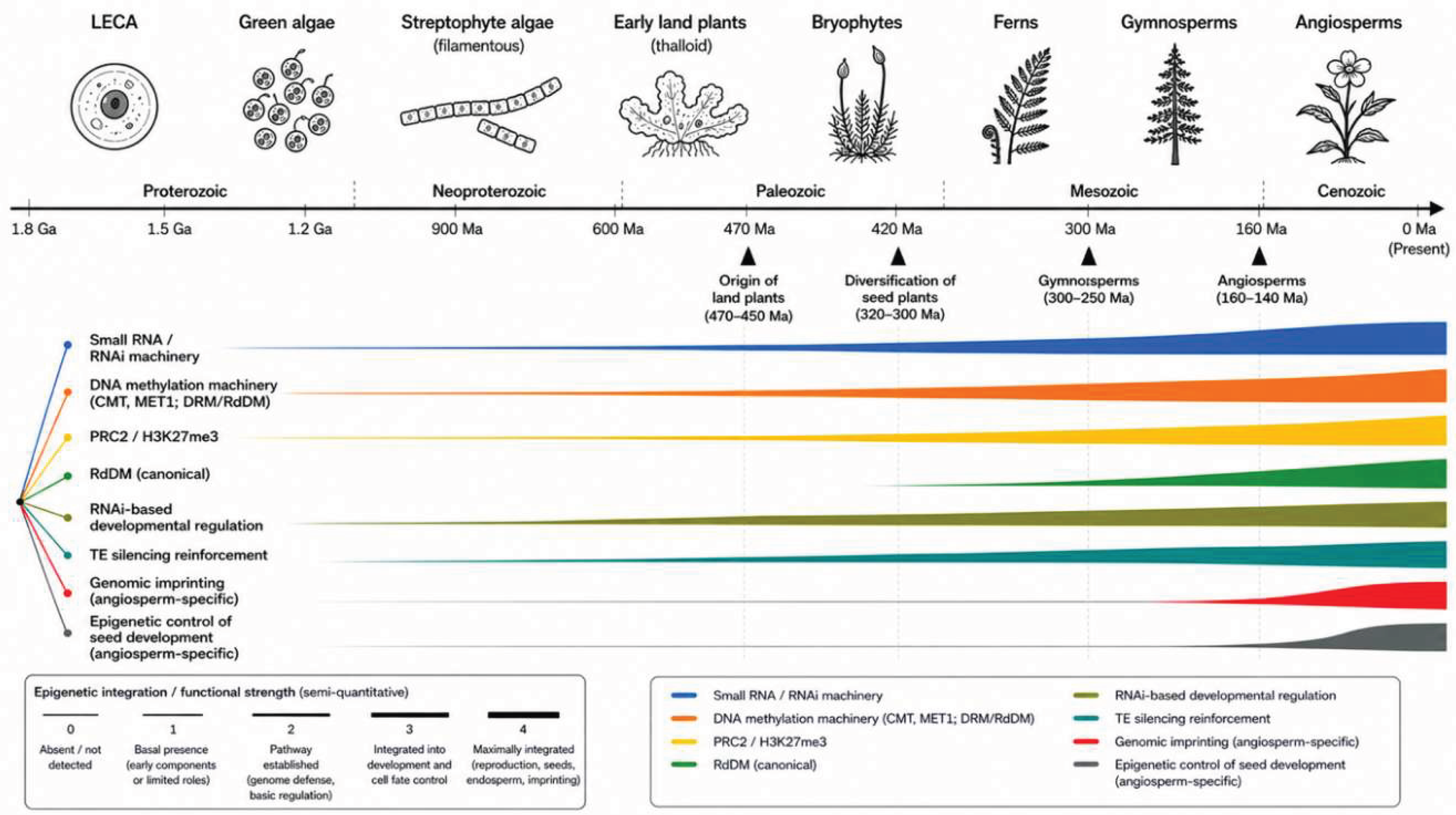

Table 1.
Functional roles of core epigenetic gene families across major plant evolutionary lineages.
Table 1.
Functional roles of core epigenetic gene families across major plant evolutionary lineages.
| Gene family Plant lineage |
AGO | DCL | RDR | CMT | DRM | PRC2 | DDM1 |
|---|---|---|---|---|---|---|---|
| Streptophyte algae | Present (ancestral AGO clades; basic RNA silencing) | Present (simplified miRNA/siRNA processing) | Present (early RNA amplification) | Rare/incipient homologs (limited CHG methylation) | Present (de novo methylation machinery emerging) | Present (primitive PcG system; developmental repression) | Present (basic heterochromatin remodeling) |
| Bryophytes | Expanded AGO families; gametophyte regulation, TE silencing | Multiple DCLs; miRNA/siRNA diversification | Functional RDRs; tasiRNA pathways active | Conserved CMT homologs; CHG maintenance methylation | DRM-mediated RdDM established | Functional PRC2; repression of sporophyte programs in gametophyte | Functional; TE silencing and chromatin compaction |
| Lycophytes | Diversified AGO clades; reproductive and meristem regulation | DCL diversification similar to seed plants | RDR-dependent siRNA amplification conserved | Conserved CMTs; heterochromatin methylation | RdDM functional; TE silencing | PRC2 conserved; developmental phase regulation | Conserved; heterochromatin accessibility control |
| Ferns | AGO expansion; roles in apogamy/phase transitions (inferred) | DCL pathways conserved; reproductive regulation | RDRs active; siRNA pathways in development | CMT homologs shared with seed plants; CHG/CHH methylation | DRM-dependent RdDM conserved | PRC2 conserved; phase identity control | Conserved; chromatin remodeling in large genomes |
| Gymnosperms | Expanded AGO families; TE silencing in large genomes | DCL diversification; reproductive small RNAs | RDR pathways active; siRNA amplification | CMT homologs (CMT2/3-like); gene body methylation-like patterns | DRM functional; RdDM in reproductive tissues | PRC2 conserved; embryogenesis regulation | Highly active; TE silencing in large, repeat-rich genomes |
| Basal angiosperms | AGO diversification; germline and imprinting roles emerging | Full DCL complement; reproductive siRNAs | RDR expansion; tasiRNA and siRNA pathways | CMT diversification; emergence of gene body methylation (gbM) | DRM robust; canonical RdDM | PRC2 central to seed development and imprinting | Essential for heterochromatin maintenance |
| Monocots | Expanded AGO clades; reproductive phasiRNAs | DCL specialization (e.g., DCL5 for reproductive siRNAs) | RDR diversification; phasiRNA pathways | CMT variants (e.g., ZMETs); lineage-specific functions | DRM active; RdDM with lineage-specific features | PRC2 conserved; endosperm regulation | Strong TE silencing in large genomes |
| Eudicots | Highly diversified AGO family; germline specification, RdDM | DCL1–4 specialization; miRNA/siRNA partitioning | RDR1/2/6 specialization; tasiRNA, antiviral roles | CMT1/2/3 diversification; gbM dependent on CMT3 | DRM2 central to RdDM; epigenetic regulation of reproduction | PRC2 highly specialized; imprinting, embryo/endosperm patterning | Essential chromatin remodeler for TE silencing |
Disclaimer/Publisher’s Note: The statements, opinions and data contained in all publications are solely those of the individual author(s) and contributor(s) and not of MDPI and/or the editor(s). MDPI and/or the editor(s) disclaim responsibility for any injury to people or property resulting from any ideas, methods, instructions or products referred to in the content. |
© 2026 by the authors. Licensee MDPI, Basel, Switzerland. This article is an open access article distributed under the terms and conditions of the Creative Commons Attribution (CC BY) license (http://creativecommons.org/licenses/by/4.0/).
Copyright: This open access article is published under a Creative Commons CC BY 4.0 license, which permit the free download, distribution, and reuse, provided that the author and preprint are cited in any reuse.


