

Submitted:
26 May 2026
Posted:
27 May 2026
You are already at the latest version
Abstract
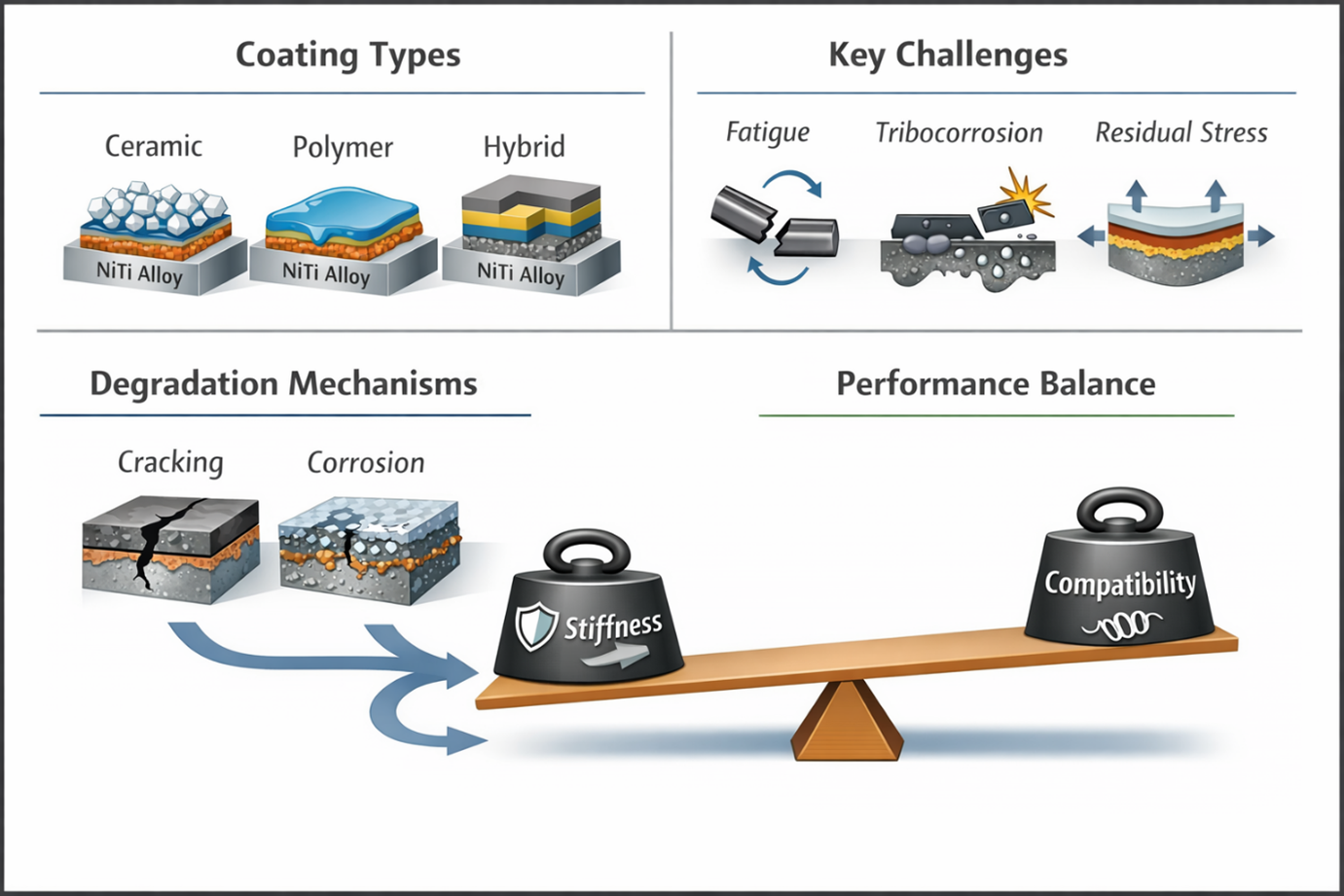
The performance and long term reliability of nickel–titanium (NiTi) alloys in biomedical applications are strongly governed by surface related degradation processes, in which the adhesion and interfacial stability of protective coatings play a critical role. This review examines ceramic, polymer, and hybrid coatings applied to NiTi substrates, with particular emphasis on adhesion mechanisms, interfacial mechanics, and tribocorrosion behavior under coupled mechanical and electrochemical loading conditions.
The analysis demonstrates that coating durability is controlled by the interplay between adhesion characteristics, mechanical compatibility, and functional thickness. Thin coatings provide favorable strain accommodation but limited wear resistance, whereas thicker layers improve barrier performance at the expense of increased susceptibility to interfacial stress accumulation and cracking. Ceramic coatings offer excellent corrosion and tribological performance but are prone to adhesion related failure under large deformation, while polymer coatings enhance interfacial compliance at the cost of reduced long term durability.
Multilayer and graded architectures are shown to improve adhesion durability and delay delamination by redistributing interfacial stresses and decoupling protective and deformational functions. Coating degradation in NiTi systems is therefore a multiphysical phenomenon involving the coupled action of mechanical damage, electrochemical reactions, tribological interactions, and martensitic transformation.
Despite significant progress, key challenges remain, including limited long term fatigue data, insufficient tribocorrosion studies under fully coupled conditions, and the lack of predictive models linking interfacial design with coating durability. This review highlights the need for integrated, adhesion oriented design strategies for advanced coating systems in NiTi biomedical applications.
Keywords:
NiTi alloys
; Nitinol
; tribocorrosion
; surface coatings
; interfacial mechanics
; martensitic transformation
; biomedical materials
1. Introduction
Nickel–titanium alloys (NiTi, commonly referred to as Nitinol) represent one of the most important classes of functional biomaterials used in modern biomedical engineering. Their unique mechanical behavior arises from a reversible martensitic phase transformation between austenite and martensite, which enables large recoverable strains (up to several percent under favorable loading conditions) while maintaining relatively high mechanical strength and fatigue resistance [1,2,3,4]. Owing to these properties, NiTi alloys have been widely implemented in biomedical devices requiring high flexibility and mechanical reliability, including vascular stents, orthodontic components, and various orthopedic implants [3,4,5,6,7].
Despite their exceptional functional properties, the long-term performance of NiTi components in physiological environments is governed predominantly by surface-controlled degradation phenomena. The alloy is naturally protected by a passive TiO₂ layer that provides a certain degree of corrosion resistance; however, the stability of this protective film may be compromised under mechanical loading or in aggressive environments containing chloride ions [8,9,10,11]. Disruption of the passive layer can lead to increased electrochemical activity, accelerated corrosion processes, and enhanced nickel ion release, which may influence both the durability of the implant and the biological response of surrounding tissues [9,12].
A particularly important degradation mechanism affecting NiTi biomedical devices is tribocorrosion, which results from the simultaneous interaction between mechanical wear and electrochemical corrosion. Unlike purely mechanical or purely electrochemical degradation processes, tribocorrosion involves complex synergistic interactions that often accelerate material loss and destabilize protective surface films [8,13,14,15,16]. Experimental studies have demonstrated that mechanical removal of the passive oxide layer leads to a local increase in corrosion current density and promotes progressive surface degradation during repeated contact or sliding conditions [14,15].
To mitigate these limitations, extensive research has focused on advanced surface modification strategies designed to enhance the durability and biological performance of NiTi alloys. Among the most widely investigated approaches are ceramic coatings, polymer coatings, and hybrid multilayer systems. Ceramic coatings such as titanium dioxide (TiO₂) and diamond-like carbon (DLC) can significantly improve wear resistance and electrochemical stability, whereas polymer coatings offer superior mechanical compliance with the deformable NiTi substrate and may enhance biocompatibility [17,18,19,20,21,22,23,24]. In addition, increasing attention has been devoted to multifunctional coating concepts capable of providing antibacterial activity, improved biointegration, or controlled release of therapeutic agents [25,26,27,28].
From the perspective of adhesive science, the performance of such coatings is governed not only by their intrinsic protective properties but, critically, by the nature and durability of the coating–substrate interface. Adhesion in NiTi-based systems should therefore be considered as an interfacial property controlled by a combination of chemical bonding, mechanical interlocking, and interfacial fracture resistance, rather than solely by initial adhesion strength values measured under simplified loading conditions.
Designing durable coating systems for NiTi alloys consequently requires careful consideration of the complex coupling between mechanical deformation, electrochemical processes, and interfacial mechanics. In particular, mechanical compatibility between the coating and the superelastic substrate is critical. Significant differences in elastic modulus may generate strain incompatibility at the coating–substrate interface, leading to stress concentration, microcrack initiation, and progressive interfacial damage during cyclic loading [29,30,31]. For this reason, multilayer and compositionally graded coating architectures are increasingly investigated as strategies for redistributing stresses and improving interfacial stability under repeated deformation [26,32].
The present article provides a critical review of surface engineering strategies applied to NiTi alloys, with emphasis on ceramic, polymer, and hybrid coating systems. Particular attention is devoted to adhesion mechanisms, interfacial fracture and stress development, the influence of coating thickness and architecture, and the multiphysical degradation processes associated with tribocorrosion. By integrating insights from materials science, tribology, electrochemistry, and adhesive mechanics, this review aims to clarify the relationships between coating design, interfacial durability, and the long-term functional performance of NiTi biomedical devices.
2. Methodology of Literature Review
Literature sources were collected from the Scopus, Web of Science, and Google Scholar databases to provide a reproducible overview of research on surface engineering of NiTi alloys. The search covered publications from 1995 to 2025, corresponding to the period of intensive development of biomedical applications of NiTi.
Keyword combinations included NiTi alloy, Nitinol, surface coating, tribocorrosion, ceramic coating, polymer coating, diamond-like carbon, hydroxyapatite, and biomedical implants. Only peer-reviewed journal articles and authoritative review papers were considered.
Approximately 120 publications were initially identified. After removal of duplicates and studies not directly addressing surface modification or degradation mechanisms of NiTi alloys, approximately 60 key papers were selected for detailed analysis.
The literature was examined with particular focus on mechanical compatibility between coatings and NiTi substrates, tribocorrosion mechanisms in biomedical environments, the influence of coatings on martensitic transformation and fatigue behavior, and the role of multilayer or hybrid coating architectures.
The selected studies were analyzed comparatively to identify relationships between coating architecture, thickness, mechanical properties, and durability under biomechanical loading conditions.
3. Surface Degradation Mechanisms
NiTi alloys are protected by a naturally formed TiO₂ passive film that limits electrochemical interaction with physiological environments [4,12]. The stability of this film decreases under mechanical damage and in chloride-containing media, such as body fluids [5]. Local rupture of the passive layer increases electrochemical activity and may promote nickel ion release, affecting both material durability and biocompatibility [9]. While partial repassivation can occur under static conditions, repeated mechanical interaction leads to continuous disruption of the passive film and progressive surface degradation, particularly in regions of stress concentration or structural heterogeneity [5,15].
Tribocorrosion represents a coupled degradation mode in which mechanical wear and electrochemical corrosion act simultaneously. Mechanical removal of the passive layer exposes the substrate and enhances electrochemical reactions, often leading to higher material loss than that expected from purely mechanical or purely electrochemical processes [8,9]. This interaction constitutes a primary durability challenge for NiTi components operating under repeated contact or sliding conditions in biomedical applications.
4. Adhesion Mechanisms and Interfacial Bonding
The adhesion of coatings to NiTi substrates is a key factor governing their durability under tribocorrosion conditions. In NiTi systems, coating failure frequently initiates at the coating–substrate interface, where insufficient interfacial bonding promotes crack propagation, delamination, and progressive substrate exposure [18,19,25]. Consequently, reliable surface modification strategies require a clear understanding of the mechanisms governing interfacial adhesion.
Adhesion in coating–substrate systems is generally governed by mechanical interlocking, chemical bonding, and diffusion-assisted interactions [21,25]. Mechanical interlocking originates from surface roughness and topographical features that provide physical anchoring of the coating. In NiTi alloys, surface treatments such as sandblasting, acid etching, or laser texturing are commonly employed to increase the effective contact area and improve adhesion [20,21].
Chemical bonding plays a particularly important role due to the presence of a native TiO₂ passive layer on NiTi surfaces [7,12]. This oxide film provides active sites for interfacial bonding with deposited coatings. In ceramic coatings, such as TiO₂ or hydroxyapatite, adhesion may involve ionic or covalent interactions, whereas polymer coatings typically rely on secondary interactions, including van der Waals forces and hydrogen bonding [22,23,24]. The composition and stability of the oxide layer therefore critically influence adhesion performance [15].
Diffusion-related mechanisms may additionally contribute to adhesion, particularly in coatings deposited at elevated temperatures or by chemical vapor deposition (CVD). Interdiffusion can lead to graded transition layers that mitigate abrupt property mismatches and reduce interfacial stress concentration [24,33]. However, excessive diffusion may adversely affect functional properties of NiTi, including martensitic transformation behavior [27,28,29].
The deposition technique strongly influences adhesion quality. Physical vapor deposition (PVD) generally produces dense coatings with limited interdiffusion, where adhesion is dominated by mechanical interlocking and residual stress effects [33,35]. In contrast, CVD and plasma-assisted processes may promote stronger chemical bonding and graded interfaces. Atomic layer deposition (ALD) enables precise control of coating thickness and conformality, supporting good adhesion on complex geometries while maintaining low residual stress levels [14,35].
Adhesion performance is commonly assessed using scratch testing, pull-off testing, and nanoindentation-based methods [25,35]. In NiTi systems, adhesion is closely coupled with deformation behavior, as superelastic strains of up to several percent impose cyclic stresses at the interface [1,2,29]. Insufficient interfacial bonding may therefore lead to delamination even when coating hardness or corrosion resistance is high [18,19].
Residual stresses generated during deposition represent an additional critical factor influencing adhesion durability. Tensile stresses promote crack initiation, whereas compressive stresses may improve crack resistance but can induce buckling or spallation if excessive [33,35].
From a design perspective, adhesion must be considered together with mechanical compatibility and coating architecture. High-stiffness ceramic coatings require strong and damage-tolerant interfacial bonding to accommodate strain mismatch with the NiTi substrate, whereas compliant polymer coatings are less sensitive to adhesion-related failure but may degrade through wear or physicochemical processes [23,26,30]. Multilayer and compositionally graded coatings offer an effective strategy for enhancing adhesion durability by redistributing stresses across the interface [32,33,34].
A comparative overview of representative coating types, dominant adhesion mechanisms, testing methods, and typical failure modes for coatings applied to NiTi alloys is presented in Table 1.
5. Interfacial Mechanics and Strain Compatibility
Mechanical compatibility between the coating and the NiTi substrate is a primary factor controlling coating durability under mechanical and tribocorrosion loading. Differences in elastic modulus generate strain incompatibility that concentrates stresses at the interface and promotes crack initiation and propagation [13,14,15].
NiTi alloys can exhibit reversible strains of up to several percent during superelastic deformation associated with stress-induced martensitic transformation [1,3]. In contrast, most ceramic coatings tolerate elastic strains typically below 1–2%, which explains their susceptibility to brittle cracking under large substrate deformation.
High-stiffness ceramic coatings constrain substrate deformation and may intensify interfacial stresses associated with martensitic transformation. This constraint effect can locally modify transformation stress levels and potentially influence fatigue behavior of the coated system [27,28,29]. In contrast, polymer coatings deform more readily and accommodate substrate strain with a lower risk of brittle damage, although their wear and long-term physicochemical stability may be limited [24].
Residual stresses introduced during deposition processes such as physical vapor deposition (PVD) or chemical vapor deposition (CVD) further affect interfacial stability. Tensile intrinsic stresses are particularly detrimental, as they increase the driving force for crack initiation and delamination under cyclic loading [18].
The fundamental differences in deformation behavior between pseudoelastic NiTi, brittle ceramic coatings, and compliant polymer layers constitute the mechanical origin of strain mismatch in coated systems, as schematically illustrated in Figure 1.
6. Effect of Coating Thickness
Coating thickness strongly influences stress distribution, damage initiation, and protective performance of coatings applied to NiTi alloys. Nanometric layers produced by atomic layer deposition (ALD) or thin-film PVD generally accommodate substrate deformation well due to limited elastic energy accumulation [14,33]. However, their protective capability may be insufficient under severe wear or high contact stresses.
Micrometric coatings provide improved barrier properties against corrosion and enhanced wear resistance, but they also increase the risk of stress concentration and crack formation, particularly in stiff ceramic layers such as diamond-like carbon (DLC) or metal oxides [18,19,20]. Increased coating thickness may additionally influence local stress states within the substrate and thereby affect martensitic transformation behavior [13].
As summarized in Table 2, no single coating thickness ensures optimal durability under all service conditions. Thin coatings favor mechanical compatibility with the superelastic substrate but offer limited tribological protection, whereas thicker coatings enhance barrier and wear performance at the expense of strain tolerance. Multilayer and compositionally graded architectures mitigate this trade-off by redistributing stresses across layers with different mechanical properties, improving adhesion and delaying damage initiation [34,35].
These observations indicate that coating design for NiTi biomedical systems requires multi-parameter optimization, in which coating thickness must be considered alongside mechanical compatibility, residual stress state, and architectural design.
7. Ceramic Coatings
Ceramic coatings are widely applied to NiTi alloys to improve corrosion resistance and tribological performance. Titanium dioxide (TiO₂) coatings stabilize the native passive layer and reduce metal–environment interactions, leading to a significant improvement in corrosion resistance in simulated physiological solutions [12,14]. Their protective effectiveness strongly depends on coating density, microstructure, and interfacial adhesion quality.
Diamond-like carbon (DLC) coatings offer high hardness (typically 10–25 GPa) and low friction coefficients (approximately 0.05–0.2), resulting in substantially improved wear resistance [17,18,19]. However, their high elastic modulus, often exceeding 200 GPa, limits strain accommodation and makes these coatings susceptible to microcracking or delamination under large substrate deformation.
Bioactive ceramic coatings such as hydroxyapatite (HAp) promote osseointegration and favorable cellular responses, which is advantageous for orthopedic applications [20,21,22]. Their inherently brittle mechanical behavior, however, restricts long-term durability under cyclic loading and limits their applicability in mechanically demanding NiTi components.
8. Polymer Coatings
Polymer coatings provide improved mechanical compatibility with NiTi substrates due to their low elastic modulus and high deformability. Materials such as polyurethane, polylactide, and poly(carbonate urea) urethane can accommodate substrate strain effectively and reduce the risk of crack initiation at the coating–substrate interface [23,24].
In addition to mechanical compliance, polymer coatings can act as diffusion barriers limiting nickel ion release and may serve as platforms for bioactive functionalization or controlled drug delivery [25,26]. Their primary limitation is relatively low wear resistance and gradual physicochemical degradation during long-term service, which may restrict their durability under severe tribological or tribocorrosion conditions.
Tribocorrosion
Tribocorrosion represents a critical degradation process for NiTi alloys operating in biological environments and arises from the coupled action of mechanical wear and electrochemical corrosion [8,9,10,11]. Sliding contact removes or damages the passive TiO₂ layer, exposing the substrate and increasing local electrochemical activity. Although repassivation may occur, repeated mechanical interaction often prevents the formation of a stable protective film, leading to progressive surface degradation and enhanced material loss.
In NiTi alloys, tribocorrosion behavior is further influenced by stress-induced martensitic transformation, which modifies local contact stresses and surface reactivity during cyclic loading [27,28,29]. Experimental studies show that tribocorrosion rates increase significantly in chloride-containing environments that destabilize the passive oxide layer [9,10].
Surface coatings mitigate tribocorrosion by reducing friction and limiting electrochemical exposure of the substrate. Ceramic coatings provide effective barrier protection but may crack under large strain due to stiffness mismatch, whereas polymer coatings accommodate deformation more readily but typically exhibit lower wear resistance. Hybrid and multilayer coating systems aim to combine these advantages by separating protective and compliant functions within the coating architecture [32,33,34,35].
The coupled mechanical–electrochemical interactions governing tribocorrosion degradation in coated NiTi systems are schematically illustrated in Figure 2.
9. Comparative Analysis of Surface Modification Strategies
Surface modification of NiTi alloys requires simultaneous optimization of mechanical compatibility, corrosion resistance, tribological performance, and biological response. The comparative characteristics of major coating classes are summarized in Table 3, Table 4 and Table 5.
Ceramic coatings provide high hardness and corrosion resistance, effectively stabilizing the passive layer and improving wear performance [12,13,14,15,16,17,18,19,20]. However, their elevated stiffness increases sensitivity to strain-induced damage, as reflected by dominant cracking and delamination mechanisms [13,14,15,18,19,20]. These effects may also influence martensitic transformation behavior and fatigue performance under large deformation conditions [13,14,15,30,31].
Bioactive ceramics such as hydroxyapatite enhance biological adhesion but remain mechanically fragile, with brittle fracture constituting the primary degradation pathway under cyclic loading [20,21,22].
In contrast, polymer coatings exhibit high deformational compatibility due to their low elastic modulus, which supports fatigue performance and minimizes transformation-related stress perturbations [24,25,26]. Their durability is primarily limited by wear and long-term physicochemical degradation.
From a functional perspective, coating influence on martensitic transformation and fatigue durability is particularly important. High-stiffness coatings may significantly modify local stress conditions and affect phase transformation behavior, whereas compliant systems exert a smaller mechanical perturbation.
The comparative data demonstrate a fundamental design trade-off: stiffness-driven protection in ceramic coatings versus strain accommodation in polymer systems. Hybrid and multilayer architectures partially overcome this limitation by combining mechanically dissimilar layers, enabling improved tribocorrosion resistance while preserving interfacial stability [32,33,34,35].
Optimal coating design for NiTi systems therefore requires integrated multi-parameter optimization rather than prioritization of a single performance attribute.
Taken together, the data summarized in Table 1, Table 2, Table 3, Table 4 and Table 5 indicate that coating performance in NiTi systems is governed by the interplay between three coupled parameters: mechanical stiffness, structural architecture, and functional thickness. High-stiffness monolithic coatings maximize barrier and wear resistance but amplify strain incompatibility effects. Compliant systems minimize mechanical perturbation yet sacrifice long-term tribological durability. Multilayer and graded architectures redistribute stresses across interfaces and decouple protective and deformational functions, thereby enabling partial optimization of conflicting requirements.
This multiparameter interaction framework highlights that coating durability cannot be predicted from individual material properties alone but must be evaluated in the context of coupled mechanical–electrochemical–functional behavior.
10. Research Gaps and Future Directions
Despite substantial progress in surface modification strategies for NiTi alloys, significant methodological and knowledge gaps remain. The comparative analysis of coating properties, degradation mechanisms, and functional effects summarized in Table 1, Table 2, Table 3, Table 4 and Table 5 highlights several critical research directions.
A major limitation is the scarcity of long-term fatigue studies conducted under realistic biomechanical loading conditions. Most available investigations rely on short-term or quasi-static tests, which do not adequately represent service conditions of load-bearing biomedical devices [30,31]. In particular, the influence of coatings on very-high-cycle fatigue behavior (>10⁸ cycles) remains poorly understood.
Another important gap concerns tribocorrosion testing under fully coupled mechanical–electrochemical conditions. Although degradation of NiTi implants is inherently multiphysical, wear and corrosion processes are still frequently investigated separately [8,9,10]. Quantitative experimental methodologies and predictive models capable of capturing synergistic effects remain limited.
Residual stress evolution in thin-film and multilayer coatings represents an additional unresolved issue. Intrinsic stresses generated during PVD or CVD deposition may critically affect adhesion, crack initiation, and fatigue durability, yet systematic studies linking residual stress characterization with long-term mechanical performance are scarce [14,18,19].
From a design perspective, clear criteria for optimizing mechanical compatibility between coating and substrate have not been fully established. While the trade-off between stiffness-driven protection and strain accommodation is well recognized (Table 2 and Table 4), robust guidelines for tailoring graded and multilayer architectures are still underdeveloped [13,14,15,32,33,34,35].
Functional coatings introduce further complexity. Bioactive, antibacterial, and drug-delivery systems are increasingly explored; however, biological performance is often evaluated independently of mechanical durability and tribocorrosion stability [23,24,25,26,32,33,34,35]. Integrated assessment protocols combining biological, mechanical, and electrochemical performance are therefore needed.
Future research should prioritize multiphysical experimental and modeling approaches that explicitly couple mechanics, electrochemistry, tribology, and martensitic transformation phenomena. In parallel, the development of standardized fatigue and tribocorrosion testing methods in simulated physiological environments would significantly improve comparability across studies. Emerging surface engineering techniques, including advanced plasma-based oxidation and hybrid processes, offer promising opportunities for controlling oxide structure and residual stress states [27,28,29,42].
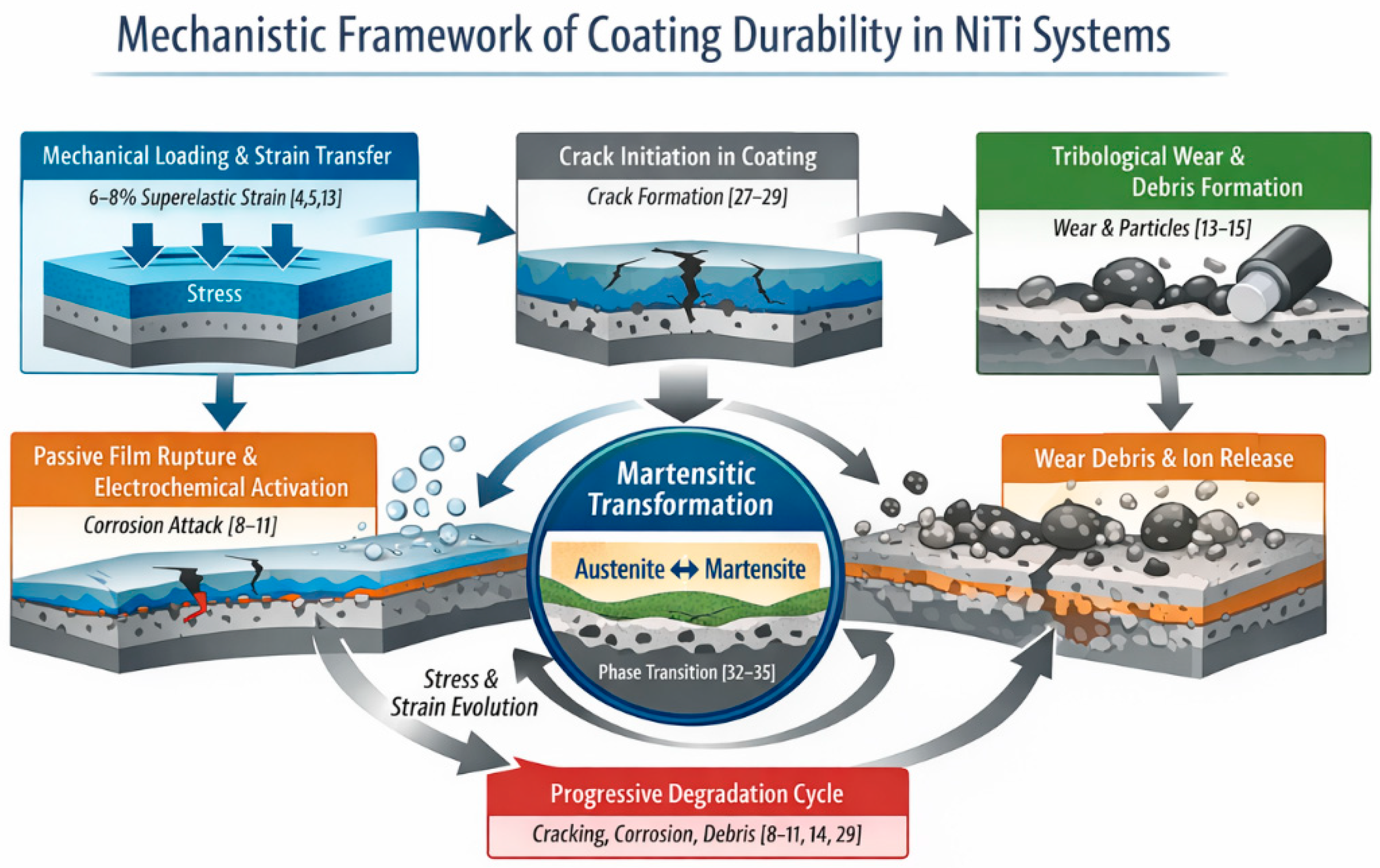
11. Mechanistic Framework of Coating Durability in NiTi Systems
The durability of coatings applied to NiTi alloys is governed by the interaction of multiple coupled mechanisms operating across different length scales. Based on the reviewed literature, coating degradation can be described using a mechanistic framework that integrates mechanical deformation, electrochemical reactions, tribological contact, and stress-induced martensitic transformation.
During service, cyclic superelastic deformation of the NiTi substrate transfers strain to the coating layer. When the coating exhibits significantly higher stiffness, interfacial stresses develop that can initiate microcracks at the coating–substrate interface [13,14,15]. Crack initiation typically occurs at structural defects, pores, or local stress concentrations and may propagate rapidly in brittle ceramic coatings once the elastic strain limit is exceeded [18,19,20].
Crack formation and coating damage expose the underlying substrate, increasing susceptibility of the TiO₂ passive film to mechanical removal. Local rupture of the passive layer enhances electrochemical activity and accelerates corrosion processes [8,9]. Simultaneously, sliding contact or micromotion generates tribological wear and debris, which further destabilize the surface and increase material loss rates [10,11].
In NiTi systems, stress-induced martensitic transformation modifies local stress distributions and contact conditions near the surface. Repeated transformation cycles can intensify crack propagation and fatigue damage in the coating–substrate system [27,28,29]. The interaction of these processes creates a positive feedback loop, ultimately leading to coating delamination, substrate exposure, and progressive degradation.
This framework demonstrates that coating durability cannot be predicted from individual material properties alone, such as hardness or corrosion resistance. Instead, reliable long-term performance requires simultaneous optimization of mechanical compatibility, coating architecture, residual stress state, and tribocorrosion resistance [32,33,34,35].
Figure 3.
Mechanistic framework of coating durability in NiTi systems illustrating the coupling between cyclic deformation, coating cracking, passive film rupture, electrochemical activation, tribological wear, and martensitic transformation.
Figure 3.
Mechanistic framework of coating durability in NiTi systems illustrating the coupling between cyclic deformation, coating cracking, passive film rupture, electrochemical activation, tribological wear, and martensitic transformation.
12. Conclusions
This review demonstrates that the long-term durability of NiTi alloys in biomedical applications is governed predominantly by surface-controlled degradation processes rather than by intrinsic bulk properties alone. Although NiTi exhibits exceptional superelastic and shape-memory behavior, its functional performance is strongly influenced by coupled mechanical, tribological, and electrochemical interactions occurring in the near-surface region.
Comparative analysis of ceramic, polymer, and hybrid coating systems reveals a fundamental design trade-off between stiffness-driven protection and mechanical compatibility with the superelastic substrate. Ceramic coatings provide effective barrier protection and superior wear resistance but are susceptible to strain-induced cracking under large deformation. In contrast, polymer coatings offer excellent deformational compliance while exhibiting reduced long-term tribological durability.
The durability of coated NiTi systems is therefore controlled by the interaction of multiple factors, including coating microstructure, architectural design, residual stress state, interfacial adhesion, and cyclic mechanical loading. Surface modifications may additionally alter local stress distributions and martensitic transformation behavior, thereby influencing fatigue resistance and functional stability of biomedical devices.
Among current surface engineering approaches, multilayer and compositionally graded coating architectures appear particularly promising. By redistributing interfacial stresses and decoupling protective and deformational functions, these systems offer an effective route toward improved adhesion durability under tribocorrosion conditions.
Overall, reliable coating performance on NiTi alloys requires a multiphysical design strategy that integrates mechanical compatibility, interfacial stability, and resistance to coupled mechanical–electrochemical degradation. Future progress will depend on the development of predictive durability models, systematic experimental validation, and standardized fatigue and tribocorrosion testing under physiologically relevant conditions.
Acknowledgments
During the preparation of this manuscript/study, the authors used Microsoft Copilot, ChatGPT and Notebook LM for the purposes of preparation of the graphical abstract (Microsoft Copilot) and Figure 2 and Figure 3 (Notebook LM). The authors have reviewed and edited the output and take full responsibility for the content of this publication.
References
- Otsuka, K.; Wayman, C.M. (Eds.) Shape Memory Materials; Cambridge University Press: Cambridge, 1998. [Google Scholar]
- Pelton, A.R. Nitinol fatigue: A review. J. Mater. Eng. Perform. 2011, 20, 613–617. [Google Scholar] [CrossRef]
- Duerig, T.; Pelton, A.; Stöckel, D. An overview of nitinol medical applications. Mater. Sci. Eng. A 1999, 273–275, 149–160. [Google Scholar] [CrossRef]
- Rondelli, G. Corrosion resistance tests on NiTi shape memory alloy. Biomaterials 1996, 17(20), 2003–2008. [Google Scholar] [CrossRef]
- Shabalovskaya, S.; Anderegg, J.; Van Humbeeck, J. Critical overview of Nitinol surfaces and their modifications for medical applications. Acta Biomater. 2008, 4(3), 447–467. [Google Scholar] [CrossRef]
- Firstov, G.S.; Vitchev, R.G.; Kumar, H.; Blanpain, B.; Celis, J.P. Surface oxidation of NiTi shape memory alloy. Mater. Sci. Eng. A 2009, 481–482, 114–118. [Google Scholar] [CrossRef]
- Stöckel, D.; Pelton, A.; Duerig, T. Self-expanding Nitinol stents: material and design considerations. Eur. Radiol. 2004, 14(2), 292–301. [Google Scholar] [CrossRef] [PubMed]
- Landolt, D.; Mischler, S. (Eds.) Tribocorrosion of Passive Metals and Coatings; Woodhead Publishing: Oxford, 2011. [Google Scholar]
- Vieira, A.C.; Ribeiro, A.R.; Rocha, L.A.; Celis, J.P. Tribocorrosion of biomaterials. Electrochim Acta 2021, 368, 138737. [Google Scholar]
- Buciumeanu, M.; Bagheri, A.; Silva, F.S.; Henriques, B.; Lasagni, A.F.; Shamsaei, N. Tribocorrosion Behavior of NiTi Biomedical Alloy Processed by an Additive Manufacturing Laser Beam Directed Energy Deposition Technique. Materials 2022, 15(2), 691. [Google Scholar] [CrossRef] [PubMed]
- Okoani, A.O.; Nand, A.; Ramezani, M. Comparative Study of the Tribocorrosion Performance of NiTiNOL60 in Acidic, Alkaline, and Saline Environments. J. Mater. Eng. Perform. 2024, 33, 13528–13542. [Google Scholar] [CrossRef]
- Krupa, D.; Baszkiewicz, J.; et al. Morphology and properties of oxide layers formed on NiTi shape memory alloy. J. BioMed Mater. Res. A 2004, 68A(1), 135–145. [Google Scholar] [CrossRef]
- Saeed, S.; et al. Surface modification of NiTi alloys: A review. Surf. Coat. Technol. 2014, 255, 1–14. [Google Scholar] [CrossRef]
- Rudolf, R.; Stambolić, A.; Kocijan, A. Atomic Layer Deposition of a TiO₂ Layer on Nitinol and Its Corrosion Resistance in a Simulated Body Fluid. Metals 2021, 11(4), 659. [Google Scholar] [CrossRef]
- Yu, H.; et al. Composition and structure of surface oxide films on NiTi shape memory alloy. Appl. Surf. Sci. 2019, 492, 253–262. [Google Scholar] [CrossRef]
- Okoani, A.O.; Nand, A.; Jiang, C. P.; Ramezani, M. Investigating the Tribocorrosion Behaviour of NiTiNOL60 Alloy in Engineering and Biomedical Applications—An Overview. Metals 2024, 14(12), 1334. [Google Scholar] [CrossRef]
- Roy, R.K.; Lee, K.R. Biomedical applications of diamond like carbon coatings: a review. J. BioMed Mater. Res. B 2007, 83B(1), 72–84. [Google Scholar] [CrossRef]
- Zhang, Y.; et al. Adhesion and tribological behavior of DLC coatings on NiTi substrates. Surf. Coat. Technol. 2018, 337, 449–459. [Google Scholar] [CrossRef]
- Wang, L.; et al. DLC coatings in biomedical applications: recent advances. Coatings 2022, 12(1), 45. [Google Scholar] [CrossRef]
- Dorozhkin, S.V. Nanosized and nanocrystalline calcium orthophosphates. Acta Biomater. 2010, 6(3), 715–734. [Google Scholar] [CrossRef]
- Mohammadi, I.; et al. Hydroxyapatite coatings for metallic implants: processing and properties. Ceram. Int. 2018, 44(14), 16585–16602. [Google Scholar] [CrossRef]
- Luo, J.; et al. Composite Ca–P/oxide coatings on NiTi: microstructure and performance. J. Eur. Ceram. Soc. 2023, 43(10), 3768–3782. [Google Scholar] [CrossRef]
- Seifalian, A.M.; Salacinski, H.J.; Tiwari, A.; Edwards, A.; Bowald, S.; Hamilton, G. In vivo biostability of a poly(carbonate urea)urethane graft. Biomaterials 2003, 24(14), 2549–2557. [Google Scholar] [CrossRef]
- Bakhshi, R.; et al. Polymer coatings for NiTi biomedical devices: corrosion and biocompatibility. Acta Biomater. 2014, 10(8), 3723–3738. [Google Scholar] [CrossRef]
- Chen, Q.; Thouas, G.A. Metallic implant biomaterials. Mater. Sci. Eng. R Rep. 2015, 87, 1–57. [Google Scholar] [CrossRef]
- Rahman, M.; et al. Polymer coatings in biomedical devices. Mater. Today Bio 2022, 16, 100245. [Google Scholar] [CrossRef]
- Auricchio, F.; Taylor, R.L.; Lubliner, J.; et al. Shape memory alloy modeling for biomedical applications. J. Biomech. 2011, 44(3), 519–542. [Google Scholar] [CrossRef]
- Petrini, L.; Migliavacca, F. A review of modeling of NiTi shape memory alloy. J. Mech. Behav. BioMed Mater. 2011, 4(3), 411–428. [Google Scholar] [CrossRef]
- Ziętala, M.; et al. Mechanical behavior of additively manufactured NiTi. Acta Mech. 2020, 231, 271–288. [Google Scholar]
- McKelvey, A.L.; Ritchie, R.O. Fatigue crack growth behavior in the superelastic and shape memory alloy Nitinol. Metall. Mater. Trans. A 2001, 32(3), 731–743. [Google Scholar] [CrossRef]
- Robertson, S.W.; Pelton, A.R.; Ritchie, R.O. Mechanical fatigue and fracture of Nitinol. Int. Mater. Rev. 2012, 57(1), 1–36. [Google Scholar] [CrossRef]
- Li, X.; et al. Surface modification of NiTi alloys for biomedical applications: recent advances. Mater. Sci. Eng. C 2020, 110, 110655. [Google Scholar] [CrossRef]
- Vokoun, D.; Racek, J.; Kadeřávek, L.; Kei, C.C.; Yu, Y.S.; Klimša, L.; Šittner, P. Atomic Layer Deposited TiO₂ Coatings on NiTi Surface. J. Mater. Eng. Perform. 2018, 27, 572–579. [Google Scholar] [CrossRef]
- Kim, J.; et al. Advanced functional coatings for biomedical devices. ACS Appl. Mater. Interfaces 2021, 13(20), 23389–23413. [Google Scholar]
- Wang, C.; et al. Biofunctional coatings: trends and challenges. Acta Biomater. 2021, 127, 1–25. [Google Scholar] [CrossRef]
- Peng, Y.; Peng, J.; Wang, Z.; Xiao, Y.; Qiu, X. Diamond like carbon coatings in the biomedical field: properties, applications and future development. Coatings 2022, 12(8), 1088. [Google Scholar] [CrossRef]
- Dudek, K.; Dulski, M.; Podwórny, J.; Kujawa, M.; Gerle, A.; Rawicka, P. Functionalization of the NiTi Surface through Hydroxyapatite/Ag–TiO₂ Hybrid Coatings. Materials 2024, 17(3), 604. [Google Scholar] [CrossRef] [PubMed]
- Goryczka, T.; Szaraniec, B. Characterization of Polylactide Layer Deposited on NiTi Shape Memory Alloy. J. Mater. Eng. Perform. 2014, 23, 269–276. [Google Scholar] [CrossRef]
- Goryczka, T.; et al. PAN-Based Carbon Fibers Deposition on NiTi Surface. Arch. Metall. Mater. 2023, 68(3), 1047–1052. [Google Scholar] [CrossRef]
- Dudek, K.; Szaraniec, B.; Goryczka, T. Structure of multilayers deposited on NiTi shape memory alloy. Solid State Phenom. 2013, 203–204, 90–95. [Google Scholar] [CrossRef]
- Dong, H.; et al. Thin film coatings: state of the art. Thin Solid Films 2021, 726, 138532. [Google Scholar] [CrossRef]
- Witkowska, J.; Sobiecki, J.; Wierzchoń, T. Advancements in Surface Modification of NiTi Alloys for Orthopedic Implants: Focus on Low Temperature Glow Discharge Plasma Oxidation Techniques. Int. J. Mol. Sci. 2025, 26(3), 1132. [Google Scholar] [CrossRef]
Figure 1.
Comparison of deformation mechanisms governing strain compatibility in coated NiTi alloys.
Figure 1.
Comparison of deformation mechanisms governing strain compatibility in coated NiTi alloys.
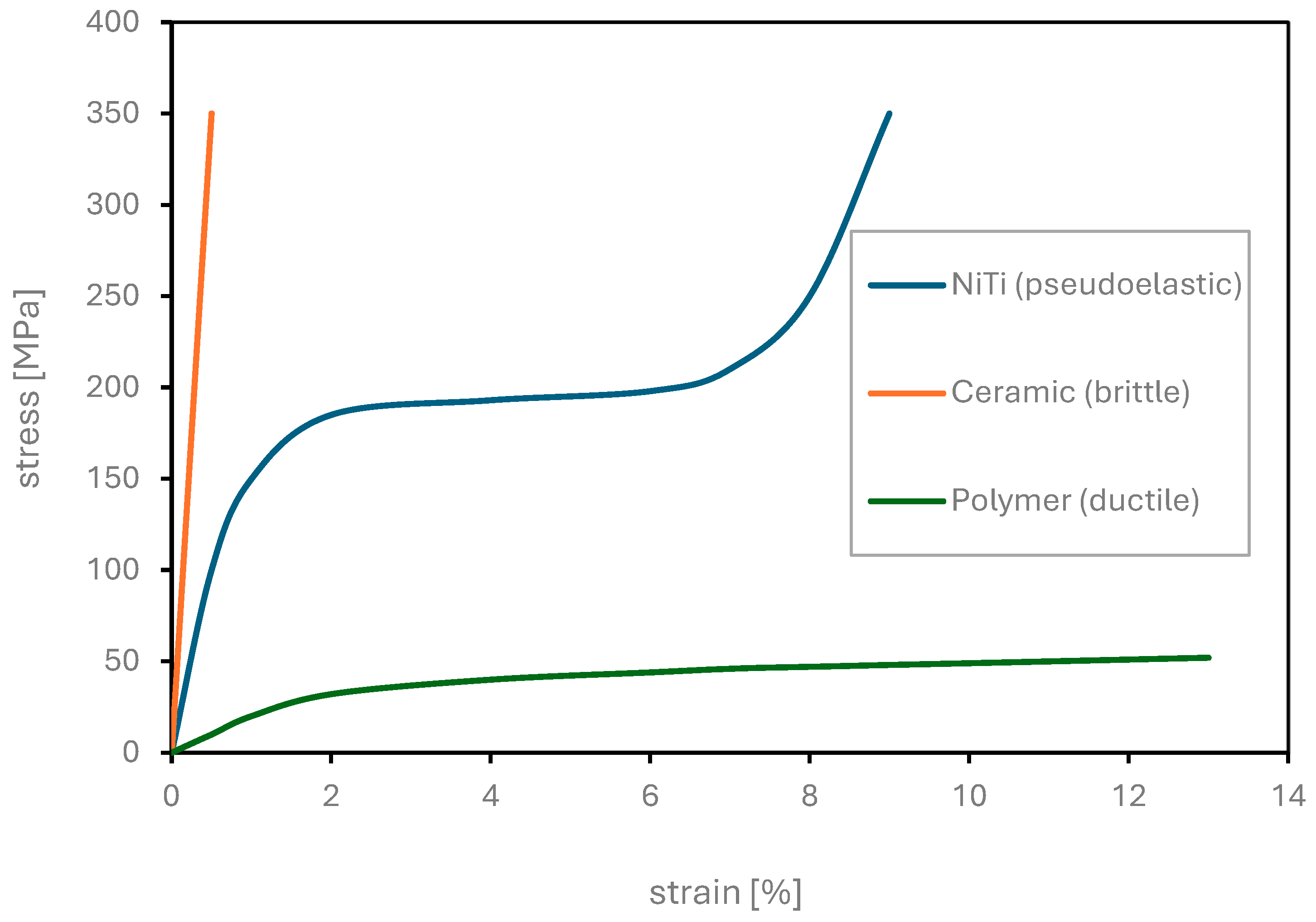
Figure 2.
Mechanistic framework of tribocorrosion degradation in coated NiTi alloys illustrating coupled mechanical–electrochemical processes, thickness-dependent damage initiation, and feedback interactions governing material loss.
Figure 2.
Mechanistic framework of tribocorrosion degradation in coated NiTi alloys illustrating coupled mechanical–electrochemical processes, thickness-dependent damage initiation, and feedback interactions governing material loss.
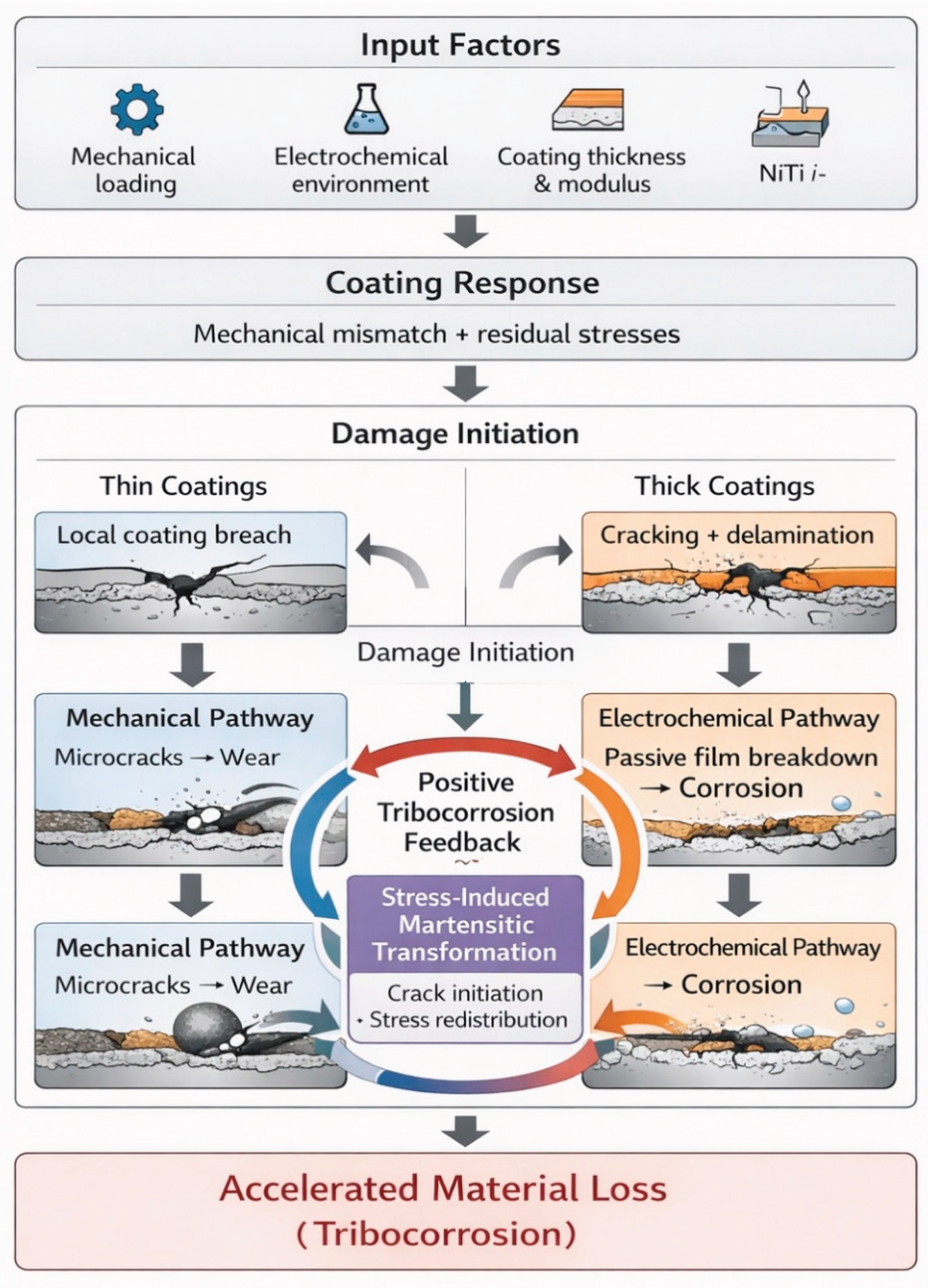

Table 1.
Adhesion Performance and Failure Mechanisms of Coatings on NiTi Alloys.
| Coating Type | Typical Adhesion Strength | Dominant Adhesion Mechanisms | Common Test Methods | Typical Failure Modes | Key Influencing Factors |
|---|---|---|---|---|---|
| TiO₂ (oxide coatings) | moderate–high | chemical bonding (via TiO₂ layer), mechanical interlocking | scratch test, nanoindentation | cohesive cracking, interfacial delamination (at defects) | oxide layer quality, porosity, residual stress |
| DLC (diamond-like carbon) | moderate | mechanical interlocking, limited chemical bonding (often via interlayers) | scratch test, Rockwell indentation | brittle cracking, delamination at high strain (>3–5%) | high stiffness mismatch, residual stress, interlayer presence |
| Hydroxyapatite (HAp) | low–moderate | chemical bonding, limited mechanical interlocking | pull-off test, scratch test | brittle fracture, rapid delamination | porosity, coating thickness, deposition method |
| Polymer coatings | moderate | van der Waals forces, hydrogen bonding, mechanical interlocking | pull-off test, peel test | gradual debonding, wear-induced removal | surface preparation, chemical compatibility, degradation |
| Hybrid / multilayer coatings | high | combined: chemical bonding + graded interface + mechanical interlocking | scratch test, nanoindentation, multi-step tests | delayed delamination, layer-by-layer failure | architecture design, interlayer properties, stress distribution |
Table 2.
Effect of Coating Thickness on Degradation Mechanisms and Functional Properties of NiTi Systems [8,9,10,13,14,15,16,17,18,19,20,27,28,29,32,33,34,36,40].
| Coating Thickness Range | Dominant Damage Mechanisms | Tribological Resistance | Corrosion Protection Effectiveness | Mechanical Compatibility | Effect on Martensitic Transformation |
|---|---|---|---|---|---|
| Nanometric | local penetration, gradual wear, continuity defects | limited under severe friction | moderate, dependent on coating integrity | high — good strain accommodation | usually negligible |
| Submicrometric | microcracking, fatigue degradation | moderate | high for dense coatings | favorable balance | low–moderate |
| Micrometric | brittle cracking, delamination, stress relaxation | high | very high — effective diffusion barrier | limited — stress concentration | moderate |
| Multilayer / graded | architecture-dependent, often delayed crack initiation | high | high | high — reduced interfacial stresses | controllable / designable |
Table 3.
Comparison of Coating Properties Applied to NiTi Alloys.
| Coating Type | Elastic Modulus | Corrosion Resistance | Wear Resistance | Mechanical Compatibility | Main Limitations | Sources |
|---|---|---|---|---|---|---|
| TiO₂ | high | very high | moderate | moderate | porosity, cracking | [12,13,14,17,18,19] |
| DLC | very high | high | very high | low–moderate | brittleness, delamination | [17,18,19,20] |
| HAp (Ca-P) | high | moderate | low | low | brittleness | [20,21,22] |
| Polymer | low | moderate | low–moderate | high | degradation | [23,24,25,26] |
| Hybrid | variable | high | high | high | structural complexity | [32,33,34,35] |
Table 4.
Degradation Mechanisms of Coatings on NiTi.
| Coating Type | Dominant Degradation Mechanism | Initiation Conditions | Result | Sources |
|---|---|---|---|---|
| TiO₂ | oxide layer cracking | cyclic loading, defects | loss of integrity | [12,18,19] |
| DLC | microcracking, delamination | strain >3–5% | substrate exposure | [18,19,20] |
| HAp | brittle fracture | tensile stress | rapid degradation | [20,21,22] |
| Polymer | wear, chemical degradation | long-term use | loss of barrier function | [23,24,25,26] |
| Hybrid | layer-dependent | variable | delayed degradation | [32,33,34,35] |
Table 5.
Influence of Coatings on Functional Properties of NiTi.
| Property | TiO₂ | DLC | HAp | Polymer | Hybrid | Sources |
|---|---|---|---|---|---|---|
| Martensitic transformation | moderate effect | strong effect | slight | minimal | controllable | [13,14,15] |
| Fatigue | structure-dependent | reduced at high strain | reduced | improved | best | [30,31,41] |
| Tribocorrosion | improved | significantly improved | slight | moderate | best | [8,9,10,32] |
| Biological adhesion | good | moderate | very good | good | high | [20,23,25] |
Disclaimer/Publisher’s Note: The statements, opinions and data contained in all publications are solely those of the individual author(s) and contributor(s) and not of MDPI and/or the editor(s). MDPI and/or the editor(s) disclaim responsibility for any injury to people or property resulting from any ideas, methods, instructions or products referred to in the content. |
© 2026 by the authors. Licensee MDPI, Basel, Switzerland. This article is an open access article distributed under the terms and conditions of the Creative Commons Attribution (CC BY) license (http://creativecommons.org/licenses/by/4.0/).
Copyright: This open access article is published under a Creative Commons CC BY 4.0 license, which permit the free download, distribution, and reuse, provided that the author and preprint are cited in any reuse.


