

Submitted:
26 May 2026
Posted:
27 May 2026
You are already at the latest version
Abstract
The brain-nose interface (BNI) is a unique and little-known element of mammalian central nervous system (CNS) anatomy. It comprises unmyelinated olfactory axons, leptomeningeal sleeves and nasopharyngeal lymphatic networks to create a direct conduit between the brain and upper nasal cavity. Here, we review anatomical, physiological and translational evidence that demonstrates how cerebrospinal fluid (CSF) and interstitial fluid (ISF) exit the intracranial compartment through the cribriform region along olfactory nerve bundles and periarterial pathways; they converge in subepithelial structures and nasopharyngeal lymphatic hubs that drain CNS metabolites, including misfolded proteins, toward the olfactory mucosa and into the nasal cavity. We juxtapose this physiological drainage mechanism to neurodegenerative disease pathogenesis. Several brain diseases may affect the olfactory circuitry ahead of other CNS sites, such as via the accumulation of misfolded proteins within intracranial olfactory structures and the olfactory mucosa situated at the roof of the nasal cavity. We further review proof‑of‑concept studies that have demonstrated that CNS-derived proteins linked to human conditions are detectable in non‑invasively collected specimens, such as in swabs, brushings and lavages of the nose as well as in BNI eluates (using a newly developed applicator), and we highlight examples of promising diagnostic performances. We propose that the BNI represents a long-overlooked gateway to human brain conditions, lending itself to atraumatic, repeatable and inexpensive collection of CSF-enriched biofluids. Such nasally collected specimens may enable early detection, longitudinal monitoring and population-level screening of brain pathology. Recognising the BNI as an anatomically privileged and clinically accessible site of the CNS has implications for brain diagnostics and could accelerate the development of precision medicine strategies for a wide range of neurological diseases.
Keywords:
brain-nose interface
; olfactory neurons
; cerebrospinal fluid clearance
; interstitial fluid
; non-invasive diagnostics
; biomarkers
; neurodegenerative diseases
; nasal samples
; nose-to-brain drug delivery
1. Introduction
The brain-nose interface (BNI) represents a unique anatomical and physiological gateway between the central nervous system (CNS) and the external environment at the level of the upper nasal cavity [1]. This interface is primarily composed of three key structures: the cribriform plate, two olfactory bulbs located underneath the two frontal lobes of the brain, and the olfactory clefts. Unlike any other region in the human body, the BNI provides direct physical access to the brain, with millions of unmyelinated bipolar olfactory neurons bridging between the external environment at the upper nasal cavity and the CNS. This arrangement creates an extensive contact surface, estimated at approximately 23 cm², where neural elements are exposed to the external environment [2]. The blood-brain barrier (BBB) enforces a highly selective, tightly regulated exchange between brain and blood. Efflux of brain-derived proteins into plasma is limited by endothelial tight junctions, transporter specificity, and perivascular clearance routes. Consequently, CNS biomarkers reach the bloodstream in low and variably diluted concentrations, often near assay limits of detection, reducing diagnostic potential for a broader examination of brain-specific processes. At the BNI, the anatomical peculiarities create a unique exception to this otherwise universal protection, establishing a gateway whereby the brain’s protective isolation is anatomically breached.
Historically, the BNI has been recognized for many centuries for its essential role in olfactory perception and sensory processing only. However, recent research has fundamentally expanded this view, highlighting the BNI as a critical conduit for drainage of cerebrospinal fluid (CSF) and interstitial fluid (ISF) [1,3,4]. This drainage system operates through sophisticated anatomical pathways, where CSF flows from the intracranial subarachnoid space (SAS) through the cribriform plate along the olfactory neurons into the olfactory mucosa and nasopharyngeal lymphatic plexus [1,5]. This olfactory route of CSF clearance via the BNI, demonstrated across various mammalian species, as conducted by post-mortem and in vivo studies, serves an important role in maintaining CNS (and CSF) homeostasis [5,6,7]. In addition to olfactory neurons and direct channels linking intracranial SAS compartments with the nasal mucosa, the olfactory region is connected to the CNS via a complex network of small arteries penetrating from the nasal cavity through the skull base. These networks may offer additional pathways for pulsatile, periarterial drainage of ISF from the brain parenchyma towards the nasal mucosa and into the nasal lymphatics [4,8]. All these direct conduits allow brain metabolites, misfolded proteins and thus CNS disease markers to reach the olfactory region, creating a unique intersection that presents opportunities for non-invasively accessing CNS-derived molecular information.
This anatomical capacity to transport brain-derived biomarkers through the BNI holds profound clinical significance, particularly given the substantial diagnostic challenges that currently constrain our ability to detect, understand and monitor brain diseases. The escalating global burden of neurodegenerative diseases is highlighted by epidemiological estimates that around the globe an estimated 57 million individuals are currently living with dementia (primarily due to Alzheimer’s disease (AD)) and 11.8 million with Parkinson’s disease (PD), indicating a near-doubling of prevalence by 2050 if current trajectories prevail [9,10,11]. Despite decades of research, molecular mechanisms underlying neurodegeneration remain incompletely understood, and current diagnostic platforms to collect tissue and CSF face limitations. For example: Brain biopsies for unknown primary CNS pathologies are practically less feasible regarding repeat diagnostic sampling, as invasive risks include the permanent or transient loss of function, intracranial haemorrhages and infections [12,13]. Lumbar puncture-derived CSF markers (e.g., amyloid-beta 42 (Aβ42); amyloid-beta 40 (Aβ40); hyperphosphorylated tau isoforms; seed amplification assay-competent α-synuclein) have demonstrated clinical utility but often remain restricted to specialized centers, limiting routine screening and frequent monitoring [14,15,16,17,18,19]. Advanced neuroimaging such as with Aβ- and tau-directed positron emission tomography (PET) is constrained by high costs, limited accessibility, and -albeit small- radiation exposure [14]. Blood-based biomarkers show promise, such as for p-tau217 in the case of mild cognitive impairment and AD-type dementia and neurofilament light chain in the course of multiple sclerosis; nonetheless, they may be limited by the BBB, which restricts translocation of brain-derived molecules into peripheral circulation, resulting in substantially lower concentrations compared to CSF and requiring highly sensitive analytical methods [20,21].In addition, blood biomarkers could be affected by additional metabolism and organ interference. Critical unmet needs include early-stage disease detection, population-based screening, comprehensive understanding of disease dynamics through longitudinal assessment over time, preventive interventions and the monitoring of treatment outcomes. This underscores the need for alternative diagnostic approaches providing non-invasive, scalable and longitudinally feasible access to brain-derived biological information [22].
The BNI presents a compelling opportunity to address these diagnostic challenges. The emerging evidence of CSF and ISF drainage across the BNI represents a significant opportunity because it establishes a direct anatomical conduit for brain-derived biomarkers to reach the readily accessible nasal cavity [1]. Evidence supporting this transport pathway for CSF constituents has emerged from multiple independent studies. Pathological proteins, like Aβ42, hyperphosphorylated tau, and misfolded α-synuclein, have been successfully identified in nasal samples using advanced analytical approaches such as immunoassays, and seeding amplification assays [23,24,25,26,27,28]. These findings confirm that disease-related proteins can be detected and quantified at the BNI. However, the current knowledge of the BNI remains distributed across distinct disciplines, from anatomy to otolaryngology, pathology, neuroscience, psychiatry and radiology, thus resulting in fragmented understanding of its relevance; moreover, this void results in missed opportunities to capture its full diagnostic and disease-monitoring potential.
This review seeks to integrate historically separate lines of evidence into a unified BNI framework that links (i) detailed microanatomy of olfactory pathways (including from little-known leptomeningeal sleeves to lymphatic networks); (ii) CSF and ISF efflux physiology from the brain across the cribriform region; (iii) local accumulation of neurodegeneration-related protein aggregates within olfactory structures; (iv) proof-of-concept data from non-invasive nasal biomarker studies; and (v) bidirectional nose-to-brain drug delivery via the same pathways. By assembling the complementary pieces of a biological puzzle, we aim to catalyse further research, clinical innovation and translational success at the intersection of craniocervical anatomy and modern diagnostics.
2. Brain-Nose Interface in Normal Olfaction and Neurodegenerative Disease-Associated Dysfunction
2.1. Physiological Role of the Brain-Nose Interface in Olfaction
The BNI provides a structurally optimised conduit that transfers olfactory signals from the nasal epithelium to the CNS efficiently. At the anatomical centre of the BNI lies the cribriform plate, a delicate, perforated component of the ethmoid bone that occupies a position of significant functional importance (Figure 1a,b). This delicate and thin structure simultaneously forms the roof of the nasal cavity and the floor of the anterior cranial fossa, creating a gateway between peripheral (nose) and central (brain, SAS) compartments. Its sieve-like architecture, featuring 15-20 foramina on each side, permits bundles of millions of unmyelinated olfactory neurons to traverse directly from the nasal mucosa into the cranial cavity and the olfactory bulb [29,30,31]. This arrangement is optimized to allow faster sensory communication while creating a balance between enabling olfactory function and maintaining brain protection.
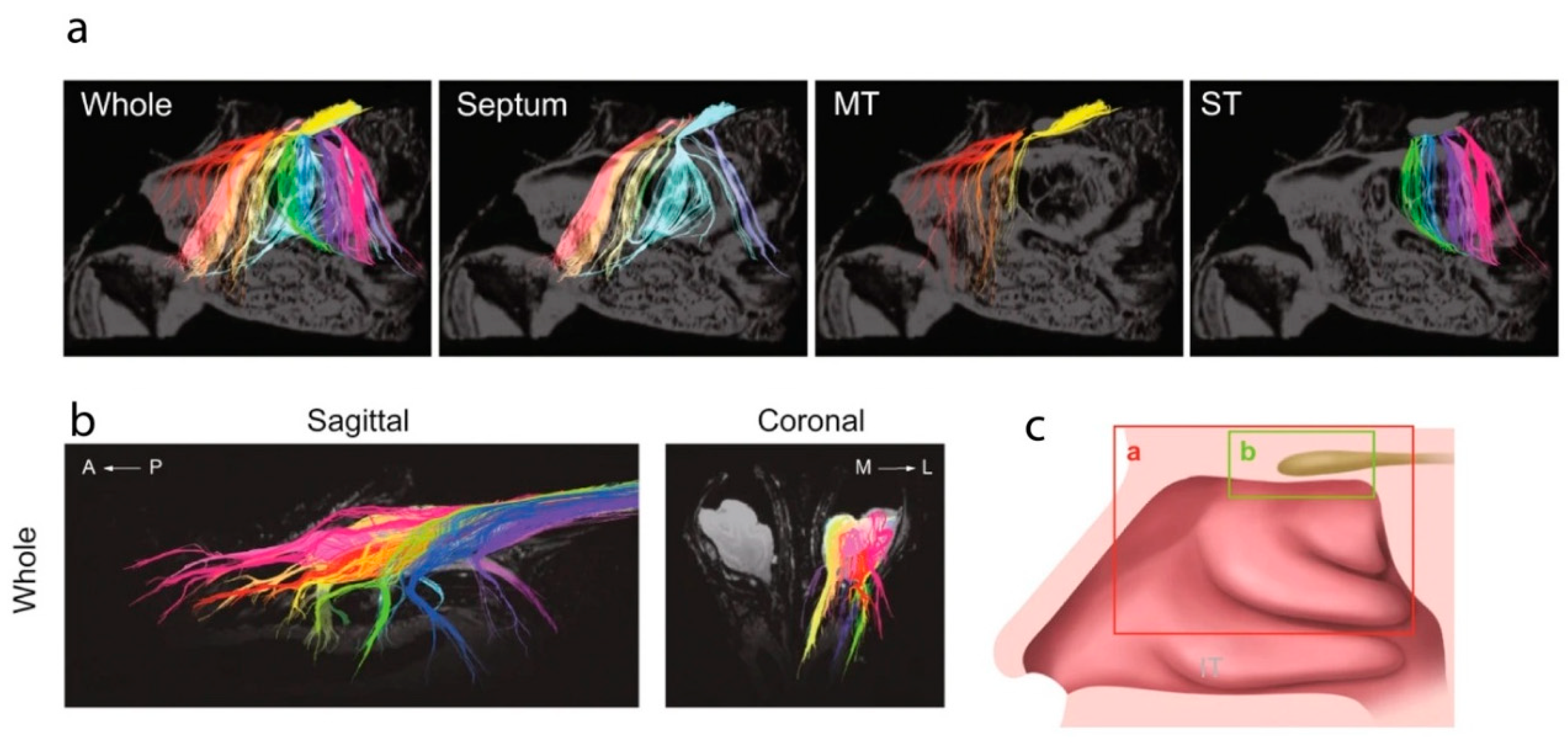
The sensory foundation of the BNI rests upon specialized olfactory bipolar neurons embedded within the nasal epithelium. Each olfactory neuron extends dendrites towards the epithelial surface, where dendritic knobs support 10-30 non-motile cilia specifically adapted for odorant detection [32]. The olfactory epithelium collectively creates an estimated 23 cm² of sensory surface area in humans, establishing the primary interface for airborne molecular detection [2]. From their basal aspects, olfactory sensory neurons project axons that converge into organized bundles termed olfactory fila within the lamina propria (Figure 1b). These olfactory fila subsequently traverse the cribriform plate to establish synaptic connections in the olfactory bulb (Figure 2), where both ipsilateral and contralateral projections enable sophisticated bilateral odour processing [33]. The axonal bundles are supported by olfactory ensheathing cells, which provide crucial structural and functional support by wrapping unmyelinated axons, while interspersed fibroblasts contribute essential extracellular matrix components [34,35,36].
Olfactory physiology is defined by receptor-mediated transduction in olfactory neurons and rapid axonal relay across the cribriform plate to the olfactory bulb. Electrophysiological studies demonstrated that odorants activate olfactory neurons and drive signal transmission across the cribriform plate to the olfactory bulb, enabling direct communication between the nasal cavity and CNS [37]. The olfactory signalling relies on a defined receptor-G protein cascade that facilitates neural transmission of olfactory signals [38,39]. Upon reaching the nasal cavity, odorant molecules encounter cilia extending from olfactory neuronal dendrites. On the ciliary membrane, odorants bind specialized olfactory receptor proteins [39,40]. Each olfactory neuron expresses a single olfactory receptor [41]. Ligand-receptor binding activates G proteins within the olfactory neuron, triggering a signalling cascade that culminates in action potential generation [38,39].
The spike initiated in the cilia propagates along unmyelinated axons of the olfactory neurons that cross the cribriform plate to the olfactory bulb, where olfactory nerves synapse with projection neurons that relay signals to higher brain regions for advanced processing. Evolutionarily, olfaction is among the most ancient sensory systems, with conserved organization from receptors to higher order olfactory circuit across species [42]. In mammals, olfactory inputs engage mnemonic circuits via piriform and lateral entorhinal projections to the hippocampus, providing a substrate for smell-memory coupling. This anatomical and functional coupling of environmentally exposed neuronal structures and direct conduits between extra and intracranial compartments in combination with the physiological projection to areas of the brain that are early involved in many neurodegenerative diseases is especially interesting since olfactory related and hippocampal structures are also the earliest affected brain regions in AD and related dementias [42,43].
Figure 1.
Illustration of Brain-Nose Interface: a. Overview of the brain-nose interface (BNI). The BNI comprises three key structures: the cribriform plate (CP), olfactory bulb (OB), and olfactory cleft. The CP forms the roof of the nasal cavity and floor of the anterior cranial fossa and permits the passage of olfactory nerve bundles from the nasal mucosa to the OB. Small arterial branches accompany olfactory nerve bundles through CP foramina from the intracranial to extracranial compartments. b. Microanatomy of BNI. The olfactory mucosa lies beneath the CP. Olfactory nerve axons cross the CP as olfactory fila to the OB, while olfactory nerve dendrites protrude their cilia into the nasal cavity. Between OB and CP, the dura, arachnoid, and pia enclose the subarachnoid space (SAS) with cerebrospinal fluid (CSF). Sleeve-like leptomeningeal extensions penetrate the CP toward the olfactory mucosa, as depicted (previously shown in rodents [44]; under study in human tissue). c. Cross-sectional view of an olfactory nerve bundle at the level of the CP. The central axonal bundle is surrounded by meningeal layers: the innermost pia mater; a SAS compartment with CSF (as well as lymphatic vessels); the arachnoid mater; and outer dura mater that merges with the periosteum of the CP. Intracranial lymphatic vessels connect to the meningeal layers offering a direct route for CSF drainage. Extracranial lymphatic vessels are present beneath the CP in the nasal submucosa, organized into two morphological types: direct cuffed and loosely arranged at the perineural interface. d. Sagittal view of CP foramen with nerve bundle. Lateral close-up view of a CP foramen sectioned through an olfactory nerve bundle, demonstrating sleeve-like extensions of the pia mater, SAS, and arachnoid mater, while the dura mater merges with the CP bone. Intracranial lymphatic vessels connect to the meningeal layers.
Figure 1.
Illustration of Brain-Nose Interface: a. Overview of the brain-nose interface (BNI). The BNI comprises three key structures: the cribriform plate (CP), olfactory bulb (OB), and olfactory cleft. The CP forms the roof of the nasal cavity and floor of the anterior cranial fossa and permits the passage of olfactory nerve bundles from the nasal mucosa to the OB. Small arterial branches accompany olfactory nerve bundles through CP foramina from the intracranial to extracranial compartments. b. Microanatomy of BNI. The olfactory mucosa lies beneath the CP. Olfactory nerve axons cross the CP as olfactory fila to the OB, while olfactory nerve dendrites protrude their cilia into the nasal cavity. Between OB and CP, the dura, arachnoid, and pia enclose the subarachnoid space (SAS) with cerebrospinal fluid (CSF). Sleeve-like leptomeningeal extensions penetrate the CP toward the olfactory mucosa, as depicted (previously shown in rodents [44]; under study in human tissue). c. Cross-sectional view of an olfactory nerve bundle at the level of the CP. The central axonal bundle is surrounded by meningeal layers: the innermost pia mater; a SAS compartment with CSF (as well as lymphatic vessels); the arachnoid mater; and outer dura mater that merges with the periosteum of the CP. Intracranial lymphatic vessels connect to the meningeal layers offering a direct route for CSF drainage. Extracranial lymphatic vessels are present beneath the CP in the nasal submucosa, organized into two morphological types: direct cuffed and loosely arranged at the perineural interface. d. Sagittal view of CP foramen with nerve bundle. Lateral close-up view of a CP foramen sectioned through an olfactory nerve bundle, demonstrating sleeve-like extensions of the pia mater, SAS, and arachnoid mater, while the dura mater merges with the CP bone. Intracranial lymphatic vessels connect to the meningeal layers.
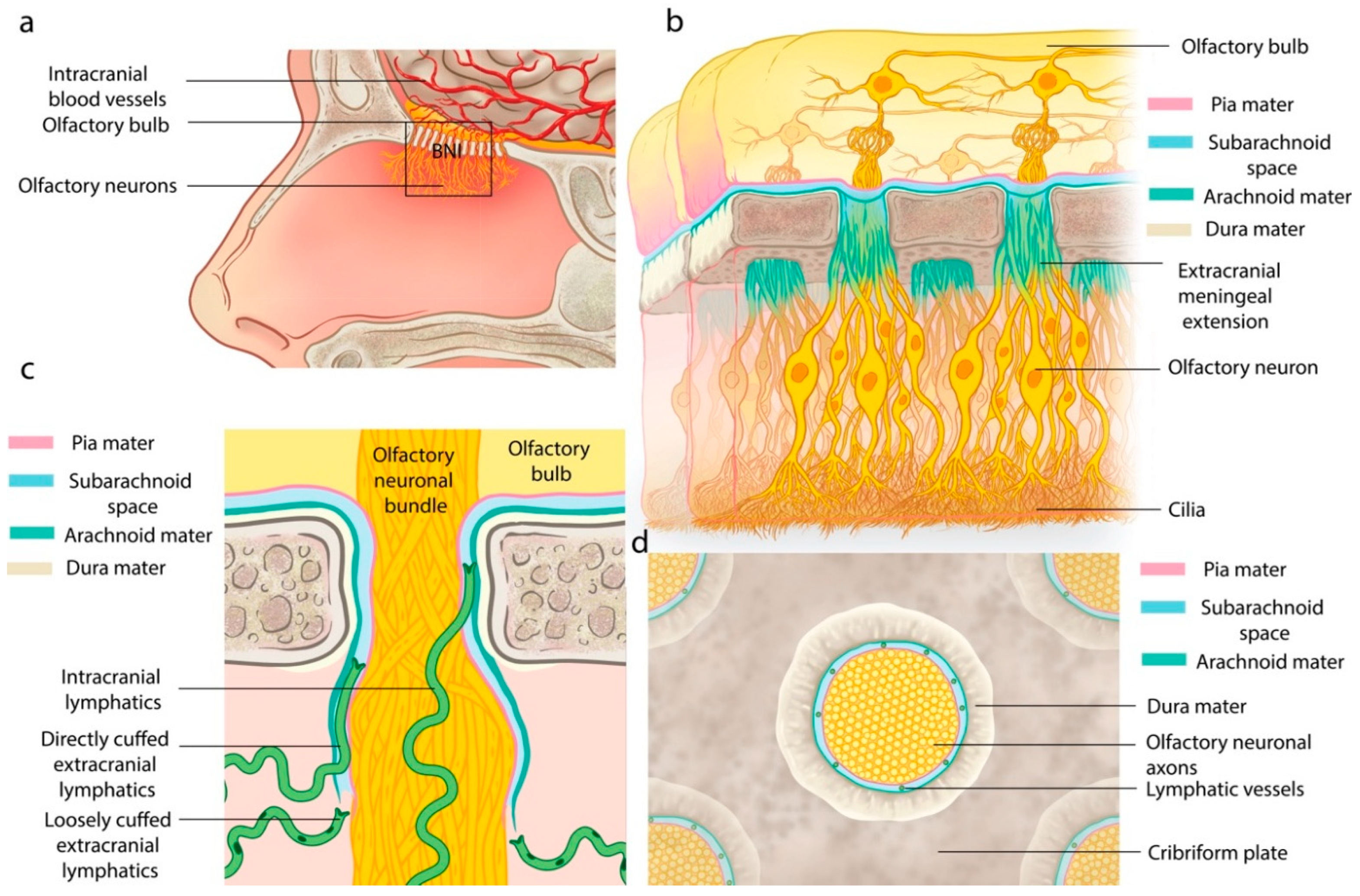
Figure 2.
Human olfactory nerve topography from nasal epithelium to olfactory bulb observed through Magnetic Resonance Imaging (MRI)[33]. a. Sagittal MRI view showing color-segmented olfactory filaments originating in distinct epithelial regions (septum, middle turbinate (MT), superior turbinate (ST)). The whole panel combines the sub-views and illustrates convergence toward the cribriform region. b. The entire nerve trajectories from the olfactory epithelium, through the cribriform plate, to the olfactory bulb, generated with diffusion MRI-based tractography displayed in sagittal and coronal planes. c. Schematic depicting the field of view in figure a and b. Red box corresponds to figure a and green box to figure b. (Adapted from Kurihara, Sho, et al. “MRI tractography reveals the human olfactory nerve map connecting the olfactory epithelium and olfactory bulb.” Communications Biology 5.1 (2022): 843[33]. Licensed under Creative Commons Attribution 4.0 International License http://creativecommons.org/licenses/by/4.0/).
Figure 2.
Human olfactory nerve topography from nasal epithelium to olfactory bulb observed through Magnetic Resonance Imaging (MRI)[33]. a. Sagittal MRI view showing color-segmented olfactory filaments originating in distinct epithelial regions (septum, middle turbinate (MT), superior turbinate (ST)). The whole panel combines the sub-views and illustrates convergence toward the cribriform region. b. The entire nerve trajectories from the olfactory epithelium, through the cribriform plate, to the olfactory bulb, generated with diffusion MRI-based tractography displayed in sagittal and coronal planes. c. Schematic depicting the field of view in figure a and b. Red box corresponds to figure a and green box to figure b. (Adapted from Kurihara, Sho, et al. “MRI tractography reveals the human olfactory nerve map connecting the olfactory epithelium and olfactory bulb.” Communications Biology 5.1 (2022): 843[33]. Licensed under Creative Commons Attribution 4.0 International License http://creativecommons.org/licenses/by/4.0/).
2.2. Olfactory Functional Decline and BNI Pathology in Neurodegenerative Diseases
- Olfactory Loss in Neurodegenerative Diseases:
Olfactory dysfunction, also referred to as hyposmia, represents one of the most prevalent and earliest detectable signs of several neurodegenerative diseases [45,46,47]. For example, impaired olfaction is highly prevalently in PD and AD with occurrence rate of approximately 80-90% in the former [45,46,48,49,50,51,52].
Longitudinal studies have established olfactory dysfunction as a powerful predictor of the likelihood to develop a neurodegenerative disease as well as the prediction of further cognitive decline. Multiple longitudinal cohort studies confirmed that idiopathic olfactory impairments emerge years, possibly decades, before cognitive decline becomes apparent, providing strong evidence for incorporating olfactory assessment in preclinical screening protocols [47,51,53,54]. The investigation conducted by Devanand et al. (2015) found that in non-demented older adults, low olfactory scores are associated with subsequent cognitive deterioration and increased risk of AD diagnosis over 2-4 year-long follow-up periods [54]. This investigation established that deficits in odorant identification impairment serve as a more robust predictor of subsequent cognitive deterioration compared to verbal episodic memory impairments among cognitively healthy elderly individuals [54]. The temporal relationship is also striking in PD. A meta-analysis by Sui et al. (2019) demonstrates that individuals with hyposmia have 3.8 fold increased risk of developing typical PD over follow-up period of 3-17 years [55]. This highlights its critical value as a prodromal indicator for early PD identification and risk stratification. Remarkably, individuals diagnosed with idiopathic REM sleep behaviour disorder along with hyposmia demonstrate a significantly elevated probability for occurrence of PD and dementia with Lewy bodies (DLB) in the decade after testing [56]. A recent study by Li et al. using a 7-odor smell identification test together with machine learning-based multi-cohort analysis achieved 0.76 sensitivity and 0.85 specificity for distinguishing PD and DLB from healthy controls [57]. Altogether, chronic (usually irreversible) hyposmia that is of idiopathic origin demonstrates significant (negative) correlations with overall cognitive ability and motor functions in subsequent years, thereby supporting the utility of olfaction testing as a surrogate marker for broader neural network functions.
- Local Protein Pathology in Olfactory Structures:
Post-mortem examinations demonstrated that olfactory dysfunction in neurodegenerative diseases is correlated with the accumulation of pathological hallmark lesions within the olfactory bulb and some higher order olfaction processing centres of the CNS [45,58,59]. This pattern aligns with established disease progression models described in AD and PD.
In AD, this relationship is captured by the study of Kovács et al. (2001) which demonstrated that early neuropathological changes appear in the olfactory bulb, preceding accumulation of hallmarks within the entorhinal cortex [59]. Similarly, Braak and Braak’s neuropathological staging system demonstrated that pathology first appears in the transentorhinal region, a subregion of the entorhinal cortex [60]. Interestingly, early-affected areas are closely linked to olfactory processing, and from there the pathology gradually spreads to other brain regions. The anatomical basis for the connection of olfactory deficit and cognitive decline becomes clear when examining how smell and memory systems are wired together. The olfactory bulb sends projections to the hippocampus, which serves as the principal memory centre in the brain. These projections are routed through interconnected pathways that include the piriform cortex and the entorhinal cortex. Neuroimaging and further histopathological studies confirmed this vulnerability. Thomann et al. (2009) demonstrated reduced olfactory bulb volume in early AD [61], while Vasavada et al. (2015) showed piriform cortex degeneration correlating with olfactory deficits in mild cognitive impairment and AD [62]. Christen-Zaech et al. (2003) provided histological evidence of early tau pathology in the olfactory bulb and tract, corroborating the early olfactory dysfunction in AD [63]. Additionally, human imaging studies across cognitively normal, mildly cognitively impaired, and AD-type dementia participants have shown that poorer olfactory performance is associated with higher cerebral amyloid load along the AD trajectory.[64]
PD follows a remarkably similar pattern, providing compelling parallel evidence for early olfactory involvement. Braak and del Tredici’s staging model for PD described how α-synuclein pathology appears very early in olfactory structures, particularly in the anterior olfactory nuclei of the olfactory bulb and tract [65]. Consistent with this, subsequent neuropathological studies have demonstrated α-synuclein pathology in the form of insoluble Lewy body and Lewy neurite inclusions in multiple intracranial olfactory structures in subjects with typical PD (as well as other Lewy body disorders), beyond the olfactory bulb and tract, such as in higher order olfactory processing regions, including the entorhinal cortex and amygdala [66,67,68] . A critical study conducted by Rey et al. (2016) showed that α-synuclein pathology initiated in the olfactory bulb of mice by the delivery of preformed fibrils of α-synuclein spread transneuronally and caudally to the piriform cortex and other regions, potentially mirroring the progression of early PD [69].
In addition to the intracranial olfactory structures, pathological proteins also accumulate in the olfactory mucosa in neurodegenerative diseases, which may be of relevance given the very short distance between dendrites of olfactory neurons protruding into the nasal cavity and their relay synapses in the bulb. A post-mortem study conducted by Arnold et al. reported higher frequencies in detecting pathological Aβ species and paired helical filament-type tau in the olfactory epithelium of AD patients when compared to healthy controls or other disease cohorts [70]. Neurodegenerative disease pathology correlated variations in Aβ and tau protein within the mucosal samples of AD patients has been observed across various independent studies [26,71,72,73,74,75]. In synucleinopathies, a first report using ultrasensitive RT-QuIC assays have demonstrated misfolded α-synuclein-induced seed amplification assay activity in olfactory mucosa biopsies collected by brush from patients with PD and multiple system atrophy. If confirmed by other investigators, these results would support the concept that the olfactory mucosa may be a prime site for the initiation of (extracranial) α-synuclein pathology [28,76,77]. A full inventory of carefully characterized specimens sampled from age-matched persons with various neurodegenerative conditions vs those from subjects with other neurological diseases vs those without any CNS disease [78] in order to quantify pathological changes in their olfactory mucosa awaits completion.
Nonetheless, these collective findings establish the olfactory circuitry as a potential nidus for the initiation of pathology in several neurodegenerative diseases, with both environmental as well as genetic risk factors. Prodromal hyposmia likely reflects functional impairment triggered by the deposition of protein aggregates in scent processing-related structures, such as the olfactory bulb and piriform cortex. Detectable pathology in the olfactory mucosa could potentially serve as a marker of change throughout the olfactory circuitry. Given its physical proximity to constituents of the olfactory circuitry, these findings highlight the BNI as an ideal site for researching the interplay of brain health, scent processing and environmental exposure history during ageing.
3. The Role of BNI in CSF Clearance
CSF serves multiple critical functions beyond mechanical protection. CSF continuously circulates through the CNS, providing nutrition to the CNS as well as collecting metabolic byproducts, misfolded proteins and cellular debris generated by neuronal activity or cellular processes. The accumulation of waste material in CSF requires efficient clearance mechanisms to maintain neural homeostasis and prevent neurotoxicity [79,80]. CSF carries these solutes through the subarachnoid space (SAS), the CSF-filled compartment within the meninges that envelops the CNS. The meninges comprise three layers: an outer dura mater, a middle arachnoid sheet, and the inner pia mater. The SAS lies between the arachnoidea and pia mater (Figure 1c,d). According to a recent animal study by Spera et al. (2023), this typical three-layer architecture is maintained across the BNI, which in its most rostral part connects the intracranial SAS compartment along the olfactory fila with extracranial compartments of the nasal cavity [44].
For over a century, the established model of CSF drainage centered exclusively on the arachnoid granulations of the dura as the primary outflow mechanism [80]. These specialized structures function as one-way valves allowing CSF to flow from the SAS directly into the venous circulation through dural sinuses [80,81]. This view shifted after Schwalbe et al. (1869) showed CSF connections across the BNI to nasal lymphatics in dogs [1,80]. Also, Mortensen and Sullivan et al. visualized in 1933 CSF entering the nasal region after intrathecal contrast injection [82]. As a result, the concept arose that the BNI might provide an alternative clearance route for CSF across species including humans. Functional and structural evidence progressively accumulated in various animal models all reporting that this pathway is integral to physiological CSF homeostasis rather than a minor bypass. In sheep, transient obstruction at the cribriform plate doubled intracranial pressure under controlled conditions, showing that disruption of the BNI rapidly perturbs outflow dynamics [83]. Further, multiple intrathecal tracer experiments consistently demonstrated CSF-derived signal in nasal compartments after its delivery into the SAS, providing additional evidence for CSF egress from the SAS along olfactory neuronal bundles into the nasal cavity [5,6,84,85,86,87,88,89,90]. Microfil injection studies across seven mammalian species, including sheep, pigs, rabbits, rats, mice, monkeys and humans, have demonstrated remarkably similar distribution patterns in nasal networks, supporting the evolutionarily conserved nature of this drainage mechanism [5]. Based on tracer distribution studies along olfactory fila at the BNI, early studies inferred a broadly perineural bulk flow from the cranial SAS into the nasal cavity. Table 1 summaries the CSF clearance studies via nasal route and their findings.
The recent animal study by Spera et al. (2023) refined the perineural route by identifying the extension of leptomeninges (i.e., arachnoid and pia mater) into the extracranial region penetrating the cribriform plate along olfactory nerve bundles [44], therefore supporting a critical anatomical conduit that adds to the understanding of unimpeded communication between CSF compartments and the nasal cavity. Spera et al. could demonstrate that the dura mater remains adherent to the ethmoid bone, while the arachnoid mater, SAS and pia mater forms sleeve-like extensions that accompany each olfactory nerve bundle (fila olfactoria) through individual cribriform foramina [44] (Figure 1 c,d). Individual olfactory nerve fascicles, as they traverse from the nasal epithelium through the cribriform plate foramina, are not only surrounded by olfactory ensheathing cells but also become gradually enveloped by pia mater extensions [34,35,36]. These meningeal sleeves provide microchannels that support CSF efflux into the nasal submucosa (Figure 1c,d).
Unexpectedly and by using in vivo tracer studies, the extracranial endpoint of CSF efflux after traversing the cribriform plate into the olfactory mucosa has been identified as a complex nasal lymphatic network (rather than the nasal cavity itself). Lymphatic vessels, embedded in the nasal mucosa at the vicinity of the BNI, take up tracer solutes, which are then drained toward both deep cervical, and retropharyngeal lymph nodes [5,44,91]. Yoon et al. (2024) confirmed these findings and provided more specific information related to the organization and function of lymphatic vessels involved in this specific drainage system. Using intracisternally delivered, fluorescently labelled tracers in Prox1-GFP lymphatic reporter mice (in which lymphatic endothelial cells express GFP under control of the Prox1 promoter), the authors showed that CSF preferentially drains through the nasopharyngeal lymphatic plexus into medial deep cervical lymph vessel and deep cervical lymph nodes, and that this route carries substantially more CSF than the alternative lateral deep cervical and neighbouring oropharyngeal/palatal lymphatic pathways, establishing it as the major drainage hub for ‘nasally cleared CSF’[91]. Jin et al.’s latest study using Prox1-GFP mice, utilizing fluorescent tracer mapping, demonstrated that meningeal lymphatic vessels near the olfactory bulb cross the cribriform plate to join nasal mucosal lymphatics, thereby establishing drainage routes toward cervical lymph nodes [92]. To explain the CSF transfer at the perineural-submucosal junction, Koh et al. (2006) discussed two possible mechanisms based on earlier tracer work [93]: a “direct cuff configuration”, in which lymphatic vessels closely encircle those olfactory fascicles that are close to the cribriform plate to permit direct entry from the perineural space; versus a “loose, perineural configuration”, in which CSF first disperses within the nasal interstitium before entering early lymphatic structures through valve-like openings.
Human studies have gradually verified the relevance of this pathway for physiological CSF clearance with striking similarities to the findings described above for other mammals. Cadaveric tracer work demonstrated similar anatomical continuity along the olfactory route in humans, consistent with the perineural route of CSF drainage into the nasal lymphatic system [5,94,95]. This conserved tracer pattern emerging from SAS, along cranial nerve-1 fibres, across the cribriform plate and draining into the olfactory mucosa strongly indicates that the olfactory bulb→cribriform plate route is a core CSF clearance pathway shared by mammalian species including humans [5] (Figure 3). Given the well conserved organization of dura, arachnoid, and pia around the CNS across mammals, conserved meningeal organisation at the BNI in humans is highly plausible and is currently investigated further. Pan et al. reported in 2009 a rich nasal lymphatic network in human cadavers using contrast injection and radiographic anatomical studies [94]. These findings are highly consistent with complex lymphatic network that has been shown to significantly contribute to the CSF clearance in animals. In vivo PET imaging studies using sophisticated anatomical reconstruction protocols were able to visualize CSF outflow dynamics and tracer enrichment at the olfactory/nasal region in living participants [96]. These findings indicate that CSF drainage across BNI operates under physiological conditions and contributes to CSF clearance, although results varied by tracer route and protocol [96]. Furthermore, observations of markedly elevated iron concentrations in nasal exudates after haemorrhagic stroke reported by García-Cabo et al. (2020), are consistent with fluid communication between intracranial compartments and extracranial drainage pathways [97]. In addition, the detection of CNS-derived proteins and pathological aggregates in nasal secretions and olfactory mucosal samples in several human studies provides functional corroboration that CSF-soluble constituents reach the nasal cavity via this route [23,24,25,26].
Taken together, current evidence positions the BNI as a significant extracranial efflux route for CSF that operates in parallel to arachnoid villi function and dural sinus outflow. Tracer studies and obstruction experiments in multiple mammalian species, combined with cadaveric and in vivo data performed in humans, consistently support a model in which leptomeningeal sleeves accompany the olfactory fila through individual cribriform foramina, creating perineural channels that connect the intracranial SAS to nasal submucosa and downstream lymphatic networks. Building on this CSF clearance-centered view, accumulating data on intramural periarterial drainage (IPAD) of ISF suggest that solutes cleared from brain parenchyma along basement membranes of capillaries and arteries may converge onto the same BNI-associated vascular territories, particularly along ethmoidal arterial branches that penetrate the olfactory region [4,98]. Conceptually, CSF-dominant efflux via leptomeningeal sleeves and ISF/IPAD-dominant efflux along arterial walls can therefore be understood as partially converging clearance routes that meet at the cribriform region and drain into nasal and ultimately nasopharyngeal lymphatic hubs. Larger prospective studies in humans across the age span are warranted to further delineate the details of CSF drainage in humans, in particular with respect to quantification of its volume (vs other routes), and any changes during normal ageing as well as in the context of mechanical alterations, such as normal pressure hydrocephalus, preceding brain trauma, closure of the cribriform plate (due to hyperostosis) and last but not least, as a result of microbiological encounters.
4. The Emerging Role of BNI in Drainage of ISF
ISF is a critical component of the extracellular environment, facilitating the delivery of nutrients and the removal of metabolic waste products, including neurotoxic proteins such as Aβ[99,100]. Efficient clearance of ISF is essential for maintaining neural homeostasis and preventing the accumulation of pathological proteins in the CNS, such as aggregation-prone α-synuclein, Aβ and tau. It has been shown that solutes may enter the basement membranes of capillaries from the extracellular space of the brain and drain toward the matrix surrounding arterial smooth muscle cells, participating in a clearance mechanism referred to as intramural periarterial drainage (IPAD)[98]. Insufficiency in IPAD results in the deposition of Aβ leading to insoluble aggregate formation within the walls of capillaries and arteries, resulting in cerebral amyloid angiopathy, a key feature of AD [4,8,101](Table 1). Studies using radio-iodinated serum albumin as a tracer suggest that once ISF and solutes have left the brain, they drain along the tunica media and the tunica adventitia of the major cerebral arteries, across the base of the skull to deep cervical lymph nodes [102]. The detection of radioactive tracer and Aβ within the wall of intracranial arteries (in contrast to low levels of tracer and Aβ in the walls of the carotid arteries)[102] together with the presence of lymph nodes embedded in carotid sheaths just below the base of the skull in humans, strongly suggest that ISF and solutes -propelled by IPAD- leave the artery walls in the neck to drain to adjacent cervical lymph nodes [103]. Solutes and ISF are therefore likely to drain along the walls of the ethmoidal arteries, effectively branches of the internal carotid arteries, reaching thus the olfactory mucosa [4,98,104].
In contrast to most CNS territories characterized by highly efficient tight junctions of the BBB that restrict solute exchange, the BNI exhibits a region-specific and unique vascular architecture. A complex network of small arteries supplies the olfactory bulb and each of the olfactory fila as they traverse the cribriform foramina, thereby creating vascular continuity between intra- and extracranial compartments. Studies on animal models demonstrated a significantly higher apparent BBB permeability surrounding the olfactory bulb, favouring additional solute exchange [105]. These collective findings support the hypothesis of a BNI-associated conduit for ISF flow by which IPAD-borne solutes follow intracranial and ethmoidal arterial walls across the cribriform plate to accumulate in submucosal structures of the nasal cavity, with subsequent drainage into nasal and nasopharyngeal lymphatic vessels. This model is central to a rich vascular network integral to BNI functions, which warrants validation in humans.

Table 1.
A schematic overview of converging CSF and ISF/IPAD pathways at the BNI.
| Model / species / setting | Primary pathway interrogated | Experimental approach | Evidence for BNI involvement | Key implication | References |
|---|---|---|---|---|---|
| Small animals (Rat / mouse / rabbit models) | CSF efflux via BNI and associated structural features | Intracranial CSF tracer injections with imaging at the BNI | Consistent tracer accumulation along olfactory nerve bundles, within meningeal sleeves traversing the BNI, and in nasal lymphatic vessels and cervical lymph nodes. | Perineural CSF efflux through BNI is a major physiological clearance route in small mammals | [5,6,44,84,85,86,87,88,91] |
| Large mammals / (pigs, sheep, monkeys) | Structural and functional aspects of CSF clearance across BNI | Intrathecal or cisternal CSF tracer injections with imaging at the BNI; blockage of cribriform plate followed with intracranial pressure monitoring in sheep | Continuous tracer path from SAS across BNI to nasal submucosa/lymphatics; intracranial pressure rises when cribriform-BNI route is obstructed | Conserved anatomical and functional BNI-associated CSF outflow in large mammals and primates strengthens translational relevance to humans | [5,7,83,89] |
| Human cadaver | Structural CSF continuity across BNI into nasal lymphatics | Post-mortem intracranial tracer injection with imaging; radiography of nasal lymphatics | Tracer continuity from intracranial SAS along olfactory neurons across BNI into nasal submucosa and lymphatic channels | Provides direct anatomical evidence for BNI-mediated CSF efflux from SAS into nasal lymphatics in humans | [5,94,95] |
| Human in vivo imaging | Functional CSF clearance across BNI | Dynamic PET / MRI with CSF-linked tracers | CSF-related signal enrichment and flow vectors toward olfactory/BNI-cribriform region | Indicates an active contribution of BNI-associated routes to CSF clearance under physiological conditions in humans | [96] |
| Rodents/Post-mortem human |
IPAD-mediated ISF drainage via arteries | Observation of radiolabeled solutes along arterial basement membranes | ISF solutes move in arterial basement membranes; failure leads to amyloid buildup; | BNI-spanning arteries may link IPAD-based ISF drainage to nasal/lymphatic clearance | [4,8,98,101] |
5. Diagnostic Potential of Non-Invasively Collected, Nasal CSF Specimens in Neurodegenerative Diseases
Building on established anatomical and physiological connections between the CNS and the olfactory region, recent investigations have concentrated on utilising non-invasive methodologies for collecting nasal biospecimens from different locations within the nasal cavity using different collection means, such as via nasal smears, mucosal brushings and lavage samples [22,25,26]. Modern nasal sampling approaches have undergone a substantial evolution beyond conventional swabbing techniques. Recent technological advances include a standardized collection device via an applicator (Nosecollect®) that demonstrates high accuracy in positioning a fluid absorbing mesh right at the BNI, with awake subjects reporting minimal procedural discomfort [106]. Below we summarize recent insights regarding the diagnostic utilization of nasal specimens collected in living subjects.
Regarding AD: In a proof-of-principle study to demonstrate the presence of CSF constituents within the roof of the nasal cavity, Liu et al. in 2018 investigated tau and Aβ species in nasal smear samples collected from the olfactory cleft and middle nasal meatus and found that the phosphorylated tau (p-tau)/total-tau (t-tau) ratio was significantly higher in AD cases compared to healthy controls [26]. Corroborating these observations, examination of nasal lavage specimens in subsequent research efforts identified elevated concentrations of tau and p-tau with greater frequency in anosmic AD patients compared to control subjects [25]. A recent investigation demonstrated that intermediate-range nasal Aβ42 concentrations (9.53-11.10 pg/mL) showed positive associations with PET-verified cerebral amyloid burden and greater cognitive impairment, suggesting a transitional disease phase where nasal biomarkers may reflect dynamic Aβ changes [107]. These findings highlight nasal Aβ42 as a potentially scalable, non-invasive marker with promise for early detection and longitudinal monitoring of AD progression. Supporting these findings, independent research groups recently identified elevated Aβ levels in nasal secretions and established their potential diagnostic utility in AD detection, with apparent capacity in discriminating AD from age-matched healthy subjects and from individuals affected by other neurological conditions [23,24]. Recent analysis of nasal fluid collected from the vicinity of the BNI using Nosecollect® device in individuals with cognitive impairment demonstrated the simultaneous detection of all four key AD biomarkers (Aβ42, Aβ40, p-tau, t-tau)[106].
Regarding human prion disease: Real-time quaking-induced conversion (RT-QuIC) tests and misfolded protein-based seed amplification assays (SAA) have substantially enhanced pathological protein detection sensitivity in biological specimens including in nasal specimens. Orru et al. (2014) demonstrated that nasal brushings from patients with Creutzfeldt-Jakob disease (CJD) contain highly detectable prion seeds, where RT-QuIC analysis of such samples was more sensitive and produced faster and stronger signal positivity than did RT-QuIC testing of CSF, with both methods showing 100% specificity [108]. The authors hypothesized that the higher sensitivity of nasal brushings is likely due to substantial prion seeding activity in the olfactory mucosa and to the sampling of a larger area of affected tissue. Recent studies by Bongianni et al. (2017) and Fiorini et al. (2020) validated olfactory mucosa RT-QuIC testing in CJD, demonstrating its high sensitivity and specificity for pathological prion proteins, confirming its value as a complementary diagnostic tool alongside CSF RT-QuiC [109,110] (Table 2). These findings establish nasal RT-QuIC and SAA testing as non-invasive, and repeatable diagnostic tools that gradually will transform CJD diagnosis from a time-consuming invasive procedure (by lumbar puncture) into a rapidly and easily performed bedside test.
Regarding synucleinopathies: De Luca et al. (2019) showed that olfactory mucosal tissue collected from individuals diagnosed with PD and multiple system atrophy (MSA) harbours potent α-synuclein seeding capability detectable by RT-QuIC [28]. Remarkably, the amplified α-synuclein aggregates from PD and MSA patients displayed distinct structural and biochemical properties, suggesting different α-synuclein strains that could enable differential diagnosis between these two synucleinopathies. Bargar et al. (2021) validated this approach across laboratories and uncovered a striking pattern [111]. Samples from patients with PD showed 69% detection rates, MSA patients with the parkinsonian phenotype (MSA-P) samples showed 90% detection rates while MSA patients with the cerebellar phenotype (MSA-C) samples were largely negative, suggesting that different protein conformations may preferentially accumulate in specific tissues and contribute to disease heterogeneity [111]. Meanwhile, Bongianni et al. (2022) solved a critical technical challenge by demonstrating that sampling location matters: targeting the agger nasi, a region dense with olfactory neurons, nearly doubled sensitivity from ~45% to ~84% while maintaining excellent specificity around 90% [27]. Perra et al. (2021) extended these findings to DLB, yielding 81% sensitivity and 92% specificity in SAA positivity for olfactory mucosa, 100% sensitivity and 91% specificity for CSF, and reached 100% diagnostic accuracy when both tests were combined [76]. Although current sensitivity rates for PD remain below those for CJD-SAA benchmarks, these studies collectively demonstrate that nasal α-synuclein detection offers a non-invasive, subtype-specific approach with real potential for screening, stratifying candidates for clinical trials and monitoring their treatment responses. Future work will require the identification of where α-synuclein SAA positivity comes from, i.e., from CSF sources, or the olfactory epithelium (where the protein is expressed at the highest level in the skull [112,113], or both, and what their correlation is to CSF concentrations of α-synuclein and olfaction performance. Nonetheless, with further refinement, nasal specimen-based SAA test methods could become an essential tool in the diagnostic toolkit for synucleinopathies.
Related CNS conditions: Recent investigations have substantially broadened the repertoire of non-traditional biomarkers identifiable in nasal specimens for neurodegenerative diseases, extending beyond conventional Aβ, tau and synuclein proteins. Differential gene expression profiles, specifically AIMP2 and PARKIN, have been characterized in nasal fluid cells from PD patients, with PARKIN reduction demonstrating 76.7% sensitivity and 76.9% specificity, while AIMP2 elevation showed 84.2% sensitivity and 84.6% specificity as candidate diagnostic indicators [114]. Treatment of olfactory epithelial cell models with α-synuclein preformed fibrils revealed transcriptomic alterations, notably the downregulation of olfactory receptor genes OR10A4 and OR9A2, alongside upregulation of the immune-related gene IFIT1B [115]. Accumulating evidence demonstrates that RNA-binding proteins, notably TDP-43, are detectable through SAAs in olfactory mucosa specimens from amyotrophic lateral sclerosis (ALS) spectrum with motor neuron diseases (MND), and achieving 46.9% sensitivity and 82% in frontotemporal lobar degeneration (FTLD) with TDP-43 pathology [116,117]. Collectively, non-conventional nasal biomarkers are advancing as diagnostic instruments complementing traditional protein markers, demonstrating the breadth and promise of nasal specimens for neurodegenerative disease identification and longitudinal assessment.
Despite promising advances in nasal biomarker detection for neurodegenerative diseases, several critical challenges must be addressed before widespread clinical implementation. Current investigations demonstrate significant variability in data comparability due to heterogeneous analytical protocols and pre-analytical processing procedures across research centres. While standardized collection devices have addressed technical sampling challenges at the BNI, the field continues to face methodological constraints including relatively small sample sizes across validation studies and absence of harmonized analytical platforms for biomarker measurement. The development of standardized analytical protocols and multicentric validation studies with larger cohorts across diverse populations represent essential next steps for clinical translation.
Table 2.
Summary of nasal samples-based list of diagnostic studies investigated for neurodegenerative diseases.
Table 2.
Summary of nasal samples-based list of diagnostic studies investigated for neurodegenerative diseases.
| Disease | Specimen, collection method and collection site if specified | Detection method | Main analyte | Key diagnostic finding | Performance (Area under curve (AUC) / Sensitivity (Sens) / Specificity (Spec)) |
|---|---|---|---|---|---|
| AD [26]. | Nasal smears; cotton swabs from inferior concha, middle nasal meatus, olfactory cleft, common nasal meatus | ELISA | p-tau, t-tau | p-tau/t-tau ratio significantly higher in AD in middle nasal meatus and olfactory cleft; can distinguish AD from controls | Middle nasal meatus: AUC 0.74, Sens 0.78, Spec 0.71. Olfactory cleft: AUC 0.72, Sens 0.58, Spec 0.87 |
| AD [25]. | Nasal lavage | Immunoassay | t-tau, p-tau181 | Tau/p-tau present in most AD patients (especially with anosmia), but absent in nearly all healthy controls | Not reported |
| AD [24] | Nasal secretions; sponge in both nasal cavities near nasal roof/olfactory region | Interdigitated microelectrode biosensor | Aβ | Aβ is elevated in AD dementia when compared to cognitively unimpaired and other neurological disorders | AD vs cognitively unimpaired: AUC 0.718, Sens 65.7%, Spec 69.2%. AD vs other neurological disorders: AUC 0.696, Sens 68.6%, Spec 72.2% |
| AD [23] | Nasal discharge | Immunoblot | Aβ oligomers (Aβ56, AβO) | Increased nasal Aβ oligomers in probable AD compared to controls | Not reported |
| AD [107]. | Nasal discharge | ELISA | Aβ42 | Aβ42 range ~9.5-11.1 pg/mL) showed the strongest association with AD, cognitive impairment, and higher brain Aβ-PET signal | AD vs non-AD: AUC ≈ 0.77); with cognitive scores added, AUC up to ≈ 0.96. |
| CJD [108]. | Olfactory mucosa from olfactory epithelium in nasal vault collected with endoscopic nasal brushing | RT-QuIC | Prion Protein | Nasal RT-QuIC correctly identified almost all CJD cases and all controls | Sens 97%, Spec 100% |
| sporadic CJD [109] | Olfactory mucosa; nasal brushing in superior nasal cavity using flocked swab or cytobrush | RT-QuIC | Prion Protein | OM RT-QuIC positive in almost all definite/probable sporadic CJD | Sens: 90-95% (for two methods of collection); Spec 100% |
| sporadic CJD [110] | Olfactory mucosa; nasal brushing | RT-QuIC | Prion Protein | CJD vs non-CJD discrimination with high sensitivity and absolute specificity | Sens 91%, Spec 100% |
| PD and MSA [28]. | Olfactory mucosa; collected by nasal brushing using from medial septal wall above the middle turbinate | RT-QuIC | α-synuclein | OM from PD and MSA often showed α-synuclein seeding; PD and MSA gave distinct Proteinase K patterns and fibril morphology. | PD :56% detection, MSA :82% detection |
| PD, MSA-P, MSA-C [111]. | Olfactory mucosa; nasal brushing between septum and middle turbinate | RT-QuIC | α-synuclein | Differentiated PD and MSA-P from healthy subjects and showed opposite behavior in MSA-P vs MSA-C, enabling phenotypic discrimination. | PD: Sens ~69%; MSA-P: Sens ~90%; specificity vs healthy subjects ~91% |
| PD [27]. | Olfactory mucosa by nasal swab at agger nasi and middle turbinate | RT-QuIC | α-synuclein | Sampling at the agger nasi provides higher RT-QuIC sensitivity than sampling via the middle turbinate. | Agger nasi: Sens 84%; middle turbinate: Sens 45% |
| DLB [76]. | Olfactory mucosa, collected by nasal swabbing of the olfactory region with flocked swabs | RT-QuIC | α-synuclein | OM RT-QuIC was positive in the vast majority of DLB-group patients and only in a small minority of controls. | Sens 81.4%, Spec 92.1% |
| PD [114]. | Nasal lavage fluid cells; collection via nasal irrigation with sterile normal saline | RT-qPCR on cDNA from total RNA of nasal cell pellets | AIMP2 mRNA; parkin mRNA | AIMP2 mRNA markedly upregulated (~7-fold overall; ~9-fold early-stage, ~5-fold late-stage) in PD vs controls; parkin mRNA ~73% reduced in PD vs controls; | AIMP2: AUC 0.903; Sens: 84.2%; Spec: 84.6% . Parkin: AUC 0.731; Sens: 76.7% ; Spec: 76.9% |
| ALS-spectrum with MND [116] | Olfactory mucosa; nasal brushing of medial septal wall above middle turbinate | SAA | TDP-43 | In about half of ALS-spectrum with MND patients, TDP-43 seeding was positive, with stronger seeding than in TDP-43-positive other neurodegenerative diseases and controls. | Sens: 46.9%; spec: 88.9% |
| FTLD-TDP [117] | Olfactory mucosa; nasal brushing at agger nasi | SAA | TDP-43 | TDP-43 seeding detectable in most FTLD-TDP patients and rarely in controls | Sens 82.4%; Spec 86.7% |
6. The BNI for Targeted Drug Delivery to CNS
Over the past decades, the BNI has also emerged as a viable route for molecular delivery to the CNS. Effective and targeted delivery of therapeutics to the brain remains severely constrained by the BBB, which is composed of tightly joined endothelial cells. The BBB permits entry only to few, selected molecules, such as specific nutrients and transport-dependent macromolecules, while excluding most xenobiotics and large biologics [118]. Free diffusion through the BBB is limited to smaller drugs of lipophilic nature with molecular weight less than 400 kDa, as they can penetrate through the lipid-based BBB membrane [118]. In practice, the vast majority, 98% of low-sized and 100% of large-sized drug molecules, are effectively prevented from entering the brain in therapeutically relevant concentrations via the bloodstream, unless substantial molecular re-engineering, carrier systems, or invasive intrathecal or intracerebral delivery strategies are employed [118,119,120].
Intranasal drug administration to the upper nasal cavity, often termed nose-to-brain (N2B) delivery, exploits the unique anatomical features of the BNI to effectively bypass the restrictions imposed by the BBB and establish direct access to CNS targets. [34,121,122]. This direct pathway for molecular delivery facilitates higher bioavailability of drugs, faster action and reduced systemic side effects in comparison to conventional systemic route [122]. Mechanistically, multiple complementary transport pathways have been proposed: direct axonal transport along olfactory sensory neurons from the olfactory mucosa to the olfactory bulb with subsequent distribution to distal CNS regions; paracellular and perineural transit through the olfactory mucosa and leptomeningeal sleeves crossing the cribriform plate into the SAS; distribution via CSF flow; and perivascular pathways along arteries traversing the BNI [34,123]. Collectively, these routes mirror in reverse direction the CSF and ISF clearance pathways outlined above, thereby turning the BNI into a bidirectional conduit for solute exchange between nose and brain.
Utilizing these pathways, successful delivery of diverse therapeutic classes, ranging from small molecules to large molecular weight, i.e., peptides and proteins has been demonstrated in animal models and in human studies [124,125,126,127,128,129,130,131,132]. Intranasal administration of centrally active hormones and neuropeptides such as insulin and oxytocin, administered via the intranasal route has produced notable CNS effects with relatively limited systemic exposure, supporting functional engagement of brain circuits via BNI-mediated transport [121,133]. Experimental N2B delivery of neuroprotective or anti-inflammatory agents in models of neurodegeneration and brain injury further illustrates that exogenous molecules can reach deep brain structures via the olfactory route in pharmacologically meaningful amounts. Critically, the successful transport of exogenous therapeutic molecules from the nasal cavity to the brain via established anatomical pathways provides direct evidence that this interface constitutes a bidirectional, permeable conduit.
Crucially, these nose-to-brain delivery data do not only demonstrate therapeutic potential, they also provide independent validation of the anatomical and physiological pathways that underlie brain-to-nose clearance. The fact that drugs administered at the nasal side can traverse the same olfactory, leptomeningeal and perivascular conduits to access the CNS implies that endogenous CNS-derived biomarkers can, in principle, use these routes in the opposite direction to reach the nasal cavity. Thus, N2B delivery via the BNI should be considered a bidirectionality proof-of-principle that reinforces the concept of the BNI as a permeable, clinically exploitable gateway to CNS biology for both diagnostics and therapeutics.
7. Conclusions
The BNI has evolved from historical curiosity to a now established, sophisticated gateway providing direct access to the brain via large areas of unmyelinated CNS tissue and the physiological drainage of CSF at this intersection. Through perineural, lymphatic, and meningeal drainage routes, combined with IPAD-based propulsion, the BNI facilitates brain-to-nasal cavity transport of CSF constituents. Theoretically these findings enable broad-spectrum biomarker detection across many brain diseases, especially neurodegenerative diseases with their onset in the olfactory related structures like AD or PD. Successful identification of pathological proteins including Ab and tau in AD as well as α-synuclein in PD and MSA within nasal samples has provided sufficient proof of concept to underline the importance of this new diagnostic approach. The BNI’s position as among the earliest affected brain regions in neurodegeneration, where olfactory dysfunction precedes clinical symptoms by years or even decades, creates unprecedented opportunities for early screening and intervention. The direct correlation between biomarker accumulation in BNI regions and disease severity provides quantitative assessment capabilities. This non-invasive alternative to invasive CSF sampling and expensive neuroimaging offers accessible, repeatable testing that could enable population-level screening, continuous monitoring, and early diagnosis while significantly accelerating drug development processes.
The emerging body of work on BNI-based biomarkers and nose-to-brain therapeutics highlights considerable translational promise but also exposes critical gaps in standardisation and validation. Sampling procedures show strong potential for harmonization: targeted, reproducible access to the BNI region using standardized devices, clear anatomical landmarks is essential to reduce pre-analytical variability. Pre-analytical workflows, including handling of nasal specimen, stabilization protocols, transport conditions, storage conditions, elution protocols along with test-, antibody- and biomarker specific protocols and analytical performance metrices must be defined in detail and aligned across centres to ensure comparability of quantitative readouts (e.g., Aβ, tau, α-synuclein, prion or TDP-43 seeding activities) across laboratories and over time.
From a clinical validation perspective, large, prospective, multicentre cohorts studies spanning the full disease spectrum, from young and old healthy individuals to at-risk and prodromal stages and manifest disease stages are needed to determine cut-offs, biomarker performance metrices, predictive values of BNI-derived biomarkers relative to established reference standards. Such studies should be designed to capture potential modifiers such as age, comorbidities, environmental exposures and anatomical variability of the BNI. Finally, regulatory and implementation aspects need to be addressed early, including integration with existing diagnostic pathways, cost-effectiveness analyses, and feasibility in settings with limited resources. Systematic progress along this standardisation and validation agenda will be crucial to transform the BNI from a compelling research concept into a clinically robust, scalable and accessible platform for CNS diagnostics and precision phenotyping.
Author Contributions
M.A., M.B., and M.S.N. conceptualized the design. R.O.C. and M.B. conducted the literature analysis and drafted the manuscript. M.S.N., L.F., O.P., S.M., H.W., R.S., M.S. and M.A. critically reviewed the manuscript. R.O.C. and M.S. provided senior-level field expertise. M.A. supervised the project. All authors approve the publication of this study.
Funding
This study was funded by Noselab GmbH, Munich. M.S. additionally received funding support from the Canadian Institutes of Health, Parkinson Canada as well as Uttra and Sam Bhargava Family. R.O.C additionally received financial support from the project „Intramural cells as biomarkers and therapeutic targets for Alzheimer’s disease” Financed by the European Union – NextGenerationEU PNRR/2022/C9/MCID/I8-Development of a program to attract highly specialized human resources from abroad in research, development and innovation activities Nr 760108/23.05.2023.
Institutional Review Board Statement
Not applicable.
Informed Consent Statement
Not applicable.
Data Availability Statement
Not applicable.
Acknowledgments
The authors acknowledge the use of Biomed Advisor for text refinement and literature search. R.O.C. would like to acknowledge the support received from British Romanian Academic Institute of Neuroscience, University of Medicine, Pharmacy, Science and Technology “G.E.Palade”, Targu-Mures, Romania.
Conflicts of Interest
M.B., M.S.N., and S.M. are employees at Noselab GmbH, Munich. H.W. is a previous employee at Noselab GmbH. M.A. is founder and employee at Noselab GmbH. R.O.C., M.S., L.F. and O.P. are advisors at Noselab GmbH.
Abbreviations
Aβ: amyloid-beta; AD: Alzheimer’s disease; ALS: amyotrophic lateral sclerosis; AUC: area under the curve; BBB: blood-brain barrier; BNI: brain-nose interface; CJD: Creutzfeldt-Jakob disease; CSF: cerebrospinal fluid; CNS: central nervous system; DLB: dementia with Lewy bodies; FTLD: frontotemporal lobar degeneration; ISF: interstitial fluid; IPAD: intramural periarterial drainage; MND: Motor neuron disease; MSA: multiple system atrophy; PET: positron emission tomography; p-tau: phosphorylated tau; PD: Parkinsons’ disease; RT-QuIC: real-time quaking-induced conversion; SAA: seed amplification assay; SAS: subarachnoid space; t-tau: total tau
References
- Mehta NH, Sherbansky J, Kamer AR, et al. The Brain-Nose Interface: A Potential Cerebrospinal Fluid Clearance Site in Humans. Front Physiol. 2021;12:769948. [CrossRef]
- Doty RL. The olfactory vector hypothesis of neurodegenerative disease: is it viable? Ann Neurol. 2008;63(1):7-15. [CrossRef]
- Chae J, Choi M, Choi J, Yoo SJ. The nasal lymphatic route of CSF outflow: implications for neurodegenerative disease diagnosis and monitoring. Anim Cells Syst (Seoul). 2024;28(1):45-54. [CrossRef]
- Weller RO, Subash M, Preston SD, Mazanti I, Carare RO. Perivascular drainage of amyloid-beta peptides from the brain and its failure in cerebral amyloid angiopathy and Alzheimer’s disease. Brain Pathol. 2008;18(2):253-266. [CrossRef]
- Johnston M, Zakharov A, Papaiconomou C, Salmasi G, Armstrong D. Evidence of connections between cerebrospinal fluid and nasal lymphatic vessels in humans, non-human primates and other mammalian species. Cerebrospinal Fluid Res. 2004;1:2. [CrossRef]
- Nagra G, Koh L, Zakharov A, Armstrong D, Johnston M. Quantification of cerebrospinal fluid transport across the cribriform plate into lymphatics in rats. Am J Physiol Regul Integr Comp Physiol. 2006;291:1383-1389. [CrossRef]
- Silver I, Kim C, Mollanji R, Johnston M. Cerebrospinal fluid outflow resistance in sheep: impact of blocking cerebrospinal fluid transport through the cribriform plate. Neuropathol Appl Neurobiol. 2002;28(1):67-74. [CrossRef]
- Hawkes CA, Härtig W, Kacza J, et al. Perivascular drainage of solutes is impaired in the ageing mouse brain and in the presence of cerebral amyloid angiopathy. Acta Neuropathol. 2011;121(4):431-443. [CrossRef]
- Su D, Cui Y, He C, et al. Projections for prevalence of Parkinson’s disease and its driving factors in 195 countries and territories to 2050: modelling study of Global Burden of Disease Study 2021. BMJ. 2025;388:e080952. [CrossRef]
- GBD 2021 Nervous System Disorders Collaborators. Global, regional, and national burden of disorders affecting the nervous system, 1990-2021: a systematic analysis for the Global Burden of Disease Study 2021. Lancet Neurol. 2024;23(4):344-381. [CrossRef]
- GBD 2019 Dementia Forecasting Collaborators. Estimation of the global prevalence of dementia in 2019 and forecasted prevalence in 2050: an analysis for the Global Burden of Disease Study 2019. Lancet Public Health. 2022;7(2):e105-e125. [CrossRef]
- Bernstein M, Parrent AG. Complications of CT-guided stereotactic biopsy of intra-axial brain lesions. J Neurosurg. 1994;81(2):165-168. [CrossRef]
- Kongkham PN, Knifed E, Tamber MS, Bernstein M. Complications in 622 cases of frame-based stereotactic biopsy, a decreasing procedure. Can J Neurol Sci. 2008;35(1):79-84. [CrossRef]
- Jack CR, Bennett DA, Blennow K, et al. NIA-AA Research Framework: Toward a biological definition of Alzheimer’s disease. Alzheimers Dement. 2018;14(4):535-562. [CrossRef]
- Jack CR, Andrews JS, Beach TG, et al. Revised criteria for diagnosis and staging of Alzheimer’s disease: Alzheimer’s Association Workgroup. Alzheimers Dement. 2024;20(8):5143-5169. [CrossRef]
- Blennow K, Hampel H, Weiner M, Zetterberg H. Cerebrospinal fluid and plasma biomarkers in Alzheimer disease. Nat Rev Neurol. 2010;6(3):131-144. [CrossRef]
- Hansson O, Seibyl J, Stomrud E, et al. CSF biomarkers of Alzheimer’s disease concord with amyloid-β PET and predict clinical progression: A study of fully automated immunoassays in BioFINDER and ADNI cohorts. Alzheimer’s & Dementia. 2018;14(11):1470-1481. [CrossRef]
- Katayama T, Sawada J, Takahashi K, Yahara O. Cerebrospinal Fluid Biomarkers in Parkinson’s Disease: A Critical Overview of the Literature and Meta-Analyses. Brain Sci. 2020;10(7). [CrossRef]
- Hermann P, Appleby B, Brandel JP, et al. Biomarkers and diagnostic guidelines for sporadic Creutzfeldt-Jakob disease. Lancet Neurol. 2021;20(3):235-246. [CrossRef]
- Zetterberg H, Blennow K. Moving fluid biomarkers for Alzheimer’s disease from research tools to routine clinical diagnostics. Mol Neurodegener. 2021;16(1):10. [CrossRef]
- Teunissen CE, Verberk IMW, Thijssen EH, et al. Blood-based biomarkers for Alzheimer’s disease: towards clinical implementation. Lancet Neurol. 2022;21(1):66-77. [CrossRef]
- Jung DH, Son G, Kwon OH, Chang KA, Moon C. Non-Invasive Nasal Discharge Fluid and Other Body Fluid Biomarkers in Alzheimer’s Disease. Pharmaceutics. 2022;14(8). [CrossRef]
- Yoo SJ, Son G, Bae J, et al. Longitudinal profiling of oligomeric Aβ in human nasal discharge reflecting cognitive decline in probable Alzheimer’s disease. Sci Rep. 2020;10(1):11234. [CrossRef]
- Kim YH, Lee SM, Cho S, et al. Amyloid beta in nasal secretions may be a potential biomarker of Alzheimer’s disease. Sci Rep. 2019;9(1):4966. [CrossRef]
- Passali GC, Politi L, Crisanti A, Loglisci M, Anzivino R, Passali D. Tau Protein Detection in Anosmic Alzheimer’s Disease Patient’s Nasal Secretions. Chemosens Percept. 2015;8(4):201-206. [CrossRef]
- Liu Z, Kameshima N, Nanjo T, et al. Development of a High-Sensitivity Method for the Measurement of Human Nasal Aβ 42, Tau, and Phosphorylated Tau. Journal of Alzheimer’s Disease. 2018;62(2):737-744. [CrossRef]
- Bongianni M, Catalan M, Perra D, et al. Olfactory swab sampling optimization for α-synuclein aggregate detection in patients with Parkinson’s disease. Transl Neurodegener. 2022;11(1):37. [CrossRef]
- De Luca CMG, Elia AE, Portaleone SM, et al. Efficient RT-QuIC seeding activity for α-synuclein in olfactory mucosa samples of patients with Parkinson’s disease and multiple system atrophy. Transl Neurodegener. 2019;8:24. [CrossRef]
- Smith TD, Bhatnagar KP. Anatomy of the olfactory system. Handb Clin Neurol. 2019;164:17-28. [CrossRef]
- Godoy MDCL, Voegels RL, Pinna F de R, Imamura R, Farfel JM. Olfaction in neurologic and neurodegenerative diseases: a literature review. Int Arch Otorhinolaryngol. 2015;19(2):176-179. [CrossRef]
- Kalmey JK, Thewissen JG, Dluzen DE. Age-related size reduction of foramina in the cribriform plate. Anat Rec. 1998;251(3):326-329. [CrossRef]
- Jenkins PM, McEwen DP, Martens JR. Olfactory cilia: linking sensory cilia function and human disease. Chem Senses. 2009;34(5):451-464. [CrossRef]
- Kurihara S, Tei M, Hata J, et al. MRI tractography reveals the human olfactory nerve map connecting the olfactory epithelium and olfactory bulb. Commun Biol. 2022;5(1):843. [CrossRef]
- Crowe TP, Greenlee MHW, Kanthasamy AG, Hsu WH. Mechanism of intranasal drug delivery directly to the brain. Life Sci. 2018;195:44-52. [CrossRef]
- Li Y, Field PM, Raisman G. Olfactory ensheathing cells and olfactory nerve fibroblasts maintain continuous open channels for regrowth of olfactory nerve fibres. Glia. 2005;52(3):245-251. [CrossRef]
- Boyd JG, Doucette R, Kawaja MD. Defining the role of olfactory ensheathing cells in facilitating axon remyelination following damage to the spinal cord. FASEB J. 2005;19(7):694-703. [CrossRef]
- MOULTON DG, TUCKER D. ELECTROPHYSIOLOGY OF THE OLFACTORY SYSTEM. Ann N Y Acad Sci. 1964;116:380-428. [CrossRef]
- Weis WI, Kobilka BK. The Molecular Basis of G Protein-Coupled Receptor Activation. Annu Rev Biochem. 2018;87:897-919. [CrossRef]
- Ronnett G V., Moon C. G Proteins and Olfactory Signal Transduction. Annu Rev Physiol. 2002;64(1):189-222. [CrossRef]
- Breer H. Olfactory receptors: molecular basis for recognition and discrimination of odors. Anal Bioanal Chem. 2003;377(3):427-433. [CrossRef]
- Glezer I, Malnic B. Olfactory receptor function. Handb Clin Neurol. 2019;164:67-78. [CrossRef]
- Brandt T, Huppert D. The mysterious sense of smell: evolution, historical perspectives, and neurological disorders. Front Hum Neurosci. 2025;19:1588935. [CrossRef]
- Elhabbari K, Sireci S, Rothermel M, Brunert D. Olfactory deficits in aging and Alzheimer’s-spotlight on inhibitory interneurons. Front Neurosci. 2024;18:1503069. [CrossRef]
- Spera I, Cousin N, Ries M, et al. Open pathways for cerebrospinal fluid outflow at the cribriform plate along the olfactory nerves. EBioMedicine. 2023;91:104558. [CrossRef]
- Doty RL. Olfactory dysfunction in Parkinson disease. Nat Rev Neurol. 2012;8(6):329-339. [CrossRef]
- Attems J, Walker L, Jellinger K. Olfactory bulb involvement in neurodegenerative diseases. Acta Neuropathol. 2014;127:459-475.
- Ross GW, Petrovitch H, Abbott RD, et al. Association of olfactory dysfunction with risk for future Parkinson’s disease. Ann Neurol. 2008;63(2):167-173. [CrossRef]
- Zou YM, Lu D, Liu LP, Zhang HH, Zhou YY. Olfactory dysfunction in Alzheimer’s disease. Neuropsychiatr Dis Treat. 2016;12:869-875. [CrossRef]
- Doty RL. Olfactory capacities in aging and Alzheimer’s disease. Psychophysical and anatomic considerations. Ann N Y Acad Sci. 1991;640:20-27. [CrossRef]
- Doty RL, Deems DA, Stellar S. Olfactory dysfunction in parkinsonism: a general deficit unrelated to neurologic signs, disease stage, or disease duration. Neurology. 1988;38(8):1237-1244. [CrossRef]
- Marin C, Vilas D, Langdon C, et al. Olfactory Dysfunction in Neurodegenerative Diseases. Curr Allergy Asthma Rep. 2018;18(8):42. [CrossRef]
- Haehner A, Boesveldt S, Berendse HW, et al. Prevalence of smell loss in Parkinson’s disease--a multicenter study. Parkinsonism Relat Disord. 2009;15(7):490-494. [CrossRef]
- Roberts RO, Christianson TJH, Kremers WK, et al. Association Between Olfactory Dysfunction and Amnestic Mild Cognitive Impairment and Alzheimer Disease Dementia. JAMA Neurol. 2016;73(1):93-101. [CrossRef]
- Devanand DP, Lee S, Manly J, et al. Olfactory deficits predict cognitive decline and Alzheimer dementia in an urban community. Neurology. 2015;84(2):182-189. [CrossRef]
- Sui X, Zhou C, Li J, Chen L, Yang X, Li F. Hyposmia as a Predictive Marker of Parkinson’s Disease: A Systematic Review and Meta-Analysis. Biomed Res Int. 2019;2019:3753786. [CrossRef]
- Iranzo A, Fairfoul G, Ayudhaya ACN, et al. Detection of α-synuclein in CSF by RT-QuIC in patients with isolated rapid-eye-movement sleep behaviour disorder: a longitudinal observational study. Lancet Neurol. 2021;20(3):203-212. [CrossRef]
- Li J, Grimes K, Saade J, et al. Development of a simplified smell test to identify Parkinson’s disease using multiple cohorts, machine learning and item response theory. NPJ Parkinsons Dis. 2025;11(1):85. [CrossRef]
- Attems J, Walker L, Jellinger KA. Olfaction and Aging: A Mini-Review. Gerontology. 2015;61(6):485-490. [CrossRef]
- Kovács T, Cairns NJ, Lantos PL. Olfactory centres in Alzheimer’s disease: olfactory bulb is involved in early Braak’s stages. Neuroreport. 2001;12(2):285-288. [CrossRef]
- Braak H, Braak E. Neuropathological stageing of Alzheimer-related changes. Acta Neuropathol. 1991;82(4):239-259. [CrossRef]
- Thomann PA, Dos Santos V, Toro P, Schönknecht P, Essig M, Schröder J. Reduced olfactory bulb and tract volume in early Alzheimer’s disease--a MRI study. Neurobiol Aging. 2009;30(5):838-841. [CrossRef]
- Vasavada MM, Wang J, Eslinger PJ, et al. Olfactory cortex degeneration in Alzheimer’s disease and mild cognitive impairment. J Alzheimers Dis. 2015;45(3):947-958. [CrossRef]
- Christen-Zaech S, Kraftsik R, Pillevuit O, et al. Early olfactory involvement in Alzheimer’s disease. Can J Neurol Sci. 2003;30(1):20-25. [CrossRef]
- Wang SM, Kang DW, Um YH, Kim S, Lee CU, Lim HK. Olfactory Dysfunction Is Associated with Cerebral Amyloid Deposition and Cognitive Function in the Trajectory of Alzheimer’s Disease. Biomolecules. 2023;13(9). [CrossRef]
- Braak H, Del Tredici K, Rüb U, de Vos RAI, Jansen Steur ENH, Braak E. Staging of brain pathology related to sporadic Parkinson’s disease. Neurobiol Aging. 2003;24(2):197-211. [CrossRef]
- Beach TG, White CL, Hladik CL, et al. Olfactory bulb alpha-synucleinopathy has high specificity and sensitivity for Lewy body disorders. Acta Neuropathol. 2009;117(2):169-174. [CrossRef]
- Hubbard PS, Esiri MM, Reading M, McShane R, Nagy Z. Alpha-synuclein pathology in the olfactory pathways of dementia patients. J Anat. 2007;211(1):117-124. [CrossRef]
- Driver-Dunckley E, Adler CH, Hentz JG, et al. Olfactory dysfunction in incidental Lewy body disease and Parkinson’s disease. Parkinsonism Relat Disord. 2014;20(11):1260-1262. [CrossRef]
- Rey NL, Steiner JA, Maroof N, et al. Widespread transneuronal propagation of α-synucleinopathy triggered in olfactory bulb mimics prodromal Parkinson’s disease. J Exp Med. 2016;213(9):1759-1778. [CrossRef]
- Arnold SE, Lee EB, Moberg PJ, et al. Olfactory epithelium amyloid-beta and paired helical filament-tau pathology in Alzheimer disease. Ann Neurol. 2010;67(4):462-469. [CrossRef]
- Tabaton M, Cammarata S, Mancardi GL, Cordone G, Perry G, Loeb C. Abnormal tau-reactive filaments in olfactory mucosa in biopsy specimens of patients with probable Alzheimer’s disease. Neurology. 1991;41(3):391-394. [CrossRef]
- Yamagishi M, Ishizuka Y, Seki K. Pathology of olfactory mucosa in patients with Alzheimer’s disease. Ann Otol Rhinol Laryngol. 1994;103(6):421-427. [CrossRef]
- Lee JH, Goedert M, Hill WD, Lee VM, Trojanowski JQ. Tau proteins are abnormally expressed in olfactory epithelium of Alzheimer patients and developmentally regulated in human fetal spinal cord. Exp Neurol. 1993;121(1):93-105. [CrossRef]
- Ayala-Grosso CA, Pieruzzini R, Diaz-Solano D, et al. Amyloid-aβ Peptide in olfactory mucosa and mesenchymal stromal cells of mild cognitive impairment and Alzheimer’s disease patients. Brain Pathol. 2015;25(2):136-145. [CrossRef]
- Crino PB, Martin JA, Hill WD, Greenberg B, Lee VM, Trojanowski JQ. Beta-Amyloid peptide and amyloid precursor proteins in olfactory mucosa of patients with Alzheimer’s disease, Parkinson’s disease, and Down syndrome. Ann Otol Rhinol Laryngol. 1995;104(8):655-661. [CrossRef]
- Perra D, Bongianni M, Novi G, et al. Alpha-synuclein seeds in olfactory mucosa and cerebrospinal fluid of patients with dementia with Lewy bodies. Brain Commun. 2021;3(2):fcab045. [CrossRef]
- Stefani A, Iranzo A, Holzknecht E, et al. Alpha-synuclein seeds in olfactory mucosa of patients with isolated REM sleep behaviour disorder. Brain. 2021;144(4):1118-1126. [CrossRef]
- Lengacher NA, Tomlinson JJ, Jochum AK, et al. Neuropathological assessment of the olfactory bulb and tract in individuals with COVID-19. Acta Neuropathol Commun. 2024;12(1):70. [CrossRef]
- Kaur J, Fahmy LM, Davoodi-Bojd E, et al. Waste Clearance in the Brain. Front Neuroanat. 2021;15:665803. [CrossRef]
- Proulx ST. Cerebrospinal fluid outflow: a review of the historical and contemporary evidence for arachnoid villi, perineural routes, and dural lymphatics. Cell Mol Life Sci. 2021;78(6):2429-2457. [CrossRef]
- Khasawneh AH, Garling RJ, Harris CA. Cerebrospinal fluid circulation: What do we know and how do we know it? Brain Circ. 2018;4(1):14-18. [CrossRef]
- Mortensen OA, Sullivan WE. The cerebrospinal fluid and the cervical lymph nodes. Anat Rec. 1933;56(4):359-363. [CrossRef]
- Mollanji R, Bozanovic-sosic R, Zakharov A, et al. Blocking cerebrospinal fluid absorption through the cribriform plate increases resting intracranial pressure. Am J Physiol Regulatory Integrative Comp Physiol. 2002;282:R1593-R1599. [CrossRef]
- Norwood JN, Zhang Q, Card D, Craine A, Ryan TM, Drew PJ. Anatomical basis and physiological role of cerebrospinal fluid transport through the murine cribriform plate. Elife. 2019;8:e44278. [CrossRef]
- Hsu M, Rayasam A, Kijak JA, et al. Neuroinflammation-induced lymphangiogenesis near the cribriform plate contributes to drainage of CNS-derived antigens and immune cells. Nat Commun. 2019;10(1):229. [CrossRef]
- Brady M, Rahman A, Combs A, et al. Cerebrospinal fluid drainage kinetics across the cribriform plate are reduced with aging. Fluids Barriers CNS. 2020;17(1):71. [CrossRef]
- Murtha LA, Yang Q, Parsons MW, et al. Cerebrospinal fluid is drained primarily via the spinal canal and olfactory route in young and aged spontaneously hypertensive rats. Fluids Barriers CNS. 2014;11:12. [CrossRef]
- Liu H, Ni Z, Chen Y, et al. Olfactory route for cerebrospinal fluid drainage into the cervical lymphatic system in a rabbit experimental model. Neural Regen Res. 2012;7(10):766-771. [CrossRef]
- Johnston M, Zakharov A, Koh L, Armstrong D. Subarachnoid injection of Microfil reveals connections between cerebrospinal fluid and nasal lymphatics in the non-human primate. Neuropathol Appl Neurobiol. 2005;31(6):632-640. [CrossRef]
- Kida S, Pantazis A, Weller RO. CSF drains directly from the subarachnoid space into nasal lymphatics in the rat. Anatomy, histology and immunological significance. Neuropathol Appl Neurobiol. 1993;19(6):480-488. [CrossRef]
- Yoon JH, Jin H, Kim HJ, et al. Nasopharyngeal lymphatic plexus is a hub for cerebrospinal fluid drainage. Nature. 2024;625(7996):768-777. [CrossRef]
- Jin H, Yoon JH, Hong SP, et al. Increased CSF drainage by non-invasive manipulation of cervical lymphatics. Nature. 2025;643(8072):755-767. [CrossRef]
- Koh L, Zakharov A, Johnston M. Integration of the subarachnoid space and lymphatics: is it time to embrace a new concept of cerebrospinal fluid absorption? Cerebrospinal Fluid Res. 2005;2:6. [CrossRef]
- Pan W, Suami H, Corlett RJ, Ashton MW. Lymphatic drainage of the nasal fossae and nasopharynx: Preliminary anatomical and radiological study with clinical implications. Head Neck. 2009;31(1):52-57. [CrossRef]
- Löwhagen P, Johansson BB, Nordborg C. The nasal route of cerebrospinal fluid drainage in man. A light-microscope study. Neuropathol Appl Neurobiol. 1994;20(6):543-550. [CrossRef]
- de Leon MJ, Li Y, Okamura N, et al. Cerebrospinal Fluid Clearance in Alzheimer Disease Measured with Dynamic PET. J Nucl Med. 2017;58(9):1471-1476. [CrossRef]
- García-Cabo C, Llano-Suárez P, Benavente-Fernández L, Calleja-Puerta S, Costa-Fernández JM, Fernández-Abedul MT. Obtaining information from the brain in a non-invasive way: determination of iron in nasal exudate to differentiate hemorrhagic and ischemic strokes. Clinical Chemistry and Laboratory Medicine (CCLM). 2020;58(5):847-853. [CrossRef]
- Morris AWJ, Sharp MM, Albargothy NJ, et al. Vascular basement membranes as pathways for the passage of fluid into and out of the brain. Acta Neuropathol. 2016;131(5):725-736. [CrossRef]
- Weller J, Budson A. Current understanding of Alzheimer’s disease diagnosis and treatment. F1000Res. 2018;7:1161. [CrossRef]
- Iliff JJ, Wang M, Liao Y, et al. A paravascular pathway facilitates CSF flow through the brain parenchyma and the clearance of interstitial solutes, including amyloid β. Sci Transl Med. 2012;4(147):147ra111. [CrossRef]
- Carare RO, Bernardes-Silva M, Newman TA, et al. Solutes, but not cells, drain from the brain parenchyma along basement membranes of capillaries and arteries: significance for cerebral amyloid angiopathy and neuroimmunology. Neuropathol Appl Neurobiol. 2008;34(2):131-144. [CrossRef]
- Szentistványi I, Patlak CS, Ellis RA, Cserr HF. Drainage of interstitial fluid from different regions of rat brain. Am J Physiol. 1984;246(6 Pt 2):F835-44. [CrossRef]
- Clapham R, O’Sullivan E, Weller RO, Carare RO. Cervical lymph nodes are found in direct relationship with the internal carotid artery: significance for the lymphatic drainage of the brain. Clin Anat. 2010;23(1):43-47. [CrossRef]
- Bradbury MWB, Westrop RJ, Bradbur MWB. Factors influencing exit of substances from cerebrospinal fluid into deep cervical lymph of the rabbit. J Physiol. 1983;339:519-534.
- Nozohouri E, Noorani B, Patel D, Ahn Y, Zoubi S, Bickel U. Assessing blood-brain barrier (BBB) integrity in an Alzheimer’s disease mouse model: is the BBB globally or locally disrupted? Fluids Barriers CNS. 2025;22(1):79. [CrossRef]
- San Nicoló M, Mertzig S, Berghaus A, et al. Novel, standardized sample collection from the brain-nose interface. Methods. 2025;234:233-241. [CrossRef]
- Jung DH, Son G, Wang SM, et al. Nasal Aβ42 mirrors brain amyloid dynamics and cognitive decline across the Alzheimer’s disease continuum. Sci Rep. 2025;15(1):30413. [CrossRef]
- Orrú CD, Bongianni M, Tonoli G, et al. A test for Creutzfeldt-Jakob disease using nasal brushings. N Engl J Med. 2014;371(6):519-529. [CrossRef]
- Bongianni M, Orrù C, Groveman BR, et al. Diagnosis of Human Prion Disease Using Real-Time Quaking-Induced Conversion Testing of Olfactory Mucosa and Cerebrospinal Fluid Samples. JAMA Neurol. 2017;74(2):155-162. [CrossRef]
- Fiorini M, Iselle G, Perra D, et al. High Diagnostic Accuracy of RT-QuIC Assay in a Prospective Study of Patients with Suspected sCJD. Int J Mol Sci. 2020;21(3). [CrossRef]
- Bargar C, De Luca CMG, Devigili G, et al. Discrimination of MSA-P and MSA-C by RT-QuIC analysis of olfactory mucosa: the first assessment of assay reproducibility between two specialized laboratories. Mol Neurodegener. 2021;16(1):82. [CrossRef]
- Geertsma HM, Fisk ZA, Sauline L, et al. A topographical atlas of α-synuclein dosage and cell type-specific expression in adult mouse brain and peripheral organs. NPJ Parkinsons Dis. 2024;10(1):65. [CrossRef]
- Tomlinson JJ, Shutinoski B, Dong L, et al. Holocranohistochemistry enables the visualization of α-synuclein expression in the murine olfactory system and discovery of its systemic anti-microbial effects. J Neural Transm (Vienna). 2017;124(6):721-738. [CrossRef]
- Kim H, Kang SJ, Jo YM, et al. Quantitative analysis of nasal transcripts reveals potential biomarkers for Parkinson’s disease. Sci Rep. 2019;9(1):11111. [CrossRef]
- Kim H, Kang SJ, Jo YM, et al. Novel Nasal Epithelial Cell Markers of Parkinson’s Disease Identified Using Cells Treated with α-Synuclein Preformed Fibrils. J Clin Med. 2020;9(7). [CrossRef]
- Vizziello M, Dellarole IL, Ciullini A, et al. TDP-43 seeding activity in the olfactory mucosa of patients with amyotrophic lateral sclerosis. Mol Neurodegener. 2025;20(1):49. [CrossRef]
- Fontana E, Bongianni M, Benussi A, et al. Detection of TDP-43 seeding activity in the olfactory mucosa from patients with frontotemporal dementia. Alzheimers Dement. 2024;20(2):1156-1165. [CrossRef]
- Pardridge WM. Drug transport across the blood-brain barrier. J Cereb Blood Flow Metab. 2012;32(11):1959-1972. [CrossRef]
- Pardridge WM. Drug transport in brain via the cerebrospinal fluid. Fluids Barriers CNS. 2011;8(1):7. [CrossRef]
- Papisov MI, Belov V V, Gannon KS. Physiology of the intrathecal bolus: the leptomeningeal route for macromolecule and particle delivery to CNS. Mol Pharm. 2013;10(5):1522-1532. [CrossRef]
- Patharapankal EJ, Ajiboye AL, Mattern C, Trivedi V. Nose-to-Brain (N2B) Delivery: An Alternative Route for the Delivery of Biologics in the Management and Treatment of Central Nervous System Disorders. Pharmaceutics. 2023;16(1). [CrossRef]
- Huang Q, Chen X, Yu S, Gong G, Shu H. Research progress in brain-targeted nasal drug delivery. Front Aging Neurosci. 2023;15:1341295. [CrossRef]
- Lochhead JJ, Davis TP. Perivascular and perineural pathways involved in brain delivery and distribution of drugs after intranasal administration. Pharmaceutics. 2019;11(11):598. [CrossRef]
- Derad I, Sayk F, Lehnert H, Marshall L, Born J, Nitschke M. Intranasal angiotensin II in humans reduces blood pressure when angiotensin II type 1 receptors are blocked. Hypertension. 2014;63(4):762-767. [CrossRef]
- Pietrowsky R, Thiemann A, Kern W, Fehm HL, Born J. A nose-brain pathway for psychotropic peptides: evidence from a brain evoked potential study with cholecystokinin. Psychoneuroendocrinology. 1996;21(6):559-572. [CrossRef]
- Hess L, Votava M, Málek J, Kurzová A, Slíva J. Sedative effects of intranasal oxytocin in rabbits and rhesus monkeys. Physiol Res. 2016;65(Suppl 4):S473-S480. [CrossRef]
- Sun B liang, Shen F ping, Wu Q jian, et al. Intranasal delivery of calcitonin gene-related peptide reduces cerebral vasospasm in rats. Front Biosci (Elite Ed). 2010;2(4):1502-1513. [CrossRef]
- Manickavasagam D, Lin L, Oyewumi MO. Nose-to-brain co-delivery of repurposed simvastatin and BDNF synergistically attenuates LPS-induced neuroinflammation. Nanomedicine. 2020;23:102107. [CrossRef]
- Kamei N, Tanaka M, Choi H, et al. Effect of an Enhanced Nose-to-Brain Delivery of Insulin on Mild and Progressive Memory Loss in the Senescence-Accelerated Mouse. Mol Pharm. 2017;14(3):916-927. [CrossRef]
- Buchthal B, Weiss U, Bading H. Post-injury Nose-to-Brain Delivery of Activin A and SerpinB2 Reduces Brain Damage in a Mouse Stroke Model. Mol Ther. 2018;26(10):2357-2365. [CrossRef]
- Derad I, Willeke K, Pietrowsky R, Born J, Fehm HL. Intranasal angiotensin II directly influences central nervous regulation of blood pressure. Am J Hypertens. 1998;11(8 Pt 1):971-977. [CrossRef]
- Pietrowsky R, Strüben C, Mölle M, Fehm HL, Born J. Brain potential changes after intranasal vs. intravenous administration of vasopressin: evidence for a direct nose-brain pathway for peptide effects in humans. Biol Psychiatry. 1996;39(5):332-340. [CrossRef]
- Wong CYJ, Baldelli A, Hoyos CM, Tietz O, Ong HX, Traini D. Insulin Delivery to the Brain via the Nasal Route: Unraveling the Potential for Alzheimer’s Disease Therapy. Drug Deliv Transl Res. 2024;14(7):1776-1793. [CrossRef]
Figure 3.
Evidence for the drainage of CSF across BNI in humans. Sagittal sections showing Microfil tracking (yellow colour) from subarachnoid space(sas) to nasal lymphatics in a human post-mortem head [5] . After intracranial injection of Microfil, the tracer was visible around the olfactory bulb (ob) (A), coursed along perineurial sleeves of the olfactory nerves (on) across cribriform plate (cp) (B, C, E), and accumulated in lymphatic vessels of the nasal septum (ns) (D), ethmoid region (E), and superior turbinate (F). Scale bars 1 mm. (Reproduced from Johnston, Miles, et al. “Evidence of connections between cerebrospinal fluid and nasal lymphatic vessels in humans, non-human primates and other mammalian species.” Cerebrospinal fluid research 1.1 (2004): 25 Licensed under Creative Commons Attribution License http://creativecommons.org/licenses/by/2.0/).
Figure 3.
Evidence for the drainage of CSF across BNI in humans. Sagittal sections showing Microfil tracking (yellow colour) from subarachnoid space(sas) to nasal lymphatics in a human post-mortem head [5] . After intracranial injection of Microfil, the tracer was visible around the olfactory bulb (ob) (A), coursed along perineurial sleeves of the olfactory nerves (on) across cribriform plate (cp) (B, C, E), and accumulated in lymphatic vessels of the nasal septum (ns) (D), ethmoid region (E), and superior turbinate (F). Scale bars 1 mm. (Reproduced from Johnston, Miles, et al. “Evidence of connections between cerebrospinal fluid and nasal lymphatic vessels in humans, non-human primates and other mammalian species.” Cerebrospinal fluid research 1.1 (2004): 25 Licensed under Creative Commons Attribution License http://creativecommons.org/licenses/by/2.0/).
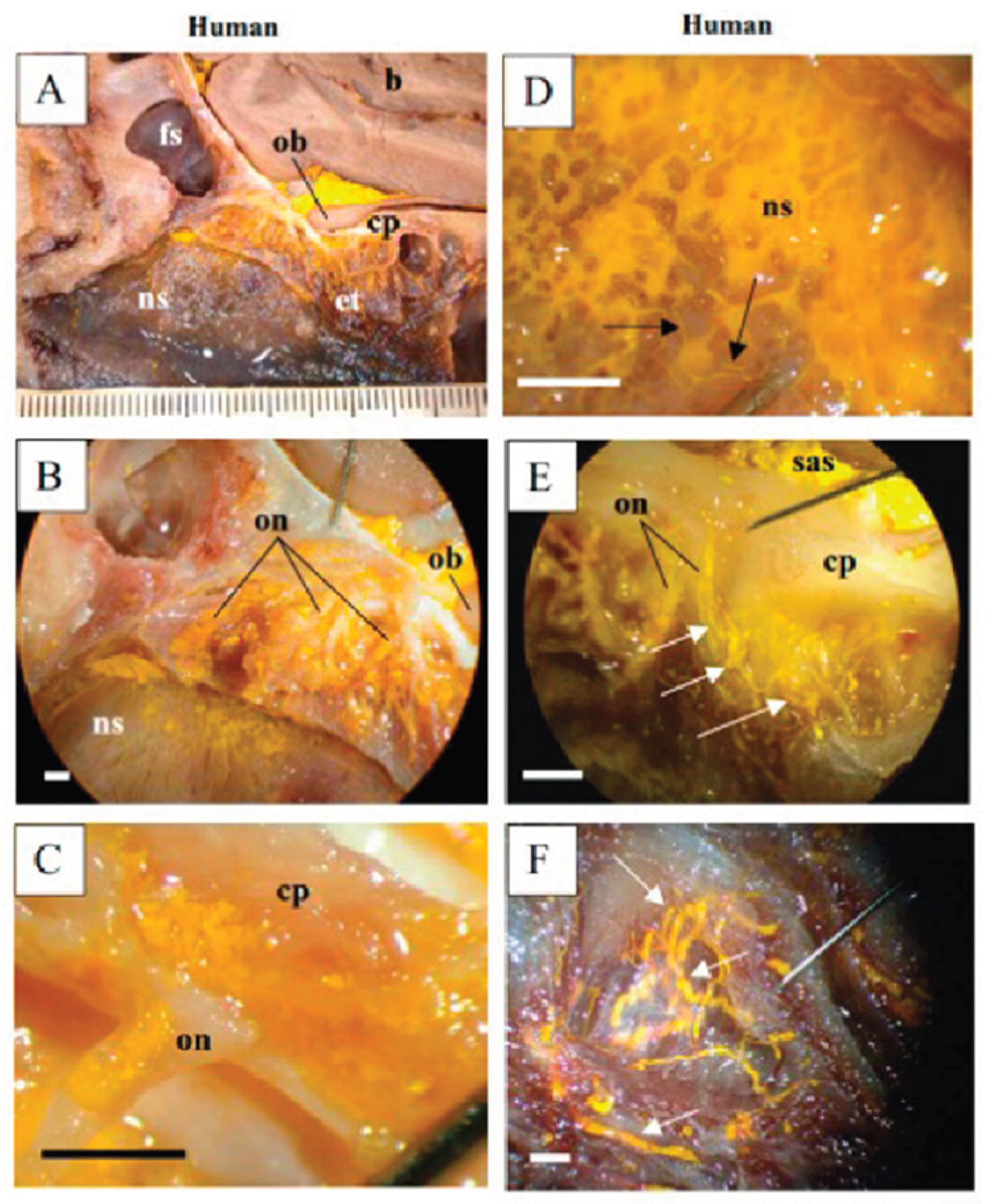
Disclaimer/Publisher’s Note: The statements, opinions and data contained in all publications are solely those of the individual author(s) and contributor(s) and not of MDPI and/or the editor(s). MDPI and/or the editor(s) disclaim responsibility for any injury to people or property resulting from any ideas, methods, instructions or products referred to in the content. |
© 2026 by the authors. Licensee MDPI, Basel, Switzerland. This article is an open access article distributed under the terms and conditions of the Creative Commons Attribution (CC BY) license (http://creativecommons.org/licenses/by/4.0/).
Copyright: This open access article is published under a Creative Commons CC BY 4.0 license, which permit the free download, distribution, and reuse, provided that the author and preprint are cited in any reuse.


