

Submitted:
26 May 2026
Posted:
27 May 2026
You are already at the latest version
Abstract
More than 100 species of grasshoppers have been documented in the Xinjiang Uygur Autonomous Region of China, several of which cause serious damage to pasturelands and negatively affect animal husbandry. Aspergillus oryzae XJ-1, a fungal pathogen of locusts and grasshoppers, has previously shown pathogenic activity against locusts and grasshoppers in crop field, but its efficacy in natural grasslands has not yet been evaluated. To assess its potential for grasshopper management in grasslands, we conducted infection assays, field-cage experiments and field trials in Xinjiang, China, from 2024 to 2025. Infection assays indicated that A. oryzae XJ-1 could infect 7 grasshopper species: Calliptamus italicus (Itanlian locust), C. barbarus, Oedipoda miniata, Oedaleus decorus, Sphingonotus coerulipes, Notostaurus albicornis, and Gomphocerus sibiricus. In field-cage experiments, cumulative mortality rates of O. miniata and C. barbarus reached 73.3 ± 8.8% and 76.7 ± 6.7%, respectively 20 days after inoculation with A. oryzae XJ-1 at 106 conidia mL-1. In field trials, grasshopper population reduction rates in treated plots reached 84.9 ± 4.3% and 59.7 ± 4.6% at 15 days after treatment with 3 × 10¹² conidia ha-1 in Huocheng County in 2024 and 2025, respectively. In Bole County in 2025, the reduction rate reached 79.6 ± 4.8% at 5 days after treatment using the same dosage. These results suggested that A. oryzae XJ-1 has potential as a biological control agent against several grasshopper species in the grasslands of the Xinjiang region.
Keywords:
grasshopper
; Aspergillus oryzae XJ-1
; biological control
; reduction of population density
; field trial
1. Introduction
Locusts and grasshoppers are major agricultural pests worldwide, affecting crop production, grassland ecosystems, and rural livelihoods [1]. Under favorable environmental conditions, their populations can rapidly reach outbreak levels, causing severe economic and ecological damage [2]. Despite decades of research and large-scale efforts, locust and grasshopper outbreaks continue to represent a major challenge in many regions of the world.
Since the 1940s, chemical insecticides, including organochlorines (dieldrin, chlordane, DDT, benzene hexachloride), organophosphates (malathion, fenitrothion), and pyrethroids (deltamethrin, cypermethrin), have been widely used for the control of locusts and grasshoppers [3,4]. Although, these compounds may leave persistent residues and negatively affect human health and non-target organisms [4]. Consequently, environmentally friendly biopesticides have been developed and widely used [5], including Beauveria bassiana [6,7], Metarhizium spp. [8,9], and Nosema locustae [10,11,12]. However, behavioral thermoregulation in locusts and grasshoppers may reduce the efficacy of fungal pathogens such as Metarhizium under field conditions, as infected insects can elevate their body temperature to inhibit fungal development [13,14,15,16,17].
Aspergillus oryzae is a filamentous fungus that has been widely used for millennia in the fermentation of traditional foods [18]. It is classified as Generally Recognized As Safe (GRAS) by the U.S. Food and Drug Administration because it does not produce aflatoxins or other known carcinogenic metabolites [19,20,21,22,23]. Although some Aspergillus species are associated with mycotoxin production or opportunistic pathogenicity, A. oryzae has long been recognized as a safe industrial microorganism and is extensively used in food fermentation. Species of Aspergillus have rarely been investigated as microbial control agents against insects. However, previous field-cage experiments and large-scale field trials conducted in Kenli County, Shandong Province, China, have shown that A. oryzae XJ-1, a fungal isolate originally obtained from a dead grasshopper collected in Xinjiang, exhibits pathogenic activity against several locust and grasshopper species, affecting both nymphal and adult stages in croplands [24,25,26]. Nevertheless, its efficacy against grasshopper populations in natural grasslands has not yet been evaluated.
More than 100 species of locusts and grasshoppers occur in the 57 million hectares of grassland in the Xinjiang region of northwestern China [27,28]. Several species periodically cause severe damage to grasslands and negatively affect animal husbandry. Current management strategies include chemical insecticides [29], N. locustae [30], Metarhizium flavoviride [31], and conservation of migratory birds such as Sturnus roseus [32]. However, few studies have evaluated microbial agents against adult grasshoppers in these arid grassland ecosystems. Because A. oryzae XJ-1 was originally isolated from a grasshopper collected in this region, we hypothesized that it may have potential as a biological control agent against grasshopper populations in the grasslands of Xinjiang. Therefore, we conducted infection assays, field-cage experiments, and field trials to evaluate its pathogenicity and field efficacy against grasshopper populations.
2. Materials and Methods
2.1. Field-Cage Bioassay of the Virulence of A. oryzae XJ-1 Against Adult Grasshoppers
Conidial powder of A. oryzae XJ-1 was prepared by the Biological Control Laboratory, Institute of Plant Protection, Shandong Academy of Agricultural Sciences. The conidial powder was suspended in 0.3% (v/v) Tween-80 solution at a concentration of 106 conidia mL-1, and conidial density was determined using a hemocytometer. Adult Oedipoda miniata (Pallas, 1771) and Calliptamus barbarus (Costa, 1836) were collected from grasslands in Huocheng County, Yili Kazak Autonomous Prefecture, Xinjiang Uygur Autonomous Region, China. Grasshoppers were maintained outdoors in cages and fed fresh alfalfa seedings daily. Enclosures were cleaned regularly and feces removed daily.
The field-cage experiment was conducted at the Yili Prefecture Desert Steppe Experimental Station in Huocheng County. Sixty adults of each species were randomly assigned to six groups, including three treatment groups and three control groups, with 10 insects per group. Grasshoppers in the treatment groups were inoculated with A. oryzae XJ-1 at a concentration of 106 conidia mL-1, whereas control insects were treated only with 0.3% (v/v) Tween-80 solution. For inoculation, each adult grasshopper was individually immersed in the conidial suspension for less than 1 s. After treatment, insects were air-dried and individually transferred to plastic boxes (top diameter: 14 cm; bottom diameter: 9 cm; height: 14 cm). Control insects were treated similarly using Tween-80 solution only. All plastic boxes were placed outdoors on the ground under natural environmental conditions. The experiment was conducted from 20 August to 8 September 2024, during which ambient temperatures ranged from 8 to 32 °C. Mortality was recorded daily for 20 days after treatment.
2.2. Field Trial Plots
Treatment Plot 1 (44°07′17.7″N, 80°55′54.3″E; altitude 723.3 m), covering 6.67 ha, was established in grassland of Huocheng County. An untreated control plot (CK 1) of the same size was located 100 m from Plot 1. The grasshopper community in Plot 1 consisted mainly of six species: Calliptamus italicus (Linnaeus, 1758), O. miniata, C. barbarus, Oedaleus decorus (Germar, 1825), Sphingonotus coerulipes (Uvarov, 1922), and Notostaurus albicornis (Eversmann, 1848). At the time of treatment, more than 95% of individuals were adults. The dominant vegetation in Plot 1 and CK 1 consisted of Artemisia capillaris, Medicago falcata, and Sophora alopecuroides.
Treatment Plot 2 (44°07′32.5″N, 81°00′45.5″E; altitude 793.6 m), covering 33.35 ha, was also established in grassland of Huocheng County, where adult C. italicus was the dominant grasshopper species. An untreated control plot (CK 2) of the same size was located 200 m from Plot 2. The dominant vegetation consisted mainly of A. capillaris.
Treatment Plot 3 (44°49′36″N, 81°39′59.0″E; altitude 2292.98 m), covering 33.35 ha, was established in grassland of Bole County, where adult Gomphocerus sibiricus (Linnaeus, 1767) was the dominant species. An untreated control plot (CK 3) of the same size was located 200 m from Plot 3. The dominant vegetation consisted of Artemisia frigida, A. capillaris and M. falcata.
No significant rainfall occurred during the three field trials.
An aqueous suspension of A. oryzae XJ-1 conidia at a concentration of 2 × 10⁸ conidia mL-1 was applied by aerial spraying using a T40 agricultural drone (DJI, Shenzhen, China) at an application rate of 3 × 10¹² conidia ha-1 in all treatment plots. Plot 1 and Plot 2 were treated in August of 2024 and July 2025, respectively, whereas Plot 3 was treated in July of 2025.
Grasshopper densities were surveyed one day before treatment and on days 5 (or 6), 10, and 15 after treatment. Sampling was conducted using a 1-m2 quadrat (plastic frame fitted with nylon mesh), placed every 30 steps along a diagonal transect across each plot. Fifty samples were collected from each treatment and control plot during each survey, and the number of grasshoppers within each quadrat was recorded. Population reduction rates were calculated according to the method described by You [25].
Dead grasshoppers were collected individually from treatment plots to assess fungal colonization. Each cadaver was placed on a sterilized glass slide over sterilized filter paper in a sterile Petri dish. To maintain high humidity, 200 µL of sterile water was added to the filter paper. Petri dishes were incubated at approximately 28 °C for 7 days and examined daily. The presence of A. oryzae XJ-1 mycelial growth on the insect surface was considered indicative of successful fungal colonization.
2.3. Statistical Analysis
All statistical analyses were performed using Origin 8.0 software (OriginLab, Northampton, MA, USA). Student’s t-tests were used to compare cumulative mortality between treatment and control groups for adult O. miniata and C. barbarus in the field-cage bioassay. The same approach was used to compare grasshopper population densities and population reduction rates between treatment and control plots in each field trial. Statistical significance was determined at p < 0.05.
3. Results
3.1. The Virulence of A. oryzae XJ-1 Against Adult Grasshoppers in the Field-Cage Experiment
After being inoculated with A. oryzae XJ-1 in the field-cage experiment, adult grasshoppers O. miniata and C. barbarus began to die on the second or third day, with mortality gradually increasing thereafter (Figure 1). By day 20, mortality in treated O. miniata was 73.3 ± 8.8%, and that of C. barbarus reached 76.7 ± 6.7%, whereas mortalities in the control groups were 26.7 ± 12.0% and 30.0 ± 11.5%, respectively. These results indicate that A. oryzae XJ-1 is pathogenic to adult O. miniata and C. barbarus, and suggest its potential as a biological control agent against these species.
3.2. The Efficacy of A. oryzae XJ-1 Against Adult Grasshoppers in the Field
In Plot 1, the mean grasshopper density decreased from one day before treatment to 15 days after the application of A. oryzae XJ-1 conidia in 2024 (Table 1). No significant differences in mean grasshopper density were observed between the treatment and control plots one day before treatment (p > 0.05), or at day 6 (p > 0.05) and day 10 (p > 0.05) after treatment. However, the mean grasshopper density in the treatment plot was significantly lower than that in the control plot on day 15 (p < 0.001) after treatment (Table 1).
In Plot 2 (2025), a similar trend was observed, with a decrease in mean grasshopper density from one day before treatment to 15 days after application of A. oryzae XJ-1 conidia (Table 1). No significant differences were detected between the treatment and control plots one day before treatment (p > 0.05), nor at day 5 (p > 0.05) or day 10 (p > 0.05) after treatment. However, a significant difference in mean grasshopper density was observed at day 15 after treatment (p < 0.001) (Table 1).
In 2024, reduction rates in the treatment plot were 54.8 ± 5.2% (day 10) and 84.9 ± 4.3% (day 15), both significantly higher than those in the control plot on the corresponding dates: 24.9 ± 8.7% (p < 0.05) and 52.2 ± 7.8%, respectively (p < 0.05 for both comparisons; Figure 2). No significant difference in reduction rates was observed between the treatment (6.0 ± 14.7 %) and the control plots (-15.6 ± 35.0 %) at day 6 (p > 0.05) (Figure 2).
In 2025, reduction rates in the treatment plot were 14.3 ± 0.8% (day 5), 43.3 ± 4.2% (day 10), and 59.7 ± 4.6% (day 15), all significantly higher than those in the control plot at the corresponding times: -13.7 ± 9.8% (p < 0.05), 9.8 ± 1.1% (p < 0.01), and 2.6 ± 0.6% (p < 0.001), respectively.
In Plot 3, mean grasshopper population density significantly declined over time in both the treatment and control plots from one day before treatment to 15 days after aerial application of A. oryzae XJ-1 conidia (Table 2). The mean grasshopper density in the treatment plot was significantly lower than that in the control plot at day 5 (p < 0.001), day 10 (p < 0.001), and day 15 (p < 0.01) after treatment (Table 2). Reduction rates in the treatment plot were 79.6 ± 4.8% (day 5) and 93.2 ± 1.6% (day 15), both significantly higher than those in the control plot on the corresponding days: 46.6 ± 4.5% (p < 0.01) and 79.4 ± 4.0% (p < 0.05), respectively (Figure 3). No significant difference in reduction rate was observed at day 10 between the treatment (89.7 ± 2.1%) and control plots (54.4 ± 13.7%) (p > 0.05) (Figure 3).
Mycelia growth of A. oryzae XJ-1 was observed on the bodies of seven grasshopper species—O. miniata, C. barbarus, S. coerulipes, O. decorus, C. italicus, N. albicornis, and G. sibiricus—collected from the treatment plots after 4–5 days of incubation. This indicates that A. oryzae XJ-1 infected and killed these seven species under field conditions after application (Figure 4).
4. Discussion
The efficacy of biocontrol agents is strongly influenced by several characteristics of the grasslands in Xinjiang. These grasslands are characterized by: (1) drought stress, with annual rainfall often below 300 mm; (2) stronger ultraviolet radiation, which may impair conidial viability and delay germination [33]; and (3) high grasshopper diversity, with more than 100 species occurring from early to late in the growing season [27].
Metarhizium spp. and N. locustae have previously been used for grasshopper control in the Xinjiang region. The corrected reduction rate of a Metarhizium strain against mixed nymph and adult C. barbarus, N. albicornis, O. decorus, Sphingonotus spp., and Dociostaurus spp. was only 37.60 ± 2.99% 14 days after treatment [34]. Field control of mixed adult G. sibiricus, Stenobothrus eurasius, Stauroderus scalaris, Chorthippus albomarginatus, Dociostaurus kraussi in Xinjiang using an oil formulation of Metarhizium flavoviride at the dose of 5 × 10¹² conidia / ha resulted in a corrected mortality rate of 60.9% after 16 days [31]. Application of the microsporidium N. locustae at concentrations of 100-150 million spores per 100 g of wheat bran produced corrected mortality rates of only 36.1% to 56.2% against 2nd – 3rd instar C. italicus after 28 days [30].
Our field results suggest that A. oryzae XJ-1 may be better adapted to the environmental conditions of Xinjiang grasslands, as it originates from this region and may therefore exhibit enhanced performance and higher mortality rates under local field conditions. These findings suggest that A. oryzae XJ-1 has strong potential for grasshopper control in arid grasslands, although additional field trials are still needed. No adverse effects on non-target organisms were evaluated in the present study and should be investigated in future work.
The reduction rates of CK 1 and CK 3 are quite high in the field trials. The possible reason may be that the grasshoppers in the plots migrate to other places. C. italicus and G. sibiricus in Xinjiang, particularly for adults, both have strong migratory ability [1,35]. C. italicus nymph could migrate more than 400 m/d [1]. G. sibiricus adult could migrate several hundred meters one time [35]. This may affect the control efficacy when investigated. To reduce the effect of migration, the area of field trial should be enlarged to several hundred hectares.
Previously, we demonstrated that A. oryzae XJ-1 was effective against adults of Locusta migratoria, Epacromius spp., Atractomorpha spp., and Oxya spp. in a large-scale field experiment conducted in Kenli County, Shandong Province, China, in 2022 under temperatures ranging from 26 to 38 ℃ [25]. During the present three field trials, temperatures ranged from 6 to 37 ℃. These findings suggest that the effective temperature range of A. oryzae XJ-1 against adult locusts and grasshoppers in the field is broad, spanning from 6 to 38 ℃, which could considerably widen its potential application.
However, it remains unknown whether infected grasshoppers can behaviorally increase their body temperature, as reported for infection by Metarhizium acridum, thereby reducing infection success and control efficacy [13,14,15,16,17,36]. This question deserves further investigation.
Here, we demonstrated that A. oryzae XJ-1 is also effective against adult O. miniata, C. barbarus, S. coerulipes, O. decorus, C. italicus, N. albicornis and G. sibiricus under field conditions. Hight virulence against adult locusts and grasshoppers appears to be a distinguishing characteristic of A. oryzae XJ-1.
Specific virulence mechanisms may be involved in its pathogenicity toward adult locusts and grasshoppers. For example, Metarhizium spp. produce destruxins that contribute to locust mortality [37], whereas B. bassiana produces several insecticidal metabolites, including beauvericin, bassianolide, beauverolide, bassianin, tenellin, oosporein, oxalic acid, and calcium oxalate crystals, with beauvericin considered one of the major toxins involved in pathogenicity [38,39]. Further studies are therefore needed to elucidate the pathogenic mechanisms of A. oryzae XJ-1 against locusts and grasshoppers.
Author Contributions
Y.Y., Y.S. and M. L. conceived and designed research. J.D., X.X., F.Y. and Y.N. conducted the experiments; Y.Y., Y.S. and M. L. wrote the manuscript. All authors read and approved the manuscript.
Acknowledgments
This work was supported by the National Natural Science Foundation of China (No. 32472640), the Shandong Provincial Natural Science Foundation (ZR2022MC117), and the Agricultural Scientific and Technological Innovation Project of the Shandong Academy of Agricultural Sciences (CXGC2025H09, CXGC2025F05).
Data Availability Statement
The original contributions presented in this study are included in the article. Further inquiries may be directed to the corresponding authors.
Conflicts of Interest
The authors declare no conflicts of interest.
References
- Lecoq, M., & Zhang, L. Encyclopedia of Pest Orthoptera of the World. China Agricultural University Press: Beijing, China, 2019.
- Zhang, L., Lecoq, M., Latchininsky, A., & Hunter, D. Locust and grasshopper management. Annu. Rev. Entomol. 2019, 64, 15–34. [CrossRef]
- Hill, R. E., & Hixson, E. Hexachlorocyclohexane dusts and fogs to control grasshoppers. J. Econ. Entomol. 1947, 40, 137. [CrossRef]
- Lomer, C. J., Bateman, R. P., Johnson, D. L., Langewald, J., & Thomas, M. Biological control of locusts and grasshoppers. Annu. Rev. Entomol. 2001, 46, 667–702. [CrossRef]
- Kumar, J., Ramlal, A., Mallick, D., & Mishra, V. An overview of some biopesticides and their importance in plant protection for commercial acceptance. Plants 2021, 10(6), 1185. [CrossRef]
- Jaronski, S. T., & Goettel, M. S. Development of Beauveria bassiana for control of grasshoppers and locusts. Mem. Entomol. Soc. Can. 1997, 171, 225–237. [CrossRef]
- Johnson, D. L., & Goettel, M. S. Reduction of grasshopper populations following field application of the fungus. Beauveria bassiana. Biocontr. Sci. Technol. 1993, 3, 165–175. [CrossRef]
- Baker, G. L., Milner, R. J., Lutton, G. G., & Watson, D. M. Preliminary field trial on the control of Phaulacridium vittatum (Sjöstetd) (Orthoptera: Acrididae) populations with Metarhizium flavoviride Gams and Rozsypal (Deuteromycetina: Hyphomycetes). J. Aust. ent. Soc. 1994, 33, 190–192. [CrossRef]
- Kooyman, C., & Abdalla, O. M. Application of Metarhizium flavoviride (Deuteromycotina: Hyphomycetes) spores against the tree locust, Anacridium melanorhodon (Orthoptera: Acrididae), in Sudan. Biocontr. Sci. Technol. 1998, 8, 215–219. [CrossRef]
- Henry, J. E., & Oma, E. A. Pest control by Nosema locustae, a pathogen of grasshoppers and crickets. In Microbial Control of Pests and Plant Diseases (1970–1980); Burges, H.D., Ed.; Academic Press: New York, NY, USA, 1981; pp. 573–586.
- Henry, J. E., Tiahrt, K., & Omaha, E. A. Importance of timing, spore concentrations, and levels of spore carrier in application of Nosema locustae (Microsporida: Nosematidae) for control of grasshoppers. J. Invertebr. Pathol. 1973, 21, 263–272. [CrossRef]
- Lange, C. E. The host and geographical range of the grasshopper pathogen Paranosema (Nosema) locustae revisited. J. Orthoptera Res. 2005, 14, 137–141. [CrossRef]
- Blanford, S., & Thomas, M. B. Thermal behavior of two acridid species: effects of habitat and season on body temperature and the potential impact on biocontrol with pathogens. Environ. Entomol. 2000, 29, 1060–1069. [CrossRef]
- Blanford, S., Thomas, M. B., & Langewald, J. Behavioural fever in the Senegalese grasshopper, Oedaleus senegalensis, and its implications for biological control using pathogens. Ecol. Entomol. 1998, 23, 9–14. [CrossRef]
- Fargues, J., Ouedraogo, A., Goettel, M.S., & Lomer, C.J. Effects of temperature, humidity and inoculation method on susceptibility of Schistocerca gregaria to Metarhizium flavoviride. Biocontr. Sci. Technol. 1997, 7, 345–356. [CrossRef]
- Inglis, G. D., Johnson, D. L., & Goettel, M. S. Effects of temperature and thermoregulation on mycosis by Beauveria bassiana in grasshoppers. Biol. Control 1996, 7, 131–139. [CrossRef]
- Thomas, M. B., & Jenkins, N. E. Effects of temperature on growth of Metarhizium flavoviride and virulence to the variegated grasshopper, Zonocerus variegatus. Mycol. Res. 1997, 101, 1469–1474. [CrossRef]
- Zhong, Y. Y., Lu, X., Xing, L., Ho, S. W. A., & Kwan, H. S. Genomic and transcriptomic comparison of Aspergillus oryzae strains: A case study in soy sauce koji fermentation. J. Ind. Microbiol. Biot. 2018, 45, 839–853. [CrossRef]
- Abe, K., Gomi, K., Hasegawa, F., & Machida, M. Impact of Aspergillus oryzae genomics on industrial production of metabolites. Mycopathologia 2006, 162, 143–153. [CrossRef]
- Barbesgaard, P., Heldt-Hansen, H. P., & Diderichsen, B. On the safety of Aspergillus oryzae: a review. Appl. Microbiol. Biotechnol. 1992, 36, 569–572. [CrossRef]
- FAO_WHO. Committee on Food Additives 31. World Health Organization Technical Report Series: Geneva, 1987.
- Geiser, D. M., Pitt, J. I., & Taylor, J. W. Cryptic speciation and recombination in the aflatoxin–producing fungus Aspergillus flavus. Proc. Natl. Acad. Sci. USA 1998, 95, 388–393. [CrossRef]
- Tailor, M. J., & Richardson, T. Applications of microbial enzymes in food systems and in biotechnology. Adv. Appl. Microbiol. 1979, 25, 7–35. [CrossRef]
- Fu, X., Liu, H., Xu, X., Guo, J., Hu, S., You, Y., & Zhang, L. Comparison of the virulence of space mutants of Aspergillus oryzae XJ-1 against adult Locusta migratoria. Agronomy 2024, 14, 116. [CrossRef]
- You, Y., An, Z., Zhang, X., Liu, H., Yang, W., Yang, M., Wang, T., Xie, X., & Zhang, L. Virulence of the fungal pathogen, Aspergillus oryzae XJ-1 to adult locusts (Orthoptera: Acrididae) in both laboratory and field trials. Pest Manag. Sci. 2023, 79, 3767–3772. [CrossRef]
- Zhang, P., You, Y., Song, Y., Wang, Y., & Zhang, L. First record of Aspergillus oryzae (Eurotiales: Trichocomaceae) as an entomopathogenic fungus of the locust, Locusta migratoria (Orthoptera: Acrididae). Biocontr. Sci. Technol. 2015, 25, 1285–1298. doi: org/10.1080/09583157.2015.1049977.
- Chen, Y.L. Studies on the Acridoids of Xinjiang Uighur Autonomous Region: Distribution of Acridoids Ⅰ. Faunal & regional distribution. Acta Entomol. Sin. 1981, 24(1): 17–27. (in Chinese) [CrossRef]
- Yan, D., Zhou, Q., Lu, H., Wu, C., Zhao, B., Cao, D., Ma, F., & Liu, X. The disaster, ecological distribution and control of poisonous weeds in natural grasslands of Xinjiang Uygur Autonomous Region. Sci. Agric. Sin. 2015, 48(3): 565–582. (in Chinese) [CrossRef]
- Tong, Y. Efficacy of 1.3% matrine for controlling grasshoppers in grassland. Xinjiang Animal Husbandry 2015, (3): 62–63. (in Chinese) [CrossRef]
- Wang, L., Cao, C., Yu, X., Waili, A., & Yang, C. Effects of the control of grasshoppers in Xinjiang rangeland by using Nosema locustae bran bait with different formulation. Chin. J. Biol. Control 1994, 10, 123–125. (in Chinese) [CrossRef]
- Li, B., Roy, B., Li, G., Meng, L., Zheng, Y., Ainiwar. Field trial on the control of grasshoppers in mountain grassland by oil formulation of Metarhizium flavoviride. Chin. J. Biol. Control 2000, 16(4): 145–147. (in Chinese) [CrossRef]
- Lin, J. Demonstration studies on the control of locust by attracting Sturnus roseus. Grass Feeding Livestock 2015, (5): 64–67. (in Chinese) [CrossRef]
- Braga, G. U., Flint, S. D., Miller, C. D., Anderson, A. J., & Roberts, D. W. Both solar UVA and UVB radiation impair conidial culturability and delay germination in the entomopathogenic fungus Metarhizium anisopliae. Photochem. Photobiol. 2001, 74, 734–739. [CrossRef]
- Mao, A., Guan, T., Jin, Q., Li, J., Ailikamu, Y., Haxiqiqige., Li, R., & Zhao, L. Field trials of five pesticides against locusts. Xinjiang Agricultural Science and Technology 2021, 5, 31–33. (in Chinese) [CrossRef]
- Locust Control Station, Barkol Kazak Autonomous Prefecture, Sinkiang Uighur Autonomous Region, & Division of Insect Ecology, Peking Institute of Zoology, Academia Sinica. Studies on the grasshoppers of Sinkiang Uighur Autonomous Region: the bionomics of five dominant species infesting the pastures. Acta Entomol. Sin. 1977, 20(3): 259–268. (in Chinese) [CrossRef]
- Bischoff, J. F., Rehner, S. A., & Humber, R. A. A multilocus phylogeny of the Metarhizium anisopliae lineage. Mycologia 2009, 101, 512–530. [CrossRef]
- Gillespie, A. T., & Claydon, N. The use of entomogenous fungi for pest control and the role of toxins in pathogenesis. Pestic. Sci. 1989, 27, 203–215. [CrossRef]
- Bi, Y., Wu, L., Li, B., Hao, Y., Li, Z., Zhang, J., Cheng, A., Yuan, G., & Fan, J. Effects of beauvericin on the blood cells of Bombyx mori. J. Invertebr. Pathol. 2023, 201, 108003. [CrossRef]
- Wang, H., Peng, H., Li, W., Cheng, P., & Gong, M. The toxins of Beauveria bassiana and the strategies to improve their virulence to insects. Front. Microbiol. 2021, 12, 705343. [CrossRef]
Figure 1.
Cumulative mortality of adult grasshoppers exposed to A. oryzae XJ-1 in a field cage experiment. O. miniata (A) and C. barbarus (B). Inoculation concentration: 106 conidia mL-1. Bars represent SE. p < 0.05 (*), p < 0.01 (**). Student’s t-test (n = 3).
Figure 1.
Cumulative mortality of adult grasshoppers exposed to A. oryzae XJ-1 in a field cage experiment. O. miniata (A) and C. barbarus (B). Inoculation concentration: 106 conidia mL-1. Bars represent SE. p < 0.05 (*), p < 0.01 (**). Student’s t-test (n = 3).
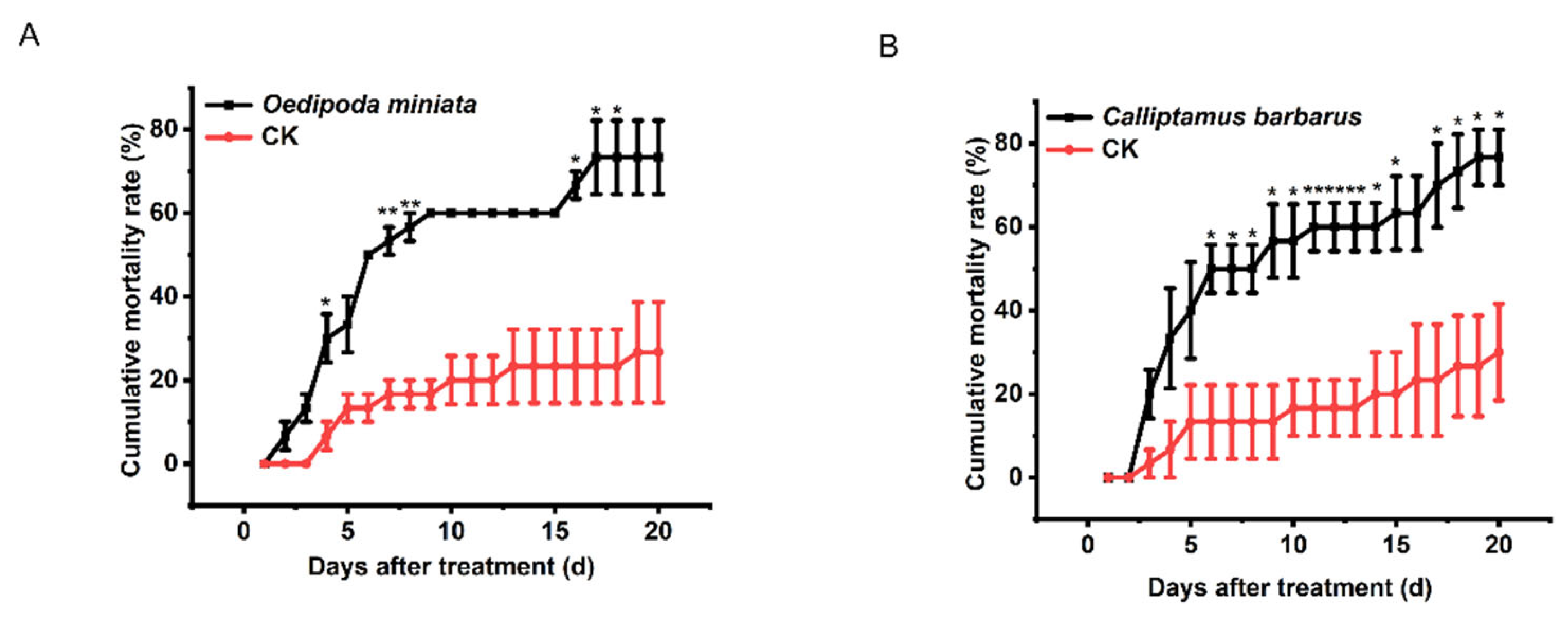
Figure 2.
Reduction rate of adult grasshoppers after treatment with A. oryzae XJ-1 in field trials in Huocheng County, China. Plot 1 was treated in 2024, and Plot 2 in 2025. Asterisks indicate significant differences between treatment and control on the same day, according to Student’s t-tests. ns, not significant. p < 0.05 (*); p < 0.01 (**); p < 0.001 (***). Bar represent SE.
Figure 2.
Reduction rate of adult grasshoppers after treatment with A. oryzae XJ-1 in field trials in Huocheng County, China. Plot 1 was treated in 2024, and Plot 2 in 2025. Asterisks indicate significant differences between treatment and control on the same day, according to Student’s t-tests. ns, not significant. p < 0.05 (*); p < 0.01 (**); p < 0.001 (***). Bar represent SE.
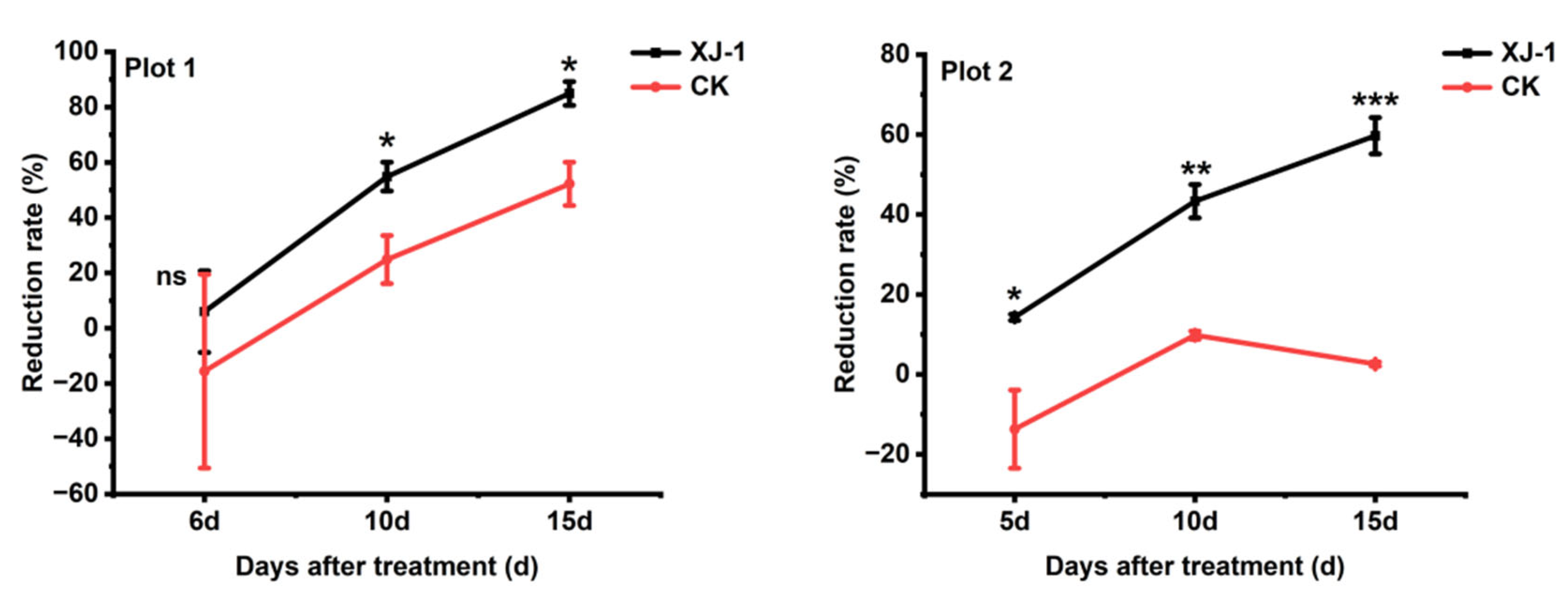
Figure 3.
Reduction rate of adult grasshoppers after treatment with A. oryzae XJ-1 in a field trial in Bole City, China, in 2025. Asterisks indicate significant differences between the treatment and control on the same day according to Student’s t-tests. ns, not significant. p < 0.05 (*); p < 0.01 (**). Bar represent SE.
Figure 3.
Reduction rate of adult grasshoppers after treatment with A. oryzae XJ-1 in a field trial in Bole City, China, in 2025. Asterisks indicate significant differences between the treatment and control on the same day according to Student’s t-tests. ns, not significant. p < 0.05 (*); p < 0.01 (**). Bar represent SE.
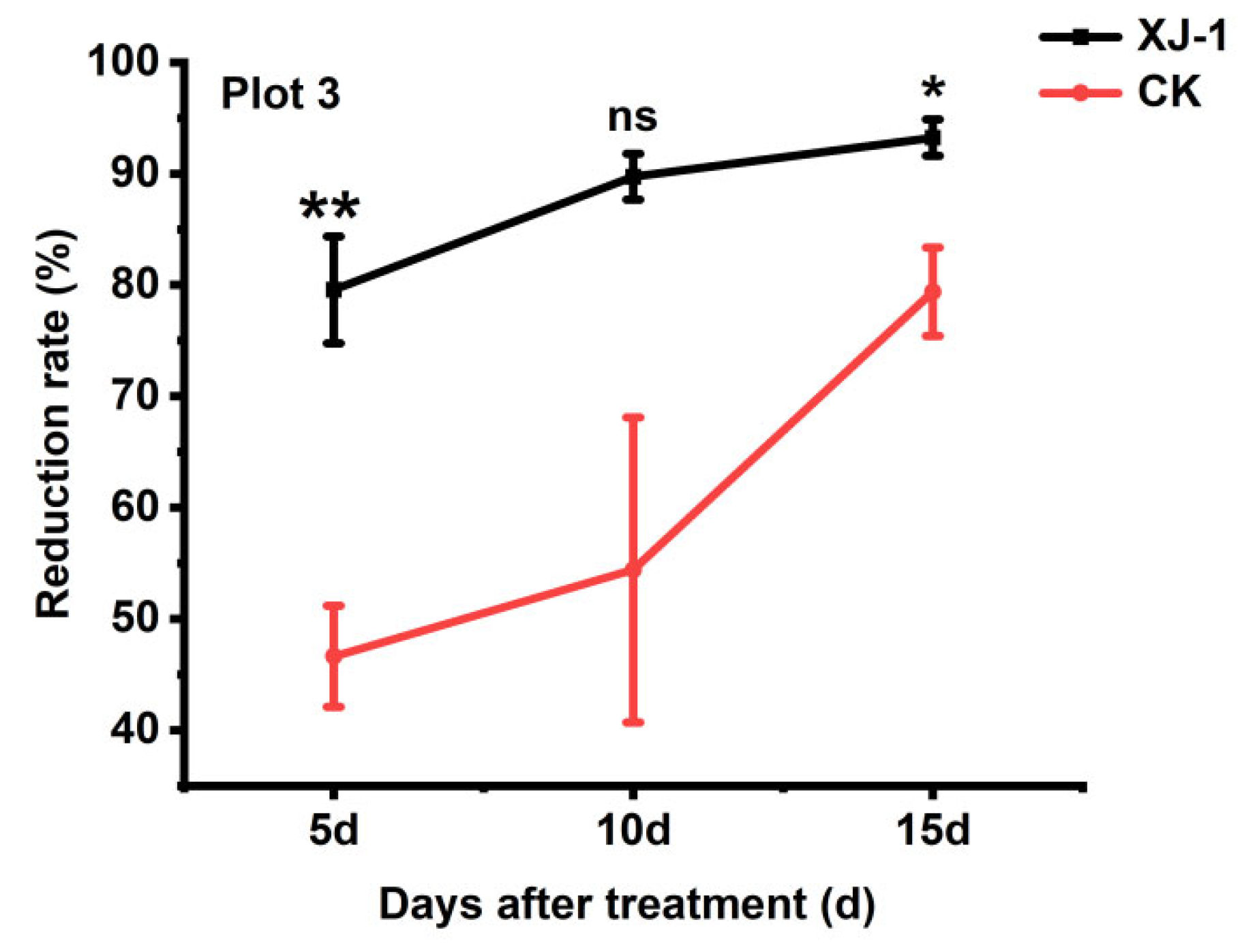
Figure 4.
External fungal growth and sporulation of A. oryzae XJ-1 on the bodies of seven species of dead adult grasshoppers collected in the treatment plot. (A) Oedipoda miniata; (B) Calliptamus barbarus; (C) Sphingonotus coerulipes; (D) Oedaleus decorus; (E) Calliptamus italicus; (F) Notostaurus albicornis; (G) Gomphocerus sibiricus.
Figure 4.
External fungal growth and sporulation of A. oryzae XJ-1 on the bodies of seven species of dead adult grasshoppers collected in the treatment plot. (A) Oedipoda miniata; (B) Calliptamus barbarus; (C) Sphingonotus coerulipes; (D) Oedaleus decorus; (E) Calliptamus italicus; (F) Notostaurus albicornis; (G) Gomphocerus sibiricus.
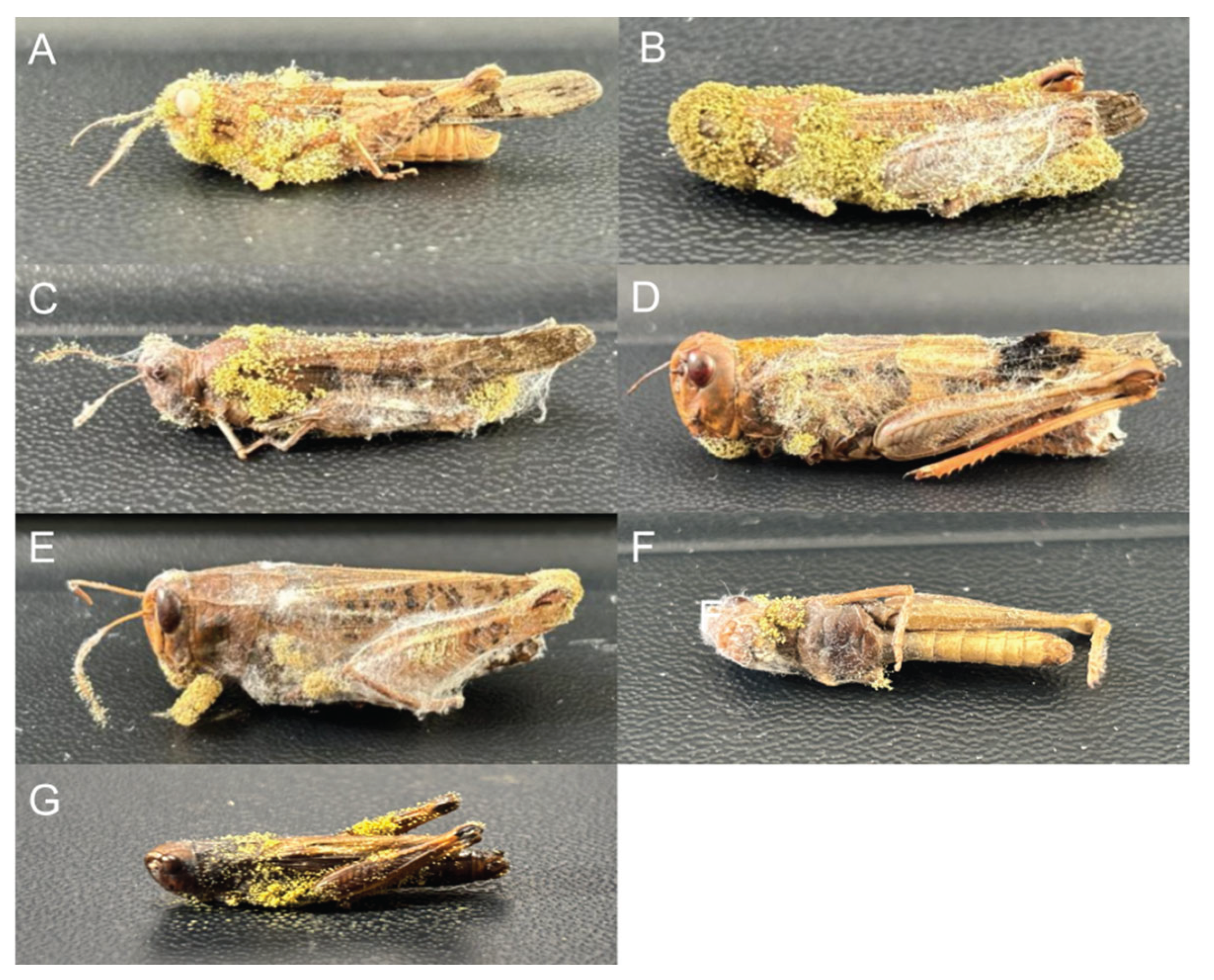

Table 1.
Mean grasshopper density (individuals m-2) in treatment and control plots (CKs) in Huocheng County, China, in 2024 and 2025.
Table 1.
Mean grasshopper density (individuals m-2) in treatment and control plots (CKs) in Huocheng County, China, in 2024 and 2025.
| 2024 | 2025 | ||||
| Survey day | CK 1 (mean ± SE) |
Plot 1 (mean ± SE) |
Survey day | CK 2 (mean ± SE) |
Plot 2 (mean ± SE) |
| 1 day before treatment | 1.76 ± 0.28a | 1.82 ± 0.21a | 1 day before treatment | 3.92 ± 0.50a | 5.06 ± 0.54a |
| 6 days | 1.84 ± 0.41a | 1.68 ± 0.34a | 5 days | 4.44 ± 0.41a | 4.34 ± 0.52a |
| 10 days | 1.28 ± 0.23a | 0.84 ± 0.16a | 10 days | 3.54 ± 0.37a | 2.88 ± 0.40a |
| 15 days | 0.80 ± 0.13a | 0.26 ± 0.08b | 15 days | 3.82 ± 0.38a | 2.02 ± 0.32b |
Note: Different letters following the values indicate significant differences between treatment and control plots (CK) on the same day within the same trial (t-test).
Table 2.
Mean grasshopper density (individuals m-2) in treatment Plot 3 and control Plot 3 (CK3) in Bole County, China, in 2025.
Table 2.
Mean grasshopper density (individuals m-2) in treatment Plot 3 and control Plot 3 (CK3) in Bole County, China, in 2025.
| Survey day | CK 3 (mean ± SE) | Plot 3 (mean ± SE) |
| 1 day before treatment | 4.00 ± 0.32a | 4.00 ± 0.32a |
| 5 days | 2.16 ± 0.21a | 0.80 ± 0.14b |
| 10 days | 1.75 ± 0.24a | 0.40 ± 0.09b |
| 15 days | 0.80 ± 0.13a | 0.28 ± 0.09b |
Note: Different letters following the values indicate significant differences between plots on the same day according to Student’s t-test.
Disclaimer/Publisher’s Note: The statements, opinions and data contained in all publications are solely those of the individual author(s) and contributor(s) and not of MDPI and/or the editor(s). MDPI and/or the editor(s) disclaim responsibility for any injury to people or property resulting from any ideas, methods, instructions or products referred to in the content. |
© 2026 by the authors. Licensee MDPI, Basel, Switzerland. This article is an open access article distributed under the terms and conditions of the Creative Commons Attribution (CC BY) license (http://creativecommons.org/licenses/by/4.0/).
Copyright: This open access article is published under a Creative Commons CC BY 4.0 license, which permit the free download, distribution, and reuse, provided that the author and preprint are cited in any reuse.


