

Submitted:
26 May 2026
Posted:
26 May 2026
You are already at the latest version
Abstract
Perovskite solar cells (PSCs) have emerged as highly promising candidates for next-generation photovoltaic technologies due to their remarkable power conversion efficiencies, low-cost fabrication routes, and tunable optoelectronic properties. However, their practical commercialization remains constrained by several critical challenges, including charge-carrier recombination, interface-related energy losses, environmental instability, and lead-associated concerns. This review presents a focused and updated analysis of advanced charge-carrier management strategies designed to address these limitations. Unlike broader PSC reviews, particular emphasis is placed on the coupled roles of carrier lifetime, mobility, and interface quality as fundamental determinants of device efficiency and long-term operational stability. Special attention is devoted to inverted p-i-n architectures, where buried hole-selective contacts, self-assembled monolayers, NiOx-based interlayers, and fullerene-derived electron-selective contacts increasingly govern voltage losses, extraction balance, operational durability, and scalability. Recent developments are discussed through the interconnected effects of buried-interface passivation, transport-layer energetics, crystallization control, and transient/steady-state characterization methods used to quantify non-radiative recombination and transport limitations. The scalability and reproducibility of these approaches are further evaluated under realistic operating conditions. Analysis of recent representative studies indicates that further improvements in PSC performance are increasingly limited not by intrinsic absorber properties alone, but by interfacial recombination, contact non-uniformity, and the long-term stability of carrier-selective interfaces under thermal, electrical, and operational stress. Recent evidence suggests that further progress in PSC technology will increasingly depend on integrated control of charge-carrier dynamics across buried interfaces, transport layers, and scalable device architectures, particularly in formamidinium-rich and inverted p-i-n systems that currently represent the most promising platforms for durable high-efficiency photovoltaics.
Keywords:
perovskite solar cells
; charge carrier management
; carrier lifetime and mobility
; interface engineering
; device stability
; tandem photovoltaics
; lead-free perovskites
1. Introduction
Over the past decade, PSCs have achieved remarkable progress in photovoltaic performance, with power conversion efficiencies exceeding 27% in single-junction devices and approaching 32% in perovskite-silicon tandem architectures [1,2]. These advances are enabled by the exceptional optoelectronic properties of hybrid perovskites, including high absorption coefficients, tunable bandgaps, and long charge-carrier diffusion lengths [3,4,5]. Despite these achievements, the transition of PSCs from laboratory-scale devices to stable, large-area commercial modules remains challenging. Device degradation under prolonged exposure to light, heat, and moisture, concerns related to lead toxicity, and efficiency losses during scale-up continue to limit practical deployment [6,7,8].
A central factor underlying these challenges is charge-carrier management. In practice, carrier generation, transport, and extraction must occur simultaneously, while non-radiative recombination must be minimized. These coupled processes ultimately determine not only efficiency, but also stability and scalability of PSCs [4,8,9]. While state-of-the-art small-area devices exhibit near-ideal efficiencies, performance typically deteriorates when device areas are increased beyond laboratory-scale cells [6,10]. This efficiency loss is commonly associated with morphological inhomogeneity, charge accumulation at grain boundaries, imbalanced electron and hole mobilities, and enhanced ion migration, all of which disrupt carrier transport and accelerate degradation [11,12,13]. Numerous strategies have been proposed to address these limitations, including low-dimensional perovskite passivation, compositional engineering, and additive incorporation [14,15,16]. However, under realistic operating conditions, such as elevated temperature and humidity, these approaches often provide limited long-term benefits [7,17]. A key reason is that charge-carrier lifetime, mobility, interfacial recombination, and ion migration are frequently optimized in isolation, without fully accounting for their strong mutual interdependence [18,19,20]. As a result, improvements in bulk material quality do not necessarily translate into enhanced device performance or stability [17,20,21].
Although a large number of review articles on PSCs have been published, charge-carrier management is still commonly discussed in a fragmented manner. Carrier lifetime, defect passivation, interface engineering, and device architecture are often treated as largely independent optimization targets, which obscures the dominant loss mechanisms governing real device operation [4,15,16]. Recent experimental and theoretical studies increasingly indicate that interfacial non-radiative recombination and transport imbalance frequently dominate voltage and fill-factor losses, even in highly crystalline perovskite films [11,22]. Consequently, bulk lifetime enhancement alone is insufficient to ensure high efficiency or long-term operational stability, particularly under realistic working conditions [7,17]. Recent studies further indicate that many of the efficiency improvements reported for small-area laboratory cells become less pronounced when scaling devices to larger areas, highlighting the persistent gap between materials-level optimization and practical module performance.
The present review addresses these limitations by explicitly focusing on the physical processes governing charge-carrier behavior in modern PSCs. Rather than cataloging materials or fabrication techniques, this work reorganizes the literature around charge-carrier dynamics. Transient optical and electrical diagnostics are discussed as quantitative tools for identifying dominant recombination pathways and transport limitations across the device stack [4,9,23]. Particular emphasis is placed on the interplay between bulk transport, interfacial recombination, and device architecture, with a focus on p-i-n configurations [6,22]. It is important to emphasize that the present review primarily focuses on the inverted p-i-n architecture, which has rapidly become the dominant configuration in high-performance and scalable PSCs [6,24]. Compared with conventional n-i-p devices, inverted p-i-n structures enable lower processing temperatures, reduced current-voltage hysteresis, improved interfacial stability, and superior compatibility with flexible substrates and tandem integration [6,7,8]. These practical advantages make p-i-n architectures more suitable for large-area fabrication and industrial manufacturing. Accordingly, most of the interface engineering and charge-carrier management strategies discussed herein are interpreted within the context of p-i-n device physics, while n-i-p configurations are referenced primarily for historical comparison. By synthesizing recent experimental and theoretical evidence within an integrated carrier-management perspective, this review aims to clarify unresolved inconsistencies in the literature and to outline realistic pathways toward simultaneous improvements in efficiency, operational stability, and scalability [8,16,25].
Although early PSC studies predominantly relied on MAPbI3/TiO2/Spiro-OMeTAD architectures, recent high-efficiency and scalable devices increasingly employ formamidinium-rich compositions and inverted p-i-n configurations [6,22]. More specifically, this review prioritizes inverted p-i-n PSCs because this architecture has become a leading platform for high-efficiency single-junction devices, monolithic tandems, and scalable module demonstrations. In this device class, the decisive challenge is no longer simply improving bulk absorption or diffusion length, but controlling buried-interface energetics, molecular contact formation, selective extraction, and contact stability under realistic operating stress. Accordingly, ETL design, HTL engineering, crystallization control, transient diagnostics, and operational stability are discussed here as strongly interconnected aspects of charge-carrier management in p-i-n PSCs.
The remainder of this review is organized as follows. Section 2 outlines the review methodology and literature selection strategy. Section 3 introduces the fundamental mechanisms of charge generation, transport, and recombination, establishing the hierarchy of dominant loss pathways. Section 4 presents experimental and transient diagnostic techniques that quantitatively probe carrier lifetime, mobility, and interfacial recombination. Section 5 discusses interface and morphology engineering strategies for suppressing non-radiative losses and improving charge extraction. Section 6 examines stability, scalability, and practical device engineering considerations that determine long-term reliability and large-area manufacturability. Section 7 synthesizes these insights to connect microscopic carrier dynamics with macroscopic device performance, and Section 8 provides an outlook highlighting future directions and remaining challenges toward commercialization.
Recent progress in scalable p-i-n architectures, buried-interface engineering, and tandem integration further indicates that the dominant limitations in modern PSCs increasingly originate from interfacial carrier dynamics rather than from bulk absorber quality alone. In this context, understanding how carrier transport, recombination, and interfacial energetics evolve across the complete device stack becomes essential for simultaneously improving efficiency, operational stability, and large-area manufacturability.
2. Review Methodology and Literature Search Strategy
This review was conducted following the principles of transparent and reproducible literature surveys, with reference to PRISMA guidelines for scoping reviews. Given the rapid development of perovskite solar cell research and the methodological diversity of charge-carrier management studies, the present work was designed as a scoping review rather than a strict systematic review [26]. The objective was to identify, categorize, and critically analyze representative and influential studies addressing charge-carrier transport, recombination dynamics, and interfacial effects in PSCs.
Literature searches were performed using the Web of Science and Scopus databases. Google Scholar was used selectively to identify additional highly cited or recently published works. The primary search period covered publications from 2018 to 2026, with particular emphasis on studies published within the last three years to reflect the current state of the field [6,7,8,9]. Earlier landmark studies were additionally included when they introduced fundamental concepts or experimental methodologies that remain widely adopted in current PSC research. The search strategy combined keywords related to perovskite photovoltaics and charge-carrier physics, including “perovskite solar cells”, “charge-carrier lifetime”, “carrier mobility”, “non-radiative recombination”, “interface engineering”, and “defect passivation”, as well as terms related to transient diagnostics such as “TRPL”, “TPV”, “TPC”, “SCLC”, and “PLQE” [4,5,6,7,8,9,23]. Studies were included if they directly investigated charge-carrier dynamics or recombination mechanisms in PSCs and reported quantitative relationships between material or interface modification and photovoltaic performance metrics. In total, approximately 185 publications were initially screened, from which representative studies relevant to the review scope were selected for qualitative analysis. Priority was given to quantitative investigations directly linking carrier dynamics with photovoltaic metrics such as Voc, FF, and stability.
3. Charge Carrier Dynamics and Dominant Loss Mechanisms in PSCs
The operation of PSCs is governed by a sequence of interrelated physical processes, including photogeneration of charge carriers, their transport through the perovskite absorber and charge transport layers, and recombination. These processes are highly sensitive to the microstructure of the perovskite film, defect density, grain boundaries, and interfacial electronic properties. A physically grounded understanding of charge carrier dynamics is therefore essential for improving both power conversion efficiency and long-term operational stability of PSCs [3,4,5]. Metal-halide perovskites possess a direct bandgap and a high absorption coefficient on the order of 105 cm⁻1, enabling efficient light harvesting in thin films with thicknesses of approximately 200-500 nm. Optical studies show that absorber layers thicker than 300 nm are sufficient to absorb nearly all incident visible photons, allowing efficient device operation with reduced material consumption and relaxed transport constraints [3,4].
Charge carriers are generated primarily within the perovskite layer, where their diffusion length strongly depends on material quality and microstructure. In high-quality single-crystal perovskites, carrier diffusion lengths can reach tens of micrometers, whereas in polycrystalline thin films commonly used in practical devices diffusion lengths typically range from submicrometer values up to a few micrometers [3,27,28]. Grain boundaries in polycrystalline films introduce localized trap states and act as pathways for ion migration, thereby coupling carrier transport to defect-assisted recombination. Furthermore, crystallographic orientation can induce anisotropy in carrier mobility, with preferential orientations supporting enhanced carrier delocalization and transport [17,20,29,30].
Non-radiative recombination in PSCs is predominantly governed by defect-assisted SRH processes. Although metal-halide perovskites exhibit an unusually high tolerance to certain point defects, vacancies and interstitials, particularly involving halide and lead ions can significantly shorten carrier lifetimes when present at high densities [19,30,31]. As a result, bulk and surface defect passivation has become a central strategy for suppressing SRH recombination and stabilizing charge carrier dynamics.
Interfaces between the perovskite absorber and the electron and hole transport layers represent another major source of performance loss. Imperfect band alignment and interfacial defect states promote non-radiative recombination, limiting the achievable open-circuit voltage and fill factor. Several independent studies consistently report that in state-of-the-art PSCs, interfacial recombination often dominates over bulk recombination, even in highly crystalline films exhibiting long photoluminescence lifetimes [17,18,22,24,32]. This explains why improvements in bulk carrier lifetime alone do not necessarily translate into higher device efficiency unless interfacial losses are simultaneously mitigated. Ion migration further complicates charge carrier dynamics under operational conditions. Mobile ionic species such as halide ions and organic cations can redistribute under illumination, thermal stress, or applied bias, leading to local electric field fluctuations and enhanced recombination at interfaces and grain boundaries. This dynamic behavior directly links charge transport to current-voltage hysteresis, light-soaking effects, and long-term device degradation [12,13,33].
Following photoexcitation, metal-halide perovskites rapidly generate free charge carriers due to their low exciton binding energies, typically on the order of tens of millielectronvolts. As a result, excitons readily dissociate into free electrons and holes at room temperature without the need for strong internal electric fields [4,34]. When photons with energies exceeding the bandgap are absorbed, high-energy carriers are initially generated and subsequently undergo ultrafast thermalization, dissipating excess energy to the lattice within sub-picosecond to picosecond timescales [35,36,37].
After thermalization, charge carriers either recombine radiatively or become trapped at defect sites where non-radiative recombination occurs. These processes typically take place on nanosecond to microsecond timescales and are strongly influenced by defect density and interfacial quality, as revealed by time-resolved photoluminescence and transient spectroscopic studies [4,19]. Consequently, carrier lifetimes measured under short-pulse excitation do not always reflect steady-state device behavior under continuous illumination. Overall, charge carrier dynamics in PSCs are governed by a hierarchy of loss mechanisms. While bulk defects establish an upper limit for carrier lifetime, interfacial non-radiative recombination and transport imbalance most frequently determine voltage losses, fill-factor reduction, and operational stability. Ion migration acts as a coupling mechanism that dynamically amplifies both bulk and interfacial losses over time [7,11,17,18]. This framework provides a foundation for interpreting diagnostic measurements and evaluating charge-carrier management strategies discussed in subsequent sections.
4. Experimental and Transient Diagnostics of Charge Carrier Dynamics in PSCs
A central challenge in PSC research is the reliable identification of performance-limiting loss mechanisms under realistic operating conditions. Charge carriers may be lost through bulk non-radiative recombination, interfacial recombination, inefficient extraction, or transport imbalance, and the dominant mechanism strongly depends on device architecture, material quality, and operating regime. Consequently, no single experimental technique can unambiguously describe charge carrier dynamics in PSCs. Instead, a hierarchical combination of transient optical and electrical diagnostics is required to distinguish bulk-limited, interface-limited, and transport-limited behavior [4,9].
Time-resolved photoluminescence is widely used to probe recombination dynamics in perovskite materials by monitoring the decay of photoluminescence following pulsed excitation. Long TRPL lifetimes are commonly interpreted as evidence of low bulk defect density and suppressed Shockley-Read-Hall recombination [4,19]. However, TRPL decay kinetics are strongly influenced by excitation density, surface recombination, and charge extraction at interfaces. As a result, long TRPL lifetimes measured on standalone films do not necessarily translate into high Voc or high device efficiency when interfacial losses dominate [24,32]. Space-charge-limited current measurements provide complementary information by enabling the estimation of bulk trap density and effective carrier mobility from current-voltage characteristics in the trap-filled limit regime [20,30]. While SCLC is valuable for quantifying bulk transport properties, it remains largely insensitive to interfacial recombination pathways and therefore cannot fully explain performance losses in high-efficiency devices where interfaces play a dominant role [17]. Transient absorption spectroscopy provides insight into ultrafast carrier processes occurring on femtosecond-to-nanosecond timescales, including hot-carrier cooling, trapping, and early-stage charge transfer from the perovskite absorber to charge transport layers [9,35,36]. TA studies consistently show that charge transfer times at perovskite/transport-layer interfaces vary over several orders of magnitude depending on film morphology, interface quality, excitation fluence, and data analysis methodology.
Reported CT lifetimes extracted from TA and TRPL measurements range from sub-picosecond to hundreds of nanoseconds even for nominally similar perovskite compositions and device architectures. Representative values reported in the literature are summarized in Table 1, illustrating that CT lifetimes are not intrinsic material constants, but rather emergent parameters reflecting interfacial quality, defect density, and experimental conditions [3,38,39,40,41,42,43,44,45,46,47,48,49,50].
This wide dispersion of reported CT times highlights a key limitation of relying on a single transient technique: fast charge transfer does not necessarily imply low recombination losses, and slow transfer does not automatically limit device efficiency if recombination is effectively suppressed elsewhere.
While TRPL and TA primarily probe excited-state dynamics in isolated films or simplified heterostructures, transient photovoltage and transient photocurrent measurements directly interrogate recombination and extraction processes in complete devices under near-operational conditions. TPV measurements monitor the decay of photovoltage following a small optical perturbation under quasi-open-circuit conditions, providing direct information on recombination lifetimes relevant to Voc losses [24,55]. Because TPV measurements are performed in the presence of built-in electric fields, selective contacts, and interfacial barriers, they are particularly sensitive to non-radiative recombination pathways that dominate real device operation.
TPC measurements complement TPV by probing carrier extraction and transport dynamics under short-circuit conditions. TPC decay profiles reflect carrier collection times, transport resistance, and charge accumulation at interfaces. Dispersive or slow TPC transients are commonly associated with transport imbalance between electrons and holes, interfacial barriers, or limited mobility in charge transport layers [45,46]. When analyzed together, TPV and TPC enable a clear distinction between recombination-limited and transport-limited device behavior, a separation that cannot be achieved using optical techniques alone.
Photoluminescence quantum efficiency measurements provide an absolute metric of radiative versus non-radiative recombination by quantifying the fraction of absorbed photons re-emitted as light. Under one-sun equivalent excitation, PLQE has been shown to correlate strongly with the maximum achievable Voc, making it a powerful predictor of voltage losses in PSCs [22,24]. Importantly, PLQE often correlates more reliably with Voc than TRPL lifetime alone, particularly in devices limited by interfacial recombination rather than bulk defects.
A recurring limitation in the literature is the interpretation of isolated measurements performed on standalone films. For example, TRPL and SCLC may indicate excellent bulk properties, while TPV and PLQE measurements reveal dominant interfacial recombination under operating conditions [24,32]. This apparent contradiction underscores the necessity of combining multiple diagnostic techniques to correctly identify the hierarchy of loss mechanisms in PSCs. To summarize the complementary roles and practical limitations of major diagnostic methods used in PSC research, representative transient and steady-state techniques are compared in Table 2.
As shown in Table 2, no individual diagnostic method can independently provide a complete understanding of charge-carrier behavior in PSCs. Optical techniques are generally more sensitive to excited-state dynamics and bulk defects, whereas electrical and operando measurements better capture recombination and extraction processes under realistic device conditions. Therefore, integrated interpretation of complementary measurements is essential for establishing reliable structure-property-performance relationships.
Taken together, transient optical and electrical diagnostics consistently demonstrate that interfacial non-radiative recombination and transport imbalance frequently dominate efficiency losses in modern PSCs, while bulk carrier lifetime and mobility primarily set the upper performance limits [7,17,18]. The diagnostic framework outlined in this section provides a quantitative basis for evaluating charge transport optimization and interface engineering strategies discussed in the following section. The complementary roles of major transient and steady-state diagnostic techniques used in PSC research are schematically summarized in Figure 1. The diagram illustrates how TRPL and TA primarily probe bulk and ultrafast carrier dynamics, whereas TPV and TPC provide direct insight into recombination and extraction in complete devices. PLQE further links non-radiative losses to the achievable open-circuit voltage.
Notably, Figure 1 highlights that no single diagnostic technique is sufficient to provide a complete description of charge carrier behavior in PSCs. Optical methods such as TRPL and TA predominantly probe excited-state dynamics and bulk or near-surface recombination processes under controlled excitation conditions. While these techniques are highly sensitive to defect density and ultrafast charge transfer, they do not fully capture the influence of built-in electric fields, contact selectivity, and ionic motion that govern device operation. In contrast, electrical techniques such as TPV and TPC directly reflect recombination and extraction dynamics in complete devices under near-operational conditions. These measurements inherently include the effects of interfacial barriers, transport layer resistance, and charge accumulation, making them more representative of real photovoltaic performance. However, TPV and TPC alone cannot unambiguously separate bulk and interfacial contributions without complementary optical data. PLQE measurements provide a critical bridge between optical and electrical diagnostics by quantitatively linking non-radiative recombination losses to the maximum achievable open-circuit voltage. As illustrated in Figure 1, high PLQE values indicate suppressed interfacial and bulk recombination, whereas low PLQE reveals hidden loss channels that may not be evident from TRPL or SCLC alone. Therefore, reliable interpretation of charge carrier dynamics in PSCs requires a synergistic combination of optical, electrical, and steady-state techniques. Only through correlated analysis of TRPL, TA, TPV, TPC, and PLQE data can the relative contributions of bulk defects, interfacial recombination, and transport limitations be disentangled. This integrated diagnostic strategy is essential for avoiding misleading conclusions based on isolated measurements and for establishing physically meaningful structure-property-performance relationships.
Recent studies further indicate that conventional transient measurements should increasingly be complemented by operando and spatially resolved characterization techniques capable of monitoring dynamic changes under realistic operating conditions [56–59]. Methods such as Kelvin probe force microscopy (KPFM), operando photoluminescence mapping, transient absorption spectroscopy, and time-resolved surface-potential measurements can directly reveal local variations in electric fields, carrier accumulation, and ionic redistribution processes [56,58,60–63]. Such approaches are particularly important because charge-carrier dynamics in PSCs evolve continuously under illumination, electrical bias, and thermal stress [57,63]. Consequently, static measurements performed under simplified laboratory conditions may not always accurately reflect real device behavior. The integration of operando and multi-modal diagnostics therefore provides a more physically realistic framework for understanding buried-interface evolution and long-term performance degradation [56–63].
From a practical perspective, such multi-technique approaches are particularly important for evaluating advanced interface engineering and morphology control strategies discussed in Section 5, as well as stability and scalability issues addressed in Section 6. In this context, transient diagnostics serve not merely as characterization tools but as quantitative design instruments for guiding rational optimization of modern PSC architectures. Collectively, these observations indicate that modern PSC diagnostics increasingly rely on operando and multi-modal characterization to capture the dynamic interplay between electronic, ionic, and interfacial processes. Such approaches are indispensable for translating microscopic carrier dynamics into reliable macroscopic device performance. Overall, these methods should be used together rather than separately. TRPL, TA, TPV, TPC, PLQE, SCLC and operando measurements probe different parts of the same loss process. Their combined use makes it possible to separate bulk recombination, interfacial recombination, transport imbalance and ion-related effects more reliably than any single technique alone.
5. Interface and Morphology Engineering for Charge Carrier Management
The diagnostic framework discussed in Section 4 consistently demonstrates that non-radiative recombination and charge extraction losses in PSCs are predominantly governed by interfacial processes rather than bulk transport alone. Consequently, interface and morphology engineering have emerged as central strategies for effective charge carrier management, directly impacting open-circuit voltage, fill factor, and long-term operational stability [7,18,56–59].
5.1. Interfaces as Dominant Loss Channels in Modern PSCs
As demonstrated by the transient diagnostics discussed in Section 4, efficiency losses in state-of-the-art PSCs are increasingly governed by interfacial rather than bulk recombination processes. While improvements in perovskite crystallinity and intrinsic carrier lifetime have significantly reduced bulk non-radiative recombination, interfaces between the perovskite absorber and charge transport layers remain highly sensitive to defect formation, energy level mismatch, and local electric field distortion [7,17,18]. At these interfaces, abrupt changes in chemical bonding, lattice symmetry, and electronic structure give rise to localized trap states that facilitate Shockley-Read-Hall recombination and carrier accumulation. Even when bulk carrier lifetimes exceed microseconds, interfacial recombination can dominate voltage losses and suppress the achievable open-circuit voltage (Voc) [22,24]. This explains why bulk lifetime metrics alone, such as TRPL measured on isolated films, often fail to predict device performance under operating conditions [22,32].
A key physical factor governing interfacial losses is energy level alignment. Small offsets between the conduction band minimum or valence band maximum of the perovskite and adjacent transport layers can introduce extraction barriers, enhance carrier accumulation, and promote non-radiative recombination [11,56–59]. In addition to purely energetic mismatches, chemically under-coordinated ions, vacancies, and lattice distortions at the interface generate localized electronic states within the bandgap that act as efficient Shockley-Read-Hall recombination centers. These interfacial trap states not only shorten the effective carrier lifetime but also pin the quasi-Fermi levels, thereby limiting the attainable open-circuit voltage (Voc) even in materials with excellent bulk quality [22,30].
Interfacial defect passivation has therefore emerged as a dual-function strategy that simultaneously reduces trap-assisted recombination and modifies the electronic structure of the interface. Chemical passivators such as alkali cations, organic ammonium salts, and Lewis base molecules can neutralize dangling bonds, suppress deep and shallow trap states, and induce beneficial shifts of the CBM or VBM. Density-of-states calculations and first-principles simulations consistently show that such treatments decrease mid-gap states and smooth the interfacial potential landscape, leading to faster carrier extraction and reduced recombination probability [26,60,61]. These coupled structural and electronic effects are schematically summarized in Figure 2. Panel (a) illustrates typical device architectures and the corresponding band alignment before and after passivation. Panels (b) and (c) present density-of-states analyses demonstrating the suppression of trap states, while panel (d) shows the passivation-induced shifts of band edges that directly correlate with the experimentally observed improvement in Voc.
Notably, Figure 2 highlights that interface engineering does not merely improve carrier extraction but directly modifies the internal electrostatic landscape of the device. By reducing interfacial defect densities and mitigating local band bending, passivated interfaces enable more uniform electric field distribution across the perovskite layer, which is essential for suppressing hysteresis and improving operational stability [25,61]. These considerations establish interfaces as the primary bottleneck in modern PSCs and motivate the development of targeted interfacial engineering strategies.
5.2. ETL/Perovskite Interface Engineering
Among the various interfaces in PSCs, the ETL/perovskite junction plays a particularly critical role in determining recombination losses and charge extraction efficiency. Beyond simple band alignment considerations, the structural quality and morphology of the ETL strongly influence defect density, interfacial contact quality, carrier extraction pathways, and the subsequent crystallization behavior of the perovskite absorber [24,62]. Poorly developed or discontinuous ETLs frequently contain voids, grain boundaries, and oxygen-related defects that act as trap states and recombination centers. Such inhomogeneous interfaces promote carrier accumulation and enhance non-radiative Shockley-Read-Hall recombination, thereby reducing the achievable Voc and fill factor. In contrast, compact and conformal ETLs provide intimate interfacial contact, minimize trap formation, and enable more efficient directional electron extraction.
Representative examples of ETL morphology engineering and their influence on device behavior are summarized in Figure 3. Surface SEM images reveal substantial differences in structural organization and grain connectivity between different electron-selective architectures (Figure 3a,b). Compact and densely packed morphologies exhibit improved structural continuity and reduced defect-rich regions, whereas non-uniform structures frequently introduce discontinuities and localized trapping sites. These differences become increasingly important because ETL morphology directly affects the nucleation and growth behavior of subsequently deposited perovskite layers [56,62]. The cross-sectional morphology shown in Figure 3c further confirms that improved ETL compactness and interfacial continuity establish more efficient charge-transport pathways across the device stack. Uniform electron-selective architectures minimize local carrier accumulation and suppress defect-assisted recombination by reducing transport discontinuities and interfacial trapping sites [62]. These observations further support the conclusion that ETL optimization affects not only energetic alignment but also the physical architecture governing charge transport. The influence of these structural differences becomes directly evident in photovoltaic behavior. As shown in Figure 3d, variations in ETL morphology and interface quality strongly affect carrier extraction efficiency, transport balance, and recombination kinetics. Meanwhile, the evolution of normalized photovoltaic parameters during operation (Figure 3e) indicates that optimized ETL architectures contribute not only to higher initial performance but also to improved operational stability. These observations suggest that ETL optimization should not be viewed solely as a strategy for reducing initial recombination losses, but also as an important approach for suppressing degradation-related transport instabilities [56–63]. Recent studies further indicate that modern ETL design increasingly extends beyond conventional material selection and incorporates interface dipole engineering, surface functionalization, buried-interface passivation, and morphology-controlled growth strategies. Such integrated approaches simultaneously improve energetic alignment, suppress defect-assisted recombination, and stabilize carrier-selective interfaces under realistic operating conditions [64–70].
These results suggest that ETL morphology engineering represents a scalable and multifunctional strategy for improving modern PSC performance. Efficient electron-selective interfaces should therefore be designed not only for favorable band alignment but also for structural continuity, defect suppression, and long-term operational robustness. Notably, while bulk carrier properties remain largely unchanged, recombination kinetics vary dramatically depending on ETL quality. This observation clearly indicates that ETL/perovskite interfaces, rather than intrinsic perovskite transport properties, frequently determine voltage losses and device efficiency. Consistent with the transient diagnostic framework introduced in Section 4, optimized and conformal ETLs enable prolonged carrier lifetimes, reduced recombination rates, and more efficient charge extraction.
5.3. Hole-Selective Interfaces and Buried-Contact Engineering in Inverted p-i-n PSCs
The buried HTL/perovskite interface has become a central optimization target in inverted p-i-n PSCs [22,24,63,64]. Carbazole-based self-assembled monolayers (SAMs), NiOx/SAM hybrid contacts, PTAA-derived polymeric layers, and other molecular hole-selective contacts can reduce parasitic absorption and tune interfacial energetics, but their benefits depend strongly on packing density, surface chemistry, wetting behavior, and long-term interfacial integrity [2,64,65]. Consequently, the buried HTL interface actively regulates carrier dynamics through defect passivation, energetic alignment, and crystallization control: it can define buried-surface nucleation, regulate band alignment, suppress defect-assisted recombination, and govern the mechanical and electrochemical stability of the buried contact under thermal and reverse-bias stress [22,24,67].
Recent progress in inverted p-i-n PSCs has been strongly associated with the emergence of carbazole-based SAM hole-selective contacts such as 2PACz, MeO-2PACz, Me-4PACz, and related molecular derivatives, which enable low parasitic absorption, favorable energy-level alignment, and efficient hole extraction [24,64]. These molecular interlayers can simultaneously passivate buried interfacial defects, regulate substrate wettability, and promote the formation of compact perovskite films with reduced non-radiative recombination losses. In addition, hybrid NiOx/SAM architectures have recently attracted considerable attention because they combine the chemical robustness of inorganic oxides with the interfacial tunability of molecular monolayers [64,70]. Recent experimental and review studies further demonstrate that the performance of SAM-based p-i-n PSCs is governed not only by energy-level alignment, but also by molecular anchoring strength, dipole orientation, surface coverage, and resistance to thermal desorption [66–68]. For example, MeO-4PADBC anchored on NiOx forms a thermally robust hybrid hole-selective layer, where stronger interfacial binding, favorable dipole formation, and improved contact with the perovskite reduce voltage losses and suppress buried-interface recombination [69,71–74]. This strategy enabled a certified PCE of 25.6% with a Voc of 1.19 V and long-term operation with more than 90% efficiency retention after 1200 h at 65 °C [69]. Such hybrid buried contacts can reduce interfacial strain, suppress ion accumulation, and improve operational stability during continuous illumination and thermal stress. Importantly, recent reports indicate that SAM-modified buried contacts are particularly beneficial for scalable fabrication routes and tandem architectures, where interfacial uniformity and contact reproducibility become critical for maintaining large-area device performance [64,75,76]. Recent studies in inverted p-i-n PSCs demonstrate that buried-interface engineering has evolved into one of the most effective approaches for simultaneously improving charge extraction, suppressing interfacial recombination, and enhancing long-term operational stability. In contrast to conventional interface modification strategies focused only on energetic alignment, modern buried-contact engineering integrates molecular passivation, crystallization regulation, wetting control, strain relaxation, and defect suppression within multifunctional hole-selective interfaces. Figure 4a illustrates the use of PEDOT:PSS/2PACz bilayer buried contacts for improving interfacial wetting compatibility and suppressing non-radiative recombination at the HTL/perovskite interface. It was found that stress-relieved NiOx-based buried interfaces stabilize charge extraction and reduce interfacial degradation during long-term operation (Figure 4b), while halogen-linkage-controlled buried contacts were found to be capable of further improving crystallization uniformity and minimizing defect-mediated recombination pathways (4c). Furthermore, the illustrations shown in Figure 4d provide a clear understanding of the interfacial design strategies demonstrated by Abrusci et al. [77] using molecular bridges that enhance energy coupling and facilitate charge carrier transport across buried interfaces. Hole-selective contacts anchored using self-assembled monolayers (SAMs) are shown in Figure 4e, where they were designed to improve energy-level alignment, interfacial passivation, and operational stability in scalable inverted p-i-n perovskite solar cell architectures.
As illustrated in Figure 4, modern buried-interface engineering strategies combine molecular passivation, energetic tuning, and morphology regulation within multifunctional hole-selective contacts. To further illustrate the quantitative impact of representative buried-interface strategies on charge-carrier extraction, recombination suppression, and operational stability, selected recent examples from experimental studies are summarized in Table 3.
The representative systems in Figure 4 collectively demonstrate that modern buried hole-selective contacts perform multiple coupled functions beyond simple hole extraction. Depending on the interfacial chemistry and molecular architecture, these interfaces can regulate perovskite nucleation behavior, reduce local strain accumulation, suppress ion migration, improve interfacial wetting compatibility, and minimize defect-assisted recombination pathways [64,68]. In addition, several studies reveal that molecularly engineered buried contacts can stabilize carrier transport under prolonged thermal and electrical stress conditions, thereby improving both efficiency retention and operational durability. These findings explain why recent progress in high-efficiency inverted p-i-n PSCs increasingly depends on integrated buried-interface engineering rather than absorber optimization alone [2,6,7,17,22,64,68]. Beyond energetic alignment, recent studies also suggest that buried hole-selective interfaces can influence local crystallization dynamics and defect formation during perovskite deposition [64,79]. Variations in SAM packing density, molecular orientation, and hydrophilic/hydrophobic balance affect nucleation kinetics and buried-interface morphology, thereby influencing carrier transport pathways and recombination activity at the nanoscale. Consequently, buried-contact engineering has evolved beyond simple energy-level tuning. Modern buried interfaces now integrate passivation chemistry, wetting regulation, crystallization control, mechanical stabilization, and operational reliability within a single multifunctional platform [64,79].
A recent example is the triphenylamine-based SAM SMA-76, which was designed as an alternative molecular hole-selective contact for inverted PSCs [69]. Compared with the carbazole-based reference EADR03, SMA-76 showed a larger dipole moment, more homogeneous electrode coverage, improved hole mobility, lower trap density, and reduced buried-interface recombination. Devices based on SMA-76 achieved a PCE of 22.4%, FF of 82%, and nearly hysteresis-free operation. SCLC analysis further showed lower trap density and higher hole mobility for SMA-76-based devices, while PL/TRPL and impedance spectroscopy confirmed reduced non-radiative losses and more favorable interfacial transport. Studies demonstrate that the molecular geometry of SAMs directly controls carrier dynamics, rather than acting only as a passive energetic modifier [69,76,80]. Taken together, these studies indicate that interface chemistry, band alignment, and transport-layer morphology cannot be optimized independently. Efficient charge extraction requires simultaneous energetic passivation, defect suppression, and structural continuity across interfaces. This coupled optimization explains why isolated materials improvements often fail to translate into device-level performance gains. Overall, these findings demonstrate that both electron-selective and hole-selective buried interfaces must be simultaneously optimized in modern p-i-n PSCs, since interfacial asymmetry frequently leads to transport imbalance and localized recombination losses [69,76,80–82].
A key lesson emerging from recent SAM studies is that molecular design must be evaluated at several coupled levels [63,66,82]. The anchoring group controls chemical binding to the oxide or conductive substrate; the spacer regulates molecular length, flexibility, and packing; and the terminal functional group determines dipole formation, hole selectivity, and interaction with the perovskite precursor. Therefore, an effective SAM is not simply an ultrathin HTL replacement, but a multifunctional interfacial regulator that simultaneously controls surface coverage, wetting, nucleation, trap passivation, and charge extraction [63,82]. Recent triphenylamine-based SAMs illustrate this principle clearly: their non-planar geometry suppresses molecular aggregation, while extended π-conjugation and favorable dipole moments improve hole mobility, interfacial electronic coupling, and photochemical stability [58,59,76,80]. Mechanistically, suppression of interfacial recombination increases quasi-Fermi-level splitting and reduces voltage losses. Therefore, effective buried-contact engineering improves not only charge extraction but also directly contributes to higher VOC and fill factor through mitigation of defect-mediated recombination pathways [24,25,64,69]. These coupled effects directly influence open-circuit voltage losses, fill-factor limitations, and long-term operational stability. Consequently, recent advances in high-efficiency p-i-n PSCs increasingly depend not only on absorber optimization, but also on precise buried-interface engineering capable of simultaneously controlling interfacial energetics, defect chemistry, morphology evolution, and carrier-selective transport.
5.4. Integrated Interface and Morphology Engineering for CCM
Following the discussion of buried hole-selective contacts in inverted p-i-n architectures, it is equally important to consider the broader coupling between interface energetics, transport-layer morphology, and crystallization dynamics across the complete device stack [17,22,24,64,83]. Recent high-efficiency PSC studies increasingly demonstrate that carrier extraction efficiency and operational stability are not governed by isolated ETL or HTL optimization alone, but rather by the simultaneous structural and electronic continuity established across multiple buried and exposed interfaces [6,7,17,24]. In this context, interface chemistry, transport-layer microstructure, and perovskite crystallization behavior become strongly interconnected parameters that collectively determine recombination losses, transport balance, and long-term operational durability. Both organic and inorganic transport layers influence carrier extraction not only through energetic alignment, but also through defect formation, interfacial morphology, surface wetting, and resistance to thermal and electrochemical degradation [64,65,67]. Consequently, modern carrier-management strategies increasingly focus on coupled interface engineering rather than isolated transport-layer modification [84–86].
Inorganic and hybrid transport layers play a particularly important role in this integrated optimization process because they simultaneously affect interfacial energetics, defect formation, carrier selectivity, and operational robustness. Inorganic hole-selective materials such as NiOx, CuSCN, and CuI generally provide higher thermal stability and improved resistance to dopant-induced degradation compared with conventional organic contacts [64,65]. Meanwhile, SAM-modified and hybrid buried interfaces can further improve work-function alignment, reduce interfacial trap density, and suppress non-radiative recombination losses at carrier-selective contacts [64,70]. These effects collectively contribute to improved quasi-Fermi-level splitting, enhanced fill factor, and more balanced carrier extraction under prolonged operational conditions. Beyond explicit interfacial layers, the microstructure of the perovskite absorber strongly influences interfacial recombination and carrier transport [86]. Grain size, crystallographic orientation, surface roughness, and film compactness determine not only bulk mobility but also the density of electronically active grain boundaries that connect directly to transport layers [15,17,20,68–70]. Polycrystalline films with small grains contain a high density of boundaries that act as trap-rich regions and fast pathways for ion migration. These features enhance Shockley-Read-Hall recombination and induce local electric field distortions, ultimately limiting Voc and fill factor. In contrast, dense films with enlarged grains and reduced boundary density exhibit longer diffusion lengths, lower trap densities, and more uniform carrier extraction [20,84].
In addition to grain-boundary-related losses, residual lattice strain has recently emerged as an important factor affecting carrier dynamics and device stability in high-performance PSCs. Recent studies indicate that local strain gradients can modify electronic band structure, alter defect formation energies, and accelerate ion redistribution within the perovskite lattice [72,73]. These effects can create spatially heterogeneous recombination pathways and induce local energetic fluctuations, thereby reducing carrier extraction efficiency and promoting long-term degradation. Such effects become particularly significant in thick films, wide-bandgap compositions, and large-area devices where local structural non-uniformities are more pronounced [72–75]. Therefore, strain engineering should also be considered an integral component of charge-carrier management because it directly influences transport balance, interfacial stability, and operational reliability.
Additive engineering has proven particularly effective for controlling nucleation and crystallization kinetics. Halide additives such as IBr or MACl promote improved crystallinity and denser packing without altering the primary perovskite phase. Structural and spectroscopic analyses demonstrate sharper diffraction peaks, stronger photoluminescence, and slower TRPL decay, all indicative of reduced defect density and suppressed non-radiative recombination [71]. As illustrated in Figure 5, additive-assisted crystallization control simultaneously stabilizes the perovskite phase, preserves surface morphology, and mitigates macroscopic degradation during aging, highlighting the strong coupling between structural integrity and long-term device stability [71]. Notably, these observations further demonstrate that morphology engineering and interface engineering are fundamentally interconnected. Variations in grain compactness, local roughness, and buried-interface continuity directly affect carrier transport pathways and interfacial recombination activity. Consequently, crystallization control should not be viewed solely as a bulk-film optimization strategy, but also as an indirect method for stabilizing charge-selective interfaces and improving extraction balance across the full device architecture.
These morphological improvements translate directly into device metrics, including increased short-circuit current density, higher fill factor, and enhanced operational stability. Notably, such benefits arise not solely from bulk improvements but also from better interfacial contact between the perovskite and transport layers, highlighting the intrinsic coupling between morphology and interface quality.
The examples discussed above demonstrate that individual optimization strategies often improve only one limiting factor. ETL engineering primarily enhances electron extraction, HTL modification improves hole selectivity, and morphology control reduces bulk and grain-boundary recombination. However, record device performance is achieved only when these approaches are combined synergistically. For instance, high-quality SnO2 ETLs with low defect density reduce interfacial recombination [63,87], SAM or molecular interlayers improve band alignment [64,65], and additive-assisted crystallization enhances carrier diffusion and suppresses trap formation [71]. Similarly, buried SAM-modified HTLs in inverted p-i-n architectures reduce interfacial voltage losses and improve extraction symmetry, further confirming that balanced optimization of both carrier-selective contacts is required for maximizing device efficiency and stability. When implemented simultaneously, these strategies yield cumulative improvements in carrier lifetime, Voc, fill factor, and long-term stability. To facilitate comparison between different transport and interface engineering approaches, representative performance improvements reported in the literature are summarized in Table 4.
The combined evidence indicates that modern PSCs operate in a regime where interfacial recombination and transport imbalance, rather than intrinsic bulk lifetime, define efficiency ceilings. Therefore, future progress requires integrated design principles that treat the perovskite film, ETL, and HTL as a coupled electronic system rather than independent components. This integrated perspective provides the conceptual bridge to the following section, where operational stability, scalability, and practical device considerations are discussed.
Overall, the studies discussed above indicate that modern PSCs are approaching intrinsic limits set by bulk carrier lifetime and mobility. Further efficiency improvements are therefore unlikely to arise primarily from enhanced crystallinity or bulk defect reduction. Instead, the available evidence consistently points to interfacial recombination and transport imbalance as the dominant bottlenecks [88]. This observation suggests that PSC optimization has transitioned into an interface-limited regime, where incremental improvements in contact quality and band alignment may yield larger benefits than substantial modifications of the absorber composition. Consequently, future research should prioritize integrated interface design rather than isolated material optimization.
Taken together, these studies indicate that interface chemistry, band alignment, and transport-layer morphology cannot be optimized independently. Efficient charge extraction requires simultaneous energetic passivation, defect suppression, and structural continuity across interfaces. This coupled optimization explains why isolated materials improvements often fail to translate into device-level performance gains.
6. Stability/Scalability and Practical Device Engineering of PSCs
Although remarkable progress in charge carrier management has enabled power conversion efficiencies exceeding 25% in single-junction PSCs and over 30% in tandem architectures, long-term operational stability remains the principal barrier to commercialization [1,2,74,89]. In contrast to mature photovoltaic technologies, metal-halide perovskites exhibit a soft ionic lattice, low defect formation energies, and highly dynamic interfaces, which collectively give rise to coupled electronic, ionic, and chemical degradation pathways under realistic operating conditions [7,8,13].
As established in Section 4 and Section 5, non-radiative recombination is predominantly governed by interfaces rather than bulk transport. Importantly, these same interfaces are also the most chemically vulnerable regions of the device stack. Trap-assisted recombination at defective ETL/perovskite or HTL/perovskite contacts generates localized heat and charge accumulation, which promotes ion redistribution, interfacial reactions, and structural decomposition [7,11,13]. Thus, recombination centers act not only as electronic loss channels limiting VOC, but also as nucleation sites for long-term degradation. The coupled electronic, ionic, and chemical degradation pathways in PSCs are summarized schematically in Figure 6. Ion migration, interfacial reactions, and defect accumulation act synergistically to accelerate performance decay by enhancing recombination and contact instability [90–95].
Direct morphological and structural evidence of such instability is shown in Figure 5, where XRD and SEM analyses reveal progressive phase transformation and surface roughening of untreated perovskite films. In contrast, stabilized or additive-treated films retain the photoactive α-phase and preserve a compact morphology over extended aging periods. These observations suggest a strong correlation between structural integrity, defect density, and recombination kinetics [96–98]. In practice, even small morphological imperfections can noticeably accelerate degradation. In other words, the same defects that accelerate non-radiative recombination also catalyze chemical decomposition. Additionally, mobile ionic species, including halide vacancies and organic cations, redistribute under illumination and electric fields, producing hysteresis, interfacial band bending, and contact degradation [12,75,99]. Such ionic drift enhances interfacial defect formation and modifies local electric fields, further increasing recombination losses and accelerating irreversible performance decay. Recent evidence further indicates that charge-carrier dynamics and ion migration cannot be considered independently [12,75,79]. Mobile ionic species not only contribute to long-term degradation but can also dynamically modify local electric fields, alter interfacial band alignment, and create transient recombination-active regions under operating conditions [12,75,100–112]. Consequently, ion redistribution affects not only device stability but also carrier extraction behavior, hysteresis characteristics, and interfacial transport balance during operation [75,79,101]. Consequently, long-term reliability requires simultaneous suppression of both electronic trap states and ionic motion. A practical limitation is that processes optimized for small-area devices often lose uniformity during scale-up, which remains a non-trivial engineering challenge.
Because degradation initiates primarily at interfaces, modern stabilization approaches increasingly rely on interfacial engineering rather than bulk modification alone [15,16,25]. The energetic benefits of such treatments were discussed above in Section 5.1 and are schematically summarized in Figure 1, where defect passivation reduces the number of bandgap states and restores favorable CBM/VBM alignment. By suppressing Shockley-Read-Hall recombination and carrier accumulation at contacts, these interlayers increase quasi-Fermi level splitting and improve VOC. Crucially, the same reduction in trap density also mitigates chemically driven degradation by eliminating reactive sites at the interface. For instance, carbonyl- or ammonium-containing functional layers have been shown to simultaneously enhance carrier lifetimes and prolong operational stability [17,7],102–104]. Ionic liquid and polymer additives provide additional chemical protection and suppress ion diffusion, enabling stable operation under thermal stress for hundreds to thousands of hours [77,78]. Similarly, 2D or quasi-2D perovskite surface layers act as moisture barriers and reduce surface defect densities, resulting in markedly improved environmental robustness [72,79,80]. These examples highlight a unifying principle: interfacial passivation that improves transient optoelectronic properties, such as longer TRPL lifetimes and slower TPV decay, also directly enhances long-term stability. Therefore, efficiency and durability originate from the same physical mechanism, namely suppression of interfacial recombination and defect-mediated reactions.
Beyond intrinsic stability, commercialization requires scalable fabrication routes compatible with large-area substrates and low-temperature processing [6]. In this context, electron transport layers must simultaneously provide uniform coverage, low recombination losses, and high reproducibility across extended device areas. SnO2 remains particularly attractive because it can be deposited by chemical bath deposition, slot-die coating, atomic layer deposition, or solution processing at relatively low temperatures [81,82]. However, the effectiveness of these layers depends critically on morphology. As demonstrated in Section 5.2, structural non-uniformities such as pinholes, roughness, or secondary phases create localized recombination hotspots that disproportionately degrade device performance. This morphology-performance relationship is directly evidenced in Figure 3. Compact and conformal electron-selective architectures improve structural continuity, establish more efficient carrier extraction pathways, and reduce localized trapping sites, whereas non-uniform morphologies frequently introduce transport bottlenecks and recombination-active regions. Cross-sectional observations further demonstrate that optimized ETL structures provide continuous buried interfaces and uninterrupted carrier transport pathways throughout the device stack, thereby minimizing local carrier accumulation and suppressing interfacial losses. The impact of these structural differences is directly reflected in device behavior. As shown in Figure 3d, morphology-dependent photovoltaic responses indicate that variations in ETL quality significantly influence carrier extraction efficiency and transport balance. Furthermore, the evolution of normalized photovoltaic parameters during operation (Figure 3e) demonstrates that optimized ETL architectures contribute not only to improved initial performance but also to enhanced operational stability and reduced degradation-induced transport instabilities.
Notably, the relevance of ETL morphology becomes even more pronounced during device scale-up. Small thickness variations, local discontinuities, or incomplete surface coverage that may exert only minor effects in laboratory-scale cells can generate severe shunting pathways and non-uniform current distribution in larger-area modules. Therefore, compact ETL architectures and conformal interface formation should be regarded not merely as performance optimization strategies, but as essential prerequisites for reproducible and industrially scalable PSC fabrication. Recent advances involving polymer-regulated SnO2 composites, graphdiyne-modified interfaces, and hybrid electron-selective transport layers further demonstrate that simultaneous chemical and morphological tuning can improve electron extraction, suppress interfacial recombination, and enhance long-term operational stability [81,83,105]. Encouragingly, recent developments indicate that PSC technology is rapidly approaching practical relevance. Monolithic perovskite/silicon tandem devices have already surpassed 28% efficiency while demonstrating improved outdoor stability [2,84], and all-perovskite tandems continue to advance toward scalable architectures [85,86]. These results confirm that the interfacial and transport-layer engineering strategies discussed above are transferable beyond small laboratory devices. Nevertheless, successful commercialization requires additional considerations, including environmental safety, lead management, and end-of-life recycling. Strategies such as encapsulation barriers, lead-sequestering layers, and recycling protocols have therefore become increasingly important [21,87,88]. These measures substantially reduce ecological risks while preserving device performance, thereby addressing regulatory and societal concerns.
Figure 7 provides a unified framework that connects microscopic charge-carrier processes with macroscopic device performance and reliability. At the most fundamental level, bulk properties such as carrier lifetime, mobility, and trap density determine the intrinsic transport limits of the perovskite absorber. However, as demonstrated by transient diagnostics in Section 4, device operation is rarely bulk-limited. Instead, interfacial recombination and extraction bottlenecks dominate under realistic conditions. Consequently, interface passivation and band alignment control (Figure 2) directly suppress non-radiative losses and enhance quasi-Fermi level splitting, leading to higher open-circuit voltage and fill factor. Simultaneously, morphology engineering of transport layers (Figure 3) ensures conformal coverage, efficient charge extraction, and reduced recombination hotspots, which becomes increasingly critical for large-area devices. Structural stabilization of the absorber through additive-assisted crystallization and phase control (Figure 5) further preserves film integrity and mitigates long-term degradation.
Taken together, these strategies reveal that efficiency, stability, and scalability originate from the same physical principles rather than independent optimizations. Improvements in carrier lifetime, interface quality, and morphology propagate hierarchically from the nanoscale to the module scale, ultimately determining operational durability and manufacturability. As a result, the integrated charge-carrier management strategy summarized in Figure 7 provides a practical roadmap for translating laboratory-scale PSC performance into stable, commercially viable photovoltaic technologies. Overall, the combined insights from Figure 1, Figure 2, Figure 3, Figure 4, Figure 5, Figure 6 and Figure 7 establish a consistent picture across multiple length scales. Energetic and chemical passivation at interfaces (Figure 2) suppresses trap-assisted recombination and improves band alignment, morphology engineering of transport layers (Figure 3) enables efficient charge extraction and reduces interfacial recombination losses, while structural stabilization of the perovskite absorber through crystallization and additive control (Figure 5) preserves long-term phase integrity and mitigates degradation. Together, these strategies demonstrate that microscopic control of charge-carrier dynamics can be directly translated into macroscopic device reliability. Thus, the convergence of interfacial chemistry, morphology optimization, and scalable processing provides a realistic pathway from high-efficiency laboratory PSCs to stable and manufacturable photovoltaic modules.
From the author’s perspective, the current bottleneck in PSC research is not the discovery of new perovskite compositions, but the insufficient integration between interfacial chemistry, scalable processing, and operando diagnostics. Emerging operando diagnostic techniques combined with data-driven and machine learning-assisted optimization tools further enable this transition from empirical materials development toward predictive and physics-informed interface engineering. Many high-efficiency devices rely on highly optimized laboratory procedures that are difficult to reproduce at scale. Therefore, the key challenge is no longer achieving record efficiencies, but establishing robust and transferable interface design principles that remain effective under thermal stress, illumination, and large-area deposition conditions [106]. In this sense, charge-carrier management should be regarded as a device-level systems engineering problem rather than a materials optimization problem.
7. Implications of CCM for Stability and Performance
The results summarized in the preceding sections collectively demonstrate that further progress in PSCs cannot rely on improvements to isolated material parameters alone. Instead, device performance emerges from the coupled optimization of charge-carrier dynamics, interfacial energetics, and structural stability across multiple length scales. The diagnostic framework presented in Section 4 and the interface and morphology engineering strategies discussed in Section 5 and Section 6 provide a unified basis for translating microscopic materials control into macroscopic device reliability and scalability.
From an efficiency perspective, the dominant limitation in modern PSCs is no longer insufficient absorption or short bulk diffusion lengths. Metal-halide perovskites already exhibit near-ideal optical properties and long intrinsic carrier lifetimes [3,4,5,6,7,107]. Rather, voltage and fill-factor losses originate primarily from interfacial non-radiative recombination and transport imbalance [17,18,19,20,21,22,23,24]. As illustrated schematically in Figure 1, energetic and chemical passivation of the ETL/perovskite and HTL/perovskite interfaces suppresses trap-assisted recombination and restores favorable band alignment. These modifications directly increase quasi-Fermi level splitting and enable higher achievable Voc. Consequently, interfacial passivation has become one of the most effective routes toward closing the gap between theoretical and practical efficiencies.
Equally important is the role of transport-layer morphology. As demonstrated experimentally in Figure 3, compact and conformal electron transport layers provide continuous percolation pathways for electrons, minimize interfacial voids, and reduce local carrier accumulation. TRPL and TPV measurements show that optimized morphologies lead to prolonged carrier lifetimes and slower recombination kinetics, confirming that nanoscale structural continuity translates directly into improved device operation. These findings emphasize that charge extraction efficiency is governed not only by band alignment but also by mesoscale morphology and contact quality.
Long-term stability introduces an additional constraint that tightly couples electronic and structural properties. The aging studies summarized in Figure 5 reveal that poorly controlled crystallization and high defect densities promote phase segregation, surface roughening, and macroscopic degradation. In contrast, additive-assisted crystallization control stabilizes the photoactive phase and preserves compact microstructure during thermal and environmental stress. Notably, the same defects responsible for non-radiative recombination also act as initiation sites for chemical decomposition [7,8,13]. Therefore, suppressing defect formation simultaneously enhances both efficiency and durability. This dual benefit highlights a central theme of this review: strategies that improve carrier lifetime and reduce recombination losses inherently improve stability as well.
When these insights are considered together, a clear hierarchy of design priorities emerges. First, bulk defect densities must be sufficiently low to enable long intrinsic carrier lifetimes. Second, interfaces must be energetically aligned and chemically passivated to suppress recombination. Third, transport layers must exhibit uniform, pinhole-free morphology to ensure scalable and reproducible extraction. Finally, crystallization control and encapsulation are required to maintain structural integrity under realistic operating conditions. Failure at any of these levels can negate improvements achieved elsewhere, and the effectiveness of individual strategies may vary depending on the specific device architecture and processing route.
In addition to experimental optimization, theoretical modeling and first-principles calculations provide an important complementary perspective for understanding these design principles at the microscopic scale. Electronic-structure calculations, including density functional theory and device-level simulations, offer quantitative insight into band alignment, defect energetics, trap formation, and charge-transport pathways. Such predictive approaches help identify dominant recombination mechanisms and guide rational interface and materials engineering, thereby linking fundamental electronic structure to experimentally observable device performance. Importantly, these requirements become even more stringent during scale-up from laboratory cells to modules. Local morphological imperfections that are negligible in millimeter-scale devices can create recombination hotspots and shunting pathways in large-area films, leading to disproportionate efficiency losses [6,7,8]. Thus, the compact ETL architectures and conformal interfaces illustrated in Figure 3, together with the structural stabilization strategies shown in Figure 4, are not merely performance enhancements but prerequisites for manufacturable photovoltaics. Recent demonstrations of scalable SnO2 deposition, polymer-regulated transport layers, and additive-controlled crystallization confirm that such control is achievable using industry-compatible processes [81–83,107–123].
Beyond performance and stability, commercialization also requires environmental and lifecycle considerations. Lead containment, recycling, and safe encapsulation have therefore become integral aspects of practical device engineering [87–89]. Encouragingly, emerging recycling and barrier technologies indicate that environmental risks can be substantially mitigated without sacrificing efficiency. These developments suggest that the remaining challenges are primarily engineering rather than fundamental. In addition to experimental diagnostics and interfacial engineering, theoretical and computational modeling plays an increasingly important role in understanding and predicting charge-carrier behavior in PSCs [90–92]. First-principles calculations, including density functional theory and multiscale device simulations, provide quantitative insight into band alignment, defect formation energies, trap states, ion migration pathways, and interfacial energetics that are often difficult to resolve experimentally [93–97]. Such approaches enable the rational design of transport layers, passivation chemistries, and contact materials by predicting how microscopic electronic structure modifications translate into macroscopic device parameters such as carrier lifetime, mobility, and recombination rates [98–100]. When combined with operando characterization and data-driven optimization, predictive modeling forms a complementary toolset that accelerates the transition from empirical materials discovery toward physics-guided interface engineering and scalable device design.
Overall, the combined insights establish a coherent picture across multiple scales. Energetic passivation at interfaces suppresses recombination, morphology engineering of transport layers ensures efficient extraction and scalability, and structural stabilization of the absorber preserves long-term integrity. Together, these strategies indicate that improvements at the microscopic scale often translate into better device reliability at the macroscopic level, although this translation is not always straightforward. The convergence of interfacial chemistry, morphology optimization, and scalable processing therefore provides a realistic pathway from high-efficiency laboratory PSCs to stable, manufacturable photovoltaic modules. Looking forward, future research should prioritize integrated device design rather than isolated materials optimization. Combining advanced transient diagnostics with scalable fabrication, in situ monitoring of degradation, and multifunctional passivation chemistries will be essential for achieving simultaneous gains in efficiency, durability, and reproducibility. Such an approach may help bridge the gap between laboratory demonstrations and practical deployment. However, achieving this transition will still require coordinated advances in materials, processing, and device engineering.
8. Conclusions and Outlook
Despite the rapid progress of the field, several open questions remain and should be addressed before large-scale commercialization becomes realistic. Perovskite solar cells have been analyzed in this review through the unified framework of charge carrier management. The evidence collected across Section 3 to 6 demonstrates that device performance is not controlled by any single material parameter. Instead, it arises from the coupled interplay of carrier lifetime, carrier mobility, interfacial recombination, and structural stability. When the literature is organized around these physical carrier processes rather than around isolated materials or fabrication routes, a consistent hierarchy of loss mechanisms becomes apparent. The transient diagnostics summarized in Section 4 and Table 1 show that bulk recombination rarely limits state of the art devices. Interfacial charge transfer barriers, non radiative recombination at selective contacts, and inefficient carrier extraction typically dominate open circuit voltage and fill factor losses under realistic operating conditions. This explains why long photoluminescence lifetimes measured on standalone films often do not translate into high device efficiencies. Consequently, interface engineering represents the most effective and universal strategy for improving performance.
The strategies discussed in Figure 2, Figure 3, Figure 4 and Figure 5 further demonstrate that energetic passivation, transport layer morphology control, and crystallization stabilization are strongly interconnected. They should not be treated as independent optimizations. The same interfacial defects that shorten carrier lifetime also act as chemically active sites that initiate degradation. As a result, efficiency and stability share a common physical origin. Devices with reduced non radiative recombination inherently show improved operational durability. From this perspective, charge carrier management is not only an efficiency optimization tool but also a fundamental reliability strategy. The comparative data summarized in Table 4 confirm that no single modification is sufficient. Record efficiencies are consistently achieved only when interfacial passivation, transport layer engineering, and absorber morphology control are implemented simultaneously. This observation supports a systems level design philosophy in which the perovskite absorber, the electron transport layer, and the hole transport layer are treated as a coupled electronic structure. This integrated view becomes even more important during scale up, where small nanoscale defects can evolve into recombination hotspots and shunting pathways in large area modules.
Looking ahead, several research directions appear particularly decisive for translating laboratory PSCs into industrial technologies. First, operando and in situ diagnostic techniques that probe recombination and degradation under realistic illumination, temperature, and electrical bias conditions will be essential. These approaches can directly correlate microscopic defect formation with macroscopic performance loss and enable rational interface optimization. Second, artificial intelligence and data driven strategies are expected to accelerate materials discovery and process optimization by efficiently exploring the multidimensional parameter space of compositions, additives, and interface modifiers. Third, the inverted p-i-n architecture, which offers low temperature processing, reduced hysteresis, and compatibility with flexible substrates and tandem integration, is likely to become the dominant configuration for scalable manufacturing. Fourth, tandem concepts such as perovskite silicon and all perovskite tandems will continue to push efficiency beyond single junction limits, provided that interfacial stability and reproducible large area coating can be achieved. Future progress in PSCs will likely depend on a transition from physically adsorbed interfacial modifiers toward chemically bonded and mechanically robust buried interfaces. Recent studies suggest that weakly adsorbed molecular layers may detach or reorganize under thermal, electrical, or illumination stress, thereby destroying the initially favorable energy alignment and creating new recombination centers. In contrast, chemically anchored, crosslinked, or multidentate interfacial layers can preserve defect passivation and charge selectivity during operation. Therefore, future charge-carrier management strategies should prioritize not only initial recombination suppression, but also interfacial chemical durability, adhesion strength, and resistance to ion-induced reconstruction under realistic operating conditions. Finally, environmental and industrial aspects including lead sequestration, recycling protocols, robust encapsulation, and standardized stability testing must accompany materials innovation to ensure commercial viability.
From the author's perspective, an important conclusion emerging from the present review is that future progress in PSCs may no longer be driven primarily by improvements in absorber quality alone. Analysis of recent studies consistently indicates that interfacial carrier dynamics increasingly dominate performance losses in state-of-the-art devices, particularly in inverted p-i-n architectures. Therefore, the next generation of PSCs will likely require a transition from isolated materials optimization toward integrated control of buried-interface energetics, transport-layer functionality, and dynamic carrier behavior.
Another observation arising from the literature analyzed here is that interfaces should no longer be regarded as passive charge-selective contacts. Instead, buried interfaces may evolve into multifunctional systems capable of simultaneously regulating carrier extraction, suppressing defect-assisted recombination, controlling local strain, and mitigating ion migration under realistic operating conditions. In this context, molecularly engineered SAMs, hybrid NiOx/SAM architectures, and chemically anchored interlayers appear particularly promising because they combine energetic tuning with long-term interfacial robustness.
The present review further suggests that future optimization strategies should increasingly move beyond static characterization approaches. Real operating conditions involve simultaneous electrical bias, illumination, thermal stress, and dynamic ionic redistribution processes. Therefore, operando multimodal diagnostics combined with predictive modeling and machine-learning-assisted optimization may become essential for identifying hidden degradation pathways and establishing quantitative structure-property-performance relationships.
An additional challenge highlighted throughout this review concerns scalability. Small interfacial imperfections that have negligible effects in laboratory-scale devices can become dominant recombination centers and shunting pathways in large-area modules. Consequently, future carrier-management strategies should prioritize reproducibility and interface uniformity together with efficiency optimization.
Overall, the evidence synthesized in this review supports the view that future advances in PSC technology will increasingly depend on coordinated engineering of carrier-selective interfaces, transport layers, and dynamic interfacial processes across multiple length scales. Progress toward commercially viable PSC technologies will therefore rely not only on achieving record efficiencies, but also on maintaining interfacial stability and charge-transport balance under realistic long-term operating conditions.
Based on the evidence analyzed throughout this review, future PSC development may increasingly depend on controlling interface evolution under realistic operating conditions rather than solely pursuing further improvements in intrinsic material quality or record efficiency values. Long-term interfacial stability and charge-transport uniformity may ultimately become the decisive factors governing practical device performance.
Funding
This work was supported by the International Science and Technology Center (grant no. TJ-0040).
Data Availability
No new data were generated or analyzed in this study.
Use of AI Tools
In the preparation of this literature review, artificial intelligence tools were used solely for language polishing, grammatical correction, and minor editorial assistance. The author performed all tasks independently, including the identification, curation, critical analysis, and synthesis of scholarly literature, as well as the formulation of conclusions. AI-assisted text was reviewed and verified by the author to ensure accuracy, originality, and compliance with ethical publishing standards.
Declaration of Interests
The author declares that there are no competing financial interests or personal relationships that could have appeared to influence the work reported in this paper.
List of Abbreviations
| PSCs | Perovskite solar cells |
| CCM | Charge Carrier Management |
| CBM | Conduction Band Minimum |
| CT | Charge Transfer |
| DFT | Density Functional Theory |
| ETL | Electron Transport Layer |
| FF | Fill Factor |
| HTL | Hole Transport Layer |
| PCE | Power Conversion Efficiency |
| PLQE | Photoluminescence Quantum Efficiency |
| PSC | Perovskite Solar Cell |
| SAM | Self-Assembled Monolayer |
| SCLC | Space-Charge-Limited Current |
| SEM | Scanning Electron Microscopy |
| SRH | Shockley-Read-Hall |
| TA | Transient Absorption |
| TPC | Transient Photocurrent |
| TPV | Transient Photovoltage |
| TRPL | Time-Resolved Photoluminescence |
| VBM | Valence Band Maximum |
| VOC | Open-Circuit Voltage |
| XRD | X-Ray Diffraction |
References
- National Renewable Energy Laboratory. Best Research-Cell Efficiencies. Available online: https://www.nrel.gov/pv/interactive-cell-efficiency (accessed on 9 July 2025).
- Li, C.; Chen, Y.; Li, Y.; Zhang, Z.; Yang, J.; Wang, Y.; Gong, L.; Yuan, Z.; Liang, L.; Liu, S.; Zhu, Y.; Lian, C.; Haider, M.; Guo, T.; Xu, X.; Li, D.; Bi, E.; Gao, P. Achieving 32% Efficiency in Perovskite/Silicon Tandem Solar Cells with Bidentate-Anchored Superwetting Self-Assembled Molecular Layers. Angew. Chem. 2025, e202502730. [Google Scholar] [CrossRef]
- Xing, G.; Mathews, N.; Sun, S.; Lim, S.S.; Lam, Y.M.; Grätzel, M.; Mhaisalkar, S.; Sum, T.C. Long-range balanced electron- and hole-transport lengths in organic-inorganic CH3NH3PbI3. Nat. Mater. 2016, 15, 476–480. [Google Scholar] [CrossRef]
- Peng, J.; Chen, Y.; Zheng, K.; Pullerits, T.; Liang, Z. Insights into charge carrier dynamics in organo-metal halide perovskites: From neat films to solar cells. Chem. Soc. Rev. 2017, 46(19), 5714–5729. [Google Scholar] [CrossRef]
- Stranks, S.D.; Snaith, H.J. Metal-halide perovskites for photovoltaic and light-emitting devices. Nat. Nanotechnol. 2025, 10(5), 391–402. [Google Scholar] [CrossRef] [PubMed]
- Li, Z.; Klein, T.R.; Kim, D.H.; Yang, M.; Berry, J.J.; van Hest, M.F.A.M.; Zhu, K. Scalable fabrication of PSCs. Nat. Rev. Mater. 2023, 8, 372–389. [Google Scholar] [CrossRef]
- Dunfield, S.P.; Bliss, L.; Zhang, F.; Luther, J.M.; Zhu, K.; Hest, M.F.A.M.v.; Reese, M.O.; Berry, J.J. From defects to degradation: A mechanistic understanding of degradation in PSCs. Joule 2022, 6(11), 2459–2476. [Google Scholar] [CrossRef]
- Correa-Baena, J.P.; Saliba, M.; Buonassisi, T.; Grätzel, M.; Abate, A.; Tress, W.; Hagfeldt, A. Promises and challenges of PSCs. Science 2019, 363(6424), 627–631. [Google Scholar] [CrossRef] [PubMed]
- Shi, J.; Li, Y.; Li, Y.; Li, D.; Luo, Y.; Wu, H.; Meng, Q. From ultrafast to ultraslow: Charge-carrier dynamics of PSCs. Joule 2018, 2(5), 879–901. [Google Scholar] [CrossRef]
- Jiang, Q.; Zhao, Y.; Zhang, X.; Yang, X.; Chen, Y.; Chu, Z.; Ye, Q.; Li, X.; Yin, Z.; You, J. Surface passivation of perovskite film for efficient solar cells. Joule 2023, 7, 8–15. [Google Scholar] [CrossRef]
- Lee, J.W.; Kim, S.G.; Bae, S.H.; Lee, D.K.; Lin, O.; Yang, Y.; Park, N.G. The interplay between trap density and hysteresis in planar heterojunction PSCs. Nat. Photonics 2023, 17(2), 144–151. [Google Scholar] [CrossRef]
- Futscher, M.H.; Lee, J.M.; McGovern, L.; Muscarella, L.A.; Wang, T.; Haider, M.I.; Fakharuddin, A.; Schmidt-Mende, L.; Ehrler, B. Quantification of ion migration in CH3NH3PbI3 PSCs by transient capacitance measurements. Mater. Horiz. 2019, 6(8), 1647–1653. [Google Scholar] [CrossRef]
- Yuan, Y.; Huang, J. Ion migration in organometal trihalide perovskite and its impact on photovoltaic efficiency and stability. Acc. Chem. Res. 2016, 49(2), 286–293. [Google Scholar] [CrossRef]
- Zheng, X.; Chen, B.; Dai, J.; Fang, Y.; Bai, Y.; Lin, Y.; Wei, H.; Zeng, X.C.; Huang, J. Defect passivation in hybrid PSCs using quaternary ammonium halide anions and cations. Science 2022, 375(6580), 402–406. [Google Scholar] [CrossRef]
- Wu, Y.; Wang, D.; Liu, J.; Cai, H. Review of interface passivation of perovskite layer. Nanomaterials 2021, 11(3), 775. [Google Scholar] [CrossRef]
- Fu, L.; Li, H.; Wang, L.; Yin, R.; Li, B.; Yin, L. Defect passivation strategies in perovskites for an enhanced photovoltaic performance. Energy Environ. Sci. 2020, 13(11), 4017–4056. [Google Scholar] [CrossRef]
- Peng, J.; Khan, J.I.; Liu, W.; Ugur, E.; Duong, T.; Wu, Y.; Shen, H.; Wang, K.; Dang, H.; Aydin, E.; Yang, X.; Wan, Y.; Weber, K.J.; Catchpole, K.R.; Laquai, F.; De Wolf, S.; White, T.P. A universal double-side passivation for high open-circuit voltage in PSCs: Role of carbonyl groups in poly(methyl methacrylate). Joule 2023, 7(3), 518–530. [Google Scholar]
- Peng, J.; Khan, J.I.; Liu, W.; Ugur, E.; Duong, T.; Wu, Y.; Shen, H.; Wang, K.; Dang, H.; Aydin, E.; Yang, X.; Wan, Y.; Weber, K.J.; Catchpole, K.R.; Laquai, F.; De Wolf, S.; White, T.P. Planar PSCs with long-term stability using ionic liquid additives. Science 2023, 379(6633), 690–694. [Google Scholar]
- Kiligaridis, A.; Frantsuzov, P.A.; Yangui, A.; Seth, S.; Li, J.; An, Q.; Vaynzof, Y.; Scheblykin, I.G. Are Shockley-Read-Hall and ABC models valid for lead halide perovskites? Nat. Commun. 2021, 12(1), 3329. [Google Scholar] [CrossRef]
- Akel, S.; Kulkarni, A.; Rau, U.; Kirchartz, T. Relevance of long diffusion lengths for efficient halide PSCs. PRX Energy 2023, 2(1), 013004. [Google Scholar] [CrossRef]
- Xu, Z.; Zhou, X.; Li, X.; Zhang, P. Polymer-Regulated SnO2 Composites Electron Transport Layer for High-Efficiency n-i-p Perovskite Solar Cells. Sol. RRL 2022, 6(8), 2200092. [Google Scholar] [CrossRef]
- Stolterfoht, M.; Wolff, C.M.; Márquez, J.A.; Zhang, S.; Hages, C.J.; Rothhardt, D.; Albrecht, S.; Burn, P.L.; Meredith, P.; Unold, T.; Neher, D. Visualization and Suppression of Interfacial Recombination for High-Efficiency Large-Area p-i-n Perovskite Solar Cells. Nat. Energy 2018, 3, 847–854. [Google Scholar] [CrossRef]
- Bojtor, A.; Krisztián, D.; Korsós, F.; Kollarics, S.; Paráda, G.; Kollár, M.; Simon, F. Dynamics of Photoinduced Charge Carriers in Metal-Halide Perovskites. Nanomaterials 2024, 14(21), 1742. [Google Scholar] [CrossRef] [PubMed]
- Krückemeier, L.; Rau, U.; Stolterfoht, M.; Kirchartz, T. How to report record open-circuit voltages in lead-halide PSCs. Adv. Energy Mater. 2020, 10(1), 1902573. [Google Scholar] [CrossRef]
- Wu, Z.; Bi, E.; Ono, L.K.; Li, D.; Bakr, O.M.; Yan, Y.; Qi, Y. Passivation strategies for enhancing device performance of PSCs. Nano Energy 2023, 115, 108731. [Google Scholar] [CrossRef]
- Han, J.; Park, K.; Tan, S.; Vaynzof, Y.; Xue, J.; Diau, E.W.G.; Bawendi, M.G.; Lee, J.-W.; Jeon, I. Perovskite solar cells. Nat. Rev. Methods Prim. 2025, 5(1), 3. [Google Scholar] [CrossRef]
- Dong, Q.; Fang, Y.; Shao, Y.; Mulligan, P.; Qiu, J.; Cao, L.; Huang, J. Electron-hole diffusion. Science 2015, 347(6225), 967–970. [Google Scholar] [CrossRef]
- Semonin, O.E.; Elbaz, G.A.; Straus, D.B.; Hull, T.D.; Paley, D.W.; van der Zande, A.M.; Hone, J.C.; Kymissis, I.; Kagan, C.R.; Roy, X.; Owen, J.S. Limits of Carrier Diffusion in n-Type and p-Type CH3NH3PbI3 Perovskite Single Crystals. J. Phys. Chem. Lett. 2016, 7(17), 3510–3518. [Google Scholar] [CrossRef] [PubMed]
- Kim, G.; Min, H.; Lee, K.S.; Lee, D.Y.; Yoon, S.M.; Seok, S.I. Impact of strain relaxation on performance of α-formamidinium lead iodide PSCs. Chem. Rev. 2020, 120, 7867–7918. [Google Scholar] [CrossRef]
- Musiienko, A.; Ceratti, D.R.; Pipek, J.; Brynza, M.; Elhadidy, H.; Belas, E.; Betušiak, M.; Delport, G.; Praus, P. Defects in hybrid perovskites: The secret of efficient charge transport. Adv. Funct. Mater. 2021, 31(48), 2104467. [Google Scholar] [CrossRef]
- Hall, R.N. Electron-hole recombination in germanium. Phys. Rev. 1952, 87(2), 387. [Google Scholar] [CrossRef]
- van Gorkom, B.T.; van der Pol, T.P.A.; Datta, K.; Wienk, M.M.; Janssen, R.A.J. Revealing defective interfaces in PSCs from highly sensitive sub-bandgap photocurrent spectroscopy using optical cavities. Nat. Commun. 2022, 13(1), 349. [Google Scholar] [CrossRef]
- Domanski, K.; Correa-Baena, J.P.; Mine, N.; Nazeeruddin, M.K.; Abate, A.; Saliba, M.; Tress, W.; Hagfeldt, A.; Grätzel, M. Not all that glitters is gold: Metal-migration-induced degradation in PSCs. ACS Nano 2016, 10(6), 6306–6314. [Google Scholar] [CrossRef]
- Ishihara, T.; Takahashi, J.; Goto, T. Optical properties due to electronic transitions in two-dimensional semiconductors (CnH2n+1NH3)2PbI4. Solid State Commun. 1989, 69(9), 933–936. [Google Scholar] [CrossRef]
- Li, M.; Fu, J.; Xu, Q.; Sum, T.C. Slow hot-carrier cooling in halide perovskites: Prospects for hot-carrier solar cells. Adv. Mater. 2019, 31(47), 1802486. [Google Scholar] [CrossRef]
- Lin, W.; Canton, S.E.; Zheng, K.; Pullerits, T. Carrier cooling in lead halide perovskites: A perspective on hot carrier solar cells. ACS Energy Lett. 2024, 9(1), 298–307. [Google Scholar] [CrossRef]
- Kahmann, S.; Loi, M.A. Hot carrier solar cells and the potential of perovskites for breaking the Shockley-Queisser limit. J. Mater. Chem. C 2019, 7(9), 2471–2486. [Google Scholar] [CrossRef]
- Shen, Q.; Ogomi, Y.; Chang, J.; Tsukamoto, S.; Kukihara, K.; Oshima, T.; Osada, N.; Yoshino, K.; Katayama, K.; Toyoda, T.; Hayase, S. Charge transfer and recombination at the metal oxide/CH3NH3PbClI2/spiro-OMeTAD interfaces: Uncovering the detailed mechanism behind high efficiency solar cells. Phys. Chem. Chem. Phys. 2024, 16(37), 19984–19992. [Google Scholar] [CrossRef]
- Dursun, I.; Maity, P.; Yin, J.; Turedi, B.; Zhumekenov, A.A.; Lee, K.J.; Mohammed, O.F.; Bakr, O.M. Why are hot holes easier to extract than hot electrons from methylammonium lead iodide perovskite? Adv. Energy Mater. 2019, 9(22), 1900084. [Google Scholar] [CrossRef]
- Kim, B.J.; Kim, M.; Lee, D.G.; Lee, G.; Bang, G.J.; Jeon, J.B.; Choi, M.; Jung, H.S. Interface design of hybrid electron extraction layer for relieving hysteresis and retarding charge recombination in PSCs. Adv. Mater. Interfaces 2018, 5(23), 1800993. [Google Scholar] [CrossRef]
- Pydzińska, K.; Karolczak, J.; Kosta, I.; Tena-Zaera, R.; Todinova, A.; Idígoras, J.; Anta, J.A.; Ziółek, M. Determination of interfacial charge-transfer rate constants in PSCs. ChemSusChem 2016, 9(13), 1647–1659. [Google Scholar] [CrossRef] [PubMed]
- Makuta, S.; Liu, M.; Endo, M.; Nishimura, H.; Wakamiya, A.; Tachibana, Y. Photo-excitation intensity dependent electron and hole injections from lead iodide perovskite to nanocrystalline TiO2 and spiro-OMeTAD. Chem. Commun. 2016, 52(4), 673–676. [Google Scholar] [CrossRef]
- Piatkowski, P.; Cohen, B.; Javier Ramos, F.; Di Nunzio, M.; Nazeeruddin, M.K.; Grätzel, M.; Ahmad, S.; Douhal, A. Direct monitoring of ultrafast electron and hole dynamics in PSCs. Phys. Chem. Chem. Phys. 2025, 17(22), 14674–14684. [Google Scholar] [CrossRef]
- Li, Y.; Zhao, Y.; Chen, Q.; Yang, Y.M.; Liu, Y.; Hong, Z.; Liu, Z.; Hsieh, Y.T.; Meng, L.; Li, Y.; Yang, Y. Multifunctional fullerene derivative for interface engineering in PSCs. J. Am. Chem. Soc. 2015, 137(49), 15540–15547. [Google Scholar] [CrossRef] [PubMed]
- Xu, W.; Du, T.; Sachs, M.; Macdonald, T.J.; Min, G.; Mohan, L.; Stewart, K.; Lin, C.T.; Wu, J.; Pacalaj, R. Asymmetric charge carrier transfer and transport in planar lead halide PSCs. Cell Rep. Phys. Sci. 2022, 3(5), 100890. [Google Scholar] [CrossRef]
- Zheng, F.; Wen, X.; Bu, T.; Chen, S.; Yang, J.; Chen, W.; Huang, F.; Cheng, Y.; Jia, B. Slow response of carrier dynamics in perovskite interface upon illumination. ACS Appl. Mater. Interfaces 2018, 10(37), 31452–31461. [Google Scholar] [CrossRef]
- Xing, G.; Wu, B.; Chen, S.; Chua, J.; Yantara, N.; Mhaisalkar, S.; Mathews, N.; Sum, T.C. Interfacial electron transfer barrier at compact TiO2/CH3NH3PbI3 heterojunction. Small 2015, 11(29), 3606–3613. [Google Scholar] [CrossRef]
- Nematov, D. Influence of iodine doping on the structural and electronic properties of CsSnBr3. Int. J. Appl. Phys. 2022, 7, 36–47. [Google Scholar]
- Wu, X.; Bi, J.; Cu, G.; Liu, N.; Xia, G.; Sun, J.; Jiang, J.; Lu, N.; Zhao, C.; Zuo, Z. Highly efficient and stable perovskite solar cells via multifunctional curcumin-modified buried interface. 2024. [Google Scholar] [CrossRef]
- Wang, L.; McCleese, C.; Kovalsky, A.; Zhao, Y.; Burda, C. Femtosecond time-resolved transient absorption spectroscopy of CH3NH3PbI3 perovskite films: Evidence for passivation effect of PbI2. J. Am. Chem. Soc. 2014, 136(35), 12205–12208. [Google Scholar] [CrossRef] [PubMed]
- Zhu, Z.; Ma, J.; Wang, Z.; Mu, C.; Fan, Z.; Du, L.; Bai, Y.; Fan, L.; Yan, H.; Phillips, D.L.; Yang, S. Efficiency enhancement of PSCs through fast electron extraction: The role of graphene quantum dots. J. Am. Chem. Soc. 2014, 136(10), 3760–3763. [Google Scholar] [CrossRef] [PubMed]
- Zhong, D.; Cai, B.; Wang, X.; Yang, Z.; Xing, Y.; Miao, S.; Zhang, W.H.; Li, C. Synthesis of oriented TiO2 nanocones with fast charge transfer for PSCs. Nano Energy 2015, 11, 409–418. [Google Scholar] [CrossRef]
- Du, B.; Wei, Q.; Cai, Y.; Liu, T.; Wu, B.; Li, Y.; Chen, Y.; Xia, Y.; Xing, G.; Huang, W. Crystal face dependent charge carrier extraction in TiO2/perovskite heterojunctions. Nano Energy 2020, 67, 104227. [Google Scholar] [CrossRef]
- Kim, J.; Godin, R.; Dimitrov, S.D.; Du, T.; Bryant, D.; McLachlan, M.A.; Durrant, J.R. Excitation density dependent photoluminescence quenching and charge transfer efficiencies in hybrid perovskite/organic semiconductor bilayers. Adv. Energy Mater. 2018, 8(35), 1802474. [Google Scholar] [CrossRef]
- Wilson, M.; Savtchouk, A.; Lagowski, J.; Kis-Szabo, K.; Korsos, F.; Toth, A.; Kopecek, R.; Mihailetchi, V. QSS-μPCD measurement of lifetime in silicon wafers: Advantages and new applications. Energy Procedia 2011, 8, 128–134. [Google Scholar] [CrossRef]
- Shin, S. S.; Park, B. W.; Noh, J. H.; Seok, S. I. Interlayer engineering in metal halide perovskite photovoltaics. Nat. Photonics 2026, 20(1), 11–23. [Google Scholar] [CrossRef]
- Niu, Y.; Wang, S.; Zhao, L.; Ren, J.; Chang, C.; Li, J.; Chen, Y. Recent Advances on High-Performance Inverted CsPbI3 Perovskite Solar Cells and Their Tandem Application. Adv. Mater. 2026, e73292. [Google Scholar] [CrossRef]
- Khan, M. T.; Almohammedi, A.; Kazim, S.; Ahmad, S. Charge carrier dynamics in perovskite solar cells. Perovskite Sol. Cells Mater. Process. Devices 2021, 389–429. [Google Scholar] [CrossRef]
- Li, Z.; Sun, X.; Zheng, X.; Li, B.; Gao, D.; Zhang, S.; Zhu, Z. Stabilized hole-selective layer for high-performance inverted pin perovskite solar cells. Science 2023, 382(6668), 284–289. [Google Scholar] [CrossRef]
- Zhang, Z.; Jiang, J.; Liu, X.; Liu, J.; Guo, X.; Wu, Z.; Zhu, C.; Zhou, H. Surface-anchored acetylcholine regulates band-edge states and suppresses ion migration in a 21%-efficient quadruple-cation perovskite solar cell. Small 2022, 18(12), 2105184. [Google Scholar] [CrossRef]
- Batmunkh, M.; Macdonald, T.J.; Shearer, C.J.; Bat-Erdene, M.; Wang, Y.; Biggs, M.J.; Parkin, I.P.; Nann, T.; Shapter, J.G. Carbon nanotubes in TiO2 nanofiber photoelectrodes for high-performance PSCs. Adv. Sci. 2017, 4(5), 1600504. [Google Scholar] [CrossRef]
- Sekar, K.; Nakar, R.; Bouclé, J.; Doineau, R.; Nadaud, K.; Schmaltz, B.; Poulin-Vittrant, G. Low-temperature hydrothermal growth of ZnO nanowires on AZO substrates for FACsPb (IBr) 3 PSCs. Nanomaterials 2022, 12(12), 2093. [Google Scholar] [CrossRef]
- Yoo, J.J.; Seo, G.; Chua, M.R.; Park, T.G.; Lu, Y.; Rotermund, F.; Kim, Y.-K.; Moon, C.S.; Jeon, N.J.; Correa-Baena, J.-P.; Bulović, V.; Shin, S.S.; Bawendi, M.G.; Seo, J. Efficient Perovskite Solar Cells via Improved Carrier Management. Nature 2021, 590, 587–593. [Google Scholar] [CrossRef]
- Suo, J.; Yang, B.; Bogachuk, D.; Boschloo, G.; Hagfeldt, A. The dual use of SAM molecules for efficient and stable PSCs. Adv. Energy Mater. 2025, 15(2), 2400205. [Google Scholar] [CrossRef]
- Tan, H.; Jain, A.; Voznyy, O.; Lan, X.; García de Arquer, F.P.; Fan, J.Z.; Quintero-Bermudez, R.; Yuan, M.; Zhang, B.; Zhao, Y. Efficient and stable solution-processed planar PSCs via contact passivation. Nat. Energy 2019, 4(5), 404–412. [Google Scholar] [CrossRef]
- Yu, X.; Sun, X.; Zhu, Z.; Li, Z. A. Stabilization Strategies of Buried Interface for Efficient SAM-Based Inverted Perovskite Solar Cells. Angew. Chem. 2025, 137(4), e202419608. [Google Scholar] [CrossRef]
- Liu, S.; Biju, V. P.; Qi, Y.; Chen, W.; Liu, Z. Recent progress in the development of high-efficiency inverted perovskite solar cells. NPG Asia Mater. 2023, 15(1), 27. [Google Scholar] [CrossRef]
- Aktas, E.; Phung, N.; Köbler, H.; González, D. A.; Méndez, M.; Kafedjiska, I.; Palomares, E. Understanding the perovskite/self-assembled selective contact interface for ultra-stable and highly efficient p–i–n perovskite solar cells. Energy Environ. Sci. 2021, 14(7), 3976–3985. [Google Scholar] [CrossRef]
- Tahuilan-Anguiano, D. E.; Sekar, A.; Li, W.; Wilkinson, D.; Martínez-Ferrero, E.; Cooke, G.; Palomares, E. Interface Passivation and Enhanced Charge Transport With a Triphenylamine Self-Assembled Molecule in Inverted Perovskite Solar Cells. Sol. RRL 2026, 10(9), e202600004. [Google Scholar] [CrossRef]
- Chen, L.C.; Lee, K.L.; Wu, W.T.; Hsu, C.F.; Tseng, Z.L.; Sun, X.H.; Kao, Y.T. Effect of different CH3NH3PbI3 morphologies on photovoltaic properties of PSCs. Nanoscale Res. Lett. 2018, 13, 1–9. [Google Scholar] [CrossRef]
- Gu, L.; Chen, M.; Liu, X.; Chen, D.; Gu, Y.; Wang, S. Halogen Anion Management in Solution-Processed Perovskite Films for Efficient Solar Cells. Sol. RRL 2024, 8(6), 2301001. [Google Scholar] [CrossRef]
- Chen, M.; Kapil, G.; Wang, L.; Sahamir, S. R.; Baranwal, A. K.; Nishimura, K.; Hayase, S. High performance wide bandgap Lead-free perovskite solar cells by monolayer engineering. Chem. Eng. J. 2022, 436, 135196. [Google Scholar] [CrossRef]
- Zhang, J.; Yang, J.; Dai, R.; Sheng, W.; Su, Y.; Zhong, Y.; Chen, Y. Elimination of interfacial lattice mismatch and detrimental reaction by self-assembled layer dual-passivation for efficient and stable inverted perovskite solar cells. Adv. Energy Mater. 2022, 12(18), 2103674. [Google Scholar] [CrossRef]
- Zhang, C.; Shen, X.; Chen, M.; Zhao, Y.; Lin, X.; Qin, Z.; Han, L. Constructing a stable and efficient buried heterojunction via halogen bonding for inverted perovskite solar cells. Adv. Energy Mater. 2023, 13(2), 2203250. [Google Scholar] [CrossRef]
- Eames, C.; Frost, J.M.; Barnes, P.R.F.; O'Regan, B.C.; Walsh, A.; Islam, M.S. Ionic transport in hybrid lead iodide PSCs. Nat. Commun. 2025, 6, 7497. [Google Scholar] [CrossRef]
- Ilicheva, E. A.; Chuyko, I. A.; Luchnikov, L. O.; Sukhorukova, P. K.; Saratovsky, N. S.; Vasilev, A. A.; Saranin, D. S. Enhanced Thermal Stability of Inverted Perovskite Solar Cells by Bulky Passivation With Pyridine-Functionalized Triphenylamine. Sol. RRL 2026, 10(4), e202500840. [Google Scholar] [CrossRef]
- Abrusci, A.; Stranks, S. D.; Docampo, P.; Yip, H. L.; Jen, A. K. Y.; Snaith, H. J. High-performance perovskite-polymer hybrid solar cells via electronic coupling with fullerene monolayers. Nano Lett. 2013, 13(7), 3124–3128. [Google Scholar] [CrossRef]
- Li, L.; Wang, C.; Chu, W.; Park, J.; Dai, Y.; Ba, Q.; Guo, W. Fully chemical interface engineering for statically and dynamically stable perovskite solar cells. Nat. Commun. 2025, 16(1), 8575. [Google Scholar] [CrossRef]
- Wu, G.; Liang, R.; Ge, M.; Sun, G.; Zhang, Y.; Xing, G. Surface passivation using 2D perovskites toward efficient and stable PSCs. Adv. Mater. 2022, 34(8), 2105635. [Google Scholar] [CrossRef] [PubMed]
- Ilicheva, E. A.; Sukhorukova, P. K.; Luchnikov, L. O.; Balakirev, D. O.; Saratovsky, N. S.; Morozov, A. P.; Saranin, D. S. Double-side integration of the fluorinated self-assembling monolayers for enhanced stability of inverted perovskite solar cells. Mater. Today Energy 2025, 47, 101741. [Google Scholar] [CrossRef]
- Li, Y.; Zhu, Y.; Cai, B.; Luo, X.; Guo, S.; Zhang, W. In situ passivation of the buried interface in PSCs using a SnO2-PACl composite electron transport layer. J. Mater. Chem. C 2025, 13, 19867–19874. [Google Scholar] [CrossRef]
- Luo, X.; Liu, X.; Lin, X.; Wu, T.; Wang, Y.; Han, Q.; Han, L. Recent advances of inverted perovskite solar cells. ACS Energy Lett. 2024, 9(4), 1487–1506. [Google Scholar] [CrossRef]
- Li, M.; Zuo, W.W.; Yang, Y.G.; Aldamasy, M.H.; Wang, Q.; Cruz, S.H.; Feng, S.L.; Niazi, M.R.; Han, Q.; Gao, F. Graphdiyne-modified SnO2 enables efficient electron extraction in PSCs. Joule 2023, 7(4), 718–735. [Google Scholar] [CrossRef]
- Liu, J.; Aydin, E.; Yin, J.; De Bastiani, M.; Isikgor, F.H.; Rehman, A.U.; Yengel, E.; Ugur, E.; Harrison, G.T.; Wang, M. 28.2%-efficient, outdoor-stable perovskite/silicon tandem solar cell. Joule 2021, 5(12), 3169–3186. [Google Scholar] [CrossRef]
- Lin, R.; Xiao, K.; Qin, Z.; Han, Q.; Zhang, C.; Wei, M.; Saidaminov, M.I.; Gao, Y.; Xu, J.; Xiao, M. Monolithic all-perovskite tandem solar cells with 24.8% efficiency exploiting comproportionation to suppress Sn(II) oxidation in precursor ink. Joule 2021, 5, 2263–2278. [Google Scholar] [CrossRef]
- Zhao, D.; Chen, C.; Wang, C.; Junda, M.M.; Song, Z.; Grice, C.R.; Yu, Y.; Li, C.; Subedi, B.; Podraza, N.J. Efficient two-terminal all-perovskite tandem solar cells enabled by high-quality low-bandgap absorber layers. Nat. Energy 2018, 3(12), 1093–1100. [Google Scholar] [CrossRef]
- Xiao, X.; Xu, N.; Tian, X.; Zhang, T.; Wang, B.; Wang, X.; Gao, F. Aqueous-based recycling of perovskite photovoltaics. Nature 2025, 638(8051), 670–675. [Google Scholar] [CrossRef]
- Li, Z.; Wu, X.; Wu, S.; Gao, D.; Dong, H.; Huang, F.; Zhu, Z. An effective and economical encapsulation method for trapping lead leakage in rigid and flexible perovskite photovoltaics. Nano Energy 2022, 93, 106853. [Google Scholar] [CrossRef]
- Chen, B.; Fei, C.; Chen, S.; Gu, H.; Xiao, X.; Huang, J. Recycling lead and transparent conductors from perovskite solar modules. Nat. Commun. 2021, 12(1), 5859. [Google Scholar] [CrossRef]
- Meggiolaro, D.; De Angelis, F. First-principles modeling of defects in halide perovskites. ACS Energy Lett. 2018, 3, 2206–2222. [Google Scholar] [CrossRef]
- Yin, W.-J.; Shi, T.; Yan, Y. Unusual defect physics in CH3NH3PbI3 perovskites. Adv. Mater. 2014, 26, 4653–4658. [Google Scholar] [CrossRef]
- Dilshod, N. DFT calculations of the main optical constants of the Cu2ZnSnSexS4-xsystem as high-efficiency potential candidates for solar cells. Int. J. Appl. 2022, 11(4), 287–293. [Google Scholar] [CrossRef]
- Nematov, D. Bandgap tuning and analysis of the electronic structure of the Cu2NiXS4 (X = Sn, Ge, Si) system: mBJ accuracy with DFT expense. Chem. Inorg. Mater. 2023, 1, 100001. [Google Scholar] [CrossRef]
- Islam, B.; Khan, T. M.; Rahaman, M. M.; Al Ahmed, S. R. Computational optimization of MASnI3 perovskite solar cells using SCAPS-1D simulations and machine learning techniques. RSC Adv. 2026, 16(2), 1172–1192. [Google Scholar] [CrossRef]
- Nematov, D.; Kholmurodov, K.; Yuldasheva, D.; Rakhmonov, K.; Khojakhonov, I. Ab-initio study of structural and electronic properties of perovskite nanocrystals of the CsSn[Br3-xIx]3 family. HighTech Innov. J. 2022, 3(2), 140–150. [Google Scholar] [CrossRef]
- Karthikeyarajan, V.; Balakrishna, R. G. Computational Modeling of Defects and Transport in Perovskite Nanostructures. In Handbook of Perovskites; CRC Press: Boca Raton, FL, 2024; pp. 533–558. [Google Scholar]
- Nematov, D.; Raufov, I.; Ashurov, A.; Sattorzoda, S.; Najmiddinov, T.; Nazriddinzoda, S.; Yusupova, K. The Promise of Lead-Free Perovskites: Can they Replace Toxic Alternatives in Solar Cells and Lead the Future? Int. J. Res. Innov. Appl. Sci. 2025, 10(1), 353–377. [Google Scholar] [CrossRef]
- Nematov, D. D.; Burhonzoda, A. S.; Khusenov, M. A.; Kholmurodov, K. T.; Yamamoto, T. First Principles Analysis of Crystal Structure, Electronic and Optical Properties of CsSnI3-xBrx Perovskite for Photoelectric Applications. J. Surf. Investig. X-Ray Synchrotron Neutron Tech. 2021, 15(3), 532–536. [Google Scholar] [CrossRef]
- Dilshod, N.; Kholmirzo, K.; Aliona, S.; Kahramon, F.; Viktoriya, G.; Tamerlan, K. On the Optical Properties of the Cu2ZnSn[S1−xSex]4 System in the IR Range. Trends Sci. 2022, 20(2), 4058. [Google Scholar] [CrossRef]
- Nematov, D.; Kholmurodov, K.; Aliona, S. On the optical properties of the Cu2ZnSn [S1-xSex] 4 system in the IR range. Available at SSRN 4847931. 2023. [Google Scholar]
- Nematov, D. Molecular and Dissociative Adsorption of H2O on ZrO2/YSZ Surfaces. Int. J. Innov. Sci. Mod. Eng. 2023, 11(10), 1–7. [Google Scholar] [CrossRef]
- Makhsudov, B.; Nematov, D.; Yarov, M. Combined X-ray Diffraction Analysis and Quantum Chemical Interpretation of the Effect of Thermal Neutrons on the Geometry and Electronic Properties of CdTe. J. Mod. Nanotechnol. 2024, 4(4), 2. [Google Scholar] [CrossRef]
- Dilshod, N. DFT calculations of the main optical constants of the Cu2ZnSnSexS4-x system as high-efficiency potential candidates for solar cells. Int. J. Appl. 2022, 11(4), 287–293. [Google Scholar]
- Nematov, D.; Raufov, I.; Murodzoda Saidjaafar, A. A.; Sattorzoda, S. The Bright Future of Materials Science with AI: Self-Driving Laboratories and Closed-Loop Discovery. J. Mod. Nanotechnol. 2025, 5(2). [Google Scholar] [CrossRef]
- Nematov, D. Computer analysis of electronic and structural properties of CsSnI3: Cl and CsPbI3: Cl nanocrystals. Electron. Period. Peer-Rev. Sci. J." SCI.-Artic. RU 2019, 76, 187–196. [Google Scholar]
- Nematov, D. D. Modeling the impact of ionizing radiation on the process of immobilization of biological molecules. SCI.-Artic. RU 2020, 81, 12–35. [Google Scholar]
- Nematov, D. A Review on Improving PSC Performance through Charge Carrier Management: Where We Stand and What's Next? arXiv 2025, e-prints. [Google Scholar] [CrossRef]
- Nematov, D. Titanium Dioxide and Photocatalytic CO2 Reduction: A Detailed Review of the Current Status and Future Prospects. Discov. Innov. 2025, 2(1), 5–5. [Google Scholar] [CrossRef]
- Nematov, D. I. L. S. H. O. D. Linear frequency-dependent optical characteristics of perovskites of the CsSn [Br1− xIx] 3 system. Int. J. Appl. Phys. 2022, 7. [Google Scholar]
- Nematov, D. D. DOPING-INDUCED PHASE TRANSITIONS IN ZrO2-Y2O3 SYSTEMS AND; НАНОЭЛЕКТРОНИКИ», 2023; p. 222. [Google Scholar]
- Doroshkevich, A. S.; Nabiev, A. A.; Shylo, A. V.; Pawlukojć, A.; Doroshkevich, V. S.; Glazunova, V. A.; Bodnarchuk, V. I. Frequency modulation of the Raman spectrum at the interface DNA-ZrO2 nanoparticles. Egyptian Journal of Chemistry The First International Conference on Molecular Modeling and Spectroscopy 19-22 February, 2019 2019, 62, 13–20. [Google Scholar] [CrossRef]
- Nematov, D. D.; Burkhonzoda, A. S.; Khusenov, M. A.; Kholmurodov, K. T.; Doroshkevich, A. S.; Doroshkevich, N. V.; Majumder, S. Molecular dynamics of DNA damage and conformational behavior on a zirconium-dioxide surface. J. Surf. Investig. X-Ray Synchrotron Neutron Tech. 2019, 13(6), 1165–1184. [Google Scholar] [CrossRef]
- Nematov, D. D. DFT STUDY OF THE GEOMETRY AND ELECTRONIC PROPERTIES OF THE. НАНОЭЛЕКТРОНИКИ» 2023, 7(2), 231. [Google Scholar]
- Giyosov, S. S.; Nematov, D. D.; Kayumov, M. M. Modeling the process of influence of silicon on the energy spectrum of carbon nano tubes. 2019, 191–196. [Google Scholar]
- Hossain, Z.; Mim, S. N.; Khan, M. R.; Al Amin, M.; Ahmad, M. H.; Rahman, M. H.; Ali, M. L. Strategic engineering of charge transport layers for designing lead-free halide perovskite CsGeIBr2-based solar cells: Insights from DFT and SCAPS-1D modeling. Energy Rep. 2025, 14, 2479–2497. [Google Scholar] [CrossRef]
- Tian, J.; Liu, C.; Forberich, K.; Wang, R.; Lüer, L.; Brabec, C. J. Decoding Interfacial Charge-Carrier Dynamics in Integrated Perovskite/Organic Solar Cells via Numerical Modeling. Adv. Energy Mater. 2026, 16, 2404060. [Google Scholar] [CrossRef]
- Suo, J.; Yang, B.; Bogachuk, D.; Boschloo, G.; Hagfeldt, A. The dual use of SAM molecules for efficient and stable perovskite solar cells. Adv. Energy Mater. 2025, 15(2), 2400205. [Google Scholar] [CrossRef]
- Li, Y.; Zhu, Y.; Cai, H.; Luo, X.; Guo, Q.; Su, J.; Zhang, J. In situ passivation of the buried interface in perovskite solar cells using a SnO2–PACl composite electron transport layer. J. Mater. Chem. C 2025, 13(38), 19867–19874. [Google Scholar] [CrossRef]
- Islam, B.; Khan, T. M.; Rahaman, M. M.; Al Ahmed, S. R. Computational optimization of MASnI 3 perovskite solar cells using SCAPS-1D simulations and machine learning techniques. RSC Adv. 2026, 16(2), 1172–1192. [Google Scholar] [CrossRef]
- Tian, J.; Liu, C.; Forberich, K.; Wang, R.; Lüer, L.; Brabec, C. J. Decoding Interfacial Charge-Carrier Dynamics in Integrated Perovskite/Organic Solar Cells via Numerical Modeling. Adv. Energy Mater. 2026, e04060. [Google Scholar] [CrossRef]
- Zhai, M.; Wu, T.; Du, K.; Chen, C.; Shibayama, N.; Narmandakh, K.; Cheng, M. Interfacial dipole engineering by self-assembled molecules in nip and pin perovskite solar cells. Nat. Commun. 2026, 17, 2374. [Google Scholar] [CrossRef] [PubMed]
- He, M.; Ma, Y.; Wu, S.; Tan, H.; Wenlong, D.; Liu, L.; Mai, Y. Amorphous grain boundary engineering for scalable flexible perovskite photovoltaics with improved stability. Nat. Energy 2026, 1–12. [Google Scholar] [CrossRef]
- Chen, K.; Liu, J.; Ma, Y.; Cheng, Y.; Qi, J.; Shi, Y.; Dang, X.; Song, Sh.; Junwei, X.; Qiaojiao, G.; Yang, Zh.; Anyi, M.; Han, H. Low-temperature conformal SnO2 coating enables efficient printable mesoscopic perovskite solar cells with industrial scalability. PhotoniX 2026, 7(1), 5. [Google Scholar] [CrossRef]
Figure 1.
Overview of major charge carrier diagnostic techniques in perovskite solar cells and the physical processes they probe, including bulk recombination, interfacial charge transfer, extraction dynamics, and non-radiative losses.
Figure 1.
Overview of major charge carrier diagnostic techniques in perovskite solar cells and the physical processes they probe, including bulk recombination, interfacial charge transfer, extraction dynamics, and non-radiative losses.
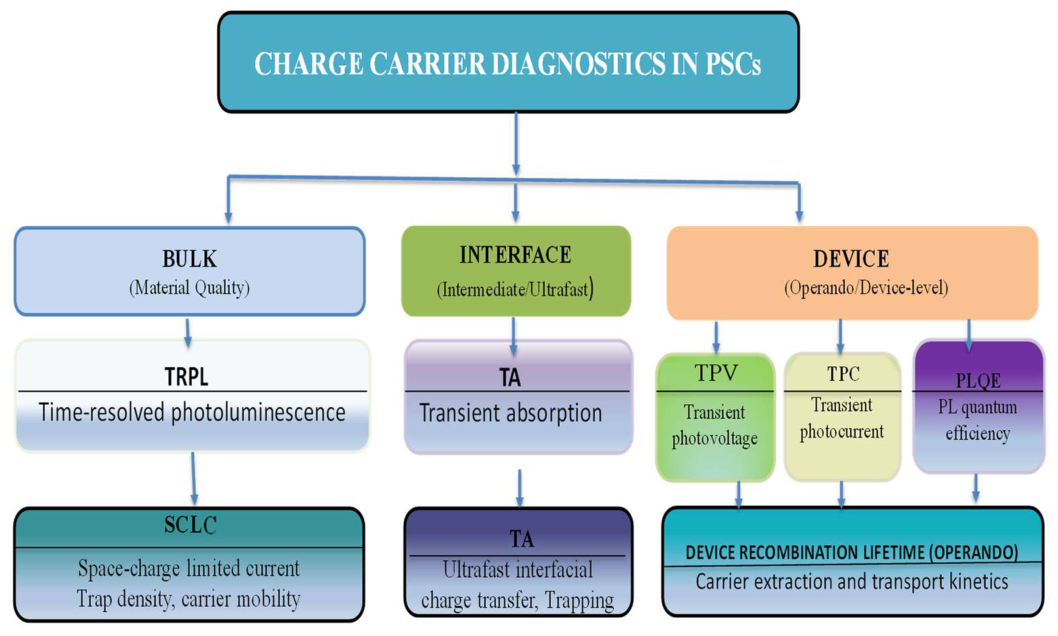
Figure 2.
Interfacial band alignment and defect passivation mechanisms in PSCs: (a) device architectures and corresponding energy diagrams. Redrawn from Ref. [60]; (b-c) density-of-states analysis showing trap suppression after passivation. Adapted with permission from Ref. [60]. Copyright © 2022 Wiley; (d) band-edge shifts induced by interfacial modifiers leading to Voc improvement. Adapted from Ref. [61] under the terms of the Creative Commons Attribution (CC BY) License.
Figure 2.
Interfacial band alignment and defect passivation mechanisms in PSCs: (a) device architectures and corresponding energy diagrams. Redrawn from Ref. [60]; (b-c) density-of-states analysis showing trap suppression after passivation. Adapted with permission from Ref. [60]. Copyright © 2022 Wiley; (d) band-edge shifts induced by interfacial modifiers leading to Voc improvement. Adapted from Ref. [61] under the terms of the Creative Commons Attribution (CC BY) License.
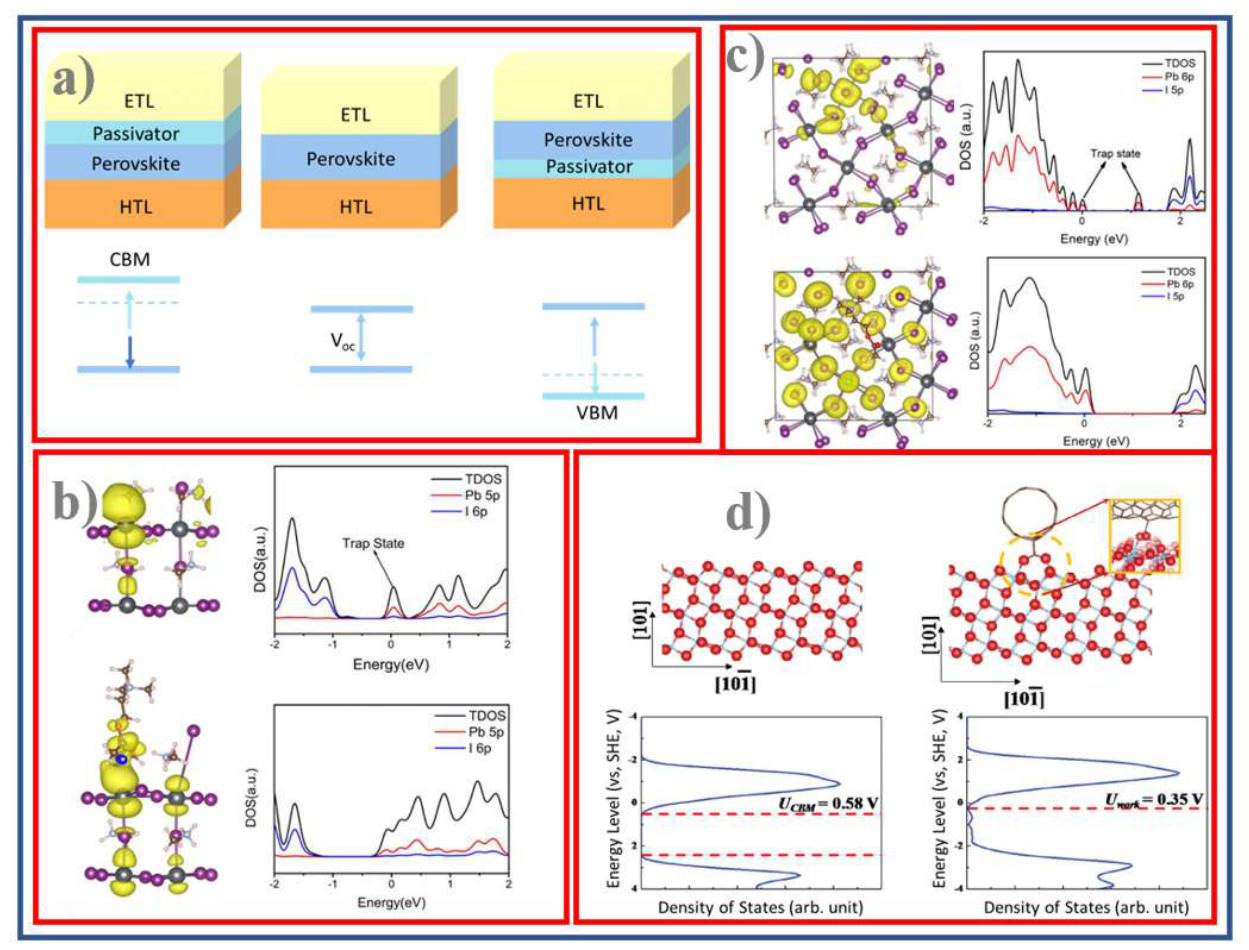
Figure 3.
Influence of ETL morphology and interfacial structure on charge-carrier transport and device behavior in PSCs. Surface SEM images illustrate representative electron-selective morphologies with (a) relatively non-uniform and (b) compact structures. (c) Cross-sectional SEM image demonstrating structural continuity and buried-interface formation across the device architecture. (d) Photovoltaic response showing morphology-dependent device behavior and (e) evolution of normalized photovoltaic parameters during operation, illustrating the influence of ETL properties on stability. Adapted from Ref. [62] under the terms of the Creative Commons Attribution (CC BY) License.
Figure 3.
Influence of ETL morphology and interfacial structure on charge-carrier transport and device behavior in PSCs. Surface SEM images illustrate representative electron-selective morphologies with (a) relatively non-uniform and (b) compact structures. (c) Cross-sectional SEM image demonstrating structural continuity and buried-interface formation across the device architecture. (d) Photovoltaic response showing morphology-dependent device behavior and (e) evolution of normalized photovoltaic parameters during operation, illustrating the influence of ETL properties on stability. Adapted from Ref. [62] under the terms of the Creative Commons Attribution (CC BY) License.
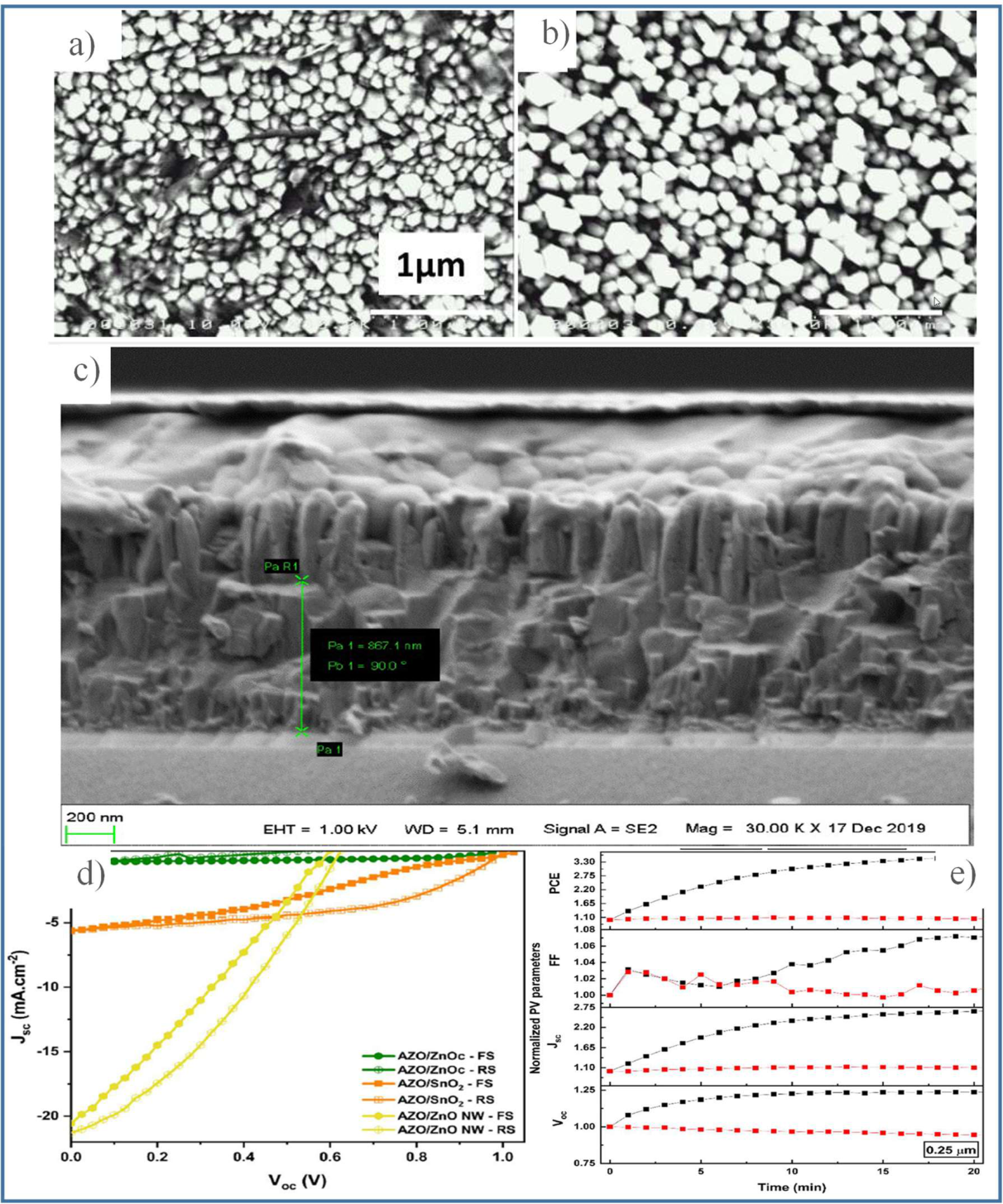
Figure 4.
Representative buried-interface engineering strategies in inverted p-i-n PSCs: (a) PEDOT:PSS/2PACz buried contact. Reproduced with permission [72]. Copyright © 2022, Elsevier; (b) strain-relieved NiOx/CBSA interface. Reproduced with permission from Ref. [73]. Copyright © 2022, Wiley-VCH; (c) halogen-linkage-controlled molecular interlayers. Reproduced with permission from Ref. [74]. Copyright © 2022, Wiley-VCH; (d) mixed molecular bridges for wide-bandgap p-i-n devices. Reproduced with permission from Ref. [77]. Copyright © 2023, American Chemical Society and (e) NiOx/SAM hybrid hole-selective contact based on MeO-2PACz and MeO-4PADBC. Reproduced from Ref. [59] under the terms of the Creative Commons Attribution (CC BY) License.
Figure 4.
Representative buried-interface engineering strategies in inverted p-i-n PSCs: (a) PEDOT:PSS/2PACz buried contact. Reproduced with permission [72]. Copyright © 2022, Elsevier; (b) strain-relieved NiOx/CBSA interface. Reproduced with permission from Ref. [73]. Copyright © 2022, Wiley-VCH; (c) halogen-linkage-controlled molecular interlayers. Reproduced with permission from Ref. [74]. Copyright © 2022, Wiley-VCH; (d) mixed molecular bridges for wide-bandgap p-i-n devices. Reproduced with permission from Ref. [77]. Copyright © 2023, American Chemical Society and (e) NiOx/SAM hybrid hole-selective contact based on MeO-2PACz and MeO-4PADBC. Reproduced from Ref. [59] under the terms of the Creative Commons Attribution (CC BY) License.
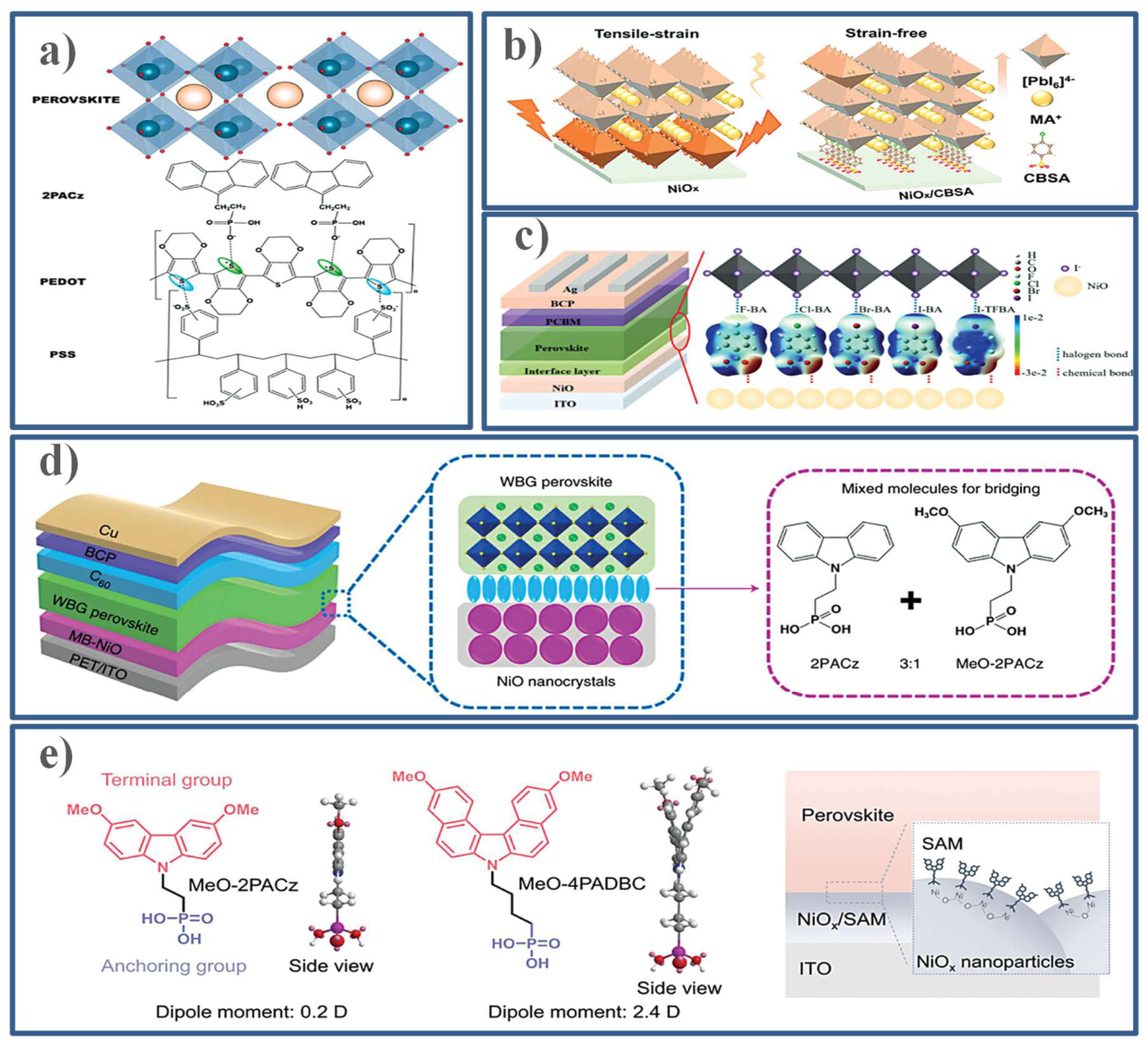
Figure 5.
Structural, morphological, and stability evolution of perovskite films with and without additive-assisted crystallization control. (a,b) XRD patterns showing phase stability over aging time for control and additive-treated films. (c) Photographs of films during storage illustrating macroscopic degradation. (d,e) Top-view SEM images revealing microstructural evolution and grain integrity. Additive incorporation suppresses impurity phases, stabilizes the perovskite lattice, and preserves compact morphology during aging. Adapted with permission from Ref. [71]. Copyright © 2024, Wiley-VCH.
Figure 5.
Structural, morphological, and stability evolution of perovskite films with and without additive-assisted crystallization control. (a,b) XRD patterns showing phase stability over aging time for control and additive-treated films. (c) Photographs of films during storage illustrating macroscopic degradation. (d,e) Top-view SEM images revealing microstructural evolution and grain integrity. Additive incorporation suppresses impurity phases, stabilizes the perovskite lattice, and preserves compact morphology during aging. Adapted with permission from Ref. [71]. Copyright © 2024, Wiley-VCH.
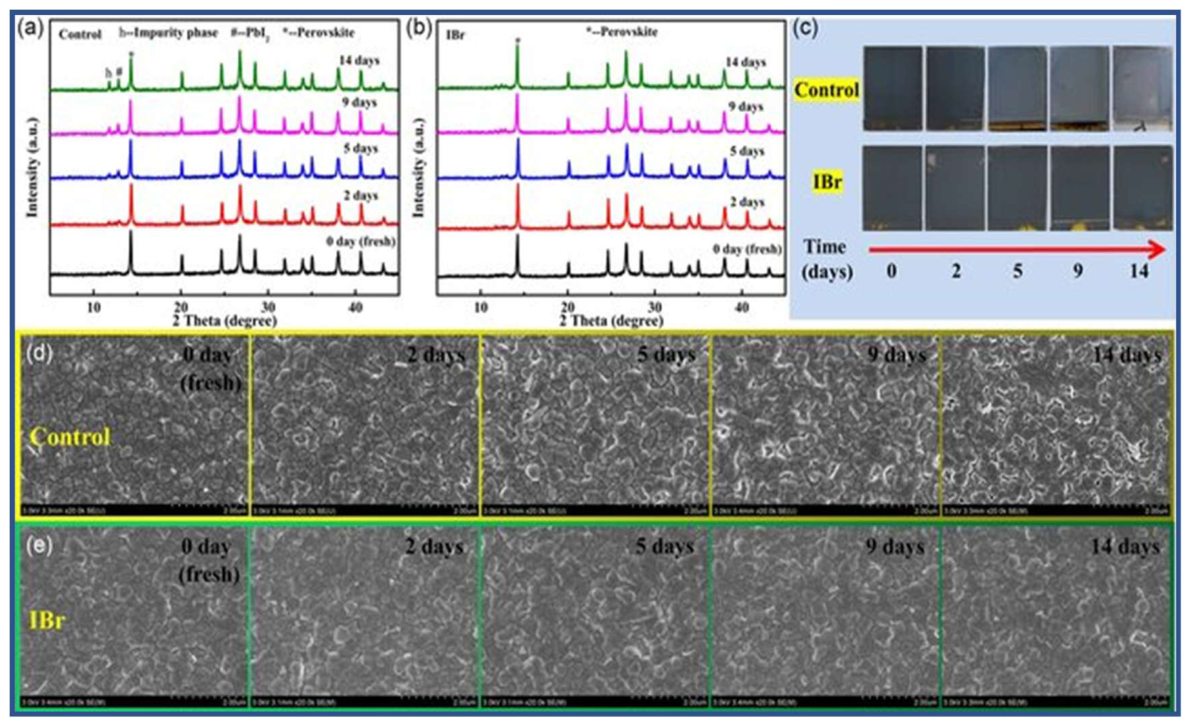
Figure 6.
Schematic illustration of major degradation pathways in perovskite solar cells, including ion migration, interfacial reactions, defect formation, and their impact on band bending, hysteresis, and non-radiative recombination.
Figure 6.
Schematic illustration of major degradation pathways in perovskite solar cells, including ion migration, interfacial reactions, defect formation, and their impact on band bending, hysteresis, and non-radiative recombination.
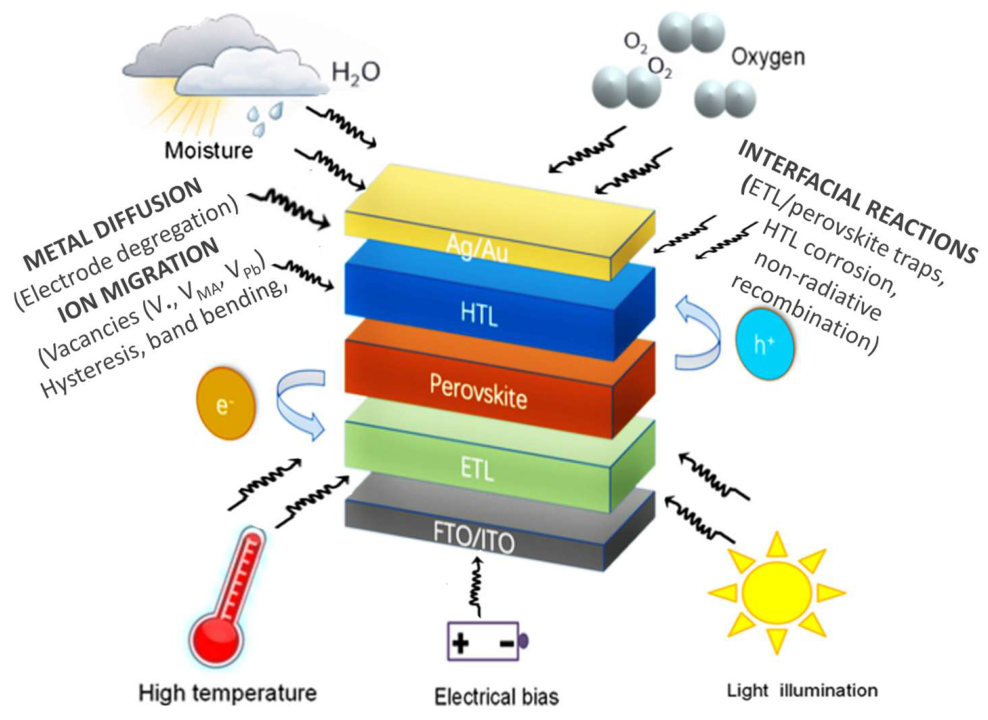
Figure 7.
Integrated framework linking charge-carrier physics to device performance and scalability in perovskite solar cells. Bulk lifetime and mobility define intrinsic transport limits, while interfacial passivation and morphology engineering suppress recombination and enable efficient extraction. These microscopic improvements translate into enhanced open-circuit voltage, fill factor, operational stability, and large-area manufacturability.
Figure 7.
Integrated framework linking charge-carrier physics to device performance and scalability in perovskite solar cells. Bulk lifetime and mobility define intrinsic transport limits, while interfacial passivation and morphology engineering suppress recombination and enable efficient extraction. These microscopic improvements translate into enhanced open-circuit voltage, fill factor, operational stability, and large-area manufacturability.
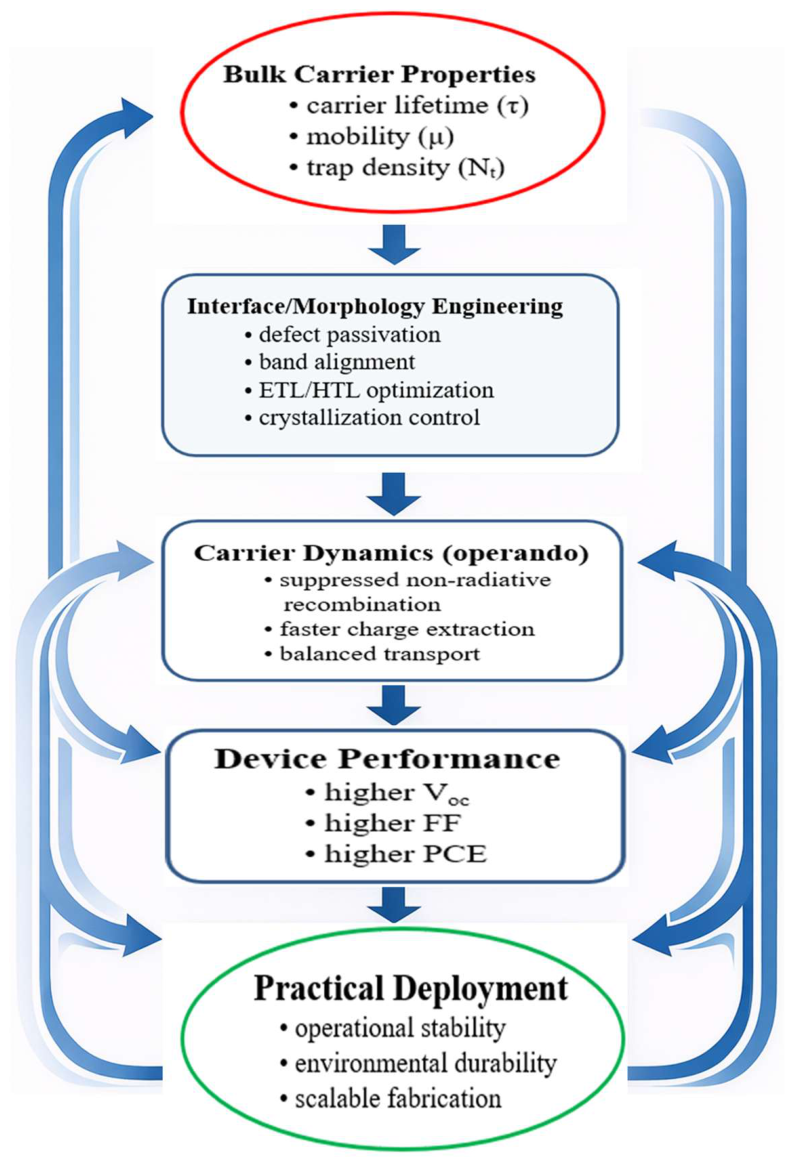

Table 1.
Reported range of charge transfer lifetimes (τ) in various CTL/PSC architectures. The reported rate constants are approximate values calculated as k = 1/τ and are provided for qualitative comparison.
Table 1.
Reported range of charge transfer lifetimes (τ) in various CTL/PSC architectures. The reported rate constants are approximate values calculated as k = 1/τ and are provided for qualitative comparison.
| Method | Architecture | Meas. Param. | Evaluation Method | τCT | Rate Constant (107 s-1) | Ref. | |||
|---|---|---|---|---|---|---|---|---|---|
| TA | Spiro-MeOTAD/ CH3NH3PbI3 |
λexc = 600 nm, 10.0 μJcm−2 |
multiexponential fitting, the short lifetime component is attributed to CT | 0.7 ns | 142.9 | 3 | |||
| λexc = 485 nm, 0.5−75 μJcm-2 |
global analysis of data, CT is determined from the fluence dependence of average lifetime | 50 ns | 2.0 | 38 | |||||
| λexc = 370 nm, 3.0 μJcm−2 |
multiexponential fitting to lower wavelength than the ground state bleach | <10 ps | >10000 | 39 | |||||
| λexc = 464 nm, unknown fluence |
triexponential fitting, the fast component is attributed to CT | 2.1 ns | 47.6 | 40 | |||||
| λexc = 485 nm, 0.5−75 μJcm−2 |
global analysis of data, CT is determined from the fluence dependence of average lifetime | 17 ns | 5.9 | 41 | |||||
| TRPL | TiO2/CH3NH3PbI3 | λexc=625 nm, 0.1 μJ cm-2 |
CT equation was used with derived τeffective (Al2O3/perovskite acted as reference without CT) | 11 ns | 9.1 | 42 | |||
| λexc = 460 nm, 2.0 μJ cm-2 |
multiexponential fitting | 0.8 ps | 125000 | 43 | |||||
| λexc = 640 nm, unknown fluence |
biexponential fitting, the fast component is attributed to CT | 9.7 ns | 10.3 | 44 | |||||
| TRPL | PCBM/MAPbI3 | λexc = 405 nm, 3 nJ cm-2 |
Bi-exponential fitting | 1.4 ns | 71.4 | 45 | |||
| Spiro-MeOTAD/FAMA perovskite | λexc = 460 nm, 0.4 W cm-2 |
global analysis of data, CT is determined from the fluence dependence of average lifetime | 100 ns | 1 | 46 | ||||
| λexc = 625 nm, <0.1 μJ cm-2 |
CT equation was used with derived τeffective (Al2O3/perovskite acted as reference without CT) | 1.8 ns | 55.6 | 42 | |||||
| TA | Compact-TiO2/CH3NH3PbI3 | λexc = 400 nm, 10 μJ cm-2 |
multiexponential fitting, the long lifetime component is attributed to CT | 370 ps | 270.3 | 47 | |||
| TRPL | Spiro-MeOTAD/ CH3NH3PbI3 |
λexc = 600 nm, 1.3 μJ cm-2 |
CT equation was used with lifetimes determined from monoexponential fitting |
0.7 ns | 142.9 | 48 | |||
| TRPL | PCBM/MAPbI3 | λexc = 600 nm, 1.3 μJ cm-2 |
Mono-exponential fitting | 0.4 ns | 250 | 48, 49 | |||
| TA | c-TiO2/MAPbI3 | λexc = 390 and 600 nm | Multiexponential fitting | 39.9 ps | 25.1 | 50 | |||
| TA | c-TiO2/mp-TiO2/MAPbI3 | n/a | Multiexponential fitting | 150 ps | 6.7 | 50 | |||
| TA | mp-TiO2/MAPbI3 | λexc = 400 nm | Multiexponential fitting | 260-307 ps | 3.3-3.8 | 51 | |||
| TRPL | TiO2/MAPbI3 | λexc = 40 nm | Bi-exponential fitting | 2.3-5.8 ns | 17.2-43.5 | 52 | |||
| TRPL | TiO2 single crystal/MAPbI3 | λexc = 60 nm, 0.63 μJ cm-2 |
Bi-exponential fitting | 0.17-20.6 ns | 4.9-588.2 | 53 | |||
| TRPL | PCBM/MAPbI3 | λexc = 635 nm, 0.06-0.13 mW cm-2 |
Bi-exponential fitting | 36 ns | 2.8 | 54 | |||
| TA | mp-TiO2/graphene QD/MAPbI3 | λexc = 400 nm | Multiexponential fitting | 90-106 ps | 9.4-11.1 | 51 | |||
| TRPL | PCBM/MAPbI3 | λexc = 464 nm | Tri-exponential fitting | 1.3 ns | 76.9 | 40 | |||
| TA | mp-TiO2/MAPbI3 | λexc = 460 and 750 nm, 2.0 μJ cm-2 | Multiexponential fitting | 0.1-0.2 ps | 5000-10000 | 43 | |||
| TA | mp-TiO2/MAPbI3 | n/a | Multiexponential fitting | 89.6 ps | 11.1 | 50 | |||
Table 2.
Complementary diagnostic techniques for charge-carrier analysis in PSCs.
| Technique | Primary Information Obtained | Main Limitation |
|---|---|---|
| TRPL | Carrier lifetime and defect-assisted recombination | Limited sensitivity to buried interfaces and device operation |
| TA spectroscopy | Ultrafast carrier dynamics and charge-transfer processes | Strong dependence on excitation conditions and fitting procedures |
| TPV | Recombination lifetime under near-operational conditions | Indirect interpretation of recombination pathways |
| TPC | Carrier extraction and transport dynamics | Sensitive to illumination intensity and contact effects |
| SCLC | Trap density and carrier mobility | Primarily probes bulk transport rather than interfaces |
| PLQE | Radiative efficiency and achievable VOC | Difficult to separate bulk and interface contributions |
| KPFM | Surface potential and local electric-field distribution | Local measurement with limited temporal resolution |
| Operando spectroscopy | Dynamic interface evolution under realistic conditions | High experimental complexity |
Table 3.
Representative recent strategies for buried-interface charge-carrier management in PSCs.
| Strategy/Material | Architecture | Main Carrier-Management Mechanism | Quantitative Performance | Stability Evidence | Ref. |
|---|---|---|---|---|---|
| NiOx/MeO-4PADBC hybrid buried interface | p-i-n | Dipole regulation, defect passivation, enhanced hole extraction | Certified PCE = 25.6%; VOC = 1.19 V; JSC = 25.4 mA cm-2; FF = 84.6% | >90% retention after 1200 h at 65 °C | 2 |
| Fully chemical interface engineering | PSC | Chemically bonded interfacial layer suppressing modifier detachment | PCE = 25.52%; certified PCE = 25.49% | T80 = 27,000 h (dark shelf); T80 = 19,000 h (85 °C); T80 = 2600 h (light-dark cycling) | 78 |
| Triphenylamine-based SMA-76 SAM | p-i-n | Larger dipole moment, reduced trap density, enhanced hole transport | PCE = 22.4%; VOC = 1.150 V; FF = 82% | T80 = 144 h at 65 °C; retained 21.7% PCE after 14 months storage | 69 |
Table 4.
Summary of representative interface and morphology engineering strategies, their dominant physical mechanisms, and resulting effects on charge-carrier dynamics and device performance in PSCs.
Table 4.
Summary of representative interface and morphology engineering strategies, their dominant physical mechanisms, and resulting effects on charge-carrier dynamics and device performance in PSCs.
| Strategy | Main Mechanism | Carrier Lifetime (τ) | ΔVoc, mV | ΔFF, % | ΔPCE, % | Ref. |
|---|---|---|---|---|---|---|
| Compact SnO2 ETL (CBD, pH ≈ 1.5) |
reduced interfacial trap density; improved contact uniformity | ↑ up to 984 ns | +90 | +5 | +3-5 | 63 |
| Defective SnO2 ETL | high trap density; poor contact; enhanced SRH recombination | ↓ down to 81 ns | −120 | −6 | −4-5 | |
| 0.8 mol% MAPbBr3 additive | enlarged grains; fewer grain boundaries; suppressed bulk/interface traps | ↑ up to 3.6 μs | +30 | +2 | +2-3 | |
| C60 SAM interlayer | band alignment tuning; surface passivation | - | +75 | +4 | - | 64 |
| PEAI buffer layer | surface defect passivation; reduced recombination velocity | - | +100 | +4-5 | +2-4 | 65 |
| 3D/2D bilayer structure | surface stabilization; suppressed ion migration; interfacial passivation | ↑ up to 1.5 μs | +50 | +3 | +2-3 | 72, 73 |
| Carbazole-based SAM buried HTL |
buried-interface passivation; improved wetting; enhanced hole extraction | ↑ | +70-110 | +3-5 | +2-4 | 64 |
| Hybrid NiOx/ SAM contact |
reduced interfacial recombination; improved energetic alignment; stabilized buried interface | ↑ | +60-100 | +2-4 | +2-3 | 64,70 |
Disclaimer/Publisher’s Note: The statements, opinions and data contained in all publications are solely those of the individual author(s) and contributor(s) and not of MDPI and/or the editor(s). MDPI and/or the editor(s) disclaim responsibility for any injury to people or property resulting from any ideas, methods, instructions or products referred to in the content. |
© 2026 by the authors. Licensee MDPI, Basel, Switzerland. This article is an open access article distributed under the terms and conditions of the Creative Commons Attribution (CC BY) license (http://creativecommons.org/licenses/by/4.0/).
Copyright: This open access article is published under a Creative Commons CC BY 4.0 license, which permit the free download, distribution, and reuse, provided that the author and preprint are cited in any reuse.


