
Submitted:
26 May 2026
Posted:
26 May 2026
You are already at the latest version
Abstract
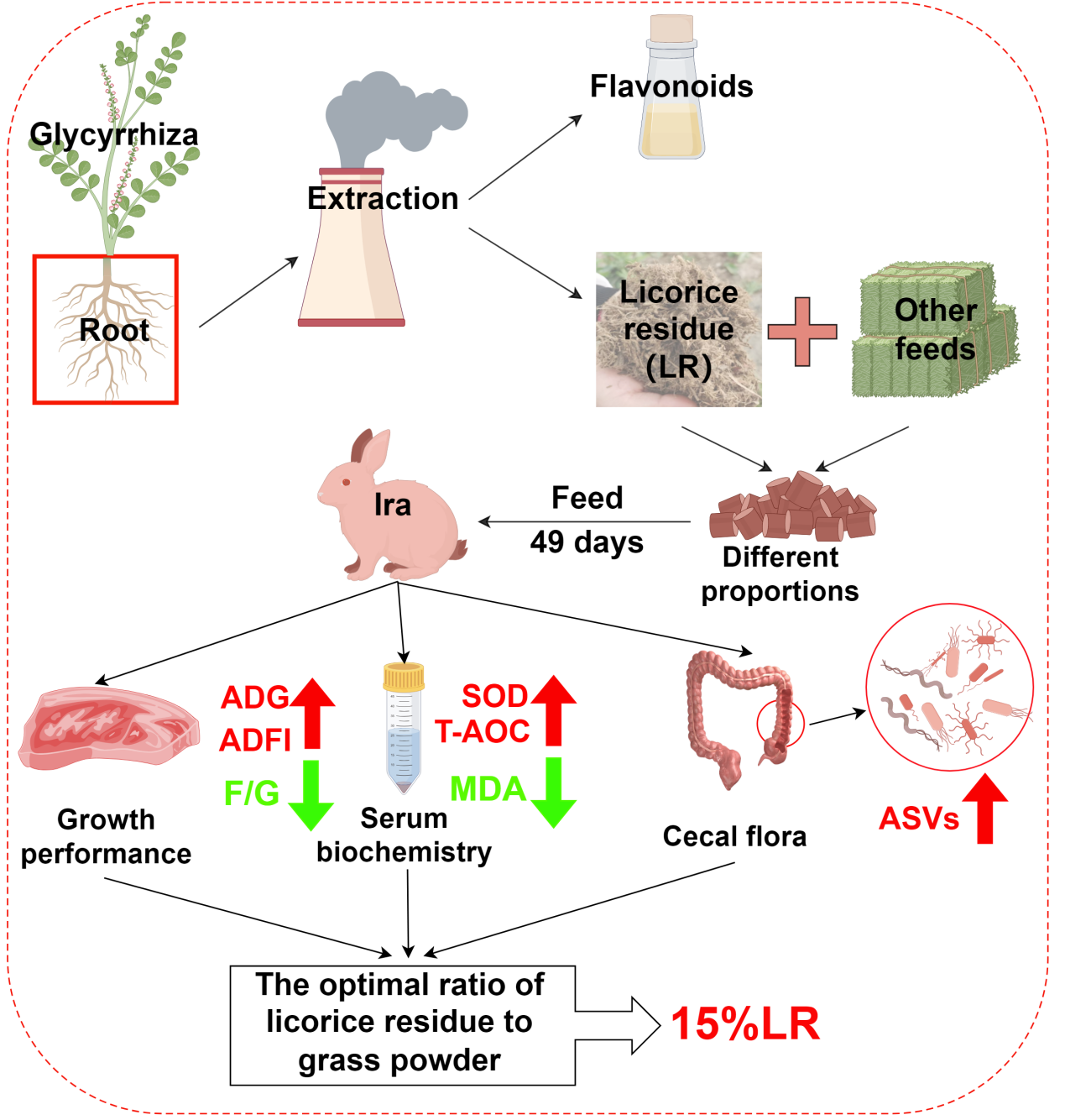
This research aimed to determine the effects of replacing ryegrass (Lolium perenne L.) with licorice residue (LR) on growth performance, slaughtering performance, meat quality, serum biochemistry and cecal flora. Five pelleted rations were formulated with different LR proportions at 0%, 15%, 30%, 45%, and 60% on a dry weight basis. One hundred and twenty 35-day old Ira rabbits with nearly uniform body weight were randomly allocated into five treatment groups, each with 24 rabbits for this experiment. The adaptation (pre-feeding) phase spanned 7 days, followed by a 49-day experimental period. The results indicated that the group receiving 15% LR achieved the highest body weight by day 49 (p < 0.05). Over the 0-49 day interval, the average daily gain (ADG) for the 15% LR group was notably greater compared to the 0%, 45%, and 60% LR groups (p < 0.05), while its feed-to-gain ratio (F/G) was significantly lower than that of the 45% and 60% groups (p < 0.05). Additionally, the pre-slaughter live weight of the 15% LR group was substantially higher than all other groups (p < 0.05).The 15% LR group had a significantly lower drip loss than the 45% and 60% LR groups and a significantly higher pH value (24 h) than the 30%, 45%, and 60% LR groups (p < 0.05). The glutathione peroxidase (GSH-Px) in the 15% LR group was significantly lower than that in the 30% and 45% LR groups (p < 0.05). The superoxide dismutase (SOD) activity in the experimental groups was significantly higher than that in the control group (p < 0.05). The LR did not significantly affect the dominant microbial communities at the phylum and genus levels (p > 0.05), but it promoted the colonization of specific flora. It appears that replacing 15% of ryegrass with LR in pelleted feed was the optimal rate in making the pellet diets for rabbits to achieve a superior production performance, high-quality meat products in Ira rabbits. However, further research is needed to investigate the effect of feeding LR on growth performance, carcass traits and meat quality of other herbivorous livestock.
Keywords:
licorice residue
; reygrass
; meat rabbit
; growth performance
; meat quality
Copyright: This open access article is published under a Creative Commons CC BY 4.0 license, which permit the free download, distribution, and reuse, provided that the author and preprint are cited in any reuse.


