

Submitted:
25 May 2026
Posted:
26 May 2026
You are already at the latest version
Abstract
Background: Despite decline in lung cancer in the U.S., lung cancer among never-smoking Asian American (AsA) women is rising, and subgroup aggregation obscures heterogeneity. We compared primary lung cancer prevalence across disaggregated AsA subgroups and examined associations with risk factors such as personal- and family-cancer histories versus non-Hispanic Whites (NHW). Methods: This cross-sectional study analyzed electronic health records of AsA women (≥18) in a large Northern California health system (2010–2022). Lung cancer cases were obtained from the hospital registry and categorized by smoking status and self-reported ethnicity. Adjusted prevalence ratios (aPRs) were estimated using targeted maximum likelihood estimation, accounting for sociodemographic, smoking, and clinical covariates. Results: Among 1,843,119 AsA women, 8,651 had primary lung cancer; 2,429 were never-smokers. In never-smokers, aPRs and 95% confidence intervals versus age-matched NHW were: Chinese (3.36, [3.20–3.53]), Filipino (2.68, [2.55–2.82]), Vietnamese (2.07, [1.96–2.18]), Japanese (1.99, [1.89–2.10]), Korean (1.90, [1.80–2.00]); Other Asian (0.35, [0.33–0.37]). Personal cancer-history reflected an increase in prevalence among Korean patients (2.91, [2.76–3.06]) while family cancer-history demonstrated increased prevalence among Chinese patients (1.51, [1.42–1.60]). Among women with uterine cancer, Chinese patients had higher lung-cancer prevalence than NHW (1.91, [1.58–2.31]). Conclusions: Never-smoking disaggregated AsA women show heterogeneous lung cancer prevalence, with higher prevalence in Korean women with personal cancer-history and in Chinese women with family cancer-history compared with NHW, supporting history-informed and ethnic-specific lung cancer screenings.
Keywords:
lung cancer
; never-smokers
; Asian American
; health disparities
; history of cancer
1. Introduction
Lung cancer remains the leading cause of cancer mortality among women in the United States across several AsA ethnic groups [1]. While smoking is a known risk-factor to lung cancer, a significant proportion of primary lung cancer occurred in never-smokers, with a California-based study reporting 15% of primary lung cancer cases were in this population [2]. Notably, if never-smoking lung cancer was considered an independent category, it would rank among the top 10 causes of cancer death in the nation [3]. Additionally, as smoking rates continue to decrease, a study predicted that never-smoking lung cancer rates may eventually be more common than ever-smoking lung cancer cases [4].
Multiple studies have reported that females appear disproportionately affected by never-smoking lung cancer, with an analysis reporting roughly twice the diagnosis rate observed in men [2]. Moreover, a California population-based study found incidence about twofold higher in Asian and Pacific Islander populations than in non-Hispanic White (NHW), Black, or Hispanic populations, with a steeper temporal increase in the former group [5]. Despite this burden, U.S. screening guidelines rely on smoking-related metrics (pack-years and years since quitting), leaving most never-smokers ineligible [6] and resulting in more than 75% of lung cancers in AsAs going undetected under current United States Preventive Services Task Force criteria [7].
Most existing lung cancer screening tools were developed in cohorts of heavy smokers and therefore do not capture exposures that matter for never-smokers, including second-hand smoke, cooking-oil fumes, radon, and tuberculosis [8,9,10]. In addition, a growing body of work implicates family history of lung cancer as a determinant of risk. For instance, the TALENT study found an elevated risk of lung cancer for participants who have a family history of lung cancer, a risk that increases with the number of affected first-degree relatives, especially for mothers and siblings with lung cancer [11]. Consistent with these observations, a study reported that Asian and Pacific Islander women with lung cancer were three times more likely than never-smoking controls to have a documented family history of the disease [12]. Additionally, prior breast, head and neck cancer along with prior therapeutic radiation, chronic lung disease, and EGFR mutation–positive tumors have been associated with risk in never-smokers; the diversity of exposures and pathways suggests a complex etiology that remains difficult to resolve [13,14,15,16,17].
Given the heterogeneity of the Asian population, a Northern California study found that in a disaggregated AsA cohort, there was a higher incidence of primary lung cancer in all AsA ethnicities with the exception of those of Japanese descent [17]. However, these associations have not been systematically evaluated across disaggregated Asian subgroups with a family or personal history of cancer. We hypothesize that AsA with a personal or family history of cancer face a greater risk of primary lung cancer compared to their NHW counterparts, an association that varies across AsA subgroups.
2. Methods
2.1. Data Source
Kaiser Permanente Northern California (KPNC) is a large, integrated healthcare system that serves more than 4.5 million members in Northern and Central California. KPNC members receive the vast majority of their care at KPNC facilities, including cancer screening, diagnosis, and treatment. Since KPNC is both a payer and provider of healthcare services, its electronic health record has optimal and accurate capture of events that occur within the healthcare system. Data elements such as encounters across patient care settings, hospitalizations, emergency department visits, outpatient and ambulatory care encounters, laboratory values, medication administration, and other salient health record information are included in the KPNC database. The SEER compliant cancer registry records cancer cases and collects sociodemographic and clinical characteristics such as tumor size and survival data [18]. This study was approved by the Kaiser Permanente Northern California Institutional Review Board (IRB) with a waiver of written informed consent. The IRB number is 2182779-4 and was approved on February 24, 2025.
2.2. Study Population
The primary purpose of this study was to estimate the adjusted prevalence ratio (aPR) of new primary lung cancer cases among AsA women relative to NHW women. To accomplish this, we performed a retrospective cross-sectional study using data from KPNC region electronic health records between January 1, 2010, and December 31, 2022. We included all adult women (age 18+) who identified as AsA or NHW without a personal history of lung cancer and with at least nine months of KPNC membership during the study period. An individual’s first date of eligibility was January 1st of the study year in which they met the above requirements. Kaiser Permanente maintains a SEER compliant cancer registry that was used to identify cases of outcome lung cancer for this study.
2.3. Exposure
Specific Asian ethnicity (Chinese, Japanese, etc.) was obtained from self-reported data in patient charts. The specific AsA ethnicities that had a sufficient sample size to study were Chinese, Japanese, Filipino, Korean, and Vietnamese. All other AsA ethnicities including Asian Pacific Islanders, Hmong, Afghan, Burmese, Cambodian, Fijian, Nepalese, Pakistani, South East Asian, South Asian, Indonesian, Laotian, East Asian, Thai, Taiwanese, and those of multiple Asian ethnicities were grouped into “Other Asian”.
2.4. Outcome
We ascertained a personal history of the following specific gynecological cancers common in women: cervical cancer, uterine cancer, breast cancer, ovarian cancer using a combination of International Classification of Disease (ICD) version 9 and 10 codes and the KPNC cancer registry. Given the association of a family history of lung cancer increasing one’s risk of developing primary lung cancer as found in the TALENT study, a family history of lung cancer and breast cancer were also assessed using ICD-9 and ICD-10 codes [11]. A personal history of any type of cancer was assessed using a combination of ICD-9 and ICD-10 codes as well as having an entry for any cancer in the KPNC cancer registry. Having a family history of any cancer was assessed using ICD-9 and ICD-10 codes. A list of all ICD-9 and ICD-10 codes used in this study can be seen in Appendix A.
2.5. Covariates
We additionally ascertained the following covariates: age in years at first date of eligibility for the study, race/ethnicity, smoking history, Charlson comorbidity index score category (Unknown, No visits in the past year, 0, 1, 2+), body mass index (BMI) category, and a history of Type II Diabetes (Yes/No). Information on smoking history was obtained from a questionnaire that is routinely administered during healthcare visits at KPNC. All data for covariates was obtained from the KPNC electronic health record. A personal/family history of cancer was assessed prior to the date of lung cancer diagnosis among people with the outcome or at any time during the study period for people without the outcome. All other variables were ascertained as close to the individual’s date of first eligibility as possible.
2.6. Statistical Analysis
To estimate the aPR of new lung cancer among AsA women relative to NHW women, we utilized the Targeted Maximum Likelihood Estimation (TMLE). TMLE is a highly flexible framework that produces doubly-robust and statistically efficient estimates for a given target parameter [19]. Our target parameter of interest for this study was the covariate-adjusted prevalence ratio described above [19]. A major benefit of TMLE is its internal utilization of the SuperLearner algorithm which creates a weighted, cross-validated ensemble of specified candidate “learner” algorithms that minimizes the variance of the model output [20]. The candidate learner library we considered was generalized linear regression models, LASSO regression, extreme gradient boosted decision trees (“xgboost”), and a negative control learner that assigns everyone the same mean predicted value.
All TMLE models were adjusted for age, race/ethnicity, Charlson comorbidity index score category, body mass index category, and history of Type II diabetes. All models were stratified by specific AsA ethnicity. Models were additionally stratified by smoking history (non-smokers, current smokers, and former smokers), personal history of breast cancer, uterine cancer, cervical cancer, and ovarian cancer, family history of breast cancer and lung cancer, and a personal or family history of any cancer. In models that were stratified by a personal/family history of a specific cancer (i.e., breast cancer), we additionally adjusted for a personal/family history of the specific types of cancer we considered in this study. The reference and control level for all models were age-controlled NHW women.
We utilized the Bonferroni correction to control the family-wise error rate for multiple comparisons by setting the p-value threshold for statistical significance at 0.05 divided by the number of comparisons conducted. Data extraction was performed using SAS Version 9.4 (SAS Institute, Cary, NC) and the analysis was done using the R programming language version 4.3.1 with the tidyverse and tmle3 packages.
3. Results
3.1. Cohort Assembly and Baseline Characteristics
From 2010 to 2022, 1,843,119 AsA women met the inclusion criteria for this study. Linkage to the institutional cancer registry identified 8,651 women with primary lung cancer; 2,429 were never-smokers. The analytic cohort was stratified by smoking status and self-reported AsA ethnicity (Chinese, Japanese, Filipino, Korean, Vietnamese, Other Asian), with NHW women as the reference group. Distributions of age, body mass index, Charlson Comorbidity Index, type II diabetes, and smoking status for the full cohort and for women with prevalent lung cancer along with ethnic subgroup counts and the proportion of never/former/current smokers are provided in Table 1, with crude prevalence by ethnicity shown in Figure 1, and unadjusted counts and prevalence by personal and family cancer history are summarized in Table 2.
3.2. Ethnicity-Specific Prevalence in Never-Smokers
Among never-smokers, there was substantial heterogeneity in aPRs relative to age-matched NHW women serving as our reference. The aPR was highest in Chinese women (3.36, 95% CI 3.20–3.53), followed by Filipino (2.68, 95% CI 2.55–2.82), Vietnamese (2.07, 95% CI 1.96–2.18), Japanese (1.99, 95% CI 1.89–2.10), and Korean (1.90, 95% CI 1.80–2.00). In contrast, women classified as Other Asian had a lower adjusted prevalence (0.35, 95% CI 0.33–0.37). These estimates are displayed in a forest plot in Figure 2 and detailed in Table 3.
3.3. Personal History of Cancer
When stratifying by personal history of any cancer, Korean women demonstrated a markedly higher adjusted prevalence of lung cancer compared with their NHW counterparts (aPR 2.91, 95% CI 2.76–3.06), as shown in Table 4. In analyses focused on specific prior cancers, a personal history of uterine cancer was associated with a higher prevalence among Chinese women (aPR 1.91, 95% CI 1.58–2.31), while analogous elevations were not observed with consistency across other ethnic subgroups. Full estimates across personal history strata are reported in Table 5.
3.4. Family History of Cancer
A family history of any cancer was associated with higher adjusted prevalence among Chinese women (aPR 1.51, 95% CI 1.42–1.60). Patterns for other ethnicities were less uniform and are presented in Table 6.
4. Discussion
This is the first study to examine the effect of personal and family history of cancer on primary lung cancer prevalence among disaggregated AsA subgroups. Consistent with the findings in De Rouen et al. 2022 and Banks et al. 2022, our results demonstrated that non-smoking female AsA subgroups are more susceptible to developing primary lung cancer compared to their NHW counterparts [2,17]. Additionally, out of the total lung cancer cases stratified by ethnicity, there is a greater proportion of never-smokers in AsA populations, with the lowest seen in NHW and other Asians. This finding could be explained by Banks et al. 2022 which found that AsAs were less likely to smoke compared to their NHW counterparts [2]. However, unlike other studies, our disaggregated prevalence ratios revealed that Chinese women display the greatest susceptibility compared to their AsA counterparts. In this context, our results underscore the need to reevaluate lung cancer screening guidelines to recognize ethnic-specific risk in never-smoking populations, particularly within heterogeneous AsA groups.
Evaluating the effect of a personal or family history of a previous type of cancer to explain this elevated risk in AsAs revealed that having a personal history of any type of cancer was associated with a greater prevalence ratio of primary lung cancer in Koreans compared to their NHW counterparts. However, Chinese, Filipino, Vietnamese, and Other Asians had a lower prevalence ratio, indicating that while having a personal history of any type of cancer increases risk in Korean women, this does not explain the greater prevalence observed in other AsA ethnicities; suggesting that each ethnicity demonstrates an increased risk attributable to various reasons. Similar to Nofal et al. 2024 who analyzed the effect of personal histories of cancer on one’s development of primary lung cancer, we disaggregated by type of cancer to analyze if certain cancers explain the increased risk in AsA [14]. Focusing on uterine cancer for its statistical and clinical significance and sufficient sample size, we found that a prior uterine cancer was associated with greater prevalence of primary lung cancer in Chinese women compared to their NHW counterparts, indicating that uterine cancer increases Chinese women’s risk of developing primary lung cancer, but does not apply for other ethnicities. While Wang et al. 2021 uncovered a personal history of breast cancer to be a contributing factor to primary lung cancer development, we were unable to determine this association in our study cohort due to limited sample size [13]. Similar to the analysis for Korean women, we were unable to determine what types of cancers explain the greater prevalence of primary lung cancer but our results suggest Koreans and Chinese with a personal history of cancer and a personal history of uterine cancer, respectively, are high-risk individuals. Similar to Nofal et al. 2024, we suggest that personal history of cancer be recognized as an eligibility criterion for primary lung cancer screening [14]. Given The National Lung Screen Trial’s with low-dose computed tomography (CT) success in not only identifying but preventing lung cancer-associated deaths in high risk populations, personal family history coupled with ethnic-based history should be added as a formal risk-factor [21].
We further analyzed the effect of a family history of cancer to explain the high prevalence of primary lung cancer in AsAs. We found that Chinese females with a family history of any type of cancer had a substantiated risk of developing primary lung cancer compared to their NHW and AsA counterparts, suggesting differentiated risk. Given how the TALENT trial found that a family history of lung cancer was associated with an increased risk of developing primary lung cancer, we further stratified by type of family history of cancer [11]. Our sample size limited our ability to stratify by specific cancer types; thus, we could not determine if the observed elevated risk in Chinese women with a family history of cancer was driven by specific cancers. Larger, multi-site studies will be necessary to disentangle these relationships.
5. Limitations
We acknowledge three limitations. First, although our study population is drawn from Northern California, a region with one of the most diverse Asian populations globally, the findings may not be generalizable nationwide. Nevertheless, the KPNC lung cancer database has been recognized as one of the most representative in the U.S. in a study by Yang et al., 2024, supporting the relevance of our cohort to broader national trends in lung cancer epidemiology [22]. Subsequently, due to the retrospective nature of our analysis, there is an inherent risk of missing or incomplete clinical data which may obscure our findings.
Second, while we examined the association of personal and family history of cancer with lung cancer prevalence, environmental exposures such as second-hand smoke, radiation, and cooking fumes are correlated with elevated risk and are difficult to quantify. To address this, we applied TMLE to estimate aPRs that accounted for confounding, providing a clearer risk assessment.
Last, the limited sample size required aggregation of several AsA ethnicities into a single cohort, underscoring the need for future studies focused on the diversity of minority AsA populations. Additionally, specific types of family cancer histories could not be analyzed separately, preventing us from determining whether specific cancer types drive the elevated risk observed in certain AsA subgroups. Larger cohorts are needed to clarify these relationships.
6. Conclusion
Our study is the first to evaluate how personal and family history of cancer influence primary lung cancer prevalence in disaggregated AsA women. Across never-smoking women in an integrated U.S. system, AsA subgroups showed higher prevalence than NHW women, with the highest burden in Chinese women. Personal history of any cancer identified Korean women at elevated prevalence, while family history identified Chinese women. The association with uterine cancer history in Chinese women highlights etiologic heterogeneity. These findings support history-informed screening that integrates ethnic and sociodemographic risk to improve early detection and guide targeted prevention.
Supplementary Materials
The following supporting information can be downloaded the website of this paper posted on Preprints.org, Figure S1: title; Table S1: title; Video S1: title.
Author Contributions
Bani Kaur and Avinav Biswas were involved with writing the manuscript, analyzing the data, drafting the figures, revising the manuscript, and submitting it. Tyler Chervo performed the data collection and data analysis and wrote the “Methods” section of the manuscript. Woo Jin Ahn and Shangzi Gao were involved with the literature search, editing the manuscript, and interpreting the data. Carissa Villanueva was involved with the study design and data collection. Dang Nguyen was involved with the literature search, data interpretation, and project management. Seth Tivakaran, Malathi Srinivasan, Nicholas Panyanouvong, Lester Andrew V. Uy, Nitya Rajeshuni, Robert J. Huang, Neil Kamdar, Osamu Yasui, Gloria S. Kim, and Latha Palaniappan were involved with the study design, manuscript editing, and project management. Jeffrey Velotta was involved in all parts of the study and manuscript writing, including project management. .
Funding
This research received no external funding.
Institutional Review Board Statement
This study was approved by the Kaiser Permanente Northern California Institutional Review Board (IRB) with a waiver of written informed consent. The IRB number is 2182779-4 and was approved on February 24, 2025.
Informed Consent Statement
This study is retrospective, and all data were fully anonymized and de-identified prior to analysis. In accordance with institutional and ethical guidelines, individual patient consent was not required for this type of study. Therefore, a patient consent form is not applicable in this case.
Data Availability Statement
The data obtained for this study was obtained from the Kaiser Permanente Northern California Healthcare system and the SEER cancer registry.
Acknowledgments
In this section, you can acknowledge any support given which is not covered by the author contribution or funding sections. This may include administrative and technical support, or donations in kind (e.g., materials used for experiments).
Conflicts of Interest
The authors declare no conflict of interest.
References
- Gomez, S.L.; DeRouen, M.; Chen, Jr; et al. Elevated risk of lung cancer among Asian American women who have never smoked: an emerging cancer disparity. J. Natl. Cancer Inst. 2025, 117(6), 1104–1109. [Google Scholar] [CrossRef]
- Banks, K.C.; Sumner, E.T.; Alabaster, A.; Hsu, D.S.; Quesenberry, C.P., Jr.; Sakoda, L.C.; Velotta, J.B. Sociodemographic and clinical characteristics associated with never-smoking status in patients with lung cancer: findings from a large integrated health system. Transl. Cancer Res. 2022, 11, 3522–3534. [Google Scholar] [CrossRef] [PubMed]
- Lariscy, J.T.; Hummer, R.A.; Rogers, R.G. Lung cancer mortality among never-smokers in the United States: estimating smoking-attributable mortality with nationally representative data. Ann. Epidemiol. 2020, 45, 5–11. [Google Scholar] [CrossRef]
- LoPiccolo, J.; Gusev, A.; Christiani, D.C.; Jänne, P.A. Lung cancer in patients who have never smoked: an emerging disease. Nat. Rev. Clin. Oncol. 2024, 21, 121–146. [Google Scholar] [CrossRef]
- Sakoda, L.C.; Alabaster, A.; Sumner, E.T.; Gordon, N.P.; Quesenberry, C.P.; Velotta, J.B. Trends in smoking-specific lung cancer incidence rates within a US integrated health system, 2007-2018. Chest 2023, 164, 785–795. [Google Scholar] [CrossRef]
- Sakoda, L.C.; Bibbins-Domingo, K.; Gilliland, F.D.; et al. Patterns and factors associated with adherence to lung cancer screening in diverse practice settings. JAMA Netw. Open 2021, 4(4), e218559. [Google Scholar] [CrossRef]
- Kamtam, D.N.; Shrager, J.B. We should be considering lung cancer screening for never-smoking Asian American females. J. Thorac. Cardiovasc Surg. 2024, 168, 272–277.e1. [Google Scholar] [CrossRef]
- Possenti, I.; Romelli, M.; Carreras, G.; et al. Association between second-hand smoke exposure and lung cancer risk in never-smokers: a systematic review and meta-analysis. Eur. Respir. Rev. 2024, 33, 240077. [Google Scholar] [CrossRef]
- Xue, Y.; Jiang, Y.; Jin, S.; Li, Y. Association between cooking oil fume exposure and lung cancer among Chinese nonsmoking women: a meta-analysis. Onco Targets Ther. 2016, 9, 2987–2996. [Google Scholar] [CrossRef] [PubMed]
- Hong, S.; Kim, J.; Park, K.; Park, B.; Choi, B.Y. Risk of lung cancer and risk factors of lung cancer in people infected with tuberculosis. J. Cancer Prev. 2024, 29, 157–164. [Google Scholar] [CrossRef] [PubMed]
- Chang, G.-C.; Chiu, C.-H.; Yu, C.-J.; et al.; TALENT Investigators Low-dose CT screening among never-smokers with or without a family history of lung cancer in Taiwan: a prospective cohort study. Lancet Respir. Med. 2024, 12(2), 141–152. [Google Scholar] [CrossRef]
- Velotta, J.B.; Sarovar, V.; Sakoda, L. Higher prevalence of family history of lung cancer in Asian American Pacific Islander (AAPI) females with vs without lung cancer. Chest 2024, 166, A4414. [Google Scholar] [CrossRef]
- Wang, Y.; Li, J.; Chang, S.; Dong, Y.; Che, G. Risk and influencing factors for subsequent primary lung cancer after treatment of breast cancer: a systematic review and two meta-analyses based on four million cases. J. Thorac. Oncol. 2021, 16, 1893–1908. [Google Scholar] [CrossRef]
- Nofal, S.; Niu, J.; Resong, P.; et al. Personal history of cancer as a risk factor for second primary lung cancer: implications for lung cancer screening. Cancer Med. 2024, 13, e7069. [Google Scholar] [CrossRef]
- Pinheiro, P.S.; Callahan, K.E.; Medina, H.N.; Koru-Sengul, T.; Kobetz, E.N.; Gomez, S.L.; De Lima Lopes, G. Lung cancer in never smokers: distinct population-based patterns by age, sex, and race/ethnicity. Lung Cancer 2022, 174, 50–56. [Google Scholar] [CrossRef] [PubMed]
- Corrales, L.; Rosell, R.; Cardona, A.F.; Martín, C.; Zatarain-Barrón, Z.L.; Arrieta, O. Lung cancer in never smokers: the role of different risk factors other than tobacco smoking. Crit. Rev. Oncol. Hematol. 2020, 148, 102895. [Google Scholar] [CrossRef] [PubMed]
- DeRouen, M.C.; Canchola, A.J.; Thompson, C.A.; et al. Incidence of lung cancer among never-smoking Asian American, Native Hawaiian, and Pacific Islander females. J. Natl. Cancer Inst. 2022, 114, 78–86. [Google Scholar] [CrossRef] [PubMed]
- Surveillance, Epidemiology, and End Results (SEER) Program. Variable & Recode Definitions. National Cancer Institute. 2018. Available online: https://seer.cancer.gov/analysis/.
- van der Laan, M.J.; Rubin, D. Targeted maximum likelihood learning. Int. J. Biostat. 2006, 2, 11. [Google Scholar] [CrossRef]
- van der Laan, M.J.; Polley, E.C.; Hubbard, A.E. Super learner. Stat. Appl. Genet Mol. Biol. 2007, 6, 25. [Google Scholar] [CrossRef]
- Kovalchik, S.A.; Tammemägi, M.C.; Berg, C.D.; et al. Targeting of low-dose CT screening according to the risk of lung-cancer death. N Engl. J. Med. 2013, 369(3), 245–254. [Google Scholar] [CrossRef]
- Yang, M.Z.; Liu, R.; Von Behren, J.; et al. Representativeness of patients with lung cancer in an integrated health care delivery system. Perm. J. 2024, 28, e1322. [Google Scholar] [CrossRef] [PubMed]
Figure 1.
Crude Prevalence of Never-Smoking Lung Cancer.
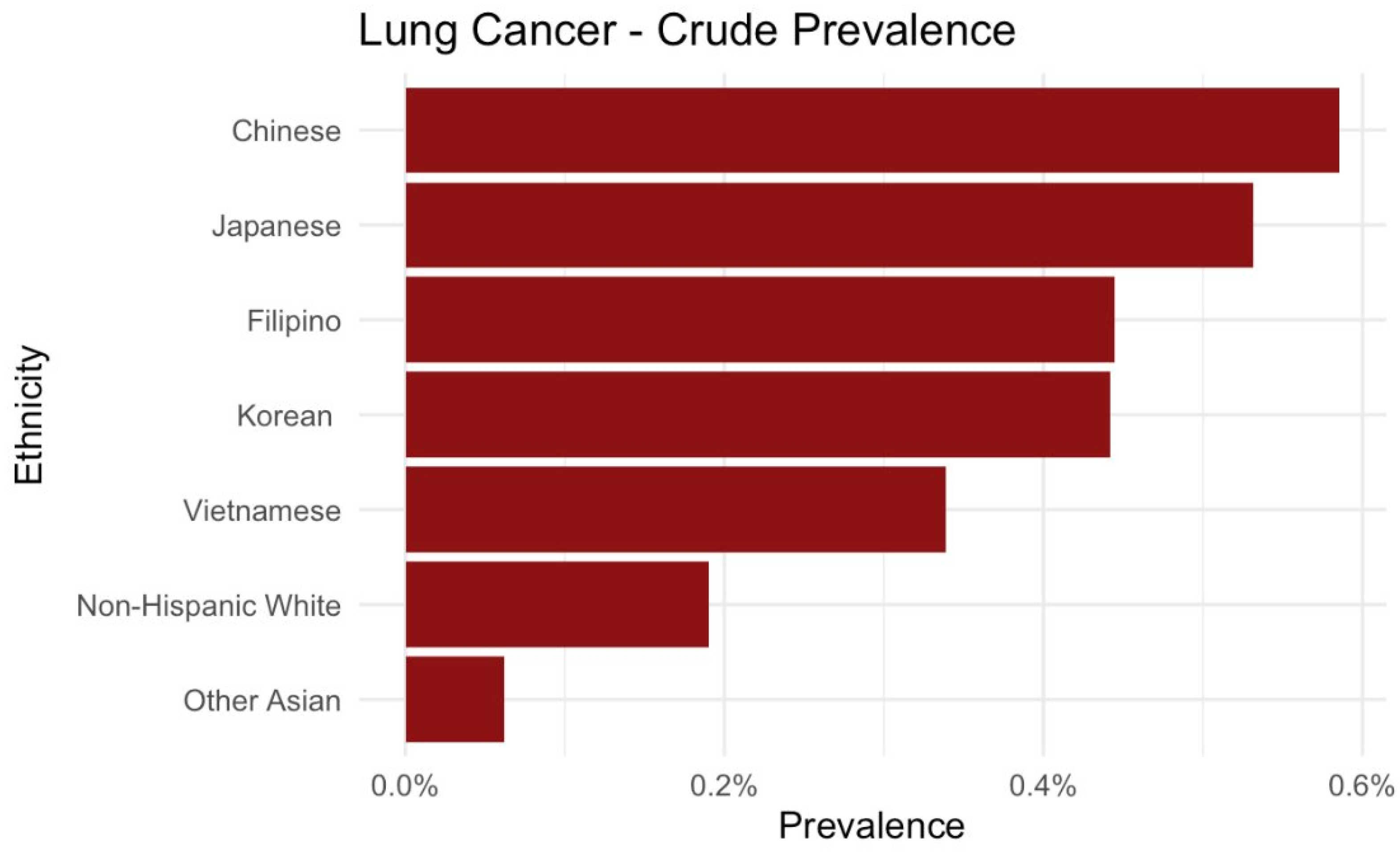
Figure 2.
Prevalence Ratio of Never-Smoking Primary Lung Cancer Across AsA Female Subgroups.
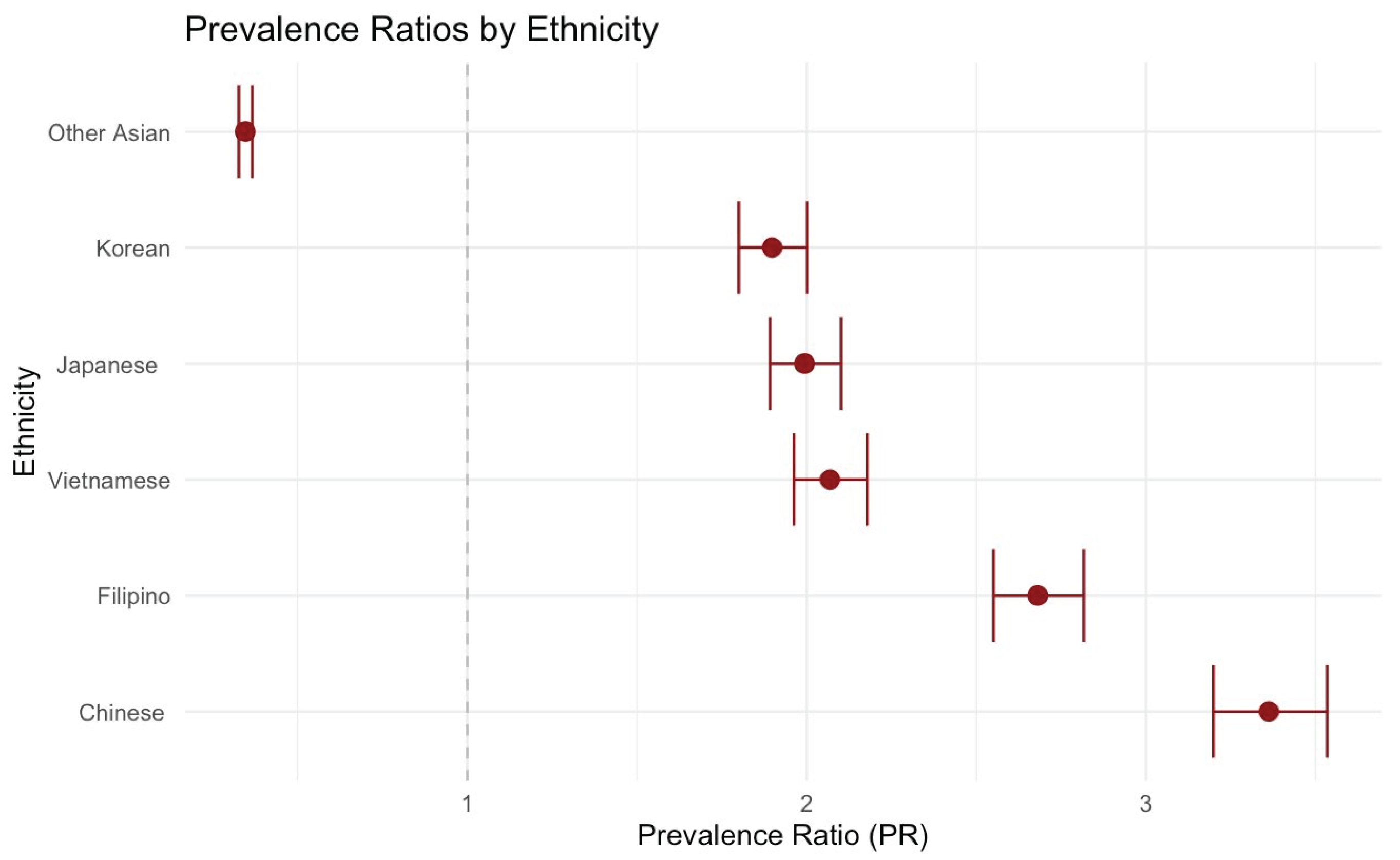

Table 1.
Strata Counts of KPNC Cohort Disaggregated by Demographic, Clinical Characteristics, and Smoking Status .
Table 1.
Strata Counts of KPNC Cohort Disaggregated by Demographic, Clinical Characteristics, and Smoking Status .
| Cohort | Cohort prevalent lung cancer cases |
|||||||
|---|---|---|---|---|---|---|---|---|
| Characteristic | Never, N = 1,184,7721 | Former, N = 217,8301 | Current, N = 123,0791 | Unknown, N = 317,4381 | Never, N = 2,4291 | Former, N = 3,1391 | Current, N = 2,1601 | Unknown, N = 9231 |
| Demographic characteristics | ||||||||
| Age (yrs) at anchor date (standard deviation) | 42 (18) | 53 (17) | 43 (16) | 40 (18) | 64 (13) | 70 (9) | 64 (9) | 65 (11) |
| Race/ethnicity | ||||||||
| NHW | 748,405 (63%) | 191,845 (88%) | 104,032 (85%) | 205,095 (65%) | 1,431 (59%) | 2,995 (95%) | 2,074 (96%) | 749 (81%) |
| Asian | 416,744 (35%) | 23,468 (11%) | 17,249 (14%) | 106,753 (34%) | 961 (40%) | 139 (4.4%) | 83 (3.8%) | 171 (19%) |
| Analysis ethnicity | ||||||||
| White | 746,921 (63%) | 191,613 (88%) | 103,885 (84%) | 204,640 (64%) | 1,420 (58%) | 2,994 (95%) | 2,071 (96%) | 749 (81%) |
| Chinese | 64,695 (5.5%) | 2,664 (1.2%) | 1,553 (1.3%) | 16,224 (5.1%) | 379 (16%) | 30 (1.0%) | 12 (0.6%) | 62 (6.7%) |
| Filipino | 71,292 (6.0%) | 7,682 (3.5%) | 5,347 (4.3%) | 17,963 (5.7%) | 317 (13%) | 45 (1.4%) | 26 (1.2%) | 46 (5.0%) |
| Japanese | 8,842 (0.7%) | 2,029 (0.9%) | 684 (0.6%) | 2,526 (0.8%) | 47 (1.9%) | 32 (1.0%) | 20 (0.9%) | 16 (1.7%) |
| Korean | 7,246 (0.6%) | 807 (0.4%) | 575 (0.5%) | 1,963 (0.6%) | 32 (1.3%) | 7 (0.2%) | 11 (0.5%) | 4 (0.4%) |
| Other Asian | 265,119 (22%) | 12,491 (5.7%) | 10,548 (8.6%) | 69,490 (22%) | 164 (6.8%) | 29 (0.9%) | 18 (0.8%) | 34 (3.7%) |
| Vietnamese | 20,657 (1.7%) | 544 (0.2%) | 487 (0.4%) | 4,632 (1.5%) | 70 (2.9%) | 2 (<0.1%) | 2 (<0.1%) | 12 (1.3%) |
| BMI | ||||||||
| Normal weight | 543,824 (46%) | 74,734 (34%) | 45,358 (37%) | 90,476 (29%) | 1,105 (45%) | 1,077 (34%) | 882 (41%) | 259 (28%) |
| Underweight | 72,538 (6.1%) | 4,675 (2.1%) | 4,951 (4.0%) | 17,572 (5.5%) | 79 (3.3%) | 100 (3.2%) | 154 (7.1%) | 27 (2.9%) |
| Overweight | 271,983 (23%) | 58,328 (27%) | 30,810 (25%) | 45,925 (14%) | 673 (28%) | 939 (30%) | 562 (26%) | 177 (19%) |
| Obese | 253,503 (21%) | 74,679 (34%) | 37,295 (30%) | 42,902 (14%) | 537 (22%) | 985 (31%) | 511 (24%) | 184 (20%) |
| Unknown | 42,924 (3.6%) | 5,414 (2.5%) | 4,665 (3.8%) | 120,563 (38%) | 35 (1.4%) | 38 (1.2%) | 51 (2.4%) | 276 (30%) |
*Descriptive statistics of patient demographic, clinical characteristics, and smoking status were computed using frequency and percentage for categorical variables and mean and standard deviation for continuous variables.
Table 2.
Personal/family history of any cancers.
| Strata | N Total | N with Outcome | Unadjusted prevalence |
|---|---|---|---|
| Personal history of any cancer | |||
| White | 109576 | 1431 | 0.0131 |
| Chinese | 6222 | 60 | 0.0096 |
| Filipino/Philippine | 9115 | 70 | 0.0077 |
| Japanese | 1722 | 23 | 0.0134 |
| Korean | 875 | 10 | 0.0114 |
| Vietnamese | 1371 | 10 | 0.0073 |
| Other Asian | 8392 | 29 | 0.0035 |
| Family history of any cancer | |||
| White | 173439 | 1003 | 0.0058 |
| Chinese | 9525 | 57 | 0.0060 |
| Filipino/Philippine | 11721 | 39 | 0.0033 |
| Japanese | 2071 | 12 | 0.0058 |
| Korean | 1172 | 3 | 0.0026 |
| Vietnamese | 2383 | 4 | 0.0017 |
| Other Asian | 22426 | 28 | 0.0012 |
| Personal and family history of any cancer | |||
| White | 27838 | 286 | 0.0103 |
| Chinese | 1369 | 14 | 0.0102 |
| Filipino/Philippine | 2042 | 7 | 0.0034 |
| Japanese | 435 | 3 | 0.0069 |
| Korean | 162 | 1 | 0.0062 |
| Vietnamese | 265 | 0 | 0.0000 |
| Other Asian | 1402 | 6 | 0.0043 |
Table 3.
Adjusted Prevalence Ratios for Primary Lung Cancer Disaggregated by Ethnicity Compared to NHW (Ref.).
Table 3.
Adjusted Prevalence Ratios for Primary Lung Cancer Disaggregated by Ethnicity Compared to NHW (Ref.).
| Ethnicity | Prevalence ratio (95% CI) | p-value |
|---|---|---|
| Chinese | 3.362 (3.199, 3.534) | < 0.001 |
| Japanese | 1.994 (1.892, 2.102) | < 0.001 |
| Filipino | 2.681 (2.551, 2.817) | < 0.001 |
| Korean | 1.898 (1.8, 2.001) | < 0.001 |
| Vietnamese | 2.069 (1.963, 2.179) | < 0.001 |
| Other Asian | 0.346 (0.327, 0.366) | < 0.001 |
*All ethnicities are compared to NHW. .
Table 4.
Prevalence Ratio of Primary Lung Cancer Disaggregated by Personal/Family History of Any Type of Cancer.
Table 4.
Prevalence Ratio of Primary Lung Cancer Disaggregated by Personal/Family History of Any Type of Cancer.
| Ethnicity | Cancer type | Prevalence ratio (95% CI) | p-value |
|---|---|---|---|
| Chinese | PH of any cancer | 0.153 (0.148, 0.157) | < 0.001 |
| Chinese | FH of any cancer | 1.507 (1.418, 1.602) | < 0.001 |
| Japanese | PH of any cancer | 1.001 (0.953, 1.052) | 0.953 |
| Japanese | FH of any cancer | 0.951 (0.893, 1.012) | 0.114 |
| Filipino | PH of any cancer | 0.073 (0.071, 0.076) | < 0.001 |
| Filipino | FH of any cancer | 0.769 (0.723, 0.818) | < 0.001 |
| Korean | PH of any cancer | 2.909 (2.764, 3.061) | < 0.001 |
| Korean | FH of any cancer | 0.598 (0.561, 0.636) | < 0.001 |
| Vietnamese | PH of any cancer | 0.222 (0.213, 0.23) | < 0.001 |
| Vietnamese | FH of any cancer | 0.489 (0.459, 0.521) | < 0.001 |
| Other Asian | PH of any cancer | 0.042 (0.04, 0.044) | < 0.001 |
| Other Asian | FH of any cancer | 0.315 (0.295, 0.337) | < 0.001 |
PH = personal history; FH = family history. *All ethnicities are compared to NHW. *Cancer type represents the stratification for these patients that have either a personal or family history of any cancer. For example, in the first row of Table 3, the aPR is the comparison among Chinese patients with a personal history of any cancer and NHW with a personal history of any cancer. .
Table 5.
Disaggregation of Type of Personal History of Cancer.
| Ethnicity | Cancer type | Prevalence ratio (95% CI) | p-value | Bonferonni adjusted significance |
|---|---|---|---|---|
| Chinese | PH of breast cancer | 0.132 (0.126, 0.137) | P < .001 | TRUE |
| Chinese | PH of uterine cancer | 1.908 (1.575, 2.31) | P < .001 | TRUE |
| Chinese | PH of cervical cancer | 0.55 (0.451, 0.671) | P < .001 | TRUE |
| Chinese | PH of ovarian cancer | 0.932 (0.736, 1.179) | 0.557 | FALSE |
| Japanese | PH of breast cancer | 1.167 (1.096, 1.244) | P < .001 | TRUE |
| Japanese | PH of uterine cancer | 0.82 (0.673, 0.999) | 0.049 | FALSE |
| Japanese | PH of cervical cancer | 0 (0, 0) | P < .001 | TRUE |
| Japanese | PH of ovarian cancer | 0 (0, 0) | P < .001 | TRUE |
| Filipino/Philippine | PH of breast cancer | 0.082 (0.079, 0.086) | P < .001 |
TRUE |
| Filipino/Philippine | PH of uterine cancer | 1.066 (0.88, 1.29) | 0.515 | FALSE |
| Filipino/Philippine | PH of cervical cancer | 0.177 (0.154, 0.205) | P < .001 | TRUE |
| Filipino/Philippine | PH of ovarian cancer | 0.492 (0.404, 0.599) | P < .001 | TRUE |
| Korean | PH of breast cancer | 1.476 (1.383, 1.576) | P < .001 | TRUE |
| Korean | PH of uterine cancer | 0 (0, 0) | P < .001 | TRUE |
| Korean | PH of cervical cancer | 0.977 (0.781, 1.223) | 0.841 | FALSE |
| Korean | PH of ovarian cancer | 2.862 (2.09, 3.918) | P < .001 | TRUE |
| Vietnamese | PH of breast cancer | 0.28 (0.266, 0.295) | P < .001 | TRUE |
| Vietnamese | PH of uterine cancer | 0 (0, 0) | P < .001 | TRUE |
| Vietnamese | PH of cervical cancer | 0.833 (0.669, 1.037) | 0.102 | FALSE |
| Vietnamese | PH of ovarian cancer | 0 (0, 0) | P < .001 | TRUE |
| Other Asian | PH of breast cancer | 0.056 (0.053, 0.058) | P < .001 | TRUE |
| Other Asian | PH of uterine cancer | 0.174 (0.14, 0.216) | P < .001 | TRUE |
| Other Asian | PH of cervical cancer | 2.561 (2.203, 2.977) | P < .001 | TRUE |
| Other Asian | PH of ovarian cancer | 1.895 (1.64, 2.189) | P < .001 | TRUE |
Table 6.
Disaggregation of Type of Family History of Cancer.
| Ethnicity | Cancer type | Prevalence ratio (95% CI) | p-value | Bonferonni adjusted significance |
|---|---|---|---|---|
| Chinese | FH of breast cancer | 1.114 (1.016, 1.222) | 0.022 | FALSE |
| Chinese | FH of lung cancer | 0.245 (0.222, 0.27) | P < .001 | TRUE |
| Japanese | FH of breast cancer | 1.108 (1.009, 1.218) | 0.032 | FALSE |
| Japanese | FH of lung cancer | 0.545 (0.468, 0.634) | P < .001 | TRUE |
| Filipino/Philippine | FH of breast cancer | 0.605 (0.551, 0.665) | P < .001 | TRUE |
| Filipino/Philippine | FH of lung cancer | 0.233 (0.206, 0.263) | P < .001 | TRUE |
| Korean | FH of breast cancer | 0 (0, 0) | P < .001 | TRUE |
| Korean | FH of lung cancer | 0 (0, 0) | P < .001 | TRUE |
| Vietnamese | FH of breast cancer | 0.316 (0.287, 0.347) | P < .001 | TRUE |
| Vietnamese | FH of lung cancer | 1.023 (0.875, 1.196) | 0.773 | FALSE |
| Other Asian | FH of breast cancer | 0.342 (0.311, 0.378) | P < .001 | TRUE |
| Other Asian | FH of lung cancer | 0.077 (0.068, 0.088) | P < .001 | TRUE |
Disclaimer/Publisher’s Note: The statements, opinions and data contained in all publications are solely those of the individual author(s) and contributor(s) and not of MDPI and/or the editor(s). MDPI and/or the editor(s) disclaim responsibility for any injury to people or property resulting from any ideas, methods, instructions or products referred to in the content. |
© 2026 by the authors. Licensee MDPI, Basel, Switzerland. This article is an open access article distributed under the terms and conditions of the Creative Commons Attribution (CC BY) license (http://creativecommons.org/licenses/by/4.0/).
Copyright: This open access article is published under a Creative Commons CC BY 4.0 license, which permit the free download, distribution, and reuse, provided that the author and preprint are cited in any reuse.


