
Submitted:
23 May 2026
Posted:
25 May 2026
You are already at the latest version
Abstract
We elaborate on computational emergence (CE), understood as the emergent acquisition of specific abilities from specific forms of computation, such as artificial neural networks and cascades of rule iterations found in cellular automata. CE leads to the acquisition of properties such as learning abilities, morphological pattern formation, and coherence, and arises from computational mechanisms. We also elaborate on emergent computation (EC), understood as the emergent acquisition of computational abilities by communities of phenomenologically interacting agents, potentially through appropriate interlinkages among them, as in emerging networks. Processes of interaction are understood generically as forms of mutually active interdependence, which can be modeled as self-generated networks. EC arises from phenomenological mechanisms of interaction among agents and leads to the acquisition of properties such as coherent behaviors, resilience, robustness, and collective intelligence. The reason for distinguishing between these two types of emergence is that doing so may open new approaches to modeling collective behavior, especially in artificial ones, such as swarms of unmanned aerial vehicles (UAVs), where introducing parametric and structural changes is more feasible. Combining the two approaches—(a) phenomenological, networked EC arising from populations of interacting (b) in turn computationally emergent agents—allows the consideration of research directions such as identifying relationships between combinations of CE and emergently acquired computational properties within the conceptual frameworks of networked neural networks and intersected neural networks, i.e., networks that share nodes. Such research directions are expected to enable approaches for influencing collective behaviors and complex systems in a non-invasive way, including swarms of UAVs (or drones), autonomous cyborg swarms, and coherent communities of artificial devices equipped with sensors, edge artificial intelligence, and secure communications. We consider the mesoscopic nature of complexity in collective behaviors as a continuous negotiation between these two forms of emergence, with EC playing a macroscopic role and CE a microscopic role. We conclude that this general framework relates to the concept of “The Middle Way” in physics by focusing on what occurs “in between” systems (such as between intersecting neural networks and their dynamic networking) and within transient spaces where non-invasive intervention may be possible and appropriate for guiding, modifying, and inducing changes in complex emergent systems.
Keywords:
acquisition of properties
; computation
; coherence
; complexity
; emergence
; network
1. Introduction
In this paper, the terms “computation” and “computational” are used, for example, in forms such as “computational emergence,” “emergent computation,” “symbolic or sub-symbolic computation,” and “(high–low) computational capabilities and abilities.”
It should be noted that the classical concept of “computation” refers to the ability to perform processes of mathematical calculation, symbol manipulation, and symbolic processing, with a general distinction between algorithmic and non-algorithmic computation. By contrast, non-symbolic computation is not primarily aimed at producing explicit results, but rather at acquiring properties through computation, such as learning in artificial neural networks (ANNs), the computational processes underlying artificial intelligence (AI) systems, and cellular automata (CA) capable of exhibiting complex morphological behaviors.
The expressions “computational emergence” and “emergent computation” are usually considered equivalent, if not identical. This contribution aims to identify structural differences between them in order to facilitate the development of research lines concerning their possible combinations.
We will also consider low and high computational capabilities in Section 3.5 in order to distinguish levels of complexity in acquired emergent computational properties.
Computational emergence (CE) is understood as arising from computational mechanisms. CE refers to the emergent acquisition from specific types of computational mechanisms of specific types capabilities, such as learning abilities in ANNs and morphological behaviors in CA. CE specifies the nature of the emergence, which in this case is due to computation [1].
Emergent computation (EC) refers to emergent collective computational capabilities acquired by emergent, e.g., collective and self-networked, communities of interacting agents. Interactions between entities are understood as occurring when one’s behavior depends on another’s behavior, for instance, through the exchange of energy, as in collisions, or through cognitive processing. EC specifies the nature of the emergent acquired computational properties, such as the establishment of swarm intelligence that performs collective strategies and decision-making (see Table 1).
EC is therefore not only a property acquired by populations of interacting agents constituting collective behaviors; it is also a mechanism that enables the emergence of subsequent collective capabilities when EC is used to process external data, e.g., the appearance of a predator, and not only internal data, e.g., maintaining or restoring the coherence of a flock or swarm. We distinguish between (a) mechanisms of emergence, (b) computational properties subsequently acquired by the emergent collective behavior, and (c) further emergent properties such as computational collective decision-making abilities and swarm intelligence, as illustrated in the schema below.
Scheme 1.
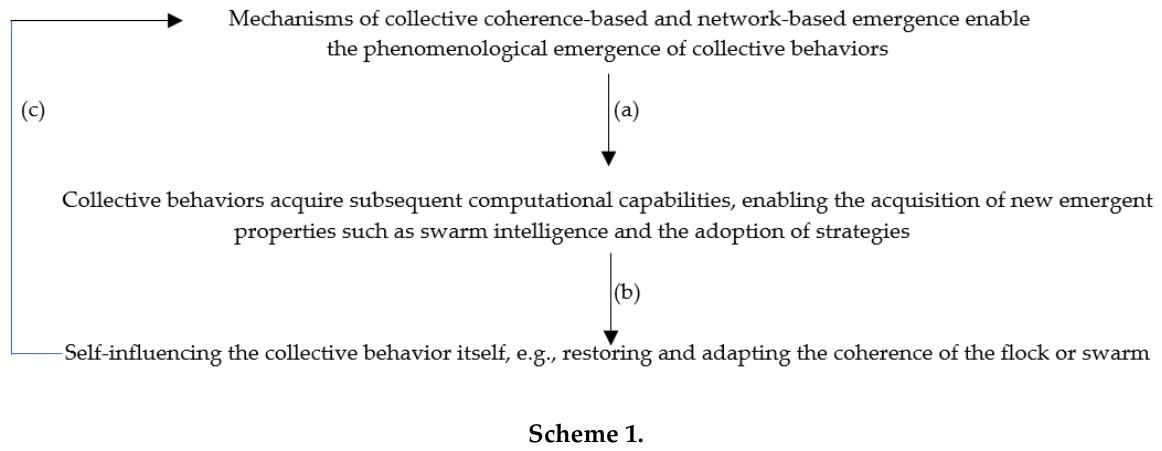
We consider here the case in which collective behaviors, such as flocks and swarms acquiring EC capabilities, are established by CE-based modelled interacting agents, e.g., boids and insects (see Section 3.3.2), rather than by simple behavioral rules or symbolic models (see Section 3.3.1).
For completeness, we specify that other emergent non-computational acquired properties are also typically observed, such as behavioral properties that establish coherent forms. Particular cases include herring schools reflecting light in a way that gives predators the impression of a larger entity that is, in reality, collective [2], and periodic color oscillations in chemical reactions such as the Belousov–Zhabotinsky reaction [3].
In Section 2, we elaborate on CE, where the term “computational” is intended in a non-symbolic sense and specifies the nature of emergence.
In Section 3, we elaborate on EC, where the term “emergent” specifies the nature of computation. EC is understood to emerge from collective coherence-based interacting agents (Section 3.1) and from networked nodes (Section 3.2).
The reason for distinguishing between EC and CE is that EC phenomena are more general, occurring in interacting populations as collective behaviors also modeled as networks through undirected links, leading to the acquisition of various types of typically behavioral emergent properties. By contrast, CE phenomena are more specific, occurring through predetermined directed links and involving the acquisition of properties such as learning and cataloguing capabilities, which can develop into the more general AI capabilities.
This distinction is considered to introduce aspects of duality in the processes by which complex collective systems and their EC capabilities are established, as specified in Section 4 and in the Conclusions.
In Section 4, we introduce two possible directions of research:
- -
- Identifying relationships between combinations of CE and EC mechanisms of emergence with emergent computationally acquired properties within the conceptual frameworks of networked neural networks (when neurons also belong to multiple networks) and intersected neural networks (when neurons are shared between networks).
- -
- Developing approaches to influence collective behaviors and complex systems in a non-invasive way.
A typical field of research and application is that of artificial collective behaviors such as swarms of unmanned aerial vehicles (UAVs), or so-called drones, autonomous cyborg swarms, and coherent communities of artificial devices equipped with sensors, edge AI, and secure communication systems. These approaches are conceptually extensible to interdisciplinary cases such as sociobiology [4], particularly when it is possible to design artificial uses of living systems (see, for instance, companies such as [5]).
We conclude that this general framework relates to the concept of “The Middle Way” in physics, which considers what happens “in between” and in the transient (such as between intersections of neural networks and their dynamic interaction and networking), where it is possible and appropriate to intervene in a non-invasive way to guide, modify, and induce changes in complex systems. It is a matter of adopting a strategy of intervening in processes of becoming as a general non-destructive approach.
2. Computational Emergence (Specifies the Nature of the Emergence) from Non-Symbolic Computation
In this section, we focus on CE and on properties acquired through computational processes. CE arises from computational mechanisms.
Examples of computational mechanisms leading to the emergence of properties (not necessarily computational in themselves) include artificial life [6]; fractality, which allows self-similar patterns to arise from the iterative application of simple rules; the classical three-body problem, i.e., the problem of computing orbits resulting from the mutual gravitational interaction among three separate masses [7], which can produce unexpected effects; deterministic chaos [8]; and morphogenesis [9].
In this section, however, we focus on emergent properties acquired through specific computational processes, as in certain forms of non-symbolic computation, such as ANNs and CA; see Table 2 for a summary.
This is the case of emergence generated by computational processes in ANNs [1], rather than by phenomenological collective coherent communities acquiring emergent collective, and in this case computational, abilities.
Constituent units, such as artificial neurons in ANNs, are themselves components of quasi-structured systems (quasi-structured because, for example, structure is defined primarily through weighted and variable connections, and multi-layer configurations; see Figure 1). These components participate in specific computational processes that allow the emergence of specific computational abilities.
The structures of CE, unlike the more general structures of EC which consist of generic collective interactions and networking, are well-defined, directed, weighted networks, neural-like except for their parametric variability. These occur in hidden, input, and output layers, with recurrent connections as in ANNs (see Section 2.1.1 and Figure 1 for a simple illustrative example) and in CA (see Figure 2a,b for simple illustrative examples). CA are discrete, abstract computational systems composed of a grid of cells, each occupying one of a finite set of possible states.
A well-known case of CA evolution is given by Rule 110, which exhibits behavior commonly categorized as “Class 4” (see Section 2.1.2). It features localized structures that interact in a way proven to support universal computation [10].
In these cases, CE arises from computational mechanisms.
However, it cannot be stated whether non-symbolic computation is a necessary condition for the emergence of computationally emergent properties.
2.1. Non-Symbolic Computation
Symbolic computation refers to explicit, algorithmic manipulations of symbolic entities. An algorithm is a systematic, step-by-step process consisting of a finite series of well-defined instructions designed to solve a specific problem or achieve a defined objective. This concept is formalized by the Turing machine [11].
Regarding non-symbolic computation, also considered a form of soft computing (see, for instance, the pioneering work of [12]), we may consider at least two illustrative cases (see Section 2.1.1 and Section 2.1.2).
Non-symbolic computation is an intriguing concept because its processing is implicit, with outcomes arising in an emergent manner rather than being determined or predicted step by step. Individual steps cannot be understood as strictly organized microscopic computational actions but are instead components of a broader computational framework that operates as a macroscopic, e.g., dynamically or randomly networked, system. This approach has been explored for decades, initially through connectionist models and tools such as ANNs, see for instance [13,14], and CA, see for instance [15,16].
More advanced adaptations, such as multiple cellular automata (MCA), are used to address scenarios like multiphase systems [17], where the phases of components or regions shift in unpredictable ways. These evolving changes aim to produce dynamic coherence across multiple phases. In such systems, distances between structures or phases are not only adjusted to maintain coherence but are also reorganized hierarchically to adapt the manner of variation. MCA research in the literature often explores CA operating in parallel, interactive, and networked environments while analyzing their behavior from an ensemble-performance perspective.
2.1.1. Artificial Neural Networks
ANNs are computational models inspired by the structure and function of biological neural networks. They are composed of layers of interconnected artificial neurons. These neurons receive inputs, process them through weighted connections across multiple layers and activation functions, and produce outputs (see, for instance, [18]).
ANNs are commonly represented as weighted, directed graphs between artificial neurons (see Figure 1). The nodes represent artificial neurons, while the edges represent connections that transmit information. In many standard ANN architectures, particularly feed-forward neural networks (FFNNs), these connections form a directed acyclic graph, ensuring that information flows in a single direction—from input to output—without cycles. However, certain architectures, such as recurrent neural networks (RNNs), include directed connections that form cycles. These cycles enable feedback loops, allowing the network to retain information about previous states [19].
Thus, ANNs are generally directed graphs, whose structure may be either acyclic or cyclic depending on the specific architecture.
In ANNs, the timing and spatial organization of physical phenomenological interactions observed in collective behaviors (such as flocks and swarms), which are characteristic of EC (see Section 3), are conceptually replaced by variable multilayered, weighted, and networked combinations of local neuronal computations, corresponding to CE.
ANNs are particular cases of networks where links are directed and predetermined, but they generate CE. This emergence arises from factors such as connection weights, which depend on conditions like learning mode, and from network architectures, which may include variable and hidden layers (see Figure 1).
When observing the computations performed by ANNs step by step, the process appears incomprehensible compared to the progressive clarity of algorithmic computation. What makes this type of computation (including CA and artificial life-based models) unique is its ability to develop non-formally defined characteristics and side effects, such as learning abilities and generalization from experience, as well as morphological pattern formation. In these cases, the computation (or algorithm) does not merely lead to a final result but instead leads to the acquisition of properties, such as the ability to learn from examples, due to networked weighted computation. These properties are inherently implicit, as they cannot be fully expressed analytically or reduced to a fixed set of equations. In this context, the result itself is less significant than the properties acquired during the ongoing computation.
The acquired weight configurations represent learning in so-called machine learning systems (see, for instance, [20]). We may say that traditional outputs are replaced, in this case, by the stability of the acquired property, see Box 1.
There are numerous variants of ANNs that can be related to the simplified diagram presented in Figure 1, included here for the benefit of the general reader. As is well known, these variants, together with other forms of non-symbolic computation, form the basis of approaches in AI systems.
Box 1. ANNs properties and collective properties.
Parametric values and properties of layered ANN architectures conceptually correspond to, and are comparable with, the parameters and properties of spatially distributed phenomenological processes of collective emergence.
With reference to the schema considered in Figure 1, we now introduce some formal introductory specifications of ANNs.
ANNs denote, in general, a system containing two components:
-
Units (sometimes called neurons or nodes), each of which is an input-output device with N input lines and one output line, characterized, at each time instant t, by an:
- -
- output state u(t) (also called activation),
- -
- inner state p(t) (the so-called activation potential), and
- -
- input state x(t) [x1(t), …, xN(t)], where xi(t) denotes the activation state of the i-th input line.
Appropriate laws allow the computation of u(t) from the knowledge of p(t), as well as the computation of p(t) as a function of the input state at time t or, possibly, at previous time steps.
- 2.
- Connection lines between the units.
These lines transmit the activation state from the output of one unit to the input of another. Each connection is associated with a connection weight (usually a real number but also not real in specific cases), which modulates the activation signal passing through it.
Among the neural-inspired laws for computing p(t), the most commonly used is:
where wi denotes the connection weight associated with the i-th input line, and s is a parameter called threshold.
p(t) = ∑i wi xi(t) − s
Among the laws for computing u(t), one of the most widely used is:
where F is a function that often takes the form of a sigmoidal function:
du/dt = −u + F[p(t)].
F(y) = 1/[1 + exp(−y)].
This law characterizes McCulloch–Pitts neurons. Its time-discretized version (almost universally used in computer simulations) is written as:
u(t + 1) = F[p(t)].
ANNs have been developed in various forms, combinations, and modifications, demonstrating significant applicability in statistical and correlational analyses. Among the many architectures, four notable examples are mentioned below:
First, the feed-forward neural networks (FFNNs) are characterized by the absence of loops in its node connections, distinguishing it from other architectures like RNNs. The learning process in FFNNs involves adjusting connection weights after processing input data, driven by the error between predicted outputs and expected values. This process occurs under supervised learning conditions through a method known as backpropagation. Backpropagation functions as an iterative optimization algorithm aimed at reducing prediction error.
FFNNs exhibit a unidirectional flow of information, moving from input layers to output layers without feedback loops; Therefore, the output is determined solely by the current input data. The backpropagation algorithm operates in two main phases: a forward propagation phase and a backward propagation phase. During the forward phase, the network processes an input example, compares the resulting output with the expected output, and calculates the associated error. During the backward phase, backpropagation updates the synaptic weights of the network based on this error. This iterative adjustment allows the output values to progressively approach the desired targets. It should be noted, however, that these learning algorithms do not necessarily guarantee convergence to an optimal solution.
Second, convolutional neural networks (CNNs) represent another prominent ANN variant. Architecturally, CNNs consist of an input layer, multiple intermediate layers, and an output layer. These networks follow a feed-forward design but feature a connectivity structure inspired by the organization of the visual cortex in biological systems. Specifically, neurons are arranged to respond to overlapping regions of the visual field, enabling CNNs to process multidimensional inputs. As a result of this architecture, CNNs demonstrate strong performance in domains such as image recognition, activity classification, computer vision, and natural language processing.
The third category encompasses recurrent neural networks (RNNs), which differ from FFNNs due to their ability to use internal states and maintain memory for sequential data processing. In these networks, the outputs of certain nodes are fed back as inputs to the same or related nodes, enabling RNNs to excel in tasks that require sequence modeling. Typical applications include speech recognition and handwriting analysis.
Lastly, recursive neural networks (RvNNs) are distinguished by their use of multiple layers between input and output nodes while recursively applying shared weights to structured inputs. RvNNs are particularly effective for learning hierarchical representations such as sequences or tree-like structures commonly found in image and structured data.
These neural network architectures have also demonstrated potential when combined with evolutionary algorithms and CA, adding an additional dimension to their applicability across various computational domains.
2.1.2. Cellular Automata
CA are systems composed of (potentially infinite) square grids of cells organized in one- or two-dimensional Euclidean space. Each cell can occupy a limited set of distinct possible states [16].
For two-dimensional CA with square lattices, several neighborhood structures are commonly used. One widely adopted example is the Moore neighborhood, which includes the cell itself and its eight adjacent cells that share at least one vertex (see Figure 2a). Another frequently used structure is the von Neumann neighborhood, where each cell interacts with its four adjacent neighbors that share a common edge (see Figure 2b).
The number of distinct possible local transition rules increases rapidly with the number of allowed states per cell and with the number of cells included in the neighborhood of a given cell.
If N is the number of possible local transition rules, k is the number of allowed states per cell, and r is the number of cells in the neighborhood of a given cell, it can be shown that:
N = kq, where q = kr.
It can immediately be seen that, even for small values of k and r, N becomes very large.
We may say that, in CA, the spatial structure of physical interactions observed in collective behaviors, mechanism characteristic of EC, is conceptually replaced by evolutionary update rules, see Box 2.
We may consider the four classes originally introduced by Stephen Wolfram for CA, first in [16] and later developed in subsequent work. In summary, the four classes and their computational behaviors can be outlined as follows, depending on how CAs evolve:
- -
- Class 1: evolution toward a uniform state.
- -
- Class 2: evolution toward simple, stable, or periodic structures.
- -
- Class 3: evolution into chaotic or pseudo-random patterns.
- -
- Class 4: evolution into complex, interacting structures.
Box 2. CA properties and collective properties.
Evolutionary rules in CA conceptually correspond to, and are comparable with, the parameters and properties of phenomenological processes of collective emergence.
In Table 3, we present examples of properties associated with ANNs and CA.
Finally, we consider how different levels of sub-symbolism can be addressed when dealing with variable combinations of symbolic and sub-symbolic computation.
A level of sub-symbolism may also relate to the symbolic computation of values assumed within ANNs, potentially organized in multiple and variable alternating sequences, see Box 3.
Box 3. The organized-like complexity of ANNs and CA.
In these cases (ANNs and CA), we may refer to an organized-like complexity, as it is based on the application of rules and computational structures, resembling a form of symbolic-like complexity. This is in contrast to the fact that ANNs and CA generate sub-symbolic computation.
3. Emergent Computation (Specifies the Nature of the Computation)
Emergent computational properties, such as swarm intelligence and strategy-based decision-making processes, are properties acquired by emergent collective entities [21], such as swarms and flocks.
In this section, we consider EC performed by emergent collective properties acquired through phenomenological processes of emergence in collective behaviors, represented through models of correlation and coherence (see Section 3.1), as well as through dynamic complex networks of relationships in social communities (see Section 3.2).
EC has often been studied by focusing on mechanisms of collective interaction and linkages, while neglecting the possible role and relationship with the individual component agents, which themselves may also be emergent but are often assumed to perform only elementary symbolic rules. In this regard, Section 3.4 considers cases in which constituent interacting agents forming collective behaviors, and constituent nodes forming networks, perform either symbolic or non-symbolic processing.
3.1. Emergence from Collective Coherence-Based Phenomenological Interacting Agents
We mention some cases of phenomenological mechanisms that allow the emergence of coherence in collective behaviors.
- -
- Synchronization can be understood as the simplest form of coherence, where the mode of change is identically iterated across the system.
- -
- Covariance refers to the extent to which two random variables X and Y covary, i.e., change together in a similar manner [22].
- -
- Correlation ([23], pp. 67–69) measures the level of dependence among random variables, such as the prices of two different products.
- -
- The concept of a domain of coherence may be considered to coincide with that of correlation length, i.e., the spatial or temporal extent of correlation, particularly when this extent spans the entire population under consideration. Diffuse, long-range correlation is interpreted as coherence. In this case, coherence can be seen as a form of global dynamical ordering.
Correlation in collective behaviors encapsulates the concept of indirect information transfer facilitated by direct interactions among individuals within a group. For instance, two boids in a flock that are beyond the range of direct interaction—whether visual, acoustic, hydrodynamic, or otherwise—may still exhibit correlation if information is transmitted between them through intermediate agents engaged in direct interactions [24]. Such intermediate transmission may involve different forms of processing, such as partial transmission or distortion of information, the introduction of marginal perturbations, and the removal or transformation of scalar components from vector information, or their reduction to certain scalar components.
An illustrative example can be observed in the movement of a boid that reacts to a predator’s attack; its maneuver affects not only its immediate neighbors but also influences all other connected, correlated individuals in the flock. Correlation thus quantifies the extent to which behavioral changes in one individual propagate across the group. Such behavioral correlations constitute a critical mechanism underlying a group’s collective responsiveness to environmental stimuli. By enabling coordinated reactions, these correlations play an important role in ensuring the survival and adaptability of the group. Similarly, correlations are likely to be significant in other contexts of collective decision-making. For example, informed individuals possessing knowledge about resources such as food locations or migratory routes can influence and guide the decisions of broader group members through these correlated interactions [25].
It is possible to apply correlation measures using linear methods, such as the Bravais–Pearson correlation coefficient [26] (see [27] for a review). This coefficient quantitatively evaluates the linear correlation between two data sets by dividing their covariance by the product of their standard deviations. Covariance, in this context, reflects the degree to which two random variables, X and Y, change together or exhibit similar patterns of variation [22]. Consequently, the Bravais–Pearson coefficient provides a normalized measure of covariance, ranging from −1 to 1. It should be noted, however, that both the Bravais–Pearson coefficient and covariance capture only linear relationships and do not account for other types of dependencies.
For a given population involving a pair of random variables (X, Y), Pearson’s correlation coefficient (ρ) can be expressed mathematically as:
Here, Cov denotes the covariance, while σX and σY represent the standard deviations of X and Y, respectively. The covariance itself is calculated as:
where and denote the mean values of the respective data series, and n corresponds to the sample size.
The Bravais–Pearson approach can be extended to other linear measures, such as the cross-correlation function. This method applies specifically to two time series of equal length N, where their respective values, denoted by xn and yn, are normalized to have zero mean and unit variance. The cross-correlation function CXY(τ), which depends on the time lag τ, is defined over the range from −(N − 1) to (N − 1) and is given as follows:
Within this framework, cross-correlation values range from 1, indicating maximum synchronization, to −1, indicating complete absence of correlation.
A broader perspective emerges when considering self-organizing processes and emergent phenomena. These are characterized by sequences of dynamic covariances and correlations, as well as evolving yet dominant patterns of coherence.
As mentioned above, long-range correlation is, in all respects, considered coherence.
Other aspects concerning phenomenological mechanisms that allow the emergence of collective behaviors are:
- -
- Interchangeability
In networks there is a conceptual interchangeability of nodes, similarly to collective behaviors where agents may assume equivalent roles at different times [21].
We emphasize that interchangeability does not necessarily imply indistinguishability or perfect similarity, but rather the rotation of equivalent roles over time. Interchangeability can be understood in terms of levels of equivalence, common admissibility, and tolerance ranges. These may be considered indices of similarity without necessarily implying full substitutability.
Interchangeability implies a notion of “sameness” within ranges of validity and agents-nodes level processing; conversely, “sameness” in processing within ranges of validity implies interchangeability.
- -
- Equivalence
Furthermore, collective behavior requires that processing performed by agents-nodes occurs within equivalence ranges.
In spatial collective behaviors, for instance, equivalence arises from the fact that spatial, velocity, and acceleration values can be functionally equivalent for the decision-making processes of neighboring agents that must determine a new positional or motion state. Within the community, this equivalence operates through continuous and distributed mutual reciprocity.
This refers to the fact that, in collective behaviors, the agents-nodes, e.g., boids and ants, are physically homogeneous.
These are physically homogeneous agents that compute in the same way and produce commensurable outputs, operating, however, at different times (with different starting and ending points), different intensities, and different influences from previous results, as observed in systems such as anthills, swarms, and ecosystems.
- -
- Same cognitive system
Furthermore, a necessary condition for the occurrence of collective behaviors may consist precisely in the fact that the agents-nodes process information using the same cognitive system, process inputs, and generate outputs in the same way.
A collective behavior may be understood as a collective dynamical coherent version of homogeneous, interchangeable components, forming a collective being [21].
We also mention the case of possible ergodicity:
- -
- Ergodicity
We refer to ergodicity [28,29], based on the idea that sampling at a single time instant across an ensemble of different copies of the same system is equivalent to sampling over time within a single system; this is the notion contained in the ergodic hypothesis ([21], pp. 291–320).
It is important to note that the same system can exhibit both ergodic and non-ergodic behavior depending on the observer’s time scale, as seen in polymers. Additionally, a system may be temporarily ergodic, and degrees or indices of ergodicity can also be considered.
Furthermore, mesoscopic ergodicity ([23], pp. 118–119) does not prescribe microscopic properties but instead refers to equivalences among clusters, allowing theoretical incompleteness, which in turn contributes to unpredictability.
3.2. Emergence from Networked Nodes
The science of networks, as outlined by various scholars (see, for instance, [30,31]), conceptualizes systems through network structures and interprets systemic properties in terms of properties arising from undirected or directed linkages within networks (see, for instance, [32]).
It is possible to distinguish between:
- (a)
- Material networks, such as electricity, telecommunications, and road networks, as well as air and sea traffic systems modeled as transport networks.
- (b)
- Emergent networks, which are self-established, such as social and dynamically evolving networks, for instance, when modeling interaction and interdependence mechanisms in collective behaviors and ecosystems as networks.
Network properties apply to both cases. A particularly large-scale example is the brain and its synaptic connectivity.
In this section, we focus on emergent computational properties acquired by emergent networked communities of agents represented as nodes. Examples of such properties include the processing of environmental information in intelligent ways, such as robustness and adaptability in the Internet, social collaborative networks, and social networks with follower relations exhibiting scale-free and small-world structures (see Section 3.2.2).
In network phenomenology [33,34], the behavior of individual CE-based nodes adapts to the properties of the comprehensive self-generated emergent EC network. The behavior of individual CE-based nodes is as if the comprehensive network has a real existence, since it produces real feedback effects on node interactions through its emergent properties.
Considering the links that connect nodes, these may be directed or undirected, stable or dynamic, as in the case of social networks. The resulting network can exhibit different topologies that influence data flow, reliability, and performance [35]. The network itself acquires emergent properties such as small-world structure and robustness.
3.2.1. Dynamic Networks
One very important area concerns dynamic networks.
Many networks evolve over time. They may expand by adding nodes and links, or contract by removing connections and becoming sparser. Underlying these networks are forces that influence their structure—sometimes in predictable ways, and other times in unpredictable ones. This results in dynamic networks that undergo a wide range of transformations (see, for instance, [36,37]).
Considering the nodes, it is possible to include, for instance:
- nodes as fuzzy agents, e.g., software agents implementing fuzzy logic [38];
- nodes that vary over time in their state; they are not always active but can switch off in different ways, e.g., periodically or randomly. Nodes can therefore vary in number and type, and may belong to multiple networks;
Considering the links, it is possible to include, for instance, cases where:
- links are not always active but can switch off in various ways, e.g., periodically or randomly, being replaced by the shortest available path;
- links have variable intensity, represented, for example, by weights as in ANNs; and
- fuzzy networks, defined as hybrid models that combine the principles of fuzzy logic with neural network methodologies, thereby enhancing the ability to handle uncertainty and imprecision in data.
3.2.2. Complex Networks
Specific features of complex systems can be expressed as network attributes understood as emergent properties.
Complex systems can often be modeled as complex networks [41,42] characterized by properties such as:
- Scale-free structure, which occurs when a network contains a large number of nodes with relatively few connections, alongside a smaller number of highly connected nodes (hubs). In these networks, the probability that a randomly chosen node has a certain number of connections follows a power-law distribution. This scale-free property is closely related to the network’s robustness against failures, enabling fault-tolerant behavior. Notable examples include the Internet and social collaborative networks.
- Small-world networks, which arise when most nodes are not directly connected, yet nearly all nodes can be reached from one another through a small number of intermediate links. This property is often associated with increased efficiency and robustness. Notable examples include electrical power grids and neuronal connectivity networks in the brain.
- Degree correlations, which refer to statistical relationships between the degrees (number of connections) of adjacent nodes. These correlations describe whether nodes preferentially connect to others with similar degree (assortative mixing) or to nodes with different degrees (disassortative mixing).
3.2.3. Emergent Networks
Some characterizing properties of networks include clustering coefficient, connectivity, degree distribution, density, diameter, directionality, edge weights, fitness, idempotence, loops, multi-edges, and the size of nodes or edges. For complex networks, additional properties include scale-free structure, small-world behavior, degree correlations, signal diffusion and concentration processes, and topology.
Relationship-based communities may be understood as implicit or virtual networks, where relationships are considered as links between constituent agents-nodes representing their interactions. Examples include human social and biological communities, relationships between transport timetables and routes, bibliographic networks, and market dynamics.
Such networks may be more properly regarded as constructed than directly observed, depending on the level of description and scalability. These virtual networks become emergent when they acquire network properties capable of exerting feedback effects on the generative nodes.
An example of a virtually networkable population of interacting agents is given by Brownian motion [43]. Brownian motion refers to the erratic and unpredictable movement of a small pollen particle suspended in water. This motion results from interactions with water molecules, which themselves move due to thermal energy. However, it is difficult to model Brownian motion using network representations except in specific cases, such as: (1) biased Brownian particles moving on networks [44], (2) swarm networks in which connections change dynamically and cells or agents undergo Brownian motion [45], and (3) Brownian network models used as formal approximations in heavy-traffic regimes [46].
While electricity, telecommunications, and road networks, as well as air and sea traffic modeled as transport networks, may be considered material, real, and directly detectable networks, emergent networks may be understood as self-established forms of networking arising from realized or observed ongoing relationships, for instance, when modeling interaction and interdependence mechanisms in collective behaviors and ecosystems as networks. Other forms of self-established networking may relate to bibliographic references and citations in general, including bibliometric systems.
However, network properties apply to both cases.
Furthermore, networks in collective behaviors and social systems should be understood as emergent, and their representations and formalizations as models that do not ignore incompleteness and equivalence relations, which are non-negligible in processes of emergence. A relevant case is the network behavior [47] of agents in collective systems. In this context, incompleteness is understood as the inherent lack of fully comprehensive representations required for the emergence of phenomena. This highlights the intrinsic incompatibility between emergent phenomena and the possibility of their complete representation, as previously discussed [48]. The challenge lies in identifying ways to intervene in the incompleteness of emergent phenomena without introducing destructive effects [23], i.e., in a non-invasive manner.
Another form of self-established networking may relate to the interdependent usage of nodes and links over time, which also includes the avoidance of certain nodes or links, as well as link generation processes, such as creating shortcuts in a road network.
Networking can be understood as a structured or emergent modeling of how nodes establish interactions or interrelationships. Modalities of usage and behavioral patterns, as well as time-dependent properties of nodes in real networks, can be considered as corresponding to and comparable with the emergence of network properties.
3.2.4. Distributed Input, Processing, and Output
We now address issues related to distributed input, distributed processing, and distributed output.
In networks, information is not localized but fluid, continuously evolving, and emergent, constituting a collective, temporary form of information.
This, together with the conceptual interchangeability of nodes—similarly to collective behaviors where agents may assume equivalent roles at different times ([21], p. 107, pp. 302–303)—implies that nodes (e.g., boids) are characterized more by their connections, position, and network properties (such as degree distribution, correlation, and topology) than by their individual properties, which are considered interchangeable.
We emphasize that interchangeability does not necessarily imply indistinguishability or perfect similarity. Interchangeability can instead be understood in terms of levels of equivalence, admissible similarity, and tolerance ranges. These may be considered indices of similarity without implying full substitutability.
The processing performed by nodes is crucial, establishing:
- -
- direct or indirect interdependencies, formalized as network links;
- -
- interchangeability, similarity, and levels of equivalence.
Interchangeability implies equivalent processing by nodes, and conversely, equivalent processing implies interchangeability.
In generic network models, there are no strictly designated input or output nodes, but rather nodes that may perform these functions regularly or not regularly. Instead, each node has inputs and outputs distributed across its connections, roles that can be identified in directed networks. Furthermore, input and output processes are distributed, as in the case of a flock of boids detecting a predator or food source, leading to collective reorganization in terms of direction, density, and speed.
In the same way, processing is distributed, delegated to the nodes and to the role of links, which may vary in how they transmit input and output signals. We note that the processing performed by nodes may be either symbolic or sub-symbolic, for example, with or without adaptive capabilities. An example of mixed node types can be found in ecosystems.
In contrast, collective behavior requires that the processing performed by nodes be equivalent, if not identical. This reflects the fact that, in collective behaviors, nodes or agents (e.g., boids and ants) are physically homogeneous.
These are physically homogeneous agents that “compute” in the same way and produce commensurable outputs, operating at different times with different start and end points, varying intensities, and different influences from prior states, as observed in systems such as anthills, swarms, and ecosystems.
Furthermore, a necessary, though not sufficient, condition for the occurrence of collective behaviors may be that nodes or agents process information using the same cognitive model, process inputs in similar ways, and generate outputs according to the same mechanisms.
Considering that autonomous agents responsible for the emergence of collective behavior typically belong to the same type (such as the same species or genus), it can be concluded that their actions are governed by identical cognitive systems operating under a shared cognitive model.
Within collective behaviors, it is possible to identify zones corresponding, for instance, to edges, centers, or variable aggregations of a flock with different densities, heights, and directions. These correspond structurally to weighted regions in simulated neural networks and, more generally, to properties of networks.
3.2.5. Diffusion, Concentration in Networks, and Links of Links
We now address issues related to diffusion, concentration and links of links in emergent networked communities.
We consider the occurrence of diffusion, concentration, and the establishment of links between liks phenomena in collective behaviors understood as emergent computational communities.
These phenomena refer to behavioral properties, such as cluster formation or increased separation while maintaining correlation, which nevertheless involve intrinsic computational aspects, including the processing of information and the relative timing of concentrated or distributed computational loads.
Diffusion
The process of diffusion in undirected networks describes how input signals—such as information, energy, ideas, infectious diseases, or noise—propagate through a system of interconnected nodes and edges. The input signals are initially absorbed by the involved nodes and then transmitted through the links to other nodes.
This phenomenon typically follows a contagion-like mechanism, where a node becomes “infected” or activated through interaction with an already infected neighbor. A hypothetical form of contagion could also involve processes that initially affect links and subsequently propagate to connected nodes, thereby transforming into a node-based contagion. This contagion, hypothetically acquired from links, would then propagate through the network in various ways to other nodes.
Some key characteristics of diffusion in networks include:
- -
- Initially, nodes are in a susceptible state but may transition to an infected or active state upon interaction with an infected neighbor. Intermediate transmission through one or more healthy carriers is also possible. Furthermore, activation may not be immediate and may involve incubation periods with effects that are not fully deterministic or predictable.
- -
- Community structures within networks significantly influence the spread, and approaches such as multitype branching processes help to understand how diffusion propagates across community boundaries.
- -
- The dynamics of spreading are shaped by the timing and activity patterns of nodes; for example, nodes may alternate between active and inactive states either randomly or according to regular or correlated patterns.
- -
- Variations in node behavior, such as “sticky” nodes that remain active for longer periods or “Poisson nodes” (corresponding to point processes with event occurrences governed by a Poisson distribution), can strongly influence diffusion and may enhance the likelihood of widespread propagation. However, in collective behavior systems, the constituent agents are typically assumed to be homogeneous, as noted above, and therefore tend to exhibit similar responses to infection-like processes. It is also necessary to consider cases in which nodes can recover from infection, and where infection states are not strictly binary but may instead exhibit graded levels that vary over time.
- -
- It is also rather unlikely and inappropriate to consider dilution-like processes in the context of diffusion, where such processes would aim to reduce concentration, since the input and its intensity are already distributed and processed through the weights of links and nodes. A hypothetical dilution process would consist of introducing nodes with reduced processing capacity and reduced output intensity.
In summary, diffusion in networks is a complex and dynamic process driven by the interplay between network structure and topology, node activity patterns, and variations in node behavior, which are nevertheless assumed to be homogeneous in collective behavior settings. Together, these factors govern the extent, speed, and probability of successful propagation throughout the network, potentially leading to an even or complete distribution. Other diffusion strategies may instead aim to maintain stable, balanced levels of propagation below full saturation.
Finally, we specify that diffusion in directed networks refers to the spread of inputs such as signals, energy, or substances across networks in which connections between nodes have a defined direction. In such networks, diffusion occurs only along paths permitted by the directionality of the links, unlike in undirected networks, where the process is typically symmetric. As a result, some nodes may remain excluded from the propagation process, just as certain communities may remain isolated or immune from epidemiological contagion processes. Examples include email exchange networks, social networks with follower relationships, and financial ownership networks, while biological networks may be either directed, such as gene regulatory networks, or undirected, such as protein–protein interaction networks.
Concentration in Networks
The concept of concentration in networks typically describes the tendency for certain behaviors, dynamics, or events within a network to become localized or clustered in specific regions, rather than being evenly distributed throughout the system. It highlights how the structure, connectivity, and interactions among nodes influence the clustering or focusing of activities, constraints, or events. At its core, concentration in networks arises from the interplay between structural features and dynamic processes operating within the network.
Network dynamics can also be understood in terms of both generalized and localized concentration–diffusion processes, in which the extent and occurrence of these phenomena vary and may alternate or coexist in different combinations.
Hypothetically, closed-loop, self-sustaining network pathways could also be established.
Links of Links
Furthermore, it is possible to consider links in networks as nodes themselves, connected through superimposed networks, forming what can be termed multiple superimposed soft networks. These networks express inter-link interdependencies, relationships, compatibilities, and incompatibilities, as well as admissibility conditions for link configurations [50].
At this point, we summarize in Table 4 the mechanisms of collective emergence (see Section 3.1) and network emergence (see Section 3.2).
3.3. Constituent Agents-Nodes Performing Symbolic or Non-Symbolic Processing
The nature of the computational processing performed by interacting agents-nodes may vary.
There are cases in which interaction rules are dominant and the computational processing performed by the agents-nodes can be considered minimal, as in artificial life, CA, the classic three-body problem, and lattice-based models, e.g., those modeling collective pattern formation such as nest building [51]. These systems share the common feature of representing individual agents as moving entities situated within a discretized spatial lattice, in which cells themselves do not compute.
The behavior of these agents, as well as the overall evolution of the system composed of interacting agents, is governed by specific local evolutionary rules. These rules determine the state of a lattice point at a given moment based on the states of its neighboring points at the previous time step.
Other cases occur when agents-nodes react to, i.e., may be considered to computationally process, external forces depending on the material properties of their constituent matter, e.g., elastic, soft, solid, or spongy. Such cases include populations of homogeneous or heterogeneous agents-nodes that may change over time due to wear, degradation, or breakage.
However, in this section, we focus on cases in which agents-nodes perform non-elementary symbolic processing, as in oscillators and chaotic maps (see Section 3.3.1).
We also consider the case (see Section 3.3.2) in which the computational processing performed by interacting agents-nodes is sub-symbolic, e.g., ANNs, including mixed cases in which sub-symbolic processing is occasionally reduced to optimization procedures or selection among available options, thereby defining CE-based agents-nodes.
CE-based approaches are introduced in order to address research questions concerning the establishment and maintenance of emergence mechanisms, their modeling, and the possibility of influencing them in a non-invasive manner.
3.3.1. Examples of Constituent Agent Types Assumed to Perform Non-Elementary Symbolic Processing
We briefly recall approaches introduced in systems science to model self-established communities of agents, such as populations of oscillators or populations of logistic maps.
Oscillators
As an introduction, we mention the possibility of considering multiple systems as dynamic clusters, where synchronization acts as the source of coherence, as in populations of interacting clocks (treated as simplified agents), whose internal cyclic dynamics can be expressed as:
where:
Φ = ω
- Φ is the phase,
- ω is the frequency.
An example of this phenomenon can be observed in large populations of fireflies, which produce high-amplitude periodic signals when synchronized ([52], p. 127).
In these cases, agents are simplified as oscillators. However, this approach may still be methodologically useful, even if it represents a particular case. The more complex case of dynamical coherence in emergence is reduced in this context to synchronization.
We may examine populations of oscillators, such as clocks, organized into dynamic clusters in which synchronization underpins their coherence (see [52]). The interaction between these oscillators becomes increasingly relevant when they are coupled, with the intrinsic cyclic dynamics of a population of coupled oscillators defined by a time-dependent phase and an inherent frequency. Such dynamics can be mathematically described, for instance, as in [53,54]:
where:
- -
- i = 1, …, N
- -
- denotes the time derivative of the phase of the i-th oscillator,
- -
- is the natural frequency of the i-th oscillator,
- -
- Kij notes a coupling matrix.
In this context, the natural frequencies of the oscillators are distributed according to a specified probability density function g(w).
This is the so-called Kuramoto model, a well-established framework extensively studied for its ability to exhibit a wide range of synchronization phenomena depending on its configuration.
This versatility has enabled applications across several disciplines, including neuroscience. For further reference on such applications, see [55,56].
Interesting phenomena have been documented in various models, including cases where distinct synchronizations emerge over time within systems exhibiting multiplicity. When these higher-level synchronizations—arising from multiple localized and instantaneous synchronization events—are sustained, they can be interpreted as a form of coherence (see [57]). These patterns are also applicable to populations of chaotic systems (see [58,59,60,61]).
In populations of N coupled oscillators described by the Kuramoto model, the emergence of multiple synchronizations within a single system has been observed (see, for example, [56,62]). Such phenomena include cases where different synchronization patterns occur over time, particularly when this multiplicity itself becomes synchronized. When this higher-level synchronization of multiple local, instantaneous synchronization processes is sustained, it can be regarded as a form of coherence.
Chaotic Maps
One well-known example of these phenomena is found in ensembles of globally coupled chaotic maps (common examples include logistic maps), first proposed by Kaneko ([63], and [52], p. 155). The approach is based on the dynamical law describing the time evolution of a generic unit represented by a logistic map capable of modeling population dynamics ([52], p. 155):
where:
f(x) = 1 − αx2
- -
- x is the number of elements,
- -
- α is a control parameter.
In their simplest form, the dynamics of these systems are governed by equations of the form:
where:
- -
- is the number of chaotic maps,
- -
- i = 1, …, N is a spatial index,
- -
- xi(n) denotes the value of the i-th map at discrete time n = 0, 1, …
- -
- f(x) is given by (the logistic map),
- -
- is the nonlinearity parameter of the logistic map,
- -
- denotes the coupling parameter.
More generally, single agents may compute, process external stimuli, decide, and generate responses in several ways, such as through simple stimulus–response rules, as in insects and other living systems with elementary rule-based cognitive processing capabilities. These mechanisms can still give rise to emergent collective behaviors exhibiting complex properties such as collective intelligence, for example, in swarms and ecosystems.
3.3.2. Agents Assumed Performing Non-Symbolic Processing
Focusing now on the aims of this contribution, instead of considering symbolic agent models, e.g., based on equation-driven systems such as oscillators and logistic maps in the cases mentioned above, we consider sub-symbolic CE-based agents, e.g., constituted by ANNs, forming networked populations of ANNs.
This assumption appears more realistic and general, and opens the way to examining the relationship between EC at the system level and CE at the agent level, which together determine behavior and interaction within the overall mechanism of EC.
This is the case when individual agents may compute, process external stimuli, decide, and generate responses in multiple ways, including cognitively reacting by using stored and correlated information.
We consider phenomenologically interacting populations of CE-based (ANN-based) agents and/or (since mixed cases are possible) continuously emerging networks self-established among CE-based nodes, as may occur in the brain (see, for instance, [64]).
3.4. Collective Coherence-Based Interacting and Networked CE Populations
We consider the case of populations constituted by CE-based (in this case, ANN-based) interacting agents equipped with sub-symbolic computational capabilities, whose:
- -
- interaction gives rise to collective emergent systems capable of acquiring the property of EC (see Section 3.1), where coherent and long-range domains arise through self-organized mechanisms of long-range correlation;
and
- -
- self-generated emergent networks acquire global properties, as in social networks (see Section 3.2). Network architectures that connect or organize multiple neural networks, as in ensemble methods, represent a structured approach for addressing complex problems. These architectures, inspired by biological brain organization, enhance efficiency by leveraging the collective strengths of individual networks. They provide improved modularity, scalability, and performance, making them particularly effective for advanced AI applications such as pattern recognition and decision-making (see, for instance, [64,65]), see Box 4.
Box 4. Agents-nodes performing mixed information processing.
The acquisition of emergent collective computational capabilities EC occurs when collective coherence-based interaction mechanisms and network-based mechanisms operate on symbolic, sub-symbolic, or mixed agents-nodes.
A relevant research topic (see Section 4, Research Line 1) concerns the level of complexity achieved when agents-nodes are CE-based, for example in relation to the four classes used by Wolfram to categorize the complexity of behavior in cellular automata and other computational systems.
In real phenomenological cases, mixed and variably partial situations occur, in which it is necessary to account for the prevailing dominance of one mode of processing and its possible recovery in non-disastrous conditions (i.e., without inducing irreversible loss of coherence), as in complex systems with respect to coherence and stability, see Box 5.
There are cases in which mixed types of information processing can be assumed, involving both symbolic and non-symbolic information processing, possibly at elementary levels, and enabling operations such as optimization, standard decision-making mechanisms, and the breaking of equivalences, for example, between one position and another nearby position. An example of such populations includes homogeneous agents (birds, insects, and other animals of the same type, as a necessary condition due to sharing same cognitive processing systems) behaving collectively and exhibiting coordinated behaviors, as well as human social systems.
Furthermore, an illustrative example of a different type of collective community formed by agents assumed to possess sub-symbolic computational capabilities is provided by so-called ensemble learning or structured learning. This approach is based on the concept of combining a diverse set of learning systems, all trained to perform the same task. This method typically aims to improve performance by stabilizing the solution, achieved by reducing dependence on both the training dataset and the optimization techniques used by the individual members of the ensemble [66], as commonly applied in machine-learning AI systems based on ANNs.
Box 5. Stability of EC properties.
Phenomenological collective coherence-based behaviors and self-established networks are emergent and dynamically stable, i.e., recurrent, while preserving their properties over time.
They are self-generated through interactions and linkages between CE-based nodes, and subsequently stabilize, producing autonomous feedback effects on the behavior and properties of CE nodes.
Their stability in terms of properties can make them appear autonomous and independent.
The behavior of individual CE nodes adapts to the (possibly EC-related) properties of collective coherence-based behaviors and to the self-generated emergent network. In this sense, the behavior of individual CE-based nodes is as if the collective system and the network possess an independent, real existence.
The same EC properties (with variations mainly due to thresholds and parameter values) can emerge from different interacting and networked CE-based node systems, and different EC properties can emerge from the same CE communities when they interact and network in different ways, under different environmental conditions, and different initial conditions.
For the sake of completeness, referring to emergence mechanism of EC properties see Box 6, we note that, in principle, individual agents can themselves be constituted by EC processes, as in multiple collective behavior phenomena such as those observed in different ecosystems where the same elements play multiple roles, as in multiple systems [67], or constitute multiple ecosystems (see, for instance, [68]) that interact collectively, e.g., emergent networked ecosystems, thereby establishing a higher-level collective behavior within a theoretically unlimited hierarchy of populations of ECs, as in a community of marine ecosystems. This concerns, for instance, idealized flocks of flocks and swarms of swarms.
One might consider properties such as swarm intelligence in multiple collective behaviors to be equivalent to, or even superior to (and most likely never inferior to), those of individual collective behaviors, as in ensemble collective learning.
“EC of multiple ECs” may be assumed to have higher computational power, e.g., learning abilities and swarm intelligence, than a single EC, in contrast, for instance, with Turing equivalence, where multiple machines or multi-tape Turing machines, which might be expected to have greater computational capability than a simple universal Turing machine, can nevertheless be shown to have no additional computational power.
Box 6. Emergence mechanism of EC properties.
The EC property emergence mechanism, i.e., the continuous coherence-oriented interaction and self-establishment of intra-agent-node networks, is phenomenological in nature, in that it depends on levels of locally equivalent synchronized states among agents, environmental conditions, and the variability of initial and physical conditions of the agents (e.g., responsiveness to stimuli, processing times, and memory functionality), thereby establishing continuously variable configurations.
We stress that the computational power of ECs is emergent, since the interactions between CEs are not functional in the same sense as in the case of subsystems.
The CE and EC approaches, and the considerations introduced, are summarized in Table 5.
Just as each cognitive system (assumed identical for each constituent agent) corresponds to a specific collective behavior—such as flocks of birds, swarms of insects, herds of animals, and schools of fish—so too we can consider the hypothesis that that the CE of agents-nodes constituting a population of specific artificial computing agents corresponds to a specific emerging type of EC.
At this point, we can state that the mechanisms of phenomenological emergence, see Box 7, are considered the same across all types of emergence, for example, physical or biological [69], with the exception of CE, where the diversity and dynamics of structured interactions correspond to the range of possible weights, layers, and rules—as in ANNs and CA.
Box 7. The sub-symbolic-like complexity of EC.
In contrast with Box 3, in cases of collective emergent behaviors acquiring EC capabilities, we can refer to non-organized complexity, as it is predominantly phenomenological and not based on the iterative application of rules or computational structures, but rather a form of non-symbolic-like complexity.
This is in contrast to the fact that collective and networked emergence are generated by explicit and symbolic rules of interactions.
3.5. Emergent Computation
In this section, we focus on emergent computational properties acquired by collective, phenomenologically, networked communities of interacting agents-nodes. These emergent computational properties include the processing of environmental information in intelligent ways, as in swarm intelligence and collective decision-making (see Table 6, referring to the schema introduced in the Introduction).
EC arises from phenomenological mechanisms of interaction and stable, see Box 8, networking among agents, which enable coherent collective behavior.
This is the case of emergent collective communities and networks acquiring emergent collective computational abilities, such as collectively computing decisions—for example, how to react to the sighting of a predator, food, or obstacles—constituting what is known as swarm intelligence; see, for instance, [72,73].
Within their self-established communities, agents individually compute external and reciprocal inputs and outputs, establishing interactions when reacting (or, more precisely, deciding on a behavior) via information, energy, and matter exchanges.
Emerging collective phenomena may acquire computational properties, although some exhibit low computational levels while others display significant and distinctive computational capabilities; see Table 7.
The scale from low to high computational capabilities may be tentatively described by variations ranging from repeated iterations of the same rules to combinations or changes of rules, from computing self-generated data to external data, and from systems without memory to those with memory. It also includes the ability to re-establish properties such as coherence and morphological structure, as well as the use of contextual and variable strategies rather than simple reactions.
Furthermore, a tentative classification from low to high computational capabilities may be related to their suitability for enabling a system to acquire complexity, in ways inspired, for example, by the four classes originally introduced by Stephen Wolfram (see Section 2.1.2).
The distinction between low and high computational capabilities is therefore general, difficult to measure, but nevertheless useful for classifying phenomena. In Table 7, we may recognize levels of emergent computational mechanisms as classified by Wolfram.
For example, vortices in fluids may be assumed to exhibit low computational abilities, such as reacting to perturbations in order to maintain the vortex—an ability that presupposes non-zero computational capability. Flocks of birds may be assumed to exhibit high computational abilities, such as performing complex strategies in the presence of predators (swarm intelligence).
In real collective emergence phenomena, the two types of EC—low and high computational abilities—may mix, appear, diminish, and reappear over time.
Here we consider the case of agents performing local CEs, e.g., ANNs and CA, that
- interact phenomenologically to give rise to EC, that is, emergence from populations of interacting agents equipped with sub-symbolic processing capabilities,
and
- are self-networked through an emergent network. In this case, we mention (artificial, designed) networks of ANNs—architectures that interlink or organize multiple neural networks in a hierarchical structure. This design enables them to tackle complex tasks more efficiently than individual networks. Such structures improve modularity, scalability, and overall performance, making them highly effective for AI applications such as pattern recognition and decision-making; see, for instance, [65].
Box 8. The stability of phenomenological emergent networks.
Furthermore, the stability of phenomenological emergent networks makes them appear autonomous and independent, while in fact they can produce subsequent autonomous-like effects in their dynamics, as is the case in social networks when acquired properties influence the system, as in riots and stock market behavior.
In Table 7, we consider cases of coherence- or network-based EC.
We stress that networked and collectively acquired emergent computational abilities are properties of collective behaviors, not their generative mechanisms.
4. Possible Research Lines
At this point, we may consider a couple of possible research lines.
Research Line 1: Identifying relationships between combinations of CE and emergent computational acquired properties (EC)
Within the context of the assumed hypothesis that CE agents-nodes share the same cognitive processing—that is, agents-nodes are equipped with highly similar and compatible sub-symbolic systems (e.g., the same ANN or CA)—the research question is: is it possible to identify meaningful relationships between the emergence mechanisms of CE and those of EC?
In essence, are there approaches that allow us, by acting on CEs, to influence the acquisition and maintenance of swarm intelligence and other emergent computational properties?
The general hypothesis that the more complex the processing of the agent-nodes (including their self-generating networking linkages), the more complex the resulting collective behavior, its emergent properties, and its EC abilities, appears naïve and unrealistic. The same limitation applies if one considers only the number of CE-based agents-nodes (analogous to relating intelligence solely to neuron count).
Is it possible to identify correlations between the homogeneous properties of constituent agents-nodes and collective-network computational properties, particularly those sensitive to CE agent-node structure? Can different classes of ANN structures in CE give rise to different EC properties?
Is it possible to identify correlation properties between agent-node-level characteristics and collective-network properties, see Box 9, as in the brain, which involves impressive numbers of interacting units? The focus should likely be on aspects of self-generated collective interactions and networks, such as connectivity efficiency, network dynamics and topology, and neuron morphology.
Furthermore, research should consider variants and their possible variable mixtures, such as incomplete neural networks and incomplete networks [76].
Furthermore, we can consider cases whose complexity appears closer to biological systems, such as the brain, for example:
- -
- Not only multiple networks in which the same nodes belong to different networks, but also networks (including neural networks) whose nodes include neurons from other neural networks. This includes neural networks of neural networks and networks of neural networks [65]; see Figure 3 and Figure 4. In Figure 5, areas of their combinations are schematically indicated. The multiple roles of their nodes may occur according to variable temporal modalities, for example, stable, synchronized (fully or partially), random, or iterated. Completely or partially shared levels, including hidden levels, of ANNs may also be considered. Furthermore, beyond the concept of multiple systems [67], where the same elements interact in different ways, one can consider structural dynamics, which pertains to shifting arrangements, organization, and interferences within interactions, such as the varying mechanisms of cytoskeletal interactions [77]. Located within the cell cytoplasm, the cytoskeleton is composed of a network of protein fibers and is defined by its dynamic structure, as its components are continuously dismantled, regenerated, or newly formed.
- -
- Temporal and partial ANNs occur, for example, when links and nodes are variably switched on and off with successive recurrences. We can refer to these as temporary or occasional ANNs, depending on their occurrence.
- -
- We can refer to hidden ANNs when, in networks with high linkage complexity and a high number of neurons, temporarily undetected or intermittent ANNs can form that nevertheless operate within the overall network.
- -
- We can consider a mesoscopic scalarity in which nodes do not only belong to one or more networks, but also to one or more ANNs and combinations between the former and the latter, across variable temporalities.
The direction of research concerns the possibility of allowing and designing the types of properties acquired by emerging collective communities and networks, as in the case of robotic swarms, groups of autonomous robots such as UAVs, or so-called drones [78]. This extends to any kind of artificially established collective community, e.g., driverless car communities (such as taxi and delivery services), and communities of driverless rescue, exploration, and defense systems.
Box 9. The relationship between CE and EC network mechanisms.
Issues of fundamental importance concern the relationship between the mechanisms of CE nodes and those of collective communities and networks that emerge from their interaction, establishing EC, as well as the subsequent feedback effects on interactions among CE nodes themselves. The interactions between CE agents-nodes give rise to emergence, which leads to the acquisition of EC properties, and these properties in turn influence the interactions among CE nodes.
Research Line 2: Developing approaches to influence artificial collective behaviors and complex systems in a non-invasive way
The research question is: is it possible to influence emergent processes, such as the acquisition of EC, in a non-invasive way—that is, without explicitly modifying them?
Approaches aimed at forcing changes that are not otherwise acquired or acquirable under different conditions by the system, or that can only be acquired at significantly different time scales, can be considered invasive.
A non-invasive approach may be defined as any explicit or implicit change, or provision of information, that influences the system or its environment. One example is the modification or introduction of environmental constraints.
There will be cases where constraints are either satisfied or violated, as well as scenarios that reveal the specific methods and histories of their application. For instance, in spatial collective behaviors, this may include inter-agent distances that align with certain percentages of the range between the maximum and minimum permissible distances among interacting agents. The way these constraints are applied over time plays a crucial role in shaping the uniqueness of emergent behavior in the system. Within the boundaries of what is not strictly defined, the system explores various configurations that are considered equivalent under the imposed constraints, eventually converging on a distinct behavior from a set of possible outcomes.
Approaches that are based solely on environmental changes and on modifying processes currently underway or previously implemented within the system—varying dosages and parameters within permissible ranges, insofar as they are compatible, historically acquired, or self-acquirable by the system—may be considered non-invasive.
It is about enabling the complex system to access a scenario space of options and decision pathways. Metaphorically speaking, the assumption is that reactions and behaviors deemed appropriate are induced within the system, rather than temporarily replacing or externally overriding a system considered to have temporary deficiencies for various reasons.
We now mention three examples of possible approaches.
First, considering that CE-based agent-nodes are generators of coherence in collective behaviors and in the emergence of networks, one possible approach is the following. Simulated emergence processes such as flocks are usually based on local interaction rules [79] and clustering mechanisms [80]. Instead, we consider the possibility of influencing the emergence of artificial collective behavior acquired by collectively interacting networked communities of agents, and the acquisition of related computational properties, as in the case of EC, by acting on CE-based agent-nodes—for instance, by artificially varying timing and internal computation modes while keeping their homogeneity unchanged, which, as discussed above, is essential for the activation of emergence processes.
For example, in populations and networks of ANN-based CE agent-nodes, the ANNs may not be kept fully identical (as in populations of homogeneous agents such as flocks and swarms), but instead allowed to differ within controlled bounds that still preserve sufficient homogeneity so as not to disrupt the artificial collective behavior. As in swarms of UAVs, autonomous cyborg swarms, and coherent communities of artificial devices equipped with sensors, edge AI (i.e., AI implemented directly on local devices such as IoT sensors—the Internet of Things sensors being physical devices designed to monitor environmental changes and collect data, serving as a bridge between the physical and digital domains), smartphones, and robots, while enabling secure communications when agents-nodes perform mixed information processing, see Box 10.
Such differences can manifest in a wide variety of forms, such as variations in neural architectures, computation times, and ANN typologies such as FFNNs, CNNs, RNNs, and RvNNs, among the many that can be considered. It is also important to consider their distribution within the population, their temporal persistence, and the manner in which they occur, e.g., whether regularly, randomly, or otherwise.
A second example involves influencing the phenomenological processes of interaction aimed at establishing collective coherence and network emergence. This influence can be achieved through environmental interventions acting on the detection of mutual information, such as acoustic (generation of acoustic waves), electromagnetic (field generation), mechanical (air or water vortices), and optical (diffusion of reflective objects), depending on the nature of the phenomenological interactions, as well as chemical interactions, as in the case of insects such as ants. We can consider introducing appropriately variable and coordinated disturbance waves, individually or in combination.
A third example of an approach consists of non-invasively placing—not replacing—side by side within the population of interacting CE elements, which constitutes the generative basis of EC mechanisms of emergence, one or more foreign agents consisting of different CEs, while maintaining sufficient levels of compatibility so that they are not rejected but instead integrated. These agents, even if virtual, may be artificial, with invariant behavior to which the CE population subsequently adapts, or with the ability to simulate and adapt to the point of exhibiting increasing variations acceptable to the CE population, thereby inducing further collective variations.
The direction of research concerns the possibility of influencing the types of properties acquired by emerging collective communities and networks, including the cases mentioned above, such as UAVs and other artificially established collective communities.
Box 10. Agents-nodes performing mixed information processing.
It is possible to consider populations of mixed interacting agents that are nonetheless interchangeable due to shared physical modes of interaction, but that perform information processing not only in a single mode, but according to different categories, such as:
- -
- CE-based processing;
- -
- symbolic computation-based processing;
- -
- mixed symbolic and sub-symbolic processing according to rules;
- -
- variable mixtures, in fixed or dynamic configurations in any proportion or arrangement.
5. Conclusions
We have examined and elaborated the distinction between CE and EC as a framework for structuring complex systems, i.e., systems in which emergent processes occur. This structuring is defined by the relationship between CE, associated with agent-nodes as the microscopic aspect of collective systems, and EC, associated with the emergent system as their macroscopic aspect.
This distinction introduces a form of duality in the processes through which complex collective systems and their EC and CE capabilities are established. Two research directions are proposed, aimed at identifying:
- -
- relationships between combinations of CE and EC mechanisms of emergence and emergent computationally acquired properties;
- -
- approaches for influencing collective behaviors and complex systems in a non-invasive way.
Finally, we consider how identifying CE and EC as dual aspects of complex collective systems may support the development of more suitable models and strategies for influencing complex systems in a non-invasive way.
This general framework relates to the concept of “The Middle Way” in physics, advocated by Robert W. Batterman [81,82], which represents a philosophical and methodological approach connecting fundamental (microscopic) theories with emergent (macroscopic or continuum) phenomena. In our case, this perspective emphasizes the importance of the mesoscale as an intermediate level between shared networked CE and EC for understanding and describing complex behaviors [83,84,85].
The duality considered here is adjacent to research topics such as the coexistence of two phases in first-order phase transitions, e.g., liquid–ice and liquid–vapor; metastability, and the coexistence of classical and non-classical representations, recalling wave–particle duality and the complementarity principle. The focus is on what occurs “in between,” particularly in transient regimes ([23], pp. 25–51; 253–266), where non-invasive interventions can be used to orient, modify, and induce changes in complex systems. This perspective favors strategies that act within ongoing processes of becoming rather than through external substitution or control. This duality is multiple and dynamic, occurring both in intersections within ANNs through the multiple roles of neurons and in networking between neural networks through neurons functioning as nodes in inter-network linkages.
Funding
This research received no external funding.
Institutional Review Board Statement
Not applicable.
Informed Consent Statement
Not applicable.
Data Availability Statement
No new data were created or analyzed in this study. Data sharing is not applicable to this article.
Conflicts of Interest
The author declares no conflict of interest.
References
- Hopfield, J.J. Neural networks and physical systems with emergent collective computational abilities. Proc. Natl. Acad. Sci. USA 1982, 79, 2554–2558. [Google Scholar] [CrossRef]
- Smith, M.Q.R.P.; Ruxton, G.D. Camouflage in predators. Biol. Rev. 2020, 95, 1325–1340. [Google Scholar] [CrossRef]
- Pattern Formations and Oscillatory Phenomena & Belousov-Zhabotinsky Reaction; Kinoshita, S., Ed.; Elsevier: Amsterdam, The Netherlands, 2013. [Google Scholar]
- Wilson, E.O. Sociobiology; The Belknam Press of Harvard University Press: Cambridge, MA, USA; London, UK, 1975. [Google Scholar]
- SWARM Biotactics. Available online: https://www.swarm-biotactics.com/ (accessed on 23 May 2026).
- Artificial Life and Computational Intelligence; Chalup, S., Blair, A.D., Randall, M., Eds.; Springer: New York, NY, USA, 2015. [Google Scholar]
- Barrow-Green, J. Poincaré and the Three Body Problem; American Mathematical Society: Providence, RI, USA, 1997. [Google Scholar]
- Sparrow, C. The Lorenz Equations: Bifurcations, Chaos, and Strange Attractors; Springer: New York, NY, USA, 1982. [Google Scholar]
- Meinhardt, H. Turing’s theory of morphogenesis of 1952 and the subsequent discovery of the crucial role of local self-enhancement and long-range inhibition. Interface Focus 2012, 2, 407–416. [Google Scholar] [CrossRef]
- Neary, T.; Woods, D. P-completeness of Cellular Automaton Rule 110. In Automata, Languages and Programming. ICALP 2006; Bugliesi, M., Preneel, B., Sassone, V., Wegener, I., Eds.; Springer: Berlin/Heidelberg, Germany, 2006; pp. 132–143. [Google Scholar] [CrossRef]
- Turing, A. On computable numbers, with an application to the Entscheidungsproblem. Proc. Lond. Math. Soc. 1937, 2, 230–265. [Google Scholar] [CrossRef]
- Zadeh, L.A. Fuzzy logic, neural networks, and soft computing. Commun. ACM 1994, 37, 77–84. [Google Scholar] [CrossRef]
- Haykin, S. Neural Networks; A Comprehensive Foundation, 2nd ed.; Prentice Hall: Upper Saddle River, NJ, USA, 1998. [Google Scholar]
- da Silva, I.N.; Hernane Spatti, D.; Andrade Flauzino, R.; Liboni, L.H.B.; dos Reis Alves, S.F. Artificial Neural Networks: A Practical Course; Springer: Basel, Switzerland, 2017. [Google Scholar]
- Essays on Cellular Automata; Burks, A.W., Ed.; University of Illinois Press: Urbana, IL, USA, 1970. [Google Scholar]
- Wolfram, S. A New Kind of Science; Wolfram Media Inc.: Champaign, IL, USA, 2002. [Google Scholar]
- Marchisio, D.L.; Fox, R.O. Computational Models for Polydisperse Particulate and Multiphase Systems; Cambridge University Press: Cambridge, UK, 2013. [Google Scholar]
- Tiumentsev, Y.; Egorchev, M. Neural Network Modeling and Identification of Dynamical Systems; Academic Press: Cambridge, MA, USA, 2019. [Google Scholar]
- Bianchi, F.M.; Maiorino, E.; Kampffmeyer, M.C.; Rizzi, A.; Jenssen, R. Recurrent Neural Networks for Short-Term Load Forecasting: An Overview and Comparative Analysis; Springer: New York, NY, USA, 2017. [Google Scholar]
- Marsland, S. Machine Learning: An Algorithmic Perspective; Chapman and Hall/CRC Press: Boca Raton, FL, USA, 2014. [Google Scholar]
- Minati, G.; Pessa, E. Collective Beings; Springer: Berlin, Germany, 2006. [Google Scholar]
- Pourahmadi, M. High-Dimensional Covariance Estimation; Wiley: Hoboken, NJ, USA, 2013; Available online: https://www.wiley.com/en-us/High-Dimensional+Covariance+Estimation%3A+With+High-Dimensional+Data-p-9781118573617 (accessed on 23 May 2026).
- Minati, G.; Pessa, E. From Collective Beings to Quasi-Systems; Springer: New York, NY, USA, 2018. [Google Scholar]
- Cavagna, A.; Cimarelli, A.; Giardina, I.; Parisi, G.; Santagati, R.; Stefanini, F.; Viale, M. Scale-free correlations in starling flocks. Proc. Natl. Acad. Sci. USA 2010, 107, 11865–11870. [Google Scholar] [CrossRef] [PubMed]
- Couzin, I.D.; Krause, J.; Franks, N.R.; Levin, S.A. Effective leadership and decision making in animal groups on the move. Nature 2005, 433, 513–516. [Google Scholar] [CrossRef] [PubMed]
- Drouetm, D.; Kotz, S. Correlation and Dependence; Imperial College Press: London, UK, 2001. [Google Scholar]
- Kreuz, T. Measures of neuronal signal synchrony. Scholarpedia 2011, 6, 11922. [Google Scholar] [CrossRef]
- Cornfeld, I.P.; Fomin, S.V. Ergodic Theory; Springer: New York, NY, USA, 1982. [Google Scholar]
- Coudène, Y. Ergodic Theory and Dynamical Systems; Springer-Verlag: London, UK, 2016. [Google Scholar]
- Baker, A. Complexity, networks, and non-uniqueness. Found. Sci. 2013, 18, 687–705. [Google Scholar] [CrossRef]
- Lewis, T.G. Network Science: Theory and Applications; Wiley: Hoboken, NJ, USA, 2009. [Google Scholar]
- Ciampaglia, G.L.; Ferrara, E.; Flammini, A. Collective behaviors and networks. EPJ Data Sci. 2014, 3, 37. [Google Scholar] [CrossRef]
- Baraba’si, A.L. Linked: The New Science of Networks; Perseus Publishing: Cambridge, MA, USA, 2002. [Google Scholar]
- Baraba’si, A.-L.; Po’sfai, M. Network Science; Cambridge University Press: Cambridge, UK, 2016. [Google Scholar]
- Newman, M.; Barabasi, A.-L.; Watts, D.J. The Structure and Dynamics of Networks; Princeton University Press: Princeton, UK, Oxford, UK, 2006. [Google Scholar]
- Bagrow, J.; Ahn, Y. Dynamics and dynamic networks. In Working with Network Data: A Data Science Perspective; Cambridge University Press: Cambridge, UK, 2024; pp. 235–250. [Google Scholar] [CrossRef]
- Motter, A.E.; Albert, R. Networks in motion. Phys. Today 2012, 65, 43–48. [Google Scholar] [CrossRef]
- Suarez, E.D.; Rodríguez-Díaz, A.; Castañón-Puga, M. Fuzzy Agents. In Soft Computing for Hybrid Intelligent Systems. Studies in Computational Intelligence; Castillo, O., Melin, P., Kacprzyk, J., Pedrycz, W., Eds.; Springer: Berlin/Heidelberg, Germany, 2008; pp. 269–293. [Google Scholar] [CrossRef]
- Magnani, M.; Rossi, L. Formation of Multiple Networks. In Social Computing, Behavioral-Cultural Modeling and Prediction. SBP 2013. Lecture Notes in Computer Science; Greenberg, A.M., Kennedy, W.G., Bos, N.D., Eds.; Springer: Berlin/Heidelberg, Germany, 2013; pp. 257–264. [Google Scholar] [CrossRef]
- Nicosia, V.; Bianconi, G.; Latora, V.; Barthelemy, M. Growing multiplex networks. Phys. Rev. Lett. 2013, 111, 058701. [Google Scholar] [CrossRef] [PubMed]
- Estrada, E. The Structure of Complex Networks: Theory and Applications; Oxford University Press: Oxford, UK, 2011. [Google Scholar]
- Cohen, R.; Havlin, S. Complex Networks: Structure, Robustness and Function; Cambridge University Press: Cambridge, UK, 2010. [Google Scholar] [CrossRef]
- Schilling, R.L.; Partzsch, L. Brownian Motion: An Introduction to Stochastic Processes; Walter de Gruyter & Co.: Boston, MA, USA, 2012. [Google Scholar]
- Zhou, H.; Lipowsky, R. Network Brownian Motion: A New Method to Measure Vertex-Vertex Proximity and to Identify Communities and Subcommunities. In Computational Science—ICCS 2004. ICCS 2004; Bubak, M., van Albada, G.D., Sloot, P.M.A., Dongarra, J., Eds.; Springer: Berlin/Heidelberg, Germany, 2004; pp. 1062–1069. [Google Scholar] [CrossRef]
- Mori, M.; Isokawa, T.; Matsui, N.; Peper, F.; Matsui, N. Swarm Networks in Brownian Environments. New Gener. Comput. 2015, 33, 297–318. [Google Scholar] [CrossRef]
- Harrison, J.M. A broader view of Brownian networks. Ann. Appl. Probab. 2003, 13, 1119–1150. [Google Scholar] [CrossRef]
- Xu, K. Network Behavior Analysis; Springer: Singapore, 2022. [Google Scholar] [CrossRef]
- Minati, G. Multiplicity, Logical Openness, Incompleteness, and Quasi-ness as Peculiar Non-reductionist Properties of Complexity. In From Electrons to Elephants and Elections: Saga of Content and Context; Wuppuluri, S., Stewart, I., Eds.; Springer: New York, NY, USA, 2022; pp. 151–173. [Google Scholar] [CrossRef]
- Green, D.G. Emergence in complex networks of simple agents. J. Econ. Interact. Coord. 2023, 18, 419–462. [Google Scholar] [CrossRef]
- Minati, G. Linked Links—A Research Project: The Multiple Superimposed Soft Networks as Network Profiles. Systems 2024, 12, 303. [Google Scholar] [CrossRef]
- Bonabeau, E. From classical models of morphogenesis to agent-based models of pattern formation. Artif. Life 1997, 3, 191–211. [Google Scholar] [CrossRef] [PubMed]
- Mikhailov, A.S.; Calenbuhr, V. From Cells to Societies . In Models of Complex Coherent Actions; Springer: Berlin, Germany, 2002. [Google Scholar] [CrossRef]
- Acebro’n, J.A.; Bonilla, L.L.; Vicente, C.J.P.; Ritort, F.; Spigler, R. The Kuramoto model: A simple paradigm for synchronization phenomena. Rev. Mod. Phys. 2005, 77, 137–185. [Google Scholar] [CrossRef]
- Kuramoto, Y. Chemical Oscillations, Waves, and Turbulence; Dover: Mineola, NY, USA, 2003. [Google Scholar]
- Breakspear, M.; Stam, C.J. Dynamics of a neural system with a multiscale architecture. Philos. Trans. R. Soc. B 2005, 360, 1051–1074. [Google Scholar] [CrossRef]
- Schmidt, R.; LaFleur, K.J.R.; de Reus, M.A.; van den Berg, L.H.; van den Heuvel, M.P. Kuramoto model simulation of neural hubs and dynamic synchrony in the human cerebral connectome. BMC Neurosci. 2015, 16, 54. [Google Scholar] [CrossRef] [PubMed]
- Boccaletti, S. The Synchronized Dynamics of Complex Systems; Elsevier: Oxford, UK, 2008. [Google Scholar]
- Ciszak, M.; Euzzor, S.; Geltrude, A.; Arecchi, F.T.; Meucci, R. Noise and coupling induced synchronization in a network of chaotic neurons. Commun. Nonlinear Sci. Numer. Simul. 2013, 18, 938–945. [Google Scholar] [CrossRef]
- Boccaletti, S.; Kurths, J.; Osipov, G.; Valladares, D.L.; Zhouc, C.S. The synchronization of chaotic systems. Phys. Rep. 2002, 366, 1–101. [Google Scholar] [CrossRef]
- Pikovsky, A.; Rosenblum, M.; Kurths, J. Synchronization: A Universal Concept in Nonlinear Sciences; Cambridge University Press: Cambridge, UK, 2001. [Google Scholar]
- Manrubia, S.C.; Mikhailov, A.S. Emergence of Dynamical Order: Synchronization Phenomena in Complex Systems; World Scientific: Singapore, 2004. [Google Scholar]
- Breakspear, M.; Heitmann, S.; Daffertshofer, A. Generative models of cortical oscillations: Neurobiological implications of the Kuramoto model. Front. Hum. Neurosci. 2010, 4, 190. [Google Scholar] [CrossRef]
- Kaneko, K. Clustering, coding, switching, hierarchical ordering, and control in a network of chaotic elements. Phys. D. 1990, 41, 137–172. [Google Scholar] [CrossRef]
- Pessoa, L. Understanding brain networks and brain organization. Phys. Life Rev. 2014, 11, 400–435. [Google Scholar] [CrossRef]
- Network of Neural Networks. In Mean-Field-Type Game Theory II. Static & Dynamic Game Theory: Foundations & Applications; Başar, T., Djehiche, B., Tembine, H., Eds.; Springer: Cham, Switzerland, 2026; pp. 267–379. [Google Scholar] [CrossRef]
- Zhang, C.; Ma, Y. Ensemble Machine Learning: Methods and Applications; Springer: New York, NY, USA, 2014. [Google Scholar]
- Minati, G. Multiple Systems, In Multiple Systems. Complexity and Coherence in Ecosystems, Collective Behavior, and Social Systems; Minati, G., Penna, M.P., Eds.; Springer: New York, NY, 2024; pp. 3–35. [Google Scholar] [CrossRef]
- Hackett, T.D.; Sauve, A.M.C.; Maia, K.P.; Montoya, D.; Davies, N.; Archer, R.; Potts, S.G.; Tylianakis, J.M.; Vaughan, I.P.; Memmott, J. Multi-habitat landscapes are more diverse and stable with improved function. Nature 2024, 633, 114–119. [Google Scholar] [CrossRef]
- Pessa, E. Physical and Biological Emergence: Are They Different? In Systemics of Emergence. Research and Development; Minati, G., Pessa, E., Abram, M., Eds.; Springer: Berlin, Germany, 2006; pp. 355–374. [Google Scholar]
- Crutchfield, J.P.; Mitchell, M. The evolution of emergent computation. Proc. Natl. Acad. Sci. USA 1995, 92, 10742–10746. [Google Scholar] [CrossRef] [PubMed]
- Forrest, S. Emergent computation: Self-organizing, collective, and cooperative phenomena in natural and artificial computing networks: Introduction to the proceedings of the ninth annual CNLS conference. Phys. D. Nonlinear Phenom. 1990, 42, 1–11. [Google Scholar] [CrossRef]
- Multi-Objective Swarm Intelligence: Theoretical Advances and Applications; Dehuri, S., Jagadev, A.K., Panda, M., Eds.; Springer: New York, NY, USA, 2015. [Google Scholar]
- Yang, X.-S.; Karamamoglu, M. Swarm Intelligence and Bio-Inspired Computation. 1: An Overview; Elsevier: London, UK, 2013. [Google Scholar]
- Watts, D.J. Small Worlds: The Dynamics of Networks Between Order and Randomness; Princeton University Press: Princeton, NJ, USA, 1999. [Google Scholar]
- Watts, D.J.; Strogatz, S.H. Collective dynamics of ‘small-world’ networks. Nature 1998, 393, 440–442. [Google Scholar] [CrossRef] [PubMed]
- Jiang, C.; Gao, J.; Magdon-Ismail, M. True nonlinear dynamics from incomplete networks. In AAAI 2020—34th AAAI Conference on Artificial Intelligence; AAAI Press: Palo Alto, CA, USA, 2020; pp. 131–138. [Google Scholar] [CrossRef]
- Fletcher, D.A.; Mullins, R.D. Cell mechanics and the cytoskeleton. Nature 2010, 463, 485–492. [Google Scholar] [CrossRef]
- Tahir, T.; Böling, J.; Haghbayan, M.-H.; Toivonen, H.T.; Plosila, J. Swarms of Unmanned Aerial Vehicles—A Survey. J. Ind. Inf. Integr. 2019, 16, 100106. [Google Scholar] [CrossRef]
- Vicsek, T.; Zafeiris, A. Collective motion. Phys. Rep. 2012, 517, 71–140. [Google Scholar] [CrossRef]
- Cui, X.; Potok, T.E. A Distributed Agent Implementation of Multiple Species Flocking Model for Document Partitioning Clustering. In Cooperative Information Agents X. CIA 2006. Lecture Notes in Computer Science; Klusch, M., Rovatsos, M., Payne, T.R., Eds.; Springer: Berlin/Heidelberg, Germany, 2006; pp. 124–137. [Google Scholar]
- Batterman, R.W. A Middle Way: A Non-Fundamental Approach to Many-Body Physics; Oxford Academic: Oxford, UK, 2021. [Google Scholar] [CrossRef]
- Laughlin, R.B.; Pines, D.; Schmalian, J.; Stojkovic, B.P.; Wolynes, P. The middle way. Proc. Natl. Acad. Sci. USA 2000, 97, 32–37. [Google Scholar] [CrossRef] [PubMed]
- Liljenstrom, H.; Svedin, U. Micro–Meso–Macro: Addressing Complex Systems Couplings; World Scientific: Singapore, 2005. [Google Scholar]
- Minati, G.; Licata, I. Emergence as Mesoscopic Coherence. Systems 2013, 1, 50–65. [Google Scholar] [CrossRef]
- Haken, H. Mesoscopic levels in science—Some comments. In Micro–Meso–Macro: Addressing Complex Systems Couplings; Liljenstrom, H., Svedin, U., Eds.; World Scientific: London, UK, 2005; pp. 19–24. [Google Scholar]
Figure 1.
Simplified conceptual diagram of a generic ANN. Each directed  connection line between units is associated with a connection weight wn that modulates the activation signal passing through it;
  units (sometimes called neurons) are input-output devices, with input and output lines characterized, at each time instant t, by an output state u(t) (also called activation), an inner state p(t) (the so-called activation potential), and an input state x(t) = [x1(t), …, xn(t)], where the symbol xi(t) denotes the activation state of the i-th input line. Appropriate laws enable the determination of u(t) based on the knowledge of p(t), as well as the calculation of p(t) as a function of the input state at time t or, potentially, at earlier moments in time; among the neural-like laws for computing p(t), the most common is p(t) = ∑i wi xi(t) − s, where wi denotes the connection weight associated with the i-th input line, and s is a parameter called threshold.
connection line between units is associated with a connection weight wn that modulates the activation signal passing through it; units (sometimes called neurons) are input-output devices, with input and output lines characterized, at each time instant t, by an output state u(t) (also called activation), an inner state p(t) (the so-called activation potential), and an input state x(t) = [x1(t), …, xn(t)], where the symbol xi(t) denotes the activation state of the i-th input line. Appropriate laws enable the determination of u(t) based on the knowledge of p(t), as well as the calculation of p(t) as a function of the input state at time t or, potentially, at earlier moments in time; among the neural-like laws for computing p(t), the most common is p(t) = ∑i wi xi(t) − s, where wi denotes the connection weight associated with the i-th input line, and s is a parameter called threshold.
Figure 1.
Simplified conceptual diagram of a generic ANN. Each directed connection line between units is associated with a connection weight wn that modulates the activation signal passing through it; units (sometimes called neurons) are input-output devices, with input and output lines characterized, at each time instant t, by an output state u(t) (also called activation), an inner state p(t) (the so-called activation potential), and an input state x(t) = [x1(t), …, xn(t)], where the symbol xi(t) denotes the activation state of the i-th input line. Appropriate laws enable the determination of u(t) based on the knowledge of p(t), as well as the calculation of p(t) as a function of the input state at time t or, potentially, at earlier moments in time; among the neural-like laws for computing p(t), the most common is p(t) = ∑i wi xi(t) − s, where wi denotes the connection weight associated with the i-th input line, and s is a parameter called threshold.
connection line between units is associated with a connection weight wn that modulates the activation signal passing through it; units (sometimes called neurons) are input-output devices, with input and output lines characterized, at each time instant t, by an output state u(t) (also called activation), an inner state p(t) (the so-called activation potential), and an input state x(t) = [x1(t), …, xn(t)], where the symbol xi(t) denotes the activation state of the i-th input line. Appropriate laws enable the determination of u(t) based on the knowledge of p(t), as well as the calculation of p(t) as a function of the input state at time t or, potentially, at earlier moments in time; among the neural-like laws for computing p(t), the most common is p(t) = ∑i wi xi(t) − s, where wi denotes the connection weight associated with the i-th input line, and s is a parameter called threshold.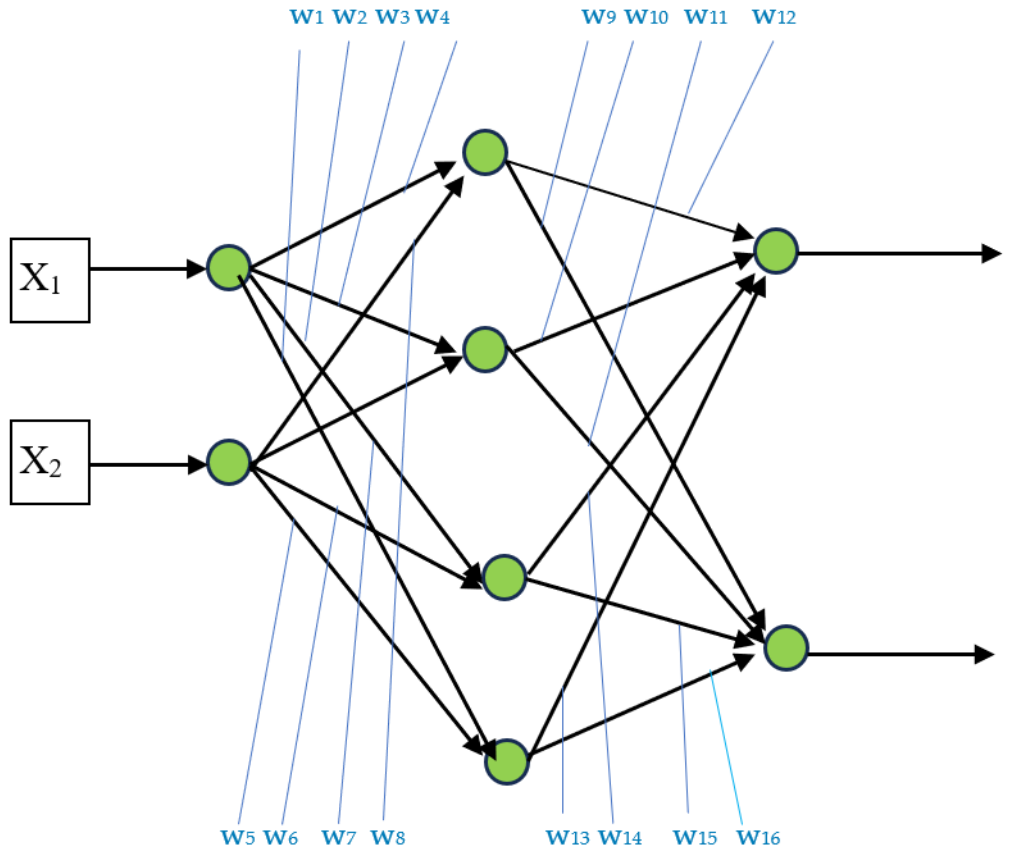
Figure 2.
The Moore (a) and von Neumann (b) neighborhoods. The grey reference cell is located at the center.
Figure 2.
The Moore (a) and von Neumann (b) neighborhoods. The grey reference cell is located at the center.
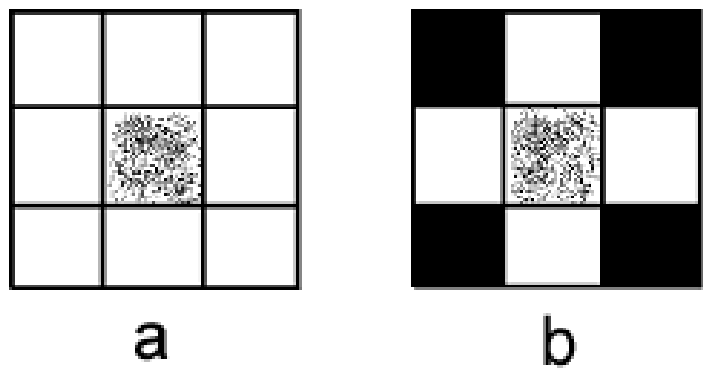
Figure 3.
In the additive synthesis (light/screens) of green and red, yellow is obtained, illustrating an example of the elementary effect of combining two ANNs, where the superimposed shared node-neuron  simultaneously having green and red roles, produces the resulting yellow links
  .
.
simultaneously having green and red roles, produces the resulting yellow links .
Figure 3.
In the additive synthesis (light/screens) of green and red, yellow is obtained, illustrating an example of the elementary effect of combining two ANNs, where the superimposed shared node-neuron simultaneously having green and red roles, produces the resulting yellow links .
simultaneously having green and red roles, produces the resulting yellow links .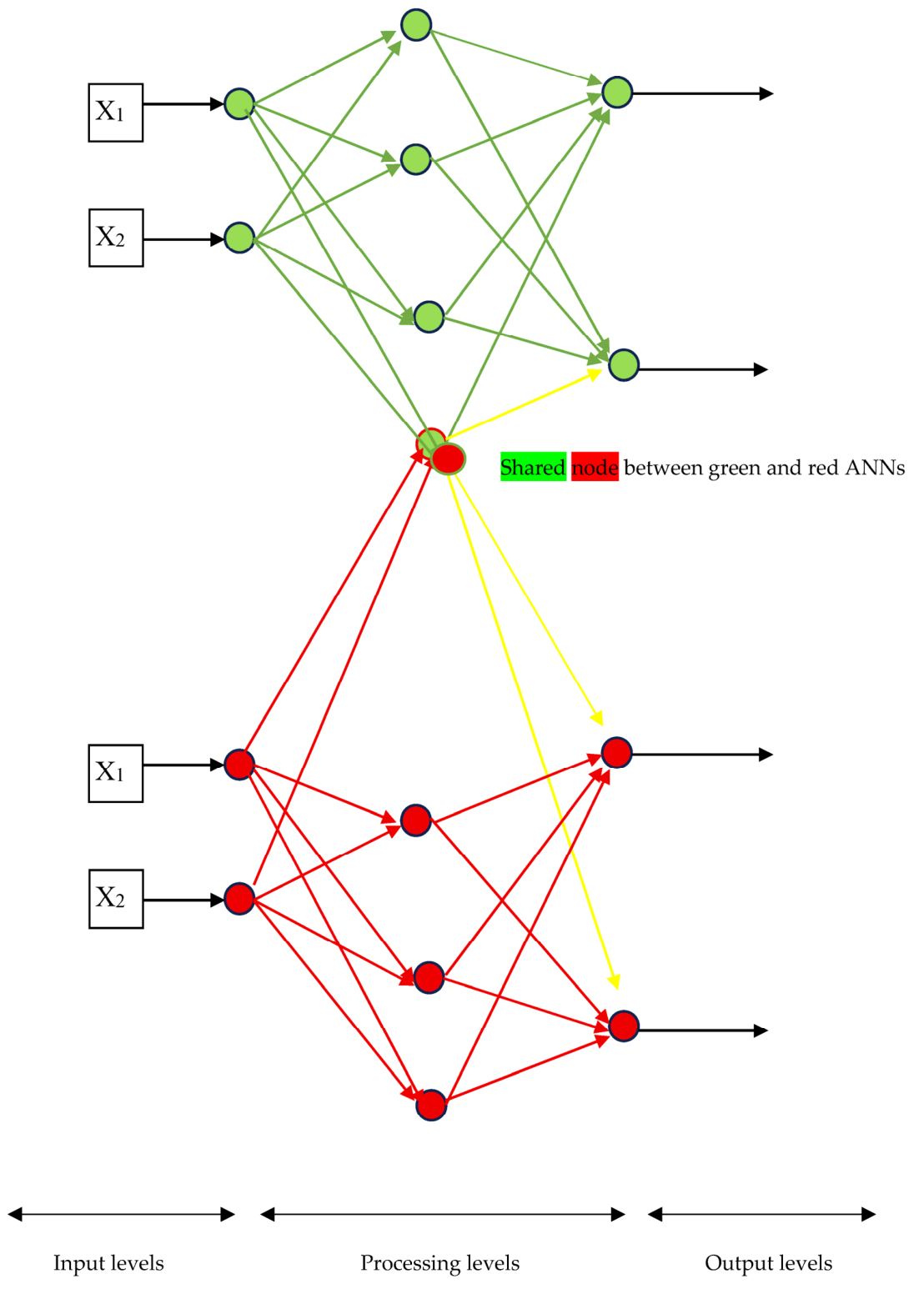
Figure 4.
An elementary schema in which nodes and shared nodes of neural networks (red, green, and yellow) are also nodes of a network indicated in black.
Figure 4.
An elementary schema in which nodes and shared nodes of neural networks (red, green, and yellow) are also nodes of a network indicated in black.
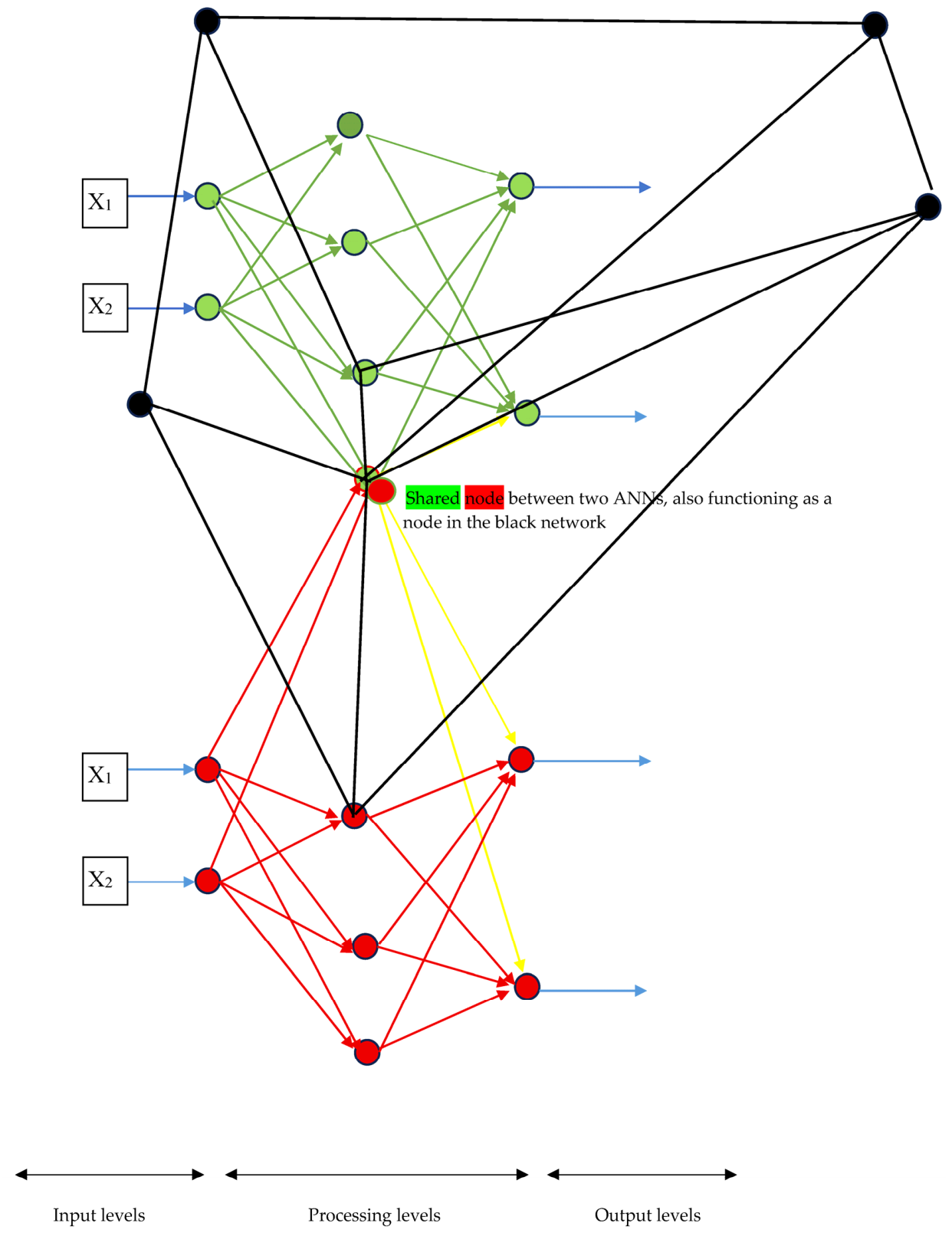
Figure 5.
An elementary schema indicating:  Areas with prevalent EC computation;
  Areas with prevalent CE computation;
  Areas with combinations of CE and EC.
Areas with prevalent EC computation; Areas with prevalent CE computation; Areas with combinations of CE and EC.
Figure 5.
An elementary schema indicating: Areas with prevalent EC computation; Areas with prevalent CE computation; Areas with combinations of CE and EC.
Areas with prevalent EC computation; Areas with prevalent CE computation; Areas with combinations of CE and EC.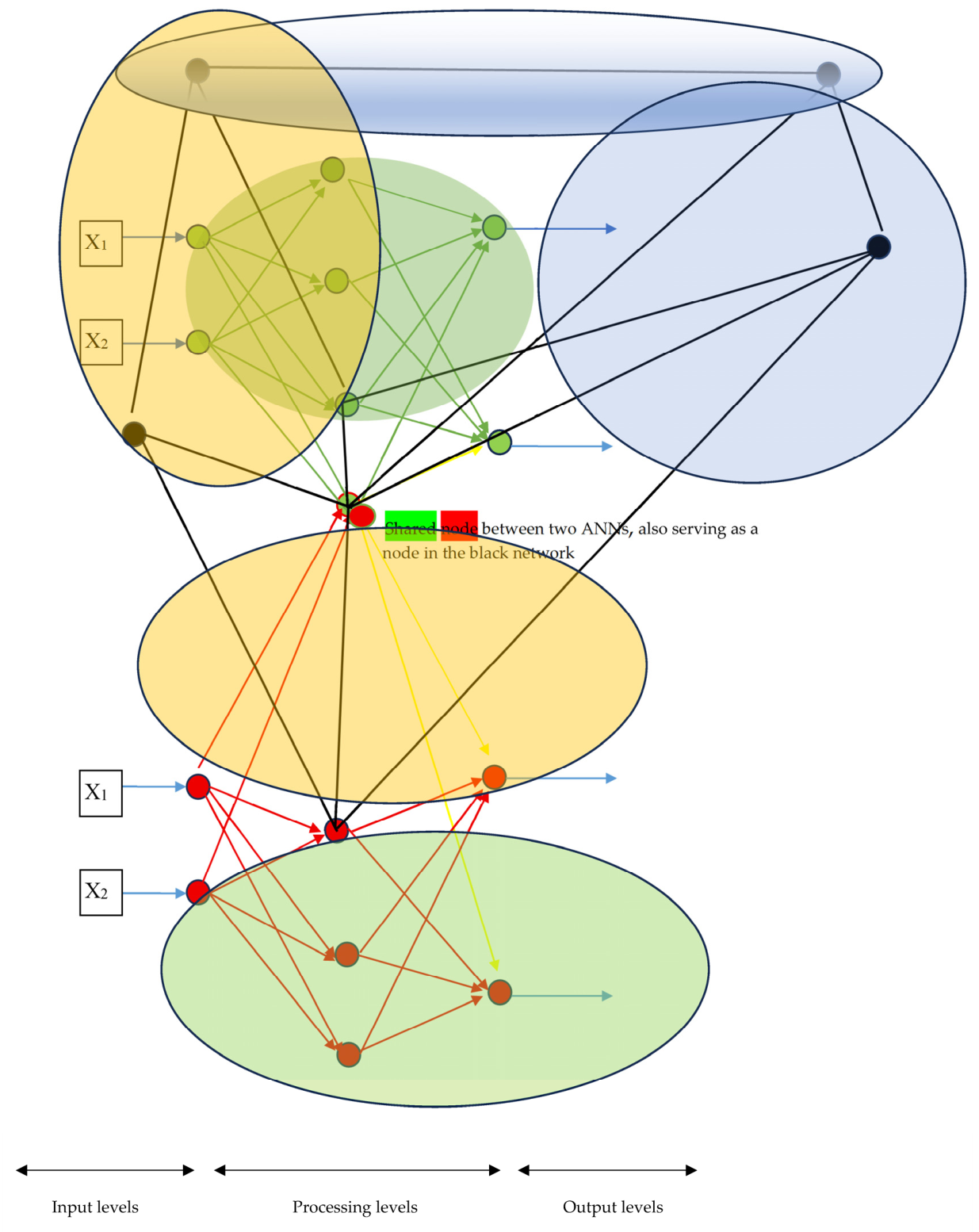

Table 1.
Computational emergence (CE) and Emergent computation (EC).
| Computational Emergence (CE) | Emergent Computation (EC) |
|---|---|
| Computational mechanisms generating emergent phenomena and properties, e.g., learning abilities | Phenomenological mechanisms generating emergent phenomena as behavioral properties, including computational ones, e.g., decision-making and optimization |
Table 2.
CE due to computational mechanisms and examples of acquired properties.
| Computational mechanisms | |
| Leading to the emergence of non-computational properties (self-referential, closed nature) | Leading to the emergence of computational properties, i.e., ability to perform acquired computational abilities by processing external environmental data (non-self-referential, open nature) |
| Examples of computational mechanisms | |
| - artificial life - deterministic chaos - fractality - morphogenesis - three-body problem |
- Cases of sub-symbolic computation: - artificial neural networks (ANNs) and connectionist models - cellular automata (CA) |
| Examples of emergent acquired properties | |
| Non-computational | Computational |
|
|
Table 3.
Examples of artificial network and CA properties involved in generating CE.
| Examples of Artificial Network Properties | Examples of CA Properties |
|---|---|
Examples of network properties involved in generating CE, allowing, for instance, machine learning and cataloguing, include:
|
Examples of CA properties involved in generating CE, allowing, for instance, simulation of phenomena such as fluid dynamics, biological pattern formation, landslides, and earthquakes, include: Local properties:
|
Table 4.
Examples of network and collective emergence mechanisms.
| Examples of Network Emergence Mechanisms in Networks | Examples of Emergence Mechanisms in Collective Interactions |
|---|---|
| Networks tend to evolve through simple yet powerful mechanisms such as preferential attachment, often conceptualized as a “rich-get-richer” phenomenon. These processes give rise to emergent behaviors across multiple levels of the network, creating a bridge between local, small-scale interactions and global, system-wide properties. Examples of network emergence include: (1) small-world networks, which exhibit high clustering and short path lengths, often observed in social and technological systems. (2) ANNs which improve performance and develop specialized capabilities involving multiple layers and weighted connections. (3) social networks that form communities and groups through local connection dynamics such as mutual acquaintances or shared relationships—for instance, the “friends of friends” principle. | Emergent phenomena occur when complex behaviors or patterns arise from simple, locally defined interaction rules. This is illustrated in systems such as ant colonies, which rely on local chemical signaling, and bird flocks, driven by simple collision avoidance and alignment principles. In graphical models of bird flocks, typical rules include: (1) a separation rule, where each individual adjusts its motion to avoid overcrowding; (2) an alignment rule, where individuals synchronize their direction of motion with the average direction of nearby neighbors; and (3) a cohesion rule, where individuals modify their position to remain close to the average position of their neighbors. Another notable example involves CA, where simple evolutionary rules generate complex, organized patterns and computational properties. A classic rule states that a cell becomes black (1) if its immediate left and right neighbors differ, and white (0) if they are identical. Through repeated iterations, this rule produces a fractal-like pattern resembling the Sierpiński triangle. |
Table 5.
Emergences: the generated EC and CE.
| Collective, networked, and CE | ||
| Phenomenological collective emergence | Network emergence | CE—specifies the nature of the interaction process generating emergence, i.e., computational |
| Physical emergence is understood to occur when agents interact in several ways and maintain significant levels of coherence, such as cognitively through information exchange and processing, and physically through energy and matter exchange and processing. Distributed physical collective emergent systems acquire overall properties, such as behaviors, forms, and structural dynamics, e.g., ecosystems, swarms, and flocks. Examples include whirlpools, hurricanes, ant colonies, swarms, and flocks. |
Network emergence is understood to occur when nodes are linked in such a way as to establish scale-free structures, small-world properties, and degree correlations. Examples include dynamic networks, such as social, human, and biological communities modeled as networks. |
Computation is performed by specific kinds of neurological-like, networked, layered, multiple, variable, recursive, recurrent, weighted structures of computing agents-nodes-neurons in ANNs. CE is regarded as sub-symbolic because the processing is not explicit and cannot be recognized or anticipated stepwise. Intermediate steps cannot be suitably understood as microscopic computational steps. The computation does not lead to results, but rather to the acquisition of properties, such as the ability to learn from examples. Examples include computational processing by individual nodes of the input through multiple-layered, weighted links between computing neurons in ANNs, and local transition rules in CA, leading to the acquisition of emergent properties. |
| EC | Emergence as an acquired property through computation (CE) | |
| EC specifies the nature of the acquired emergent property, i.e., computational. EC is performed by collective, coherence-oriented communities of interacting and networked computing agents-nodes, where there is distributed input, distributed processing, and distributed output. Examples of acquired emergent properties include decision-making, strategy-based abilities, and swarm intelligence. |
CE is performed by specific kinds of neurological-like, networked, layered, multiple, variable, recursive, recurrent, weighted structures of computing agents-nodes-neurons in ANNs. CE is regarded as sub-symbolic because the processing is not explicit and cannot be recognized or anticipated stepwise. Examples of acquired emergent properties include the ability to learn from examples, to catalog, and to generate coherent shapes. |
|
Table 6.
Phases of collective behaviors.
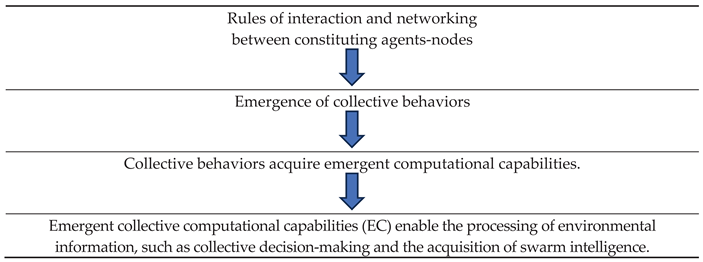 |
Table 7.
EC with low or high computational abilities.
| EC | |
|---|---|
| Computational mechanisms | |
| Leading to the emergence of low-level collective computational properties | Leading to the emergence of higher collective computational properties, i.e., the ability to perform acquired computational tasks to process external data |
| Examples of related emergence mechanisms | |
|
|
| Examples of acquired emergent computational properties | |
| Having low computational abilities | Having high computational abilities |
|
|
Disclaimer/Publisher’s Note: The statements, opinions and data contained in all publications are solely those of the individual author(s) and contributor(s) and not of MDPI and/or the editor(s). MDPI and/or the editor(s) disclaim responsibility for any injury to people or property resulting from any ideas, methods, instructions or products referred to in the content. |
© 2026 by the authors. Licensee MDPI, Basel, Switzerland. This article is an open access article distributed under the terms and conditions of the Creative Commons Attribution (CC BY) license (http://creativecommons.org/licenses/by/4.0/).
Copyright: This open access article is published under a Creative Commons CC BY 4.0 license, which permit the free download, distribution, and reuse, provided that the author and preprint are cited in any reuse.


