

Submitted:
20 May 2026
Posted:
20 May 2026
Read the latest preprint version here
Abstract
Three coherent wave sources at 120◦ separation produce hexagonal interference patterns whose lattice constant reaches a minimum of a = 2λ/3, the rational fraction that also defines the charged-lepton Koide ratio Q = 2/3. Integer-wavelength resonances occur at sinθ = 2/(3N); at N = 3, exactly three wave lengths fit per cell, suggesting a geometric interpretation of the same rational value 2/9 that appears as Shulga’s compact-cycle offset in the charged-lepton spectrum. The geometric-mean interpolation between adjacent resonance scales is modeled on the Dykhne effective-medium theorem for two-phase Z2-symmetric boundaries. These condensed-matter structures (C3 phase cancellation, standing-wave resonance, and effective-medium interpolation) motivate a companion identity (the Fidentity) that reduces to the classical Descartes circle theorem at Q = 2/3. Applied to charged-lepton masses with a single input µ⋆ = mℓ = 1883.1 MeV, the construction yields closed-form candidate expressions for three light-quark masses (ms, md, mu), with internal self-consistency at 0.06% and an up-quark value mu = 2.22 MeV (+0.23σ from PDG, within current uncertainties). Whether these correspondences between wave interference geometry and the fermion mass spectrum reflect an underlying physical connection or are structural parallels between C3 × Z2 systems is an open question that we propose merits investigation.
Keywords:
Koide relation
; light-quark masses
; fermion mass spectrum
; C3 symmetry
; three-beam interference
; Descartes circle theorem
; Dykhne effective-medium theorem
; Berry phase
; geometric mean cascade
; Z2 symmetry
1. Introduction
Three coherent beams separated by produce hexagonal intensity patterns: a standard result in interference lithography [1,2]. The lattice constant is , reaching a minimum of at grazing incidence. The mathematical toolkit underlying this result ( phase cancellation, geometric means of transport coefficients, Berry phases on compact cycles) is native to condensed matter [3,4,5,6]; cross-domain applications of these tools to particle physics have been explored at book length by Volovik [7].
The same phase-cancellation identities that govern three-beam interference also enforce in the charged-lepton parametrization. When evaluated on lepton masses, the resulting algebraic carrier yields closed-form candidate expressions for light-quark masses. This paper develops the interference geometry first, on its own condensed-matter terms, and then notes that the resulting mass relations match particle data at the sub-percent level.
The approach is deliberately narrow: if the geometric relations survive further tests, they could serve as analytic anchors for cross-domain work. If they do not, the interference geometry stands on its own as a structure with integer resonances. The Koide relation has been addressed via family gauge symmetry [8] and compact-cycle Berry phase [9]; the present approach uses neither, relying instead on interference geometry. We make no claim to a fundamental theory of fermion masses; we observe that the mathematical structures organizing these relations are familiar from condensed matter and report the numerical correspondences.
2. Phase Cancellation
Place identical sources at intervals on a circle. Three coherent beams at these angles produce an intensity pattern whose structure follows from two trigonometric identities that hold for any offset :
where . The first identity encodes the phase cancellation underlying the hexagonal pattern; the second fixes the quadratic normalization.
Writing the intensity at each sampling point as [19,27]
the total intensity is (by Eqs. 1–), and the ratio
is forced by the identities alone. The coefficient is simultaneously fixed: requiring gives . Neither Q nor is fitted. The parametrization (3) can be viewed as an algebraic realization of the identities; whether it corresponds to a physical interference pattern in an internal space is an open question. Throughout, denotes the positive branch; the identity is exact for signed roots, and the charged-lepton sector uses the branch where .
A factor at each position distinguishes the two signs of , giving a sixfold structure. Rivero [10] independently showed that the eigenvalue condition with and forces .
3. Resonance Conditions
The hexagonal lattice constant from three-beam interference is [1]
Integer-wavelength resonances, , occur at :
| N | Interpretation | ||
| 1 | 1 | (intensity ratio) | |
| 2 | 2 | sublattice doubling | |
| 3 | 3 | Three wavelengths per cell | |
| 6 | 6 | fully resolved |
The rational number appears in three distinct roles: as in the resonance table, as the Shulga orientation parameter in the charged-lepton spectrum, and as the compact-cycle Berry phase. The proposed connection is an equality of dimensionless rational values, not an identification of the physical incidence angle with the Koide phase.
Figure 1.
(a) Steady-state intensity for three cylindrical-wave sources at on a ring of radius , showing the interference pattern with sixfold visual symmetry. (b) At , additional fringes resolve between the primary arms, consistent with the row of the resonance table ( regime). Peak counts follow the sequence as increases, adding three peaks per step in the numerical examples studied here. Each resolved interference ring contributes one peak per source. (c) The geometric-mean cascade from to , with ring closure.
Figure 1.
(a) Steady-state intensity for three cylindrical-wave sources at on a ring of radius , showing the interference pattern with sixfold visual symmetry. (b) At , additional fringes resolve between the primary arms, consistent with the row of the resonance table ( regime). Peak counts follow the sequence as increases, adding three peaks per step in the numerical examples studied here. Each resolved interference ring contributes one peak per source. (c) The geometric-mean cascade from to , with ring closure.
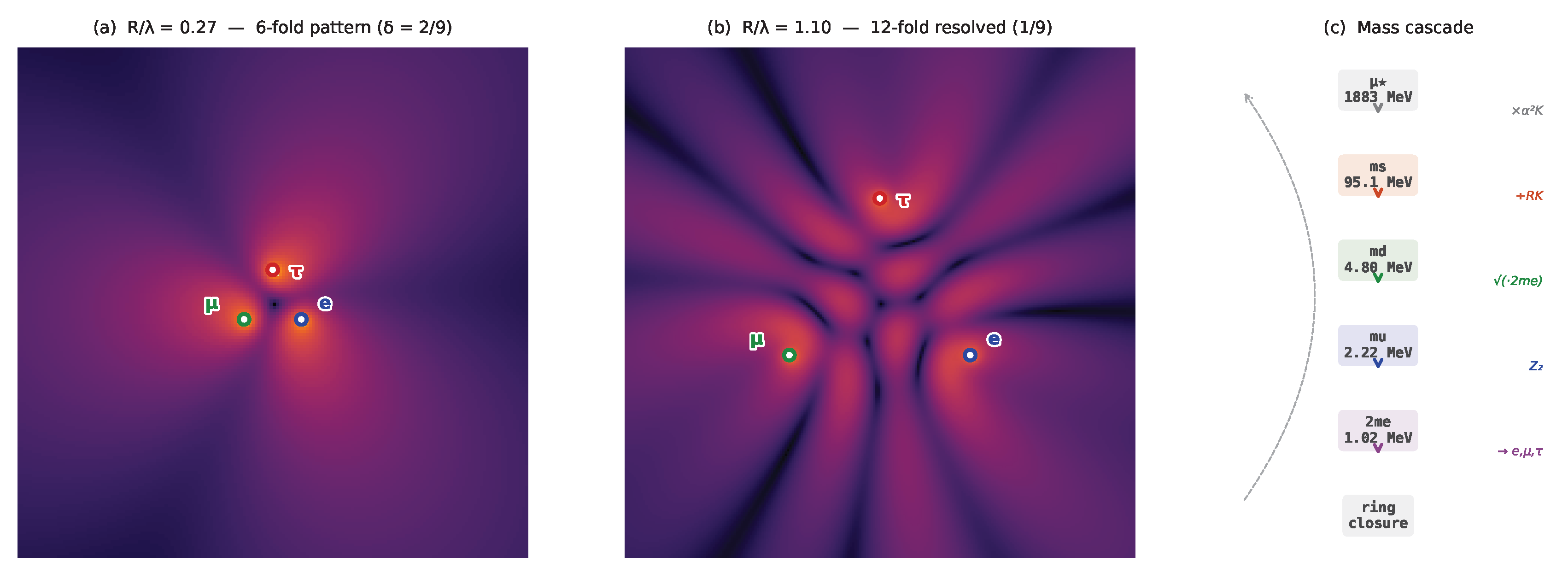
At , three standing-wave antinodes fit inside one lattice cell. Numerical simulation of three cylindrical-wave point sources (2D Helmholtz equation, equal amplitude , wavelength grid units, exponential damping with ) on a ring of radius R illustrates this: at , six intensity peaks appear at spacing. Doubling R resolves the sublattice structure, doubling the peak count and halving the sector width to . Simulation code is available at https://github.com/AndBrilliant/quarkscrew.
Shulga [9] independently derived as a Berry phase on a compact family cycle, from integrating out higher Fourier harmonics on an internal circle. The resonance interpretation proposed here reads the same rational value as a boundary-condition analogue: the cycle accommodates three wavelengths, suggesting three selected modes. Shulga’s compact-cycle calculation remains the derivation of ; the resonance picture is a geometric correspondence. All prior Berry-phase-fixes-an-observable examples in condensed matter (TKNN, Zak, Jauregui; see Xiao et al. [11] for a review) give integer or -rational values; a non-integer rational like is, to our knowledge, without CM precedent outside Shulga’s construction. Until Shulga’s result is independently verified, the lepton-mass expressions should be regarded as a one-parameter fit to .
3.1. Quark-Sector Offsets
Żenczykowski [12] observed that quark-sector offsets are fractions of :
with the charge as the selection factor. In the interference picture, corresponds naturally to the row, where the full structure is resolved.
4. Effective Medium: Geometric Means
Dykhne [4] proved that for a two-dimensional isotropic two-phase system with equal area fractions, the effective transport coefficient is exactly the geometric mean:
This is a theorem, not an approximation; variational bounds by Hashin and Shtrikman [13] show that the geometric mean is the exact attainable optimum for such systems.
The Dykhne theorem applies to transport coefficients in two-phase media; it does not, in itself, apply to fermion masses. We borrow only the geometric-mean functional form as an ansatz for interpolation between adjacent resonance scales:
treating adjacent scales as if they were the two self-dual boundary values. Whether a valid physical mapping exists between the effective-medium setting and the fermion mass hierarchy is an open question; the ansatz is adopted here because it is the simplest interpolation consistent with the structure and because it reproduces the data. The pair-production threshold enters as the base unit: the minimum energy at which mass is created from the electromagnetic field.
5. A Companion Identity
The phase cancellation and the Dykhne interpolation suggest a natural companion quantity. Given any three intensities , define
The companion uses only addition, square roots, and subtraction.
The Descartes circle theorem [14,15] gives a companion via curvatures : . Writing , , , the Soddy formula subtracts ; the F-identity subtracts . They agree when :
This is proved in Sec. Section 2: the cancellation forces identically. The companion identity therefore reduces to the Descartes circle theorem as a consequence of the interference geometry.
The identification as a curvature variable was noted by Kocik [16]. In condensed matter, is standard [3]; Satija [17] showed that the integer Apollonian gasket maps onto the Hofstadter butterfly energy spectrum, with curvatures encoding quantum Hall conductivities; this establishes a precedent for Descartes-type circle geometry appearing as a physical energy spectrum.
From :
where . The cascade ratio
is unitless and independent of .
6. Correspondence with Charged-Lepton Masses
The Koide relation [18,19] for charged-lepton pole masses,
has held to one part in for forty-four years and is approximately RG-invariant [20]. Setting MeV and in Eq. 3 reproduces , , and to four significant figures.
The companion evaluates to
All comparisons use PDG 2024 / FLAG 2024 values as a frozen reference convention. Comparison with PDG 2024 [21], run to via four-loop (RunDec 3 [22], , ):
The companion of the charged-lepton intensity pattern lies on the strange-quark mass at within current uncertainties. This coincidence is empirical; the interference model does not predict which particle the companion should match. Among QCD mass scales below 1 GeV, only falls within the band of ; the pion decay constant MeV lies below, and no meson, baryon, or other quark mass falls within .
7. Light-Quark Cascade
The geometric-mean cascade motivated by the Dykhne construction (Eqs. 8–) gives:
PDG 2024 gives MeV (). QED corrections for charge- quarks reach (Appendix A), giving MeV systematic. The relation selects MeV. The quoted MeV scale reflects the estimated size of the missing QED correction (QED is not applied; see Appendix A), not an experimental uncertainty. The deviation is computed in a QCD-only scheme against PDG values.
The prediction chain forms a loop:
The light-quark sum, pair-normalized, is empirically close to , with the light-quark hierarchy 20 approximated by the Koide–Soddy cascade ratio :
8. Cross-Checks
The tau-slice: applying the F-identity to at the mass scale gives . Using PDG running masses directly (no cascade input, with and taken from external running-mass tables rather than from Eqs. 8–), the agreement is ; using cascade-derived run to , the agreement is . The first uses no cascade-derived quantities and thus tests the algebraic consistency of the F-identity with externally measured running masses; the second is a self-consistency check of the cascade itself.
A separately preregistered Monte Carlo analysis [25] tests the null hypothesis that a random Koide-compatible lepton spectrum (, random ) produces an residual as small as the observed MeV. Under four independent priors (log-uniform, log-normal, Yukawa anarchy, and linear uniform on ), the probability is in all cases. A look-elsewhere correction over 24 natural mass functions (ratios, roots, sums) reduces the effective significance by a factor of . The analysis has not yet been independently scrutinized and is cited as supporting evidence, not as a standalone result. Pre-registered predictions are archived at [26]. An earlier version of this work appeared as [28].
9. Frozen-Input Outputs and Comparisons
The outputs are chained: determines , which determines . No free parameters buffer a discrepancy at any link.
Predictions were archived at Zenodo [26] prior to PDG 2026; any drift relative to updated PDG/FLAG values will be reported without retrofitting. The current agreements are suggestive but not yet decisive: the u and d quark masses carry large uncertainties (PDG quotes for , for ), and the cascade values fall well within these bands. The true test is convergence: as lattice QCD+QED determinations sharpen over the next several years, the cascade outputs are fixed point values that will either be confirmed or excluded. Only that convergence, not the present-day overlap, can discriminate the construction from coincidence.

Table 1.
Six masses from closed-form expressions. Input: . The lepton masses () are reproduced by construction via and ; they are inputs, not predictions. The quark masses () are the testable outputs.
Table 1.
Six masses from closed-form expressions. Input: . The lepton masses () are reproduced by construction via and ; they are inputs, not predictions. The quark masses () are the testable outputs.
| Closed-form | Pred. | PDG/FLAG | Dev. | |
|---|---|---|---|---|
| 1776.93 | 1776.93 | |||
| 105.66 | 105.66 | |||
| e | 0.5110 | 0.5110 | ||
| s | 95.12 | |||
| d | 4.804 | |||
| u | 2.216 |
10. Discussion
The central observation is that phase cancellation, standing-wave resonance, and Dykhne effective-medium interpolation, all standard condensed-matter constructions, organize a set of algebraic identities whose numerical values match the light-fermion mass spectrum. The F-identity companion at reduces to the Descartes circle theorem; the resonance condition gives a geometric counterpart to ; the Dykhne geometric mean motivates the quark cascade.
This construction does not provide a Lagrangian or dynamical mechanism, nor does it conflict with one. The Standard Model accommodates fermion masses through Yukawa couplings that are free parameters; the present work observes that six of those parameters are matched by closed-form geometric relations motivated by interference geometry. The construction constrains the Yukawa sector rather than competing with it.
Whether the fermion mass spectrum ultimately reflects an interference pattern on an internal compact space, or whether the numerical correspondences are structural parallels between systems with no dynamical connection, remains open. We propose it merits investigation.
Acknowledgments
The author thanks A. Rivero for critical correspondence on the Koide relation; K. Shulga for deriving within a compact-cycle framework [9]; C. A. Brannen for the cosine parametrization; J. Kocik for the Descartes-circle reading [16]; R. Foot for the cone interpretation [27]; and Y. Sumino for the radiative protection mechanism.
Conflicts of Interest
The authors declare no conflicts of interest.
Use of Artificial Intelligence
AI tools were used for programming assistance and document editing. The scientific claims, calculations, code outputs, and final text were reviewed and approved by the author.
Appendix A. Mass Running Procedure
Light quark masses are compared at MeV. PDG 2024 reference values at 2 GeV [21]: MeV, MeV, MeV.
The scheme- and scale-independence of light-quark mass ratios was established by Gasser and Leutwyler [29]; running from 2 GeV to uses four-loop QCD evolution (RunDec 3 [22], version 3.1) with , active flavors, charm threshold at GeV. No flavor thresholds are crossed in the interval .
QED corrections are not applied. For charge- quarks (d, s) these are sub-per-mille. For charge- quarks (u), QED effects can reach and represent the dominant systematic uncertainty in the comparison.
The ratio is RG-invariant for same-charge quarks under QCD. FLAG 2024 [24] reports and for , giving .
Numerical verification is available at https://github.com/AndBrilliant/quarkscrew. References
References
- de Boor, J.; Geyer, N.; Gösele, U.; Schmidt, V. Three-beam interference lithography: upgrading a Lloyd’s interferometer for single-exposure hexagonal patterning. Opt. Lett. 2009, 34, 1783–1785. [Google Scholar] [CrossRef]
- Hecht, E. Optics, 5th ed.; Pearson: Boston, MA, USA; Chapter 9, 2017; ISBN 978-0-13-397722-6. [Google Scholar]
- Ashcroft, N.W.; Mermin, N.D. Solid State Physics; Holt, Rinehart and Winston: New York, NY, USA, 1976; Volume Chapter 12, ISBN 978-0-03-083993-1. [Google Scholar]
- Dykhne, A.M. Conductivity of a two-dimensional two-phase system. Sov. Phys. JETP 1971, 32, 63–65. Available online: http://www.jetp.ras.ru/cgi-bin/e/index/e/32/1/p63?a=list (accessed on 19 May 2026).
- Thouless, D.J.; Kohmoto, M.; Nightingale, M.P.; den Nijs, M. Quantized Hall conductance in a two-dimensional periodic potential. Phys. Rev. Lett. 1982, 49, 405–408. [Google Scholar] [CrossRef]
- Kane, C.L.; Mele, E.J. Z2 topological order and the quantum spin Hall effect. Phys. Rev. Lett. 2005, 95, 146802. [Google Scholar] [CrossRef]
- Volovik, G.E. The Universe in a Helium Droplet; Oxford University Press: Oxford, UK, 2003; ISBN 978-0-19-850782-6. [Google Scholar]
- Sumino, Y. Family gauge symmetry and Koide’s mass formula. Phys. Lett. B 2009, 671, 477–480. [Google Scholar] [CrossRef]
- Shulga, K. Charged-lepton Koide geometry from a Green-dressed compact family cycle. arXiv 2026, arXiv:2605.10245. [Google Scholar]
- Rivero, A. A new Koide tuple: strange-charm-bottom. arXiv 2011, arXiv:1111.7232. [Google Scholar] [CrossRef]
- Xiao, D.; Chang, M.-C.; Niu, Q. Berry phase effects on electronic properties. Rev. Mod. Phys. 2010, 82, 1959–2007. [Google Scholar] [CrossRef]
- Żenczykowski, P. Remark on Koide’s Z3-symmetric parametrization of quark masses. Phys. Rev. D. 2012, 86, 117303. [Google Scholar] [CrossRef]
- Hashin, Z.; Shtrikman, S. A variational approach to the theory of the elastic behaviour of multiphase materials. J. Mech. Phys. Solids 1963, 11, 127–140. [Google Scholar] [CrossRef]
- Soddy, F. The kiss precise. Nature 1936, 137, 1021. [Google Scholar] [CrossRef]
- Lagarias, J.C.; Mallows, C.L.; Wilks, A.R. Beyond the Descartes circle theorem. Am. Math. Mon. 2002, 109, 338–361. [Google Scholar] [CrossRef]
- Kocik, J. The Koide lepton mass formula and geometry of circles. arXiv 2012, arXiv:1201.2067. [Google Scholar] [CrossRef]
- Satija, I.I. A tale of two fractals: the Hofstadter butterfly and the integral Apollonian gaskets. Eur. Phys. J. Spec. Top. 2016, 225, 2533–2547. [Google Scholar] [CrossRef]
- Koide, Y. A fermion-boson two-body model of quarks and leptons and Cabibbo mixing. Lett. Nuovo Cim. 1982, 34, 201–205. [Google Scholar] [CrossRef]
- Koide, Y. New view of quark and lepton mass hierarchy. Phys. Rev. D. 1983, 28, 252–254. [Google Scholar] [CrossRef]
- Li, N.; Ma, B.-Q. Energy scale independence of Koide’s relation for quark and lepton masses. Phys. Rev. D. 2006, 73, 013009. [Google Scholar] [CrossRef]
- Navas, S.; et al. [Particle Data Group]. Review of particle physics. Phys. Rev. D. 2024, 110, 030001. [Google Scholar] [CrossRef]
- Herren, F.; Steinhauser, M. Version 3 of RunDec and CRunDec. Comput. Phys. Commun. 2018, 224, 333–345. [Google Scholar] [CrossRef]
- Leutwyler, H. The ratios of the light quark masses. Phys. Lett. B 1996, 378, 313–318. [Google Scholar] [CrossRef]
- Aoki, Y.; et al. [Flavour Lattice Averaging Group]. FLAG review 2024. Phys. Rev. D. 2026, 113, 014508. [Google Scholar] [CrossRef]
- Brilliant, A.M. Pre-registered Monte Carlo protocols for the outer Soddy–Koide numerical observation. Zenodo 2026. [Google Scholar] [CrossRef]
- Brilliant, A.M. Pre-Registered Fermion Mass Predictions for comparison with PDG 2026. Zenodo 2026. [Google Scholar] [CrossRef]
- Foot, R. A note on Koide’s lepton mass relation. arXiv 1994, arXiv:hep. [Google Scholar]
- Brilliant, A.M. Why Q=2/3: pair production and the F-identity in the fermion mass spectrum. Preprints 2026, 2026040693. [Google Scholar] [CrossRef]
- Gasser, J.; Leutwyler, H. Quark masses. Phys. Rep. 1982, 87, 77–169. [Google Scholar] [CrossRef]
Disclaimer/Publisher’s Note: The statements, opinions and data contained in all publications are solely those of the individual author(s) and contributor(s) and not of MDPI and/or the editor(s). MDPI and/or the editor(s) disclaim responsibility for any injury to people or property resulting from any ideas, methods, instructions or products referred to in the content. |
© 2026 by the authors. Licensee MDPI, Basel, Switzerland. This article is an open access article distributed under the terms and conditions of the Creative Commons Attribution (CC BY) license (http://creativecommons.org/licenses/by/4.0/).
Copyright: This open access article is published under a Creative Commons CC BY 4.0 license, which permit the free download, distribution, and reuse, provided that the author and preprint are cited in any reuse.


