

Submitted:
20 May 2026
Posted:
20 May 2026
You are already at the latest version
Abstract
International Political Economy (IPE) confronts a moment of genuine intellectual reckoning. The theoretical frameworks that defined discipline during the three decades following the Cold War—anchored in liberal assumptions concerning convergence, institutionalized cooperation, and the pacifying logic of economic interdependence, are increasingly strained by a world they were not constructed to explain. The 2020s have delivered a compounding cluster of structural disruptions: systemic rivalry between liberal and non-liberal states, the existential imperatives of climate change and the distributional politics of the green energy transition, the deliberate weaponization of economic interdependence as an instrument of statecraft, the emergence of an intangible platform economy that defies established regulatory categories, and the deepening entanglement of geopolitics with international finance. Against this backdrop, this paper identifies and analyzes five foundational research gaps that collectively define the frontier of contemporary IPE scholarship: (a) the retreat of liberal ontology and the ascendance of non-liberal economic orders; (b) the material politics of climate change and the green transition; (c) the return of interstate war and the re-militarization of economics; (d) the analytical challenge of digital sovereignty and the intangible economy; and (e) the imperative to re-center politics in the study of global finance. Drawing on a systematic synthetic literature review and comparative conceptual analysis, the paper integrates twenty-three analytical tables and two original figures. These visual instruments function not as summaries but as structured devices for mapping conceptual terrain that prose description alone cannot fully render. The paper argues that none of these gaps can be addressed through incremental refinement of existing frameworks; each requires a more fundamental rethinking of the ontological and epistemological commitments that have shaped IPE over five decades. Addressing them demands genuine methodological pluralism—the productive integration of quantitative, formal, qualitative, and historical approaches. The crisis of relevance confronting IPE is real, yet it is simultaneously an opportunity to construct a discipline more intellectually honest and analytically adequate to the world it seeks to explain.
Keywords:
International Political Economy
; liberal order
; great-power competition
; climate transition
; critical minerals
; industrial policy
; digital sovereignty
; intangible economy
; financial sanctions
; de-dollarization
; weaponized interdependence
; platform power
; methodological pluralism
; geopolitical economy
; state capitalism
1. Introduction
There is something quietly ironic about the intellectual predicament in which International Political Economy (IPE) now finds itself. For roughly three decades following the Cold War's end, the discipline invested considerable energy in refining theories of cooperation, liberalization, and institutional design—theoretical projects premised, whether explicitly or implicitly, on the assumption that world politics was moving in a broadly liberal direction. Fukuyama's (1992) "end of history" was not a thesis that serious scholars endorsed without qualification, yet it supplied the horizon against which the field's questions were formulated and its answers evaluated. Trade liberalization, financial openness, and the institutionalization of interstate cooperation were treated not merely as objects of analysis but as the presumed trajectory of world politics itself (Cohen, 2019; Ikenberry, 2018).
That trajectory now appears both doubtful and, in important respects, retrospectively illusory. The past decade has confronted IPE with a convergence of developments that challenge not only specific theoretical claims but the foundational assumptions from which those claims derived. China has emerged not as a liberal power gradually integrating into the existing order but as a systemic rival deliberately constructing alternatives to it (Hopewell, 2021; Weiss & Wallace, 2021). Multilateral institutions have become sites of geopolitical contestation rather than platforms for consensual governance (Cooley & Nexon, 2020). Economic interdependence—once theorized as a structural pacifier—has been weaponized by states seeking coercive leverage over adversaries (Drezner et al., 2021; Farrell & Newman, 2019, 2023). Climate change has elevated resource politics from a peripheral concern to a structural determinant of interstate competition (Bridge, 2022; Newell, 2021). Digital technologies have generated forms of power and vulnerability that existing IPE categories were never designed to capture (Haskel & Westlake, 2017; Zuboff, 2019). And war returned to Europe in February 2022, delivering the uncomfortable reminder that economics and security were never as neatly separable as the field had assumed (Tooze, 2021).
The intellectual challenge this convergence poses is not merely empirical. It is theoretical and ontological. The dominant traditions in IPE were organized around a vision of political economy reflecting specific historical conditions. As Ruggie's (1982) foundational analysis demonstrated, the postwar international economic order rested on a carefully constructed political bargain: the reconciliation of international openness with domestic social stability, sustained by American hegemony and underwritten by a shared commitment among Western states to managed capitalism. Strange (1988), approaching the same period from a different analytical angle, identified the structural dimensions of American power—in finance, production, security, and knowledge—as what made the liberal order genuinely systemic rather than merely institutional. These insights described a specific historical configuration, not universal theoretical truths from which policy and prediction could be indefinitely derived.
Against this backdrop, this paper advances a straightforward but consequential argument: IPE is experiencing a crisis of relevance, not because its analytical tools are inherently invalid but because the empirical phenomena those tools were designed to explain are undergoing rapid structural transformation (Cohen, 2019; Helleiner, 2021). The field must confront five foundational research gaps that represent not incremental extensions of existing programs but fundamental challenges to IPE's core categories of state, market, power, institution, and development. Addressing them requires new empirical research alongside a reconsideration of the ontological and epistemological commitments that have shaped the field over the past half-century.
The paper proceeds as follows. Section 2 reviews theoretical literature and contextualizes the five gaps within the field's intellectual history. Section 3 outlines the research methodology. Section 4 presents the data analysis and findings for each gap. Section 5 discusses the interconnections among the gaps and their broader analytical implications. Section 6 offers recommendations for further research and concludes.
2. Literature Review
The literature review surveys on the intellectual evolution of International Political Economy (IPE), highlighting how the field’s foundational liberal frameworks—focused on institutional cooperation, market openness, and the pacifying effects of economic interdependence—have come under increasing strain in the face of contemporary global disruptions. Drawing on landmark works and recent scholarship, this section traces the construction and consolidation of liberal IPE, examines the growing cracks in established paradigms following the global financial crisis and the rise of non-liberal economic models, and identifies five urgent research gaps that now define the frontier of IPE inquiry. By contextualizing these developments within the discipline’s broader theoretical history, the review sets the stage for a critical analysis of how IPE must adapt to remain relevant amid rapidly changing geopolitical, technological, and environmental landscapes.
2.1. The Construction and Consolidation of Liberal IPE
International Political Economy emerged as a distinct academic discipline in the early 1970s from the recognition that the traditional boundaries between economics and political science were intellectually untenable (Cohen, 2007; Gilpin, 1987). The collapse of the Bretton Woods monetary system, the Organization of Petroleum Exporting Countries oil shocks, and the visible interpenetration of market forces and state power made clear that neither neoclassical economics nor conventional international relations theory could adequately explain global economic dynamics on its own. The discipline that emerged was institutionally hybrid, methodologically diverse, and theoretically contested, though its contestation took place within broadly liberal parameters.
The theoretical pillars that came to dominate mainstream American IPE were liberal institutionalism, hegemonic stability theory, and what Lake (2009) termed open economy politics. Keohane's (1984) After Hegemony constituted the foundational statement of liberal institutionalism's core argument: that states, despite operating in an anarchic international environment, could sustain cooperation through institution-building mechanisms that reduced transaction costs and enabled credible long-term commitments. Keohane and Nye (1977) had earlier demonstrated that complex interdependence, the multiplication of cross-border ties across state, societal, and transnational channels—transformed international politics in ways that classical realism's exclusive focus on military power could not accommodate. Gilpin (1987) provided a more skeptical account organized around the logic of hegemonic stability, arguing that open international economic orders require the leadership of a dominant state willing and able to provide the requisite collective goods.
What these frameworks shared, despite their differences, was a common liberal ontology. They treated the progressive institutionalization of international economic relations as both a descriptive tendency and a normative aspiration. Ruggie's (1982) concept of embedded liberalism, the postwar bargain reconciling international openness with domestic social protection—supplied the normative architecture within which these institutional projects made sense. Strange (1988) was among the most incisive internal critics of this consensus, arguing that power relations (both structural and relational) were systematically underweighted in liberal accounts of international order. Cox (1987) offered a more fundamental critique from a neo-Gramscian perspective, insisting that the liberal order was not a natural equilibrium but a historically specific hegemonic formation serving particular class interests. Despite these critical contributions, the field's dominant research programs through the 1990s and 2000s remained organized around liberal assumptions about the direction of global political economy (Blyth, 2009).
2.2. Cracks in the Liberal Framework
The 2008 global financial crisis marked a turning point, though its full theoretical implications for IPE took years to register. Helleiner's (2014) meticulous account of post-crisis financial governance documented a central paradox: despite the most severe financial disruption since 1929, the international regulatory response was reformist rather than transformative, preserving the basic architecture of financial globalization while adding macroprudential guardrails around it. Tooze (2018) situated the crisis within a broader account of how financial catastrophe reshaped political possibilities across the Atlantic, demonstrating that the connections among financial markets, state power, and democratic legitimacy were far more intimate and consequential than standard accounts of central bank independence and market self-regulation had acknowledged. These contributions revealed a field that had analytically separated finance and politics in ways that the crisis exposed as deeply misleading (Starrs, 2019).
The crisis of liberal order accelerated across the 2010s as phenomena that earlier frameworks had treated as marginal or temporary proved to be structural. Ikenberry (2018) acknowledged the depth of the challenge confronting the liberal international order while arguing for its normative resilience. Cooley and Nexon (2020) were more direct in their assessment: the American-led order was unraveling not merely because of domestic distributional failures but because states that had never fully accepted liberal norms were deliberately constructing alternative institutional frameworks. Slobodian's (2018) intellectual history of neoliberalism added an important analytical corrective, demonstrating that the liberal order had always been more about insulating market relations from democratic contestation than about extending democratic freedoms—a distinction that complicated both the standard narrative of liberal decline and the field's capacity to theorize the alternatives being constructed in its shadow.
China's developmental trajectory has proven the single most consequential development for IPE's theoretical adequacy. Naughton (2021) demonstrates that Chinese industrial policy from 1978 to 2020 constituted a genuinely distinctive developmental logic—one that strategically engaged with global markets while systematically building indigenous technological capabilities, maintaining state control over strategic sectors, and subordinating market rationality to political-economic objectives defined by the party-state. This was not a transitional developmental state converging toward liberal capitalism; it was a sophisticated alternative model of political economy demanding new theoretical tools (Hopewell, 2021; Weiss & Wallace, 2021). Musacchio et al. (2015) documented comparable dynamics across what they characterize as new varieties of state capitalism—in the Gulf states, Russia, and across emerging economies—identifying political-economic formations characterized by sophisticated management of the state-market boundary that neither the developmental state model nor the authoritarianism literature adequately captured. Babic et al. (2020) extend this line of inquiry by mapping the rise of transnational state capital, showing that state-owned enterprises and sovereign wealth funds have become major players in global investment markets in ways that reorganize the state-market distinction itself.
2.3. Identifying the Five Research Gaps
The literature surveyed above converges on recognition that IPE's existing frameworks, for all their analytical power, are inadequate to several urgent and interconnected research frontiers. First, the field lacks a systematic theory of non-liberal economic orders and their interactions with the residual liberal architecture (Babic et al., 2020; Cooley & Nexon, 2020; Naughton, 2021). Second, the political economy of climate change and the green transition remain underdeveloped relative to its structural significance (Meckling & Allan, 2020; Newell, 2021; Newell & Mulvaney, 2013). Third, the re-militarization of economics, the systematic weaponization of economic interdependence as a tool of statecraft—has outpaced the field's theoretical toolkit, with the weaponized interdependence framework offering a partial but incomplete analytical response (Drezner et al., 2021; Farrell & Newman, 2019, 2023). Fourth, the shift toward intangible capital and platform-based economic organization challenges virtually every established IPE category, from ownership and trade to regulation and development (Haskel & Westlake, 2017; Miller, 2022; Srnicek, 2017; Zuboff, 2019). Fifth, the political dimensions of finance—its distributional consequences, geopolitical entanglements, and implications for monetary sovereignty—remain inadequately integrated into mainstream IPE scholarship despite foundational contributions from Eichengreen (2011), Helleiner (2014), McDowell (2023), and Tooze (2018). Table 1 maps the conceptual disjuncture between traditional IPE assumptions and the realities these gaps expose, providing an analytical baseline for the paper's substantive argument.
Table 2 extends this assessment by situating the five gaps within a systematic evaluation of IPE's major theoretical frameworks, identifying the specific analytical limitations each faces in the contemporary context.
2.4. The Contemporary Research Landscape: A Critical Synthesis
Post-2019 scholarship has increasingly recognized that the challenges confronting IPE are systemic rather than sectoral. Drezner et al. (2021) argue that weaponized interdependence has become a generalized condition of global political economy rather than an exceptional use of economic tools. Kalyanpur and Newman (2019) demonstrate how jurisdictional expansion—particularly by U.S. regulatory agencies—has become a structural feature of contemporary economic statecraft. Miller's (2022) analysis of the semiconductor industry reveals how a single technology domain has become the linchpin of both economic competitiveness and geopolitical rivalry. McDowell (2023) documents the accelerating international backlash against dollar hegemony as sanctions fatigue catalyzes sovereign diversification strategies. Hopewell (2021) traces how U.S.–China rivalry has reconfigured the governance of global trade, with the World Trade Organization increasingly paralyzed by contestation among its most powerful members.
Table 3 synthesizes this recent scholarship against the five gaps identified in this paper, demonstrating the convergence across subfields on a shared recognition that the field's inherited categories require substantial reconstruction.
3. Methodology
This section outlines the research design and methodological approach guiding the study. Drawing on the interpretivist tradition within International Political Economy (IPE), the paper employs a qualitative strategy centered on systematic synthetic literature review. Through the integration of diverse scholarly contributions across subfields and disciplines, the methodology aims to identify emerging trends and theoretical gaps within contemporary global political economy. By combining comparative conceptual analysis, historical institutionalism, and structured conceptual mapping, the study provides a robust framework for examining complex transformations in economic, digital, and financial domains. This multifaceted approach ensures a comprehensive understanding of the field, facilitating the critical mapping of intellectual terrain necessary for advancing IPE scholarship.
3.1. Research Design and Epistemological Foundations
This paper adopts a qualitative research design grounded in the interpretivist tradition of IPE scholarship. Its primary method is systematic synthetic literature review—the structured integration of findings across subfields and adjacent disciplines to identify emergent research frontiers and the theoretical gaps they expose. This approach reflects what Spilker (2021) identifies as the growing recognition within IPE that the field's progress depends not only on the accumulation of individual empirical findings but on the periodic, critical mapping of the intellectual terrain that gives those findings meaning and direction.
The paper's epistemological position reflects what Blyth (2009) characterizes as critical realism within IPE—the view that social structures are real and exert causal force independently of individual knowledge of them, while acknowledging that understanding those structures is always mediated through theoretical frameworks. This position enables the productive integration of insights from both the American and British schools of IPE—the former's emphasis on formal models and causal identification alongside the latter's commitment to historical depth and structural critique—without collapsing the methodologically important distinctions between them (Cohen, 2007). The paper does not adjudicate between these traditions; it argues that their creative combination is analytically necessary given the complexity of the phenomena under analysis.
3.2. Multi-Method Synthetic Strategy
The analysis employs three complementary methodological strategies. First, systematic synthetic literature review integrates peer-reviewed articles, academic monographs, and edited volumes published between 1970 and 2025, with particular emphasis on post-2008 scholarship directly engaging with contemporary structural transformations in global political economy. Second, comparative conceptual analysis follows the tradition of historical institutionalism in IPE (Cox, 1987; Gilpin, 1987), identifying patterns of convergence and divergence across institutional configurations and policy contexts that reveal the analytical limits of existing frameworks. Third, structured conceptual mapping employs twenty-three analytical tables and two original figures deployed throughout the paper as instruments for systematic comparison across dimensions that discursive analysis tends to handle unevenly and incompletely.
Figure 1 depicts the integrated analytical logic of the study, linking the literature-review process to the identification of gaps and the construction of the research agenda.
3.3. Source Selection and Evaluation
The primary corpus comprises approximately 45 core scholarly works, selected from a larger review pool through a transparent filtering process. Source selection prioritized peer-reviewed publications in leading IPE and adjacent journals—including International Organization, International Security, Review of International Political Economy, New Political Economy, Global Environmental Politics, Annual Review of Political Science, International Affairs, and Journal of International Economics—alongside foundational monographs from major university presses. Policy research from recognized institutional sources supplements academic literature where contemporary policy debates are directly relevant to mapping research frontiers. Working papers and think-tank reports are included selectively where they represent the field's best current analytical thinking on rapidly evolving phenomena such as critical mineral geopolitics and digital monetary competition.
3.4. Scope and Limitations
Several limitations require explicit acknowledgment. The selection of five research gaps is itself an analytical and interpretive choice that reflects the authors' disciplinary vantage point; other configurations are possible and may carry equal justification. Synthetic analysis necessarily trades depth for breadth, and each gap examined here merits extended monographic treatment. The rapid pace of change in global political economy means that empirical patterns identified may evolve substantially between writing and publication. Most fundamentally, systematic literature review identifies patterns and maps frontiers; it does not establish causal claims, which require the experimental or quasi-experimental designs discussed by Spilker (2021). The paper's contributions are therefore offered as an analytical cartography of the field's research frontier, not as a set of empirically confirmed causal propositions.
4. Data Analysis and Results
This section presents the key findings derived from a systematic analysis of the selected scholarly corpus, policy research, and contemporary working papers. Drawing on the methodological framework established earlier, the analysis aims to map the main research gaps within the field of international political economy (IPE), evaluating the empirical and conceptual shifts identified in recent literature. Each gap is explored with reference to both established academic sources and emergent policy debates, highlighting how the rapid evolution of global economic dynamics challenges conventional theoretical assumptions. The results are organized to provide a clear overview of the field’s current frontiers, with particular attention to the retreat of liberal ontology and the rise of non-liberal economic orders, as well as other critical developments that reshape the landscape of global political economy.
4.1. Gap One: The Retreat of Liberal Ontology and the Rise of Non-Liberal Orders
The challenge that non-liberal orders pose to mainstream IPE is, at its core, ontological rather than merely empirical. The dominant frameworks were not simply wrong about particular facts; they were organized around a vision of political economy reflecting the specific conditions of liberal hegemony. Understanding the contemporary moment requires theoretical tools that the liberal consensus was never designed to produce, and building those tools requires confronting the ontological presuppositions that have, often implicitly, organized the field's research programs (Hopewell, 2021; Weiss & Wallace, 2021).
China's economic model is the clearest and most consequential illustration of this challenge. Naughton (2021) demonstrates that the Chinese party-state has developed sophisticated instruments for coordinating market actors—state-owned enterprises, private firms, policy banks, and sovereign wealth funds—in pursuit of strategically defined national objectives. The "dual circulation" strategy, which simultaneously maintains engagement with global markets while systematically building indigenous technological capacity, represents a strategic logic that no existing IPE framework captures adequately. It is neither autarky nor liberal integration but something genuinely novel that demands new theoretical apparatus (Miller, 2022). Musacchio et al. (2015) document comparable dynamics across what they term new varieties of state capitalism—in the Gulf states, Russia, and a range of emerging economies—characterized by sophisticated management of the state–market boundary and strategic calibration of international economic engagement to serve domestic political-economic objectives rather than to converge toward liberal norms. Babic et al. (2020) extend this line of analysis by documenting how transnational state capital now operates across borders in ways that confound the foreign/domestic and state/market distinctions foundational to classical IPE.
Cooley and Nexon (2020) frame this development within a broader account of order contestation, arguing that the American-led international order faces not merely internal stress from domestic political backlash but the deliberate construction of parallel institutional frameworks by states seeking to reduce their exposure to liberal conditionality. Slobodian's (2018) intellectual history adds analytical depth by demonstrating that liberalism's apparent universalism was always a historically specific project with identifiable beneficiaries—a recognition that complicates both the narrative of liberal decline and the field's capacity to theorize alternatives. Table 4 contrasts the ideal-typical characteristics of liberal and non-liberal economic orders.
Keohane and Nye (1977) demonstrated that complex interdependence transformed international politics by multiplying channels of contact between states and reducing the utility of military force. Farrell and Newman (2019, 2023) have since shown, with analytical precision, how this same interdependence becomes a weapon when states control central network nodes. Their framework distinguishes panopticon effects—the extraction of information through network centrality—from chokepoint effects—coercive leverage through control of network bottlenecks. This is an important theoretical advance, but it leaves open the equally critical question of how non-liberal states are constructing the parallel institutional architecture needed to reduce their exposure to these vulnerabilities over time (McDowell, 2023). Table 5 contrasts the institutional logic at stake.
The research frontiers exposed by this first gap are substantial. IPE lacks a systematic theory of non-liberal institutional logic comparable in analytical power to Keohane's (1984) theory of regimes. It lacks adequate tools for analyzing the internal dynamics of authoritarian capitalism—specifically, how party-state structures shape innovation patterns, firm behavior, and international economic engagement in ways that depart systematically from liberal expectations (Weiss & Wallace, 2021). It has not yet developed the theoretical infrastructure needed to analyze how the coexistence of liberal and non-liberal orders shapes systemic governance gaps and the prospects for selective international cooperation in domains—climate, pandemic response, financial stability—where global coordination remains indispensable.
4.2. Gap Two: The Material Politics of Climate Change and Green Transition
Green transition is not a sectoral policy adjustment or an environmental management challenge. It represents a transformation of the material basis of the global economy—a wholesale reconfiguration of energy systems, production processes, and resource dependencies that will reshape interstate power relations as profoundly as the historical transition from wood to coal transformed the nineteenth-century international order (Newell, 2021). IPE has been slow to recognize the full structural significance of this transformation, and the resulting analytical deficit is consequential for both scholarship and policy.
Allan et al. (2021) documents how the climate imperative is driving the emergence of green industrial policy as a central instrument of economic statecraft development that cuts across conventional analytical boundaries between environmental politics, trade policy, and national security strategy in ways that existing subfield boundaries make genuinely difficult to analyze. Aklin and Mildenberger (2020) offer an essential corrective to standard collective-action accounts of climate politics by emphasizing distributional conflict—the structured struggle between winners and losers from the energy transition—as the primary obstacle to effective climate policy, refocusing analytical attention from international negotiations to domestic political economy. This reframing has important methodological implications: it suggests that understanding climate politics requires the same distributional analysis that Lake (2009) associates with open economy politics, applied to a new and more urgent policy domain.
Table 6 maps the geopolitical transition from hydrocarbon dependence to critical mineral dependence, one of the most structurally consequential dimensions of the green transition for IPE.
Table 7 maps supply chain vulnerabilities across the critical minerals essential to decarbonization, revealing a pattern of structural dependency that parallels hydrocarbon-era vulnerabilities while presenting distinctive governance challenges.
The concentration of critical mineral processing in China creates structural dependencies for the green transition that mirror hydrocarbon-era oil dependencies in important respects—but with less geographic diversification of production and in a context of sharper geopolitical rivalry and reduced institutional mechanisms for cooperative management (Miller, 2022). Ross's (2012) resource curse analysis provides partial guidance, but it was constructed around hydrocarbons and requires substantial adaptation for the governance challenges of transition minerals, which differ in their extraction economics, supply chain organization, and geopolitical significance (Bridge, 2022). Table 8 maps the asymmetric burdens of decarbonization between the Global North and Global South, one of the most politically contested dimensions of the green transition.
Rodrik (2022) argues persuasively that industrial policy has returned as a mainstream instrument across both advanced and developing economies, driven by the convergence of security concerns, climate imperatives, and technological competition. Table 9 captures the diversity of contemporary industrial policy forms.
4.3. Gap Three: The Return of War and the Re-Militarization of Economics
IPE was intellectually shaped by a period in which the de-securitization of economic relations seemed both descriptively accurate and normatively desirable. The discipline's research agenda reflected this context: trade liberalization, financial integration, and institutional design occupied center stage, while questions of interstate military conflict were largely bracketed as the province of security studies. This division of intellectual labor was never theoretically defensible, but it held for a generation (Farrell & Newman, 2023).
Russia's full-scale invasion of Ukraine in February 2022 made the arrangement analytically untenable. The Western response was primarily economic in character: unprecedented financial sanctions coordinated across the G7, technology export controls targeting Russian defense industries, energy embargoes that restructured European energy markets at enormous cost, and the unprecedented freezing of central bank foreign exchange reserves held in Western financial systems (Tooze, 2021). These were not peripheral measures complementing a military strategy; they were the primary instruments through which Western states chose to engage, and their effectiveness became a central question for statecraft. The structure of global economic networks—and the vulnerabilities that structure creates for states on the wrong side of network asymmetries—moved decisively to the center of great-power competition (Drezner et al., 2021; Farrell & Newman, 2019). Table 10 maps the principal mechanisms through which economics has been re-militarized in the contemporary period.
Table 11 maps the full range of decoupling strategies being pursued across the Atlantic and among U.S. partners in the Indo-Pacific, reflecting the diversity of approaches through which states are actively managing the structural tension between economic efficiency and strategic security.
Drezner's (1999) foundational analysis of the sanction’s paradox—developed when sanctions were primarily bilateral measures aimed at relatively limited objectives—provides essential but insufficient theoretical resources for the coalition-based, comprehensive sanctions regimes that characterize the contemporary era (McDowell, 2023). Table 12 traces the historical evolution of sanctions as instruments of statecraft, making visible the qualitative shift that the Ukraine case represents.
The pattern visible in Table 12 reveals something IPE has been slow to theorize systematically: contemporary sanctions regimes are no longer primarily instruments of bilateral coercive diplomacy. They function increasingly as mechanisms of geopolitical bloc formation—devices through which states signal alignment, consolidate coalitions, and sort the international system into antagonistic groupings (Farrell & Newman, 2023). This order-making function is analytically distinct from, and arguably more consequential than, the coercive function that the sanctions literature has traditionally emphasized, and it demands theoretical tools that existing scholarship has not yet fully developed. Figure 2 visualizes the structural entanglement among the five identified gaps, highlighting the feedback mechanisms that make compartmentalized analysis analytically inadequate.
4.4. Gap Four: Digital Sovereignty and the Intangible Economy
IPE's conceptual vocabulary was built for a world of tangible things—containers crossing borders, factories producing goods, workers earning wages from physical labor. These are not obsolete realities, but they are no longer the primary sites of value creation in advanced economies. Haskel and Westlake (2017) document the remarkable and systematic shift toward intangible capital—data, algorithms, intellectual property, brand equity, and organizational knowledge—as the dominant form of productive asset in contemporary capitalism. This shift fundamentally reorganizes the logic of competition, the structure of monopoly, the meaning of ownership, and the capacity of states to regulate economic activity within their territorial boundaries (Kalyanpur & Newman, 2019).
Srnicek (2017) demonstrates that the dominant business models of the contemporary digital economy are organized around the extraction and control of data as a form of capital, generating winner-take-all dynamics and monopolistic tendencies that defy antitrust frameworks developed for industrial-era competition. Zuboff (2019) extends this analysis through her concept of surveillance capitalism, identifying a new economic logic in which behavioral prediction products derived from unilateral data extraction constitute the primary commodity of platform firms—a logic that operates largely outside existing regulatory categories. Couldry and Mejias (2019) situate these dynamics within a broader account of data colonialism, arguing that the systematic extraction of behavioral data from populations in the Global South constitutes a new form of appropriation that mirrors colonial resource extraction in important structural respects, creating new forms of dependency that developmental state strategies developed for the industrial era cannot address. Aggarwal and Reddie (2021) synthesize these concerns within a framework of techno-nationalism, documenting how digital economic competition is increasingly managed through security-framed interventions that fracture global markets along geopolitical lines.Table 13 maps the full dimensions of the transition from tangible to intangible economic organization and its implications for IPE's analytical categories.
Power in the digital economy operates through mechanisms that existing IPE frameworks were not designed to analyze. Strange's (1988) structural power—the capacity to set the rules within which others must operate—is clearly operative in the digital sphere, but it functions through private actors (Meta, Alphabet, Amazon, Microsoft, Tencent, ByteDance) in ways that confound the state-centric assumptions of classical power analysis (Kalyanpur & Newman, 2019). Table 14 maps the varieties of digital power now operating in the global political economy.
Table 15 contrasts the industrialization-era and platform-economy-era development paradigms, revealing why the developmental state model requires fundamental conceptual revision for the contemporary period.
Table 16 maps the sharply divergent national regulatory approaches to digital platform governance that have emerged across major jurisdictions, a divergence with significant implications for trade in digital services, investment in digital infrastructure, and the broader geopolitics of data governance.
4.5. Gap Five: Re-Centering the Political in Global Finance
The 2008 global financial crisis prompted a welcome expansion of IPE scholarship on finance and financial governance. Yet the dominant post-crisis analytical frame—macroprudential supervision and systemic financial stability—carried a significant and largely unacknowledged limitation: it kept financial governance within the boundaries of technical economic management, treating finance as a domain to be calibrated through regulatory instruments rather than as a deeply political arena in which distributional conflicts, geopolitical rivalries, and questions of democratic accountability are permanently and consequentially at stake (Starrs, 2019).
Tooze (2018, 2021) demonstrated that the financial crisis and its pandemic-era sequel reshaped political possibilities in ways that the macroprudential frame was not designed to capture—that the intimate connections among financial markets, state power, and democratic legitimacy were real and operational, not merely rhetorical. Helleiner (2014) showed that the reform of global financial governance preserved the basic architecture of financial globalization while redistributing its costs in ways that reflected political power rather than economic logic. More recently, Helleiner (2021) has excavated the autarkic intellectual traditions that shaped pre-1945 political economy, demonstrating that ideas of national economic self-sufficiency—long dismissed as atavistic—offer important analytical resources for understanding contemporary retrenchment from financial globalization. These contributions set the terms for a more politically attentive financial IPE, but the research agenda they implied has been only partially pursued. Table 17 maps the shift from post-2008 preoccupations to the contemporary research frontiers demanding urgent analytical attention.
Table 18 maps the distributional mechanisms through which monetary policy instruments produce consequential redistributive outcomes set of politically significant effects that IPE has under-analyzed relative to their social and democratic implications.
Eichengreen's (2011) canonical account of the dollar's exorbitant privilege—the structural advantage the United States derives from issuing the primary global reserve currency—identifies a foundation that is now being actively and deliberately eroded by the weaponization of dollar-denominated financial infrastructure for strategic purposes (McDowell, 2023; Norrlöf, 2020). Table 19 tracks de-dollarization indicators and the development of alternative monetary arrangements over the 2015–2025 period.
Table 20 maps the diversity of national state responses to cryptocurrencies, revealing the range of political-economic strategies through which governments are adapting to digital monetary innovation.
Table 21 extends the analysis of finance–geopolitics entanglement by documenting the accelerating evolution of sovereign debt architecture under conditions of systemic contestation, a domain where traditional IPE frameworks have been particularly strained.
5. Discussion
Having mapped the five foundational research gaps in Section 4, the analysis now turns from diagnosis to synthesis. The purpose of this discussion is threefold: to demonstrate that the gaps are not discrete deficits but mutually constitutive features of a single conjuncture; to argue that addressing them requires methodological pluralism rather than the prevailing orthodoxies of either American or British IPE; and to draw out the policy and governance implications that follow once the field's analytical apparatus is recalibrated to the contemporary moment. Taken together, these three threads reframe the gaps identified in the preceding section as an integrated research agenda rather than a checklist of subfield omissions.
5.1. The Structural Coherence of the Contemporary Moment
The five gaps have been analyzed sequentially throughout Section 4, but the analytical separation is a methodological convenience rather than an empirical description. In practice, these dynamics are deeply and consequentially entangled in the workings of contemporary global political economy, and understanding the entanglement is as analytically important as understanding each gap individually (see Figure 2).
The most structurally significant entanglement connects geopolitical rivalry (Gap One), resource competition (Gap Two), and economic coercion (Gap Three) through the domain of critical minerals and clean technology competition. The United States and China are simultaneously competing for control over the supply chains essential to decarbonization—lithium processing capacity, cobalt sourcing, rare earth production, polysilicon fabrication—and for dominance in the clean technology industries that will define economic and strategic positions for decades (Bridge, 2022; Miller, 2022; Newell, 2021). This competition is simultaneously a climate issue, a trade issue, a security issue, and a development issue. No existing analytical framework encompasses its full dimensions; it requires the kind of cross-domain synthesis that IPE's subfield organization has historically been structurally ill-suited to produce.
The digital transformation (Gap Four) cuts across all other gaps in equally important ways. Digital infrastructure is simultaneously an instrument of sanctions enforcement and, increasingly, an avenue for sanctions evasion (Gap Three; McDowell, 2023). Platform governance determines the conditions of participation in an intangible economy for developing states (Gap Two; Couldry & Mejias, 2019). The development of central bank digital currencies is simultaneously a monetary sovereignty project and a digital governance initiative with potentially significant implications for reserve currency competition (Gaps Four and Five; Prasad & Ye, 2021). Chinese digital industrial policy pursues technological self-reliance while maintaining export competitiveness—a strategy that exemplifies the entanglement of non-liberal order construction with digital transformation (Gaps One and Four; Aggarwal & Reddie, 2021).
Finance (Gap Five) permeates the other four gaps. The weaponization of dollar-denominated financial infrastructure accelerates de-dollarization and incentivizes the construction of alternative payment systems, creating new channels for sanctions circumvention and accelerating CBDC development (Norrlöf, 2020). Climate finance architecture—or its chronic inadequacy—mediates the distributional politics of the green transition, determining whether developing economies can afford to decarbonize without sacrificing development goals or accumulating unsustainable debt (Horn et al., 2021; Volz, 2018). Private equity and asset management shape the investment flows that determine which clean technologies are commercially deployed, in which countries, and at what speed—political-economic choices dressed in the language of portfolio management (Starrs, 2019).
These structural interconnections argue for a research agenda that takes seriously what might be called the systemic coherence of the contemporary moment—the way in which great-power rivalry, climate transition, economic re-militarization, digital transformation, and financial geopolitics reinforce and condition one another. Analyzing these phenomena in carefully separated specialist silos produces insights that are locally coherent but globally misleading, missing the interactions that most decisively shape systemic dynamics.
5.2. The Methodological Imperative for Pluralism
The five gaps cannot be adequately addressed within any single methodological tradition. Stating this plainly matters because it runs against tendencies in American IPE toward methodological orthodoxy—the privileging of formal modeling, causal identification, and large-N quantitative analysis (Cohen, 2007). These are valuable tools; the rigor they impose is real and consequential. But the phenomena at stake in all five gaps genuinely exceed what any single approach can capture, and insisting otherwise produces not rigor but a form of analytical tunnel vision—the appearance of precision applied to the wrong questions.
Table 22 maps the methodological requirements for addressing each gap, demonstrating why pluralism is a practical analytical necessity rather than an intellectual concession to diversity.
As Spilker (2021) demonstrates, experimental methods have gained significant traction in IPE for establishing causal identification, but they are most analytically powerful when combined with qualitative insights that illuminate the mechanisms and contextual conditions that experiments cannot directly observe. The field's graduate training structures and leading journals need to reflect this reality more deliberately and systematically than they currently do—valuing research designs that combine methods appropriate to complex, multi-causal phenomena rather than rewarding methodological purity.
5.3. Policy and Governance Implications
The research gaps analyzed in this paper carry direct implications for the policymakers and international civil servants navigating terrain that academic frameworks have not yet adequately mapped. Three implications stand out as particularly urgent.
First, the asymmetric burdens of the green transition demand financial architectures—climate finance mechanisms at genuinely transformative scale, credible debt relief instruments for climate-vulnerable states, and technology transfer arrangements with real intellectual property dimensions—that go substantially beyond what existing multilateral frameworks currently provide (Newell & Mulvaney, 2013; Volz, 2018). The current gap between climate finance pledges and disbursements is not merely a technical financing problem; it is a political-economic failure with distributional consequences that Roberts and Parks (2007) characterize as a fundamental climate injustice.
Second, the weaponization of economic interdependence creates a structural governance dilemma: the aggressive use of economic coercion to pursue security objectives progressively erodes the institutional infrastructure on which economic cooperation in other domains—climate, pandemic response, financial stability—depends (Farrell & Newman, 2023). Managing this tension requires analytical frameworks that IPE has not yet fully developed.
Third, the entanglement of geopolitics and the dollar's reserve currency status demands creative approaches to international monetary cooperation that can address dollar fragility without triggering the financial fragmentation that would make global economic governance even more difficult (Eichengreen, 2011; McDowell, 2023; Prasad & Ye, 2021). The apparent equilibrium of dollar centrality is structurally more fragile than commonly assumed, and the policy community requires analytical tools that recognize the risk of non-linear transitions rather than assuming indefinite continuity.
6. Conclusions
International Political Economy stands at an uncomfortable but intellectually productive juncture. The theoretical frameworks developed during the long liberal moment, the three decades between the Cold War's end and the compounding crises of the 2010s—offered genuinely powerful analytical tools for understanding a world organized around economic openness, institutionalized interstate cooperation, and the apparent subordination of geopolitical competition to market rationality. That world is now in question, and the tools calculated for it are struggling to keep pace with structural changes they were not designed to anticipate.
This paper has argued that IPE confronts five foundational research gaps—concerning non-liberal orders, the material politics of climate change, the re-militarization of economics, digital sovereignty and the intangible economy, and the political dimensions of global finance—each representing not merely a new empirical domain but a genuine challenge to the ontological and epistemological commitments that have organized the field over five decades. These gaps are interconnected in ways that reward multi-dimensional, cross-subfield analysis and resist the compartmentalized approaches that conventional disciplinary organization tends to produce. They share a methodological requirement: they can be adequately addressed only through genuinely pluralistic research programs that combine formal modeling, quantitative analysis, historical institutionalism, comparative case methods, and critical theory in productive and mutually informing combination.
The twenty-three analytical tables and two figures integrated throughout this paper are offered as a working cartography of intellectual territory requiring far more systematic exploration than any single synthetic review can provide. Each gap identified here merits extended monographic treatment; the synthesis undertaken in these pages necessarily sacrifices depth for breadth. But breadth is itself an analytical contribution: the argument that these five gaps are structurally interconnected, that they collectively define the research frontier of contemporary IPE, and that addressing them requires both theoretical ambition and methodological openness constitutes a substantive claim about where the field needs to go and what kinds of scholarly investment will most reward the effort.
The liberal horizon that shaped IPE for three decades has not entirely disappeared. Normative ideals of open economies, rules-based cooperation, and democratic accountability retain both analytical traction and political relevance in a world where their alternatives are becoming more visible and more powerful. But they can no longer function as unexamined background assumptions that give the field's questions their shape before the analysis begins. The world that IPE seeks to explain is more complex, more contested, and more dangerous than the liberal paradigm anticipated. Confronting that complexity honestly—with appropriate theoretical humility, genuine methodological pluralism, and sustained attention to the structural forces reshaping the global political economy—is simultaneously the defining intellectual challenge and the defining opportunity facing the field today.
7. Recommendations for Further Research
The analysis presented in this paper suggests several specific research priorities that the IPE scholarly community should pursue with intellectual urgency. Table 23 provides a structured overview of these priorities mapped against each of the five gaps identified.
6.1. Specific Theoretical Priorities
Three theoretical developments deserve priority given their intellectual urgency and practical policy relevance.
First, IPE urgently needs a systematic theory of non-liberal institutional logics—one that can analyze the governance architecture, behavioral incentives, international implications, and developmental performance of state capitalist systems with the analytical rigor and empirical precision that Keohane (1984) brought to the study of liberal institutions. Such a theory needs to account for the diversity within the non-liberal category—distinguishing among Chinese party-state capitalism, Gulf sovereign wealth capitalism, Russian oligarchic state capitalism, and the various developmental state variants across East and Southeast Asia—while identifying the structural features that distinguish non-liberal institutional logics from their liberal counterparts (Babic et al., 2020; Weiss & Wallace, 2021).
Second, a theory of digital sovereignty adequate to the analytical challenges of the contemporary moment should specify how different configurations of state regulatory capacity, private platform power, and geopolitical positioning shape national outcomes in the digital economy—connecting the macro-structural analysis of Srnicek (2017) and Zuboff (2019) with the institutional specificity of comparative political economy and the developmental concerns of the Global South. Couldry and Mejias's (2019) data colonialism framework is an important starting point, but it requires translation into the institutional categories and causal mechanisms that IPE employs (Kalyanpur & Newman, 2019).
Third, the field needs a theory of sanctions as ordering mechanisms that builds on Drezner's (1999) foundational analysis while extending it to account for the coalition dynamics, bloc-formation functions, and international monetary system implications of contemporary comprehensive sanctions regimes (Drezner et al., 2021; Farrell & Newman, 2023). Understanding why the threat of exclusion from the dollar-based financial system has simultaneously pushed targeted states toward constructing alternative monetary infrastructure while also consolidating alignment among states willing to bear the costs of sanctions participation is one of the most consequential and analytically challenging questions in contemporary IPE (McDowell, 2023).
6.2. Empirical Priorities
Beyond theoretical development, the field requires sustained empirical investment in several underdeveloped research sites. These include longitudinal mapping of Chinese state-owned enterprise behavior in host countries across multiple sectors; systematic cross-national panel data on critical mineral supply chain restructuring; granular studies of post-2022 central bank asset diversification strategies; comparative platform governance outcome studies across advanced, emerging, and Global South economies; and political-economic analyses of the distributional consequences of central bank balance sheet policies during the 2020–2024 inflationary cycle. Each of these empirical projects demands data infrastructure that currently does not exist at the scale required for robust cumulative findings.
6.3. Institutional and Pedagogical Recommendations
Several structural recommendations follow from the paper's analysis. First, leading IPE journals should more actively solicit and reward research designs that combine complementary methods appropriate to complex phenomena, rather than implicitly privileging the methodological traditions dominant in particular national scholarly communities. The transatlantic divide that Cohen (2007) documented has real costs in terms of the field's collective analytical capacity, and mitigating it requires deliberate institutional effort. Second, graduate training in IPE should more systematically develop interdisciplinary fluency—familiarity with environmental politics, security studies, science and technology studies, and development economics—given that the five research frontiers identified here all sit at or across subfield boundaries that conventional graduate curricula rarely bridge effectively. Third, the field's relationship with policy communities should be cultivated in ways that maintain the critical distance and theoretical ambition that distinguish scholarly from consultancy work, while ensuring that the most policy-relevant analytical insights reach audiences capable of acting on them.
The funding statements
This work was supported and funded by the Deanship of Scientific Research at Imam Mohammad ibn Saud Islamic University (IMSIU) (grant number IMSIU-DDRSP2602).
Conflicts of Interest
The authors declare no conflicts of interest.
Transparency
The author confirms that the manuscript is an honest, accurate and transparent account of the study that no vital features of the study have been omitted and that any discrepancies from the study as planned have been explained. This study followed all ethical practices during writing.
The Author Contribution declaration
The main text of the manuscript was written by the author.
Consent to Publish declaration
Applicable.
Consent to Participate declaration
Not applicable.
Ethics declaration
Not applicable.
References
- Aggarwal, V. K., & Reddie, A. W. (2021). Economic statecraft in the 21st century: Implications for the future of the global trade regime. World Trade Review, 20(2), 137–151. [CrossRef]
- Aklin, M., & Mildenberger, M. (2020). Prisoners of the wrong dilemma: Why distributive conflict, not collective action, characterizes the politics of climate change. Global Environmental Politics, 20(4), 4–27. [CrossRef]
- Allan, B. B., Lewis, J. I., & Oatley, T. (2021). Green industrial policy and the global transformation of climate politics. Global Environmental Politics, 21(4), 1–19. [CrossRef]
- Babic, M., Garcia-Bernardo, J., & Heemskerk, E. M. (2020). The rise of transnational state capital: State-led foreign investment in the 21st century. Review of International Political Economy, 27(3), 433–475. [CrossRef]
- Blyth, M. (Ed.). (2009). Routledge handbook of international political economy (IPE): IPE as a global conversation. Routledge. [CrossRef]
- Bremmer, I. (2010). The end of the free market: Who wins the war between states and corporations? Portfolio.
- Bridge, G. (2022). Towards a political ecology of critical minerals. The Extractive Industries and Society, 12, Article 101177. [CrossRef]
- Callaghan, M., & Hubbard, P. (2016). The Asian Infrastructure Investment Bank: Multilateralism on the silk road. China Economic Journal, 9(2), 116–139. [CrossRef]
- Chin, G. T. (2016). Asian Infrastructure Investment Bank: Governance innovation and prospects. Global Governance, 22(1), 11–26. [CrossRef]
- Cohen, B. J. (2007). The transatlantic divide: Why are American and British IPE so different? Review of International Political Economy, 14(2), 197–219. [CrossRef]
- Cohen, B. J. (2019). Advanced introduction to international political economy (2nd ed.). Edward Elgar. [CrossRef]
- Cooley, A., & Nexon, D. H. (2020). Exit from hegemony: The unraveling of the American global order. Oxford University Press. [CrossRef]
- Couldry, N., & Mejias, U. A. (2019). The costs of connection: How data is colonizing human life and appropriating it for capitalism. Stanford University Press. [CrossRef]
- Cox, R. W. (1987). Production, power, and world order: Social forces in the making of history. Columbia University Press.
- Drezner, D. W. (1999). The sanctions paradox: Economic statecraft and international relations. Cambridge University Press. [CrossRef]
- Drezner, D. W., Farrell, H., & Newman, A. L. (Eds.). (2021). The uses and abuses of weaponized interdependence. Brookings Institution Press.
- Eichengreen, B. (2011). Exorbitant privilege: The rise and fall of the dollar and the future of the international monetary system. Oxford University Press.
- Farrell, H., & Newman, A. L. (2019). Weaponized interdependence: How global economic networks shape state coercion. International Security, 44(1), 42–79. [CrossRef]
- Farrell, H., & Newman, A. L. (2023). Underground empire: How America weaponized the world economy. Henry Holt.
- Fukuyama, F. (1992). The end of history and the last man. Free Press.
- Gilpin, R. (1987). The political economy of international relations. Princeton University Press.
- Haskel, J., & Westlake, S. (2017). Capitalism without capital: The rise of the intangible economy. Princeton University Press. [CrossRef]
- Helleiner, E. (2014). The status quo crisis: Global financial governance after the 2008 meltdown. Oxford University Press. [CrossRef]
- Helleiner, E. (2021). The return of national self-sufficiency? Excavating autarkic thought in a de-globalizing era. International Studies Review, 23(3), 933–957. [CrossRef]
- Hopewell, K. (2021). Clash of powers: US–China rivalry in global trade governance. Cambridge University Press. [CrossRef]
- Horn, S., Reinhart, C. M., & Trebesch, C. (2021). China's overseas lending. Journal of International Economics, 133, Article 103539. [CrossRef]
- Ikenberry, G. J. (2018). The end of liberal international order? International Affairs, 94(1), 7–23. [CrossRef]
- International Energy Agency. (2023). Critical minerals market review 2023. IEA. https://www.iea.org/reports/critical-minerals-market-review-2023.
- Kalyanpur, N., & Newman, A. L. (2019). Mobilizing market power: Jurisdictional expansion as economic statecraft. International Organization, 73(1), 1–34. [CrossRef]
- Keohane, R. O. (1984). After hegemony: Cooperation and discord in the world political economy. Princeton University Press.
- Keohane, R. O., & Nye, J. S. (1977). Power and interdependence: World politics in transition. Little, Brown.
- Klinger, J. M. (2018). Rare earth frontiers: From terrestrial subsoils to lunar landscapes. Cornell University Press. [CrossRef]
- Lake, D. A. (2009). Open economy politics: A critical review. The Review of International Organizations, 4(3), 219–244. [CrossRef]
- Le Billon, P. (2013). Wars of plunder: Conflicts, profits and the politics of resources. Oxford University Press.
- Malkin, A. (2021). The Asian Infrastructure Investment Bank and the politics of multilateral lending. Review of International Political Economy, 28(4), 1077–1095. [CrossRef]
- McDowell, D. (2023). Bucking the buck: US financial sanctions and the international backlash against the dollar. Oxford University Press. [CrossRef]
- Meckling, J., & Allan, B. B. (2020). The evolution of ideas in global climate policy. Nature Climate Change, 10(5), 434–438. [CrossRef]
- Miller, C. (2022). Chip war: The fight for the world's most critical technology. Scribner.
- Musacchio, A., Lazzarini, S. G., & Aguilera, R. V. (2015). New varieties of state capitalism: Strategic and governance implications. Academy of Management Perspectives, 29(1), 115–131. [CrossRef]
- Naughton, B. (2021). The rise of China's industrial policy, 1978 to 2020. Universidad Nacional Autónoma de México.
- Newell, P. (2021). Power shift: The global political economy of energy transitions. Cambridge University Press. [CrossRef]
- Newell, P., & Mulvaney, D. (2013). The political economy of the "just transition." The Geographical Journal, 179(2), 132–140. [CrossRef]
- Norrlöf, C. (2020). Global monetary order and the liberal order debate. International Studies Perspectives, 21(2), 109–153. [CrossRef]
- Prasad, E. S., & Ye, L. S. (2021). The renminbi's role in the global monetary system. Brookings Institution.
- Roberts, J. T., & Parks, B. C. (2007). A climate of injustice: Global inequality, North–South politics, and climate policy. MIT Press. [CrossRef]
- Rodrik, D. (2022). An industrial policy for good jobs (Hamilton Project Strategy Paper). Brookings Institution.
- Ross, M. L. (2012). The oil curse: How petroleum wealth shapes the development of nations. Princeton University Press. [CrossRef]
- Ruggie, J. G. (1982). International regimes, transactions, and change: Embedded liberalism in the postwar economic order. International Organization, 36(2), 379–415. [CrossRef]
- Slobodian, Q. (2018). Globalists: The end of empire and the birth of neoliberalism. Harvard University Press. [CrossRef]
- Spilker, G. (2021). Experimental approaches in IPE research. In J. C. W. Pevehouse & L. Seabrooke (Eds.), The Oxford handbook of international political economy (pp. 117–138). Oxford University Press. [CrossRef]
- Srnicek, N. (2017). Platform capitalism. Polity.
- Starrs, S. K. (2019). Can China unmake the American making of global capitalism? Socialist Register, 55, 173–200.
- Strange, S. (1988). States and markets. Pinter.
- Tooze, A. (2018). Crashed: How a decade of financial crises changed the world. Viking.
- Tooze, A. (2021). Shutdown: How Covid shook the world's economy. Viking.
- Volz, U. (2018). Fostering green finance for sustainable development in Asia (ADBI Working Paper No. 814). Asian Development Bank Institute. [CrossRef]
- Wade, R. (1990). Governing the market: Economic theory and the role of government in East Asian industrialization. Princeton University Press.
- Weiss, J. C., & Wallace, J. L. (2021). Domestic politics, China's rise, and the future of the liberal international order. International Organization, 75(2), 635–664. [CrossRef]
- Weiss, L. (2014). America Inc.? Innovation and enterprise in the national security state. Cornell University Press. [CrossRef]
- Zuboff, S. (2019). The age of surveillance capitalism: The fight for a human future at the new frontier of power. PublicAffairs.
Figure 1.
Integrated Analytical Framework of the Study.
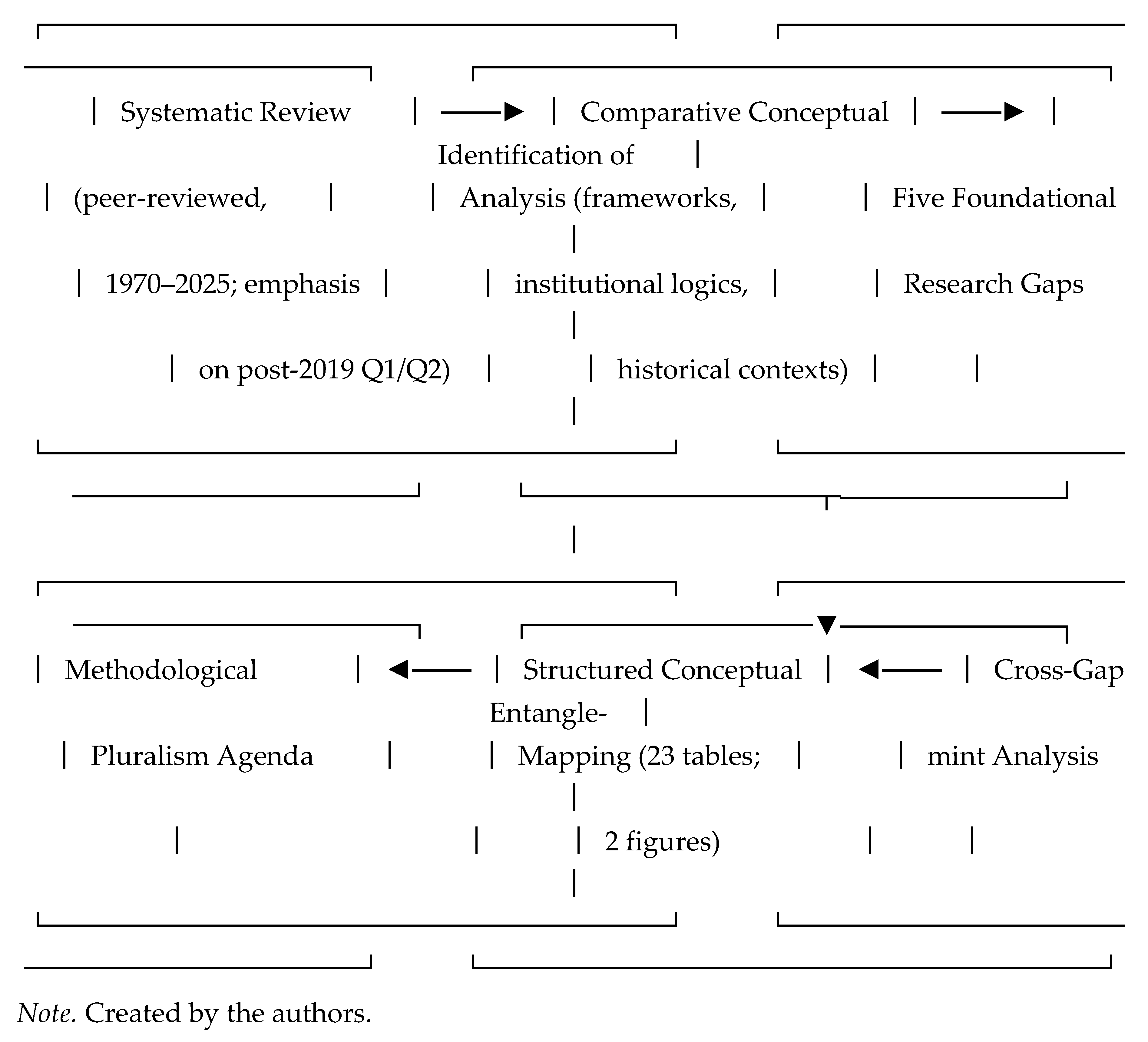
Figure 2.
Structural Entanglement of the Five Foundational Research Gaps.
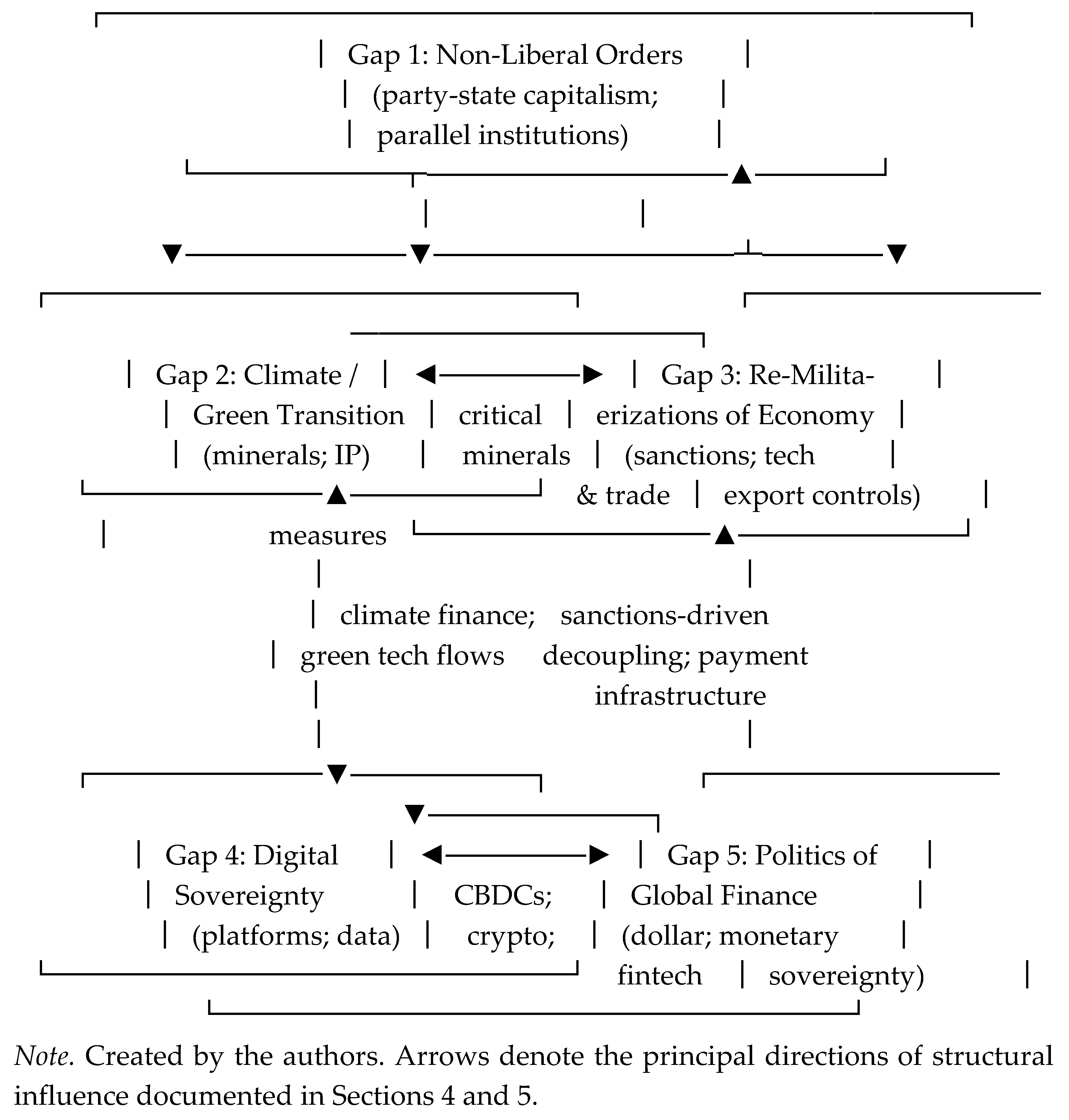

Table 1.
Conceptual Disjuncture: Traditional IPE Assumptions Versus Contemporary Realities.
| Domain | Traditional IPE Assumption | Contemporary Reality |
| Systemic structure | Liberal hegemony; unipolarity stabilizing open economies | Great-power competition; contested and parallel orders |
| Economic integration | Complex interdependence as pacifying force | Weaponized interdependence; strategic decoupling |
| State–market relation | State retreat; ascendancy of market governance | Resurgent industrial policy; new varieties of state capitalism |
| Institutional role | International institutions as cooperation-enhancing | Institutions as sites of geopolitical contestation |
| Security–economy nexus | Analytically separate; peace through trade | Re-militarization of economics; finance as statecraft |
| Nature of capital | Tangible assets; manufacturing as development engine | Intangible assets; data as strategic infrastructure |
Note. Synthesized from Cooley and Nexon (2020), Farrell and Newman (2019, 2023), Gilpin (1987), Haskel and Westlake (2017), Ikenberry (2018), Keohane (1984), Miller (2022), Rodrik (2022), Tooze (2018), and Zuboff (2019).
Table 2.
IPE Theoretical Frameworks: Core Assumptions and Analytical Limitations in the Contemporary Context.
Table 2.
IPE Theoretical Frameworks: Core Assumptions and Analytical Limitations in the Contemporary Context.
| Framework | Ontological Foundation | Primary Analytical Focus | Key Assumptions | Limitations in Contemporary Context |
| Liberal institutionalism | Anarchy; rational states | International cooperation; institutional design | States cooperate for mutual gains; institutions reduce transaction costs | Struggles with non-liberal institutions; cannot explain weaponized interdependence or authoritarian capitalism |
| Hegemonic stability theory | Structural realism | Hegemonic provision of collective goods | Single dominant state required for open economy maintenance | Cannot explain multipolar governance; treats liberal hegemony as normative baseline |
| Open economy politics | Domestic interest aggregation | Trade and financial policy preferences | Factor- or sector-based distributional preferences drive policy | Treats international structure as exogenous; systematically underweights ideational factors and state autonomy |
| Constructivism | Ideational structures | Norms, identities, and discourse | Ideas and norms constitute and shape state interests | Limited materialist analysis; underdeveloped on power, coercion, and resource politics |
| Critical IPE / neo-Gramscian | Historical materialism | Class relations; hegemony; global social structures | Capitalism as primary driver; hegemony as ideological project | Prescriptive orientation; limited policy traction; underemphasizes state agency in economic coordination |
| Developmental state theory | Political economy of late development | Late industrialization; state–market coordination | Embedded autonomy enables strategic industrial policy | Developed for a specific historical context requires substantial updating for digital and green transitions |
Note. Synthesized from Blyth (2009), Cohen (2007), Cox (1987), Gilpin (1987), Keohane (1984), Lake (2009), Ruggie (1982), Strange (1988), and Wade (1990).
Table 3.
Recent Scholarship (2019–2024) Addressing Contemporary IPE Gaps.
| Research Gap | Representative Contributions | Central Theoretical Innovation |
| Non-liberal orders | Babic et al. (2020); Hopewell (2021); Weiss and Wallace (2021) | Transnational state capital; contested trade governance; regime-type effects on global order |
| Climate transition | Allan et al. (2021); Bridge (2022); Newell (2021) | Green industrial policy; critical minerals political economy; power shift analytics |
| Economic re-militarization | Drezner et al. (2021); Farrell and Newman (2023); Miller (2022) | Generalization of weaponized interdependence; "underground empire" thesis; chokepoint technologies |
| Digital sovereignty | Kalyanpur and Newman (2019); Zuboff (2019); Aggarwal and Reddie (2021) | Regulatory extraterritoriality; surveillance capitalism; techno-nationalism |
| Finance and politics | Helleiner (2021); McDowell (2023); Norrlöf (2020) | National self-sufficiency revival; sanctions-driven de-dollarization; dollar hegemony as power |
Note. Compiled by the authors based on a systematic review of post-2019 IPE scholarship in Q1/Q2 journals and major university press monographs.
Table 4.
Ideal-Typical Characteristics of Liberal Versus Non-Liberal Economic Orders.
| Dimension | Liberal Order | Non-Liberal Order |
| Market governance | Market-led; regulatory state at arm's length | State-led; developmental or party-state coordination |
| Property regime | Private property dominance; depoliticized | Mixed; strategic state ownership in key sectors |
| International integration | Openness; binding multilateral commitments | Managed integration; selective strategic decoupling |
| Institutional logic | Rule-based; conditional access; liberal norms | Sovereignty-based; non-interference; bilateral flexibility |
| Firm–state relation | Arms-length regulation; regulatory capture as pathology | Embedded coordination; strategic alignment as policy tool |
| Geopolitical posture | Integration as peace strategy; interdependence as constraint | Autonomy as security imperative; interdependence as vulnerability |
Note. Synthesized from Babic et al. (2020), Bremmer (2010), Cooley and Nexon (2020), Hopewell (2021), Musacchio et al. (2015), Naughton (2021), Wade (1990), and Weiss (2014).
Table 5.
Institutional Logics: Liberal Versus Non-Liberal International Economic Institutions.
| Feature | Liberal Institutions (WTO, IMF, World Bank) | Non-Liberal Institutions (AIIB, NDB, SCO) |
| Conditionality | Extensive; structural adjustment and liberalization requirements | Minimal; project-based lending; no policy conditionality |
| Membership model | Formally universalist; substantive Western dominance | Selective or region-based; emerging-economy voice emphasized |
| Governance structure | Weighted voting; U.S. and European dominance institutionalized | Consensus-based; formal equality among major contributors |
| Normative foundation | Liberal economic norms as membership criteria | State sovereignty; non-interference as operational principles |
| Relationship to U.S. hegemony | Structurally embedded in U.S.-led international order | Explicitly parallel; designed to reduce dependence on U.S.-led order |
Note. Synthesized from Callaghan and Hubbard (2016), Chin (2016), Cooley and Nexon (2020), Hopewell (2021), and Malkin (2021).
Table 6.
Geopolitical Transitions: From Hydrocarbons to Critical Minerals.
| Dimension | Hydrocarbon Era (20th Century) | Critical Mineral Era (21st Century) |
| Geographic concentration | Middle East, Russia, Venezuela (production) | China (processing dominance); DRC (cobalt); Australia, Chile (lithium and copper) |
| Supply chain structure | Long pipeline and tanker routes; geographic diversification of production | Concentrated processing; shorter but tightly controlled value chains |
| Key state actors | National oil companies; OPEC cartel governance | State-backed mining firms; Chinese processing monopolies; resource-nationalist governments |
| Conflict dynamics | Resource wars; petro-aggression; pipeline politics | Supply chain coercion; export restrictions; mining-related local conflict |
| Rentier state dynamics | Oil rents enabling authoritarian redistribution | Mixed evidence; potential for new forms of mineral rentierism |
| Environmental justice | Localized extraction impacts; downstream refining pollution | Processing pollution concentrated in Global South; artisanal labor exploitation |
Note. Synthesized from Bridge (2022), International Energy Agency (2023), Klinger (2018), Le Billon (2013), Newell (2021), and Ross (2012).
Table 7.
Critical Mineral Supply Chain Vulnerabilities in the Green Transition.
| Mineral | Primary Transition Use | Top Producer | Processing Concentration | Geopolitical Risk | Priority IPE Research Gap |
| Lithium | EV batteries; grid storage | Australia; Chile; China | China (~70% of global refining) | Resource nationalism; U.S.–China rivalry | Political economy of sovereign acquisition strategies |
| Cobalt | Battery cathodes | DRC (~70% of production) | China (~80% of global refining) | Conflict minerals; artisanal labor governance | Governance of artisanal mining in global supply chains |
| Rare earth elements | Permanent magnets; wind turbines; electronics | China (~85% of global supply) | China (overwhelmingly dominant) | Export restriction leverage; monopoly leverage over allies | Systematic theory of rare earth statecraft |
| Copper | Broad electrification infrastructure | Chile; Peru; DRC | Geographically distributed | Resource nationalism; permitting backlash | Political economy of green extractivism in Global South |
| Nickel | Battery cathodes; stainless steel | Indonesia; Philippines; Russia | Geographically dispersed | Indonesian export restrictions; Russian sanctions exposure | Supply chain resilience modeling under geopolitical fragmentation |
| Polysilicon | Solar photovoltaic panels | China (~80% of global supply) | China (dominant) | Trade restrictions; Xinjiang labor rights concerns | Labor governance and human rights compliance in solar supply chains |
Note. Synthesized from Bridge (2022), International Energy Agency (2023), Klinger (2018), Le Billon (2013), and Ross (2012).
Table 8.
Asymmetric Burdens of Decarbonization: Global North Versus Global South.
| Dimension | Global North | Global South |
| Historical responsibility | High cumulative greenhouse gas emissions since industrialization | Disproportionately low cumulative contribution to atmospheric concentrations |
| Transition financing | State-subsidized green industries; access to capital markets | High capital costs for transition; severely constrained fiscal space |
| Trade measures | Imposing carbon border adjustment mechanisms | Facing potential deindustrialization; new barriers to export markets |
| Adaptation and loss | Primarily mitigation-focused; adaptive capacity resilient | Severe adaptation needs; escalating loss-and-damage claims |
| Technology access | Indigenous innovation capacity; first-mover advantages | Structurally dependent on technology transfer; IP barriers |
| Debt dynamics | Low borrowing costs for sovereign green investment | Chronic debt distress; persistent climate finance gaps relative to need |
Note. Synthesized from Allan et al. (2021), Meckling and Allan (2020), Newell (2021), Newell and Mulvaney (2013), Roberts and Parks (2007), and Volz (2018).
Table 9.
Varieties of Contemporary Industrial Policy.
| Type | Objectives | Primary Instruments | Illustrative Cases |
| Green industrial policy | Climate mitigation; renewable energy deployment at scale | Production subsidies; feed-in tariffs; green bond frameworks | U.S. Inflation Reduction Act; EU Green Deal Industrial Plan |
| Strategic autonomy policy | Reducing dependence on strategic rivals; supply chain resilience | Export controls; tariffs; domestic content requirements; localization mandates | EU Chips Act; U.S. CHIPS and Science Act |
| Developmental state 2.0 | Technological catch-up; strategic sector dominance; dual-use capacity | State-owned enterprise coordination; R&D investment; procurement preferences | China's Made in China 2025; dual circulation strategy |
| Defense-industrial policy | Wartime production capacity; munitions stockpile reconstruction | Defense procurement; defense industrial base subsidies; production mobilization | European Defence Fund; U.S. Defense Production Act activation |
Note. Synthesized from Aggarwal and Reddie (2021), Allan et al. (2021), Miller (2022), Naughton (2021), and Rodrik (2022).
Table 10.
Mechanisms of Economic Re-Militarization in Contemporary Statecraft.
| Mechanism | Description | Primary Cases |
| Financial sanctions | SWIFT exclusion; central bank asset freezes; secondary sanctions targeting third-country actors | Russia (2022); Iran; North Korea |
| Technology export controls | Restrictions on advanced dual-use technologies; semiconductor fabrication equipment bans | U.S. restrictions on advanced chips and equipment to China |
| Supply chain weaponization | Strategic leveraging of existing dependencies in critical sectors | European energy dependence on Russia; Chinese rare earth export leverage |
| Investment screening | Mandatory national security reviews of inbound foreign direct investment | CFIUS (U.S.); EU Foreign Direct Investment Screening Regulation |
| Industrial mobilization | Rebuilding wartime production capacity; reconstructing munitions and defense industrial base | European NATO members' munitions production expansion; U.S. Defense Production Act activation |
| Digital infrastructure control | Leveraging control over subsea cables, cloud computing infrastructure, and 5G network standards | Huawei network exclusion campaigns; cloud sovereignty initiatives across G7 |
Note. Synthesized from Drezner et al. (2021), Farrell and Newman (2019, 2023), Miller (2022), and Tooze (2021).
Table 11.
Typology of Economic Decoupling Strategies.
| Strategy | Definition | Implementation Mechanisms | Primary Costs and Limitations |
| Full decoupling | Complete severance of economic ties with target state | Comprehensive trade bans; mandatory divestment; technology denial | Massive efficiency losses; strong incentives for bloc formation; difficult to sustain multilaterally |
| Selective decoupling | Targeted restrictions confined to strategic sectors | Sectoral export controls; targeted investment prohibitions; limited tariffs | Moderate efficiency losses; definitional difficulty of "strategic" boundary |
| Friendshoring | Deliberate supply chain diversification toward allied economies | Preferential trade agreements; supply chain subsidies; investment incentives for allied firms | Significant reconfiguration costs; political alignment constraints; limited supply alternatives |
| Resilience-building | Maintaining ties while reducing shock vulnerability | Strategic reserves; domestic production capacity subsidies; redundant supply chains | Higher ongoing costs; reduced just-in-time efficiency; difficult to sustain politically |
| De-risking | Reducing exposure to rivals without severing economic ties | Supplier diversification; hedging strategies; export monitoring | Partial risk reduction only; definitional ambiguity exploited in practice; implementation complexity |
Note. Synthesized from Aggarwal and Reddie (2021), Drezner (1999), Drezner et al. (2021), and Rodrik (2022).
Table 12.
Historical Evolution of Sanctions Regimes.
| Era | Period | Defining Characteristics | Representative Cases |
| Bilateral sanctions | 1945–1990 | Unilateral measures; limited multilateral coordination; modest ambitions | U.S. sanctions on Cuba; U.S. grain embargo on USSR (1980) |
| Multilateral sanctions | 1990s–2000s | UN Security Council authorization; broad coalitions; humanitarian exemptions | Comprehensive Iraq sanctions (1990s); Libya (1990s) |
| Smart sanctions | 2000s–2010s | Targeted financial measures; individual asset freezes; travel bans; minimizing civilian impact | Post-9/11 counter-terrorism designations; Iran nuclear sanctions |
| Bloc-based sanctions | 2020s–present | G7-coordinated coalitions; secondary sanctions imposing third-country compliance; functioning as international order-sorting mechanism | Russia (2022 onward); U.S.-led technology sanctions on China |
Note. Synthesized from Drezner (1999), Drezner et al. (2021), Farrell and Newman (2023), and McDowell (2023).
Table 13.
Tangible Versus Intangible Economies: Implications for IPE.
| Dimension | Tangible Economy (20th Century) | Intangible Economy (21st Century) |
| Primary productive assets | Factories; machinery; physical inventory | Data; algorithms; intellectual property; brand equity |
| Trade patterns | Containerized goods; bilateral merchandise flows | Cross-border data flows; digital services exports |
| Ownership and jurisdiction | Clear property rights; physical location determines regulatory jurisdiction | Ambiguous; digital jurisdiction genuinely contested across legal systems |
| Regulatory instruments | Tariffs; product safety standards; customs enforcement | Data localization requirements; privacy regulation; platform-specific antitrust |
| Geopolitical stakes | Resource competition; control of trade routes and chokepoints | Digital sovereignty; platform power concentration; semiconductor supremacy |
| Dominant firm structure | Vertically integrated multinational corporations | Platform ecosystems; network firms; data intermediaries |
Note. Synthesized from Aggarwal and Reddie (2021), Haskel and Westlake (2017), Miller (2022), Srnicek (2017), and Zuboff (2019).
Table 14.
Varieties of Digital Power in the Contemporary Global Political Economy.
| Type | Definition | Mechanisms | Illustrative Actors and Cases |
| Infrastructural power | Control over the underlying physical and logical architecture of the internet | Ownership of subsea cables; cloud computing infrastructure; semiconductor fabrication nodes | AWS; Azure; Google Cloud; TSMC; Chinese telecommunications infrastructure |
| Algorithmic power | Capacity to shape information environments and behavior through code | Search ranking; content recommendation systems; content moderation policy | Google search algorithm; TikTok recommendation engine; Facebook content moderation |
| Data power | Capacity to extract, analyze, commodify, and leverage large-scale behavioral information | Surveillance; predictive analytics; behavioral micro-targeting | Surveillance capitalism model (Zuboff, 2019); targeted political advertising |
| Platform power | Control over multi-sided markets connecting producers, consumers, and developers | Market access gatekeeping; fee structures; API control; vertical integration | Amazon marketplace; Apple App Store; WeChat super-app ecosystem |
| Narrative power | Capacity to shape political and social discourse at scale through digital distribution | Algorithmic amplification; disinformation distribution; computational propaganda | State-linked social media operations; viral political content |
Note. Synthesized from Aggarwal and Reddie (2021), Miller (2022), Srnicek (2017), and Zuboff (2019).
Table 15.
Development Paradigms: Industrialization Versus Platform Economy.
| Dimension | Industrialization Era | Platform Economy Era |
| Core growth model | Manufacturing-led; export-oriented; learning-by-doing | Services-led; digital exports; network effects as primary driver |
| Employment structure | Formal manufacturing employment; structured labor relations | Gig and platform-mediated informal work; compressed labor bargaining power |
| Capital requirements | Fixed physical capital; factory construction and machinery | Intangible capital; algorithmic infrastructure; user data |
| Technology acquisition | Foreign direct investment; technology licensing; reverse engineering | Digital infrastructure dependency; cloud services; platform API access |
| State development role | Classic developmental state; strategic industrial policy; embedded autonomy | Digital sovereignty regulation; data localization; digital public infrastructure |
| Key development vulnerability | Commodity dependence; adverse terms of trade; middle-income trap | Data colonialism (Couldry & Mejias, 2019); platform dependency; digital infrastructure asymmetry |
Note. Synthesized from Couldry and Mejias (2019), Haskel and Westlake (2017), Rodrik (2022), and Wade (1990).
Table 16.
Comparative Digital Governance Frameworks Across Major Jurisdictions.
| Jurisdiction | Regulatory Philosophy | Key Instruments | Digital Sovereignty Priority | Key Limitations and Tensions |
| United States | Market competition; limited federal intervention; first-mover advantage protection | Antitrust enforcement (post-2020 reform); Section 230 liability shield; no comprehensive federal privacy law | Infrastructure security (cloud, 5G); foreign platform screening | Highly fragmented regulatory landscape; significant enforcement gaps; innovation–protection tension |
| European Union | Rights-based; precautionary principle; fundamental rights framework | GDPR; Digital Markets Act; Digital Services Act; EU AI Act | Data sovereignty; algorithmic accountability; regulatory autonomy from U.S. platforms | Potential innovation-chilling effects; uneven enforcement capacity across member states |
| China | State sovereignty; party-state control; data as national security resource | Data Security Law; Cybersecurity Law; platform crackdowns (2020–2022); Great Firewall | Comprehensive; national data treated as strategic state resource | Significant market distortion; constraints on private innovation; foreign platform exclusion |
| India | Emerging regulatory state; development-oriented | Personal Data Protection Act; intermediary guidelines; data localization requirements | Data localization; digital public infrastructure (Aadhaar, UPI) | Regulatory uncertainty; implementation capacity gaps; balancing development and sovereignty goals |
| Global South (general) | Development-oriented; severely capacity-constrained | Nascent and fragmented data protection frameworks | Avoiding data colonialism; leveraging digital development potential | Structurally asymmetric power vis-à-vis U.S. and Chinese platforms; deep technology dependency |
Note. Synthesized from Aggarwal and Reddie (2021), Couldry and Mejias (2019), Kalyanpur and Newman (2019), and Zuboff (2019).
Table 17.
Shifting Landscape of Global Finance: From Post-2008 Concerns to Contemporary Research Frontiers.
Table 17.
Shifting Landscape of Global Finance: From Post-2008 Concerns to Contemporary Research Frontiers.
| Domain | Post-2008 Research Focus | Contemporary Frontier Questions |
| Monetary policy | Central bank independence; inflation targeting effectiveness; unconventional policy tools | Distributional effects of quantitative easing; political pressures on central bank mandates; inflation politics |
| Currency system | Dollar hegemony maintenance; currency peg sustainability | De-dollarization trends, competition among digital and reserve currencies, and the effects of sanctions on dollar-based financial infrastructure |
| Financial regulation | Macroprudential tools; Basel III capital adequacy | Regulatory fragmentation along geopolitical lines; non-bank financial intermediation; shadow banking |
| Crypto-assets | Peripheral; limited systemic relevance | State responses to crypto proliferation; sanctions circumvention mechanisms; digital monetary sovereignty |
| Financialization | Corporate governance reform; shareholder primacy critique | Intangible asset financialization; private equity political economy; wealth concentration |
| Debt dynamics | Sovereign debt crises; austerity politics | Climate finance architecture gaps; debt-for-nature swap mechanisms; developing country debt distress |
Note. Synthesized from Eichengreen (2011), Helleiner (2014, 2021), Horn et al. (2021), McDowell (2023), Norrlöf (2020), Tooze (2018, 2021), and Volz (2018).
Table 18.
Distributive Mechanisms of Monetary Policy Instruments.
| Policy Tool | Primary Beneficiaries | Primary Losers | Core Transmission Mechanism |
| Quantitative easing | Asset holders; financial sector; high-net-worth individuals | Savers; wage earners; public pension funds | Asset price inflation across equities and real estate; yield suppression on savings instruments |
| Sustained low interest rates | Borrowers; real estate investors; corporate sector | Savers; fixed-income retirees; conservative institutional investors | Suppressed savings returns; artificially low borrowing costs increasing asset leverage |
| Inflation regime | Debtors; holders of real assets; fiscal authorities | Fixed-income households; nominal wage earners; cash savers | Erosion of real wages; automatic deleveraging of nominal debt burdens |
| Rapid interest rate increases | Savers; currency holders; fixed-income investors | Highly leveraged borrowers; mortgage holders; emerging market dollar debtors | Increased debt service costs; recession risk; capital flow reversal to emerging markets |
| Currency intervention | Export-oriented domestic producers | Importers; households purchasing consumer goods; foreign currency debtors | Exchange rate manipulation; competitive devaluation dynamics; imported inflation |
Note. Synthesized from Norrlöf (2020), Starrs (2019), and Tooze (2018, 2021).
Table 19.
De-Dollarization Indicators and Alternative Payment Arrangements (2015–2025).
| Indicator | Observed Trend | Emerging Alternatives |
| Dollar share of global foreign exchange reserves | Gradual decline from approximately 66% to approximately 58% | RMB; gold; SDRs; diversified reserve currency baskets |
| SWIFT alternative payment infrastructure | Growth of CIPS (China Interbank Payments System); SPFS (Russian system) | Bilateral currency swap arrangements; Project mBridge (BIS) |
| Central bank digital currency development | Active pilot programs or research in 130+ countries | Digital yuan (e-CNY) as leading operational case; digital euro in development |
| Bilateral non-dollar trade settlement | Increased frequency of non-dollar commodity trade contracts | RMB–rial; rupee–ruble; BRICS currency discussion frameworks |
| Central bank gold accumulation | Record central bank net purchases in 2022 and 2023 | Systematic diversification away from dollar-denominated reserve assets |
| Sanctions circumvention infrastructure | Proliferation of shadow payment systems and cryptocurrency adoption by sanctioned states | Cryptocurrency adoption in Iran, Russia, and North Korea |
Note. Synthesized from Eichengreen (2011), McDowell (2023), Norrlöf (2020), and Prasad and Ye (2021).
Table 20.
Typology of State Responses to Cryptocurrencies and Digital Assets.
| Response Type | Regulatory Approach | Illustrative Cases | Primary Political-Economic Rationale |
| Prohibition | Comprehensive bans on trading, mining, or holding | China (2021); Algeria; Bolivia | Monetary sovereignty protection; capital control enforcement |
| Regulated integration | Licensing regimes with AML/CFT compliance requirements | United States; European Union; Japan | Balancing innovation facilitation with consumer protection and systemic risk management |
| Strategic embrace | Crypto-friendly regulatory environment; mining attraction | El Salvador; UAE; Switzerland | Investment and innovation hub positioning; economic diversification |
| Sanctions circumvention | De facto tolerance enabling sanctions evasion | Russia; Iran; North Korea | Bypassing Western dollar-denominated financial sanctions |
| CBDC development | State-backed digital currency replacing or complementing cash | China (e-CNY operational); Nigeria (eNaira); Sweden (e-krona pilot) | Preserving monetary sovereignty in digital economy; advancing financial inclusion goals |
| Ambivalent accommodation | Permissive but largely unregulated environment | India; Brazil; most emerging market economies | Balancing innovation potential against systemic and macrofinancial risk |
Note. Synthesized from McDowell (2023) and Prasad and Ye (2021).
Table 21.
Sovereign Debt Architecture Under Geopolitical Fragmentation.
| Domain | Legacy Architecture (Pre-2010) | Contemporary Reconfiguration |
| Principal creditors | Paris Club governments; IMF; World Bank; private bondholders | Chinese policy banks; private bondholders; commodity-collateralized lenders |
| Transparency norms | Relatively high (Paris Club disclosure) | Widespread non-disclosure of Chinese lending terms (Horn et al., 2021) |
| Restructuring venues | Paris Club; London Club; IMF programs | G20 Common Framework; fragmented ad hoc processes |
| Conditionality logic | Structural adjustment; fiscal discipline | Mixed; project-linked collateral; strategic-asset claims |
| Climate finance integration | Largely absent | Emerging debt-for-nature and debt-for-climate swap mechanisms |
| Crisis resolution speed | Moderate; standardized procedures | Markedly slower; coordination failures across creditor blocs |
Note. Synthesized from Horn et al. (2021), Tooze (2021), and Volz (2018).
Table 22.
Methodological Requirements for Addressing IPE's Five Foundational Research Gaps.
| Research Gap | Quantitative and Formal Methods | Qualitative and Historical Methods | Integrative Research Potential |
| Non-liberal orders | Formal modeling of state–firm coordination; institutional design theory; comparative economic performance analysis | Historical institutionalism; comparative political economy; area studies expertise | Combine formal models of institutional incentives with country-specific historical institutional analysis |
| Climate transition | Econometric modeling of transition costs and distributional effects; supply chain network mapping | Political ethnography; coalition formation analysis; critical discourse analysis | Model distributional effects of transition; explain political feasibility constraints through qualitative mechanisms |
| War and economics | Sanctions effectiveness quantitative analysis; global financial network topology analysis | Archival research; elite interview methods; process tracing; strategic studies integration | Formal models of coercive leverage complemented by historical case analysis of outcomes |
| Digital sovereignty | Platform economics; network topology mapping; algorithm auditing methodologies | Critical infrastructure studies; firm-level ethnography; comparative legal analysis | Model digital power concentration quantitatively; trace institutional evolution of governance regimes qualitatively |
| Finance and politics | Monetary policy transmission modeling; financial network analysis; wealth distribution measurement | Central bank ethnography; archival financial policy research; critical political economy | Link quantitatively measured distributional effects to political processes through qualitative institutional analysis |
Note. Synthesized from Blyth (2009), Cohen (2007), Farrell and Newman (2019), Spilker (2021), and Tooze (2018).
Table 23.
Priority Research Agendas for IPE's Five Foundational Gaps.
| Gap | Priority Research Question | Theoretical Contribution Required | Recommended Methodological Approach |
| Non-liberal orders | How do authoritarian political structures systematically condition patterns of economic coordination, innovation, and international engagement? | Systematic theory of non-liberal institutional logic and state–firm coordination | Comparative historical institutionalism; formal modeling of authoritarian economic coordination |
| Climate transition | Under what political-economic conditions do green industrial policy generate genuine developmental benefits for Global South economies rather than new dependency relationships? | Integrated theory connecting green extractivism, climate finance, and just transition conditions | Mixed methods; political economy of development; case comparison across transition mineral producers |
| War and economics | Under what conditions do bloc-based sanctions function as mechanisms of international order-making rather than simply instruments of bilateral coercion? | Theory of sanctions as institutional sorting and order-building mechanisms | Process tracing across contemporary cases; financial network analysis; historical comparative case study |
| Digital sovereignty | How do different configurations of state regulatory capacity, platform market structure, and geopolitical alignment shape national development outcomes in the digital economy? | Political economy of digital power asymmetries and developmental consequences | Comparative regulatory analysis; platform economics; mixed-method firm-level and macro-level analysis |
| Finance and politics | Through what specific political processes do the distributional consequences of monetary policy translate into institutional change or political instability? | Theory of monetary politics under conditions of advanced financialization | Central bank ethnography; quantitative distributional analysis; comparative political economy of central bank governance |
Note. Compiled by the authors.
Disclaimer/Publisher’s Note: The statements, opinions and data contained in all publications are solely those of the individual author(s) and contributor(s) and not of MDPI and/or the editor(s). MDPI and/or the editor(s) disclaim responsibility for any injury to people or property resulting from any ideas, methods, instructions or products referred to in the content. |
© 2026 by the authors. Licensee MDPI, Basel, Switzerland. This article is an open access article distributed under the terms and conditions of the Creative Commons Attribution (CC BY) license (http://creativecommons.org/licenses/by/4.0/).
Copyright: This open access article is published under a Creative Commons CC BY 4.0 license, which permit the free download, distribution, and reuse, provided that the author and preprint are cited in any reuse.


