
Submitted:
18 May 2026
Posted:
19 May 2026
You are already at the latest version
Abstract
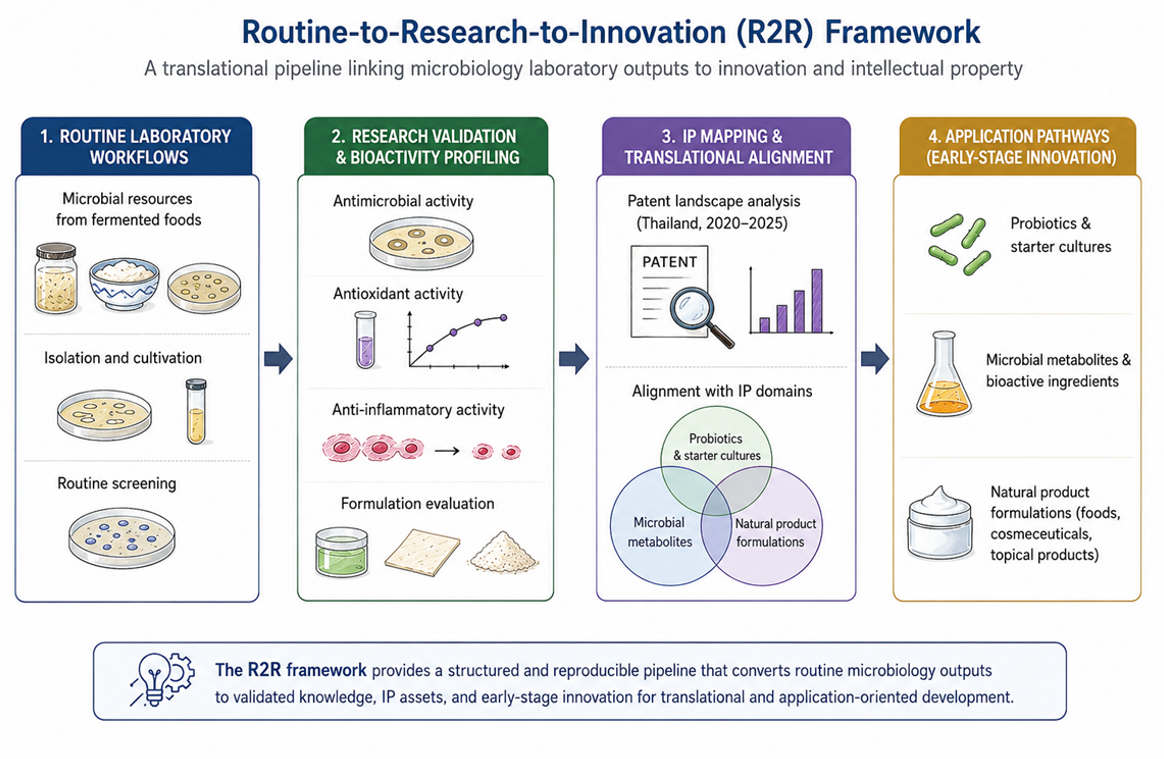
Microbiology laboratories generate extensive experimental outputs that are often in-sufficiently translated into applied innovation and technology development. This study presents a Routine-to-Research-to-Innovation (R2R) framework integrating routine labor-atory workflows with bioactivity validation, formulation development, and intellectual property (IP) mapping. Lactic acid bacteria isolated from Thai fermented foods demon-strated strong bacteriocin activity and storage stability, while secondary metabolites de-rived from Streptomyces and Brevibacillus exhibited antibacterial, antioxidant, and an-ti-inflammatory activities with prototype formulation potential. Red palm oil-based sys-tems enriched with microbial bioactives also showed favorable physicochemical stability under accelerated conditions. Patent landscape analysis (Thailand, 2020–2025) demon-strated translational alignment between laboratory outputs and existing innovation do-mains, supporting the potential application of the R2R framework in translational micro-biology, technology transfer, and early-stage innovation development.
Keywords:
Routine-to-Research-to-Innovation (R2R)
; translational microbiology
; technology transfer
; probiotics
; lactic acid bacteria
; bacteriocins
; microbial secondary metabolites
; Streptomyces
; Brevibacillus
; natural product formulations
; red palm oil
; patent landscape analysis
; intellectual property mapping
; microbial biotechnology
; prototype development
; incubation-ready technology
; early-stage innovation
Copyright: This open access article is published under a Creative Commons CC BY 4.0 license, which permit the free download, distribution, and reuse, provided that the author and preprint are cited in any reuse.


