
Submitted:
16 May 2026
Posted:
18 May 2026
You are already at the latest version
Abstract
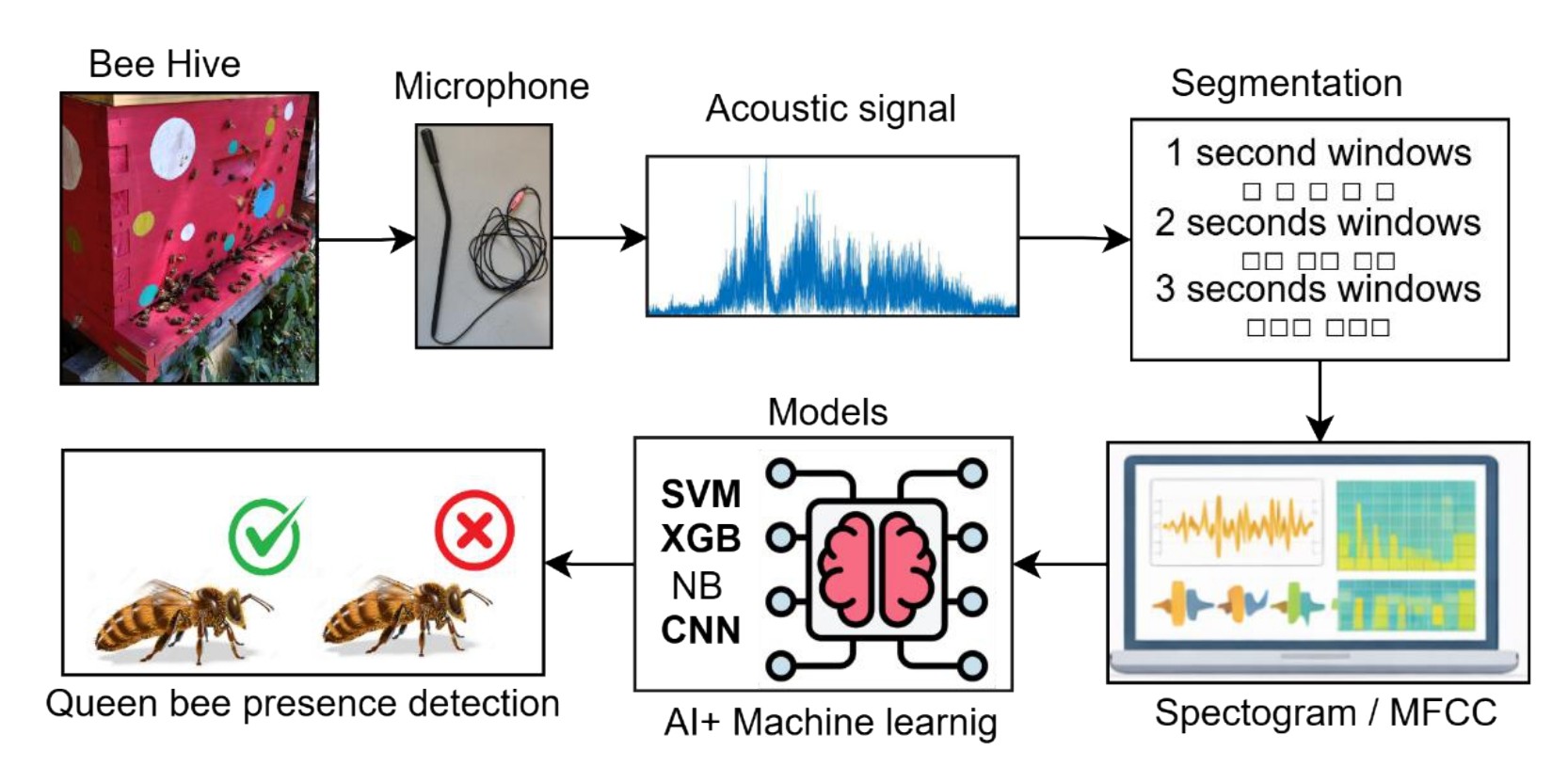
Honeybee population decline poses a serious threat to global biodiversity and agricultural productivity, underscoring the need for continuous and non-invasive hive monitoring solutions. In particular, early detection of queen absence is critical for maintaining colony viability. This study investigates the effectiveness of machine learning and deep learning models for acoustic-based queen-presence detection using short-duration hive audio recordings. Audio data collected from multiple sources were processed to extract spectrogram, Mel-spectrogram, and Mel-frequency cepstral coefficient features, which were evaluated using classical ML classifiers and convolutional neural networks. Experimental results indicate that MFCC-based representations consistently outperform spectrogram-based features across segment lengths, achieving higher accuracy and greater stability. The best performance was obtained with Mel features using convolutional neural networks for short segments and gradient-boosted models for longer windows. These findings demonstrate that brief acoustic segments are sufficient for reliable classification, supporting real-time monitoring under noisy field conditions. The proposed approach offers a scalable and low-cost framework for precision beekeeping and contributes to sustainable beekeeping through early, automated anomaly detection. The proposed framework supports real-time, low-cost deployment scenarios, enabling scalable precision apiculture solutions.
Keywords:
acoustic-based classification
; machine learning
; deep learning
; MFCC
; precision apiculture
Copyright: This open access article is published under a Creative Commons CC BY 4.0 license, which permit the free download, distribution, and reuse, provided that the author and preprint are cited in any reuse.


