
Submitted:
16 May 2026
Posted:
18 May 2026
You are already at the latest version
Abstract
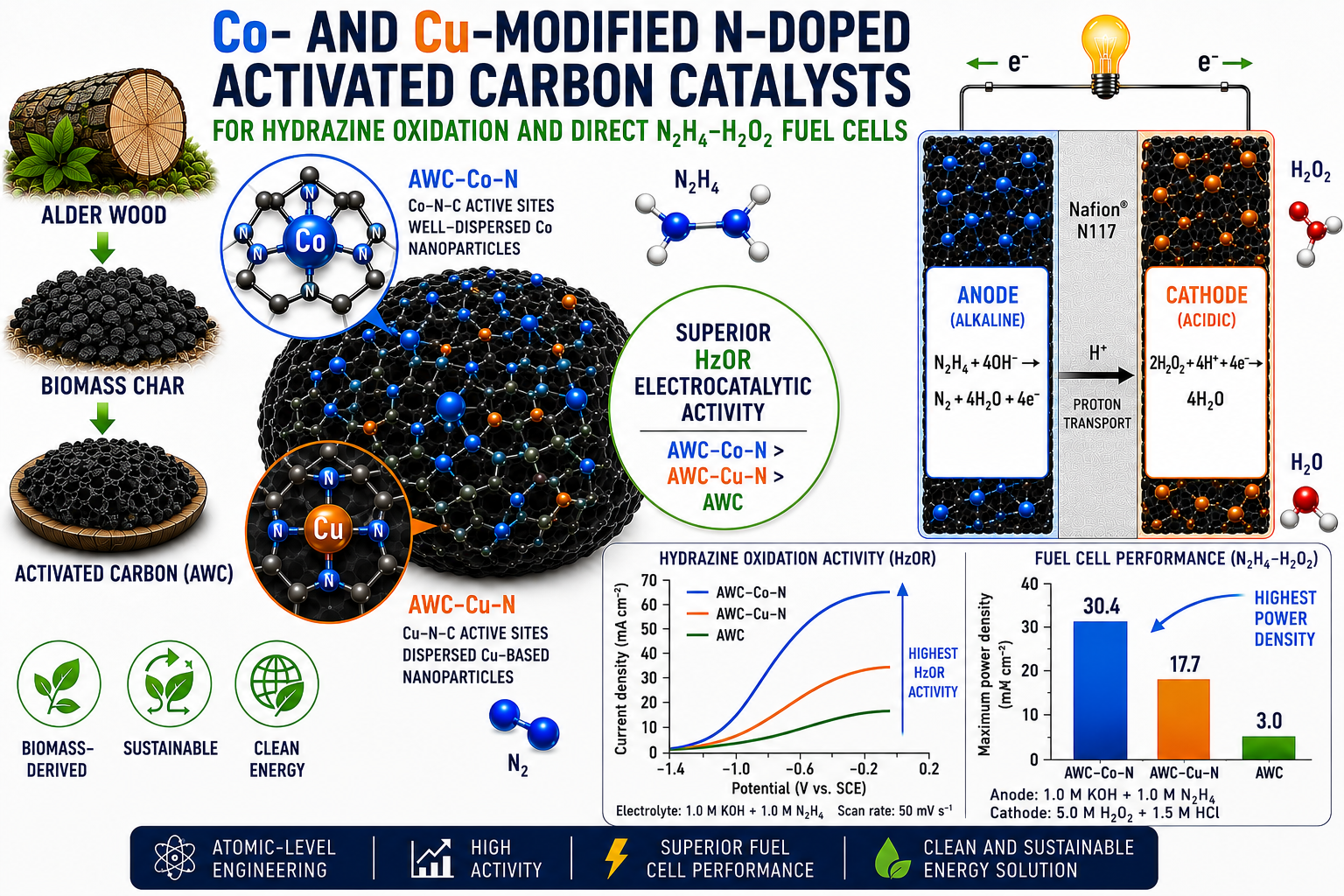
In this study the development of sustainable electrocatalysts for clean energy by modifying biomass-derived activated carbon with nitrogen and transition metals is presented. Activated carbon (AWC) was synthesized using alder wood char as a precursor, while nitrogen and cobalt or copper nanoparticles were incorporated with the aim to create efficient materials for hydrazine oxidation (HzOR) and direct hydrazine-hydrogen peroxide fuel cells (DHHPFC, N2H4–H2O2). The composition, structure, and surface morphology of the created catalysts were examined using inductively coupled plasma optical emission spectroscopy (ICP-OES), X-ray photoelectron spectroscopy (XPS), X-ray diffraction (XRD), and scanning electron microscopy and energy dispersive X-ray analysis (SEM/EDX). The activity of the AWC, AWC–Co–N, and AWC–Cu–N catalysts for HzOR was evaluated by cyclic voltammetry (CV) and linear sweep voltammetry (LSV). N2H4–H2O2 fuel cell tests were carried out by employing the catalysts both as the anode and cathode. It was found that all materials retained a hierarchical porous carbon framework, while metal incorporation altered surface compactness Cobalt doping produced well-dispersed Co nanoparticles and abundant Co–N–C coordination sites, whereas Cu introduction resulted in moderately compact structures with uniformly distributed Cu-based nanoparticles. Electrochemical measurements demonstrated that both metal dopants enhanced HzOR activity, with the catalytic performance following the order AWC–Co–N > AWC–Cu–N > AWC. Fuel-cell testing further confirmed this trend: AWC–Co–N achieved the highest maximum power density (30.4 mW cm–2), outperforming AWC–Cu–N (17.7 mW cm–2). These results identify AWC–Co–N as a highly effective bifunctional electrocatalyst for DHHPFCs.
Keywords:
biomass
; alder wood char
; activated carbon material nitrogen
; cobalt
; copper
; hydrazine oxidation
; fuel cell
Copyright: This open access article is published under a Creative Commons CC BY 4.0 license, which permit the free download, distribution, and reuse, provided that the author and preprint are cited in any reuse.


