
Submitted:
15 May 2026
Posted:
18 May 2026
You are already at the latest version
Abstract
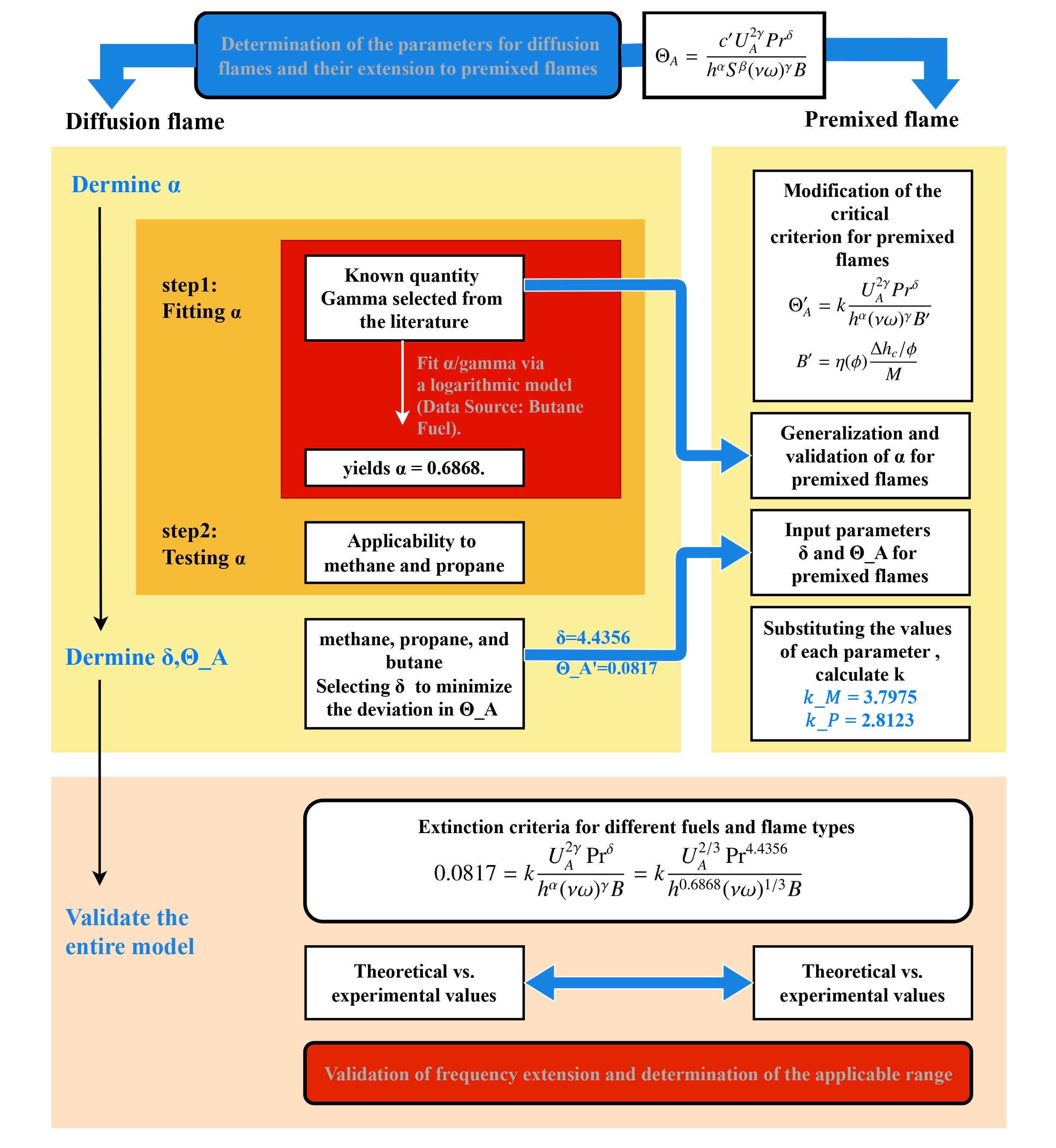
To investigate the critical extinction criterion for fire extinguishment through acoustic oscillation and achieve the transition from empirical qualitative studies to quantitative and precise applications for acoustic fire extinguishment, this study, based on the flame-fuel cycle model proposed by Friedman, A.N., conducts modifications and extensions of several critical parameters. By modifying the Quintiere-Spalding B-number model for gaseous fuels and premixed combustion, and carrying out multi-factor extinction experiments considering combustion type, flame size, and fuel properties, a generalized acoustic extinction criterion model applicable to gaseous fuels is established, breaking through the serious limitation that the original theory was only applicable to liquid fuels with similar Prandtl numbers. Through logarithmic fitting of methane, propane and butane diffusion flames, the flame height exponent α = 0.6868 is quantitatively determined, and the flame type terms for methane and propane gas premixed flames at an equivalence ratio ϕ ≈ 1 are found to be kM = 3.7975 and kP = 2.8123, respectively. The critical extinction criterion for gaseous fuel flames is finally obtained as Θ′ A = 0.0817. Meanwhile, comprehensive universal validation of the above parameters is performed. Finally, the study reveals the dual effect of acoustic frequency on flame extinction and the phenomena of flame necking and fracture under acoustic field interference, and discovers an abnormal increase in the critical particle velocity for acoustic extinction in the relatively high-frequency regime above 90 Hz. This research provides theoretical support for the engineering application of acoustic fire extinguishing technology and the in-depth exploration of the mechanism of sound-induced flame extinction.
Keywords:
acoustic flame extinction
; air particle vibration
; multi-factor flame-fuel cycle model
; critical criterion
; flame morphology
Copyright: This open access article is published under a Creative Commons CC BY 4.0 license, which permit the free download, distribution, and reuse, provided that the author and preprint are cited in any reuse.


