

Submitted:
14 May 2026
Posted:
18 May 2026
You are already at the latest version
Abstract
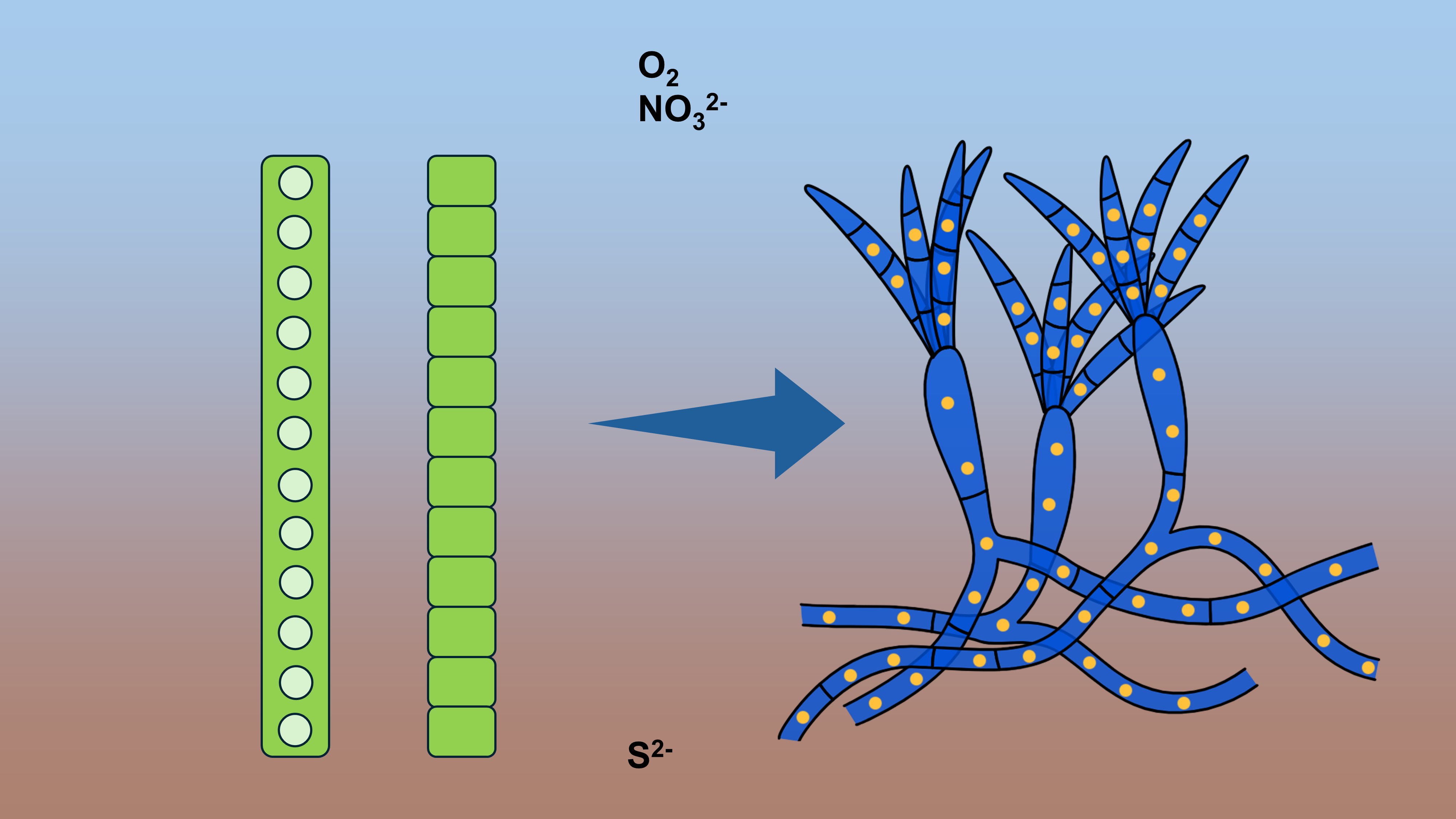
The emergence of the eukaryotic cell is regarded as a pivotal transition in the history of life on Earth. However, mounting evidence suggests eukaryogenesis was a specific, accidental event sparked by a syntrophic symbiosis between an Asgard archaeon and a bacterial endosymbiont. This prompts a fundamental counterfactual question: what if this symbiosis never occurred? The prevailing assumption is that life would remain perpetually microbial, constrained by the bioenergetic limits of prokaryotic cells. This article challenges that view by exploring the evolutionary potential of a unique group of bacteria: giant sulfur bacteria. These bacteria, driven by powerful selection pressure to bridge spatially separated pools of hydrogen sulfide and oxygen, have independently evolved remarkable sizes and different forms of complexity, including a form of eukaryote-like compartmentalization in Thiomargarita magnifica. Through the analysis of their novel bioenergetic solutions and conceptual modelling of an alternative evolutionary history, I propose that in an eukaryote-free world, giant sulfur bacteria represent a plausible starting point for the de novo evolution of complex, multicellular life. This thought experiment, albeit extremely speculative, offers new understanding of mechanisms of gaining complexity and could be useful for the analysis of the actual eukaryogenesis event, as well for the modelling of life complexity in astrobiological settings.
Keywords:
eukaryogenesis
; giant sulfur bacteria
; Thiomargarita magnifica
; multicellularity
; alternative evolution
; bioenergetics
; complexity
; syntrophy
Copyright: This open access article is published under a Creative Commons CC BY 4.0 license, which permit the free download, distribution, and reuse, provided that the author and preprint are cited in any reuse.


