
Submitted:
14 May 2026
Posted:
15 May 2026
You are already at the latest version
Abstract
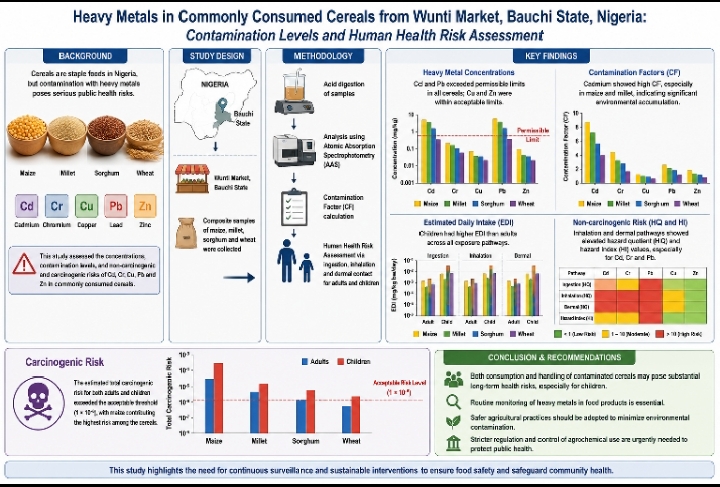
Cereals are a staple component of the Nigerian diet; however, their contamination with heavy metals raises serious public health concerns. This study evaluated the concentrations, contamination levels, and associated non-carcinogenic and carcinogenic risks of cadmium (Cd), chromium (Cr), copper (Cu), lead (Pb), and zinc (Zn) in commonly consumed cereals; maize, millet, sorghum, and wheat sold in Wunti Market, Bauchi State, Nigeria. Composite samples were collected and analyzed using atomic absorption spectrophotometry after acid digestion. Contamination factors (CF) and standard human health risk assessment models were employed to estimate exposure via ingestion, inhalation, and dermal contact for both adults and children. The results indicated that Cd and Pb concentrations in all cereal samples exceeded recommended permissible limits, whereas Cu and Zn remained within acceptable thresholds. Cadmium showed particularly high contamination factors, especially in maize and millet, indicating significant environmental accumulation. Exposure assessments revealed that children had higher estimated intake levels than adults across all exposure pathways, reflecting their greater vulnerability. Although ingestion pathways suggested low non-carcinogenic risk overall, inhalation and dermal exposure routes demonstrated elevated hazard quotient (HQ) and hazard index (HI) values, particularly for Cd, Cr, and Pb. Furthermore, the estimated total carcinogenic risk for both adults and children surpassed the acceptable threshold established by regulatory agencies, with maize contributing the highest risk levels among the cereals studied. These findings suggest that both consumption and handling of contaminated cereals may pose substantial long-term health risks, especially for children. The study underscores the need for routine monitoring of heavy metal contamination in food products, adoption of safer agricultural practices, and stricter regulation of agrochemical use.
Keywords:
carcinogenic
; non-carcinogenic
; health risk
; exposure
; heavy metal
Copyright: This open access article is published under a Creative Commons CC BY 4.0 license, which permit the free download, distribution, and reuse, provided that the author and preprint are cited in any reuse.


