
Submitted:
12 May 2026
Posted:
13 May 2026
You are already at the latest version
Abstract
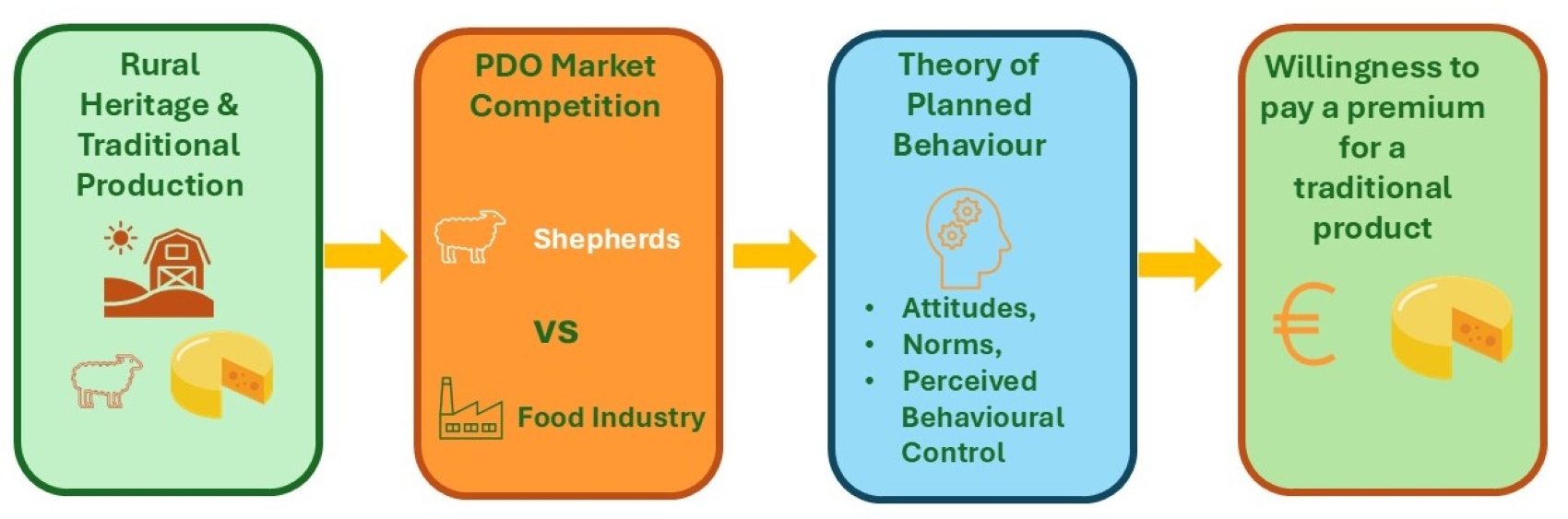
Traditional food systems are increasingly threatened by industrialised agri-food production, which relies on standardised processes, economies of scale, and lower production costs. This transformation risks undermining not only the economic viability of artisanal producers but also the cultural heritage, local knowledge, pastoral practices, and territorial identities embedded in traditional foods. This study investigates whether consumers’ willingness to pay a premium for traditionally produced foods can help safeguard rural cultural heritage in a competitive PDO market. Focusing on an Italian cheese, the Fiore Sardo PDO, the research combines a Bertrand duopoly framework with the Theory of Planned Behaviour (TPB) to examine the relationships among market competition, consumer beliefs, and support for traditional production systems.
Data from 1,640 Italian consumers were analysed using structural equation modelling. The results show that attitudes towards cultural preservation, social recognition of traditional production, and perceived support for rural shepherd communities significantly influence consumers’ willingness to purchase and pay higher prices for traditionally produced cheese. Consumers associate artisanal production not only with superior sensory quality and authenticity but also with the protection of cultural identity, traditional pastoral knowledge, and rural landscapes.
Keywords:
traditional foods
; protected designation of origin
; willingness to pay
Copyright: This open access article is published under a Creative Commons CC BY 4.0 license, which permit the free download, distribution, and reuse, provided that the author and preprint are cited in any reuse.


