
Submitted:
11 May 2026
Posted:
12 May 2026
You are already at the latest version
Abstract
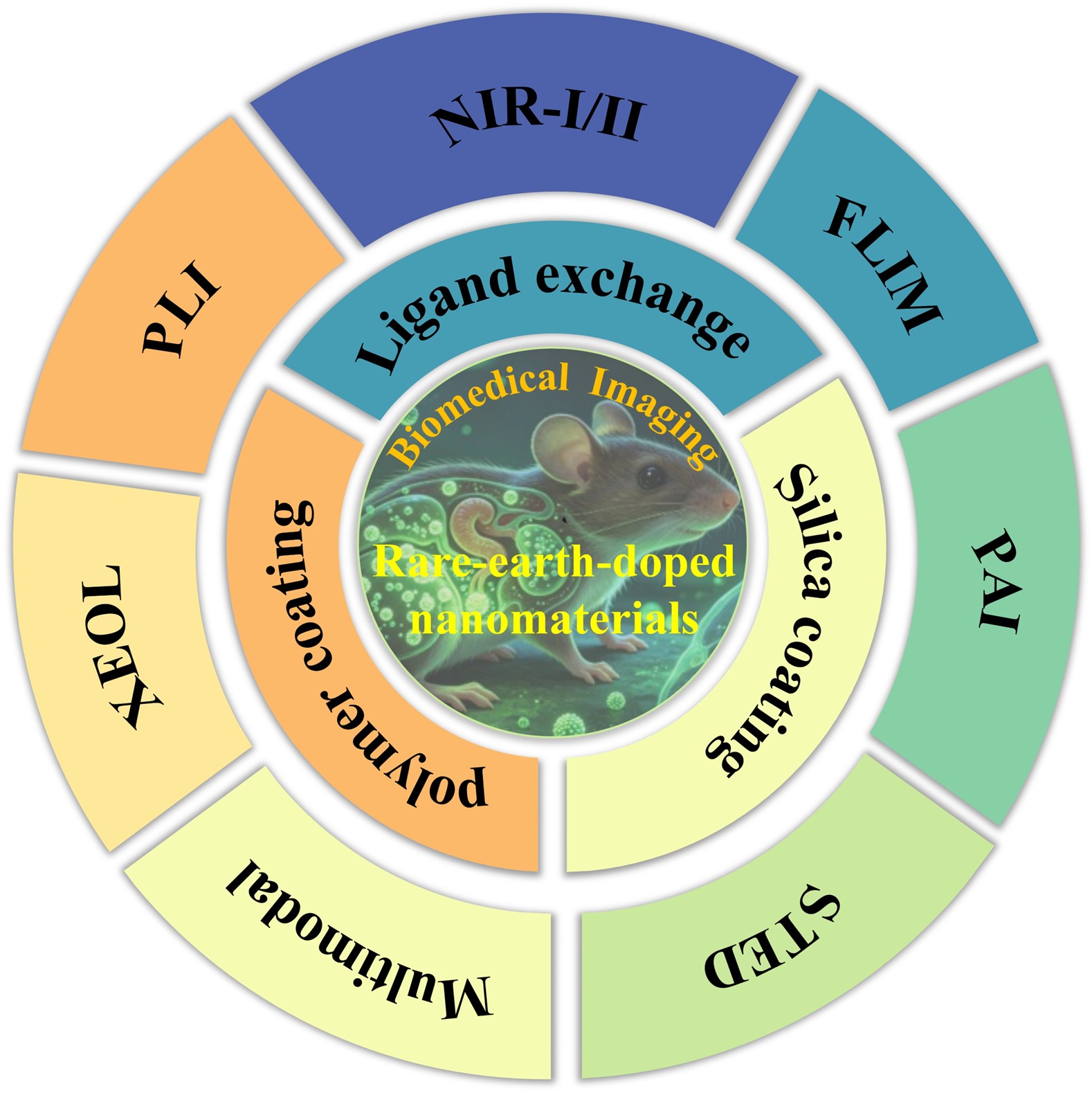
Benefiting from tunable emission from ultraviolet to near-infrared windows, long luminescence lifetimes, and exceptional photostability, rare-earth-doped nanomaterials overcome the limitations of conventional dyes and quantum dots, enabling deep-tissue, high-resolution, and low-background imaging. As multifunctional fluorescent probes, rare-earth-doped nanomaterials are driving the development of next-generation biomedical imaging. This review summarizes recent advances in the structural design of rare earth-doped nanomaterials, surface engineering for biocompatibility, and targeting strategies for improved performance, and highlights their integration into advanced imaging modalities, including NIR-I/II fluorescence, FLIM, PAI, super-resolution STED, multimodal FL/MRI/CT, X-ray-excited luminescence, and persistent luminescence. Meanwhile, mechanistic insights, material innovations, and comparative advantages are discussed. Furthermore, challenges related to quantum yield, scalable synthesis, imaging resolution, and clinical translation are considered, while future directions—centered on multifunctional probe design, NIR-II imaging, and AI-assisted data analysis—are proposed, offering a versatile platform for precise multimodal imaging with significant potential to advance early diagnosis, personalized therapy, and clinical applications.
Keywords:
rare-earth-doped nanomaterials
; surface engineering
; fluorescent probes
; biomedical imaging
; near infrared
Copyright: This open access article is published under a Creative Commons CC BY 4.0 license, which permit the free download, distribution, and reuse, provided that the author and preprint are cited in any reuse.


