
Submitted:
11 May 2026
Posted:
12 May 2026
You are already at the latest version
Abstract
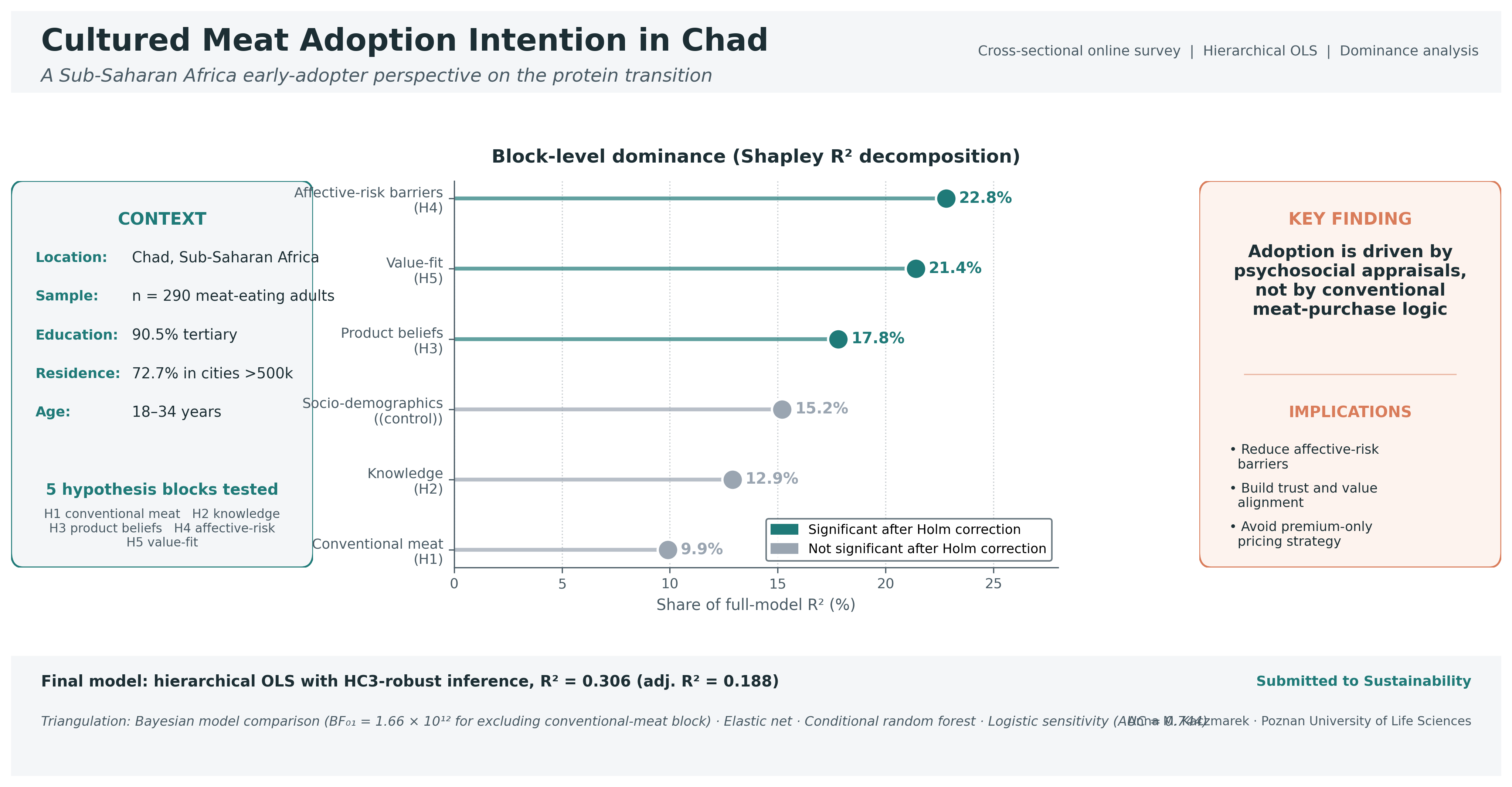
The extant body of evidence pertaining to the acceptance of cultured meat in Sub-Saharan Africa remains limited. The present study examined the determinants of intention to adopt cultured meat among a sample of young, urban, meat-eating adults in Chad (n = 290, from a recruited sample of 304). This was achieved using a cross-sectional online survey. Hierarchical OLS with HC3-robust inference was estimated across five hypothesis blocks, complemented by dominance analysis, binary-outcome sensitivity, and exploratory triangulation (Bayesian, elastic net, conditional random forest). Approximately half of the respondents expressed a willingness to try cultured meat (52.4%). The final model accounted for 30.6% of the intention variance (adjusted R² = 0.188). Following Holm's correction for multiple comparisons, the conventional-meat and knowledge blocks did not demonstrate a significant difference. The product beliefs (ΔR² = 0.056, p = 0.022), affective-risk barriers (ΔR² = 0.086, p = 0.004), and value-fit (ΔR² = 0.039, p = 0.048) were found to be significant, with affective-risk ranking first in dominance analysis (22.8%). Binary sensitivity analysis demonstrated acceptable discrimination (AUC = 0.744), although no block remained significant after correction. Exploratory analyses yielded convergent results, including notably robust Bayesian support for excluding the conventional-meat block (BF01 = 1.66 × 10^12). Sensitivity power analysis confirmed adequate power (≥ 0.80) for the significant blocks, but indicated that the conventional-meat non-significance may partly reflect limited power (estimated power = 0.47). Cultured-meat adoption intention was more strongly associated with affective-risk and value-fit appraisals than with conventional meat-purchase priorities. This suggests that acceptance strategies should prioritise risk reduction, trust-building, and perceived value. Findings should be interpreted as applying to a digitally connected, young, urban, meat-eating, predominantly tertiary-educated early-adopter-like segment (90.5% with university-level education; 72.7% residing in cities of more than 500,000 inhabitants), rather than to the general Chadian population.
Keywords:
cultured meat
; cultivated meat
; alternative proteins
; protein transition
; sustainable food systems
; consumer acceptance
; adoption intention
; affective-risk barriers
; value-fit
; young adults
; Chad
; Sub-Saharan Africa
Copyright: This open access article is published under a Creative Commons CC BY 4.0 license, which permit the free download, distribution, and reuse, provided that the author and preprint are cited in any reuse.


