

Submitted:
08 May 2026
Posted:
08 May 2026
You are already at the latest version
Abstract
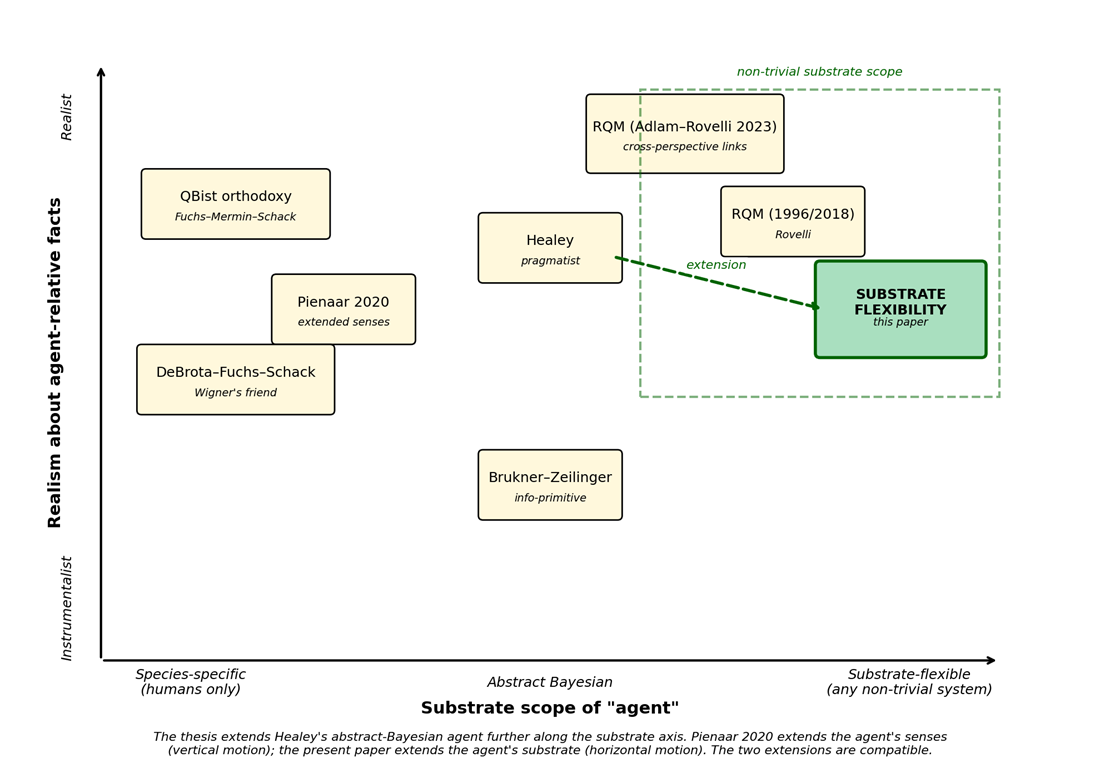
The QBist and Relational Quantum Mechanics (RQM) informational readings of quantum theory have been developed across two decades without a clear position on what kind of physical system qualifies as an "agent" or "observer" for the formalism. Fuchs, Mermin, and Schack write as if the agent is a human physicist or a generic Bayesian; Rovelli writes as if any physical system can play the relational-observer role; Healey deflates the agent into an abstract Bayesian without specifying its substrate; the recent Khrennikov-Schack-Zwirn intersubjectivity exchange sharpens the question without resolving it. This paper argues that the QBism/RQM informational reading is substrate-flexible: any physical system whose input-output statistics admit characterization through quantum-probability structure with non-trivial Contextuality-by-Default (CbD) signatures resistant to simplex-embeddable ontological models is a candidate epistemic agent for the formalism. Substrate flexibility is the most coherent reading of the shared formal commitments of QBism and RQM once the agent role is separated from historically human-centered examples; the non-triviality requirement is necessary but not sufficient for agency, which additionally requires an input-output architecture capable of state-sensitive updating across measurement contexts. The thesis preserves the QBist objection to view-from-nowhere framings while removing the requirement that agents be human or conscious; it disciplines Rovelli's "any physical system" claim by indexing it to the non-triviality requirement; and it specifies what would count as evidence for or against. Engineered cortical wetware preparations (Cortical Labs CL1, DishBrain) provide a non-human, non-conscious-in-any-unambiguous-sense, controllable testbed on which the question can be empirically pursued; nothing in the argument requires attributing phenomenal consciousness or quantum-coherent biological dynamics to such systems. The paper distinguishes substrate flexibility from Pienaar's prior extension of the QBist agent (which extends the agent's senses, not its substrate), engages the neo-Everettian opposition (Wallace 2012, 2023) directly, and rejects the recent attempts (Edwards 2024, 2025) to fold classical large language models into a QBism-grounded formalism. Classical AI architectures admit simplex-embeddable models for their token-generation processes and therefore fail the non-triviality requirement; substrate flexibility is narrower, not wider, than such proposals.
Keywords:
QBism
; relational quantum mechanics
; informational interpretations
; agency
; observer
; contextuality
; Contextuality-by-Default
; ontological models
; organoid intelligence
; wetware computing
; foundations of quantum mechanics
Copyright: This open access article is published under a Creative Commons CC BY 4.0 license, which permit the free download, distribution, and reuse, provided that the author and preprint are cited in any reuse.


