
Submitted:
07 May 2026
Posted:
08 May 2026
You are already at the latest version
Abstract
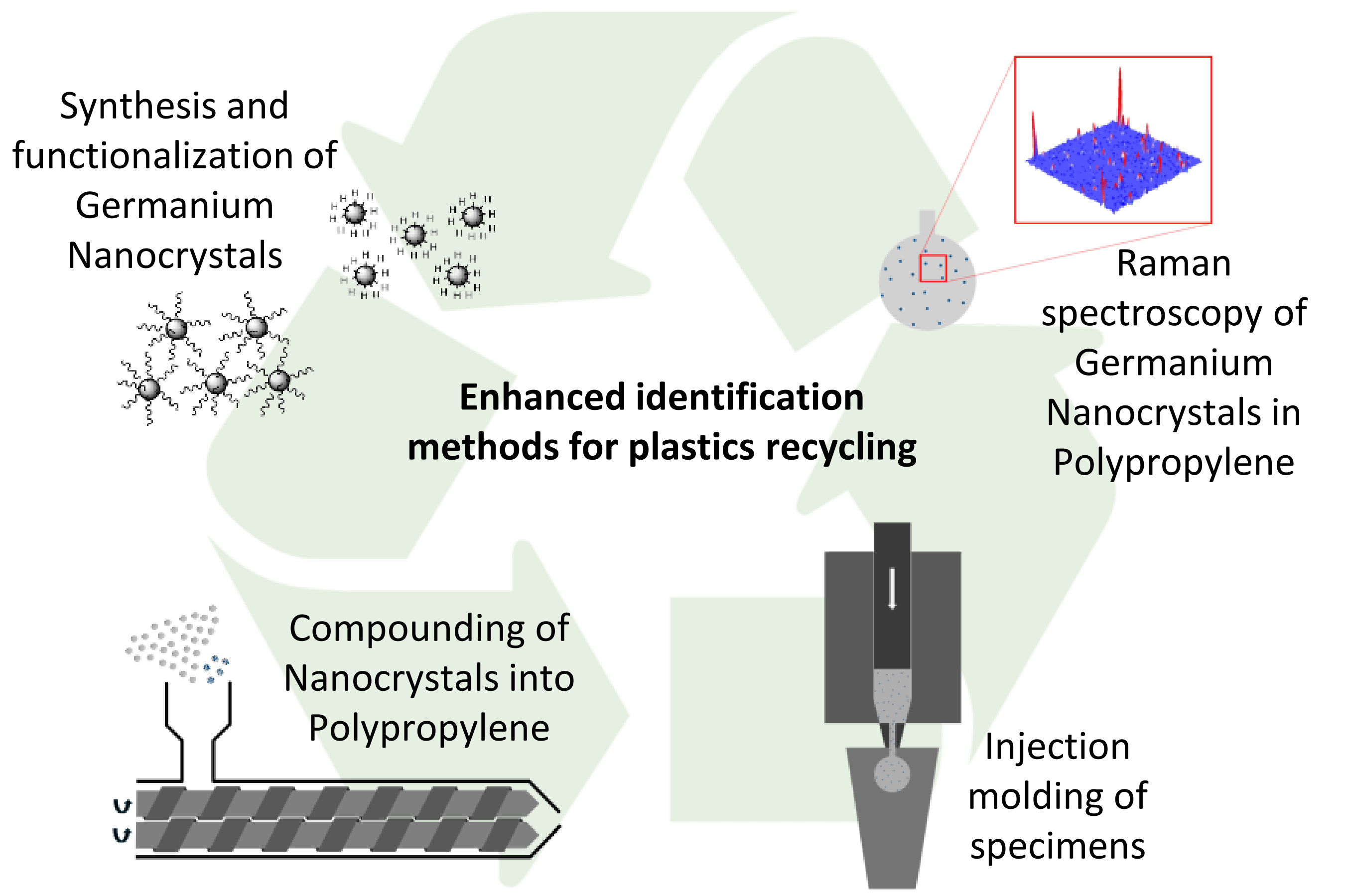
Increasing regulatory demands for high-quality plastic recycling create a strong need for novel tracer systems that enable reliable polymer identification and sorting. This feasibility study evaluates germanium nanocrystals (GeNCs) as Raman-detectable tracer materials in polypropylene (PP). The synthesis of GeNC/PP composite materials possessing various GeNC contents via a solvent-based intercalation process followed by compounding and injection molding is reported. Hydride-terminated GeNCs were synthesized and subse-quently functionalized with dodecyl ligands to ensure chemical stability, compatibility with the polymer matrix, and processability under conventional melt-processing condi-tions. The dodecyl-functionalized GeNCs were successfully stabilized and homogeneous-ly integrated into the PP matrix. Raman spectroscopy demonstrates the clear detection of GeNCs within the composites through a characteristic Ge–Ge optical phonon mode at 296 cm⁻¹, which is well separated from the intrinsic Raman bands of polypropylene. The Ra-man signal intensity increases systematically with increasing GeNC concentration. Ra-man mapping reveals an overall homogeneous distribution of the nanocrystals within the polymer, while a slight tendency toward agglomeration is observed at higher loadings. These results demonstrate that GeNCs are well suited as optically detectable tracers for polypropylene and can be reliably identified using Raman spectroscopy, highlighting their potential for tracer-based sorting concepts in advanced recycling and digital material passport applications.
Keywords:
Germanium Nanocrystals
; Polypropylene
; Composites
; Raman spectroscopy
; Tracer technology
; Digital material passport
Copyright: This open access article is published under a Creative Commons CC BY 4.0 license, which permit the free download, distribution, and reuse, provided that the author and preprint are cited in any reuse.


