
Submitted:
07 May 2026
Posted:
08 May 2026
You are already at the latest version
Abstract
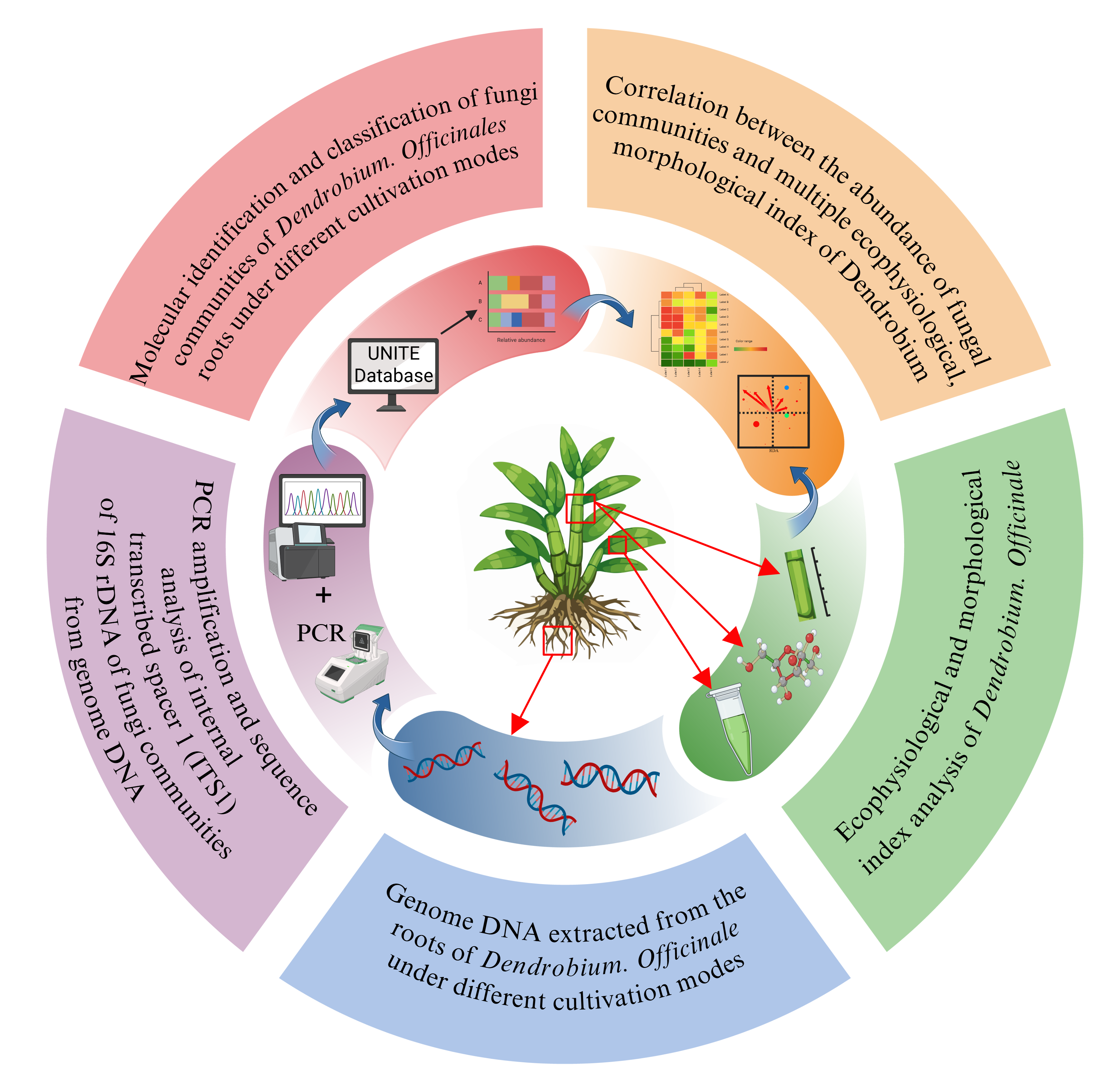
Background: Symbiotic fungi play essential roles throughout the entire cycle of orchid plants, including seed germination, seedling development, and maturation. Dendrobium officinale Kimura & Migo (Orchidaceae) (D. officinale) is a rare and highly valued traditional Chinese medicinal herb. Currently, artificial breeding using tissue culture technology is widely adopted and essential in the Dendrobium industry; however, this approach may impair or disrupt the plant’s ability to establish and maintain symbiotic relationships with mycorrhizal fungi; Methods: In this study, the fungal endophyte community (FEC) in the roots of D. officinale cultivated under four different modes was analyzed using high-throughput sequencing. Correlation analyses were also carried out to examine the relationships between bioactive compounds and the FEC; Results: 1) the FEC in D. officinale roots was dominated by Ascomycota and Basidiomycota, with significant differences in abundance, diversity, and community structure among cultivation modes; 2) the FEC under greenhouse cultivation mode differed significantly from those under tree epiphytic cultivation in terms of fungal nutritional types and dominant taxa; 3) six major mycorrhizal fungal taxa were identified in Dendrobium roots, although non-mycorrhizal fungi accounted for approximately 97% of the community; and 4) the main bioactive compounds were positively correlated with variations in the FEC; Conclusions: this study provides a foundation for understating the growth of D. officinale under different cultivation modes and highlights the relationship between bioactive compound accumulation and mycorrhizal fungal communities.
Keywords:
Dendrobium officinale
; cultivation modes
; fungal endophyte
; polysaccharides
Copyright: This open access article is published under a Creative Commons CC BY 4.0 license, which permit the free download, distribution, and reuse, provided that the author and preprint are cited in any reuse.


