
Submitted:
07 May 2026
Posted:
08 May 2026
You are already at the latest version
Abstract
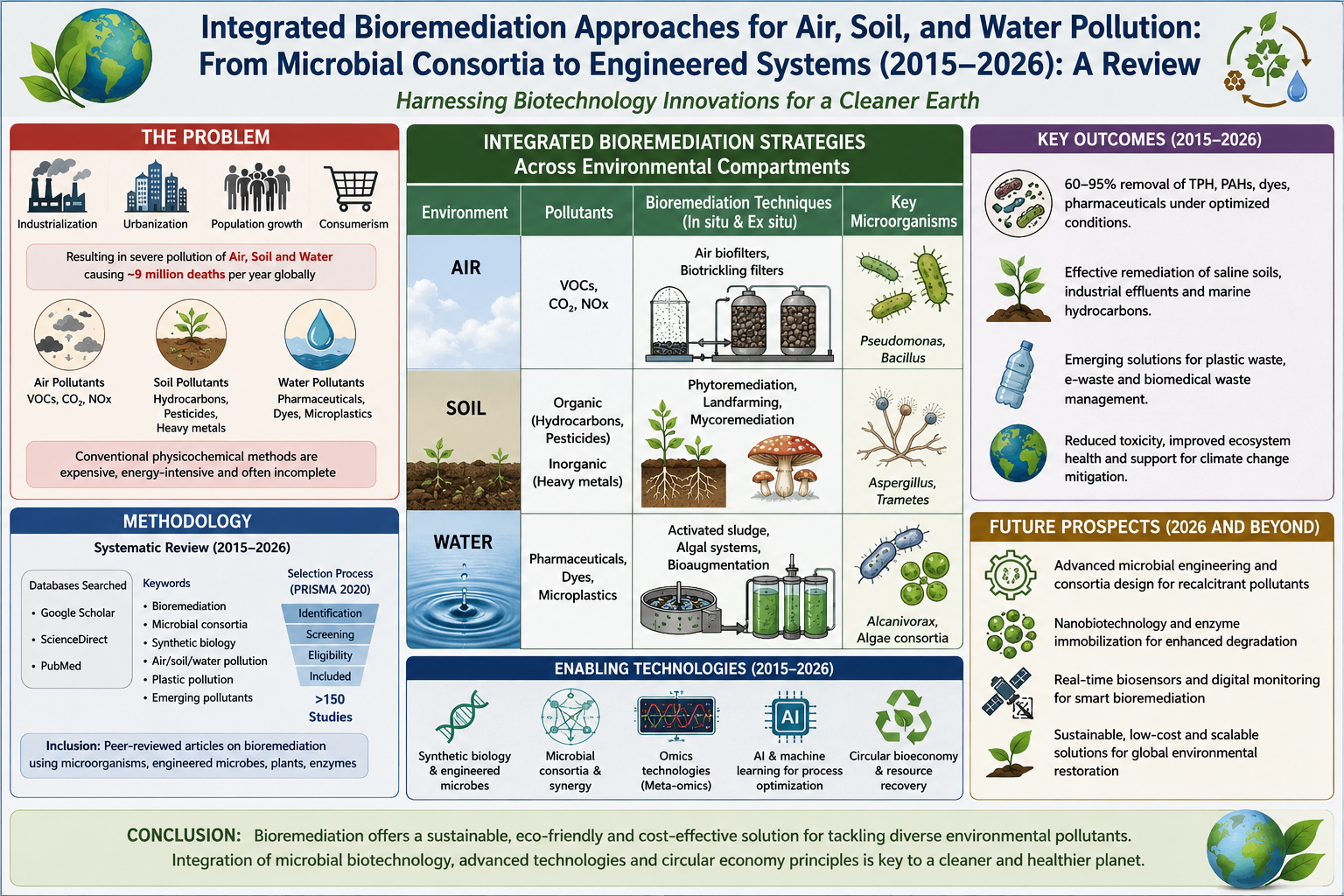
The increasing burden of municipal solid waste, petroleum hydrocarbons, industrial wastewater, saline soils, marine pollution, electronic wastes, and plastic contaminants is among the foremost global environmental issues that need sustainable remediation practices. In this review, the current status and future prospects in terms of the use of bioremediation techniques for environmental remediation are highlighted by discussing their advancements over the years 2020–2026. Various in situ and ex situ remediation techniques like bioaugmentation, biostimulation, biosparging, land farming, composting, bioreactor techniques, phytoremediation, activated sludge process, algal remediation, and fungal-based remediation techniques are highly efficient for the degradation of hydrocarbons, dyes, pharmaceutical compounds, heavy metals, volatile organic compounds, and new-age plastic pollutants. Microbial genera such as Pseudomonas, Bacillus, Alcanivorax, Aspergillus, Trametes, and halotolerant plant growth-promoting rhizobacteria exhibit an important role in pollutant mineralization, transformation, and detoxification through different metabolic pathways and enzyme systems. Emerging developments in synthetic biology, AI-assisted waste management, engineering of microbial consortia, and circular bio-economy models have enhanced the efficiency of remediation processes. Nonetheless, problems associated with scale-up, environmental variability, pollutant complexity, cost-effectiveness, and incomplete mineralization hinder practical application in field conditions.
Keywords:
bioremediation
; bioaugmentation
; biostimulation
; hydrocarbon degradation
; municipal solid waste
; microplastics
; industrial wastewater
; phytoremediation
; mycoremediation
; microbial consortia
; environmental pollution
; circular bioeconomy
; petroleum hydrocarbons
; marine pollution
; saline soil remediation
; activated sludge
; waste management
; biodegradation
; sustainable remediation
; environmental biotechnology
Copyright: This open access article is published under a Creative Commons CC BY 4.0 license, which permit the free download, distribution, and reuse, provided that the author and preprint are cited in any reuse.


