

Submitted:
07 May 2026
Posted:
08 May 2026
You are already at the latest version
Abstract
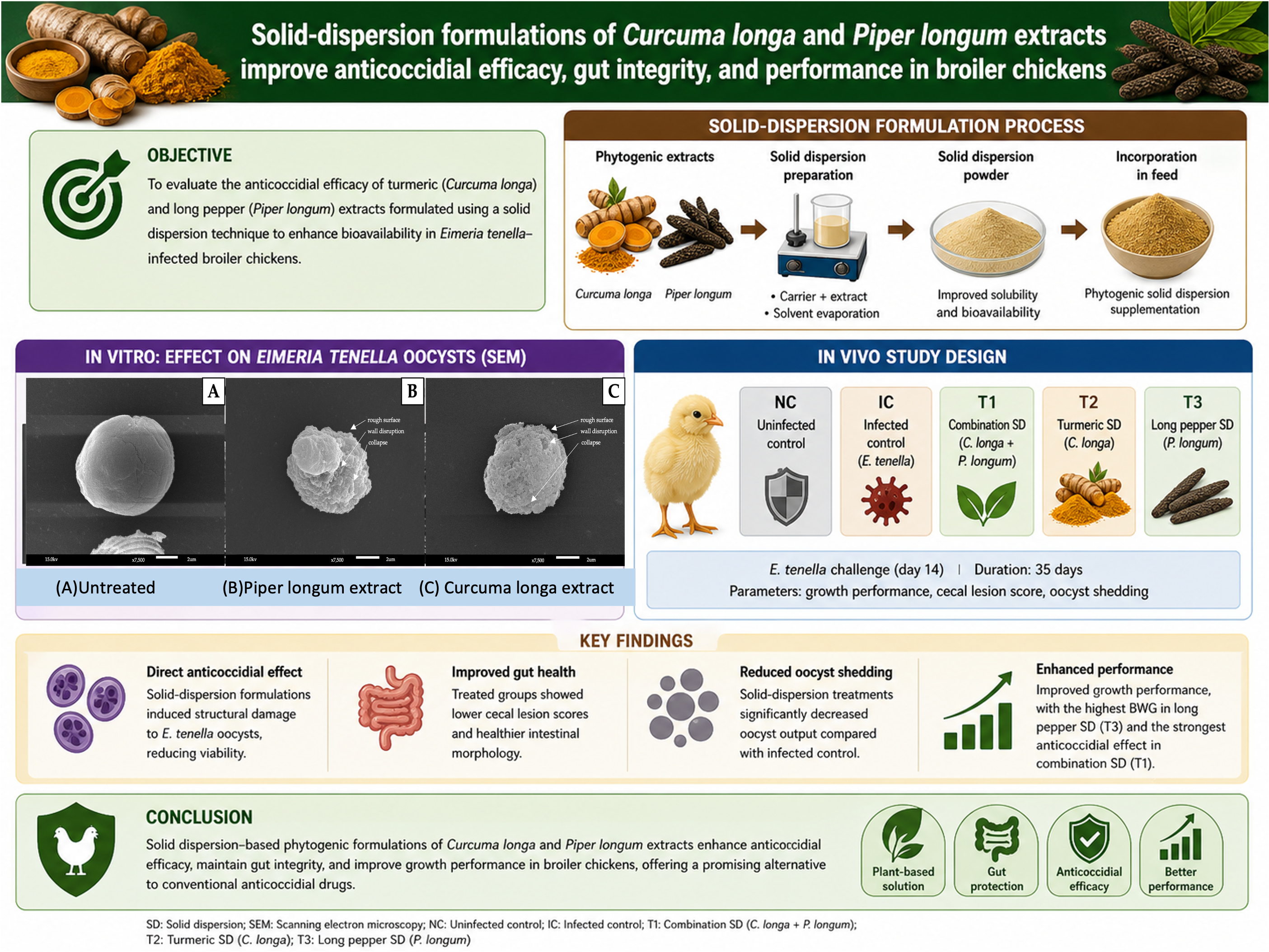
Coccidiosis is a major parasitic disease in poultry that negatively affects intestinal health, growth performance, and production efficiency, while reliance on anticoccidial drugs raises concerns regarding resistance and residues. This study aimed to evaluate the anticoccidial efficacy of phytogenic extracts from turmeric and long pepper formulated using a solid dispersion technique to enhance bioavailability. In vitro activity was assessed using scanning electron microscopy to observe ultrastructural changes in Eimeria oocysts, while in vivo efficacy was evaluated in broiler chickens experimentally infected with Eimeria tenella. Parameters including growth performance, cecal lesion scores, and oocyst shedding were determined. The results showed that treated groups exhibited significant structural damage to oocysts, reduced lesion severity, and decreased oocyst output compared to the infected control. The optimal growth performance was observed in the group receiving long pepper extract at 6 g/kg feed (T3), whereas the strongest anticoccidial effect was associated with the combined extract treatment (T1). These effects are likely mediated through improved solubility and intestinal availability of active compounds, leading to both direct antiparasitic activity and enhanced gut health. In conclusion, solid dispersion-based phytogenic formulations represent a promising alternative strategy for coccidiosis control and may reduce reliance on conventional anticoccidial drugs in poultry production.
Keywords:
phytogenic feed additive
; coccidiosis
; Eimeria tenella
; solid dispersion
; curcumin
; piperine
; broiler chicken
; anticoccidial activity
Copyright: This open access article is published under a Creative Commons CC BY 4.0 license, which permit the free download, distribution, and reuse, provided that the author and preprint are cited in any reuse.


