
Submitted:
07 May 2026
Posted:
08 May 2026
You are already at the latest version
Abstract
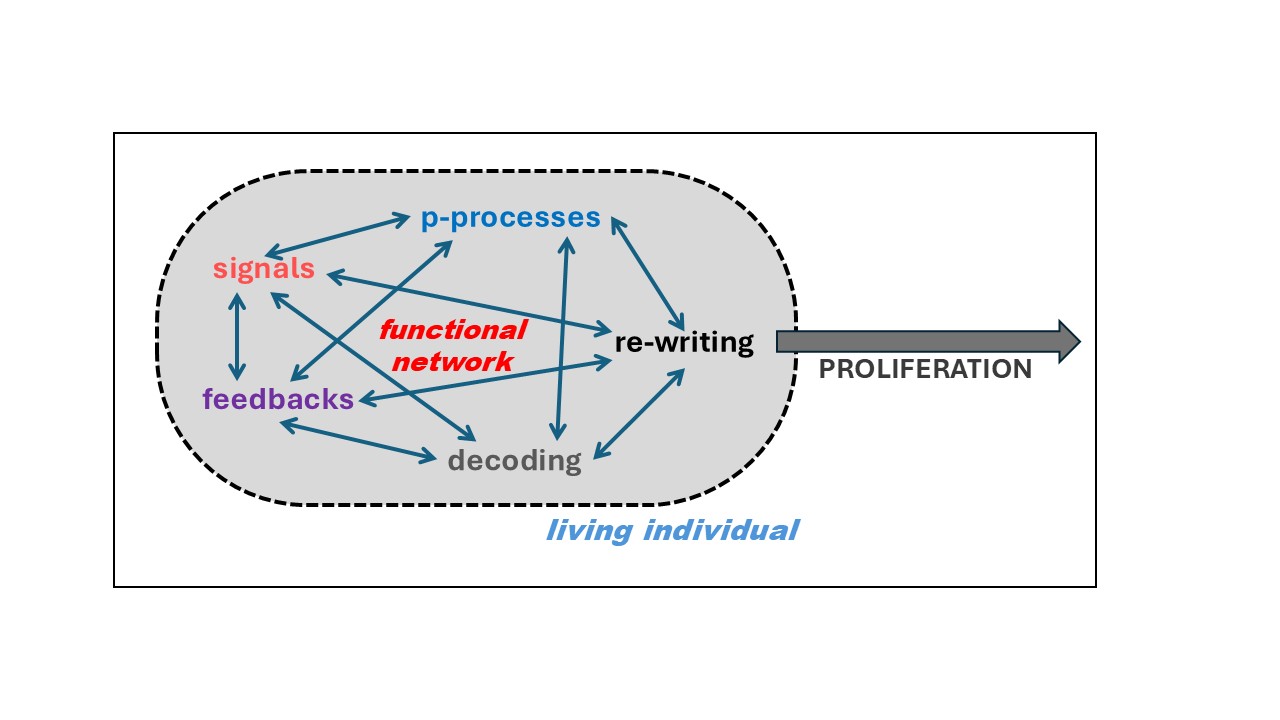
A function-based definition of a living individual as a central element and specially distinguished level of the phenomenon of life is proposed. According to this definition a living individual is a causally-closed network of five types of subordinate functions: p-processes (Ps), signals (Ss), feedbacks (Fs), re-writing (R(s)) and decoding (D(s)), directed recursively on the superior function: survival and proliferation (copying of its own identity in a possibly large number of copies possibly similar to the original), being self-dependent and self-sufficient in the realization of this purpose in its environment/ecological niche. This definition separates univocally living phenomena from inanimate processes in the case of the contemporary terrestrial life, origin of life on our planet, spontaneously-originated alien life in the universe, artificial and virtual life. According to this definition, life originated in the moment of formation of the first genetic code, including the “key” to this code coupling autocatalytic cycles of proteins (with random amino-acid sequences and divers catalytic abilities) and RNA (R), supported by and supporting proto-metabolism (P) and embedded in coacervate-like bubbles, into hypercycles of proteins and RNA (D) (“everything first” hypothesis). It clearly distinguishes the living individual from other levels of the organization of biological systems, such as living cells and organs, populations, ecosystems and the whole biosphere. Finally, it clearly decides whether such phenomena of doubtful status as viruses and viroids, plasmids, retrotransposons, chromosomes B, prions, cancer cells, mutualistic symbionts, mitochondria, colonial coelenterates, slime molds and eusocial insect(s) (colonies) are living individuals or not, and to what degree.
Keywords:
life
; living individual
; biological function
; purposefulness
; origin of life
; extraterrestrial life
; artificial life
; virtual life
Copyright: This open access article is published under a Creative Commons CC BY 4.0 license, which permit the free download, distribution, and reuse, provided that the author and preprint are cited in any reuse.


