
Preprint
Article

This version is not peer-reviewed.

Effects of Physical Recycling of Acrylonitrile Butadiene Styrene (ABS) Plastics on Properties of the Final Product

Submitted:

06 May 2026

Posted:

06 May 2026

You are already at the latest version

Abstract
ABS is widely used as engineering plastic, but extensive use generates a significant amount of waste which is difficult to recycle due to material's complex composition. Physical recycling of ABS using TNO Möbius dissolution technique has been used here to separate pure SAN polymer, from PBR, and other substances. Relationships between properties and composition of the original materials were investigated as a starting point for evaluation of the effects of recycling on the quality of recycled materials. Three ABS materials were used in the recycling process to produce pure SAN polymers. The recycled SANs were then melt-blended with fresh masterbatch. The final ABS ma-terials had the same composition which allowed to investigate whether SAN recycled from different sources causes differences in properties of the final ABS materials. All properties of ABS materials made with recycled SAN are similar regardless of the source of SAN. Substances were quantified in the original ABS materials and in SAN polymers obtained by the recycling process. The substances were largely removed from all materials except one. The main conclusions from this study are that SAN polymer obtained by physical recycling from different sources does not affect properties of the final ABS material and the TNO process successfully separates SAN from other substances.
Keywords: 
;  ;  ;  ;  ;  

1. Introduction

Plastics, as inexpensive, lightweight and durable materials have substantial benefits in comparison to other materials. They can also be readily moulded into a variety of products that find use in a wide range of applications. Consequently, the global production of plastics has increased markedly, to reach 430,9 Mt by 2024, of which 54,6 Mt was produced in Europe [1]. However, high levels of their production and usage generate some environmental problems that must be addressed [2]. One of the most important actions currently available to reduce these problems is plastics recycling. Increased recycling lowers demand for virgin plastics which, in turn, results in reduced greenhouse gas emissions from plastic production and reduce environmental impact from plastic production, use and waste. But even though well-functioning recycling has the potential to drastically reduce environmental problems, only less than 10 % globally is recycled today [1].
There are currently three main approaches for recycling plastics viz. mechanical, chemical and physical recycling. However, because of the wide range of recycling and recovery activities in this field, the terminology for plastics recycling is sometimes inconsistent and confusing. So for the sake of clarity, we refer to the following definition of physical recycling which is the subject of this publication: “process in which a plastic is subjected to a series of purification steps to separate the target polymer/polymers from other polymers, additives and other added materials such as fibers, fillers, colorants and contaminants, resulting in recovered polymer(s), which remain largely unaffected by the process and can be reformulated into plastics” [3]. This relatively rarely used recycling method so far has been used in the current investigation for recycling of ABS (acrylonitrile–butadiene–styrene) plastics.
ABS is a terpolymer consisting of acrylonitrile, butadiene and styrene monomers. The polymer is produced either by mass or emulsion polymerization process. In the first of these, styrene and acrylonitrile (AN) react in the presence of a polybutadiene substrate, whereas in the second of these, ABS is produced in two steps. In the first step, butadiene is produced in an aqueous emulsion using radical initiators and emulsifiers, followed by a grafting step in which styrene and acrylonitrile are emulsion polymerized onto the polybutadiene substrate [4]. The morphological structure of ABS consists of a continuous phase of copolymers of styrene and acrylonitrile (SAN) and a dispersed phase containing mostly polybutadiene rubber (PBR). PBR particles are grafted with SAN to achieve interaction with SAN matrix, which endows ABS high impact toughness. Consequently, the rubber phase has crucial importance for the mechanical properties of the final material. Particularly, parameters such as content, particle size, grafting, molecular weight, degree of crosslinking, structure, and properties of the rubbery phase have great effect on the toughness and other properties [5]. The final ABS product normally contains also one or more of the following additives: antioxidants, colorants, flame-retardants, heat stabilizers, impact modifiers, lubricants, nucleating agents and UV stabilizers. The final product can be produced using various manufacturing processes such as injection moulding which is the most common process, extrusion, blow moulding, thermoforming and 3D–printing.
ABS was chosen for this investigation due to its wide and rapidly increasing use. The global market for ABS is expected to reach EUR 42,6 billion by 2027, growing at a CAGR of 6,92 % from 2020 [6]. ABS is used as engineering plastic in many applications such as automobile parts, electronic components, medical devices, toys and consumer goods owing to properties such as high impact strength, lightweight nature, favourable electric properties and chemical resistance. Another reason was that its extensive use generates a significant amount of waste which is difficult to recycle due to the material's complex composition. Mechanical recycling is the dominant form of recycling of ABS in which waste is ground down, melted and re-extruded into pellets, which are reformulated and used in new plastic products. However, the limitation in mechanical recycling is that the recycled materials have often lower performance compared with virgin materials. The main reason for this is degradation caused by thermo-oxidation, thermo-mechanical stress, and polymer chain scission which mainly affects the rubber part. The presence of contaminants can also be of great importance. According to some reports, even 1% impurities can significantly impair mechanical properties of the material [7]. In addition, mechanically recycled ABS contains various additives from the original products which give rise to safety concerns in some applications. For example, the ABS waste from electronic and electrical equipment contains harmful additives such as brominated flame retardants (5–25 wt.%) and heavy metals (0,5–3 wt.%) [8].
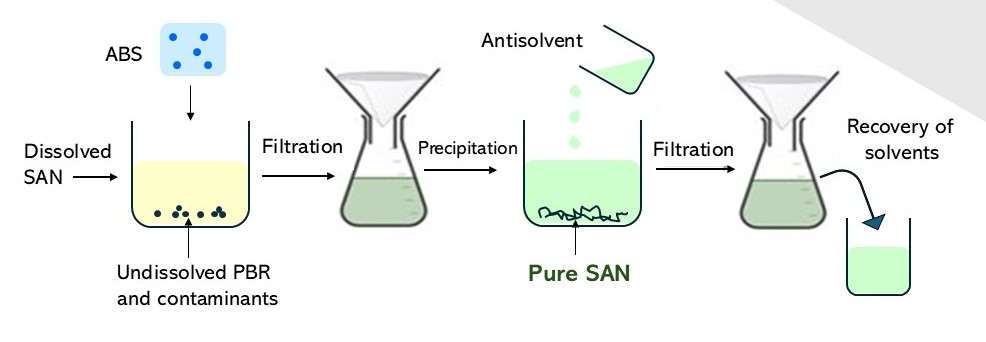
The drawbacks of mechanical recycling can be avoided by using a physical recycling processes based on dissolving the polymer waste in a suitable solvent, filtering out any insoluble contaminants, additives and other unwanted substances, and recovering the pure SAN polymer through re-precipitation and drying [9,10]. By optimizing dissolution process conditions such as choice of solvent, polymer concentration, dissolution temperature, and time, SAN polymer’s structure and molecular weight is maintained while environmental impact is minimized. The ongoing development of eco-friendly solvents has great potential to further reduce the environmental impact and to enhance scalability of this method.
The main purpose of this study was to evaluate effects of the physical recycling process on the quality, safety, and functionality of the ABS materials made with recycled SAN from various waste sources and a masterbatch (MB) formulated for a final application.

2. Materials

2.1. Materials Included in This Investigation

Materials included in this study can be divided into two groups viz. virgin ABS materials with different rubber content and materials that have been used in the recycling experiments. Two series of ABS materials with varying rubber content based on two different SAN polymers were manufactured by Trinseo. The SAN polymers are designated SAN 1 with low AN content and high molecular weight (Mw) and SAN 2 with high AN content and low Mw. The materials were used in the development of analytical methods for the determination of rubber content and in the tests to determine dependence of properties on rubber content and type of SAN.
The second group of materials can be divided into three categories: starting ABS materials, SANs obtained from the starting ABS materials using the physical recycling process based on the TNO Möbius dissolution technology and the final ABS materials produced from the recycled SANs and one master batch (MB) by melt processing using micro-compounder (see Figure 1).
The following materials were used in the recycling experiments.
In all final ABS materials in this category, the PBR content (25 wt. %) as well as the content of additives were at the same level, which created similar conditions for the comparison of mechanical and other properties between different ABS samples. This approach provided an opportunity to compare the effect of SAN recycled from different sources on properties of the final product.

2.2. Physical Recycling

In the recycling experiments, the TNO Möbius dissolution technology was used which is based on a selective dissolution process in which the polymer is separated from impurities, additives and contaminant polymers [11]. It is an innovative solvent-based technology developed to address the challenges of plastic recycling with the objective of recovering and decontaminating polymers that can be re-compounded to plastic. TNO’s Möbius process utilizes a selective solvent-based approach for dissolution of specific polymers from pretreated waste plastics streams (sorted and washed).

2.3. Manufacturing of Materials

The melt processing of ABS materials significantly influences the final product's properties. Process parameters such as temperature, shear rate, and cooling rate determine the polymer’s viscosity, molecular integrity, internal stress, shrinkage, etc. Each parameter plays an important role in formation of microstructure and stress distribution affecting the products mechanical properties [12]. In this study only small amounts of recycled SAN were available for investigation, which is why all ABS materials based on recycled SAN were produced with micro-compounder. Consequently, all material properties have been evaluated on these materials. The absolute values ​​of mechanical properties presented here may therefore differ from those that can be obtained from materials manufactured with industrial equipment. However, the most important objectives of the investigation were to show how the properties vary with the rubber content and type of SAN and to compare the quality of the ABS materials made with recycled SAN from different waste sources. In this context, the results should be seen primarily as relative rather than absolute.

2.3.1. Industrial Scale Manufacturing of ABS Materials by Trinseo

Trinseo, which is a company that offers a broad line of plastics and binders in many areas of application provided to this investigation virgin raw ABS materials and moulded test specimens. It also produced masterbatch (MB) and several eABS compounds with various proportions of PBR as well as virgin eABS and mABS materials that have been used as input to the TNO Möbius process.

2.3.2. Small-Scale Manufacturing by RISE

Before processing, ABS was dried at 80 °C for 4 hours in an oven. The samples studied regarding quality of the recycled ABS (see figure 1) were prepared by mixing virgin or recycled SAN with the fresh masterbatch (MB) containing PBR grafted onto SAN and standard additives. The materials were then processed in a micro-compounder (Xplore MC 15 HT) which is a small-scale twin-screw extruder at 220 °C, 50 rpm. The materials were maintained in the machine for 1 min using a recirculation channel, and then transferred to an injection moulding attachment (Xplore IM 12) and moulded to test bars of the shape according to ISO 527-2 type 5A, and rectangular specimens with dimension 80 x 10 x 4 mm.

3. Methods

The quality of ABS materials is determined by a combination of mechanical, thermal, physical and chemical properties which are largely shaped by the ratio of the three monomers. ABS is a so-called rubber-toughened material where a brittle SAN polymer is blended with rubber particles to create a tough material. Consequently, morphology of ABS materials together with volume fraction of the rubbery phase and rubber particle size and orientation are very important factors controlling the mechanical properties of ABS [13]. The following sections describe methods that have been used here for evaluating key properties that determine the quality of ABS materials.

3.1. Morphology

Morphology of ABS is represented by a continuous SAN phase in which grafted PBR particles are dispersed. Morphological analysis was performed using scanning electron microscopy (SEM) on test specimens from bars used for impact test which were fractured in liquid nitrogen and then immersed in an aqueous solution of 2 wt. % osmium tetroxide for 48 h. Then, the specimens were washed, dried and coated with gold to make the samples electrically conductive during SEM imaging, using a Zeiss Supra 40 VP instrument. Backscattered electron (BSD) images of the materials were obtained by using an accelerating voltage between 10 and 20 kV. To view clearly contrasts differences between the phases and counting the particle size, the original SEM images were converted to negative images using the software ImageJ®.
SEM statistics of particle size were calculated analyzing individual images to determine a distribution, using median diameter. This was done by measuring particle dimensions from an image, the diameter for roughly spherical particles or length and width for irregular ones. The statistical analysis of hundreds of particles, presented in histograms, provides data on mean (D) and number-based percentages (using the software ImageJ® and Origin®).

3.2. Mechanical Testing

Evaluation of mechanical properties was performed by measurements of tensile and impact strength. The test specimens were produced by injection moulding using micro-compounder.
The impact tests were performed at 23 ℃ and -30 ℃ using a Resil Impactor and following the ISO 179-1 standard “Determination of Charpy impact properties”.
Tensile tests were performed on a Zwick/Roell Z100 system according to ISO 527-2 and using a 5 kN load cell. Sample size was Type 5A, preload 0,1 MPa, and test speed 10 mm/min. The test speed during measurements of tensile modulus was 1 mm/min.

3.3. Thermal Analysis

Thermo-gravimetrical analysis (TGA) experiments were performed on a Mettler Toledo TGA1 instrument. The test materials were heated from room temperature to 800 ℃ in nitrogen atmosphere at a heating rate of 10 K/min and the weight of the sample was registered as a function of heating temperature.
Determination of Vicat softening temperature (VST) was performed according to ISO 306 method B50 using 50 N force and a heating rate of 50 K/h. It is measured as temperature at which the sample is penetrated exactly 1 mm by a flat-ended circular indenter of 1 mm² in cross-section.

3.4. Rheology by Melt Mass Flow Rate (MFR) Measurements

The MFR of the materials investigated in this study was measured using the test method ISO 1133-1, procedure A, with the test conditions: temperature 220 ℃ and load 10 kg. The MFR was determined as the mass extruded over a specified time under prescribed conditions and calculated as grams per 10 min. The standard recommends using half size die if the MFR is > 75 g/10 min. This has not been applied here in order to be able to make a direct comparison between materials with different rheological properties, which has increased the measurement uncertainty for the material with high MFR.

3.5. Rubber Content Analysis

Rubber content is one of the most important factors determining the physical, mechanical and rheological properties of ABS materials. For this reason, many different methods have been developed over the years to determine the PBR content in ABS as reported by Zamani et al [14]. Also, in this study attempts have been made to determine the rubber content but without using chemicals or solvents. Consequently, two different methods were selected for the analysis, namely pyrolysis-gas chromatography/mass spectrometry (Py-GC/MS) and Fourier Transform InfraRed (FTIR) spectroscopy.
The result of the chemical analyses using Py-GC/MS was a pyrogram which is a characteristic mass spectrum of a material (see Figure 2), with the intensity of the products set against the retention time. Mass spectra were recorded, to enable identification of the chemical structure of the materials.​ The pyrograms show one peak from PBR and several peaks corresponding to SAN. A calibration curve was created by plotting the ratio of the area of the PBR peak and a selected peak at 1,67 min. from SAN against the % PBR contents.
In the second method, FTIR spectra were collected using a Nicolet iS50 FTIR spectrometer equipped with an all-reflective diamond attenuated total reflection (ATR) attachment (see Figure 3). 32 scans collected between 4000 and 400 cm-1 were averaged to reduce noise. The resulting spectra were compared with the literature.
Quantitative analysis by IR spectroscopy has some limitations but comparing spectra obtained from the materials containing known amounts of PBR makes it possible to construct a calibration curve and thus determine the content of PBR in an unknown material. ABS materials with known rubber contents were analyzed with FTIR. The ratios of the absorbance peaks intensities between the band appearing at 966 cm-1 which corresponds to PBR and the band at 1493 cm-1 corresponding to the aromatic ring vibration in polystyrene which is frequently used as the internal reference were plotted against PBR content.

3.6. Chemical Analysis of Substances

Chemical analysis has been performed with focus on materials compliance according to the European Union’s REACH regulation (EC) No 1907/2006, the Toy Safety Directive 2009/48/EC as well as the relevant product requirements for the automotive industry.
The chemical analysis of the samples was performed by GC-MS, XRF, ICP-OES and IC to detect remaining substances and SVHCs (Substances of Very High Concern) present before and after the recycling process. Both screening analysis and methods directed for the concentration determination of individual compounds known as pollutants or additives in ABS were used, in combination with migration tests of certain elements. The analysis methods were chosen towards product safety requirements in the areas of hygiene, automotive and toys safety with focus on detection, identification and quantification of selected substances in the rABS.

3.6.1. Materials and Reagents

Dichloromethane (>99%, stabilized with 2-metyl-2-buten 20 ppm), methanol (99%), nitric acid (70%) and hydrogen peroxide (30%) were purchased from Merck. Styrene (>99%) and Irganox 1076 (>98%) were obtained from TCI Europe N.V. Certified reference standard solutions of DEHP (Bis(2-ethylhexyl) phthalate), triphenyl phosphate and bisphenol A were purchased from Neochema GmbH.

3.6.2. X-Ray Fluorescence (XRF)

Elements heavier than sodium were screened by handheld XRF, Thermo ED-XRF, Niton XL3t, focusing on halogen concentration determination. The concentration determination of bromine was done by external standards of ABS samples with known concentrations in the range of 20-150 mg/kg.

3.6.3. Inductively Coupled Plasma-Optical Emission Spectrometry (ICP-OES)

The samples were dissolved with a mixture of nitric acid and hydrogen peroxide by microwave digestion. The metal determination was performed by inductively coupled plasma-optical emission spectrometry (ICP-OES) using external standards.

3.6.4. Determination of Total Fluorine Content

Quantification of total fluorine was done using pyrohydrolytic combustion of samples, followed by fraction collection of the fluoride formed and IC detection, i.e. combustion ion chromatography (CIC). The instrument used was an XPREP C-IC from Trace Elements, together with an IC from Metrohm.

3.6.5. Migration Tests

The migration of elements from the samples to water was tested according to the European standard EN 71-3. Safety of toys - Part 3: Migration of certain elements. All the elements except chromium (VI) and organic tin were determined by inductively coupled plasma-optical emission spectrometry (ICP-OES). Organic tin was determined in the sample parts made from material that can contain organic tin compounds, with a total concentration of tin at a level making it possible to exceed the limit value for the part analysed. Chromium (VI) was determined by ion chromatography (IC) using inductively coupled plasma-mass spectrometry (ICP-MS) as detector. Chromium (VI) was determined in the sample parts with a total concentration of chromium at a level making it possible to exceed the limit value for the part analyzed.

3.6.6. Characterization of Volatile Organic Compounds by GC-MS (Gas Chromatography Mass Spectrometry)

The GC-MS analysis were performed on an Agilent GC:MS 6890N equipped with 5975 Inlet XL MSD with Triple-Axis Detector, and a DB-5MS column (30m, 0.250 mm, 0.25 mm), using helium carrier gas at 1,2 ml/min and inlet temperature 280 °C. The temperature program started at 35 °C for 3 min followed by heating at 15 °C /min to 320 °C, keeping the final temperature for 8 min. The mass spectrometer operated in EI mode at 70 eV, in the scan range m/z 32-650 Da.
The samples were extracted in dichloromethane in a sonic bath for 30 min at 40 °C. The extracts were diluted in methanol and analyzed by GC-MS after removal of the solid polymers by centrifugation. The compounds detected by GC-MS were identified by NIST database of mass spectra, and the concentrations were estimated in decane equivalents. The external decane standards showed a linear standard concentration range between 1-80 mg/l. The method detects compounds of boiling points between 100 °C to approximately 380 °C, and the compounds detected are divided into categories of oligomers, solvents and unknowns.
Initially, the screening analysis by GC-MS revealed the presence of Bisphenol A, styrene, triphenyl phosphate, DEHP and Irganox 1076 in mechanically recycled ABS samples. These compounds were therefore determined specifically by external standards, using four standard points between 2-80 mg/l in the calibration curve.

3.6.7. Characterization of Residual Solvents by Headspace GC-MS

For the detection of compounds with boiling points lower than 100 °C, the samples were heated in sealed headspace vials at 120 °C for 30 min before injecting the headspace on the GC-MS. The compounds detected by GC-MS were identified by NIST database of mass spectra, and the concentrations were estimated in decane equivalents by external standard.
The GC-MS analysis were performed on an Agilent 7890B GC system equipped with 5977B MSD, and a DB-5MS column (30 m, 0,250 mm, 1,0 mm), using helium carrier gas at 0,9 ml/min and an inlet temperature of 280 °C. The temperature program started at 35 °C for 2 min followed by heating at 10 °C /min to 280 °C, keeping the final temperature for 5 min. The mass spectrometer operated in EI mode at 70 eV, scan range m/z 30-650 Da.

4. Results and Discussion

4.1. Properties of Virgin ABS Materials

4.1.1. Determination of Rubber Content

To evaluate the effects of recycling on the quality of a recycled material, it is important to have detailed knowledge about relationships between properties, morphology and composition of the original materials. Rubber content is one of the important factors determining the physical, mechanical, and rheological properties of ABS plastics [15]. In addition to the rubber content, the size of the rubber particles is also known to be an important parameter affecting especially the fracture toughness of rubber-modified materials [16]. Consequently, development of a suitable method to determine rubber content in ABS has also been part of this study. Two different analytical methods were selected for the analysis of rubber content.
Calibration curves using Py-GC/MS were successfully created to determine the content of PBR in ABS. However, the area ratio PBR/SAN depends on the settings and temperatures during the pyrolysis. A calibration curve needs therefore to be created in connection with the analysis of PBR in unknown samples. The Py-GC/MS calibration curve is presented in Figure 4. The measurement uncertainty for the highest rubber contents was about ±1,5 % and ±1% for the lower contents.
Also, another calibration curve was created using FTIR. Sample preparation and the FTIR analysis itself are relatively simple but the complex structure of ABS containing grafted rubber, and different linkages in PBR such as 1,4-cis/trans and 1,2-vinyl which gives rise to different IR signals can complicate direct quantification and contributes to greater measurement uncertainty. The measurement uncertainty for the highest rubber contents (35 %) was about ±3 % and decreasing with decreasing rubber content. The FTIR calibration curve is presented in Figure 5.

4.1.2. Mechanical Properties

As mentioned before, the mechanical properties depend on morphology of ABS materials together with the PBR content and rubber particle size and orientation. But SAN's properties can also affect the mechanical and rheological properties of ABS, especially the acrylonitrile (AN) content and molecular weight (Mw) of the SAN [17]. In this study, two different SAN polymers were used, namely SAN 1 (low AN content, high Mw) and SAN 2 (high AN content, low Mw) to produce ABS materials with various proportion of PBR. It is generally recognized that both increased AN content and higher Mw of SAN can lead to slightly higher E-modulus. Both SAN polymers used in this study have resulted in ABS materials with almost the same E-modulus. This result is in agreement with the theory that the modulus of a blend with dispersed spherical rubber particles depends mainly on the rubber particle volume fraction alone and is the most important parameter controlling modulus values of ABS resins. The E-modulus of the two ABS materials decreased linearly with increasing rubber content as expected for both materials as shown in Figure 6.
Different effects of the two SAN polymers used are more visible in properties such as tensile strength and elongation at break as shown in Table 1. Generally, higher AN content in the SAN phase increases rigidity because of strong polar interactions and thus the tensile strength of the ABS material but often leads to a decrease in the elongation at break. Conversely, increasing the PBR content decreases tensile strength but increases the elongation at break. These effects can also be seen in Table 1 where ABS based on SAN 2 has lower elongation at break but higher tensile strength at lower PBR content compared to ABS based on SAN 1.

4.1.3. Rheological Properties

Optimal processing of plastic materials is important for the properties of the final product. One of the fundamental properties to consider when selecting processing parameters is the rheological behaviour. Knowledge of this parameter is vital to carry out a correct extrusion or injection moulding of the polymer. A common method for measuring rheological properties is measuring melt flow rate (MFR). In Figure 7 and Figure 8 results of MFR as a function of PBR content in the two previously described SAN matrices are presented. It is seen that MFR of ABS plastics is inversely proportional to its rubber content. As the rubber content increases, the viscosity of the ABS melts increases, resulting in a decrease in MFR, which means that the material is more difficult to process.
It is worth pointing out the large difference in MFR between ABS based on SAN 1 and SAN 2 which is of course mainly due to the difference in Mw. The MFR of both SAN polymers increases by adding small amounts of PBR. Thereafter, MFR decreases with increasing PBR content.

4.1.4. Morphological Properties

ABS is a multiphase polymer blend with structural and compositional properties whose effects are complex and interdependent. Mechanical properties of ABS is one of many properties affected by the rubber phase volume fraction, particle size and size distribution, and structure which in turn are affected by the manufacturing process. Industrial synthesis of ABS is performed mainly via emulsion or mass polymerization routes. Due to different polymerization processes, these two main ABS material types exhibit different morphologies concerning PBR particles content, shape and size distribution.
Commercial eABS contains a significantly higher amount of grafted ABS (gABS) compared to mABS. It also includes a compounding step of the first polymerization product with pure SAN thus it can be regarded as a blend of gABS with SAN [18]. In the mass process, preformed PBR is dissolved in the styrene and acrylonitrile monomers which polymerize around the rubber phase which causes mABS to have a higher amount of SAN inclusions in the PBR-particles. This causes a significantly larger spherical diameter while maintaining a low PBR content, resulting in the well-established “salami” morphology of mABS. Examples of SEM images of eABS and mABS are shown in Figure 9 and Figure 10.

4.1.5. Thermal Properties

Thermal analysis provides a thermal fingerprint for materials. In this investigation, TGA was used to study the thermal decomposition of ABS materials containing various amounts of PBR. The TGA curves are presented in Figure 11. All TGA curves show a one-stage weight loss between 390 ℃ and 500 ℃. Analyses clearly show that the decomposition temperature increases with increasing PBR content in the material. This relationship is in good agreement with the results of Hitachi who reported that the decomposition of PBR is reflected in the high temperature range while the decomposition of styrene is reflected in the low temperature range [19].
Another important thermal property is Vicat softening temperature (VST) which serves as an indicator of when the material begins to lose its structural rigidity under a specified load. ABS materials based on SAN 1 (low AN, high Mw) and SAN 2 (high AN content, low Mw) with various proportions of PBR were also used in this test. As shown in Table 2, the composition of SAN does not seem to affect VST significantly while it decreases with increased PBR content as expected. In theory, VST should increase with increased Mw and also increase with increased AN content. Since a SAN with low AN and high Mw respectively a SAN with high AN and low Mw, have been used, the effects of these two parameters seem to cancel each other out, resulting in the same effect on the VST.

4.2. Effect of Physical Recycling on Properties of Final ABS Materials

4.2.1. The Effect on Mechanical Properties

Mechanical properties of ABS materials are highly dependent on several technical factors such as material composition, manufacturing method, processing temperature etc. To find out whether the mechanical properties of the final ABS are affected by the source from which SAN is recycled, three different ABS materials were manufactured with the same composition and the same manufacturing method. The only difference is that SAN has been obtained by TNO Möbius recycling process from three different ABS materials, namely eABS, mABS and rABS, which is a mechanically recycled ABS from ELV (end-of-life vehicles) waste. The tensile properties of the original and recycled materials are reported in Table 3 while impact strength is reported in Table 4.
Mechanical tests show that ABS materials made with recycled SAN give similar results regardless of the source of the SAN. It is also clear that mechanically recycled ABS has poorer impact strength but after removing PBR and adding new additives, the material acquires the same properties as the others.

4.2.2. The Effect on Viscosity

As demonstrated in Figure 7 and Figure 8, MFR is strongly dependent on the rubber content and the molecular weight of SAN. It is also affected by the size and hardness of the rubber particles. In the ABS materials based on recycled SANs, the rubber particles are the same, which gives materials with almost the same viscosity as shown in Table 5.

4.2.3. The Effect on Morphology

It is known that the size and shape of the rubber particles are important parameters affecting especially mechanical properties of ABS materials. PBR particles shape, distribution in the matrix and size distribution were studied by SEM. The SEM micrographs are shown in Figure 12 where images on the left side are of the original ABS materials while images on the right side are of the ABS materials based on recycled SAN. Micrographs of the original ABS materials show different morphology; firstly, there is a very special difference between eABS and mABS where mABS exhibits a characteristic "salami" structure. Secondly, there is a difference in particle size distribution. Of course, the images from the ABSs with recycled SAN show the same morphology because the PBR particles from original materials are removed while the new PBR particles are from the same MB that has been used in the manufacturing.
Preprints 212169 i001
It can be seen in Figure 13 that particle size distribution in eABS and in the ABS with recycled eSAN is almost the same ranging between 0,1 and 0,6 microns. Naturally, the two other ABS materials with recycled SAN also have similar particle size distribution because all SANs were blended with the same MB. Of course, mABS differs, as due to its "cell-type" particles containing internal SAN inclusions showing broader and larger particle size distribution ranging between 0 and 1,3 microns.

4.2.4. Analysis of Impurities and Other Substances

Post-consumer plastic waste, even if it has been well sorted and cleaned beforehand, can contain contaminations and unwanted substances. It is generally accepted that physical recycling has great potential to remove contaminants. However, the optimal removal of contaminants during the dissolution-based recycling of ABS depends on several factors including solvent selection, polymer concentration and process configuration (temperature, filtration method etc.). Table 6 shows the concentration of certain substances in the original ABS materials and the concentration of the substances in the corresponding SANs after physical recycling.
The compounds detected in samples eABS and mABS before recycling were Styrene, Irganox 1076 and various oligomers (mainly identified as ABS and SAN dimers and trimers) and unknown compounds. The compound concentrations were significantly reduced in samples eSAN and mSAN after recycling, except for solvent concentration that increased due to the solvent residues from the recycling process. However, the small amount of solvent should not have any practical significance because it evaporates in the subsequent compounding step without affecting the properties of the material. On the other hand, reduced content of oligomers in recycled SAN could affect the rheological properties of the polymer melt during processing.
The concentration of styrene was reduced to levels clearly below the LOQ (limit of quantification) for both samples apart from Irganox 1076 in eSAN which was detected at approximately 8 mg/kg. Bisphenol A, Triphenyl phosphate, DEHP, cadmium and bromine were detected in the sample rwABS at concentrations between 40-320 mg/kg. The recycling to sample rwSAN resulted in a decrease to concentrations between 28-130 mg/kg. The styrene, Irganox 1076 and oligomer concentrations also showed a minor decrease. Overall, the recycling to sample rwSAN was less effective in decreasing the compounds detected, compared to the concentration reduction observed for the recycling of samples eABS and mABS.

5. Conclusions

The main purpose of this study was to evaluate effects of the physical recycling process on the quality, safety, and functionality of the recycled ABS materials for final applications. The composition of ABS is fundamental to its properties, where variations in the ratios of the monomers Acrylonitrile, Butadiene, and Styrene directly determine its mechanical, thermal, and processing characteristics. Since, in a recycling process, ABS materials with unknown composition are often handled, it is important to have simple and quick methods for determining the PBR content. In this study two different methods were therefore evaluated for determination of rubber content without using chemicals or solvents, namely pyrolysis-gas chromatography/mass spectrometry (Py-GC/MS) and Fourier Transform InfraRed (FTIR) spectroscopy. Both methods made it possible to construct calibration curves that can be used to determine the rubber content of an unknown ABS material.
Furthermore, it was investigated how important properties vary with rubber content and SAN composition using two series of ABS materials with varying rubber content and based on two different SAN polymers (SAN 1 (low AN content, high Mw) and SAN 2 (high AN content, low Mw)). Both series of ABS materials exhibited almost the same tensile E-modulus which decreased linearly with increasing rubber content. Differences between ABS based on SAN 1 and SAN 2 could be noticed in properties such as tensile strength and elongation at break where ABS based on SAN 2 has lower elongation at break but higher tensile strength at lower PBR contents compared to ABS based on SAN 1. The difference between these two SANs is significantly greater when it comes to rheological properties. MFR of ABS with SAN 2 (low Mw) is four times higher than ABS with SAN 1 (high Mw). The MFR of both ABS materials with various SAN polymers decreases with increasing content of PBR. On the other hand, no clear difference between ABSs with SAN 1 and 2 can be measured regarding VST (Vicat softening temperature) but both show decreasing VST with increasing PBR content. Another thermal characteristic that was investigated was the decomposition temperature measured by TGA which increases with increasing PBR content in the material.
Physical recycling of ABS using dissolution technique separates the relatively pure SAN polymer, from mainly PBR, and additives that were used in the original materials as well as possible contaminants. The recycled SAN is then melt-blended with the fresh masterbatch (MB) containing PBR grafted onto SAN and standard additives using a micro-compounder. The final ABS materials had the same composition which created an opportunity to compare the effect of SAN recycled from different sources on properties of the final ABS materials.
Mechanical properties of ABS materials made with recycled SAN are similar regardless of the source of the SAN. It is also clear that mechanically recycled ABS has poorer impact strength but after removing PBR and adding MB, the material acquires the same properties as the others. Since ABS materials based on recycled SANs contain the same PBR and additives the MFR and the morphology is the same. Of course, mABS morphology as a starting material differs because the special "cell-type" particles in mABS are removed during the recycling process and replaced by emulsion type of rubber particles.
An important part of the investigation was to evaluate how effective the recycling process is for removing various substances. The optimal removal of various substances in the dissolution-based recycling process depends on several factors both chemical and physical. The most important factors are the choice of solvent, the concentration of the polymer, and the process conditions prevailing during the separation. Several substances were quantified in original ABS materials and in SAN polymers obtained from the physical recycling process. Chemical analysis indicates that the TNO Möbius process successfully separates the product from monomers, oligomers, elements, and additives by using small scale apparatus. Styrene that was detected in virgin eABS and mABS was effectively removed by the process. Bisphenol A was detected in ABS from mechanically recycled ELV waste and was partially removed. Oligomers and antioxidants were largely removed from all materials except from ELV waste. Bromine was only found in ABS waste from ELV which was reduced from 270 to 40 mg/kg after physical recycling process. Migration tests have shown that amounts of elements and styrene are well below the limits specified in the European toy directive. The reduction of compound and element concentrations by physical recycling is significantly higher for the virgin samples compared to that of mechanically recycled ABS waste which we believe is due to changed parameters in the recycling process.

Author Contributions

Conceptualization NY and IJ, investigations JAL, AH and RS, recycling methodology RC, writing—original draft preparation NY and IJ, review and editing all authors.

Funding

This research was funded by the European Union`s Horizon 2020 Research and Innovation Programme under Grant Agreement N° 101058636 for ABSolEU project.

Data Availability Statement

The original contributions presented in this study are included in the article. Further inquiries can be directed to the corresponding authors.

Acknowledgments

The authors would like to thank the European Commission for founding this work. The authors also thank Trinseo Netherlands B.V. and Dr. Pieter Janssen in particular for providing materials for this investigation and valuable discussions. Mrs. Sofia Regnell Andersson and Mrs. Azadeh Soroudi are appreciated for analyses and laboratory works. .

Conflicts of Interest

The authors declare no conflicts of interest.

Abbreviations

The following abbreviations are used in this manuscript:
AN Acrylonitrile
ABS Acrylonitrile Butadiene Styrene
gABS grafted ABS
mABS ABS obtained by mass polymerization
eABS ABS obtained by emulsion polymerization
vABS Virgin ABS (original material)
wABS ABS waste (post-consumer and post-industrial)
rwABS Mechanically recycled wABS
SAN Copolymer of styrene and acrylonitrile
mSAN SAN from mABS after the Möbius process
eSAN SAN from eABS after the Möbius process
rwSAN SAN from rwABS after the Möbius process
PBR Polybutadiene rubber
MB Masterbatch (50 % SAN + 50 % PBR)
XRF X-ray fluorescence
ICP-OES Inductively coupled plasma-optical emission spectrometry
GC-MS Gas chromatography mass spectrometry
IC Ion chromatography

References

  1. Plastics Europe – the fast Facts 2025. Available online: https://plasticseurope.org/knowledg.
  2. Hopewell, J.; Dvorak, R.; Kosior, E. Plastics recycling: challenges and opportunities. Phil. Trans. R. Soc. B 2009, 364, 2115–2126. [Google Scholar] [CrossRef] [PubMed]
  3. EN 17625; Plastics - Environmental Aspects - Vocabulary.
  4. Adams, M.E.; Buckley, D.J.; Colborn, R.E.; England, W.P.; Schissel, D.N. Acrylonitrile-Butadiene-Styrene: Review Reports; Rapra Technology: Shawbury, UK, 1993. [Google Scholar]
  5. Yu, Zhisheng; Li, Yang; Zhao, Zhongfu; Wang, Chaoxian; Yang, Juan; Zhang, Chunqing; Li, Zhansheng; Wang, Yurong. Effect of Rubber Types on Synthesis, Morphology, and Properties of ABS Resins. Polym. Eng. Sci. 2009, Volume 49(Issue 11), 2085–2292. [Google Scholar] [CrossRef]
  6. www.prnewswire.com (Accessed on 2021-09-09). (accessed on 2021-09-09).
  7. Deshmukh, D.; Kulkarni, H.; Sai Srivats, D.; Bhanushali, S.; More, A. P. Recycling of acrylonitrile butadiene styrene (ABS): a review. Polym. Bull. 2024, 81, 11361–11398. [Google Scholar] [CrossRef]
  8. Moon, S.; Jung, G. Recent Progress in Sustainable Recycling of Waste Acrylonitrile–Butadiene–Styrene (ABS) Plastics. Sustainability 2025, 17, 8742. [Google Scholar]
  9. Anderson, L.; Yu, E.; Chen, W.T. Chemical recycling of mixed plastics in electronic waste using solvent-based processing. Processes 2022, 10, 66. [Google Scholar] [CrossRef]
  10. Lu, Taofeng; Chen, Wan-Ting. Material recycling of Acrylonitrile Butadiene Styrene (ABS) from toy waste using density separation and safer solvents. Resour. Conserv. Recycl. 2023, 197, 107090. [Google Scholar] [CrossRef]
  11. Recycling plastics through dissolution | TNO (Accessed on 2024-12-06).
  12. Mokhtar, W. A.; Benta Nasir, S. Effects of injection molding process parameters on the mechanical properties of ABS and PP polymer. In Proceedings of the 2024 ASEE North Central Section Conference, 2024. [Google Scholar]
  13. Xu, X.F.; Wang, R.; Tan, Z.Y.; Yang, H.D.; Zhang, M.Y.; Zhang, H.X. Effects of polybutadiene-g-SAN impact modifiers on the morphology and mechanical behaviours of ABS blends. Eur. Polym. J. 2005, 41, 1919–1926. [Google Scholar] [CrossRef]
  14. Zamani, A.; Abbasi, F.; Agah, A.M. Characterization of Rubber Phase in Acrylonitrile–Butadiene – Styrene Polymers. J. Appl. Polym. Sci. 2009, 114(3), 1908–1913. [Google Scholar] [CrossRef]
  15. Tan, ZI Ying; Xu, X.F.; Sun, S.L.; et al. Influence of rubber content in ABS in wide range on the mechanical properties and morphology of PC/ABS blends with different composition. 2006, 46(10), 1476–1484. [Google Scholar] [CrossRef]
  16. Yanchun, H.; Lach, R.; Grellmann, W. Effects of Rubber Content and Temperature on Unstable Fracture Behaviour in ABS Materials with Different Particle Sizes. J. Appl. Polym. Sci. 2001, Vol. 79, 9–20. [Google Scholar]
  17. Kim, H.; Keskkula, H.; Paul, D.R. Effect of acrylonitrile content on the toughness of ABS materials. Polymer 1991, vol. 32, 1447–1455. [Google Scholar] [CrossRef]
  18. Fernandez, E.; Edeleva, M.; Cardon, L.; D’hooge, D. R. Correlating processing induced orientation with tensile properties for mass polymerized acrylonitrile butadiene styrene test specimens. RSC Appl. Polym. 2024, vol. 2, 1032–1042. [Google Scholar] [CrossRef]
  19. Hitachi High-Tech, Thermal Decomposition Measurement of ABS resin I – Analysis by quasi- isothermal TG and TG/FT-IR measurements. 1995, TA No. 66.
Figure 1. Investigated materials and material flows.
Preprints 212169 g001
Figure 2. Example of a pyrogram from ABS.
Preprints 212169 g002
Figure 3. Example of an FTIR spectrum of ABS.
Preprints 212169 g003
Figure 4. Ratio of area of PBR/SAN peak eluting at 1,67 min against the % contents of PBR.
Preprints 212169 g004
Figure 5. IR index as the ratio between band intensities at 966 cm-1 and 1493 cm-1 vs the % contents of PBR.
Preprints 212169 g005
Figure 6. Figure 6. Youngs modulus vs PBR content for two ABS materials based on SAN 1 (high Mw and low AN content) (blue line) and SAN 2 (low Mw and high AN content) (orange line).
Preprints 212169 g006
Figure 7. Melt flow rate vs % PBR for ABS material containing SAN 1.
Preprints 212169 g007
Figure 8. Melt flow rate vs % PBR for ABS material containing SAN 2.
Preprints 212169 g008
Figure 9. SEM micrograph of eABS indicating the shape and dispersion of rubber particles in the matrix visible as dark dots.
Preprints 212169 g009
Figure 10. SEM micrograph of mABS indicating the shape and dispersion of rubber particles in the matrix which exhibits a characteristic “salami” structure.
Preprints 212169 g010
Figure 11. TGA analyses of ABS containing SAN 2 plus various amount of PBR.
Preprints 212169 g011
Figure 12. SEM micrographs of (A) virgin eABS, (B) eSAN + 50 % MB, (C) virgin mABS, (D) mSAN + 50 % MB, (E) rwABS and (F) rwSAN +50 % MB. Magnification: 20.000 x. .
Preprints 212169 g012aPreprints 212169 g012b
Figure 13. Particle size distribution before and after recycling. .
Preprints 212169 g013
Table 1. Tensile properties of virgin ABS with different rubber content.
PBR content Tensile strength [MPa] Elongation at break [%]
[%] SAN 1 SAN 2 SAN 1 SAN 2
3 44,3 72,3 2,7 1,2
7 45,7 55,6 4,4 2,3
12 46,4 40,9 6,3 2,9
17 42,3 41,1 5,3 2,5
26 39,1 37,5 6,2 4,0
35 36,7 23,0 6,2 4,1
Table 2. Vicat softening temperature [℃].
PBR content [%] eABS, SAN 1 eABS, SAN 2
0 101,4 100,4
17 96,3 96,2
26 94,6 94,8
35 92,1 93,9
Table 3. Tensile properties of the recycled ABS materials.
Sample Original ABS ABS with recycled SAN
E (GPa) σ (MPa) ɛ (%) E (GPa) σ (MPa) ɛ (%)
mABS 1,35 36,4 23,7 1,32 41,8 16,8
eABS 1,48 44,6 12,1 1,41 38,4 12,2
rwABS 1,30 50,0 10,2 1,39 37,7 17,6
Table 4. Impact strength [kJ/m2].
Sample Original ABS ABS with recycled SAN
23 ℃ -30 ℃ 23 ℃ -30 ℃
mABS 18,5 10,4 20,5 11,7
eABS 19,0 9,0 21,6 12,2
rwABS 10,7 5,2 22,2 14,7
Table 5. MFR of the original ABS and ABS materials based on recycled SANs [g/10 min.].
Sample Original ABS ABS based on
recycled SAN
mABS- 10,8 23,8
eABS- 27,0 26,3
rwABS- 27,2 24,1
Table 6. The content of certain substances before and after physical recycling indicated in [mg/kg].
Substance [mg/Kg] eABS eSAN mABS mSAN rwABS rwSAN
Styrene 200 < 0,5 170 <0,5 120 90
Bisphenol A < 1 <1 <1 <1 320 130
Triphenyl phosphate < 1 < 1 <1 <1 42 4.1
DEHP <5 <5 <5 <5 40 28
Irganox 1076 1400 10 2300 <10 3100 470
Bromine <20 <20 <20 <20 270 40
Cadmium <25 <25 <25 <25 43 <25
Solvents and unknowns 530 2600 270 450 310 1800
Oligomers 9500 79 3800 170 3000 2800
Disclaimer/Publisher’s Note: The statements, opinions and data contained in all publications are solely those of the individual author(s) and contributor(s) and not of MDPI and/or the editor(s). MDPI and/or the editor(s) disclaim responsibility for any injury to people or property resulting from any ideas, methods, instructions or products referred to in the content.
Copyright: This open access article is published under a Creative Commons CC BY 4.0 license, which permit the free download, distribution, and reuse, provided that the author and preprint are cited in any reuse.
Prerpints.org logo

Preprints.org is a free preprint server supported by MDPI in Basel, Switzerland.

Subscribe

Disclaimer

Terms of Use

Privacy Policy

Privacy Settings

© 2026 MDPI (Basel, Switzerland) unless otherwise stated