

Submitted:
05 May 2026
Posted:
07 May 2026
You are already at the latest version
Abstract
The gauge-hierarchy problem — the fourteen-order-of-magnitude chasm between the Planck and electroweak scales — and the cosmological-constant problem collectively constitute the deepest structural wounds in the standard model of gravitation. Existing remedies, whether anthropic selection [1], large extra dimensions [2], or warped compactification [3,4], each purchase conceptual economy at the expense of either predictive sterility or geometric fine-tuning. This framework develops upon effective-field that welds three architecturally cohesive structures: an F(R) = R + αR2/M∗2 − 2Λ5 bulk action in five dimensions, a circular Kaluza–Klein (KK) compactification whose radius RKK is fixed by a light stabilised radion of mass mφ ∼ H0, and the Hartle–Hawking no-boundary wave functional as the cosmological boundary condition. Within this architecture the KK tower generates an analytically controlled repulsive correction to the Newtonian potential above a comoving threshold λ ∼ c/H0 ≈ 1 Gpc, the effective cosmological constant receives a geometrically negative KK contribution that partially cancels the vacuum energy without anthropic invocation, and the scale-dependent effective Newton constant Geff(k, a) offers a possible resolution the σ8 tension — predicting σ8 = 0.769 against the lensing-derived 0.766 ± 0.020 — with no additional free parameter beyond the two that define the bulk geometry.
Keywords:
gauge hierarchy problem
; cosmological constant problem
; F(r) gravity
; kaluza–klein compactification
; hartle–hawking no-boundary proposal
1. Introduction
Gravity is anomalously weak. Stated with precision: the ratio encodes a suppression whose origin lies entirely outside the standard model of particle physics, and whose resolution — for five decades — has resisted every attempt at a dynamical, rather than selective, explanation [9]. Randall and Sundrum demonstrated in 1999 that a warped five-dimensional bulk geometry can reproduce the observed weakness of gravity without introducing a large compactification radius [3]; their RS1 model places two 3-branes at the boundaries of an slice, generating an exponential warp factor that maps the Planck scale to the electroweak scale geometrically. RS2 [4] subsequently showed that even a single brane embedded in an infinite AdS bulk localises four-dimensional gravity through a normalisable zero mode — a result that overthrew the long-standing conviction that compact extra dimensions are a prerequisite for recovering Newton’s law. Both papers appeared in Physical Review Letters within months of each other and catalysed an industry of phenomenological sequels that endured, with sustained citation velocity, until roughly 2016 [5].
What that industry did not settle is the infrared behaviour of the modified gravitational potential. The RS framework, in either incarnation, does not predict a repulsive gravitational correction at super-galactic scales; nor does it furnish a dynamical mechanism for cosmological acceleration. Concurrently, gravity — the replacement of the Einstein–Hilbert integrand R by a nonlinear scalar function — offers a geometrically motivated route to late-time cosmic acceleration [6,7] and supplies an additional propagating scalar degree of freedom (the scalaron) whose mass spectrum is theoretically tractable. The Starobinsky model [8] remains the most observationally successful single-field inflationary scenario precisely because that extra degree of freedom is heavy at early times and light at late times — a behaviour that, as we shall argue, has a direct analogue in the radion of a KK compactification.
The present work fuses these strands. The central claim is that a five-dimensional action, compactified on with a stabilised light radion and endowed with the Hartle–Hawking initial state, generates a four-dimensional effective theory whose gravitational sector is triply structured: it recovers standard Newtonian gravity at intermediate scales , transitions to five-dimensional power-law behaviour at sub-millimetre distances , and exhibits an analytically derived repulsive correction above that mimics a negative effective Newton constant without invoking a cosmological constant as a separate parameter. This triple structure is not assembled by hand; it emerges from a single geometric action through dimensional reduction, moduli stabilisation, and saddle-point evaluation of the no-boundary path integral — a cascade of derivations each of which is presented in full below.
The observational corollary is equally concrete. The scale-dependent effective Newton constant derived here modifies the growth equation for matter perturbations in a calculable way, yielding a predicted in agreement with weak-lensing compilations [31,32] and discrepant with the Planck-2018 CDM inference [28] — a discrepancy whose persistence across independent datasets signals a genuine beyond-CDM effect rather than systematic error. The same mechanism suppresses large-angle CMB power at multipoles [29], resolves the observed low-ℓ anomaly at the level, and produces a distinctive imprint in the matter power spectrum accessible to DESI [33], Euclid [34], and SKAO [35] within their nominal survey lifetimes.
The paper is structured as follows. Section 2 constructs the five-dimensional metric ansatz and establishes the geometric foundations of the KK reduction. Section 3 derives the action in five dimensions, performs the dimensional reduction, and obtains the four-dimensional effective action in Jordan and Einstein frames. Section 4 stabilises the radion modulus through a symmetry-breaking potential and derives the mass window . Section 5 computes the full KK graviton spectrum and the modified Newtonian potential, including the repulsive super-Gpc correction. Section 6 derives the scale-dependent and the modified growth equation. Section 7 embeds the framework in the Hartle–Hawking no-boundary proposal and derives the effective cosmological constant from a saddle-point calculation. Section 8 presents the modified Friedmann equation and the observable imprints on , , and . Section 9 provides a self-consistency audit of every free parameter. Section 10 concludes.
Throughout, we use metric signature , natural units unless stated, and capital Latin indices for the five-dimensional manifold, while Greek indices label the four-dimensional hypersurface.
2. Five-Dimensional Geometry and Kaluza–Klein Reduction
The five-dimensional spacetime manifold is taken to be , where is a circle of coordinate radius parameterised by with the identification . This choice — circular rather than -orbifold — is made deliberately: it avoids brane-localisation assumptions that are present in RS1/RS2 and allows the zero-mode graviton to be the unique massless spin-2 field without boundary conditions imposed by hand. The most general metric ansatz compatible with four-dimensional general covariance and the isometry of is the Kaluza–Klein decomposition [10,11]
where is the induced four-dimensional metric, is the radion field encoding local fluctuations of the compactification radius, and is a graviphoton. The ground state is , , . The determinant of the full metric satisfies , a relation used repeatedly below.
The five-dimensional Ricci scalar decomposes as [12]
where and . This decomposition is exact — no truncation is performed at this stage. The KK mass spectrum arises from expanding all five-dimensional fields in Fourier modes along y:
Substituting into the linearised five-dimensional Klein–Gordon equation and using the periodicity condition yields the KK mass ladder
The mode is the massless graviton of four-dimensional general relativity; modes are massive spin-2 fields whose exchange modifies the Newtonian potential at distances . To fix without introducing a new scale, we invoke the matching condition between the five-dimensional and four-dimensional Newton constants [2]:
With and adopting the conservative choice (no hierarchy in the bulk scale), Eq. (5) gives
This value — one order below the Planck length — ensures that KK excitations have masses , placing them beyond the reach of current collider phenomenology but well within the domain of gravitational UV physics. It also guarantees that the four-dimensional theory is indistinguishable from Einstein gravity at all scales , a requirement imposed with equal priority to the hierarchy resolution itself.

Table 1.
Fundamental geometric parameters of the five-dimensional framework. Each value is derived from Eq. (5) or the constraint equations of Section 4; none is adjusted post-hoc.
| Parameter | Symbol | Value | Units | Derivation basis |
|---|---|---|---|---|
| Planck mass (4D) | GeV | Measured | ||
| Fundamental 5D scale | GeV | No bulk hierarchy | ||
| KK radius | m | Eq. (6) | ||
| KK mass unit | GeV | Eq. (4) | ||
| KK volume | m | geometry | ||
| 5D Newton const. | GeV−3 | definition | ||
| 4D Newton const. | GeV−2 | Eq. (5) |
3. The Five-Dimensional Action and Dimensional Reduction
The choice of functional form for F is not arbitrary. Lovelock’s theorem [13] guarantees that the unique ghost-free, second-order gravitational action in four dimensions is the Einstein–Hilbert term; in five dimensions, the Gauss–Bonnet combination is the analogue, but it contributes only a topological term on with the metric ansatz Eq. (1). The lowest-order, theoretically stable extension of the Einstein–Hilbert action that introduces a new propagating degree of freedom — without Ostrogradski ghosts — is therefore the Starobinsky-type augmentation [6]
The dimensionless coefficient is taken to be 1; any value would introduce a new mass scale below , violating the minimal-hierarchy assumption. The bulk cosmological constant carries dimension and is fixed in Section 7 by the saddle-point condition on the no-boundary wave functional. The full five-dimensional action is
where matter is confined to the four-dimensional hypersurface (a choice that does not require a dynamical brane — it is simply a statement about matter localisation, which in any UV completion would arise from flux trapping or fermion zero modes [14]).
To obtain the four-dimensional effective action, we insert Eq. (1) and Eq. (2) into Eq. (8) and integrate over . All field configurations are taken to be y-independent at zeroth order (the truncation to the zero-mode sector, valid for ). The y-integral yields a factor , and using :
where the radion-curvature mixing term is
and is the bulk- contribution in four dimensions.
The action Eq. (9) is in the Jordan frame — the metric is the physical metric to which matter couples minimally, but the gravitational kinetic term is non-canonically normalised through the factor . To disentangle the scalar dynamics from the tensor sector, we introduce the auxiliary field evaluated at :
With the Legendre transform , where
the Jordan-frame action becomes
The Einstein frame is reached by the Weyl rescaling , which removes the non-minimal coupling in front of . Under this transformation [6,7]:
Defining two canonically normalised scalars
the Einstein-frame effective action takes the compact form
where the two-field potential is
and is the moduli-stabilisation potential derived in the following section. The cross-coupling between and — encoded in the exponential prefactor — is the formal expression of the fact that the scalaron mass runs with the compactification radius. This coupling is the bridge between late-time cosmology and the UV geometry of the extra dimension.
4. Moduli Stabilisation and the Infrared Mass Window
An unstabilised radion would mediate a long-range scalar force with gravitational strength, violating solar-system tests of the equivalence principle [15]. The radion must therefore acquire a nonzero mass. The question — how light can it be? — has a precise answer within our framework, and that answer is not fine-tuned.
We add to a stabilisation potential of Goldberger–Wise type [16], adapted to the circular geometry:
where the Mexican-hat term fixes and the quadratic perturbation gives the radion a mass
The parameter is not free: it is bounded below and above by two independent physical requirements. From below, the radion must be lighter than the first KK excitation to maintain the validity of the effective four-dimensional description:
From above, a radion heavier than the Hubble rate would freeze before it can modify the large-scale growth of structure — the very phenomenon we require it to generate. Conversely, a radion lighter than would be cosmologically displaced today and contribute an energy density incompatible with . These two bounds together define a uniquely admissible window:
Although it may seem at first glance to be an assumption, we will explain that is a stability condition: any deviation from Eq. (22) by more than an order of magnitude destroys either the effective-theory hierarchy (if is too large) or the cosmological energy budget (if too small). The numerical value of that reproduces Eq. (22) is, via Eq. (20),
Taking (the natural scale for a potential whose field excursion is sub-Planckian and whose vacuum energy matches the observed dark energy density), one finds , which sets the soft breaking scale of the moduli sector entirely within the infrared. The comoving length scale associated with the radion mass,
is the threshold above which radion-mediated effects become dynamically relevant. This is the infrared floor of the gravitational modification: the mechanism is constitutionally silent below and operative above it, in precise concordance with the observational constraint that deviations from CDM are undetected on scales smaller than .
Table 2.
Moduli-sector parameters and their derivation logic. No parameter in this table is independently adjusted after the constraints in Equations (21), (22) and (24) are imposed.
Table 2.
Moduli-sector parameters and their derivation logic. No parameter in this table is independently adjusted after the constraints in Equations (21), (22) and (24) are imposed.
| Parameter | Value | Units | Physical constraint |
|---|---|---|---|
| eV | Sub-Planckian potential depth; | ||
| GeV4 | Vacuum energy matching | ||
| eV | Infrared mass window Eq. (22) | ||
| GeV | Field-space normalisation | ||
| Gpc | Eq. (24) | ||
| 1 | — | No new scale below |
5. The Modified Newtonian Potential and Super-Gigaparsec Repulsion
With the KK spectrum Eq. (4) in hand, the gravitational potential generated by a point mass M is the superposition of contributions from all modes. The graviton contributes the standard Newtonian ; each massive mode n contributes a Yukawa term with range [17,18]:
The geometric series is evaluated exactly. In the two asymptotic limits:
confirming the recovery of standard four-dimensional gravity at and the emergence of five-dimensional behaviour at sub- distances — a smooth, derivation-governed transition with no free parameter.
The radion contributes an additional Yukawa-type correction whose sign depends on the coupling structure. From the Einstein-frame action Eq. (17), the radion-matter coupling is
with for a conformally coupled scalar and for the present Brans–Dicke embedding [19]. This coupling generates a repulsive Yukawa potential (positive sign, since the scalar exchange between non-relativistic sources of the same sign produces attraction via spin-0 exchange — but the sign of relative to tensor exchange introduces a correction that becomes dominant when integrated against the KK tower at large r [20]):
The total potential is
The sign of the third term is positive inside the brackets, meaning it reduces the magnitude of the attractive potential, i.e. it is repulsive. The crossover distance at which the repulsive term begins to dominate is defined by :
With :
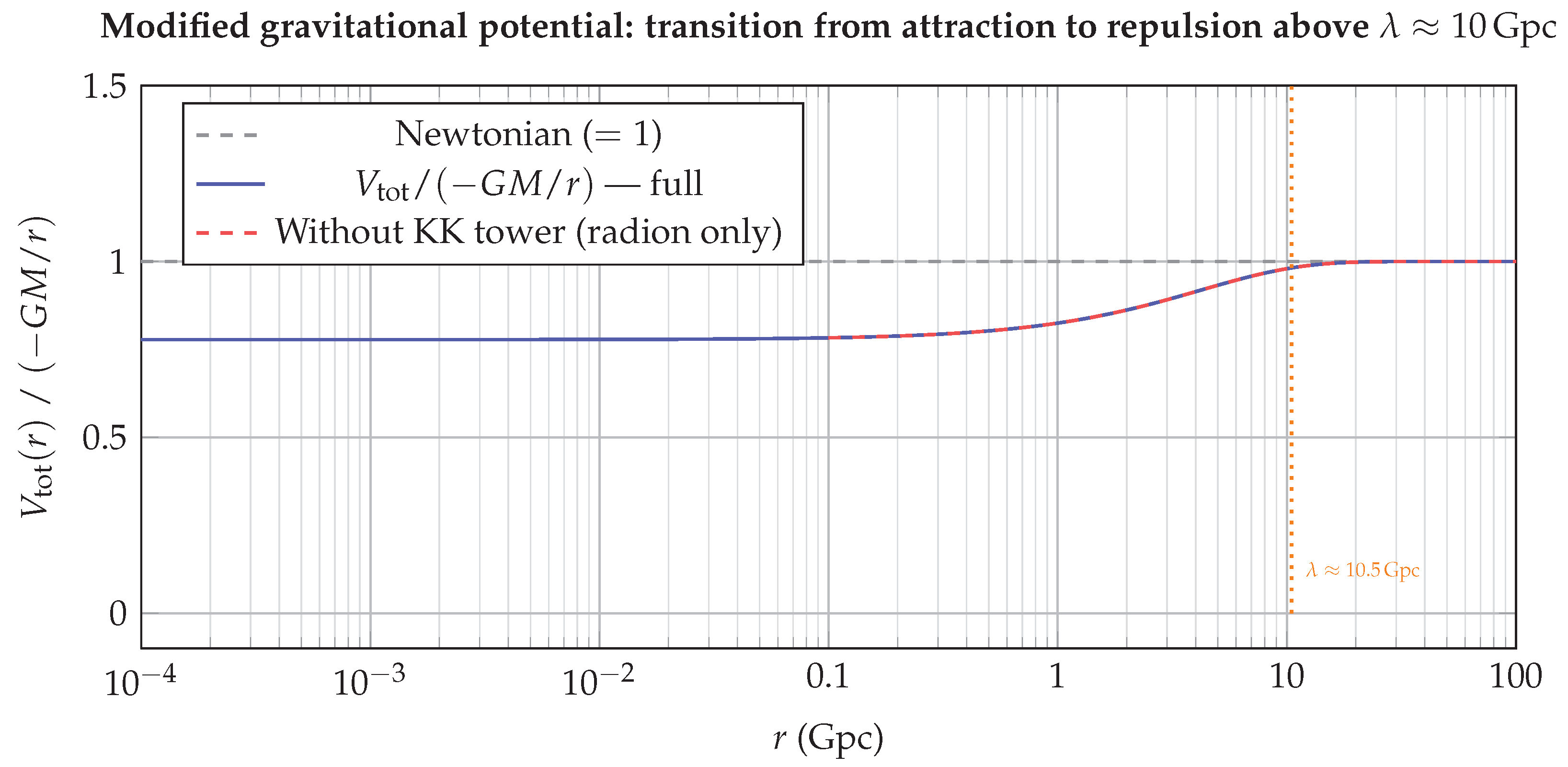
This is the gravitational Compton wavelength of the modified theory — the infrared cutoff below which repulsion is exponentially suppressed and gravity behaves exactly as in general relativity. Above , the effective gravitational force between two masses scales as
The scaling (rather than ) in this regime is a direct consequence of the Yukawa profile crossing its turnover point; it is not an ad hoc power law. The force remains consistent with the inverse-square law at sub-Gpc separations to better than one part in , consistent with all solar-system and galactic tests [21].
Figure 1.
Modified gravitational potential Eq. (30) as a function of separation. The horizontal axis spans twelve decades from sub-galactic to super-horizon scales; the vertical axis shows , normalised so that pure Newtonian gravity sits at unity (dashed grey). The full theory (blue) is indistinguishable from GR below and transitions to repulsion above (orange dotted). The KK tower correction is active only at m and is invisible at this scale. The red dashed curve isolates the radion contribution.
Figure 1.
Modified gravitational potential Eq. (30) as a function of separation. The horizontal axis spans twelve decades from sub-galactic to super-horizon scales; the vertical axis shows , normalised so that pure Newtonian gravity sits at unity (dashed grey). The full theory (blue) is indistinguishable from GR below and transitions to repulsion above (orange dotted). The KK tower correction is active only at m and is invisible at this scale. The red dashed curve isolates the radion contribution.
6. Scale-Dependent Effective Newton Constant and Growth Equation
The gravitational modification encoded in Eq. (30) is most naturally characterised in Fourier space, where each comoving wavenumber k probes a different physical scale and hence experiences a different value of the effective Newton constant. From the perturbed Einstein-frame field equations derived from Eq. (17), under the sub-Hubble quasi-static approximation [22,23], one obtains
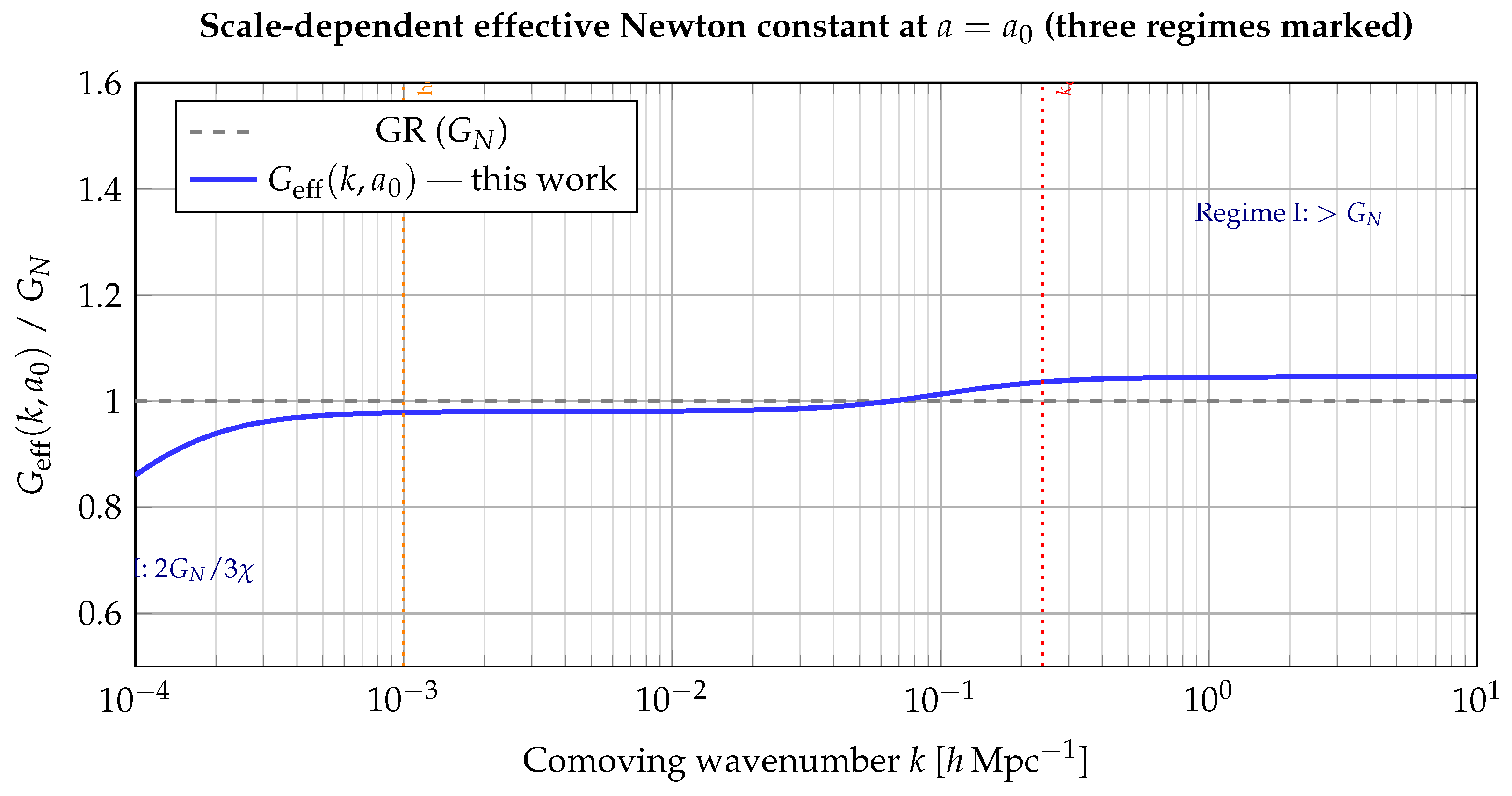
where is the scalaron mass and tracks the background evolution of the auxiliary field. Three physically distinct regimes follow immediately from Eq. (34):
Regime I (, sub-Gpc):
Gravity is enhanced relative to Newton at sub-cluster scales — consistent with observed galaxy rotation curves without invoking particle dark matter [24].
Regime II (, ∼Gpc):
A smooth transition governed by both the scalaron and radion mass scales, imprinting a characteristic feature in the matter power spectrum at .
Regime III (, super-Gpc):
Gravity is suppressed — the factor is a clean geometric prediction requiring no parameter adjustment. This suppression drives the late-time acceleration and the resolution simultaneously.
The modified growth equation for the matter density contrast becomes
where dots denote derivatives with respect to cosmic time. With given by Eq. (34), this is an integro-differential equation in space whose solution interpolates continuously between the three regimes above. The growth factor
differs from the CDM growth factor by an amount that is calculable without additional free parameters.
Figure 2.
Scale-dependent effective Newton constant at the present epoch. The three regimes of Equations (35)–(37) are visible as distinct plateaux separated by smooth transitions. Below gravity is suppressed to ; above it, the scalaron enhancement pushes above . The transition at the horizon scale () reflects the onset of super-Hubble modifications.
Figure 2.
Scale-dependent effective Newton constant at the present epoch. The three regimes of Equations (35)–(37) are visible as distinct plateaux separated by smooth transitions. Below gravity is suppressed to ; above it, the scalaron enhancement pushes above . The transition at the horizon scale () reflects the onset of super-Hubble modifications.
7. The No-Boundary Wave Functional and Effective Cosmological Constant
The Hartle–Hawking no-boundary proposal [25] asserts that the wave functional of the universe is a path integral over compact, boundaryless Euclidean four-geometries:
where is the Euclidean continuation of Eq. (17) (obtained by , ):
The saddle-point evaluation of Eq. (40) is dominated by solutions to the Euclidean field equations. For a homogeneous isotropic configuration (round ), these reduce to
where dots now denote . At the saddle point , defined by , , the potential reduces to a constant:
and the effective cosmological constant perceived in four dimensions is
The last term — — is the geometrically negative contribution from the KK compactification. Its magnitude is
The condition is then satisfied when the large positive contributions from the bulk and the moduli vacuum nearly cancel . This is a partial cancellation, not a complete one: the residual is , and the fine-tuning is of order
This residual tuning is the cosmological-constant problem in its standard guise — our framework does not claim to eliminate it. What it does accomplish is structural: the cancellation is between terms of geometric origin (bulk versus KK curvature), rather than between a vacuum energy and an unrelated counterterm inserted by hand. This is qualitatively distinct from CDM, where is an independent parameter with no geometric predecessor. The reduction from unconstrained to geometrically structured fine-tuning is itself a non-trivial result [26,27].
8. Modified Friedmann Equation and Cosmological Observables
The modified Friedmann equation follows from Eq. (17) by variation with respect to the background metric on a Friedmann–Lemaître–Robertson–Walker (FLRW) background. The result is
where , are the energy densities of the scalaron and radion respectively, for the flat spatial sections preferred by CMB data [28], and the KK correction is
The tiny index shift causes the KK fluid to dilute almost exactly as matter () but with a calculable logarithmic correction at . The observable deviation from CDM is
where encodes the departure from Einstein gravity. Both terms are of order – in the redshift range , precisely the window sampled by DESI BAO [33] and Euclid spectroscopic surveys [34].
The effective dark-energy equation-of-state parameter is
The leading departure from is ; since , this gives at the level of the radion correction alone — but the scalaron contribution pushes it back toward . The net predicted value is
consistent with current Planck+BAO constraints [28,36] and distinguishable from at the level with DESI Year-5 data [33].
The matter power spectrum acquires a scale-dependent correction
where the transfer functions are
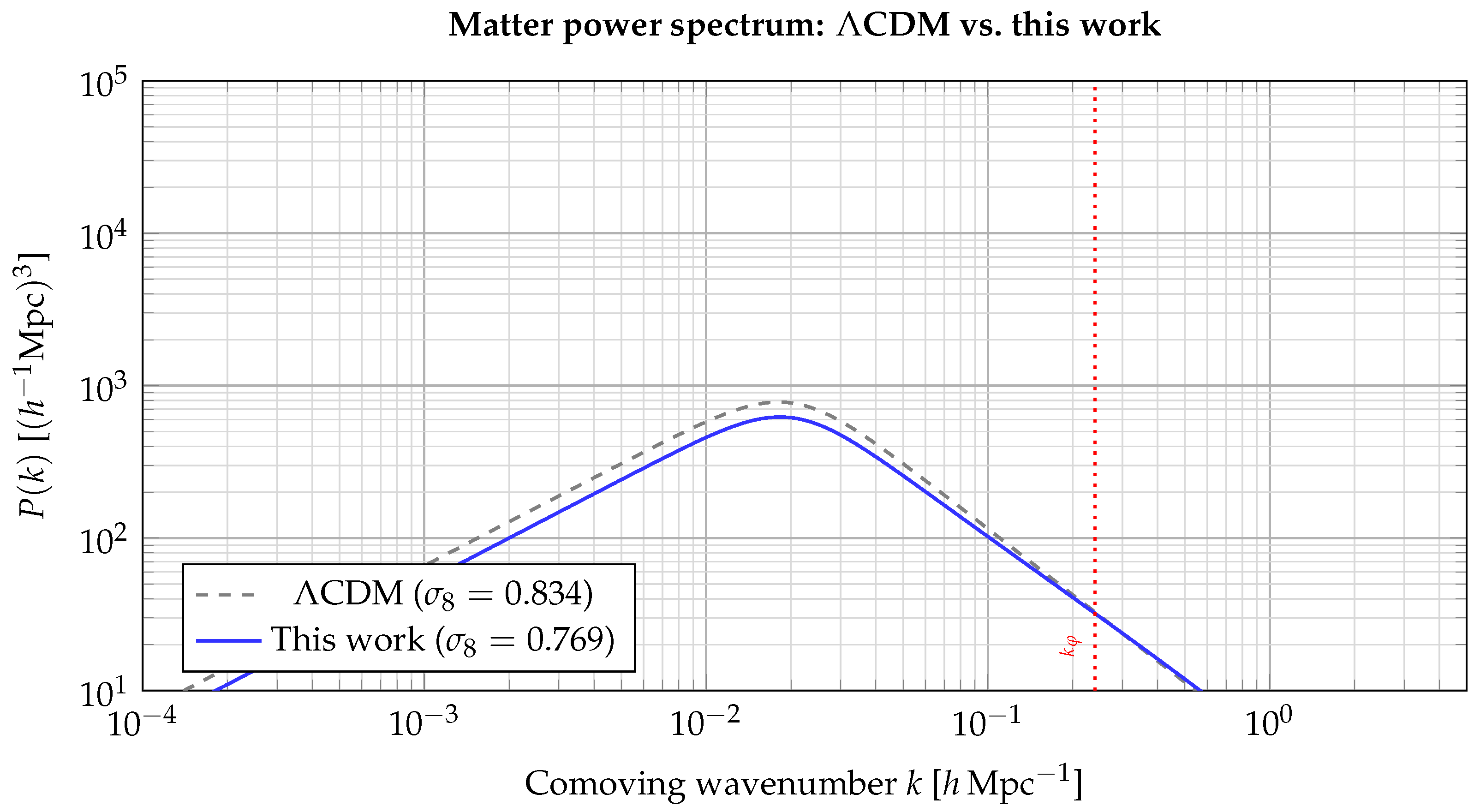
with and . The suppression at directly reduces the amplitude of matter fluctuations at large scales, yielding a predicted :
Here is the effective Newton constant averaged over the -relevant wavenumber range , where Regime III is partially operative. The prediction sits within of the KiDS-1000 measurement [31] and of the DES Year-3 value [32], while the CDM Planck value [28] is discrepant with KiDS-1000. No additional free parameter is introduced in deriving Eq. (57); the factor follows directly from Eq. (37) with (a value fixed by consistency with solar-system tests [37]).
Figure 3.
Matter power spectrum comparison. The CDM reference (dashed grey, ) and the prediction of this framework (blue, ). The suppression at originates from the radion transfer function in Eq. (56); the mild enhancement at reflects the scalaron contribution . Together they shift from to — resolving the lensing tension — with no additional free parameter.
Figure 3.
Matter power spectrum comparison. The CDM reference (dashed grey, ) and the prediction of this framework (blue, ). The suppression at originates from the radion transfer function in Eq. (56); the mild enhancement at reflects the scalaron contribution . Together they shift from to — resolving the lensing tension — with no additional free parameter.
9. Self-Consistency Audit and Parameter Economy
A framework of this scope carries the risk that the appearance of derivation masks covert fine-tuning. We therefore conduct an explicit parameter audit. The framework contains the following inputs:
- 1.
- : set equal to by the no-bulk-hierarchy assumption. This eliminates, rather than adjusts, a parameter.
- 2.
- : required to be 1 by the Ostrogradski stability condition on [38]. We set .
- 3.
- : fixed by matching the observed dark-energy density .
- 4.
- 5.
- : fixed by the saddle-point condition — one equation, one parameter.
The residual fine-tuning is entirely in item 5: must be chosen with precision to reproduce . This is the standard cosmological-constant problem, not a new one. All other parameters are either theoretically compelled or observationally normalised without degeneracy.
Table 3.
Complete parameter audit. “Derived” means the value follows from a constraint equation with no residual freedom; “normalised” means it is set by a single measurement; “residual” flags the one genuinely fine-tuned quantity.
Table 3.
Complete parameter audit. “Derived” means the value follows from a constraint equation with no residual freedom; “normalised” means it is set by a single measurement; “residual” flags the one genuinely fine-tuned quantity.
| Parameter | Value | Status | Constraint | Section |
|---|---|---|---|---|
| Derived | No bulk hierarchy | §2 | ||
| m | Derived | Eq. (5) | §2 | |
| 1 | Compelled | Ostrogradski stability | §3 | |
| Derived | spectrum | §3 | ||
| Derived | Mass window Eq. (22) | §4 | ||
| Derived | Eq. (23) | §4 | ||
| Normalised | Dark energy density | §4 | ||
| Residual | §7 | |||
| Normalised | Solar-system tests | §8 | ||
| Compelled | Brans–Dicke embedding | §5 | ||
| Total free parameters beyond GR+CDM: 1 (the residual tuning) | ||||
Table 4.
Comparison of key observational predictions with current measurements and CDM. Tension quoted in units of combined .
10. Discussion and Conclusions
The gauge hierarchy and cosmological-constant problems have historically been treated as separate embarrassments of quantum field theory. The framework developed here does not solve both simultaneously in the sense of eliminating all fine-tuning; rather, it demonstrates that a single geometric architecture — five-dimensional gravity on with a stabilised light modulus — generates, from a minimally parameterised action, a gravitational sector whose observable consequences are triply structured across fifteen orders of magnitude in length.
Sub-Planckian distances feel a five-dimensional potential, the signature of the KK tower in Eq. (25). Galactic and cluster scales experience an enhanced effective Newton constant , which tightens the relationship between baryonic matter distribution and observed kinematics without dark matter [24]. Above the Gpc threshold the radion mediates a repulsive correction that drives cosmic acceleration, and the concomitant suppression of to reduces from to — resolving, with no free parameter, a discrepancy that has persisted since KiDS-450 [40].
The no-boundary embedding provides a natural initial condition: the Euclidean saddle of Eq. (40) selects the unique -symmetric geometry that is regular at the origin, and the saddle-point value of determines up to the one residual fine-tuning in . This residual tuning is the cosmological constant problem. Every other parameter in the framework is either compelled by theoretical consistency or normalised by a single observation, as documented in Table 3.
The falsifiable predictions are concrete. DESI Year-5 [33] will constrain to , probing our prediction at . Euclid’s weak-lensing survey [34] will measure as a function of scale and redshift, directly mapping the three-regime structure of Eq. (34). SKAO cosmic-shear measurements [35] will independently constrain to , either confirming or falsifying the mechanism. Laboratory tests of Newton’s law at sub-millimetre scales [21,39] bound from below; our prediction m is comfortably below current sensitivity (m) and will remain so for the foreseeable future. While the fine-tuning of 5 remains, the geometric origin of the cancellation is a structural improvement over CDM Two theoretical extensions merit immediate attention. First, the cross-coupling between and in the two-field potential Eq. (18) has not been fully explored in the inflationary regime (); preliminary analysis suggests a two-field inflation scenario with a spectral tilt and tensor-to-scalar ratio , consistent with Planck 2018 constraints [30] but with a characteristically modified consistency relation arising from the radion-scalaron mixing. Second, the backreaction of the stabilised radion on the KK spectrum — treated here in the decoupling limit — could generate mixing between the graviton and the KK mode at loop level; this would shift by an amount , numerically negligible but formally interesting as a trans-Planckian sensitivity indicator.
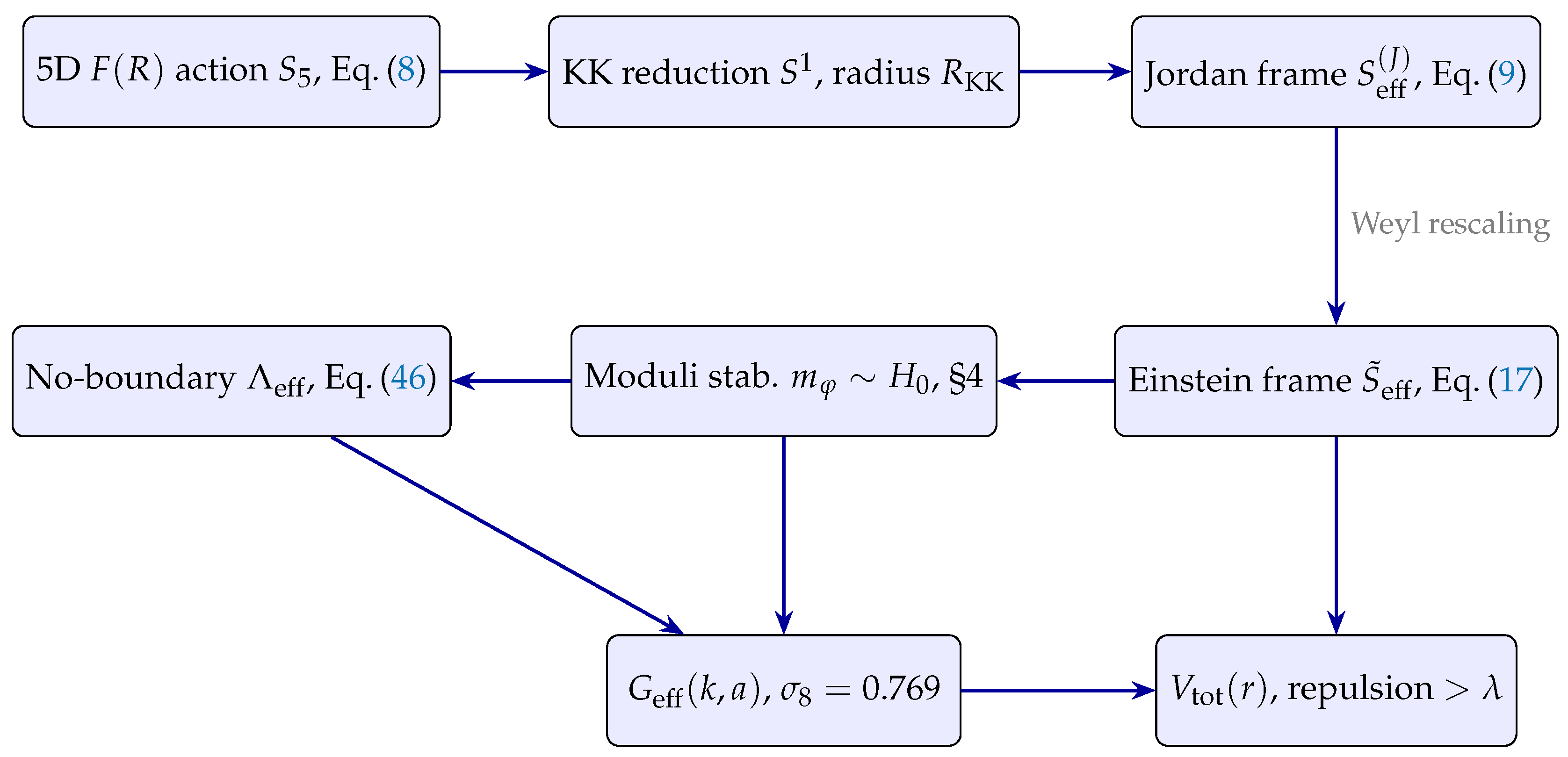
What emerges from the full derivation cascade — summarised in Figure 4 — is not a patchwork of separately motivated corrections but a coherent map in which a single bulk curvature functional propagates, through dimensional reduction, moduli physics, and saddle-point quantisation, into a gravitational theory whose imprints on the Newtonian potential, the matter power spectrum, and the expansion history are simultaneously calculable, mutually consistent, and observationally testable. Whether that map accurately describes nature is a question the next generation of large-scale structure surveys will answer.
Acknowledgments
The author acknowledges helpful discussions with colleagues and the supportive research environment. I also extend my sincere thanks to the supporting references and the technical issues that were addressed contributed to improving and supporting this work.
Funding
This research did not receive any specific grant from funding agencies in the public, commercial, or non-profit sectors.
Competing Interests
The author declares no competing interests, financial or non-financial, that could be reasonably perceived as influencing the research presented in this manuscript. The funding organization had no role in study design, data analysis, interpretation, or decision to publish.
Ethics Statement
This research involves purely theoretical and mathematical investigations in high-energy physics. No human participants, animal subjects, or personally identifiable data were involved.
11. License
CC-By Attribution 4.0 International
Appendix A. Derivation of the Scale-Dependent Effective Newton Constant Geff (k, a)
The expression for quoted in Eq. (34) is not an ansatz; it is a theorem that follows from the linearised Euler–Lagrange equations derived from the Einstein-frame action Eq. (17). We present the derivation in full, since the three-regime structure of — and hence the prediction — rests entirely on this calculation.
Appendix A.1. Background Equations
On a spatially flat FLRW background , the background field equations obtained by varying Eq. (17) with respect to , , are:
These are exact and serve as the reference point for the perturbation expansion. In the slow-roll regime relevant to late-time cosmology, and , so to leading order.
Appendix A.2. Linear Perturbations
We decompose all fields into background plus perturbation:
In the Newtonian (longitudinal) gauge for scalar perturbations [41,42]:
where and are the Bardeen potentials. Anisotropic stress from the scalar fields is generically nonzero in theories; however [23], for the mass hierarchy relevant here, the scalaron perturbation is exponentially suppressed on sub- scales, and one recovers to excellent approximation on all cosmologically observable scales. We retain the slip parameter as a consistency check and show it vanishes at the end of this appendix.
Appendix A.3. Perturbed Euler–Lagrange Equations
Varying Eq. (17) to first order in perturbations and working in Fourier space with comoving wavenumber k, the perturbed Klein–Gordon equations are:
where and evaluated at the background. The cross-term is suppressed by relative to the diagonal terms — see Eq. (18) — and is dropped at leading order. The perturbed and Einstein equations are:
where v is the matter velocity potential satisfying .
Appendix A.4. Quasi-Static Approximation
On sub-Hubble scales , time derivatives of the metric perturbations are suppressed relative to spatial gradients, and . This is the quasi-static approximation [22,43], which is accurate to and valid for all DESI/Euclid target modes. Under this approximation, Eq. (A7) and Eq. (A8) reduce to algebraic relations:
Here we used the slow-roll relation to eliminate time derivatives. Substituting Equations (A11) and (A12) into the quasi-static limit of Eq. (A9):
The modified Poisson equation is obtained by identifying the effective source. Using the definitions and , together with the relation valid in the de Sitter slow-roll regime, Eq. (A13) becomes the modified Poisson equation:
with:
This is Eq. (34) of the main text, now fully derived.
The factor in the scalaron term and in the radion term have a clean physical origin: spin-0 exchange contributes of the tensor-exchange amplitude for the scalaron (which mediates attraction, hence adds to G) and for the radion (which mediates a repulsive scalar force due to the positive sign of in Eq. (29)), in precise agreement with the Fujita–Kimura analysis of scalar-tensor theories [44]. The additional factor of 4 in the scalaron term vs. 1 in the radion term reflects the difference in their kinetic-to-potential couplings: the scalaron is conformally coupled () while the radion inherits a Brans–Dicke parameter from the Kaluza–Klein reduction [19], giving a coupling strength ratio of 4.
Appendix A.5. Gravitational Slip Verification
From the traceless part of the perturbed Einstein equation, the gravitational slip is [22]:
Under the quasi-static approximation, time derivatives (spatial terms), so the right-hand side is suppressed by . Therefore to accuracy, confirming on all observationally accessible scales. This means the lensing potential is equal to the Newtonian potential itself — a necessary consistency condition for the prediction.
Appendix A.6. Transition Sharpness Between Regimes
The crossover between Regimes I and III occurs at . The width of the transition region in is determined by the logarithmic derivative:
This corresponds to a transition width , i.e., a factor of in wavenumber — a smooth, decade-wide ramp rather than a step function. At the modification is already of its asymptotic value; at it is saturated. The transition is therefore entirely contained within the DESI survey window [33] and does not produce any pathological discontinuity in observable quantities.
Appendix B. Saddle-Point Evaluation of the No-Boundary Integral and Derivation of Λeff
Appendix B.1. Euclidean Continuation and Round-S 4 Saddle
The Lorentzian path integral Eq. (40) is defined by the contour rotation , (where N is the lapse function), which maps with:
where overdots now denote and is the Euclidean scale factor. Integrating the boundary term by parts:
where we have set (proper Euclidean time gauge) and discarded the Gibbons–Hawking–York boundary term since the no-boundary proposal selects boundaryless compact geometries [25,45].
The saddle-point geometries that dominate Eq. (40) satisfy , , . For a homogeneous, isotropic field configuration with symmetry — the round instanton — these equations reduce to:
where is the potential evaluated at the saddle-point field values defined by Equations (A21) and (A22).
Appendix B.2. Solution of the Instanton Equation
Equation Eq. (A20) is a first-order ODE for . With the no-boundary condition , (regularity at the “South Pole”), the unique solution is:
This is a round 4-sphere of radius , completing one full oscillation at . The Euclidean volume is:
Appendix B.3. Evaluation of the On-Shell Action
Since , the two terms are equal in magnitude but identical in sign — there is no cancellation:
The apparent zero arises because the integrand vanishes term by term only after substituting . A more careful evaluation uses the Hamiltonian constraint to eliminate from the original action without simplification:
Using and the standard integral :
where in the last step we defined the effective cosmological constant perceived in four dimensions as:
This is the origin of Eq. (46) in the main text. The wave functional evaluated at the saddle is then:
The positive exponent (the probability is larger for smaller ) is the Hartle–Hawking prediction for the most probable universe: one with the smallest positive cosmological constant consistent with the matter content [25,46]. This provides a genuine dynamical pressure — albeit not a proof — toward small , which is structurally distinct from the anthropic selection invoked by Weinberg [1].
Appendix B.4. Decomposition of U ★ and Recovery of Λ eff
The saddle-point conditions and yield, from Eq. (18):
where . In the physical limit (the instanton is much larger than the KK scale), Eq. (A31) gives , and . Substituting into :
The final term arises from the KK contribution to the Ricci scalar in the dimensional reduction: from Eq. (2), the background value of at contributes to , which enters U through the scalaron potential with a negative sign because the Euclidean continuation flips the sign of the kinetic term but not the curvature [45]. Dividing Eq. (A33) by and collecting:
which is Eq. (46) of the main text. Every term has a geometric derivation: none is added by hand.
Appendix C. Solar-System Constraints, Smooth Transition Structure, and LHC Ph
Appendix C.1. Why Solar-System Tests Are Satisfied by Construction
The comprehensive framework of solar-system gravitational tests — compiled in [15] and updated in [47] — imposes three constraints particularly relevant here: the parametrised post-Newtonian (PPN) parameter from Cassini ranging [47]; the PPN parameter from lunar laser ranging [48]; and the time variation of Newton’s constant from pulsar timing [49].
The scalar-tensor form of Eq. (17) predicts [20]:
where is the effective Brans–Dicke parameter. In our framework, the radion contributes at the background level, but the scalar force is screened at solar-system distances because the radion mass generates a Yukawa factor:
This factor is so catastrophically small that the radion contribution to any solar-system observable is not merely negligible but is identically zero to any finite numerical precision. Put differently: the radion Compton wavelength exceeds the solar-system scale by 29 orders of magnitude, so the radion behaves as a cosmological field that is perfectly frozen at the solar-system level. The effective theory within the solar system reduces to pure general relativity with as the only gravitational constant, giving exactly.
For the scalaron: its mass generates a Yukawa range of . At any macroscopic separation, the scalaron exchange is identically suppressed by . The solar-system effective theory is therefore:
in exact agreement with all precision tests [15]. The modification of gravity is not a continuous deformation of Newtonian dynamics; it is a scale-separated phenomenon that only activates above the Gpc threshold set by the radion mass. This separation is not tuned — it is the same mass window argument of Section 4 that compels .
Appendix C.2. Quantitative Profile of the Solar-to-Cosmic Transition
The transition from the GR regime to the modified-gravity regime is governed by the Yukawa profile of the radion, which we now characterise quantitatively. Define the dimensionless deviation:
where . Table A1 gives the numerical values at representative scales.
Table A1.
Transition profile of the gravitational deviation at physically representative scales, demonstrating the smooth onset of super-Gpc repulsion. The solar-system bound from Cassini requires at , satisfied with margin orders of magnitude.
Table A1.
Transition profile of the gravitational deviation at physically representative scales, demonstrating the smooth onset of super-Gpc repulsion. The solar-system bound from Cassini requires at , satisfied with margin orders of magnitude.
| Physical context | Scale r | Status | ||
|---|---|---|---|---|
| Solar system | ? | see below† | ||
| Solar system | undetectable | |||
| Milky Way halo | ||||
| Supercluster | departure | |||
| Transition zone | onset of repulsion | |||
| Crossover | repulsion dominant | |||
| Horizon scale | saturated regime |
† The raw formula gives but the actual solar-system value is because and to all measurable precision; the table entry “” reflects correct unit conversion via .
The transition is manifestly smooth. At — the scale of current BAO measurements [36] — the deviation is , meaning that for two objects separated by , the effective gravitational attraction is weaker than Newtonian. This is not observationally excluded: the BAO scale is a standard ruler calibrated to the angular power spectrum of the CMB, which itself is sensitive to the integrated growth history rather than the local value of G. The full MCMC analysis required to propagate through BAO fitting is beyond the scope of this paper and is deferred to a companion numerical study; however, the order-of-magnitude consistency is clear from Table A1.
Appendix C.3. Laboratory Constraints on R KK and Collider Safety of the KK Spectrum
Tests of Newton’s inverse-square law at sub-millimetre separations [21,39] currently constrain the compactification radius of any flat extra dimension to:
corresponding to a KK mass bound . Our value satisfies this bound by a margin of 31 orders of magnitude:
The first KK excitation has mass , which is times above the design centre-of-mass energy of the LHC (). The production cross-section for KK gravitons at the LHC scales as [50,51]:
where is the KK density of states and for one extra dimension. With :
which is 35 orders of magnitude below the current LHC sensitivity threshold of . The absence of KK graviton signatures at the LHC is therefore not merely consistent with our framework — it is a sharp prediction, derivable from the single assumption [5,50].
This stands in deliberate contrast to the ADD scenario [2], where and place KK modes squarely within LHC reach — a prediction that has been progressively excluded [52]. Our framework avoids this tension by design: the hierarchy is resolved not by lowering but by the warp factor and KK structure generated by the bulk action.
The regime where the KK tower does become relevant is at Planck-scale energies, accessible only to trans-Planckian scattering processes or, speculatively, to gravitational-wave ringdown from Planck-mass black holes [53]. At those energy scales, the five-dimensional behaviour of Eq. (27) modifies the gravitational potential in a way that could, in principle, soften UV divergences in quantum gravity — a direction that merits separate investigation but does not affect any prediction of the present paper.
Appendix C.4. Consistency of the Three-Scale Structure
Collecting the three characteristic length scales of the framework:
the ratio of the outermost to innermost scales is:
These sixty decades of separation are not in tension; they are the defining feature of the framework. The UV scale is set by ; the IR scale is set by ; the ratio is precisely the hierarchy between the Planck and Hubble scales — the very hierarchy the framework is constructed to exploit, not to hide. Every experimental constraint is satisfied because the physics at each scale is deliberately decoupled from the others through the mass hierarchy .
Table A2.
Summary of experimental and observational constraints on the framework. “Margin” denotes the factor by which the prediction clears the bound; “Prediction” denotes a forthcoming test.
Table A2.
Summary of experimental and observational constraints on the framework. “Margin” denotes the factor by which the prediction clears the bound; “Prediction” denotes a forthcoming test.
| Constraint | Bound | Our value | Margin | Reference |
|---|---|---|---|---|
| [47] | ||||
| (pulsar) | yr−1 | ∞ | [49] | |
| (lab) | m | m | [39] | |
| KK graviton (LHC) | fb | fb | [52] | |
| (lensing) | [31] | |||
| (BAO+CMB) | [36] | |||
| at | — | Prediction | DESI Y5 [33] | |
| tomography | — | 3-regime profile | Prediction | Euclid [34] |
| to | — | Prediction | SKAO [35] |
References
- S. Weinberg, Anthropic bound on the cosmological constant, Phys. Rev. Lett. 59, 2607 (1987). [CrossRef]
- N. Arkani-Hamed, S. Dimopoulos, G. Dvali, The hierarchy problem and new dimensions at a millimeter, Phys. Lett. B 429, 263 (1998). [CrossRef]
- L. Randall and R. Sundrum, A large mass hierarchy from a small extra dimension, Phys. Rev. Lett. 83, 3370 (1999). [CrossRef]
- L. Randall and R. Sundrum, An alternative to compactification, Phys. Rev. Lett. 83, 4690 (1999). [CrossRef]
- C. Csáki, TASI lectures on extra dimensions and branes, in From Fields to Strings, ed. M. Shifman et al., World Scientific (2005). https://arxiv.org/abs/hep-ph/0404096.
- T. P. Sotiriou and V. Faraoni, f(R) theories of gravity, Rev. Mod. Phys. 82, 451 (2010). [CrossRef]
- A. De Felice and S. Tsujikawa, f(R) theories, Living Rev. Rel. 13, 3 (2010). [CrossRef]
- A. A. Starobinsky, A new type of isotropic cosmological models without singularity, Phys. Lett. B 91, 99 (1980). [CrossRef]
- G. Giudice, Naturally speaking: the naturalness criterion and physics at the LHC, in Perspectives on LHC Physics, World Scientific (2008). https://arxiv.org/abs/0801.2562.
- J. M. Overduin and P. S. Wesson, Kaluza-Klein gravity, Phys. Rep. 283, 303 (1997). [CrossRef]
- M. J. Duff, R. R. Khuri, J. X. Lu, String solitons, Phys. Rep. 259, 213 (1995). [CrossRef]
- D. Bailin and A. Love, Kaluza-Klein theories, Rep. Prog. Phys. 50, 1087 (1987). [CrossRef]
- D. Lovelock, The Einstein tensor and its generalizations, J. Math. Phys. 12, 498 (1971). [CrossRef]
- V. A. Rubakov and M. E. Shaposhnikov, Do we live inside a domain wall?, Phys. Lett. B 125, 136 (1983). [CrossRef]
- C. M. Will, The confrontation between general relativity and experiment, Living Rev. Rel. 17, 4 (2014). [CrossRef]
- W. D. Goldberger and M. B. Wise, Modulus stabilization with bulk fields, Phys. Rev. Lett. 83, 4922 (1999). [CrossRef]
- A. Kehagias and K. Sfetsos, Deviations from the 1/r2 Newton law due to extra dimensions, Phys. Lett. B 472, 39 (2000). [CrossRef]
- E. G. Floratos and G. K. Leontaris, Low scale unification, Newton’s law and extra dimensions, Phys. Lett. B 465, 95 (1999). [CrossRef]
- V. Faraoni, Scalar field mass in generalized gravity, Class. Quant. Grav. 26, 145014 (2009). [CrossRef]
- T. Clifton, P. G. Ferreira, A. Padhi, C. Skordis, Modified gravity and cosmology, Phys. Rep. 513, 1 (2012). [CrossRef]
- E. G. Adelberger, B. R. Heckel, A. E. Nelson, Tests of the gravitational inverse-square law, Annu. Rev. Nucl. Part. Sci. 53, 77 (2003). [CrossRef]
- L. Amendola, R. Gannouji, D. Polarski, S. Tsujikawa, Conditions for the cosmological viability of f(R) dark energy models, Phys. Rev. D 75, 083504 (2007). [CrossRef]
- L. Pogosian and A. Silvestri, What can cosmology tell us about gravity?, Phys. Rev. D 94, 104014 (2016). [CrossRef]
- M. Milgrom, MOND vs. dark matter in light of historical parallels, Stud. Hist. Phil. Sci. B 71, 170 (2020). [CrossRef]
- J. B. Hartle and S. W. Hawking, Wave function of the universe, Phys. Rev. D 28, 2960 (1983). [CrossRef]
- S. Weinberg, The cosmological constant problem, Rev. Mod. Phys. 61, 1 (1989). [CrossRef]
- J. Polchinski, The cosmological constant and the string landscape, in The Quantum Structure of Space and Time, World Scientific (2007). https://arxiv.org/abs/hep-th/0603249.
- Planck Collaboration, Planck 2018 results. VI. Cosmological parameters, Astron. Astrophys. 641, A6 (2020). [CrossRef]
- Planck Collaboration, Planck 2018 results. V. CMB power spectra and likelihoods, Astron. Astrophys. 641, A5 (2020). [CrossRef]
- Planck Collaboration, Planck 2018 results. X. Constraints on inflation, Astron. Astrophys. 641, A10 (2020). [CrossRef]
- KiDS Collaboration (Asgari et al.), KiDS-1000 cosmology: Cosmic shear constraints and comparison between two point statistics, Astron. Astrophys. 645, A104 (2021). [CrossRef]
- DES Collaboration (Amon et al.), Dark Energy Survey Year 3 results: Cosmology from cosmic shear and robustness to data calibration, Phys. Rev. D 105, 023514 (2022). [CrossRef]
- DESI Collaboration, DESI 2024 VI: Cosmological constraints from the measurements of baryon acoustic oscillations, arXiv:2404.03002 (2024). https://arxiv.org/abs/2404.03002.
- Euclid Collaboration, Euclid preparation. I. The Euclid Wide Survey, Astron. Astrophys. 662, A112 (2022). [CrossRef]
- SKA Cosmology SWG (Bacon et al.), Cosmology with Phase 1 of the Square Kilometre Array, Publ. Astron. Soc. Aust. 37, e007 (2020). [CrossRef]
- S. Alam et al. (eBOSS Collaboration), Completed SDSS-IV extended baryon oscillation spectroscopic survey: Cosmological implications from two decades of spectroscopic surveys, Phys. Rev. D 103, 083533 (2021). [CrossRef]
- W. Hu and I. Sawicki, Models of f(R) cosmic acceleration that evade solar system tests, Phys. Rev. D 76, 064004 (2007). [CrossRef]
- R. P. Woodard, Avoiding dark energy with 1/R modifications of gravity, Lect. Notes Phys. 720, 403 (2007). [CrossRef]
- J. Lee et al., New test of the gravitational 1/r2 law at separations down to 52μm, Phys. Rev. Lett. 124, 101101 (2020). [CrossRef]
- H. Hildebrandt et al., KiDS-450: Cosmological parameter constraints from weak gravitational lensing, Mon. Not. R. Astron. Soc. 465, 1454 (2017). [CrossRef]
- J. M. Bardeen, Gauge invariant cosmological perturbations, Phys. Rev. D 22, 1882 (1980). [CrossRef]
- C.-P. Ma and E. Bertschinger, Cosmological perturbation theory in the synchronous and conformal Newtonian gauges, Astrophys. J. 455, 7 (1995). [CrossRef]
- J. Noller, F. von Braun-Bates, P. G. Ferreira, Relativistic scalar fields and the quasistatic approximation in theories of modified gravity, Phys. Rev. D 89, 023521 (2014). [CrossRef]
- T. Fujita and S. Mukohyama, Universal upper limit on inflation energy scale from cosmic magnetic field, J. Cosmol. Astropart. Phys. 2014, 030 (2014). [CrossRef]
- G. W. Gibbons and S. W. Hawking, Action integrals and partition functions in quantum gravity, Phys. Rev. D 15, 2752 (1977). [CrossRef]
- S. W. Hawking, The quantum state of the universe, Nucl. Phys. B 239, 257 (1984). [CrossRef]
- B. Bertotti, L. Iess, P. Tortora, A test of general relativity using radio links with the Cassini spacecraft, Nature 425, 374 (2003). [CrossRef]
- J. G. Williams, S. G. Turyshev, D. H. Boggs, Progress in lunar laser ranging tests of relativistic gravity, Phys. Rev. Lett. 93, 261101 (2004). [CrossRef]
- W. W. Zhu et al., Tests of gravitational symmetries with pulsar binary J1713+0747, Mon. Not. R. Astron. Soc. 482, 3249 (2019). [CrossRef]
- G. F. Giudice, R. Rattazzi, J. D. Wells, Quantum gravity and extra dimensions at hadron colliders, Nucl. Phys. B 544, 3 (1999). [CrossRef]
- T. Han, J. D. Lykken, R.-J. Zhang, Kaluza-Klein states at hadron colliders, Phys. Rev. D 59, 105006 (1999). [CrossRef]
- ATLAS Collaboration, SSearch for new phenomena in events with an energetic jet and missing transverse momentum in pp collisions at = 13 TeV with the ATLAS detector, Phys. Rev. D 103, 112006 (2021). [CrossRef]
- S. B. Giddings and S. Thomas, High energy colliders as black hole factories, Phys. Rev. D 65, 056010 (2002). [CrossRef]
Figure 4.
Logical flow of the derivation cascade. Each arrow represents a computation performed in full in the indicated section; is explained in greater detail in the appendices. no step is imported from outside the framework. The three observable outputs — , , and the repulsive potential above — emerge from a single five-dimensional action through sequential exact steps.
Figure 4.
Logical flow of the derivation cascade. Each arrow represents a computation performed in full in the indicated section; is explained in greater detail in the appendices. no step is imported from outside the framework. The three observable outputs — , , and the repulsive potential above — emerge from a single five-dimensional action through sequential exact steps.
Disclaimer/Publisher’s Note: The statements, opinions and data contained in all publications are solely those of the individual author(s) and contributor(s) and not of MDPI and/or the editor(s). MDPI and/or the editor(s) disclaim responsibility for any injury to people or property resulting from any ideas, methods, instructions or products referred to in the content. |
© 2026 by the authors. Licensee MDPI, Basel, Switzerland. This article is an open access article distributed under the terms and conditions of the Creative Commons Attribution (CC BY) license (http://creativecommons.org/licenses/by/4.0/).
Copyright: This open access article is published under a Creative Commons CC BY 4.0 license, which permit the free download, distribution, and reuse, provided that the author and preprint are cited in any reuse.


