
Submitted:
01 May 2026
Posted:
06 May 2026
You are already at the latest version
Abstract
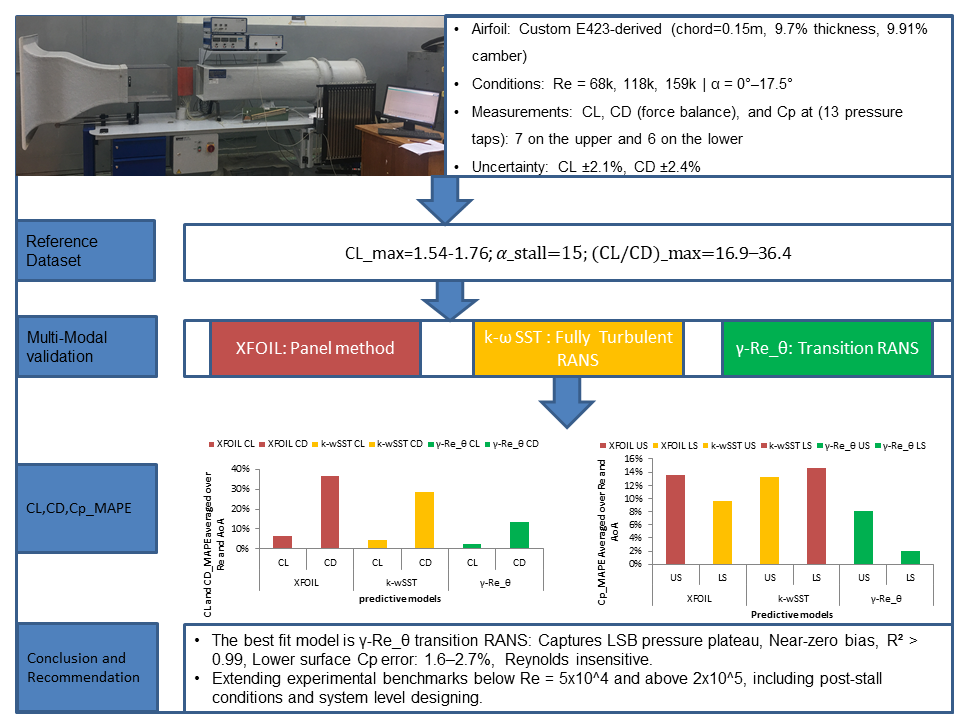
Diffusers in diffuser-augmented wind turbines (DAWTs) require high-camber airfoils operating at low Reynolds numbers (Re) and its laminar separation bubbles significantly complicate aerodynamic predictions. This study provides an experimental and numerical data for a custom-designed airfoil tested at Re = 68k–159k and angles of attack α = 0°–17.5°. Lift, drag, and pressure coefficient (Cp) distributions were measured experimentally. The XFOIL, the fully turbulent 3D k-ω SST, and the γ-Re_θ transition RANS models were validated against the experimental data using multiple quantitative metrics. The γ-Re_θ model demonstrated superior performance, achieving lift Maximum Absolute Percent Error of 1.6–3.4%, near-zero bias, and coefficient of determination > 0.99. It accurately captured the laminar separation bubble pressure plateau at mid-chord, with mean gross-averaged Cp percent errors of 8.1% and 2.1% for upper and lower surfaces, respectively. In contrast, the k-ω SST model overpredicted lift by up to +9.8% at Re = 68k and underpredicted drag by up to 66%. XFOIL showed poor reliability in transitional flow regimes. Sensitivity analyses confirmed the robustness of the γ-Re_θ model across the tested Re and α ranges. The generated experimental dataset, combined with the validated transition-sensitive RANS approach, provides a strong foundation for low-Re airfoil and DAWT diffuser design. Future work should extend experimental measurement below Re = 5x10⁴ and above 2x10⁵, including post-stall conditions and system level designing.
Keywords:
diffuser-augmented wind turbine
; low reynolds number airfoil
; laminar separation bubble
; transition modeling
; γ-Re_θ transition model
; experimental validation
; pressure coefficient distribution
Copyright: This open access article is published under a Creative Commons CC BY 4.0 license, which permit the free download, distribution, and reuse, provided that the author and preprint are cited in any reuse.


