

Submitted:
04 May 2026
Posted:
05 May 2026
You are already at the latest version
Abstract
When applying the geometric quantization ansatz that focuses on quantizing the fundamental metric tensor to the reformulation of general relativity, eigencurvatures emerge at low (quantum) scales. They are distinct from the standard curvatures that manifest gravitational sources in conventional general relativity. The analytical and numerical evolution of timelike geodesic congruence expansion in the spacetime surrounding rotating, massive, non-charged, and axially symmetric Kerr black hole is introduced. This facilitates the assessment of whether the space singularity continues to exist or diminishes at low (quantum) scales. Furthermore, the characteristics of the quantum-conditioned curvatures can be defined by means of the Kretschmann invariant scalar. We conclude that the space singularity can be regulated by the proposed quantization approach. Moreover, the quantum-conditioned curvatures that arise in Kerr spacetime are genuinely real, essential, and intrinsic. They cannot be classified as artifacts in any coordinate systems, whether known or yet to be found.
Keywords:
Kerr black hole
; space singularity
; quantum-conditioned curvatures
; geometric quantization ansatz
1. Introduction
Over the last century, considerable research efforts have been made to establish a consensus between the principles of General Relativity (GR) and Quantum Mechanics (QM) [1,2,3]. Despite the attempts of various scientists to formulate alternative theories or to develop novel mathematical approaches that could facilitate the attainment of this long-standing scientific, cognitive, and philosophical aim, we are, unfortunately, still far from proposing an agreed-upon theory of quantum gravity [4,5,6]. A thorough examination conducted by one of the authors (AT) revealed that the reason both fundamental theories are orthogonal could be attributed to their mathematical formulations, which have prevented their unification over the last century [7,8,9,10,11,12,13,14,15,16]. Therefore, it was concluded that by implementing essential generalizations aimed at relaxing the various approximations that were imposed on both theories, it would be feasible to unify their fundamental principles. The notion that GR is predominant at large scales, in contrast to QM at minimal scales, seems to stem from the approximations that have been enforced. As the Einstein field equations (EFE) in GR can be fully constructed using the metric tensor, it was proposed that the metric tensor alone can be subject to geometric quantization. To accomplish this aim, it was crucial to adopt an ansatz that generalizes both theoretical frameworks. This is the main motivation for applying the geometric quantization approach [7,8,9,10,11,12,13,14,15,16]. In QM, it is presumed that finite gravitational fields are ought to be integrated, leading to the imposition of appropriate modifications. In this context, the Heisenberg uncertainty principle arises as the essential quantum theory that requires generalization and reformulation in a relativistic framework [17]. On the other hand, confining GR to Riemannian geometry is a presumption that results in approximations in the context of four-dimensional spacetime [18]. Riemannian geometry, in which quadratic restriction is assumed, is therefore a particular case of Finslerian geometry, in which such restriction is genuinely relaxed [19,20]. As a result, the proposal to replace Riemann with Finsler was naturally put forward [7,8,9,10,11,12,13,14,15,16]. This ansatz is associated with replacing manifold and tensor (Riemann) with manifold and structure (Finaler) [21,22]. By preserving all the mathematical properties of the tangent (Finsler) and the cotangent (Hamilton) structures, most notably the homogeneity of degree one in tangent quantities, momentum could be integrated on cotangent manifold. After verifying the validity of such transformations from Finsler to Hamilton geometry, it becomes possible to deduce the metric where quantum-mechanical ingredients are integrated via the Relativistic Generalized Uncertainty Principle (RGUP) [17]. Thereby, principles of QM are integrated into the metric obtained from Hamilton geometry. Its translation into Riemann geometry is achieved through further approximations, including the assumption that the line elements in both geometries are equivalent.
By deriving the fundamental metric tensor that integrates quantum components, one can straightforwardly reconstruct the entire theory of GR, thereby applying it to various phenomena, especially in cases where conventional GR faces substantial challenges. A thorough compilation of such implications is presented in recent publications [8,9,10,11,12,13,14,15,16]. To adhere to the scope of this manuscript, we highlight the implications related to black holes and the resulting effects on the spacetime curvatures and the nature of space singularities [23,24,25]. Such considerations are vital for a thorough exploration of the topic on intrinsic quantum curvatures and attenuating if not entirely regulating space singularity. This examination is carried out for the timelike geodesic congruence in the Kerr black hole, which is rotating, massive, non-charged, and axially symmetric. A similar analysis was performed in a homogeneous, isotropic, and spherically symmetric Schwarzschild, de Sitter–Schwarzschild and Friedmann–Lemaitre–Robertson–Walker (FLRW) metrics, as well as in a non-homogeneous Einstein–Gilbert–Straus (EGS) metric [8,9,10]. The intrinsic curvatures and space singularity in the vicinity of the Reissner-Nordström black hole were also examined as well [11]. Therefore, this investigation emphasizes the Kerr black hole and thus draws comparisons with other black holes.
The script is structured as follows. The formalism is detailed in Section 2. The geodesic equations, utilizing a quantum-mechanically revised metric tensor, are presented in Section 2.1. The timelike geodesic congruence with the conventional metric tensor is discussed in Section 2.2, whereas the one with the quantized metric tensor is covered in Section 2.3. The numerical results and discussions are thoroughly examined in Section 3. Finally, Section 4 is dedicated to the concluding remarks.
2. Formalism
As elaborated in the previous section, the notion of geometric quantization ansatz is based on the understanding that the fundamental metric tensor in GR conveys all essential information about spacetime and thereby the underlying geometry. For further details on the geometric quantization ansatz and its implications for various phenomena, one can refer to recent literature [7,8,9,10,11,12,13,14,15,16]. The derivation of the quantum-mechanically revisited metric tensor was introduced in ref. [7]. It was presumed that the quantized metric tensor could be expressed conformally in relation to the conventional one
The conformal coefficient comprises all quantum-mechanical operators and quantities that are imposed on the revisited metric tensor. Although the approximations in deriving , Equation 1, a precise formulation of still constitutes a mathematical challenge
where the subscript 0 refers to auxiliary four-vector quantities that satisfy non-commutative relationships and represents the maximum proper gravitational force that allows the quantum particles to achieve their maximum gravitational acceleration during their motion in the quantum-conditioned curvatures; sources of quantum gravity. The discovery of as a new physical constant was reported in ref. [26], for example. It is apparent that is linearly correlated with the maximum proper acceleration discovered by Caianiello [27,28,29], which was established on the basis of quantum corrections imposed on the spacetime metric through geometric phase space quantization [30]. The function is introduced through the RGUP ansatz [17], leading to a modification of the momentum operator as follows: , where is a dummy index and is the RGUP parameter that can be determined either through observational or empirical methods [17,31]. Both and are auxiliary four-vectors for space and momentum, respectively, and they are canonically conjugate variables that under the general static metric fulfill the relation . The quantity is defined as . Furthermore, , where is a proper paramtrization that is imposed to ensure that the coordinates in Hamilton, Finsler, and Riemann manifolds are identical. It is obvious that represents the squared gravitational force acting on quantum particles with mass m.
The enduring mathematical challenge consists of reformulating the second line in Equation (2) in terms of , as is done with the first line. This issue has been explored in the literature, and for the sake of simplicity, it was presumed that Equation (2) would be truncated. Arguments for and against have been noted. As a result, we conclude that
As stated in Equation (3), for instance, multiple quantum operators are included. The estimation, which is the measure of , is entirely contingent upon the evaluation of the various operators and quantities.
It is obvious that the RGUP ansatz [17,31] assumes a multi-dimensional generalization of the uncertainty principle, namely, auxiliary four-vector space and momentum, for example. Furthermore, a quantum operator representation was also discussed in literature [32]. Accordingly, the uncertainty in non-commutative quantities is related to quantum states and the operators are evaluated at the expectation value on the quantum state [33]. In curved spacetime, let us assume that,
As noted in ref. [33], the metric , which is a tensor whose generic element corresponds to evaluated at the expectation value of the quantum state, is viewed as being made up of operators that act on the state of the underlying quantum system. An analogous evaluation of metric tensors constructed from operators was also reported in ref. [34]. For the Kerr black hole, Section 2.2, the corresponding metric elements can be given as
where , . Here, the spherical coordinates are utilized. The RGUP ansatz [17,31] appears to regard all components of space and momentum on an equal footing. This might be acceptable in terms of space, at least orthogonal coordinates. However, the equivalence of , , , and , and whether the function is uniformly applied to each, needs to be investigated elsewhere. In view of this discussion, one can conclude that the considerable challenge involves estimating the quantum operators and improving the RGUP ansatz. Until this issue is resolved, the approximate methods are inevitably applied.
The truncation imposed on Equation (2), regardless of the mathematical and physical limitations, appears to be unavoidable and, on the other hand, seems to facilitate the retention of the quantum revisions. As the proposed geometric quantization approach is exclusively based on the fundamental metric tensor, it is imperative to first confirm its accuracy and effectiveness, even if only approximately. Whatever the numerical intentions may be, the quantum operators likely undergo multiple approximations. In this context, at least, qualitative analyses can be undertaken by treating , the conformal coefficient, as a perturbative correction to , where is evidently positive. Notice that the values assigned to are exclusively applied by only in the contexts where the quantity is found. The derivatives that contribute to various formulations, including affine corrections, Riemann and Ricci tensors, and scalars, are approached in an approximate quantum-mechanical manner. With this approximation, it is possible to gain valuable insights into the quantization of spacetime surrounding Kerr black hole. The conformal coefficient plays the role of an independent parameter that signifies the impact of quantization on the emergence of quantum-conditioned curvatures, which are sources of additional gravity. This also allows for the evaluation of space singularity in Kerr black holes.
The geodesic equations derived from are introduced in Section 2.1. A comparison with the conventional geodesic equations shows that the proposed quantization ansatz results in important contributions, causing substantial modifications in the related velocity fields and timelike geodesic congruence. The aim of this manuscript is to identify these modifications, particularly in the context of spacetime defined by the Kerr metric.
2.1. Geodesic Equations with Quantum-Mechanically Revisited Metric Tensor
For the fundamental metric tensor of conventional GR, , the proper time is formulated as . Based on Equation (1), is linearly related to , which results in the corresponding proper time being given by . In geometrized units, we find that
where is the Lagrangian. For maximal timelike geodesics, one can directly apply the Euler–Lagrange equation
resulting in a set of equations that are equivalent to the geodesic ones. On the other hand, this ansatz seems to avoid the calculations associated with Christoffel symbols. Accordingly, one derives the quantized geodesic equations as
where is the conformal coefficient defined in Equation (3), while represents the structure on either tangent (Finsler) or cotangent (Hamilton) manifolds. It is evident that the proposed geometric quantization introduces an extra term that integrates the quantum operators and quantities imposed. Additionally, the quantized affine connections, , add another quantum term,
Regarding the structure, let us consider the most basic metric, namely the Klein metric, which is defined on the complement of a fixed quadric within a projective space, utilizing a cross-ratio [35]. In non-Euclidean geometry, it is fundamental and provides a framework for hyperbolic and elliptic geometry. Accordingly, the comma derivative reads
The present study, both analytical and numerical, examines the contributions of the proposed geometric quantization ansatz. It evaluates their effects on the space singularity of Kerr black hole and the emergence of intrinsic curvatures at quantum scales. In particular, we analyze the additional contributions to the timelike geodesic congruence in the spacetime surrounding the Kerr black hole. To achieve this, a comprehensive comparison between the conventional and quantized timelike geodesic congruence is provided. Section 2.2 introduces the timelike geodesic congruence utilizing the conventional metric tensor .
2.2. Timelike Geodesic Congruence with
The solution of EFE which describes the geometry of spacetime characterized by rotating, massive, non-charged, axially symmetric black hole, the Kerr metric, in Boyer–Lindquist coordinates is given as
where is length scale, with M is the mass and J is the angular momentum that characterizes the rotation. Given the natural units, that are , for instance, all occurrences of relate to the Schwarzschild radius, . The Kerr black hole is characterized by its angular momentum, which exhibits distinct features when compared to non-rotating black holes, including frame-dragging and a quasispherical event horizon. Furthermore, the existence of ergosphere, which is the region surrounding the black hole where spacetime is dragged along with rotation of the black hole, comes up with additional features. Objects within the ergosphere are compelled to rotate in the same direction as the black hole, allowing for the extraction of energy from the rotation of the black hole.
In co-moving coordinate, i.e., vanishing and , velocity components in and directions, the first geodesic equation is derived as
where is the r-component of velocity. Here, for the sake of simplicity, it was assumed that . Then, Equation (11) can be rewritten as
Obviously, the integration wrt r results in
Now with the normalization condition , the second velocity component, , can be derived as well
where .
The covariant derivatives of the velocity fields express the geodesic congruence expansion, namely , so that
where
Now, the evolution of the timelike geodesic congruence expansion, Equation (15), can be derived straightforwardly. The expression obtained from is very long to be displayed in the main text. Appendix A is devoted to.
The timelike geodesic congruence and its evolution obtained from the proposed quantization approach, are presented in Section 2.3.
2.3. Timelike Geodesic Congruence with
Because of the linearity expressed in Equation (1), the revisited timelike geodesic congruence expansion can be derived from
This results in
Now, the evolution of the timelike geodesic congruence expansion can be straightforwardly derived from . The resulting expression is also long to be given in the main text. All details are outlined in Appendix A.
Regarding the curvatures which emerge with the proposed geometric quantization ansatz, i.e., replacing by , one needs to assess whether they are real, essential, and intrinsic or merely artifacts that appear in some coordinate systems while not in others? To this end, both Ricci and Kretschmann invariant scalars - among others - can be utilized. The polynomial scalars in GR are, as the name says, invariant whatever the coordinate system is being. Notice that the curvature of spacetime could be determined quantitatively despite the coordinate-system being taken into consideration. It is apparent that the Ricci scalar can be contracted from the Ricci curvature tensor, which in turn can be contracted from the Riemann curvature tensor [15,16,21,22]. Therefore, we find that
The Kretschmann invariant scalar, on the other hand, is defined as the quadratic polynomial invariant composed of the sum of the squares of the Riemann curvature tensor components [36,37,38]
where and are the Riemann curvature tensors.
It is straightforward to confirm that the last two expressions (23) and (22) are obviously valid for the quantized metric tensor, Equation (1), i.e., both Ricci and Kretschmann scalar is invariant under the proposed conformal transformation so that
The derivation of expressions for R, K, , and in relation to the Kerr metric is algebraically straightforward, although the derivation for K and is computationally intensive.
The numerical analyses and discussion of the results are elaborated in Section 3.
3. Numerical Results and Discussions
This section discusses the results of the evolution of the timelike geodesic congruence expansion in spacetime defined by the Kerr metric. Figure 1 illustrates a systematic comparison of the results for and , which were derived using the conventional (left panel) and quantized metric tensor (right panel), respectively. These calculations are performed using arbitrary values for M, a, and . These values have been chosen at random, but to ensure real evolution. It is observed that approaches near zero at large radial distances r. As r decreases, the values of decline rapidly. The negative sign indicates the presence of a space singularity. The slight increase to positive values before the prevailing negative results suggests a spherically asymmetric structure.
The results of (right panel) exhibit a rich structure. At larger values of r, the vanishing evolution becomes dominant. It is only at very small , which indicates an almost vanishing metric tensor, that negative values begin to appear rapidly. For small r, a nonmonotonic behavior is observed, where the results gradually alternate between negative and positive values. The sign of the results is exclusively dictated by . According to Equation (1), as , the geometric quantization nearly ceases, resulting in . This phenomenon is - as anticipated - linked to a significant negative , similar to that of (left panel). Conversely, a different trend is observed as moves away from 1. The values of jump to positive, indicating a controllable attenuation in the space singularity [23,24,25].
As can be concluded from Equation (1), the proposed quantization ansatz retains all the assumptions of conventional GR. This suggests that apparently combines results from with an additional contribution that only appears at quantum scales. The latter can be clearly deduced when is subtracted from . The relevant results are depicted in Figure 2. Expectedly, we find that almost all finite values of , with the exception of very small values that correspond to a vanishing metric tensor, change the sign of to positive. Thus, we conclude that the proposed geometric quantization offers a mechanism to control the space singularity in Kerr black hole.
For a better comparison, Figure 3 merges the three varieties of results. It is noted that at large r, the curvature, whether it is conventional or quantized, disappears. Lowering r results in the emergence of finite curvatures. The results obtained from the proposed quantization approach demonstrate the interplay between pure quantum and pure classical phenomena.
Figure 3 graphically demonstrates the emergence of quantum-conditioned curvatures resulting from the proposed quantization. It is now legitimate to question their intrinsic nature. One might argue that these curvatures were simply artifacts found within certain coordinate systems. An ultimate assessment of this matter is to verify whether they are preserved after various coordinate transformations. On the other hand, such an evaluation would not be entirely thorough, due to the fact that, whatever we have discovered in coordinate systems and performed transformations across all of them, there is no mathematical or physical evidence indicating that there are no other coordinate systems yet to be discovered. Thus, the ultimate evaluation would involve the invariant scalars. We have discussed two of them in the preceding section. Let us exclude the Ricci scalar, as its value is perpetually vanishing in a vacuum background. Figure 3 illustrates the results from the Kretschmann invariant scalar.
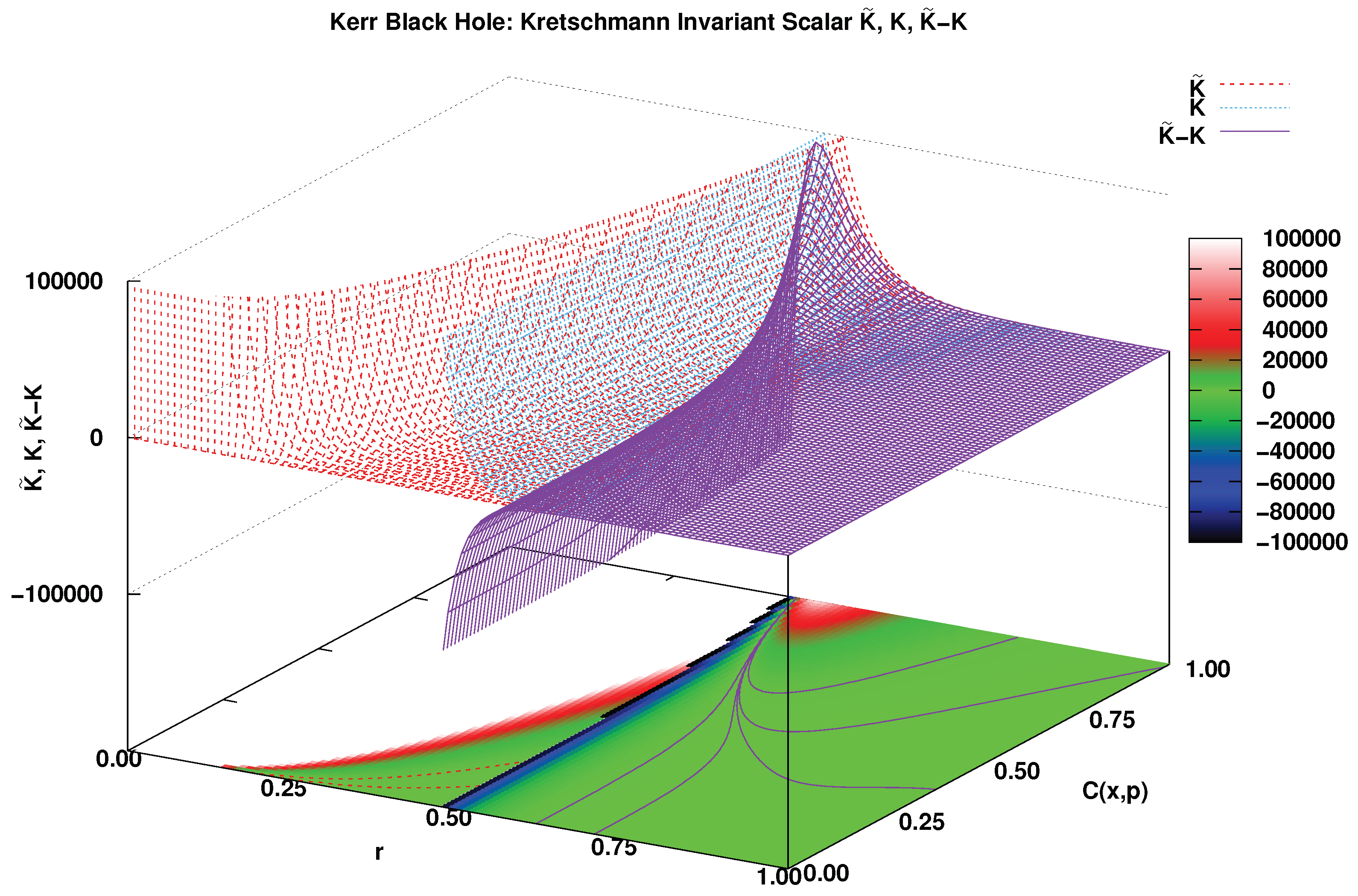
As depicted in Figure 3, a large r is associated with vanishing curvatures. In this region, the Kretschmann invariant scalar, Figure 4, is correspondingly vanishing as well. With a reduction in r, the positive values of K increase substantially, indicating that the conventional curvatures are indeed real, essential, and intrinsic. The behavior of is notably structured. We observe that remains positive throughout. As increases, there is a large positive increase even at smaller values of r.
As shown in Figure 2, the pure quantum contributions can be inferred by subtracting K from . The results in this case are non-monotonic. Moreover, large r is marked by the absence of quantum curvatures. There is a noteworthy relationship between r and . When is small, a reduction in r results in a large negative Kretschmann scalar, indicating the presence of negative quantum curvatures, while an increase in changes this to positive, thus indicating positive curvatures.
Let us first discuss negative and positive curvatures. Negative curvatures found in black holes reveal the formation of a singularity. On the other hand, positive curvatures are directly related to spacelike singularities, which are defined by trapped surfaces in spacetime. These surfaces occur when gravitational forces modify the path of light, creating focal points that converge the light rays and stop them from escaping. Such a trapped surface signifies the existence of a singularity, where the gravitational field reaches infinite strength, resulting in the disruption of spacetime itself. The finite Kretschmann scalar holds significance not merely in indicating the types of curvature. Instead, it reflects the nature of curvature, particularly its intrinsic characteristics. Consequently, we conclude that the resulting quantum curvatures are indeed real, essential, and intrinsic. They do not represent artifacts that can be removed in a particular coordinate system.
4. Conclusions
The analysis of the expansion of the timelike geodesic congruence in the Kerr metric is conducted using both the conventional and quantized metric tensor . A systematic numerical examination of its evolution is carried out for both versions of the metric tensor. It is important to emphasize that the proposed geometric quantization ansatz deliberately broadens the scope of conventional GR to encompass low (quantum) scales, thereby maintaining the fundamental postulates of Einsteinian GR. Our focus is directed towards the gravitational field associated with a rotating, massive, non-charged, and axially symmetric Kerr black hole.
We would like to first emphasize that the numerical results presented are likely reliant on the approximate values assigned to M (mass) and (length scale) of a Kerr black hole, where J represents its angular momentum, and , the derivative of the tangent or cotangent structure, of the proposed quantization approach. It is found that as the radial distance r is reduced, an extremely large evolution of the geodesic congruence expansion and thus curvatures is achieved. The proposed geometric quantization ansatz, qualitatively estimated by the conformal coefficient that relates to , contributes significantly to the quantum-conditioned curvatures that emerge at quantum (low) scales. For instance, the sign of the evolution of the quantum-conditioned curvatures abruptly changes from negative to positive as the conformal coefficient increases.
To evaluate the intrinsic nature of the quantum-conditioned curvatures, the Kretschmann invariant scalar is utilized, which yields non-monotonic results for pure quantum contributions. For vanishing quantization, or unity conformal coefficient, the Kretschmann invariant scalar indicates positive curvatures, which then reverses to a negative sign as the conformal coefficient decreases. This seemingly manifests the ability to regulate space singularity through the proposed quantization. Nevertheless, the crucial function of the Kretschmann invariant scalar is to evaluate whether the curvatures that arise at low (quantum) scales are artifacts of a certain coordinate system or are genuinely intrinsic eigencurvatures. The finite Kretschmann scalar obtained appears to signify the characteristics of these distinguished curvatures that have emerged. We conclude that the quantum-conditioned curvatures in the gravitational field of a rotating, massive, non-charged, and axially symmetric Kerr black hole are indeed real, essential, and intrinsic. They do not merely represent removable artifacts within any coordinate system, either known or to yet to be discovered.
Funding
This research received no external funding.
Data Availability Statement
The data supporting the findings of this study are available within the paper.
Conflicts of Interest
The authors declare no conflicts of interest.
Appendix A. Evolution of Timelike Geodesic Congruence Expansion with gμν and
For the conventional metric tensor , let us divide the expression for ,
into two parts. The first one reads
| The second part is given as
where
By combining both parts, we obtain
Similarly, for the quantized metric tensor , the derivative of wrt to is also divided into two parts. The first one reads
Due to its lengthy expression, let us - for the sake of a better display - divide it into two parts. The first one reads
where
The second one is given as follows:
Now, we combine both terms together and find that
References
- Yuguru, S.P. Unconventional reconciliation path for quantum mechanics and general relativity. IET Quant. Commun. 2022, 3, 99–111. [Google Scholar] [CrossRef]
- Howl, R.; Penrose, R.; Fuentes, I. Exploring the unification of quantum theory and general relativity with a Bose–Einstein condensate. New J. Phys. 2019, arXiv:quant21, 043047. [Google Scholar] [CrossRef]
- Sidharth, B.G. Quantum mechanical black holes: Towards a unification of quantum mechanics and general relativity. Indian J. Pure Appl. Phys. 1997, 35, 456–471. [Google Scholar]
- DeWitt, B.S. Quantum Theory of Gravity. 1. The Canonical Theory. Phys. Rev. 1967, 160, 1113–1148. [Google Scholar] [CrossRef]
- Hawking, S.W. The Unpredictability of Quantum Gravity. Commun. Math. Phys. 1982, 87, 395–415. [Google Scholar] [CrossRef]
- Ashtekar, A. New Variables for Classical and Quantum Gravity. Phys. Rev. Lett. 1986, 57, 2244–2247. [Google Scholar] [CrossRef] [PubMed]
- Tawfik, A.N.; Elgendi, S.G.; Shenawy, S.; Hanafy, M. Canonical Quantization of Metric Tensor for General Relativity in Pseudo-Riemannian Geometry. MDPI Phys. 2025, 7, 52. [Google Scholar] [CrossRef]
- Tawfik, A.; Elgendi, S.G.; Hanafy, M. Vacuum homogeneous and nonhomogeneous metrics with conventional and quantized metric tensor: Singular or nonsingular solution. Ann. Phys. 2025, arXiv:gr480, 170127. [Google Scholar] [CrossRef]
- Tawfik, A.N.; Alshehri, A.A.; Pasqua, A. Expansion evolution of nonhomogeneous metric with quantum-mechanically revisited fundamental metric tensor. Nucl. Phys. B 2025, arXiv:gr1015, 116893. [Google Scholar] [CrossRef]
- Tawfik, A.N.; Dabash, T.F.; Amer, T.S.; Shaker, M.O. Einstein-Gilbert-Straus solution of Einstein field equations: Timelike geodesic congruence with conventional and quantized fundamental metric tensor. Nucl. Phys. B 2025, 1014, 116866. [Google Scholar] [CrossRef]
- Tawfik, A. Quantum-Conditions Curvatures as Sources of Quantum Gravity. J. Phys. Conf. Ser. 2025, 3027, 012021. [Google Scholar] [CrossRef]
- Tawfik, A.; Alshehri, A. Quantum geometric approach: Nature and characteristics of emerged quantum-conditioned spacetime curvatures on three-sphere. Int.J.Mod.Phys.D 2024, 33, 13. [Google Scholar] [CrossRef]
- Nasser Tawfik, A.; Pasqua, A.; Waqas, M.; Alshehri, A.A.; Kr Haldar, P. Quantum geometric perspective on the origin of quantum-conditioned curvatures. Class. Quant. Grav. 2024, 41, 195018. [Google Scholar] [CrossRef]
- Tawfik, A.; Dabash, T.F. Timelike geodesic congruence in the simplest solutions of general relativity with quantum-improved metric tensor. Int. J. Mod. Phys. D. 2023, 32, 2350097. [Google Scholar] [CrossRef]
- Tawfik, A.N.; Dabash, T.F. Born reciprocity and discretized Finsler structure: An approach to quantize GR curvature tensors on three-sphere. Int. J. Mod. Phys. D. 2023, 32, 2350068. [Google Scholar] [CrossRef]
- Tawfik, A.N.; Dabash, T.F. Born reciprocity and relativistic generalized uncertainty principle in Finsler structure: Fundamental tensor in discretized curved spacetime. Int. J. Mod. Phys. D. 2023, 32, 2350060. [Google Scholar] [CrossRef]
- Tawfik, A.N.; Alshehri, A. Relativistic generalized uncertainty principle for a test particle in four-dimensional spacetime. Mod. Phys. Lett. A 2024, 39, 2450079. [Google Scholar] [CrossRef]
- O’Neill, B. Semi-Riemannian Geometry With Applications to Relativity. In Pure and Applied Mathematics; Academic Press, 1983. [Google Scholar]
- Chern, S.; Shen, Z. Riemann-Finsler Geometry; Nankai tracts in mathematics; World Scientific, 2005. [Google Scholar]
- Xia, Q. Geometry And Analysis On Finsler Spaces; Nankai Tracts In Mathematics; World Scientific Publishing Company, 2025. [Google Scholar]
- Tawfik, A.N. On possible quantization of the fundamental tensor in the relativistic regime. Astron. Nachr. 2023, 344, e220072. [Google Scholar] [CrossRef]
- Tawfik, A.N. On quantum-induced revisiting Einstein tensor in the relativistic regime. Astron. Nachr. 2023, 344, e220071. [Google Scholar] [CrossRef]
- Frolovsky, D.; Ketov, S.V. Fitting Power Spectrum of Scalar Perturbations for Primordial Black Hole Production during Inflation. Astronomy 2023, 2, 47–57. [Google Scholar] [CrossRef]
- Sebastiani, L.; Zerbini, S. Some Remarks on Non-Singular Spherically Symmetric Space-Times. Astronomy 2022, 1, 99–125. [Google Scholar] [CrossRef]
- Paiman, M.; Cornean, H.; Köhn, C. Schwarzschild Black Holes in Extended Spacetime with Two Time Dimensions. Astronomy 2023, 2, 269–285. [Google Scholar] [CrossRef]
- Tawfik, A.N. Discretized Finsler Structure: An Approach to Quantizing the First Fundamental Form. Phys. Sci. Forum 2023, 7, 36. [Google Scholar] [CrossRef]
- Caianiello, E.R. Maximal acceleration as a consequence of Heisenberg’s uncertainty relations. Lett. Al Nuovo Cim. (1971-1985) 1984, 41, 370–372. [Google Scholar] [CrossRef]
- Caianiello, E.R. Is There a Maximal Acceleration? Lett. Nuovo Cim. 1981, 32, 65. [Google Scholar] [CrossRef]
- Caianiello, E.R.; Gasperini, M.; Scarpetta, G. Phenomenological Consequences of a Geometric Model With Limited Proper Acceleration. Nuovo Cim. B 1990, 105, 259. [Google Scholar] [CrossRef]
- Caianiello, E.R.; Feoli, A.; Gasperini, M.; Scarpetta, G. Quantum Corrections to the Space-time Metric From Geometric Phase Space Quantization. Int. J. Theor. Phys. 1990, 29, 131. [Google Scholar] [CrossRef]
- Bhandari, G.; Pathak, S.D. Stark energy shifts due to quantum gravity in RGUP algebra. Nucl. Phys. B 2025, arXiv:gr1018, 117019. [Google Scholar] [CrossRef]
- Blank, J.; Exner, P.; Havlícek, M. Hilbert Space Operators in Quantum Physics. In AIP series in computational and applied mathematical physics; American Inst. of Physics, 1999. [Google Scholar]
- Giné, J.; Luciano, G.G. Gravitational effects on the Heisenberg Uncertainty Principle: A geometric approach. Results Phys. 2022, 38, 105594. [Google Scholar] [CrossRef]
- Maddox, I.J. Schur’s theorem for operators. Bull. Soc. Math. Grece 1975, 16, 18–20. [Google Scholar]
- Klein, F. Über die geometrischen Grundlagen der Lorentzgruppe. Jahresber. Der Dtsch. Math.-Ver. 1910, 19, 533–552. [Google Scholar] [CrossRef]
- Kretschmann, E. Über die prinzipielle Bestimmbarkeit der berechtigten Bezugssysteme beliebiger Relativitätstheorien (I), (II). Ann. Der Phys. 1915, 48, 907–982. [Google Scholar] [CrossRef]
- Kretschmann, E. Über den physikalischen Sinn der Relativitätspostulate: A. Einsteins neue und seine urprüngliche Relativitätstheorie. Ann. Der Phys. 1917, 53, 577–614. [Google Scholar] [CrossRef]
- Henry, R.C. Kretschmann scalar for a kerr-newman black hole. Astrophys. J. 2000, 535, 350. [Google Scholar] [CrossRef]
Figure 1.
The evolution of timelike geodesic congruence expansion is depicted in dependence on radial distance r and quantization conformal coefficient . The left panel is devoted to the results obtained with , i.e., no quantization, while the right panel with quantization, i.e., .
Figure 1.
The evolution of timelike geodesic congruence expansion is depicted in dependence on radial distance r and quantization conformal coefficient . The left panel is devoted to the results obtained with , i.e., no quantization, while the right panel with quantization, i.e., .
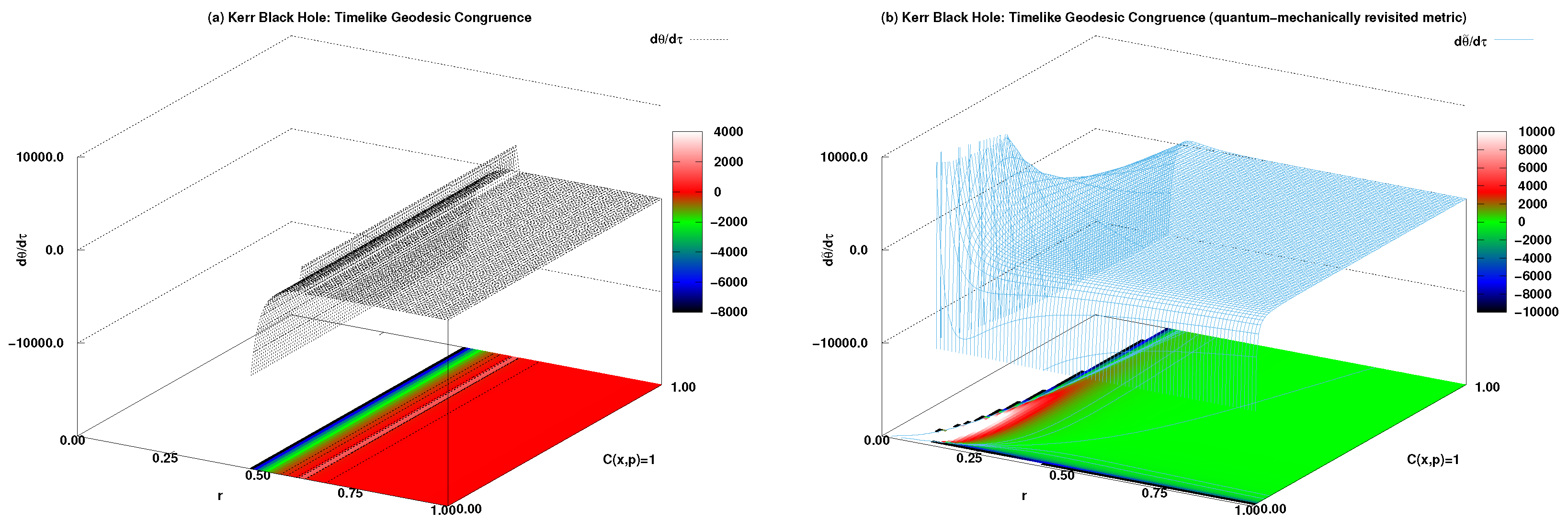
Figure 2.
The same as in Figure 1 but here the difference is presented.
Figure 2.
The same as in Figure 1 but here the difference is presented.
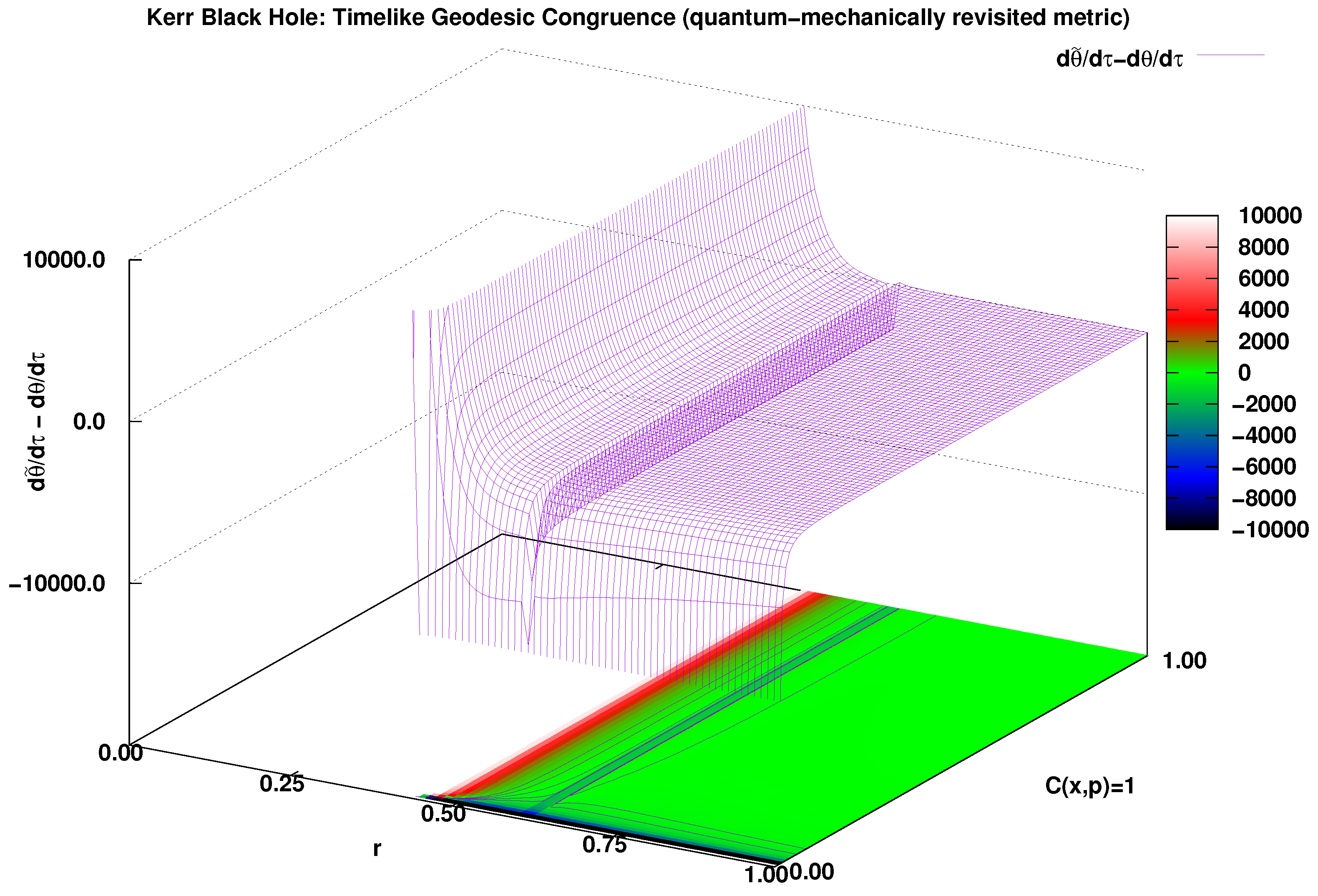
Figure 3.
A systematic comparison between , , and is presented.
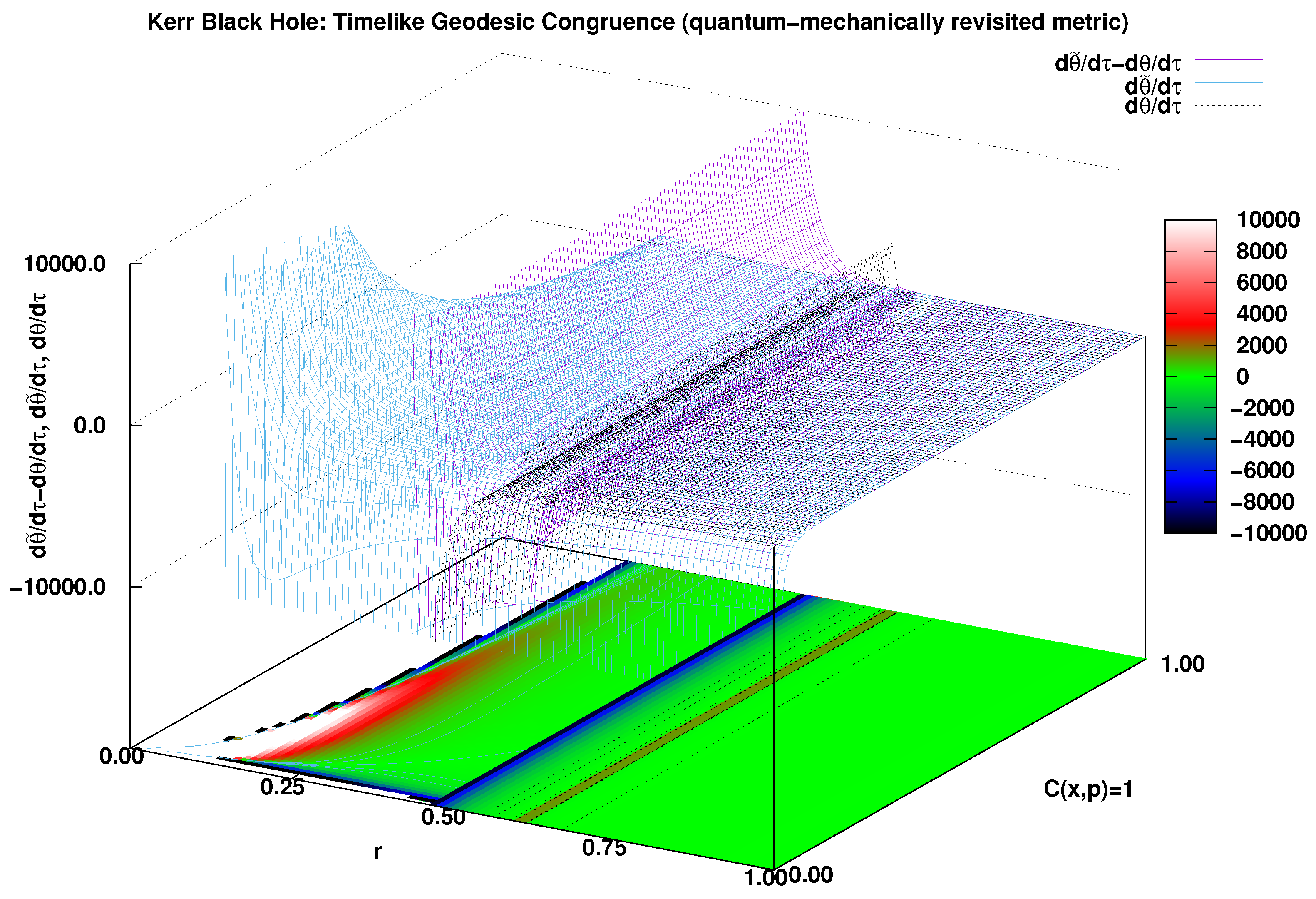
Figure 4.
The Kretschmann invariant scalar is depicted as a function of r and . Results obtained with and are confronted with each other.
Figure 4.
The Kretschmann invariant scalar is depicted as a function of r and . Results obtained with and are confronted with each other.
Disclaimer/Publisher’s Note: The statements, opinions and data contained in all publications are solely those of the individual author(s) and contributor(s) and not of MDPI and/or the editor(s). MDPI and/or the editor(s) disclaim responsibility for any injury to people or property resulting from any ideas, methods, instructions or products referred to in the content. |
© 2026 by the authors. Licensee MDPI, Basel, Switzerland. This article is an open access article distributed under the terms and conditions of the Creative Commons Attribution (CC BY) license (http://creativecommons.org/licenses/by/4.0/).
Copyright: This open access article is published under a Creative Commons CC BY 4.0 license, which permit the free download, distribution, and reuse, provided that the author and preprint are cited in any reuse.


