
Submitted:
03 May 2026
Posted:
05 May 2026
You are already at the latest version
Abstract
As key lifting equipment in construction engineering, tower cranes (TCs) play a critical role in prefabricated buildings (PBs). However, current construction scheduling relies primarily on manual observation by operators and assistants and their experience to perform repetitive tasks, resulting in inefficiency, tediousness, and safety hazards. To enhance lean construction and management efficiency in PBs, this study proposes a scheduling model that comprehensively considers the initial hook position and the specific locations of prefabricated component (PC) supply and demand points. The model is then solved using particle swarm optimization (PSO). Optimization results clearly show that the operational times of two TCs are reduced by 23.94% and 12.16%, respectively, while their daily operating costs decrease by ¥207.29 and ¥293.96. Moreover, the overall construction cost of the PBs is lowered by 8.0%. These findings clearly demonstrate the effectiveness of the proposed model in significantly improving construction efficiency and promoting lean management in PBs.
Keywords:
prefabricated buildings
; prefabricated component
; tower crane
; lean construction
; construction scheduling
; particle swarm optimization
1. Introduction
The construction industry is the leading industry of the national and regional economies, playing a crucial role in driving economic development [1]. However, the traditional construction industry is characterized by slow progress, low productivity, and high resource consumption, posing significant threats to ecological sustainability, public safety, and long-term development [2]. For instance, construction activities generate 40% of total construction waste, consume 32% of resources, and account for 40% of greenhouse gas emissions, while dust pollution severely impacts urban residents’ quality of life [2,3,4,5]. Clearly, conventional construction methods hinder social development, degrade living environments, and impede the construction industry’s sustainable growth.
In this context, PBs have gained increasing attention owing to their advantages in energy efficiency, environmental friendliness, and production efficiency. They are regarded as an ideal pathway for promoting the transformation and upgrading of the construction industry and achieving high-quality development [6,7,8]. As an emerging construction method, PBs involve transferring a substantial portion of on-site operations—traditionally performed in conventional construction—to factories for mass production. The manufactured PCs are then transported to construction sites for assembly [9]. Studies have demonstrated that PBs offer substantial advantages in terms of environmental and resource efficiency [10]. For instance, regarding carbon emissions, Jayawardana et al. [11] reported an approximate 8.06% reduction in greenhouse gas emissions, while Greer et al. [12] further demonstrated a potential reduction from 4% to 20%. In the area of resource conservation and waste reduction, Mao et al. [13] found that material consumption in PBs is only 25% of that in traditional building construction, with additional benefits including minimized waste generation and high recyclability. Similarly, Cao et al. [14] confirmed a 35.82% reduction in resource consumption. Regarding energy consumption, Hong et al. [15] revealed that energy savings of 16% to 24% can be achieved in the recycling phase, while total life-cycle energy consumption can be reduced by 4% to 14%. Concerning comprehensive ecological benefits, Cao et al. [14] further reported that PBs can reduce health damage by 6.61% and ecosystem damage by 3.47%. Currently, PBs have been widely adopted in developed countries, including Germany, the Netherlands, Denmark, and Sweden [12,13,14,15,16]. Nevertheless, systematic analysis and in-depth research on the lean management of PBs, particularly concerning the on-site scheduling of PCs, remain scarce.
The lean construction theory (or framework), initially proposed by Professor Koskela [17,18], which is an extension of the lean manufacturing production method into the construction field. Its core objective is to minimize, if not eliminate, waste (e.g., in resources, time, and materials), thereby maximizing project value. This approach is now widely regarded as an advanced construction system and project management model [19]. Implementing lean construction principles in the construction process of PBs can optimize production processes, enhance product quality, reduce waste, and lower costs. Although existing research has applied lean construction to PBs [20,21,22], these studies focus primarily on theoretical frameworks [23,24] and technical implementations [25,26]. A significant gap remains, however, in comprehensive empirical studies and systematic validation of the specific pathways for realizing these potential economic benefits.
Based on this, this study focuses on the assembly process of PCs at construction sites and investigates the optimization of construction scheduling through lean construction management. The main contributions are as follows: (1) Development of a simulation and optimization methodology for PCs scheduling in PBs; (2) Identification of optimal supply locations, scheduling plans, and minimal time costs for PCs; (3) Achievement of efficient assembly process management for multi-project PCs in PBs; (4) Validation of the model’s effectiveness through multi-project case studies in real-world PBs. This research focuses on lean construction management in PCs construction sites, contributing positively to improving overall site efficiency and managerial standards.
2. Literature Review
2.1. Lean Construction of PBs
PBs are complex systems comprising four stages: design, production, transportation, and construction, each with stringent requirements. However, continuing to prioritize traditional construction goals—cost management, schedule control, and quality management—makes it challenging to meet the objectives of lean construction management for PBs. For instance, the design phase must holistically integrate production, transportation, and construction needs for PCs to avoid adverse impacts on subsequent stages. During production and transportation, optimizing assembly-line processes and transportation planning are critical. In the construction phase, prioritizing construction operational efficiency and implementing optimized scheduling plans are essential.
Lean construction aligns with the developmental philosophy of PBs, with the goal of systematically eliminating waste, shortening project cycles, and maximizing value throughout the entire process chain [27]. Consequently, PBs are widely considered an effective approach for implementing lean principles and have attracted substantial research [28]. In terms of lean construction theory, Nahmens et al. [29] highlighted its role in reducing resource waste, accelerating construction cycles, and improving the safety of PBs. Similarly, Zhu et al. [30] emphasized the role of lean practices in enhancing operational performance in complex project delivery systems, fostering stakeholder engagement, and reinforcing sustainability. Regarding lean construction techniques, Niu et al. [31] developed an IoT system leveraging intelligent building objects to enhance supply chain management in PBs. Xu et al. [32] proposed a cloud-based IoT platform designed to improve the delivery efficiency of PCs. Parameswaran et al. [33] investigated the application and impact of lean techniques and tools in precast concrete, identifying Value Stream Mapping (VSM) and Just-in-Time (JIT) production as the most widely adopted lean methods in this field.
Overall, improving the implementation of lean construction in PBs is generally achieved through optimizing construction plans or establishing tailored management systems. However, most existing studies restrict the perspective of lean optimization to outcomes enabled by technological enhancements or focus exclusively on single-project or phase-specific improvements. In practice, construction enterprises often manage multiple PBs simultaneously [34,35]. Nevertheless, issues such as resource coordination and conflict resolution in such multi-project environments have seldom been incorporated into the research framework of lean construction. This limitation impedes the ability of single-project optimization measures to achieve the core lean objective of maximizing overall corporate profit.
2.2. TCs for PBs
Tower cranes (TCs) are critical auxiliary equipment on construction sites, whose operational efficiency governs the assembly efficiency of precast components (PCs) and thus the overall project schedule. Conventional TC scheduling, which relies on material sequences at supply points and repetitive task assignment based on operator experience, lacks systematic spatial planning and often leads to inefficient transportation paths and low operational efficiency. Three key factors significantly affect TC operational efficiency and safety: (1) TC selection and layout, (2) supply and demand locations of PCs, and (3) TC operation plan and hook runtime.
In response to these challenges, scholars have conducted extensive research. Regarding TCs selection and layout, simulation models [36,37] and automated systems [38,39] have been developed to optimize crane positioning, thereby effectively preventing collisions and improving operational efficiency. For operational trajectory and scheduling, methods such as genetic algorithms [40,41,42], mixed-integer linear programming [43,44], and multi-agent simulation [45,46] have been widely adopted to optimize hook trajectories and service sequences [47], as well as to reduce waiting times [48]. Prior research has established a solid foundation for lean construction and TC scheduling in PBs. However, it inadequately addresses TC task allocation and path planning across multiple projects, especially during construction. Existing scheduling approaches either rely heavily on operator experience, resulting in suboptimal efficiency, or depend fully on algorithmic optimization, which often fails to account for complex on-site conditions and thus limits practical applicability. Both scenarios risk wasting time and resources.
To address these gaps, this study focuses on multi-project construction scenarios for PBs. A mathematical model for multi-project TCs scheduling is established, with the objectives of determining optimal supply point locations, optimizing scheduling schemes, and minimizing time costs, solved using PSO algorithm. Grounded in the principles of lean construction, this research extends the scheduling problem from a single-project to a multi-project context, aiming to eliminate wastes—including waiting, idling, and other inefficiencies—caused by poor inter-project coordination. Therefore, this work seeks to provide broader and more practical decision-making support for the lean management of PBs. The structure of this study is as follows: Section 1 presents the research background and problem statement; Section 2 introduces the literature review; Section 3 describes the practical problems and develops the mathematical framework; Section 4 provides a case study as an illustrative example of PSO to multi-project PCs scheduling in PBs; Section 5 discusses the research limitations and proposes future research directions; Section 6 concludes the paper.
3. Problem Description
3.1. Description of Construction Scheduling Issues
In PBs, PCs are typically stored within the operating range of TCs or on temporarily parked transport vehicles. Effective scheduling schemes improve construction efficiency, reduce costs, minimize safety risks, and enhance management standards. Conversely, poor scheduling may cause work idling, rework, and even major safety incidents such as collisions involving TCs. It can also lead to frequent crane operations, prolonged waiting times for other equipment, and unnecessary resource consumption, all of which increase project costs. Given the parallel execution of multiple projects and tight schedules, efficient integrated scheduling of PCs within limited time has become a significant challenge for managers. Thus, developing scheduling strategies based on lean construction theory to address multi-project and multi-scenario demands has emerged as a critical issue in current construction practice.
To address this, we decompose the operational process of TCs. When executing scheduling tasks, the TC hook moves radially, tangentially, and vertically along the boom to transport PCs from supply points (e.g., Li) to demand points (e.g., Wj) on standard floor workspaces (Figure 1). Beginning at its initial position, the hook transports PCk from L1 to W1 for positioning and assembly (completing task T1), then returns to L1 to transport PC2 to W2, and repeats this cycle until all scheduling tasks for multi-project PCs are completed. The complete motion trajectory of the TC hook is: initial position→Li (PCk)→Wj→Li (PCk)→Wj→initial position.
3.2. Analysis of Construction Scheduling Process
3.2.1. Model Assumptions
To facilitate the development of a mathematical model for multi-project PCs construction scheduling in PBs and to ensure it accurately reflects the actual conditions of lean construction within PBs, the following assumptions are established for the PCs construction scheduling model:
- (1)
- The model focuses exclusively on the scheduling of PCs and excludes other materials, such as reinforcing steel and formwork;
- (2)
- The model does not account for the impact of PCs dimensions or site topography on the scheduling process;
- (3)
- The temporary parking area for the PCs transport vehicles and TCs’ origin positions are modeled as fixed coordinate points;
- (4)
- Each PC’s scheduling task is assigned to a single TC and is performed only once;
- (5)
- Interactions between concurrently operating TCs (e.g., stopping, waiting, or collision avoidance) are not considered;
- (6)
- TCs operate without interruption until all PCs scheduling tasks are completed;
- (7)
- Owing to site space constraints, the PCs transport lanes are modeled as one-way pathways.
3.2.2. Definition of Model Parameters
The parameter symbols and meanings involved in constructing a mathematical model for the construction scheduling of PCs in PBs are shown in Table 1.
3.2.3. Analysis of Construction Scheduling Process
In PBs, the primary function of TCs is to transport PCs from supply points to demand points. The motion trajectory can be simplified into three parts. ① Tangential movement: Horizontal rotation of the TC boom along its central axis. ② Radial movement: Forward-and-backward movement of the hook along the boom. ③ Vertical movement: Up-and-down movement of the hook along the boom’s height. Tangential and radial movements collectively define the horizontal motion trajectory, while vertical movement operates independently. The combined horizontal and vertical motion paths are illustrated in Figure 2.
(1) Horizontal movement time. In the horizontal direction, the hook moves tangentially with the boom along the motion trajectory shown in Figure 2 (a). According to relevant studies, [49,50,51]the coordinates of the supply and demand points of PCs and the origin of the TC are (Lx, Ly, Lz), (Wx, Wy, Wz), and (TCx, TCy, TCz), respectively. The planar distances d (L, W), d (TC, L), and d (W, TC) between the three are calculated as follows:
where d(TC, L) represents the straight-line distance between the origin coordinates of the TC and the supply point coordinates on the same plane, d(L, W) represents the straight-line distance between the coordinates of the supply point and the demand point on the same plane, and d(W, TC) represents the straight-line distance between the coordinates of the demand point and the origin coordinates of the TC on the same plane.
- Assuming the hook moves uniformly in the tangential direction and has an angular velocity of v1. According to the cosine theorem, the angle of tangential movement of the hook is θ, and the time of tangential movement is Tθ (Tθ = θ / v1). The calculation formula is as follows:
- Assuming the hook moves uniformly in the radial direction at a speed of v2. The distance of radial movement of the hook and the time of radial movement. The calculation formula is as follows:
Tr = dr / v2
The tangential and radial movements of TCs are interconnected and overlap, mainly manifested as the TC simultaneously moving in both directions. Therefore, it is necessary to introduce the TC horizontal movement synchronization coordination parameter α (closely related to the professional level of the TC operator). The calculation formula for the horizontal movement time of the hook of the TC is as follows:
where α∈[0, 1]. The smaller the α, the higher the synchronization between tangential and radial hooks and the shorter the overall horizontal movement time [42]. Due to various unexpected situations at the construction site, the value of α is 0.25 [50].
Th = max (Tθ, Tr) + α min (Tθ, Tr)]
(2) Vertical movement time. The vertical movement trajectory of the hook of the TC is shown in Figure 2 (b). Assuming L and W are the supply and demand points of PCs, respectively, and the vertical coordinates are Lz and Wz. Considering the safe distance h between the TC and the building, the vertical movement trajectory of the hook is that the PC starts from the supply point L, rises for |Wz-Lz|+h distance, and then slowly descends h distance until the PC is transported to the demand point W [52]. Assuming the hook moves uniformly in the vertical direction at a speed of v3. The vertical lifting height dz and vertical movement time Tv of the hook are calculated as follows:
dz =|Wz-Lz|+2h
Tv = dz / v3
(3) Single transportation time of hook. The horizontal and vertical movements of the hook are usually coordinated synchronously when the TC performs the construction scheduling task. Therefore, it is necessary to introduce the synchronization coordination parameter β and the difficulty level γ of controlling the hook during movement caused by uncertain factors on the construction site [50,52,53]. The total time Tij for the TC hook to move from the supply point L to the demand point W is calculated as follows:
Where β represents the degree of coordination between the horizontal and vertical movements of the TC. β∈[0, 1], the smaller the β, the shorter the complete transportation time. Due to various unexpected situations on site, the value of β is 1.0. γ denotes the uncontrollable factors such as weather, accidents, and obstacles in the course of the construction scheduling process, and the operating time of the TC may be delayed as a result. The smaller the value of γ, the better the operating conditions of the PC and the easier it is to control. γ = 1.0 represents operation under normal conditions, and γ = 10 represents operation under difficult on-site conditions, and the hook is tough to control.
Tij = γ [max (Tv, Th) + β min (Tv, Th)]
(4) Total time for a single complete transportation. In a complete construction scheduling task, the preparation time Tk loading for the start of lifting PCs, the time Tij for moving from the supply point to the demand point, the time for assembling the work surface, and the time Tji for returning from the demand point to the supply point also need to be considered. The calculation formula for the total time of a single complete construction scheduling of PCs is as follows:
Where k=a, b, c indicates the type of PCs: prefabricated shear wall PCa, laminated panel PCb, prefabricated staircase PCc, and , indicates the preparatory time for the start of lifting of the PCs and the time for assembling them at the work surface in place.
3.3. Mathematical Modeling of Construction Scheduling
The total time required for TC construction scheduling consists of two parts. (i) Initial movement time: The duration for the TC hook to travel from its initial position to the first supply point. (ii) Cumulative scheduling time: The cycle time for the hook to move between supply and demand points (supply→demand→supply). To minimize the total travel time of TCs, a mathematical model is used to transform the construction scheduling problem of TCs into a mathematical problem and to maximize the shortening of the TC operation process time while meeting the assembly of the prefabricated component working surface, which was initially proposed by Zhang et al. [50].
3.3.1. Decision Variables
For the sth construction scheduling task of PCs, xk s ij represents the execution of the sth construction scheduling task from the supply point i to the demand point j for the kth PC. If this construction scheduling task exists, the value is 1; If it does not, the value is 0. = 1; otherwise, = 0.
3.3.2. Objective Function
- Initial movement time. The time it takes for the hook to move from its initial position to the first supply point. Combined with equation (8), the time T1 for the TC hook to move from the initial position to the first supply point is calculated as follows:
- Cumulative scheduling time. The PCs move from the supply point to the demand point and then from the demand point to the supply point within a limited area. Combined with equation (9), the cumulative time T2 for completing the construction scheduling of PCs is calculated as follows:
- Construction scheduling objective function. According to equations (10) and (11), the total time Ttotal for PCs of PBs and the total cost C for TC construction scheduling are calculated as follows:
minC = min (Ttotal·Qm)
3.3.3. Constraint Condition
For ∀s∈ {1, 2, …, S}, i∈ {1, 2, …, I} there are:
Equation (14) stipulates that each construction scheduling task initiate from a single supply point, select a PC for transportation to the demand point, and return to the supply point once transportation has concluded. Equation (15) mandates that the hook must return to the supply point after completing each task. Furthermore, the hook must remain at the original supply point to align with subsequent construction schedule execution.
4. Case Study
4.1. Experimental Method Design
Traditional construction scheduling primarily relies on the observational expertise of TC operators and assistants to repeatedly execute scheduling tasks. This approach lacks systematic spatial consideration, often leading to issues such as inefficient paths and redundant transportation during the process. Therefore, this study focuses on multi-project PC scheduling in PBs by establishing a mathematical model and leveraging intelligent algorithms to formulate and solve optimal TC scheduling plans, thereby enhancing lean management of PCs on the construction site of PBs. Research on intelligent algorithms has demonstrated significant advancements. For TC optimization, traditional methods like linear and dynamic programming remain widely used [54,55], while recent studies increasingly employ genetic algorithm hybrids or enhancements. [56] As a meta-heuristic method, however, PSO can effectively resolves multi-objective scheduling challenges. Jiby et al. [57] applied PSO to multi-resource-constrained project scheduling. Zhu et al. [58] proposed a hybrid PSO-SA meta-heuristic algorithm for solving the automatic lifting path planning problem of PB TCs. Hammad et al. [49] proposed a hook path problem for prefabricated TCs using PSO. Similarly, Zhang et al. [59] and Arboui et al. [57,60]. leveraged PSO for resource-constrained scheduling. Therefore, in this study, PSO is adopted for PC scheduling optimization and compared against genetic and artificial bee colony algorithms to validate its efficacy.
Kennedy et al. [57] proposed the concept of PSO in 1995, this robust evolutionary algorithm outperforms other meta-heuristics in computational efficiency, developmental flexibility, and result consistency [61,62]. The calculation formula is as follows:
vid (t+1) = wvid (t)+c1r1(Pid (t)-xid (t))+c2r2(Pgd (t)-xid (t))
xid (t+1) = vid (t)+xid (t)
In equations (16)-(17), i represent the ith particle, d represent the dth dimension, and w represent the inertia weight (a decimal between 0 and 1); vid (t) represent the dth dimensional flight velocity component of particle i at the ith iteration; c1, c2 represent acceleration factors or learning factors, r1, r2 represent random numbers on [0, 1]; Pid (t) represent the individual optimal solution of the ith particle in the dth dimension at the tth iteration; Pgd (t) represent the global optimal solution of the entire particle swarm in the dth dimension at the tth iteration.
Where equation (16) defines the updated velocity by combining the particle’s prior velocity with its distance to both its individual and global optimal positions. Equation. (17) updates the particle’s position using its historical experience, the swarm’s collective best experience, and its previous velocity.
4.2. Construction Scheduling Resource Allocation
4.2.1. Layout of TCs
As illustrated in Figure 1, the project comprises 11 residential buildings. In this study, the construction scheduling of PCs in buildings 8# to 11# served as the focus. Buildings 8# and 10# were allocated to TC1, while buildings 9# and 11# utilized TC2.
4.2.2. Supply Point Location
The configurations of PC transport vehicles and yards are modeled as supply points in this study, designated as L1, L2, L3, and L4, respectively. These supply points accommodate three PC types: PCa, PCb, and PCc. The coordinate system was redefined based on the construction site’s specific layout, with the coordinate ranges for the PC supply points provided in Table 2.
4.3. Solving the Construction Scheduling Model
4.3.1. Supply Demand Plan for PCs
To ensure the stability and reliability of PBs, the first three floors of the building were constructed using the traditional cast-in-place method. From the fourth floor onward, PCs were utilized for construction. Specifically, the assembly cycle for the first floor was 20 days, the second floor 12 days, and the third floor 10 days. Subsequently, the standard floor assembly cycle was reduced to 7 days. The construction timeline and progress plan for multiple PBs (Buildings 8#–11#) are detailed in Table 3.
Based on Table 3, to ensure the construction scheduling of PCs for multi-projects in PBs from March 24 to 30, 2023, project managers must submit a demand plan for PCs to the PC factory one week in advance to prevent supply delays and impacts on the project’s construction progress. According to the standard floor construction tasks, the demand plan for PCs from June 24 to 30, 2023, is presented in Table 4.
4.3.2. Construction Scheduling Experiment Data
An analysis of the demand for lean construction scheduling of PCs in multi-projects was conducted on June 30, 2023. Building 8# was constructed up to the 14th floor, with PCb assembled in place. The process involved binding the steel bars of the PCb; with no construction scheduling tasks for PCs. Building 9# reached the 13th floor, involving PCc assembly, concrete pouring, and four scheduling tasks for PCc construction. Building 10# (up to the 13th floor) required surveying, setting out, PCc assembly, and scheduling 10 PCa installations. Building 11# reached the 13th floor for PCb assembly, requiring scheduling tasks for 48 PCb installations.
Based on the previous analysis, a construction scheduling study for PCs in multi-projects within PBs will be conducted, using the PC demand from June 30, 2023, as the basis. TC1 is assigned to manage construction scheduling for Buildings 8# and 10# at coordinates (12.90, 42.10, 0.00), while TC2 oversees scheduling for Buildings 9# and 11# at coordinates (82.35, 45.75, 0.00). After defining PC supply point coordinates, determining demand point coordinates on the standard working layer surface is required. Therefore, the coordinates of the demand points on June 30, 2023, are presented in Table 5.
4.3.3. Construction Scheduling Parameter Setting
The experimental simulation was conducted using Matlab 2022b software. Two TCs of the same model were configured with angular velocity v1=0.7 rad/min, a radial velocity v2=100 m/min, and a vertical velocity v3=100 m/min during scheduling. The operators of the TCs had moderate skill levels, with operating coefficients α = 1.0 and β = 0.25. During the operation of the TC, the weather conditions were optimal, and there were no obstacles along the hook movement path between the supply and demand points of PCs. The difficulty coefficient of hook movement control is γ = 1.0. The TC has a good field of view, and the safe distance between the TC and the building is h = 1.5m. The daily cost of each TC was 2000 yuan/day, operating for 8 hours/day with a unit time cost of 4 yuan/min.
Based on the on-site observations, preparation and assembly times were as follows: = = 6min, = = 3.5min, ==3min; the height of TC1 was determined by the highest structural elevation of the 14th floor (40.83 m) for Buildings 8# and 10#, while TC2 was set to the 13th floor’s structural elevation (37.68 m) for Buildings 9# and 11# . The initial hook coordinates were defined as P0(TC1) = (12.90, 42.10, 45.83), P0(TC2) = (12.90, 42.10, 42.68).
4.4. Results of Construction Scheduling Experiment
4.4.1. Best Construction Scheduling Plan and Supply Points
After the model algorithm settings were completed, the population sizes for the PSO, GA, and ABC algorithm were set to 100, with a maximum of 400 iterations. The parameters were defined as c1 = 2.8, c2 = 1.3, w = 0.729, Pc = 0.8, Pm = 0.2, and the number of employed bees was set to 100. Based on the construction progress of multi-projects in PBs (Buildings 8# to 11#), TC1 was only responsible for the construction scheduling of 10 PCa in 10# on that day. The Gantt chart of the scheduling plans for TC1 before and after optimization is shown in Figure 3.
According to the construction progress of the multi-project in PBs, TC2 was responsible for scheduling 4 PCc in Building 9# and 48 PCb in Building 11# on the specified day. The Gantt chart of the scheduling plans for TC2 before and after optimization is shown in Figure 4.
4.4.2. Minimum Time Cost for Tower Crane Construction
To ensure the effectiveness and reliability of the algorithm, the widely recognized PSO algorithm was employed to simulate and optimize the construction scheduling of PCs in multi-project PBs. Additionally, the computational reliability of the algorithm was compared and analyzed against the Ant Colony Optimization (ACO) and Artificial Bee Colony (ABC) algorithms. After 400 iterations, all algorithms achieved convergence. In contrast, the traditional scheduling approach relies primarily on the experience of TC operators and assistants, whereas three distinct optimization algorithms were utilized for problem-solving. The cumulative runtime of TC1 and TC2 from iterative convergence is shown in Figure 5, while the cumulative costs for both TCs are presented in Figure 6. The operational cost convergence curves for TC1 and TC2 are demonstrated in Figure 7.
4.4.3. Analysis of Experimental Simulation Results
As shown in Figure 5, the optimization simulation for PC construction scheduling in multi-project PBs (Buildings 8#–11#) was conducted to minimize TC runtime. Compared to traditional construction methods, the three optimization algorithms achieved comparable convergence results, with PSO demonstrating superior performance by reducing TC1 and TC2 runtime by 23.94% and 12.16%, respectively, during multi-project scheduling. Compared to the pre-optimization baseline, the daily operational time for both TCs was reduced by 85.31 minutes (1.4 hours).
As shown in Figure 6 and Figure 7, the convergence curves for construction scheduling and operating costs of TCs in multi-project PBs (Buildings 8#–11#) indicate that PSO demonstrates superior convergence performance. After 378 iterations, the algorithm achieved a runtime of 31 seconds and the lowest total runtime cost of ¥5,790.61 for both TCs, outperforming the GA and ABC algorithms. When using traditional scheduling methods, the operating costs for TC1 and TC2 were ¥2,531.73/day and ¥3,760.14/day, respectively. After optimization, the operating cost of TC1 was reduced by ¥207.29/day, and the operating cost of TC2 was reduced by ¥293.96/day, yielding a total daily savings of ¥501.25 during PCs construction scheduling tasks.
In summary, the multi-project PCs scheduling model for PBs proposed in this study significantly reduces time and cost while delivering multifaceted lean benefits. The reduced operational time minimizes idle and non-productive periods for TCs, thereby reducing energy consumption and mechanical wear. Furthermore, the optimized path and supply point planning enhance on-site spatial utilization efficiency and logistics organization, mitigating resource waste and safety risks in PCs management. Consequently, the optimization outcomes of this research represent a comprehensive integration of temporal, economic, resource, and safety benefits. The findings provide a scientifically sound and readily applicable analytical method for optimizing management and promoting lean practices in PBs processes, offering substantial practical guidance for advancing lean management in construction projects.
5. Discussion and Future Research Directions
5.1. Discussion
Lean thinking is applied to the construction scheduling of PCs in PBs. The project managers develop precise procurement plans, ensuring PCs are promptly transported to designated supply points based on construction progress constraints. The TCs execute scheduling tasks immediately after unloading PCs from the current transport vehicle. Subsequent vehicles are temporarily parked at optimal supply points to minimize on-site management, waiting time for TCs, resource waste, and safety hazards
According to TCs layout assignments, TC1 is responsible for the scheduling tasks for Buildings 8# and 10#, while TC2 manages Buildings 9# and 11#. In practice, TC1 only has the scheduling tasks of 10 PCa units and provides the best supply point locations and scheduling plans (as shown in Figure 3), while TC2 has the scheduling task for 4 PCc and 48 PCb units, with its optimized plans detailed in Figure 4. The optimized scheduling plan improves PB construction efficiency, reduces TC operating time, and mitigates safety risks.
Moreover, the scheduling model and optimization method proposed in this study demonstrate strong generality and scalability. The model employs universal input parameters, such as coordinates, velocities, and task lists, facilitating its application to other PBs. By incorporating PSO algorithm, the proposed approach effectively solves large-scale scheduling problems involving multiple TCs and tasks. Furthermore, it accommodates varying operator proficiency levels through parameters α and β, responds to on-site environmental complexity via parameter γ, and adheres to specific safety regulations by setting the safety distance “h”. These features enable the framework to adapt to dynamic construction site conditions while maintaining robust performance.
In summary, through case studies and experimental simulations, the content and methodology of the study are reasonable and practical. When two TCs are used for PCs scheduling tasks in a multi-project of PBs according to the provided supply points and scheduling plans, ¥501.25 can be saved. Therefore, considering the PBs, this study has excellent comprehensive benefits while improving the lean management of PBs.
5.2. Research Limitations and Future Research Directions
Notwithstanding the demonstrated efficacy and reliability of the multi-project TCs scheduling model and optimization algorithm for PBs developed in this study, several limitations warrant acknowledgment, as delineated below:
- (1)
- TCs represent critical mechanical equipment in PBs, whose safety concerns during operation should not be overlooked. This study deliberately omits potential spatial interference and collision risks among multiple TCs operating simultaneously at construction sites in its model assumptions. In practical engineering applications, factors including safety distances between cranes, overlapping operational zones, and conflicts in jib rotation trajectories fundamentally impact scheduling safety and efficiency. Future research should integrate anti-collision algorithms with real-time positioning systems to establish collaborative scheduling mechanisms capable of dynamic obstacle avoidance. Furthermore, while the current model idealizes the handling of dynamic site conditions such as weather changes and temporary obstacles—primarily addressed through a holistic adjustment via parameter γ—this approach provides valuable insights for developing more sophisticated real-time response models in subsequent studies.
- (2)
- For the construction scheduling of PCs in PBs, this study fully incorporates practical conditions but is limited to scenarios where a single prefabricated plant supplies multiple PBs, without addressing the collaborative supply and transportation scheduling among multiple prefabricated plants. As the scale of PBs expands, cross-plant and cross-project collaborative scheduling will become crucial for enhancing the efficiency of the overall supply chain. As evidenced by studies such as Song [63] and Cui [64], which focus on collaborative scheduling involving multiple prefabricated plants, future research should aim to develop multi-plant–multi-project collaborative scheduling models. Such models would integrate transportation resources and lifting plans to achieve seamless coordination between the supply chain and on-site construction processes.
- (3)
- Although the optimization model adopted in this study demonstrates satisfactory performance in static environments, it still exhibits limitations in addressing dynamic on-site variations (e.g., task priority adjustments, equipment failures, and emergent task insertions). Future research should prioritize the development of dynamic adaptive scheduling mechanisms by integrating digital twins, Internet of Things, and real-time data fusion technologies to achieve a transition from “pre-planning” to “real-time response”.
- (4)
- Current research outcomes remain predominantly focused on theoretical models and algorithms, lacking user-friendly visual interfaces and interactive systems for on-site management personnel. Enhanced efforts should be directed toward developing human-machine collaborative decision-support systems that translate optimized results into graphical and instructional construction guidance, thereby improving the practical applicability and scalability of research achievements.
In light of the aforementioned limitations, future research will be closely aligned with practical industry demands, focusing on the following directions:
- Developing an intelligent collaborative scheduling platform integrated with safety constraints: By deeply integrating anti-collision algorithms for TCs, real-time positioning technology, and the scheduling model proposed in this study, a multi-TC collaborative operation system will be established. This system will incorporate safety warnings, path obstacle avoidance, and dynamic adjustment capabilities, achieving a balance between efficiency and safety.
- Constructing an integrated “supply chain–construction” scheduling model: Expanding the research scope to integrate multiple PCs factories, transportation fleets, and on-site TCs resources, a cross-factory, multi-project, and full-process collaborative scheduling model will be developed to enhance the overall efficiency of construction industrialization.
- Investigating data-driven dynamic adaptive scheduling mechanisms: To address the rapidly changing conditions on construction sites, future research will explore the use of technologies such as the Internet of Things (IoT) and digital twins. This will enable the scheduling system to perceive dynamic information, including equipment status, weather changes, and task progress, in real time, and respond quickly with rescheduling. The goal is to transition from static, pre-planned scheduling to dynamic, adaptive real-time scheduling, significantly improving the system’s robustness in real-world environments.
- Promoting the practicality and operability of algorithmic outcomes: Recognizing that even the most advanced algorithms may fail to be implemented if they are not understood and accepted by on-site personnel, we will strive to optimize the visualization of scheduling results and human-computer interaction design. By developing intuitive graphical interfaces and simplified operational instructions, complex optimization results will be transformed into specific guidance that is easy for on-site managers and tower crane operators to understand and execute. This will fundamentally enhance the practical applicability and operational feasibility of the research outcomes.
6. Conclusions
This study focuses on the construction scheduling problem of PCs for multi-projects of PBs. By analyzing on-site management practices and integrating lean construction theory with PC scheduling characteristics, a mathematical model for PC construction scheduling was developed and solved using three optimization algorithms. The model determined the optimal supply point locations, scheduling schemes, and minimal time costs for PCs. The main conclusions obtained are as follows:
- (1)
- Aligned with lean construction theory, PCs must be delivered promptly to the construction site, and assembly tasks on standard floors must be completed within agreed timelines. This study advances the practical application of lean principles in PC scheduling, offering innovative methodologies for optimizing construction workflows.
- (2)
- A mathematical model for PC construction scheduling was developed to improve the lean management level and reduce the construction costs of PBs. The PSO, ACO, and ABC algorithms were applied to optimize the scheduling process, and the mathematical model’s validity and reliability were verified simultaneously. The results showed that compared with before optimization when completing the predetermined construction scheduling tasks of PCs for multi-project PBs, the cumulative runtime of two TCs decreased by 1.4 hours and saved ¥501.25.
- (3)
- By researching the optimization of PCs construction scheduling for multi-projects in PBs, the optimal supply point location, optimal scheduling scheme, and lowest time cost of PCs on the construction site can effectively improve the management level and comprehensive benefits of PBs. These strategies provide replicable and promotable recommendations for improving lean practices in similar engineering projects.
Author Contributions
Conceptualization, C.Z. and J.Z.; methodology, C.Z. and X.Q.; investigation, C.Z., X.Q., Z.M. and K.Z.; validation, C.Z. and Q.W.; Formal analysis, C.Z. and Q.W.; data curation, C.Z. and Q.W.; writing–original draft, C.Z.; visualization, C.Z. and X.Q.; funding acquisition, C.Z. and J.Z.; supervision, J.Z., Q.W., Z.M. and K.Z.; project administration, Z.M. and K.Z.
Funding
This research was funded by the 2024 Shaanxi College of Communications Technology Research and Innovation Team Funding Project (Grant number CX24002), The Key R&D Program Project of Shaanxi Province (Grant number 2024SF2-GJHX-06), Xi’an Science and Technology Plan Project (Grant number 2025JH-SFJS-0044).
Data Availability Statement
The original contributions presented in the study are included in the article, further inquiries can be directed to the corresponding author.
Conflicts of Interest
The authors declare no conflicts of interest.
Abbreviations
The following abbreviations are used in this manuscript:
| TC | Tower Crane |
| PBs | Prefabricated Buildings |
| PSO | Particle Swarm Optimization |
| PC | Prefabricated Component |
References
- Arrigoni A, Pelosato R, Melià P, Ruggieri G, Sabbadini S, Dotelli G: Life cycle assessment of natural building materials: the role of carbonation, mixture components and transport in the environmental impacts of hempcrete blocks. J Clean Prod 2017, 149:1051-1061. [CrossRef]
- Liu S, Li Z, Teng Y, Dai L: A dynamic simulation study on the sustainability of prefabricated buildings. Sustainable Cities and Society 2022, 77:103551. [CrossRef]
- Han Y, He T, Chang R, Xue R: Development Trend and Segmentation of the US Green Building Market: Corporate Perspective on Green Contractors and Design Firms. Journal of Construction Engineering and Management 2020, 146(11):05020014. [CrossRef]
- Mostafa S, Chileshe N, Abdelhamid T: Lean and agile integration within offsite construction using discrete event simulation. Construction Innovation 2016, 16(4):483-525. [CrossRef]
- Boafo FE, Kim J-H, Kim J-T: Performance of Modular Prefabricated Architecture: Case Study-Based Review and Future Pathways. In: Sustainability. vol. 8; 2016.
- Zhu H, Hong JK, Shen GQ, Mao C, Zhang HJ, Li ZR: The exploration of the life-cycle energy saving potential for using prefabrication in residential buildings in China. Energ Buildings 2018, 166:561-570. [CrossRef]
- Wu GB, Yang R, Li L, Bi X, Liu BS, Li SY, Zhou SX: Factors influencing the application of prefabricated construction in China: From perspectives of technology promotion and cleaner production. J Clean Prod 2019, 219:753-762. [CrossRef]
- Du J, Zhang JY, Castro-Lacouture D, Hu YQ: Lean manufacturing applications in prefabricated construction projects. Automat Constr 2023, 150. [CrossRef]
- Yin J, Huang R, Sun H, Cai SY: Multi-objective optimization for coordinated production and transportation in prefabricated construction with on-site lifting requirements. Comput Ind Eng 2024, 189. [CrossRef]
- Nasirian A, Arashpour M, Abbasi B, Akbarnezhad A: Optimal Work Assignment to Multiskilled Resources in Prefabricated Construction. Journal of Construction Engineering and Management 2019, 145(4):04019011. [CrossRef]
- Jayawardana J, Sandanayake M, Jayasinghe JASC, Kulatunga AK, Zhang G: A comparative life cycle assessment of prefabricated and traditional construction – A case of a developing country. Journal of Building Engineering 2023, 72:106550. [CrossRef]
- Greer F, Horvath A: Modular construction’s capacity to reduce embodied carbon emissions in California’s housing sector. Building and Environment 2023, 240. [CrossRef]
- Mao C, Shen QP, Shen LY, Tang LYN: Comparative study of greenhouse gas emissions between off-site prefabrication and conventional construction methods: Two case studies of residential projects. Energ Buildings 2013, 66:165-176. [CrossRef]
- Cao XY, Li XD, Zhu YM, Zhang ZH: A comparative study of environmental performance between prefabricated and traditional residential buildings in China. J Clean Prod 2015, 109:131-143. [CrossRef]
- Hong JK, Shen GQ, Mao C, Li ZD, Li KJ: Life-cycle energy analysis of prefabricated building components: an input-output-based hybrid model. J Clean Prod 2016, 112:2198-2207. [CrossRef]
- Cheng C, Shen K, Li X, Zhang Z: Major barriers to different kinds of prefabricated public housing in China: The developers’ perspective. In: ICCREM 2017. 2017: 79-88.
- Koskela L: Application of the new production philosophy to construction, vol. 72: Stanford university Stanford; 1992.
- Koskela L: An exploration towards a production theory and its application to construction: VTT Technical Research Centre of Finland; 2000.
- Koskela L, Howell G, Ballard G, Tommelein I: The foundations of lean construction. In: Design and construction. Routledge; 2007: 211-226.
- Barkokebas B, Khalife S, Al-Hussein M, Hamzeh F: A BIM-lean framework for digitalisation of premanufacturing phases in offsite construction. Eng Constr Archit Ma 2021, 28(8):2155-2175. [CrossRef]
- Ahmad S, Soetanto R, Goodier C: Lean approach in precast concrete component production. Built Environment Project and Asset Management 2019, 9(3):457-470. [CrossRef]
- Ballard G, Harper N, Zabelle T: Learning to see work flow: an application of lean concepts to precast concrete fabrication. Engineering, Construction and Architectural Management 2003, 10(1):6-14. [CrossRef]
- Li CZ, Tam VWY, Hu M, Zhou Y: Lean construction management: A catalyst for evaluating and enhancing prefabricated building project performance in China. Journal of Building Engineering 2024, 94:109930. [CrossRef]
- Goh M, Goh YM: Lean production theory-based simulation of modular construction processes. Automat Constr 2019, 101:227-244. [CrossRef]
- Xu GY, Li M, Chen CH, Wei YC: Cloud asset-enabled integrated IoT platform for lean prefabricated construction. Automat Constr 2018, 93:123-134. [CrossRef]
- Yuan Z, Man Q, Guan Z, Yi C, Zheng M, Chang Y, Li HX: Simulation and optimization of prefabricated building construction considering multiple objectives and uncertain factors. Journal of Building Engineering 2024, 86:108830. [CrossRef]
- Yu HT, Al-Hussein M, Al-Jibouri S, Telyas A: Lean Transformation in a Modular Building Company: A Case for Implementation. J Manage Eng 2013, 29(1):103-111. [CrossRef]
- Tam C, Tam VW, Chan JK, Ng WC: Use of prefabrication to minimize construction waste-a case study approach. International Journal of Construction Management 2005, 5(1):91-101. [CrossRef]
- Nahmens I, Ikuma LH: Effects of lean construction on sustainability of modular homebuilding. Journal of architectural engineering 2012, 18(2):155-163. [CrossRef]
- Zhu DW, Ab Rahman MN, Khamis NK: Quantifying the Impact of Lean Construction Practices on Sustainability Performance in Chinese EPC Projects: A PLS-SEM Approach. Sustainability 2025, 17(12). [CrossRef]
- Niu YH, Lu WS, Liu DD, Chen K, Anumba C, Huang GG: An SCO-Enabled Logistics and Supply Chain-Management System in Construction. Journal of Construction Engineering and Management 2017, 143(3). [CrossRef]
- Xu GY, Li M, Luo LZ, Chen CH, Huang GQ: Cloud-based fleet management for prefabrication transportation. Enterp Inf Syst-Uk 2019, 13(1):87-106. [CrossRef]
- Parameswaran A, Tam VWY, Geng LN, Le KN: Application of lean techniques and tools in the precast concrete manufacturing process for sustainable construction: A critical review. J Clean Prod 2025, 503. [CrossRef]
- Yao G, Zhu MT, Yang Y, Lei T, Zhou CW, Men W: Stage interaction multi-objective optimization of dynamic layout planning for irregular prefabricated construction site. Journal of Building Engineering 2025, 111. [CrossRef]
- Zhang L, Lin XY, Wang M: Material ordering based on activity delay in multi-project scheduling of prefabricated buildings. Ksce J Civ Eng 2025, 29(4). [CrossRef]
- Khodabandelu A, Park J, Arteaga C: Crane operation planning in overlapping areas through dynamic supply selection. Automat Constr 2020, 117:103253. [CrossRef]
- Cho S, Han SG: Reinforcement learning-based simulation and automation for tower crane 3D lift planning. Automat Constr 2022, 144. [CrossRef]
- Li RY, Chi HL, Peng ZY, Li X, Chan APC: Automatic tower crane layout planning system for high-rise building construction using generative adversarial network. Advanced Engineering Informatics 2023, 58. [CrossRef]
- Li RY, Chen JY, Chi HL, Wang D, Fu Y: Interpretable decision support system for tower crane layout planning: A deep learning-oriented approach. Advanced Engineering Informatics 2024, 62. [CrossRef]
- Wang YY, Zhao WJ, Cui WJ, Zhou GQ: Multi-Objective Optimization of Tasks Scheduling Problem for Overlapping Multiple Tower Cranes. Buildings 2024, 14(4). [CrossRef]
- Fu Y, Bu JR, Lin JJ, Liu J, Zhang CL: Selection and Layout Optimization of Double Tower Cranes. Buildings 2024, 14(6). [CrossRef]
- Yin J, Wang HH, Li JH, Zhang ZT, Cai SY, Liu WJ: Dispatching rule design for tower crane scheduling in prefabricated construction via genetic programming. Automat Constr 2024, 165. [CrossRef]
- Riga K, Jahr K, Thielen C, Borrmann A: Mixed integer programming for dynamic tower crane and storage area optimization on construction sites. Automat Constr 2020, 120. [CrossRef]
- Briskorn D, Dienstknecht M: Mixed-integer programming models for tower crane selection and positioning with respect to mutual interference. Eur J Oper Res 2019, 273(1):160-174. [CrossRef]
- Wu K, García de Soto B, Zhang F: Spatio-temporal planning for tower cranes in construction projects with simulated annealing. Automat Constr 2020, 111:103060. [CrossRef]
- Younes A, Marzouk M: Tower cranes layout planning using agent-based simulation considering activity conflicts. Automat Constr 2018, 93:348-360. [CrossRef]
- Zavichi A, Madani K, Xanthopoulos P, Oloufa AA: Enhanced crane operations in construction using service request optimization. Automat Constr 2014, 47:69-77. [CrossRef]
- Monghasemi S, Nikoo MR, Adamowski J: Sequential ordering of crane service requests considering the pending times of the requests: An approach based on game theory and optimization techniques. Automat Constr 2016, 70:62-76. [CrossRef]
- W.A. Hammad A, Rey D, Akbarnezhad A, Haddad A: Integrated mathematical optimisation approach for the tower crane hook routing problem to satisfy material demand requests on-site. Advanced Engineering Informatics 2023, 55:101885. [CrossRef]
- Zhang P, Harris FC, Olomolaiye PO, Holt GD: Location Optimization for a Group of Tower Cranes. Journal of Construction Engineering and Management 1999, 125(2):115-122. [CrossRef]
- Peng B, Flager FL, Wu J: A method to optimize mobile crane and crew interactions to minimize construction cost and time. Automat Constr 2018, 95:10-19. [CrossRef]
- Huang C, Wong CK: Optimization of crane setup location and servicing schedule for urgent material requests with non-homogeneous and non-fixed material supply. Automat Constr 2018, 89:183-198. [CrossRef]
- Huang C, Wong CK, Tam CM: Optimization of tower crane and material supply locations in a high-rise building site by mixed-integer linear programming. Automat Constr 2011, 20(5):571-580. [CrossRef]
- Robinson DR: A Dynamic Programming Solution to Cost-Time Tradeoff for CPM. Management Science 1975, 22(2):158-166. [CrossRef]
- Perera S: Linear Programming Solution to Network Compression. Journal of the Construction Division 1980, 106(3):315-326. [CrossRef]
- Dutta S, Cai Y, Huang L, Zheng J: Automatic re-planning of lifting paths for robotized tower cranes in dynamic BIM environments. Automat Constr 2020, 110:102998. [CrossRef]
- Joy J, Rajeev S, Abraham EC: Particle swarm optimization for multi resource constrained project scheduling problem with varying resource levels. Materials Today: Proceedings 2021, 47:5125-5129. [CrossRef]
- Zhu A, Zhang Z, Pan W: Crane-lift path planning for high-rise modular integrated construction through metaheuristic optimization and virtual prototyping. Automat Constr 2022, 141:104434. [CrossRef]
- Zhang H, Li X, Li H, Huang F: Particle swarm optimization-based schemes for resource-constrained project scheduling. Automat Constr 2005, 14(3):393-404. [CrossRef]
- Jarboui B, Damak N, Siarry P, Rebai A: A combinatorial particle swarm optimization for solving multi-mode resource-constrained project scheduling problems. Appl Math Comput 2008, 195(1):299-308. [CrossRef]
- Kim J, Lee K, Choe J: Efficient and robust optimization for well patterns using a PSO algorithm with a CNN-based proxy model. Journal of Petroleum Science and Engineering 2021, 207:109088. [CrossRef]
- Lavanya R, Murukesh C, Shanker NR: Microclimatic HVAC system for nano painted rooms using PSO based occupancy regression controller. Energy 2023, 278. [CrossRef]
- Song Y, Wang J, Lu J, Si X: Research on collaborative scheduling of multiple projects of prefabricated building based on the niche genetic-raccoon family optimization algorithm. Alexandria Engineering Journal 2023, 64:1015-1033. [CrossRef]
- Cui L, Liu X, Lu S, Jia Z: A variable neighborhood search approach for the resource-constrained multi-project collaborative scheduling problem. Appl Soft Comput 2021, 107:107480. [CrossRef]
Figure 1.
Schematic diagram of the operation path of the construction scheduling of TCs hook.
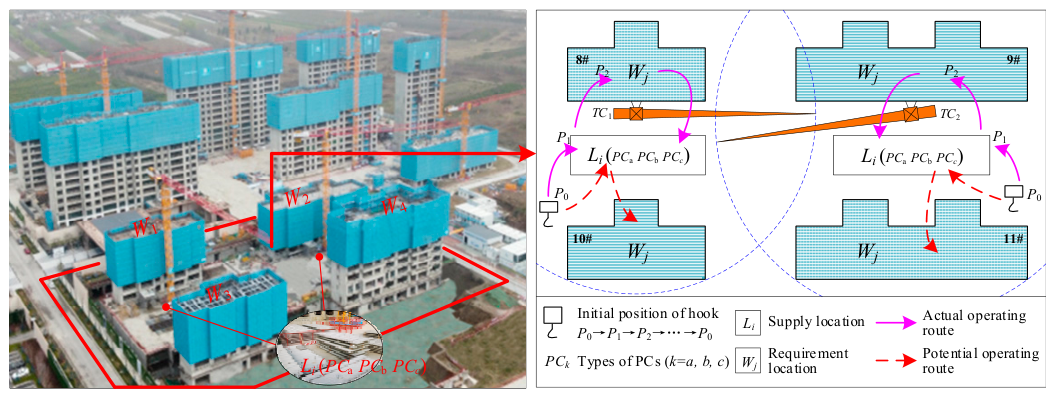
Figure 2.
Schematic diagram of horizontal and vertical operation process of TC.
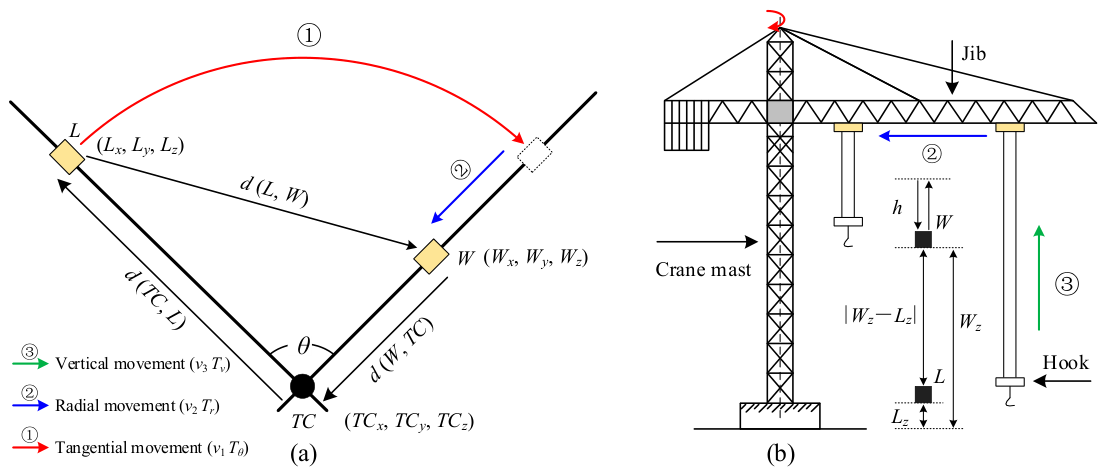
Figure 3.
Gantt chart of scheduling scheme for tower crane TC1 before and after optimization.
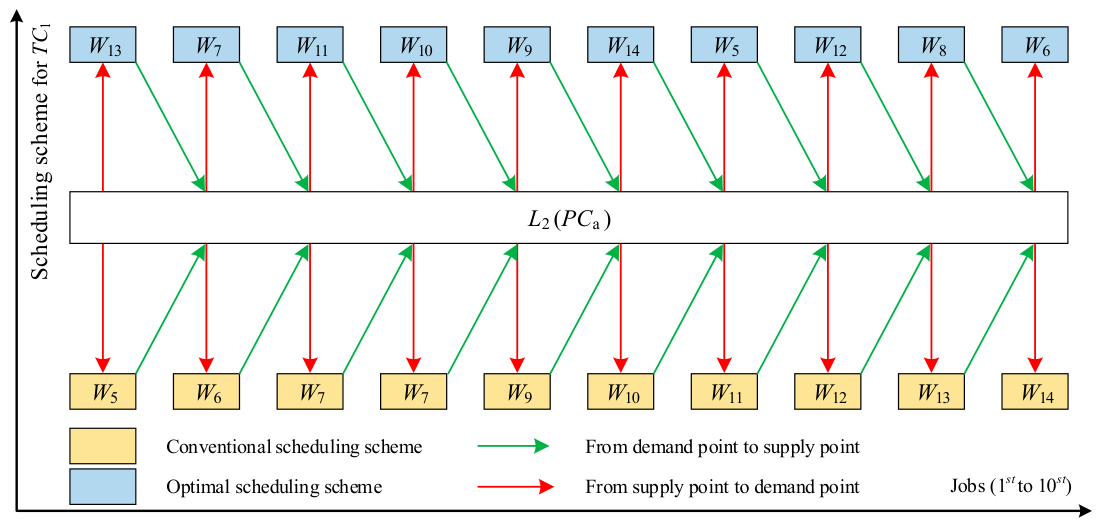
Figure 4.
Gantt chart of scheduling scheme for tower crane TC2 before and after optimization.
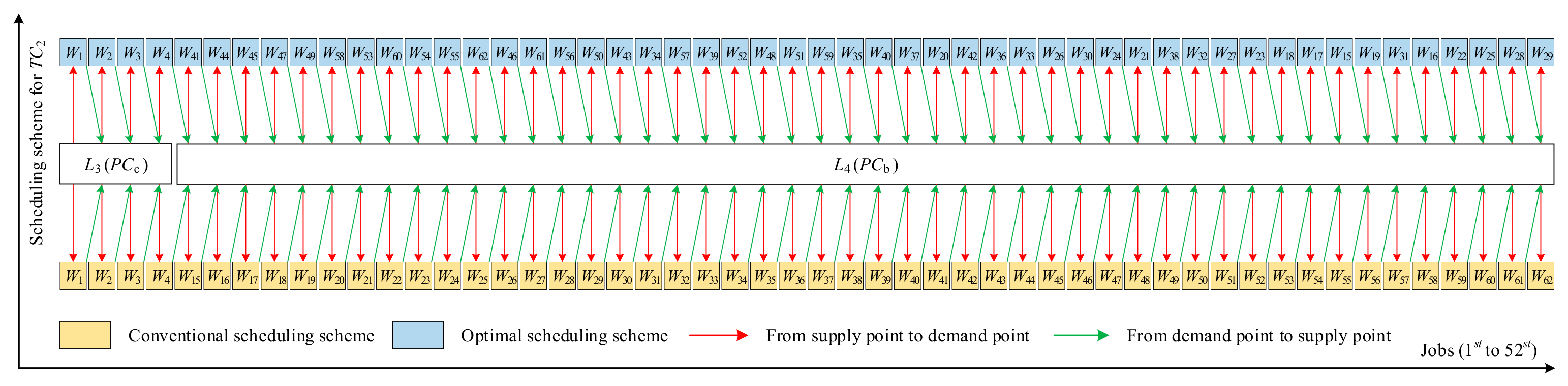
Figure 5.
Comparative analysis of operating time between TC1 and TC2.
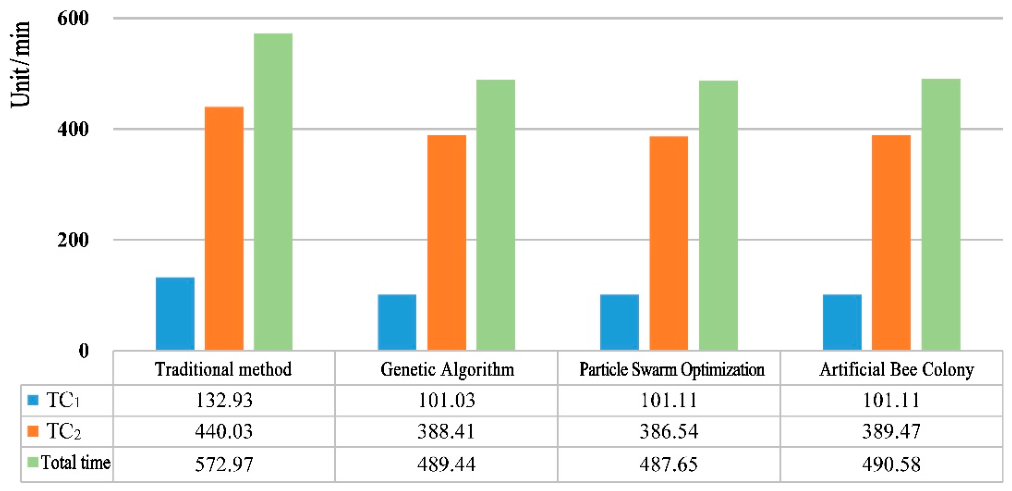
Figure 6.
Comparative analysis of operating costs between TC1 and TC2.
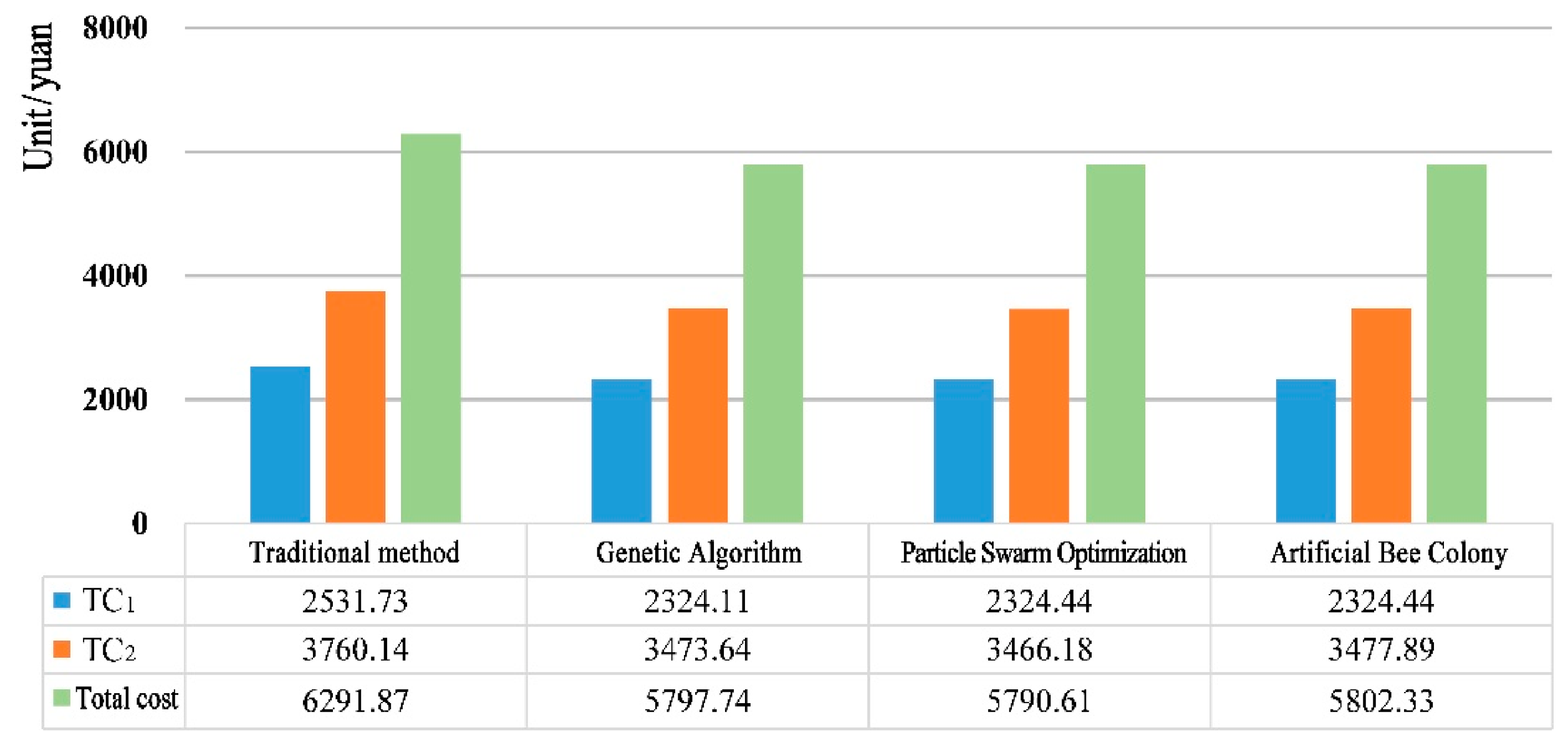
Figure 7.
Convergence curve of operating cost fitness for TC1 and TC2.
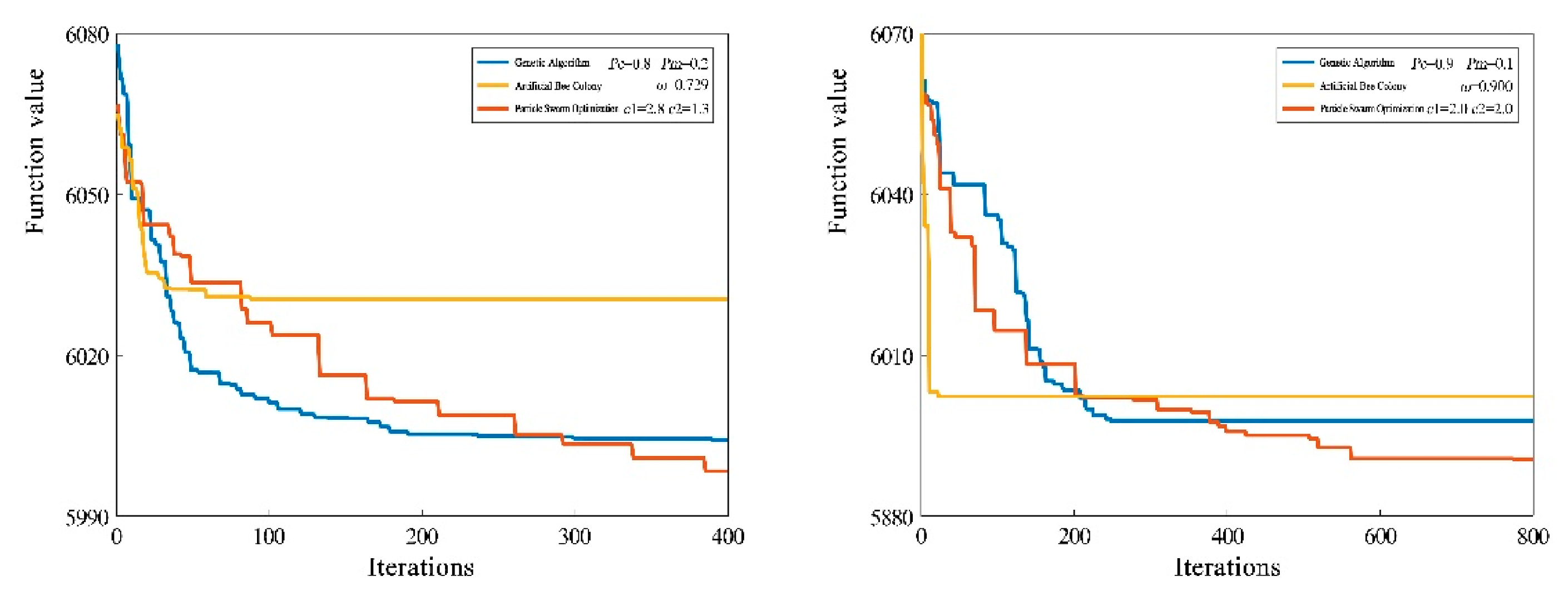

Table 1.
Model parameter notation and its description.
| NO. | Symbol | Definition |
|---|---|---|
| 1 | Li | The position of the ith PC supply point, i∈ {1, 2, …, I} |
| 2 | Wj | The position of the jth PC requirement point, j∈ {1, 2, …, J} |
| 3 | PCk | The kth PC, k∈ {a, b, d, …,} |
| 4 | s | The sth transportation task, s∈ {1, 2, …, S} |
| 5 | P0 | Initial position of hook |
| 6 | P1 | The first component supply point position reached by the hook |
| 7 | v1,v2,v3 | Tangential angular velocity, radial movement velocity, and vertical lifting velocity of TC boom (m/min) |
| 8 | Tθ,Tr,Tv | Tangential movement time, radial movement time, and vertical lifting time of TC boom (min) |
| 9 | Ti,j | The time it takes for the PC to move from supply point i to demand point j, where Ti,j = Tj,i |
| 10 | α | The synchronous coordination parameters for the horizontal (tangential and radial) movement of TCs, α∈[0, 1] |
| 11 | β | The synchronous coordination parameters for the horizontal and vertical movement of TCs, β∈[0, 1] |
| 12 | γ | The difficulty level of hook movement control, γ∈[1,10] |
| 13 | TCm | Multi-project mth tower crane performs construction scheduling tasks, m∈ {1, 2, …, M} |
| 14 | Qm | The cost incurred by the construction scheduling of the mth TC per unit time per day, m∈ {1, 2, …, M} |
| 15 | The time required for the preparation of the kth PC to be lifted at once | |
| 16 | The time required for the kth PC to be assembled in place on the work surface |
Table 2.
Coordinate information of PCs supply points.
| TC | Supply point (Li) | Supply points and regional coordinates (Lx, Ly, Lz) | ||
| x | y | z | ||
| TC1 | L1 | 13.00 [-2.00, 28.00] | 36.00 [33.00, 39.00] | 0.00 |
| L2 | 15.50 [0.50, 30.50] | 15.00 [12.00, 18.00] | 0.00 | |
| TC2 | L3 | 82.00 [62.00, 102.00] | 40.00 [37.00, 43.00] | 0.00 |
| L4 | 82.00[62.00, 102.00] | 24.00 [21.00, 27.00] | 0.00 | |
Table 3.
Group building schedule and construction schedule.
| Building number | Floor | Duration (days) | Time-on | Time-end |
| 8# | 4th floor (first floor PC) | 20 | 2023-03-26 | 2023-04-14 |
| 5th floor | 12 | 2023-04-15 | 2023-04-26 | |
| 6th floor | 10 | 2023-04-27 | 2023-05-06 | |
| 7th-17thfloors | 77 | 2023-05-07 | 2022-07-22 | |
| 9# | 4th floor (first floor PC) | 20 | 2023-02-28 | 2023-03-19 |
| 5th floor | 12 | 2023-03-20 | 2023-03-31 | |
| 6th floor | 10 | 2023-04-01 | 2022-04-10 | |
| 7th-25thfloors | 133 | 2023-04-11 | 2023-09-22 | |
| 10# | 4th floor (first floor PC) | 20 | 2023-04-07 | 2022-04-26 |
| 5th floor | 12 | 2023-04-27 | 2022-05-08 | |
| 6th floor | 10 | 2023-05-09 | 2022-05-18 | |
| 7th-17thfloors | 77 | 2023-05-19 | 2023-08-03 | |
| 11# | 4th floor (first floor PC) | 20 | 2023-04-03 | 2023-04-22 |
| 5th floor | 12 | 2023-04-23 | 2023-05-04 | |
| 6th floor | 10 | 2023-05-05 | 2023-05-14 | |
| 7th-22thfloors | 112 | 2023-05-15 | 2023-09-03 |
Table 4.
Demand plan for PCs of PBs (24th-30th June).
| Demands | June 24th | June 25th | June 26th | June 27th | June 28th | June 29th | June 30th |
| 8# | 2 | 10 | 6 | — | — | 26 | — |
| 9# | 16 | 9 | — | — | 48 | — | 4 |
| 10# | 6 | — | — | 26 | — | 2 | 10 |
| 11# | — | 4 | 16 | 9 | — | — | 48 |
| Total (block) | 24 | 23 | 22 | 35 | 48 | 28 | 62 |
Table 5.
Coordinate information of prefabricated component demand points.
| Types of PCs | Demand points | Coordinate (Wx, Wy, Wz) Unit / m | Types of PCs | Demand points | Coordinate (Wx, Wy, Wz) Unit / m | ||||
| x | y | z | x | y | z | ||||
| PCc | W1 | 68.95 | 61.85 | 37.68 | PCb | W32 | 74.50 | 4.27 | 37.68 |
| W2 | 70.25 | 61.85 | 38.28 | W33 | 77.37 | 11.40 | 37.68 | ||
| W3 | 95.35 | 61.85 | 37.68 | W34 | 79.55 | 11.40 | 37.68 | ||
| W4 | 96.65 | 61.85 | 38.28 | W35 | 81.82 | 11.40 | 37.68 | ||
| PCa | W5 | 0.10 | 6.25 | 37.68 | W36 | 77.51 | 7.50 | 37.68 | |
| W6 | 0.10 | 3.75 | 37.68 | W37 | 79.65 | 7.50 | 37.68 | ||
| W7 | 0.10 | 1.50 | 37.68 | W38 | 81.79 | 7.50 | 37.68 | ||
| W8 | 6.40 | 6.15 | 37.68 | W39 | 83.77 | 11.40 | 37.68 | ||
| W9 | 6.40 | 1.67 | 37.68 | W40 | 86.05 | 11.40 | 37.68 | ||
| W10 | 12.40 | 1.85 | 37.68 | W41 | 88.22 | 11.40 | 37.68 | ||
| W11 | 15.10 | 4.90 | 37.68 | W42 | 83.81 | 7.50 | 37.68 | ||
| W12 | 16.30 | 4.90 | 37.68 | W43 | 85.97 | 7.50 | 37.68 | ||
| W13 | 15.70 | 4.10 | 37.68 | W44 | 88.09 | 7.50 | 37.68 | ||
| W14 | 15.70 | 1.25 | 37.68 | W45 | 93.47 | 18.52 | 37.68 | ||
| PCb | W15 | 61.47 | 11.40 | 37.68 | W46 | 93.10 | 15.95 | 37.68 | |
| W16 | 63.75 | 11.40 | 37.68 | W47 | 90.80 | 13.85 | 37.68 | ||
| W17 | 65.92 | 11.40 | 37.68 | W48 | 94.00 | 13.85 | 37.68 | ||
| W18 | 61.51 | 7.50 | 37.68 | W49 | 91.10 | 11.64 | 37.68 | ||
| W19 | 63.65 | 7.50 | 37.68 | W50 | 95.95 | 11.64 | 37.68 | ||
| W20 | 65.79 | 7.50 | 37.68 | W51 | 91.10 | 9.00 | 37.68 | ||
| W21 | 72.35 | 18.52 | 37.68 | W52 | 95.95 | 9.00 | 37.68 | ||
| W22 | 72.49 | 15.95 | 37.68 | W53 | 91.10 | 6.36 | 37.68 | ||
| W23 | 71.60 | 13.85 | 37.68 | W54 | 95.95 | 6.36 | 37.68 | ||
| W24 | 74.80 | 13.85 | 37.68 | W55 | 91.10 | 4.27 | 37.68 | ||
| W25 | 69.65 | 11.64 | 37.68 | W56 | 95.95 | 4.27 | 37.68 | ||
| W26 | 74.50 | 11.64 | 37.68 | W57 | 99.67 | 11.40 | 37.68 | ||
| W27 | 69.65 | 8.99 | 37.68 | W58 | 101.85 | 11.40 | 37.68 | ||
| W28 | 74.50 | 9.00 | 37.68 | W59 | 104.12 | 11.40 | 37.68 | ||
| W29 | 69.65 | 6.36 | 37.68 | W60 | 99.81 | 7.50 | 37.68 | ||
| W30 | 74.50 | 6.36 | 37.68 | W61 | 101.95 | 7.50 | 37.68 | ||
| W31 | 69.65 | 4.27 | 37.68 | W62 | 104.09 | 7.50 | 37.68 | ||
Disclaimer/Publisher’s Note: The statements, opinions and data contained in all publications are solely those of the individual author(s) and contributor(s) and not of MDPI and/or the editor(s). MDPI and/or the editor(s) disclaim responsibility for any injury to people or property resulting from any ideas, methods, instructions or products referred to in the content. |
© 2026 by the authors. Licensee MDPI, Basel, Switzerland. This article is an open access article distributed under the terms and conditions of the Creative Commons Attribution (CC BY) license (http://creativecommons.org/licenses/by/4.0/).
Copyright: This open access article is published under a Creative Commons CC BY 4.0 license, which permit the free download, distribution, and reuse, provided that the author and preprint are cited in any reuse.


