

Submitted:
04 May 2026
Posted:
05 May 2026
You are already at the latest version
Abstract
Anthropogenic prehistory may be divided into two subsequent phases, the first one from the Last Common Ancestor (LCA) between humans and great apes till the emergence of the genus Homo, and the second phase onwards from then. Until hominins appeared, LCA had lived predominantly on trees, while Homo finally lived only on the ground. The intermediate bimodal transition period was coined by the emergence of systematic bipedal gait, breaking the previously uniform locomotion symmetry. By contrast to versions of the common savannah hypothesis, this paper suggests an alternative fictitious scenario by which migration between seasonally inhabitable arboreal refuges, possibly caused by regional climate change, forced hominins to genetically develop speedy and efficient bipedal locomotion for survival during their temporary but extended regular excursions across open territory. Increasingly upright locomotion resulted in offspring’s early weaning, and in turn in the emergence of childhood with enhanced lethal risks for toddlers. Related selective pressure caused transformations of reproductive traits from gradual sexual selection in apes to undulating sexual conflicts in hominins. Between LCA and Homo, consistent with fossil evidence, the evolutionary bimodal transition phase did not necessarily require advanced mental capabilities, nor specific communication or new forms of social cooperation such as those successively found in Homo. Assumingly, broken spatial and temporal environmental symmetry had induced related symmetry breaking of hominin behaviour, their anatomic structures and reproduction habits.
Keywords:
locomotion symmetry
; phase transition
; hominins
; bipedalism
; migration
; Afar region
There shall be neither glory nor grandeur in our creation and formation until the human being is formed.Popol Vuh1
1. Introduction
Why did hominins start walking on two legs? Inevitable seasonal migration between distant habitats may had been a systematic reason for that. As a mental model, the scenario of hominin evolution presented in this paper is speculative but consistent with empirical and fossil findings, and it obeys Lehninger’s (1972) heuristic criteria of plausibility and continuity. In terms of kinetic phase transitions and their symmetries, it proposes a logical prehistoric migration framework, enclosing the emergence of bipedalism and childhood, the ritualisation of human sexual behaviour, and the final hominin spreading by emigration pressure, resulting from amplified reproduction rates (Feistel 2025). A brief and compact summary is given in Section 6.
Physical kinetic phase transitions far from thermodynamic equilibrium, or mathematical bifurcations in nonlinear systems, possess universal qualitative properties. Such transitions found in complex systems may be studied by means of simple mathematical models (Glansdorff and Prigogine 1971; Haken 1977; Prigogine and Stengers 1981; Nicolis and Prigogine 1987).
From its very beginning, the history of life has been a succession of symmetry-breaking transitions (Schrödinger 1944; Oparin 1963; Eigen 1971; Prigogine et al. 1972; Haken 1977; Ebeling and Feistel 1982, 1994; Margulis and Sagan 1995). In particular, the origin of life itself is a symmetry-breaking phase transition of the 2nd kind (Feistel 2023a, 2024) by which structural information of catalytic networks transformed into the first arbitrary symbols of a primordial genetic code. According to Landau and Lifschitz (1966), involved in a transition of the 2nd kind, the two phases possess different symmetries, coincide at the transition point but cannot stably coexist elsewhere. A typical such transition is the Hopf bifurcation for the onset of self-sustained oscillations (Wiki 2026f). In finite-size systems, the vicinity of this sharp transition point is weakened to a transition region with amplified fluctuations (Feistel and Ebeling 1978, 1989). The morphogenetic differentiation of a homogeneous embryo nucleus into tissues and organs belongs to transitions of the 2nd kind, as well as breaking the sexual symmetry of multicellular organisms.
By contrast, such as the physical evaporation of water, the two phases of a transition of the 1st kind may possess the same symmetry and they, within a finite transition interval, may stably coexist in space with a mutual interface. That coexistence region has a broken spatial symmetry as compared to both pure single-phase regions. In spatially extended systems, the transition starts from a nucleation process (Oxtoby 1998; Kashchiev 2000; Schmelzer 2005) accompanied by strong fluctuations. While symmetry-breaking kinetic transitions of the 2nd kind far from thermodynamic equilibrium are frequently encountered in the physics of self-organisation and evolution (Haken 1977; Prigogine and Stengers 1981; Nicolis and Prigogine 1987; Feistel and Ebeling 2011; Feistel 2023b; 2024), those of the 1st kind with a two-phase transition region are less often investigated. Here, however, as a transition model of the 1st kind in anthropogenesis, the hominin evolution from great apes to Homo will be considered in detail as such a special case. For comparison, as an alternative example with similarities to the hominin evolution, a conceptual model of the phase transition of swarming locusts is briefly described in Appendix D.
“The probably most relevant trait which unifies all representatives of the human lineage and which, to our current state of knowledge, did not emerge in parallel, is the upright gait. Locomotion on two legs, also known as bipedalism, is the proper revolution at the beginning of the human evolution. … Even well-documented skeletons, such as for example the one of »Lucy« (Australopithecus afarensis), raised a heated scientific dispute … about the question in how far … modern-like bipedalism had been developed, or whether »Lucy« had mostly lived on trees”2 (Böhme et al. 2019: p. 116, 121). “Hominin fossil discoveries as old as 6 Ma and advances in DNA research have now documented that humans evolved in Africa and then migrated to other parts of the world starting as early as 2.0 Ma” (Ashley 2009). “Apparently, the success story of humans started with some Pliocene species that developed a habitual bipedal way of life, while the shortening and shrinking of the mastication apparatus and the typically human brain expansion had followed only much later with the appearance of the genus Homo … It was not before [the begin of the Quaternary] about 2.6 million years ago that populations of the early Homo – or of Australopithecus – had changed to permanent bipedalism”3 (Henke and Rothe 2003: p. 29, 68).
Apparently, hominin evolution had at least two different evolutionary stages (Donges et al. 2011). The initial stage, from the LCA up to »Lucy« (Wiki 2025a), see Figure 1 for artist reconstructions, is coined by the development of bipedal gait without advanced manual or mental skills, with a small ape-like brain and skull. West of the Awash River of the African Rift Valley, “Australopithecus and early Homo co-existed as two non-robust lineages in the Afar Region before 2.5 million years ago” (Villmoare et al. 2025).
Only after »Lucy«, apparently, the physical traits had arrived at an advanced level that made permanent survival possible in the open grass land without arboreal refuge (Gursky and Nekaris 2007). There, the selective pressure became redirected to mental progress along with social cooperation and advanced spoken language, reduced forelimbs, jawbones and teeth as required for cooperative hunting, habitual use of fire and consuming cooked food (Organ et al. 2011). Fossil brain mass started to exceed 500 g only after 2.5 Myr BP (de Sousa and Wood 2007).”The genus Homo and the earliest stone tools date back to between 2.4 and 2.6 Ma” (Trauth et al. 2010: p. 2981). There are, however, also some 3.4 Myr old cut marks on bones, and 3.3 Myr old stone tools (Roberts 2011; Callaway 2015).
Onward from »Lucy«, along with close social cooperation necessary for survival, rapid human cultural evolution emerged and interfered progressively with the biological adaption to the newly unlocked ecological niche. Supported by communication, fast and cumulative cultural experience added a new quality to the already existing slow, long-range phylogenetic experience and the fast, short-range ontogenetic one. The road to incomparable human success went along the invention, accumulation and versatile exploitation of increasingly complex causal mental models (Feistel 2023b; Marijuan et al. 2026). “Although the reasons for the accelerated evolution of the human brain remain unclear, it is apparent that this acceleration encompasses at least the entire Homo genus” (Rosales-Reynoso et al. 2018). The brain volume increased, for instance (Holloway et al. 2004), from 446 ml (Australopithecus afarensis, 3.11 Myr) during the bimodal transition phase, via 801 ml (Homo ergaster, 1.74 Myr) shortly after it, see Appendix C, up to a typical modern human size such as 1266 ml (Homo heidelbergensis, 0.27 Myr).
In the hypothetical scenario presented here, the famous, 3.2 million years old fossil of »Lucy« may serve as a demonstrative representative, as a culmination point of a metastable, transitional two-phase interval of occasionally enforced bipedal gait of hominins between the single-phase quadrupedal LCA before and the single-phase bipedal Homo population after that, as schematically displayed in Figure 2. Apes and humans may stably coexist, each of both in its respective, spatially separate Lebensraum.
»Lucy« was discovered by Johanson and Gray in 1974 at Hadar, located at the Awash river in the Afar region of the Ethiopian Rift Valley (Johanson et al. 1978). Fossil evidence indicates that between 4 and 2 Myr BP, hominins became adapted similarly to arboreal habitats with ape-like forelimbs as well as to bipedal locomotion on the ground with human-like feet and hind limbs. Such a design is neither perfectly adapted to a permanent life in the trees nor to a permanent life in the open savannah, but fits as a compromise to either conditions prevailing alternatingly. Naturally compelled seasonal migration may constitute a plausible explanation for the evolution of such a compromise.
By contrast to several existing hypotheses for the origin of bipedal gait, which mostly assume that apes more or less voluntarily and optionally tested their permanent life out of arboreal conditions and experienced it as successful and advantageous (Suhr 2018; Smith and Reynolds 2025), the seasonal migration model mandatorily enforces temporary but skilled motion on the ground for a short time interval regularly each year. Selective pressure is high then for gradual improvement of bipedal speedy locomotion. Motion on the dangerous ground, however, reduces the population’s reproduction rate and may take it to the brink of extinction. Upright gait also affects the hominin’s reproductive behaviour and enforces its transformation (Feistel 2025), as described in Section 4.
The swing-climbing quadrupedal Last Common Ancestor (LCA) of chimpanzees and humans is commonly assumed to have lived in arboreal habitats while bipedal Homo is permanently living on the ground in open territories. In this paper, the transition from the LCA to the genus Homo will be considered as a kinetic phase transition of the 1st kind, see Figure 2. The time interval between LCA and Homo may then be understood as a (metastable) two-phase composite during which hominins spent their lives partly in the trees and only in part on the ground, see Section 3 and Appendix C. The related broken symmetry of the hominin skeletal constitution and behaviour is assumed here to have been produced with high selective pressure by a broken spatial and temporal symmetry of the habitat due to regional climatic change, Section 3 and Appendix A.2. Animal migration, Section 2, may serve as a paradigm for a similar, genetically implemented behaviour of hominins. Required for successful migration between separate, only seasonally beneficial arboreal habitats, the increasingly upright gait resulted in early weaning, hazardous childhood and reduced reproduction rates of the LCA, Section 4.
Reproduction rates could even substantially exceed the previous ones due to shorter interbirth gaps of younger mothers, after the sexual traits had dramatically transformed from LCA to very distinct, human-like ones. Increasing population densities are assumed to had caused migration pressure to explore new distant habitats on the ground, such as in natural caves or manually erected shelters. This expansion was supported by advanced bipedal locomotion and forelimbs and hands liberated for the use of tools and weapons by the upcoming Homo for permanent cooperative social life, Section 5.
When water evaporates from the sea surface, for thermodynamic reasons, the fraction of light isotopes becomes larger in the vapour than in the remaining liquid (Wei et al. 2019). It is reasonable to assume that a similar separation of individual properties may also take place during substantial emigration processes. Likely, the migrating individuals were mostly younger, healthier, more curious, courageous and innovative than the remaining resident ones. At least in part, such properties may be hereditary. Ultimately, step by step, in the course of many millennia this radiation of humans conquered the entire globe, starting from a local nucleus where Homo had emerged.
2. Animal Migration
In the morning, marine autotroph phytoplankton is ascending to the light water surface that is exhausted of nutrients. At the end of the day, plankton returns to deep, dark, nutrient-rich levels (Wasmund and Siegel 2008). This simple, practically observed biological example from a different context demonstrates clearly that migration behaviour can, at least in principle, offer selective advantage over resident competitors. Such kind of argument may similarly apply to other conditions.
Regular or occasional migration of animals is widespread in numerous species, from insects to vertebrata. “On the basis of the recent ratio between migrating and resident large animals in East Africa, the number of migrating species exceeds that of the resident ones by a factor of ten”4 (Reichholf 2004: p. 175). “We recognize migration as an adaptation to resources that fluctuate spatiotemporally either seasonally or less predictably, and note that it is often preemptive” (Dingle and Drake 2007). “In the common sense, migration is considered by many authors as a mechanism for avoiding unfavorable environments by moving to expectedly more auspicious locations at different times. In other terms, migration may represent the seasonal movement of organisms from place to place owing to the change in the environmental conditions. Consequently, two important questions arise to mind, why do some animals migrate? How would migration affect the gene pool?” (Elawa 2005).
Typical migration behaviour is instinctive and genetically controlled. Although little is known about the origin of migration, the conditions causing it must have prevailed a long enough period of time in order to propagate the advantageous genes across the entire given population. Migration must have been such a successful strategy that not-participating individuals lost the competition for survival and sufficient reproduction rate, even though migration comes at a cost and with substantial hazards. Here, three kinds of animal migration may be distinguished,
- (i)
- seasonal migration, such as that of ruminants in the African savannah, following the local rainy season, or of geese and cranes (Weßling 2020) that escape the dark polar winter periodically, driven by external forcing,
- (ii)
- ontogenetic migration, such as that of salmons (McCleave et al. 1984), whales or turtles which spend their lives on certain feeding grounds but return to their place of birth for the breeding period, driven by internal forcing of individual ontogenetic development, and finally,
- (iii)
- density migration, such as that of swarming locusts (Dirsh 1974) that leave their habitat when it becomes overcrowded, driven by climate fluctuations and population dynamics, without return to the starting site.
There are multiple examples for regularly migrating animals, such as Monarch butterflies in Mexico, about 1800 bird species, in particular at high latitudes, or ruminants of the “Great Migration” in the tropical African Serengeti (Wiki 2026b). However, “little is known about the conditions under which migration is expected to evolve from an ancestral resident population” (Griswold et al. 2010). “We lack answers to broad questions such as what ultimate factors generally drive animal migration” (Shaw and Couzin 2013). Typically, various animals move from a “breeding” habitat to a “feeding” habitat and back.
Genetically controlled migration may evolve only if the required environmental conditions persist sufficiently longer than the time needed for establishment of related mutations in the population’s gene pool by “evolutionary invasion” (Otto and Day 2007). “A species capable of persisting as residents in two separate sites is vulnerable to the invasion of a migratory genotype if there is a difference in geometric mean fitness between habitats” (Griswold et al. 2010; Fryxell and Holt 2013). Despite the quadratic ecological growth law of a sexually reproducing population, the invasion of a beneficial mutation follows a linear dynamics with exponential increase of the allele frequency in the genetic pool (Feistel 1977; Feistel and Ebeling 2011: Ch. 6.9).
As a biblical plague, swarming grasshoppers such as Locusta migratoria or Schistocerca gregaria are a particularly well investigated case of animal migration (Uvarov 1921, 1955; Dirsh 1974; Song 2004; Stige et al. 2007). Transitions from solitary to gregarious behaviour of locusts typically depend on the population density, which in turn is strongly affected by dry or wet environmental conditions. In China, “for the periods 200 B.C. to A.D. 1900 and A.D. 957-1956, it has been shown that locust outbreaks typically occurred in years reported as drought years or in years after floods” (Stige et al. 2007).
Modelling the bimodal behaviour of locusts is possible in the form of a kinetic phase transition of the 1st kind (Feistel and Feistel 2015), see Appendix D, from the solitary to the gregarious phase. Qualitative similarities of that locust transition are assumed in this paper to exist with the transition from quadrupedally climbing apes to bipedally walking Homo, passing a bimodal hominin stage in which both forms of locomotion coexist. Dirsh (1974) had emphasized that swarming locust Schistocerca is of very recent origin, possibly from the second half of the Tertiary. Continental lowlands fell dry repeatedly on a large scale, and grasslands expanded 20 Myr ago (Van Soest, 1994). Varying environmental conditions that favoured migrating locusts may similarly had also been responsible for hominin migration. Evidently, unlike locusts, to implements migration genetically, such conditions must had prevailed over numerous generations of apes or hominins, that is, through many centuries or millennia.
3. Hominin Migration
“As soon as some ancient member in the great series of the Primates came to be less arboreal, owing to a change in its manner of procuring subsidence, or to some change in the surrounding conditions, its habitual manner of progression would have been modified: and thus it would have been rendered more strictly quadrupedal or bipedal. … If it be an advantage to man to stand firmly on his feet and to have his hands and arms free, of which, from his pre-eminent success in the battle of life, there can be no doubt, then I can see no reason why it should not have been advantageous to the progenitors of man to have become more and more erect or bipedal. They would have thus have been better able to defend themselves with stones or clubs, to attack their prey, or otherwise to obtain food” (Darwin 2004: p. 70-72).
“The role of African savannahs in the evolution of early hominins has been debated for nearly a century. … Data point to the prevalence of open environments at the majority of hominin fossil sites in eastern Africa over the past 6 million years” (Cerling et al. 2011). On the other hand, “Australopithecus sediba is a two-million-year-old hominin fossil from South Africa … Stable isotope, dental microwear and plant microfossil analyses … show that A. sediba consumed a diet high in tree leaves, fruits and bark, indicating a woodland environment” (Henry et al. 2012).
„After Darwin’s … early speculations about the evolution of bipedalism and environmental change, the classic savanna hypothesis of Henry Fairfield Osborn and Raymond Dart attempted to link the evolutionary divergence of hominins and other great apes, and the emergence of bipedalism, with the proposed forest-savanna transition in Mio-Pliocene time” (Trauth et al. 2011: p. 2981). The “Savannah hypothesis” for the transition of quadrupeds in trees to bipeds on the ground became known later as the “East Side Story” that was supported also by the leader of the Lucy expedition, Yves Coppens (Henke and Rothe 2003; Suhr 2018). However, already Owen Lovejoy (1981) was in doubt about its plausibility. For example, as a potential model for the hominid origin, modern gelada baboons (Theropithecus gelada) do feed on grass on the ground, „yet geladas … are not bipedal and show no significant adaptations to bipedality” (Owen Lovejoy 1981: p. 342). Several alternative related hypotheses are reviewed by Suhr (2018). In this paper, a migration hypothesis is favoured as a trigger for temporary bipedal locomotion.
„The Hominidae probably originated in Africa sometime between 14 my and 4 my ago. … The origin of Hominidae, or at least bipedalism, has been conjecturally associated with a regional environmental change from tropical forest to widespread grassland. Evidence accumulating from various parts of Africa … suggests this was not an abrupt transition. The pattern of habitats was probably patchy in space and time” (Hill and Ward 1988). Only little is known about details of the variability of climate and geology at the Horn of Africa during the Pliocene (5.3 to 2.6 Myr BP) and the beginning Pleistocene (2.6 to 0.012 Myr BP). However, harsh and fluctuating conditions for survival in the Ethiopian Rift Valley and the Afar Depression (see Appendices A and B) may reasonably motivate speculations about nomadic life and seasonal migration of hominins at that time and place.
“If seasonality is understood as an alternating succession of periods of either shortage or abundance of food, then seasonality can be regarded as a factor that contributes to more intense selection and ultimately to evolutionary change”5 (Henke and Rothe 2003: p. 87). Seasonal animal migration is behavioural normality rather than exception in Africa, and this may also apply to hominins. For example, much more recently, “changes in [Atlantic meridional overturning circulation] AMOC influenced North African climate and, at times, contributed to amenable conditions in the central Sahara/Sahel, allowing humans to cross this otherwise inhospitable region … during a wet phase in the Early Holocene known as the African Humid Period (AHP) … [that] ended at ≈5.5 ka” (Castañeda et al. 2009).
Gradually, climate change may have spatially separated different seasonal habitats from one another. Between those, the regular relocation trek could have included dangerous areas on the ground such as open savannah or rivers to cross. If such a situation prevails for a sufficiently long period of time, selective pressure results in bimodal adaptation, on the one hand for feet and hind limbs to permit safe and fast motion on the hazardous ground, on the other hand to retain the abilities of swing-climbing in the safe arboreal habitats. The skeleton of Lucy exhibits such a compromise, human-like legs and feet are combined with long ape-like arms and hands.
A recent investigation of “directional selection in ancient DNA” has demonstrated that, under sufficient selective pressure, allele propagation in humans may proceed fast enough to change phenotypic traits already within a few millennia. However, while “this includes … increases in measures of cognitive performance [,] these effects were measured in industrialized societies, and it remains unclear how these relate to phenotypes that were adaptive in the past” (Akbari et al 2026). “The best known example of such ‘directional selection’ is a genetic variant that maintains production of the lactose enzyme into adulthood, which enables many people of European ancestry to digest milk throughout their lives” (Callaway 2026). Probably, genetically implemented lactose intolerance of adults had originally emerged to ensure milk supply for hominin offspring, saving those from starvation and keeping the population’s reproduction rate above subcritical values (Feistel 2025).
“Walking on two legs allows for greater energy efficiency compared to quadrupedalism, especially over long distances. This efficiency would have been advantageous for early hominins traveling between scattered resources” (Jakobus 2024). Some “researchers argue that the australopithecine pelvic morphology only makes sense for a biped who may still spend some time in the trees or whose bipedalism differs in style or frequency from that of modern humans” (Gruss and Schmitt 2015: p.5). “Scapulae [of the Australopithecus afarensis skeleton from Dikika, Ethiopia] display several traits characteristic of suspensory apes, ... and their presence in australopith fossils supports the hypothesis that their locomotor repertoire included a substantial amount of climbing” (Green and Alemseged 2012).
Regular migration treks certainly attracted predators, such as the giant bear Agriotherium, hunting hyena Chasmaporthetes or the sabre-toothed cats Machalrodus and Dinofelis (Treves and Palmquist 2007) at the time between 7 and 3 Myr BP of bipedal evolution. Old, sick individuals or toddlers run the highest risks of being killed or lost by accidents. However, increasingly upright bipedal gait prevents mothers from carrying older and heavier infants on their back. This way, the regular loss of offspring reduces the population’s average reproduction rate and selective value. The famous Laetoli footprints from the Kilimanjaro region (Facchini 2006; Roberts 2011) are 3.6 Myr old and suggest that an adult (likely, the mother) and a child may had walked along in lockstep side by side, such as if they went hand in hand.
Similar to the ritualisation hypothesis for the initial emergence of human reproduction traits (Feistel 2025) as described in Section 4, the seasonal migration assumption suggested here does not presume any advanced manual skills, mental capabilities or social cooperation beyond those commonly observed in chimpanzees. Also here, such conditions are well consistent with Lucy’s fossil skeleton. “The pelvis of the skeleton known as »Lucy« from Afar Locality 288 has been fully reconstructed. One of its most salient features is a birth canal whose shape and dimensions show little or no effects of selection for passage of enlarged fetal crania, adaptations that so clearly dominate the form of the modern human pelvis” (Owen Lovejoy 1981: p. 341).
According to current knowledge, the LCA transition to bipedalism occurred successfully only once in the evolution history. This singular event of anthropogenesis may had been caused by rather exceptional conditions, or it may had been so difficult to survive that eventually only one group of hominins was able to overcome its obstacles and dangers through adaptive radiation. It seems impossible to determine in hindcast the exact local geological and climatic conditions of that time, but certainly it was a period of dramatic geological and climatic unrest (see Appendix A, B) that likely had favoured the emergence and evolution of exceptional traits and behaviours such as genetic adaption to regular migration.
4. Emerging Childhood
„The unique sexual and reproductive behavior of man may be the sine qua non of human origin” (Owen Lovejoy 1981). Fossil and genetic evidence is consistent with the plausible hypothesis that the last common ancestor (LCA) of humans and great apes lived about 7 million years ago and was similar to recent chimpanzees (Pilbeam and Lieberman 2017). The sexual behaviour of the latter, however, is very distinct from that of humans. Female chimpanzees breastfeed their offspring, carried on their back, for about five years (Kennedy 2005). Premature weaning poses a high lethal risk to the helpless infant. After weaning, females develop a prominent anogenital swelling as a sex symbol that invites males to mate (Goodall 1991). It is exclusively then that males show relevant sexual interest, and preferably in old “ugly” females. How may human sex life have evolved from such foreign roots during a relatively short period of history? Likely, the radical change was enforced by violent selective pressure.
When the LCA gradually turned to bipedalism, carrying older, heavier infants on the back became impractical and weaning occurred earlier, with increasing risks for the offspring and generally reduced reproduction rates. Females suppressing the fertility swelling protected the toddler by preventing early pregnancy. However, males necessarily responded with permanent sexual interest also in non-swollen females (Diamond 1997; Feistel 2025). Consequently, females reacted with repulsive frigidity, males in turn with coercive mating. Already from a distance, ostentatious adipose breasts, perfectly imitating lactating ones, prevented coercive male approaches, who in return started closer visual, manual or oral inspection of the nipples in order to check fertility and reveal the possible fake. Although there is no scientific evidence available for hominin females like Lucy to possess already permanent breasts, as the reconstructing artist of Figure 1 had imagined, the narrative of undulating sexual conflicts suggested here renders likely the emergence of such breasts already before Lucy.
The permanent adipose breast of human females is a sex symbol that is unique among any animals, and in particular among primates. However, “the possession of permanent, adipose breasts in women is a uniquely human trait that … remains an unresolved conundrum” (Pawłowski and Żelaźniewicz 2021). It is often assumed that capricious male sexual and/or reproductive interest, “according to their standard of beauty” (Darwin 1911: Ch. IV therein), was the main driving force for the emergence of persistent female breasts (Barash and Lipton 2009), so that “the existence of permanent breasts in women is likely an aesthetic trait that has evolved by male choice” (Prum 2017: p. 256). In qualitative distinction from the smooth, gradual increase of fitness by male or female choice of Darwinian sexual selection, it is suggested in the model scenario of this paper that the formation of the permanent breast was an essential step of alternating sexual conflicts between hominin males and females (Pizzari and Snook 2003; Palombit 2010; Feistel 2025), see the schematic of Figure 3. The symbolic breast as a part of courtship habits evolved by ritualisation from a previous contraception trait. Rather than as a preceding cause, male sexual interest in it arose only after females had originally developed it for an opposite purpose, namely, to refuse rather than to attract male mating approaches.
Successful contraception by fertile females caused periodic futile ovulation and subsequent regular menstruation. Both phenomena are known to be only exceptional in chimpanzees (Emera et al. 2011). The resulting ovary depletion lowered the menopause age into the lifespan, so that old females became infertile and could take care of their grandchildren when the mother became pregnant too soon. This grandmother effect raised the reproduction rate substantially, from about 5.5 years in chimpanzees to about 3.5 years in native human cultures (Galdikas and Wood 1990), supporting enhanced migration pressure on the younger generation. The previous inspection of female nipples and genitals was no longer a necessary use-activity and turned into a courtship habit of humans by a ritualisation transition, similar to that of waterfowls originally discovered by Huxley (1914). This is a hypothetical narrative of how the ritualisation of human sexual behaviour was possibly caused by the transition to bipedal gait (Feistel 2025), and how in turn the novel reproduction traits affected the migration behaviour.
5. Migration Feedback
Climatically enforced, an enduring need for seasonal migration may likely had triggered initial attempts of hominin bipedal gait with its various severe consequences for the anatomy and the behaviour of the LCA (Jakobus 2024). This was a bifurcation point for a symmetry-breaking transition from former unimodal apes to then bimodal hominins, the latter equally capable of living under arboreal conditions as well as of migrating across the open savannah with its natural obstacles, predators and various other risks.
In the beginning, the implications created by that first transition were responsible for a critical decline of the reproduction rate due to increased mortality of infants. High selective pressure accelerated the evolution of novel, alternative forms of sexual behaviour which in the end raised the reproduction rates significantly above former values. The resulting population growth was followed by a new substantial migration wave, this time, however, exploring completely new habitats rather than returning periodically to the familiar ones. The perfection of bipedal locomotion achieved during the bimodal phase permitted emigration to more distant habitats with increasing accommodation to living condition in open territories. The succession of a first, reversible seasonal migration by a subsequently caused, irreversible migration is understood here as a nonlinear evolutionary feedback effect.
Supercritical population density is a possible reason for locust migration (Uvarov 1955; Stige et al. 2007), see Section 2 and Appendix D, and may as well had similarly been one for the expansion of Homo. Note, however, that such emigration processes due to competition for resources are not necessarily harmonic and peaceful ones, but may take place in conjunction with violent conflicts between primate population groups (Sandel et al. 2026).
Evidently, survival in the open savannah with its predators and various other dangers is possible for bipeds if those use weapons, build shelters, cooperate closely in social groups or have learnt to use fire, based on intelligence, language and a developed brain. None of those abilities may reasonably be attributed, however, already to the last common ancestor (LCA) of chimpanzees and humans at the very beginning of bipedalism. “It is more likely that hominids venturing into open habitats were already bipedal and that their regular occupation of savannahs was not possible until intensified social behavior was well developed” (Owen Lovejoy 1981; Wiki 2026a). Due to the second migration wave of hominins, survival out of arboreal refuges turned possible and increasingly advantageous. The bimodal hominin population became gradually replaced (Callaway 2015) by unimodal Homo who exclusively settled and fed on the ground as a vast new habitat with exotic new evolution opportunities (Darwin 2004; Engels 2000; Klix 1980; Bramble and Liebermann 2004; Morgan et al. 2015; Marijuan et al. 2026).
6. Summary
Narrative in brief: Miocene/Pliocene environmental change forced LCA to migrate periodically. Changing knuckle-walk to more upright gait improved survival of adults but caused lethal offspring hazard. Implied decreasing reproduction rates recovered only after grave sexual conflicts had been overcome by successively alternating changes to a more human-like behaviour. As soon as hominin skeletons like Lucy’s had adapted bimodally to habitually both living on trees and on the ground, shortened birth spacing owing to novel groomed childhood rapidly raised the population density, and caused in turn emigration pressure into the open savannah without return. Hands and arms, then liberated from climbing, could adapt there to tool use, division of labour and social cooperation, eventually ending up in modern humans. This way, via feedback by bipedalism and innovated reproductive traits, the enhanced and irreversible spatial spreading of upcoming Homo had resulted from original, reversible seasonal LCA migration. Periodic migration had modified reproduction, and reproduction in turn commenced irrevocable migration out of arboreal habitats.
Scenario in more detail: At the end of the Miocene (until 5.3 Myr BP) and during the Pliocene (between 5.3 and 2.6 Myr BP), geological processes in and around Africa (Appendices A,B,C) had fundamentally varied its climate, in particular that of the Afar triangle where today the East African Rift Valley opens to the Red Sea and the Gulf of Aden. In a hypothetical scenario of beginning anthropogenesis in that region, it is assumed that the symmetry of certain large and persistent habitats of the LCA (the Last Common Ancestor of great apes and humans) was spatially and temporally broken into mutually isolated arboreal islands with conditions suitable for LCA survival prevailing only seasonally.
Individuals capable of safely migrating between distant seasonal refuges, such as by gradually more upright knuckle walk, gained selective advantage. If modern chimpanzees may represent former LCA, mothers breastfeed their infants for about 5 years. During that time, offspring is helpless, mostly riding on the mother’s back and cannot survive without assistance and protection. Habitual promiscuous mating prevents paternity information and any childcare by males. Upcoming upright gait physically shortens the time span during which elder offspring can be carried and breastfed. Early weaning prematurely resumes the mother’s oestrus cycle, and pronounced female swellings invite males to mate. Early pregnancy raises the lethal risk for the immature toddler, in particular during repeated seasonal migration moves across open territory.
Protecting infants from early pregnancy required concealed oestrus of females which in turn unavoidably caused permanent mating attempts of males. Alternating sexual conflicts continued until female menstruation, caused more frequently by contraception, had lowered the menopause age down into the life span, and infertile grandmothers may had taken care of toddlers as soon as the mother gave another birth. Birth spacing, typically about 5.5 years in chimpanzees, could reduce to about 3.5 years, a typical rate in native human cultures (Galdikas and Wood 1990). Such a nearly doubling of the reproduction rate implied an exponential growth of the population and high emigration pressure to explore additional habitats.
Evolution of reproductive traits proceeded in parallel to physical adaption of feet, legs and hips to perfect intermediate migration locomotion on the ground while forelimbs remained adapted to climbing in arboreal habitats. Symmetry of morphology required for life on trees was broken in favour of bimodal symmetry for surviving alternately in arboreal home and during migration transits on two legs.
Rising population numbers eventually required permanent survival of emigrated groups away from arboreal regions. While feet and legs were already adjusted to such a life, hands and arms became liberated for new activities that could provide selective advantage for survival on the ground, such as division of labour in hunting, tool production, and childcare in combination with improved communication supported by increasing brain size and appropriate cuisine. After having passed the bimodal hominin evolution phase of commuting between distinct habitats, upcoming Homo refrained entirely from climbing in favour of efficient endurance running on two legs with powerful novel social, mental and manual abilities.
Author Contributions
R.F.: Physical concept; S.F.: Biological expertise. All authors have read and agreed to the published version of the manuscript.
Funding
This research received no external funding.
Institutional Review Board Statement
Not applicable.
Informed Consent Statement
Not applicable.
Data Availability Statement
All data used are published in the cited literature.
Conflicts of Interest
The authors declare no conflict of interest.
Appendix A: On Geological Conditions 8-2 Myr BP
The Ethiopian Afar region, where the East African Rift Valley is widening to the Red Sea in the north and to the Gulf of Aden at Bab el Mandab in the east, is still today characterised by strong geological activity which has even intensified since 2005. Addis Ababa is located on the valley’s crest and records typically seven small tremors per month on average; in 1961, however, the town was hit by a stronger earthquake (Last 1965). Various small active volcanos are located there along with bigger dormant ones, and hot springs and lakes in the valley are similar to those known from Iceland, Yellowstone (USA) or Rotorua (New Zealand). “The hot-springs of the Awash National Park are only a part of the long series of [today’s] spas and therapeutic bathing places that the volcanic heritage of the Rift has enabled” (Hancock et al. 1983: p. 180). Between 8 and 2 Myr BP, there was intense volcanic activity in the Rift Valley, such as the formation of the Ngorongoro Crater. “The Ngorongoro volcano was active from about 2.45 to 2 million years ago… Various hominid species have occupied the area for at least 1.75 million years” (Wiki 2026g).
Indicating a desiccated past oceanic basin there, the Danakil Depression down to 125 m below sea level is covered with thick salt deposits that are harvested and sold by local native Afar people. “Several cycles of marine flooding with transgression of the Red Sea into the Danakil Depression resulted in the formation of kilometre-thick evaporite successions” (Foubert et al. 2024), known as the “Salt Giants”. The Danakil rift had begun opening about 10 Myr BP (Rime et al. 2024). “This is a land of blackened lava flows and sandy plains strewn with boulders baking under the fierce desiccating heat. Across it flows the Awash river, attracting life and greenery to its banks, a fragile expression of hope soon defeated – for the Awash fails in its quest to reach the sea. Not far north of the town of Mile it begins to meander and thereafter dissipates its force into a series of shallow pools which soon evaporate. … This was the land of Dinqinesh [or »Lucy«, Figure 1], our remote, distant, more than three-million-years-old ancestor, the land in which the human species was born. … Miraculously, human life still persists here. … It was in honour of these remarkable people, the Afar, that Johanson coined for Dinqinesh her scientific name [Australopithecus afarensis]. … Sparing, careful use of the resources at their disposal, ingenuity in overcoming the challenges of nature, courage in the face of adversity, an indomitable will that refuses to accept defeat or humiliation, a soaring restless spirit that ever seeks for greener pastures – these are the central values of their culture, values which, in their wider context, have made the human race masters of the earth, sea and skies” (Hancock et al. 1983: p. 191).
“The last small areas of sedimentary rocks were deposited at the end of the Miocene Period [at 5.3 Myr BP], and then the region was uplifted in a dome formation extending over the whole present Ethiopia, with the present site of Addis Ababa at about the centre of the dome. At the beginning of this period of uplift, great cracks opened in the crust of the earth and from mid-Tertiary times onwards great outpourings of basaltic lava flowed over the region. The very fluid lava flowed out through both fissures (cracks) and pipes. As the uplift continued, the earth’s crust cracked further and the centre of the dome dropped down to form the vast and spectacular Rift Valley system” (Last 1965: p. 11).
Various studies had found the Red Sea rift to had opened about 5 Myr BP (Almaki et al. 2016), however, recent geological investigations of the sea floor crust estimated even an age between 12.7 ± 0.6 and 13.5 ± 0.5 Myr from velocities of ocean spreading (Augustin et al. 2021).
On a wider scope, significant global lowering of the sea level about 5.6 ± 0.3 Myr BP (Robert et al. 2009), possibly caused by increasing polar glaciation, may have contributed to the so-called Messinian Salinity Crisis that was discovered from vast salt deposits at the Mediterranean sea floor near Messina, Sicily (Meijer and Krijgsman 2005). At 5.96 Myr, large parts of the Mediterranean fell dry (Garcia-Castellanos and Villaseñor 2011) and only several large salt lakes remained (Böhme et al. 2029: p. 204). Zebras and donkeys immigrated to Africa (Orlando et al. 2013) about 4.5 – 4.0 Myr BP; in return the steppe mammoth (Mammuthus trogontherii) appeared in Asia “after the initial radiation of early forms out of Africa and into Eurasia at the beginning of the late Pliocene (c. 3.5-3.0 Ma)” (Wei et al. 2010). Also, several new predators invaded Africa about 3.5 Myr (Treves and Palmquist 2007), such as hyenas, cheetahs, saber-toothed cats, wolves and panthers.
About 500 000 years later, the Zanclean Flood at 5.33 Myr refilled the Mediterranean again from the Atlantic through the Strait of Gibraltar, and the outflow of warm salty water into the Atlantic commenced (Hernández-Molina et al. 2014), assumingly similar to its present form which raises Atlantic salinity to higher values than found in other oceans. After a “continental bridge lasted till the end of the Late Miocene, ca. 5.3 Ma”, dwarfed elephants remained confined on several Aegean islands (Sen 2017). Likely by opening the Bab-el-Mandab strait, which is estimated to had occurred about 4.5 Myr BP (Dumont 2009: p. 604), the Red Sea had turned over from a freshwater lake to oceanic seawater at 5 Myr (Horowitz 2001). First mammoth fossils at Afar are dated to about 4.5 Myr BP (Kalb et al. 1996). All those transitions must have imposed dramatic variations and severe consequences upon the climate in the Afar region and the Rift Valley.
Between 4.7 and 3.5 Myr BP, the Panama Isthmus between the Americas closed (Campbell et al. 2010; Hoorn et al. 2010; Fedorov et al. 2013; Stone 2013) with suspected impact on the Gulf Stream and the Arctic glaciation (Lunt et al. 2008). “However, recent studies show that this closure and associated changes in North Atlantic circulation occurred 4.6 Myr ago, well before the onset of intense Northern Hemisphere glaciation” (Haug et al. 2005). “Marine cores collected off the shore of southeast Greenland record multiple Late Cenozoic glaciations beginning in the Late Miocene” (Larsen et al. 1994). “High-quality two-dimensional seismic reflection data [of Greenland] … record 11 major phases of shelf-edge ice advance and subsequent transgression since the first ice sheet expansion 3.3 – 2.6 million years ago” (Knutz et al. 2019). While any roles played by the Russian meteorite impacts of Karla at 5 ± 1 Myr (Spray and Elliot 2013) and of El’gygytgyn at 3.58 ± 0.04 Myr (Melles et al. 2011; Koeberl et al. 2023) on the continental dynamics remain speculative, additional global climate effects of the Yellowstone super-volcano eruption at 4.4876 ± 0.0023 Myr (Wotzlaw et al. 2014) are highly probable.
African climate is sensitive to global geological processes such as those at the end of the Miocene. As a more recent example, a study of sedimentary layers of Lake Yoa in Chad covered the Holocene African Humid Period of Sahara and Sahel that began 14.8 kyr BP. It included a prominent draught at the so-called “8.2 kyr cold event” which “was a direct and rapid response to a potential weakening of the Atlantic Meridional Overturning Circulation (AMOC) owing to sudden freshwater input into the North Atlantic” (Sylvestre et al. 2026). That event is known to be related to the “Storegga tsunami” (6225 – 6170 BCE) in the North Atlantic and to a flooding of Doggerland in the North Sea (Weninger et al. 2008; Bondevik et al. 2012), as well as to an abrupt Greenland warming and cooling by 6 °C and exceptional monsoons in China, Oman and Brazil (Thomas et al. 2007; Cheng et al. 2009; Müller et al. 2009; Gregoire et al. 2012; Wiki 2026d)
Appendix B: On Climatic Conditions 8-2 Myr BP
“Climate change and its effects on African ecosystems may have played a key role in human evolution” (deMenocal 2011). “The analysis of paleoclimate archives encoding the environmental variability in East Africa during the past 5 Ma has … [revealed] three epochs with transitions between qualitatively different types of environmental variability in North and East Africa during the (i) Middle Pliocene (3.35–3.15 Ma B.P.), (ii) Early Pleistocene (2.25–1.6 Ma B.P.), and (iii) Middle Pleistocene (1.1–0.7 Ma B.P.)” (Donges et al. 2011). “During the late Neogene [until 2.6 Myr BP], global climate underwent a long-term transition to cooler climates that culminated in the Quaternary icehouse conditions” (Bohm et al. 2023).
“As grasslands replaced forests and shrubs they influenced mammalian evolution” (Chamberlain 2014). “Paleobotanical, paleofaunal and stable isotope studies have documented the rapid rise of C4 grasslands at the expense of forests in the Middle to Late Miocene” (Mix et al. 2013). However, in northeast Africa, “we identify two distinct phases of increasing C4 biomass between 11 and 9 Ma (with a reversal by 4.3 Ma) and then a re-expansion between 4.3 and 1.4 Ma; surprisingly, neither was associated with grassland expansion” (Feakins et al. 2013). “Neogene desertification in Africa … started in the southwest ca 17–16 Ma, much earlier than the region of the present-day Sahara (ca 8–7 Ma) and long before the deserts in East Africa (Plio-Pleistocene). A consequence of this history is that animals and plants inhabiting the South of the continent had a long period of time in which to adapt to arid, unstable climatic conditions. When parts of East Africa became arid during the Late Miocene and Plio-Pleistocene, several of these lineages expanded northwards and occupied developing arid niches before local lineages could adapt. Several of the latter became extinct, while others withdrew westwards as the tropical forest diminished in extent” (Senut et al. 2009).
Regarding the lifestyle of contemporary Afar pastoralists in Ethiopia, Chocian (2017) concluded: “Wherever it rains, we go there: Afar nomadic architecture: tradition and challenge”. Nomadic life, as performed by 80% of today’s Afar population, appears to have a very deep tradition in those people. “One of the oldest tribes in the Horn of Africa, the key to the Afar’s survival has been their ability to move with their herds of camels, goats, cattle and sheep to wherever grass happens to be growing, across a region larger than Ireland” (Benanav 2020).
At present climatic conditions, the Ethiopian highlands receive ‘monsoonal’ rainy seasons while the Afar Depression is extremely dry (Last 1965; Dullo and Kalyanapu 2025). The Awash River has its spring near Addis Ababa and follows the Rift Valley until it ends up in some salt lakes where all its water evaporates without discharge into the ocean (Wiki 2026c). From 2006 to 2010, “by far the most dust-active region in the Horn of Africa is the Afar Triangle … which features the Afar and Danakil depressions and is fed by the Awash River” (Kunkelova et al. 2024).
On the other hand, “the Afar region was one of the worst affected areas during the 2020 floods largely due to the overflow of the Awash River – 162,921 people were affected” (ARISE 2022). “Floods in Ethiopia are mainly characterised by large-scale riverine floods in the lowlands and flash floods in the highlands that occur following heavy rainfalls during rainy seasons” (Dullo and Kalyanapu 2025), where the Afar depression takes the highest frequency of flood hazard.
“The El Niño–Southern Oscillation (ENSO) was identified as one of the primary drivers of precipitation in eastern Africa” (Mologni et al. 2024). On longer time scales, Afar floods and droughts are correlated with the periodic ice ages at higher latitudes (Hoffmann et al. 2016; Stinchcomb et al. 2023). “The 2.5-2.4 Ma oxygen isotope excursion … represents a major climate step toward modern conditions (northern hemisphere ice volume increased, polar fronts were strengthened and glacial-interglacial variation intensified) … While the interval of time between 3.29 and 2.97 Ma … is distinct in that mean conditions were different than the intervals immediately surrounding it, there is a high degree of variability within the time slab” (Dowsett et al. 1999).
Appendix C: On Fossil Hominin Evidence 8-2 Myr BP

Table A1.
Selected events of anthropogenesis from LCA to Homo. Note that in hindcast, important advantageous mutations necessarily appear genetically as virtual “population bottlenecks”.
Table A1.
Selected events of anthropogenesis from LCA to Homo. Note that in hindcast, important advantageous mutations necessarily appear genetically as virtual “population bottlenecks”.
| Myr BP | Event / Fossil | Reference |
| 10 | Beginning Danakil rift opening | Rime et al. (2024) |
| 9-8 | Oreopithecus | Facchini (2006) |
| 8-1 | Gigantopithecus | Facchini (2006) |
| 7.175 | Graecopithecus freybergi in Pyrgos | Böhme et al. (2019) |
| >7 | Hominins switched to upright walking | Pennisi (2012) |
| 7-6 | Sahelanthropus tschadensis | Roberts (2011) |
| 6.2-5.6 | Orrorin tugenensis | Roberts (2011) |
| 6.1-5.7 | Bipedal Orrorin tugenensis in Kenya | Richmond & Jungers (2008) |
| 6 | Hominin loss of body hair | Sutou (2014) |
| 6-5 | Main Ethiopian Rift opening | Smith and Reynolds (2025) |
| 5.96-5.33 | Desiccated Mediterranean | Garcia-Castellanos & Villaseñor (2011) |
| 5.8-5.2 | Ardipithecus kadabba | Roberts (2011) |
| 5 | Gorilla separated from apes | Prado-Martinez et al. (2013) |
| 5 | Oceanic Red Sea | Horowitz (2001) |
| 4.5-4.3 | Ardipithecus ramidus | Roberts (2011) |
| 4.4 | Ardipithecus from Awash, Ethiopia | Gibbons (2009) |
| 4.2-3.9 | Australopithecus anamensis | Roberts (2011) |
| 4.2 | Earliest bipedal hominins outside Afar | Smith and Reynolds (2025) |
| 4 | Australopithecus populated Rift Valley | Schrenk et al. (2002) |
| 3.7-3 | Australopithecus afarensis | Roberts (2011) |
| 3.66 | Laetoli bipedal footprints | Deino (2010) |
| 3.6 | Bipedalism of Australopithecus | Haile-Selassie et al. (2010) |
| 3.6-3 | Australopithecus bahrelghazali | Roberts (2011) |
| 3.5-3.3 | Kenyanthropus platyops | Roberts (2011) |
| 3.4 | Human neuronal gene mutation | Geschwind & Konopka (2012) |
| > 3.39 | Stone-tool scraps in Dikika, Ethiopia | McPherron et al. (2010) |
| 3.3-2.1 | Australopithecus africanus | Roberts (2011) |
| 3.2 | Skeleton of »Lucy« from Afar, Ethiopia | Johanson & Edey (1990) |
| 3.032-2.581 | Paranthropus and tool use in Kenya | Plummer et al. (2023) |
| 3 | Homo separated from apes | Prado-Martinez et al. (2013) |
| 3 | Australopithecus eating grass, Chad | Lee-Thorp et al. (2012) |
| 2.7-2.5 | East African humid period | Trauth et al. (2005) |
| 2.7-2.3 | Paranthropus aethiopicus | Roberts (2011) |
| 2.6 | First stone tools from Afar, Ethiopia | Semaw et al. (2003) |
| 2.6 | Evolution of early Homo | Antón et al. (2014) |
| 2.6 | Homo regularly ate meat | Roach et al. (2013) |
| 2.5 | Homo separated from Paranthropus | Schrenk et al. (2002) |
| 2.5 | Stone tools used for hunting weapons | Deacon (1997) |
| 2.5 ± 0.1 | Quaternary ice-age oscillations began | Hewitt (2000), Horowitz (2001) |
| 2.5 | Formation of the Sahara desert | Kröpelin (2006) |
| 2.5-2.3 | Australopithecus garhi | Roberts (2011) |
| 2.45-2 | Ngorongoro Crater activity | Nigel (2001) |
| 2.4 | Human neuronal gene mutation | Geschwind & Konopka (2012) |
| 2.4-1.6 | Homo habilis | Roberts (2011) |
| 2.3-1.4 | Paranthropus boisei | Roberts (2011) |
| 2-1.2 | Paranthropus robustus | Roberts (2011) |
| 2 | Endurance running ofHomo | Bramble & Liebermann (2004) |
| 2 | “Genetic bottleneck” of Homo erectus | Hawks et al. (2000) |
| 1.95-1.78 | Australopithecus sediba | Roberts (2011) |
| 1.9-1.5 | Homo ergaster | Roberts (2011) |
| 1.85 | dispersal of Homo to Eurasia | Antón et al. (2014) |
| 1.8 | Homo georgicus | Roberts (2011) |
| 1.8-0.03 | Homo erectus | Roberts (2011) |
| 1.75 | Human spoken language | Morgan et al. (2015) |
| 1.6 | Homo ergaster in Koobi Fora, Kenya | Facchini (2006) |
Appendix D: Mathematical Feedback Model for Migrating Locusts
“Between June 2019 and February 2022, a major outbreak of desert locusts began developing, threatening food supplies in East Africa, the Arabian Peninsula and the Indian subcontinent. The outbreak was the worst to hit Kenya in 70 years, and the worst in 25 years for Ethiopia, Somalia, and India … Previously green, nocturnal and solitary creatures become larger, develop black-and-yellow colouring, and begin to seek out other locusts, a process known as gregarization. These changes result in the formation of large locust swarms” (Wiki 2026e). Swarming locusts have been a menace to human agriculture since biblical times.
Here, for possible similarities with hominin migration, a conceptual mathematical feedback model for swarming locusts is briefly described that had originally been proposed by Feistel and Feistel (2015). That approach paints a picture in which the African desert locust evolved within a similar, fluctuating spatial and temporal context as hominins. Not only that the ecological niches of the two species are well-known to mutually overlap violently, resulting in biblical conflicts, it may also be that hominins and locusts developed alternative solutions to deal with their similar environmental problems. High reproduction rates due to favourable environmental conditions may increase the reproduction rate and the local population density to supercritical values and does exert significant migration pressure on the individuals. The population may split into a resident and an emigrating part. The latter may randomly explore more or less distant new habitats to settle there, at some risk of becoming extinct, and may never return to its original place. Such a scenario of irreversible (rather than periodic) migration may similarly apply to both locusts and hominins, and even up to Homo sapiens when leaving Africa and successively conquering the entire globe.
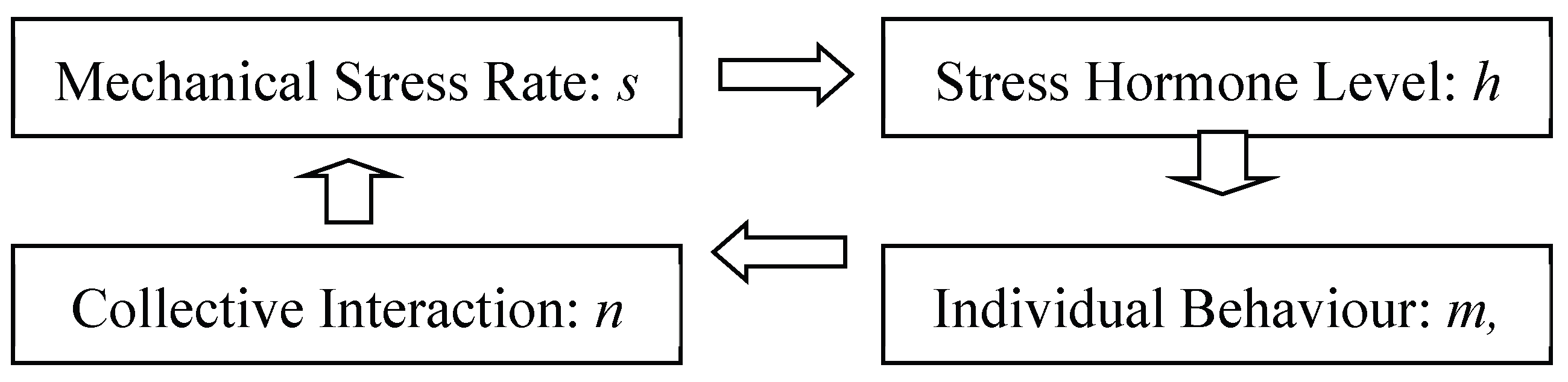
As soon as the locust population density at a given site exceeds a critical value, the individual gets stressed and increases its mobility, which intensifies the stress of neighbouring individuals in a feedback loop. Such a typical scenario of the locust transition is shown in Figure A1. To study the character of the transition implied by that model, plausible mathematical relations between the parameters specified in the diagram are considered.
Figure A1.
Schematic of a conventional feedback model assumed to produce bimodality in locusts. Of a given individual, the rate of external mechanical stress, s, drives the internal production of a stress hormone, h. Changes of that hormone level induce changes in individual behavior such as mobility, m, or coherence expressed by the sign of the diffusion constant, D, which in turn act back at the individuals in the form of mechanical collision stress generated by the local population density, n.
Figure A1.
Schematic of a conventional feedback model assumed to produce bimodality in locusts. Of a given individual, the rate of external mechanical stress, s, drives the internal production of a stress hormone, h. Changes of that hormone level induce changes in individual behavior such as mobility, m, or coherence expressed by the sign of the diffusion constant, D, which in turn act back at the individuals in the form of mechanical collision stress generated by the local population density, n.
For the production rate of the stress hormone, h, we may assume some kind of Michaelis-Menten kinetics which reasonably constrains the production at high stress, s, in the form,
, (A1)
where A is some unit conversion factor, E describes the saturation-stress threshold (the Michaelis-Menten constant), and B is the decay rate of the stress hormone (likewise, 1/B is the individual response time to external stress events).
Inserting this expression into the dynamical equation for the population density, n, introducing individual mobility, m, and the hormone threshold h0 between diffusive (repulsive) and coherent (attractive) pair interaction, some additional arrangements result in the logistic growth rate (Wilson and Bossert, 1973)
, (A2)
or, in dimensionless writing,
. (A3)
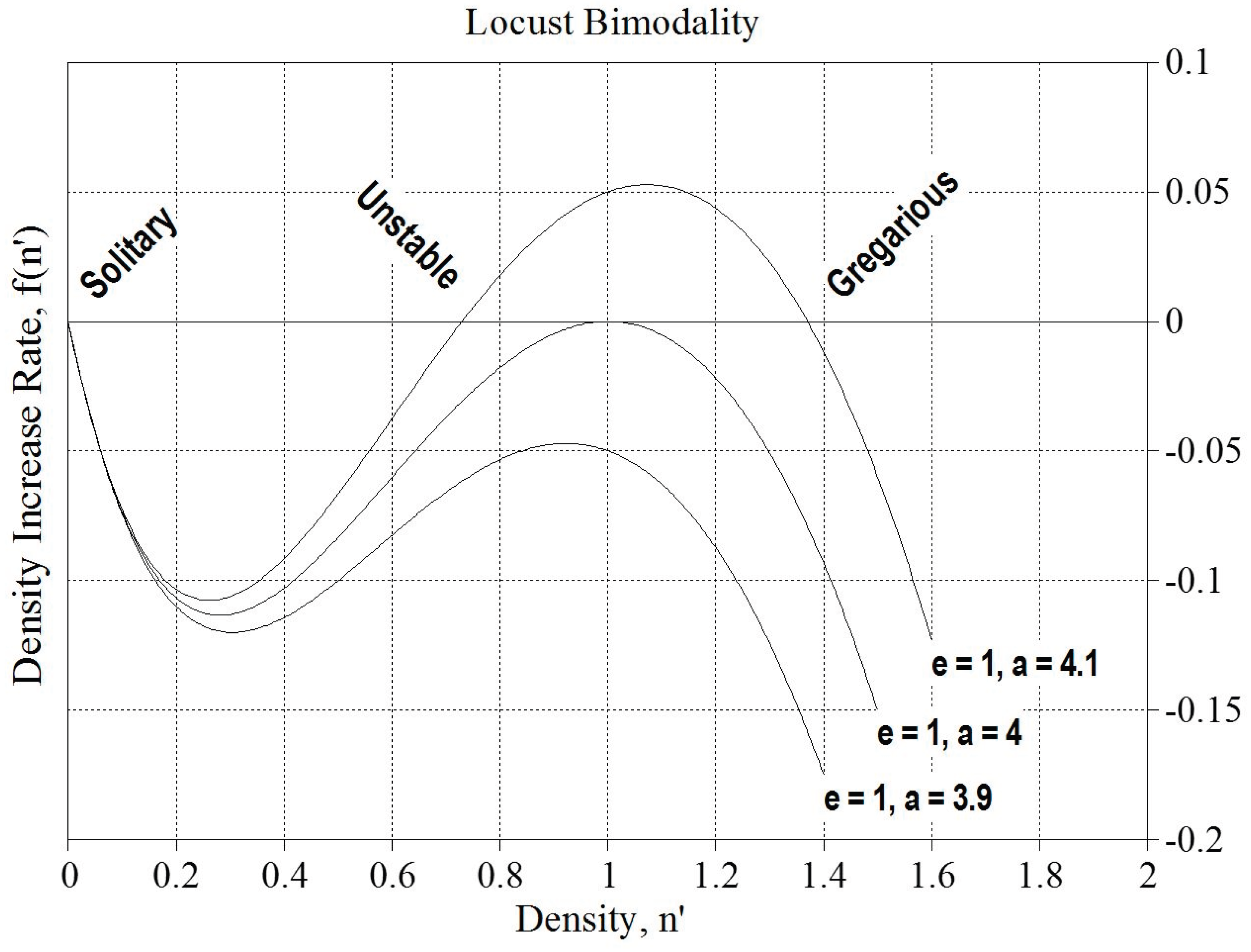
It is easily seen that the solitary fixpoint n’ = 0 is always stable. The remaining two non-zero stationary solutions of Equation (A2) are given by
, (A4)
where is the dimensionless density, is the dimensionless stress sensitivity, and is the dimensionless Michaelis-Menten constant. The two additional solutions exist if
, (A5)
and are positive if the stress sensitivity exceeds the critical value,
. (A6)
We may conclude from Figure A5 that our simple locust model describes the locust transition as a kinetic transition of the 1st kind.
Figure A2.
Shape of the function f(n’) given by Equation (A3) for three examples of the control parameters, e and a. Zeros with a negative slope correspond to stable steady states, those with a positive slope to unstable ones. For subcritical stress sensitivity, a, the phase transition disappears and only the solitary state remains as a stable attractor.
Figure A2.
Shape of the function f(n’) given by Equation (A3) for three examples of the control parameters, e and a. Zeros with a negative slope correspond to stable steady states, those with a positive slope to unstable ones. For subcritical stress sensitivity, a, the phase transition disappears and only the solitary state remains as a stable attractor.
References
- Akbari, A.; Perry, A.; Barton, A.R.; et al. (2026): Ancient DNA reveals pervasive directional selection across West Eurasia. Nature 2026. [Google Scholar] [CrossRef]
- Almalki, K.A.; Betts, P.G.; Ailleres, L. Incipient seafloor spreading segments: Insights from the Red Sea. Geophys. Res. Lett. 2016, 43, 2709–2715. [Google Scholar] [CrossRef]
- Antón, S.C.; Potts, R.; Aiello, L.C. Evolution of early Homo: An integrated biological perspective. Science 2014, 345, 1236828. [Google Scholar] [CrossRef] [PubMed]
- ARISE (2022): Mobilize for relief: Emergency response to flood affected communities in Afar. Advancement for Recovery Initiative for Safer Ethiopia (ARISE) Project. https://alnap.hacdn.io/media/documents/2022-ydt2Wj-ADPC-4_CaseStudies2028129.pdf accessed 06 Apr 2026.
- Ashley, G.M. Gornitz, V., Ed.; Human Evolution and Climate Change. In Encyclopedia of Paleoclimatology and Ancient Environments. Encyclopedia of Earth Sciences Series.; Springer; Dordrecht, 2009. [Google Scholar] [CrossRef]
- Augustin, N.; van der Zwan, F.M.; Devey, C.W.; Brandsdottir, B. 13 million years of seafloor spreading throughout the Red Sea Basin. Nature Communications 2021, 12, 2427. [Google Scholar] [CrossRef] [PubMed]
- Barash, D.P.; Lipton, J.E. How Women Got Their Curves and Other Just-So Stories: Evolutionary Enigmas; Columbia University Press; New York, 2009. [Google Scholar]
- Benanav, M. The Afar of Ethiopia. Nomads navigating a troubled twenty-first century. Traditional Cultures Project. 2020. Available online: https://www.afarofethiopia.com/ (accessed on 06 Apr 2026).
- Böhme, M.; Braun, R.; Breier, F. Wie wir Menschen wurden; Heyne; München, 2019. [Google Scholar]
- Bohm, K.; Kaakinen, A.; Stevens, T.; Lahaye, Y.; O’Brien, H.; Tang, H.; Shang, Y.; Zhang, H.; Lu, H. Neogene global climate change and East Asian dust sources: Combined rutile geochemistry and zircon U-Pb analysis from the northern Chinese Loess Plateau. Global and Planetary Change 2023, 221, 104049. [Google Scholar] [CrossRef]
- Bondevik, S.; Stormo, S.K.; Skjerdal, G. Green mosses date the Storegga tsunami to the chilliest decades of the 8.2 ka cold event. Quaternary Science Reviews 2012, 45, 1–6. [Google Scholar] [CrossRef]
- Bramble, D.M.; Lieberman, D.E. Endurance running and the evolution of Homo. Nature 2004, 432, 345–352. [Google Scholar] [CrossRef]
- Callaway, E. Oldest stone tools raise questions about their creators. The 3.3-million-year-old implements predate the first members of the Homo genus. Nature 2015, 520, 421. [Google Scholar] [CrossRef]
- Callaway, E. (2026): Landmark ancient-genome study shows surprise acceleration of human evolution. Nature 2026. [Google Scholar] [CrossRef]
- Campbell, R.M.; Vinas, G.; Henneberg, M.; Diogo, R. Visual Depictions of Our Evolutionary Past: A Broad Case Study Concerning the Need for Quantitative Methods of Soft Tissue Reconstruction and Art-Science Collaborations. Front. Ecol. Evol. 2021, 9, 639048. [Google Scholar] [CrossRef]
- Campbell, K.E., Jr.; Prothero, D.R.; Romero-Pittman, L.; Hertel, F.; Rivera, N. Amazonian magnetostratigraphy: Dating the first pulse of the Great American Faunal Interchange. Journal of South American Earth Sciences 2010, 29, 619–626. [Google Scholar] [CrossRef]
- Cordan, W. Popol Vuh. Das Buch des Rates; Mythos und Geschichte der Maya. Diederichs, Düsseldorf, 1962. [Google Scholar]
- Garcia-Castellanos, D.; Villaseñor, A. Messinian salinity crisis regulated by competing tectonics and erosion at the Gibraltar arc. Nature 2011, 480, 359–365. [Google Scholar] [CrossRef]
- Castañeda, I.S.; Mulitza, S.; Schefuß, E.; Lopes dos Santos, R.A.; Sinninghe Damsté, J.S.; Schouten, S. Wet phases in the Sahara/Sahel region and human migration patterns in North Africa. Proceedings of the National Academy of Sciences of the United States of America 2009, 106, 20159–20163. [Google Scholar] [CrossRef]
- Cerling, T.; Wynn, J.; Andanje, S.; et al. Woody cover and hominin environments in the past 6 million years. Nature 2011, 476, 51–56. [Google Scholar] [CrossRef] [PubMed]
- Chamberlain, C. P.; Winnick, M.J.; Mix, H.T.; Chamberlain, S.D.; Maher, K. The impact of neogene grassland expansion and aridification on the isotopic composition of continental precipitation. Global Biogeochem. Cycles 2014, 28, 992–1004. [Google Scholar] [CrossRef]
- Cheng, H.; Fleitmann, D.; Edwards, R.L.; Wang, X.; Cruz, F.W.; Auler, A.S.; Mangini, A.; Wang, Y.; Kong, X.; Burns, S.J.; Matter, A. Timing and structure of the 8.2 kyr B.P. event inferred from δ18O records of stalagmites from China, Oman, and Brazil. Geology 2009, 37, 1007–1010. [Google Scholar] [CrossRef]
- Chocian, E. Wherever it rains, we go there: Afar nomadic architecture: tradition and challenge. Diploma Thesis, Technische Universität Wien, 2017. [Google Scholar] [CrossRef]
- Darwin, C. The Origin of Species by Means of Natural Selection; Hurst & Co.; New York, 1911. [Google Scholar]
- Darwin, C. The Descent of Man; Penguin Books; London, 2004. [Google Scholar]
- Deacon, T.W. The Symbolic Species. The Co-evolution of Language and the Brain; W.W. Norton & Company; New York, London, 1997. [Google Scholar]
- Deino, A.L. Harrison, T., Ed.; 40Ar/39Ar Dating of Laetoli, Tanzania. In Paleontology and Geology of Laetoli: Human Evolution in Context. Vertebrate Paleobiology and Paleoanthropology Series.; Springer; Dordrecht, 2011. [Google Scholar] [CrossRef]
- De Sousa, A.; Wood, B. 4.18 – The Hominin Fossil Record and the Emergence of the Modern Human Central Nervous System. Evolution of Nervous Systems 2007, 4, 291–336. [Google Scholar] [CrossRef]
- deMenocal, P.B. Climate and Human Evolution. Science 2011, 331, 540–542. [Google Scholar] [CrossRef]
- Diamond, J. Why Is Sex Fun? The Evolution of Human Sexuality (Science Masters); BasicBooks; New York, 1997. [Google Scholar]
- Dingle, H.; Drake, V.A. BioScience 2007, 57, 113–121. [CrossRef]
- Dirsh, V.M. Genus Schistocerca (Acridomorpha, Insecta); Kluwer; Dordrecht, 1974. [Google Scholar]
- Donges, J.F.; Donner, R.V.; Trauth, M.H.; Kurths, J. Nonlinear detection of paleoclimate-variability transitions possibly related to human evolution. PNAS 2011, 108, 20422–20427. [Google Scholar] [CrossRef]
- Dowsett, H.J.; Barron, J.A.; Poore, R.Z.; Thompson, R.S.; Cronin, T.M.; Ishman, S.E.; Willard, D.A. Middle Pliocene Paleoenvironmental Reconstruction: PRISM2. U.S. GEOLOGICAL SURVEY OPEN FILE REPORT 99-535. 1999. Available online: https://pubs.usgs.gov/of/1999/of99-535/ (accessed on 31 Mar 2026).
- Dullo, T.T.; Kalyanapu, A.J. Floods in Ethiopia: A Review; Natural Hazards Research, 2025. [Google Scholar] [CrossRef]
- Dumanot, H.J. The Nile: Origin, environments, limnology and human use; Springer Science & Business; Berlin, Heidelberg, 2009. [Google Scholar]
- Ebeling, W.; Feistel, R. Physik der Selbstorganisation und Evolution; Akademie-Verlag; Berlin, Germany, 1982. [Google Scholar]
- Ebeling, W.; Feistel, R. Chaos und Kosmos. In Prinzipien der Evolution; Spektrum-Verlag; Heidelberg, Germany, 1994. [Google Scholar]
- Eigen, M. Selforganization of matter and the evolution of biological macromolecules. Naturwissenschaften 1971, 58, 465–523. [Google Scholar] [CrossRef]
- Elawa, A.M.T. Migration of Organisms. In Climate. Geography. Ecology.; Springer; Berlin, Heidelberg, 2005. [Google Scholar] [CrossRef]
- Emera, D.; Romero, R.; Wagner, G. The evolution of menstruation: A new model for genetic assimilation. Bioessays 2011, 34, 26–35. [Google Scholar] [CrossRef]
- Engels, F. Heid, H., Rodax, K., Hoff, E.H., Eds.; Anteil der Arbeit an der Menschwerdung des Affen. In Ökologische Kompetenz. VS Verlag für Sozialwissenschaften; Wiesbaden, 2000. [Google Scholar] [CrossRef]
- Facchini, F. Die Ursprünge der Menschheit; Konrad Theiss; Stuttgart, 2006. [Google Scholar]
- Feakins, S.J.; Levin, N.E.; Liddy, H.M.; Sieracki, A.; Eglinton, T.I.; Bonnefille, R. Northeast African vegetation change over 12 m.y.; Geological Society of America; Data Repository, 2013; p. item 2013079. [Google Scholar] [CrossRef]
- Fedorov, A.V.; Brierley, C.M.; Lawrence, K.T.; Liu, Z.; Dekens, P.S.; Ravelo, A.C. Patterns and mechanisms of early Pliocene warmth. Nature 2013, 496, 43–49. [Google Scholar] [CrossRef]
- Feistel, R. Beschreibung von Evolutionsprozessen bei diploider Sequenzreplikation. Wiss. Z. WPU Rostock 1977, 26, 655–662. Available online: https://www.researchgate.net/publication/266685247_Zur_Beschreibung_von_Evolutionsprozessen_bei_diploider_Sequenzreplikation (accessed on 10 Apr 2026).
- Feistel, R. On the Evolution of Symbols and Prediction Models. Biosemiotics 2023b, 16, 311–371. [Google Scholar] [CrossRef]
- Feistel, R. Origin of Life: A Symmetry-Breaking Physical Phase Transition. Symmetry 2024, 16, 1611. [Google Scholar] [CrossRef]
- Feistel, R. Bipedalism, Childhood, and Ritualisation of Human Sexual Behaviour: A Hominin Model Scenario of Ontogenetic Selection. Biosystems 2025, 257, 105598, Update (2026). [Google Scholar] [CrossRef] [PubMed]
- Feistel, R.; Ebeling, W. Deterministic and Stochastic Theory of Sustained Oscillations in Autocatalytic Reaction Systems. Physica A 1978, 93, 114–137. [Google Scholar] [CrossRef]
- Feistel, R.; Ebeling, W. Evolution of Complex Systems; Kluwer; Dordrecht, 1989. [Google Scholar]
- Feistel, R.; Ebeling, W. Physics of Self-Organization and Evolution; Wiley VCH; Weinheim, 2011. [Google Scholar]
- Feistel, R.; Feistel, S. Locust Phase Transitions. Preprint 2015. [Google Scholar] [CrossRef]
- Foubert, A.; Keir, D.; Atnafu, B.; Kidane, T. and the ADD-ON Workshop Consortium (2024): Workshop report: Afar Dallol Drilling – ONset of sedimentary processes in an active rift basin (ADD-ON). Scientific Drilling 33, 207–218. [CrossRef]
- Fryxell, J.M.; Holt, R.D. Environmental change and the evolution of migration. Ecology 2013, 94, 1274–1279. [Google Scholar] [CrossRef]
- Galdikas, B.M.F.; Wood, J.W. Birth spacing patterns in humans and apes. American Journal of Biological Anthropology 1990, 83, 185–191. [Google Scholar] [CrossRef] [PubMed]
- Garcia-Castellanos, D.; Villaseñor, A. Messinian salinity crisis regulated by competing tectonics and erosion at the Gibraltar arc. Nature 2011, 480, 359–365. [Google Scholar] [CrossRef] [PubMed]
- Geschwind, D.H.; Konopka, G. Neuroscience: Genes and human brain evolution. Nature 2012, 486, 481–482. [Google Scholar] [CrossRef]
- Gibbons, A. A New Kind of Ancestor: Ardipithecus Unveiled. Science 2009, 326, 36–40. [Google Scholar] [CrossRef] [PubMed]
- Glansdorff, P.; Prigogine, I. Thermodynamic Theory of Structure, Stability and Fluctuations; Wiley-Interscience; London – New York – Sydney - Toronto, 1971. [Google Scholar]
- Goodall, J. Wilde Schimpansen. In Verhaltensforschung am Gombe-Strom; Rowohlt; Reinbek, 1991. [Google Scholar]
- Green, D.J.; Alemseged, Z. Australopithecus afarensis Scapular Ontogeny, Function, and the Role of Climbing in Human Evolution. Science 2012, 338, 514–517. [Google Scholar] [CrossRef]
- Gregoire, L.J.; Payne, A.J.; Valdes, P.J. (1012): Deglacial rapid sea level rises caused by ice-sheet saddle collapses. Nature 487, 219–222. [CrossRef]
- Griswold, C.K.; Taylor, C.M.; Norris, D.R. The evolution of migration in a seasonal environment. Proc. Biol. Sci. 2010, 277, 2711–2720. [Google Scholar] [CrossRef]
- Gruss, L.T.; Schmitt, D. The evolution of the human pelvis: changing adaptations to bipedalism, obstetrics and thermoregulation. Phil. Trans. R. Soc. B 2015, 370, 20140063. [Google Scholar] [CrossRef]
- Gursky, S.L.; Nekaris, K.A.I. Primate Anti-Predator Strategies; Springer; New York, 2007; Available online: https://link.springer.com/content/pdf/bfm:978-0-387-34810-0/1.pdf (accessed on 31 Mar 2026).
- Haile-Selassie, Y.; Latimer, B.M.; Alene, M.; Deino, A.L.; Gibert, L.; Melillo, S.M.; Saylor, B.Z.; Scott, G.R.; Lovejoy, C.O. An early Australopithecus afarensis postcranium from Woranso-Mille, Ethiopia. Proceedings of the National Academy of Sciences of the United States of America 2010, 107, 12121–12126. [Google Scholar] [CrossRef]
- Haken, H. Synergetics. An Introduction. Nonequilibrium Phase Transitions and Self-Organization in Physics, Chemistry and Biology; Springer; Berlin/Heidelberg, Germany; New York, NY, USA, 1977. [Google Scholar]
- Hancock, G.; Pankhurst, R.; Willetts, D. Under ETHIOPIAN Skies; H&L Communications; London, 1983. [Google Scholar]
- Haug, G.H.; Ganopolski, A.; Sigman, D.M.; Rosell-Mele, A.; Swann, G.E.A.; Tiedemann, R.; Jaccard, S.L.; Bollmann, J.; Maslin, M.A.; Leng, M.J.; Eglinton, G. North Pacific seasonality and the glaciation of North America 2.7 million years ago. Nature 2005, 433, 821–825. [Google Scholar] [CrossRef]
- Hawks, J.; Hunley, K.; Lee, S.H.; Wolpoff, M. Population Bottlenecks and Pleistocene Human Evolution. Molecular Biology and Evolution 2000, 17, 2–22. [Google Scholar] [CrossRef]
- Henke, W.; Rothe, H. Menschwerdung; Avus Buch & Medien; Köln, 2003. [Google Scholar]
- Henry, A.; Ungar, P.; Passey, B.; et al. The diet of Australopithecus sediba. Nature 2012, 487, 90–93. [Google Scholar] [CrossRef]
- Hernández-Molina, F.J.; Stow, D.A.V.; Alvarez-Zarikian, C.A.; Acton, G.; Bahr, A.; Balestra, B.; Ducassou, E.; Flood, R.; Flores, J.-A.; Furota, S.; Grunert, P.; Hodell, D.; Jimenez-Espejo, F.; Kim, J.K.; Krissek, L.; Kuroda, J.; Li, B.; Llave, E.; Lofi, J.; Lourens, L.; Miller, M.; Nanayama, F.; Nishida, N.; Richter, C.; Roque, C.; Pereira, H.; Sanchez Goñi, M.F.; Sierro, F.J.; Singh, A.D.; Sloss, C.; Takashimizu, Y.; Tzanova, A.; Voelker, A.; Williams, T.; Xuan, C. Onset of Mediterranean outflow into the North Atlantic. Science 2014, 344, 1244–1250. [Google Scholar] [CrossRef] [PubMed]
- Hewitt, G. The genetic legacy of the Quaternary ice ages. Nature 2000, 405, 907–913. [Google Scholar] [CrossRef]
- Hill, A.; Ward, S. Origin of the Hominidae: The Record of African Large Hominoid Evolution Metween 14 My and 4 My. American Journal of Physical Anthropology 1988, 31, fmi, ii, 1–229. [Google Scholar] [CrossRef]
- Hoffmann, D.; Rogerson, M.; Spötl, C.; et al. Timing and causes of North African wet phases during the last glacial period and implications for modern human migration. Scientific Reports 2016, 6, 36367. [Google Scholar] [CrossRef] [PubMed]
- Holloway, R.L.; Broadfield, D.C.; Yuan, M.S. Schwartz, J.H., Tattersall, I., Holloway, R.L., Broadfield, D.C., Yuan, M.S., Eds.; Appendix 1: Endocranial Volumes of the Fossil Hominids; The Human Fossil Record, 2004. [Google Scholar] [CrossRef]
- Hoorn, C.; Wesselingh, F.P.; ter Steege, H.; Bermudez, M.A.; Mora, A.; Sevink, J.; Sanmartín, I.; Sanchez-Meseguer, A.; Anderson, C.L.; Figueiredo, J.P.; Jaramillo, C.; Riff, D.; Negri, F.R.; Hooghiemstra, H.; Lundberg, J.; Stadler, T.; Särkinen, T.; Antonelli, A. Amazonia Through Time: Andean Uplift, Climate Change, Landscape Evolution, and Biodiversity. Science 2010, 330, 927–931. [Google Scholar] [CrossRef]
- Horowitz, A.; Swets; Zeitlinger, B.V. The Jordan Rift Valley; Lisse, 2001. [Google Scholar]
- Huxley, J. (1914): The Courtship-Habits of the Great Crested Grebe (Podiceps cristatus); with an Addition to the Theory of Sexual Selection. Proceedings of the Zoological Society of London 1914, 491–562. Available online: https://dn790006.ca.archive.org/0/items/biostor-107422/biostor-107422.pdf (accessed on 05 June 2025). [CrossRef]
- Jakobus, F. Bipedalism: The Evolutionary Leap that Shaped Humanity. Journal of Evolutionary Medicine 2024, 12, 146158. [Google Scholar] [CrossRef]
- Johanson, D.C.; Edey, M. Lucy: the Beginnings of Humankind; Simon & Schuster; New York, 1990. [Google Scholar]
- Johanson, D.C.; White, T.D.; Coppens, Y. A New Species of the Genus Australopithecus (Primates: Hominidae) from the Pliocene of Eastern Africa. Kirtlandia 1978, 28, 1–14. Available online: https://biostor.org/reference/193077.
- Kalb, J.E.; Froehlich, D.J.; Bell, G.L. Shoshani, J., Tassy, P., Eds.; Palaeobiogeography of late Neogene African and Eurasian Elephantoidea. In The Proboscidea. Evolution and palaeoecology of the Elephants and their relatives.; Oxford, New York, Tokyo, 1996; pp. 117–123. [Google Scholar] [CrossRef]
- Kashchiev, D. Nucleation. In Basic Theory with Applications; Butterworth-Heinemann; Oxford, 2000. [Google Scholar] [CrossRef]
- Kennedy, G.E. From the ape’s dilemma to the weanling’s dilemma: early weaning and its evolutionary context. Journal of Human Evolution 2005, 48, 123–145. [Google Scholar] [CrossRef]
- Klix, F. Erwachendes Denken; Deutscher Verlag der Wissenschaften; Berlin, 1980. [Google Scholar]
- Knutz, P.C.; Newton, A.M.W.; Hopper, J.R.; et al. Eleven phases of Greenland Ice Sheet shelf-edge advance over the past 2.7 million years. Nat. Geosci. 2019, 12, 361–368. [Google Scholar] [CrossRef]
- Koeberl, C.; Pittarello, L.; Reimold, W.U.; Raschke, U.; Brigham-Grette, J.; Melles, M.; Minyuk, P.; Spray, J. El’gygytgyn impact crater, Chukotka, Arctic Russia: Impact cratering aspects of the 2009 ICDP drilling project. Meteoritics & Planetary Science 2013, 48, 1108–1129. [Google Scholar] [CrossRef]
- Kröpelin, S. Revisiting the Age of the Sahara Desert. Science 2006, 312, 1138. [Google Scholar] [CrossRef] [PubMed]
- Kunkelova, T.; Crocker, A. J.; Wilson, P.A.; Schepanski, K. Dust source activation frequency in the Horn of Africa. Journal of Geophysical Research: Atmospheres 2024, 129, e2023JD039694. [Google Scholar] [CrossRef]
- Landau, L.D.; Lifschitz, E.M. Lehrbuch der Theoretischen Physik Band V, Statistische Physik; Akademie-Verlag; Berlin, Germany, 1966. [Google Scholar]
- Larsen, H.; Saunders, A.; Clift, P.; Beget, J.; Wei, W.; Spezzaferri, S.; Ali, J.; Cambray, H.; Demant, A.; Fitton, G.; Fram, M.; Fukuma, K.; Gieskes, J.; Holmes, M.; Hunt, J.; Lacasse, C.; Larsen, L.; Lykke-Andersen, H.; Meltser, A.; Morrison, M.; Nemoto, N.; Okay, N.; Saito, S.; Sinton, C.; Stax, R.; Vallier, T.; Vandamme, D.; Werner, R. Seven million years of glaciation in Greenland. Science 1994, 264, 952–955. [Google Scholar] [CrossRef]
- Last, G.C. A Geography of Ethiopia; Ministry of Education; Addis Ababa, Ethiopia, 1965. [Google Scholar]
- Lee-Thorp, J.; Likius, A.; Mackaye, H.T.; Vignaud, P.; Sponheimer, M.; Brunet, M. Isotopic evidence for an early shift to C4 resources by Pliocene hominins in Chad. PNAS 2012, 109, 20369–20372. [Google Scholar] [CrossRef]
- Lehninger, A.L. Biochemistry; Worth Publishers; New York, 1972. [Google Scholar]
- Lunt, D.J.; Foster, G.L.; Haywood, A.M.; Stone, E.J. Late Pliocene Greenland glaciation controlled by a decline in atmospheric CO2 levels. Nature 2008, 454, 1102–1105. [Google Scholar] [CrossRef]
- Margulis, L.; Sagan, D. What is Life? The Eternal Enigma; University of California Press; Berkeley, CA, USA; Los Angeles, CA, USA, 1995. [Google Scholar]
- Marijuan, P.C.; Igamberdiev, A.U.; Deacon, T.W.; Iurato, G. Anthropogenesis and the origin of human consciousness. BioSystems 2026, 259, 105668. [Google Scholar] [CrossRef]
- McCleave, J.D.; Arnold, G.P.; Dodson, J.J.; Neill, W.H. Mechanisms of Migration in Fishes; Springer; New York, 1984. [Google Scholar] [CrossRef]
- McPherron, S.P.; Alemseged, Z.; Marean, C.W.; Wynn, J.G.; Reed, D.; Geraads, D.; Bobe, R.; Béarat, H.A. Evidence for stone-tool-assisted consumption of animal tissues before 3.39 million years ago at Dikika, Ethiopia. Nature 2010, 466, 857–860. [Google Scholar] [CrossRef] [PubMed]
- Meijer, P.T.; Krijgsman, W. A quantitative analysis of the desiccation and re-filling of the Mediterranean during the Messinian Salinity Crisis. Earth and Planetary Science Letters 2005, 240, 510–520. [Google Scholar] [CrossRef]
- Melles, M.; Brigham-Grette, J.; Minyuk, P.; Koeberl, C.; Andreev, A.; Cook, T.; Fedorov, G.; Gebhardt, C.; Haltia-Hovi, E.; Kukkonen, M.; Nowaczyk, N.; Schwamborn, G.; Wennrich, B. El’gygytgyn Scientific Party (2011): The Lake El’gygytgyn Scientific Drilling Project – Conquering Arctic Challenges through Continental Drilling. Scientific Drilling 11, 29–40. [CrossRef]
- Mix, H.T.; Winnick, M.J.; Mulch, A.; Chamberlain, C.P. Grassland expansion as an instrument of hydrologic change in Neogene western North America. Earth and Planetary Science Letters 2013, 377–378, 73–83. [Google Scholar] [CrossRef]
- Mologni, C.; Revel, M.; Chaumillon, E.; Malet, E.; Coulombier, T.; Sabatier, P.; Brigode, P.; Hervé, G.; Develle, A.-L.; Schenini, L.; Messous, M.; Davtian, G.; Carré, A.; Bosch, D.; Volto, N.; Ménard, C.; Khalidi, L.; Arnaud, F. 50-year seasonal variability in East African droughts and floods recorded in central Afar lake sediments (Ethiopia) and their connections with the El Niño–Southern Oscillation. Climate odell Past 2024, 20, 1837–1860. [Google Scholar] [CrossRef]
- Morgan, T.J.H., Uomini, N.T., Rendell, L.E., Chouinard-Thuly, L., Street, S.E., Lewis, H.M. Cross, C.P., Evans, C., Kearney, R., de la Torre, I., Whiten, A., Laland, K.N. (2015): Experimental evidence for the co-evolution of hominin tool-making teaching and language. Nature Communications 6, 6029. [CrossRef]
- Müller, J.; Massé, G.; Stein, R.; Belt, S.T. Variability of sea-ice conditions in the Fram Strait over the past 30,000 years. Nature Geoscience 2009, 2, 772–776. [Google Scholar] [CrossRef]
- Nicolis, G.; Prigogine, I. Die Erforschung des Komplexen; Piper; München, 1987. [Google Scholar]
- Nigel, P. Africa’s Great Rift Valley; Harry N. Abrams; New York, 2001. [Google Scholar]
- Organ, C.; Nunn, C.L.; Machanda, Z.; Wrangham, R.W. Phylogenetic rate shifts in feeding time during the evolution of Homo. PNAS 2011, 108, 14555–14559. [Google Scholar] [CrossRef]
- Oparin, A.I. Das Leben, seine Natur, Herkunft und Entwicklung; Gustav Fischer; Jena, 1963. [Google Scholar]
- Orlando, L.; Ginolhac, A.; Zhang, G.; Froese, D.; Albrechtsen, A.; Stiller, M.; Schubert, M.; Cappellini, E.; Petersen, B.; Moltke, I.; Johnson, P.L.F.; Fumagalli, M.; Vilstrup, J.T.; Raghavan, M.; Korneliussen, T.; Malaspinas, A.-S.; Vogt, J.; Szklarczyk, D.; Kelstrup, C.D.; Vinther, J.; Dolocan, A.; Stenderup, J.; Velazquez, A.M.V.; Cahill, J.; Rasmussen, M. Recalibrating Equus evolution using the genome sequence of an early Middle Pleistocene horse. Nature 2013, 499, 74–78. [Google Scholar] [CrossRef]
- Otto, S.P.; Day, T. A biologists guide to mathematical modeling in ecology and evolution; Princeton University Press; Princeton, NJ, 2007. [Google Scholar]
- Owen Lovejoy, C. The Origin of Man. Science 1981, 211, 341–350. [Google Scholar] [CrossRef]
- Oxtoby, D.W. Nucleation of First-Order Phase Transitions. Accounts of Chemical Research 1998, 31, 91–97. [Google Scholar] [CrossRef]
- Palombit, R.A. Kappeler, P.M., Silk, J.B., Eds.; Chapter 3. Conflict and Bonding Between the Sexes. In Mind the Gap; Springer; Berlin Heidelberg, 2010. [Google Scholar] [CrossRef]
- Pawłowski, B.; Żelaźniewicz, A. The evolution of perennially enlarged breasts in women: a critical review and a novel hypothesis. Biological reviews of the Cambridge Philosophical Society 2021, 96, 2794–2809. [Google Scholar] [CrossRef]
- Pennisi, E. The Burdens of Being a Biped. Science 2012, 336, 974. [Google Scholar] [CrossRef]
- Pilbeam, D.R.; Lieberman, D.E. Muller, M.N., Wrangham, R.W., Pilbeam, D.R., Eds.; Reconstructing the Last Common Ancestor of Chimpanzees and Humans. In Chimpanzees and Human Evolution; Belknap Press of Harvard University Press; Cambridge, MA, 2017; pp. 22–141. [Google Scholar]
- Pizzari, T.; Snook, R.R. Perspective: Sexual conflict and sexual selection: Chasing away paradigm shifts. Evolution 2003, 57, 1223–1236. [Google Scholar] [CrossRef] [PubMed]
- Plummer, T.W.; et al. Expanded geographic distribution and dietary strategies of the earliest Oldowan hominins and Paranthropus. Science 2023, 379, 561–566. [Google Scholar] [CrossRef] [PubMed]
- Prado-Martinez, J., Sudmant, P.H., Kidd, J.M., Li, H., Kelley, J.L., Lorente-Galdos, B., Veeramah, K.R., Woerner, A.E., O’Connor, T.D., Santpere, G., Cagan, A., Theunert, C., Casals, F., Laayouni, H., Munch, K., Hobolth, A., Halager, A.E., Malig, M., Hernandez-Rodriguez, J., Hernando-Herraez, I., Prüfer, K., Pybus, M., Johnstone, L., Lachmann, M., Alkan, C., Twigg, D., Petit, N., Baker, C., Hormozdiari, F., Fernandez-Callejo, M., Dabad, M., Wilson, M.L., Stevison, L., Camprubi, C., Carvalho, T., Ruiz-Herrera, A., Vives, L., Mele, M., Abello, T., Kondova, I., Bontrop, R.E., Pusey, A., Lankester, F., Kiyang, J.A., Bergl, R.A., Lonsdorf, E., Myers, S., Ventura, M., Gagneux, P., Comas, D., Siegismund, H., Blanc, J., Agueda-Calpena, L., Gut, M., Fulton, L., Tishkoff, S.A., Mullikin, J.C., Wilson, R.K., Gut, I.G., Gonder, M.K., Ryder, O.A., Hahn, B.H., Navarro, A., Akey, J.M., Bertranpetit, J., Reich, D., Mailund, T., Schierup, M.H., Hvilsom, C., Andres, A.M., Wall, J.D., Bustamante, C.D., Hammer, M.F., Eichler, E.E., Tomas Marques-Bonet, T. (2013): Great ape genetic diversity and population history. Nature 499, 471-475. [CrossRef]
- Prigogine, I.; Nicolis, G.; Babloyantz, A. Thermodynamics of Evolution. Physics Today 1972, 25, 23–28. [Google Scholar] [CrossRef]
- Prigogine, I.; Stengers, I. Dialog mit der Natur; Piper; München, 1981. [Google Scholar]
- Prum, R.O. The Evolution of Beauty; Doubleday; New York, USA, 2017. [Google Scholar]
- Reichholf, J.H. Das Rätsel der Menschwerdung. Die Entstehung des Menschen im Wechselspiel der Natur; Dtv; München, 2004. [Google Scholar]
- Richmond, B.G.; Jungers, W.L. Orrorin tugenensis Femoral Morphology and the Evolution of Hominin Bipedalism. Science 2008, 319, 1662–1665. [Google Scholar] [CrossRef]
- Rime, V.; Negga, H.; Fentimen, R.; Rüggeberg, A.; El Korh, A.; Pirkenseer, C.; Schaegis, J.-C.; Hajdas, I.; Adatte, T.; Atnafu, B.; Kidane, T.; Foubert, A. Nature and significance of Late Pleistocene to Holocene thick evaporite deposits of the Danakil Depression, Afar, Ethiopia. Sedimentology 2025, 72, 475–506. [Google Scholar] [CrossRef]
- Roach, N.T.; Venkadesan, M.; Rainbow, M.J.; Lieberman, D.E. Elastic energy storage in the shoulder and the evolution of high-speed throwing in Homo. Nature 2013, 498, 483–486. [Google Scholar] [CrossRef]
- Robert, C.; Diester-Haass, L.; Paturel, J. Clay mineral assemblages, siliciclastic input and paleoproductivity at ODP Site 1085 off Southwest Africa: A late Miocene–early Pliocene history of Orange river discharges and Benguela current activity, and their relation to global sea level change. Marine Geology 2009, 216, 221–238. [Google Scholar] [CrossRef]
- Roberts, A. Evolution. The Human Story; Dorling Kindersley; London, 2011. [Google Scholar]
- Rosales-Reynoso, M.A.; Juárez-Vázquez, C.I.; Barros-Núñez, P. Evolution and genomics of the human brain. Neurología 2018, 33, 211–282. [Google Scholar] [CrossRef]
- Sandel, A.A.; et al. Lethal conflict after group fission in wild chimpanzees. Science 2026, 392, 216–220. [Google Scholar] [CrossRef]
- Schmelzer, J.W.P. Nucleation Theory and Applications; Wiley VCH; Weinheim, 2005. [Google Scholar] [CrossRef]
- Schrenk, F.; Kullmer, O.; Sandrock, O.; Bromage, T.G. Early Hominid diversity, age and biogeography of the Malawi-Rift. Human Evolution 2002, 17, 113–122. [Google Scholar] [CrossRef]
- Schrödinger, E. (1944): What is Life? The Physical Aspect of the Living Cell; Cambridge University Press; Cambridge, UK.
- Semaw, S.; Rogers, M.J.; Quade, J.; Renne, P.R.; Butler, R.F.; Domínguez-Rodrigo, M.; Stout, D.; Hart, W.S.; Pickering, T.; Simpson, S.W. 2.6-Million-year-old stone tools and associated bones from OGS-6 and OGS-7, Gona, Afar, Ethiopia. Journal of Human Evolution 2003, 45, 169–177. [Google Scholar] [CrossRef] [PubMed]
- Sen, S. A review of the Pleistocene dwarfed elephants from the Aegean islands, and their paleogeographic context. Fossil Imprint 2017, 73, 76–92. [Google Scholar] [CrossRef]
- Senut, B.; Pickford, M.; Ségalen, L. Neogene desertification of Africa. Comptes Rendus Geoscience 2009, 341, 591–602. [Google Scholar] [CrossRef]
- Shaw, A.K.; Couzin, I.D. Migration or Residency? The Evolution of Movement Behavior and Information Usage in Seasonal Environments. The American Naturalist 2013, 181, 114–124. [Google Scholar] [CrossRef]
- Smith, I.G.; Reynolds, S.C. Out of Afar: the first hominin migration? Long-term landscape changes in the Afar region and implications for hominin bipedalism. Earth ArXive 2025, preprint. [Google Scholar] [CrossRef]
- Song, H. On the origin of the desert locust Schistocerca gregaria (Forskål) (Orthoptera: Acrididae: Cyrtacanthacridinae). Proc. Biol. Sci. 2004, 271, 1641–1648. [Google Scholar] [CrossRef]
- Spray, J.; Elliott, R. Earth Impact Database. Planetary and Space Science Centre, University of New Brunswick, Fredericton, New Brunswick, Canada. 2013. Available online: http://www.passc.net/ (accessed on 05 Apr 2026).
- Stige, L.C.; Chan, K.-S.; Zhang, Z.; Stenseth, N.C. Thousand-year-long Chinese time series reveals climatic forcing of decadal locust dynamics. PNAS 2007, 104, 16188–16193. [Google Scholar] [CrossRef]
- Stinchcomb, G.E.; Quade, J.; Levin, N.E.; Iverson, N.; Dunbar, N.; McIntosh, W.; Arnold, L.J.; Demuro, M.; Duval, M.; Grün, R.; Zhao, J.; White, M.; Hynek, S.A.; Brown, F.H.; Rogers, M.J.; Semaw, S. Fluvial response to Quaternary hydroclimate in eastern Africa: Evidence from Gona, Afar, Ethiopia. Quaternary Science Reviews 2023, 309, 108083. [Google Scholar] [CrossRef]
- Stone, R. Battle for the Americas. Science 2013, 341, 230–233. [Google Scholar] [CrossRef] [PubMed]
- Suhr, D. Das Mosaik der Menschwerdung; Springer; Heidelberg, 2018. [Google Scholar]
- Sutou, S. The Hairless Mutation Hypothesis: a Driving Force of Humanization by Enforcing Bipedalism to Hold a Baby, by Allowing Immature Baby Delivery to Enlarge the Brain after Birth, and by Making Use of Fire to Get Meat and to Cook Foods. Genes and Environment 2014, 36, 78–88. [Google Scholar] [CrossRef]
- Sylvestre, F.; Melles, M.; Wennrich, V.; et al. Decadal-scale droughts disrupted the African Humid Period in the Sahara. Nature 2026, 652, 365–370. [Google Scholar] [CrossRef]
- Thomas, E.R.; Wolff, E.W.; Mulvaney, R.; Steffensen, J.P.; Johnsen, S.J.; Arrowsmith, C.; White, J.W.C.; Vaughn, B.; Popp, T. The 8.2 kyr event from Greenland ice cores. Quaternary Science Reviews 2007, 26, 70–81. [Google Scholar] [CrossRef]
- Trauth, M.H.; Maslin, M.A.; Deino, A.; Strecker, M.R. (2005): Late Cenozoic Moisture History of East Africa. Science 309, 2051–2053. [CrossRef]
- Trauth, M.H.; Maslin, M.A.; Deino, A.L.; Junginger, A.; Lesoloyia, M.; Odada, E.O.; Olago, D.O.; Olaka, L.A.; Strecker, M.R.; Tiedemann, R. Human evolution in a variable environment: the amplifier lakes of Eastern Africa. Quaternary Science Reviews 2010, 29, 2981–2988. [Google Scholar] [CrossRef]
- Treves, A.; Palmqvist, P. Gursky, S.L., Nekaris, K.A.I., Eds.; Reconstructing Hominin Interactions with Mammalian Carnivores (6.0–1.8 Ma). In Primate Anti-Predator Strategies. Developments in Primatology: Progress and Prospects.; Springer; Boston, MA, 2007. [Google Scholar] [CrossRef]
- Uvarov, B.P. A revision of the genus Locusta, L. ( = Pachytylus, Fieb.), with a new theory as to the periodicity and migrations of locusts. Bulletin of Entomological Research 1921, 12, 135–163. [Google Scholar] [CrossRef]
- Uvarov, B.P. The aridity factor in the ecology of locusts and grasshoppers of the Old World. In Unesco Report NS/AZ/204; Paris, 1955. [Google Scholar]
- Van Soest, P.J. Nutritional ecology of the ruminant; Cornell University Press; Ithaca, 1994. [Google Scholar]
- Villmoare, B.; Delezene, L.K.; Rector, A.L.; et al. New discoveries of Australopithecus and Homo from Ledi-Geraru, Ethiopia. Nature 2025, 650, 374–380. [Google Scholar] [CrossRef]
- Wasmund, N.; Siegel, H. Feistel, R., Nausch, G., Wasmund, N., Eds.; Chapter 15: Phytoplankton. In State and Evolution of the Baltic Sea 1952-2005; Wiley-Interscience; Hoboken, NJ, 2008. [Google Scholar] [CrossRef]
- Wei, G.B.; Hu, S.M.; Yu, K.F.; Hou, Y.M.; Li, X.; Jin, C.Z.; Wang, Y.; Zhao, J.X.; Wang, W.H. New materials of the steppe mammoth, Mammuthus trogontherii, with discussion on the origin and evolutionary patterns of mammoths. Science China Earth Sciences 2010, 53, 956–963. [Google Scholar] [CrossRef]
- Wei, Z.; Lee, X.; Aemisegger, F.; et al. A global database of water vapor isotopes measured with high temporal resolution infrared laser spectroscopy. Scientific Data 2019, 6, 180302. [Google Scholar] [CrossRef]
- Weninger, B.; Schulting, R.; Bradtmöller, M.; Clare, L.; Collard, M.; Edinborough, K.; Hilpert, J.; Jöris, O.; Niekus, M.; Rohling, E.J.; Wagner, B. The catastrophic final flooding of Doggerland by the Storegga Slide tsunami. Documenta Praehistorica 2008, 35, 1–24. [Google Scholar] [CrossRef]
- Weßling, B. Der Ruf der Kraniche: Expeditionen in eine geheimnisvolle Welt; Wilhelm Goldmann; München, 2020. [Google Scholar]
- Wilson, E.O.; Bossert, W.H. Einführung in die Populationsbiologie. In American original (1971): A Primer of Population Biology; Springer, Berlin-Heidelberg-New York; Sinauer Associates; Stamford, CT, 1973. [Google Scholar]
- Wiki Lucy. 2025a. Available online: https://de.wikipedia.org/wiki/Lucy (accessed on 01 Apr 2026).
- Wiki (2026a): Savannah hypothesis. Available online: https://en.wikipedia.org/wiki/Savannah_hypothesis (accessed on 30 Mar 2026).
- Wiki (2026b): Animal migration. Available online: https://en.wikipedia.org/wiki/Animal_migration (accessed on 01 Apr 2026).
- Wiki (2026c): Afar Triangle. Available online: https://en.wikipedia.org/wiki/Afar_Triangle (accessed on 06 Apr 2026).
- Wiki (2026d): 8.2-kiloyear event. Available online: https://en.wikipedia.org/wiki/8.2-kiloyear_event (accessed on 11 Apr 2026).
- Wiki (2026e): 2019–2022 locust infestation. Available online: https://en.wikipedia.org/wiki/2019%E2%80%932022_locust_infestation (accessed on 13 Apr 2026).
- Wiki (2026f): Hopf bifurcation. Available online: https://en.wikipedia.org/wiki/Hopf_bifurcation (accessed on 14 Apr 2026).
- Wiki (2026g): Ngorongoro Conservation Area. Available online: https://en.wikipedia.org/wiki/Ngorongoro_Conservation_Area (accessed on 28 Apr 2026).
Figure 1.
Left panel: Artist’s reconstruction of Australopithecus afarensis based on fossils found at Hadar, Ethiopia, about 3.2 million years old, exhibited at the Natural History Museum (NHM) Vienna, Austria. Note the ape-like long forelimbs for swing-climbing and the human-like feet and hind limbs for effective upright gait. Photo taken in April 2018. Right panel: Reconstructed face of »Lucy« (figure slightly modified from Campbell et al. 2021, copyright CC BY).
Figure 1.
Left panel: Artist’s reconstruction of Australopithecus afarensis based on fossils found at Hadar, Ethiopia, about 3.2 million years old, exhibited at the Natural History Museum (NHM) Vienna, Austria. Note the ape-like long forelimbs for swing-climbing and the human-like feet and hind limbs for effective upright gait. Photo taken in April 2018. Right panel: Reconstructed face of »Lucy« (figure slightly modified from Campbell et al. 2021, copyright CC BY).
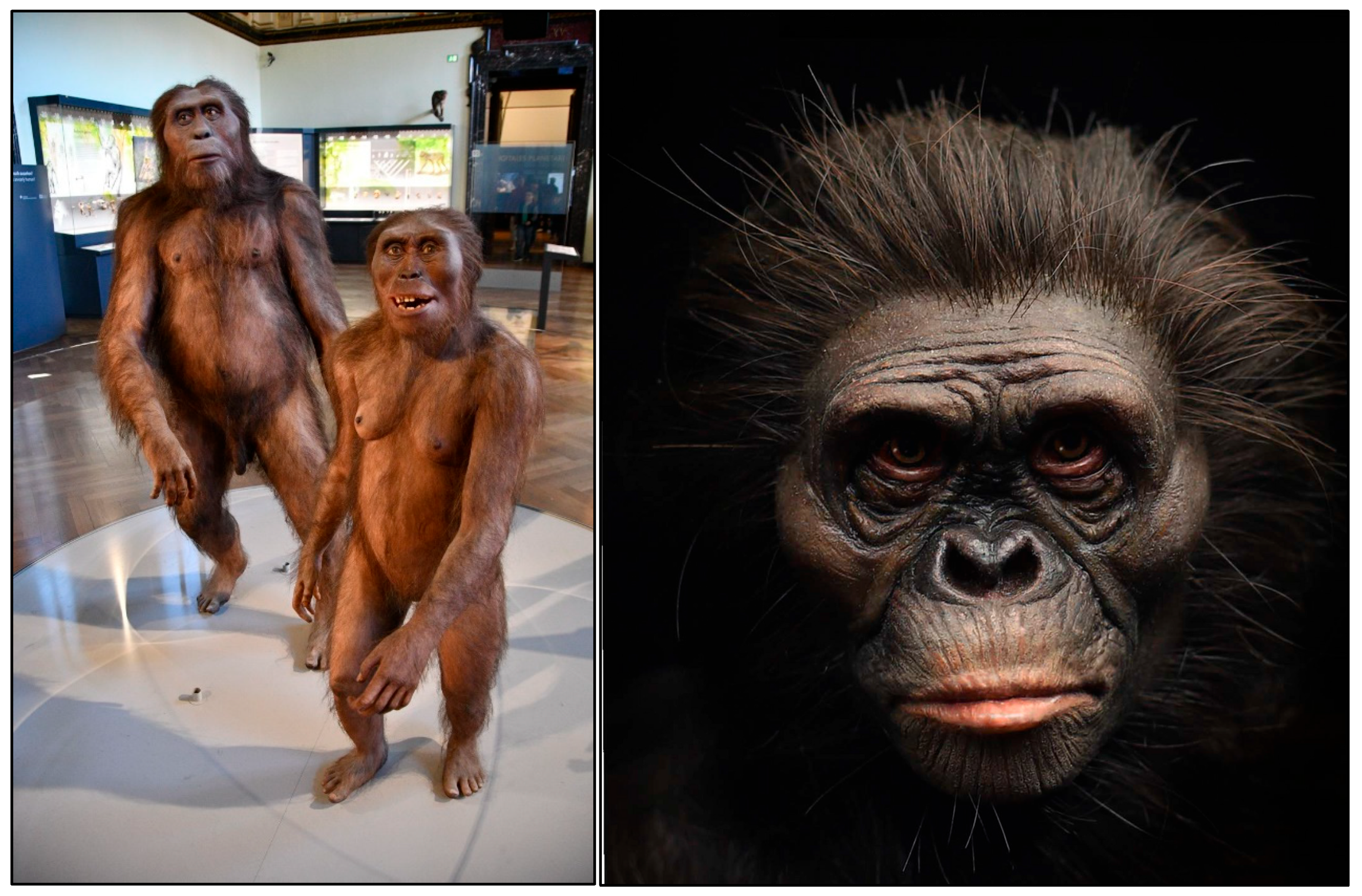
Figure 2.
Symbolic schematic of a hominin 1st order kinetic phase transition from quadrupedal LCA to bipedal Homo. While apes in the rain forest and humans on open ground still coexist, the transient bimodal hominins have disappeared.
Figure 2.
Symbolic schematic of a hominin 1st order kinetic phase transition from quadrupedal LCA to bipedal Homo. While apes in the rain forest and humans on open ground still coexist, the transient bimodal hominins have disappeared.
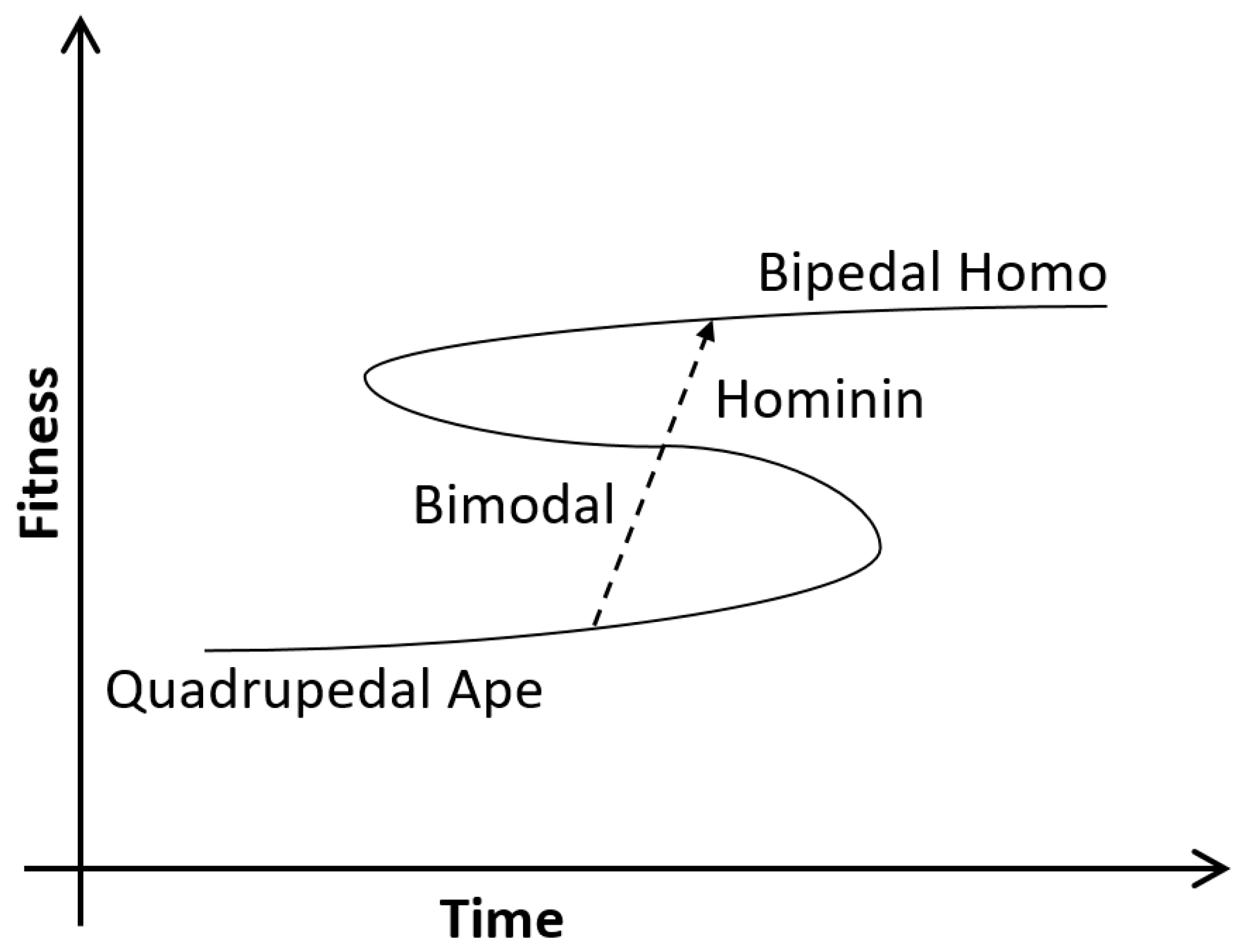
Figure 3.
Symmetry-breaking transition from continuous fitness evolution of apes (left panel) to undulating fitness of hominins (right panel), due to sexual conflicts as a consequence of the transition to bipedal gait (Feistel 2025) in the bimodal evolution range between LCA and Homo. Schematic modified from Pizzari and Snook (2003).
Figure 3.
Symmetry-breaking transition from continuous fitness evolution of apes (left panel) to undulating fitness of hominins (right panel), due to sexual conflicts as a consequence of the transition to bipedal gait (Feistel 2025) in the bimodal evolution range between LCA and Homo. Schematic modified from Pizzari and Snook (2003).
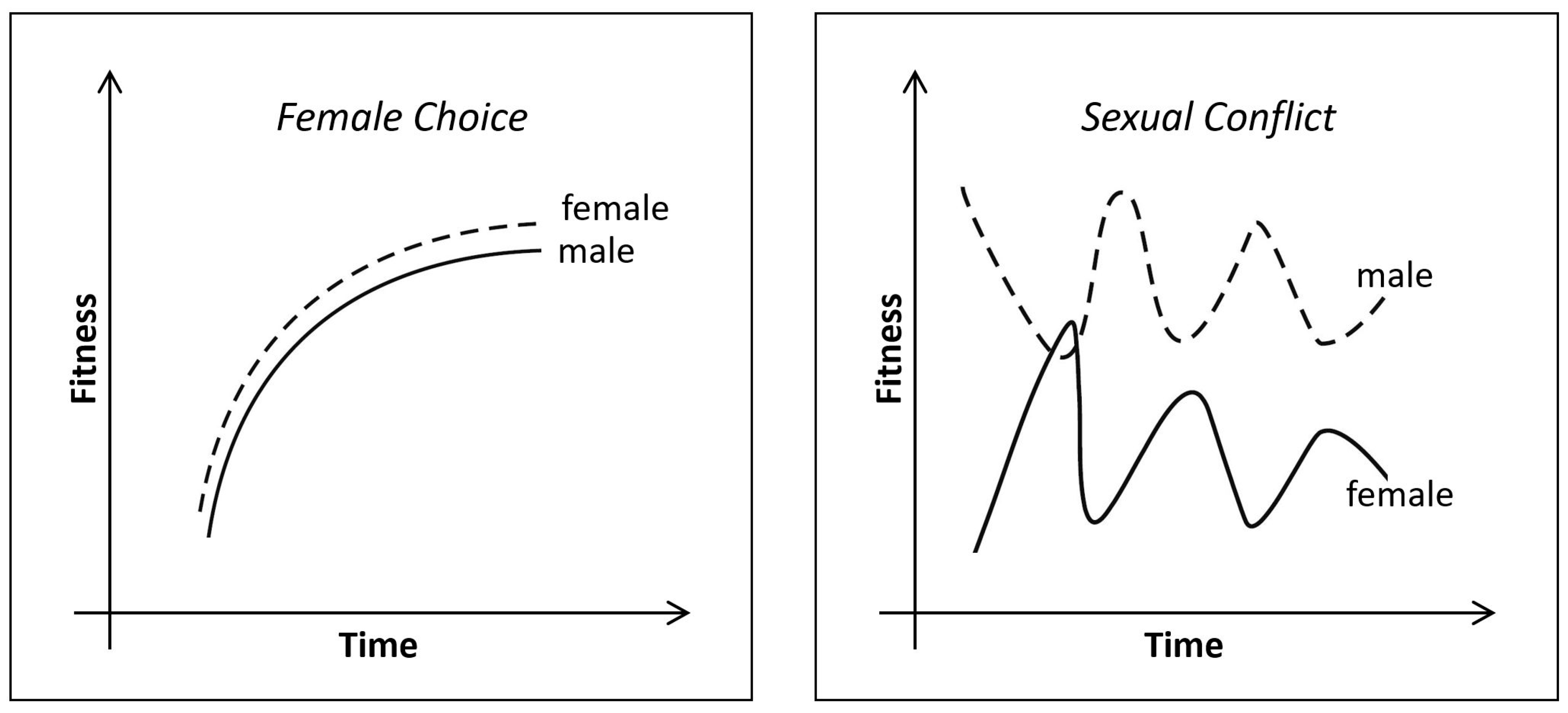
| 1 | Cordan (1962): p. 30: Nicht Ruhm noch Größe wird sein, bis der Mensch erscheint, bis der Mensch geschaffen. |
| 2 | Original quoted text: „Das wahrscheinlich wichtigste Merkmal, das alle Vertreter der menschlichen Linie eint und das, nach derzeitigem Wissensstand, nicht parallel entstanden ist, ist der aufrechte Gang. Die zweibeinige Fortbewegung, auch Bipedie genannt, ist die eigentliche Revolution zu Beginn der menschlichen Evolution. … Selbst bei gut dokumentierten Skeletten, wie beispielsweise dem von »Lucy« (Australopithecus afarensis), gab es einen hitzigen wissenschaftliche Disput … um die Frage, inwieweit … eine modern zu nennende Zweibeinigkeit entwickelt war oder ob »Lucy« doch überwiegend auf Bäumen lebte.“ |
| 3 | Original quoted text: „Die Erfolgsgeschichte des Menschen begann offenbar damit, dass einige pliozäne Arten eine habituelle zweibeinige Lebensweise entwickelten, während die Verkürzung und Verkleinerung des Kauapparats und die typisch menschliche Hirnentfaltung erst viel später mit dem Auftreten der Gattung Homo folgten. … Erst vor rund 2,6 Millionen Jahren sind Populationen des frühen Homo – oder von Australopithecus – zu einer dauerhaften Bipedie übergegangen.“ |
| 4 | Original quoted text: „Legt man das heutige Verhältnis zwischen wandernden und ortsfesten (residenten) Großtieren in Ostafrika zugrunde, dann übertreffen die Wandernden die Residenten um das Zehnfache“ |
| 5 | Original quoted text: „Wenn Saisonalität als die alternierende Abfolge von Perioden der Nahrungsverknappung und des Nahrungsreichtums angesehen wird, dann kann Saisonalität als ein Faktor bezeichnet werden, der zu intensiverer Selektion und letztlich zu evolutionärem Wandel beiträgt“ |
Disclaimer/Publisher’s Note: The statements, opinions and data contained in all publications are solely those of the individual author(s) and contributor(s) and not of MDPI and/or the editor(s). MDPI and/or the editor(s) disclaim responsibility for any injury to people or property resulting from any ideas, methods, instructions or products referred to in the content. |
© 2026 by the authors. Licensee MDPI, Basel, Switzerland. This article is an open access article distributed under the terms and conditions of the Creative Commons Attribution (CC BY) license.
Copyright: This open access article is published under a Creative Commons CC BY 4.0 license, which permit the free download, distribution, and reuse, provided that the author and preprint are cited in any reuse.


